PART 2: After Eight Days Missing, I Found My Dog Guarding Something in a Collapsed Barn—Then He Refused to Let Me Come Closer
PART 2
I don’t remember breathing for the next few seconds.
The only sounds inside the barn were Nala whining softly behind us, water dripping through a hole in the roof, and the weak, uneven breaths of the foal.
Bruno stood between us and the animal.
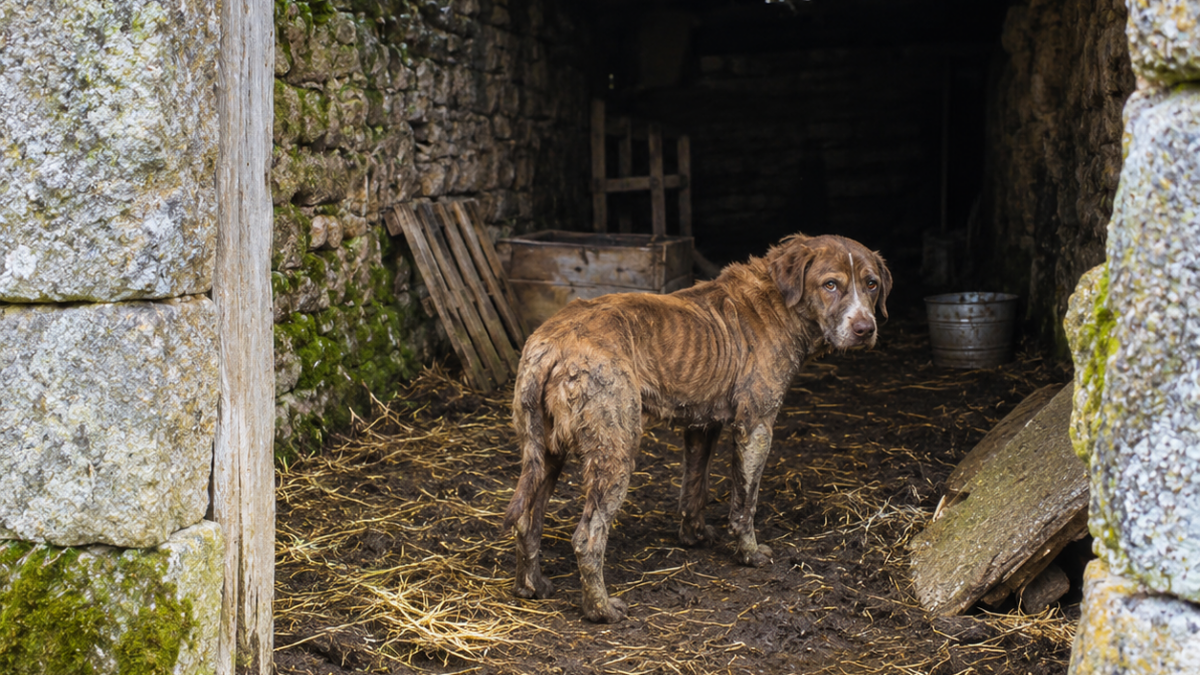
His body looked terrible.
His loose shar-pei skin hung differently because he had lost so much weight.
Mud had dried around his paws.
There was a small cut above one eye.
He was exhausted.
But the moment Nathalie moved toward the foal, something in him came alive.
“Bruno,” I whispered.
His eyes shifted toward me.
“It’s okay.”
His body remained rigid.
Nathalie lowered herself completely onto one knee.
She kept her hands visible.
“He doesn’t know what we’re going to do.”
“He knows me.”
“Yes.”
“But he won’t let me near it.”
“He knows you,” she repeated. “That doesn’t mean he knows what you intend to do with the foal.”
I looked at Bruno.
For eight days, I had imagined finding him trapped.
Injured.
Lost.
I had never imagined finding him free to leave but unwilling to.
“Could he have stayed here the whole time?”
Nathalie looked around.
“Maybe not the whole time.”
There were signs in the straw.
Dog prints.
Horse tracks.
A shallow depression where Bruno had apparently been sleeping.
Near the far wall, someone had left an old feed sack.
It was empty.
A broken plastic bucket lay on its side beneath a leak in the roof.
Rainwater had collected inside.
Nathalie noticed it too.
“If he found water here, he could survive several days.”
“What about food?”
She didn’t answer.
Bruno looked skeletal enough to give me the answer himself.
I took off my backpack.
Very slowly, I removed some dog treats.
The smell reached him.
His nose moved.
I held one out.
“Come on.”
Bruno looked at the treat.
Then at the foal.
He stayed.
That almost broke me.
“You idiot,” I whispered, tears filling my eyes. “You stubborn, wonderful idiot.”
Nathalie touched my arm.
“Throw it to him.”
I did.
The treat landed near his front paws.
He looked at it.
For a few seconds, he didn’t move.
Then hunger won.
He ate.
I tossed another.
Then another.
With each one, I moved slightly closer.
Bruno tolerated it.
When I was about six feet away, I stopped.
The foal opened one eye.
It tried to raise its head.
A faint sound escaped its throat.
Bruno immediately turned.
He lowered his nose toward the foal’s face.
The foal relaxed.
Nathalie whispered, “Look at that.”
Bruno licked the animal’s muzzle.
Once.
Then he looked back at us.
Something in my chest collapsed.
This wasn’t a dog guarding territory.
It wasn’t prey drive.
It wasn’t confusion.
Bruno was caring for it.
“How?” I whispered.
Nathalie shook her head.
“I don’t know.”
One of the other volunteers approached from outside.
“We found no people nearby.”
“Call a veterinarian,” Nathalie said. “Tell them we have a severely weakened foal with a possible leg fracture.”
The volunteer stepped away.
Bruno followed him with his eyes.
I tried moving one step closer.
Bruno immediately shifted.
I stopped.
“Okay.”
I sat down in the wet straw.
Nathalie glanced at me.
“What are you doing?”
“Waiting.”
That word felt familiar.
It was what Claire and I had been doing for eight days.
Waiting for Bruno.
Now I was asking him to wait for me.
“Bruno,” I said quietly, “I’m not taking your friend away.”
His ears moved.
“I promise.”
Of course he didn’t understand my words.
But he understood my voice.
I hoped that was enough.
Twenty minutes later, I was close enough to touch him.
I moved my hand slowly.
Bruno watched.
I rested my fingers against his neck.
His whole body softened.
Not much.
Just enough.
I felt every ridge of his spine.
My throat tightened.
“Oh, buddy.”
He pushed his head against my hand.
For the first time since I saw him, his eyes closed.
I scratched the fold behind his ear.
“You scared us to death.”
His tail moved weakly.
Then the foal made another sound.
Bruno immediately turned back.
There it was again.
The choice.
Me.
Or the foal.
He chose the foal.
Instead of feeling rejected, I felt proud enough to cry.
Nathalie smiled.
“You understand now?”
“Yes.”
“He’ll probably leave when he knows someone else is protecting it.”
That became our problem.
How do you convince a dog that a creature he has guarded for days will be safe without him?
The veterinarian arrived forty minutes later.
Dr. Éric Faure was a tall man in his fifties who worked mostly with cattle and horses.
He took one look at the foal and became serious.
“How long has it been here?”
“We don’t know.”
“Owner?”
“No idea.”
He approached slowly.
Bruno stood again.
Dr. Faure stopped.
“That the missing dog?”
“Yes.”
“He’s guarding it?”
“Yes.”
The veterinarian looked at Bruno.
Then at me.
“That complicates things.”
Bruno had never bitten anyone.
But exhaustion, fear, and protective behavior could change any dog.
I clipped his leash to his collar.
At first he let me.
Then Dr. Faure stepped toward the foal.
Bruno surged forward.
Not aggressively.
Desperately.
His nails scraped the floor.
“Easy!” I said.
Bruno pulled harder.
The foal cried.
Bruno’s entire body twisted toward it.
“Wait,” Nathalie said.
She looked at Dr. Faure.
“Could you examine them together?”
“What do you mean?”
“Let Bruno stay beside it.”
The vet considered.
“If the dog remains controlled.”
I nodded.
“I can hold him.”
We moved slowly.
I stayed beside Bruno.
Nathalie stayed on his other side.
Dr. Faure knelt beside the foal.
Bruno trembled.
When the veterinarian touched the injured leg, the foal jerked.
Bruno barked.
One sharp bark.
“Bruno.”
I held him against my chest.
“I know.”
He turned his head toward me.
“Let him help.”
I don’t know whether he understood.
But he stopped pulling.
Dr. Faure examined the leg.
His expression worsened.
“Fracture?”
“Possibly.”
He ran his hands carefully along the limb.
“Severe swelling. Maybe trauma to the joint. The animal is dehydrated and underweight.”
“Can you save it?”
He looked at me.
“We need to move it first.”
“And the leg?”
“I won’t know without imaging.”
He checked the gums.
“Very dehydrated.”
The foal tried to lift its head.
Bruno immediately lay down beside it.
The vet looked at them.
“How old?”
“Bruno?”
“The foal.”
“Oh.”
I felt stupid.
“I don’t know.”
Dr. Faure examined its teeth.
“Maybe five or six months.”
“So young?”
“Yes.”
My anger arrived before I even understood why.
“Where is its mother?”
Nobody answered.
That question became important later.
At the moment, all that mattered was keeping the foal alive.
Dr. Faure started an IV.
Bruno watched every movement.
When the needle went in, Bruno whined.
“Buddy,” I whispered, “he’s helping.”
The veterinarian looked at me.
“He’s unusually attached.”
“He’s been missing eight days.”
Dr. Faure glanced at the empty water bucket.
“Then there’s a good chance this dog kept that foal alive.”
“How?”
“Warmth. Companionship. Maybe protection from predators.”
Nathalie added, “Possibly leading it toward water before the leg worsened.”
I stared at Bruno.
“Could he have brought it here?”
“Maybe the foal was already here.”
The vet shrugged.
“We may never know.”
We found out more than we expected.
But not that day.
The rescue trailer arrived just after two in the afternoon.
Moving the foal was difficult.
Bruno became increasingly agitated as the volunteers prepared a sling.
I had to keep him close.
He watched every strap.
Every hand.
Every movement.
When the foal was lifted, it screamed.
Bruno lost control.
He pulled so hard I nearly fell.
“Bruno!”
He barked repeatedly.
The first sustained barking I had heard from him in years.
“Mathieu!” Nathalie shouted. “Get him outside!”
“I can’t!”
“You have to!”
“No!”
I knew how ridiculous that sounded.
But after eight days of Bruno refusing to abandon this animal, I wasn’t going to drag him away while it screamed.
So I did something nobody had planned.
I climbed into the transport trailer.
“With him?” Dr. Faure asked.
“Yes.”
“You’re riding in there?”
“Yes.”
Nathalie smiled.
“Of course he is.”
I guided Bruno inside.
The foal lay secured on thick bedding.
Bruno approached.
He sniffed its face.
The foal stopped crying.
Everyone became quiet.
Dr. Faure stared.
“Well.”
“What?”
“Nothing.”
He closed the trailer gate.
“It seems your dog has appointed himself medical staff.”
We drove to a veterinary clinic outside Aurillac.
I sat on the floor of the trailer with Bruno.
I kept one hand on his back.
The other rested against the wall for balance.
The foal breathed beside us.
Every time the trailer bounced, Bruno lifted his head.
Every time the foal moved, Bruno checked it.
Halfway there, I called Claire.
She answered before the first ring finished.
“Mathieu?”
I couldn’t speak.
“What happened?”
I laughed and cried at the same time.
“I found him.”
Silence.
Then a sound I will never forget.
Claire sobbing.
“You found him?”
“Yes.”
“Is he alive?”
“Yes.”
“Is he hurt?”
“He’s exhausted. Thin. But he’s alive.”
“Oh my God.”
“He’s with me.”
“Bring him home.”
I looked at Bruno.
“He won’t come home yet.”
“What?”
“It’s complicated.”
“What do you mean?”
I looked at the foal.
“He found someone.”
There was a long silence.
“Mathieu.”
“A baby horse.”
“What?”
“A foal.”
I told her everything.
The barn.
The injured leg.
Bruno refusing to leave.
When I finished, Claire said nothing for several seconds.
Then:
“That sounds exactly like him.”
I smiled through tears.
“Yes.”
“It really does.”
Claire met us at the clinic.
When Bruno saw her, he finally lost the seriousness he had carried all day.
His tail wagged.
His whole body moved.
Claire dropped to her knees.
“Bruno!”
He went to her.
Not quickly.
He was too weak.
But he went.
She buried her face in his neck.
“You horrible dog.”
Bruno licked her chin.
“You horrible, horrible dog.”
She was laughing and crying.
I stood behind them.
For a moment, I thought:
Now he’ll come home.
Then the doors to the treatment area opened.
Bruno heard the foal cry.
He pulled away from Claire.
Turned.
Walked toward the sound.
Claire looked at me.
“Oh.”
“Exactly.”
The clinic staff examined Bruno too.
He had lost nearly nine pounds.
His paws were cracked.
One pad was cut.
He was dehydrated but not dangerously so.
No major injuries.
“He’s lucky,” the veterinarian said.
I looked through the glass toward the stall where the foal was being treated.
“No.”
The vet followed my gaze.
“I think he thinks the foal is the lucky one.”
The X-rays confirmed a fracture near the hock along with severe soft-tissue damage.
It was serious.
But not hopeless.
The foal would need surgery.
That created a new problem.
Who owned it?
Nobody knew.
The abandoned farm had belonged to a family years earlier.
According to local records, the land had changed hands twice.
The current registered owner lived in Lyon and claimed he had no animals on the property.
The barn itself was supposed to be empty.
The next morning, a local gendarme visited the clinic.
His name was Captain Roussel.
He asked us questions.
“Where exactly did you find the foal?”
We showed him the location.
“Any fencing?”
“Broken fencing.”
“Feed?”
“An old sack.”
“Fresh?”
“No.”
“Signs someone had been caring for it?”
Nathalie shook her head.
“Not properly.”
Roussel frowned.
A young foal does not appear from nowhere.
Somewhere, there was a mare.
Somewhere, there was an owner.
And somehow, a badly injured baby horse had ended up abandoned inside a collapsing barn.
Bruno remained beside the stall.
The clinic staff tried moving his bed to another room.
He carried the blanket back.
They gave up.
By that evening, everyone was calling the foal “Petit.”
It was supposed to be temporary.
It wasn’t.
On the second night, Bruno finally ate a full meal.
But only after a bowl was placed beside Petit’s stall.
Claire sat next to me.
“You realize we’re never getting him home.”
“He has a job.”
“Apparently.”
She looked through the bars.
Bruno lay with his back against the stall wall.
Petit was on the other side.
The two animals couldn’t touch.
But they were inches apart.
Claire leaned against my shoulder.
“I was so angry with him.”
“For disappearing?”
“Yes.”
“So was I.”
She wiped her eyes.
“I kept imagining he had chased a deer or wandered off because he smelled something.”
I looked at Bruno.
“Maybe he did.”
“And found Petit.”
“Maybe.”
Claire shook her head.
“Then he stayed.”
That was what I kept returning to.
He stayed.
Bruno could have come back.
We were less than four miles from the cottage.
Maybe the terrain had confused him at first.
Maybe he lost our scent.
But once he found the barn, he stopped searching for us.
He chose something else.
A wounded animal who couldn’t follow him.
A creature more helpless than he was.
Three days after the rescue, Captain Roussel called.
“We may have identified the foal.”
My stomach tightened.
“Owner?”
“Possibly.”
“Who?”
“A breeder named Marc Delatour.”
I knew nothing about him.
Roussel explained that Delatour operated a small horse-breeding property several miles from the abandoned farm.
One of his mares had recently lost a foal.
At least that was what his records claimed.
“Lost how?” I asked.
“According to him, illness.”
“Was it Petit?”
“We’re investigating.”
I looked toward the clinic stall.
“What happens if he owns him?”
“That depends.”
“On what?”
“On why the animal was there.”
Two hours later, Marc Delatour arrived at the clinic.
I knew it was him before anyone introduced us.
Tall.
Heavy jacket.
Expensive boots.
He walked quickly toward the front desk.
“I’m here about my horse.”
My horse.
Not the foal.
Not the animal.
My horse.
Something about the way he said it bothered me.
The receptionist asked him to wait.
He didn’t.
He stepped toward the treatment corridor.
Bruno stood.
The change was immediate.
His body stiffened.
I noticed before anyone else.
“Bruno?”
His ears went back.
Delatour appeared in the doorway.
Bruno growled.
A low, deep sound.
I had heard Bruno growl maybe three times in five years.
Delatour stopped.
“What’s wrong with that dog?”
I stood.
“He’s been protecting the foal.”
“Then control him.”
Bruno moved closer to Petit’s stall.
Delatour looked past him.
“That’s mine.”
I felt Claire tense beside me.
Captain Roussel, who had arrived minutes earlier, stepped between us.
“Mr. Delatour, before you approach the animal, we need to speak.”
“There’s nothing to speak about.”
“There is quite a bit.”
Delatour’s expression hardened.
“That horse wandered away.”
“Your records say the foal died.”
For the first time, Delatour hesitated.
“Different animal.”
“Your mare had two foals?”
“You know what I mean.”
Roussel did not blink.
“Then explain.”
Delatour glanced toward the stall.
Petit shifted.
Bruno growled again.
“Get that dog away from my horse.”
I looked at him.
“No.”
He stared at me.
“Excuse me?”
“You heard me.”
The veterinarian stepped out.
“Mr. Laurent.”
I knew I needed to control myself.
But eight days.
Eight days Bruno had starved beside that foal.
I looked at Delatour’s clean boots.
His expensive jacket.
Then at Petit’s swollen leg.
“What happened to him?”
Delatour shrugged.
“He escaped.”
“With a fractured leg?”
“He probably hurt it afterward.”
“Then why did you report him dead?”
His eyes narrowed.
“Who are you?”
“The owner of the dog that kept your foal alive.”
Delatour laughed once.
Not kindly.
“Your dog?”
“Yes.”
“You think a dog saved a horse?”
I stepped closer.
“I think he did more for that animal in eight days than you did.”
“Mathieu,” Claire whispered.
Roussel moved between us.
“That’s enough.”
Delatour pointed toward Petit.
“I’m taking him.”
Dr. Faure answered from behind us.
“No.”
Delatour turned.
“I own him.”
“That remains under investigation.”
“The animal requires surgery,” the vet continued. “Transport is not authorized.”
“Then I’ll pay.”
“No decision about custody will be made today.”
Delatour’s face changed.
“What exactly are you accusing me of?”
Captain Roussel replied calmly.
“We haven’t accused you of anything.”
That was true.
But everyone in the room was thinking the same question.
Why had a foal supposedly declared dead been found starving in an abandoned barn?
The answer came slowly.
And when it did, I understood why Delatour wanted Petit back so badly.
The first clue was a scar.
Not on the foal.
On the mare.
Investigators visited Delatour’s property.
They found the mare believed to be Petit’s mother.
Her name was Étoile.
She had recently given birth.
Her veterinary records showed complications.
The foal was registered as male.
Brown coat.
White mark above one hoof.
Same approximate age.
Delatour claimed that foal had died.
There was no body.
No veterinary certificate.
No disposal record.
Nothing.
Then one of Delatour’s former employees called the police.
His name was Lucas Perrin.
He had left the property two months earlier after an argument.
He said Petit had been injured before disappearing.
The story changed everything.
Petit had been born healthy.
At four months, he hurt his hind leg after being caught in damaged fencing.
Lucas told Delatour the foal needed a veterinarian.
Delatour refused.
“He said the animal wasn’t worth enough to justify surgery,” Lucas later told investigators.
Instead, Petit was confined.
The injury worsened.
Then Delatour allegedly decided the foal was “useless.”
Lucas claimed he was told to move Petit away from the main property.
“To where?” the police asked.
Lucas told them.
The abandoned farm.
The same barn where we found Bruno.
I wanted to be wrong.
I hoped Lucas was lying because he hated his former employer.
Then police found messages.
Short messages.
Cold messages.
One from Delatour:
**Move the little brown one tonight. No vet.**
Another:
**Use old barn. If anyone asks, he died.**
I read those words later.
I still remember feeling physically sick.
No vet.
If anyone asks, he died.
That was all Petit’s life had been worth to him.
A lie in a text message.
The story became worse.
Lucas said he had left food and water when he moved Petit.
He intended to return.
But the next day, Delatour fired him.
Lucas was threatened with legal action if he trespassed.
He assumed Delatour would care for the foal.
He was wrong.
Nobody returned.
Petit remained there.
Alone.
Injured.
Until Bruno found him.
We still don’t know exactly how.
Our best guess came from tracks found near the forest.
Bruno had likely wandered farther than he realized on his first night away.
He may have heard the foal crying.
Or smelled it.
Once he found Petit, he stayed.
There were signs suggesting Bruno had traveled between the barn and a nearby stream.
Nathalie believed he may have drunk there and returned.
The old bucket inside the barn probably collected enough rainwater for Petit to survive.
Maybe Bruno discovered it.
Maybe the foal already knew.
What mattered was that somehow, against all odds, both survived.
Petit had his surgery four days after we found him.
Bruno waited outside the operating room.
For nearly three hours.
He refused to sleep.
Every time footsteps approached, he stood.
Claire sat beside him.
I paced.
When Dr. Faure finally appeared, I knew the news before he spoke because he was smiling.
“He made it.”
Claire started crying.
I dropped into a chair.
Bruno stared at the veterinarian.
“The surgery went well,” Dr. Faure continued. “The fracture was difficult, but we stabilized it.”
“What happens now?”
“Recovery.”
“How long?”
“Months.”
I looked at Bruno.
“Did you hear that?”
Bruno wagged his tail.
I like to believe he understood.
When Petit woke from anesthesia, Bruno was allowed back beside his stall.
The foal was groggy.
Disoriented.
For several seconds, he stared around.
Then he heard Bruno.
A soft whine.
Petit turned his head.
Bruno stepped closer to the bars.
Petit stretched his muzzle toward him.
Their noses touched.
Nobody in the room spoke.
Dr. Faure cleared his throat.
“I’m going to pretend I don’t have tears in my eyes.”
Claire laughed.
“So are we.”
The investigation against Delatour continued.
He denied everything.
He said Lucas had acted without permission.
He said the messages were taken out of context.
He said the foal had been moved temporarily.
He claimed he intended to send a veterinarian later.
Nothing matched.
Phone records showed no call to any veterinarian.
Bank records showed no planned treatment.
The abandoned property did not belong to him.
Petit had been left without food arrangements.
And most damaging of all, his breeding records already listed the foal as dead.
Delatour was charged with animal cruelty, abandonment, falsification of records, and other related offenses.
When he heard the charges, he blamed everyone except himself.
Lucas.
The police.
The veterinarian.
Us.
Especially us.
One afternoon, I received a letter from his lawyer.
It demanded that I stop “interfering” with Delatour’s property rights.
I laughed when I read it.
Claire didn’t.
“This isn’t funny.”
“I know.”
“What if he comes here?”
“He won’t.”
“You don’t know that.”
She was right.
Two nights later, someone did.
We had returned to the cottage temporarily because Petit was still hospitalized nearby.
Bruno had finally started sleeping with us again, though he spent most days at the clinic.
At 1:17 in the morning, Bruno barked.
One bark.
Sharp.
I woke immediately.
He stood near the bedroom door.
“What is it?”
Another bark.
I got up.
Claire sat upright.
“Mathieu?”
“Stay here.”
I walked toward the window.
A vehicle was parked near the road.
Lights off.
My stomach tightened.
I grabbed my phone.
Bruno growled.
Then someone moved near the garden fence.
I called the police.
I did not go outside.
That was the smartest thing I did that night.
Within minutes, the figure disappeared.
The car drove away.
Police found fresh footprints near the terrace.
Nothing had been stolen.
Nothing damaged.
At first, we could prove nothing.
Then a neighbor’s camera caught the vehicle.
It belonged to a man employed by Delatour.
He claimed he had merely driven past.
At one in the morning.
Stopped.
Walked toward our cottage.
Then left.
Nobody believed him.
Delatour denied sending him.
The incident was added to the investigation.
After that, my anger became something harder.
Until then, I had wanted Petit safe.
Now I wanted Delatour exposed.
Not hurt.
Not frightened.
Exposed.
I wanted every lie opened.
Every record examined.
Every animal checked.
Investigators did exactly that.
They inspected his property.
What they found turned one foal’s case into something larger.
Two horses were underweight.
One had an untreated hoof infection.
Several fencing sections were unsafe.
Medication logs were incomplete.
There were discrepancies in registration records.
A mare had an old untreated wound.
None of it alone looked dramatic.
Together, it showed a pattern.
Money first.
Animals second.
Always.
The local animal welfare authorities removed three animals temporarily.
Delatour’s breeding operation was suspended pending investigation.
He called it persecution.
I called it consequences.
Petit recovered slowly.
At first, he could barely stand.
Then he stood with assistance.
Then without.
The first day he put full weight on the injured leg, Bruno was beside the stall.
Petit took one step.
Stopped.
Bruno wagged.
Petit took another.
I laughed.
“Look at him.”
Claire squeezed my hand.
Bruno followed along the outside of the stall.
Step.
Step.
Pause.
Step.
It looked as though he was teaching the foal how to walk.
Of course he wasn’t.
But that is how it felt.
Weeks became months.
We had long since ended our vacation.
I drove back and forth from home whenever necessary.
Claire took time off work.
Our lives rearranged themselves around an animal that technically belonged to nobody we knew.
Then came the custody hearing.
Delatour wanted Petit returned.
I could not believe it.
His lawyer argued that ownership rights remained intact until conviction.
The animal welfare association argued that returning Petit posed a risk.
The veterinarian submitted medical reports.
Lucas testified.
So did Nathalie.
Then, unexpectedly, I was asked to speak.
I had never been in a courtroom for anything more serious than a traffic matter.
My hands shook.
Delatour sat across the room.
He looked bored.
That made me angry.
The judge asked:
“Mr. Laurent, tell us how you found the animal.”
I told the story.
Not dramatically.
Just truthfully.
Bruno disappeared.
We searched eight days.
Nala found the barn.
Bruno refused to leave.
I described his condition.
His weight loss.
His cracked paws.
The way he positioned himself between us and Petit.
Then the judge asked:
“Why do you believe your dog stayed?”
I looked at Bruno’s photo among the evidence.
“I can’t know what a dog thinks.”
The judge nodded.
“But?”
I swallowed.
“But Bruno had every reason to leave.”
I looked toward Delatour.
“He was hungry. Cold. Lost. We were nearby looking for him.”
My voice tightened.
“Yet he stayed with an animal that couldn’t walk.”
Delatour shifted.
I continued.
“My dog had no legal obligation to that foal. No financial interest. No ownership papers. Nothing.”
The room was silent.
“He simply knew the foal needed someone.”
I looked at the judge.
“And somehow, that dog understood responsibility better than the man who owned him.”
Delatour’s lawyer objected.
The judge allowed the statement to remain.
For the first time, Delatour looked at me.
I held his gaze.
I didn’t need revenge.
That moment was enough.
For months, he had treated Petit like a worthless problem.
Now an entire courtroom was listening to how a starving dog had done what he refused to do.
Stayed.
The judge denied immediate return of the foal.
Temporary custody went to the rescue association.
Delatour’s lawyer protested.
The ruling stood.
Claire cried outside the courthouse.
I called Dr. Faure.
“He stays.”
“For now?”
“For now.”
The vet laughed.
“Then you’d better tell Bruno.”
We drove straight to the rehabilitation center.
By then, Petit had been moved to a larger stall with a small outdoor pen.
Bruno recognized the building.
The second I opened the car door, he pulled me toward the entrance.
“Slow down.”
He ignored me.
When Petit heard him, he appeared at the gate.
He had grown.
Still thin.
Still recovering.
But standing.
Bruno reached the fence.
Petit lowered his head.
Their noses touched.
I crouched beside Bruno.
“You did it.”
His tail moved.
“You kept him here long enough.”
Claire rested a hand on my shoulder.
“No.”
I looked at her.
“We all did.”
She shook her head.
“He started it.”
She was right.
The criminal trial against Delatour began the following spring.
By then, Petit could trot.
Not perfectly.
There was a slight irregularity in his stride.
Dr. Faure said he might always have it.
But he was alive.
Healthy.
Growing.
Delatour continued denying responsibility.
Lucas testified first.
He admitted he had moved Petit.
That mattered.
He could have hidden.
Instead, he stood before the court and said:
“I obeyed an order I knew was wrong.”
His voice broke.
“I told myself I would go back.”
Delatour stared at him.
Lucas continued.
“I should have called the police immediately.”
The prosecutor asked:
“Why didn’t you?”
“I was afraid of losing my job.”
“You lost it anyway.”
“Yes.”
“Do you regret moving the foal?”
Lucas looked toward the judge.
“Every day.”
Then he said something I never forgot.
“That dog did what I should have done.”
Bruno was not in court.
But somehow he was everywhere.
The photos.
The rescue report.
The veterinary notes.
The witness statements.
A dog could not testify.
He didn’t need to.
His body had been evidence.
Eight days of starvation.
Eight days of waiting.
Eight days beside an animal a human being had discarded.
The prosecution presented the messages.
**Move the little brown one tonight. No vet.**
Then:
**Use old barn. If anyone asks, he died.**
Delatour’s lawyer claimed the words were misunderstood.
I almost laughed.
There are sentences that can be explained.
That was not one of them.
Dr. Faure testified about Petit’s condition.
“If the foal had remained there another forty-eight to seventy-two hours,” he said, “survival would have been unlikely.”
The prosecutor asked:
“Did the dog contribute to survival?”
The veterinarian paused.
“Scientifically, I can’t prove how much.”
He looked toward the court.
“But the foal was weak, injured, and alone in cold conditions. The dog provided warmth, companionship, and likely protection. There was water nearby. Whether the dog actively helped the foal access it, we cannot know.”
“Your conclusion?”
Dr. Faure smiled slightly.
“My conclusion is that when we found them, the dog was still doing his best to keep that foal alive.”
Claire gripped my hand.
Delatour looked down.
The verdict came several weeks later.
Guilty.
Not on every charge.
But enough.
Animal cruelty.
Abandonment.
False declarations.
Breeding restrictions.
Financial penalties.
A prohibition on keeping certain animals for several years, subject to review.
His remaining horses were evaluated and redistributed where necessary.
His breeding business collapsed.
Some people later told me:
“He got what he deserved.”
Maybe.
I don’t know.
Punishment is complicated.
What mattered to me was simpler.
He would never own Petit again.
That became official shortly afterward.
The rescue association obtained permanent custody.
Then they asked us a question.
“Would you consider adopting him?”
I laughed.
Claire stared at me.
“You’re not seriously thinking about this.”
I looked through the paddock fence.
Petit was grazing.
Bruno lay in the grass nearby.
“Maybe.”
“Mathieu.”
“We have land.”
“We have a garden.”
“My brother has pasture.”
“You know nothing about horses.”
“We know veterinarians.”
She stared at me for several seconds.
Then she looked toward Bruno.
Petit lifted his head.
Bruno stood.
The foal walked toward him.
Claire sighed.
“That dog has ruined our lives.”
I smiled.
“Yes.”
She smiled too.
“When do we sign?”
Petit did not come to live directly in our backyard, obviously.
We arranged for him to stay on my brother’s small property twenty minutes from our home, where there was pasture, proper fencing, shelter, and other horses nearby.
We visited almost every day.
Bruno came every time.
At first, I worried the relationship might disappear once Petit grew stronger.
It didn’t.
Petit became taller.
Heavier.
More confident.
Bruno remained Bruno.
Short.
Wrinkled.
Serious.
The size difference became ridiculous.
Yet every time Bruno arrived, Petit walked toward the fence.
Bruno waited.
Nose to nose.
Always.
Two years passed.
Petit grew into a beautiful young horse.
The injured leg remained slightly imperfect, but he could run.
The first time I saw him gallop across the field, I felt something catch in my throat.
Bruno ran along the fence.
For about ten seconds.
Then remembered he was a shar-pei approaching middle age and stopped.
Claire laughed.
“He thinks he’s keeping up.”
“Don’t tell him.”
Petit circled the pasture.
Then ran toward us.
He stopped at the fence.
Bruno panted.
Petit lowered his head.
Bruno licked his muzzle.
I took a photograph.
That picture still sits in our living room.
People who visit often ask about it.
They see a horse and a wrinkled dog standing nose to nose.
They don’t understand.
So sometimes I tell them.
Not everything.
The story is too long.
I simply say:
“Bruno found him.”
But the truth is more than that.
Bruno didn’t only find Petit.
He chose him.
That matters.
I used to think loyalty was a simple thing.
A dog waiting at the door.
Following his owner.
Sleeping beside someone when they’re sick.
Bruno had done all those things.
But what happened in the Cantal taught me another version of loyalty.
Sometimes loyalty appears when there is nothing to gain.
No reward.
No command.
No relationship built over years.
Just another living creature that needs help.
And a decision to stay.
Years later, Nathalie visited us.
She hadn’t seen Petit since shortly after the rescue.
When she arrived at the pasture, her mouth fell open.
“That’s him?”
“That’s him.”
“He’s enormous.”
“He eats like he’s trying to bankrupt us.”
She laughed.
Bruno was older now.
Gray around the muzzle.
Slower.
But when he saw Nathalie, he remembered her.
His tail moved.
She crouched.
“Well, hero.”
Bruno sniffed her hand.
Nathalie looked toward Petit.
“Do you ever think about why Bruno found him?”
“All the time.”
“And?”
“I don’t think we’ll ever know.”
Maybe he followed a scent.
Maybe he heard a cry.
Maybe he wandered into that barn seeking shelter from rain.
Maybe it was random.
But what happened afterward was not.
Bruno could have walked away.
He didn’t.
Nathalie leaned against the fence.
“You know what I remember?”
“What?”
“The moment we approached.”
I smiled.
“He blocked you.”
“He looked exhausted enough to collapse.”
She shook her head.
“But when I stepped toward Petit, he stood up.”
I remembered.
The trembling legs.
The mud.
The ribs.
That body had almost nothing left.
But Bruno stood anyway.
Nathalie said quietly:
“That’s when I knew we had found more than a lost dog.”
A few months later, Bruno’s health began to change.
Age.
Nothing dramatic at first.
He slept longer.
Stairs became harder.
His joints hurt in cold weather.
The veterinarian gave us medication.
We adjusted.
We bought ramps.
Moved his bed.
Stopped long hikes.
Petit changed too.
Whenever Bruno visited, the horse no longer tried to encourage him to run.
He simply walked beside the fence.
Slowly.
Matching Bruno.
One evening, I realized what I was watching.
The roles had reversed.
Years earlier, Bruno had stayed beside an injured foal that couldn’t walk away.
Now Petit slowed down for an old dog who couldn’t keep up.
I turned toward Claire.
She already had tears in her eyes.
“Don’t.”
“I didn’t say anything.”
“You were about to.”
“I wasn’t.”
“You have the face.”
“What face?”
“The emotional face.”
I laughed.
Then cried anyway.
Bruno lived another three years after Petit’s rescue.
Long enough to see the horse become fully grown.
Long enough to return to the Cantal once more.
We did that deliberately.
I wasn’t sure whether it was a good idea.
Claire wanted to go.
“One last trip.”
I agreed.
We rented a different cottage.
The old one had been renovated and was unavailable.
Bruno moved slowly.
We kept walks short.
On the second day, we drove near the place where we had found him.
The abandoned barn had finally been torn down.
Only part of the stone foundation remained.
I parked beside the road.
Bruno stood near me.
He sniffed the air.
For several seconds, nothing happened.
Then he walked toward the ruins.
Claire looked at me.
“Do you think he remembers?”
“Yes.”
I knew he did.
He stopped where the entrance had once been.
The roof was gone.
The wet straw.
The broken bucket.
The dark corner.
All gone.
Grass had grown through the stones.
Bruno stood there.
I crouched slowly beside him.
“This is where you scared ten years off my life.”
His tail moved.
“Eight days, Bruno.”
He looked at me.
“Eight days.”
Claire came beside us.
She placed her hand on his back.
“You could have come home.”
Bruno sniffed the grass.
Claire smiled through tears.
“But you couldn’t leave him.”
We stood there quietly.
No monument.
No plaque.
Nobody else knew what had happened in that exact patch of ground.
But we did.
A dog had once made a decision there.
And a horse lived because of it.
The following winter, Bruno declined quickly.
One morning, he could not stand without help.
The veterinarian came to our home.
After examining him, she sat with us.
“We can keep him comfortable for a little while.”
“How long?” I asked.
She looked at Bruno.
“Days. Maybe weeks.”
Claire began crying.
I stared at the floor.
Bruno lay between us.
His breathing calm.
I had spent years believing I was prepared for this because Bruno was getting older.
I wasn’t.
No one is.
That evening, I called my brother.
“We’re bringing him to see Petit tomorrow.”
“Of course.”
The next afternoon, we drove to the pasture.
Bruno lay on a blanket in the back of the car.
I carried him to the fence.
He hated being carried.
That day, he allowed it.
Petit was at the far end of the field.
My brother called him.
Petit lifted his head.
Then he saw Bruno.
He walked toward us.
Not ran.
Walked.
Slowly.
He stopped at the fence.
Bruno lifted his head.
His tail moved once.
Petit lowered his muzzle.
I held Bruno gently so he could reach.
Their noses touched.
Petit breathed against his face.
Bruno closed his eyes.
Nobody spoke.
Petit remained there.
Minutes passed.
Eventually, Bruno lowered his head onto my arm.
Petit stayed.
I understood then that this was goodbye.
Maybe animals don’t understand that word.
Maybe they understand it better than we do.
I don’t know.
But Petit did not walk away.
Not until we did.
Two days later, Bruno stopped eating.
The veterinarian returned.
Claire and I sat on the floor beside him.
I placed one hand against his wrinkled face.
“You can stop now.”
Claire kissed his forehead.
“You’ve done enough.”
Bruno looked at us.
His tail moved once.
Then, peacefully, with both of us beside him, he was gone.
For weeks afterward, the house felt wrong.
No footsteps.
No breathing near the bed.
No serious face watching us from the hallway.
I found myself opening doors carefully so I wouldn’t hit a dog who wasn’t there.
Claire still left space near the stove.
Grief creates habits faster than reality can erase them.
We had Bruno cremated.
I kept part of his ashes.
Claire kept his collar.
Then we took something else to Petit.
Bruno’s old blanket.
The same one Claire had held on the sixth night of his disappearance years earlier.
We placed it near the fence.
Petit approached.
He sniffed it.
He stood completely still.
Then he lowered his head onto the fabric.
Claire turned away.
I didn’t.
I cried openly.
Petit stayed there for almost ten minutes.
Afterward, we placed the blanket in his shelter.
For months, he sometimes slept near it.
That was Bruno’s final gift to him.
A familiar scent.
A reminder.
A piece of the dog who had refused to leave.
Petit is still with us.
He is older now.
Strong.
Healthy.
The slight stiffness in his rear leg remains.
If you don’t know what happened, you barely notice.
Sometimes children visit the pasture.
They see the horse.
They ask his name.
“Petit.”
They laugh because he is no longer little.
Then they see the photograph attached inside the shelter.
A tan shar-pei beside a tiny foal.
One child once asked:
“Was that his dog?”
I didn’t know how to answer.
So I said:
“Yes.”
Maybe that was true.
Or maybe Petit was Bruno’s horse.
Either way, they belonged to each other in a way none of us planned.
Delatour eventually tried to rebuild his business elsewhere.
It never really recovered.
People knew.
The court records were public.
Local breeders remembered.
The man who once decided Petit wasn’t worth a veterinary bill became known for exactly that decision.
That was enough revenge for me.
He lost the animal he discarded.
He lost the reputation he protected.
And every time Petit walked into a field healthy and alive, the lie Delatour tried to create became smaller.
He had written:
**If anyone asks, he died.**
He was wrong.
Petit lived.
He grew.
He ran.
He became loved.
And the reason he got that chance was a dog who had no reason to care.
That is the part I think about most.
Not the court.
Not Delatour.
Not even those eight terrible nights.
I think about Bruno in that barn.
Hungry.
Cold.
Lost.
He could have left.
Maybe he could not find us.
But he could have found a road.
A house.
A person.
Food.
Instead, he curled his body beside a broken foal.
He drank enough to survive.
Ate almost nothing.
And waited.
For what?
Help?
Us?
I’ll never know.
Maybe Bruno didn’t understand rescue.
Maybe he simply understood one rule:
You don’t leave someone behind when they can’t follow.
That was Bruno.
The dog who rarely barked.
Never showed off.
Never begged for attention.
He simply stayed.
When Claire was sick, he stayed outside her door.
When I came home late, he stayed in the hallway.
When a wounded foal was abandoned inside a ruined barn, Bruno stayed there too.
Until someone came.
That was his life.
Stay.
Protect.
Wait.
Love without needing to make noise about it.
After Bruno died, I thought the story was over.
It wasn’t.
One spring morning, almost a year later, my brother called.
“You should come over.”
“Why?”
“Just come.”
Claire and I drove to the pasture.
Petit stood near the fence.
Beside him was another horse.
A young mare recently rescued by a local association.
She had arrived terrified of people.
She avoided everyone.
For days, she had stayed at the far edge of the field.
But that morning, she stood beside Petit.
Close.
Relaxed.
My brother smiled.
“He’s been staying near her since she arrived.”
I looked at Petit.
Something inside me broke and healed at the same time.
Claire whispered:
“Oh, Bruno.”
I laughed through tears.
“What?”
“You see it.”
I did.
The foal Bruno once protected had grown into the horse who now stood beside another frightened animal.
No miracle.
No dramatic rescue.
Just presence.
Stay.
Wait.
Let them know they are not alone.
Petit had learned Bruno’s language.
Maybe that was the real ending.
Not that Bruno saved one foal.
Not that a cruel owner was punished.
Not that a missing dog came home.
The real ending was that kindness continued after Bruno was gone.
A dog stayed beside a foal.
A horse later stayed beside another horse.
And somewhere in that quiet chain of choices was the proof that what Bruno did in that dark barn had become bigger than a single rescue.
Sometimes, when I visit Petit, I sit near the fence.
He comes over.
I place my hand against his neck.
His coat is warm.
Strong.
Alive.
And I think about that first moment.
Bruno standing between Nathalie and this tiny animal.
His legs trembling.
His body exhausted.
His eyes saying something none of us understood yet.
Don’t take him.
Don’t hurt him.
Don’t leave him.
We didn’t.
Neither did Bruno.
People still tell me I was lucky to find my dog after eight days.
They’re right.
But that isn’t the whole truth.
I found Bruno.
And because I found him, I found Petit.
Because Bruno stayed, Petit lived.
Because Petit lived, the truth came out.
Because the truth came out, other animals were removed from neglect.
One missing dog changed far more than our family.
I used to think those eight days were the worst days of Bruno’s life.
Now I’m not sure.
He was hungry.
Cold.
Lost.
But maybe, for Bruno, those eight days were also the days when he did exactly what he believed he was supposed to do.
He found something vulnerable.
And he refused to leave.
The last photograph we have of Bruno and Petit together was taken a few weeks before Bruno died.
Bruno is lying in the grass outside the fence.
Petit stands on the other side.
His head is lowered.
Bruno’s eyes are closed.
Their noses almost touch.
There is nothing dramatic about the picture.
If you didn’t know the story, you might scroll past it.
I never can.
Because I remember the first time I saw those two together.
A ruined barn.
Cold straw.
A starving dog.
A dying foal.
And Bruno standing up on shaking legs to tell us, without a single word, that if we wanted to reach that little horse, we would have to prove we had come to help.
Years later, I finally understood.
Bruno had never refused to come home because he didn’t love us.
He refused because love had asked something else of him first.
And after everything that happened—the search, the rescue, the surgery, the investigation, the trial, the years that followed—I think that was the greatest thing our quiet, stubborn dog ever taught me.
Sometimes the bravest thing you can do is not fight.
Not run.
Not make noise.
Sometimes the bravest thing you can do is simply stay beside someone who cannot get up and refuse to leave until help arrives.
Bruno stayed.
And because he did, Petit got the life someone else had decided he wasn’t worth.
That is why, when people ask me whether Bruno was a hero, I never hesitate.
Yes.
But not because he was fearless.
Not because he was strong.
Not because he rescued Petit in some dramatic way.
Bruno was a hero because even when he was hungry, lost, exhausted, and afraid, he still chose not to save himself first.
He chose to stay.
And for one little horse lying alone in the darkness, that choice became everything.








