PART 2: After 12 Years Saving Lives, This K9 Was Left to Grow Old in a Cage—Then One Sunday, Everything Changed
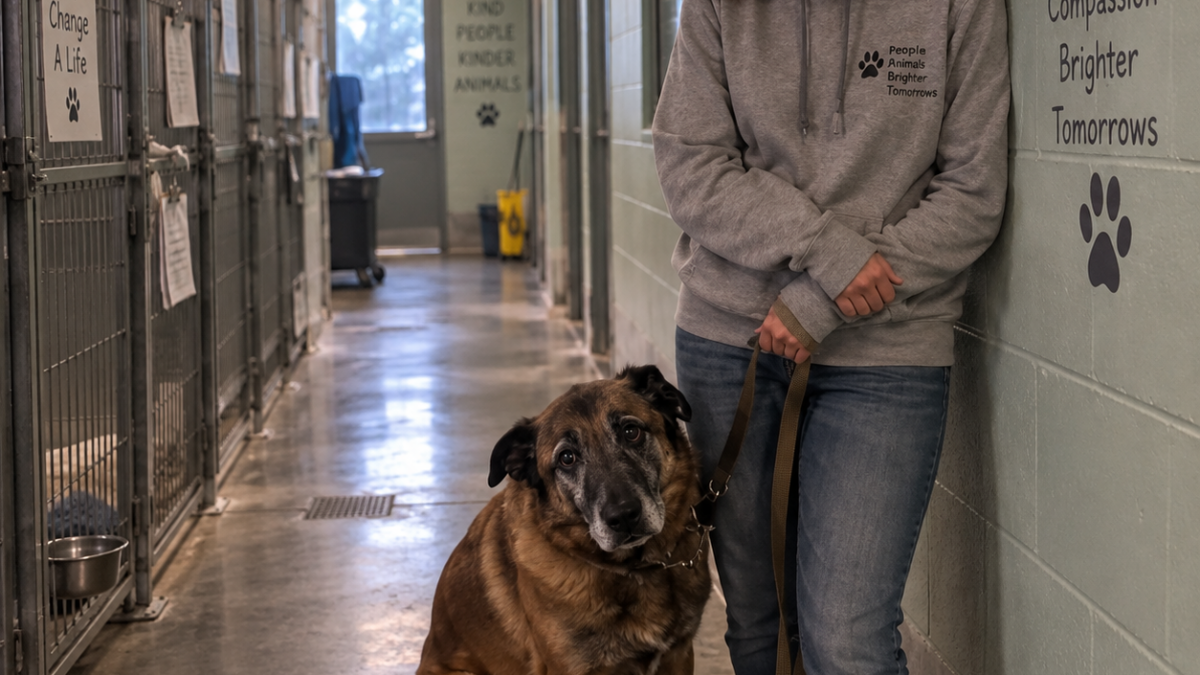
PART 2
Rex dragged me toward the wreck with a strength I hadn’t felt from him in months.
“Rex!”
I nearly lost my footing crossing the wet shoulder.
The intersection had transformed into chaos.
Steam rose from the hood of a dark SUV that had struck a tree. The second vehicle, a silver sedan, sat crooked across two lanes with its front end crushed inward.
Someone was already calling 911.
Another driver had stopped and was shouting for everyone to stay back.
I remember the smell most clearly.
Burned rubber.
Gasoline.
Hot metal.
And something sharp and chemical I couldn’t identify.
Rex didn’t hesitate.
He passed the sedan.
That surprised me.
A woman was visible behind its wheel, conscious but bleeding from her forehead.
“Help her!” someone yelled.
But Rex continued toward the SUV.
“Rex, stop!”
He reached the driver’s side and began circling.
The windshield was shattered.
The driver, a middle-aged man, was slumped over the steering wheel.
I could hear him groaning.
I grabbed Rex’s harness.
“Easy.”
He ignored me.
His nose moved quickly along the vehicle.
Rear door.
Back wheel.
Passenger side.
Then he stopped.
His entire body became rigid.
He stared at the crushed rear section of the SUV.
Then he barked.
It was the first time I had ever heard Rex bark.
Not the casual bark of a shelter dog.
Not excitement.
One sharp, commanding explosion.
Then another.
I ran around the vehicle.
“What is it?”
Rex scratched at the damaged rear passenger door.
I looked through the broken glass.
Nothing.
The back seat appeared empty.
“There isn’t anyone there.”
Rex barked again.
I leaned closer.
Then I heard it.
A sound so faint I almost convinced myself I’d imagined it.
Crying.
A child.
“Oh my God.”
I pulled on the door handle.
It wouldn’t move.
“There’s a kid in here!” I screamed. “There’s a child!”
Several people rushed over.
A man in a work jacket tried the door.
“It’s jammed.”
Rex moved toward the rear hatch, sniffed, then returned to the passenger side.
The crying became weaker.
“Sweetheart!” I shouted through the broken window. “Can you hear me?”
No answer.
I climbed partly through the shattered opening, careful of the glass.
Then I saw a tiny sneaker.
The child’s car seat had been thrown partly sideways during the collision and was hidden behind luggage and a folded stroller.
“There!”
The little girl couldn’t have been more than four.
Her eyes were closed.
Blood ran along one side of her face.
Her chest moved, but barely.
Sirens sounded in the distance.
Rex pressed himself against the vehicle, whining.
“She’s breathing,” I said. “She’s breathing.”
The man beside me looked toward the front.
“We smell fuel. Everybody needs to back away.”
I looked at Rex.
He wouldn’t move.
Neither would I.
The first fire engine arrived less than two minutes later.
Firefighters took over immediately.
One pulled me away while another approached the SUV.
“You found another patient?”
“The dog did.”
“What?”
“Rex. He found her.”
The firefighter looked at the old Malinois.
Rex stood perfectly still, eyes locked on the SUV.
For the first time since I’d known him, he didn’t look elderly.
He looked like he was waiting for instructions.
The firefighter studied him for half a second.
Then something changed in his expression.
“Hold on.”
He walked closer.
“What’s his name?”
“Rex.”
The firefighter stared.
“Rex?”
“Yes.”
He crouched.
Rex’s ears moved forward.
The man looked at a worn patch of fur around Rex’s neck, then at the scar on his shoulder.
“No way.”
Before I could ask what he meant, someone shouted from the wreck.
The firefighter ran.
Crews stabilized the vehicle and cut through the rear door.
I stood near an ambulance holding Rex’s leash with both hands.
His entire body trembled.
Every time metal screamed beneath the hydraulic cutters, he leaned forward.
“She’s okay,” I whispered, though I had no idea whether it was true.
“She’s going to be okay.”
Several minutes later, a firefighter emerged carrying the girl.
Her face was pale.
An oxygen mask covered her mouth.
Her tiny arm hung limp.
But she was alive.
Rex watched until the ambulance doors closed.
Then something extraordinary happened.
He simply sat down.
The energy drained from him.
His back curved.
His bad leg shook.
Suddenly he was twelve years old again.
I dropped beside him.
“You did it.”
I wrapped my arms around his neck.
For once, I didn’t care whether service dogs were supposed to be hugged.
Rex leaned against me.
“You did it, buddy.”
Behind us, the firefighter who had recognized him returned.
He removed his helmet.
He was maybe forty-five, with gray beginning around his temples.
“Where did you get that dog?”
“The county shelter.”
His face changed.
“That can’t be right.”
“Why?”
He looked down at Rex.
“Because I know him.”
My stomach tightened.
“You do?”
The man slowly crouched.
“Rex.”
The dog’s head lifted.
The firefighter said something I didn’t understand.
One word.
“Search.”
Rex stood instantly.
Not slowly.
Instantly.
My heart stopped.
The firefighter’s eyes filled with tears.
“Yeah,” he whispered.
Then he looked at me.
“This dog worked with our regional search-and-rescue task force.”
I stared at him.
“For how long?”
“Years.”
“Do you know his handler?”
The firefighter didn’t answer immediately.
His expression told me there was a story there.
Finally he said, “His primary handler was Officer Daniel Mercer.”
“Was?”
The firefighter lowered his eyes.
“He died.”
That single sentence explained more about Rex than every piece of shelter paperwork combined.
I looked down at him.
The quiet kennel.
The lowered head.
The endless waiting.
“He lost his handler?”
“About eleven months ago.”
My throat tightened.
The firefighter nodded toward the ambulance.
“Rex and Mercer were one of the best search teams in the region. Building collapses. Missing children. Floods. Tornado response. You name it.”
“Then why is he in a shelter?”
His jaw tightened.
“I have no idea.”
His name was Captain Aaron Pierce.
While paramedics worked, Aaron told me what he knew.
Rex hadn’t simply been a police dog.
He and Daniel Mercer had specialized in urban search and rescue.
They had been deployed across several counties.
Rex had located an elderly couple after a tornado destroyed their home.
He had found a teenager lost overnight in freezing woodland.
He had detected survivors after part of a parking structure collapsed.
Once, during flooding, he had located two children trapped inside a drainage building after everyone else had assumed it was empty.
“He had instincts you couldn’t teach,” Aaron said. “Mercer trusted that dog more than most people.”
I looked at Rex.
He was lying beside my boots now.
“What happened to Mercer?”
“Cancer.”
The word landed quietly.
“Fast?”
Aaron shook his head.
“No. He fought it nearly two years.”
I looked back toward Rex.
“Did Rex stay with him?”
“Until near the end.”
“Then what?”
Aaron’s expression hardened.
“I don’t know.”
That bothered me.
A dog with twelve years of service.
A deceased handler.
A regional task force that clearly remembered him.
Yet somehow Rex had been delivered anonymously to a small shelter with almost no information.
Before Aaron left, he took my phone number.
“I’m going to make some calls.”
I returned Rex to the shelter that afternoon.
For the first time, putting him back into his kennel felt wrong.
Not merely sad.
Wrong.
Rex stepped inside.
I unclipped his leash.
He turned around and looked at me.
His eyes were brighter than usual, but when I closed the gate, something in them changed.
I stood there gripping the latch.
“I’ll be back tomorrow.”
Rex remained standing.
I walked away.
Ten steps later, I turned.
He was still watching me.
That night, I barely slept.
I kept seeing him running toward the wreck.
Not waiting for permission.
Not wondering whether he was too old.
Just responding to someone who needed him.
And then I kept seeing the kennel door closing.
The next morning, I arrived before my volunteer shift.
Mr. Dalton was in his office.
“We need to talk about Rex.”
He sighed before I finished the sentence.
“I heard about the accident.”
“He found a little girl.”
“I know.”
“He probably saved her life.”
Dalton removed his glasses.
“Emily—”
“Why was he brought here?”
“What do you mean?”
“Who surrendered him?”
Dalton leaned back.
“That information isn’t relevant to your volunteer duties.”
“It is relevant to his life.”
“Emily.”
“A firefighter recognized him yesterday. His handler died eleven months ago.”
Dalton’s face shifted just slightly.
He knew.
That made me angrier.
“You already knew.”
“I knew portions of his history.”
“Why didn’t you tell me?”
“Because confidential information about surrendered animals isn’t something I discuss with volunteers.”
“Then tell me why a decorated K9 who served twelve years is sitting in your smallest back kennel.”
Dalton stood.
“First, it’s not our smallest kennel. Second, Rex has medical problems. Third, his age makes adoption difficult.”
“Has anyone tried?”
“Of course.”
“How many applications?”
Silence.
“Has he even been listed?”
Dalton looked toward his computer.
That was my answer.
“He hasn’t.”
“There are complications.”
“What complications?”
“Ownership.”
That stopped me.
“What?”
Dalton took a breath.
“Rex’s status is disputed.”
“By who?”
“I’m not discussing this.”
“Then I’m going to find out myself.”
His eyes sharpened.
“Be careful, Emily.”
“About what?”
“You walked into this story halfway through. Don’t assume you understand everything because you’re emotionally attached to a dog.”
Maybe he meant it as a warning.
Instead, it sounded like a challenge.
I left his office furious.
Rex was waiting at the kennel gate.
When I crouched beside him, he pressed his nose between the bars.
“What happened to you?”
He blinked slowly.
I touched his muzzle.
“Who put you here?”
That afternoon Aaron called.
“I found Mercer’s sister.”
My pulse jumped.
“Is she alive?”
“Very much alive. Her name is Claire Mercer.”
“Does she know where Rex is?”
“No.”
I felt cold.
“What do you mean, no?”
“She thought Rex had been placed with a retired handler.”
I looked through the office window toward the kennel wing.
“He’s been here for months.”
“I know.”
“Why?”
Aaron exhaled.
“That’s what we’re trying to figure out.”
Claire lived two hours away.
When Aaron contacted her, she initially thought he was mistaken.
According to what she had been told after Daniel’s death, Rex had entered a retirement-placement program through a private contractor connected to the regional K9 association.
Claire had wanted him herself.
But she’d been told Rex’s medical needs and work history required placement with someone experienced with retired service animals.
She trusted them.
She had signed paperwork.
Then she’d received a brief notice claiming Rex had been successfully placed.
She never saw him again.
Until Aaron texted her the photograph I’d taken outside the shelter.
She drove to us the next morning.
I was cleaning bowls when Dalton came rushing down the kennel aisle.
“Emily.”
I turned.
“Office. Now.”
Claire was standing there.
I knew immediately who she was.
She had Daniel’s eyes.
Beside her stood Aaron.
Dalton closed the office door.
Claire didn’t sit.
“Where is Rex?”
Dalton folded his hands.
“Ms. Mercer, I’m reviewing the documentation.”
“Where is my brother’s dog?”
“Kennel fourteen.”
Claire looked at me.
“Would you take me to him?”
Dalton stepped forward.
“I think we should resolve the legal—”
“No.”
Her voice wasn’t loud.
It didn’t need to be.
“I asked where he was. I’m going to see him.”
We walked together toward the back wing.
Rex was asleep.
Claire stopped about ten feet from his kennel.
Her hand covered her mouth.
“Oh, Rex.”
His eyes opened.
He lifted his head.
For a second, nothing happened.
Then Claire said his name again.
“Rex.”
His ears rose.
She took another step.
“It’s Claire.”
Rex stood.
His bad leg slipped slightly.
Then he walked toward the gate.
Claire began crying.
Not quietly.
The kind of crying that comes from somewhere below language.
She crouched.
Rex pressed his entire body against the bars.
“Oh God.”
She reached through.
He pushed his head beneath her hand.
“You remember me.”
Rex whined.
I’d never heard that sound from him.
Claire buried her face against the gate.
“I thought you were safe.”
Aaron turned away.
Even Dalton looked uncomfortable.
“I thought they gave you a home.”
Rex licked her fingers.
“I’m sorry.”
The reunion lasted several minutes before Claire finally stood.
Then she faced Dalton.
“I want every document you have.”
Dalton nodded.
“Of course.”
“Today.”
“There are privacy procedures.”
Claire pulled a folder from her bag.
“My attorney sent this an hour ago.”
Dalton looked at it.
His face lost color.
I didn’t understand then how much trouble those papers would eventually cause.
Over the next several days, the story unfolded.
After Daniel Mercer died, Rex technically belonged to a nonprofit organization called the Western County Working Dog Foundation.
Daniel had been Rex’s handler and caretaker for almost Rex’s entire career, but the foundation retained ownership.
Daniel’s written retirement request stated something simple:
When Rex could no longer work, he was to live with Daniel.
If Daniel died first, Rex was to be offered to Claire.
That was in writing.
Claire had never seen that page.
Instead, following Daniel’s death, a foundation administrator named Victor Harlan contacted her.
Harlan told Claire that Rex had been evaluated and deemed unsuitable for a normal home because of age, arthritis, and “service conditioning.”
He recommended specialized placement.
Claire trusted him.
What she didn’t know was that Harlan had quietly changed the internal records.
Rex was transferred first to a contracted boarding facility.
Then to another.
Then eventually surrendered to our shelter as an “unclaimed retired working dog.”
No one contacted Claire.
No one contacted Daniel’s former unit.
No one contacted Aaron.
It would have remained buried if not for the crash.
And suddenly I understood Dalton’s warning.
Rex wasn’t simply an old dog who had been forgotten.
Someone had deliberately allowed him to disappear.
The obvious question was why.
The answer arrived in a spreadsheet.
Aaron called me one evening.
“You should probably sit down.”
I was already sitting on my apartment floor with takeout noodles.
“What happened?”
“We found eleven more dogs.”
I put the carton down.
“What?”
“Retired working dogs processed through the same contractor over the last four years.”
“What happened to them?”
“Three went to legitimate handlers. Eight disappeared from the program.”
My stomach tightened.
“Disappear how?”
“Shelters. Cheap boarding facilities. One went through two rescues before being adopted.”
“Why would anyone do that?”
Aaron hesitated.
“Money.”
Of course.
The foundation received donations specifically for retired K9 care.
Medical care.
Specialized boarding.
Handler-placement assistance.
End-of-life support.
If Rex was officially listed as receiving specialized retirement care, money could continue being billed.
Even if he was actually sitting in a low-cost shelter kennel.
“Are you saying they were collecting money for him while he was here?”
“That’s what it looks like.”
“How much?”
“We don’t know yet.”
I thought of Rex sitting in the corner.
The stiff leg.
The untreated skin irritation he’d had when he arrived.
The cheap bag of senior kibble.
“You’ve got to be kidding me.”
“I wish I were.”
The worst part came later.
Rex had supposedly received physical therapy twice a week.
Specialized veterinary monitoring.
Joint injections.
Individual enrichment.
Private boarding.
The invoices existed.
The care did not.
Claire obtained Rex’s veterinary records from the shelter.
They showed basic vaccinations, pain medication, and an arthritis evaluation.
Nothing matching the foundation invoices.
Someone had been charging donors hundreds of dollars every month for services Rex never received.
And Rex wasn’t the only one.
Claire didn’t scream when she learned.
She became very quiet.
That frightened me more.
“My brother donated his life to that program,” she said.
We were sitting in the shelter parking lot.
Rex lay between us in the grass during one of his approved outdoor visits.
“Daniel missed birthdays. Holidays. Christmas morning once. He slept in trucks during flood searches. He came home with stitches and bruises and never complained because he believed the work mattered.”
She rubbed Rex’s ear.
“And they waited until Daniel was dead.”
Rex looked up.
Claire swallowed.
“They knew he couldn’t fight them.”
I understood then what revenge would look like for Claire Mercer.
Not violence.
Not shouting.
Documentation.
Names.
Bank records.
Every signature.
Every invoice.
Every dollar.
She was going to make sure the people who had used Daniel’s death to bury Rex would have nowhere left to hide.
But first we had a more immediate problem.
Rex still couldn’t leave the shelter.
The foundation remained his legal owner while attorneys challenged the transfer.
Dalton refused to release him without written authorization.
Claire was furious.
“So the same people who dumped him here still own him?”
“Legally, for the moment,” Dalton said.
“Then the law is insane.”
“I’m not defending it.”
For the first time, I realized Dalton wasn’t protecting the foundation.
He was protecting the shelter.
“If I hand Rex over without authorization,” he explained, “they can sue this shelter. We barely survive financially as it is.”
Claire paced.
“Then what can we do?”
Dalton looked at Rex through the office window.
“Make them surrender ownership.”
Victor Harlan arrived three days later.
He wore a tailored navy suit and carried himself like someone who had spent years entering rooms expecting people to defer to him.
He didn’t look at Rex first.
He looked at Claire.
“Ms. Mercer.”
“Mr. Harlan.”
“I wish you’d contacted me directly.”
“I did.”
His smile faltered.
“Through attorneys.”
“Because when I contacted you eleven months ago, you lied to me.”
“That’s an inflammatory characterization.”
“You told me Rex had gone to a specialist retirement home.”
“That was the intended placement.”
Claire pointed through the glass.
“Does that look like a retirement home?”
Harlan finally glanced toward Rex’s kennel.
His expression barely changed.
“There were unforeseen changes.”
“Eight dogs?”
That landed.
Harlan’s eyes flicked toward Aaron.
Aaron crossed his arms.
“We’re reviewing the records.”
Harlan’s jaw tightened.
“I’m not sure why the fire department is involved.”
“We aren’t. I am.”
“As what?”
“A man who watched that dog save people for ten years.”
Silence.
Then Harlan turned to Dalton.
“I’m here to retrieve foundation property.”
My stomach dropped.
Claire stepped between him and the hallway.
“No.”
Harlan didn’t raise his voice.
“Rex belongs to the foundation.”
“He belonged with my brother.”
“Mr. Mercer was his handler.”
“My brother’s retirement directive named me.”
“That document was superseded.”
“Show me.”
Harlan smiled.
“Our counsel will respond.”
“Then Rex stays here.”
“That’s not your decision.”
Dalton spoke.
“Actually, at the moment, it is mine.”
Everyone turned toward him.
Harlan frowned.
“Excuse me?”
Dalton opened a folder.
“When Rex was surrendered, your representative signed our standard relinquishment form.”
Harlan froze.
Dalton continued.
“Which transfers ownership to the shelter.”
The room went completely silent.
I nearly laughed.
Claire stared at him.
“You told me ownership was disputed.”
“It is. Their attorney has argued the employee who signed lacked authority.”
Dalton slid a photocopy across the desk.
“But until a court decides otherwise, I’m not releasing Rex to anyone.”
Harlan picked up the page.
His face hardened.
“This is going to become expensive for you.”
Dalton leaned back.
“Probably.”
“You operate on donations.”
“Yes.”
“Legal costs could close this facility.”
Dalton’s eyes narrowed.
For the first time, I understood why he’d been cautious.
Harlan wasn’t merely asking.
He was threatening him.
Claire understood too.
“So that’s how you do it.”
Harlan looked at her.
“Do what?”
“You find organizations without money and scare them until they stop asking questions.”
“Ms. Mercer—”
“My brother spent twelve years beside that dog.”
Her voice trembled now.
“You put Rex into a cage, billed people for care he wasn’t receiving, and now you’re threatening the shelter that accidentally exposed you.”
Harlan gathered his papers.
“I’ve heard enough.”
“No.”
Claire stepped closer.
“You haven’t heard nearly enough.”
Harlan looked at her.
Claire’s voice became almost calm.
“Because Daniel kept copies.”
That stopped him.
Aaron looked at her too.
Even I didn’t know what she meant.
Claire reached into her bag.
“My brother didn’t trust electronic records.”
She held up a battered black notebook.
“He wrote everything down.”
Harlan stared.
“Every deployment. Every injury. Every veterinary visit. Every retirement conversation.”
She opened it.
“And apparently, every conversation he had with you.”
For the first time, Victor Harlan’s confidence disappeared.
Only for a second.
But I saw it.
So did Claire.
And she smiled.
It wasn’t a happy smile.
It was the expression of someone who had finally found the loose thread.
The notebook changed everything.
Daniel had begun documenting concerns during the final year of his life.
At first, the entries seemed routine.
Rex’s medications.
Mobility evaluations.
Training notes.
Then Victor Harlan’s name started appearing.
“V. Harlan asked if Rex could remain listed active through fiscal year.”
“Declined.”
“Harlan says retirement funding requires approved facility.”
“Asked why home placement not approved.”
“No clear answer.”
And then, six weeks before Daniel died:
“Harlan pushing transfer paperwork. Told him Rex goes to Claire if I don’t make it. He said foundation decides. Told him written directive says otherwise.”
Claire read that sentence three times.
Her hands shook.
Two pages later, Daniel had written:
“If anything happens to me, check Rex’s account.”
That was all.
Check Rex’s account.
Aaron knew a detective in the county fraud unit.
Claire’s attorney turned over copies.
Within days, investigators were involved.
The foundation initially called the accusations “a misunderstanding involving outdated administrative procedures.”
Then the financial records arrived.
There was no misunderstanding.
Rex had his own retirement-care ledger.
Donations from former officers.
Community fundraising.
A grant.
Money left by one elderly couple whose grandson Rex had helped locate years earlier.
Nearly $38,000 had been earmarked specifically for Rex’s retirement and medical care.
Most of it was gone.
Not spent on Rex.
Transferred through management fees, consultant charges, and payments to companies linked to Victor Harlan.
And the eight other missing dogs had similar accounts.
The total grew.
$91,000.
Then $147,000.
Then more than $230,000.
Every new number made me angrier.
But none of those numbers felt as real as Rex’s worn blanket.
That was what I kept thinking about.
Hundreds of thousands of dollars.
And Rex slept on a donated blanket with a tear in one corner.
The investigation remained quiet at first.
Harlan apparently believed the foundation’s lawyers could contain the damage.
He sent a formal demand for Rex’s return.
Dalton refused.
Then someone from the foundation called one of the shelter’s largest donors.
Two days later, that donor suspended funding.
Dalton showed me the email.
“We can’t prove Harlan did it.”
“You know he did.”
“I know.”
“How bad is it?”
Dalton looked exhausted.
“Bad.”
The shelter depended on three major donors.
One backing out meant medication purchases, food contracts, and staffing cuts.
I felt guilty.
“This happened because I kept pushing.”
“No.”
Dalton looked toward the kennels.
“This happened because people who rely on silence panic when someone starts asking questions.”
I had misjudged him.
He wasn’t cold.
He was tired.
Tired of balancing ethics against electricity bills.
Tired of trying to save animals while calculating whether the shelter could afford another surgery.
“Why didn’t you list Rex for adoption?”
He looked down.
“Because I suspected something wasn’t right.”
“From the beginning?”
“His surrender paperwork was strange. The woman who brought him wouldn’t answer basic questions. Then I found an identification tattoo that didn’t match the paperwork.”
“So you kept him here.”
“I kept him where I could find him.”
I felt ashamed.
“I thought you’d forgotten him.”
Dalton shook his head.
“I was trying not to lose him.”
From that day on, I saw him differently.
And when Harlan tried to crush the shelter financially, Dalton finally stopped being cautious.
He called a reporter.
Her name was Melissa Grant.
She worked for a regional television station.
At first she expected a small human-interest piece about a retired K9 finding a child after a car accident.
Then Dalton handed her the documents.
The story aired Thursday evening.
I watched from my apartment with Rex’s photograph on the screen.
The segment began with footage from the crash scene.
Then came photographs of Rex during his service years.
Standing beside Daniel.
Wearing a search harness.
Climbing over collapsed concrete.
Sitting beside rescued families.
One photograph broke me.
Daniel was kneeling with his arm around Rex.
They both looked younger.
Daniel was laughing.
Rex was staring at him.
The caption beneath it read:
K9 Rex and Handler Daniel Mercer, 2017.
Then Melissa’s voice changed.
“After Mercer’s death, Rex was reportedly placed in specialized retirement care. Instead, he was discovered months later at a small county shelter.”
Invoices appeared on screen.
Veterinary charges.
Boarding fees.
Therapy appointments.
Then the shelter records contradicting them.
By midnight, the story was everywhere locally.
By morning, national pages had picked it up.
Veterans.
Police handlers.
Firefighters.
Animal rescue groups.
People were furious.
But what happened next surprised all of us.
Donations flooded into the shelter.
Five dollars.
Twenty.
Fifty.
One thousand.
People wrote messages:
For Rex.
For the old heroes.
No service dog should end like this.
Within forty-eight hours, the shelter had received more money than the donor Harlan had apparently pressured would have given us in an entire year.
Dalton stared at the fundraising total on the computer.
“I don’t know what to say.”
I smiled.
“Maybe don’t threaten people who love dogs.”
That afternoon Claire came in carrying a cheeseburger.
“Absolutely not,” I said.
She laughed.
“It’s plain.”
“Rex is on a diet.”
“He’s twelve.”
“That doesn’t make cheeseburgers medicine.”
Rex was staring at the bag.
Claire looked at him.
Then at me.
“He saved a child.”
“Half.”
“Three quarters.”
“Half.”
Rex received half a cheeseburger.
He considered this an acceptable compromise.
For the first time since I’d met him, I saw him wag his tail so hard his entire back end moved.
It felt like we had won.
We hadn’t.
Victor Harlan resigned four days later.
His statement said he wanted to avoid becoming “a distraction to the important mission of supporting working dogs.”
Investigators searched the foundation offices the following week.
Financial records were seized.
Two board members claimed they had never been shown detailed retirement-account reports.
A contractor admitted receiving payments for services never performed.
And eventually, Harlan was charged with fraud, falsifying records, and misappropriating charitable funds.
The revenge Claire wanted wasn’t dramatic in the way movies make revenge dramatic.
There was no fistfight.
No screaming match in the rain.
There was a courtroom.
There were bank statements.
There were twelve retired dogs whose names were read into the record.
And there was Victor Harlan sitting at a defense table while Claire Mercer stared at him from the front row.
I sat beside her.
Aaron sat on my other side.
Rex wasn’t allowed in the courtroom.
He waited outside with another volunteer.
The prosecutor explained how the scheme worked.
Retired service dogs became financial assets.
Their names attracted donations.
Their care justified grants.
But elderly dogs were expensive.
So actual expenses were minimized while fictional expenses continued being reported.
The difference disappeared through administrative contracts.
Harlan’s attorney argued the accounting had been sloppy rather than criminal.
Then Claire testified.
She talked about Daniel.
Not the decorated version.
The brother.
The man who burned scrambled eggs.
The man who forgot anniversaries but remembered the birthday of every dog he ever trained.
The man who slept on his living-room floor beside Rex after the dog injured his shoulder during a search.
She described Daniel’s final months.
“There was a hospital bed in his house,” she said. “Rex slept underneath it.”
The courtroom was silent.
“Even when my brother could barely walk, Rex followed him from room to room.”
The prosecutor asked, “Did your brother express his wishes regarding Rex?”
“Yes.”
“What were they?”
“Rex was family.”
Claire looked directly at Harlan.
“He said if he couldn’t keep his promise to Rex, I was supposed to keep it for him.”
The prosecutor showed Daniel’s handwritten directive.
Then came the notebook.
The defense objected repeatedly.
The judge allowed portions into evidence.
Finally the prosecutor displayed one sentence.
If anything happens to me, check Rex’s account.
No one moved.
Harlan stared at the table.
Claire stared at him.
For months, she had carried rage.
I had seen it in the parking lot.
In meetings.
In phone calls.
That day, something changed.
She wasn’t angry anymore.
She had evidence.
And evidence was stronger.
The jury returned its verdict after less than five hours.
Guilty on multiple counts.
Claire didn’t celebrate.
Neither did Aaron.
She simply closed her eyes.
Then she whispered, “Daniel would’ve hated all of this.”
I squeezed her hand.
“But he would’ve loved what happened to Rex.”
She nodded.
“Yeah.”
The financial case resulted in restitution orders and additional investigations.
The foundation board was reorganized.
A court-appointed administrator reviewed every retired working dog account.
Several families were reimbursed.
Three dogs were located and returned to former handlers or relatives.
Two others remained with adoptive families who loved them.
One elderly Labrador named Scout had died months earlier.
When investigators found that out, Claire cried harder than she had during the verdict.
“We were too late for him.”
That became her next mission.
But Rex still needed a home.
Once the legal dispute ended, Dalton called me into his office.
He had a folder on his desk.
I sat down.
“What now?”
He pushed the folder toward me.
“Adoption application.”
I stared at it.
“For Rex?”
“Unless you’re planning to adopt a different twelve-year-old retired K9 who ignores almost everyone except you.”
I laughed.
Then I stopped.
“Claire should take him.”
“She applied.”
My chest tightened.
“Then she should have him.”
Dalton smiled.
“She withdrew.”
“Why?”
“Ask her.”
Claire was waiting outside.
Rex lay in the grass beside her.
I walked toward them holding the application.
“You withdrew.”
She nodded.
“Why?”
“Because Daniel wanted Rex with family.”
“Exactly.”
Claire looked at me.
“Emily, look at him.”
I did.
Rex lifted his head when he heard my voice.
Claire smiled.
“That’s family.”
My throat tightened.
“No.”
“Yes.”
“You knew him before me.”
“I knew my brother’s dog.”
She rubbed Rex’s shoulder.
“You know Rex now.”
I sat beside them.
“What if he needs someone experienced?”
“He needs someone who will let him sleep on the couch.”
“I don’t even know if my apartment allows dogs his size.”
“I called them.”
I stared at her.
“You called my landlord?”
She shrugged.
“Former cop’s sister.”
“You are terrifying.”
“I’ve been told.”
“They said yes?”
“After I explained that half the town would probably riot if they said no.”
I laughed through tears.
Rex put his head on my knee.
Claire looked down at him.
“My brother’s last months were hard. Rex watched him disappear little by little.”
Her voice softened.
“I think Rex believed his job ended when Daniel died.”
I stroked the gray fur around his ears.
“Maybe that’s why he stopped moving.”
“Maybe.”
She looked at me.
“Then you walked into his kennel every day and talked about bad coffee.”
“Very meaningful therapy.”
“Apparently.”
We both laughed.
Claire touched Rex’s collar.
“Daniel would’ve wanted him somewhere he was needed.”
I looked at the old dog.
“I need him.”
“I know.”
That afternoon, I filled out the adoption application.
Dalton pretended it required the normal three-day approval process.
It lasted twenty minutes.
When he returned, he carried Rex’s file.
“Congratulations.”
I stared at him.
“That’s it?”
“That’s it.”
“What do I do now?”
“Take your dog home.”
My dog.
The words didn’t feel real.
We walked to kennel fourteen together.
Rex stood when he saw me.
I opened the gate.
For months, I had entered that kennel.
That day, for the first time, I didn’t close the gate behind us.
I clipped on his leash.
“Come on, Rex.”
He stepped into the hallway.
Several shelter employees were waiting.
Someone had hung a handmade sign above the exit.
HAPPY RETIREMENT, REX.
Rex couldn’t read it.
Probably for the best.
He hated attention.
But when we walked past the front desk, everyone applauded.
He stopped.
Looked around.
Then looked at me as if asking what exactly he’d done wrong.
I laughed.
“It’s okay.”
Claire was crying.
Aaron saluted him.
Dalton scratched behind his ears.
Then we walked through the front door.
Rex stopped outside.
Just like he had on our first rainy Sunday.
The afternoon sun touched his face.
He lifted his nose.
Breathed.
And walked forward.
No kennel waiting at the end this time.
My apartment was completely unprepared for a retired service dog.
I had bought a bed.
Rex ignored it.
I had bought expensive senior-dog food.
Rex initially refused it.
I bought three toys.
He stared at them as if they were evidence in a criminal investigation.
The first night, I pointed toward the new orthopedic bed.
“That’s yours.”
Rex looked at it.
Then looked at my couch.
“No.”
He looked back at the couch.
“Absolutely not.”
Ten minutes later, he was on the couch.
Apparently twelve years of obedience had officially ended.
Retirement suited him.
At first, he followed me everywhere.
Bathroom.
Kitchen.
Bedroom.
If I closed a door, he waited outside.
If I stood up suddenly, he stood too.
If something fell in another apartment, his ears snapped forward.
Some habits never disappeared.
But slowly, he learned others.
He learned that the refrigerator opening sometimes meant cheese.
He learned that squirrels had no respect for decorated public servants.
He learned that my mother would feed him chicken under the table while denying it directly to my face.
He learned sunlight moved across the living-room carpet in warm rectangles perfect for afternoon naps.
And I learned things too.
Rex hated thunderstorms.
That surprised me.
A dog who had worked around collapsed buildings and emergency vehicles would crawl into my bedroom during storms and sleep beside the bed.
He loved children but disliked skateboards.
He could open a partially closed door with his nose.
He knew dozens of commands I’d never been taught.
Sometimes Aaron visited and showed me.
“Watch.”
He pointed toward a chair.
“Rex, check.”
Rex sniffed around it systematically.
Then returned.
“He still remembers everything,” I said.
Aaron nodded.
“They never really forget.”
The little girl from the accident survived.
Her name was Madison Cole.
She had a fractured arm, a concussion, several cuts, and internal bruising.
Doctors later told her parents that the speed with which rescuers found her mattered.
Because the SUV’s damaged position had hidden her from the road, first responders might have initially focused on the visible adults.
Rex changed that.
Three weeks after the crash, Madison’s parents asked to meet us.
I was nervous.
Rex wasn’t.
We met at the fire station.
Madison walked in wearing a purple cast.
The moment she saw Rex, she stopped.
Her mother knelt beside her.
“That’s him.”
Madison stared.
“That’s Rex?”
“Yes.”
Rex remained still.
I loosened the leash.
“Would you like to say hello?”
She approached slowly.
Rex lowered himself to the floor.
That movement made everyone quiet.
It was as if he understood she was afraid.
Madison touched his head.
Then she wrapped both arms around his neck.
Rex closed his eyes.
Her father turned away.
Her mother cried.
I was already crying.
Madison whispered something into Rex’s ear.
I couldn’t hear it.
Later I asked what she’d said.
She looked at me as though the answer were obvious.
“I told him thank you for finding me.”
That photograph became famous locally.
Madison with her purple cast.
Rex lying beside her.
No harness.
No uniform.
Just an old dog receiving the gratitude he had earned.
A few months later, Claire created a nonprofit.
Not another massive organization.
Something small.
Transparent.
Every dollar public.
Every dog trackable.
It was called Mercer’s Promise.
The purpose was simple: retired working dogs should never disappear when their handlers retire or die.
Aaron joined the advisory board.
Dalton helped coordinate shelter relationships.
I handled volunteer outreach.
I still didn’t know what I wanted to do with my life.
Then suddenly, without planning it, I did.
I went back to school for animal welfare administration and nonprofit management.
Turns out career plans sometimes arrive on four paws.
Rex came to several early fundraising events.
He hated them.
People wanted photographs.
Rex wanted snacks.
We compromised.
One photograph equaled one small treat.
This policy made Rex an enthusiastic supporter of nonprofit philanthropy.
Within the first year, Mercer’s Promise helped place nineteen retired working dogs.
Some went home with former handlers.
Some went to relatives.
Some needed specialized families.
Two stayed with firefighters.
One retired explosives-detection Labrador moved in with an elementary-school principal and became absurdly spoiled.
Every time another dog left a kennel for a home, Claire sent me a photograph.
For Daniel, she’d write.
For Rex, I’d answer.
Victor Harlan eventually received a prison sentence and was ordered to repay part of the stolen funds.
Some people said it wasn’t enough.
Maybe it wasn’t.
Money could be repaid.
Time couldn’t.
Rex could never get back the months he spent sitting behind wire.
Scout could never receive the retirement he had been promised.
Daniel could never know exactly how close Rex came to being forgotten.
But punishment wasn’t what stayed with me.
What stayed with me was what happened afterward.
People changed the system.
The county adopted a new retired-K9 tracking requirement.
Service organizations began notifying handlers’ families directly about placement decisions.
Partner shelters created identification procedures for former working dogs.
A local veterinary group donated annual exams to retired K9s.
None of that erased what happened.
But it made repeating it harder.
That felt more satisfying than revenge.
Rex lived with me for almost three more years.
By fourteen, he walked more slowly.
By fifteen, stairs became difficult.
I moved to a ground-floor apartment because I refused to make him climb them.
He developed worsening arthritis.
His muzzle became almost completely white.
But every Sunday, we walked.
Always Sunday.
Sometimes only one block.
Sometimes less.
I never stopped the ritual.
Neither did he.
One Sunday in early spring, we reached the little park near my apartment.
Rex stopped beneath a maple tree.
He looked tired.
I sat on the grass.
He lowered himself beside me.
“Remember when you almost pulled my arm out of its socket?”
His ear twitched.
“You were supposed to be old.”
He breathed deeply.
“I think you lied.”
Rex put his head on my lap.
Cars moved along the distant road.
Children played near the swings.
Someone was grilling somewhere nearby.
It was an ordinary afternoon.
That was what I wanted for him more than anything.
Ordinary.
No sirens.
No commands.
No collapsed buildings.
No missing children.
No cages.
Just grass beneath his paws and someone beside him.
His health declined quickly that summer.
I knew what was happening.
Knowing didn’t make it easier.
One morning, he couldn’t stand.
I knelt beside him.
“Come on, buddy.”
He tried.
His front legs pushed against the floor.
His back legs failed.
He looked at me.
There are moments when animals say things without language.
That was one of them.
He was tired.
Not sad.
Not afraid.
Tired.
I called Claire.
Then Aaron.
Then our veterinarian.
Everyone came.
We spent the afternoon in my living room.
Claire brought Daniel’s old search harness.
She placed it beside Rex.
Aaron told stories I’d never heard.
About the tornado.
About the flood.
About the night Rex found a six-year-old boy asleep beneath a fallen pine tree.
“He sat beside that kid until Mercer reached him,” Aaron said.
Claire laughed through tears.
“Daniel said Rex looked annoyed because everyone was taking too long.”
“That sounds right.”
Rex slept while we talked.
Near sunset, he woke.
I helped him outside.
We carried him to the grass on a blanket.
The sky was orange.
Claire sat on one side.
I sat on the other.
Aaron stood nearby.
Rex lifted his nose.
The same way he had on that first rainy Sunday.
He breathed slowly.
I put my hand on his chest.
“You don’t have to work anymore.”
His eyes turned toward me.
“No one’s missing.”
I was crying so hard my voice barely worked.
“No one needs saving.”
I stroked his face.
“You finished the job.”
Rex’s breathing became softer.
“You can rest.”
The veterinarian helped him peacefully.
His head was in my lap.
Claire’s hand rested over mine.
Aaron saluted him one final time.
And Rex died outside beneath an open sky.
For months afterward, Sundays were unbearable.
I’d wake up and instinctively reach for his leash.
Sometimes I thought I heard his nails on the kitchen floor.
Once I opened my apartment door expecting to see him waiting.
Grief does strange things.
It creates ghosts from routines.
Claire understood.
One Sunday she called.
“Get dressed.”
“I don’t want to.”
“I didn’t ask.”
Twenty minutes later she arrived.
“Where are we going?”
“You’ll see.”
She drove to the shelter.
I hadn’t visited in weeks.
Walking down the kennel hallway hurt.
Then Dalton opened a door.
Inside was an elderly German shepherd.
Gray face.
Cloudy eyes.
One ear bent slightly.
He looked at me.
I looked at Dalton.
“No.”
“I’m not asking you to adopt him.”
“Good.”
“His handler had a stroke.”
I looked back at the dog.
“Family?”
“None who can take him.”
“Name?”
“Cooper.”
Cooper didn’t approach.
He sat in the corner.
Head lowered.
I felt my heart crack.
Claire leaned against the wall.
“Don’t you dare.”
I looked at her.
“Don’t I dare what?”
“Tell yourself that helping him means replacing Rex.”
I swallowed.
“I can’t do this again.”
“Then don’t.”
She nodded toward the kennel.
“Just sit with him.”
So I did.
I sat outside Cooper’s gate.
For twenty minutes, nothing happened.
Then I started talking.
I told him about terrible coffee.
About student loans I’d finally almost finished paying.
About a dog named Rex who had once destroyed half a cheeseburger in approximately three seconds.
Cooper’s ear moved.
I smiled through tears.
“Yeah.”
I moved closer.
“I know that trick.”
He raised his head.
And for the first time since Rex died, Sunday didn’t feel empty.
Years have passed since then.
Mercer’s Promise now helps retired service dogs across several states.
Claire keeps Daniel’s notebook in a locked display case at our office.
Open to one page.
Not the page about fraud.
Not the warning.
The final entry Daniel ever wrote about Rex.
I didn’t know it existed until Claire found it tucked near the back.
The handwriting was shaky.
Daniel had written it less than two weeks before he died.
“Rex stayed beside me all night again. He thinks he still has to watch me. Twelve years and he still doesn’t understand that he has already done enough.”
Beneath that was one last sentence.
“When I’m gone, somebody please teach him how to rest.”
For a long time, Claire couldn’t read it without crying.
Neither could I.
Because Daniel never got to see the answer.
He never saw Rex step into the rain on our first Sunday.
He never saw him race toward that wreck.
He never saw Madison wrap her arms around him.
He never saw Rex asleep upside down on my couch, paws in the air, completely unconcerned with dignity.
He never saw him discover cheese.
Or squirrels.
Or sunny patches on the carpet.
He never saw Rex become an ordinary dog.
But I did.
And I think that was the greatest privilege of my life.
People sometimes call me the woman who saved Rex.
I correct them.
I gave him walks.
A couch.
A home.
He did the saving.
He saved Madison.
He exposed what was happening to other retired dogs.
He changed a shelter.
He changed laws.
He gave Claire a way to continue her brother’s work.
He gave me a career I never knew I wanted.
And long before any of that, he spent twelve years finding people who could not find their own way home.
Maybe that was why his story affected so many people.
Because when Rex finally became the one who was lost, strangers did for him what he had spent his entire life doing for others.
They found him.
And eventually, after twelve years of sirens, orders, searches, danger, loss, and one lonely cage at the back of a shelter, Rex finally received the one thing Daniel Mercer had wanted for him all along.
He came home.
Rex lived with me for almost three more years.
Those years changed my understanding of what a happy ending actually looked like.
It wasn’t dramatic.
It wasn’t a medal ceremony.
It wasn’t Rex standing in front of cameras while people called him a hero.
Most days, happiness looked much smaller than that.
It looked like an old dog asleep in a patch of afternoon sunlight.
It looked like muddy paw prints on my kitchen floor.
It looked like half a piece of toast mysteriously disappearing from my plate whenever I turned my back.
It looked like Rex learning that no one was going to give him another command.
For the first few months after I adopted him, he still woke whenever I moved.
If I walked toward the front door, he was immediately beside me.
If something crashed outside, his head snapped up.
If sirens passed our apartment, he would stand perfectly still and listen until they faded.
Sometimes, late at night, I would wake and find him sitting near the window.
Just watching.
“You’re retired,” I’d whisper.
His ears would move.
“Seriously, Rex. Nobody’s paying you anymore.”
He would stare at me for a few seconds.
Then he would lie back down.
Eventually.
There were other habits that disappeared much faster.
For example, any belief that he wasn’t allowed on furniture.
Within a month, my couch belonged to him.
By the second month, he had developed a routine in which he occupied exactly the middle cushion, leaving me approximately twelve inches of space at one end.
“You’re not a small dog,” I told him one evening.
Rex sighed.
“You understand that, right?”
Another sigh.
“Move.”
He opened one eye.
That was the entire negotiation.
I sat on the floor.
Claire thought this was hilarious.
She visited often.
Sometimes she brought photographs of Daniel and Rex from years earlier.
There was Rex standing in front of a collapsed warehouse.
Rex beside a police helicopter.
Rex soaked with mud after a flood search.
Rex sitting proudly next to Daniel in the bed of a pickup truck.
The difference between that dog and the dog snoring on my couch always amazed me.
One photograph became my favorite.
Daniel was kneeling in a field.
Rex was sitting beside him.
Daniel wasn’t looking at the camera.
He was looking at Rex.
And Rex was looking back.
There was nothing heroic about the picture.
No uniform.
No emergency.
Just a man and his dog.
Claire gave me a copy.
I framed it and placed it beside my bookshelf.
One afternoon, Rex walked over, sniffed it, and stood there longer than usual.
I didn’t know what dogs remembered.
I didn’t know whether he understood photographs.
But I sat beside him anyway.
“That’s him.”
Rex remained still.
“He’d be proud of you.”
His ears lowered slightly.
I put my arm around him.
“And I think he’d be glad you became spoiled.”
Rex looked toward the kitchen.
I laughed.
“That’s not permission for cheese.”
He went to the kitchen anyway.
Mercer’s Promise continued growing too.
What had started as Claire’s determination to make sure no retired working dog disappeared again turned into something much larger.
The first year, we helped nineteen dogs.
The second year, forty-three.
Soon, police departments and fire agencies from neighboring counties began calling us directly.
We built a registry.
Every dog entering retirement had a confirmed destination.
Every medical fund was documented.
Every family received contact information.
No anonymous transfers.
No vague “specialized placements.”
No dog could simply vanish into paperwork.
Claire insisted on one rule above all others.
“We always know where the dog sleeps.”
That sentence became almost sacred to us.
Not because of money.
Because of Rex.
One winter afternoon, we received a call about a retired Labrador named Murphy.
His handler had died unexpectedly.
The department thought Murphy had gone to a training facility.
The facility thought he had been picked up by a family member.
The family thought the department still had him.
For two days, nobody knew where he was.
Old fear returned immediately.
Claire didn’t sleep.
Neither did I.
We eventually found Murphy at a boarding kennel forty miles away.
He was safe.
Confused, but safe.
When we arrived, Claire walked straight into the kennel, dropped to her knees, and wrapped her arms around him.
I stood behind her and realized something.
Rex’s story wasn’t only about what happened to Rex.
It was about all the dogs who came after him.
Every time one of them made it home, part of the injustice done to him became something useful.
Rex came to the office sometimes.
He had no official job.
Claire jokingly called him Chief Retirement Officer.
His responsibilities consisted primarily of sleeping beneath my desk and inspecting lunches.
Visitors loved him.
Young officers would kneel beside him and say things like, “I heard about you.”
Rex usually responded by sniffing their pockets.
Fame did not impress him.
Snacks did.
Madison came to see him every year on the anniversary of the crash.
The first year, she still wore a small scar near her hairline.
The second year, she arrived carrying a drawing.
It showed a very large brown dog standing beside a very small purple stick figure.
Above them she had written, in shaky letters:
REX FOUND ME.
I hung it in the office.
The third year, Madison was old enough to understand more of what had happened.
She sat beside Rex on the floor and stroked his white muzzle.
“Did he know I was there?” she asked.
Her mother looked at me.
I answered carefully.
“I think he knew someone needed help.”
Madison considered that.
“Even though nobody told him?”
“Nobody had to.”
She hugged him.
“Good boy.”
Rex closed his eyes.
By then, age was catching him.
At fourteen, his back legs weakened.
We added rugs to my apartment because smooth floors became difficult.
At fourteen and a half, he started taking stronger medication for arthritis.
At fifteen, he couldn’t climb stairs comfortably anymore.
So I moved.
My friends told me it was ridiculous to change apartments because of a dog.
I stopped talking to some of those friends.
The new place was on the ground floor.
There was a little patch of grass outside the back door.
Rex loved it.
Every morning, he walked out, stood in the sunlight, and inspected the yard like he still held jurisdiction over the entire county.
Then he would choose exactly one spot and lie down.
Our Sunday walks became shorter.
At first, we had walked several miles.
Then one mile.
Then six blocks.
Then three.
Eventually, some Sundays, we only reached the end of the street.
I never hurried him.
The walk wasn’t exercise anymore.
It was a ritual.
A promise.
One Sunday in early spring, Rex stopped beneath a maple tree near the park.
The grass was still wet from morning rain.
He looked back at me.
“Done?”
He sat.
I lowered myself beside him.
For several minutes, neither of us moved.
Children shouted from the playground.
A bicycle passed.
Somebody nearby was mowing a lawn.
Rex rested his chin on my knee.
I scratched behind his ears.
“Remember the first Sunday?”
His eyes remained half closed.
“You almost gave me a heart attack.”
His tail tapped the ground once.
“You were supposed to be fragile.”
Another tap.
“You completely lied on your résumé.”
I smiled.
Then the smile disappeared.
His breathing had become slower over the previous weeks.
Not dangerous.
Just different.
Older.
I had started measuring time in small changes.
How long he could stand.
How far he could walk.
Whether he finished breakfast.
Whether he needed help getting up.
Anyone who has loved an old animal knows this kind of counting.
You don’t want to do it.
You do it anyway.
Because somewhere inside you, you’re trying to calculate how much time remains.
But love doesn’t give numbers.
It gives signs.
That summer, Rex began having bad days.
On good mornings, he still followed me into the kitchen.
On bad mornings, he stayed in bed.
Sometimes his legs slipped beneath him.
Sometimes he stared at his water bowl as though the distance between him and it was too far.
I carried the bowl over.
He drank.
Then he’d lick my hand.
“Don’t thank me.”
He always looked at me afterward.
“You spent twelve years doing the hard part.”
I touched his head.
“I can carry a water bowl.”
Claire noticed too.
She never said anything at first.
Then one evening, after Rex struggled to stand, she waited until he was sleeping.
“Emily.”
“I know.”
She sat across from me.
“Okay.”
“I said I know.”
My voice came out sharper than I intended.
Claire didn’t react.
“I don’t want to talk about it.”
“We don’t have to.”
“He’s still eating.”
“I know.”
“He walked yesterday.”
“I know.”
“He barked at the mailman this morning.”
That made her smile.
“Then clearly he’s cured.”
I laughed once.
Then I started crying.
“I can’t do this.”
Claire moved beside me.
“You already are.”
“No.”
I wiped my face.
“I saved him from that kennel. I brought him home. He trusts me.”
“Exactly.”
“What kind of person makes that decision for a dog who trusts them?”
Claire was quiet.
Then she said, “The kind who loves him enough not to make him stay for them.”
That sentence stayed with me.
For another month, Rex remained comfortable most days.
Then one morning, I woke because I heard his nails scraping against the floor.
He was trying to stand.
His front legs pushed.
His back legs wouldn’t follow.
“Rex.”
I jumped out of bed.
He tried again.
Nothing.
I dropped beside him.
“It’s okay.”
He looked at me.
Not panicked.
Embarrassed.
That somehow hurt worse.
“Hey.”
I put one arm beneath his chest and another beneath his hips.
Together, we got him upright.
His back legs shook.
He took one step.
Then another.
Then stopped.
He looked exhausted.
I knew.
There was no dramatic moment.
No sudden collapse.
No emergency siren.
Just an old dog looking at me and telling me, in the only way he could, that the job was finished.
I called Claire.
Then Aaron.
Then Dr. Patel, the veterinarian who had cared for Rex through his final years.
We decided to do it at home.
I refused to let his last memory be a sterile room.
That afternoon, people came quietly.
Claire brought Daniel’s old search harness.
Aaron brought a photograph from Rex’s first deployment.
Dalton came from the shelter carrying a bag of cheeseburgers.
I looked at him.
“Seriously?”
He shrugged.
“What are you going to do? Put him on a diet?”
I laughed through tears.
Rex received an entire cheeseburger.
No negotiation.
He ate half.
That scared me more than anything.
Rex had never voluntarily abandoned food.
We spent hours telling stories.
Aaron told me about a winter search I’d never heard.
A six-year-old boy had disappeared near a wooded campground.
Temperatures fell below freezing.
Search teams worked all night.
At three in the morning, Rex suddenly changed direction.
Daniel trusted him.
They followed.
Almost half a mile later, Rex found the child curled beneath the roots of a fallen tree.
The boy was hypothermic but alive.
“Rex laid beside him,” Aaron said.
“Wouldn’t move until Daniel got there.”
Claire smiled.
“Daniel said Rex looked offended that humans were so slow.”
“That’s accurate.”
I looked down.
Rex was sleeping with his head against my leg.
There were so many lives inside that old body.
So many roads.
So many strangers he’d found.
So many people who went home because Rex refused to stop searching.
Near sunset, he woke.
I asked Dr. Patel if we could go outside.
Together, Aaron and I carried Rex on his blanket to the grass.
The sky was turning orange.
There was almost no wind.
Claire sat beside him.
Aaron stood a few feet away.
Dr. Patel waited quietly.
I held Rex’s head in my lap.
He lifted his nose.
Breathed.
For one second, I saw him exactly as he had been on our first Sunday.
Rain falling across his face.
Eyes closed.
Discovering the outside world again.
“You remember?” I whispered.
His eyes moved toward me.
“I do.”
I stroked the white fur around his muzzle.
“You were supposed to be my shelter dog.”
I laughed weakly.
“Then you completely ruined my life plan.”
Claire smiled through tears.
“You gave me a career.”
I touched his chest.
“You gave Madison her life.”
His breathing was slow.
“You gave Claire something to fight for.”
Claire covered her mouth.
“You helped all those dogs come home.”
I bent closer.
“And you found me too.”
That was the part I’d never said aloud.
When I met Rex, I had been twenty-three and completely lost.
Everyone kept asking what I wanted to do.
I didn’t know.
Rex never asked.
He simply needed me to show up.
So I did.
One day.
Then another.
Somewhere between kennel fourteen and those Sunday walks, my life had found direction.
“You spent your whole life looking for people who were lost.”
My voice broke.
“I guess you had one more search left.”
Rex’s eyes stayed on mine.
I pressed my forehead against his.
“No one is missing now.”
His body relaxed slightly.
“No one needs you to search.”
I kissed his head.
“No sirens.”
Another breath.
“No commands.”
Another.
“No cages.”
Claire was crying openly now.
I held him closer.
“You finished the job, Rex.”
Dr. Patel knelt beside us.
I nodded.
My hand stayed on Rex’s chest.
“You can rest.”
He died peacefully with his head in my lap.
The last thing he felt was my hand.
The last thing he heard was my voice.
Aaron raised his hand in a final salute.
Claire placed Daniel’s old search harness beside Rex.
For several minutes, none of us moved.
The sun disappeared behind the trees.
And the dog who had spent twelve years running toward people in danger finally didn’t have to run anywhere anymore.
The weeks afterward were worse than I expected.
I would wake and listen for his breathing.
I would open the refrigerator and automatically reach for a piece of cheese.
I’d come home and say, “Hey, buddy,” before remembering.
Grief doesn’t only live in memories.
It lives in habits.
An empty water bowl.
A leash hanging beside the door.
A dent in the couch cushion.
A patch of carpet where sunlight falls and nobody sleeps anymore.
Sundays were the worst.
For years, Sunday meant Rex.
After he died, Sunday became silence.
Then Claire showed up one morning.
“Get dressed.”
“No.”
“Emily.”
“I don’t want to go anywhere.”
“I know.”
She stood in my doorway holding two coffees.
“That’s why we’re going.”
Twenty minutes later, we were driving toward the shelter.
When I realized where we were going, I looked at her.
“Absolutely not.”
“I’m not asking you to adopt anything.”
“Good.”
“I’m asking you to walk inside.”
“I hate you.”
“I know.”
Dalton met us near the back kennels.
He didn’t say much.
He led us to a quiet run.
An elderly German shepherd sat in the corner.
Gray muzzle.
Cloudy eyes.
One ear folded slightly.
He didn’t bark.
He barely looked at us.
My chest tightened.
“No.”
Dalton nodded.
“His name is Cooper.”
“I said no.”
“His handler had a stroke three weeks ago.”
I looked away.
“Family?”
“Nobody who can keep him.”
“Then find someone.”
“We’re trying.”
Cooper lowered his head.
I hated how familiar it felt.
Claire spoke softly.
“Nobody is replacing Rex.”
“I know.”
“Do you?”
I turned toward her.
“I can’t lose another one.”
Claire nodded.
“Then don’t adopt him.”
She pointed toward the floor outside Cooper’s kennel.
“Just sit.”
I stared at her.
“That’s how this started last time.”
“Exactly.”
For several seconds, I didn’t move.
Then I sat.
Cooper ignored me.
So I started talking.
“I make terrible coffee.”
His ear moved.
I swallowed.
“I had a dog once who liked cheeseburgers.”
Cooper raised his head slightly.
“He also believed couches were government property.”
Claire laughed behind me.
I wiped my eyes.
“He was impossible.”
Cooper stood.
Slowly.
He walked toward the gate.
I held out my hand.
He sniffed my fingers.
Then rested his forehead against the wire.
I stopped breathing.
For a moment, the room disappeared.
I was twenty-three again.
Rex was twelve.
And everything was beginning.
I closed my eyes.
“Okay.”
Cooper stayed there.
“Okay, buddy.”
I didn’t adopt him that day.
I became his Sunday walker.
Then his foster.
Three months later, he came home with me.
Not because Rex had been replaced.
He never could be.
But because Rex had taught me something I hadn’t understood before.
Love isn’t made smaller because it ends.
Sometimes it leaves behind room for another life.
Years have passed now.
Mercer’s Promise operates across several states.
Every retired service dog in our program has a name, a photograph, a medical record, a confirmed home, and someone responsible for knowing exactly where that dog sleeps at night.
Daniel’s notebook sits in a locked display case at our office.
Claire chose the page.
Not the page that exposed Victor Harlan.
Not the account numbers.
Not the evidence.
The last entry Daniel wrote about Rex.
His handwriting was weak.
The final lines say:
“Rex stayed beside me all night again. He thinks he still has to watch me. Twelve years and he still doesn’t understand that he has already done enough.”
Then underneath:
“When I’m gone, somebody please teach him how to rest.”
Daniel never knew whether anyone would.
He never saw Rex walk out of kennel fourteen.
He never saw him stand in the rain.
He never saw him find Madison.
He never saw the couch he stole from me.
He never saw the ridiculous birthday hat Claire once put on him.
He never saw Rex discover that chicken dropped from my mother’s dinner table was apparently invisible to humans.
He never saw him grow old without a uniform.
But I did.
And that was the greatest gift Rex ever gave me.
People still occasionally recognize his name.
Sometimes they call me the woman who rescued Rex.
I always correct them.
I gave him a leash.
A couch.
A home.
Rex did the rescuing.
He rescued strangers for twelve years.
He rescued Madison when nobody knew she was trapped.
He exposed a system that had failed dogs like him.
He helped create a program that brought hundreds of retired working dogs safely home.
And somehow, without ever being asked, he rescued a twenty-three-year-old woman who had no idea what she wanted to do with her life.
There is a photograph on my desk now.
Rex is lying in the grass beneath that maple tree.
His muzzle is white.
His eyes are almost closed.
There is no harness around his chest.
No badge.
No emergency vehicle behind him.
Nothing in the photograph tells you he was a hero.
He simply looks peaceful.
That’s why it’s my favorite.
Because Rex had spent almost his entire life being useful to someone.
Finding someone.
Protecting someone.
Saving someone.
That photograph shows the one thing he had never been trained to do.
Nothing.
Just exist.
Just breathe.
Just be loved.
Sometimes, when new volunteers join Mercer’s Promise, they ask me why we care so much about what happens after a working dog’s service ends.
I take them to Daniel’s notebook.
Then I show them Rex’s photograph.
And I tell them what I learned.
Heroes shouldn’t have to earn their way home twice.
Rex spent twelve years finding people who couldn’t find their own way back.
When his turn came, he became the one who was lost.
For a while, he waited quietly behind a kennel door, believing perhaps that no one was coming.
But someone did.
Then more people came.
A shelter manager.
A firefighter.
A grieving sister.
A little girl he saved.
Strangers who donated five dollars.
Handlers who refused to stay silent.
Families who opened their homes.
And one confused twenty-three-year-old volunteer who thought she was simply taking an old dog for a Sunday walk.
Together, we found him.
Maybe that was the final rescue of Rex’s life.
Not the crash.
Not the investigation.
Not even the dogs who came after him.
Maybe the final rescue was teaching a dog who had spent twelve years serving everyone else that he was allowed to stop.
Allowed to grow old.
Allowed to sleep on the couch.
Allowed to be stubborn.
Allowed to walk slowly.
Allowed to need help.
Allowed to be loved without having to save anyone first.
And when his work was finally finished, Rex didn’t leave this world in a cage.
He left beneath an open sky.
Surrounded by people who knew his name.
With Daniel’s harness beside him.
With my hand on his heart.
And with no one left for him to save.
He had found them all.
In the end, we found him too.








