PART 2: A Wounded Stray Dragged an Unconscious Boy Out of the Lake—Then We Learned Why He Refused to Leave
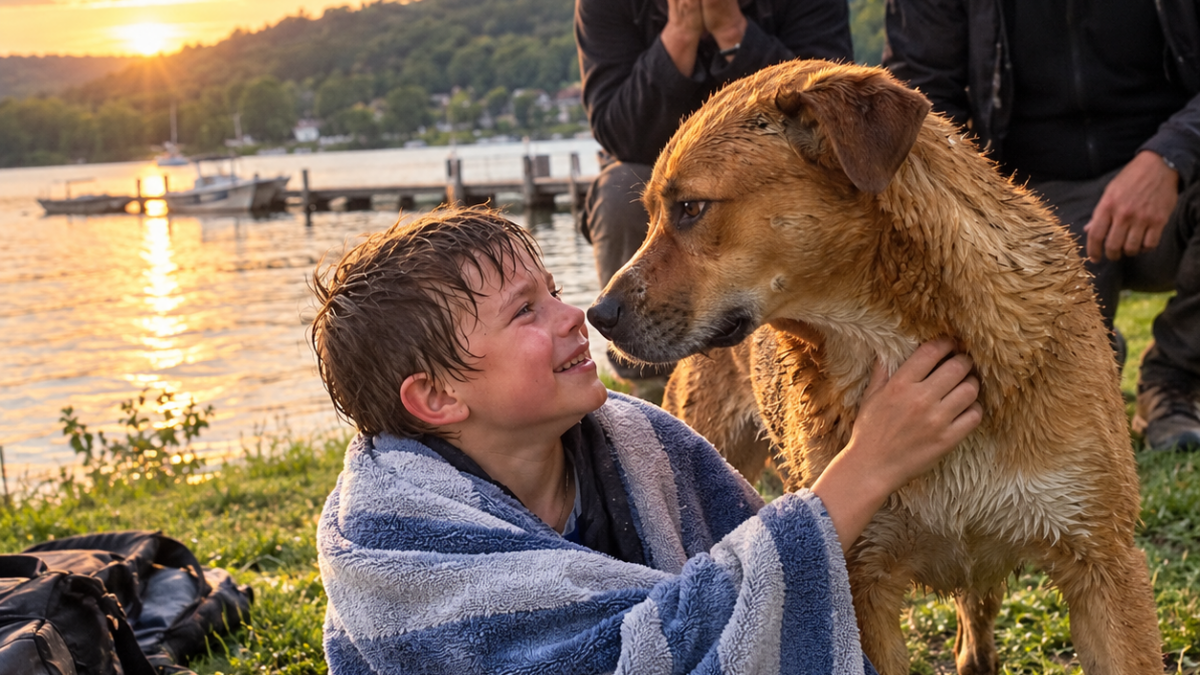
The more his injured leg collapsed beneath him, the harder the stray dog pulled on the unconscious boy’s jacket, because half of that child was still in the lake.
I watched the final yards from shore as the dog fought the water, lost his footing, got back up, and dragged again even though nobody had called his name and nobody seemed to know where he belonged.
But when the boy finally started breathing, the dog did something that made me realize the rescue at Lake Bourget had only uncovered the beginning of the story.
My name is Claire Moreau, and at the time I was a gendarme assigned to a small brigade in Savoie.
That Sunday afternoon, I was the first officer to reach an old dock along Lake Bourget after a fisherman called emergency services shouting that a child had gone into the water.
It was just after four.
By the time I ran down the bank, the dog was already there.
He was tan, medium-sized, with a broad white patch over his chest, one ear standing upright while the other folded slightly forward, and a pale scar running diagonally across his dark muzzle.
His fur was soaked.
His ribs showed when he breathed.
His left front leg barely supported him.
And his teeth were locked into the shoulder of an eight-year-old boy’s jacket.
The dog backed toward shore.
One step.
Then another.
His injured leg buckled.
He crashed against the stones.
The boy slid several inches backward toward the water.
“No,” I said, running faster.
The dog struggled upright before I reached them.
He shifted his grip higher on the jacket and pulled again.
This time, the boy’s head reached wet grass.
I dropped beside him.
The child wasn’t breathing.
The dog backed away perhaps six feet but refused to leave.
“No collar,” I noticed.
No leash.
No owner yelling for him.
Nothing that told me who this animal was or why he had just nearly destroyed his own body saving a child he apparently didn’t know.
I started CPR while a witness waved the ambulance toward us from the road.
Every time my hands moved, the dog watched.
Every time I stopped briefly to check the boy’s breathing, his head lifted.
“Come on,” I whispered. “Come on, sweetheart.”
The boy’s skin was frighteningly pale.
Then he coughed.
A small, wet sound.
Almost nothing.
But the dog immediately tried to stand.
His injured leg folded underneath him again.
“Stay down,” I told him, though I had no reason to believe he would listen.
He did.
Paramedics arrived moments later and took over.
Inside the boy’s jacket, we found a laminated emergency card.
LUCAS PERRIN.
Two telephone numbers.
Before we could call either one, a woman came running between the trees.
“Lucas!”
Sophie Perrin reached the stretcher first.
Her husband, Julien, was right behind her, his face drained of color and both hands held awkwardly in front of him as though he needed something solid to keep himself upright.
They had been less than two hundred yards away.
A family birthday had filled the picnic area with conversations, children, bags, food, and people moving between tables.
No one had seen Lucas follow his red ball toward the old dock.
No one had seen him fall.
No one except the dog.
The fisherman who made the emergency call was named Michel.
Later, while paramedics stabilized Lucas, Michel told me what he had witnessed.
The dog had been sleeping beneath an isolated picnic table since early afternoon.
Someone had tossed him a piece of meat.
He waited until the person walked away before eating it.
“He wanted to be near people,” Michel said, “but he didn’t trust them.”
Then a red ball rolled toward the abandoned dock.
Lucas followed.
There was a splash.
The dog’s head shot up.
According to Michel, he stared toward the water for perhaps two seconds.
Then he ran.
He reached the dock before any adult understood what had happened.
He jumped from the edge.
No command.
No hesitation.
No owner telling him what to do.
The dog swam directly toward Lucas, caught the shoulder of his jacket, turned him onto his back, and started pulling toward land.
Michel’s voice shook as he described it.
“I’ve had dogs my whole life,” he told me. “Claire, that wasn’t luck. That dog knew exactly where to grab him.”
I looked toward the animal.
He was lying in the grass now, shivering, his injured leg stretched awkwardly in front of him.
Sophie followed my gaze.
“That’s not our dog,” she whispered.
“I know.”
The dog heard Lucas cough again from the stretcher.
His head rose immediately.
Then, despite the injured paw, he pushed himself upright.
He didn’t go toward the boy.
Instead, he turned toward the trees behind the picnic area.
He stared into them.
One second.
Five.
Ten.
Then a low growl came from his chest.
Michel stopped speaking.
I stood.
And for the first time since arriving, I noticed something hanging from a branch near the abandoned dock.
A short piece of rope.
Freshly cut.
And caught around it was a narrow strip of tan fur.
PART 2
I walked toward the rope without touching it.
Behind me, the paramedics were preparing to move Lucas to the ambulance, Sophie was crying into one hand, and Julien kept asking the same question in different ways.
“Is he breathing normally?”
“Can I ride with him?”
“Is he conscious?”
“Will he be okay?”
The paramedic answered as carefully as he could.
“He’s breathing. That is the important thing right now. We need to take him to Chambéry.”
Julien nodded even though I wasn’t sure he heard any of it.
I crouched beside the branch.
The rope was synthetic, dark green, maybe eight millimeters thick.
One end had been cut cleanly.
The other had a loop tied into it.
Tan hairs were caught where the rope had rubbed against bark.
I looked back at the dog.
Same color.
Michel came closer.
“That his?”
“Maybe.”
“What does it mean?”
“I don’t know yet.”
I pulled on gloves and photographed the rope before touching it.
Then I bagged it.
The dog watched me the entire time.
His body remained pointed toward the trees.
Not toward the lake.
Not toward the crowd.
Toward the woods.
“What is it, boy?” Michel whispered.
The dog growled again.
Then he took three limping steps forward.
His front leg failed.
He hit the ground.
I went toward him slowly.
“Easy.”
He showed no teeth.
But when I reached within three feet, his muscles tightened.
I stopped.
“That’s fine. I’m staying here.”
His eyes moved from me to the trees.
Then back.
I had worked around frightened animals during searches, traffic accidents, farm incidents, and domestic interventions.
This was different.
He wasn’t trying to escape.
He was trying to decide whether I was useful.
That thought sounds ridiculous when I say it now.
It didn’t feel ridiculous then.
I turned toward another gendarme who had just arrived.
“Marc, stay with the ambulance. Get the family’s full information and have someone contact animal rescue.”
He looked toward the woods.
“You going in?”
“Not far.”
“Alone?”
“Michel saw the accident. I want him here.”
Michel blinked.
“Me?”
“You know what the dog was doing before Lucas fell.”
He looked at the dog.
Then at me.
“Okay.”
The ambulance doors closed.
The moment the engine started, the dog struggled upright.
He tried to follow it.
“Lucas!” Sophie cried from inside.
The dog took two desperate steps after the vehicle before his leg collapsed again.
That settled one thing for me.
Whatever else was happening, his concern for the boy was real.
I crouched beside him.
“They’re helping him.”
His breathing was fast.
“Now we help you.”
I removed my jacket and placed it on the grass near him.
He smelled it.
No reaction.
Then Michel pulled the remains of a sandwich from his bag.
The dog’s nose twitched.
“Don’t throw it directly at him,” I said.
Michel placed a small piece of chicken on the ground and backed away.
The dog waited.
Exactly as Michel had described.
He did not move until both of us stepped several yards back.
Then he limped forward and swallowed it.
“He expects people to take food back,” Michel said quietly.
“Or punish him for approaching.”
Another piece.
Another retreat.
We repeated it until the dog allowed me close enough to see his leg properly.
The injury wasn’t new.
There was swelling around the wrist joint and an older abrasion higher up.
Around his neck, hidden beneath wet fur, I saw another mark.
A narrow band of rubbed skin.
Almost a perfect circle.
A tether injury.
I looked toward the green rope in my evidence bag.
Michel saw my face.
“He was tied here?”
“Maybe.”
“For how long?”
“I don’t know.”
The dog stood again.
This time he moved toward the trees.
He looked back at me.
Walked another few steps.
Looked back.
Michel whispered, “He wants us to follow.”
“Maybe.”
But I followed.
Slowly.
Twenty yards beyond the picnic area, the sounds of the families faded.
The dog moved between trees with difficulty but determination.
Every few yards he stopped to make sure we were still there.
We reached a narrow service path.
He crossed it.
Behind a cluster of shrubs was a small clearing.
I smelled it before I saw anything.
Dog waste.
Old food.
Wet canvas.
Michel stopped.
“Oh, God.”
A crude shelter had been built between two trees using a torn tarp.
Beneath it sat an empty plastic bowl.
A rusted chain.
Two food tins.
And another length of green rope.
The rope ended at a thick metal stake driven into the ground.
No dog should have been living there.
Not beside a public picnic area.
Not hidden in brush.
Not with that kind of restraint.
The dog walked directly to the stake.
Then looked at me.
He wasn’t showing me where he lived.
He was showing me where someone had kept him.
I called Marc.
“Get another patrol here. And call the local animal protection officer now.”
“What did you find?”
“A tether site.”
“For that dog?”
“Looks like it.”
Michel noticed something near the tarp.
A plastic bag.
Inside were empty cans, old receipts, and a crushed cigarette package.
I kept him away.
“Don’t touch anything.”
The dog moved toward the back of the clearing.
There was a shallow depression in the ground.
Inside lay a red tennis ball.
Not Lucas’s.
Older.
Faded almost pink.
Then I saw two more.
And a child’s plastic bracelet.
Michel stared at me.
“What the hell happened here?”
I didn’t answer.
Not because I had a theory.
Because I had too many.
The dog suddenly barked.
One sharp sound.
He limped toward the path.
A man had appeared between the trees.
He stopped when he saw us.
Mid-forties.
Dark shorts.
Gray T-shirt.
Baseball cap.
His eyes went first to me.
Then to the dog.
Then to the rope stake.
“Can I help you?” I asked.
The man forced a smile.
“I was going to ask you the same thing.”
“You know this dog?”
“No.”
The dog growled.
Not loudly.
The man shifted backward.
I noticed scratches along his forearm.
“Never seen him?”
“No.”
“Interesting.”
“Why?”
“Because he seems to know you.”
The man looked at the dog.
“Strays growl at everybody.”
“This one didn’t growl at the paramedics.”
His face tightened.
Michel moved closer to me.
I asked, “What’s your name?”
“Why?”
“Because I’m asking.”
“Am I being detained?”
“Not currently.”
He looked toward the service path.
“Then I don’t have to answer.”
“No. But if you leave, I may identify you another way.”
That stopped him.
“Patrick Legrand.”
“Address?”
He gave one in Aix-les-Bains.
“What brings you here?”
“Walking.”
“Do you walk here often?”
“Sometimes.”
“Do you smoke?”
His eyes flicked toward the cigarette packet under the tarp.
“Sometimes.”
“What brand?”
He stared at me.
“Is this an interrogation?”
“No. It’s a conversation.”
“Then I’m done talking.”
He turned.
The dog lunged.
Not at him.
Toward him.
There is a difference.
The dog didn’t bare his teeth or snap.
He tried to close the distance.
His injured leg collapsed almost immediately.
Patrick flinched as though expecting to be bitten.
That reaction interested me.
People afraid of strange dogs usually back away.
Patrick raised one hand as if he knew exactly how far the dog could reach.
Except the dog wasn’t tethered anymore.
“Stop,” I told him.
Patrick looked at me.
“What?”
“Don’t leave yet.”
“You said I’m not detained.”
“That has changed.”
His face drained slightly.
I radioed for assistance.
Within minutes, Marc arrived.
Patrick protested.
We didn’t arrest him.
Not then.
We identified him, photographed the scene, and told him we would need a formal statement.
Animal rescue staff arrived with a veterinarian.
The dog refused a catch pole.
Refused food from the rescue officer.
Refused a blanket.
Then Lucas’s mother returned.
I hadn’t expected her.
The ambulance had left almost forty minutes earlier, but Sophie had followed in Julien’s brother’s car, realized Lucas’s emergency card and phone were still with us, and sent her sister back to retrieve them.
Sophie had come too.
“I couldn’t leave without knowing about him,” she said, looking at the dog.
She knelt.
I started to warn her.
The dog saw her.
His body changed.
The tension disappeared.
He limped toward Sophie.
She covered her mouth.
“Hey, sweetheart.”
He reached her and pressed his wet forehead against her chest.
Sophie wrapped both arms around him.
That was how we finally got a leash on him.
The veterinarian examined him beside the patrol car.
The left front leg had an untreated fracture that had begun healing badly.
Several weeks old.
He had abrasions around his neck consistent with prolonged tethering.
He was underweight.
Dehydrated.
The pale scar on his muzzle was old.
There were smaller scars beneath his fur.
Sophie stroked his ears.
“What happens to him?”
“He’ll go to a veterinary clinic first.”
“Can I visit?”
The rescue officer smiled gently.
“Let’s get your son stabilized first.”
Sophie looked toward me.
“He saved Lucas.”
“Yes.”
“I don’t care who owns him. Nobody is putting him back on a rope.”
Patrick, standing beside Marc, laughed once.
It was a small sound.
But Sophie heard it.
She turned.
“What is funny?”
“Nothing.”
“Do you know this dog?”
“No.”
The dog heard Patrick’s voice.
He pressed closer against Sophie.
Her face changed.
Mothers notice things.
“You do.”
Patrick rolled his eyes.
“Lady, I don’t know your dog.”
“He’s not mine.”
“Exactly.”
She took one step toward him.
Marc moved between them.
Sophie pointed at the dog’s neck.
“Somebody did that.”
Patrick shrugged.
“Strays get into things.”
“And somebody broke his leg?”
“I don’t know.”
“And tied him to a tree?”
Patrick’s eyes moved toward me.
I said, “Ms. Perrin, we need you to leave this to us.”
She breathed hard.
Then looked at the dog.
“I have to go to Lucas.”
“Yes.”
She kissed the dog’s forehead.
“I’ll come back.”
The animal watched her walk away.
Then the rescue team lifted him carefully onto a stretcher.
Before the vehicle doors closed, I asked the veterinarian, “Can you scan for a chip?”
He did.
The scanner beeped.
We all froze.
The veterinarian ran it again.
Another beep.
“He’s chipped.”
Patrick looked away.
I saw it.
So did Marc.
Within twenty minutes, we had the registration.
The dog had a name.
Rex.
Male.
Approximately four years old.
Registered owner:
Patrick Legrand.
Patrick’s story collapsed before sunset.
He stopped pretending he’d never seen the dog.
Now he claimed Rex had run away six months earlier.
The microchip record showed no lost-animal report.
Patrick insisted he’d called shelters.
No shelter had a record.
He said somebody else must have tied Rex near the lake.
Then we found photographs on his public social-media profile.
Rex in his yard.
Rex beside his car.
Rex as a younger dog wearing a thick black collar.
And one photograph posted only nine weeks earlier.
Rex lying behind Patrick’s garage.
Six months missing had become nine weeks present.
Patrick changed his story again.
He said the photograph was old.
Metadata said otherwise.
At the hospital that evening, Lucas opened his eyes.
I didn’t learn that until almost nine.
Sophie called my work phone.
“He asked about the dog.”
I smiled for the first time all day.
“What did you tell him?”
“That he’s getting help.”
“Good.”
“He doesn’t remember falling.”
“That’s probably normal.”
“He remembers his ball.”
Sophie went quiet.
Then: “Claire?”
“Yes?”
“Can I ask something?”
“Of course.”
“Why would that dog do that?”
I looked at the evidence photographs on my desk.
The tether.
The scars.
The fractured leg.
“I don’t know.”
“But he didn’t know Lucas.”
“No.”
Sophie started crying again.
“He saved my son anyway.”
“Yes.”
The investigation into Patrick moved quickly.
Not because Rex had rescued Lucas.
Heroism isn’t evidence of abuse.
The evidence came from the clearing.
From veterinary findings.
From Patrick’s contradictory statements.
From the rope.
And eventually from his phone.
He gave consent for a limited search because, at first, he seemed convinced there was nothing incriminating on it.
He was wrong.
There were photographs of Rex tied near the lake.
Not one.
Dozens.
Patrick had been bringing him there for months.
Sometimes for hours.
Sometimes overnight.
Why?
That was the question.
The answer began with gambling.
Patrick owed money.
Not enormous organized-crime money.
But enough to frighten him.
He had started using Rex in illegal dog-training exercises organized by a small group outside Chambéry.
Not formal fights in some hidden arena.
Something uglier in its ordinariness.
Men testing aggressive dogs.
Using weaker animals to provoke them.
Timing reactions.
Betting on which dogs would engage.
Rex wouldn’t.
That was the problem.
Again and again, Patrick tried to make him aggressive.
He isolated him.
Tethered him.
Starved him before sessions.
Used intimidation.
According to messages later recovered from Patrick’s phone, Rex repeatedly refused to attack.
One text from another man read:
Your mutt’s useless. He backs off every time.
Patrick replied:
I’ll fix him.
Another:
He’ll learn when he’s hungry enough.
He didn’t.
Whatever Patrick did, Rex did not become the dog he wanted.
Eventually Rex’s leg was injured during one of those sessions.
Patrick didn’t take him to a veterinarian because questions might be asked.
He brought him to the lake instead.
Tied him out of sight.
Left food occasionally.
And apparently waited for the problem to solve itself.
It almost did.
Except Rex broke the rope.
The fibers on the branch matched the rope at the tether site.
The fresh cut I’d noticed wasn’t from a knife.
It was a tension failure where weakened rope had scraped repeatedly against bark.
Rex had pulled until it snapped.
When?
We couldn’t know exactly.
Michel had first seen him free beneath the picnic table around one in the afternoon.
Perhaps he’d broken loose that morning.
Perhaps an hour earlier.
Then, after weeks of being tied, hungry, injured, and ignored, the first thing he did with his freedom was save a child.
That fact destroyed me.
It destroyed Sophie too.
Three days after the rescue, Lucas was discharged from the hospital.
His lungs were clear enough.
No neurological injury.
No serious complications.
Eight years old.
Bruised.
Exhausted.
Alive.
Sophie called the rescue clinic before driving him home.
“Can we visit Rex?”
The veterinarian said yes, briefly.
I happened to be there.
Officially, I was collecting medical documentation.
Unofficially, I wanted to see him.
Rex had undergone surgery on the injured leg that morning.
He was awake but groggy.
His front leg was bandaged.
He wore no collar.
Lucas entered slowly.
He looked much smaller than I’d remembered on the lake shore.
Children always do after the emergency ends.
He held his mother’s hand.
Rex smelled him before he saw him.
His head lifted.
Lucas stopped.
“That’s him?”
Sophie nodded.
“That’s Rex.”
The boy approached.
Rex tried to stand.
The veterinarian put a hand against his shoulder.
“No, buddy. Stay down.”
Lucas knelt beside the bed.
For several seconds he didn’t touch him.
Then he whispered, “You pulled me out.”
Rex’s tail moved once.
Lucas smiled.
The dog leaned forward and touched his nose to the boy’s hand.
Lucas started crying.
Quietly.
No dramatic sobs.
Just tears sliding down his face while he stroked Rex’s wet-black nose with one finger.
“I don’t remember you.”
Rex licked his knuckle.
“I’m sorry.”
Sophie knelt behind her son.
“You don’t have to remember for it to matter.”
Lucas pressed his forehead against Rex’s.
The dog closed his eyes.
I stepped into the hallway.
I had witnessed fatalities.
Domestic violence.
Road collisions.
People receiving news that divided their lives into before and after.
You learn, in uniform, how to stand beside emotion without drowning in it.
That afternoon, I failed.
I leaned against the wall and cried.
Michel arrived ten minutes later carrying a red tennis ball.
He’d found Lucas’s original ball wedged beneath the old dock.
“I cleaned it,” he said.
Lucas took it.
Then immediately put it beside Rex.
“For you.”
Rex smelled it.
His tail moved.
That ball stayed with him for years.
Patrick was arrested the next morning.
The illegal training group widened the case beyond him.
Three other men were questioned.
Two properties were searched.
Seven dogs were removed.
One was so fearful he had to be transported without direct handling.
Another had fresh injuries.
The third was pregnant.
The rest were physically better but showed clear signs of chronic neglect.
No evidence suggested Rex had been used to seriously injure another animal.
In fact, messages repeatedly complained that he wouldn’t engage.
That mattered to Sophie more than I expected.
“He kept refusing,” she said.
“Yes.”
“Even after everything.”
“Yes.”
“Then he sees Lucas drowning and jumps in.”
I knew what she was thinking.
Patrick had tried to teach Rex that weakness was something to attack.
Rex had decided weakness was something to protect.
I would never say dogs reason morally like people.
I don’t need to.
Behavior speaks for itself.
Patrick’s lawyer tried to make the lake rescue irrelevant.
Legally, he was mostly right.
Rex saving Lucas didn’t prove what Patrick had done earlier.
So we built the case without leaning on the heroic part.
Veterinary records showed the untreated fracture.
Forensics linked rope fibers.
Phone data placed Patrick repeatedly at the tether site.
Photographs showed Rex restrained there.
Messages documented the training activity.
Bank transfers and betting conversations connected the men.
Witnesses described the sessions.
One witness mattered more than the others.
His name was Damien Roux.
Twenty-six.
He had attended several illegal training sessions but hadn’t owned a dog.
He placed bets.
At first, he denied everything.
Then investigators showed him photographs of Rex.
Damien stared at the pale scar on his muzzle.
“I know that dog.”
He described a night in June.
Patrick had brought Rex to a fenced piece of private land.
Another man had brought a larger dog known for aggression.
Rex was tethered.
The other dog was restrained separately.
The men expected barking, lunging, excitement.
Rex sat down.
Patrick shouted.
Rex moved behind him.
The men laughed.
Patrick became furious.
Damien said Patrick jerked Rex forward by the collar.
Rex still refused.
Then something happened and Rex injured his leg while trying to retreat.
Damien’s description matched the fracture pattern.
“Why didn’t you stop it?” I asked during his statement.
He looked at his hands.
“I don’t know.”
“That’s not an answer.”
“I was drunk.”
“Still not an answer.”
He swallowed.
“Because everybody else acted like it was normal.”
There it was.
The explanation behind a thousand ugly things.
Everybody else acted like it was normal.
Damien looked at me.
“I didn’t hurt him.”
“No.”
“But I didn’t help him.”
“No.”
He cried then.
I didn’t comfort him.
Not immediately.
Regret has value only when you’re willing to stay inside it long enough to change.
He agreed to cooperate fully.
His testimony helped identify the organizer.
The investigation lasted months.
During that time, the Perrin family applied to foster Rex.
Animal protection initially said no.
Not because of the family.
Because Rex remained evidence in an active case and needed rehabilitation.
Sophie was furious.
“He saved our son.”
“I know.”
“And now he stays in a kennel?”
“A medical foster kennel.”
“Still a kennel.”
“He’s healing.”
“I can help him heal.”
I let her be angry.
Then explained the part she didn’t want to hear.
“Rex has lived under stress for months. He may guard food. He may panic around ropes. He may react to sudden movement. Lucas is eight.”
Sophie looked toward her son.
Lucas was in the waiting room drawing something.
“He’d never hurt Lucas.”
“Maybe not.”
“You don’t believe that.”
“I believe Rex deserves a transition that doesn’t require him to be perfect because he did something heroic.”
That stopped her.
I continued.
“If he growls once because he’s frightened, people cannot decide the hero dog suddenly became dangerous. We need to let him be a dog, not a legend.”
Sophie sat down.
Her anger went out of her.
“I hadn’t thought about that.”
“Most people don’t.”
“What can we do?”
“Visit. Work with the behaviorist. Learn his triggers. Let him decide whether your family is where he wants to be.”
She smiled faintly.
“Decide?”
“Yes.”
“He already decided at the lake.”
“Maybe.”
Rex’s rehabilitation took four months.
His leg healed slower than we hoped.
The fracture had been untreated too long, and surgery could only correct part of the damage.
He would always have a slight limp.
But the bigger injuries weren’t visible.
The first time someone picked up a rope near him, Rex flattened himself to the floor.
A broom handle made him hide.
A raised male voice sent him searching for an exit.
He ate too fast.
Slept lightly.
Woke at small sounds.
And yet Lucas could sit beside him for an hour without Rex showing any anxiety at all.
Lucas read to him.
At first children’s adventure books.
Then comic books.
Then whatever homework Sophie wanted him to practice.
Rex didn’t care.
He would rest his head on Lucas’s shoe and listen.
The red ball stayed nearby.
One afternoon, Lucas asked me something while Sophie spoke with the behaviorist.
“Did Rex know I was dying?”
I sat beside him.
“I don’t know what Rex understood.”
“Michel said I wasn’t moving.”
“That’s true.”
“Would he have died too?”
“What do you mean?”
“He was hurt. And the water was deep.”
I chose my words carefully.
“He put himself in danger.”
Lucas looked toward Rex.
“Why?”
“No one can know exactly.”
“He didn’t know me.”
“No.”
Lucas thought about that.
Then said, “Maybe he knows what it’s like when nobody helps.”
I had no answer.
Sometimes an eight-year-old reaches the truth faster than adults because he doesn’t bother building walls around it.
By November, animal protection approved a trial foster with the Perrins.
I went with Rex on his first day.
Their house sat outside Chambéry with a fenced garden and a view toward the mountains.
Julien had built a low ramp beside the back steps because of Rex’s leg.
He had also bought three dog beds.
One for the living room.
One for Lucas’s bedroom.
One for the kitchen.
Sophie looked embarrassed.
“I didn’t know where he’d want to sleep.”
Rex solved the problem.
He ignored all three.
He lay directly across the hallway where he could see Lucas’s room, the front door, and most of the living room.
Julien laughed.
“Security position.”
Maybe.
Or maybe he simply liked the cold tile.
That first night, Sophie texted me at 11:42.
He won’t sleep.
I called.
“What is he doing?”
“Walking between Lucas’s room and the front door.”
“Leave doors open. Don’t crowd him.”
“He keeps checking Lucas.”
“Then let him.”
At 1:10 she texted again.
He’s asleep outside Lucas’s door.
The next morning, I received a photograph.
Lucas sleeping.
Door open.
Rex stretched across the threshold.
Red ball beside one paw.
I saved it.
I still have it.
Patrick, meanwhile, began looking for ways to avoid consequences.
He blamed the other men.
Then Damien.
Then debt.
Then alcohol.
Then Rex himself.
That last one came during an interview.
He said Rex had been “unmanageable.”
I asked, “In what way?”
“He wouldn’t obey.”
“What command?”
Patrick didn’t answer.
“What command, Mr. Legrand?”
“He was supposed to work.”
“Doing what?”
Silence.
“You mean attack.”
“No.”
“Then what?”
“He was a dog. Dogs have jobs.”
“Rex found one.”
He looked at me.
“What?”
“Saving an eight-year-old boy.”
His face hardened.
I shouldn’t have said it.
It wasn’t investigative.
It was personal.
But I don’t regret it.
Patrick laughed without humor.
“You people act like he’s some saint.”
“No.”
“He’s an animal.”
“Yes.”
“He doesn’t know what he did.”
“Maybe not.”
“So stop making it sound noble.”
I leaned forward.
“You’re right about one thing.”
“What?”
“Rex doesn’t know reporters wrote about him. He doesn’t know strangers call him a hero. He doesn’t know anyone is impressed.”
Patrick said nothing.
“He just saw a child in the water and went in.”
That ended the interview.
The case reached court the following spring.
By then, Rex had become famous locally despite our efforts to keep attention controlled.
Someone had recorded part of the rescue.
Not the fall.
Not the worst moments.
A thirty-second clip showing Rex dragging Lucas through the shallows while his leg repeatedly collapsed.
The video spread.
People sent gifts.
Dog food.
Harnesses.
Money.
One company offered Sophie thousands of euros to use Rex in an advertisement.
She refused.
“I’m not selling what he did.”
Instead, all donations went through an animal welfare association supporting the seven dogs removed during the investigation.
Lucas suggested the fund’s name.
Rex’s Second Chance.
I suggested something less centered on Rex.
Lucas objected.
“He gave them one too.”
I lost that argument.
The money paid for surgery, foster care, training, and long-term treatment for several dogs.
That was one of the first things that felt like real revenge.
Patrick had treated vulnerable dogs as tools to generate money.
Rex generated money too.
But every euro went toward repairing what men like Patrick had damaged.
The courtroom was crowded on the day Patrick testified.
His lawyer tried to separate the injured dog in the photographs from the dog at the lake.
“He was fed.”
Sometimes.
“He had shelter.”
A torn tarp.
“He was not permanently abandoned.”
Only left injured and tethered out of sight.
“He was difficult to handle.”
Veterinary staff disagreed.
“He had escaped before.”
No records supported that.
Then the messages were introduced.
Your mutt’s useless.
I’ll fix him.
He’ll learn when he’s hungry enough.
Patrick stared at the table.
His lawyer argued that crude private messages didn’t necessarily describe actual abuse.
Then Damien testified.
He described the sessions.
He described Rex refusing to engage.
He described the injury.
He described Patrick’s rage.
Patrick’s lawyer attacked Damien’s credibility.
“You participated.”
“Yes.”
“You gambled.”
“Yes.”
“You were intoxicated.”
“Yes.”
“You initially lied to investigators.”
“Yes.”
“So why should this court believe you now?”
Damien looked toward Patrick.
Then toward the judge.
“Because I’m telling you what makes me look bad too.”
The room went quiet.
That was the strongest answer he could have given.
Truth that costs the speaker something carries weight.
I testified after him.
Most of my testimony concerned the tether site and Patrick’s contradictory statements.
Then the prosecutor asked about Rex’s behavior when Patrick appeared in the clearing.
“He became focused on Mr. Legrand.”
“Aggressive?”
“I would not characterize it as aggressive.”
“Why?”
“He tried to move toward him. He growled, but he did not lunge to bite. His posture appeared fearful and conflicted.”
Patrick’s attorney stood.
“Officer Moreau, are you a veterinary behaviorist?”
“No.”
“Then your interpretation is speculation.”
“My interpretation of motivation may be. My description of what I observed is not.”
He moved on.
Sophie testified about arriving at the lake.
She cried before she spoke a full sentence.
The judge gave her time.
She described seeing Lucas on the stretcher.
Rex shaking nearby.
The wounds around his neck.
The way he tried to follow the ambulance.
Patrick’s lawyer objected when the prosecutor asked how she felt.
The question was narrowed.
Then Lucas’s rescue video played.
I had seen it before.
I still wasn’t ready.
Rex’s injured leg folded.
His body disappeared lower into the water.
He recovered.
Pulled again.
Lucas’s head reached shore.
Thirty seconds.
No music.
No narration.
No dramatic editing.
Just a dog who had every reason to save himself spending what strength remained on somebody else.
Patrick didn’t watch the screen.
I watched Patrick.
That may not have been professional.
But I wanted to know whether he would look.
He didn’t.
The trial included the other defendants involved in the illegal training operation.
Not everyone received the same outcome.
Some had participated less.
Some evidence was stronger than others.
Patrick faced the most direct evidence regarding Rex.
When judgment came, he was convicted on animal cruelty and related offenses, along with charges connected to the illegal animal-training and betting activity proven against him.
He received a custodial sentence, part subject to the specific rules of French sentencing and supervision, significant financial penalties, and a long prohibition on owning or working with animals.
The court permanently removed Rex from his ownership.
That last part made Sophie cry harder than the sentence.
Patrick could serve time.
Pay money.
Lose privileges.
None of it mattered to her as much as one sentence:
Rex would never legally belong to him again.
The other removed dogs were transferred through recognized rescue organizations.
The pregnant female later delivered six puppies in a foster home.
All survived.
One of the frightened males eventually went to Damien.
That surprised everyone.
Including me.
Animal protection made him wait almost a year.
He underwent screening.
Training.
Home inspections.
Volunteer hours.
He didn’t ask for special treatment.
He understood why.
The dog was named Oscar.
The first time I visited, Oscar stayed across the room.
Damien sat on the floor and didn’t approach him.
“You sure about this?” I asked.
“No.”
“Good.”
He smiled.
“You always this encouraging?”
“Only with people who deserve it.”
He nodded.
“I do deserve that.”
I respected him for saying it.
He never asked me to forgive him for participating.
He just kept showing up.
Sometimes accountability doesn’t look like one punishment.
Sometimes it looks like making different choices for years.
Patrick took longer to understand that, if he ever did.
He appealed parts of the judgment.
His lawyer challenged aspects of the evidence.
Some procedural issues moved slowly.
That frustrated Sophie.
“Why does he get so many chances?”
“Because that’s what a legal system is supposed to provide.”
“Even him?”
“Especially people we dislike.”
She hated my answer.
So did I sometimes.
But revenge without rules is just another form of power.
And I had seen what Patrick did when he believed power was enough.
Rex’s adoption became final in early summer.
We held no public ceremony.
No reporters.
No speeches.
The Perrins signed the paperwork in the rescue office.
Lucas sat on the floor.
Rex lay against his legs.
The coordinator slid the final document toward Sophie.
“Name staying Rex?”
Sophie looked at Lucas.
Lucas looked offended.
“Of course.”
Julien laughed.
“We tried other names.”
“What names?” I asked.
“Hero,” Sophie said.
Lucas made a face.
“Terrible.”
“Lucky.”
“Worse.”
“Bourget.”
“That sounds like a cheese.”
I laughed.
“So Rex.”
Lucas scratched behind the dog’s good ear.
“He already had one good thing before us. His name.”
Sophie signed.
Then Julien.
The coordinator stamped the form.
“That’s it.”
Sophie stared at the page.
“That’s it?”
“That’s it.”
She started crying.
Julien put an arm around her.
Lucas looked at me.
“Does that mean nobody can take him?”
“Not without going through your parents, a lot of paperwork, and probably me.”
He smiled.
“Good.”
Rex lifted his head.
Lucas hugged him.
“Home.”
That should have been the end.
It wasn’t.
Three weeks later, someone threw raw meat over the Perrins’ fence.
Rex found it before Julien did.
He smelled it.
Didn’t eat it.
That saved him.
The meat contained crushed medication.
Not enough to guarantee death.
Enough to make a dog extremely ill.
The retaliation case began immediately.
Sophie called me shaking.
“He’s coming after Rex.”
“We don’t know that.”
“Who else?”
“We don’t know.”
“You always say that.”
“Because until we have evidence, it’s true.”
“I am tired of evidence.”
“I know.”
“He saved my son, Claire.”
“I know.”
“If that man touches him—”
“Sophie.”
Silence.
“Keep Lucas inside. Keep Rex inside. Officers are coming.”
Security cameras at a neighboring house captured a vehicle at 2:36 a.m.
Dark hatchback.
Partial plate.
Not Patrick’s.
Patrick was under supervised conditions that made direct involvement difficult anyway.
The vehicle belonged to his cousin, Jérôme Legrand.
Jérôme initially denied being near the house.
Then traffic cameras placed him in the area.
A search of his garage found the same veterinary sedative packaging associated with the contaminated meat.
He claimed it was for livestock.
He didn’t own livestock.
Phone records showed Patrick had spoken with Jérôme repeatedly in the week before the incident.
Did Patrick explicitly order him to poison Rex?
We never established that to a standard I could responsibly claim.
Jérôme said no.
Patrick said no.
There were no messages spelling it out.
But Jérôme admitted he wanted to “teach that family a lesson” because he believed their media appearances had destroyed Patrick’s life.
Sophie nearly exploded when she heard that.
“Our media appearances?”
She had given one interview.
Lucas none.
The rescue video had been filmed by someone else.
But resentment doesn’t require accuracy.
Jérôme was prosecuted for what could be proved against him.
The Perrins installed better fencing and cameras.
For weeks, Lucas wouldn’t let Rex outside alone.
That hurt more than he admitted.
One evening I visited.
Lucas sat on the back steps with Rex beside him.
“You scared?” I asked.
“No.”
“That’s not convincing.”
He stared at the garden.
“What if somebody takes him?”
“Then they’ll have to get through a lot of people.”
“What if we’re sleeping?”
“The cameras are on.”
“What if—”
“Lucas.”
He looked at me.
“You can’t build your whole life around what somebody bad might do next.”
He looked down.
“Rex did.”
That stopped me.
Because he was right.
Rex had spent months learning to anticipate harm.
Food might disappear.
A hand might hurt.
A rope meant confinement.
A raised voice meant danger.
Now Lucas was beginning to do the same.
I sat beside him.
“You know what helped Rex?”
“What?”
“People being predictable.”
He looked at me.
“Food came when it was supposed to. Nobody hit him. Doors opened again. Walks ended at home. He learned that most days were boring.”
Lucas smiled a little.
“Boring?”
“Boring is underrated.”
Rex put his chin on Lucas’s knee.
I scratched his ear.
“We’ll handle the dangerous things. Your job is to give him boring.”
Lucas thought about it.
Then threw the red ball.
Rex ran after it.
With a limp.
Always the limp.
But fast enough.
That became the family’s real victory.
Not headlines.
Not sentencing.
Not Patrick losing Rex.
Boring afternoons.
Rex sleeping beneath the kitchen table.
Lucas doing homework.
Julien burning dinner.
Sophie complaining about dog hair on black clothes.
Ordinary life.
The kind Patrick had denied Rex.
The kind the lake nearly denied Lucas.
A year after the rescue, Michel organized a small picnic near Lake Bourget.
Same area.
Not the old dock.
That section had been repaired and fenced after the incident.
The municipality installed better barriers and warning signs.
Michel insisted we meet there.
Lucas brought Rex.
Rex stopped when he smelled the lake.
His body stiffened.
Sophie looked at me.
“Should we leave?”
“No.”
The behaviorist had taught them not to force him and not to flee every discomfort either.
Lucas sat in the grass.
He didn’t call Rex.
Didn’t pull the leash.
Just sat.
Rex stood ten feet from the water.
Then five.
Then he looked at Lucas.
Lucas rolled the red ball between his hands.
“You don’t have to.”
Rex approached him.
Sat.
The lake moved quietly behind them.
Michel wiped his eyes.
“I’m getting old.”
“You were old last year.”
“Thank you, Claire.”
“You’re welcome.”
He handed me coffee.
A group of children played farther up the shore.
One ball rolled toward us.
Blue this time.
Rex watched it.
A little girl ran after it.
Her father called her back before she reached the water.
Rex relaxed.
Lucas noticed.
“He checks.”
“Yes.”
“Every time.”
“Yes.”
“Does that ever stop?”
I looked at Rex.
“I don’t know.”
Lucas put a hand on his neck.
“That’s okay.”
The dog leaned against him.
That afternoon, the mayor presented Rex with a small medal from the municipality.
I had argued against turning it into a spectacle.
Lucas wanted the ceremony.
His reason changed my mind.
“He doesn’t know what a medal is,” he said. “But people do. Maybe when they see it, they’ll remember dogs like him shouldn’t be tied somewhere and forgotten.”
So we did it.
No costume.
No stupid hat.
No forcing Rex onto a stage.
He stood beside Lucas on the grass while the mayor spoke briefly.
The medal attached to his new red collar.
Rex immediately tried to scratch it off.
Everyone laughed.
Then Lucas leaned toward him.
“You hate awards too?”
Rex sneezed.
The photograph from that moment became my favorite.
Not the lake rescue.
Not the courtroom.
Lucas laughing.
Rex looking irritated.
Sophie in the background crying.
Julien pretending he wasn’t.
Later, after most people left, Sophie walked with me toward the old dock.
“You know what I wanted at first?” she asked.
“What?”
“I wanted Patrick to hurt.”
I didn’t answer.
“I wanted him terrified. I wanted him to lose everything.”
“Understandable.”
“Is that wrong?”
“Feelings aren’t court orders.”
She smiled slightly.
“I still hate him.”
“You may always.”
“But it’s different now.”
“How?”
She looked back.
Rex was lying beneath a tree while Lucas and Michel argued over how to grill sausages.
“I used to think revenge meant Patrick having a miserable life.”
“And now?”
“Now I think it’s Rex having a good one.”
I nodded.
That was exactly it.
Patrick had tried to turn Rex into something violent.
Rex became known for saving a child.
Patrick had used hunger to control him.
Rex now had to be stopped from stealing roast chicken off Julien’s counter.
Patrick had tied him where nobody could see him.
Rex now slept wherever he pleased in the center of a family home.
Patrick had left his broken leg untreated.
Lucas saved money from birthdays for a canine hydrotherapy program so Rex could stay mobile as he aged.
Patrick had treated him as useless because he wouldn’t attack.
The quality Patrick hated became the reason Rex survived in people’s memory.
He wouldn’t hurt something weaker.
When something weaker needed him, he pulled it home.
Three years passed.
Lucas grew taller.
Rex’s muzzle became lighter.
His injured leg developed arthritis earlier than expected.
On cold mornings, he moved slowly.
Lucas learned to massage the muscles around his shoulder.
They had a routine.
Breakfast.
Short walk.
School.
Rex slept in the hallway.
Lucas came home.
Red ball.
Homework.
Dinner.
Another walk.
Boring.
Perfect.
I remained in contact with them partly because of the case and eventually because friendships don’t always announce when they begin.
Sophie became the person who called me when she was angry at Julien.
Julien became the person who repaired my garden gate without being asked.
Michel joined every family barbecue.
He claimed honorary-grandfather status despite having no legal basis whatsoever.
Rex loved him because Michel always dropped food.
“Accidentally,” Michel insisted.
Every single time.
Damien volunteered at the rescue twice a month.
Oscar eventually slept on his bed.
The first time that happened, Damien sent me a photograph at 1:03 a.m.
HE GOT ON BY HIMSELF.
I replied:
GO TO SLEEP.
He answered:
CAN’T.
I understood.
Jérôme’s retaliation conviction brought its own penalties and restrictions.
We never proved Patrick directed it.
Sophie struggled with that for a while.
She wanted every question answered.
Most victims do.
Real cases rarely offer that.
Eventually she accepted the difference between suspicion and proof.
That was harder than believing the worst.
It was also necessary.
I retired from active service several years later.
On my last day, my colleagues gave me a framed photograph.
I expected something humiliating.
It was Rex.
Not at the lake.
Standing beside my patrol vehicle months later during a school safety event.
Lucas was holding the leash.
On the back, my colleagues had written:
FIRST ON SCENE. SECOND BEST RESCUER.
Fair.
I hung it in my hallway.
Rex lived long enough to see Lucas enter secondary school.
Then high school.
Age changes large dogs faster than we want.
His walks shortened.
The red ball became something he carried rather than chased.
Stairs became difficult.
Julien built another ramp.
Then another.
Sophie placed rugs over slippery floors.
Lucas slept downstairs during Rex’s hardest weeks because he didn’t want him alone.
I visited one Sunday.
Rex was gray almost everywhere.
The pale scar across his muzzle had nearly disappeared into the lighter fur.
But his eyes were the same.
Dark.
Watchful.
Gentle.
He lifted his head when I entered.
“Still remember me?”
Tail.
One thump.
Good enough.
Lucas came from the kitchen.
He was sixteen now.
Nearly as tall as Julien.
“He’s having a bad week.”
“I can see.”
The veterinarian had been.
Medication adjusted.
Pain controlled.
But time was winning.
We all knew.
Lucas sat on the floor beside Rex.
“Do you think he remembers the lake?”
I had been asked versions of that question for eight years.
“I don’t know.”
“I barely do.”
“You were unconscious for the important part.”
He smiled.
Then looked down.
“I only remember everyone telling me.”
“That can be enough.”
“What do you remember?”
I didn’t need to think.
“His leg collapsing.”
Lucas stroked that leg gently.
“What else?”
“The way he got up.”
Silence.
Rex breathed slowly.
“What else?”
“The way he watched you when you coughed.”
Lucas’s eyes filled.
“What else?”
“The fact nobody knew his name.”
He swallowed.
“And then?”
“Then we learned it.”
Lucas leaned over and kissed Rex’s forehead.
“He always knew mine.”
Maybe.
The emergency card.
Sophie shouting.
Years of hearing it afterward.
Who knows what parts dogs attach meaning to.
But Rex had known Lucas in the only way that mattered before he knew anything else about him.
A body in trouble.
A life worth pulling toward shore.
Rex died at home two months later.
Not alone.
Not tied.
Not hungry.
Not afraid.
Lucas lay beside him.
Sophie held his head.
Julien kept one hand on his back.
Michel sat nearby.
I arrived shortly before the veterinarian.
The red ball was between Rex’s paws.
Lucas didn’t speak much.
None of us did.
At one point Rex opened his eyes.
Lucas whispered, “I’m here.”
His tail moved.
Barely.
One final thump.
The veterinarian gave him medication to sleep.
Then the last injection.
His breathing slowed.
Stopped.
Lucas pressed his face into Rex’s neck.
I looked toward the window because I couldn’t watch.
Outside, rain had begun.
Light rain.
The kind that barely marks the glass.
I thought about the lake.
Water had nearly taken Lucas.
Water had carried Rex toward him.
Eight years later, rain tapped softly against the house where both of them had gotten far more time together than either should have had.
Afterward, Lucas removed the medal from Rex’s collar.
He kept the collar.
Sophie asked what he wanted to do with the red ball.
Lucas thought.
Then said, “Not bury it.”
A week later, we went back to Lake Bourget.
Just six of us.
No ceremony.
No media.
Lucas carried the red ball.
Near the repaired dock stood a small municipal plaque installed years earlier.
It didn’t glorify the rescue.
It simply recorded that a stray dog named Rex had pulled an eight-year-old child from the lake and that improved safety barriers had been added afterward.
Lucas sat beneath the tree where Michel first saw Rex sleeping.
He placed the ball in his lap.
“I used to think he saved me once.”
Sophie sat beside him.
“He did.”
Lucas shook his head.
“No.”
He looked at all of us.
“He saved me every day after.”
Nobody asked what he meant.
We knew.
A child who nearly dies doesn’t simply return to normal.
Lucas had nightmares after the lake.
Fear of deep water.
Guilt when he learned Rex had been injured during the rescue.
Then fear during the retaliation.
Rex had been beside him through all of it.
When Lucas woke at night, Rex was at the door.
When he first returned to swimming lessons, Rex waited outside the facility with Sophie.
When Lucas finally swam across a pool without panicking, the first thing he did was kneel beside Rex and tell him.
When Lucas became afraid of losing people he loved, Rex taught him that love isn’t made safer by refusing it.
Sophie put her arm around her son.
“What do you want to do with the ball?”
Lucas stood.
For one second I thought he’d throw it into the lake.
He didn’t.
He walked toward a little boy sitting with his father farther along the grass.
The boy had a small dog.
Lucas knelt.
“Does your dog like balls?”
The child nodded.
Lucas held out the faded red tennis ball.
“This belonged to a really good dog.”
The father looked toward us.
He recognized the story.
I could tell.
He didn’t say anything.
The little boy took the ball.
His dog grabbed it immediately.
Lucas laughed.
That was what Rex would have wanted, if dogs wanted symbolic things.
Not a ball sealed behind glass.
Not a shrine.
A dog running after it.
We watched the little terrier race across the grass.
Then Lucas turned toward the lake.
He wasn’t crying anymore.
Neither was I.
Years have passed since that Sunday.
I have been asked about Rex hundreds of times.
People always want to know whether I think he was naturally heroic.
Whether training from some earlier owner taught him water rescue.
Whether instinct made him turn Lucas onto his back.
Whether some forgotten memory told him where to grip the jacket.
We never found evidence Rex had formal rescue training.
Patrick had owned him from young adulthood.
Before that, records led only to an ordinary rural foster.
Maybe Rex learned something nobody documented.
Maybe he improvised.
Maybe dogs understand drowning better than we think.
I don’t know.
And after all these years, I no longer think that is the most important question.
The important part isn’t why Rex entered the water.
It’s what he did after a human had spent months teaching him that humans could be cruel.
He still went.
He was hurt.
He went.
He was exhausted.
He pulled.
His leg failed.
He stood again.
He didn’t know Lucas’s family.
He pulled.
He had no home waiting for him.
He gave someone else the chance to go home.
Patrick thought Rex’s refusal to attack made him worthless.
That was the cruelest mistake he made.
Because Rex wasn’t weak.
He had simply refused to become what someone else wanted cruelty to turn him into.
And in the end, that refusal became his whole legacy.
A boy lived.
Seven other dogs were removed from danger.
An illegal operation was exposed.
A frightened witness finally spoke.
A family grew larger.
A lake became safer.
And a dog who once slept beneath a picnic table because he wanted to be near people but was afraid to trust them spent the rest of his life sleeping across a boy’s doorway because he finally knew exactly where he belonged.
The last photograph I have of Rex was taken about three months before he died.
Lucas is sitting on the back steps.
Almost grown.
Rex lies beside him.
Almost completely gray.
No medals.
No reporters.
No lake.
No evidence bags.
Just late-afternoon sunlight and Lucas’s hand resting gently across Rex’s shoulders.
Whenever someone asks me what justice looked like in that case, I think of that photograph.
Patrick lost Rex.
Rex gained Lucas.
Patrick tried to create an aggressive dog.
Rex became remembered for compassion.
Patrick left him injured where he believed no one would care whether he disappeared.
For eight years afterward, an entire family planned its days around making sure he never felt abandoned again.
That was the revenge.
Not pain returned for pain.
Something better.
A long life placed exactly where cruelty had expected an empty space.
And whenever I remember that first afternoon by Lake Bourget, I don’t picture the courtroom.
I don’t picture Patrick.
I don’t even picture the broken rope.
I picture Rex in the shallows.
His left leg folding beneath him.
Lucas sliding backward.
And that exhausted dog forcing himself upright one more time.
He grabbed the jacket.
He pulled.
And he refused to let the boy go.
The months after Rex officially became part of the Perrin family gave us one more chapter none of us expected, because Patrick losing ownership of the dog did not immediately mean he had accepted losing control.
At first, the changes were small enough that Sophie tried to convince herself she was imagining them.
A car would slow near the house and continue past.
Someone called twice after midnight and hung up without speaking.
A printed photograph of Rex appeared beneath the windshield wiper of Julien’s car while he was shopping in Chambéry.
There was nothing written on it.
Just Rex standing beside Lucas outside the rescue clinic.
Sophie brought the photograph to me the following morning.
She placed it on my desk.
“I know what you’re going to say.”
“What am I going to say?”
“That a photograph isn’t a threat.”
I studied it.
“No. I’m going to say somebody wanted you to know they were watching.”
Her face tightened.
“That’s worse.”
“Maybe.”
“Claire.”
“We document it. That’s what we do.”
She paced once across the office.
“I hate that sentence.”
“I know.”
“Every time something happens, you say document it.”
“Because anger disappears. Evidence doesn’t.”
She stopped.
For months Sophie had wanted something immediate.
An arrest.
A confession.
A judge who would look Patrick in the face and say exactly what she wanted him to hear.
But real cases rarely moved with the emotional speed victims deserved.
So we documented.
The photograph.
The phone calls.
License plates.
Times.
Vehicles.
Messages.
Three weeks later, someone cut the outer wire of the Perrins’ garden fence.
Not enough to open it.
Enough to weaken it.
Julien found it before Rex went outside.
That changed the atmosphere in the house.
Lucas started checking doors twice.
Then three times.
He stopped leaving his bedroom window cracked open at night.
When Rex barked after dark, Lucas got out of bed.
Sophie noticed.
One evening she called me.
“He’s becoming afraid in his own house.”
“Lucas?”
“Yes.”
I closed the report I was reading.
“What happened tonight?”
“Nothing. That’s the problem.”
I waited.
“He heard Rex bark at a car. He ran downstairs and asked Julien if the cameras were recording.”
Her voice broke slightly.
“He’s eight, Claire.”
“I know.”
“He shouldn’t know where every camera is.”
“No.”
“He shouldn’t know how to check whether the gate is locked.”
“No.”
She breathed into the phone.
“I wanted Rex here because I wanted Lucas to feel safe again.”
“He will.”
“How do you know?”
“I don’t.”
Silence.
I hated saying that to her.
But she deserved truth more than reassurance.
“What do I do?”
“Keep the adults responsible for the danger.”
“What does that mean?”
“Don’t hide everything from Lucas. He’ll know something’s wrong. But don’t turn him into a guard. He doesn’t check cameras. He doesn’t inspect the gate. He doesn’t answer strange calls. That’s your job.”
“And Rex?”
“Rex’s job is to be a dog.”
She gave a small laugh.
“Try telling him that.”
“I will.”
The next afternoon I visited.
Lucas was on the floor with homework spread around him.
Rex lay between the table and the front door.
I sat beside Lucas.
“Your mother tells me you’ve been helping with security.”
He immediately looked guilty.
“I just check.”
“Why?”
“So nobody gets Rex.”
“Is that your job?”
He looked toward the dog.
“I don’t know.”
“It isn’t.”
“What if Mom forgets?”
“She won’t.”
“What if Dad forgets?”
“He won’t.”
“What if—”
“Lucas.”
He stopped.
I pointed toward Rex.
“Do you remember what happened when he lived with Patrick?”
“He had to watch everything.”
“Right.”
“He didn’t know when somebody was coming.”
“Right.”
“He didn’t know if food was coming.”
“Exactly.”
I tapped the math book in front of him.
“If you spend every day waiting for something bad to happen, then whoever frightened you still controls your day even when they’re nowhere near you.”
Lucas considered that.
“So what am I supposed to do?”
“Math.”
He made a face.
“That seems worse.”
I laughed.
“So complain about math. Play soccer. Throw Rex’s ball. Be annoyed when your father burns dinner. That’s how you win.”
He looked at me carefully.
“Win against Patrick?”
“No.”
“Then who?”
“The fear.”
That became important later.
Because Patrick’s power had never been only the rope.
It had been anticipation.
Rex had learned to expect pain before it arrived.
Now Lucas was learning the same thing.
Breaking that pattern became another form of justice.
A behaviorist named Dr. Émilie Caron began working with Rex at the Perrin house once a week.
I attended one session because Sophie asked me to.
Émilie placed a loose rope on the ground ten feet from Rex.
His reaction was immediate.
His body dropped.
Ears back.
Tail tucked.
He moved behind Lucas.
Lucas looked at Émilie.
“Take it away.”
“In a second.”
“He’s scared.”
“I know.”
“Then why leave it?”
“Because we’re going to show him something.”
She sat on the floor.
Nobody touched the rope.
Nobody pulled Rex toward it.
Nobody gave a command.
Five minutes passed.
Then ten.
Rex watched.
Nothing happened.
Émilie tossed a treat several feet away from the rope.
Rex ate it.
Another treat.
Closer.
Not close enough to force him.
He ate that too.
Over several sessions the rope became meaningless.
Not completely.
Trauma doesn’t vanish because we want a symbolic ending.
But Rex learned that rope on the floor did not always become rope around his neck.
One afternoon, months later, Lucas left a jump rope in the hallway.
Sophie saw Rex walk past it.
No freezing.
No crouching.
No panic.
He simply stepped over it.
She called me crying.
“He stepped over a rope.”
For anyone else, that sentence would have sounded absurd.
To us, it was enormous.
The legal case produced its own slow transformations.
The organizer of the illegal training group was a man named Alain Dufort.
He owned a rural mechanics business and had enough property behind it that neighbors rarely saw what happened there.
Investigators recovered betting records from his computer.
Dog names.
Amounts.
Dates.
Short descriptions.
Some animals were listed by name.
Others by color.
One entry made me stop reading.
TAN WHITE CHEST — WON’T ENGAGE.
Rex.
No name.
Just appearance and failure.
Under comments:
P. says more pressure next time.
P.
Patrick.
The prosecutor asked Damien whether “more pressure” had a specific meaning within the group.
Damien stared at the document.
“It meant starve him longer. Tie him shorter. Make him desperate.”
The room was silent.
“And did that work?”
“No.”
“Why?”
Damien looked at Rex’s old intake photograph displayed on a monitor.
“Because he wouldn’t do it.”
“Wouldn’t do what?”
“Attack.”
That answer eventually became central to how people talked about Rex.
I was careful about that.
Hero stories can become another cage.
People began saying Rex was “pure goodness,” “an angel,” “born to save.”
I understood why.
But dogs don’t need to be saints to deserve protection.
Rex was allowed to be irritated.
He was allowed to growl when frightened.
Allowed to hate strangers touching his injured leg.
Allowed to steal food.
Allowed to be tired.
Allowed to walk away.
The remarkable thing wasn’t that he was perfect.
It was that after humans taught him fear, fear didn’t become the only thing he could give back.
That distinction mattered to me.
It mattered even more one afternoon when a volunteer at the rescue made a mistake.
She reached suddenly for Rex’s collar from behind.
He spun.
Growled.
Snapped once into the air.
No contact.
The volunteer froze.
Sophie went pale.
Lucas saw everything.
For three seconds, the room changed.
The heroic dog.
The child rescuer.
The famous gentle stray.
Now he’d snapped.
I watched Sophie’s face.
This was the moment I had warned her about months earlier.
The moment when love became conditional on Rex never behaving like a traumatized animal.
Émilie stepped between everyone.
“No one move.”
Rex backed into the wall.
His entire body shook.
The volunteer started crying.
“I didn’t mean—”
“I know,” Émilie said calmly.
Lucas stood up.
“Is Rex bad?”
My chest tightened.
Émilie looked at him.
“No.”
“He tried to bite.”
“He warned someone who scared him.”
“Will he bite me?”
“Has he ever?”
“No.”
“Then don’t invent a future because of one frightened second.”
Sophie lowered herself beside Lucas.
The volunteer apologized.
More importantly, nobody punished Rex.
No shouting.
No grabbing.
No forced apology in the strange way humans sometimes demand from animals.
We gave him space.
Ten minutes later, he approached Lucas.
Lucas did nothing.
Rex placed his head against the boy’s leg.
That night Sophie called.
“I almost panicked.”
“I saw.”
“For one second I thought, What if everyone was wrong?”
“About what?”
“Him.”
“No one was wrong.”
“He snapped.”
“Yes.”
“And you’re not worried?”
“I’m attentive. That’s different.”
She was quiet.
Then I said, “Patrick wanted Rex to attack on command. Today Rex used one warning because someone frightened him, then stopped. That’s self-control.”
Sophie exhaled.
“I needed to hear that.”
“You needed to understand it.”
That incident never became public.
Not because we hid danger.
Because there was no ongoing danger to hide.
The behaviorist documented it.
The volunteer adjusted how she approached him.
Rex continued rehabilitation.
That was all.
But privately, it changed the Perrins.
They stopped expecting gratitude.
They stopped treating Rex like a creature who owed them gentleness because they’d saved him after he saved Lucas.
They began loving him without requiring repayment.
That is a much harder kind of love.
The most unexpected confrontation happened almost eighteen months after the lake rescue.
Patrick had been released under supervised conditions while portions of his appeal remained unresolved.
He was prohibited from possessing animals.
Prohibited from contacting the Perrins.
Prohibited from approaching Rex.
One Saturday morning, I was off duty and shopping at an outdoor market in Chambéry when I heard someone say my name.
“Claire.”
I turned.
Patrick stood near a fruit stall.
Older.
Thinner.
No uniform around me.
No interview table.
No lawyer.
Just two people in a market.
My first instinct was professional distance.
My second was anger.
He looked at the bag in my hand.
“Still following me?”
“No.”
“Convenient.”
“You spoke to me.”
He gave a humorless smile.
“I suppose the famous dog is doing well.”
“Rex is fine.”
His jaw moved.
“Of course.”
There was bitterness in that answer.
Not grief.
Ownership.
“You still think he’s yours?” I asked.
“He was my dog.”
“He was registered to you.”
“Same thing.”
“No.”
He stared.
“You people act like I woke up one morning wanting to torture him.”
“I don’t care what you wanted.”
“You should. Intent matters.”
“In court, sometimes.”
He took one step closer.
I didn’t move.
“I was broke.”
“So were many people.”
“I owed money.”
“So do many people.”
“I got involved with people I shouldn’t have.”
“That explains choices. It doesn’t erase them.”
“You think you’re better than me?”
“No.”
He seemed surprised.
I continued.
“I think I made different choices.”
Patrick looked away.
Market noise moved around us.
Children.
Vendors.
A bicycle bell.
Ordinary life.
Then he said, “He wasn’t supposed to get hurt.”
I felt something cold move through me.
“Which time?”
He looked back.
“The leg.”
“You tied him there afterward.”
“I was scared.”
“So was he.”
“I thought someone would find him.”
“That line didn’t work for Fabien Roussel in another case either.”
He frowned, not understanding the reference.
I didn’t explain.
Patrick looked tired.
“I saw the video again.”
“What video?”
“The lake.”
I said nothing.
“He could barely stand.”
“No.”
“And he still went back.”
“Yes.”
Patrick swallowed.
Then, very quietly:
“He never did that for me.”
There it was.
Not an apology.
Not redemption.
Something smaller.
Jealousy.
Pain.
Maybe recognition.
I could have hurt him with my answer.
For a second, I wanted to.
I could have said Rex didn’t save you because you weren’t worth saving.
It would have felt satisfying.
For about ten seconds.
Instead I said, “You never gave him the chance to choose you.”
Patrick’s face changed.
I continued.
“You wanted obedience. Fear. Control. Lucas needed help. Rex chose help.”
He looked down.
“What do you want me to say?”
“Nothing.”
“Don’t you want an apology?”
“No.”
That surprised him.
“Why not?”
“Because Rex doesn’t need it.”
“What about you?”
“I wasn’t the one you hurt.”
He looked toward the crowd.
Then walked away.
I never told Sophie about that conversation until years later.
Not because it was secret.
Because it belonged to nothing official.
No confession.
No evidence.
No dramatic breakdown.
Just a man finally confronted by the fact that the animal he considered useless had become beloved for the exact qualities he failed to value.
That was enough.
The revenge Sophie once imagined had been fire.
She wanted Patrick destroyed.
The revenge life gave her was contrast.
Patrick alone in a market asking why Rex had never done something noble for him.
Rex at home asleep outside Lucas’s bedroom.
No judge could have designed anything sharper.
The second anniversary of the rescue brought another milestone.
Lucas returned to Lake Bourget not just to stand near the water.
He went in.
For almost two years, he’d refused.
Swimming pools were manageable because he could see the bottom.
The lake was different.
Dark water.
Cold water.
Memory without images.
His therapist never forced him.
Neither did Sophie.
Then one July morning, Lucas said, “I want to try.”
Rex came too.
Of course.
A life jacket had been fitted for him because of the old leg injury.
He hated it.
Michel called him “Captain Rex.”
Rex looked offended.
Lucas stood knee-deep near shore.
Then waist-deep.
He stopped.
His breathing changed.
Sophie stayed behind him but didn’t touch him.
“I’m here.”
Lucas stared at the water.
“I can’t.”
“You don’t have to.”
Rex barked from shore.
Once.
Lucas turned.
The dog stood beside me, red ball at his feet.
Lucas laughed nervously.
“He thinks I’m stupid.”
“Probably.”
“Claire.”
“I’m helping.”
He took another step.
Then another.
Finally he pushed away from the bottom.
Three strokes.
Stopped.
Found his footing.
Breathed.
Nothing happened.
No panic.
No darkness.
No hands reaching for him.
He did it again.
Five strokes.
Then ten.
Sophie started crying.
Julien put both hands on his head.
Michel whispered, “Look at him.”
Rex barked again.
Lucas swam back to shore.
He came out shaking.
Not from cold.
He walked straight to Rex.
Dropped to his knees.
“I did it.”
Rex licked water from Lucas’s chin.
Lucas laughed.
That day mattered as much as the original rescue in a different way.
Rex had pulled Lucas out of the lake once.
Two years later, Lucas walked back in by choice.
That was recovery.
Not forgetting what happened.
Not pretending the danger wasn’t real.
Returning to the place fear had claimed and discovering fear no longer owned all of it.
That evening, we sat beneath the same trees where Rex had once slept as a stray.
Michel cooked too much food.
Julien burned half the sausages.
Sophie complained.
Lucas threw the red ball.
Rex limped after it.
I watched him return.
Slowly.
Proudly.
Ball in his mouth.
A family waiting.
No rope.
No stake.
No one timing him.
No one betting on what he would do.
No one angry when he refused violence.
He dropped the ball at Lucas’s feet.
Lucas threw it again.
Rex ran.
And for the first time since the case began, I understood that the most complete revenge wasn’t what happened to Patrick in court.
It was what no longer happened to Rex.
No more hunger used as punishment.
No more fear used as training.
No more pain ignored because treatment cost money.
No more being hidden where nobody would see him.
Patrick had spent months trying to force Rex into a life defined by cruelty.
Lucas gave him a life defined by repetition.
Breakfast.
Walk.
School.
Ball.
Dinner.
Sleep.
Again.
Again.
Again.
Thousands of ordinary days.
That was how Rex won.
Not once at the lake.
Every morning afterward.








