PART 2: A Stray Dog Guarded Our Fence Every Night for Seven Years—Then One Stormy Night, He Scratched at Our Door and Led Me Into the Woods
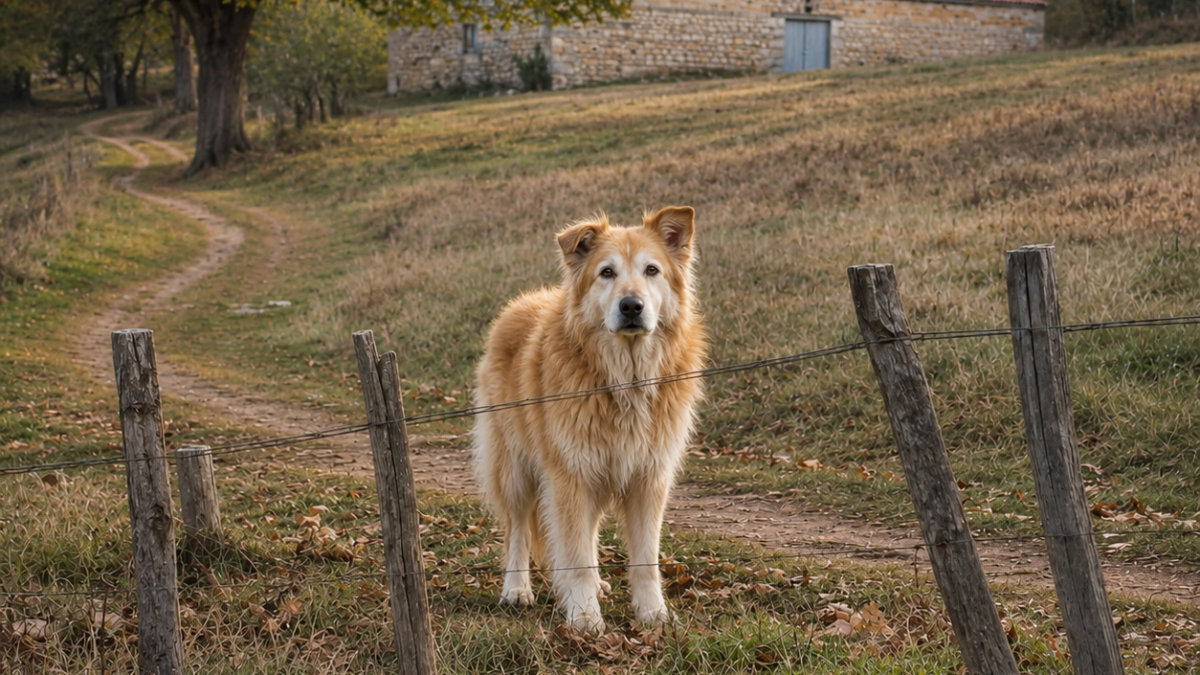
PART 2
The moment I left the porch, Rex ran.
Not wildly.
He would sprint ahead twenty or thirty yards, stop, turn, make sure I was still behind him, then run again.
Rain hit my face almost horizontally.
The beam from my flashlight bounced across mud, tree trunks, and branches thrashing in the wind.
“Rex!”
He stopped.
Waited.
Then moved again.
Behind me, Catherine shouted from the porch:
“Take your phone!”
I turned just long enough to catch it when she tossed it.
“Stay inside!”
“Obviously!”
I almost smiled.
Then Rex barked again from the trees.
Urgent.
I ran after him.
The path disappeared almost immediately.
Within minutes, we were off anything I recognized.
I had walked those woods plenty of times since moving in, but never at night during a storm, and certainly never at Rex’s pace.
He moved like he knew every root.
Every ditch.
Every break in the hedge.
His bad leg barely seemed to slow him.
We crossed a narrow stream that had swollen from the rain. Water came halfway up my boots.
Then Rex stopped.
For a second, I could hear nothing except the storm.
Then beneath it—
a horn.
Weak.
One long sound.
Then silence.
I stared into the darkness.
“Hello?”
Another horn.
Rex took off.
I followed.
Maybe fifty yards farther, the ground dropped sharply beside the old lane.
My flashlight caught metal.
A car.
Upside down.
Halfway down the embankment.
Branches covered one side.
One headlight still burned weakly beneath the water and mud.
“Oh, God.”
Rex scrambled down.
I followed more carefully, sliding twice.
“Hello!”
A voice answered.
“Help!”
Young.
Male.
Rex reached the passenger side and began barking.
I shone the flashlight through shattered glass.
There was someone inside.
A young man hanging sideways in his seat belt.
Blood along his temple.
“Can you hear me?”
“Yes.”
“Are you alone?”
“I think so.”
“Think?”
“My dog—”
His voice broke.
“My dog was in the back.”
Of course.
I recognized him then.
“Ben?”
He blinked through the rain.
“Will?”
Ben Greenwood.
Mrs. Greenwood’s twenty-one-year-old grandson.
He worked in Cheltenham and stayed with her several nights a week.
“What happened?”
“Tree came down.”
He coughed.
“I swerved.”
“Don’t move.”
“I can’t.”
Good.
Maybe.
I pulled out my phone.
One bar.
Then none.
I climbed halfway back up the embankment.
One bar again.
I called emergency services and gave the lane, approximate location, and situation.
The dispatcher told me not to move Ben unless there was immediate danger.
Then I looked down.
Water was beginning to flow beneath the car.
Not enough to flood it yet.
But the stream was rising.
I told the dispatcher.
“Emergency crews are on the way.”
“How long?”
“We can’t give an exact time.”
Of course not.
Storm.
Blocked roads.
Fallen trees.
I looked at Rex.
He had stopped barking.
Now he was sniffing around the rear of the vehicle.
Then he disappeared behind a fallen branch.
“Rex!”
No response.
I slid down again.
“Ben, stay with me.”
“Trying.”
“Talk to me.”
“What about?”
“Anything.”
He laughed weakly.
“My grandmother is going to kill me.”
“That’s encouraging.”
“What?”
“If you’re worried about Mrs. Greenwood, you’re not dying tonight.”
Another weak laugh.
Then Rex barked.
Farther into the trees.
Once.
Twice.
I turned.
“Ben, your dog. What kind?”
“Terrier.”
“Name?”
“Pip.”
Rex barked again.
I followed the sound.
Twenty yards behind the car, beneath a hedge torn open by impact, I saw a tiny white body.
Pip.
One hind leg trapped under a branch.
Alive.
Terrified.
He snapped when I reached toward him.
“Easy.”
Rex came beside me.
Pip stopped snapping.
That stunned me.
Rex lowered himself.
The little terrier sniffed his face.
Whined.
I lifted the branch enough to free the leg.
Pip tried to stand.
Collapsed.
I took off my outer fleece and wrapped him in it.
Rex followed as I carried him back.
Ben began crying when he saw us.
“You found him.”
“Rex found him.”
I placed Pip near the broken rear window where Ben could see him.
“He’s alive.”
“Thank you.”
“Thank him.”
Rex stood in the rain.
Watching both of us.
—
Emergency crews took almost forty minutes.
It felt like four hours.
I kept Ben talking.
Rex stayed beside the car.
Pip remained bundled against my chest.
When firefighters finally appeared above the embankment, lights flashing through trees, Rex backed away immediately.
People.
Uniforms.
Noise.
He disappeared into darkness.
“Rex!”
Nothing.
I wanted to follow.
Couldn’t.
Rescuers stabilized the car.
Ben was extracted.
Broken collarbone.
Concussion.
Deep cut near his temple.
Pip’s leg turned out to be fractured but repairable.
Mrs. Greenwood arrived in a neighbor’s vehicle wearing slippers beneath a raincoat.
She hugged me hard enough to hurt.
Then demanded to see Ben.
Only when the ambulance doors closed did she ask:
“How did you know?”
“Rex.”
She stared.
“The dog?”
“He came to our door.”
Her eyes moved toward the woods.
For a long moment, she said nothing.
Then:
“He’s done that before.”
My skin prickled.
“What?”
“Not exactly this.”
“Mrs. Greenwood.”
She looked at me.
“There are things about that dog I never told you because I wasn’t sure they were true.”
Before I could ask, Catherine appeared running down the lane.
She ignored everyone else and threw both arms around me.
“You idiot.”
“I’m fine.”
“You’re bleeding.”
I touched my forehead.
Apparently a branch had cut me.
“I’m fine.”
“Where’s Rex?”
That question stopped me.
I looked toward the forest.
Gone.
—
He returned at four in the morning.
I know because I never went to sleep.
Catherine and I sat in the kitchen with the lights low.
Every few minutes I checked the porch.
Nothing.
At 4:06, there was a soft scrape outside.
I opened the door.
Rex stood beneath the porch light.
Soaked.
Covered in mud.
His bad leg trembled violently.
“Rex.”
He didn’t retreat.
But he didn’t come closer.
I lowered myself.
“That was you, wasn’t it?”
His ears moved.
“You heard the crash.”
One step.
“You came for us.”
Another.
I held out my hand.
For months, that had been where our relationship stopped.
Hand out.
Rex six feet away.
Never closer.
This time he crossed the distance.
Slowly.
His nose touched my fingers.
That was all.
But Catherine made a sound behind me.
I looked back.
She was crying.
When I turned again, Rex hadn’t moved.
I touched the side of his face.
His whole body flinched.
I froze.
“I’m sorry.”
He could have run.
Instead he stayed.
I touched him again.
Barely.
One finger against wet fur.
Then two.
Rex closed his eyes.
Seven years.
No one had touched him.
At least not according to Mrs. Greenwood.
I whispered:
“You don’t have to stand out here.”
I opened the door wider.
Rex looked inside.
The kitchen.
Warm floor.
Firelight from the next room.
Dry towels.
Catherine.
Then he backed away.
Not frightened.
Decided.
Not yet.
Catherine crouched several feet behind me.
“It’s okay.”
Rex looked at her.
“You can stay outside.”
His tail moved once.
“We’re not going anywhere.”
He lay down beneath the porch roof.
I brought blankets.
He refused them.
Food?
Accepted.
Water?
Accepted.
Home?
Not yet.
—
The next morning, Mrs. Greenwood came over with a folder.
An actual paper folder.
That woman kept everything.
Ben was in hospital but stable.
Pip was having surgery.
She sat at our kitchen table and looked through the window at Rex sleeping beneath the porch.
“I first saw him seven years ago.”
“You said that.”
“Three days after Arthur Bell went into hospital.”
I frowned.
“Who?”
“Arthur lived at Moorfield Cottage.”
She pointed through the trees.
“About a mile north.”
“There’s no cottage.”
“Not anymore.”
She opened the folder.
Inside were photographs.
Old village events.
Garden competitions.
Church fêtes.
In one photograph, an elderly man stood beside a dark young shepherd mix.
Same ears.
Same white patch near the chest.
Healthy back leg.
My heart accelerated.
“Rex?”
“I think so.”
On the back:
**Arthur Bell & Rex — Summer Fair**
Date.
Eight years earlier.
I stared at her.
“You knew?”
“I suspected.”
“Why didn’t you tell anyone?”
“I did.”
“What happened?”
“Arthur had a stroke the following spring. Ambulance took him away. His nephew came and cleared the cottage.”
“Rex?”
“He told everyone the dog had gone to a friend.”
I looked through the window.
Rex was awake now.
Watching us.
“Then three days later you saw Rex in the woods.”
“Yes.”
“Did you tell the nephew?”
“I tried.”
“What did he say?”
Mrs. Greenwood’s mouth hardened.
“That it couldn’t be Rex.”
“Why?”
“He said Rex was miles away.”
“Who was the nephew?”
“Gavin Bell.”
She hesitated.
“Not a pleasant man.”
“Where is Arthur?”
She looked surprised.
“I thought he died.”
That answer sat heavily.
“Thought?”
“I never knew for certain.”
—
The rescue incident finally gave us a reason to involve a veterinarian.
Rex’s rear leg was swollen worse than usual, and his paws had several cuts from the storm.
The problem was getting him into a vehicle.
We tried a leash.
He panicked.
Not aggressive.
Pure terror.
The moment the loop moved toward his neck, he flattened himself and started trembling.
Catherine immediately dropped it.
“Okay.”
She sat on the ground.
“No leash.”
Rex’s breathing slowed.
Our local vet, Dr. Evans, agreed to come to the house.
He arrived that afternoon.
Rex retreated twenty feet.
Dr. Evans ignored him.
Sat on the porch.
Talked to us.
Ate a biscuit.
Eventually Rex approached.
He sniffed the doctor’s shoes.
Then his bag.
Dr. Evans touched him once.
Rex flinched.
Stayed.
Twenty minutes later, he allowed an examination.
Old injury in the hind leg.
Likely fracture that had healed badly.
Severe arthritis.
Scars around his neck.
One broken tooth.
And—
a microchip.
Dr. Evans passed the scanner over Rex’s shoulders twice.
Beep.
We all froze.
“You’ve got one?”
“Yes.”
He wrote the number.
Called the registry.
Ten minutes later he looked at me.
“Registered name is Rex.”
Catherine grabbed my hand.
“Owner?”
Dr. Evans read from the screen.
“Arthur James Bell.”
Mrs. Greenwood sat down.
“Oh, my.”
Address:
Moorfield Cottage.
Phone disconnected.
But there was a secondary contact.
A solicitor.
Robert Haines.
Still practicing.
We called.
His receptionist put us through immediately once we explained.
Robert Haines was quiet for several seconds.
Then:
“Where did you find the dog?”
“He’s been living near the woods for seven years.”
Another silence.
“Mr. Haines?”
“Arthur Bell is alive.”
I stood.
“What?”
“He lives at Westbrook Care Residence.”
Catherine covered her mouth.
“He’s alive?”
“Yes.”
“Does he know Rex is alive?”
“No.”
The solicitor sounded stunned.
“He was told Rex died seven years ago.”
—
Arthur Bell was eighty-two.
We went to see him two days later.
Without Rex at first.
I wanted to know the truth before putting an elderly man through something that might be cruel.
Westbrook was a converted country house surrounded by gardens.
Arthur sat near a window in a wheelchair.
His left side was weak from the stroke.
But his eyes were sharp.
Mr. Haines had told him only that someone wanted to ask about Rex.
Arthur studied me.
“You found something.”
Not a question.
“Yes.”
His hand tightened on the blanket across his knees.
“Where?”
“In the woods near Moorfield.”
Arthur’s face changed.
“Alive?”
My throat tightened.
“Yes.”
He closed his eyes.
For almost a minute he said nothing.
Then his shoulders began shaking.
Catherine knelt beside him.
Arthur whispered:
“Gavin said he was dead.”
I sat opposite.
“What exactly happened?”
Arthur looked toward the window.
“Stroke.”
He touched his weak arm.
“I woke up in hospital. Couldn’t speak properly. Couldn’t walk. Gavin came.”
His nephew.
Arthur had no children.
His wife died years earlier.
Gavin was his sister’s son.
“He said he’d take Rex temporarily.”
Arthur paused.
“I trusted him.”
“What did he tell you later?”
“First that Rex was difficult.”
Then:
“That he had run away while Gavin was taking him to a boarding place.”
Arthur’s voice cracked.
“Then two weeks later Gavin said someone had found a dog hit on the road.”
“Did you see the body?”
“No.”
“Photograph?”
“No.”
“He just told you?”
Arthur nodded.
“I was ill.”
He looked ashamed.
That bothered me.
“You had suffered a stroke.”
“I should have checked.”
“No.”
His eyes met mine.
“I should have.”
I knew that kind of guilt.
It doesn’t respond to logic.
Catherine asked:
“Did Gavin know Rex was microchipped?”
“Yes.”
“Then if Rex ran away…”
“He could have reported him missing.”
“Yes.”
Arthur stared at us.
“He didn’t, did he?”
“No.”
—
We brought Rex the next day.
Getting him into our car took patience.
We opened the rear hatch.
Put his food inside.
Waited.
He paced.
Retreated.
Returned.
Finally climbed in.
Catherine sat beside him the entire way.
At Westbrook, staff cleared a quiet room.
Arthur waited.
His hands shook.
I opened the door.
Rex entered beside me.
He saw Arthur.
Stopped.
Everything in him became still.
Arthur whispered:
“Rex?”
The dog’s head lifted.
I will remember that moment for the rest of my life.
Rex did not run.
Not at first.
He walked.
Slowly.
One step.
Two.
His bad leg dragged.
Arthur reached out.
Rex came close enough to smell his fingers.
Then a sound came from him.
A low cry.
Not barking.
Not whining.
Something deeper.
Arthur broke.
“Oh, my boy.”
Rex pushed his head under Arthur’s hand.
Seven years of avoiding human touch vanished.
Arthur bent over him.
Rex climbed halfway into his lap despite his size.
Arthur laughed and cried.
“You’re alive.”
Rex licked his face.
“You’re alive.”
Catherine turned away.
I didn’t.
Some moments deserve witnesses.
Arthur buried his face in Rex’s neck.
“I’m sorry.”
Rex’s tail thumped against the wheelchair.
“I’m sorry.”
Then Arthur looked at me.
“Seven years?”
“Yes.”
“Out there?”
“Yes.”
His expression changed.
Not sadness.
Anger.
“Gavin.”
—
Arthur told us there was more.
Before the stroke, he had made arrangements for Rex.
Not extravagant.
Responsible.
A savings account containing £18,000 was designated for Rex’s care if Arthur became incapacitated.
Gavin had access under a temporary financial authority while Arthur recovered.
“He told me the money paid for boarding.”
My stomach tightened.
“For how long?”
“Until Rex supposedly died.”
“How long was that?”
Arthur thought.
“Maybe six weeks.”
Mr. Haines, sitting nearby, looked troubled.
“I reviewed some of those accounts years later.”
Arthur looked at him.
“Robert?”
The solicitor frowned.
“There were withdrawals labeled animal care for much longer than six weeks.”
“How long?”
He hesitated.
“Several years.”
The room went quiet.
Arthur whispered:
“No.”
Mr. Haines nodded slowly.
“I never had reason to challenge them because you told me Rex had died and Gavin claimed some expenses related to prior boarding debts.”
“How much?”
“I’ll need to pull records.”
Arthur looked toward Rex.
The dog was lying beside the wheelchair now, head on Arthur’s shoe.
“Find out.”
His voice was weak.
But firm.
“Find out everything.”
—
That was when the story stopped being only about an abandoned dog.
Bank statements arrived.
Then copies of receipts.
Kennel boarding.
Veterinary treatment.
Medication.
Food.
Grooming.
Years of expenses.
More than £14,000 had been withdrawn from money Arthur had intended for Rex.
But Rex had been living in the woods.
Mrs. Greenwood had seen him.
Farmers had fed him.
A pub owner had occasionally left scraps.
Nobody had boarded him.
The kennels listed on the receipts didn’t exist.
One business had closed four years before Arthur’s stroke.
Another address belonged to a self-storage site.
Dr. Evans’ name even appeared on one invoice.
He had never treated Rex.
His supposed signature was fake.
Catherine looked at the papers spread across our table.
“He abandoned the dog and charged Arthur for taking care of him.”
I nodded.
She looked out the window.
Rex stood near the fence.
Same place every evening.
Watching the road.
“Why?”
“Money.”
“No.”
She shook her head.
“I mean why leave him here?”
We eventually learned that too.
—
Mrs. Greenwood kept diaries.
Every year.
Every day.
Weather.
Visitors.
Odd events.
She had done it since her husband died.
December 3, seven years earlier:
**Gavin Bell at Moorfield. White van. Cleared furniture. Angry with dog.**
December 5:
**Van returned late afternoon. Rex inside? Heard barking.**
December 6:
**Saw Rex at wood edge before dawn. Limping badly. Would not come close.**
Arthur’s stroke occurred November 29.
The timeline fit.
But Mrs. Greenwood remembered something else.
“The leg.”
“What?”
“Before Arthur went into hospital, Rex didn’t limp.”
I stared at the photograph.
Healthy dog.
Then the woods.
Bad leg.
“Could Gavin have hurt him?”
“I don’t know.”
We didn’t accuse.
Not without proof.
Then the viral story happened.
Ben posted online about Rex saving him during the storm.
He meant well.
Photograph of Rex outside our cottage.
Caption:
**This dog lived wild for seven years and never trusted anyone. Last night he ran through a storm to get help after my car crashed. I’d probably be dead without him.**
The post spread.
Local newspapers picked it up.
Then someone recognized Rex.
A man named Colin Price.
Former employee at a building firm Gavin once owned.
He called us.
“I know that dog.”
—
Colin met us in a café.
He looked uncomfortable from the beginning.
“You’re sure it’s Arthur’s Rex?”
“Yes.”
“I thought he died.”
“So did Arthur.”
Colin rubbed his face.
“I worked for Gavin back then.”
“What happened?”
“The week Arthur went into hospital, Gavin was clearing the cottage.”
“Why?”
“Said Arthur wouldn’t be coming back.”
Arthur had been hospitalized less than a week.
Gavin had already decided his future.
Colin continued.
“Rex kept getting in the way.”
“What does that mean?”
“Following people. Guarding Arthur’s bedroom. Wouldn’t let Gavin take some boxes.”
“What did Gavin do?”
Colin stared at his coffee.
“Hit him.”
Catherine’s hand tightened around mine.
“With what?”
“Metal pole.”
“Where?”
“Back end.”
The badly healed leg.
“Did it break?”
“I heard him yelp. After that he wouldn’t put weight on it.”
“You saw this?”
“Yes.”
“Why didn’t you report it?”
Colin looked ashamed.
“I should have.”
Not an answer.
But honest.
“Then?”
“Gavin told me to put Rex in the van.”
“You did?”
“Yes.”
My anger rose.
“Where did you take him?”
“I didn’t.”
“What?”
“Gavin drove.”
“Where?”
Colin looked toward the window.
“The east wood.”
Our wood.
My stomach dropped.
“How do you know?”
“I followed in another van because we were dumping old furniture at a storage place afterward.”
“What happened?”
“Gavin stopped by the lane. Opened the back.”
Colin swallowed.
“Rex wouldn’t get out.”
Catherine whispered:
“Oh, God.”
“So Gavin threw Arthur’s walking stick into the grass.”
“What?”
“Rex jumped after it.”
Of course.
A familiar object.
Arthur’s scent.
“Then?”
“He shut the door and drove off.”
I could hear my heartbeat.
“With a broken leg?”
“Yes.”
“Did Rex chase?”
“For a bit.”
Colin looked at me.
“I watched him in the mirror.”
Silence.
“Why are you telling us now?”
He took out his phone.
“Because I kept something.”
A photograph.
Old.
Low quality.
Taken from inside a vehicle.
Gavin’s white van ahead.
Roadside.
Rex standing behind it.
Arthur’s walking stick visible in the grass.
Metadata showed date and time.
December 5.
Seven years earlier.
Colin whispered:
“I took it because even then I knew it was wrong.”
I stared at him.
“You took a picture instead of helping.”
He flinched.
“Yes.”
Catherine touched my arm.
I stopped.
Colin’s eyes filled.
“I’ve regretted it every day.”
Then he said:
“I’ll testify.”
That mattered.
Regret without action is just pain.
Action can still change something.
Even late.
—
Gavin Bell called me three days later.
No introduction.
“Stop talking about me.”
My body went cold.
“You know who this is?”
“Yes.”
“Then you know why I’m calling.”
His voice was smooth.
Controlled.
Not what I expected from someone accused of dumping an injured dog.
“You’re spreading lies.”
“I haven’t said your name publicly.”
“People are asking questions.”
“Maybe answer them.”
Silence.
Then:
“That dog belongs to my uncle.”
“No.”
“It was his property.”
“Arthur is alive.”
That stopped him.
For one second.
“I know.”
Interesting.
“You’ve spoken to him?”
“None of your business.”
“Rex lives with us.”
“He has no right.”
“He’s a dog.”
“A dog with ownership attached.”
I almost laughed.
“You abandoned him.”
“I didn’t.”
“We have a witness.”
“Colin Price is a drunk.”
“We have a photograph.”
Silence.
Then:
“You don’t understand what Arthur was like.”
“What does that have to do with Rex?”
“He treated that animal better than family.”
There it was.
Resentment.
Not logic.
“He had money for a dog while people around him struggled.”
“You mean you.”
Gavin’s voice hardened.
“Be careful.”
I looked through the window.
Rex stood outside.
Watching me.
“No.”
I said it quietly.
“You should have been careful seven years ago.”
He hung up.
—
That night, Rex came to the porch.
Catherine sat on the step.
He lay beside her.
Closer than before.
She was touching him now.
Slowly.
Only when he initiated.
His head rested near her knee.
“I think he knows.”
“What?”
“That something’s happening.”
“Dogs read us.”
She stroked the fur behind his ear.
“I hate Gavin.”
“Join the queue.”
“No.”
She looked at me.
“I really hate him.”
“I know.”
She stared toward the woods.
“He left him injured.”
“Yes.”
“And Rex stayed here.”
“Yes.”
“Why?”
That question haunted me.
Why these woods?
Why not wander into another village?
Why remain near the same stretch of lane for seven years?
Mrs. Greenwood eventually gave us the answer.
Arthur used to walk Rex there every morning.
Same route.
From Moorfield Cottage.
Through the east wood.
Past what was now our property.
Then home.
The house Catherine and I rented had once been an empty gamekeeper’s cottage.
Arthur often stopped at the fence and spoke to whoever lived there.
Rex knew the route.
Gavin hadn’t chosen a random dumping site.
He chose somewhere familiar enough that the dog might stay.
Far enough from Arthur that he wouldn’t return easily.
Rex had spent seven years near one of the last places he associated with his owner.
Waiting.
Maybe guarding.
Maybe hoping Arthur would eventually appear on the path.
That thought nearly destroyed me.
—
Arthur wanted Rex back.
Of course he did.
But he could not care for him.
Westbrook allowed visits, not resident pets of Rex’s size.
We offered to take Rex there weekly.
Arthur cried.
Then said:
“He chose you.”
I shook my head.
“He remembers you.”
“Both can be true.”
Rex lay between us.
Arthur touched his head.
“He spent seven years looking backward.”
Then he looked at me.
“Don’t make him do that anymore.”
I understood.
“Are you giving him to us?”
Arthur smiled.
“I think he already did that himself.”
He signed ownership transfer papers.
Not because love required paperwork.
Because Gavin had begun threatening a legal claim.
Arthur wanted no ambiguity.
Rex became ours.
Legally.
Emotionally, that process was still happening.
—
He still would not enter the house.
Winter worsened.
We built him an insulated shelter beside the porch.
He used it.
Sometimes.
Mostly he slept beneath the porch roof.
Catherine left the door open while she worked.
Rex would sit exactly at the threshold.
Front paws almost touching the wood floor.
Never over it.
One afternoon she put her laptop on the floor inside.
Sat ten feet away.
Ignored him.
Two hours later, Rex placed one paw over the threshold.
Catherine did not move.
Then the second.
He stood there.
Half in.
Half out.
A delivery van came down the lane.
Rex bolted outside.
Progress vanished.
Or seemed to.
The next day he tried again.
That taught me something.
Healing does not reset to zero every time fear wins.
The nervous system remembers progress too.
—
Gavin’s trouble deepened.
Mr. Haines reviewed Arthur’s financial records.
The fraudulent dog-care expenses were only the beginning.
Large withdrawals had been made while Arthur was recovering from his stroke.
Furniture sold.
Tools.
A vintage motorcycle.
Cash transfers described as “house maintenance.”
Some legitimate.
Many questionable.
Arthur’s signature appeared on documents he didn’t remember signing.
One transferred ownership of a small parcel of woodland to a company connected to Gavin.
That drew authorities.
What began as a dog-abandonment story became an investigation into financial abuse.
Gavin responded by becoming more aggressive.
He sent Arthur letters.
Accused Mr. Haines of manipulation.
Threatened to challenge Rex’s transfer.
Then he came to our house.
At night.
—
It was January.
Cold.
Clear.
No storm.
Rex growled before I heard the vehicle.
He was on the porch.
Catherine was inside.
Headlights appeared beyond the hedge.
A dark SUV stopped at the gate.
Rex stood.
Every hair along his back lifted.
The driver got out.
Gavin.
I recognized him from photographs.
Mid-fifties.
Expensive coat.
Confident walk.
He stopped at the gate.
“William?”
I stepped onto the porch.
“Leave.”
“That’s not very neighborly.”
“You’re not my neighbor.”
Rex moved in front of me.
Gavin looked at him.
Something changed in his face.
Recognition.
“Hello, Rex.”
The dog froze.
Then backed up.
Not aggression.
Fear.
That answered more than words.
Gavin whistled.
Rex trembled.
Catherine appeared behind me.
“Will.”
“I know.”
I had already started recording.
Gavin reached for the gate.
“Don’t.”
“He knows me.”
Rex backed into my legs.
“Exactly.”
Gavin smiled without warmth.
“Dogs are dramatic.”
I said:
“You broke his leg.”
His expression flickered.
“Who told you that?”
Not denial.
A question.
Wrong question.
I heard Catherine inhale behind me.
I said:
“Thank you.”
“For what?”
“Confirming you know what I’m talking about.”
His face hardened.
“You people have no idea what happened.”
“Then explain.”
“Arthur was impossible.”
“Arthur isn’t Rex.”
“He spent money on that dog while expecting everyone else to clean up his life.”
“So you dumped him?”
“I didn’t say that.”
“You threw Arthur’s walking stick into the grass.”
That stopped him.
The silence was perfect.
Then Gavin said:
“That old drunk Colin should’ve kept his mouth shut.”
The camera recorded every word.
I almost smiled.
“Leave.”
He stepped toward the gate again.
Rex growled.
Gavin snapped:
“Shut up.”
Rex flinched.
Then something remarkable happened.
Catherine stepped past me.
Not outside the gate.
Just onto the porch.
She said:
“Rex.”
He looked at her.
“Come here.”
Rex turned his back on Gavin.
Walked to Catherine.
Pressed himself against her legs.
Gavin stared.
Catherine placed one hand on Rex’s neck.
“You don’t own him.”
Gavin laughed.
“You think a few months of feeding him makes you family?”
Catherine’s voice stayed calm.
“No.”
She looked down at Rex.
“He decided that.”
Blue lights appeared at the end of the lane.
I had called police before stepping outside.
Gavin’s confidence vanished.
He left the gate.
Officers stopped him before he reached his vehicle.
No dramatic arrest that night.
Questions.
Warnings.
Documentation.
But the recorded statements mattered.
Especially:
**Who told you that?**
And:
**That old drunk Colin should’ve kept his mouth shut.**
People who think they are smarter than everyone else often become excellent witnesses against themselves.
—
After police left, Rex stood at the open door.
Shaking.
Catherine went inside.
Sat on the floor.
I remained outside.
No pressure.
Minutes passed.
Then Rex looked toward the lane.
Where Gavin had disappeared.
Then toward Catherine.
She whispered:
“You don’t have to guard us from out there.”
His ears moved.
“Not anymore.”
One paw crossed the threshold.
Then another.
He stopped.
Catherine didn’t reach.
Didn’t call.
Didn’t move.
Rex took one more step.
Then another.
For the first time in seven years, he entered a house.
He walked straight to Catherine.
Lay down beside her.
And placed his head in her lap.
She cried silently.
I sat beside them.
No one celebrated loudly.
That would have frightened him.
We simply closed the door.
Rex lifted his head at the sound.
For a second, panic.
Then Catherine touched his shoulder.
“I’m here.”
His breathing slowed.
That was the night he became our dog.
Not because of paperwork.
Because he chose to stay after the door closed.
—
The investigation lasted almost a year.
Real justice is slow.
Forms.
Statements.
Bank tracing.
Solicitors.
Interviews.
Experts.
Records.
Nothing like films.
Arthur’s testimony mattered.
So did Colin’s.
Mrs. Greenwood’s diaries helped establish the timeline.
The photograph showed Rex beside Gavin’s van.
The veterinary examination showed a healed fracture consistent with the period witnesses described.
The financial records were devastating.
Gavin had submitted years of fabricated expenses for Rex.
Food.
Kenneling.
Medication.
Even “hydrotherapy.”
Rex had spent those same years outside in rain and snow.
Mrs. Greenwood nearly exploded when she saw the hydrotherapy invoice.
“He drank from puddles.”
That might have been the angriest I ever saw her.
Authorities uncovered broader misuse of Arthur’s funds.
Some charges were financial.
Some involved false documents.
Animal welfare investigators handled Rex’s abandonment and injury evidence separately.
Gavin tried to negotiate.
Then tried to blame Colin.
Then claimed Arthur had asked him to “rehome” Rex.
Arthur’s answer was simple.
“I asked him to keep my dog safe.”
That sentence followed Gavin everywhere.
—
The story reached local newspapers after court filings became public.
Photographs of Rex appeared online.
Before-and-after.
Wild dog at the fence.
Then Rex asleep beside our fireplace.
I hated the “hero dog” label.
Yes, he saved Ben.
But Rex was worthy of safety before he ever saved anyone.
Catherine understood that immediately.
One reporter asked her:
“Do you think Rex earned his home by saving Ben?”
She looked offended.
“No.”
The reporter blinked.
“He earned nothing.”
Pause.
“He needed a home. That was enough.”
I loved her for that.
The quote spread farther than the rescue story.
—
Ben recovered.
His collarbone healed.
The scar on his temple stayed.
Pip recovered too, though the terrier developed an absurd hatred of rain.
Ben visited often.
Every time he arrived, Rex met him at the gate.
Not barking.
Waiting.
One afternoon Ben sat beside him.
“You know you saved me?”
Rex yawned.
“Very moving.”
I laughed.
Ben looked at me.
“He’d have done it for anybody, wouldn’t he?”
“Probably.”
He nodded.
“That’s somehow better.”
He was right.
Heroism means more when it isn’t transactional.
—
Catherine changed too.
Slowly.
She began working again.
Not for another corporation.
At first, freelance editing from the kitchen table.
Rex lay under her desk.
Then she started helping the local animal charity with newsletters and adoption profiles.
One afternoon she said:
“I think I want to do this properly.”
“What?”
“Work with the rescue.”
“For money?”
“Eventually.”
“That’s a dangerous plan.”
“Why?”
“You’ll bring every dog home.”
She looked at Rex.
“Only the ones who spend seven years screening us.”
He lifted his head.
We laughed.
The laughter came more easily by then.
The house no longer felt like a place we had moved to because life elsewhere had failed.
It felt like ours.
—
Arthur visited when his health allowed.
Westbrook had a transport service.
The first time they brought him to our cottage, Rex knew the vehicle before the door opened.
He ran to the gate.
Tail moving.
Arthur descended in his wheelchair.
“My boy.”
Rex pushed his head under Arthur’s hand.
Then did something beautiful.
After greeting Arthur, he returned to Catherine.
Lay beside her.
Arthur noticed.
His smile changed.
Not sad.
Relieved.
“He knows where home is.”
Catherine crouched.
“You’re still part of it.”
Arthur shook his head.
“That’s not the same.”
No.
It wasn’t.
That was okay.
Love does not need every relationship to stay in its old shape.
Arthur had been Rex’s home.
Now we were.
Neither erased the other.
—
Gavin’s trial began the following autumn.
By then, Arthur’s health had declined.
He testified by recorded interview.
He wore a sweater.
Rex’s photograph stood on the table beside him.
The prosecutor asked:
“Did you authorize Gavin Bell to abandon Rex?”
“No.”
“Did you authorize him to injure Rex?”
Arthur’s jaw tightened.
“No.”
“Did you authorize years of withdrawals for Rex’s care after being told Rex was dead?”
“No.”
“What did you believe the money was for?”
“My dog.”
His voice cracked.
“To keep him safe if I couldn’t.”
Then:
“Was that done?”
Arthur looked directly into the camera.
“No.”
Nothing dramatic.
No speech.
That single word hurt more.
—
Colin testified in person.
Gavin’s barrister attacked him hard.
“You waited seven years.”
“Yes.”
“You disliked Mr. Bell.”
“Yes.”
“You had financial disputes.”
“Yes.”
“So now you have a reason to retaliate.”
Colin looked toward the judge.
“I had a reason to stay quiet too.”
“What?”
“Cowardice.”
Silence.
Then he said:
“I chose that one the first time.”
He looked at Gavin.
“I’m choosing differently now.”
That was strong because it didn’t pretend Colin was heroic.
People sometimes do the right thing late.
Late still matters.
—
Mrs. Greenwood testified about her diaries.
The barrister asked:
“You expect the court to rely on handwritten notes about village gossip?”
Mrs. Greenwood stared at him.
“I wrote that it rained on March 3, my boiler broke April 17, and your client dumped a dog December 5.”
A few people laughed.
The judge did not.
The barrister continued:
“You did not see Mr. Bell physically remove the dog.”
“No.”
“You did not see him strike the dog.”
“No.”
“Then your notes prove very little.”
Mrs. Greenwood smiled.
“You’d be amazed what little things prove once people stop lying around them.”
I nearly applauded.
Didn’t.
Barely.
—
The strongest evidence was financial.
The fake receipts.
Forged signatures.
Payments into accounts Gavin controlled.
Money supposedly spent on Rex after Rex was already presumed dead.
Arthur’s funds used for personal expenses.
Then our porch recording.
Gavin’s own voice:
**Who told you that?**
Then:
**That old drunk Colin should’ve kept his mouth shut.**
His lawyer argued anger.
Misunderstanding.
Context.
The recording remained exactly what it was.
Gavin testified.
Another mistake.
He claimed Arthur had always manipulated family with money.
That Arthur loved Rex more than people.
That he was overwhelmed.
That he never intended the dog to suffer.
The prosecutor asked:
“You left a dog with an injured hind leg beside woodland in December?”
Gavin said:
“I thought someone would find him.”
“Who?”
“No idea.”
“You did not contact a shelter.”
“No.”
“Veterinarian?”
“No.”
“Police?”
“No.”
“Animal charity?”
“No.”
“You told Arthur Rex died?”
“I believed he probably had.”
“You then withdrew money for Rex’s ongoing care?”
Gavin’s face tightened.
“Expenses had already been incurred.”
“For seven years?”
Silence.
That silence convicted him more effectively than anger ever could.
—
The court found him guilty on multiple fraud-related charges and offenses connected to his misuse of Arthur’s finances and false documentation. The animal welfare case also resulted in findings against him tied to Rex’s abandonment and treatment, supported by the available witness and veterinary evidence.
He received a custodial sentence followed by supervision, was ordered to repay substantial sums, and lost any authority over Arthur’s affairs.
Assets were recovered where possible.
The woodland parcel transfer was reversed after separate proceedings.
Gavin was barred from owning or being responsible for animals for a significant period.
People asked whether I felt satisfied.
I did.
But not in the way I expected.
I didn’t want him hurt.
I wanted his power removed.
He had taken advantage of an old man who trusted him and a dog who couldn’t complain.
Now he could do neither.
That was enough.
—
Arthur lived long enough to hear the verdict.
Mr. Haines called him.
Then called us.
“He smiled.”
“That’s all?”
“He said, ‘Good.’”
Very Arthur.
The next weekend, we took Rex to Westbrook.
Arthur looked weaker.
Rex lay beside the wheelchair.
For most of the visit, Arthur said nothing.
Then:
“I’ve been thinking.”
I waited.
“Gavin hated Rex.”
“Why?”
Arthur looked toward the garden.
“Because Rex chose me.”
I frowned.
“Dogs don’t choose inheritance.”
“No.”
Arthur smiled.
“But people jealous of love don’t always know the difference.”
That stayed with me.
Before we left, Arthur touched Rex’s face with his good hand.
“You did all right.”
Rex leaned in.
“Better than me.”
I said:
“That’s not fair.”
Arthur looked at me.
“Probably.”
Then smiled.
“But old men are allowed drama.”
—
Arthur died three months later.
Peacefully.
Westbrook called Mr. Haines, who called us.
Catherine sat on the floor beside Rex.
I told him.
Ridiculous, maybe.
But I did.
“Arthur’s gone.”
Rex looked at me.
No dramatic reaction.
Catherine placed Arthur’s old walking stick beside his bed.
The one police had recovered from Gavin’s storage unit after Colin identified it.
Rex sniffed it.
Then rested his chin across the wood.
He slept that way all afternoon.
The next morning, he left it.
Never returned.
That was Rex.
Remember.
Then continue.
—
Arthur left a small amount of money to the local rescue.
Not to us.
He knew better.
His will included a note:
**For dogs who wait longer than people think they should have to.**
Catherine framed a copy.
The rescue used the funds to establish emergency support for older strays and difficult-to-catch animals.
They named it the Bell-Rex Fund.
Arthur would have complained.
Rex didn’t care.
—
Years passed.
Rex became fully domestic.
Mostly.
He still preferred sleeping near doors.
He still checked windows when vehicles arrived.
But now he slept inside.
The first winter after the trial, snow fell heavily overnight.
I woke at three and saw him standing by the front door.
Old habit.
I opened it.
He stepped onto the porch.
Looked toward the woods.
For a long time.
Then turned.
Came back inside.
No patrol.
No disappearing into trees.
I closed the door.
He climbed onto the rug beside our bed.
That moment meant more to me than the verdict.
For seven years, Rex believed safety required vigilance.
Eventually he learned other people could watch too.
—
His bad leg worsened.
Dr. Evans recommended medication.
Then injections.
Then physical therapy.
Rex hated the hydrotherapy tank.
The irony was not lost on Mrs. Greenwood.
“When Gavin claimed to pay for hydrotherapy, Rex lived in a ditch. Now he actually gets it and hates it.”
Dr. Evans laughed.
Rex glared at everyone.
He still improved.
At twelve, maybe thirteen, he could walk a mile comfortably.
At fourteen, half a mile.
At fifteen, to the gate and back.
We never knew his exact age.
Old enough.
—
Catherine eventually became communications director for the animal charity.
The woman who had barely left her bedroom after losing her job now spent days writing stories about overlooked dogs.
But she had one rule.
“No pity marketing.”
I asked what that meant.
“Don’t sell animals as tragedies.”
“Rex was a tragedy.”
“No.”
She looked offended.
“Things happened to him. He wasn’t one.”
That distinction shaped everything she wrote.
She described needs.
Personality.
History.
Not brokenness.
The adoption rate for older dogs improved.
Not because of Rex alone.
But his story helped.
—
Ben married.
Pip attended the wedding wearing a bow tie.
Rex did not.
Crowds were never his thing.
Afterward, Ben and his wife came to our house.
They sat on the porch.
Ben raised a glass.
“To the dog who got me to the ceremony.”
Rex was asleep.
He did not acknowledge the honor.
Perfect.
—
One summer evening, Mrs. Greenwood came over carrying a box.
She was in her eighties by then.
Still unstoppable.
“What’s that?”
“Things from Moorfield.”
The cottage had been demolished years before, but she had kept photographs Arthur gave her.
Inside were pictures of Rex as a young dog.
Running.
Swimming.
Standing beside Arthur.
One showed Arthur sitting on a fallen tree near our woods.
Rex beside him.
Behind them, partly visible—
our cottage.
Same porch.
Different paint.
I showed Catherine.
She stared.
“He knew this house.”
“Apparently.”
Mrs. Greenwood nodded.
“Arthur used to stop here for tea with the old gamekeeper.”
I looked through the window at Rex asleep by the fireplace.
Seven years he had returned to this fence.
Maybe he had not been guarding strangers.
Maybe he had been guarding a place he remembered as safe.
Then we arrived.
Maybe safety recognized safety before trust did.
I liked that explanation.
Couldn’t prove it.
Didn’t need to.
—
Rex’s final year came slowly.
Kidneys.
Heart.
Arthritis.
Old age arriving from several directions.
He still ate well.
Then less.
Still greeted Catherine at the gate.
Then from the porch.
Still followed me into the garden.
Then watched from the doorway.
The doorway.
That old boundary.
Except now he stood on the inside.
That mattered.
One evening a storm came through.
Not as violent as December 14 years earlier.
But wind.
Rain.
Branches against glass.
Rex woke.
For a moment I saw the old dog beneath the wild one.
Ears alert.
Body ready.
Then he looked at Catherine.
At me.
The house.
He lay back down.
Didn’t patrol.
Didn’t guard the door.
He trusted us to survive the storm together.
I cried quietly.
Catherine noticed.
“What?”
“Nothing.”
She followed my gaze.
Understood.
“Yeah.”
That was all.
—
The final decline began on a Wednesday.
Rex refused breakfast.
Then dinner.
Drank little.
Dr. Evans came.
Bloodwork.
Examination.
The results weren’t shocking.
Only final.
We could hospitalize.
Fluids.
Maybe a little time.
Catherine asked:
“Good time?”
Dr. Evans hesitated.
“Possibly a few days.”
Rex lay on his blanket.
Head between paws.
Tired.
I knew the answer before Catherine looked at me.
“No hospital.”
I said it.
She nodded.
Rex had spent enough of his life being taken places he did not choose.
He would stay home.
—
We gave him two days.
Good enough days.
Chicken.
Bits of cheese Mrs. Greenwood said he wasn’t supposed to have.
“Who’s going to tell him?”
Fair.
Ben visited.
Pip was gone by then.
Old age.
Ben sat beside Rex.
“Remember the storm?”
Rex’s tail moved once.
“You’re the reason I’m obnoxiously alive.”
Another movement.
Ben cried.
“So thanks.”
Rex licked his hand.
Mrs. Greenwood came next.
“You never let me catch you.”
Rex looked at her.
“Very rude.”
She touched his head.
Seven years earlier, impossible.
Now he leaned into her hand.
Mrs. Greenwood whispered:
“Arthur would like this.”
—
On the final evening, Catherine opened the front door.
Not because Rex asked.
Because she remembered.
Cold air entered.
Rex lifted his head.
The woods were dark beyond the garden.
His woods.
Seven years.
He tried to stand.
I helped.
He walked slowly to the threshold.
Stopped.
One paw inside.
One paw near the sill.
Exactly opposite the first time.
Back then he had been outside trying to enter.
Now he was inside deciding whether to leave.
He looked toward the trees.
Then back at us.
Catherine knelt.
“You can go out if you want.”
Rex looked at her.
“Or stay.”
He turned.
Slowly.
Walked back to his bed.
Lay down.
The choice destroyed me.
He had spent seven years belonging to the woods because no home felt safe.
At the end, offered the woods again—
he chose the house.
—
Dr. Evans came after sunset.
No clinic.
No bright room.
Just our living room.
Fire low.
Rain beginning outside.
Catherine sat on one side of Rex.
I sat on the other.
We placed Arthur’s old walking stick nearby.
Not because Rex needed it.
Because we did.
I held his head.
Catherine stroked the place behind his ears he had once refused to let anyone touch.
“You know what’s funny?” she whispered.
Rex’s eyes moved.
“You spent years guarding us before we even knew you.”
His breathing was slow.
“You waited outside every night like it was your job.”
She kissed his forehead.
“You can retire.”
I laughed through tears.
Rex’s tail moved once.
Dr. Evans gave the sedative.
Rex relaxed.
For the first time I could remember, his body seemed completely free of tension.
No listening.
No watching.
No waiting for a vehicle.
No calculating distance from human hands.
Just rest.
I leaned close.
“You saved Ben.”
A breath.
“You helped Catherine.”
Another.
“You brought Arthur back into our lives.”
Another.
“You brought us back too.”
That was true.
We moved to the Cotswolds because we wanted to disappear from a life that had exhausted us.
Rex taught us the difference between disappearing and belonging somewhere quiet.
I touched his face.
“You don’t have to guard anything anymore.”
The final medication entered.
Catherine whispered:
“We’re safe.”
Rex exhaled.
I felt the breath against my hand.
Then stillness.
Outside, rain moved through the oaks.
But inside, for once, nobody was waiting at the door.
—
We buried Rex’s ashes near the fence.
Not in the woods.
Not entirely in the garden.
At the boundary.
It felt right.
Catherine chose the marker:
**REX**
**HE GUARDED THE DOOR
UNTIL HE LEARNED HE BELONGED BEHIND IT.**
Mrs. Greenwood read it.
Then said:
“Too sentimental.”
Catherine looked offended.
Mrs. Greenwood smiled.
“It’s perfect.”
—
Gavin eventually completed his sentence.
Some money was recovered.
Some never was.
Arthur’s estate funded the rescue as he intended.
Colin began volunteering with an animal welfare transport group.
He never asked us to forgive him.
I respected that.
Once, years later, he came to a fundraising event.
He stood in front of Rex’s photograph for a long time.
Then found me.
“I should’ve opened the van door.”
“Yes.”
His eyes lowered.
“I know.”
I said:
“You can’t fix that day.”
“No.”
“But you helped fix something later.”
He nodded.
Not absolution.
Truth.
Sometimes that is enough.
—
People often ask about the “revenge” part of Rex’s story.
They like the court.
The forged invoices.
Gavin being exposed.
The recording.
The verdict.
I understand.
Justice matters.
Consequences matter.
But if you ask me what felt like revenge, I think of a different scene.
Sunday morning.
Sunlight.
Catherine reading on the sofa.
Me making coffee.
Rex asleep on his back in the middle of the rug, legs slightly open, completely vulnerable.
The dog Gavin left injured beside the woods because he was inconvenient had become an old dog confident enough to sleep where anyone could touch him.
That was defeat.
Not ours.
Gavin’s.
He had taught Rex that people were dangerous.
We did not defeat that lesson by hurting Gavin.
We defeated it every time Rex went to sleep without fear.
—
There was a small wooden box Arthur left us after his death.
Mr. Haines delivered it months later.
Inside was a leather collar.
Rex’s old collar.
Arthur had kept it.
Gavin apparently removed it before abandoning him and later returned it with Arthur’s belongings, claiming it had been recovered after Rex died.
Arthur had never thrown it away.
The brass tag read:
**REX BELL**
Below:
**IF LOST, PLEASE CALL ARTHUR.**
I held it for a long time.
Catherine said:
“Do you want to put it on him?”
Rex was still alive then.
I looked at him.
“No.”
“Why?”
“He isn’t lost.”
We framed it instead.
That collar still hangs near our front door.
—
After Rex died, the house was quiet.
Painfully.
The first morning I carried coffee outside and automatically looked toward the fence.
Nothing.
Catherine came behind me.
“I did the same thing.”
We sat.
For weeks, I thought I saw him.
Shadow beneath an oak.
Movement near the gate.
Grief is creative.
Eventually the phantom sightings stopped.
The habits remained.
We still put a water bowl near the porch for visiting dogs.
Still looked at the gate when cars approached.
Still left the front light on during storms.
Some losses become architecture.
—
We eventually adopted again.
Not quickly.
Not because Rex needed replacing.
He didn’t.
A year later, Catherine brought home a small, elderly lurcher from the rescue.
Her name was Maisie.
One eye.
Terrible teeth.
Zero respect for furniture.
I looked at Catherine.
“One?”
“One.”
“You promised.”
“I promised nothing.”
Maisie walked into the living room and immediately climbed onto Rex’s old bed.
Catherine looked guilty.
I laughed.
“He’d hate her.”
“He would.”
We kept her.
Of course.
Love after loss is not replacement.
It is evidence that grief did not successfully close the door.
Rex taught us that too.
—
The Bell-Rex Fund grew.
Arthur’s original donation inspired others.
It became specifically useful for hard-to-catch strays, older dogs, and animals requiring long trust-building periods before adoption.
No forced deadlines where possible.
No labeling a frightened dog “unadoptable” because he refused contact after two weeks.
Catherine wrote the program’s guiding line:
**TRUST HAS ITS OWN TIMETABLE.**
I knew exactly who she meant.
—
Years later, a young shepherd mix came into the rescue.
Would not enter a building.
Would not accept touch.
Slept outside the kennel shelter.
Staff called Catherine.
She visited.
Sat ten feet away.
Did nothing.
For weeks.
One day the dog touched her hand.
The volunteer cried.
Catherine didn’t.
Not until she got home.
Then she sat beside me and said:
“Rex.”
I nodded.
“Yeah.”
Some dogs teach you how to help dogs they will never meet.
That may be the longest part of their life.
—
Mrs. Greenwood lived to ninety-one.
Still complained about everyone’s hedges.
Still knew everything.
One afternoon near the end of her life, Catherine and I visited.
She asked:
“Did you ever work out why Rex picked you?”
I smiled.
“No.”
“Liar.”
“What do you think?”
She looked toward the window.
“You were both hiding.”
“Who?”
“You and Catherine.”
I laughed.
“We weren’t hiding.”
“You moved to the end of a dirt lane surrounded by woods.”
Fair.
She continued.
“Rex knew hiding.”
I thought about it.
“He also knew how to come back.”
Mrs. Greenwood smiled.
“There you go.”
That was the last conversation we had about him.
—
Sometimes I think of our first night in the cottage.
Catherine and me on the porch.
Rex at the tree line.
We thought he was watching us.
Maybe he was.
But I wonder now if he was waiting to see what kind of people we were.
Would we chase?
Would we corner him?
Would we demand trust because we had offered food?
Would we become angry when he refused touch?
We didn’t.
Not because we were extraordinary.
Because we had no idea what else to do.
So we waited.
He watched.
Then one day Catherine cried on the steps and Rex moved closer.
Another day I offered my hand and he touched it.
Then a storm came.
He needed help.
He asked.
That is how relationships often work.
Not one grand moment.
Tiny tests.
Repeated.
Until someone finally risks needing someone else.
—
Rex spent seven years at the edge of a forest because one person taught him a home could disappear in a single car ride.
It took months for us to teach him something different.
The door could close and still open again.
A hand could touch without hurting.
A vehicle could take him to a veterinarian and bring him home.
A leash could mean a walk, not capture.
A house could be shelter, not a trap.
People could leave and return.
Most importantly—
he did not have to earn any of it.
He had already saved Ben before he came inside.
But we would have loved him if he had never saved anyone.
That matters.
—
On December 14 every year, Catherine lights a candle by Rex’s collar.
Not because it was the night he saved Ben.
Because it was the first night he asked us for something.
Trust is often described as allowing somebody close.
I think that’s incomplete.
Sometimes trust is asking for help.
Rex had survived seven years without asking anybody.
Then one night he scratched our door.
Maybe that was the bravest thing he ever did.
Not finding Ben.
Not standing in the storm.
Asking.
—
If I could return to that night, I would do almost everything the same.
I would still pull on my coat.
Still follow Rex.
Still fall in mud.
Still find the car.
Still carry Pip.
Still sit awake waiting for Rex to return.
But when he appeared at four in the morning, I wouldn’t look at him and think:
We saved someone tonight.
I would understand the larger thing.
Rex was changing.
He had spent years believing he had to handle danger alone.
That night, he heard a crash in the woods and instead of running toward it alone until he collapsed, he came to our door.
He recruited a human.
He believed I might listen.
That was the beginning of home.
—
The woods are still behind our house.
Older somehow.
Or maybe I am.
The oak where Rex first watched us lost a large branch in another storm.
The fence has been replaced.
The porch repaired.
Catherine changed the kitchen twice.
Life edits everything.
But one section of the old fence remains.
I refused to replace it.
There are scratches near the bottom.
Maybe Rex.
Maybe not.
I choose Rex.
Sometimes memory is allowed one harmless invention.
—
Our house is no longer isolated in the way it once felt.
Friends visit.
Rescue volunteers.
Ben and his wife.
Children.
Dogs.
Too many dogs, according to me.
Not enough, according to Catherine.
The woods no longer feel like something separating us from the world.
They feel like part of our world.
That is because of Rex.
He came from those trees every evening like a shadow and taught us how to live in the place we thought we had chosen only to escape somewhere else.
—
I sometimes wonder what Arthur felt during those seven years.
Thinking Rex was dead.
Then learning he was alive.
There is cruelty in lost time.
Nothing restores it.
Arthur and Rex got only a few years of visits after reunion.
Not enough.
But “not enough” can still contain something complete.
Arthur touched his dog again.
Rex heard his voice.
They got one more goodbye.
Many people don’t.
I am grateful for that.
—
The court gave Gavin consequences.
Rex gave him something worse.
Irrelevance.
At first Gavin occupied the center of every conversation.
What he did.
What he stole.
What he lied about.
Then the years moved.
Rex lived.
Arthur died peacefully knowing the truth.
Catherine rebuilt her career.
Ben recovered.
The rescue grew.
Other dogs found homes.
Gavin became smaller and smaller inside the story.
Eventually he became simply the man who made one terrible choice and kept making more to hide it.
Rex became everything else.
That is how cruelty truly loses.
Not when punishment becomes the most memorable part.
When life grows around it until cruelty becomes a footnote.
—
The last photograph of Rex hangs above my desk.
Not the heroic photograph from Ben’s rescue.
Not the picture with Arthur.
Not even the one of Rex entering our house.
It is boring.
That’s why I love it.
Rex is asleep beside the fireplace.
One front paw stretched forward.
Gray muzzle pressed against the rug.
Catherine’s slippers nearby.
My coffee mug on the table.
Nothing happening.
No danger.
No waiting.
No fence.
No storm.
Just an old dog asleep in a house.
For someone else, it would be a meaningless photograph.
For me, it is the entire victory.
Rex got to become ordinary.
After seven years of survival, ordinary was everything.
—
If people ask me why Rex guarded our fence before he trusted us, I still cannot give them a certain answer.
Maybe Arthur’s old walking route brought him there.
Maybe the cottage smelled familiar.
Maybe Rex saw Catherine’s sadness and recognized something wounded.
Maybe he simply liked our food.
Dogs are allowed to be less poetic than the stories we build around them.
But I know this:
He came every night.
He watched.
He stayed.
He never asked to enter.
Then one night someone in the woods needed help, and Rex decided we were finally trustworthy enough to involve.
After that, everything changed.
For Ben.
For Arthur.
For us.
For Rex.
—
I used to think we adopted Rex when Arthur signed the transfer papers.
Then I thought maybe it happened when Rex entered the house.
Now I think both ideas are wrong.
Rex adopted us long before that.
The first morning he sat beside the fence while I drank coffee.
The evening he stayed near Catherine while she cried.
The nights he paced the boundary.
He had already placed us inside the circle of things he believed were worth protecting.
We just took longer to understand.
—
And maybe that is why the ending still feels right to me.
Rex’s life was divided by doors.
Arthur’s door.
Gavin’s van.
The forest.
Our gate.
Our porch.
The threshold he would not cross.
Then the night he finally stepped inside.
At the beginning, a door closing meant abandonment.
At the end, Rex could hear a door close and keep sleeping.
Because he knew the people on the other side were coming back.
That is what home became for him.
Not walls.
Not ownership papers.
Not a bed.
Expectation.
The belief that love would still be there after you stopped watching it every second.
—
On Rex’s final night, Catherine told him:
“We’re safe.”
I think about that sentence often.
For years, I assumed Rex believed his job was to keep us safe.
Maybe.
But by the end, the sentence meant something else too.
**You are safe.**
Safe enough to sleep.
Safe enough to age.
Safe enough to stop guarding.
Safe enough to die without wondering who would be left alone in the storm.
He had spent seven years outside our fence acting as though he had sworn to protect a family he didn’t yet know.
What I understand now is that he wasn’t only searching for someone to protect.
He was searching for people he could finally trust to protect him back.
And when he found us, it took time.
Months of food.
Quiet mornings.
A woman crying on a porch.
A storm.
A rescue.
An old owner’s voice.
A courtroom.
An open door.
But he got there.
He came inside.
He stayed.
And in the end, the dog who had spent most of his life watching a house from the outside finally closed his eyes inside one and trusted that he no longer had to keep watch.








