PART 2: A Starving Paw Reached Through My Neighbor’s Rusted Fence—What We Found Behind That Locked Gate Shook Our Entire Street
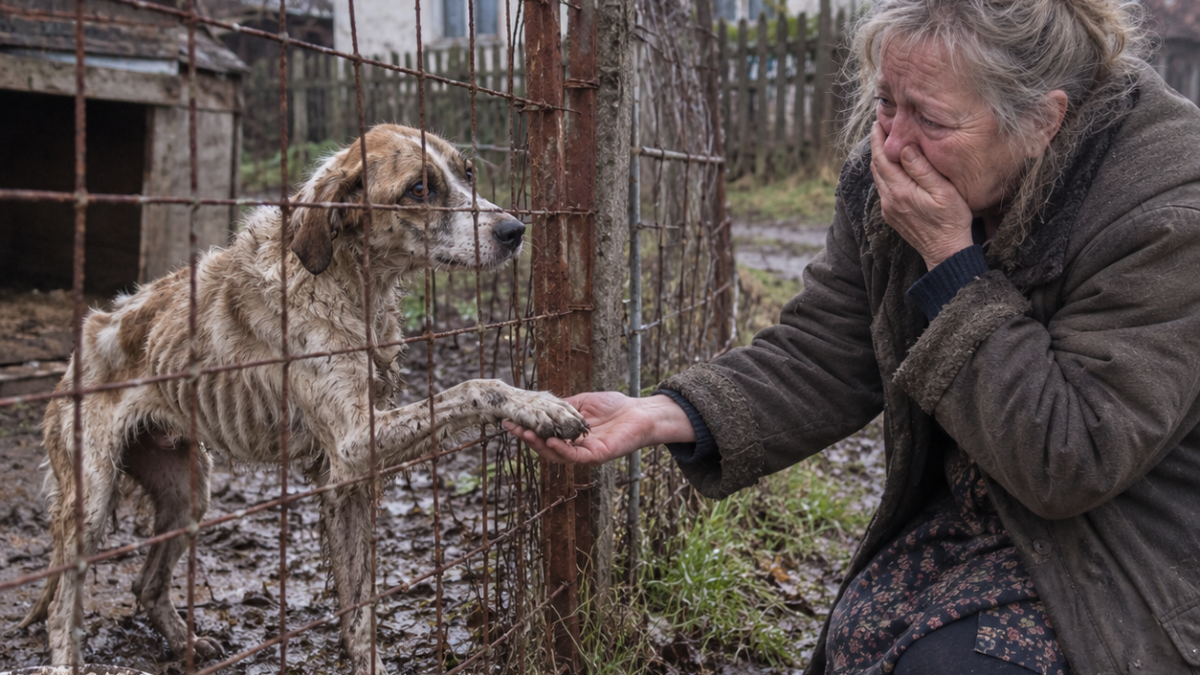
The paw appeared before I saw the dog—a thin, trembling leg reaching through the rusted fence of the silent house next door.
For weeks I had convinced myself the owners were simply away and had taken their dog with them, but the moment that paw touched the sidewalk, I knew something terrible had been happening only yards from my kitchen window.
Then rescuers opened the locked gate, and what we discovered inside made every person on our street ask the same painful question: How had all of us missed this?
My name is Madeleine Renaud.
I was sixty-three then, recently retired after thirty-seven years as a school secretary, and I had lived on that quiet street outside Angers for nearly three decades.
I knew almost everyone.
I knew which neighbor put his trash cans out too early, which family’s teenage son practiced drums after dinner, and which little terrier barked every morning when the mail carrier arrived.
The beige rental house next door was different.
Laurent and Sophie had moved in less than a year earlier.
They were both in their forties and rarely spoke to anyone for longer than necessary.
Sometimes I saw a beige-and-white dog in their backyard.
Medium-sized.
One floppy ear.
One ear with a small tear along the edge.
I never learned his name.
Once, while hanging laundry, I noticed him standing near the fence.
He looked thinner than I remembered.
Laurent was outside.
“Is your dog okay?” I called.
He turned quickly.
“Of course.”
“He seems thin.”
“He’s always been thin.”
The way he said it ended the conversation.
After that, I saw less of the dog.
Then Laurent and Sophie’s car disappeared.
One day became three.
Three became a week.
The shutters stayed closed.
No lights appeared at night.
Their trash bins never moved.
I told myself they were traveling.
And because I didn’t hear barking, I convinced myself they had taken the dog.
It was the easiest explanation.
So I accepted it.
Until that Tuesday morning.
I was returning from my mailbox with a handful of envelopes when I noticed something poking through the fence.
At first I thought it was a branch.
Then it trembled.
I stopped.
The paw slowly disappeared.
A few seconds later, it came through again.
I walked closer.
The smell reached me before the dog did.
Stagnant water.
Waste.
Rotting leaves.
Something sour and neglected.
“Hello?”
The paw vanished.
Then a face appeared behind the wire.
I dropped my mail.
The dog was skeletal.
His ribs showed beneath a dull coat.
His hip bones formed sharp angles.
His head looked too large for his body.
But what I remember most were his eyes.
He didn’t bark.
He didn’t growl.
He just looked at me.
Then, slowly, he pushed that same paw through the fence again and rested it on my side of the sidewalk.
It looked less like scratching than reaching.
“Oh, sweetheart.”
His tail moved once.
That one tiny wag broke something inside me.
I hurried home for water and canned food.
When I came back, he was still standing there, as if he had been afraid I might disappear too.
I slid a shallow bowl beneath the fence.
He drank three laps.
Stopped to breathe.
Then drank again.
That was when I saw the empty food bowl near a small wooden shelter.
Beside it sat a large sealed plastic container filled with kibble.
Food.
Right there.
Only a few yards away.
But locked away from him.
I looked at the gate.
Heavy padlock.
The back door was closed.
Windows shut.
And suddenly the truth became impossible to excuse.
This dog had not been lost.
He had been left behind.
I called local emergency animal services with shaking hands.
Within thirty minutes, two animal welfare officers and a police officer arrived.
Neighbors began stepping outside.
One by one.
Mr. Bernard from across the road.
Claire from number fourteen.
The young couple on the corner.
Everyone staring through the fence at the dog we had somehow failed to see.
An officer cut the lock.
The gate opened.
The dog tried to stand.
Then his legs folded beneath him.
As the rescuers rushed forward, one officer stopped near the back door and looked down.
There were several empty water containers.
A torn leash.
And beside them, half hidden under a dirty blanket, something that made his expression change instantly.
He turned toward the police officer.
“Don’t let anyone touch this.”
Then he looked at all of us standing at the fence.
“This wasn’t just abandonment.”
And suddenly the street went silent.
PART 2
I remember the silence more clearly than anything else.
A dozen neighbors had gathered along the sidewalk, but nobody spoke.
The animal welfare officer, a broad-shouldered man named Julien Mercier, crouched near the dirty blanket without touching what was underneath it.
The police officer stepped closer.
“What have you got?”
Julien pointed.
I couldn’t see clearly from where I stood.
Only a metal edge.
Something rectangular.
Then the officer pulled on gloves and carefully lifted the blanket.
It was a chain.
Not a dog leash.
A chain.
Heavy.
Rust-stained.
One end had been looped around the leg of the wooden shelter.
The other ended in a snap hook.
A faded strip of blue nylon remained caught beneath it.
Julien looked at the dog.
Then at the raw, darkened ring around his neck.
My stomach turned.
“Oh, God.”
Claire covered her mouth.
The dog lay only a few yards away while the second welfare officer examined him.
He was too weak to resist.
His breathing came rapidly.
His tongue was pale.
One of his front paws shook each time he inhaled.
“What does that mean?” Mr. Bernard asked.
Nobody answered him.
We already knew.
Julien finally stood.
“Everyone needs to stay outside the property.”
His voice had changed.
He was no longer speaking like someone handling a neglected stray.
He was speaking like someone preserving evidence.
The dog lifted his head.
His eyes searched toward the fence.
Toward me.
I don’t know why.
Maybe because I had been the first voice he heard that morning.
Maybe because I had brought water.
Maybe he was simply looking for the closest familiar shape in a world that had become terrifying.
I stepped toward the open gate.
Julien held out one hand.
“Madame, please.”
“He’s looking for me.”
Julien glanced back.
The dog tried to move.
His body barely shifted.
Julien’s expression softened.
“All right. Stay by the gate. Don’t enter farther.”
I knelt.
“Hey.”
One ear lifted slightly.
“I’m here.”
The dog’s tail moved once against the dirt.
That tiny movement caused Claire to cry.
The second welfare officer, a woman named Amélie, slid a blanket beneath him.
“Easy, boy.”
He flinched when her hand passed near his neck.
She stopped.
“No one’s hurting you.”
Julien returned with a portable stretcher.
Together they lifted him.
He weighed so little that the canvas barely dipped.
As they carried him toward the gate, I saw the backyard properly for the first time.
The wooden shelter was barely large enough for him to turn around inside.
There was no shade over most of the yard.
The water containers were bone dry.
A cracked plastic bowl contained something black and hardened that might once have been food.
Near the back step were several piles of waste in different stages of decay.
This had not happened overnight.
Not even over several days.
This had been going on long before Laurent and Sophie disappeared.
And I had been next door.
That thought would follow me for years.
The stretcher passed through the gate.
The dog turned his head toward me.
“Does he have a name?” Amélie asked.
I opened my mouth.
Nothing came out.
Then Claire spoke from behind me.
“I heard Sophie call him Rémy once.”
Rémy.
For the first time, he became more than “the dog next door.”
Rémy.
“Rémy,” I whispered.
His eyes shifted.
There was no doubt.
He knew it.
Amélie looked at Julien.
“That’s him.”
Julien wrote the name on the intake sheet.
Rémy.
Male.
Estimated six years.
Severe emaciation.
Possible dehydration.
Neck injury consistent with prolonged tethering.
Unable to stand without assistance.
Then they carried him toward the van.
I stood up.
“I’m coming.”
Julien turned.
“You’re not the owner.”
“I know.”
“The veterinary clinic may not allow—”
“I don’t care if I sit outside.”
“Madame—”
“I’m coming.”
For the first time that morning, Mr. Bernard almost smiled.
“Don’t argue with Madeleine.”
Julien looked at him.
Then at me.
Apparently he understood.
“All right.”
I grabbed my purse.
Before getting into my car, I looked back at the house.
The shutters were still closed.
The gate hung open now, the cut padlock on the ground.
For almost two weeks, that house had looked empty.
Now it looked guilty.
—
The veterinary clinic was fifteen minutes away.
It felt like an hour.
I followed the animal welfare van, gripping the steering wheel with both hands.
At every traffic light, I could see Rémy’s outline through the rear window.
Lying down.
Still.
At the clinic, staff met the van with a gurney.
The doors swung open.
Rémy didn’t move.
My heart dropped.
“Is he breathing?”
Amélie glanced at me.
“Yes.”
They rolled him inside.
I tried to follow.
A receptionist stopped me gently.
“Family?”
“No.”
“Owner?”
“No.”
I hated both answers.
“I’m the neighbor who found him.”
She looked toward the treatment doors.
“All right. Sit here.”
“How long?”
“I don’t know.”
I sat.
Ten minutes.
Twenty.
Forty.
At some point Julien came into the waiting room.
He had been speaking with the police.
“What happens now?” I asked.
“To Rémy?”
“To the people who did this.”
“We first establish what happened.”
“They left him.”
“That appears likely.”
“They chained him.”
“Yes.”
“They left him without water.”
“The veterinarian will document his condition.”
“And then?”
Julien sighed.
“Then we locate Laurent and Sophie.”
“Do you know where they are?”
“The police are working on it.”
I looked at him.
“They’ve been gone almost two weeks.”
“Twelve days, according to one neighbor.”
“Who?”
“Mr. Bernard saw their car leave.”
I thought about Rémy drinking three laps at a time because even swallowing exhausted him.
“Twelve days.”
Julien’s face tightened.
“We don’t yet know when he last received food or water.”
“There was food in the container.”
“Locked.”
“Yes.”
He nodded.
“That will matter.”
I felt anger rising through the guilt.
“Everything matters except the dog nearly died.”
Julien didn’t react defensively.
Instead he sat across from me.
“Madame Renaud, I’ve done this job for sixteen years. I understand.”
“No, you don’t.”
“I do.”
“Then tell me what happens.”
“If the evidence supports deliberate abandonment and severe neglect, the case will be referred for prosecution. The animal can be permanently removed from the owners. They may face fines, restrictions, and potentially criminal penalties depending on what investigators establish.”
“Potentially?”
“Yes.”
I hated every careful word.
Potentially.
Depending.
If.
Meanwhile Rémy had nearly starved ten meters from my kitchen.
The treatment doors opened.
A veterinarian stepped out.
She was small, maybe in her late thirties, with dark hair tied back.
“Rémy?”
I stood immediately.
“I found him.”
“I’m Dr. Camille Moreau.”
“Is he alive?”
“Yes.”
My knees almost weakened.
“But he’s in serious condition.”
“What’s wrong?”
“Severe dehydration. Significant muscle wasting. Anemia. Pressure sores. Flea infestation. His neck has chronic tissue damage from tethering.”
I closed my eyes.
“Can you save him?”
She waited just long enough to frighten me.
“I think we have a chance.”
Not certainty.
A chance.
“What does he need?”
“Fluids slowly. Bloodwork. Imaging. Careful feeding. Antibiotics because several sores are infected.”
“Anything else?”
She hesitated.
“There’s something unusual.”
My stomach tightened again.
“What?”
“His stomach contains material.”
“What kind?”
“Food.”
I stared.
“That’s good, isn’t it?”
“Potentially. But it means he ate recently.”
I thought about the locked container.
“Someone fed him?”
“Perhaps.”
“How recently?”
“Within the last day, probably.”
Julien straightened.
“That changes things.”
“How?”
“If Laurent and Sophie left twelve days ago, somebody else may have been entering the property.”
I remembered the food container.
The chain.
The empty bowls.
“Could a neighbor have fed him?”
Julien looked at me.
“Did you?”
“No.”
He turned toward the door.
“We need to go back.”
“What are you thinking?”
“That somebody may know more than they’ve said.”
—
The neighborhood changed after that morning.
Before Rémy, we were friendly but separate.
People waved.
Borrowed tools.
Complained about parking.
That was about it.
By afternoon, everyone was talking.
Not gossiping exactly.
Searching.
Who had seen Laurent?
Who had heard Rémy?
Who had noticed movement?
Claire remembered hearing barking three nights earlier.
Mr. Bernard had seen a white van near the house after midnight two days before I found Rémy.
The young couple at number twelve had a doorbell camera.
That camera changed everything.
At 11:17 p.m. two nights earlier, footage showed a man walking toward Laurent and Sophie’s gate.
He carried a plastic bag and a bottle of water.
His face was partly hidden beneath a baseball cap.
He climbed over the side fence.
Six minutes later, he climbed back out.
The bag was gone.
Julien watched the video twice.
“Recognize him?”
Nobody did.
Then Mr. Bernard leaned closer.
“Wait.”
He pointed at the screen.
“The jacket.”
“What about it?”
“Laurent’s brother wears one like that.”
I looked at him.
“You know Laurent’s brother?”
“He came here a few times last winter. Drives a white van.”
Julien turned.
“The van you saw?”
Bernard nodded slowly.
“I think so.”
The police identified him that afternoon.
Étienne.
Laurent’s younger brother.
When questioned, Étienne initially denied entering the property.
Then officers showed him the video.
His story changed.
Laurent had asked him to “check the house.”
Did that include Rémy?
“At first.”
How often?
Every few days.
The officers pushed harder.
Eventually the truth came out.
Laurent and Sophie had gone to Spain.
Not for an emergency.
Not unexpectedly.
A vacation.
Twelve days.
They had planned to be away for almost three weeks.
Laurent told Étienne to check on Rémy.
But according to Étienne, Laurent insisted the dog remain chained because “he gets out.”
The food container had been locked because Laurent claimed Rémy would knock it over.
The water?
Étienne filled it when he came.
How often did he come?
Three times.
In twelve days.
That meant Rémy had gone stretches of several days in summer heat with whatever water remained in the bowls.
Étienne said the dog had been thin before they left.
He admitted seeing the sores.
He admitted noticing the chain rubbing Rémy’s neck.
“Why didn’t you call anyone?” I asked Julien when he told me.
“He says he thought Laurent was handling it.”
“That sentence should be carved into a wall somewhere.”
Julien looked at me.
“What sentence?”
“I thought somebody else was handling it.”
He didn’t respond.
Because that sentence belonged to more people than Étienne.
It belonged to me too.
I had seen Rémy thin.
I had noticed the house quiet.
I had chosen reassuring explanations.
Maybe not criminally.
Maybe not intentionally.
But I had looked away because looking closer would have demanded something from me.
That realization hurt.
—
Rémy remained at the clinic for eight days.
I visited every one.
The first two days, he barely acknowledged me.
On day three, he lifted his head when I entered.
On day four, his tail moved.
On day five, Dr. Moreau let me sit inside his recovery room.
He lay on a padded bed.
His coat had been cleaned.
The dirt was gone.
Without it, his body looked even thinner.
I sat several feet away.
“Hello, Rémy.”
His ear twitched.
“I brought nothing exciting.”
He watched me.
“I’m apparently not allowed to give you cheese yet.”
Tail movement.
I laughed.
“Oh, so you understand cheese?”
Another tiny thump.
Dr. Moreau smiled from the doorway.
“He likes you.”
“He barely knows me.”
“Sometimes dogs make decisions faster than people.”
I reached out.
Rémy leaned his nose into my hand.
That was the first time I touched him.
His head felt too light.
I stroked the white stripe between his eyes.
“I’m sorry.”
He closed his eyes.
“For what?” Dr. Moreau asked.
I hadn’t realized I said it aloud.
“For taking so long to notice.”
She came inside.
“You noticed.”
“Eventually.”
“He’s alive because eventually happened.”
I wanted to believe her.
But guilt does not always listen to logic.
—
On the ninth day, Laurent and Sophie returned.
Not voluntarily.
Police had contacted them in Spain.
They came back early.
Laurent arrived on our street before speaking with investigators.
I was watering flowers when his car stopped.
He got out hard enough to slam the door.
Sophie remained inside.
Laurent looked at the cut padlock.
Then at me.
“What did you do?”
I put down the watering can.
“What did I do?”
“You called the police?”
“You left Rémy chained in that yard.”
“My brother was checking on him.”
“Three times in twelve days.”
His face changed.
So he knew I knew.
“You had no right to enter my property.”
“I didn’t.”
“You caused all this.”
“No.”
I walked toward the fence.
“You did.”
Sophie opened the passenger door.
“Laurent, stop.”
He ignored her.
“Where’s my dog?”
“At the veterinary clinic.”
“You took him?”
“Animal welfare took him.”
“He belongs to me.”
For a second, I honestly thought I might slap him.
I had not slapped anyone in my life.
Not even when my ex-husband told me after twenty-two years that he had fallen in love with someone from his tennis club.
But something about “he belongs to me” made my blood burn.
Instead I said quietly, “Then why didn’t you treat him like he belonged to you?”
Laurent stepped toward me.
Mr. Bernard appeared across the road.
Then Claire.
Then the young man from number twelve.
It happened almost simultaneously.
Doors opened.
Neighbors came outside.
Nobody had planned it.
Nobody shouted.
They simply stood.
Laurent looked around.
For the first time, he saw that this was no longer a disagreement between him and one interfering old woman.
The entire street knew.
“What is this?” he demanded.
Bernard crossed his arms.
“This is your neighborhood.”
Laurent laughed bitterly.
“My neighborhood? You all ignored that dog until Madeleine decided to play hero.”
That landed.
Because it was partly true.
He saw it.
He used it.
“You all walked past him.”
Nobody answered.
“You heard him.”
Claire’s face went pale.
“You saw him.”
He pointed toward me.
“And now you’re judging me?”
“Yes,” I said.
Laurent turned.
I stepped closer.
“We should have noticed sooner. That is our shame.”
He looked almost triumphant.
Then I continued.
“But we did not chain him.”
His expression changed.
“We did not leave him without reliable water.”
Silence.
“We did not watch his body waste away and decide a vacation mattered more.”
Sophie began crying.
Laurent looked at her.
“Get inside.”
“No.”
It was the first word she had spoken directly to him.
“What?”
“No.”
She stepped out of the car.
Her hands were trembling.
“I’m not going inside.”
Laurent stared.
She looked at us.
Then at the house.
“I told him we should surrender Rémy.”
Laurent’s face hardened.
“Sophie.”
“He wouldn’t.”
“Stop talking.”
She flinched.
That tiny reaction told me something.
Julien’s investigation would later tell the rest.
Sophie had wanted to take Rémy to a shelter months earlier.
Laurent refused because he believed surrendering a dog made people look irresponsible.
So instead, he kept him hidden in the backyard.
When Rémy became sick, Sophie asked to call a veterinarian.
Laurent said veterinary bills were “ridiculous for a mutt.”
She bought food.
She sometimes cleaned his sores.
But she did not call authorities.
Did not take him herself.
Did not tell us.
Fear, shame, dependence—those were her explanations later.
I believed some of them.
None erased what Rémy endured.
But that afternoon, she finally stopped protecting the lie.
“He was getting thinner before we left,” she said.
Laurent grabbed her arm.
“Inside.”
I stepped forward.
So did Bernard.
Laurent released her.
A police car turned onto the street.
Apparently Julien had expected trouble.
Two officers got out.
One approached Laurent.
“Mr. Delorme?”
Laurent’s face drained slightly.
“We need you to come with us to answer some questions.”
“What questions? I already spoke to someone.”
“We have additional evidence.”
“What evidence?”
The officer looked toward the house.
“Veterinary reports. Video. Witness statements.”
Laurent looked at me.
I will never forget his expression.
Not remorse.
Not yet.
Hatred.
“You’re going to regret getting involved.”
The officer heard him.
“Mr. Delorme.”
Laurent looked away.
The officer added something to his notes.
That threat would matter later too.
—
Three days after Laurent returned, somebody smashed my front flowerpots.
At first I thought neighborhood kids had done it.
Then I saw all six.
Every pot along the porch.
Broken deliberately.
Soil scattered.
Geraniums crushed.
Nothing else touched.
Bernard came over.
“You call police.”
“For flowerpots?”
“Yes.”
“I don’t know who did it.”
“Call.”
I did.
The next night, my garbage bins were overturned.
The following morning, I found a note pushed under my door.
MIND YOUR OWN BUSINESS.
No signature.
I stared at it for a long time.
Then photographed it.
The officer handling the complaint asked whether I suspected Laurent.
“Yes.”
“Can you prove it?”
“No.”
A camera went above my porch that afternoon.
Bernard installed one facing the street.
Claire bought another.
Within forty-eight hours, half the block had cameras.
Laurent had spent years keeping Rémy hidden.
His intimidation accomplished the opposite.
Now the entire street was watching.
Three nights later, at 1:38 a.m., my camera recorded a hooded figure walking onto my porch.
The person placed something beside my door.
Then looked directly toward the camera.
Too late.
The hood slipped.
Not Laurent.
Étienne.
His brother.
Police identified him.
The object beside my door was Rémy’s old metal food bowl.
Inside was a folded note.
NEXT TIME DON’T STEAL PEOPLE’S DOGS.
That was the moment everything became much more serious.
Étienne claimed Laurent had not asked him to do it.
I never knew whether I believed him.
But harassment charges were added against Étienne.
And the prosecutor now had evidence that people connected to Laurent were trying to intimidate the witness who had discovered the dog.
The revenge Laurent expected to frighten me into silence did something else.
It made me angry enough to stop feeling guilty.
Not because I had done everything right.
I hadn’t.
But Rémy needed someone willing to speak.
So I spoke.
To investigators.
To the municipal animal welfare board.
To the prosecutor.
I gave every detail.
The thin body months earlier.
Laurent’s dismissal.
The closed shutters.
The paw.
The water.
The chain.
The locked food.
The way Rémy collapsed when the gate opened.
I stopped minimizing anything.
—
Rémy was transferred from the veterinary clinic to an animal rescue center once he became stable.
He had gained four pounds.
Then six.
Then nine.
The first time I saw him walk across the rescue yard by himself, I cried.
He still moved cautiously.
His neck remained tender.
His hind legs were weak.
But he walked.
He sniffed grass.
He stopped beside a tree.
Then he lifted his leg.
I laughed.
The volunteer beside me looked confused.
“What?”
“Nothing.”
Rémy finished, turned, and walked toward me.
I crouched.
He came faster.
Not running.
Not yet.
But with purpose.
He placed both front paws against my knees.
“You remember me.”
His tail wagged.
A real wag this time.
Back and forth.
Back and forth.
I buried my face against his head.
The volunteer smiled.
“He definitely remembers you.”
The rescue coordinator, Isabelle, came outside with paperwork.
“We need to talk about placement.”
My heart jumped.
“Placement?”
“Once legal custody is resolved, Rémy will need a foster home.”
“Mine.”
She smiled.
“I thought you might say that.”
Then reality returned.
“I’m sixty-three.”
“That is not particularly ancient.”
“I have a small garden.”
“He doesn’t need a farm.”
“I’ve never had a dog alone.”
“You raised three children.”
“Dogs are different.”
“Usually easier.”
I laughed.
Then I became serious.
“What if Laurent gets him back?”
Isabelle’s expression changed.
“We’re fighting that.”
“Fighting?”
“He has formally requested return of the dog.”
I stared.
“You’re joking.”
“I wish.”
“After all this?”
“He claims the neglect resulted from his brother failing to provide care while he was away.”
“The dog was starving before he left.”
“We have veterinary evidence supporting chronic neglect.”
“He threatened me.”
“That’s separate.”
“He wants Rémy back?”
“Yes.”
I looked across the yard.
Rémy was sniffing a bench.
One of the volunteers called his name.
He looked up.
His ears rose.
He was beginning to look like a dog again.
“No.”
Isabelle touched my arm.
“We agree.”
“No, I mean absolutely not.”
“I know.”
“I will testify.”
“You may have to.”
“Good.”
I surprised myself with that answer.
Good.
I had spent most of my life avoiding confrontation.
As a school secretary, I mediated angry parents with tea and careful phrases.
I hated raised voices.
Hated arguments.
Hated making scenes.
Then a starving paw came through a fence.
Apparently that was enough to change a sixty-three-year-old woman.
—
The custody hearing happened six weeks later.
By then Rémy had gained nearly fourteen pounds.
His coat had begun growing shiny along his shoulders.
The rescue staff discovered he loved soft blankets, boiled chicken, and squeaky toys.
He was terrified of chains.
The sound alone could make him crouch.
He also panicked when left alone outdoors.
That detail broke my heart.
If a volunteer stepped inside for even thirty seconds while Rémy remained in the yard, he rushed to the door.
Not barking.
Not scratching.
Just waiting against it.
The behavior specialist explained it simply.
“He has learned that people going inside can mean nobody comes back.”
I went home that evening and removed the decorative chain from my garden gate.
I replaced it with a simple latch.
It felt ridiculous.
It wasn’t.
The hearing room was small.
Laurent sat with an attorney.
Sophie sat separately.
She had moved out of the beige house.
I learned she was staying with her sister.
Étienne was not present because of his harassment case.
Julien testified first.
He described the property.
The empty containers.
The chain.
The body condition.
The padlock.
Then Dr. Moreau testified.
She brought photographs.
I had seen Rémy that morning.
Still, I struggled to look at them.
The dog in those pictures barely resembled the one recovering at the rescue.
The defense attorney tried to blame Étienne.
“Doctor, can you say precisely when Rémy stopped receiving adequate nutrition?”
“No.”
“Can you say whether Mr. Delorme personally denied him food during the twelve days he was abroad?”
“I cannot testify about who physically fed the dog.”
“So you cannot state that Mr. Delorme starved Rémy.”
Dr. Moreau remained calm.
“I can state that Rémy’s muscle wasting and pressure injuries developed over a substantially longer period than twelve days.”
The attorney paused.
“And how long?”
“Weeks to months.”
That changed the room.
Sophie testified after lunch.
Laurent did not look at her once.
She admitted Rémy had been losing weight for at least three months.
She admitted the sores appeared before the trip.
She admitted asking Laurent to see a veterinarian.
“Why didn’t you take the dog yourself?” the hearing officer asked.
Sophie looked down.
“I should have.”
“That does not answer the question.”
“I was afraid of what would happen at home.”
Laurent’s lawyer objected.
The hearing officer allowed the statement but asked Sophie to remain focused on the animal-care facts.
Sophie continued.
Rémy had originally belonged to her mother.
After her mother died, Sophie took him.
At first Laurent tolerated him.
Then Rémy began scratching at doors when left alone.
Laurent hated it.
He moved the dog outside.
When Rémy escaped twice, Laurent chained him.
“How long was he routinely tethered?” the officer asked.
“About five months.”
I closed my eyes.
Five months.
The old scar.
The terrified reaction to chains.
All of it made sense.
Sophie began crying.
“I fed him.”
Laurent finally looked at her.
“Most days.”
“What do you mean, most days?”
“When Laurent was angry, I wasn’t always allowed—”
Her lawyer touched her arm.
She stopped.
The room went completely quiet.
Then came my testimony.
I gave my name.
Age.
Address.
How long I had lived there.
When I first noticed Rémy thinning.
What Laurent told me.
The twelve silent days.
The paw.
The fence.
The water.
I described the moment Rémy stretched his leg through the wire.
My voice broke.
The hearing officer gave me a moment.
Laurent’s lawyer eventually stood.
“Madame Renaud, you testified that you noticed this dog appeared thin months earlier.”
“Yes.”
“You did not contact animal welfare at that time.”
“No.”
“You did not contact police.”
“No.”
“You did not enter the property.”
“No.”
“So for months, you observed what you now characterize as neglect and did nothing.”
The words hurt because they were true.
I looked at Laurent.
He was watching me.
Waiting for me to become defensive.
I didn’t.
“Yes.”
His attorney seemed surprised.
“Yes?”
“I should have acted sooner.”
“So you admit you failed to intervene.”
“I do.”
“Then perhaps your interpretation now is influenced by guilt.”
“Some of it probably is.”
Laurent almost smiled.
His attorney continued.
“You are emotionally involved.”
“Yes.”
“You want Rémy placed with you.”
“Yes.”
“You dislike my client.”
I looked at Laurent again.
“Yes.”
A few people shifted.
The attorney appeared pleased.
“Then how can this tribunal trust your objectivity?”
I turned back to him.
“You don’t have to trust my opinion.”
He paused.
“Excuse me?”
“Trust the photographs.”
Silence.
“Trust the veterinarian.”
He opened his mouth.
I continued.
“Trust the chain.”
The hearing officer watched me.
“Trust the empty water containers. Trust the locked food. Trust your own client’s wife, who said the dog was losing weight for months.”
Laurent’s attorney stiffened.
“And most of all,” I said, “trust Rémy’s body. He cannot lie for me.”
Nobody spoke.
I hadn’t planned that sentence.
Maybe that was why it worked.
—
The decision came three days later.
Permanent forfeiture.
Laurent lost all ownership rights to Rémy.
He was prohibited from reclaiming him.
The criminal neglect case would continue separately.
When Isabelle called me, I was in the grocery store.
“Madeleine?”
“Yes?”
“He’s free.”
I stood between canned vegetables and pasta.
“What?”
“Rémy. The order came through.”
I covered my mouth.
A woman beside me looked concerned.
“Are you all right?”
I nodded while crying.
“He’s free.”
She had no idea what I meant.
Probably thought I was unstable.
Maybe I was.
Isabelle continued.
“If you’re still serious about fostering…”
“I don’t want to foster.”
Silence.
My own heart stopped.
Then I said, “I want to adopt him.”
Isabelle laughed.
“I was hoping you’d say that.”
The adoption couldn’t happen that same day because of administrative processing.
I complained.
Isabelle reminded me that I had survived sixty-three years without Rémy and could manage forty-eight more hours.
I told her that was irrelevant.
Two days later, I arrived at the rescue center with a new collar.
Blue.
I almost chose red.
Then I remembered the faded blue nylon trapped beneath the chain.
For a second, I worried the color might frighten him.
The behavior specialist said dogs didn’t attach symbolism to colors the way humans did.
So I kept it.
Because I wanted blue to mean something different now.
Not chain.
Not tether.
Home.
Rémy came through the door wearing a temporary slip lead.
When he saw me, he froze.
Then he ran.
Actually ran.
His legs were still thin.
His body still recovering.
But he ran across the reception area and hit me hard enough that I fell backward into a chair.
Everyone laughed.
I didn’t care.
He put his paws against my shoulders.
His tail moved so fast his entire body twisted.
“You ridiculous creature.”
He licked my face.
“I’m sixty-three. You’re going to kill me after all this.”
More tail.
Isabelle handed me the adoption papers.
I signed every page.
Then she asked, “Do you want to keep the name Rémy?”
I looked at him.
He knew it.
Despite everything connected to his old life, it belonged to him.
“Yes.”
Rémy.
Not victim.
Not evidence.
Not abandoned dog.
Rémy.
I fastened the blue collar.
The tag read:
RÉMY RENAUD
My address.
My phone number.
On the back:
I AM HOME.
I know.
Excessive.
I didn’t care.
—
The first night was harder than I expected.
Rémy entered my house and immediately explored every room.
Kitchen.
Living room.
Hallway.
Bedroom.
Then back to the kitchen.
I had bought a large orthopedic bed.
He ignored it.
I placed treats on it.
He ate the treats and left.
I put one of my old blankets there.
Still no.
At ten-thirty, I found him lying against the back door.
“Rémy.”
He looked up.
“You don’t have to guard that.”
Nothing.
I moved his bed near the door.
He moved beside it.
At midnight, he was still awake.
So I carried a pillow into the living room.
I lay on the sofa.
At some point, I fell asleep.
When I woke before dawn, Rémy was standing beside me.
He stared.
Then he placed one paw on the sofa.
The paw.
That same long, thin leg that had once reached through the rusted fence.
I moved aside.
“I suppose rules are already over.”
He climbed up.
Carefully.
Turned three times.
Then curled against my legs.
For the first time since I found him, I heard Rémy snore.
I cried into the cushion.
Not because it was sad.
Because he was asleep deeply enough to make noise.
Safety has sounds.
I learned that.
Snoring.
A water bowl being emptied.
Toenails clicking across tile.
A collar tag jingling in the hallway.
The soft sigh of a dog who has stopped waiting for danger.
—
Recovery took months.
Not days.
Rémy gained weight steadily.
His neck healed, but a thin ring of scar tissue remained beneath the fur.
His pressure sores closed.
His muscles returned.
His personality appeared in pieces.
First we discovered he loved bread.
I learned that when he stole half a baguette from my kitchen counter.
“Rémy!”
He froze.
Baguette hanging from his mouth.
I had never seen guilt expressed so clearly by an animal.
“Drop it.”
He lowered his head.
“Drop.”
Nothing.
“Rémy.”
He swallowed part of it.
I laughed despite myself.
“Criminal.”
Tail wag.
He also hated rain.
This surprised me because he had spent months outdoors.
Or perhaps that was exactly why.
On rainy mornings, he would stand at the open back door, look outside, then look at me.
“No.”
He would retreat.
“You need to go.”
No.
“Rémy.”
He would sit.
Eventually I bought him a ridiculous yellow raincoat.
Bernard laughed so hard the first time he saw it that he had to lean against his gate.
“Madeleine, what have you done to that dog?”
“He’s dry.”
“He looks like a fisherman.”
Rémy loved Bernard.
That surprised me too.
Perhaps because Bernard always carried little pieces of ham.
Dogs forgive age quickly when meat is involved.
The whole neighborhood changed around Rémy.
Claire kept biscuits near her front door.
The family at number twelve installed a water bowl by the sidewalk.
Children began stopping outside my gate after school.
Rémy, once hidden in a backyard, became the most visible dog on the street.
There was something almost poetic about it.
Laurent had spent months keeping people from seeing him.
Now everybody knew his name.
—
Laurent’s criminal case took longer.
Almost nine months.
During that time he moved out of the beige house.
The landlord terminated the lease after learning about the condition of the property.
Sophie filed for divorce.
Étienne received a suspended sentence and community service for the harassment incident, along with a restraining order preventing him from approaching my home.
Laurent denied asking Étienne to intimidate me.
Maybe he had.
Maybe not.
By then I cared less.
The main case was stronger.
Veterinary records.
Photographs.
Witness statements.
Sophie’s testimony.
The chain.
The timeline.
The court found Laurent guilty of serious neglect and abandonment-related offenses under the charges brought.
He received fines, probationary restrictions, mandatory animal-welfare education, and a multiyear prohibition on owning animals.
He was also ordered to reimburse a substantial portion of Rémy’s veterinary and rescue expenses.
But the part that felt most satisfying came afterward.
The rescue organization asked the court whether restitution payments could support a medical fund for severe neglect cases after Rémy’s costs were covered.
Permission was granted.
They named it the Rémy Fund.
When Isabelle told me, I laughed.
“Laurent is paying to rescue dogs?”
“In a way.”
“How does he feel about that?”
“I didn’t ask.”
I smiled.
That was revenge I could accept.
Money that had once been withheld from one suffering dog now paid for antibiotics.
Surgery.
Food.
Emergency boarding.
Not destruction.
Correction.
Rémy had almost died because someone considered his care inconvenient.
Now that person’s money kept other animals alive.
—
A year after Rémy came home, the rescue invited us to an adoption event.
I nearly declined.
Crowds made Rémy nervous.
But Isabelle said we could stay at the edge.
So we went.
There were senior dogs.
Puppies.
Three-legged dogs.
Dogs recovering from surgery.
Rémy wore a blue bandana.
A woman approached us.
“Is that Rémy?”
I blinked.
“You know him?”
“The fence dog?”
I hated the nickname.
Then I understood she meant no harm.
“Yes.”
She crouched.
Rémy walked toward her.
“He looks amazing.”
“He thinks so.”
The woman laughed.
“I saw his case in the newspaper. I adopted my dog because of him.”
She pointed toward an old black Labrador beside her husband.
“Twelve years old.”
I stared.
“What’s his name?”
“Marcel.”
Marcel looked entirely unimpressed by life.
I loved him instantly.
The woman scratched Rémy’s chest.
“I always wanted a puppy. Then I read about him and thought maybe the ones who’ve already waited deserve a chance too.”
That stayed with me.
By the end of the event, fourteen dogs were adopted.
The Rémy Fund received enough donations to cover treatment for two emergency cases.
Rémy slept the entire drive home.
I kept one hand on his back at red lights.
“You’re becoming important.”
He snored.
“Stay humble.”
—
Two years passed.
Then three.
Rémy became healthy enough that strangers could barely imagine his former condition.
Photos from the rescue still made me sick.
But I kept one.
Not displayed.
In a drawer.
Sometimes I looked at it.
Not to punish myself.
To remember.
Because comfort can make people forget how easily suffering hides behind fences.
After Rémy, I became unbearable.
That is what Bernard called me.
“You hear one dog bark twice and start conducting an investigation.”
He wasn’t entirely wrong.
I learned the numbers for local welfare services.
I learned what constituted an emergency.
I learned not to trespass—but also not to use that as an excuse to do nothing.
When animals appeared repeatedly without water, I reported it.
When someone left a dog inside a car on a warm day, I called authorities instead of assuming the owner would return quickly.
Sometimes the answer was innocent.
Good.
I preferred being embarrassed to being too late.
Other neighbors changed too.
The young couple at number twelve started volunteering twice a month.
Claire fostered kittens.
Bernard, who claimed to dislike animals, adopted an eleven-year-old terrier named Gaston.
“You adopted a dog?”
“I didn’t adopt anything.”
“Bernard.”
“He was going to be euthanized.”
“You adopted him.”
“He lives with me temporarily.”
“How long?”
“Seven months.”
“That’s adoption.”
Bernard muttered something and walked away.
Gaston followed wearing a sweater Bernard had bought him.
I laughed for ten minutes.
—
The beige house remained empty for months.
Eventually a new family moved in.
Young parents.
Two children.
Before they signed the lease, the landlord replaced the fence.
The rusted wire disappeared.
The new fence was wooden, clean, with wide gaps between slats.
I watched workers remove the old section.
One of them called to me.
“Madame, do you want this?”
He held a piece of rusted wire.
I nearly said no.
Then I looked at the spot.
The exact place where Rémy’s paw had appeared.
“Yes.”
He cut out a small square.
I kept it in my garage for years.
I never knew what to do with it.
Too painful to display.
Too important to discard.
Eventually I gave it to Isabelle.
The rescue was expanding.
They created an education room where school groups learned about responsible animal care.
Isabelle mounted the piece of fence inside a simple wooden frame.
No photograph of starving Rémy.
I asked them not to use one.
Just the fence.
Below it, a plaque:
SOMETIMES HELP BEGINS WITH NOTICING.
That was enough.
—
When Rémy was around ten, his old injuries began catching up with him.
Arthritis.
Stiffness in one hind leg.
Tenderness around the scarred neck during cold weather.
Our new veterinarian suggested anti-inflammatory medication and joint support.
“Will he be okay?”
“He’s aging.”
I hated that answer.
Rémy had lost too much time already.
Years chained.
Months neglected.
I wanted compensation.
Ten extra years.
Twenty.
A legal extension from the universe.
Nobody offered one.
So I adjusted.
Shorter walks.
More rugs.
A ramp near the back step.
The orthopedic bed he had ignored for years suddenly became acceptable.
Apparently old age made him less particular.
He still slept on my sofa whenever possible.
One afternoon I caught him halfway onto it.
His back legs couldn’t push enough.
I reached under him.
“Come on.”
He growled.
Not aggressively.
Embarrassed.
“Yes, yes, your dignity.”
I lifted him.
He settled beside me.
“Don’t tell Bernard.”
Tail thump.
—
Sophie visited once.
Five years after the rescue.
I was outside trimming roses when a woman stopped near my gate.
I barely recognized her.
Shorter hair.
Thinner.
She looked older.
“Madeleine?”
“Yes.”
“It’s Sophie.”
My stomach tightened.
Rémy was sleeping on the porch.
She saw him.
Her hands rose toward her mouth.
“Oh.”
Rémy woke.
He looked at her.
For one horrible second, I didn’t know what he would do.
His ears moved.
He stood slowly.
Sophie began crying.
“Rémy.”
He did not approach.
He did not retreat.
Just watched.
She remained outside the gate.
“I won’t come in.”
“Good.”
She nodded.
“I understand.”
We stood in silence.
Then she said, “I’ve wanted to apologize for years.”
“To me?”
“To him.”
Rémy lay back down.
Sophie closed her eyes.
“I should have taken him.”
“Yes.”
“I should have called someone.”
“Yes.”
“I kept thinking I would fix it later.”
I looked at her.
“Later almost killed him.”
“I know.”
No excuses.
That mattered.
Not enough to erase anything.
But it mattered.
She reached into her bag.
“I volunteer now.”
I frowned.
“At a shelter near Nantes.”
That surprised me.
“Why?”
Her laugh was small and sad.
“Because I know what silence costs.”
She placed an envelope on the gate post.
“For the Rémy Fund.”
“You don’t have to.”
“I do.”
I didn’t touch it.
She looked at Rémy one final time.
“I’m sorry.”
Rémy yawned.
Not forgiveness.
Not condemnation.
Just a dog living in the present.
Sophie walked away.
Inside the envelope was a check.
A large one.
And a note.
For every animal whose suffering someone is still calling “not bad enough yet.”
I gave it to Isabelle.
The fund paid for surgery on a neglected Mastiff.
He survived.
I never told Sophie.
Maybe she learned.
Maybe not.
Some restitution doesn’t need applause.
—
Rémy turned twelve.
We didn’t know his exact birthday, so I chose the day he reached through the fence.
July 18.
I called it Found Day.
Every year we celebrated.
Chicken.
A new toy.
Neighbors.
Bernard brought ham and pretended it was accidental.
Claire baked dog-safe biscuits.
Children drew cards.
On Rémy’s twelfth Found Day, he could no longer handle a crowd.
So we kept it small.
Just me.
Bernard.
Gaston.
Rémy.
Gaston had gone almost completely deaf.
Rémy’s eyesight was beginning to cloud.
The two old dogs lay beside each other in the shade.
Bernard and I drank coffee.
“Remember when we barely spoke?” he asked.
“You complained about my hedge.”
“It was too tall.”
“It was not.”
“It blocked sunlight.”
“To what?”
“My driveway.”
I laughed.
He looked toward Rémy.
“That dog changed this street.”
“Yes.”
“Funny.”
“What?”
“All he did was stick out a paw.”
I looked at Rémy.
His white muzzle rested on the grass.
“No.”
Bernard turned.
“He survived long enough to stick out a paw.”
That was different.
And true.
—
The end came slowly.
I am grateful for that.
Some people think a peaceful ending means there is no pain.
They’re wrong.
There can be enormous pain in something gentle.
Rémy’s kidneys began failing during his thirteenth year.
At first he drank more.
Then lost appetite.
The veterinarian adjusted food.
Medication.
Fluids.
We gained months.
Good months.
Porch mornings.
Slow walks.
Bread theft when he felt ambitious.
Then one January week, everything changed.
Rémy stopped meeting me at the kitchen door.
Stopped asking for breakfast.
Stopped wanting to go outside.
I carried him to the garden.
He stood in winter sunlight.
For a few seconds, he looked around.
Then walked toward the new wooden fence.
He stopped near the place where the old rusted fence had once stood.
I don’t know whether dogs remember locations that precisely.
I know what I wanted to believe.
Rémy placed one paw against the bottom board.
I sat beside him.
“Do you remember?”
He looked at me.
The paw.
Always the paw.
I touched it.
It was no longer skeletal.
The nails were trimmed.
The pads soft from years of safe floors and garden grass.
“This is what got you into my house.”
Tail movement.
“One paw.”
Another small wag.
“Very manipulative.”
He leaned against me.
That afternoon he refused chicken.
Rémy had never refused chicken.
I knew.
I called the veterinarian.
She came to my house the next morning.
I had already decided.
That sounds colder than it felt.
In truth, the decision had taken days.
Maybe weeks.
Every time Rémy struggled, I asked whether I was keeping him because he still wanted to stay or because I could not bear what came after.
Eventually love gave me an answer I did not want.
The veterinarian examined him on his bed.
Kidneys failing.
Weakness worsening.
Pain.
Nausea.
“He could have a few more days,” she said.
“Good days?”
She looked at me.
“Probably not.”
I nodded.
“Then no.”
Bernard came over.
Claire too.
I didn’t call Sophie.
I didn’t call anyone else.
Rémy’s ending belonged to the people who had been part of his safe life.
Bernard sat on the floor despite his bad knees.
“You’re a good dog.”
Rémy licked his fingers.
Bernard started crying.
“I hate you, Madeleine.”
“Why?”
“You did this.”
“What?”
“Turned me into somebody who cries over dogs.”
I laughed through tears.
“You adopted Gaston.”
“Temporary.”
“Six years.”
“Still temporary.”
Claire kissed Rémy’s head.
Then they left.
I wanted the last minutes quiet.
The veterinarian prepared the medication.
Rémy lay with his head across my lap.
I stroked the torn edge of his ear.
The scar beneath his fur.
The places that once told a story of neglect.
Now they were only parts of him.
“Do you know what you did?” I whispered.
His eyes moved.
“You made an old woman very nosy.”
Tail thump.
“You made Bernard adopt a dog.”
Another thump.
“You cost Laurent a lot of money.”
Nothing.
Apparently finances did not interest him.
“You made Sophie tell the truth.”
I took a breath.
“You saved dogs you never met.”
Rémy sighed.
“And you saved me from becoming the kind of person who sees something wrong and chooses the comfortable explanation.”
My voice broke.
“That was a big job.”
The veterinarian gave the sedative.
Rémy relaxed.
His breathing deepened.
I held his paw.
The same paw.
“I’m here.”
His eyes stayed on me.
“You reached through that fence.”
I kissed his forehead.
“And I finally reached back.”
His eyes closed.
The final injection was gentle.
His last breath left quietly.
No chain.
No locked gate.
No thirst.
No waiting.
Rémy died in my living room with his paw in my hand.
I was sixty-nine years old.
I had loved him for six years.
It wasn’t enough.
It was everything.
—
The street held a small gathering a week later.
I hadn’t asked for one.
Neighbors organized it.
Children brought flowers.
Bernard brought a photograph of Rémy in the yellow raincoat.
“That is the worst photograph ever taken.”
“That’s why I printed it.”
I laughed.
Then cried.
The new family in the beige house asked if they could do something.
I thought about it.
Then I remembered the piece of fence already hanging at the rescue.
“No monument.”
They nodded.
“No plaque.”
“All right.”
“Plant something.”
We chose a tree.
A small maple.
Right beside the place where Rémy’s paw had come through.
Every summer, its branches grew wider.
Eventually they shaded both sides of the fence.
That mattered to me.
Shade where there had once been none.
—
Years later, I was invited to speak to a group of schoolchildren at the rescue center.
I almost refused.
Public speaking terrified me more than confronting Laurent ever had.
Isabelle insisted.
“You spent thirty-seven years working in a school.”
“As secretary.”
“You yelled at parents.”
“I never yelled.”
“You should have.”
The children sat on the floor beneath the framed piece of rusted fence.
A boy raised his hand.
“Was Rémy mad at the people who hurt him?”
I thought about it.
“I don’t know.”
“Did you want revenge?”
That surprised me.
Children ask direct questions adults avoid.
“Yes.”
“What did you want to happen?”
At first, I remembered Laurent outside my house.
His threat.
The broken flowerpots.
The courtroom.
There had been nights when I wanted him to suffer.
I’m not proud of that.
I was angry.
But life gave me something better.
“I wanted Rémy to become more important than what happened to him.”
The boy frowned.
“What does that mean?”
“It means the bad thing wasn’t the ending.”
I pointed toward the fence.
“Someone locked him behind this.”
Then toward photographs around the room.
Dogs treated through the Rémy Fund.
Families adopting neglected animals.
Volunteers.
Veterinary staff.
“The person who hurt him created one part of his story.”
I paused.
“Rémy created the rest by surviving.”
A little girl raised her hand.
“What happened to the bad man?”
“He faced legal consequences. He lost the right to own Rémy. He paid fines and restitution. He was restricted from owning animals for years.”
“Is that revenge?”
“No.”
“What is?”
I smiled.
“Maybe the best revenge was that Rémy became loved everywhere the man had tried to keep him hidden.”
The children seemed satisfied.
So was I.
—
I am seventy-four now.
The street has changed.
Bernard died two years ago.
Gaston went six months before him.
Claire moved closer to her daughter.
The young couple from number twelve have two children now.
They still keep a water bowl outside their gate every summer.
The maple beside the old fence is tall.
Sometimes, when afternoon light passes through the leaves, shadows fall across the sidewalk where I first saw that paw.
I still stop.
Every time.
I can see it.
Thin.
Trembling.
Reaching.
For years, I carried guilt that I had not noticed sooner.
I have learned to hold that guilt differently.
Guilt can become useless if all it does is make you suffer.
But guilt can also become a promise.
Mine became this:
Look again.
When the easy explanation feels too easy, look again.
When an animal seems thinner, look again.
When a house stays silent too long, look again.
When someone tells you everything is fine but something in your chest says otherwise, look again.
You do not need to trespass.
You do not need to accuse.
You do not need to become a hero.
You only need to refuse to make comfort more important than curiosity.
Ask.
Call.
Notice.
Rémy taught an entire neighborhood that lesson.
Not by barking.
Not by attacking the fence.
Not by making enough noise to force us to pay attention.
He was already too weak for that.
He simply reached out one paw.
And finally someone saw it.
I used to think I rescued Rémy that morning.
That is the version people prefer.
An older woman sees a starving dog.
She calls for help.
The dog survives.
Beautiful.
Simple.
But it isn’t completely true.
Rémy exposed something in me I needed to change.
I had spent most of my life being polite.
Not interfering.
Assuming people handled their private lives privately.
Avoiding uncomfortable questions.
Then I met an animal who almost died behind a locked gate because too many people—including me—found comfortable explanations.
After Rémy, I became less polite about suffering.
I consider that one of his greatest gifts.
And Laurent?
For years, I wondered whether he understood what he had done.
I received my answer much later.
After Rémy died, the rescue received a letter.
No return address.
Inside was a bank check for the Rémy Fund.
A significant amount.
There was one sentence.
I was wrong about him, and I was wrong about what I did.
No name.
But I recognized the handwriting.
I had seen it on the old veterinary records.
Laurent.
I sat with that letter for a long time.
Part of me wanted to tear it up.
Another part wanted to send it back.
Instead, I gave the check to Isabelle.
“What do you want us to do?”
“Use it.”
“For Rémy?”
“No.”
I looked at the treatment board.
“Use it for the next dog whose owner decides care is too expensive.”
She nodded.
That check eventually helped pay for surgery on a seven-year-old female Boxer found chained behind a warehouse.
Her name was Luna.
She survived.
When Isabelle told me, I smiled.
That was the final revenge.
Laurent’s money saved a chained dog.
He had once considered Rémy’s suffering somebody else’s problem.
Years later, his money became part of somebody else’s solution.
Life had completed the circle better than anger ever could.
—
I still keep Rémy’s blue collar in the drawer beside my bed.
The tag is scratched.
RÉMY RENAUD.
My address.
My phone number.
On the back:
I AM HOME.
Sometimes I hold it.
Not often.
Grief changes with age.
At first, memories hurt because they remind you what you lost.
Later, they become proof that something existed at all.
My favorite memory isn’t the rescue.
It isn’t the courtroom.
It isn’t the day Rémy ran toward me at the adoption center.
It happened one ordinary summer evening.
I was sitting outside.
Rémy was asleep near my chair.
Bernard was complaining about municipal taxes across the fence.
Children were riding bicycles down the street.
Someone was cooking dinner.
Nothing dramatic happened.
At one point Rémy woke.
He looked around.
At me.
At the garden.
At the open gate.
Yes.
Open.
I had forgotten to close it.
For years, Rémy could have walked out.
He had no chain.
No locked fence.
No one forcing him to stay.
He noticed the opening.
Stood.
Walked toward it.
I remember holding my breath.
Rémy reached the gate.
Looked down the street.
Then turned around.
Came back.
And lay beside my chair.
That moment means more to me than anything else.
The first time Rémy was behind a gate, he was trapped.
The second time, he stayed because he chose to.
There is an enormous difference between captivity and belonging.
Rémy taught me that too.
So when people ask what happened to the starving dog whose paw came through the rusty fence, I don’t begin with Laurent anymore.
I don’t begin with chains.
Or court.
Or neglect.
I say this:
His name was Rémy.
He loved bread.
He hated rain.
He looked ridiculous in yellow.
He snored.
He stole food when he thought I wasn’t looking.
He turned a grumpy old man into a dog owner.
He made children kinder.
He helped pay for animals he never met.
He lived six more years.
And every single night during those years, he slept somewhere warm.
That is the story.
Not what someone did to him.
What came after.
One thin paw reached through a rusted fence.
A neighborhood finally noticed.
A gate opened.
A dog survived.
And once we learned what had been hidden behind that quiet house, none of us ever looked away quite so easily again.
[END OF FIRST COMMENT / FULL STORY]








