PART 2: A Starving Gray Puppy Clung to an Orange Traffic Cone—Then I Lifted It and Understood Why He Wouldn’t Leave
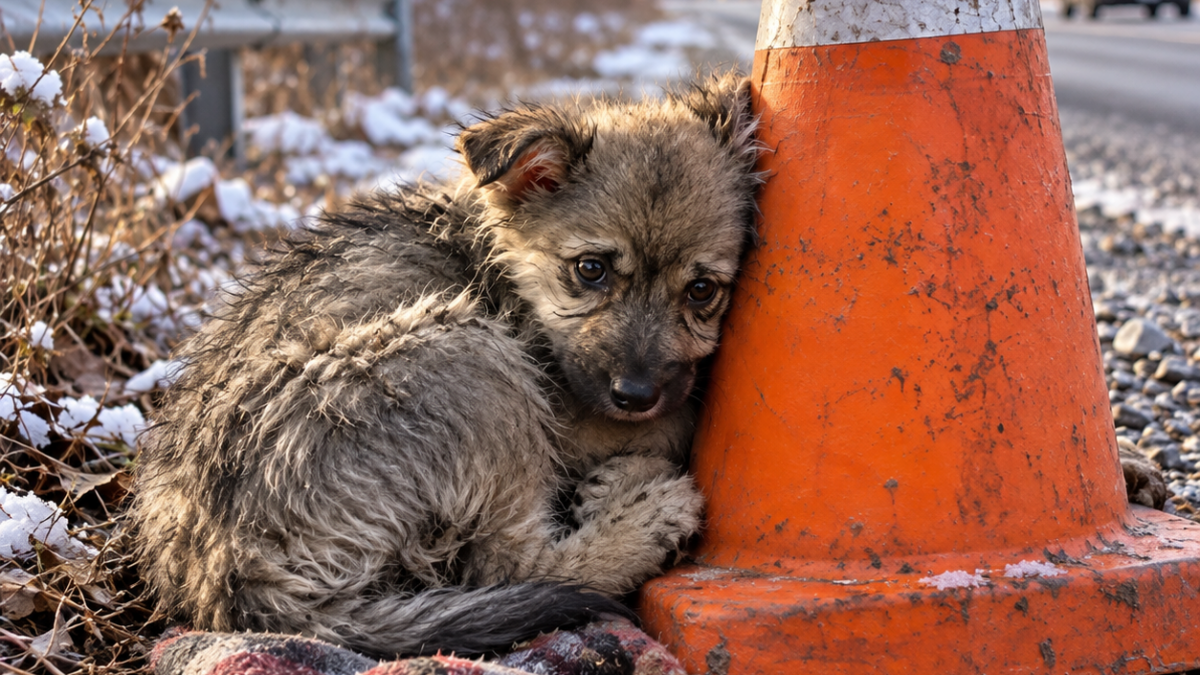
I almost drove past him that morning because, from the road, he looked like nothing more than a dirty gray rag beside an old orange traffic cone.
Then the tiny puppy pressed his entire body against that cone as my car approached, as if the faded piece of plastic were the only thing in the world he still had left.
It wasn’t until I lifted him into my arms that I saw what was underneath—and suddenly I understood why freezing, starving, and terrified, he had refused to leave.
My name is Megan, and I was heading to work just after sunrise when I passed an abandoned bus stop on a county road outside town.
The shelter roof had partially collapsed years earlier. Weeds grew through cracks in the asphalt, and somebody had left a faded orange traffic cone near the curb.
I drove past without thinking.
Then something moved beside it.
I hit the brakes.
For a second, I sat staring into my rearview mirror.
Nothing.
Then I saw the movement again.
Small.
Gray.
Alive.
I backed up.
The puppy couldn’t have been more than three months old.
He was painfully thin, with oversized ears, muddy paws and a narrow little face that looked too serious for something so young.
He was curled tightly around the base of the cone.
Not beside it.
Around it.
His front legs were pressed against the orange plastic, and his chest rested against the rubber base as if he were trying to hold it in place.
I got out slowly.
“Hey, little guy.”
His head lifted.
He didn’t bark.
He didn’t run.
He just pushed himself closer to the cone.
I crouched several feet away.
Cars passed behind me, sending cold wind across the shoulder.
The puppy shook so badly I could see it from where I sat.
I took a granola bar from my bag, broke off a piece without chocolate, and placed it on the pavement.
His nose moved.
Hunger won.
He crawled toward it, swallowed it, then immediately scrambled back to the cone.
That was strange.
Most frightened strays either ran from people or followed food.
This puppy kept returning to one exact spot.
I moved closer.
He watched my hand.
When I finally touched his shoulder, he flinched so hard his belly hit the pavement.
“It’s okay.”
His eyes stayed on mine.
I slipped off my jacket and wrapped it around him.
He was freezing.
His ribs felt like pencils beneath his skin.
When I lifted him, he suddenly began struggling.
Not to escape me.
To get back down.
He twisted toward the cone and made a sound I hadn’t heard until then.
A tiny, desperate cry.
“Wait.”
I held him against my chest and looked down.
The cone shifted when his paw struck it.
Underneath the wide black base, there was a dark gap in the pavement.
I set the puppy down beside me.
He immediately crawled toward it.
The cone wasn’t marking a construction site.
Someone had placed it directly over the broken opening of an old roadside drainage pipe.
I grabbed the top and pulled it aside.
The puppy rushed forward.
Then froze at the opening.
I heard nothing at first.
Only traffic.
Wind.
My own breathing.
Then, from somewhere inside the darkness, came a sound so faint I thought I imagined it.
A whimper.
The gray puppy answered instantly.
Another whimper came from underground.
Then another.
I dropped to my knees.
“There’s something in there.”
I switched on my phone flashlight and aimed it into the drainage pipe.
Ten feet in, something reflected the light.
Two eyes.
Then I saw a brown muzzle.
A paw.
And behind it, several tiny shapes pressed together against the concrete.
The puppy beside me began crying.
Not barking.
Crying.
A dog was trapped inside.
And she wasn’t alone.
I reached for my phone to call for help.
That’s when I noticed the tire tracks in the mud behind the bus stop.
Fresh enough to still hold their shape.
They ended beside the drainage opening.
And sitting near them was a torn plastic bag containing a dog-food receipt dated the night before.
Someone hadn’t simply lost these dogs.
Someone had brought them here.
Covered the opening with a traffic cone.
And driven away.
PART 2
I called 911 first.
Then animal control.
Then Rachel.
Rachel ran the small rescue group where I volunteered on weekends, and she answered on the second ring sounding half asleep.
“Megan?”
“I need you.”
“What happened?”
“I found a puppy.”
There was a pause.
“At seven in the morning?”
“That’s not the problem.”
“What is?”
I looked into the drainage pipe.
The brown dog inside had shifted slightly.
Three smaller shapes were pressed against her belly.
“I think someone dumped an entire family inside a culvert.”
Rachel was silent.
Then:
“Send me your location.”
I did.
“I’m coming.”
The gray puppy was still standing at the entrance.
Every time the dog inside made a sound, his entire body trembled.
I crouched beside him.
“You came out.”
He looked at me.
“How?”
The opening was barely large enough for a medium-sized dog.
The pipe ran beneath the old bus stop and curved somewhere beneath the road.
Maybe the gray puppy had crawled through after whoever left them.
Maybe he had been outside the whole time.
I didn’t know.
What I knew was that he could have walked away.
There were houses less than a mile down the road.
A gas station maybe two miles farther.
He could have followed traffic.
He could have searched for food.
Instead, he stayed.
Beside the cone.
Beside that hole.
I picked him up again.
This time he resisted less.
“You’re not leaving them.”
His head turned toward the pipe.
“Neither am I.”
—
The first officer arrived twelve minutes later.
Officer Daniels was young and clearly expected something simpler.
He parked behind my car, stepped out and asked, “You the caller?”
“Yes.”
“Where’s the animal?”
I pointed.
He saw the puppy.
Then the pipe.
Then heard the whimper.
His expression changed.
“How many?”
“I can see an adult and maybe three puppies.”
He crouched.
“Can you reach them?”
“No.”
The pipe was too narrow for a person.
Daniels shone his flashlight inside.
The adult dog raised her head.
That movement alone seemed to cost her.
“She looks bad.”
“She is.”
The gray puppy squirmed in my arms.
I lowered him.
He went straight to the opening.
The adult dog’s ears lifted.
For the first time, her tail moved.
Barely.
Daniels looked at me.
“That hers?”
“I think so.”
The puppy whined.
The mother answered.
That settled it.
A county animal-control truck arrived next.
Then Rachel.
She came running from her SUV wearing sweatpants under a winter coat.
“You okay?”
“I’m fine.”
She looked at the puppy.
“Oh my God.”
Then she saw the pipe.
Her face hardened.
“Who did this?”
“We don’t know.”
Officer Daniels pointed toward the tire tracks.
“Maybe we will.”
Rachel crouched at the entrance.
“Hey, mama.”
The dog didn’t growl.
That scared me.
A healthy mother with puppies often warns strangers.
This dog didn’t have enough strength.
Animal-control officer Denise Walker arrived with catch poles, blankets, a crate and a telescoping inspection camera.
“Let’s see what we’re dealing with.”
She fed the camera into the pipe.
We watched the screen.
The adult female was maybe forty pounds when healthy.
She looked closer to twenty-five.
Brown coat.
White chest.
Ribs visible.
There were three puppies beside her.
One black.
One tan.
One brown-and-white.
All younger than the gray puppy.
Maybe six or seven weeks.
The gray puppy might have belonged to an earlier litter.
Or perhaps he was simply larger.
Then the camera moved farther.
Something else appeared.
A cardboard box.
Crushed.
Wet.
Next to it was a blue plastic water bowl.
Empty.
Denise swore under her breath.
“What?”
“She didn’t crawl in there.”
I understood.
Somebody had placed them inside.
The box had probably been used to carry the puppies.
The water bowl meant preparation.
Intent.
Not a dog wandering into shelter.
Someone had chosen that pipe as a place to leave them.
Then put the cone over the entrance.
Rachel whispered, “They wanted nobody to see.”
Denise looked at the roadway.
“Or they wanted them contained.”
Contained.
The word made me sick.
Like they were trash.
—
The fire department arrived because there was no safe way to remove the adult dog through the opening without risking injury.
The drainage system had an access point on the opposite side of the road, but it had collapsed under years of sediment and debris.
Public works shut down one lane.
Within forty minutes, what had been an abandoned bus stop became an emergency scene.
The gray puppy stayed wrapped in my jacket.
We tried putting him in a heated animal-control truck.
He screamed.
Not barked.
Screamed.
He scratched at the crate door until I thought he would hurt himself.
So Denise let me carry him back.
The instant he saw the pipe, he settled.
Rachel looked at me.
“He thinks they’re going to disappear.”
“I know.”
I held him tighter.
“You don’t have to guard them anymore.”
But of course he didn’t understand.
For however long he’d been there, guarding that cone had been his job.
A firefighter named Marcus crawled partway through after they widened the entrance.
He moved slowly.
The mother dog lifted her head.
“Easy, girl.”
Her lips moved.
Not quite a growl.
Marcus stopped.
He placed a piece of chicken on the concrete.
The dog sniffed.
Didn’t eat.
Then the gray puppy called from outside.
A sharp little whine.
The mother’s ears moved.
Marcus looked back at us.
“Bring him closer.”
I knelt at the entrance with the puppy.
He stared into the pipe.
“Mama.”
I don’t know why I said it.
Maybe for him.
Maybe for her.
The mother dog relaxed slightly.
Marcus moved another foot.
Then another.
He reached the puppies first.
One by one, he slid them into a padded carrier.
The tan one squealed.
The gray puppy in my arms exploded with excitement.
His tail moved for the first time.
He tried climbing into the pipe.
“Not yet.”
The black puppy came out.
Then the brown-and-white one.
All alive.
Cold.
Thin.
But alive.
The mother was harder.
When Marcus touched her harness—or what was left of one—she flinched.
Then we saw why.
A length of rope was tied through it.
The other end disappeared beneath the crushed cardboard.
“She was restrained.”
Nobody spoke.
Marcus followed the rope.
It had been looped around a piece of broken concrete.
Not tightly enough to choke her.
Tightly enough that she couldn’t reach the opening.
Rachel looked away.
“That puppy got out and stayed for them.”
Denise nodded.
“Looks like it.”
The gray puppy wasn’t trapped.
The mother had been.
The smaller puppies were too young to find their way out.
He had escaped.
But he hadn’t left.
He stayed beside the cone marking the place where his family had vanished beneath the road.
—
Marcus cut the rope.
The mother tried to stand.
Her legs failed.
He wrapped her in a blanket and slowly backed out of the pipe.
When her head emerged into daylight, the gray puppy lost his mind.
He twisted free from me.
Before anyone could stop him, he ran to her.
“Megan!”
I reached for him.
Too late.
He pressed himself against her face.
The mother opened her eyes.
Then she licked his ear.
Once.
That was it.
The puppy collapsed beside her.
Rachel started crying.
Officer Daniels turned away.
Even Denise, who had worked cruelty cases for fifteen years, wiped her cheek with the back of one glove.
The mother was loaded into the heated truck with all four puppies.
The gray puppy refused a separate crate.
Denise finally allowed him to ride beside the mother while I sat nearby.
He curled against her chest.
Within minutes, he was asleep.
Not just dozing.
Completely asleep.
I realized he might not have slept properly in days.
Maybe every sound had made him wake.
Every passing car.
Every animal in the woods.
Every movement from that pipe.
Now the cone was gone.
The opening was surrounded by people.
His family was out.
For the first time, the little gray dog could stop guarding them.
—
At the emergency clinic, they were given names because forms required names.
Rachel looked at me.
“You found them.”
“Don’t make me name five dogs.”
“You already named one.”
“I did not.”
“You’ve been calling him Little Guy for two hours.”
“That is not a name.”
Dr. Patel smiled from across the exam room.
“It is now.”
“No.”
Rachel laughed.
“Little Guy it is.”
I looked at the puppy.
His ears were enormous.
“That is a terrible name.”
His tail moved.
Dr. Patel wrote it down.
**LITTLE GUY.**
“Traitors.”
The mother became **June** because we guessed she was around three years old and Rachel claimed she “looked like a June.”
The three younger puppies were **Bean**, **Scout**, and **Rosie**.
The names didn’t matter.
Their condition did.
June was severely underweight and dehydrated.
She had pressure sores on her legs.
Her nails were worn strangely from scraping against concrete.
She had an infected wound on one back paw.
Her milk production was dangerously low.
The younger puppies were dehydrated.
Bean had a respiratory infection.
Rosie had parasites.
Scout had a swollen abdomen caused by worms.
Little Guy was older than the others.
About fourteen weeks.
He was underweight but surprisingly strong.
Dr. Patel examined his paws.
“He’s walked.”
“How far?”
“No way to know.”
The pads were scraped and cracked.
One toe had a small cut.
“He may have left the culvert searching for food.”
Rachel looked at me.
“Then came back.”
“Apparently.”
Dr. Patel scanned all five dogs for microchips.
The puppies had none.
June did.
The scanner beeped over her left shoulder.
Every person in the room stopped.
Denise stepped forward.
“Run it.”
The clinic technician typed the number.
The registration appeared.
A name.
Address.
Phone number.
Rachel stared at the screen.
“So we know who she belongs to.”
Denise’s face was careful.
“We know who she was registered to.”
“Same thing.”
“No.”
She looked at us.
“Not legally. Not yet.”
I hated how right she was.
People rehome animals.
Records don’t get updated.
Dogs get stolen.
Run away.
Change hands.
A microchip was a lead.
Not a conviction.
The registered owner was **Travis Boone**.
Thirty-six.
Address fifteen miles away.
I recognized the last name.
“Boone?”
Rachel did too.
“Wait.”
She pulled out her phone.
“There’s a Boone Family Puppies page.”
My stomach tightened.
I had seen it online.
Cute photos.
Barn backgrounds.
Puppies wearing colored ribbons.
“Family-raised dogs,” the page claimed.
“Raised with love.”
Rachel found it.
The most recent post showed golden-colored puppies beside a wooden sign.
There were hearts in the caption.
Someone had commented asking about price.
Eight hundred dollars.
Another litter had sold for nine hundred.
Denise looked at June.
“What breed does the page advertise?”
“Lab-shepherd mixes sometimes. Doodles. Whatever sells.”
“Look for her.”
We searched.
It took less than five minutes.
There she was.
June.
Healthy.
Heavier.
Glossy brown coat.
Same white patch on the chest.
The post was almost two years old.
**Our sweet Junie girl welcomed seven beautiful babies today!**
I felt cold.
“She was breeding.”
Rachel scrolled.
Another litter.
Then another.
June had produced at least three litters documented publicly.
Maybe more.
Little Guy appeared in a photograph from four months earlier.
I recognized the ears.
A litter of six puppies sat on a blanket.
Five had red **SOLD** labels edited over their photos.
One didn’t.
The gray puppy.
The caption:
**Last little male available. Discounted. Serious homes only.**
I looked across the room.
Little Guy was sleeping beside June.
Nobody had bought him.
The younger puppies were apparently her newest litter.
No sales post.
Maybe they were unexpected.
Maybe June had become too sick.
Maybe Travis decided the cost of caring for them was higher than whatever money he could make.
Rachel whispered, “He dumped the dog that made him money.”
Denise said, “We don’t know that yet.”
But her voice had changed.
She knew where this was going.
—
Travis Boone told animal control that June had been stolen.
That was his first story.
Denise told us later.
He said somebody had entered his property three weeks earlier and taken June.
He claimed he had no idea she’d had another litter.
That story lasted less than an hour.
Because if your breeding dog is stolen, you usually report it.
Travis hadn’t.
No police report.
No lost-dog post.
No message on his breeding page.
Nothing.
Denise asked why.
He said he’d been “dealing with family problems.”
Then she asked about Little Guy.
Travis said he’d sold him.
“To whom?”
“Some guy.”
“Name?”
“Don’t remember.”
“Payment record?”
“Cash.”
“Phone number?”
“Deleted.”
Then Denise showed him the photograph from his own page.
Travis changed his story.
Maybe the buyer returned the puppy.
Maybe his brother handled it.
Maybe June escaped later.
The more he spoke, the worse it got.
But lies aren’t always enough.
Denise needed proof he had been at the bus stop.
That proof began with the receipt I’d found in the torn plastic bag.
The store was a farm-supply shop eleven miles away.
Dog food.
Paper towels.
Zip ties.
Purchased at 9:18 the previous night.
The receipt showed the last four digits of a credit card.
Investigators obtained surveillance footage.
Travis Boone stood at the register.
Baseball cap.
Dark jacket.
Same transaction.
At 9:26, he walked into the parking lot carrying the bag.
He loaded it into a white Ford pickup.
The camera captured the plate.
The truck was registered to him.
Still not enough to prove where he went next.
But there was more.
A gas station two miles from the abandoned bus stop had exterior cameras facing the county road.
At 9:47 p.m., a white Ford pickup drove north.
At 10:16, the same truck drove south.
Twenty-nine minutes.
Enough time to reach the bus stop.
Unload dogs.
Place the cone.
Leave.
Denise called me that evening.
“We’re applying for a warrant.”
“For his property?”
“Yes.”
“What do you expect to find?”
“I don’t know.”
“More dogs?”
A pause.
“Yes.”
My stomach dropped.
“How many?”
“I don’t know, Megan.”
—
They executed the warrant the following morning.
I wasn’t there.
Rachel wasn’t allowed either.
Probably for the best.
Animal control found eleven dogs.
Three adult females.
One adult male.
Seven puppies.
None were dying.
But none were living the way the advertisements suggested.
The cheerful barn in Travis’s photographs was real.
The dogs didn’t live there.
They lived in wire kennels inside a converted storage building behind it.
Some had no bedding.
Several had untreated skin problems.
One female had nails so long they curled sideways.
Another had recently had puppies and was severely underweight.
Medical records were incomplete.
Vaccinations missing.
Breeding records messy.
The “family raised” puppies had apparently spent most of their lives in kennels.
Investigators found old collars.
Medication.
Sales paperwork.
And orange traffic cones.
A stack of them.
Travis’s company did small paving and landscaping jobs.
The cone beside the bus stop had his business initials written underneath in black marker.
I remember sitting in Rachel’s office when Denise told us that.
For several seconds, neither of us spoke.
Then Rachel said, “So that’s it.”
“It’s strong evidence.”
“He put them there.”
“Looks that way.”
Rachel slammed her hand on the desk.
“Why?”
Denise sighed.
“According to Travis, June attacked one of the puppies.”
I stared.
“What?”
“He now says the younger litter wasn’t viable for sale. June had lost weight, one puppy got sick, and Little Guy had been returned because he was ‘too skittish.’”
“So he dumped all of them?”
“He says he intended someone to find them.”
My anger became so sharp it almost felt calm.
“By tying June inside a drainage pipe?”
“He says the rope was to keep her from running into traffic.”
“And covering the entrance?”
“He says the cone was to mark it.”
Rachel laughed.
There was nothing funny in the sound.
“Then why leave at ten o’clock at night?”
Denise didn’t answer.
“Why not call a shelter?”
No answer.
“Why not knock on one door?”
Still nothing.
I thought about Little Guy wrapped around the cone.
A puppy sitting in cold darkness beside the place where his mother had been hidden.
Travis said he’d left them where someone would find them.
But Little Guy was the only reason anybody had.
If he hadn’t escaped the pipe…
If he hadn’t stayed visible…
If I hadn’t noticed him move…
We might have driven past that orange cone for days.
Maybe weeks.
June couldn’t reach the opening.
The young puppies couldn’t survive without her.
Water didn’t naturally collect inside that section.
They would have died in the dark.
And the cone would still have been standing over them.
—
Little Guy recovered quickly.
His personality appeared in pieces.
The first surprise was that he loved socks.
Not shoes.
Socks.
Clean or dirty made no difference.
At Rachel’s rescue house, he stole them from laundry baskets and carried them beneath the dining table.
We found eleven there one afternoon.
“You’re running a criminal enterprise,” I told him.
He wagged.
The second surprise was stairs.
He had apparently never seen them.
The first time he encountered three steps leading to the porch, he barked at them.
Rachel demonstrated.
“Look.”
She walked up.
Little Guy stared.
She walked down.
He stared.
“You try.”
He put one paw on the first step.
Pulled it back.
Then Pepper, one of Rachel’s foster dogs, ran past him.
Little Guy chased her without thinking and reached the top.
He froze.
Looked around.
Then seemed incredibly pleased with himself.
After that, stairs belonged to him.
The third surprise was orange objects.
That one broke me.
Rachel had an orange bucket near the barn.
The first time Little Guy saw it, he ran toward it.
He pressed his shoulder against it.
Then looked around.
Searching.
We moved the bucket away.
He followed.
For several weeks, anything orange caught his attention.
Traffic cones.
Buckets.
A child’s plastic toy at the park.
He associated that color with the last place he’d had his family.
Rachel said, “We should desensitize him.”
I agreed.
Slowly.
Never forcing.
We bought a brand-new orange cone.
Smaller than the one by the bus stop.
Placed it in the yard.
Little Guy walked toward it.
Sniffed.
Then sat beside it.
My eyes filled.
“You don’t have to do that.”
He leaned against it.
We let him.
Some habits aren’t problems immediately.
Sometimes they’re memories.
We gave him time to learn a new meaning.
—
June’s recovery was slower.
Her body had been used hard.
The clinic estimated she’d had multiple litters too close together.
Her calcium levels were low.
Her teeth were worn.
She had an untreated uterine infection beginning to develop.
Dr. Patel spayed her once she was strong enough.
“She was lucky,” he told us.
“How lucky?”
“Another untreated cycle, maybe another litter, and we could have been dealing with something fatal.”
Rachel looked at June sleeping.
“So breeding her again could’ve killed her.”
“Yes.”
That became important later.
Because Travis’s records showed he had already advertised another “planned pairing” involving June for the spring.
He knew she was thin.
Knew she’d struggled with the last litter.
Still intended to breed her again.
Until the newest puppies became inconvenient.
—
The younger puppies gained weight.
Bean’s respiratory infection cleared.
Scout’s round belly disappeared after deworming.
Rosie became the loudest creature I had ever met.
She barked at bowls.
Shoes.
Reflections.
Her own tail.
Within a month, all three looked like normal puppies.
That was both beautiful and strange.
Healing can make suffering disappear from the surface.
If you met them later, you would never know.
You wouldn’t know their first bed was wet concrete.
You wouldn’t know their mother had been tied inside a drainage pipe.
You wouldn’t know an orange cone had been placed between them and the world.
That’s why documentation mattered.
Photographs.
Veterinary records.
Receipts.
Surveillance footage.
Because animals heal, and sometimes the better they look, the easier it becomes for people to underestimate what was done to them.
—
The Boone case became public after charges were filed.
Cruelty.
Abandonment.
Failure to provide adequate care.
Several licensing and business violations followed after investigators reviewed his breeding operation.
Local news stations showed footage of the property.
Then came the internet.
People found old advertisements.
Customers began contacting investigators.
Some had bought healthy puppies.
Others hadn’t.
One family said the puppy they purchased developed severe parasites within days.
Another said Travis stopped answering after their dog was diagnosed with a congenital condition.
A woman named Kelly contacted our rescue.
She had bought a puppy from June’s second documented litter.
The dog, Cooper, was now two.
Beautiful.
Healthy enough.
But when Kelly saw June’s photograph in the news, she recognized her.
“I met her.”
“You did?”
“When we picked Cooper up.”
“How did she look?”
“Thin.”
My heart sank.
“How thin?”
Kelly sent a photograph.
June stood behind a fence.
Ribs faintly visible.
Not as bad as when we found her.
But too thin for a nursing mother.
“What did Travis tell you?”
“That nursing puppies takes a lot out of dogs.”
“Did you question it?”
“I asked.”
“And?”
“He said the vet wasn’t concerned.”
Records showed no veterinary visit around that date.
Kelly started crying.
“I believed him.”
“You had no reason not to.”
“I paid him eight hundred dollars.”
That money hadn’t bought June better food.
Better medical care.
Rest between litters.
It had apparently bought nothing for her.
Cooper came to visit June one afternoon.
We didn’t know whether dogs recognize adult offspring after long separation.
People argue about it.
I don’t pretend to know.
What happened was simple.
Cooper entered the yard.
June watched him.
He approached carefully.
They sniffed.
June’s tail moved.
Then Cooper bowed.
June stared at him.
He bounced sideways.
For the first time since rescue, June ran.
Not far.
Maybe twenty feet.
But she chased him.
Kelly cried.
Rachel cried.
I cried.
Apparently our rescue group had become useless around emotionally significant dogs.
Little Guy joined them.
Then Bean.
Scout.
Rosie.
Five dogs racing through the yard.
June in the middle.
No pipe.
No rope.
No cone.
Just grass.
—
Travis pleaded not guilty initially.
His attorney argued that he had experienced financial hardship.
That the dogs were left near a road where they could be discovered.
That the supplies inside the pipe proved he had attempted to provide for them.
A bowl.
A cardboard box.
Some food scattered nearby.
Rachel nearly exploded when she heard that.
“That makes it worse.”
In a way, she was right.
An impulsive act can happen in seconds.
Planning takes time.
The bag.
The drive.
The rope.
The cone.
He had opportunities to stop.
He could have driven to the county shelter.
It was open until six.
He could have called after-hours animal control.
He could have contacted any of the customers who had paid him hundreds of dollars for June’s puppies.
He could have posted online.
He knew how.
His business depended on it.
Instead, he drove past all those possibilities to an abandoned bus stop.
At night.
Then concealed the dogs beneath the road.
—
The preliminary hearing was the first time I saw Travis Boone in person.
He looked ordinary.
That bothered me.
I don’t know what I expected.
A monster, maybe.
Somebody whose cruelty would be visible the moment he entered.
Instead, he wore khakis and a blue button-down shirt.
Clean haircut.
Wedding ring.
He whispered to his lawyer.
Once, he laughed quietly at something.
I hated him immediately.
Then I caught myself.
Hatred is easy when someone becomes a symbol instead of a person.
But nothing he looked like mattered.
Evidence mattered.
Officer Denise Walker testified first.
Then Dr. Patel.
Then the fire captain.
Then me.
The prosecutor asked me to describe the morning.
I did.
The bus stop.
The movement.
The cone.
Little Guy.
“How was the puppy positioned when you first saw him?”
“Pressed against the cone.”
“Could he move freely?”
“Yes.”
“So he wasn’t physically trapped?”
“No.”
“Did he leave?”
“No.”
“Why?”
Travis’s attorney objected.
“Calls for speculation.”
“Sustained.”
The prosecutor changed direction.
“What happened when you moved the cone?”
“I heard whimpering.”
“From where?”
“The drainage pipe.”
“And what did the gray puppy do?”
“He went to the opening.”
“Reaction?”
“He cried.”
I hated saying it.
But that’s what he did.
“What was found inside?”
“June and three younger puppies.”
“Condition?”
“Extremely weak.”
“Was June free to leave?”
“No.”
“Why?”
“She had a rope attached to her harness.”
Travis looked down.
The prosecutor showed the photograph.
June on the concrete.
Puppies against her belly.
Rope visible.
The courtroom became silent.
Then came the orange cone.
The actual cone was evidence.
Mud still stained the base.
The business initials were visible underneath.
**TB PAVING.**
Travis stared at it.
For the first time, something changed in his face.
He knew objects don’t forget.
People can change stories.
A traffic cone cannot.
—
The strongest evidence came unexpectedly.
Travis’s former employee.
A nineteen-year-old named Caleb.
He contacted investigators after seeing the news.
Caleb had worked part-time cleaning kennels.
He testified that Travis complained June was “done.”
“What did he mean?” the prosecutor asked.
Caleb swallowed.
“That she wasn’t making him money anymore.”
“Why?”
“She was losing weight. The new puppies were small.”
“Did Mr. Boone discuss taking them somewhere?”
“Yes.”
Travis’s lawyer objected.
Overruled.
Caleb continued.
“He asked if I knew anywhere people dumped dogs.”
The room changed.
“What did you say?”
“I told him no.”
“When?”
“About a week before they were found.”
The prosecutor paused.
“Did he say anything else?”
Caleb looked toward Travis.
“He said shelters ask too many questions.”
Travis stopped looking at him.
Rachel squeezed my hand.
There it was.
Not panic.
Not confusion.
Avoidance.
He didn’t want to answer questions.
So he created a place where the dogs couldn’t answer either.
Except Little Guy escaped.
And sat beside the marker Travis himself left behind.
—
The case never reached a full jury trial.
Facing the surveillance footage, veterinary records, business records, microchip history, employee testimony and evidence from the property, Travis accepted a plea agreement.
Some people online were furious.
They wanted maximum punishment.
Prison for years.
Business destroyed.
Everything taken.
I understood the anger.
I felt plenty myself.
The final sentence included jail time, probation, fines, restitution toward veterinary costs, closure of the unlicensed breeding operation and a lengthy court prohibition on breeding, selling or possessing dogs.
The remaining dogs were permanently surrendered.
His business licensing problems continued separately.
Several former customers pursued civil claims.
The money he had made by treating dogs as inventory began disappearing into attorneys, restitution, fines and refunds.
Rachel called that revenge.
I didn’t.
Not anymore.
Revenge was too small.
The important part happened outside the courtroom.
—
Bean was adopted first.
A family with two teenagers.
They sent photographs of him asleep under blankets.
Scout went to a retired firefighter who took him fishing.
Rosie went to a woman who already had an older dog and apparently didn’t mind being yelled at by a puppy all day.
Cooper stayed with Kelly, of course.
June received twelve adoption applications.
Rachel rejected eleven.
“You’re impossible,” I told her.
“They’re wrong.”
“You haven’t met half of them.”
“I can tell.”
“That’s not how rescue works.”
“It is today.”
Then application twelve arrived.
A widow named Evelyn.
Sixty-three.
Two acres.
No other pets.
Recently retired.
She wrote:
**I don’t need a young dog. I don’t need a perfect dog. I would like a dog who has spent enough of her life working and deserves to spend the rest resting.**
Rachel read it twice.
Then handed me the phone.
“Well?”
I swallowed.
“Call her.”
Evelyn visited three times.
First time, June wouldn’t approach.
Evelyn sat in the yard reading a book.
Second visit, June sniffed her shoe.
Evelyn pretended not to notice.
Third visit, June placed her head on Evelyn’s knee.
Done.
Rachel cried before the adoption papers were signed.
June left wearing a soft green harness.
No rope.
No breeding collar.
No cracked kennel floor waiting for her.
Evelyn opened her car door.
June jumped in.
Then looked back at us.
Little Guy stood beside me.
June looked at him.
He looked at her.
For a moment, I worried.
Would he panic?
Would the old fear return?
His mother leaving.
A car.
Separation.
June’s tail moved through the open window.
Little Guy walked closer.
They touched noses.
Then he stepped back.
Evelyn drove away.
Little Guy watched.
No screaming.
No chasing.
No desperate attempt to hold the car in place.
He looked at me.
Then walked toward my truck.
Rachel raised an eyebrow.
“He knows where he’s going.”
I pretended not to understand.
—
Little Guy had received applications too.
Good ones.
A teacher.
A couple with a farm.
A family whose older shepherd had died.
I read every one.
Then found reasons to reject them.
Rachel let this continue for several weeks.
Finally, one afternoon, she put a folder in front of me.
“Last application.”
“I don’t want to see it.”
“You should.”
“Why?”
“Strong candidate.”
I opened it.
Applicant name:
**Megan Carter.**
I stared at her.
“What is this?”
“I filled it out.”
“You can’t apply for me.”
“Apparently I can.”
I read.
Address.
Mine.
Employer.
Mine.
Veterinary reference.
Mine.
Under **Why do you want to adopt this dog?**, Rachel had written:
**Because he already goes home with her every night and she is embarrassing herself pretending this is temporary.**
I looked up.
“I hate you.”
“No, you don’t.”
Little Guy was asleep under my desk.
An orange tennis ball rested between his paws.
Rachel pointed at him.
“Tell him he’s going to another family.”
I opened my mouth.
Nothing came out.
“Go ahead.”
“Shut up.”
“Tell him.”
I looked down.
Little Guy opened one eye.
His tail thumped.
I sighed.
“Fine.”
Rachel smiled.
“Fine what?”
“He can stay.”
“Say it properly.”
“No.”
“Megan.”
I got on the floor.
Little Guy stood.
I put both hands around his face.
“You want to live with me?”
He licked my nose.
“Terrible decision.”
His tail exploded.
Rachel clapped.
“You’re adopted.”
Little Guy barked.
That became his first truly happy day that belonged only to him.
Not rescue.
Not survival.
Not evidence.
Home.
—
I changed his name.
Not immediately.
For weeks, he remained Little Guy.
Then one morning, I was drinking coffee when he carried something into the kitchen.
The small orange cone we’d used to help him work through his fear.
He had learned to play with it.
Not hug it.
Not guard it.
Play.
He grabbed the narrow top in his teeth, ran across the yard and shook it like a toy.
Then he dropped it at my feet.
I laughed.
“You know that used to terrify me, right?”
He barked.
I threw a tennis ball.
He ignored it.
Picked up the cone again.
Rachel had been suggesting names.
Ash.
Storm.
Ghost.
Nothing fit.
Then I thought about what he’d done.
He had stayed.
Held his ground.
Refused to abandon the others.
“Anchor.”
His ears lifted.
I said it again.
“Anchor.”
Tail wag.
That was it.
Little Guy became Anchor.
Not because the cone had held him there.
Because he had held himself there for everyone else.
—
For months, Anchor hated driving past the old bus stop.
The county repaired the drainage opening after the rescue.
The traffic cone was gone as evidence.
Later, the bus shelter itself was demolished.
But dogs don’t need buildings to remember.
The first time my truck approached that stretch of road, Anchor stood up.
His breathing changed.
He moved toward the window.
Then started whining.
I pulled over.
Maybe that was a mistake.
Maybe I needed it as much as he did.
We got out.
Anchor walked toward where the cone had stood.
He sniffed.
Circle.
Another circle.
Then stopped.
He stared at the sealed drainage opening.
I crouched beside him.
“They’re not there.”
He looked at me.
“June’s home.”
His ears moved.
“Bean has his family.”
“Scout too.”
“Rosie is probably yelling at somebody.”
Tail wag.
“You did it.”
Anchor pressed against my leg.
“You don’t have to stay here.”
For several minutes, he didn’t move.
Then something remarkable happened.
A county road worker had left another cone about fifty yards away near fresh pavement.
Anchor noticed it.
He froze.
Looked.
Then walked toward it.
I followed.
He sniffed the base.
No panic.
No crying.
Then he lifted his leg and peed on it.
I laughed so suddenly I scared him.
“Oh, that’s perfect.”
He looked incredibly proud.
We got back into the truck.
Anchor climbed into the passenger seat.
He didn’t look back.
—
June’s new life became everything we had hoped.
Evelyn sent updates constantly.
June sleeping beside the fireplace.
June lying in sunlight.
June standing waist-deep in a pond.
June refusing to come inside during snow.
June discovering that couches were apparently invented for dogs.
The biggest change was her body.
She gained weight.
Muscle returned.
Her coat became glossy.
Her eyes softened.
The exhausted mother beneath the road slowly disappeared.
One year after rescue, Evelyn brought June to our annual fundraiser.
Anchor was there.
They saw each other across the field.
Anchor ran.
June ran.
They met near the fence and started circling each other like puppies.
Everyone stopped to watch.
Evelyn came beside me.
“She still mothers everything.”
“What does that mean?”
“She found a nest of baby rabbits last month and sat ten feet away guarding it.”
I laughed.
“That sounds like June.”
Evelyn’s voice softened.
“She’s a wonderful dog.”
“I know.”
“No.”
She looked at me.
“I mean she is easy to love.”
That sentence hurt.
Because somewhere along the way, June had been treated as useful instead of lovable.
Breeding female.
Inventory.
Expense.
Problem.
But none of that had been true.
She was easy to love.
Someone had simply decided love wasn’t profitable.
—
Travis Boone appeared once more in our lives.
Three years after the case.
I was at a farm-supply store buying dog food.
Anchor was home.
I turned into an aisle.
There he was.
Older.
Heavier.
No blue courtroom shirt.
Work boots.
Baseball cap.
For a second, I wasn’t certain.
Then he recognized me.
We both stopped.
I had imagined that moment hundreds of times.
In those imaginary conversations, I was brilliant.
Calm.
Devastating.
I told him everything.
What June looked like now.
What Anchor had done.
How close the puppies came to dying.
How much money the rescue spent.
How many people hated him.
In reality, I said nothing.
Neither did he.
Then his eyes dropped to the dog food in my cart.
“Still got that gray one?”
The casualness of the question stunned me.
I stared at him.
“Yes.”
He nodded.
“Figured you would.”
That was it.
No apology.
No explanation.
I felt the old anger coming back.
Then I remembered Elena telling me years earlier that some people may never understand.
I asked, “Do you remember the cone?”
His face changed.
Only slightly.
“Yes.”
“Anchor does.”
He frowned.
“Who?”
“The gray puppy.”
“Oh.”
I pushed my cart past him.
Then stopped.
“He doesn’t sit beside cones anymore.”
Travis looked at me.
I smiled.
“He pees on them.”
I walked away.
It was childish.
Rachel laughed for ten straight minutes when I told her.
But I don’t regret it.
—
Anchor lived a big life.
Much bigger than the abandoned bus stop.
He learned to swim.
Badly.
He believed every body of water existed specifically for him to splash other people.
He loved children.
Hated inflatable holiday decorations.
Once, he spent twenty minutes barking at a six-foot plastic snowman until I unplugged it.
He still stole socks.
At age seven, he had a collection beneath my bed.
He came with me to rescue events.
Not because he was trained as a therapy dog.
He wasn’t.
He was too opinionated.
But people loved hearing his story.
We kept a photograph of the old orange cone on our table.
Beside it sat a new cone.
Children could sign their names on it after learning about animal abandonment and what to do if they found a stray.
At first, Anchor avoided the display.
Later, he slept beside it.
Eventually, he used it as a pillow.
That became my favorite photograph of him.
Old fear.
New meaning.
—
The money from Travis’s restitution didn’t cover everything.
Not even close.
But something else came from the case.
The county changed procedures for abandoned-animal calls.
Public works employees were taught to check suspicious containers, taped boxes and blocked drainage openings instead of assuming they were roadside trash.
Local officers received updated guidance about animal abandonment.
The rescue created an emergency surrender fund.
People who couldn’t afford food, veterinary treatment or litter care could ask for help without being shamed.
Because one thing mattered to us:
We never wanted desperation to become someone’s excuse for another orange cone.
Most people who asked for help weren’t cruel.
They were broke.
Sick.
Overwhelmed.
Evicted.
Scared.
Some cried when they surrendered animals.
We helped when we could.
Compassion for struggling people didn’t require excusing deliberate cruelty.
The difference was choice.
Travis had options.
He hid the dogs instead.
—
Five years after the rescue, June developed cancer.
Evelyn called me.
I knew before she finished.
“Megan.”
“What happened?”
“The vet found a mass.”
I closed my eyes.
“Where?”
“Spleen.”
I drove to Evelyn’s house that evening.
June met me at the door.
Slower than before.
Gray around the muzzle.
But tail wagging.
Anchor came with me.
When he saw her, he pushed past my legs.
June sniffed him.
He licked her face.
We sat in Evelyn’s living room.
June lay between us.
The prognosis wasn’t hopeless.
But it wasn’t good.
Surgery could help.
Maybe months.
Maybe more.
Evelyn didn’t hesitate.
“Do it.”
The operation went well.
The tumor was malignant.
But hadn’t visibly spread everywhere.
June got ten good months.
Ten.
People say that as though months are small.
They aren’t.
Ten months can contain hundreds of mornings.
Meals.
Walks.
Naps.
Rainstorms.
Car rides.
Visitors.
Sunlight.
June had been denied choices for years.
Evelyn gave her ten months filled with them.
In the final week, June stopped eating.
Anchor visited twice.
On the last day, he lay beside her.
He was nine by then.
Gray beginning around his own face.
June rested her head across his paws.
Evelyn cried silently.
I stroked June’s ear.
“You did enough.”
I thought about the drainage pipe.
The rope.
The concrete.
The puppies.
The years of breeding.
Everything her body had survived.
“You don’t have to take care of anybody now.”
June breathed slowly.
Anchor didn’t move.
The veterinarian came to the house.
Evelyn kissed June between the eyes.
“You were never a burden.”
That sentence shattered me.
Because maybe somewhere in June’s story, someone had taught her the opposite.
Evelyn repeated it.
“You hear me?”
June’s eyes stayed on her.
“You were never a burden.”
Anchor licked June’s paw.
She died with her head still resting across his feet.
—
Afterward, Anchor searched Evelyn’s house.
Room by room.
Kitchen.
Bedroom.
Hallway.
Backyard.
He returned to the living room.
Sniffed June’s bed.
Then looked at me.
I didn’t know how to explain death to a dog.
Maybe they understand more than we think.
Maybe less.
I sat on the floor.
“She isn’t here.”
Anchor lay on June’s bed.
We let him stay as long as he wanted.
Eventually, he stood.
Walked to the front door.
Looked at me.
Ready.
We went home.
He didn’t refuse to leave.
He didn’t stand guard.
That mattered.
Some part of him had learned the difference between being left behind and saying goodbye.
—
Years passed.
Anchor became eleven.
Then twelve.
The ears still looked too large.
His face turned almost silver.
His back legs developed arthritis.
He stopped jumping into my truck, so I bought a ramp.
He hated the ramp.
We argued.
I won because I controlled the treats.
Eventually, he accepted it.
One cold November morning, I drove him down the county road.
The old bus stop was long gone.
A small pull-off had replaced it.
The drainage pipe had been rebuilt completely.
I hadn’t planned to stop.
Then I saw something.
An orange traffic cone.
A crew had been repairing the shoulder.
One cone remained near the grass.
I smiled.
I pulled over.
Anchor lifted his head.
“You want to see?”
He stood slowly.
We walked toward it.
No fear.
No urgency.
Anchor sniffed.
Then sat.
Not pressed against it.
Just beside it.
I sat on the ground with him.
Cars passed.
Cold wind moved through my jacket.
For a moment, I could see the puppy again.
Skinny.
Dirty.
Shivering.
Wrapped around orange plastic because his whole world was beneath it.
I put my arm around Anchor.
“You know something?”
He looked at me.
“I almost didn’t see you.”
His ears moved.
“Three more seconds and I would’ve kept driving.”
I hated thinking about that.
What would have happened?
Maybe another driver would have stopped.
Maybe a road worker.
Maybe nobody.
Life sometimes turns on terrifyingly small decisions.
A movement in peripheral vision.
A brake pedal.
A U-turn.
One person deciding to look again.
Anchor leaned against me.
I smiled.
“You made sure I stopped.”
He had.
By staying visible.
By refusing to abandon the cone.
By holding his position when every instinct must have told him to find warmth and food somewhere else.
He saved June.
Bean.
Scout.
Rosie.
Then, indirectly, eleven more dogs on Travis’s property.
Maybe more through every animal our surrender fund helped afterward.
A puppy nobody wanted had become the reason an entire breeding operation ended.
Not because he fought anyone.
Not because he understood justice.
Because he stayed.
—
Anchor was thirteen when his kidneys began failing.
Dr. Patel had retired by then.
The new veterinarian was kind.
She explained the numbers.
The treatments.
The likely timeline.
I listened.
Pretended to be rational.
Went to my truck afterward and cried until I couldn’t see.
We managed his condition for months.
Special diet.
Fluids.
Medication.
Anchor hated all of it except the extra attention.
He still stole socks.
Still barked at inflatable decorations.
Still slept with his back against my legs.
But the walks became shorter.
Then one morning, he stopped at the driveway.
He looked toward the road.
Didn’t move.
“You tired?”
He turned back toward the house.
That was our new distance.
Door to driveway.
Driveway to door.
It was enough.
Eventually, even that became hard.
Rachel came over more often.
We were both older.
She sat on my kitchen floor with Anchor’s head in her lap.
“Remember when you said you weren’t adopting him?”
“I was young and stupid.”
“You were thirty-four.”
“Young.”
“Stupid, yes.”
Anchor’s tail tapped.
I laughed.
That sound became precious.
—
The final day came quietly.
No emergency.
No dramatic collapse.
Anchor simply stopped eating.
Then drinking.
He could still raise his head.
Still knew me.
Still wagged when Rachel arrived.
The veterinarian offered to come to the house.
I said yes.
Before she came, I carried Anchor outside.
It was spring.
Warm.
The grass had just been cut.
I laid a blanket beneath the maple tree.
Anchor rested beside me.
Rachel brought something from her car.
An orange traffic cone.
The little one we’d bought years ago.
I stared.
“You kept that?”
“Of course.”
She placed it several feet away.
Anchor noticed.
His ears rose.
I laughed through tears.
“Look.”
Rachel sat beside us.
“For old times.”
Anchor stared at the cone.
Then, impossibly, pushed himself upright.
“Buddy, you don’t have to.”
He took one slow step.
Then another.
He reached the cone.
Sniffed it.
I held my breath.
Anchor turned around.
Walked back.
And lay beside me.
Not the cone.
Me.
That broke whatever was left of my heart.
I buried my face in his fur.
“You figured it out.”
He sighed.
“You don’t have to guard it.”
His eyes closed halfway.
“Nobody’s under there.”
I touched the gray fur between his ears.
“They’re all safe.”
Bean had died the year before at twelve after a good life.
Scout was still alive with his retired firefighter.
Rosie had become an elderly tyrant who ruled her household.
June was gone.
But she’d been loved.
“They’re safe.”
Anchor’s breathing slowed.
“And you are too.”
The veterinarian arrived.
She sat with us.
No rush.
No clinic table.
No bright room.
Just grass.
Wind.
Birds.
Rachel crying openly.
I put my jacket beneath Anchor’s head.
The same thing I had done the morning we met.
Different jacket.
Same instinct.
Keep him warm.
I remembered lifting that tiny freezing puppy and feeling him fight to get back to the cone.
I remembered thinking he was afraid of me.
He wasn’t.
He was afraid I would take him away from the ones who needed him.
I whispered into his ear.
“You can leave now.”
His eyes opened.
“You don’t have to wait for me.”
Tail tap.
“You don’t have to watch anything.”
Another breath.
“You did your job.”
I kissed his forehead.
“And you did it better than all of us.”
The sedative went in.
Anchor relaxed.
His head became heavy across my arm.
Rachel placed one hand on his back.
The veterinarian waited.
I looked toward the orange cone.
For years, I’d thought of it as a symbol of what had been done to him.
But sitting there beneath the maple tree, I saw it differently.
That cone was the place Anchor had made his stand.
He couldn’t move it.
Couldn’t call anyone.
Couldn’t untie his mother.
Couldn’t explain what happened.
So he did the only thing he could.
He stayed where someone might see him.
And eventually, someone did.
I looked back at Anchor.
“I’m glad I stopped.”
His breathing was almost silent.
“I am so glad I saw you.”
The final medication was given.
Anchor took one long breath.
Then another.
Then no more.
His body rested against mine.
Free.
—
We buried his ashes in the yard.
Not all of them.
I kept a small amount in a wooden box.
Rachel asked what I wanted to do with the orange cone.
For a while, I didn’t know.
Throwing it away felt wrong.
Keeping it in my garage felt worse.
Then I had an idea.
The rescue had purchased a permanent property by then.
Eight acres.
Kennels.
Medical rooms.
Play yards.
A small building for emergency surrender.
At the entrance stood a garden planted in memory of rescued animals.
We placed the orange cone there.
Not upright.
That would have looked ridiculous.
Rachel cut part of the base and turned it into a planter.
We filled it with orange flowers.
A small plaque sat beside it.
**ANCHOR**
**He stayed until someone stopped.**
Underneath:
**Because of him, thirteen dogs were rescued that week. Hundreds more received help afterward.**
Visitors always asked why a rescue garden had a traffic cone.
Then somebody told the story.
—
Years later, a young volunteer named Sophie asked me something.
“Do you think Anchor knew he saved them?”
I thought about it.
“No.”
She seemed disappointed.
“I don’t think dogs think like that.”
“What did he think?”
“He knew his family was under the road.”
“And?”
“He knew they shouldn’t be alone.”
Sophie looked at the flowers growing from the cone.
“So he stayed.”
“Yes.”
“That’s all?”
I smiled.
“That’s enough.”
People want heroism to be complicated.
A plan.
A sacrifice understood in advance.
But maybe the strongest kind is simpler.
Someone you love is in trouble.
You could leave.
You don’t.
Anchor didn’t know that orange cone would become evidence.
Didn’t know police would investigate.
Didn’t know eleven more dogs would be found.
Didn’t know courtrooms.
Restitution.
Rescue programs.
New policies.
He didn’t know that one day his story would teach people to stop when they saw something strange beside a road.
He knew his mother was under the ground.
His siblings were there.
And he was outside.
So he stayed close enough to hear them.
Close enough to answer.
Close enough for me to see him.
—
I still drive that county road sometimes.
The landscape changed.
New houses appeared farther down.
The old gas station was renovated.
The bus stop disappeared completely.
If you didn’t know where it had stood, you’d never guess.
But I know.
I always slow down.
Not because I expect another puppy.
Because that’s where my life divided into before and after.
Before, I believed rescue meant finding animals.
After Anchor, I understood something else.
Sometimes animals are trying desperately to find us.
They just don’t have our language.
They have movement.
Sound.
Waiting.
A gray body beside an orange cone.
A tiny head lifting when a car slows.
A puppy refusing to walk away.
That morning, I thought Anchor was hugging the cone because he was frightened.
I was wrong.
He was holding his place.
He couldn’t lift it.
Couldn’t reach June.
Couldn’t bring the puppies out.
But he could make sure one member of the family stayed where the world could see.
For hours—maybe longer—cars passed.
Nobody stopped.
He stayed.
Cold.
Hungry.
Tired.
He stayed.
Then my car passed.
I almost kept going.
A few yards later, something in me said turn around.
So I did.
That was all.
One brake pedal.
One reverse.
One small decision.
I used to think I rescued Anchor that morning.
I don’t anymore.
Anchor rescued his family.
He exposed the man who abandoned them.
He helped save dogs he’d never met.
He changed how our county handled abandonment.
He gave June a peaceful life.
He gave me thirteen years I never planned to have.
All I did was finally notice him.
And whenever I picture him now, I don’t see the old dog beneath my maple tree.
I see the puppy.
Huge ears.
Dirty gray fur.
Skinny legs.
Standing beside that faded orange cone.
I kneel.
He watches me.
I reach out.
He lets me touch him.
Then I lift him.
He struggles.
Turns back.
Shows me the darkness beneath the cone.
And without saying a word, tells me exactly what he needs.
Not:
Save me.
Something bigger.
They’re still down there.
Don’t leave.
So I don’t.
And neither does he.
Not until every last one of them comes out.








