PART 2: A Starving Dog Took Meat From My Butcher Shop Every Night—Then I Followed Her Across the Bridge
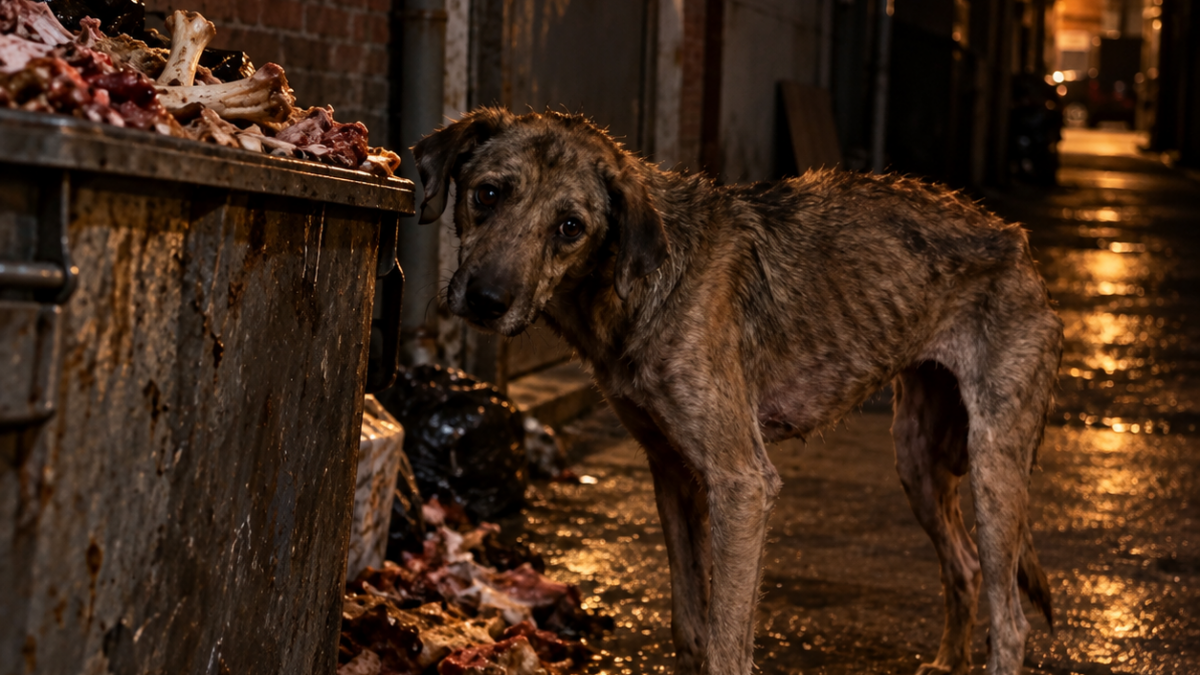
PART 2
I stood behind that abandoned warehouse with one hand wrapped around the cold chain-link fence and the other holding my phone.
For several seconds, I couldn’t make myself dial.
The brown dog was lying on his side.
The black-and-white dog had lifted his head just enough to chew.
And the little gray-brown dog I had been feeding for weeks sat between them like a guard.
She still hadn’t eaten.
Not one piece.
“Come on,” I whispered. “Eat something.”
She looked toward me.
Then back at the others.
That was when anger finally pushed through the shock.
I called the county animal emergency number first.
Then the police non-emergency line.
I explained that two severely emaciated dogs were trapped behind a locked fence on apparently abandoned industrial property.
The dispatcher asked whether I could safely reach them.
“No,” I said. “The gate is padlocked.”
“Are the animals in immediate danger?”
I stared at the brown dog.
“I don’t know how they make it through another night.”
She told me not to force the gate myself.
I hated that answer.
But I understood it.
Trespassing charges weren’t going to help those dogs.
I stayed.
The little stray knew I was there now.
She did not run.
She simply watched me from the other side of the fence.
I crouched.
“You did your part,” I told her. “Let me do mine.”
Her ears moved slightly.
It was after midnight by the time an officer arrived.
His name was Deputy Paul Harris.
He was maybe fifty, broad-shouldered, with the tired expression of a man who had seen every stupid thing people could do and had stopped being surprised by most of them.
He shined his flashlight through the fence.
His face changed.
“How long have they been here?”
“I don’t know.”
“Those yours?”
“No.”
“You know the property owner?”
“No.”
He looked at the padlock.
Then at the dogs.
“We’re going to get animal control involved.”
“They said emergency rescue is sending somebody.”
“Good.”
He crouched beside me.
The black-and-white dog tried to move toward us.
His front legs worked.
His back end barely did.
Harris muttered something under his breath.
“What?” I asked.
“Nothing I should say in uniform.”
I liked him immediately.
We waited another thirty minutes.
A van finally pulled behind the warehouse.
Three people got out.
The woman who seemed to be in charge introduced herself as Laura Bennett.
She had dark hair tied back, work boots, and the calm voice of someone who understood that frightened animals notice panic.
Two men were with her, Marc and Tom.
Laura walked to the fence and lowered herself into a crouch.
“Oh, sweetheart.”
The brown dog’s eyes opened.
Laura spoke softly.
“We see you.”
His ears twitched.
“You’re not invisible anymore.”
I don’t know why that sentence hit me so hard.
Maybe because that was exactly what they had been.
Invisible.
Behind a warehouse nobody used.
Behind a fence nobody checked.
Slowly disappearing while traffic crossed a bridge two hundred yards away.
Laura examined the lock.
“This was placed recently.”
Harris pointed his flashlight at the shackle.
“No rust.”
The fence was orange with corrosion.
The padlock was almost new.
My stomach tightened.
“So somebody locked them in.”
“Looks that way,” Harris said.
Laura glanced at him.
“Can we cut it?”
He took photographs first.
The gate.
The lock.
The water bowl.
The dogs.
The surrounding property.
Then he nodded.
Marc brought out long-handled bolt cutters.
The first attempt barely scratched the lock.
Tom stabilized the chain.
Marc tried again.
Metal snapped.
The sound made the dogs flinch.
The little stray stood immediately and positioned herself in front of them.
Laura stopped.
“Easy.”
She entered alone at first.
The dog from my shop growled.
Not loudly.
But clearly.
Laura froze.
“It’s okay.”
The dog’s body trembled.
“She thinks you’re going to hurt them,” I said.
Laura looked at me.
“Can you come closer?”
“To the gate?”
“Yes. Talk to her.”
I stepped through.
The little dog stared at me.
I crouched.
“Hey.”
Her growl stopped.
“It’s the meat guy.”
Laura glanced at me.
“The meat guy?”
“Long story.”
I extended my hand.
“You’ve seen me every night.”
The dog took one step toward me.
Then another.
She sniffed my fingers.
I didn’t touch her.
“Your friends need help.”
She looked back at them.
“I know you don’t trust us.”
Her eyes returned to mine.
“But I think you’re out of options.”
For a moment, nothing happened.
Then she moved aside.
Laura exhaled.
“Good girl.”
They started with water.
Not too much at once.
Laura explained that severely dehydrated dogs sometimes needed fluids carefully controlled.
The black-and-white dog licked from a small bowl.
The brown dog needed water offered from Laura’s hand.
The stray watched every movement.
Then Laura noticed her.
“She’s just as thin.”
“I know.”
“You said she was getting food?”
“Every night.”
Laura looked at the scraps scattered in front of the other dogs.
Then she understood.
“Oh.”
That was all she said.
“Oh.”
The dog from my shop had carried everything here.
Night after night.
While she starved too.
Laura sat back on her heels.
“She’s been keeping them alive.”
My throat tightened.
“Apparently.”
The black-and-white dog managed to drink again.
Laura looked at the little dog.
“You stubborn little thing.”
She held out a piece of soft food.
The dog sniffed it.
Then turned toward her friends.
Laura blocked her gently.
“No.”
The dog looked confused.
“This one is yours.”
She hesitated.
Then ate.
One bite.
That was all it took.
I turned away.
Harris pretended not to notice me wiping my eyes.
The three dogs were taken to an emergency veterinary clinic.
I followed in my truck.
It was nearly three in the morning when Dr. Ellen Ellis came into the waiting room.
She had silver streaks in her hair and reading glasses hanging from a cord around her neck.
“You’re the person who found them?”
I nodded.
“How are they?”
She sat.
That told me it wasn’t simple.
“They’re alive.”
“That’s a low bar.”
“Yes.”
She appreciated that I understood.
“The black-and-white male is severely dehydrated and malnourished. He has pressure sores and a wound on one paw. The brown male is weaker. He’s anemic, underweight, and has an intestinal infection.”
“And the gray one?”
“Female.”
I blinked.
I had been calling her “buddy” for weeks.
Dr. Ellis continued.
“She is underweight but surprisingly stable.”
“Because she could get out.”
“That’s our guess.”
“She wasn’t eating much.”
“I can tell.”
I looked through the small window in the treatment-room door.
“Are they going to live?”
She paused.
“If you want certainty, I can’t give you that.”
“Give me your best guess.”
“I think the female will.”
“And the others?”
“We’ll know more in forty-eight hours.”
I went home at four-thirty.
At six, my alarm rang for work.
I turned it off.
For the first time since Dad died, the shop didn’t open on time.
I taped a handwritten note to the front window.
**FAMILY EMERGENCY. OPEN AT NOON.**
Technically, I wasn’t lying.
I just hadn’t realized until that night that the family emergency involved three dogs I hadn’t known existed.
At eleven, Deputy Harris came into the shop.
He bought nothing.
That was unusual.
Cops almost always bought sandwiches.
“You got coffee?” he asked.
“Back room.”
We sat beside the old cutting table where Dad used to eat lunch.
Harris opened a notebook.
“I need your timeline.”
I told him everything.
The first night.
The scratching.
The food boxes.
The fact that the dog never gained weight.
Following her.
Finding the others.
He wrote quietly.
“When did you first notice the new lock?”
“Last night.”
“Had you been near those warehouses before?”
“Not in years.”
“Know a man named Trent Calder?”
“No.”
“Calder owns that warehouse.”
“Thought it was abandoned.”
“Mostly is.”
“Mostly?”
“Property records show he still owns three buildings over there.”
I leaned back.
“Did he put the dogs there?”
“We don’t know.”
“But somebody did.”
“That’s what we’re looking into.”
I thought of the clean padlock against the rusted fence.
“What happens if you find out who?”
“Depends on evidence.”
“And if evidence says somebody intentionally locked starving dogs behind a fence?”
Harris looked at me.
“Then I suggest you let people with badges deal with it.”
“Why are you looking at me like that?”
“Because you’re holding a cleaver.”
I looked down.
I was.
I set it on the table.
“I’m a butcher.”
“I’m aware.”
“I’m not going to kill anybody.”
“Glad we cleared that up.”
He drank his coffee.
“People get angry when animals are hurt.”
“They should.”
“Angry is useful if it gets evidence preserved. Less useful if it gets you arrested.”
I nodded.
Dad would have liked Harris.
He had that same annoying habit of being right in a way that made arguing exhausting.
Before leaving, Harris said, “If anybody contacts you about those dogs, you call me.”
“Why would they contact me?”
“I don’t know.”
That answer bothered me.
It bothered me more the next afternoon when a black pickup parked across from my shop.
The driver never got out.
He sat there for twenty minutes.
Then left.
I told myself it meant nothing.
The following day, it returned.
Same pickup.
Same spot.
This time I wrote down the plate number.
I sent it to Harris.
He replied ten minutes later.
**Don’t approach.**
That did not improve my mood.
I visited the clinic every evening.
The little gray dog began recognizing my footsteps.
By the third day, she would lift her head when I entered.
Laura had started calling her Hannah.
“Why Hannah?” I asked.
“She needed a name for the chart.”
“You could’ve called me.”
“At three in the morning?”
“You did call her Hannah at three in the morning.”
“That’s different.”
I crouched beside the kennel.
“Hannah.”
Her tail moved.
Once.
“Well,” I said. “Guess that settles it.”
Blackie got his name next.
Not imaginative, I admit.
But the black-and-white dog responded to it.
The brown dog became Brownie.
Laura rolled her eyes.
“You own a butcher shop and those are the best names you can do?”
“I sell meat. I don’t write novels.”
Brownie’s recovery was the hardest.
For almost a week, he barely stood.
Dr. Ellis warned us about refeeding syndrome.
Their bodies had been deprived for so long that feeding too much too quickly could make them dangerously sick.
So meals were small.
Measured.
Frequent.
Hannah hated this.
She thought every bowl should go to Blackie and Brownie.
We had to feed her separately at first.
She would eat two bites, then turn toward their room.
“She still thinks they’re her responsibility,” Laura said.
“Maybe they are.”
“No.”
Laura looked at me.
“They were.”
I understood what she meant.
Hannah had done everything she could.
Now we had to convince her she was allowed to survive too.
On the eighth day, Blackie stood without assistance.
I happened to be there.
His legs shook.
Laura held her hands beneath his chest without touching him.
“Come on.”
He pushed himself up.
For three seconds, he stood.
Then five.
Then he took one step.
Hannah began whining from her kennel.
I opened the gate.
She ran toward him.
Not quickly.
She was still weak.
But she reached him and licked his face.
Blackie leaned against her.
I had to leave the room.
I stood in the hallway staring at a poster about heartworm prevention because apparently that was preferable to letting everybody watch a thirty-eight-year-old butcher cry.
Dr. Ellis came beside me.
“You okay?”
“Fantastic.”
“You’re crying at a heartworm poster.”
“It’s moving.”
She smiled.
Two weeks after the rescue, Deputy Harris returned.
This time, he brought Laura.
They came after closing.
That made me nervous.
“What happened?”
Harris set a flash drive on my counter.
“We found a camera.”
“Where?”
“Auto repair shop across from the industrial access road.”
My pulse changed.
“It saw the warehouse?”
“Not the kennel area. But it saw vehicles entering and leaving.”
Laura looked angry.
Not sad.
Angry.
Harris continued.
“Four days before you found the dogs, a truck registered to Trent Calder entered the property at 9:17 p.m.”
“That proves he went to his own warehouse.”
“Correct.”
“Anything else?”
“Forty-three minutes later, the same truck left.”
I waited.
“That’s still not proof.”
“No.”
He looked at Laura.
She took out photographs.
Close-ups of the black-and-white dog’s collar.
Brownie’s collar.
Both had been dirty enough that I hadn’t noticed anything unusual.
Laura pointed.
“See these marks?”
“Yes.”
“Looks like tags were removed recently.”
My stomach tightened.
“Microchips?”
“No chips.”
Harris opened his notebook.
“We interviewed Calder.”
“What did he say?”
“He says he has never seen the dogs.”
“Do you believe him?”
“It doesn’t matter what I believe.”
I hated cop answers.
“What matters?”
“What we can establish.”
He turned another page.
“Calder has an employee named Wade Mercer. Caretaker. Handles security, cleanup, property inspections.”
“Okay.”
“Mercer says he saw stray dogs around the warehouse.”
I leaned forward.
“And?”
“He says Calder ordered him to get rid of them.”
Laura’s jaw tightened.
I felt my hands curl into fists.
“What does ‘get rid of them’ mean?”
“That’s where stories stop matching.”
“Meaning?”
“Calder says he meant call animal control.”
“And Mercer?”
“Mercer says Calder told him nobody wanted ‘filthy strays’ around a property he was trying to sell.”
My mouth went dry.
“Did Mercer lock them in?”
Harris was silent.
“Did he?”
“Yes.”
For a few seconds, all I heard was the refrigeration unit behind the counter.
“Why?”
“Mercer claims Calder told him to trap them until animal control could pick them up.”
“For weeks?”
“Mercer says he assumed somebody would come.”
Laura spoke.
“There was no animal-control call.”
I looked at Harris.
“None?”
“None.”
“And the water?”
“Mercer claims he left water.”
“He left an empty bowl.”
“I know.”
“The new lock?”
“Mercer admits putting it there.”
“And Hannah?”
“That part is interesting.”
I waited.
“Mercer says there were three dogs originally.”
My eyes went toward the back door.
“Hannah escaped.”
“Looks that way.”
“How?”
“Gap beneath the fence.”
I thought about how easily she slipped through the night I followed her.
Harris continued.
“Mercer says he saw her outside the enclosure later.”
“And he left the other two there.”
“Yes.”
“Did he feed them?”
“He says twice.”
“Twice?”
“He claims Calder stopped paying him and he stopped going to the property.”
I stood.
Laura said my name.
I ignored her.
“So they locked three dogs inside a fence.”
“Yes.”
“One escaped.”
“Yes.”
“She spent weeks stealing scraps to keep the others alive.”
“That appears to be what happened.”
“And these men just went home?”
Harris stood too.
“This is exactly the point where I remind you what I said about anger.”
“Don’t.”
“I’m going to.”
“I fed that dog every night.”
“I know.”
“I watched her starve because every piece she got went to those two.”
“I know.”
“She was doing the job a human being should’ve done.”
Harris’s expression hardened.
“I know.”
That stopped me.
He wasn’t detached.
He was furious too.
He was simply better at carrying it.
“What happens now?” I asked.
“Animal cruelty investigation.”
“Against Mercer?”
“Potentially.”
“And Calder?”
“Potentially.”
“Potentially.”
“Evidence,” Harris said. “Not revenge.”
I stared at him.
He added, “If you want them punished, help us make the case clean.”
That sentence changed how I handled everything that followed.
I wanted revenge.
I won’t pretend otherwise.
I wanted Calder to know what hunger felt like.
I wanted him to stand behind a fence and watch food sit six feet beyond his reach.
Those were ugly thoughts.
But thoughts aren’t actions.
My father used to say anger is a knife.
Held properly, it does useful work.
Grab the blade, and you’re the one who bleeds.
So I did exactly what Harris asked.
I documented.
Every receipt for veterinary food I purchased.
Every date I had seen Hannah.
Every photograph.
Every text.
The clinic provided weight records.
Laura wrote a timeline.
Dr. Ellis documented dehydration, muscle wasting, pressure sores, infection, and the estimated duration of neglect.
Then something happened none of us expected.
A woman walked into my shop on a Tuesday afternoon.
She was probably in her early sixties.
Gray hair.
Tan coat.
She stood near the refrigerated case without ordering.
“Can I help you?”
“Are you the man who found the dogs?”
Every muscle in my back tightened.
“Who’s asking?”
“My name is Susan Hale.”
She swallowed.
“I think one of them used to belong to my brother.”
I stared at her.
“Which one?”
“The black-and-white dog.”
“Blackie?”
Her face crumpled.
“His name was Jasper.”
I came around the counter.
“Sit down.”
She did.
I locked the front door.
Susan’s brother, Michael, had lived in a trailer near the industrial district.
He owned Jasper and Brownie.
Brownie’s real name was Rusty.
Hannah had apparently begun following Michael months earlier.
“She was a stray,” Susan explained. “Michael fed her.”
“What happened to your brother?”
“Heart attack.”
“When?”
“About two months before you found them.”
My stomach dropped.
“What happened to the dogs?”
Susan started crying.
“I thought animal control took them.”
“Why?”
“Because that’s what the landlord told me.”
“What landlord?”
She looked at me.
“Trent Calder.”
Everything inside me went still.
Michael had rented the trailer from a company Calder owned.
After Michael died, Susan lived three states away.
She came for the funeral and cleared what she could.
She couldn’t find the dogs.
Calder told her they had been turned over to the county.
She believed him.
“Why are you here now?” I asked.
“A friend sent me an article about the rescue.”
There had been a small local news story after Laura’s organization posted photographs.
Susan recognized Jasper.
“I called the county,” she said.
“They said there was never an intake.”
“No.”
She looked sick.
“He lied to me.”
It suddenly made sense.
The dogs hadn’t wandered onto Calder’s property by accident.
They had belonged to one of his tenants.
They had become inconvenient after that tenant died.
I called Harris.
Susan gave a formal statement.
Then she gave us something even more valuable.
Text messages.
She had kept them.
One message read:
**I’m worried about Mike’s dogs. Please make sure they go somewhere safe.**
Calder had replied:
**Already handled. County picked them up this morning.**
There it was.
A lie in writing.
Harris looked at the screenshot for a long time.
“This helps.”
“Helps?”
He glanced at me.
“It helps a lot.”
Calder’s attorney began making calls.
The story spread.
At first, I hated that.
People came into the shop asking questions while I was trying to work.
Some wanted gossip.
Some wanted photographs.
A local television reporter waited outside.
I refused interviews.
Then Laura changed my mind.
“If people know what happened, they’ll care what happens next.”
“I don’t want Hannah turned into some internet circus.”
“Neither do I.”
“Then what?”
“Use the attention for something useful.”
So I agreed to one interview.
No cameras inside the clinic.
No filming the weaker dogs without Dr. Ellis’s approval.
No dramatic music.
No staged reunions.
I stood behind my butcher counter while a reporter named Jenna Park asked why I followed Hannah.
“I don’t know.”
“What made you suspicious?”
“She kept taking food but never gained weight.”
“And when you found the other dogs?”
I looked into the camera.
“I realized she had been doing what the rest of us should’ve done sooner.”
“What do you mean?”
“She noticed they needed help.”
The reporter became quiet.
I continued.
“She was starving too, but she didn’t decide their suffering wasn’t her problem.”
The clip aired that night.
By morning, the rescue organization had received more donations than it usually got in two months.
People brought blankets.
Dog food.
Medical supplies.
One anonymous donor paid Blackie and Brownie’s veterinary bill.
The shop became busier than it had been in years.
I didn’t deserve that.
Hannah did.
So I put a jar beside the register.
**SENIOR AND EMERGENCY RESCUE FUND**
No photograph.
No marketing.
Just the jar.
Customers filled it.
Meanwhile, Calder fought everything.
Through his attorney, he claimed Mercer acted independently.
Mercer responded by producing text messages.
That was the beginning of the end.
One read:
**Get those dogs off the trailer lot before the buyer comes Thursday.**
Mercer replied:
**Shelter says they’re full.**
Calder answered:
**Then put them in the old enclosure until somebody deals with them. I don’t care how.**
Another, sent almost a week later:
**Dogs still there. What do you want me to do?**
Calder:
**Stop bothering me about dogs.**
That sentence became important.
Because by then, according to Dr. Ellis, Blackie and Brownie would already have been severely dehydrated.
Calder knew they were there.
And did nothing.
Mercer wasn’t innocent.
He had physically locked the gate.
But he eventually cooperated.
He admitted he should have called authorities himself.
He admitted he had gone back once, seen the water bowl empty, and left.
“I thought Calder had somebody coming,” he told investigators.
I didn’t accept that excuse.
Neither did the prosecutor.
But Mercer’s cooperation made the larger case possible.
Calder tried to sell the warehouse.
The county placed a hold related to code violations uncovered during the investigation.
That part had nothing directly to do with the dogs, but once officials inspected the property, they discovered illegal dumping, hazardous debris, and years of unaddressed violations.
Funny how one loose thread can unravel an entire coat.
The man who treated three dogs like garbage had apparently been treating half his property the same way.
The case took months.
During that time, the dogs recovered.
Hannah gained eleven pounds.
Her coat changed.
I had thought she was gray-brown because of dirt and poor nutrition.
Once healthy, she was almost golden around the face, with darker fur across her back.
She had bright amber eyes.
She began coming to work with me after Dr. Ellis cleared her.
At first, she stayed in the back.
Then one morning, she followed me onto the shop floor.
Mrs. Donnelly, one of my oldest customers, saw her.
“That the famous dog?”
“Hannah doesn’t know she’s famous.”
“Good.”
Mrs. Donnelly crouched.
Hannah approached.
“Can I give her something?”
“If Dr. Ellis finds out I let my customers feed her bacon, I’ll be killed.”
“So that’s a yes?”
“It’s a no.”
Mrs. Donnelly gave her bacon anyway.
Hannah became the unofficial shop greeter.
Children loved her.
Older customers brought biscuits.
Delivery drivers asked about her.
But she never lost one habit.
Whenever I gave her food, she looked around before eating.
Looking for Blackie and Brownie.
I took her to visit them every day I could.
The first time Blackie walked the length of the clinic hallway, Hannah followed beside him.
Brownie recovered more slowly.
His infection cleared, but his muscles had wasted badly.
We celebrated tiny things.
The first time he stood.
The first time he wagged his tail.
The first time he barked at Marc.
Marc looked personally offended.
“I helped rescue you.”
Brownie barked again.
“Ungrateful.”
Laura laughed.
“That means he feels better.”
Three months after the rescue, a couple named Catherine and James Foster applied to adopt Blackie and Brownie.
Together.
That condition mattered.
I had become protective.
Probably too protective.
When Laura told me, my first question was, “What do they do?”
“She’s a school librarian. He’s retired from the fire department.”
“Fence?”
“Yes.”
“House?”
“Yes.”
“Other animals?”
“One old cat.”
“Does the cat approve?”
Laura stared at me.
“I haven’t interviewed the cat.”
“You should.”
“Daniel.”
That was the first time she had called me by my name with the exact exhausted tone my mother used when I was twelve.
“Fine.”
Catherine and James came to the clinic.
Hannah was there.
Catherine sat on the floor.
She didn’t reach for Blackie.
She waited.
Eventually he approached.
James did the same with Brownie.
Brownie sniffed his shoe.
Then rested his chin on James’s knee.
I looked at Laura.
She smiled.
I hated how right she was.
They were good people.
Still, the adoption day nearly wrecked me.
Blackie climbed into their SUV first.
Brownie needed help.
Hannah stood beside me.
She watched.
No barking.
No pulling.
Just watching.
Catherine opened the rear window.
Blackie put his nose out.
Hannah walked closer.
They touched noses.
Then Brownie appeared behind him.
Hannah’s tail moved.
Slowly.
The SUV drove away.
She remained at the edge of the parking lot until it disappeared.
I rested my hand on her head.
“They’re okay.”
She looked at me.
“They’re going to have a yard.”
Her ears moved.
“Beds.”
She leaned against my leg.
“A ridiculous amount of attention.”
I crouched beside her.
“You saved them.”
She licked my hand.
“Now you get to stay with me.”
That had been the plan for weeks.
I just hadn’t said it out loud.
Hannah came home that night.
Not to the clinic.
Not to a temporary foster room.
Home.
My house was small.
Two bedrooms.
Old hardwood floors.
A yard with a wooden fence Dad and I had built ten years earlier.
Hannah walked through each room.
Sniffed everything.
She found Dad’s old chair.
Turned around three times.
Lay down.
I stood in the doorway.
“That was his chair.”
She looked at me.
“Figures.”
I had lived alone since Dad died.
Mom had been gone much longer.
Cancer.
Dad and I had kept the shop going together after that.
Then his heart failed five years later.
I told people I liked living alone.
Mostly I did.
Or I thought I did.
But that first night with Hannah breathing in Dad’s chair, the house felt different.
Not noisier.
Not full.
Just less empty.
A month later, Calder’s preliminary hearing began.
I attended.
Not because Harris wanted me there.
He didn’t.
“You don’t have to watch,” he said.
“I know.”
“Court isn’t satisfying.”
“I know.”
“It’s paperwork and arguments.”
“I know.”
He sighed.
“You’re going anyway.”
“Yes.”
Calder looked nothing like the villain I had imagined.
That surprised me.
He was in his late fifties.
Expensive suit.
Carefully trimmed hair.
Glasses.
If you passed him in a grocery store, you would never think: *There goes a man who left dogs to starve.*
Maybe that was the lesson.
Cruelty doesn’t always announce itself.
Sometimes it signs contracts.
Pays taxes.
Drives a clean truck.
And simply decides another living thing is inconvenient.
Calder’s attorney argued he never intended harm.
Mercer had misunderstood.
The warehouse enclosure was temporary.
Calder believed animal control had been contacted.
Then the prosecutor displayed the messages.
**Dogs still there. What do you want me to do?**
**Stop bothering me about dogs.**
Calder stared straight ahead.
The prosecutor called Dr. Ellis.
She explained what prolonged dehydration does.
The muscle loss.
The infection.
The weakness.
The pain.
Then she described Hannah.
“How did the third dog survive in better condition?” the prosecutor asked.
“She had access through a gap beneath the fence.”
“And the other two?”
“Could not fit through.”
“What do you believe she did?”
“Based on witness observations, she repeatedly transported food to them.”
“Would that food have contributed to their survival?”
“Yes.”
“How significantly?”
Dr. Ellis paused.
“In my opinion, without that additional food, there is a substantial chance one or both would have died before discovery.”
My hands tightened.
Calder looked down.
I wanted him to look at me.
He didn’t.
Susan testified next.
She described her brother Michael.
How he loved Jasper and Rusty.
How Hannah began following him.
How he fed her.
How Calder told her the county had taken them.
The prosecutor displayed his text.
**Already handled. County picked them up this morning.**
Susan cried.
Then Mercer testified.
He admitted locking them inside.
That part was hard to hear.
“Why didn’t you call animal control yourself?” the prosecutor asked.
“I thought Mr. Calder had.”
“Why didn’t you confirm?”
“I don’t know.”
“You returned to the property?”
“Yes.”
“You saw the animals?”
“Yes.”
“You saw the water bowl?”
“Yes.”
“Was it full?”
“No.”
“What did you do?”
Mercer’s face changed.
“Nothing.”
That single word sat in the courtroom like a bad smell.
Nothing.
Sometimes that is all cruelty requires.
Not a kick.
Not a weapon.
Not shouting.
Just nothing.
See suffering.
Do nothing.
Hear about it.
Do nothing.
Know a living thing depends on you.
Do nothing.
Mercer eventually pleaded guilty to a lesser neglect charge in exchange for cooperation.
He received probation, community service, fines, and a prohibition against owning or caring for animals for several years.
Some people thought it was too light.
I was one of them.
But Harris reminded me that without Mercer’s testimony, proving Calder’s knowledge would have been harder.
Calder took the case further.
He insisted on trial.
That decision exposed everything.
Property records.
Messages.
Witnesses.
Previous complaints.
A former tenant testified that he had once threatened to “dump every stray in the county somewhere they won’t come back from.”
Another employee described Calder ordering animals driven away from rental properties rather than calling rescue groups because “shelters ask too many questions.”
Then an unexpected piece of evidence appeared.
A photograph.
One of Calder’s own property-inspection photographs.
It had been taken ten days before I found the dogs.
The kennel was visible in the background.
Blackie stood behind the fence.
Brownie lay beside him.
The prosecutor zoomed in.
Calder had been there.
He had photographed the property.
He could no longer claim he didn’t know.
That was the moment the courtroom changed.
Even his attorney stopped writing.
Calder finally looked toward me.
I expected satisfaction.
I had imagined this moment.
For months.
I thought I would enjoy watching him realize he had lost.
I didn’t.
I only thought about Hannah crossing that bridge hungry.
Again.
And again.
And again.
A dog had shown more responsibility than every adult who knew those two animals were trapped.
The jury found Calder guilty on multiple animal-cruelty and neglect-related counts under the charges available in our jurisdiction.
The judge imposed jail time, substantial fines, restitution for veterinary expenses, and a long-term prohibition on owning animals.
Because the case also triggered separate property and environmental enforcement, Calder faced additional penalties unrelated to the dogs.
His warehouse sale collapsed.
Liens were filed.
The property was eventually sold under financial pressure.
People called that revenge.
I didn’t.
Revenge would have been me hurting him because he hurt something I loved.
This was consequence.
There is a difference.
The best part came weeks later.
The new property owner contacted Laura’s rescue organization.
He wanted to donate the usable portion of one warehouse temporarily for storage.
Food.
Crates.
Blankets.
Emergency supplies.
The same property where dogs had nearly died became a place that helped save them.
When Laura told me, I laughed.
“You’re kidding.”
“No.”
“Harris know?”
“He already made the same face.”
“What face?”
“That one.”
“What one?”
“The smug one.”
“I am not smug.”
“You absolutely are.”
The first time I walked back onto that property, Hannah came with me.
I wasn’t sure she would go.
She stopped at the bridge.
Her body stiffened.
I knelt.
“We don’t have to.”
She stared toward the warehouses.
Then she took one step.
Another.
We crossed slowly.
When we reached the old fenced enclosure, it was gone.
Completely removed.
No padlock.
No rusted chain.
No empty water bowl.
Just open ground.
Hannah walked to the place where Blackie and Brownie had once lain.
She sniffed.
Then looked at me.
I had no idea what she remembered.
Dogs don’t tell us.
Maybe that is why people project so much onto them.
But I know what I remembered.
I remembered her dropping meat in front of her friends.
I remembered her refusing to eat.
I remembered the way she stood between them and Laura.
I remembered thinking I was the one feeding her.
I had been wrong.
I was supplying food.
Hannah had been deciding what it meant.
That afternoon, Laura called Catherine and James.
They brought Blackie and Brownie.
Jasper and Rusty, Susan still called them.
The names didn’t matter to the dogs.
When their SUV arrived, Hannah heard them before I did.
She ran.
I had never seen her move so fast.
Blackie jumped out.
Brownie followed.
For several minutes, they were a mess of tails, noses, circles, and whining.
Susan stood beside me crying.
“That’s Jasper,” she whispered.
“I know.”
“And Rusty.”
“I know.”
She smiled through tears.
“My brother would’ve loved this.”
Hannah ran back toward us.
Susan crouched.
“Hannah.”
The dog stopped.
Susan held out her hand.
“You took care of them when Michael couldn’t.”
Hannah approached.
Susan touched her face.
“Thank you.”
I looked away.
Again.
I had become very skilled at pretending something across the room required my immediate visual attention whenever I was about to cry.
A year passed.
Hannah came to the shop every morning.
Six o’clock.
I unlocked the front door.
She inspected the sidewalk.
I turned on the case lights.
She sat near the entrance.
Customers started asking for her before they asked for me.
“Where’s Hannah?”
“Good morning to you too.”
“Is Hannah here?”
“I’ve run this shop twenty years.”
“That’s nice. Where’s the dog?”
I accepted my new position in the hierarchy.
Mrs. Donnelly brought biscuits.
Officer Harris brought beef jerky, even though I repeatedly reminded him I literally owned a butcher shop.
Children from the elementary school down the street would wave through the window.
Hannah loved them.
One little girl named Emma became especially attached.
She was eight.
Red coat.
Two missing front teeth.
She came in every Saturday with her father.
One afternoon, Emma sat beside Hannah near the front door.
“Why is she so nice?” she asked me.
I was trimming steaks.
“What do you mean?”
“She shares.”
I stopped.
Her father looked embarrassed.
“Emma, Mr. Miller is working.”
“It’s okay.”
I wiped my hands.
“How do you know she shares?”
“My dad told me the story.”
I glanced at him.
He shrugged.
“Everybody knows.”
Emma stroked Hannah’s head.
“Why would she give away food if she was hungry too?”
That question stayed in the air.
Adults like to complicate things.
We explain survival instinct.
Pack behavior.
Bonded animals.
Social structures.
All of that may be true.
But none of it was what an eight-year-old was asking.
So I gave her the simplest answer I knew.
“Because she knew what hunger felt like.”
Emma frowned thoughtfully.
“And she didn’t want her friends to feel it alone?”
“Something like that.”
She looked down at Hannah.
“I want to be like her.”
I smiled.
“You can.”
“How?”
“When you notice somebody needs help, don’t pretend you didn’t notice.”
Her father became very quiet.
Emma nodded seriously.
Then she asked whether Hannah could have a hot dog.
Children are excellent at moving on from profound subjects.
“Hannah cannot have everything in this store.”
Emma stared at me.
“Why?”
“Because I need customers to pay for some of it.”
Her father laughed.
I gave Hannah a small piece anyway.
Of course I did.
I stayed in contact with Catherine and James.
They sent photographs.
Blackie sleeping on a couch.
Brownie in the garden.
Both wearing ridiculous holiday sweaters.
Hannah visited several times a year.
Every reunion was the same.
Joy without hesitation.
No resentment.
No accusation.
No *Where have you been?*
Just happiness that the others were there.
That taught me something too.
Humans can turn old pain into identity.
Dogs seem better at recognizing the present.
You’re here.
I’m here.
Good.
Let’s run.
Susan eventually moved closer to her daughter and began volunteering at Laura’s rescue.
The first time she came into my shop wearing a rescue T-shirt, I pointed at it.
“Look at you.”
“Don’t start.”
“I didn’t say anything.”
“You’re about to.”
“I was going to say Michael would be proud.”
She stopped.
Her expression changed.
“Yes,” she said quietly. “I think he would.”
Then she smiled.
“And Calder would hate it.”
I laughed.
“That too.”
The rescue fund at my shop grew.
Eventually the jar wasn’t enough.
My accountant hated that sentence.
We created a proper fund through Laura’s organization.
Customers donated.
Other local businesses joined.
Dr. Ellis’s clinic offered discounted emergency treatment.
A feed store donated food.
A contractor donated fencing materials.
Harris convinced the sheriff’s office to hold an annual supply drive.
I named the fund after Hannah.
Laura objected.
“She’s alive.”
“So?”
“Usually people name funds after dead dogs.”
“That sounds like a terrible rule.”
So it became the Hannah Fund.
Its purpose was simple.
Emergency food and veterinary care for animals whose owners died, were hospitalized, or suddenly became unable to care for them.
The exact situation that had started everything.
No animal should disappear between the cracks because one human life ended unexpectedly.
The first family the fund helped was an eighty-one-year-old man named George.
He had a stroke.
His daughter lived out of state.
His two dogs remained in his house.
A neighbor contacted us.
This time, nobody said, “Somebody else will handle it.”
Laura handled the rescue.
The dogs were fed that same day.
The daughter arranged temporary foster care.
When George recovered enough to leave rehabilitation, his dogs came home.
His daughter sent us a picture.
George sat in a recliner.
One dog on each side.
Hannah was beside me when I opened the letter.
I showed her.
“This is because of you.”
She sniffed the paper.
“You don’t care.”
She sneezed.
“Fine.”
But I cared.
Because now I understood something I hadn’t understood the night I first saw her at my dumpster.
Small acts don’t always stay small.
A box of scraps becomes a trail across a bridge.
A trail becomes a rescue.
A rescue becomes an investigation.
An investigation becomes accountability.
A story becomes a fund.
A fund becomes two dogs returning to an old man who thought he had lost them.
One decision touches another.
Years later, when people asked me whether following Hannah that night changed my life, I usually said yes.
But that answer isn’t quite accurate.
The change began earlier.
It began the first night I chose not to chase her away.
I didn’t know her story.
I didn’t know where she came from.
I didn’t know whether feeding her would accomplish anything.
I simply saw something hungry and decided hunger was reason enough to help.
Dad would have understood.
He grew up poor.
Really poor.
Not the kind of poor people joke about when they say they lived on noodles in college.
His family sometimes didn’t know what dinner would be.
That was why he hated waste.
Near the end of his life, when I threw away anything usable, he would glare at me.
“Somebody could use that.”
“Dad, it’s half a sandwich.”
“Then somebody could use half a sandwich.”
I used to roll my eyes.
Now, every time I put aside safe scraps for the rescue organization, I heard him.
Somebody could use that.
One winter morning, Hannah didn’t get out of Dad’s chair when I picked up my keys.
She was older by then.
We never knew exactly how old.
Dr. Ellis estimated she had been four or five when I found her.
By the time she was eleven or twelve, gray had spread across her muzzle.
“Hannah?”
Her eyes opened.
She tried to stand.
Her back legs slipped.
My stomach dropped.
I took her to Dr. Ellis immediately.
Arthritis.
Nothing catastrophic.
Medication helped.
Rugs appeared across my hardwood floors.
Then a ramp appeared beside the back steps.
I pretended I found these things annoying.
I did not.
Hannah slowed.
But she still came to the shop.
I shortened her hours.
She spent afternoons sleeping near the front window in a bed Mrs. Donnelly bought.
Customers stepped around her.
Children sat beside her.
Emma grew from eight to fourteen.
She still visited.
One Saturday, she came in wearing a volunteer shirt from Laura’s rescue.
I stared.
“No.”
She grinned.
“Yes.”
“You’re volunteering?”
“Every Sunday.”
“Your dad approve?”
“He drives me.”
Her father raised both hands.
“I lost control years ago.”
Emma sat beside Hannah.
“You’re the reason.”
Hannah rested her head on Emma’s knee.
Six years earlier, a starving dog had crossed a bridge carrying scraps.
Now a teenager was spending weekends helping abandoned animals because of her.
Tell me that one life doesn’t matter.
Tell me one act disappears.
I won’t believe you.
Blackie died first.
Catherine called me.
He had been old when we found him.
They got almost five good years.
Five.
Years.
The dog I thought might not survive forty-eight hours lived long enough to become completely spoiled.
His last breakfast was scrambled eggs.
He died at home with Catherine and James beside him.
Brownie was there.
Hannah and I visited afterward.
Brownie moved more slowly.
He searched Hannah’s face.
They lay together for almost an hour.
No one talked.
Brownie died eight months later.
James called.
“He had a good morning.”
That sentence mattered.
He had walked into the yard.
Lay in the sun.
Ate chicken.
Then became tired.
Dr. Ellis helped him pass peacefully that afternoon.
Hannah was the last.
The little dog who had once starved herself to keep the other two alive outlived them both.
I told her.
I don’t know whether she understood.
“Hannah, Blackie and Brownie are gone.”
She looked at me.
I touched her head.
“You did your job.”
She leaned against me.
“No.”
I corrected myself.
“You did more than your job.”
She lived another year.
Then one October morning, she refused breakfast.
Hannah had never been obsessed with food.
That history never completely left her.
But she had not refused breakfast in years.
I knew.
I took her to the shop anyway.
We opened at six.
Mrs. Donnelly came at seven.
She saw my face.
“Oh.”
That was all.
She sat beside Hannah.
Harris came at eight, retired by then, hair almost entirely gray.
He brought beef jerky.
“For once,” I told him, “I’m not going to complain.”
Emma came after school.
She was fifteen.
She cried into Hannah’s neck.
Laura arrived before closing.
Dr. Ellis came last.
I locked the front door.
The same shop where Hannah had once searched for scraps behind a dumpster was filled with people who loved her.
I carried her outside.
Behind the shop.
To the exact place where I first saw her.
The dumpster had been replaced years earlier.
The alley had been repaved.
Almost nothing looked the same.
I set a blanket down.
Hannah rested in my lap.
“You remember this place?”
Her breathing was slow.
“You looked terrible.”
Laura laughed through her tears.
“She still looks better than you.”
“Thank you.”
Harris said, “She’s not wrong.”
I ignored him.
I stroked Hannah’s face.
“I thought I was feeding you.”
My voice broke.
“But you were feeding everybody else.”
Hannah’s eyes remained on me.
“You were better than us from the beginning.”
Dr. Ellis knelt.
“There’s no rush.”
I nodded.
I looked around.
At Laura.
At Harris.
At Emma.
At Mrs. Donnelly.
At the people whose lives had somehow crossed because one thin dog refused to abandon two others.
Then I looked at Hannah.
“I’m ready when she is.”
Hannah died with her head against my chest.
Quietly.
No fear.
No hunger.
No fence.
No empty bowl.
No bridge left to cross.
Just hands touching her.
Voices she knew.
And me telling her the same thing until she stopped breathing.
“You’re home.”
For several months after she died, I couldn’t move her bed from the shop.
Nobody asked me to.
Customers still looked toward the window expecting her.
Children asked where she was.
I answered honestly.
“She got old.”
Some cried.
I did too.
The Hannah Fund continued.
We expanded it.
The city eventually turned part of Calder’s former industrial property into a small municipal services site.
The rescue organization retained use of warehouse space.
On the wall near the entrance, they put up a photograph.
Not of Hannah looking heroic.
I wouldn’t allow that.
It showed her lying in sunlight at the butcher shop.
Eyes half closed.
Completely relaxed.
Underneath were four words:
**NO ONE GETS LEFT.**
That was enough.
People sometimes call what happened to Calder revenge.
They tell me it must have felt good watching him lose his property, his money, his reputation, and eventually his freedom for a while.
That isn’t the part I remember.
I remember the dogs.
I remember the empty bowl.
I remember Blackie trying to lift his head.
Brownie too weak to stand.
Hannah setting food in front of them.
Calder became less important with time.
That surprised me.
When I was angry, I thought justice meant making the person who caused suffering occupy as much space in the ending as he had occupied in the pain.
I was wrong.
The best revenge was that his cruelty failed.
He tried to make those dogs disappear.
Instead, thousands of people learned their names.
He treated them as worthless.
Instead, their story paid veterinary bills.
Fed abandoned animals.
Reunited pets with hospitalized owners.
Inspired children to volunteer.
Helped people notice.
The warehouse where he left them became storage for rescue supplies.
The dog he dismissed as a stray became the name on an emergency fund.
That was enough justice for me.
More than enough.
I’m older now.
The shop still opens at six.
Dad’s photograph hangs beside the register.
Hannah’s collar hangs beneath it.
Emma works at the rescue during college breaks.
Harris stops by and complains about his knees.
Laura still calls me whenever she has an emergency dog who needs special food.
Mrs. Donnelly finally stopped sneaking bacon to animals.
Mostly because her doctor told her to stop buying bacon for herself.
I still set aside usable scraps.
Every evening.
They go to licensed rescue partners now.
Properly stored.
Properly handled.
Dad would have appreciated that.
Sometimes, just after sunset, I stand behind the shop.
Traffic moves along the street.
The old bridge is visible in the distance.
And for half a second, I can almost see her again.
Thin body.
Folded ear.
Tired eyes.
Standing beside the dumpster without begging.
Waiting to see what kind of man I would decide to be.
People like to say I saved Hannah.
I didn’t.
I gave her meat.
I followed her.
I made phone calls.
Other people cut the fence.
Doctors healed her.
Investigators built the case.
Families gave Blackie and Brownie homes.
A community turned one rescue into hundreds more.
But Hannah started everything.
She had almost nothing.
And still, what little she found, she carried to someone who had less.
That is the part I cannot forget.
Not Calder.
Not court.
Not the headlines.
Her.
A starving dog walking through the dark with food in her mouth.
Passing streets where nobody noticed her.
Crossing an old bridge.
Crawling beneath a fence.
Dropping dinner in front of two friends.
Then sitting beside them while they ate.
She could have saved herself.
Instead, she kept coming back.
Again.
And again.
And again.
Until one ordinary butcher finally became curious enough to follow.
I used to think kindness had to be big to matter.
Money.
Rescues.
Heroic decisions.
Hannah taught me otherwise.
Sometimes kindness is a scrap of food.
Sometimes it is leaving a box beside a dumpster.
Sometimes it is making one phone call instead of deciding something isn’t your business.
Sometimes it is carrying dinner across a bridge even though your own stomach is empty.
And sometimes the smallest creature in the story is carrying the biggest heart.
I was thirty-eight when Hannah first appeared behind my shop.
I thought she was just another hungry stray.
I thought I was doing her a favor by letting her take my scraps.
I thought I was feeding her.
I had it backward.
Hannah was teaching me.
She taught me that loyalty costs something.
That love without sacrifice is easy.
That suffering becomes cruelty when people see it and choose convenience instead.
That justice matters.
But she also taught me something bigger than justice.
Cruelty should never be allowed to write the last chapter.
Calder locked a gate.
Hannah found a gap.
He left two dogs behind.
She went back for them.
He counted on nobody caring.
She found someone who did.
And in the end, the fence came down.
Blackie got his couch.
Brownie got his sunny yard.
Hannah got Dad’s chair.
And I got something I never knew I was missing.
A reason to believe that even when people fail each other badly, one small act of loyalty can still start pulling everything back toward good.
Years after that first night, Emma asked me one final question while helping close the shop.
“Do you think Hannah knew she saved them?”
I thought about it.
Then shook my head.
“No.”
“Why not?”
“Because she wasn’t trying to be a hero.”
Emma looked at Hannah’s collar beneath Dad’s photograph.
“What was she trying to be?”
I smiled.
“A friend.”
And maybe that is why I still tell her story.
Not because a dog performed some miracle.
Not because a bad man was punished.
Not because a butcher became famous for following a stray.
I tell it because somewhere right now, somebody is seeing suffering and thinking the same dangerous words people have always used to excuse themselves.
*It isn’t my problem.*
I once could have said that.
I almost did.
Then I followed a hungry dog across a bridge.
And I learned that sometimes the moment you decide another living creature’s suffering is your problem is the exact moment your own life begins to change.
Hannah had been hungry every day.
Yet every piece she found, she carried to someone else.
When I finally understood where she was going, I decided I could no longer look away.
I thought that decision saved three dogs.
I was wrong.
It saved far more than that.
And one of the lives it changed forever was mine.








