PART 2: A Starving Dog Ran Behind My Car at 2 A.M.—Then I Learned Why He Wouldn’t Stop Pawing My Leg
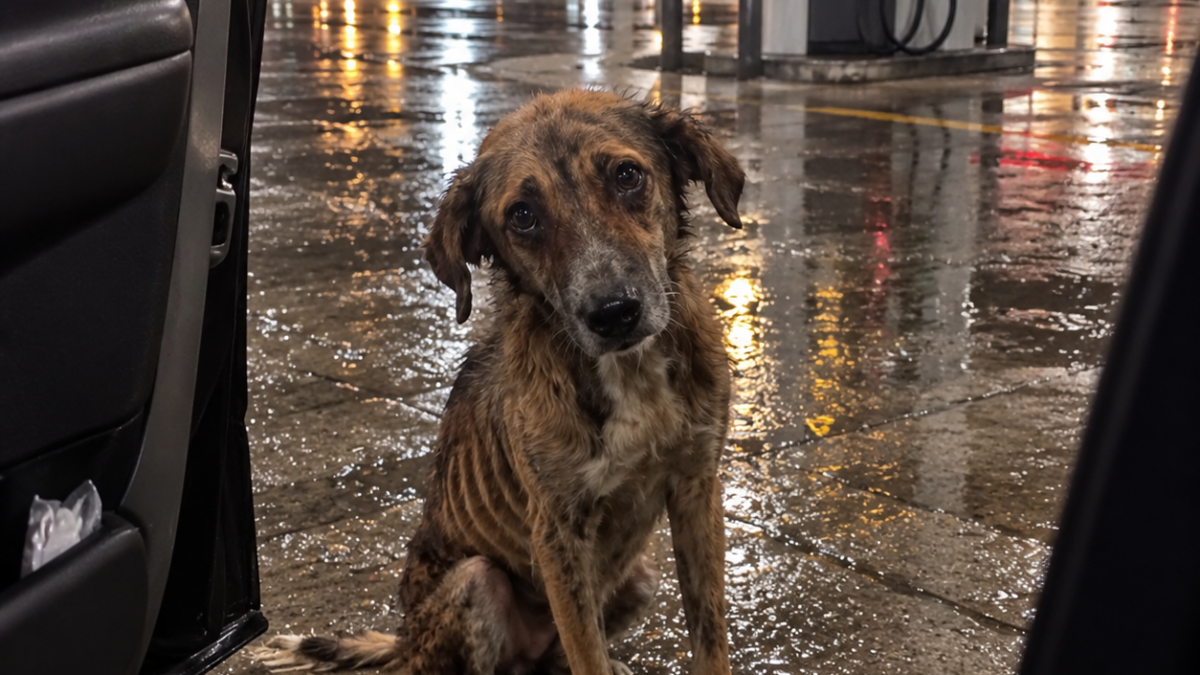
PART 2
The dog disappeared around a bend in the trail.
“Hey!”
I ran faster.
Branches scratched my arms as I pushed through the brush.
The sun was beginning to rise, turning the horizon pale orange, but beneath the trees it was still dim.
I could hear him ahead of me.
His paws striking dry earth.
Then silence.
I stopped.
“Where are you?”
A faint whine answered.
I followed the sound.
The trail opened into a small clearing surrounded by low bushes.
The dog stood in the middle of it.
He wasn’t looking at me anymore.
He was staring toward an old blue tarp collapsed near the edge of the clearing.
Something moved underneath.
My stomach dropped.
I walked forward slowly.
The smell reached me first.
Dirt.
Old rain.
Animal waste.
The sour smell of bodies that had been living too long without enough food or clean water.
The gray-brown dog rushed to the tarp.
He pawed at one corner.
Then looked at me.
That same look.
The one from the gas station.
The one from my front door.
The one I had failed to understand for three days.
I knelt and pulled the tarp back.
For several seconds, I couldn’t move.
A female dog lay beneath it.
She was even thinner than the dog who had found me.
Her ribs rose sharply through her coat.
Her eyes were half closed.
She lifted her head perhaps an inch when the light reached her, then let it fall again.
Pressed against her body were puppies.
Several of them.
Tiny.
Dirty.
Their bodies curled against one another.
One made a weak sound.
Another crawled blindly toward the mother’s belly.
I counted.
One.
Two.
Three.
Four.
Five.
Five puppies.
“Oh my God.”
The dog beside me whined.
He approached the female and touched his nose gently to her face.
Her eyes opened.
Her tail moved once against the dirt.
That was when everything made sense.
The food he refused.
The nights without sleep.
The paw against my leg.
The door.
The constant whining.
He had never been asking me to save him.
He had been trying to bring me here.
I sat back on my heels.
“You were trying to tell me.”
The dog turned toward me.
“You ran behind my car because of them.”
He moved toward the puppies.
One of them pressed against his front leg.
He lowered his head and licked the puppy carefully.
My eyes burned.
I had spent three days wondering why a starving dog barely cared about food.
Because somewhere beyond that gas station, there were six more lives he believed were in greater danger than his own.
I pulled out my phone.
The signal was weak.
I moved several yards until one bar appeared.
I called the veterinary clinic.
The receptionist answered.
“This is the man with the gray stray from yesterday.”
“Yes?”
“He found what he was looking for.”
There was a pause.
“What do you mean?”
“There’s another dog. A female. Five puppies. They’re in terrible condition.”
Her tone changed instantly.
“Where are you?”
I tried to explain.
Behind the gas station.
Beyond a field.
Past a dry creek bed.
Not exactly an address.
She transferred me to the veterinarian.
“Don’t try to make the mother stand,” he said.
“She barely can.”
“Keep everyone shaded. Offer very small amounts of water if they’re alert enough to swallow safely. We’re contacting a rescue team.”
I looked at the puppies.
“What about food?”
“Not large amounts. Not yet. If they’ve been starved, we need to be careful.”
“How long?”
“We’re coming.”
I ended the call.
The gray-brown dog sat beside the mother.
For the first time since I had met him, he stopped pacing.
He looked exhausted.
Completely exhausted.
As if he had been holding himself upright for one reason, and now that someone else had finally seen what he had been trying to show them, his job was finished.
I sat on the ground.
He walked over.
Then lowered his head onto my knee.
“You did it.”
His eyes closed.
I touched the side of his face.
“You found somebody.”
He sighed.
For three days, he had barely allowed himself to rest.
Now he slept against me while we waited.
The mother dog watched us.
I did not approach her immediately.
She had no reason to trust me.
I placed a shallow container of water nearby.
Her eyes moved toward it.
She tried to rise.
Her front legs pushed.
Her body trembled.
“Easy.”
I slid the water closer.
She drank several small laps.
Then stopped.
One puppy woke and squeaked.
The mother immediately turned her head toward it.
Even in that condition, she was still trying to care for them.
I thought about the dog sleeping against my leg.
Two starving animals.
Both still putting somebody else first.
I had never seen anything like it.
Help arrived almost an hour later.
Two rescue vehicles pulled near the edge of the trail.
Four people came carrying crates, blankets, water and medical supplies.
The veterinarian came with them.
When he entered the clearing, he looked at the gray dog beside me.
“So this is where he wanted to come.”
“Yes.”
The doctor crouched near the mother.
His expression became serious.
“She’s very dehydrated.”
He checked her gums.
Then listened to her chest.
The puppies were examined one at a time.
They were thin.
Weak.
Fleas crawled through their coats.
One was colder than the others.
A rescuer wrapped him immediately.
I stood nearby feeling useless.
“Will they survive?”
The veterinarian looked at me.
“I think you got here in time.”
“How close?”
He hesitated.
“Another day without water or nutrition could have been very different.”
I looked at the gray dog.
He was standing again now.
Watching every person who touched the puppies.
“He knew.”
The veterinarian followed my gaze.
“He knew they needed help.”
“Why didn’t he stay with them?”
“He probably was trying to find food. Or people.”
The thought hit me.
Maybe he had walked miles.
Maybe the gas station was not random.
Maybe he had learned that humans stopped there.
Cars came.
Lights stayed on.
Food existed.
And out of every person passing through that night, he had chosen me.
Or perhaps I had simply been the first idiot willing to follow eventually.
One rescuer lifted the smallest puppy.
“We need to move.”
The mother was placed carefully onto a blanket stretcher.
She did not resist.
The gray dog immediately followed.
When they loaded her into the rescue vehicle, he tried to climb in after her.
“Wait.”
I opened the door.
He jumped inside.
One of the rescuers smiled.
“I guess he’s coming.”
“He goes where they go.”
We drove to the veterinary center.
This time, I followed behind.
At every stoplight, I stared at the rescue vehicle in front of me.
My hands shook.
Three days earlier, my only plan had been to buy gas and go home.
Now I was driving behind a mobile rescue unit containing seven starving dogs.
Life has a strange sense of timing.
At the clinic, the mother and puppies were taken directly into treatment.
The gray dog tried to follow through the swinging doors.
A technician blocked him gently.
“Let them work.”
He whined.
I crouched beside him.
“They’re helping.”
He looked toward the doors.
“I promise.”
That word felt dangerous.
Promises should mean something.
So I stayed.
The veterinarian examined him again while the others were stabilized.
He had lost more weight during those days because he had barely eaten.
“You were right,” I said.
“About what?”
“He was looking for someone.”
The doctor smiled faintly.
“I wish I were wrong more often.”
“Do you think he’s the father?”
“Could be.”
“The brother?”
“Could be.”
“You can’t tell?”
“Not without more information or testing.”
The dog stared toward the treatment room.
The veterinarian looked at him.
“But whatever the biological relationship is, he considers them family.”
That was enough for me.
Hours passed.
The mother received fluids.
Parasites were addressed.
The puppies were warmed and fed cautiously according to the medical plan.
One needed more intensive support.
The gray dog finally ate a proper meal.
Not quickly.
He kept looking toward the treatment room.
I sat on the floor beside him.
“Eat.”
He took another bite.
“They’re here.”
Another.
“Nobody’s leaving them.”
His pace increased.
For the first time, he finished the bowl.
I nearly cried over an empty dog dish.
The veterinarian came out near evening.
“You got them here at the right time.”
I stood.
“All of them?”
“Right now, yes.”
I exhaled.
“The mother?”
“Very weak. But responsive.”
“The puppies?”
“The smallest concerns me. But they’re fighting.”
I looked down.
The gray dog was standing against my leg.
I rested my hand on his head.
“You hear that?”
His tail moved.
Just once.
I smiled.
“That might be the first time I’ve seen you wag.”
The veterinarian laughed.
“He was busy.”
The mother stayed hospitalized.
So did the puppies.
The gray dog could technically have gone home with me again.
I tried.
We made it halfway to the parking lot.
He stopped.
Refused to move.
“Come on.”
Nothing.
He looked back at the clinic.
I tugged gently.
He planted his feet.
The veterinarian came outside.
“I think you’ve lost this argument.”
“I have a bed for him.”
“He has family inside.”
I looked at the dog.
“Can he stay?”
“We’ll find a safe arrangement.”
He did.
They placed him in a kennel near enough that he could smell and sometimes see the mother.
The change was immediate.
He lay down.
Actually lay down.
Head on the blanket.
Eyes closed.
No pacing.
No pawing.
No whining.
I stood outside the kennel.
“So that’s all you wanted.”
He was already asleep.
The veterinarian touched my shoulder.
“Go home.”
“I’ll come back tomorrow.”
“I assumed.”
I drove home alone.
The house felt strange without him.
His old blanket was still in the corner.
The food bowl remained on the kitchen floor.
I looked at the spot where he had touched my leg over and over.
Three days.
I had spent three days misunderstanding him.
That bothered me.
Then I thought about what the veterinarian had said.
I had eventually listened.
Maybe listening late was better than never listening.
The next morning, I arrived before visiting hours officially began.
The receptionist laughed.
“You again.”
“How are they?”
“You know I can’t give you a hallway report.”
She pointed toward a chair.
“Sit.”
I sat.
For approximately twenty seconds.
Then stood.
She pointed again.
“Sit.”
“You enjoy this.”
“A little.”
The veterinarian finally appeared.
“The mother ate.”
I smiled.
“How much?”
“Enough.”
“The smallest puppy?”
“Warmer. Stronger.”
“And him?”
“Your gas-station friend?”
“Yes.”
“He ate breakfast and yelled at us when we moved him too far from the mother.”
I laughed.
“Good.”
We went back.
The gray dog saw me.
For the first time, he approached with something other than desperation.
His tail moved.
Then again.
I opened the kennel.
He stepped out.
He touched my leg with his paw.
My throat tightened.
“That means something very different now.”
He looked toward the treatment room.
“Fine. Still about them.”
We were allowed to sit near the mother briefly.
She looked better.
Not healthy.
Better.
Her eyes were more open.
When the gray dog approached, her tail moved weakly.
He sniffed each puppy.
One climbed partly onto his paw.
He remained perfectly still.
The veterinarian watched.
“I’ve seen bonded dogs, but this guy…”
“What?”
“He is unusually focused on them.”
I nodded.
“He ran behind a moving car.”
The doctor smiled.
“Fair point.”
The days that followed created a routine I had not planned.
Work.
Clinic.
Home.
Sleep.
Repeat.
I visited daily.
The gray dog began recognizing my arrival.
He still stayed close to the mother and puppies, but he also greeted me.
At first, one tail wag.
Then several.
By the fifth day, he walked toward me when I entered.
I crouched.
“Hey.”
He pressed his forehead against my chest.
I wrapped one arm around him.
Very gently.
“You scared the hell out of me.”
His tail moved.
“I thought you were the problem.”
He looked toward the puppies.
“I know. They were the problem.”
The smallest puppy started gaining strength.
The mother began standing with assistance.
Her first steps were unstable.
The gray dog walked beside her.
Not touching.
Just there.
She stopped.
He stopped.
She moved.
He moved.
I looked at the veterinarian.
“This is ridiculous.”
“What?”
“He’s escorting her.”
“Maybe she’s his sister.”
“Maybe.”
“Could be the father.”
“Would a father dog behave like that?”
“Some do. Some don’t. Social bonds aren’t always simple.”
I watched them.
Biology felt less important every day.
Whatever they were to each other, he had risked himself for them.
That was family.
One week later, the puppies began behaving like puppies.
That sounds obvious.
It did not feel obvious.
The first days, they mostly slept and ate.
Then one morning, two started wrestling.
One bit the other’s ear.
A tiny growl.
A tumble.
A technician called me over.
“Look.”
I watched them.
The gray dog watched too.
One puppy rolled onto his back.
The other attacked his paw.
I laughed.
The mother lifted her head.
Her eyes looked tired but softer.
Alive.
The veterinarian stood beside me.
“Different picture from last week.”
“Completely.”
“You know what I keep thinking?”
“What?”
“If you hadn’t looked in your mirror…”
I stopped him.
“I know.”
That question haunted me enough without finishing it.
What if I had not stopped?
What if I had assumed the dog would give up?
What if I had driven faster?
What if he had collapsed?
What if I had taken him to a shelter immediately and never noticed the pawing?
What if I had ignored the veterinarian?
There is no bottom to what-if.
Eventually I learned to replace it with what happened.
I stopped.
He followed.
I took him home.
He insisted.
The doctor understood.
We returned.
We found them.
They lived.
That was the version reality gave us.
It was enough.
The mother began trusting me slowly.
The first time I touched her, she stiffened.
I pulled back.
The gray dog looked between us.
“He trusts you,” the technician said.
“That doesn’t mean she has to.”
So I waited.
I sat nearby during visits.
Food helped.
Naturally.
One afternoon, I offered a piece of chicken.
The mother sniffed.
Took it.
I offered another.
She moved closer.
The gray dog sat beside me as though supervising negotiations.
“You planned this?”
His tail moved.
Weeks earlier, I had not known any of them existed.
Now I was bribing a starving-dog family with chicken.
Life continued becoming stranger.
After two weeks, the mother was strong enough to leave intensive veterinary care and move into foster placement with the puppies.
The gray dog went too.
There was no question.
I offered to foster him at my house.
The rescue coordinator shook her head.
“Not yet.”
“Why?”
“Because he’ll tear your door off trying to return to them.”
I looked at him.
He was lying beside the mother.
“Probably.”
“So let them stabilize together.”
I agreed.
Not happily.
I had become attached.
That surprised me.
When I first put him in my car, I had told myself temporary.
Feed him.
Help him.
Shelter.
Done.
Now I drove home missing him.
That evening, I found one of his hairs on my couch.
I picked it up.
Then laughed at myself.
“This is pathetic.”
The next day I visited anyway.
The foster home had a fenced yard.
For the first time, I saw the gray dog run without desperation.
He chased one of the older puppies in a circle.
The puppy turned.
He followed.
The mother watched from the porch.
I stood at the gate.
He saw me.
Stopped.
Then ran directly toward me.
Not behind a car.
Toward me.
Tail wagging.
He jumped against my legs.
I laughed.
“Okay.”
He put one paw on my thigh.
That paw.
I looked down.
“You don’t need anything?”
He licked my hand.
“You’re sure?”
More wagging.
I scratched his neck.
The gesture had changed meaning.
The first paw had been urgency.
Now it was affection.
That nearly broke me.
The foster mother smiled.
“He waits for you.”
“No, he doesn’t.”
“He does.”
I looked at the dog.
He leaned against my leg.
“Great.”
I was in trouble.
The puppies grew.
Their eyes brightened.
Their bellies became round in the healthy way puppies should be.
Their coats improved.
They discovered toys.
Shoelaces.
Furniture.
Human fingers.
One puppy had a particular talent for stealing dish towels.
Another screamed during nail trims as though the rescue staff were committing war crimes.
The smallest puppy, the one we had feared losing, became the loudest.
I told the veterinarian.
“You worried about that one?”
He looked at the puppy barking at a toy.
“I regret everything.”
The mother regained weight.
She became beautiful.
Not in some miraculous cosmetic sense.
Her body simply became what it should have been when enough food and care returned.
Muscle replaced sharp angles.
Her coat gained shine.
Her eyes softened.
She began greeting people.
Still cautiously.
But willingly.
The rescue named her Grace.
It fit.
The puppies received names too.
Juniper.
Benny.
Pearl.
Otis.
And Scout.
The gray dog still had no official name.
Everyone called him different things.
Highway.
Hero.
Buddy.
Gray.
One volunteer called him Dad whether or not biology agreed.
I refused to name him.
The foster mother noticed.
“You know you’re avoiding it.”
“Avoiding what?”
“Naming him.”
“He already belongs to the rescue.”
“That’s not why.”
“Then why?”
“Because if you name him, you’re keeping him.”
I laughed.
“I am not.”
She stared.
The dog sat on my foot.
I looked down.
“Traitor.”
Eventually adoption applications opened.
The puppies attracted immediate interest.
Of course they did.
Healthy puppies are easy to imagine bringing home.
Grace received fewer applications.
Adult female.
Calm.
More cautious.
The gray dog received several.
People loved his story.
That bothered me.
I did not want someone adopting him because they liked the idea of the heroic dog.
I wanted someone who liked him.
His habits.
His needs.
His personality.
The rescue screened carefully.
I told myself I wanted him to find a wonderful home.
Then an approved family came to meet him.
I hated them immediately.
That sounds terrible.
They were lovely.
A couple in their forties.
Fenced yard.
Veterinary references.
Plenty of time.
A calm older dog at home.
Everything perfect.
They sat in the yard.
The gray dog approached.
Accepted treats.
Allowed petting.
The woman smiled.
“He’s wonderful.”
“Yes.”
My voice sounded strange.
The foster mother looked at me.
I ignored her.
The man rolled a ball.
The dog chased it.
Brought it halfway back.
I felt something unpleasant in my chest.
Jealousy.
Completely irrational.
This was the outcome.
Rescue.
Recovery.
Adoption.
I should have been thrilled.
Instead, I wanted them to go home.
Without him.
After the meeting, I drove away before anyone could ask how I felt.
At home, the house was quiet.
I sat at the kitchen table.
I thought about the gas station.
The rearview mirror.
The weak dog running behind my car.
His paw against my leg.
The trail.
The tarp.
The moment his head rested on my knee after we found his family.
I had been telling myself the entire story was about him leading me to them.
Maybe it was also about him leading himself to me.
I did not sleep much.
The next morning, the foster mother called.
“They want him.”
I closed my eyes.
“They’re good people.”
“Yes.”
“Very good.”
“Yes.”
Silence.
“You could say something else.”
“What do you want me to say?”
“What you actually think.”
I stood.
Walked to the window.
“I think he’ll be happy.”
“That’s not what I asked.”
I laughed bitterly.
“You’re enjoying this.”
“A lot.”
I exhaled.
“I want him.”
“There.”
“I said it.”
“I heard.”
“But I don’t want to interfere with a good adoption because I’m emotional.”
“You were the first person he chose.”
“That doesn’t mean—”
“You have a safe home.”
“Yes.”
“You can afford his care?”
“Yes.”
“You want him?”
I stared at the driveway.
“Yes.”
“Then fill out the application.”
I did.
The adoption committee still reviewed me like anyone else.
I appreciated that.
No shortcuts because I had been part of the rescue.
Home check.
References.
Veterinary plan.
Everything.
Approved.
The day I signed the papers, I finally gave him a name.
Ranger.
The foster mother laughed.
“Because he ranged across half the county looking for you?”
“Because he always knew where he needed to go.”
Ranger looked at me.
I held the new tag.
“Ranger.”
Tail wag.
“That’s you.”
He touched my leg with his paw.
I nearly lost it.
“Yeah.”
I clipped the tag onto his collar.
“You’re coming home.”
But Ranger was not the only one.
There was one puppy I had become attached to too.
The smallest.
Scout.
The one everyone had feared might not survive.
He had grown into a ridiculous, energetic troublemaker.
During my visits, Scout followed Ranger constantly.
If Ranger lay down, Scout climbed on him.
If Ranger moved, Scout followed.
If Ranger drank, Scout tried to drink from the same side of the bowl despite there being plenty of space.
Separating them was possible.
Maybe even easy with time.
But I kept watching.
The rescue coordinator noticed.
“No.”
“I didn’t say anything.”
“You’re thinking.”
“I always think.”
“You’re taking two dogs.”
“That would be irresponsible.”
“You have space.”
“I did not plan on this.”
“Neither did Ranger.”
I looked at Scout.
He was biting Ranger’s ear.
Ranger tolerated it with supernatural patience.
“What about the applicants?”
“Scout has several.”
“Good.”
The word came out less enthusiastically than intended.
The coordinator laughed.
“You are terrible at fostering.”
“I didn’t foster him.”
“You somehow failed foster care without officially fostering.”
I went home.
Thought.
Calculated.
Food.
Veterinary care.
Training.
Travel.
Space.
Long-term commitment.
Emotion alone does not pay medical bills.
I wanted to be responsible.
Then I returned the next day.
Ranger was lying under a tree.
Scout asleep against his stomach.
I knew.
I adopted Scout too.
My house changed overnight.
Ranger entered first.
He walked through the doorway slowly.
Sniffed.
Paused at the place where I had originally made his temporary bed.
The old blanket was gone.
I had replaced it with two proper beds.
Ranger stood there.
I wondered if he remembered.
Then Scout ran past him carrying a toy and crashed into the couch.
Moment destroyed.
“Perfect.”
Ranger followed.
Scout explored everything.
Kitchen.
Hallway.
Bathroom.
Backyard.
Ranger moved more slowly.
He checked each room.
Then found me.
Touched my leg.
I knelt.
“This time you’re not asking me to go anywhere.”
He leaned into me.
“You’re home.”
Scout attacked my shoelace.
I laughed.
“You too.”
The first night, I expected Ranger to sleep beside the door.
Instead, he chose a bed near mine.
Scout climbed into the same bed.
Ranger looked annoyed.
Scout ignored him.
Within ten minutes, they were asleep.
I lay awake listening.
Months earlier, Ranger had refused to sleep because six animals needed him somewhere beyond the highway.
Now they were safe.
Grace had been adopted by a retired couple with a quiet home and a large fenced yard.
They sent pictures constantly.
Grace sleeping on a couch.
Grace walking beside a lake.
Grace wearing an absurd raincoat.
I saved every one.
The other four puppies found homes too.
One went to a family with teenagers.
One to a nurse.
One to a retired firefighter.
One to a couple who already had another young dog.
We kept in touch through the rescue group.
At first, I worried Ranger would suffer without everyone together.
He searched the foster yard during the final transitions.
At my house, he occasionally stood at the gate as if listening.
Scout stayed close.
I worried.
Then Grace visited.
The reunion removed some of that fear.
When her adopters brought her into my yard, Ranger froze.
Grace froze.
Then both dogs ran.
No hesitation.
They met in the middle.
Sniffing.
Whining.
Tails moving so hard their entire bodies bent.
Scout screamed with excitement.
For several minutes, the yard became chaos.
I stood back.
Grace’s new owner wiped her eyes.
“They remember.”
“Yes.”
Ranger and Grace eventually calmed.
They lay beneath the tree.
Scout squeezed between them.
I took a photograph.
Family.
Not all under one roof.
Still family.
That taught me something I had not understood before.
Staying connected does not always mean staying physically together forever.
The puppies needed individual homes.
Grace needed hers.
Ranger and Scout had mine.
Their lives could grow outward without erasing what came before.
The rescue began arranging occasional reunions.
Not often.
Enough.
Every time, Ranger inspected everybody.
He greeted each dog differently.
Grace received the longest greeting.
The puppies bounced around him.
He tolerated their nonsense.
Then everyone returned home.
Ranger never tried to follow the other cars afterward.
He watched.
Then turned toward mine.
That mattered to me.
He knew which one was home.
My life changed too.
Before Ranger, I lived quietly.
Too quietly, if I’m honest.
Work.
Home.
Television.
Sleep.
Repeat.
I told people I liked independence.
It sounded stronger than loneliness.
My parents had worked constantly when I was growing up.
Nobody was cruel.
We simply lived beside one another more than with one another.
Meals happened at different times.
Problems were handled privately.
Asking for help felt embarrassing.
By adulthood, I had become very good at needing no one.
At least that was what I told myself.
Ranger challenged that without ever knowing it.
He had nearly died.
He was starving.
Yet his first instinct had been connection.
Find help.
Bring help back.
Stay with family.
He had every reason to save only himself.
He didn’t.
I thought about that often.
One evening, my sister called.
We had not spoken properly in months.
Normally I would have let it go to voicemail.
Ranger sat beside me.
I answered.
“Hey.”
She sounded surprised.
“Hey.”
We talked for an hour.
Nothing dramatic.
Work.
Our mother.
Her children.
The weather.
Afterward, Ranger put his head on my knee.
I laughed.
“Don’t take credit.”
He closed his eyes.
Over time, I started making other small changes.
Calling my parents more.
Accepting invitations instead of inventing excuses.
Asking friends for help when I actually needed it.
Letting people come to my house even when it was messy.
Scout helped with that.
There was no keeping a clean house with Scout.
He destroyed the illusion of controlled adulthood.
One afternoon, a friend arrived unexpectedly.
Scout had shredded a cardboard box across the living room.
Ranger was asleep in the middle of the debris.
I opened the door.
My friend looked inside.
“Bad time?”
Normally I would have been embarrassed.
Instead I laughed.
“Come in.”
That sounds small.
For me, it wasn’t.
Ranger had taught me that being seen in the middle of disorder does not automatically make people leave.
Months passed.
Ranger filled out.
His ribs disappeared beneath muscle.
His coat became thick and glossy.
The dog who had once looked as if wind might knock him over became strong.
Not bulky.
Athletic.
He loved running.
The first time he sprinted across my backyard at full speed, I stopped what I was doing.
He ran in a wide circle.
Scout chased him.
Ranger accelerated.
I laughed.
At the gas station, every step behind my car had seemed to cost him something.
Now he ran because running felt good.
That image became my favorite form of revenge against whatever neglect had brought him to that highway.
Not punishment.
Abundance.
Food.
Strength.
Distance covered for joy instead of desperation.
Scout grew too.
Far too quickly.
The puppy who once fit beneath his mother’s rib cage became a lanky adolescent with terrible decision-making skills.
He stole socks.
Dragged shoes into the yard.
Once brought a garden hose into the kitchen.
I still do not know how.
Ranger often watched Scout’s crimes with the exhausted patience of an older relative.
“You saved this,” I told him.
Ranger looked away.
“This is partly your fault.”
Scout sprinted past us carrying a dish towel.
Ranger sighed.
I laughed.
Grace’s family sent updates.
She became inseparable from the retired couple.
The woman said Grace followed her husband into his workshop every morning.
He built a small platform near his workbench so she could lie beside him without being in the way.
One photograph showed Grace asleep there, head resting on a folded towel.
I looked at it for a long time.
The tarp in the clearing had been her shelter once.
Now someone had built her furniture because the floor might be uncomfortable.
Good.
The other puppies thrived too.
Benny became obsessed with swimming.
Pearl slept with one of the children in her family.
Otis grew enormous and remained convinced he was a lapdog.
Juniper developed a talent for opening cabinet doors.
Every few months, someone posted an update.
Alive.
Loved.
Annoying.
Safe.
That was enough.
Then one day, the rescue coordinator called.
“We found the landowner.”
My body tightened.
“The clearing?”
“Yes.”
“What did they say?”
“The property has been mostly unused. They didn’t know the dogs were there.”
“Do we know how they got there?”
“Not conclusively.”
I felt anger returning.
“Someone left them.”
“Possibly. Or the dogs found shelter there after being abandoned elsewhere.”
“Can we find out?”
“We can try.”
There were no cameras.
No microchips tied to current owners.
No witness who had seen someone abandon seven dogs.
The investigation into origin led nowhere definitive.
I hated that.
I wanted a person.
A clear villain.
Someone to answer.
Who allows a nursing mother, puppies and another adult dog to starve in a field?
Who drives away?
Who stops looking?
Who decides living animals can simply disappear?
But wanting a villain does not create evidence.
I had learned that much.
Ranger’s body told a story of hardship.
It could not give me a name.
Grace could not testify.
The puppies had been too young to know anything.
Eventually, I had to accept that we might never know exactly how they ended up under that tarp.
I did not like it.
Then Ranger did what Ranger always did.
He redirected me.
I sat on the porch angry after another dead-end call.
Ranger approached.
Touched my leg.
That paw.
Always that paw.
I looked at him.
“What?”
He walked toward the yard.
Stopped.
Looked back.
For half a second, my heart jumped.
The old pattern.
Then I realized.
Ball.
His ball lay in the grass.
He wanted me to throw it.
I laughed.
“You have got to be kidding.”
Ranger touched my leg again.
I stood.
“Fine.”
I picked up the ball.
Threw it.
Ranger ran.
Scout chased him.
And there, watching them race, I realized I did have an ending.
It just wasn’t the one anger wanted.
Someone may have abandoned them.
Someone may have failed them.
Maybe we would never know.
But that person did not get to finish the story.
Ranger did.
Grace did.
The puppies did.
Every family that opened a door did.
That became enough.
A year after the gas station, I drove that highway again with Ranger in the passenger area and Scout behind him.
I had avoided the station for months.
Not intentionally.
Life simply took other routes.
When the sign appeared ahead, Ranger stood.
My hands tightened on the wheel.
“Remember?”
His nose lifted.
I pulled in.
Same pumps.
Same convenience store.
Different night.
This time, daylight.
I parked.
Ranger jumped down.
Scout followed.
The employee inside was not the same person from that night.
I bought water anyway.
Then walked Ranger toward the place where I had first seen him.
He sniffed.
No trembling.
No panic.
He looked toward the trail behind the station.
I hesitated.
“Want to go?”
Ranger began walking.
We followed the old path.
It was more overgrown.
The dry creek held a little water now.
Scout plunged into it immediately.
“Of course.”
Ranger continued.
He remembered.
I could tell by the certainty of his direction.
When we reached the clearing, he stopped.
The tarp was gone.
Brush had grown.
Nothing marked the spot.
Scout ran around sniffing.
Ranger stood quietly.
I watched him.
No dramatic reaction.
No whine.
No desperate paw.
He simply sniffed the air.
Then looked at me.
I knelt.
“This is where you brought me.”
Ranger walked over.
Pressed against my chest.
I put both arms around him.
“You did good.”
His tail moved.
“You did so good.”
We stayed a few minutes.
Then Ranger turned toward the trail.
Ready to leave.
That affected me more than anything.
He did not remain at the place where fear had lived.
He had somewhere else to go.
Home.
On the drive back, Ranger slept.
Really slept.
Head down.
Body loose.
Scout sprawled behind him.
I looked in the mirror.
A year earlier, that mirror had shown a starving dog running until he had almost nothing left.
Now it showed two sleeping animals complaining only when I stopped for too long.
Life can change dramatically when somebody stops the car.
The rescue organization later asked whether they could tell Ranger’s story during a fundraising event.
I said yes with one condition.
“Don’t make me the hero.”
The coordinator smiled.
“Then who is?”
“Ranger.”
“He found you.”
“Exactly.”
At the event, people cried.
They saw photographs.
Ranger at the gas station shortly after rescue.
Grace under veterinary care.
The puppies.
Recovery.
Adoption.
The final slide showed all seven dogs in their homes.
Ranger beside me.
Scout asleep on the couch.
Grace near the workshop.
The others with families.
Someone asked me afterward, “How did you know to follow him?”
“I didn’t.”
“But you did.”
“Eventually.”
“What made you understand?”
“I didn’t understand. The veterinarian did.”
The woman smiled.
“So the dog had to ask more than once.”
“Many times.”
She laughed.
I became serious.
“That’s the part I remember. He kept asking even when I didn’t understand.”
Maybe courage is not making one perfect attempt.
Maybe it is asking again.
Ranger had tried at the gas station.
I misunderstood.
He tried at home.
I misunderstood.
He pawed.
Whined.
Waited.
Refused to settle.
Until eventually somebody understood.
That lesson changed how I saw animals.
And people.
Sometimes behavior is communication long before language catches up.
A dog refusing food may be sick.
Fearful.
Searching.
A child becoming quiet may be asking something without words.
A friend disappearing may not mean they want to be forgotten.
I became less quick to label behavior.
More willing to ask, “What are you trying to tell me?”
Ranger did that.
Without knowing it.
Years passed.
Scout became larger than Ranger.
He still behaved like a puppy around him.
Ranger became more patient with age.
He stopped running every time Scout invited him.
Sometimes he simply looked at him.
Scout would bark.
Ranger would close his eyes.
I understood completely.
Grace aged beautifully with her family.
We continued occasional reunions.
Eventually the puppies stopped looking like puppies.
Adult dogs.
Seven lives moving in separate directions.
The gatherings became harder to organize.
Work schedules.
Distance.
Health.
But once a year, we tried.
The last full reunion happened in my yard.
Grace arrived first.
Ranger greeted her quietly.
No wild running now.
They touched noses.
Walked together.
Scout and the others created chaos.
People brought food.
Someone hung photographs from the rescue days on a line near the porch.
I did not love seeing the early ones.
Then a little girl from Pearl’s family stood beside me.
“Is that Ranger?”
She pointed to the emaciated dog in one picture.
“Yes.”
“He looks different.”
“He was very hungry.”
“Why?”
I paused.
“We don’t know everything that happened before we found him.”
She looked toward Ranger, who was lying in the shade.
“Is he hungry now?”
I laughed.
“Constantly.”
She ran to get a treat.
Ranger accepted it with dignity.
The girl stroked his head.
“He’s lucky.”
I looked at him.
Maybe.
Then I looked around.
Grace asleep beside her owner’s chair.
Scout wrestling with Otis.
Benny chasing a ball.
Juniper attempting to steal food.
Pearl surrounded by children.
I thought about the clearing.
“Yeah,” I said. “We all are.”
Ranger began graying around the muzzle sooner than I expected.
The first white hairs offended me.
“You’re not allowed.”
He ignored me.
Scout remained energetic.
Ranger preferred longer naps.
Walks shortened gradually.
Nothing alarming.
Just time.
The gas-station dog became a middle-aged dog.
Then an older one.
Every year felt like evidence.
He had once looked as though he might not survive another week.
Now he was getting old enough to complain about stairs.
I built a ramp.
My younger self would have laughed.
My younger self also believed needing people was weakness.
He had been wrong about many things.
My relationship with my family changed during those years.
Not magically.
I still liked solitude.
Still needed quiet.
But I stopped using independence as armor.
When my mother became ill for a period, I asked my sister for help instead of trying to manage everything alone.
We divided appointments.
Meals.
Transportation.
One evening, my sister said, “You know, you used to never ask anybody for anything.”
I looked at Ranger sleeping nearby.
“I had a teacher.”
She laughed.
“The dog?”
“Yes.”
“That tracks.”
After my mother recovered, our family remained closer than before.
More dinners.
More calls.
More inconvenience.
More life.
Ranger loved gatherings because gatherings contained dropped food.
He had philosophical depth only when meals were not available.
Scout preferred children.
Ranger preferred adults with plates.
One Thanksgiving, he stole half a roll from my father’s hand.
Dad stared.
“Did he just rob me?”
“Yes.”
Ranger swallowed.
My father looked at me.
“You trained him terribly.”
“He found five starving puppies and their mother.”
Dad considered this.
“Fine. He can have the roll.”
Ranger became morally untouchable.
I may have encouraged that.
Age eventually brought medical problems.
Arthritis first.
Then mild heart changes.
Nothing unusual.
The veterinarian adjusted care.
The original doctor had long since retired, but his notes remained in Ranger’s record.
One new veterinarian read the history.
“Is this the dog?”
“Yes.”
“The one who led you to the litter?”
“Yes.”
She looked at Ranger.
He was standing at the treat jar.
“Legendary.”
“Don’t tell him.”
“He already knows.”
Ranger barked.
We laughed.
His arthritis progressed.
I added rugs.
More beds.
Scout learned, slowly, not to crash into him.
Grace’s family called one winter.
Her health was failing.
I drove Ranger to visit.
I was not sure whether it was wise.
The families wanted it.
Grace lay on a soft bed near the window.
When Ranger entered, he stopped.
Grace lifted her head.
For several seconds, they simply looked.
Then Ranger approached.
They touched noses.
Grace’s tail moved.
Ranger lay beside her.
No excitement.
No running.
Just presence.
I sat across the room with Grace’s owners.
Nobody spoke much.
They stayed like that for nearly an hour.
When Ranger stood to leave, Grace watched.
I cried in the car.
Two days later, Grace died peacefully at home.
Her family called me.
“We wanted you to know.”
“I’m sorry.”
“She had a good life.”
“I know.”
“She loved him.”
I looked at Ranger.
He was asleep.
“He loved her too.”
Afterward, Ranger seemed quieter for several days.
Maybe I imagined it.
Maybe not.
He went to the door once after hearing a similar car outside.
Then returned to bed.
Loss is difficult to measure in dogs.
I did not force a story onto him.
I simply stayed near.
That was what he had taught me.
Stay.
Scout aged too.
The puppy Ranger had helped save became his closest companion for years.
They slept near each other.
Ranger still corrected him occasionally.
Scout still acted offended.
Some relationships never change completely.
One evening, I found Scout cleaning Ranger’s ear while Ranger slept.
I took a photograph.
The tiny puppy under the tarp.
The emaciated dog from the gas station.
Now both gray.
Safe.
Together.
I sent it to the rescue coordinator.
She replied:
THIS IS WHY WE DO IT.
Yes.
Not for dramatic rescues.
For ordinary aging.
For dogs becoming old in homes.
For years nobody could see in the first photograph.
Ranger’s heart condition worsened eventually.
Medication helped.
Then kidney values shifted.
The veterinarian spoke carefully.
“We can manage this for now.”
“For how long?”
“I don’t know.”
I hated that answer.
I had heard uncertainty before.
This time it felt different.
Ranger had already given me more years than the dog at the gas station seemed capable of having.
Wanting more still felt reasonable.
Maybe greed is unavoidable when you love an animal.
We adjusted.
Medication.
Diet.
Short walks.
More sleep.
Ranger remained Ranger.
He still touched my leg with his paw.
Even when standing became harder.
Sometimes he wanted outside.
Sometimes food.
Sometimes nothing.
Just contact.
That gesture had followed us through his entire life.
At two in the morning years earlier, it had meant:
Please understand.
Later:
Follow me.
Then:
Feed me.
Throw the ball.
Pet me.
Stay.
By the end, I think it mostly meant:
Here you are.
I answered every time.
One winter morning, Ranger refused breakfast.
That frightened me.
He had never been casual about food.
I offered chicken.
He ate two pieces.
Better.
The veterinarian adjusted medication for nausea.
Ranger improved for several weeks.
Then another decline.
Old age is not a straight road either.
Good day.
Bad day.
Two good.
Three difficult.
You learn to stop letting one bright morning erase an overall pattern.
That lesson hurts.
I kept notes.
Eating.
Drinking.
Walking.
Sleeping comfortably.
Interest in Scout.
Interest in me.
Joy.
That last one mattered most.
As long as Ranger still wanted things, we continued.
One day, he pawed my leg and walked toward the car.
I stared.
“You want to go somewhere?”
Tail wag.
I opened the door.
Ranger climbed in slowly with help.
Scout came too.
I drove without knowing exactly where.
Then the gas station sign appeared.
I had not planned it.
Maybe subconsciously.
I pulled in.
Ranger lifted his head.
His nose worked.
“Want to stop?”
He looked toward me.
I parked.
We walked slowly behind the station.
Not all the way to the clearing.
Ranger’s body could not manage that distance anymore.
We reached the start of the trail.
He stood there.
Wind moved through his gray fur.
Scout sniffed everything.
I sat on a low rock.
Ranger came beside me.
Touched my leg.
I put my hand on his back.
“This place changed everything.”
He looked toward the trail.
“You know what’s back there?”
No answer.
“Nothing you need to fix anymore.”
Ranger sat.
His breathing was slightly labored from the walk.
I stroked his chest.
“You found help.”
His eyes closed briefly.
“You saved them.”
Maybe he understood nothing.
Maybe scent brought pieces back.
Maybe to him it was simply another roadside stop.
I did not need symbolism from him.
I needed it for me.
“Now you let me take care of you.”
We went home.
Ranger slept the entire drive.
A month later, the veterinarian came to the house for a quality-of-life assessment.
Ranger had stopped eating full meals.
His heart disease had progressed.
Kidney function worse.
He struggled to stand some mornings.
Scout stayed close.
The veterinarian sat on my couch.
“We’re approaching the point.”
“I know.”
“How are the good days?”
“Still some.”
“More than bad?”
I hesitated.
That hesitation answered more than words.
She touched my arm.
“You don’t have to decide this second.”
I looked at Ranger.
He was asleep near my feet.
The same position he had chosen so many nights.
I remembered the gas station.
How light he felt in my arms.
How desperate his running looked.
Back then, he had been spending everything to reach the future.
Now his body had spent the future.
Every year.
Every run.
Every meal.
Every reunion.
Every ordinary night.
The goal had never been forever.
The goal had been enough.
Still, enough is difficult to recognize when you are standing at the edge of losing it.
Ranger gave me another good week.
He ate chicken.
Walked into the yard.
Barked at a delivery driver.
Touched my leg constantly.
Scout lay beside him.
I called Grace’s family.
Then the families of the other dogs.
I told them Ranger was declining.
Pictures came back.
Benny by a lake.
Pearl with gray around her muzzle.
Otis asleep on a couch.
Juniper under a blanket.
All older.
All alive.
The family he had led me to had lived entire lives.
I printed the photographs.
Placed them near his bed.
Ridiculous.
Ranger could not understand photographs.
I needed them.
Proof.
You did it.
That was what the pictures said.
The final morning came quietly.
Ranger did not stand when I entered the room.
His eyes opened.
Tail moved once.
I crouched.
“Morning.”
He lifted his paw.
Touched my leg.
I sat immediately.
“What do you need?”
He did not move toward the door.
Did not look toward food.
He simply kept his paw against me.
I knew.
Not because of some mystical communication.
Because I had spent years learning his patterns.
That gesture was no longer urgent.
It was tired.
I called the veterinarian.
Then my sister.
Then the rescue coordinator.
Scout stayed beside Ranger.
The veterinarian arrived that afternoon.
We placed Ranger’s bed near the open back door.
Fresh air entered.
Scout lay close.
I offered Ranger chicken.
He took one piece.
Then another.
Refused the third.
I laughed through tears.
“Leaving food?”
Ranger closed his eyes.
“You really changed.”
The rescue coordinator came.
She knelt beside him.
“Hey, Highway.”
I smiled.
“You still call him that?”
“Always.”
Ranger’s tail moved.
She cried.
“Do you remember me?”
I said, “He remembers food.”
She laughed.
“Fair.”
We talked about the clearing.
Grace.
The puppies.
The foster home.
Ranger’s adoption.
Scout.
Everything.
A whole life.
The veterinarian gave us time.
Eventually, I lay beside Ranger.
His head rested near my knee.
I put my hand under his paw.
“You know what I thought that first night?”
His eyes opened.
“I thought you wanted food.”
His breathing was slow.
“You did not care about yourself at all.”
I swallowed.
“You drove me crazy for three days.”
Scout shifted closer.
“You kept touching my leg.”
I laughed softly.
“I was so stupid.”
The rescue coordinator whispered, “You listened eventually.”
I nodded.
I looked at Ranger.
“Yeah.”
The first medication made him sleepy.
His muscles relaxed.
I continued.
“You were right.”
His eyes grew heavy.
“Family was worth going back for.”
I thought about my sister.
My parents.
Friends.
The people I had learned to call instead of disappearing into myself.
“You taught me that.”
Ranger’s breathing slowed.
“And you don’t have to lead anybody anywhere now.”
His paw remained in my hand.
“They’re safe.”
Another breath.
“Grace was loved.”
Another.
“Every puppy got a home.”
Scout pressed his body against Ranger’s side.
“This one stayed with us.”
I laughed through tears.
“He’s still annoying.”
Scout sighed.
Ranger’s eyes closed completely.
I lowered my forehead to his.
“You did your job.”
The final medication was administered only when we were ready.
Ranger left quietly.
No highway.
No gas station lights.
No empty field.
No desperate running.
Home.
Scout beside him.
My hand holding the paw that had once begged me to understand.
Afterward, I stayed there.
I expected some overwhelming revelation.
There was only grief.
Heavy.
Physical.
The rescue coordinator cried.
Scout sniffed Ranger.
Then lay down.
The veterinarian waited.
No one rushed.
I kept staring at Ranger’s paw.
That paw had changed my life.
It sounded absurd.
One paw.
A simple gesture.
But communication does not need language when repetition becomes impossible to ignore.
He had asked.
I had eventually answered.
Now there would be no more questions.
The house became painfully quiet.
Scout searched for Ranger for several days.
He checked the bed.
The yard.
The hallway.
I let him.
Then one evening, Scout climbed onto the couch beside me.
He placed his head on my leg.
I cried.
“You too?”
He sighed.
We stayed there.
Grief changed shape slowly.
At first, everything was Ranger.
The food bowl.
The leash.
The car.
The gas station when I passed.
Then memories began arriving without breaking me completely.
Ranger running in the yard.
Ranger standing beside Grace.
Ranger watching Scout commit crimes.
Ranger stealing Thanksgiving bread.
Ranger older, asleep in sunlight.
Those were better.
Months after his death, the rescue organization invited all the families back for an anniversary gathering.
Not everybody could come.
Pearl’s family did.
Benny’s.
Otis’s.
Juniper’s.
Scout came with me.
Grace’s family attended without her.
They brought her collar.
I brought Ranger’s tag.
We sat under a pavilion.
Nobody planned anything ceremonial.
Then the rescue coordinator stood.
“I want to tell you something.”
She held up the first photograph of Ranger.
Thin.
Exhausted.
At the gas station after I had taken him in.
Then a photograph of Grace and the puppies.
She said, “Seven dogs are represented in these families because one exhausted animal refused to stop asking for help.”
I looked down.
Scout leaned against me.
She continued.
“And because one driver stopped.”
I shook my head.
She saw.
“Yes, I know. He doesn’t like that part.”
People laughed.
I smiled.
She put the photographs down.
“The lesson isn’t that everyone should chase stray dogs into unknown fields alone.”
More laughter.
“Please don’t.”
Then she became serious.
“The lesson is to pay attention when behavior doesn’t make sense. Ask questions. Get help. Involve professionals. And when you can safely intervene, don’t assume the first need you see is the only need.”
That was better.
Useful.
Ranger deserved useful.
Afterward, Grace’s owner handed me something.
A framed photograph.
Ranger and Grace lying beneath the tree during one of their reunions.
Both healthy.
Both older.
Scout asleep between them.
I touched the frame.
“This is perfect.”
“She kept it in our hallway.”
I looked at her.
“You’re giving it away?”
“We printed another.”
I laughed.
“Good.”
At home, I hung it near the entrance.
Not the gas station photograph.
Not the tarp.
This one.
Family after survival.
Years later, I still pass that gas station occasionally.
Sometimes I stop.
Not every time.
The employees have changed.
The pumps have been replaced.
The lights are brighter.
The road behind it looks smaller than I remember.
Funny how places shrink after memories become larger.
Once, I walked to the beginning of the trail alone.
I did not continue.
The clearing belonged to an old chapter.
I stood for a minute.
Then returned to the car.
On the drive home, I thought about the person I had been that first night.
Tired.
Closed off.
Focused on getting home.
I believed independence meant strength.
I thought needing people made life complicated.
Then Ranger ran behind my car.
A starving dog with almost nothing left taught me that dependence is not always weakness.
Connection is not the opposite of freedom.
Sometimes connection is the reason you survive long enough to experience freedom at all.
Grace needed Ranger.
The puppies needed Grace.
Ranger needed a stranger at a gas station.
I needed a veterinarian smart enough to notice what I could not.
The rescue team needed one another.
The dogs needed foster families.
I needed my own family more than I had admitted.
Nobody in that story survived entirely alone.
That was Ranger’s lesson.
Not a sentimental slogan.
A fact.
Years later, my father died.
During the weeks around his illness, my old habits returned.
I tried handling everything.
Hospital calls.
Paperwork.
Work.
Transportation.
My sister finally grabbed my arm in a hallway.
“Stop.”
“I’m fine.”
“No.”
“I can do it.”
“I know you can.”
“Then—”
“You don’t have to.”
That sentence landed hard.
I thought of Ranger.
The gas station.
The paw.
Someone else needs you.
I sat down.
My sister sat beside me.
We divided everything.
Friends brought food.
People drove.
Others called.
I let them.
After my father died, I understood Ranger’s lesson differently.
Love is not measured only by what you give.
Sometimes trusting someone enough to receive help is part of love too.
Ranger had done both.
He gave everything to find help.
Then he got into my car.
That second part mattered.
He trusted a stranger.
Courage.
Years after Ranger was gone, Scout became old.
Much older than the trembling puppy under the tarp had seemed likely to become.
His muzzle whitened.
His joints stiffened.
He still followed me.
One afternoon, I sat on the porch.
Scout walked over slowly.
Placed his paw on my leg.
I froze.
The gesture.
Same family.
Maybe learned.
Maybe coincidence.
I smiled.
“What?”
Scout looked toward the kitchen.
Of course.
“Food?”
Tail wag.
I laughed.
“Your family used that gesture for more important things.”
Scout pawed me again.
“Apparently dinner is important.”
I stood.
We went inside.
While preparing his meal, I looked at Ranger’s photograph.
Gray-brown coat.
Healthy body.
Grace beside him.
Scout younger.
The full circle was almost too neat.
Real life had been messier.
Better.
When Scout eventually died years later, he went peacefully too.
By then, the last of the original litter had become seniors.
Some were still alive.
Some gone.
Their families remained connected through occasional messages.
The story kept shrinking from an emergency into family history.
That was beautiful.
Rescue should become history.
The animal should outgrow the crisis.
Ranger outgrew it completely.
When people now ask me about the most incredible rescue I ever experienced, they expect me to talk about finding Grace and the puppies.
I do.
But that is not the part that stays deepest.
It is the rearview mirror.
A dog running behind my car.
Exhausted.
Starving.
Refusing to stop.
At the time, I thought he was running toward me because he needed saving.
I understand now.
He was running toward the first possibility he had found.
A car that stopped.
A human who looked back.
Someone who might be persuaded to follow.
That is what makes his story extraordinary to me.
Ranger did not have language.
He had behavior.
He used everything available.
Eyes.
Movement.
Whining.
A paw.
Refusal to eat.
Refusal to sleep.
Running behind a car.
Returning to the door.
He kept communicating until someone finally understood.
And because he did, a mother lived.
Five puppies lived.
Ranger lived.
Seven futures opened.
Seven families eventually gained dogs they would have never known.
My own life changed.
My family changed.
The rescue changed.
All because a starving dog refused to let misunderstanding become the ending.
That is why I no longer think of the night as the night I rescued Ranger.
That description gives me far too much credit.
I stopped the car.
Yes.
I opened the door.
Yes.
But Ranger made every important decision first.
He approached.
He followed.
He insisted.
He led.
He trusted.
I was simply lucky enough to become useful.
There is humility in that.
Sometimes helping is not arriving with the answer.
Sometimes it is admitting you have no idea what the other living creature is trying to tell you and being willing to follow long enough to learn.
Ranger taught me that.
I have one final photograph of him that I keep beside my desk.
He is old.
Completely gray around the muzzle.
Asleep beside my feet.
One paw resting over my shoe.
Nothing dramatic.
If you did not know the story, you would see an old dog sleeping.
That is exactly why I love it.
He had reached the most extraordinary ending possible.
Ordinary safety.
No running.
No hunger.
No one waiting under a tarp.
No urgent message.
Nothing left to save that night.
Just sleep.
That may be the greatest reward for a creature who once believed he had to remain awake until somebody understood.
Rest.
Years of it.
A lifetime of knowing his family was safe.
And knowing he had one too.
Whenever I look at that photograph, I remember what the veterinarian told me.
“Take him back where you found him. Let him show you.”
I thought I was following a dog down a trail.
I was following him into a completely different life.
Before Ranger, I thought home was a place where nobody bothered me.
After Ranger, home became the place where somebody noticed when I arrived.
Where a dog met me at the door.
Where my sister could call without feeling like she was interrupting.
Where friends could visit without an appointment.
Where Scout destroyed things.
Where Ranger’s paw touched my leg.
Home became less quiet.
More inconvenient.
More connected.
Better.
That was the real journey.
The highway trail ended in a clearing.
The lesson never did.
Sometimes I still wake around two in the morning.
The house is quieter now.
For a second, I can almost hear a faint scratch against the floor.
I remember that night.
Gasoline smell.
Cold air.
Empty highway.
A pair of eyes watching from the darkness.
I remember thinking he wanted food.
Then shelter.
Then me.
I was wrong every time.
What Ranger wanted was simple.
He wanted someone to care enough to follow.
So I followed.
And because I did, I found six lives waiting beneath a tarp.
Years later, when I held Ranger on his final day, I finally understood the full meaning of that night.
He had never been asking only for rescue.
He was asking for relationship.
Come with me.
Don’t stop.
Stay.
Those were his words without words.
And I am grateful I eventually heard them.
If there is any justice in Ranger’s story, it is not that we ever found someone to blame.
We did not.
It is that hunger did not win.
Abandonment did not win.
The empty field did not win.
The tarp did not become a grave.
The highway did not swallow Ranger before I looked in the mirror.
Every one of those dogs got more life than the condition in which I found them suggested they would.
They got homes.
Names.
Beds.
Veterinary records full of ordinary problems.
Birthdays.
Gray hair.
People who cried when they died because their absence mattered.
That was their revenge against whatever had brought them to that clearing.
They became impossible to discard.
They became family.
Ranger most of all.
The dog I once planned to keep “for a few days” stayed until his body could stay no longer.
And even now, years after his paw last touched my leg, I still catch myself looking down sometimes.
Habit.
Memory.
Love.
Maybe those are all the same thing after enough time.
I still know what I would say if he were standing there.
“All right.”
The same words I said beside the highway.
“All right. Come on.”
Only this time, I would understand immediately.
Wherever you need me to go, I’m listening.








