PART 2: A Starving Dog Hid in My Tire Shop—Ten Days Later, I Was Terrified Someone Would Come Take Him Away
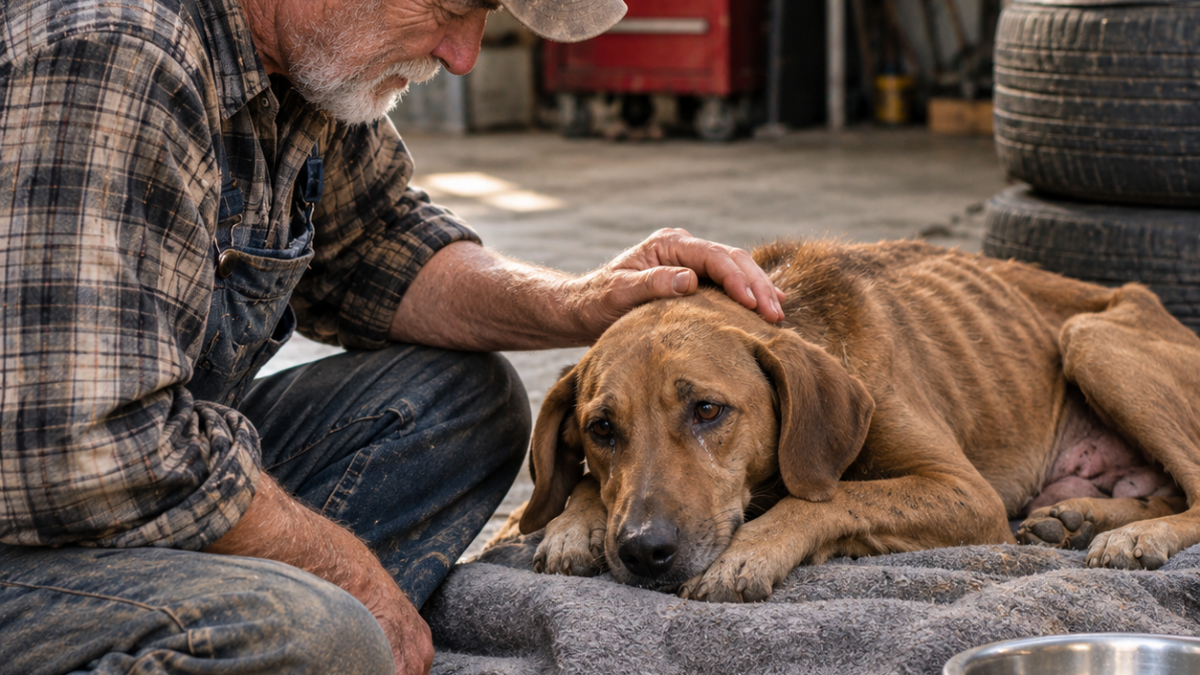
PART 2
By the tenth day, the dog still didn’t have a name.
That was deliberate.
People kept asking me.
“What are you calling him?”
“Nothing.”
“You have to call him something.”
“No, I don’t.”
My reasoning was simple.
If I named him, he became somebody.
If he became somebody, he became easier to care about.
And if his owner appeared one morning and took him away, I would be left standing in my garage listening to the silence where a named dog had been.
So I called him things that didn’t count.
“Hey.”
“Buddy.”
“You.”
“Move.”
“Not there.”
“Stop licking that.”
None of those were names.
At least that’s what I told myself.
Two of my regular customers ruined that plan.
André arrived carrying a bag of dog food.
Behind him came Luc, a retired truck driver with a small red rubber ball.
I saw the ball.
“No.”
Luc frowned.
“What?”
“This is a tire shop.”
“I know.”
“Not a pet store.”
“I know.”
“Then why are you bringing toys?”
Luc looked toward the dog.
“Because he’s a dog.”
“That isn’t an explanation.”
André set the food on my workbench.
“What do you call him?”
“I don’t.”
“You can’t keep calling him ‘the dog.’”
“I can if I want.”
André looked around the shop.
His eyes settled on a tray full of nuts and bolts.
Then he smiled.
“Boulon.”
I stared at him.
“No.”
Luc burst out laughing.
“Boulon?”
“He sleeps between tires. He lives with a mechanic. It fits.”
“It’s ridiculous.”
André shrugged.
“Better than ‘the dog.’”
I shook my head and went back to work.
A few minutes later, the red ball rolled underneath a cabinet.
The dog watched it disappear.
I bent down, pulled it out, and tossed it gently across the floor.
“Here, Boulon.”
One ear lifted.
I froze.
The dog turned his head toward me.
André grinned.
I pointed a warning finger at him.
“Don’t.”
“Didn’t say anything.”
I tried again.
“Boulon?”
This time, the dog took one cautious step toward me.
Luc laughed.
“Well, that’s settled.”
“It is not.”
But it was.
By early August, Boulon had become almost as well known as I was.
People came into the shop pretending they needed air in their tires when really they wanted to see him.
Some brought food.
Some brought towels.
One woman brought a large cushion.
Boulon refused to sleep on it for almost two weeks.
He slept beside it.
Then one morning, I found one front paw resting on the corner.
That became two paws.
Three nights later, he slept on it.
Everything with Boulon happened like that.
One inch at a time.
He never demanded anything.
That was what bothered me most.
A healthy dog should demand things.
Food.
Attention.
Play.
Space.
Boulon behaved like a guest who believed he could be thrown out for taking too much.
When someone offered him food, he often waited.
When someone called him, he looked at me first.
Not because I had trained him.
Because he seemed to need permission.
Permission to eat.
Permission to walk forward.
Permission to trust.
I hated whoever had taught him that.
But I had no idea who that person was.
And I had no proof anyone had deliberately hurt him.
All I had was the dog standing in front of me.
So I concentrated on that.
One morning, I was changing the rear tire on an old Peugeot when I felt something touch my shoe.
I looked down.
Boulon had placed his muzzle gently across the toe of my work boot.
I stopped the machine.
“What’s wrong?”
He didn’t move.
I crouched slowly.
Usually, if my hand came within a few inches of his head, he backed away.
That morning, he stayed.
I lowered my hand.
Slowly.
My fingertips touched the rough fur between his ears.
His body tensed.
I stopped.
For several seconds, neither of us moved.
Then he exhaled.
A long breath.
His head remained on my shoe.
I stroked him once.
Then again.
“That’s it,” I whispered.
“Nothing bad.”
His eyes closed.
Only for a second.
But they closed.
I don’t know how long I remained crouched there.
Long enough that a customer eventually honked outside.
I stood up.
Boulon moved back to his blanket.
And I went to work.
But from that day forward, something changed.
Before, I had been waiting for his owner.
After that morning, I began dreading the possibility.
I imagined the phone ringing.
A stranger’s voice.
“That’s my dog.”
What would I say?
Of course.
Come get him.
That was what a decent man should say.
Wasn’t it?
I told myself yes.
Then I imagined Boulon being led out of the garage by someone he didn’t want to follow.
My stomach tightened.
I stopped imagining it.
A few days later, an animal welfare volunteer named Élodie arrived at the shop.
I recognized her from one of the calls I had made when Boulon first appeared.
She was in her forties, practical, calm, and carrying a leash.
The leash worried me immediately.
“What’s that for?”
She looked down.
“A leash.”
“I can see that.”
“Then why did you ask?”
I didn’t answer.
She smiled slightly.
“Where is he?”
Boulon was behind the counter.
He had started lying there during the day because he could see both me and the front door.
Élodie crouched several feet away.
“Hello, Boulon.”
I looked at her.
“Who told you his name?”
“Half the town.”
I muttered something unpleasant.
She ignored me.
Boulon looked toward her.
Then toward me.
There it was again.
Permission.
Élodie saw it.
“He checks with you.”
“He checks with everyone.”
“No.”
She looked at me.
“He checks with you.”
I crossed my arms.
“What do you want?”
Her expression became more serious.
“We need to talk about what happens next.”
“There is no next.”
“There has to be.”
“He has food.”
“I know.”
“Water.”
“I know.”
“A place to sleep.”
“I know.”
“People bring him things.”
“I definitely know.”
She almost smiled.
Then she shook her head.
“That’s not enough.”
My chest tightened.
“He’s safe here.”
“For now.”
“What’s that supposed to mean?”
“It means a dog needs a legal and practical long-term solution. A responsible person. Regular veterinary care. Identification. Vaccines if needed. A proper plan.”
“I’ve managed perfectly well.”
“For a few weeks.”
“I’ve been managing this shop for forty-one years.”
“We’re talking about a dog.”
“Exactly.”
She studied my face.
Then she spoke more gently.
“Marcel, I’m not accusing you of anything.”
“That leash says otherwise.”
“The leash is because I visit animals all day.”
I glanced at it again.
She noticed.
“You think I came to take him.”
“No.”
“You do.”
I didn’t answer.
Élodie sat on a stool near the counter.
“Listen. Nobody has claimed him.”
I stared at her.
“How long do we keep waiting?”
“There are procedures.”
“I know.”
“And they’ve been followed.”
My throat felt dry.
“So?”
“So now we need to decide what future is best for him.”
Boulon stood.
He came out from behind the counter.
Élodie held out one hand.
He stopped.
Looked at her.
Looked at me.
Then instead of approaching her, he walked slowly across the workshop.
Straight toward me.
He lowered his head.
And rested it on my shoe.
The same place he had touched me the first time.
Élodie watched.
I stared at the floor.
“Don’t do that,” I muttered.
Boulon stayed.
Élodie’s voice softened.
“He’s made his opinion fairly clear.”
“He’s a dog.”
“Yes.”
“He doesn’t understand what we’re discussing.”
“No.”
She paused.
“But he understands where he feels safe.”
I looked toward the open garage.
The tire racks.
The compressor.
The hydraulic jack.
The oil stains I had never managed to remove.
Forty-one years of my life lived in those walls.
And now a skinny brown dog was sleeping there like he had always belonged.
Élodie stood.
“If you want to keep him, Marcel, you need to be sure.”
I laughed without humor.
“Sure?”
“Yes.”
“I’m seventy.”
“I know.”
“I work ten-hour days.”
“He spends most of them with you.”
“I’ve never owned a dog.”
“That can be learned.”
“What if I get sick?”
“That’s a real question.”
“What if I can’t handle him?”
“Also real.”
“What if I make a mistake?”
“You will.”
I looked at her sharply.
“That’s encouraging.”
“Every dog owner makes mistakes.”
Boulon shifted his head against my shoe.
Élodie took the leash from her bag.
“We can find him another solution if that’s the right thing.”
My eyes dropped to the leash again.
I hated it.
And that frightened me.
Because two weeks earlier, I had wanted nothing more than for somebody to come collect this dog.
Now the thought made my chest hurt.
Élodie looked at me.
“So, sir…”
She smiled faintly.
“Are you ready to become his owner?”
I opened my mouth.
Nothing came out.
André happened to be in the doorway.
Luc stood beside him.
Neither man joked.
I looked down.
Boulon’s head remained on my boot.
I had spent forty-one years repairing other people’s cars.
I knew what responsibility meant.
If I replaced a tire badly, somebody could crash.
If I tightened a wheel incorrectly, somebody could die.
You didn’t make promises casually when someone depended on your work.
A dog was no different.
Maybe worse.
A car didn’t trust you.
Boulon did.
Or at least he was beginning to.
And that made the answer terrifying.
“I need until tomorrow.”
Élodie nodded.
“That’s fair.”
She put the leash away.
I breathed again.
She noticed.
“You really thought I was taking him today.”
“No.”
André coughed suspiciously.
I glared at him.
Élodie stood.
“I’ll come back tomorrow afternoon.”
When she left, André walked inside.
“You’re keeping him.”
“I haven’t decided.”
“You have.”
“No.”
Luc picked up Boulon’s rubber ball.
He tossed it.
Boulon watched it bounce.
Then looked at me.
“Go on,” I said.
He ran after it.
Not fast.
Not yet.
But he ran.
André leaned against the workbench.
“You’re keeping him.”
I threw a rag at him.
That night, I went home alone.
For the first time since Boulon arrived, the garage felt more like home than my house did.
My house had once belonged to two people.
My wife, Hélène, had died seven years earlier.
Cancer.
Fast.
Too fast.
The kind that gives you a few months to understand what is happening and then takes even those months away.
After she died, I kept working.
People said it was good for me.
Routine.
Purpose.
Something to get me out of bed.
They were right.
But work also meant I didn’t have to sit in rooms where her absence was louder than any machine I owned.
I ate dinner alone.
Watched half an hour of television.
Turned it off.
Then sat in the kitchen.
There was a framed photograph of Hélène on the shelf.
She was laughing.
I looked at it.
“What am I doing?”
The photograph didn’t answer.
“You would say yes.”
Still nothing.
“You’d say I’m being ridiculous.”
I rubbed my face.
“She would probably be right.”
I slept badly.
At five thirty, I was awake.
At six twenty, I was driving toward the garage.
I told myself I always arrived early.
That was true.
But not that early.
I raised the shutter carefully.
Boulon was already standing behind it.
Not hiding.
Standing.
Waiting.
When he saw me, his tail moved.
Once.
Then again.
It wasn’t dramatic.
He didn’t jump.
He didn’t bark.
He simply walked toward me.
I crouched.
“Morning.”
He stopped inches away.
Then touched his nose to my hand.
I closed my fingers around the fur beneath his chin.
That was the answer.
When Élodie returned that afternoon, I didn’t let her finish her question.
“I’ll keep him.”
She stopped.
“You’re sure?”
“No.”
She smiled.
“That’s actually a better answer than ‘yes.’”
I frowned.
“Why?”
“Because people who understand responsibility are usually a little scared of it.”
I looked at Boulon.
“What do I need to do?”
And so began my education.
Veterinarian.
Identification.
Vaccination.
Parasite treatment.
Nutrition.
Weight monitoring.
A proper collar.
A proper bed.
A list long enough to make me wonder how dogs had survived humanity for thousands of years.
The first veterinary visit was a disaster.
Boulon refused to get into my van.
I tried food.
Nothing.
Encouragement.
Nothing.
André pushed from behind.
Boulon panicked.
“Stop!”
I yelled so sharply that André jumped backward.
Boulon flattened himself against the ground.
I immediately regretted raising my voice.
“Easy.”
I crouched.
André rubbed his shoulder.
“You could’ve warned me.”
“He was scared.”
“I noticed.”
We waited.
Ten minutes.
Fifteen.
Finally I climbed into the back of the van myself.
I sat on the floor.
“Come on.”
Boulon stared at me.
I held out a piece of chicken.
Nothing.
I waited.
Eventually, one paw touched the bumper.
Then the other.
He climbed inside.
André stared at us.
“I’ve never seen you spend twenty minutes persuading anything.”
“Cars don’t have opinions.”
At the clinic, the veterinarian examined Boulon carefully.
He was underweight.
Badly.
But there were no obvious signs of severe illness.
No broken bones.
No fresh injuries.
His teeth suggested he was still relatively young.
Maybe two.
Perhaps three.
“Will he be all right?” I asked.
The veterinarian looked at me.
“If you mean physically, I think so.”
“And otherwise?”
“That may take longer.”
I knew what she meant.
Trust.
She explained feeding carefully.
Small meals.
Gradual weight gain.
Routine.
Patience.
“Don’t overwhelm him.”
“I don’t overwhelm anyone.”
André, who had invited himself along, started laughing.
The veterinarian smiled.
“Apparently opinions differ.”
Over the next month, Boulon gained weight.
Not quickly.
Steadily.
His coat became brighter.
His legs stopped looking absurdly large because the rest of his body finally began catching up.
He learned the sound of my van.
He learned when customers arrived.
He learned André usually had food.
He learned Luc always carried the red ball.
And he learned my schedule better than I realized.
One morning, I was ten minutes late.
When I raised the shutter, Boulon was pacing.
The second he saw me, he ran forward.
Not walked.
Ran.
He stopped just before colliding with my legs.
His tail beat against a stack of boxes.
I laughed.
“Ten minutes.”
He jumped once.
“Ten minutes late and suddenly I’m a criminal.”
His entire rear end was wagging.
I hadn’t seen that before.
A full wag.
Not cautious.
Not testing.
Happy.
Something tightened in my throat.
I turned away.
“Come on. We have work.”
Within another month, Boulon had a routine.
He slept beside the counter.
Greeted regular customers.
Avoided the air compressor.
Hated the metal shutter.
Loved chicken.
Distrusted umbrellas.
And became strangely fascinated by the pneumatic wrench.
The first time I used it near him, he ran to the back of the shop.
I stopped.
The next day, I used it farther away.
He watched.
A week later, he slept through the noise.
Small victories.
That was life with Boulon.
People wanted dramatic transformations.
They wanted a frightened dog to wake up one morning healed.
That isn’t how it happened.
Healing was boring.
Repetition.
Food appearing at the same time every day.
A hand that never struck.
A door that opened every morning.
A voice that remained calm.
Nothing dramatic.
Until one afternoon in October.
A storm had been building all day.
By four, the sky was almost black.
Rain hammered the metal roof.
Thunder shook the windows.
Boulon disappeared.
I found him behind the old tires.
Exactly where I had discovered him months earlier.
He was trembling.
Not ordinary trembling.
His whole body shook.
I crouched.
“Boulon.”
He pressed against the wall.
For a second, I was back on that first Monday.
All the progress disappeared.
Or that’s what it felt like.
I moved closer.
He recoiled.
I stopped.
“Okay.”
Thunder cracked.
Boulon whimpered.
I had never heard him make that sound.
It went through me.
I sat down on the dirty floor.
Not close enough to touch him.
Just close.
I stayed there.
Five minutes.
Ten.
Customers came.
I told them to wait.
One left.
I didn’t care.
Rain ran beneath the garage door.
My knees hurt.
I was seventy years old sitting on concrete beside a dog who didn’t want me to touch him.
“Your choice,” I said.
Thunder again.
Boulon looked at me.
“I’m not going anywhere.”
I don’t know why I said those words.
Maybe they were for him.
Maybe for myself.
I’m not going anywhere.
Twenty minutes passed.
Then Boulon moved.
One paw.
Then another.
He crawled from behind the tires.
He came toward me.
Slowly.
And pushed his head beneath my arm.
I froze.
His body pressed against my chest.
He was shaking violently.
I wrapped one arm around him.
Not tight.
Enough.
“There you go.”
He buried his face against my jacket.
“That’s it.”
Rain slammed the roof.
Thunder rolled.
Boulon stayed.
So did I.
André found us there fifteen minutes later.
He stepped into the shop.
Stopped.
Looked at me sitting on the floor holding the dog.
I raised one finger.
“If you laugh, I will kill you.”
He turned around.
“I saw nothing.”
That evening, I took Boulon home for the first time.
Until then, he had slept at the garage.
I told myself he preferred it.
Maybe he did.
But after the storm, leaving him there alone felt wrong.
I opened the passenger door of my van.
He looked at it.
Then at me.
“You’ve done this before.”
He hesitated.
Then climbed in.
At my house, he stood in the hallway.
Everything smelled unfamiliar.
Hélène’s old coat still hung behind the closet door.
I had never thrown it away.
Boulon sniffed the floor.
The chairs.
The kitchen.
Then he found the rug beside the couch.
He circled once.
Lay down.
I sat in my chair.
The television was on.
Neither of us watched it.
For years, my evenings had sounded like a refrigerator humming and a clock ticking.
Now I could hear breathing.
Boulon sighed.
A deep, exhausted sigh.
I looked at him.
“Don’t get comfortable.”
He closed his eyes.
“You’re still sleeping at the garage tomorrow.”
His tail tapped once against the floor.
I sighed.
“You’re impossible.”
He never slept at the garage again.
From then on, Boulon came to work with me every morning.
Customers loved it.
I pretended to be annoyed.
“Stop feeding him.”
They kept feeding him.
“Stop bringing toys.”
They brought more.
“Do not buy him a sweater.”
Someone bought him a sweater.
I refused to put it on him.
André did it while I was fixing a tractor tire.
Boulon walked through the garage wearing a red knitted sweater with a ridiculous white stripe.
I stared.
“What happened to you?”
André grinned.
“He looks handsome.”
“He looks humiliated.”
Boulon wagged his tail.
“Traitor.”
By winter, he had gained enough weight that people who hadn’t seen him in months hardly recognized him.
The ribs disappeared.
His coat shone.
His eyes changed too.
That was harder to describe.
The fear didn’t vanish completely.
Certain noises still made him flinch.
Fast movements worried him.
If someone reached suddenly above his head, his body sometimes ducked before he could stop himself.
But now, after the fear came something new.
Recovery.
He looked for me.
He realized nothing happened.
He relaxed.
Fear was no longer the end of the story.
One afternoon, Élodie visited.
She stood in the doorway.
Boulon saw her.
He walked over.
Sniffed her hand.
Then returned to his bed near my workbench.
Élodie smiled.
“You’ve done well.”
“We’ve kept him alive.”
“More than that.”
I looked at Boulon.
He was chewing the red rubber ball.
“He’s destroyed three balls this month.”
“That’s a healthy problem.”
I smiled despite myself.
Then she asked a question I hadn’t expected.
“What happens when you retire?”
I stared at her.
“I’m not retiring.”
“You’re seventy.”
“So?”
“So most people retire before seventy.”
“Most people are lazy.”
Élodie laughed.
“I’m serious.”
“So am I.”
But her question followed me.
What happens when you retire?
For forty-one years, the garage had been my life.
After Hélène died, it became my reason to keep a schedule.
Then Boulon arrived.
I began wondering whether I had stayed because I loved the work…
or because I had been afraid to discover who I was without it.
That winter, my right shoulder started hurting.
I ignored it.
Then my back.
Ignored that too.
Then one morning, while lifting a wheel I had no business lifting alone, something seized in my chest.
Not pain exactly.
Pressure.
I put the wheel down.
The room tilted.
Boulon stood immediately.
“I’m fine.”
I wasn’t talking to anyone else.
That should have told me something.
I sat on a stool.
Boulon came over.
His ears lowered.
“Stop looking at me like that.”
The pressure eased.
I stood.
It returned.
Boulon began whining.
I had heard him frightened.
I had heard him excited.
This sound was different.
He moved between me and the door.
Then barked.
One sharp bark.
“Quiet.”
He barked again.
André happened to pull up outside.
Boulon ran to him.
Then back to me.
Then back to André.
“What’s wrong with him?” André asked.
“Nothing.”
André looked at my face.
“What’s wrong with you?”
“Nothing.”
“Marcel.”
“I said I’m fine.”
Boulon barked again.
André grabbed my arm.
“Sit.”
“Take your hand off me.”
“You’re gray.”
“I’m seventy.”
“You’re gray-er.”
“I hate you.”
“Good. Hate me from the hospital.”
It wasn’t a heart attack.
The doctor said exhaustion.
High blood pressure.
Stress.
And a warning I didn’t want.
Slow down.
I spent one night under observation.
André took Boulon home.
Apparently the dog refused to eat dinner.
When André brought him to the hospital parking lot the next morning, I walked outside.
Boulon saw me from the car.
He lost his mind.
Barking.
Whining.
Pawing the window.
André opened the door.
Boulon launched himself out.
Straight into me.
I almost fell.
“Easy!”
He jumped.
Licked my hands.
Pressed against my legs.
People stared.
I didn’t care.
I crouched.
“Hey.”
Boulon pushed his forehead into my chest.
I wrapped both arms around him.
“I’m here.”
I had said those words before.
During the storm.
Now I understood something.
They weren’t only words animals needed.
People did too.
I’m here.
I’m still here.
That afternoon, I sat inside my silent garage.
No customers.
Doctor’s orders.
André had taped a sign on the shutter.
**CLOSED BECAUSE MARCEL IS STUBBORN.**
I tore it down.
Then put it back because it made me laugh.
Boulon lay beside me.
Élodie’s question returned.
What happens when you retire?
For the first time, I had an answer.
I didn’t know.
That scared me.
A week later, I reduced my hours.
Everyone acted like I had announced my death.
“Marcel closes at four now?”
“Yes.”
“Are you sick?”
“No.”
“Retiring?”
“No.”
“Dying?”
“Not today.”
The truth was simpler.
At four, I closed.
Boulon and I went home.
Sometimes we walked along a quiet path outside town.
He had become strong enough to enjoy it.
The first time I unclipped his leash inside a fenced field, he looked at me.
Permission.
“Go.”
He ran.
Not away.
In circles.
Across the grass.
Back toward me.
Away again.
The skinny dog who once feared drinking water in front of a human ran until his tongue hung from his mouth.
I laughed so hard my chest hurt.
Not the hospital kind.
The good kind.
“Boulon!”
He came back.
Actually came back.
No hesitation.
He stopped in front of me.
I scratched his neck.
“Look at you.”
His tail wagged.
“You’re getting arrogant.”
Spring arrived.
Then summer.
A full year passed since I found him.
André remembered the exact date.
I didn’t.
At least I claimed I didn’t.
He arrived at the garage carrying a cake.
“For you?”
“No.”
“For Boulon.”
“You bought my dog a birthday cake?”
“Adoption anniversary.”
“That is not a birthday.”
“Close enough.”
Half the regular customers showed up.
Somebody made a sign.
**ONE YEAR OF BOULON.**
I hated it.
I hung it above his bed.
People told stories.
The first bowl.
The blanket.
The name.
The storm.
The sweater.
I stood behind the counter pretending I had work to do.
Then Luc raised a plastic cup.
“To Marcel.”
I looked up.
“Why me?”
“Because you finally fixed something without a wrench.”
Everyone laughed.
I pointed at him.
“That is the last free tire repair you’ll ever get.”
Boulon rested his head against my leg.
I looked down.
Maybe Luc was right.
Maybe not.
I hadn’t fixed Boulon.
I had learned enough to know that.
You don’t fix a frightened animal.
You give him enough safe days that the frightening days stop controlling everything.
Boulon had done the rest himself.
That evening, after everyone left, I found an envelope beneath the sign.
Inside were photographs.
Boulon on his first week.
Thin.
Head low.
Boulon three months later.
Standing near the counter.
Boulon in the red sweater.
Boulon in my van.
Boulon asleep beside my chair at home.
The final picture showed me sitting outside the garage.
Boulon’s head rested on my knee.
I didn’t remember anyone taking it.
On the back, André had written:
**You said you never had time for a dog. Turns out you were waiting for the right one.**
I sat alone for a long time.
Boulon slept nearby.
I thought about Hélène.
She would have laughed.
She would have spoiled him.
She would have told everybody she was the reason I kept him even though she had nothing to do with it.
I wished she had met him.
That grief surprised me.
You would think after seven years, you know every form of missing someone.
You don’t.
New things happen.
You discover new ways they aren’t there.
I looked at Boulon.
“Your timing is terrible.”
He opened one eye.
“Hélène would’ve liked you.”
His tail moved.
“Don’t get smug.”
Two years after Boulon arrived, I finally repaired the rear door.
The same door he had pushed through on that first night.
André noticed immediately.
“You fixed it?”
“It was broken.”
“It’s been broken fifteen years.”
“So?”
“You think Boulon’s going to invite friends?”
“No.”
“Then why now?”
I looked at the repaired door.
“I don’t need it open anymore.”
André understood.
He didn’t make a joke.
For once.
By then I was seventy-two.
My body complained more.
The work became harder.
One afternoon, I watched a young mechanic named Julien change four tires faster than I could have changed two.
He was thirty-one.
Good worker.
Patient.
Not too arrogant.
Only moderately irritating.
He had been helping me part-time for months.
I handed him a wrench.
“You want this place?”
He nearly dropped it.
“What?”
“The garage.”
He stared at me.
“Are you joking?”
“No.”
“You said you’d die here.”
“I’ve changed my mind.”
“Why?”
Boulon was asleep near the door.
I looked at him.
“No reason.”
Julien followed my gaze.
Then smiled.
“You want to retire with your dog.”
“I want to stop listening to customers complain about tire prices.”
“Same thing.”
We spent six months arranging everything.
Paperwork.
Accounts.
Tools.
Suppliers.
Customers acted personally betrayed.
“You’re leaving?”
“I’m retiring.”
“Who’ll fix my car?”
“Julien.”
“He’s young.”
“So was I once.”
“Were you?”
I threw them out.
The final day arrived in October.
Forty-three years after I first opened the place.
I raised the metal shutter at six forty-five.
Boulon walked beside me.
The shop smelled exactly as it always had.
Rubber.
Oil.
Dust.
Coffee.
My life.
At noon, people began arriving.
Too many.
André had organized another ambush.
There was food.
Wine I refused to open until closing time.
Photographs.
Stories.
People I hadn’t seen in years.
A farmer whose first tractor tire I repaired in 1984.
A woman whose daughter now brought her own car to me.
A retired postal worker.
Half the village, apparently.
And Boulon moved among them as if he owned the garage.
Maybe he did.
At four thirty, I serviced my final car.
An old Renault.
Front left tire.
Simple.
I tightened the bolts.
Lowered the jack.
Stood.
“That’s it.”
Julien watched.
“You want to check my work tomorrow?”
“No.”
“Really?”
“No.”
“You’re going to call me.”
“Probably.”
At five, everyone went outside.
Julien lowered the metal shutter.
I had heard that sound thousands of times.
Metal rattling.
Sliding.
Then the final heavy bang against the ground.
For forty-three years, that sound meant the workday was over.
That evening, it meant something else.
Finished.
I stood in front of the closed garage.
My keys were in my hand.
Julien waited.
I looked at them.
Then gave them to him.
“Don’t lose these.”
“I won’t.”
“The compressor sticks when it’s cold.”
“I know.”
“René always says his left front tire leaks. Usually it doesn’t.”
“I know.”
“André will try to get free work.”
“I definitely know.”
André shouted from behind us.
“I heard that!”
I ignored him.
Julien held out his hand.
I shook it.
Then Boulon walked toward the shutter.
He sniffed the bottom edge.
Looked at me.
For one second, I wondered if he understood.
His first safe place.
The place where he learned food remained in the bowl.
Where water wasn’t taken away.
Where people brought blankets.
Where he learned his name.
I crouched.
“We’re going home.”
He stared at me.
Then turned away from the garage.
Just like that.
No drama.
No hesitation.
He walked to my van.
I laughed.
Forty-three years.
And the dog was ready before I was.
At home, retirement nearly killed me from boredom.
The first week, I woke at five thirty every morning.
By six thirty, I was dressed.
At six forty-five, I stood in the kitchen.
Boulon watched me.
“What?”
He tilted his head.
“We have nowhere to go.”
His tail wagged.
“That’s not exciting.”
We walked.
Long walks.
Short walks.
Slow walks.
I learned roads I had driven past for decades but never noticed.
I learned which neighbor left food for stray cats.
Which field flooded first after heavy rain.
Where Boulon liked to stop and smell the same tree for five full minutes.
I learned retirement was not the absence of work.
It was the presence of time.
Time had frightened me after Hélène died.
Now Boulon filled it in strange little pieces.
Breakfast.
Walk.
Nap.
Garden.
Another walk.
Trips into town.
Sometimes we visited the garage.
Julien pretended to hate it.
“You’re checking on me.”
“I’m checking on Boulon’s old bed.”
“You took the bed.”
“Then I’m checking on the floor.”
Boulon always walked to the same place behind the counter.
He sniffed.
Then came back to me.
He no longer hid.
That mattered.
Years passed.
Boulon’s muzzle slowly turned gray.
Nobody knew his exact age.
The veterinarian estimated he had been two or three when he arrived.
By the time I was seventy-seven, he was probably nine or ten.
Still strong.
Still loved chicken.
Still hated umbrellas.
Still suspicious of thunder.
But now, during storms, he didn’t hide behind tires.
He came directly to me.
And I opened my arm.
No waiting.
No fear.
Just routine.
One night, thunder rolled over the house.
Boulon stood beside my chair.
“Come on.”
He lay against my feet.
I looked toward Hélène’s photograph.
The house didn’t feel empty anymore.
Different.
Never the same as before.
But not empty.
Then came the winter when Boulon began slowing down.
At first, I pretended not to notice.
He took longer to stand.
So did I.
He hesitated before climbing into the van.
So did I.
He stopped running in the field.
Well.
I had never run in the field.
But I understood.
The veterinarian said arthritis.
Medication helped.
We changed the walks.
Shorter.
More often.
I put a rug on the kitchen tiles because his paws slipped.
André saw it.
“You bought a rug for the dog?”
“I bought a rug for me.”
“You’ve had the same kitchen floor thirty years.”
“Leave.”
One morning, Boulon refused breakfast.
That scared me.
He had never refused chicken.
I sat beside him.
“Come on.”
Nothing.
I offered a smaller piece.
He turned his head.
My chest tightened.
At the veterinary clinic, they ran tests.
I sat in the waiting room.
Boulon’s head rested on my shoe.
Always the shoe.
All those years later.
Same place.
The veterinarian returned.
Her expression told me before she spoke.
There was a mass.
His liver.
More tests would tell us more.
Treatment might be possible.
Surgery, perhaps.
But Boulon was old.
And the mass was large.
I listened.
Asked questions.
Practical questions.
The way I always had with machines.
What fails?
What can be replaced?
What happens if we wait?
What happens if we operate?
Percentages.
Risks.
Recovery.
Costs.
Then I asked the only question that mattered.
“What gives him the best days?”
Not the most days.
The best.
The veterinarian understood.
We chose comfort.
Medication.
Monitoring.
Food whenever he wanted.
Walks when he wanted.
Sleep when he wanted.
Chicken even when he shouldn’t have it.
André came over more often.
Luc too.
Élodie visited.
She sat on the floor beside Boulon.
“He remembers me?”
I smiled.
“He remembers everybody who brought food.”
“That’s not sentimental.”
“It’s accurate.”
Boulon sniffed her hand.
Then placed his head on her knee.
She looked at me.
“Okay.”
“What?”
“Maybe he remembers me.”
His final weeks were not entirely sad.
That surprised me.
There were hard mornings.
But also sunlight.
Quiet walks.
A ridiculous afternoon when he stole a sausage from André’s plate.
André shouted.
I laughed until I coughed.
Boulon ate the sausage in three bites.
“Terminal illness does not excuse theft,” André said.
I gave Boulon another piece.
“You’re encouraging him.”
“Yes.”
One Sunday afternoon, Boulon and I went to the old garage.
Julien was closed.
I still had permission to enter.
Not keys.
Permission.
He had changed the rear wall.
Painted part of the office.
Replaced the old compressor.
But the tire racks were almost the same.
I walked to the corner where I had first found Boulon.
He followed slowly.
He sniffed the floor.
Then looked at me.
“You remember?”
He stepped forward.
Placed one paw where the blanket had once been.
I sat on an old stool.
“You looked terrible.”
His tail moved.
“Honestly. Awful.”
Another wag.
“I didn’t even like dogs.”
He came closer.
“Don’t argue.”
His head settled on my knee.
I ran my hand over the gray fur around his muzzle.
“I was going to find your owner.”
He closed his eyes.
“I really was.”
My throat tightened.
“For ten days I refused to name you.”
I laughed softly.
“That worked well.”
The garage was silent.
Then I said something I had never said aloud.
“I was scared.”
Boulon breathed slowly.
“Not of you.”
I rubbed his ear.
“Of needing something again.”
After Hélène died, I had learned how dangerous love was.
Nobody says it that way.
People say love is beautiful.
Necessary.
Worth everything.
All true.
But love creates places inside you that grief can later enter.
I had survived losing my wife by closing doors.
Work.
Routine.
No dog.
No new responsibilities.
Nothing that could leave another empty place.
Then Boulon crawled through a broken door.
Literally.
And ruined the entire plan.
I laughed.
“You’re lucky you were skinny.”
His tail tapped the floor.
“If you’d been heavier, you wouldn’t have fit.”
We stayed until the afternoon light shifted.
Then I stood.
“Come on.”
Boulon took several seconds to rise.
I helped him.
We went home.
Three days later, he stopped walking.
Not completely.
But enough.
He stood in the kitchen.
Took two steps.
His back legs gave way.
I caught him badly.
We both nearly fell.
“Easy.”
He tried again.
Couldn’t.
He looked at me.
That look.
Animals cannot explain pain.
Humans have to decide when love means fighting and when love means stopping.
I hated that responsibility more than any I had ever carried.
I called the veterinarian.
She came to the house.
André arrived without being asked.
Élodie too.
Luc stood in the kitchen holding Boulon’s ridiculous red ball.
Nobody had invited half of Gaillac.
Good.
I couldn’t handle half of Gaillac.
Boulon lay on his old blanket beside my chair.
The first blanket.
The one I had placed near the tires on his first day.
I had kept it.
Patched twice.
Washed dozens of times.
Still his.
The veterinarian examined him.
Then looked at me.
“We can try to make him comfortable another day or two.”
I stared at Boulon.
His breathing was uneven.
He tried to lift his head when I moved.
He still worried I might leave.
I sat down.
“No.”
The word barely came out.
André looked away.
The veterinarian nodded.
“You’re sure?”
“No.”
Exactly the same answer I had given Élodie all those years before.
No.
But I knew.
I lowered myself onto the floor.
My knees protested.
I didn’t care.
Boulon’s head moved toward me.
I placed my shoe beside him.
He rested his muzzle across it.
Of course.
I laughed.
Then cried.
“I know.”
My hand moved slowly over his head.
“You really like that boot.”
His eyes lifted.
André turned away.
Luc wiped his face.
Élodie sat beside the wall.
The veterinarian prepared the medication.
I looked at Boulon.
The first time I saw him, he had been afraid to drink while I watched.
Now he lay completely relaxed beneath my hand.
That was his whole life between us.
From fear to trust.
No grand miracle.
Thousands of ordinary days.
“You remember what I told you during the storm?”
My voice broke.
“I said I wasn’t going anywhere.”
Boulon blinked slowly.
“I’m still here.”
The veterinarian gave the first injection.
His body relaxed.
His breathing slowed.
I kept touching his head.
“You don’t have to be scared.”
He exhaled.
“You don’t have to wait for permission.”
My tears fell onto his fur.
“You can rest.”
André made a sound behind me.
I ignored it.
I bent closer.
“You chose a good garage.”
Boulon’s tail moved once.
I swear it did.
Maybe it was reflex.
Maybe not.
I prefer my version.
The veterinarian gave the final medication.
Boulon’s breathing became softer.
Slower.
Then stopped.
His muzzle remained on my shoe.
Nobody spoke.
I sat there with my hand on him.
One minute.
Five.
Ten.
Time had mattered so much when he arrived.
Meal times.
Appointments.
Work hours.
Opening.
Closing.
Now time meant nothing.
Eventually, Élodie knelt beside me.
“He had a good life.”
I looked at Boulon.
“No.”
She seemed surprised.
I swallowed.
“He gave me one.”
Élodie’s face crumpled.
I didn’t mean to make anyone cry.
Too late.
We buried Boulon beneath the old cherry tree in my yard.
Hélène had planted it.
That felt right.
André made a small wooden marker.
He carved only one word.
**BOULON**
Underneath, he added:
**HE FOUND THE RIGHT GARAGE.**
I pretended to be angry.
Then I hugged him.
That evening, I sat alone in my chair.
For the first time in years, there was no breathing beside me.
No nails on the floor.
No head against my shoe.
The house felt unbearable.
I almost turned on the television.
Instead, I went outside.
The cherry tree moved gently in the wind.
I stood beside it.
“I hate dogs,” I said.
Then I laughed.
The laugh became something else.
I stayed there until the night turned cold.
Weeks passed.
Grief has routines too.
You wake expecting a sound.
You drop food and wait for someone to appear.
You open a door wider than necessary.
You look at an empty bed.
Then one day you don’t.
Then you feel guilty because you didn’t.
Months later, I visited the garage.
Julien had expanded the waiting area.
There was a framed photograph near the counter.
Boulon.
The same picture from years earlier.
His head on my knee.
I stared at it.
“Who put that there?”
Julien looked up.
“André.”
“Of course.”
A customer entered.
Young woman.
Small boy.
They were carrying a dog.
Not walking it.
Carrying.
Skinny.
Black.
Terrified.
The boy’s face was wet with tears.
“We found him near the road.”
Julien looked at me.
I looked at him.
“No.”
He hadn’t said anything.
“Don’t look at me like that.”
The woman shifted the dog.
“We don’t know what to do.”
I closed my eyes.
Of course.
Of course this would happen.
I looked toward Boulon’s photograph.
“You planned this.”
Julien frowned.
“What?”
“Nothing.”
I walked toward the dog.
Slowly.
Not reaching.
Not crowding.
I crouched several feet away.
The animal pressed closer to the woman.
I knew that look.
I knew what not to do.
“Get a bowl of water,” I told Julien.
He did.
I placed it on the floor.
The dog didn’t move.
I stood.
Turned away.
Behind me, I heard the sound.
Fast drinking.
Too fast.
My chest tightened.
For a second, I was seventy again.
Metal shutter.
Old tires.
Thin brown dog.
A broken back door.
I did not turn around.
“Easy,” I said.
“Nobody’s taking it.”
The drinking slowed.
Julien was watching me.
“What?”
He smiled.
“Nothing.”
I pointed at him.
“Don’t start.”
The little boy looked at me.
“Do you know dogs?”
I almost said no.
That had been my answer once.
Instead, I looked at Boulon’s photograph.
Then at the frightened animal behind me.
“A little.”
The dog stopped drinking.
I waited.
Then I heard one cautious step.
Another.
I lowered my hand beside my leg.
Didn’t turn.
A cold nose touched my fingers.
I closed my eyes.
Not Boulon.
Never Boulon.
That mattered.
Love doesn’t replace what came before.
It adds.
I turned slowly.
The dog looked up at me.
I stroked his head once.
He flinched.
Then stayed.
The little boy smiled.
And for the first time since Boulon died, the ache in my chest changed.
It was still grief.
But something else was growing beside it.
Not a replacement.
A door.
An open one.
Years earlier, Boulon had entered my life through a broken door I had been too lazy to repair.
I used to think that was an accident.
Maybe it was.
But sometimes the accidents become the parts of your life that make everything before them look like preparation.
I spent forty-one years believing my job was repairing things.
Tires.
Wheels.
Bearings.
Machines.
Anything made of metal.
Then one starving dog crawled between a stack of worn tires and showed me the one thing I had never understood.
Not everything broken needs to be repaired.
Some things need patience.
Some need safety.
Some need food left in a bowl until they believe it will still be there.
Some need a hand that moves slowly.
Some need a voice saying the same thing every day until fear finally believes it.
And sometimes two broken things simply need to sit beside each other long enough to realize neither one has to be alone anymore.
People still tell the story as though I saved Boulon.
They say:
“You rescued that dog.”
I always correct them.
“No.”
I gave him water.
I gave him food.
Eventually, I gave him a name.
But Boulon gave me something harder.
He gave me a reason to open doors I had kept closed since Hélène died.
He taught me that getting older does not mean your life is finished surprising you.
He taught a seventy-year-old mechanic who had spent decades listening to machines that some of the most important things in the world make almost no sound at all.
A paw on a blanket.
A nose against a boot.
A frightened dog drinking when he thinks nobody is watching.
A tail tapping the floor once at the end of a long life.
That is what I remember.
Not the day he died.
Not first.
I remember the first morning.
The metal shutter rising.
The gray light entering the garage.
And two frightened eyes staring at me from between a pile of useless tires.
I remember standing there with a bowl of water, completely certain I was only helping a stray for one night.
I remember saying:
“Tomorrow, we’ll find your owner.”
I was wrong.
We never found his owner.
Boulon did.
He found him before I was ready to admit it.
He found an old mechanic who had convinced himself he didn’t have time for a dog.
He found a garage full of people who pretended they were only customers.
He found a home.
And somewhere between that first terrified drink of water and the final night with his head resting against my shoe, the dog nobody came looking for made sure that an old man who thought the important chapters of his life were already behind him would never again believe he had nothing left to give.
Boulon came into my garage because the back door was broken.
He stayed because, somehow, we both were.
And neither of us had to be repaired alone.








