PART 2: A STARVING DOG CHASED MY CAR DOWN AN EMPTY HIGHWAY—THEN I REALIZED HE WASN’T ASKING ME TO SAVE HIM
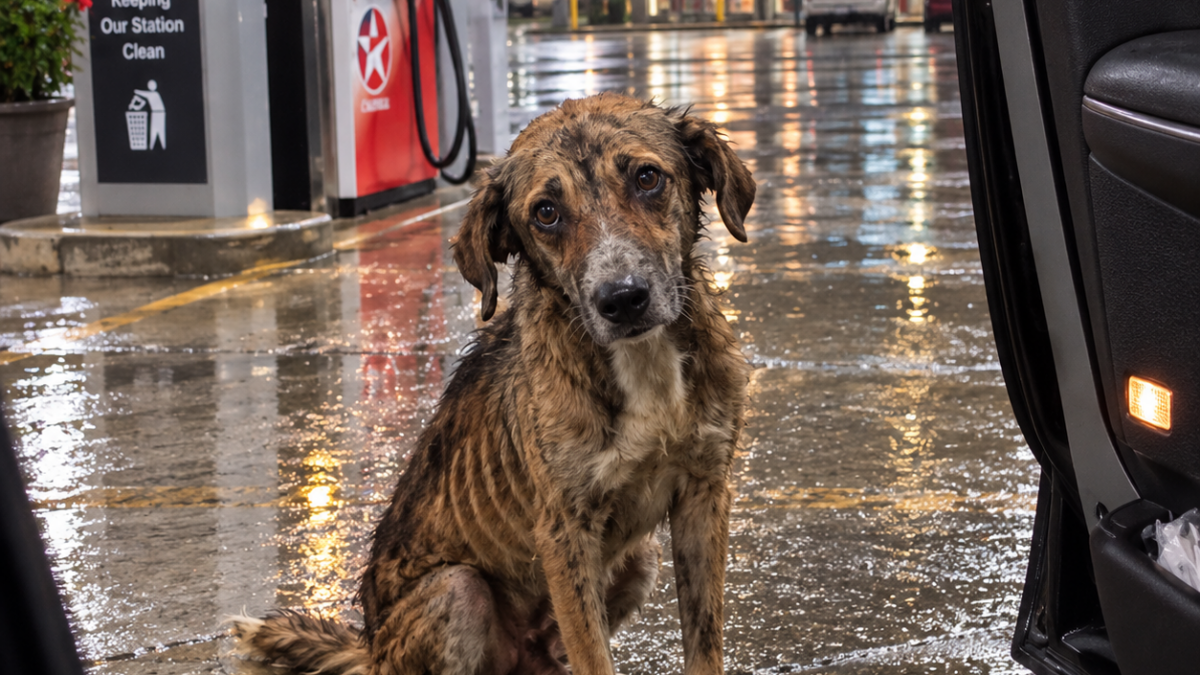
The starving dog chased my car away from a deserted gas station at two in the morning, but after I brought him home, he barely touched the food I gave him.
For two days, he refused to sleep, kept pressing one trembling paw against my leg, and stared toward the front door as if something outside mattered more than his own survival.
I thought he was afraid I would abandon him—until I realized his desperate behavior had never been about him at all.
It was just after 2:00 a.m. when I pulled into a lonely gas station off the highway.
I was exhausted.
The kind of exhausted where you stop thinking about anything except your bed.
The station was nearly empty, the convenience store glowing beneath harsh fluorescent lights while insects circled the lamps over the pumps. I started fueling my car and leaned against the door, staring at nothing.
Then I felt it.
Someone was watching me.
I turned.
A dog stood between my car and the edge of the parking lot.
He was medium-sized, maybe a little larger, with gray-brown fur hanging unevenly over a painfully thin body. His ribs showed through his coat. His ears were lowered.
But it was his eyes that stopped me.
He wasn’t looking at the food inside the store.
He was looking directly at me.
“Hey, buddy.”
He didn’t move.
I went inside, bought a bag of dog food and a bottle of water, then returned and poured both into disposable bowls.
“There you go.”
The dog approached carefully.
He ate three or four bites.
Then stopped.
He looked toward the highway.
Then back at me.
“Eat.”
He took another bite.
Then walked several yards toward a dark service road beyond the station.
He stopped.
Looked back.
I didn’t understand.
My gas pump clicked.
I closed the tank, climbed into my car, and pulled away.
Thirty seconds later, I checked my rearview mirror.
The dog was running behind me.
I slowed.
He kept coming.
His movements were awkward and exhausted, but he wouldn’t stop.
I pulled over.
When I stepped out, he reached me and stood there trembling.
“What are you doing?”
He stared up at me.
I still remember what I felt in that moment.
Not pity exactly.
Responsibility.
“All right.”
I opened the passenger door.
“Come on.”
When I lifted him, my stomach turned.
He weighed almost nothing.
At home, I gave him water, food, and an old blanket beside the couch.
I expected him to collapse.
He didn’t.
He lay down, but every time I moved, his eyes opened.
At dawn, he was sitting beside the front door.
I told myself I would keep him for a few days, help him gain strength, then contact a rescue.
Temporary.
That was the plan.
But by the next evening, something felt wrong.
He barely ate.
Every few hours, he walked to me and placed one paw against my leg.
Then he went to the door.
On the second night, he began whining.
Not loudly.
Just one low, broken sound.
He would touch my leg.
Walk to the door.
Look back.
Again.
And again.
“Do you want outside?”
I took him into the yard.
He immediately went to the gate.
He wasn’t looking for a place to relieve himself.
He was trying to leave.
By the third morning, he looked weaker than when I’d found him.
That scared me.
I took him to a veterinarian.
The doctor listened to his heart, examined his eyes, checked his gums and abdomen, then watched him pace toward the examination-room door.
“He’s underweight and dehydrated,” she said, “but I’m not seeing an illness that explains this behavior.”
“He won’t eat.”
“Not enough.”
“He won’t sleep either.”
She watched him come back to me.
He touched my leg with his paw.
Then turned toward the door.
The veterinarian’s expression changed.
“What?”
She crouched.
The dog looked toward the hallway again.
“I’ve seen this before.”
“Seen what?”
“A dog searching.”
“For his owner?”
“Maybe.”
She stood.
“Or another animal.”
I looked down at him.
He touched my leg again.
My throat tightened.
“What am I supposed to do?”
The veterinarian held my gaze.
“Take him back to exactly where you found him.”
I stared at her.
“And then?”
She glanced at the dog.
“Open the door.”
PART 2
For several seconds, I thought I had misunderstood her.
“You want me to let him go?”
“Not exactly.”
The veterinarian, Dr. Rachel Bennett, folded her arms and watched the dog.
“He’s been trying to tell you something for three days.”
“He can barely stand.”
“And yet every time he has enough energy to make a choice, he chooses the door.”
I looked down.
The dog was standing beside my leg.
His ribs still showed sharply beneath his coat. His head hung slightly from exhaustion, but his eyes were alert.
Waiting.
Rachel continued.
“Take water. Take food. Keep a leash with you, but don’t put it on him unless you have to. Return to the gas station. Open the car door.”
“And follow him?”
“If he goes somewhere, yes.”
“What if he runs into traffic?”
“Then stop him.”
“What if he disappears?”
She looked at me.
“I don’t think he’s going to disappear.”
“How can you know?”
“I don’t.”
She smiled faintly.
“But I think he’s spent three days wondering why you can’t understand something he’s been saying as clearly as he knows how.”
I looked at the dog.
He lifted one paw.
Touched my shin.
Then turned toward the clinic door.
Rachel raised an eyebrow.
“There. He said it again.”
That should have been funny.
It wasn’t.
Because suddenly I felt stupid.
For three days, I had interpreted everything from my own perspective.
He was hungry.
He was afraid.
He was lonely.
He wanted shelter.
He wanted me.
But what if none of that was true?
What if running behind my car hadn’t been a desperate attempt to escape the highway?
What if he’d been trying to stop me?
I crouched.
“Is that it?”
His ears lifted slightly.
“Did I leave somebody behind?”
He stepped toward the door.
My chest tightened.
“All right.”
I stood.
“Let’s go.”
Rachel packed electrolyte solution, several cans of high-calorie veterinary food, gauze, saline, and a small first-aid kit into a bag.
“If you find an injured animal, don’t force-feed it.”
“Call you?”
“Immediately.”
“And if I find nothing?”
She glanced toward the dog.
“Then bring him back.”
I paid, loaded him into the car, and drove home.
That night, I barely slept.
Neither did he.
At 4:51 the next morning, I walked into the living room.
He was sitting beside the front door.
Waiting.
Outside, the sky was still dark blue.
I filled a backpack.
Water.
Food.
Towels.
Flashlight.
Phone charger.
The supplies Rachel had given me.
Then I opened the door.
The dog walked outside without hesitation.
For the first time since I had found him, he seemed almost impatient.
I opened the passenger door.
He tried to climb in and failed.
I lifted him.
Again, his weight shocked me.
“Just hold on.”
He settled into the seat.
“I finally understand. I think.”
His eyes stayed on me.
“I hope.”
During the drive, he didn’t lie down.
He sat upright, occasionally wobbling when the road curved.
The closer we got to the gas station, the more restless he became.
Ten miles away, his ears rose.
Five miles away, he stood.
At the exit, he began whining.
When the gas-station sign appeared ahead, he pushed his nose against the window.
“All right. Easy.”
He trembled.
But this time it wasn’t the exhausted shaking I had seen at home.
This was urgency.
Recognition.
I pulled into the same parking space where I’d first seen him.
The sun was just beginning to rise.
The station looked completely different in daylight.
Smaller.
Less mysterious.
I opened the passenger door.
The dog jumped down.
His front legs nearly buckled.
I reached for him.
He recovered.
Then he looked at me.
“Go.”
He turned and started moving.
Not toward the highway.
Toward the narrow service road behind the station.
I followed.
At first he walked.
Then he trotted.
I had not seen him move that fast since the night he chased my car.
“Slow down.”
He didn’t.
The service road ended after several hundred yards and narrowed into an old dirt track.
We passed rusted fencing.
A drainage ditch.
An abandoned utility shed.
Then the dog left the trail completely.
He pushed through waist-high weeds.
I followed.
Branches caught my jacket.
Mud pulled at my boots.
Every few minutes he stopped.
Looked back.
Made sure I was there.
Then continued.
We crossed a dry creek bed.
Climbed a low hill.
Passed through a stand of scrub oak.
After nearly half an hour, sweat ran down my back despite the cool morning.
The dog should have been exhausted.
Maybe he was.
But something stronger was pulling him forward.
Then he disappeared behind a line of brush.
I heard a sound.
A whine.
Not his.
Higher.
Fainter.
I stopped.
Another sound.
Then another.
The hair rose along my arms.
I pushed through the brush.
The dog was standing in a small clearing.
At first, I didn’t understand what I was seeing.
There was an old blue tarp stretched unevenly between broken branches near the ground.
Beneath it lay something brown.
Then it moved.
A female dog lifted her head.
Barely.
She was thinner than the dog I had found.
Much thinner.
Her ribs and hip bones pushed through her coat. Her face was dusty. One ear was torn near the tip.
Around her belly were five puppies.
Tiny.
Dirty.
Pressed together for warmth.
One of them cried.
The male dog ran to them.
He didn’t greet the female first.
He went directly to the puppies.
Sniffed each one.
Nudged them.
Counted them, in the only way a dog can count.
Then he returned to the female.
Their noses touched.
She closed her eyes.
I couldn’t move.
Everything from the previous three days suddenly made sense.
The food he refused.
The whining.
The door.
His paw against my leg.
The way he’d chased my car when I left the gas station.
He had not followed me because he wanted a home.
He had followed me because he needed a human.
Someone with a car.
Someone with food.
Someone who would stop.
“Oh, God.”
I dropped my backpack.
The female tried to stand.
Her legs folded.
I knelt several feet away.
“It’s okay.”
The male dog came to me.
He pressed his paw against my knee.
The same gesture.
Except now I understood the words behind it.
Help them.
“I’m here.”
My voice broke.
“I finally got it.”
I called Rachel.
She answered on the second ring.
“You found something.”
She didn’t say hello.
I looked at the female.
“Five puppies. Adult female. She’s in bad shape.”
“Breathing normally?”
“Shallow.”
“Responsive?”
“Barely.”
“Can she stand?”
“No.”
“Any bleeding?”
“Not that I can see.”
“Listen carefully. Don’t give her a lot of water at once.”
Rachel gave me instructions.
Wet her gums.
Small amounts.
Keep the puppies warm.
Check whether the mother was nursing.
Don’t move them unnecessarily until help arrived.
“What about the male?”
“He got you there?”
“Yes.”
“Then give him water slowly too.”
I looked at him.
He wasn’t interested.
He sat beside the female.
“Rachel…”
“What?”
“He could’ve stayed at my house.”
“I know.”
“He had food.”
“I know.”
“He could barely walk.”
Rachel was quiet.
Then she said:
“He wasn’t trying to survive alone.”
I swallowed.
Help arrived fifty-three minutes later.
Rachel came herself with a veterinary technician named Luis and two volunteers from a local rescue group.
The male dog stood between them and the tarp when they entered the clearing.
I crouched beside him.
“They’re helping.”
He looked at me.
Then at Rachel.
She sat slowly on the ground.
“Hey, sweetheart.”
She placed her medical bag beside her.
“No one’s taking them away from you.”
He watched.
Finally, he stepped aside.
Rachel examined the female.
Her expression grew serious.
“How bad?”
“Very.”
She listened to her chest.
Checked her gums.
Took her temperature.
“She needs fluids now.”
“What about the puppies?”
“Dehydrated. Underweight. Some flea infestation. But they’re responsive.”
“Will they make it?”
Rachel looked at me.
“I think you got here in time.”
That sentence nearly took my knees out from under me.
I sat in the dirt.
The male dog came over and lowered his head into my lap.
For the first time since I’d found him, he closed his eyes.
Not for seconds.
For minutes.
He slept while everyone worked around him.
His job was finished.
Or so I thought.
We transported all seven dogs to Rachel’s clinic.
The female went in first.
The puppies followed in a heated carrier.
The male refused to enter another crate until I climbed into the back of the rescue van with him.
“Seriously?”
Luis laughed.
“I think you’ve been assigned.”
“I’ve noticed.”
I sat on the floor.
The dog lay against my leg.
At the clinic, the staff worked for hours.
I stayed.
There was nowhere else I wanted to be.
Near noon, Rachel finally came out.
Her scrubs were stained.
“How are they?”
“The mother is severely dehydrated and malnourished. She’s also producing less milk than the puppies need, so we’ll supplement them.”
“Infection?”
“Some skin irritation. Parasites. Nothing we can’t treat so far.”
“And him?”
She looked through the glass toward the male dog.
“He’s exhausted.”
“No disease?”
“Not that I can find.”
“Then why wouldn’t he eat?”
Rachel leaned against the counter.
“Stress. Separation. Drive. Maybe guilt, if you want to put a human word on something we can’t fully interpret.”
I looked through the glass.
He was lying beside the puppies’ kennel.
One puppy had pushed its nose through the bars.
The male dog had positioned his paw against it.
“What is he to them?”
“Could be the father. Could be related to the mother. Could simply be a bonded companion.”
“Can you tell?”
“DNA could tell us something eventually.”
She smiled.
“But I don’t think he cares what label we use.”
Neither did I.
We began calling the male Ranger.
Because he’d ranged farther than any dog should have had to travel to find help.
Rachel named the mother Willow.
The puppies were initially Puppy One through Puppy Five.
That lasted approximately six hours.
The clinic staff named them Scout, Daisy, Finn, Clover, and Bean before the day was over.
Ranger ate that evening.
Really ate.
Rachel placed a bowl beside him while Willow and the puppies were sleeping in the next enclosure.
He sniffed it.
Looked toward them.
Then ate every bite.
I stood beside the kennel.
“So that’s what it took.”
Ranger finished and looked at me.
“You just needed to know they were safe.”
His tail moved once.
I went home after midnight.
The house felt strange without him.
I had known Ranger three days.
Somehow, the empty blanket beside my couch bothered me.
The next morning, I returned before the clinic opened.
Rachel saw me through the front window and unlocked the door.
“You know visiting hours don’t start until nine.”
“I brought coffee.”
She stepped aside.
“Visiting hours have been revised.”
Ranger heard my voice.
His head came up.
He stood.
Then he looked toward Willow.
Then toward me.
For a moment, I thought he might stay with her.
Instead, he walked over.
Pressed his head against my leg.
And touched me with his paw.
This time there was no urgency.
No door.
No command.
Just contact.
I crouched.
“You don’t need anything?”
His tail moved.
“You sure?”
Another small wag.
I rubbed behind his ear.
“All right.”
The next several days became a routine.
Work.
Clinic.
Home.
Clinic.
Work.
Every morning, Willow looked a little more alive.
Every day, the puppies became louder.
Bean was the smallest.
Finn was the first to climb over one of his siblings.
Daisy screamed whenever she was weighed.
Scout slept on top of everybody.
Clover discovered that human shoelaces were apparently prey.
Ranger stayed beside them.
But something else began happening.
He started waiting for me.
At first, I told myself I imagined it.
Then Luis pointed it out.
“You know he recognizes your car.”
“What?”
“Every afternoon at five, he starts watching the window.”
“He doesn’t know what time it is.”
“He knows your car.”
One afternoon I parked on the far side of the building.
Ranger was asleep.
I walked silently to the kennel area.
Before I reached him, his head lifted.
He turned.
Saw me.
His entire body relaxed.
I felt something uncomfortable in my chest.
Not pain.
Something I hadn’t allowed myself to feel for a long time.
Being expected.
I lived alone.
Had for years.
I worked long hours.
Ate most meals standing over the kitchen counter.
Ignored invitations.
Forgot birthdays.
Told myself I liked quiet.
Maybe I did.
But there is a difference between liking solitude and becoming so used to it that you stop noticing the absence of connection.
Ranger noticed me.
Every time.
Then, on the sixth day after we found the clearing, everything changed.
I arrived at the clinic around four.
Two county animal-control officers were inside.
Rachel was standing with them.
Her face was serious.
“What happened?”
One officer introduced herself as Deputy Animal Control Investigator Maya Torres.
“Were you the person who found these dogs?”
“Yes.”
“Both locations?”
“The male at the gas station. The others in the clearing.”
“Can you show us exactly where?”
“Of course.”
My stomach tightened.
“Why?”
Maya glanced at Rachel.
Then back at me.
“We have reason to believe they didn’t get there accidentally.”
I stared at her.
“What does that mean?”
She held up a plastic evidence bag.
Inside was a piece of cracked red material.
A collar.
Willow’s collar.
Rachel had removed it while cleaning her neck.
At first we’d assumed it was simply old.
But on the inside of the buckle, someone had written a phone number in faded permanent marker.
Maya had traced it.
“To who?”
“A man named Travis Cole.”
“Is he their owner?”
“He says no.”
“What does he say?”
“That he’s never seen them.”
“Then why is his number on her collar?”
“He says he doesn’t know.”
Ranger stood behind the kennel door.
Watching us.
Maya continued.
“Mr. Cole runs an unlicensed dog-breeding operation about fourteen miles from the gas station.”
My stomach tightened.
“What kind of operation?”
“That’s what we’re determining.”
“Do you think he dumped them?”
“I think we need evidence.”
“Look at them.”
“That tells me they were neglected. It doesn’t tell me who did it.”
I hated how calm she sounded.
Later, I would understand why.
Evidence had to survive more than anger.
Maya asked me to take her to the gas station.
We drove separately.
The manager was there.
His name was Al.
When Maya explained what we were investigating, his expression changed.
“You found that dog?”
“You saw him?”
“I fed him.”
“When?”
“Few nights before you picked him up.”
He looked at me.
“Gray-brown one?”
“Yes.”
“He kept coming around. Wouldn’t stay.”
“Did you see where he came from?”
“No.”
Maya asked about surveillance cameras.
Al pointed toward the building.
“We keep thirty days.”
My heart started beating faster.
We went inside.
The camera system covered the pumps, parking lot, rear service lane, and entrance.
I gave Al the approximate time I’d found Ranger.
We watched.
There I was.
My car.
The pump.
Ranger in the shadows.
Seeing the moment from above was strange.
He looked even thinner than I remembered.
Then Maya asked Al to rewind.
Six hours.
Twelve.
Twenty-four.
Nothing.
Then the previous afternoon.
A white cargo van appeared on the rear camera.
It didn’t enter the gas station.
It stopped near the service road.
Maya leaned forward.
“Pause.”
Al froze the video.
The van was partially obscured by a utility pole.
No visible license plate.
“Play.”
The rear doors opened.
A man stepped out.
Too far from the camera to identify.
He pulled something from the van.
A dog.
Gray-brown.
Ranger.
My stomach dropped.
The man shoved him toward the ditch.
Ranger tried to turn back.
The man kicked dirt toward him and closed the door.
The van drove away.
Ranger chased it.
For nearly the entire visible stretch of road.
Then stopped.
I couldn’t breathe.
“He was dumped.”
Maya’s voice remained controlled.
“Yes.”
“Can you identify the van?”
“Possibly.”
“What about Willow?”
“We keep watching.”
Thirty-two minutes later, the same van returned.
It passed the station.
Didn’t stop.
Headed toward the service track.
One hour and seventeen minutes later, it came back.
I looked at Maya.
Her expression had gone hard.
“What?”
She pointed.
“The rear suspension.”
I didn’t understand.
“Look at the van going in.”
She rewound.
Then going out.
It sat higher.
Lighter.
Something heavy had been removed.
My stomach turned.
“You think Willow and the puppies were inside.”
“I think we’re getting closer.”
The gas station didn’t capture the plate.
But it captured something else.
A dent above the driver’s-side rear wheel.
And a rectangular patch where an old business decal had been removed.
Maya photographed the screen.
“Travis Cole owns a white cargo van.”
“Same kind?”
“Yes.”
“With a dent?”
“I don’t know yet.”
“Go look.”
She turned toward me.
“I will.”
“When?”
“Now.”
“I’ll come.”
“No.”
“Why?”
“Because you’re a witness.”
“I know what his place looks like?”
“You don’t.”
“I know what Ranger looks like after whatever happened there.”
Maya’s voice dropped.
“That is exactly why you’re not coming.”
I stared at her.
She continued.
“If he’s responsible, I need a clean case. Not an angry civilian at his gate.”
I wanted to argue.
Then I remembered Ranger chasing the van.
I stepped back.
“Find out.”
“We will.”
The next morning, Maya called.
“The van matches.”
I sat up in bed.
“What does that mean?”
“Same make. Same model. Same dent location.”
“Arrest him.”
“Not yet.”
“What else do you need?”
“Proof he was driving.”
“His number was on Willow’s collar.”
“Helpful.”
“He owns the van.”
“Helpful.”
“He operates a breeding place.”
“Also helpful.”
“But?”
“But if we move too soon and he says an employee borrowed it, or claims the dogs were stolen, or says the collar came from an animal he sold years ago, we need evidence to answer that.”
I hated the word helpful.
I wanted proof.
Immediate.
Simple.
The way movies work.
Real justice is mostly paperwork until suddenly it isn’t.
Maya obtained a warrant to inspect Cole’s property after former customers confirmed seeing a female dog matching Willow’s description there.
What officers found changed the case.
Twenty-three dogs.
Most underweight.
Some confined in narrow outdoor pens.
Three had untreated skin infections.
Two had collars embedded deeply enough to require medical care.
There were breeding records.
Sales records.
Medication bottles.
Stacks of cash receipts.
And photographs.
Lots of photographs.
One showed Willow.
Another showed Ranger.
Standing beside her.
Healthy.
Both wearing collars.
Ranger had once been broader.
Strong.
His coat shiny.
He stood proudly beside Willow while six older puppies played around them.
I stared at the photograph on Maya’s tablet.
“When was this?”
“About eight months ago.”
“What happened?”
“Business slowed.”
I looked up.
“What?”
“According to records and messages on Cole’s phone, he had more adult dogs and puppies than he could sell.”
My stomach twisted.
Maya continued.
“There were also complaints from neighbors.”
“So he dumped the ones he didn’t want.”
“We’re still reconstructing it.”
“He starved them.”
“Likely.”
“He drove them out there.”
“We have strong evidence.”
“He left puppies under a tarp.”
Maya’s jaw tightened.
“Yes.”
“Why dump Ranger separately?”
“We don’t know.”
But I did.
At least I thought I did.
Ranger would have followed.
If Cole had dumped Willow and the puppies first, Ranger might have stayed with them.
He might have protected them.
Might have attracted attention.
Maybe Cole separated him deliberately.
Miles apart.
Break the family.
Reduce the chance they would be found together.
Except Ranger didn’t stay where he was left.
He searched.
Maybe for hours.
Maybe all night.
Somehow, he found his way close enough to the gas station to find me.
I went to the clinic.
Ranger ran to the kennel door.
I sat on the floor.
He leaned against me.
“You chased him, didn’t you?”
His ears moved.
“The van.”
He looked up.
“You tried to go back.”
My voice broke.
“And when you couldn’t find them, you found me.”
Ranger put his paw on my arm.
I laughed through tears.
“Yeah.”
I rubbed his neck.
“I know.”
The case against Travis Cole grew quickly.
Maya interviewed a former employee named Ellie Grant.
Ellie had quit two months earlier.
She told investigators Cole routinely withheld food when money was tight.
He bred females too frequently.
When dogs became difficult to sell, he called them “inventory problems.”
Ellie had seen Ranger and Willow together for years.
“They were bonded,” she told investigators.
Ranger had shared his food with Willow after her previous litter.
Whenever puppies cried, he slept outside her pen.
Ellie recognized the five puppies immediately from photographs.
She also identified Cole’s van.
Then she said something that made me sick.
Three days before I found Ranger, she had received a text from Cole.
Problem solved.
Below it was a photograph of empty kennels.
Maya had the message.
The timestamp.
The metadata.
The case stopped being circumstantial.
Cole was charged with multiple counts related to animal cruelty, abandonment, and neglect.
I thought I would feel relief.
Instead, I felt rage.
Because now I knew.
Ranger hadn’t become emaciated because he was lost.
Willow hadn’t crawled beneath that tarp naturally.
Five puppies hadn’t nearly starved because of bad luck.
A human being had made a decision.
Load them.
Drive them out.
Leave them.
Then sleep somewhere that night knowing exactly what was happening.
That knowledge changed the way I looked at Ranger.
He had trusted me after a human had betrayed him.
That felt almost unbearable.
A week later, Willow stood without assistance.
Everyone at the clinic applauded.
She looked confused.
Ranger ran circles around her.
The puppies were gaining weight.
Bean remained the smallest but had developed a personality large enough to compensate.
He escaped his pen twice.
The second time, we found him sleeping in my jacket.
Rachel handed him to me.
“You realize you’ve been selected by another one.”
“I already have Ranger.”
“You don’t technically have Ranger.”
I looked toward him.
Ranger was asleep beside my chair.
“Don’t tell him that.”
Rachel smiled.
“The legal hold won’t last forever.”
“What happens afterward?”
“The rescue will handle adoption.”
I was silent.
Rachel studied me.
“You’ve thought about it.”
“No.”
“Terrible liar.”
“I travel sometimes.”
“You work ten minutes from here.”
“I don’t have a fenced backyard.”
“You spent last weekend building one.”
“That was unrelated.”
She laughed.
“You’re hopeless.”
The truth was I had built the fence because I already knew.
I just wasn’t ready to say it.
The first night Ranger had chased my car, I had thought I was giving him temporary shelter.
A bowl.
A blanket.
A few safe days.
Somewhere during those weeks, temporary stopped meaning anything.
I went home one evening and looked around my house.
Food bowl.
Water bowl.
Dog bed.
Toys.
Leash.
Fence.
The old blanket.
I sat on the couch.
Ranger wasn’t there because he was still under evidence hold at the clinic.
The house felt empty.
That was my answer.
Then Travis Cole tried to take the dogs back.
I wish I were joking.
His attorney filed a property petition arguing that because the criminal case had not reached conviction, the dogs were still legally his property and should either be returned or compensated at their commercial value.
When Maya told me, I thought she was testing me.
“He dumped them.”
“I know.”
“He nearly killed them.”
“I know.”
“He wants them back?”
“He wants leverage.”
“What kind?”
“The puppies have received attention since the story got out.”
I stared.
“What story?”
A local reporter had learned about Ranger leading me to Willow.
The rescue had posted a short account without my name.
It spread.
People donated.
Hundreds applied to adopt the puppies.
Cole’s attorney now argued that the animals had commercial value.
I actually laughed.
Not because it was funny.
Because sometimes anger comes out sounding like laughter.
“He wants money.”
“Possibly.”
“For dogs he threw away.”
Maya nodded.
I stood.
She pointed at the chair.
“Sit.”
“No.”
“Sit before you give yourself a stroke.”
I sat.
“What happens?”
“We oppose the petition.”
“And if he wins?”
“He won’t walk into the clinic and collect them tomorrow.”
“That’s not what I asked.”
Maya leaned forward.
“This is where you trust the process.”
“I trusted the process when you told me not to go to his house.”
“And we got a warrant.”
“I trusted it when you said wait for evidence.”
“And he’s facing charges.”
I knew she was right.
I still hated it.
The property hearing was held three weeks later.
I attended.
So did Rachel.
Maya sat with county counsel.
Cole sat across the room.
That was the first time I saw him in person.
I expected a monster.
That would’ve been easier.
He looked ordinary.
Late forties.
Clean shirt.
Trimmed beard.
Glasses.
He could have been anybody standing beside you in a grocery store.
I hated that more.
People who do cruel things rarely arrive wearing signs.
His attorney spoke first.
He described the dogs as “valuable breeding animals.”
I felt my hands tighten.
He argued that Cole’s ownership had not been legally extinguished when county officers seized the animals.
Then the county presented photographs.
Willow when found.
Ranger at the gas station.
The puppies under the tarp.
The twenty-three dogs seized from Cole’s property.
The courtroom changed.
Not loudly.
People simply stopped shifting in their seats.
Maya testified about the surveillance footage.
The van.
The timing.
The collar.
The breeding records.
Ellie testified about Cole’s message.
Problem solved.
Cole’s attorney objected repeatedly.
The judge allowed the message.
Then Rachel testified.
She described Willow’s condition.
Severe dehydration.
Malnutrition.
Parasites.
Reduced milk production.
She described Ranger’s condition.
She explained that another day without intervention might have been fatal for Willow or one or more puppies.
Then Cole testified.
He denied dumping them.
He claimed someone else had access to his van.
“Who?”
He named an employee.
That employee had already provided work records showing he was eighty miles away.
Cole then said the dogs had escaped.
County counsel asked:
“All seven?”
Cole hesitated.
“Yes.”
“Together?”
“I suppose.”
“Then how did one adult dog arrive near the gas station while the female and five puppies were located several miles away beneath a tarp?”
“I don’t know.”
“Did the puppies stretch the tarp themselves?”
Cole’s attorney objected.
Sustained.
But the point had landed.
County counsel showed him the surveillance still.
“Is this your van?”
“It looks like mine.”
“The dent?”
“Could be.”
“The removed decal patch?”
“Could be.”
Then a second image appeared.
It came from a traffic camera several miles down the highway.
Maya had not told me about it.
The white van.
The license plate visible.
Cole’s plate.
Timestamped seventeen minutes before the gas-station camera showed Ranger being pulled from the vehicle.
I turned toward Maya.
She kept her eyes forward.
Cole stopped talking.
His attorney whispered urgently.
County counsel asked:
“Is that your license plate?”
Silence.
“Mr. Cole?”
“Yes.”
The room seemed to exhale.
Then came the final piece.
A convenience-store receipt.
Fuel.
Coffee.
Timestamped twenty-four minutes after Willow and the puppies were believed to have been left near the service road.
The receipt came from Cole’s bank card.
He had fueled less than five miles away.
He had abandoned seven dogs.
Then bought coffee.
That detail bothered me for years.
Maybe because it was so normal.
He drove away from suffering he’d created and purchased a drink.
The judge denied his petition.
Custody remained with the county pending final disposition.
Cole was ordered to cover substantial veterinary and boarding costs as part of the ongoing proceedings.
Outside the courtroom, reporters surrounded Maya.
I stayed back.
Cole exited through another door.
For a second, our eyes met.
He recognized me.
I knew immediately.
Maybe from the news.
Maybe from court.
He stopped.
“You’re the guy.”
I said nothing.
“The gas station.”
I kept walking.
He stepped closer.
“You think you’re some hero?”
I stopped.
My whole body wanted to turn around.
Maya saw it.
She started moving toward us.
Cole smiled.
“They’re dogs.”
Three words.
That’s all.
They’re dogs.
I looked at him.
Then I thought of Ranger running on exhausted legs behind my car.
Willow closing her eyes beneath my hand because she finally believed she could rest.
Five puppies pressed against a starving mother.
I looked back at Cole.
“Yes,” I said.
“They are.”
He waited for more.
I didn’t give it to him.
Because suddenly I understood something.
I didn’t need revenge.
He wanted anger.
He wanted somebody to lose control so he could point and say we were unreasonable.
Instead, I walked away.
Ranger had already beaten him in every way that mattered.
Cole had thrown him away.
Ranger survived.
Cole tried to separate him from his family.
Ranger found them.
Cole tried to make them disappear.
Ranger made the entire county see them.
Cole called them inventory.
People learned their names.
The criminal case concluded months later.
Cole entered a negotiated plea after prosecutors presented the surveillance footage, financial records, veterinary evidence, and former employee testimony.
He received penalties that included jail time, restitution for veterinary care, supervised probation, and a long-term prohibition on owning or breeding animals under the applicable court order.
His remaining dogs were legally surrendered.
All were treated.
All eventually went into rescue placement.
His breeding operation closed.
The kennels were emptied.
The signs came down.
The animals he’d treated like inventory became evidence against him.
And Ranger—the dog he had driven into darkness and abandoned—was the reason anyone looked closely enough to discover the rest.
That felt like justice.
Not because Cole suffered.
Because the dogs stopped suffering.
When Ranger’s legal hold finally ended, Rachel called me.
“Come down.”
“Why?”
“Just come.”
I left work early.
Ranger was in the lobby.
He wore a blue collar.
Bean sat beside him.
Willow was in the recovery room with the other puppies.
Rachel placed a folder on the counter.
“What’s that?”
“Foster-to-adopt paperwork.”
“For Ranger?”
“And?”
She looked at Bean.
“No.”
Bean barked.
Rachel smiled.
“He disagrees.”
“I cannot adopt two dogs.”
“You built a fence large enough for six.”
“That doesn’t mean anything.”
“You have two dog beds.”
“One is temporary.”
“You bought puppy food.”
“I was helping.”
“It’s in your kitchen.”
I stared at her.
She folded her arms.
Ranger came over.
Touched my leg with his paw.
I looked down.
“No.”
Bean ran over and put both front paws on my shoe.
Rachel started laughing.
“This feels coordinated.”
“It probably is.”
I crouched beside Ranger.
“You planned this?”
His tail moved.
I looked at Bean.
The puppy bit my shoelace.
“Terrible judgment.”
Three hours later, I drove home with both of them.
Ranger sat upright in the passenger seat.
Bean slept in a carrier behind me.
When we passed the gas-station exit, Ranger turned his head.
I slowed.
For a moment, I considered stopping.
Then Ranger looked at me.
He didn’t whine.
Didn’t stand.
Didn’t touch my arm.
He looked toward the road once.
Then settled back into the seat.
He didn’t need to go there anymore.
Everyone was safe.
Willow recovered completely.
When she was strong enough for adoption, more than two hundred families applied.
Rachel rejected most immediately.
“You’re enjoying this.”
“Absolutely.”
She eventually chose a retired nurse named Carol and her husband, James.
They lived on eight fenced acres.
No breeding.
No crowded house.
No young children who might overwhelm Willow.
Just two patient people who wanted a quiet dog.
I went with Rachel when they met.
Willow approached Carol slowly.
Carol sat on the floor.
Didn’t reach.
Didn’t call.
Just waited.
Willow sniffed her hand.
Then leaned against her.
Carol started crying.
“Well,” James said quietly, “I think we’ve been accepted.”
Willow went home with them a week later.
Scout was adopted by a firefighter and his wife.
Daisy went to a school counselor.
Finn went to a family who already had an older rescue dog.
Clover went to Luis, the veterinary technician who had insisted for weeks that he was “absolutely not adopting a puppy.”
No one believed him.
Bean stayed with me.
And Ranger.
The first few months weren’t easy.
Ranger hoarded food.
He hid pieces of kibble beneath couch cushions.
Bean found them and considered this a fantastic system.
Ranger panicked when I closed the garage door too quickly.
He hated white vans.
That was the hardest.
Whenever one passed us during a walk, his body became rigid.
If it slowed, he tried to pull away.
So we worked on it.
Distance.
Treats.
Patience.
No forcing.
Months passed.
Eventually a white delivery van could stop across the street without making him shake.
The first time that happened, I stood in my driveway with tears in my eyes like an idiot.
“You did it.”
Ranger looked at me.
Bean was trying to eat a leaf.
Not every member of the family understood the significance of the moment.
At night, Ranger slept beside my bed.
Bean slept wherever gravity eventually defeated him.
For the first few weeks, Ranger still woke and walked to the front door.
He would stand there.
Listen.
Then come back.
I wondered whether he was searching for Willow.
So one Saturday, I drove him to Carol and James’s house.
The moment Willow heard the car, she ran to the gate.
Ranger saw her.
He made a sound I had never heard from him.
Half bark.
Half cry.
They collided in the yard.
Ran circles around each other.
Pressed shoulders together.
Willow licked his face.
Ranger followed her everywhere.
I stayed for three hours.
When it was time to leave, I worried.
Would he refuse to come?
Would taking him away feel like another separation?
I opened the car door.
“Ranger.”
He looked at Willow.
Then at me.
My heart stopped.
He touched noses with Willow.
Then walked to the car.
He climbed in.
No hesitation.
I sat behind the wheel and stared at him.
“You’re coming home?”
He placed one paw on the center console.
I laughed.
“Okay.”
That night, something changed in me.
I had spent years believing independence was a kind of achievement.
I didn’t ask for help.
Didn’t need much.
Didn’t depend on anyone.
My parents had worked constantly when I was growing up.
Nobody was cruel.
Nobody abandoned me.
We were simply a family that handled things quietly.
You had a problem?
Solve it.
You were sad?
Keep moving.
You were lonely?
Stay busy.
I got very good at staying busy.
Good enough that nobody noticed when I became isolated.
Including me.
Ranger didn’t understand any of that.
He believed connection was survival.
When Willow needed him, he didn’t protect himself.
He ran.
When he couldn’t save her alone, he found someone.
When I failed to understand, he kept asking.
Paw.
Door.
Whine.
Paw.
Door.
Whine.
Again.
Again.
Again.
He never confused needing someone with weakness.
I had done that my entire life.
One evening, Rachel came over for dinner.
That alone would have been unimaginable a year earlier.
I almost never invited anyone into my house.
She looked around.
Ranger was asleep beside my chair.
Bean was upside down on the couch.
There were dog toys everywhere.
She smiled.
“Temporary?”
I laughed.
“Very.”
“What happened to taking him to a shelter?”
“Plans changed.”
“Clearly.”
After dinner, she asked me something.
“If Ranger had eaten normally that first day, would you have gone back?”
I thought about it.
Probably not.
I hated admitting that.
“No.”
“If he hadn’t touched your leg?”
“No.”
“If he hadn’t chased your car?”
I shook my head.
Rachel looked at him.
“He saved them because he refused to stop communicating.”
I nodded.
Then she said:
“And you saved them because eventually you listened.”
I carried that sentence with me.
A year after I found Ranger, the gas station installed a small bulletin board near the entrance.
Al called me.
“You need to come see something.”
I drove over with Ranger and Bean.
On the board was a photograph.
Ranger.
The original one from the rescue.
Thin.
Dirty.
Standing beside me outside Rachel’s clinic.
Beneath it, Al had written:
SOMETIMES STOPPING SAVES MORE THAN ONE LIFE.
I stood there longer than I expected.
Ranger sniffed the base of the sign.
Then walked toward the edge of the parking lot.
The same place where he had first watched me.
I followed.
He sat.
I sat beside him.
Cars passed.
The pumps clicked.
The lights hummed.
It was hard to believe that one night, in that ordinary place, an exhausted dog had made the biggest decision of both our lives.
He chose a stranger.
Maybe because I looked safe.
Maybe because I was simply the first person who stayed long enough.
I would never know.
I put my hand against his neck.
“You picked pretty badly.”
His tail moved.
“Could’ve found somebody smarter.”
He leaned against me.
Bean jumped on both of us.
“Definitely smarter.”
Years passed.
Ranger grew older.
His muzzle turned gray.
His pace slowed.
Bean grew into a strong, ridiculous dog with endless energy.
Ranger never became playful in the same reckless way.
He remained observant.
Protective.
Always checking where everybody was.
If Bean wandered too far in the yard, Ranger watched.
If I stayed late at work, Ranger sat by the window.
If someone came to the door, he placed himself between me and the entrance until he decided the person was safe.
He never stopped touching me with his paw.
That gesture changed meaning over the years.
At first:
Follow me.
Then:
Help them.
Later:
Don’t leave.
Eventually:
I’m here.
And sometimes:
Your dinner appears to contain chicken.
Ranger visited Willow several times each year.
She lived a long, peaceful life with Carol and James.
She became almost unrecognizable from the dog beneath the tarp.
Healthy coat.
Good weight.
Bright eyes.
She slept in the sun.
Chased squirrels badly.
Learned that couches were more comfortable than dirt.
Whenever Ranger arrived, she greeted him the same way.
Nose to nose.
Then shoulder against shoulder.
Neither needed anything more.
One autumn, Carol called.
Willow was sick.
Cancer.
Advanced.
There wasn’t much time.
I took Ranger immediately.
Willow was lying on a blanket beneath an oak tree.
Ranger approached slowly.
He sniffed her.
She lifted her head.
Her tail moved.
One time.
Ranger lay beside her.
For two hours, he didn’t move.
Bean stayed unusually quiet.
Carol cried.
So did I.
Before we left, Willow pressed her face against Ranger’s.
He closed his eyes.
She died three days later.
Afterward, Ranger searched my house that night.
Kitchen.
Hallway.
Front door.
Back door.
Then he lay on Willow’s old blanket, which Carol had given us.
I sat beside him.
He put his paw on my leg.
For once, I knew there was nothing I could fix.
So I didn’t try.
“I miss her too.”
He rested his head against me.
Sometimes listening is the only thing love asks.
The puppies stayed connected in strange ways too.
Every year, Rachel organized a reunion.
Scout became huge.
Daisy remained bossy.
Finn loved swimming.
Clover followed Luis everywhere.
Bean remained Bean.
They played.
Ranger supervised.
Photos were taken.
People laughed.
And for a few hours each year, I looked around and remembered the clearing.
Seven animals nearly erased.
Now seven lives expanding outward.
Families.
Birthday photos.
Hikes.
Beds.
Christmas stockings.
Vet records.
Favorite toys.
All the ordinary details that cruelty almost prevented.
That became my understanding of justice.
The court case mattered.
Cole losing his breeding operation mattered.
His sentence mattered.
The restitution mattered.
The ban on animal ownership mattered.
But the deepest answer wasn’t punishment.
It was continuation.
He had treated lives as disposable.
Those lives continued anyway.
He abandoned Ranger beside a highway.
Ranger found me.
He abandoned Willow and five puppies beneath a tarp.
They became beloved members of five different families.
He tried to make them invisible.
They became unforgettable.
That was the revenge I eventually learned to appreciate.
Not destruction.
Survival.
Not hatred.
A life so full that the person who tried to erase it becomes irrelevant.
Ranger taught me that.
He taught me something else too.
As he aged, I became the one watching doors.
The one noticing whether he ate.
The one waking when he moved at night.
The one following.
Around eleven years after the gas station, Ranger’s hips began giving him trouble.
Medication helped.
Then ramps.
Then shorter walks.
Bean, now older himself, slowed his pace to stay beside him.
The first time I noticed that, I had to turn away.
One winter morning, Ranger stood at the front door.
I grabbed his leash.
“Outside?”
He looked at me.
Touched my leg.
Then walked toward the garage.
I froze.
That gesture.
That look.
It had been years.
“Where do you want to go?”
He waited.
I opened the car.
He climbed in with help.
Bean came too.
I didn’t know where Ranger wanted to go.
So I started driving.
At the highway, he lifted his head.
When I approached the old gas-station exit, Ranger became alert.
I understood.
“You want to go there?”
His ears rose.
I turned.
The station had changed ownership.
New signs.
New pumps.
New paint.
But the parking lot was the same.
I opened the door.
Ranger stepped down slowly.
Bean followed.
Ranger walked to the spot where I’d first seen him.
He stood there.
Wind moved through his gray coat.
I remembered a starving animal in the darkness.
Ribs visible.
Eyes desperate.
I remembered the food he wouldn’t eat.
The moment he chased my car.
The weight of him when I lifted him.
Ranger looked toward the service road.
I felt afraid.
Did he want to go to the clearing?
Could he make the walk?
I brought water.
A support harness.
We went slowly.
Very slowly.
The old trail had nearly disappeared.
Vegetation had grown over parts of it.
The creek bed had changed.
Where the tarp once stood, wildflowers covered the clearing.
Ranger stopped.
He sniffed.
Bean wandered nearby.
I stood where Willow had once lain.
Nothing remained.
No tarp.
No bowls.
No footprints.
Just grass.
Ranger walked to the center.
Then lay down.
I sat beside him.
For a long time, neither of us moved.
“You did it.”
He looked at me.
“You know that?”
His tail tapped the grass.
“You saved every one of them.”
I thought about correcting myself.
Technically, people had helped.
Rachel.
Maya.
Luis.
The rescue volunteers.
Carol.
James.
The adoptive families.
But none of us would have been there without Ranger.
So I let the sentence stand.
“You saved them.”
He placed his paw on my hand.
I smiled.
“And me.”
That part surprised me most.
I had not been starving when Ranger found me.
Not physically.
I had a house.
A job.
Food.
Money.
Routine.
From the outside, I needed nothing.
But my life had become narrow.
Work.
Home.
Sleep.
Repeat.
I didn’t realize emptiness could become comfortable.
Ranger destroyed that comfort.
He filled my house.
Then Bean did.
Then Rachel became a friend.
Then Luis.
Maya.
Carol and James.
Then birthday dinners.
Dog reunions.
Barbecues.
Phone calls.
People.
A life.
All because at 2:00 a.m. a starving dog decided I looked like someone worth chasing.
Ranger lived another eight months after that visit.
His final decline was gentle.
No dramatic emergency.
No highway.
No desperate run.
Just age.
One evening, he refused dinner.
I knew.
The same dog who had once refused food because his family was still outside now refused because his body was tired.
I sat beside him.
Bean lay on his other side.
Ranger looked at me.
His breathing was slow.
I called Rachel.
She came to the house.
She was older too.
We all were.
She examined him.
Then looked at me.
That was enough.
I nodded.
We placed Ranger on the old blanket beside the couch.
The same kind of place I had made for him the first night.
Except now he wasn’t watching the door.
He was watching me.
I put my hand on his chest.
“You remember?”
His eyes stayed on mine.
“I had no idea what you wanted.”
My voice cracked.
“You must’ve thought I was the dumbest person alive.”
Rachel laughed softly through tears.
Bean pressed closer.
I continued.
“But you didn’t give up.”
Ranger moved his paw.
Slowly.
It touched my leg.
Exactly where it had thousands of times.
I broke.
I lowered my forehead to his.
“I know.”
For once, those two words contained everything.
I know you tried.
I know you were scared.
I know who you loved.
I know what you gave.
I know what you changed.
I know what you’re asking now.
Stay.
So I stayed.
Ranger died with my hand against his chest and Bean beside him.
He didn’t die abandoned.
He didn’t die hungry.
He didn’t die chasing a car.
He died home.
The next morning, I woke automatically at six.
For eleven years, Ranger had usually been awake before me.
The house was silent.
Bean stood beside the bed.
He looked toward the door.
Then at me.
I sat on the floor.
He came over.
And placed one paw against my leg.
I laughed and cried at the same time.
“Runs in the family, huh?”
Bean leaned into me.
Life continued.
It always does.
Years have passed since that night at the gas station.
The station is different now.
The veterinarian clinic has expanded.
Maya retired.
Luis owns part of the practice with Rachel.
Bean’s muzzle is gray.
I am not the man I was when Ranger found me.
I talk to people now.
I ask for help.
I let people into my house.
I understand that needing others is not failure.
I learned that from a dog who nearly starved because he refused to save himself before saving his family.
I still think about the question people ask most often when they hear Ranger’s story.
“How did he know to choose you?”
I don’t know.
Maybe he didn’t.
Maybe I happened to be there.
Maybe he would have chased the next car.
And the next.
And the next.
Maybe the miracle wasn’t that he chose me.
Maybe the miracle was that one of us finally stopped.
That is the part I never forget.
He was not asking me to adopt him.
He wasn’t asking for a warm bed.
He wasn’t asking for food.
He wasn’t even asking me to love him.
Not yet.
He was asking for one thing.
Follow me.
Because somewhere beyond the gas station, across the service road, through the weeds and the dry creek bed, a starving mother lay beneath a tarp with five puppies who had almost run out of time.
Ranger had no phone.
No language I understood.
No money.
No strength.
All he had was persistence.
A paw.
A look.
A road.
And one exhausted stranger who finally realized the dog wasn’t asking to be rescued.
He was asking for help rescuing someone else.
That is why I still keep Ranger’s old collar in a drawer beside my bed.
Not because I want to remember how thin he was.
Not because I want to remember Travis Cole.
I rarely think about that man anymore.
Ranger’s life became too big for the person who tried to throw it away.
I keep the collar because sometimes I need to remember the lesson.
Pay attention.
When something keeps touching your life, don’t always push it away.
When someone cannot explain what they need, look more carefully.
When you’re tempted to believe a problem isn’t yours, remember that sometimes being the person who happened to stop makes it yours for just long enough to change everything.
And if you’re lucky, what begins as a burden may become the greatest gift you never knew you needed.
That starving dog ran behind my car because he refused to abandon his family.
I followed him because eventually I understood.
And for the rest of his life, he never had to chase me again.
I was already beside him.
[END OF FULL STORY]








