PART 2: A Starving Dog Came to a Stranger’s Door With a Belly So Swollen She Could Barely Stand—Then the Vet Told Us Why
PART 2
That first night, I sat beside Lulu longer than I intended.
The clinic had quieted, though no veterinary center is ever truly silent. Machines hummed. Doors opened somewhere down the hall. A frightened cat cried from another room. Someone rolled a metal cart across the floor, and every time the wheels rattled, Lulu’s eyes opened.
She watched everything.
Not with curiosity.
With vigilance.
Her body seemed too weak to defend itself, but her mind had not stopped expecting danger.
I placed my hand on the blanket several inches from her paw.
I didn’t touch her.
“You can sleep.”
Lulu stared.
“I know you don’t believe me.”
Nothing.
“You don’t know me.”
Her breathing remained shallow.
“But nobody is going to chase you tonight.”
I stayed until nearly two in the morning.
Every time her eyes closed, they opened again within minutes.
At some point I realized I had become obsessed with seeing her sleep.
Not just rest.
Sleep.
Deeply enough to stop monitoring the room.
She never did.
Not that night.
The next morning, her abdominal fluid had already begun accumulating again.
Less than before.
Still enough to concern us.
The veterinarian explained the balance carefully.
“We can drain fluid when it is affecting her breathing or comfort, but repeatedly removing large amounts has its own risks. We need to support the underlying condition as much as we can.”
“Which is her liver.”
“Yes.”
“Can medication help?”
“We can support liver function, manage symptoms, improve nutrition, monitor fluid, treat what is treatable.”
“But you still don’t think the damage reverses.”
He looked toward Lulu.
“I don’t want to give you false hope.”
I hated that sentence.
Rescue work is built partly from hope.
Hope gets you out of bed at five in the morning.
Hope makes you drive across a city for a dog you have never met.
Hope makes donors pay bills for animals they will never touch.
Hope makes you sit beside a kennel reading lab results you barely understand because you are desperate for one number to move in the right direction.
But false hope can become cruelty.
So I nodded.
“What does she need today?”
That became our question.
Not next month.
Today.
The answer was food.
Carefully.
Lulu was severely malnourished.
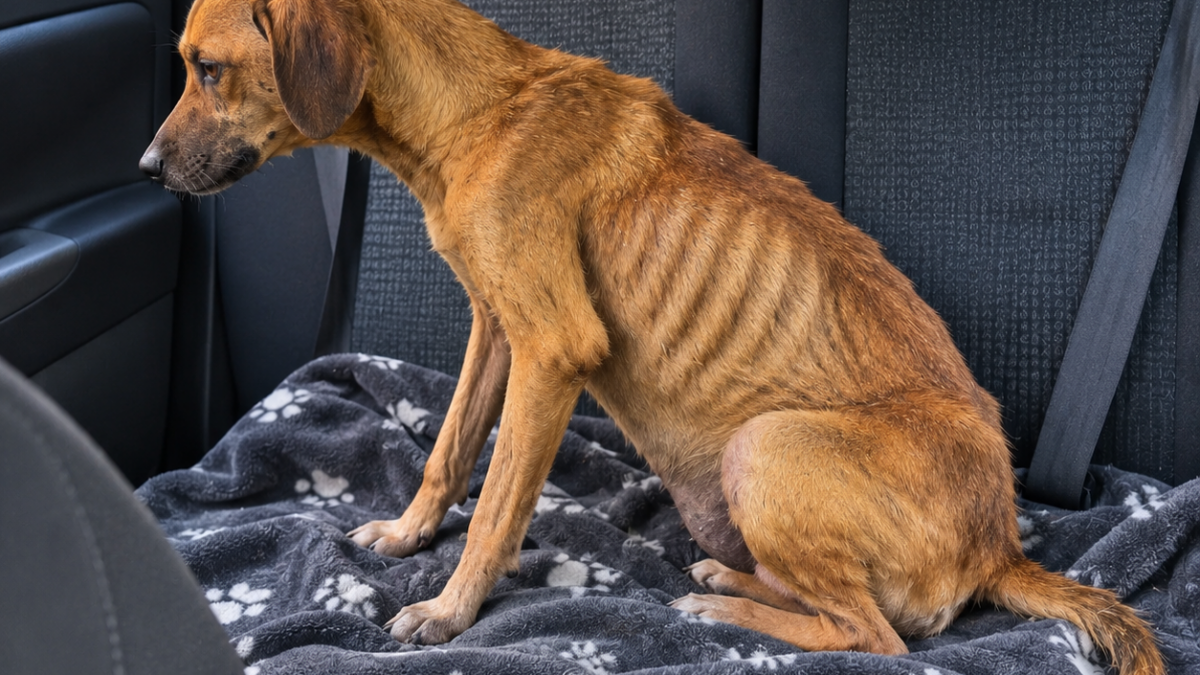
The swollen abdomen made the contrast more disturbing because people unfamiliar with her condition could glance at her and assume she was overweight or pregnant.
She was neither.
Under the fluid, she was wasting away.
We started with small, carefully managed meals appropriate to what the veterinary team believed her body could tolerate.
The first bowl arrived.
Lulu smelled it immediately.
Her head lifted.
The technician placed it near her.
Lulu looked at the bowl.
Then at the technician.
Then back at the bowl.
She didn’t move.
“Go ahead.”
Nothing.
The technician stepped away.
Still nothing.
I crouched several feet from her.
“Are you hungry?”
Of course she was.
Her bones answered that question.
But hunger and fear can exist together, and sometimes fear wins.
We moved farther away.
Lulu finally lowered her muzzle.
One bite.
Pause.
Another.
Then she ate faster.
Too fast.
The technician approached carefully.
Lulu froze.
Her body shifted over the bowl.
Not growling.
Not snapping.
Guarding.
“Stop,” I whispered.
The technician stepped back.
Lulu resumed eating.
Her entire body told us something.
Food had not always felt secure.
Maybe other animals had competed for it.
Maybe people had removed it.
Maybe she simply had gone so long without reliable meals that any hand near the bowl meant danger.
We didn’t know.
So we didn’t punish the behavior.
We changed ours.
Food arrived.
Food remained hers.
Nobody reached into the bowl.
Nobody tested her.
Nobody tried to prove dominance.
Day after day.
Predictability first.
Trust later.
On the third day, a woman called asking whether she could foster Lulu.
I almost cried from relief.
Then I explained the medical situation.
Severe liver failure.
Possible recurrent abdominal fluid.
Medications.
Frequent follow-ups.
Potential emergency visits.
Uncertain prognosis.
Silence.
“Oh.”
I waited.
“I thought she just needed somewhere to rest.”
“She does.”
“But medically…”
“Yes.”
Another pause.
“I’m sorry. I don’t think I can handle that.”
I told her I understood.
I did.
Mostly.
The next person said the same.
Then another.
Everyone felt terrible for Lulu.
Very few people felt prepared to bring a possibly dying dog home.
By the end of the first week, we had no foster.
So Lulu stayed at the clinic.
I worried that would be another kind of failure.
A clinic is designed to treat illness.
It is not a home.
There are smells of disinfectant.
Unfamiliar animals.
Footsteps all night.
People changing shifts.
I wanted Lulu to know a couch.
A quiet room.
A person who slept nearby.
Instead, she had us.
So we tried to make “us” enough.
One technician brought a thick blanket from home.
Another placed a small stuffed toy beside her.
Someone bought a softer bed.
We moved her to the quietest area we could.
Her meals arrived at consistent times.
The same people handled her whenever possible.
And slowly, Lulu began learning the rhythm.
Morning meant medication.
Then food.
Late morning meant examination.
Afternoon meant rest.
Evening meant another meal.
Night meant quieter lights.
The world started making sense.
Trust came in strange pieces.
The first time Lulu took food from my hand, I almost missed the significance.
I was holding a small piece of chicken.
She sniffed.
I expected her to turn away.
Instead, she stretched her neck.
Took it.
Then retreated.
“That counts.”
Her ears moved.
“Absolutely counts.”
Two days later, she took food without pulling away.
A week after that, she let me scratch beneath her chin.
Her body remained tense.
But she stayed.
The next day, she leaned into my fingers.
I stopped.
She moved closer.
I laughed.
“Oh.”
There she was.
Not the diagnosis.
Not the swollen abdomen.
Not the terrified dog from the street.
Lulu.
A dog who apparently liked having her chin scratched.
That was how her personality returned.
Once you knew where to look, she was funny.
Stubborn.
Suspicious of pills.
Deeply interested in anyone carrying food.
Offended by cold floors.
She preferred one particular blanket and would paw at the others until someone replaced them.
One night, a technician gave her the wrong blanket after laundry.
Lulu stood.
Walked to the corner.
Refused to lie down.
The technician tried everything.
Fresh water.
Adjusted bed.
Temperature.
Nothing.
Then I walked in.
“Where’s the blue blanket?”
“It’s being washed.”
I looked at Lulu.
“She wants it.”
The technician laughed.
“No.”
We brought a similar one.
Lulu sniffed it.
Lay down immediately.
The technician stared.
“You have got to be kidding me.”
I smiled.
“She has standards now.”
That was progress.
Dogs fighting for survival have no energy for preferences.
Dogs beginning to feel safe become inconvenient.
I loved every inconvenience.
Her bloodwork remained serious.
Some days numbers improved slightly.
Then worsened again.
Fluid returned.
We managed it.
Her appetite fluctuated.
We adjusted.
There were mornings when Lulu looked brighter and I convinced myself the veterinarians had been wrong.
Then an afternoon came when she refused food and slept for six hours.
Hope rose and fell with her.
The veterinary team tried to keep me realistic.
“She is still very sick.”
“I know.”
“You keep talking like she’s recovering.”
“She is stronger.”
“Stronger is not the same as cured.”
I hated that.
Because he was right.
At the end of the second week, we repeated imaging.
The liver still looked terrible.
The veterinarian showed me.
I stared at a screen where shades of gray apparently meant the difference between life and death.
“I don’t see anything.”
He pointed.
“This is what concerns us.”
“Can it improve?”
“We cannot promise that.”
“But she’s eating.”
“Yes.”
“She’s walking more.”
“Yes.”
“She trusts people.”
He smiled sadly.
“That isn’t a liver test.”
I looked through the window.
Lulu was standing while a technician changed her bedding.
“No.”
But it mattered to me.
The third week brought a setback.
Her abdomen expanded more quickly.
Breathing became uncomfortable.
We had to drain fluid again.
Lulu hated the procedure.
Not because the team was rough.
They weren’t.
Because restraint frightened her.
The moment multiple hands supported her body, panic entered her face.
I stayed near her head.
“Lulu.”
Her eyes searched.
“Here.”
I let her smell my hand.
She pressed her nose against it.
The procedure continued.
“Stay with me.”
Her breathing slowed slightly.
I kept talking.
About nothing.
About the weather.
The blanket.
Dinner.
How badly she had scared us when she ran from the stranger’s house.
“You know we chased you through half the neighborhood?”
Her eye moved toward me.
“Very rude.”
A technician laughed quietly.
Lulu remained focused on my voice.
When it was over, we placed her back on her bed.
She looked exhausted.
I sat beside her.
“You did good.”
She pushed her nose beneath my hand.
I stroked her head.
That evening, she finally slept deeply.
I knew because I entered the room and she did not wake.
I froze at the doorway.
For a second, fear punched through me.
Was she breathing?
Yes.
Slow.
Steady.
Her body was stretched on one side.
Her abdomen softer after drainage.
One paw extended.
Eyes closed.
I didn’t move closer.
I didn’t want to ruin it.
A technician appeared behind me.
“Is she okay?”
I held up a hand.
“She’s sleeping.”
The technician looked confused.
“Yes.”
“No.”
I smiled.
“Really sleeping.”
We stood there like idiots watching a dog sleep.
Lulu remained asleep for almost two hours.
That became one of the most important moments of the six weeks.
Because for the first time, she trusted the room enough to stop guarding herself.
Week four arrived.
Still no foster.
People shared Lulu’s story.
Messages came.
Offers to donate.
Prayers.
Advice.
Everyone wanted her to make it.
But a home remained theoretical.
I began getting angry.
Not at any individual.
At the situation.
Lulu had finally learned to trust people, and somehow she was still sleeping in a clinic.
One evening I sat beside her.
“I’m sorry.”
She looked at me.
“We keep telling you humans are better than you think.”
Tail movement.
“And nobody will take you home.”
Lulu leaned against my leg.
I almost made a reckless decision.
I nearly took her myself.
But I had two dogs at home, one reactive.
My apartment was not appropriate for a medically fragile dog who needed peace.
Love did not magically make bad logistics good.
So I stayed.
Then went home.
Then returned the next morning.
Maybe that mattered too.
One of the younger veterinary assistants, Camila, began spending her lunch breaks with Lulu.
Camila was quiet.
Twenty-seven.
She had joined the clinic less than a year earlier.
She never spoke about Lulu dramatically.
Never called her angel.
Never said she was meant to be hers.
She just sat.
Sometimes ate lunch.
Sometimes read messages.
Sometimes let Lulu sleep with her head on her shoe.
One afternoon I walked in.
Camila was on the floor.
Lulu had placed her head across her lap.
I stopped.
Camila looked up.
“What?”
“Nothing.”
“You’re smiling.”
“No.”
“You are.”
Lulu sighed.
Camila scratched her chest.
“Don’t start.”
“I didn’t say anything.”
“You’re thinking something.”
I absolutely was.
But I kept quiet.
Week five.
Lulu’s lab results showed something unexpected.
Not normal.
Not even close.
But several values had stabilized.
The veterinarian repeated tests because he didn’t trust the trend.
Then repeated them again days later.
Still serious.
Still advanced disease.
But not deteriorating as quickly as predicted.
“What does this mean?” I asked.
“It means she’s responding better than we expected.”
“How much better?”
“Don’t turn this into a miracle.”
“I wasn’t.”
“You were.”
I smiled.
“Maybe a small miracle.”
He sighed.
“Supportive care is helping. Nutrition is helping. Reducing fluid is helping. Her liver is still severely compromised.”
“Could she live months?”
“Yes.”
“A year?”
He paused.
“Possibly.”
“Longer?”
“I don’t know.”
For the first time, uncertainty sounded beautiful.
I don’t know.
Weeks earlier, the uncertainty had meant Lulu might die tomorrow.
Now it meant maybe she wouldn’t.
At the end of week six, Camila found me outside.
“I need to talk to you.”
I knew.
“What did she do?”
“Nothing.”
“Did she stop eating?”
“No.”
“Fluid?”
“Stable.”
“Then what?”
Camila looked nervous.
“I want to foster her.”
I stared.
“Really?”
“Don’t make a big deal.”
“I’m absolutely making a big deal.”
“I live in a small house.”
“Quiet?”
“Yes.”
“Other pets?”
“One elderly cat who stays mostly upstairs. We can separate them.”
“Work schedule?”
“I work here.”
I laughed.
“Convenient.”
Camila looked toward the clinic door.
“What if she dies with me?”
There it was.
The real question every potential foster had heard inside their own head.
I answered honestly.
“She might.”
Camila swallowed.
“I don’t know if I can handle that.”
“You may not.”
She looked at me.
“Terrible sales pitch.”
“I’m not selling you Lulu.”
Silence.
Then I said:
“But if the choice is between being afraid of losing her later and giving her a home now, only you can decide which regret you can live with.”
Camila cried.
I pretended not to notice.
The home visit happened quickly.
The space was small.
Clean.
Quiet.
One-story living area except the cat’s upstairs refuge.
Secure yard.
Soft light.
A corner near the couch where we placed Lulu’s familiar blue blanket.
Camila bought six different dog beds.
I looked at them.
“Why?”
“I didn’t know what she’d like.”
“She’s going to choose the most inconvenient one.”
She did.
The day Lulu left the clinic, everyone came to say goodbye.
Six weeks.
Forty-two days.
The dog who had fled from a stranger’s doorstep because she feared people now had an entire hallway of people kneeling to touch her gently.
Lulu walked slowly.
Still thin.
Abdomen still fuller than normal.
But stronger.
She stopped at one technician.
Sniff.
Another.
Tail wag.
Then me.
She leaned into my leg.
I crouched.
“You’re leaving.”
Her ears moved.
“You finally got what we promised.”
Camila stood nearby holding the leash.
I passed it to her.
Lulu looked from me to Camila.
Then moved toward Camila without hesitation.
My chest hurt.
Perfect.
We loaded her into the car.
She hesitated.
Camila climbed into the back seat first.
“Come on.”
Lulu put one paw up.
Then another.
We helped lightly.
She settled beside Camila.
Before they left, Camila opened the window.
“Any last instructions?”
“Yes.”
“Medication chart?”
“You have it.”
“Diet?”
“You work at the clinic.”
“Then what?”
I looked at Lulu.
“Keep the blue blanket.”
Camila laughed.
“Obviously.”
The first evening went better than expected.
Lulu inspected the house.
Slowly.
Kitchen.
Couch.
Door.
Water.
Bed.
Then she found the blue blanket.
She circled twice.
Lay down.
Camila sent a photograph.
**Home for 37 minutes. Already asleep.**
I stared at the image.
Lulu’s eyes were closed.
No clinic walls.
No IV.
No metal cage.
Just a living room.
A lamp.
A blanket.
Home.
For the first week, Camila brought Lulu to the clinic for regular checks.
Lulu’s reaction changed almost immediately.
Before, entering the hallway had been normal because the clinic was her entire world.
Now she arrived from somewhere else.
She walked in with Camila.
Received treatment.
Then when Camila picked up her bag, Lulu stood.
Ready.
She knew they were going home.
The first time I saw it, I laughed.
“You understand the routine already?”
Tail wag.
Camila smiled.
“She waits at the door at seven every morning.”
“Why?”
“She thinks she’s coming to work.”
Lulu became an unofficial staff member.
She spent some days at home and others resting in a quiet office while Camila worked.
People adored her.
But home remained different.
At home she developed habits.
She liked sleeping with her head under the coffee table.
She preferred drinking from a wide ceramic bowl.
She hated bananas.
Loved chicken.
Refused one medication unless hidden in cheese.
Camila once tried a pill pocket.
Lulu ate the pocket.
Spat out the pill.
Camila stared.
“How?”
I laughed.
“Advanced liver disease, perfect criminal intelligence.”
Lulu looked pleased.
Weeks passed.
Then months.
Her liver remained damaged.
That never disappeared.
But something extraordinary happened.
Her body stabilized far beyond the timeline anyone had initially expected.
Fluid accumulation slowed.
Her nutritional state improved.
Her coat became thicker.
The sharp bones softened under new weight.
Some blood values remained abnormal, but others improved enough that the veterinarian finally used a sentence I had almost stopped expecting.
“She may have more time than we thought.”
Camila’s eyes filled.
“How much?”
He smiled.
“You people never learn.”
“What?”
“Stop asking me to predict Lulu.”
We laughed.
Lulu ate cheese.
That became the new rule.
Stop predicting Lulu.
Three months after she entered foster care, Camila called me on a Sunday morning.
“I have a problem.”
“What?”
“She’s running.”
I paused.
“What?”
“Lulu is running in the yard.”
“Is she supposed to?”
“That’s why I’m calling!”
I drove over.
Not because it was medically necessary.
Because I wanted to see.
Lulu was standing near the back door when I arrived.
She recognized my voice.
Tail wag.
Then Camila opened the yard.
Lulu walked out.
Sniffed the grass.
For months, her movements had been careful.
Measured.
That morning, a bird landed near the fence.
Lulu noticed.
She moved faster.
The bird hopped.
Lulu trotted.
Then, for approximately four seconds, Lulu ran.
Not far.
Not dramatically.
Just four seconds.
Camila covered her mouth.
I started laughing.
Lulu stopped.
Looked at us.
“What?” Camila whispered.
“She has no idea this is emotional.”
The veterinarian later informed us we were ridiculous.
He also asked to see the video three times.
By the fifth month, Camila stopped using the word foster.
Everyone noticed except her.
I finally confronted her.
“When are you signing the adoption papers?”
She looked offended.
“I haven’t decided.”
“Lulu sleeps in your bed.”
“She gets cold.”
“You canceled a weekend trip because her medication schedule changed.”
“Responsible foster.”
“You purchased a custom ramp to the couch.”
“She struggled getting up.”
“You have a photograph of her framed beside your mother.”
Camila stared.
“That one is unrelated.”
“Camila.”
She looked at Lulu.
Lulu was asleep with her head on Camila’s foot.
“I’m scared.”
The humor disappeared.
“Of what?”
“That if I make it official, something will happen.”
I understood.
As though naming love makes loss notice you.
“She’s already yours.”
Camila cried.
“I know.”
The adoption became official the following week.
Lulu celebrated by refusing breakfast because Camila changed the flavor.
I considered that appropriate.
Then, seven months after rescue, someone sent us a message.
A man claimed Lulu had once belonged to his family.
I read it twice.
Then three times.
He knew details not visible in public posts.
A small scar near one ear.
A white patch under her chest.
An old habit of scratching one side of her neck.
I felt sick.
We arranged everything through proper channels.
No direct confrontation.
No handing over information.
No promises.
The man eventually produced photographs.
Lulu.
Younger.
Healthier.
Same face.
Same markings.
Camila went pale.
“He wants her back?”
“He says she disappeared.”
“When?”
His timeline shifted.
First, months earlier.
Then weeks.
Then he said she had “wandered off.”
Something didn’t fit.
People familiar with the area were contacted.
Records reviewed.
Old veterinary information requested.
In this fictional continuation, the truth emerged slowly.
Lulu had lived on a property outside the neighborhood where she was ultimately found.
Her condition had deteriorated for months.
The family knew her abdomen was swelling.
They had discussed treatment.
But treatment cost money.
They delayed.
Then delayed again.
Eventually Lulu wandered away—or was allowed to leave. The details remained disputed.
The man insisted:
“She left on her own.”
I asked:
“How does a dog that could barely stand travel that far?”
He had no answer.
Camila wanted to scream.
Instead, she sat beside Lulu.
The dog was sleeping.
“Does she recognize him?”
“We don’t know.”
“I don’t want her near him.”
Neither did I.
But the legal ownership issue needed resolution.
The photographs mattered.
So did medical records.
So did the extraordinary cost of the care Lulu had already received.
Most importantly, so did animal welfare law and the evidence of neglect.
The man claimed he had loved her.
That sentence made Camila furious.
“You can love a dog and still fail her.”
I looked at her.
She knew.
She had learned exactly how demanding caring for Lulu could be.
Medication.
Special food.
Appointments.
Fluid monitoring.
Bloodwork.
Emergencies.
It was difficult.
Expensive.
Exhausting.
But difficulty did not transform neglect into inevitability.
A supervised meeting was eventually arranged as part of determining history and resolving the dispute.
Camila nearly refused.
The behaviorist assured her:
“Lulu will not be forced to interact.”
So we went.
Neutral fenced area.
Two professionals present.
Camila.
Me.
Lulu entered first.
She sniffed the ground.
Relaxed.
The man approached the opposite side.
“Lulu.”
Her head lifted.
She froze.
I felt Camila’s hand tighten around the leash.
The man crouched.
“Lulu, baby.”
The dog stared.
Then took one step backward.
The man smiled nervously.
“She knows me.”
Maybe.
Her body certainly changed.
Tail lowered.
Ears moved back.
She stayed close to Camila.
“Come here.”
Lulu didn’t.
He extended his hand.
She moved behind Camila’s legs.
Camila said nothing.
Neither did I.
The man looked embarrassed.
“She used to sleep beside me.”
That sentence hurt.
Because maybe she had.
Neglect is complicated.
People imagine someone who fails an animal must never have loved them.
Sometimes they did.
Sometimes affection existed right beside irresponsibility.
That doesn’t excuse the outcome.
The man stood.
“She’s my dog.”
Camila finally spoke.
“She was dying.”
“I didn’t know it was that bad.”
“You watched her stomach grow.”
“She always had stomach issues.”
“She had liver failure.”
“I’m not a vet.”
“You didn’t need to be a vet to see her bones.”
Silence.
I touched Camila’s arm.
Not to stop her.
To keep the conversation from becoming useless.
The man looked at Lulu.
“Did you pay for all this?”
Camila stared.
“All this?”
“Her treatment.”
“That’s what you’re asking?”
“I’m asking.”
“No.”
She took a breath.
“Rescuers, donors, the clinic, and eventually I did.”
He looked uncomfortable.
“I couldn’t afford all that.”
Camila’s voice softened in a way I didn’t expect.
“Then you ask for help.”
The man looked at her.
“You don’t wait until she has to knock on a stranger’s door.”
That was the sentence that ended the argument for me.
Lulu had done what nobody else had done for her.
She had asked.
In the only way a dog could.
She walked.
Starving.
Swollen.
Sick.
Terrified.
She walked to someone’s door.
Then fear drove her away.
We almost lost her.
The investigation continued.
The man’s ownership claim weakened under evidence of prolonged untreated illness and inconsistent statements about when Lulu disappeared.
The outcome, in this fictional continuation, included restrictions on reclaiming her, financial responsibility for part of the documented care, and a formal animal-welfare finding that prevented him from simply taking Lulu back.
There was no dramatic arrest.
No cheering courtroom.
No movie speech.
The most important document was much quieter.
Lulu’s ownership status was finally secure.
Camila received the call while standing in the clinic hallway.
She answered.
Listened.
Then sat down on the floor.
“What?” I asked.
She started crying.
“She stays.”
I knew exactly what she meant.
Lulu was in the quiet office.
We went to her.
Camila knelt.
“You’re mine.”
I corrected her gently.
“No.”
She looked at me.
“You’re hers.”
Camila laughed through tears.
“Fair.”
Lulu sniffed her face.
Then licked her nose.
That evening, Camila took her home.
The man who once claimed ownership never became part of Lulu’s life again.
That was the real victory.
Not suffering imposed on him.
Irrelevance.
There had been a time when his decisions determined whether Lulu ate, received treatment or had access to help.
Now they determined nothing.
Camila chose her medication.
Lulu chose which bed to use.
The veterinarian chose treatment.
Lulu chose when she wanted the yard.
Her old owner had become a file.
Lulu became a life.
One year after rescue, we returned to the stranger’s house where the story began.
Not because Lulu needed closure.
She didn’t.
I did.
The woman who first saw her had stayed in contact.
Her name was Elena.
When Lulu stepped out of Camila’s car, Elena covered her mouth.
“That’s her?”
“Yes.”
“No.”
Lulu was still lean.
Liver disease never allowed us to forget itself completely.
But compared with the skeletal dog at the door, she looked transformed.
Elena crouched.
“Hi, Lulu.”
Lulu approached.
Sniffed.
No fear.
Elena started crying.
“I scared you away last time.”
“No,” I said. “Fear scared her away.”
“I should have done more.”
“You called.”
“After she left.”
“You still called.”
Elena touched Lulu’s cheek.
“I thought she died.”
Camila looked at Lulu.
“So did we.”
Lulu leaned into Elena’s hand.
That moment felt almost impossible.
The doorstep where fear had once sent her running became a place she stood voluntarily while people touched her gently.
Elena invited us inside.
Lulu walked through the doorway.
That broke me.
The first time, she had stood outside.
Sick.
Hungry.
Too frightened to cross into help.
Now she walked inside as though doors were simply doors.
Water waited.
A blanket waited.
Nothing bad happened.
She slept for twenty minutes on Elena’s rug.
When we left, Elena hugged Camila.
“Thank you.”
Camila shook her head.
“She found us.”
That was true.
Lulu had done the hardest part.
She had kept moving long enough to become visible.
Her second year after rescue was better than anyone predicted.
Liver disease remained.
There were medications.
Special nutrition.
Regular monitoring.
Occasional abdominal fluid.
Bad days.
But there were also mornings when Lulu woke Camila before the alarm because breakfast had apparently become an emergency.
There were afternoons in the yard.
There were car rides.
There was one disastrous attempt at swimming.
Lulu hated water.
Camila had assumed shallow water might help her joints.
Lulu stepped into a small dog-safe pool.
Looked down.
Looked at Camila.
Walked out.
End of therapy.
“She hates it,” Camila complained.
“She has boundaries.”
“She won’t even try.”
“She tried.”
“For four seconds.”
“Enough.”
Lulu preferred grass.
Sun.
Shade.
Couches.
People.
Cheese.
Especially cheese.
At two years, she began greeting new foster dogs.
Camila had started helping rescue medically fragile animals occasionally.
I warned her:
“One Lulu was not enough?”
She smiled.
“She taught me too much.”
The first foster was a small dog named Nino.
Terrified of people.
Lulu approached him slowly.
Nino hid.
Lulu walked away.
No pressure.
That happened for three days.
On the fourth, Nino followed her.
Not Camila.
Lulu.
She went to the water bowl.
Drank.
Nino watched.
Then drank.
She went to her bed.
Nino lay nearby.
Camila sent me a video.
**She’s teaching him the house.**
Maybe.
Or maybe Nino simply trusted another dog sooner than a person.
Either way, Lulu had become the safe one.
I could barely reconcile that with the dog who once fled from a stranger’s doorstep.
Three years.
Four.
Every annual veterinary visit felt like an argument with the original prognosis.
The veterinarian never pretended Lulu was cured.
She wasn’t.
Her liver remained compromised.
But her body had created a new equilibrium.
Some values improved.
Others remained poor.
The medical team adjusted constantly.
One afternoon, I asked:
“How is she still doing this?”
The veterinarian smiled.
“You want me to say love?”
“Yes.”
“No.”
I laughed.
“Medication, nutrition, monitoring, individual biology, and probably some luck.”
“And love.”
He sighed.
“And people actually giving the medication, nutrition and monitoring.”
“I’ll take it.”
Camila did everything.
Every pill.
Every blood test.
Every diet adjustment.
When Lulu refused one medication, Camila found a new method.
When a food stopped working, she consulted nutrition specialists.
When money became difficult, the rescue community helped.
Lulu’s survival was never a magical rejection of medicine.
It was medicine plus relentless care.
That distinction mattered.
At five years after rescue, Lulu’s face began turning gray.
Camila hated it.
“She’s getting old.”
I smiled.
“That’s the goal.”
“How is that the goal?”
I pulled up the first photograph on my phone.
Lulu outside the stranger’s door.
Bones.
Swollen abdomen.
Fear.
“We once didn’t know if she had six weeks.”
Camila looked at the current Lulu.
Gray around the muzzle.
Sleeping on a couch.
“So old age is good?”
“Old age is victory.”
Camila started crying.
“You always ruin everything.”
Lulu opened one eye.
We laughed.
By then, Lulu had become stubborn about weather.
Hot afternoon?
No.
Rain?
Absolutely no.
Early morning?
Maybe.
Cool evening?
Acceptable.
Camila once stood at the door with an umbrella.
“Come on.”
Lulu looked outside.
Rain.
Turned around.
Went back to bed.
Camila called me.
“Your dog refuses to pee.”
“My dog?”
“She learned stubbornness from you.”
“Wait ten minutes.”
Lulu eventually went outside.
Under protest.
These were the problems I wanted.
Not fluid crushing her abdomen.
Not liver failure.
Rain.
Picky food.
Blanket preferences.
Normal problems.
At six years, she developed arthritis.
We added joint support and pain management that fit safely within her broader medical picture.
Walks became shorter.
Camila bought a ramp for the car.
Lulu refused it for a week.
Then discovered it was easier.
After that, she waited for the ramp and refused to jump.
“She’s manipulating me,” Camila said.
“She’s efficient.”
At seven, the liver condition worsened for the first time in years.
Fluid returned more frequently.
Appetite declined.
Everyone became frightened.
We had grown used to Lulu defeating expectations.
That created a dangerous illusion.
We started believing she could defeat time too.
She was hospitalized for two days.
Camila barely left.
I found her asleep in a chair.
“You need to go home.”
“No.”
“You’re useless exhausted.”
“Then I’ll be useless here.”
Lulu rested in the kennel beside us.
Her eyes opened.
Camila stood immediately.
“I’m here.”
Lulu relaxed.
I watched them.
The dog nobody could find a foster for had a person who refused to leave a hospital chair.
Life had changed completely.
Lulu stabilized again.
Not back to her previous baseline.
A little weaker.
A little slower.
But home.
We celebrated the discharge with cheese.
Medically approved quantity.
Camila accused me of being no fun.
At eight years after rescue, Lulu could no longer manage long walks.
Her world became smaller.
House.
Yard.
Car rides.
Clinic.
A shaded park where Camila took her simply to smell the air.
But a smaller world is not automatically a worse world.
She still wanted breakfast.
Still sought Camila.
Still liked sun.
Still sniffed visitors.
Still became suspicious when pills appeared.
Good days remained good.
Then came the summer when Lulu started refusing cheese.
That scared us more than any lab value.
Camila called.
“She didn’t take it.”
“What?”
“The cheese.”
“Maybe she’s nauseous.”
“She always takes cheese.”
We went in.
Bloodwork.
Imaging.
Examination.
The liver had deteriorated significantly.
Kidneys were beginning to show strain too.
The veterinarian spoke gently.
“We can support her.”
Camila’s face changed.
“But?”
“We need to start thinking about quality rather than simply time.”
I hated those words.
They were the same kind of words we had heard at the beginning.
Comfort.
Time.
Quality.
Except everything was different now.
Back then, Lulu barely trusted anyone.
Now she lay with her head on Camila’s foot while we discussed her future.
We had gotten the years.
That did not make losing them easier.
For several months, Lulu remained stable enough.
Some mornings she ate well.
Some she didn’t.
Camila learned not to panic at every skipped bite.
Then one cool morning, Lulu went outside and lay in the grass.
Sunlight reached her face.
Camila sat beside her.
I arrived with coffee.
“How is she?”
Camila smiled.
“Today?”
“Yes.”
“Good.”
That became our language.
Today.
Not next month.
Not forever.
Today is good.
We had learned that from the beginning.
The final decline came quietly.
Lulu stopped greeting Camila at the door.
Then stopped wanting the yard.
Then one morning, she tried to stand and couldn’t remain upright.
Camila called me.
I drove over.
Lulu was on the blue blanket.
Not the original one.
That had worn out years ago.
But every replacement had been blue because Camila refused to break tradition.
I sat beside her.
“Hey, Lulu.”
Her eyes opened.
Tail moved once.
That was enough.
The veterinarian came to the house.
We could have hospitalized.
Possibly drained more fluid.
Adjusted medication.
Maybe gained a few days.
But her body was tired.
The veterinarian asked the hardest question.
“What would those days feel like?”
Silence.
Camila looked at Lulu.
That was the answer.
Not enough good.
She cried.
“I promised I’d never give up on her.”
The veterinarian shook his head.
“This isn’t giving up.”
Camila covered her face.
I said:
“You promised she wouldn’t be scared and alone.”
She looked at me.
“She isn’t.”
No.
She wasn’t.
That afternoon, we carried Lulu into the yard.
Not because she asked.
Because the air was cool and she lifted her nose when we opened the door.
We placed the blue blanket beneath a tree.
Lulu rested.
Camila lay beside her.
I sat nearby.
For almost an hour, nobody talked much.
Birds.
Wind.
Distant traffic.
Ordinary sounds.
The same world Lulu had once tried desperately to survive.
Now she did not have to fight it.
Camila stroked her cheek.
“Do you remember the first night at my house?”
Lulu breathed slowly.
“You stole my bed.”
I smiled.
“You encouraged it.”
“I did not.”
“You absolutely did.”
Camila laughed through tears.
Lulu’s eyes opened.
For a moment, she looked almost annoyed by us.
Perfect.
We brought her inside before she became uncomfortable.
The veterinarian returned near sunset.
Everything happened at home.
No bright clinic.
No restraint beyond gentle support.
Lulu rested on her blue blanket.
Camila held her head.
I sat near her shoulders.
The veterinarian gave the first medication.
Lulu relaxed.
Her breathing slowed.
Her eyes remained open.
Camila whispered:
“You can close them.”
My throat tightened.
“You don’t have to watch anymore.”
That sentence broke all of us.
Because when Lulu first arrived, she watched everything.
Every footstep.
Every hand.
Every door.
Six weeks in the clinic before she learned to sleep deeply.
Years in Camila’s house after that.
Now, on the final evening, her eyelids lowered.
Camila kissed her forehead.
“You found the right door.”
Lulu breathed.
I looked at her.
The stranger’s doorstep.
The search.
The wall where we finally found her.
The swollen abdomen.
The diagnosis.
No foster.
Six weeks.
Camila.
Home.
Years.
“You found us,” I whispered.
The veterinarian waited until Camila nodded.
Then administered the final medication.
Lulu’s breathing became softer.
One breath.
Another.
Then stillness.
Camila kept her hand on Lulu’s face.
No one moved.
Outside, the light faded.
For a long time, I listened to nothing.
Then Camila whispered:
“She closed her eyes.”
Yes.
The frightened dog who once could not stop watching finally left the world without needing to guard herself.
If you want to know where Lulu’s story truly ended, it was not in death.
It ended in trust.
Death was simply the last event.
Trust was the destination.
Months later, Camila packed Lulu’s medications away.
That was harder than the bed.
Harder than the bowls.
Every bottle represented a day we had fought for.
She called me.
“I don’t know what to do with all this.”
“Dispose of what needs to be disposed of properly.”
“I know.”
Her voice broke.
“I mean emotionally.”
I understood.
We went through the cabinet together.
Labels.
Dates.
Dosages.
Years of routines.
At the back, Camila found the first clinic discharge sheet.
She sat down.
“Look.”
I read it.
Advanced liver disease.
Guarded prognosis.
Frequent monitoring required.
Possible recurrent abdominal effusion.
No guarantee of long-term survival.
Camila laughed through tears.
“No guarantee.”
I looked around the house.
Photographs of Lulu covered one wall.
Lulu in the yard.
Lulu asleep.
Lulu wearing a ridiculous birthday scarf.
Lulu beside foster dogs.
Gray-faced Lulu in the park.
“No,” I said.
“No guarantee.”
That was what made those years matter.
We had never been promised them.
One afternoon, months later, Elena—the woman whose door Lulu first approached—visited Camila.
She brought a small potted tree.
“For the yard.”
Camila stared.
“What kind?”
“A flowering tree.”
They planted it near the place where Lulu liked to sleep.
Nothing symbolic was said.
No plaque.
No dramatic ceremony.
They simply planted it.
The following spring, it flowered.
Camila sent me a photograph.
The blue blanket was folded beneath it.
I cried.
Again.
Apparently Lulu never cured me of that.
A year after Lulu died, another dog arrived at the clinic with severe abdominal swelling.
Different illness.
Different dog.
A new veterinary assistant saw the fluid and whispered:
“This looks hopeless.”
I looked at her.
“No.”
She seemed surprised.
“I mean, the prognosis—”
“Maybe terrible.”
I pointed toward the dog.
“But don’t confuse prognosis with biography.”
“What?”
“You know how this dog’s medical story looks today.”
I thought of Lulu.
“You do not yet know the life.”
That became something I repeated often.
Medical reality matters.
We never lie about it.
But a diagnosis is not a complete biography.
Lulu had severe liver failure.
True.
Lulu nearly died.
True.
Lulu also had years of cheese negotiations, rainy-day arguments, foster dogs, car ramps and blue blankets.
Also true.
People like simple rescue stories.
Animal is suffering.
Animal is saved.
Animal lives happily ever after.
Reality is messier.
Lulu was saved and remained sick.
Her happiness existed beside medication.
Her good days existed beside abnormal bloodwork.
Her home existed beside the knowledge that we might lose her sooner than we wanted.
That did not make the happiness fake.
If anything, it made us pay attention.
We celebrated meals.
Normal bowel movements.
Stable fluid.
A good blood test.
A walk.
A nap.
Things healthy people barely notice.
Lulu made ordinary days visible.
That may have been her greatest gift.
And the “revenge” people sometimes wanted from her story?
They wanted the person who failed her punished dramatically.
They wanted anger.
A confrontation.
A courtroom.
I understand.
In our fictional continuation, there was accountability.
There were consequences.
Lulu was legally protected.
The person connected to her neglect lost control over her future.
That mattered.
But I stopped thinking of it as revenge.
The best answer Lulu ever gave to the people who failed her was becoming uninterested in them.
She did not spend her new life looking backward.
She spent it figuring out which cheese hid pills best.
She spent it sleeping beside Camila.
She spent it teaching frightened foster dogs that water bowls refill themselves.
She spent it deciding rain was unacceptable.
She spent it getting old.
Old.
That word still feels miraculous.
When we found Lulu, I did not know whether she had days.
She lived long enough for her muzzle to turn gray.
Think about how much life fits between those two images.
A starving dog at a stranger’s door.
An old dog under a tree.
Everything in between was the victory.
The first person who noticed Lulu sometimes told me she regretted not getting her inside immediately.
I always reminded her:
“You called.”
Maybe imperfectly.
Maybe after Lulu ran.
But she called.
One action opened everything.
Search.
Rescue.
Clinic.
Camila.
Years.
We like to imagine saving a life requires heroic certainty.
It often begins with discomfort.
Something looks wrong.
You are not sure what to do.
You call anyway.
You stop anyway.
You notice.
Lulu’s life was built from people eventually choosing not to look away.
The woman at the door.
The search team.
The veterinary staff.
The donors.
Camila.
Every person became one link.
For years afterward, Camila fostered dogs with difficult diagnoses.
Not all survived.
That mattered too.
Lulu had taught us that a happy ending cannot always be measured in years.
One foster lived three weeks.
But those three weeks were warm.
Another lived five months.
He slept in a bed every night.
Another recovered and was adopted.
Each story different.
Camila said once:
“I used to think I couldn’t foster medical dogs because I was afraid they’d die.”
“What changed?”
She looked toward Lulu’s photograph.
“I realized they can die whether or not somebody loves them.”
Silence.
“I’d rather they die after somebody did.”
That sentence stayed with me.
Not because death is the goal.
Because love before death matters.
Comfort matters.
A name matters.
A hand matters.
Lulu had approached a stranger’s door because somewhere inside her, despite fear, she still believed another living being might matter.
She was right.
Years later, I went back to that street alone.
I don’t know why.
Maybe age makes us sentimental.
The house was still there.
Different paint.
Same doorway.
I stood across the street.
For a moment I could see the photograph in my mind.
Lulu.
Thin.
Swollen.
Terrified.
Standing outside.
Then I replaced it deliberately.
Not with imagination.
With memory.
Lulu running four seconds after a bird.
Lulu refusing bananas.
Lulu asleep on Camila’s bed.
Lulu gray around the muzzle.
Those memories were heavier.
Better.
The doorway became smaller.
That is what a full life does to a terrible beginning.
It does not erase it.
It puts it in proportion.
One door.
One day.
One crisis.
Then thousands of mornings after.
I walked back to my car.
Before leaving, I looked once more at the house.
And I thought about how close we came to never knowing Lulu.
If the woman had not looked outside.
If she had assumed someone else would call.
If we had arrived an hour later.
If Lulu had hidden somewhere deeper.
If her body had stopped one street earlier.
So many ifs.
But none happened.
Instead, Lulu was found.
That was enough to begin.
People still ask me what the “surprise” was after those first six weeks.
They expect a dramatic medical revelation.
A test showing the diagnosis was wrong.
A cure.
That wasn’t it.
The doctors had not been wrong.
Her liver was severely damaged.
She really was critically ill.
The surprise was Lulu herself.
Her body found stability nobody could guarantee.
Her appetite returned.
Her strength returned.
Trust returned.
Then time came.
Months.
Years.
More than we dared ask for.
That was the surprise.
Not that medicine failed to predict her.
Medicine had told us the truth about risk.
The surprise was that risk is not destiny.
Sometimes the animal with almost no future left uses every tiny piece of it.
Lulu did.
If I could choose one photograph to represent her now, it would not be the doorstep picture.
It would be a photograph Camila took several years later.
Lulu is lying on the couch.
Her head rests against Camila’s thigh.
Her abdomen is no longer enormous.
Her ribs are no longer visible.
Her muzzle has the first hints of gray.
Her eyes are closed.
That is all.
But I know what those closed eyes mean.
On the street, Lulu watched because she was afraid.
At the clinic, she watched because she didn’t know us.
At home, she slept because she did.
That was her transformation.
Not simply from sick to healthier.
From vigilance to rest.
From surviving the room to trusting it.
From standing outside a stranger’s door to knowing exactly which door was hers.
And in the end, that is the revenge I want for every abandoned animal.
Not violence.
Not somebody else’s suffering.
A full bowl that becomes boring.
A bed that becomes ordinary.
A person whose footsteps no longer cause fear.
A door they never have to beg outside again.
Lulu got all of that.
She came to us starving, swollen and terrified, with doctors warning that time might already be running out.
Then she did the one thing nobody could promise.
She stayed.
Long enough to trust.
Long enough to love.
Long enough to become old.
Long enough for the worst day of her life to become only the first page of a much better story.
And long enough, finally, to close her eyes without fear.








