PART 2: A Starving Cat Collapsed in Front of Me at the Park—When I Came Back the Next Day, He Was Still Waiting
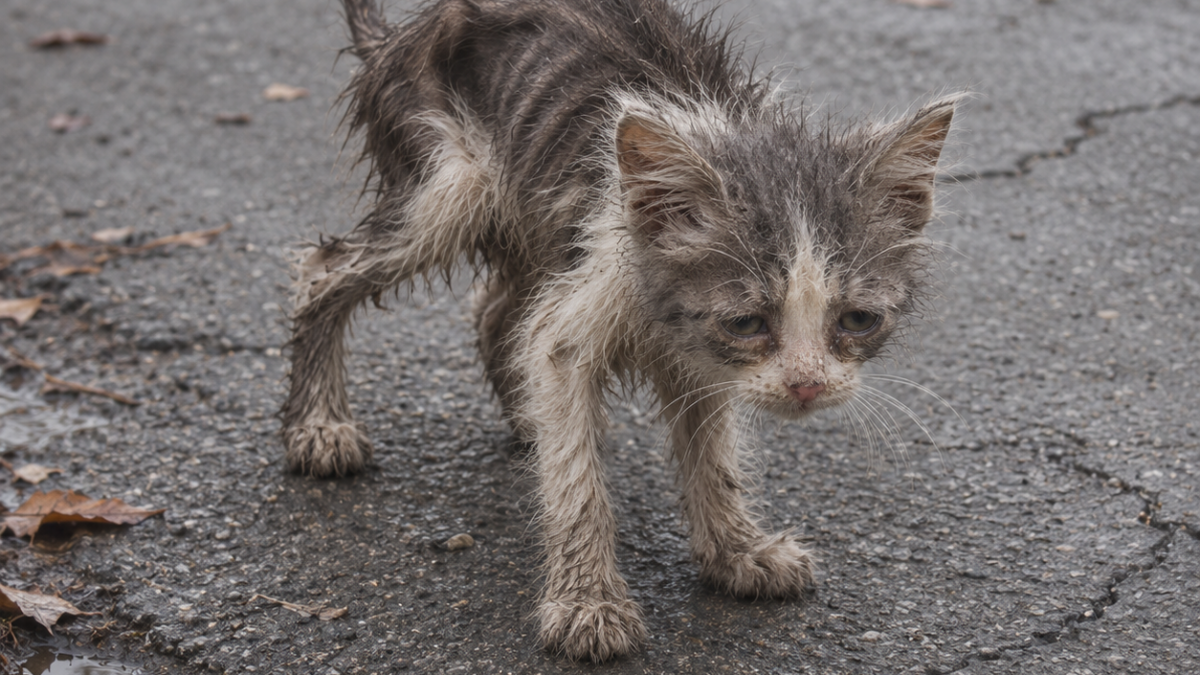
PART 2
When I came back with the carrier, the sky was already beginning to darken.
I had lined the bottom with an old towel and placed another soft blanket inside. I also brought a small dish of chicken because by then I had learned something about the little cat.
Food was the only reason he was willing to move.
He was sitting beneath the same tree.
For four days, I had been telling myself I was “helping a stray.”
That evening, I finally admitted the truth.
I was delaying the obvious.
He needed more than food.
He needed a doctor.
He needed warmth.
He needed somewhere safe enough to sleep without spending every ounce of energy simply trying to survive until morning.
I set the carrier down.
The cat watched it suspiciously.
“I know,” I said. “It looks terrible.”
His ears twitched.
“But sleeping outside is worse.”
I placed the chicken just inside the carrier door.
He smelled it.
Then stared at me.
I moved farther away.
“Your decision.”
He took one step.
Stopped.
Another.
His legs trembled.
He sat down.
For almost a minute, he remained there staring at the food.
Then hunger won.
He dragged himself forward.
He put his front paws inside the carrier.
I held my breath.
One more step.
Then another.
The moment his body was fully inside, I closed the door gently.
He didn’t fight.
That scared me.
A healthy frightened cat might have thrown himself against the carrier.
This cat simply turned around once and collapsed onto the towel.
“Okay,” I whispered.
“You’re coming with me.”
I had already called a nearby veterinary hospital and warned them I was bringing in a severely emaciated stray.
When I arrived, a technician took one look through the carrier door and immediately disappeared into the back.
Within a minute, two people returned.
“How long have you had him?” one asked.
“I don’t. I found him in the park.”
“How long has he been like this?”
“I’ve been feeding him for four days. I don’t know what happened before that.”
They carried him into an examination room.
I followed.
The technician placed him on the scale.
I remember staring at the number.
It seemed impossible.
He weighed less than half of what an adult cat his frame should have weighed.
Dr. Ellis, the veterinarian, ran her hands gently along his body.
She could feel everything.
Spine.
Ribs.
Hip bones.
Shoulders.
There was no protective layer of fat.
Hardly any muscle.
“What age do you think?” I asked.
“Maybe three or four years.”
I blinked.
“He looks older.”
“Starvation ages the face.”
She checked his eyes.
“There’s an upper respiratory infection. Possibly conjunctivitis too.”
She opened his mouth carefully.
His gums were pale.
Several teeth were in poor condition.
When she placed a small piece of hard kibble in front of him, he tried to chew, stopped, and let it fall from his mouth.
“That explains some of it,” she said.
“What?”
“He’s too weak to handle hard food comfortably. There may also be mouth pain.”
I thought about all the chicken I had been bringing.
“Was I feeding him the wrong thing?”
“No. The chicken probably helped keep him alive.”
I felt something loosen in my chest.
“Is he going to make it?”
Dr. Ellis didn’t answer immediately.
Instead, she listened to his heart.
Then his lungs.
“He’s severely malnourished and dehydrated. We need bloodwork. We need to rule out kidney disease, liver disease, diabetes, viral infection, parasites, and a few other things.”
She looked directly at me.
“But he is eating.”
“That’s good?”
“Very.”
The cat sat on the examination table as though the conversation had nothing to do with him.
His head slowly lowered.
Then he simply lay down.
I touched one finger to his forehead.
He didn’t move away.
“Does he have a chip?”
“We’ll check.”
The scanner passed over his shoulders.
Nothing.
Again.
Nothing.
“No microchip.”
I looked at him.
“So nobody knows who he is.”
“Not from a chip.”
“What happens to him now?”
Dr. Ellis glanced toward me.
“That depends.”
“On what?”
“Are you surrendering him to a rescue?”
I hadn’t thought that far ahead.
“I just didn’t want him to die in the park.”
“That’s how it starts.”
There was a small smile in her voice.
I looked down.
The cat had placed one weak paw against my sleeve.
The gesture was accidental.
Probably.
Still, I couldn’t move.
“Can he stay here tonight?”
“Yes.”
“Then keep him.”
“For hospitalization?”
“Whatever he needs.”
The words came out before I thought about the cost.
Dr. Ellis gave me a cautious look.
“We’ll give you an estimate.”
“I said whatever he needs.”
I went home alone that night.
The apartment felt strange.
I had known the cat for four days.
He had never been inside my home.
Yet somehow the place already felt emptier because he wasn’t there.
I opened my phone and stared at a photograph I had taken in the park.
He was beneath the tree, eating chicken from a white plastic bowl.
His cheeks looked hollow.
His eyes looked tired.
I wondered how many people had walked past him.
Not because they were cruel.
People are busy.
People look at phones.
People assume someone else will help.
Maybe he had hidden whenever crowds appeared.
Maybe I had simply been there at the right moment.
I didn’t know.
What I did know was that I hadn’t done anything heroic.
I had noticed.
Sometimes that is the beginning of everything.
The hospital called at seven the next morning.
I answered so fast I nearly dropped the phone.
“Is he alive?”
The technician laughed softly.
“Good morning to you too.”
“Sorry.”
“He’s alive.”
I sat down.
“How is he?”
“Hungry.”
I smiled for the first time that morning.
“That’s my guy.”
“We offered him a soft recovery diet. He ate about half.”
“What did the bloodwork show?”
“Dr. Ellis will explain everything when you come in, but there are signs consistent with prolonged malnutrition and dehydration. Nothing immediately indicates terminal organ failure.”
I closed my eyes.
“Okay.”
“We also treated him for parasites and started medication for the eye and respiratory infection.”
“Can I see him?”
“Yes.”
I arrived forty minutes later.
The little cat was sitting inside a hospital cage.
A soft towel had been placed beneath him.
There was food in one bowl and water in another.
His eyes were cleaner.
Not good.
Just cleaner.
When I approached, he looked up.
Then something happened that surprised me.
He stood.
His legs wobbled.
He walked to the front of the cage.
And pressed his forehead against the bars.
I opened the small door.
He leaned into my hand.
Dr. Ellis came in behind me.
“Well.”
“What?”
“He hasn’t done that with us.”
I scratched beneath his chin.
“Maybe he knows who brings the chicken.”
“Could be.”
The cat started purring.
It was barely audible.
A weak little vibration.
But it was there.
Dr. Ellis smiled.
“That’s encouraging.”
I looked at him.
“You need a name.”
I tried several.
Nothing felt right.
Then I remembered something my grandmother used to say about fortune changing suddenly.
Good fortune sometimes arrives late, she would tell me, but when it arrives, you hold onto it.
The name came to me almost immediately.
“Fubo.”
Dr. Ellis raised an eyebrow.
“Fubo?”
“It means something like good fortune to me.”
The cat looked up.
I repeated it.
“Fubo.”
His crooked, exhausted little face turned toward my voice.
“That’s it.”
Dr. Ellis smiled.
“Fubo it is.”
He stayed at the hospital two more nights.
The biggest danger was not simply feeding him as much as possible.
His body had been deprived for too long.
Nutrition had to be restored carefully.
Small meals.
Frequently.
Monitored hydration.
Medication.
Bloodwork.
Rest.
When Dr. Ellis finally said he could come home, I felt more nervous than excited.
“What if I mess something up?”
“You won’t.”
“How do you know?”
“Because you’ve asked me that question six times.”
She handed me written instructions.
Medication twice a day.
Soft meals in controlled portions.
Eye cleaning.
Monitoring stool.
Watching for vomiting.
Watching his breathing.
Checking his energy.
Follow-up appointment.
“If anything worries you, call.”
“Everything worries me.”
“Then you’re going to call a lot.”
She wasn’t wrong.
My first evening with Fubo began with an argument over medicine.
“Open your mouth.”
Fubo turned his head.
“Come on.”
He turned farther.
“You’re acting pretty strong for a cat who couldn’t walk five days ago.”
He looked at me.
I tried mixing the medicine with food.
He ate around it.
I stared at the bowl.
“How?”
He licked his lips.
I eventually learned to hide it properly in a tiny amount of something he loved.
After each meal, I cleaned the corners of his mouth with a damp towel.
At first he hated it.
He would pull away weakly.
“Two seconds.”
He glared at me.
“One.”
I wiped gently.
“Done.”
After several days, he stopped fighting.
Then something even stranger happened.
He began waiting for it.
Eat.
Drink.
Sit beside me.
Face wiped.
Nap.
Routine made him calm.
I placed three beds around the apartment because I didn’t know where he would prefer sleeping.
He ignored two.
The third was beside my desk.
That became his place.
For the first week, he barely explored.
Bedroom to kitchen.
Kitchen to bed.
Bed to food.
That was his whole world.
But every day, he stayed awake a little longer.
One afternoon, I dropped a pen.
Fubo lifted his head.
That small response excited me.
Two days later, he followed the pen with his eyes.
A week later, he reached out and tapped it.
I laughed.
“There you are.”
He blinked.
“The cat was in there somewhere.”
His cheeks were still sunken.
His spine still showed.
But the numbers on the scale began moving.
Slowly.
A few ounces.
Then more.
I photographed him every week.
Not for social media.
For myself.
Week one: skeleton.
Week two: still painfully thin.
Week three: face beginning to soften.
Week four: ribs less obvious.
Week five: a hint of roundness returning to his cheeks.
The first time Dr. Ellis saw him after that change, she stopped in the doorway.
“Look at you.”
Fubo stood on the examination table.
He still walked with an uneven, hesitant gait.
But he stood.
He didn’t collapse.
Dr. Ellis pressed gently along his abdomen.
“He’s gained almost two pounds.”
“Is that good?”
“It’s excellent.”
“Too fast?”
“No. We’re monitoring him.”
Fubo rubbed his face against my wrist.
Dr. Ellis smiled.
“He likes you.”
“I feed him.”
“That’s not the only reason.”
I pretended not to hear that.
Because I still hadn’t said the word.
Adoption.
I had told myself I was fostering him.
Temporarily.
Until he became strong enough.
Until a rescue found a home.
Until somebody with more experience took over.
Then one evening I came home late.
Fubo was sleeping in his bed.
The second I opened the door, his head came up.
He stood.
Walked toward me.
Still slightly unsteady.
Then sat directly on my foot.
I looked down.
“That’s inconvenient.”
He leaned against my leg.
I put my bag down.
“You know you’re supposed to become adoptable and leave, right?”
Fubo looked up.
“That’s how this works.”
He began purring.
“You don’t care.”
Louder purring.
I sat on the floor.
Fubo climbed into my lap.
He had never done that before.
He turned around twice.
Then curled himself against my stomach.
I stopped speaking.
His body felt warmer now.
Heavier.
Not heavy.
But no longer frighteningly light.
I rested one hand against his side.
His breathing was slow.
Calm.
That was the night I realized I was lying to myself.
Fubo wasn’t waiting for another home.
He had already decided this was it.
I just hadn’t caught up.
The adoption paperwork was completed the following week.
I brought the form to Dr. Ellis during his checkup.
“Official?” she asked.
“Official.”
She looked at Fubo.
“Congratulations.”
I laughed.
“I think he adopted me first.”
“That’s usually how cats do it.”
For several months, life became almost boring.
And I loved it.
Medicine.
Meals.
Weight checks.
Quiet evenings.
Fubo learned the sound of the refrigerator.
He learned that chicken sometimes came from it.
He learned that if he sat directly behind my feet while I cooked, I would nearly trip over him.
He continued doing it anyway.
His fur improved.
At first it was dull and coarse.
Then it became softer.
The real surprise was the color.
Under all the dirt and poor condition, Fubo wasn’t gray-brown at all.
His coat was pale cream with warm golden patches along his back and head.
His tail darkened toward the tip.
When sunlight hit him, he looked almost completely different from the cat I had found.
His cheeks filled out.
People noticed immediately.
A neighbor who had seen him during the first week visited two months later.
“That’s not the same cat.”
“It is.”
“No.”
I showed her the photographs.
She put one hand over her mouth.
“Oh my God.”
Fubo walked over and sniffed her shoe.
“He looks round.”
“Don’t say that where he can hear.”
He was still thinner than ideal.
But compared with where he started, he looked transformed.
His legs remained the slowest part of recovery.
Months of starvation had stripped away muscle.
He would walk normally for a short distance, then wobble.
The veterinarian believed time and nutrition would help.
So we worked on it carefully.
Short movements.
No forcing.
I moved his food bowl a little farther away.
Placed beds in different rooms.
Encouraged him to follow me.
Eventually he began climbing onto the couch.
The first time, he failed.
He jumped.
His front paws reached the cushion.
His back legs didn’t.
He slid to the floor.
I reached toward him.
Fubo immediately tried again.
“Okay.”
Second attempt.
He made it.
Then he sat on the couch as though nothing unusual had happened.
I applauded.
Fubo stared at me.
“Yes, I’m embarrassing.”
He turned his back.
That became his personality.
Quiet.
Stubborn.
Affectionate only when he chose.
He wanted to stay close to me, but not always on me.
If I worked, he slept nearby.
If I went to the kitchen, he followed.
If I showered, he waited outside.
If I closed a door, he objected.
Loudly.
The cat who once barely had enough energy to cry had developed opinions about interior access.
Then, three months after I brought him home, I received a phone call that changed the quiet rhythm of our lives.
It was Dr. Ellis.
“Do you remember when we checked Fubo for a microchip?”
“Yes.”
“We didn’t find one.”
“Right.”
“Animal control contacted us today.”
I sat up.
“Why?”
“Someone reported seeing your missing-cat notice from the week you found him.”
I frowned.
I had posted photographs in neighborhood groups when I first rescued him.
Not because I wanted someone to take him back automatically.
Because I needed to know whether he belonged to anyone.
Nobody had responded.
“What did they say?”
“Apparently a park employee remembers seeing a man leave a cat near that path several days before you found Fubo.”
My stomach tightened.
“Leave?”
“That’s what they’re investigating.”
“Like feeding him?”
“No.”
The way she said it made me cold.
“A man carried a pet carrier from a vehicle. The employee assumed he was letting a cat out on a leash.”
“But?”
“He drove away.”
I stood.
“Did they get a license plate?”
“Partial.”
I looked toward the living room.
Fubo was asleep in the sun.
His body was curled into a soft circle.
“What does this mean?”
“At the moment? Nothing certain.”
“Does someone think he was dumped?”
“Yes.”
I didn’t know why that possibility hurt more than imagining he’d always been a stray.
Maybe because a stray animal has never necessarily known security.
But an abandoned animal did.
Someone had once closed a door behind Fubo.
Someone had transported him somewhere unfamiliar.
Set him down.
Driven away.
And Fubo had stayed near that same path.
Waiting.
Suddenly everything made horrible sense.
Why he hadn’t left.
Why he returned beneath the same tree every day.
Why food alone never made him move on.
He hadn’t chosen the park as territory.
He had been left there.
And maybe some part of him believed the person who left would come back.
That night, I sat beside his bed.
Fubo woke.
He stretched one paw toward me.
I touched it gently.
“You waited for them, didn’t you?”
He blinked.
I felt anger rise.
It wasn’t explosive.
It was colder.
The kind that sits deep in your chest.
“You almost died waiting.”
Fubo pushed his forehead into my palm.
I promised myself something then.
If animal control found the person who had abandoned him, I wanted consequences.
Not violence.
Not revenge in the way anger fantasizes about revenge.
I wanted that person to understand that Fubo had not disappeared.
He had survived.
And somebody had noticed.
The investigation moved slowly.
The park had only a few cameras, and most did not cover the path where Fubo had been found.
But one camera near the parking entrance had captured a dark sedan.
The park employee remembered the approximate time.
Animal control reviewed footage.
The vehicle entered.
Twelve minutes later, it left.
The employee described a man carrying a hard-sided animal carrier.
No carrier was found near Fubo.
That suggested the man had taken it back with him after releasing the cat.
The partial plate narrowed the possibilities.
Then one of my original online posts received a private message.
**Where did you get that cat?**
I stared at the screen.
The account belonged to a woman named Hannah.
I replied carefully.
**I found him in the park several months ago. Why?**
Three dots appeared.
Stopped.
Appeared again.
Then a photograph arrived.
I opened it.
My stomach dropped.
Fubo.
Healthy.
Round cheeks.
Clean cream fur.
Sitting on a kitchen counter.
The photograph was dated almost a year earlier.
I called animal control before answering anything else.
Officer Martinez had been assigned to the abandonment report.
“Don’t accuse her,” he told me.
“I’m not going to.”
“Ask where she knows him from.”
I typed.
**Is this your cat?**
Her response came quickly.
**He was my brother’s. His name was Sunny.**
I looked across the room.
Fubo was eating.
Sunny.
He had another name.
Another life.
Another home.
Hannah called me.
Her voice shook.
“My brother told me the cat ran away.”
“When?”
“Months ago.”
“From where?”
“His apartment.”
“Near the park?”
“No. Almost eight miles away.”
I closed my eyes.
“What’s your brother’s name?”
She gave it to me.
Jason Miller.
The vehicle registered to Jason was a dark sedan.
The plate matched the partial numbers captured by the park camera.
My anger became very still.
Hannah continued.
“Is he okay?”
“Now?”
I looked at Fubo.
“Yes.”
“What happened?”
I told her only the basic facts.
Found severely malnourished.
Barely walking.
Eye infection.
Unable to chew hard food.
Veterinary treatment.
Months of recovery.
When I finished, Hannah was crying.
“I knew something was wrong.”
“What do you mean?”
“My brother kept complaining about him.”
“About Fubo?”
“Sunny.”
I hesitated.
“His name is Fubo now.”
She was quiet.
“Okay.”
Then she explained.
Jason had adopted the cat from a friend roughly two years earlier.
At first, everything seemed fine.
Then Jason changed jobs.
Started traveling more.
Sunny developed a respiratory infection.
Then dental problems.
Vet bills appeared.
Jason began complaining.
“He kept saying the cat cost too much.”
I gripped the phone tighter.
“Did he take him to the vet?”
“Sometimes.”
“Did he feed him?”
“I thought so.”
Hannah began crying harder.
“I didn’t know he was starving.”
I believed her.
At least at first.
She sent more photographs.
Fubo sleeping on a sofa.
Fubo looking out a window.
Fubo beside a Christmas tree.
He had been loved once.
Or at least treated like someone wanted him.
Then the photos changed.
Later pictures showed him thinner.
His fur duller.
In one image, his cheeks had already begun sinking.
“What happened here?”
Hannah hesitated.
“Jason said Sunny was getting picky.”
“Picky?”
“Wouldn’t eat dry food.”
My jaw tightened.
He couldn’t chew it.
Even at the hospital, hard food hurt him.
“He needed medical care.”
“I know that now.”
“Did your brother?”
She didn’t answer.
That was answer enough.
Officer Martinez interviewed Hannah separately.
She provided messages.
One, sent by Jason two weeks before Fubo appeared in the park, said:
**I’m done spending money on this cat.**
Another:
**If he won’t eat what’s in the bowl that’s his problem.**
Then:
**I’m not paying another vet bill.**
And finally:
**I’m getting rid of him this weekend.**
I read that last one several times.
Getting rid of him.
Fubo had lived in Jason’s home.
Slept on his furniture.
Looked out his windows.
Probably followed him through rooms the way he followed me.
Then illness made him inconvenient.
And suddenly he became something to “get rid of.”
I wanted to call Jason.
Martinez stopped me.
“Don’t.”
“Why?”
“Because there’s nothing useful you can say.”
“I can think of plenty.”
“Useful.”
I hated how calm he was.
“Fine.”
“Let us handle it.”
The evidence kept building.
The park employee identified Jason from a photo lineup as the man he believed he’d seen carrying the carrier.
The vehicle matched.
The messages showed intent to remove the cat.
Hannah confirmed Fubo’s identity through distinctive markings and old veterinary records.
Those records were worse than I expected.
Fubo—then Sunny—had been diagnosed with dental inflammation and recurring respiratory problems.
A veterinarian had recommended treatment.
Jason had declined part of it due to cost.
There had been a follow-up appointment.
He never attended.
For months after that, there were no veterinary records.
Then the park.
Officer Martinez called me.
“We’re issuing citations and referring the more serious neglect elements for review.”
“Is abandonment enough?”
“It’s evidence.”
“He was nearly dead.”
“I know.”
“Nearly dead.”
“I know.”
I looked at Fubo.
He was asleep in the soft bed beside my chair.
“Can Jason claim him?”
“No.”
I turned sharply.
“You’re sure?”
“Based on the documentation and the abandonment finding, he would have a very difficult time. But more importantly, you completed the proper stray-hold and adoption process months ago.”
Relief hit me so hard I had to sit down.
“He can’t take him.”
“No.”
That should have ended it.
It didn’t.
Because two days later, Jason came to my apartment.
I don’t know how he found the address.
Maybe Hannah gave it to him accidentally.
Maybe someone online recognized my building.
Maybe he followed information from the neighborhood group.
I opened the door because I was expecting a package.
A man stood in the hallway.
Mid-thirties.
Dark jacket.
Short hair.
He looked at me.
Then past me.
Fubo was sitting in the living room.
The man froze.
“So that’s him.”
Every instinct in my body told me exactly who I was looking at.
“Jason?”
He folded his arms.
“His name is Sunny.”
Fubo heard the voice.
His body changed.
It happened instantly.
His ears flattened.
His back lowered.
He backed away.
Not curiosity.
Fear.
I stepped into the hallway and pulled the door almost closed behind me.
“You need to leave.”
“That’s my cat.”
“No.”
“I raised him for two years.”
“You abandoned him in a park.”
His jaw tightened.
“He got out.”
“Animal control has video.”
“He got out of the carrier.”
“You drove away.”
“I looked for him.”
“For twelve minutes?”
His eyes narrowed.
“You think you’re some kind of hero?”
“No.”
“Then give me my cat.”
I actually laughed.
Not because it was funny.
Because the demand was so absurd.
“You left him when he was too weak to walk.”
“He wasn’t like that when I left him.”
That sentence told me everything.
Not **I didn’t leave him.**
Not **You’re wrong.**
He wasn’t like that when I left him.
I stared.
“You just admitted it.”
His expression changed.
“I didn’t say—”
“You left him.”
“He was sick. I couldn’t afford it.”
“So you dumped him?”
“I thought someone would find him.”
“Someone did.”
I stepped closer.
“And do you know what I found?”
He looked away.
“A cat who collapsed after three steps.”
Silence.
“A cat whose body had eaten almost all its own muscle.”
“Stop.”
“His eyes were infected.”
“I said stop.”
“He couldn’t chew.”
Jason raised his voice.
“I couldn’t afford thousands of dollars for a cat!”
Fubo disappeared into the bedroom.
That made my anger sharper.
“You had other options.”
“What options?”
“Rescue groups. Shelters. Surrender. Asking for help. Calling a veterinarian. Asking your sister.”
“You don’t know my situation.”
“You’re right.”
I lowered my voice.
“But I know his.”
Jason pointed toward my door.
“I want him back.”
“No.”
“He looks healthy now.”
There it was.
The sentence that almost made me lose control.
He looked healthy now.
Now that somebody else had paid the bills.
Now that somebody else had administered medicine twice every day.
Now that somebody else had wiped his mouth after meals.
Now that somebody else had watched him wobble across the floor.
Now that somebody else had spent nights wondering whether his body would recover.
Now Jason wanted the finished version.
I opened the door just enough to step inside.
“Leave.”
“I can call the police.”
“Please do.”
He hesitated.
That surprised him.
I continued.
“Tell them you’re the man animal control is investigating for abandoning him.”
Jason stared.
I took out my phone.
“Actually, I’ll help.”
He turned and walked toward the stairs.
Before he left, he looked back.
“This isn’t over.”
I held up my phone.
“You’re right.”
I called Officer Martinez.
The hallway confrontation was documented.
So was Jason’s statement that Fubo “wasn’t like that when I left him.”
His own words.
His own mistake.
Animal cruelty investigations rarely end like movies.
There was no dramatic courtroom confession.
No huge prison sentence.
No crowd applauding.
There was paperwork.
Veterinary records.
Photographs.
Statements.
Evidence.
Jason was formally cited and charged under applicable neglect and abandonment provisions.
He accepted a negotiated resolution rather than taking every allegation through trial.
He paid fines.
He was ordered to reimburse part of the veterinary costs that had been documented during the investigation.
He faced restrictions related to animal ownership for the period required by the court.
And he permanently lost any claim he imagined he still had to Fubo.
Was it enough?
Some days, I thought no.
I had seen Fubo fall.
Jason hadn’t.
I had watched him chew food slowly because even eating hurt.
Jason had not sat beside him while he shook from weakness.
A fine could not equal that.
Money could not equal it.
But revenge was not the reason I had carried Fubo into the veterinary hospital.
And eventually I understood something.
Jason’s punishment was only a footnote.
Fubo’s recovery was the story.
The first real sign that Fubo had become a different cat came one rainy morning.
I was preparing breakfast.
I heard a crash in the living room.
Then another.
“Fubo?”
Silence.
I walked in.
He was standing on the coffee table.
A plant lay on the floor.
Soil everywhere.
Fubo looked at me.
I looked at Fubo.
“What happened?”
He blinked.
“You were in the park dying six months ago, and this is how you repay me?”
Fubo stepped over the empty pot.
I laughed.
I couldn’t help it.
The cat who once barely moved now had enough strength to destroy furniture.
“You’re grounded.”
He jumped off the table.
Not gracefully.
But successfully.
That mattered more than the plant.
His muscles continued strengthening.
The wobble became less noticeable.
Eventually, most strangers couldn’t see it at all.
Only I noticed when he became tired.
Then he would slow.
I kept beds everywhere.
Living room.
Bedroom.
Beside my desk.
One beneath the window.
Fubo rotated between them according to rules I never understood.
His favorite was still the original soft bed beside my desk.
Sometimes he slept so deeply that his paws twitched.
I wondered what cats dream about.
Food?
Birds?
Warm rooms?
Do they dream about the bad things too?
One night Fubo woke suddenly.
He cried out.
I was beside him immediately.
“Hey.”
His eyes were wide.
He looked around.
Then saw me.
His body relaxed.
I sat on the floor.
“You’re home.”
He crawled out of the bed.
Then climbed into my lap.
He hadn’t done that in weeks.
I wrapped both arms around him.
“Whatever you were dreaming about, it isn’t happening again.”
He pressed his face against my chest.
For the next hour, I didn’t move.
The weight of a healthy cat on your legs becomes uncomfortable after a while.
I never complained.
There had been a time when Fubo didn’t have enough weight to make anything uncomfortable.
A year after I found him, Dr. Ellis compared his original chart with his current examination.
“Do you want to know his weight?”
“Yes.”
She told me.
I smiled.
“Is he fat?”
“No.”
“Be honest.”
“He’s healthy.”
Fubo sat on the examination table looking deeply offended.
His cheeks were completely filled out now.
His coat was thick.
His chest had broadened.
He no longer looked like a sick elderly cat.
He looked his actual age.
Maybe five.
Strong.
Bright-eyed.
Beautiful.
Dr. Ellis pulled up his first photograph.
I hated that photograph.
Fubo lying under the park tree.
Hollow face.
Dirty fur.
Eyes crusted.
Then she placed a recent picture beside it.
I stared.
“I don’t even recognize him.”
“I do.”
She pointed.
“The eyes.”
She was right.
His body had changed.
His eyes had not.
Same shape.
Same gold-green color.
But something inside them was different.
In the old photograph, they looked exhausted.
Waiting.
Now they looked curious.
Demanding.
Alive.
“Good fortune,” Dr. Ellis said.
“What?”
“You named him Fubo.”
I smiled.
“Yeah.”
“Looks like it worked.”
I shook my head.
“No.”
I scratched Fubo behind the ear.
“He was the good fortune.”
That wasn’t sentimentality.
My life had changed.
Before Fubo, I came home to a quiet apartment.
I worked too much.
Ate dinner too late.
Spent evenings scrolling through things I didn’t care about.
I told myself I liked the independence.
Then Fubo arrived.
Suddenly somebody expected breakfast at exactly the same time every morning.
Somebody objected when I worked too late.
Somebody sat beside the door when I came home.
Somebody followed me into the kitchen.
Somebody needed me.
At first, I thought that responsibility would feel heavy.
It didn’t.
It gave shape to my days.
Fubo recovered enough to play.
That was another milestone.
I bought expensive toys.
He ignored most of them.
His favorite thing was a paper ball.
I threw it.
He chased.
Not fast.
But faster every week.
Sometimes he brought it back.
Sometimes he sat beside it and stared at me, expecting me to understand the new location was now my problem.
One evening, he sprinted across the living room.
Actually sprinted.
I stood frozen.
Fubo reached the hallway.
Turned.
Ran back.
Then did it again.
Zoomies.
I called Mara, one of the rescue volunteers who had helped me arrange his initial follow-up care.
“He’s running.”
“What?”
“Fubo is running.”
She laughed.
“Cats do that.”
“Not this one.”
She became quiet.
“Oh.”
“He’s running.”
I heard emotion in her voice.
“Send me a video.”
I did.
She replied with one sentence.
**That’s what winning looks like.**
I saved the message.
Because she was right.
For months, I had imagined justice as Jason being punished.
But this was justice too.
Fubo running.
Fubo gaining weight.
Fubo complaining about breakfast.
Fubo sleeping without keeping one eye open.
Fubo choosing softness because he no longer had to choose survival.
Then something happened that gave me a different kind of closure.
Hannah asked to visit.
Jason’s sister.
I hesitated.
Part of me didn’t want anyone from Fubo’s old life near him.
But Hannah had cooperated fully with investigators.
She had provided the photographs and messages that helped establish what happened.
She had cried when she learned how close Fubo came to dying.
So I agreed.
She arrived carrying nothing.
No treats.
No toys.
“I didn’t want to make him come near me.”
That told me she understood.
I opened the door.
Fubo was on the couch.
He saw her.
His ears moved.
Hannah froze.
“Sunny.”
I looked at her.
She immediately corrected herself.
“Fubo.”
The cat watched.
For several seconds, nothing happened.
Then he stood.
Slowly.
He sniffed the air.
Hannah began crying.
“He remembers me.”
Maybe.
Maybe not.
I didn’t claim to know.
Fubo walked toward the edge of the couch.
Hannah sat on the floor.
She didn’t reach.
“I used to feed him when Jason traveled,” she said.
Fubo jumped down.
He approached.
Sniffed her knee.
Then her hand.
Hannah covered her mouth with the other hand.
“I’m sorry.”
Fubo rubbed his cheek against her fingers.
That broke her.
She cried openly.
“I’m so sorry I didn’t know.”
I sat nearby.
“You helped when you found out.”
“I should’ve checked earlier.”
“Maybe.”
She looked at me, surprised by the answer.
I wasn’t going to tell her guilt was meaningless.
Sometimes we should have done more.
Sometimes recognizing that changes what we do next.
“But you gave animal control the messages,” I said. “You told the truth.”
She looked at Fubo.
“My brother still says everyone overreacted.”
I felt anger flicker.
Then disappear.
“That’s his problem.”
“He says you stole his cat.”
“Also his problem.”
Hannah almost laughed.
Fubo climbed partly into her lap.
She stroked his back.
“He looks good.”
“He is.”
“Happy?”
I watched him.
“Very.”
She nodded.
Then whispered, “Good.”
That visit lasted twenty minutes.
When Hannah left, Fubo did not follow her.
He walked back to his bed.
Curled into it.
And slept.
I realized then that the past no longer had the same hold over him that it had over me.
I was the one still carrying anger.
Fubo was busy living.
So I tried to learn from him.
I stopped checking the status of Jason’s case once every week.
Stopped reading old messages.
Stopped imagining things I would say if I saw him.
The best revenge wasn’t thinking about him forever.
The best revenge was letting him become irrelevant.
Two years passed.
Fubo became known in our building.
The neighbor downstairs called him “Mr. Round Face.”
The first time she said it, I laughed.
Round face.
The exact opposite of the hollow-cheeked animal I had found.
She often sat in the hallway with grocery bags.
If Fubo slipped outside my door, he would walk over and inspect them.
“Nothing for you,” she told him.
Fubo disagreed.
Another neighbor had a young daughter named Lily.
Fubo adored her.
Or tolerated her with unusual generosity, which for a cat is almost the same thing.
Lily would sit on my floor and read books aloud.
Fubo lay beside her.
Once she asked me, “Why does he walk funny when he’s tired?”
I explained that he had been very sick and weak when I found him.
“Did it hurt?”
“Probably.”
“Was he scared?”
“Yes.”
She looked at Fubo.
“Who helped him?”
“A lot of people.”
“You?”
“I started.”
She thought about that.
Then she said, “He picked you.”
I smiled.
“Something like that.”
Fubo stretched out beside her.
Lily rubbed his head.
“He picked good.”
I had to look away for a second.
The years became quieter after that.
There were no investigations.
No confrontations.
No dramatic calls.
Just life.
And ordinary life turned out to be the most beautiful part.
Fubo developed habits.
He woke me at 5:48 every morning.
Not 5:45.
Not six.
5:48.
I never understood how.
If I ignored him, he touched my face with one paw.
No claws.
Just pressure.
If that failed, claws became negotiable.
He drank water only from a wide ceramic bowl despite owning a perfectly good fountain.
He loved chicken.
Hated salmon.
Would eat tuna only if it was not the tuna I specifically purchased for him.
He sat beside the bathroom door.
He stole warm laundry.
He feared the vacuum cleaner but enjoyed watching it from a safe elevated position.
He discovered cardboard boxes.
I spent money on beds.
Fubo slept in shipping containers.
Every time I looked at him curled inside a box, belly round, paws tucked beneath him, I thought about the park.
The contrast never completely disappeared.
Sometimes it still hurt.
But slowly, the memory changed.
It stopped being the first thing I thought when I looked at him.
That felt important.
Fubo became Fubo.
Not “the starving cat.”
Not “the abandoned cat.”
Just Fubo.
My cat.
The one who yelled at birds.
The one who stole my chair.
The one who refused medication with the strategic intelligence of a military commander.
The one who sat beside me when I was sick.
The one who somehow knew when I was having a terrible day.
Once, after I lost my job unexpectedly, I spent most of an afternoon sitting on the floor beside the couch.
I didn’t cry.
I didn’t do much of anything.
Fubo came over.
He sat beside me.
Then climbed into my lap.
He hadn’t done that regularly for years.
He stayed for almost two hours.
At one point I laughed.
“What are you doing?”
He purred.
“You think I’m dying?”
Louder purring.
“Fair.”
I rested my head against the couch.
“You remember when you couldn’t walk?”
Fubo slept.
“I guess we’ll figure this out too.”
That night, I understood another part of rescue.
At first, you believe the relationship is one-directional.
You save the animal.
You feed them.
Treat them.
Carry them.
Pay bills.
Protect them.
Then years pass.
And one day, when you’re the one who can’t move forward, they sit beside you.
Maybe that’s why we call it rescue even when it’s impossible to say who rescued whom.
Fubo turned eight.
Then nine.
He stayed healthy for most of those years.
His weak gait never disappeared completely.
As he aged, arthritis appeared earlier than Dr. Ellis would have liked.
We managed it.
Medication.
Supplements.
Weight control.
Steps beside the bed.
A ramp near the couch.
Fubo hated the ramp for three months.
Then suddenly decided it had always been his idea.
His jumps became smaller.
His naps became longer.
His cheeks remained beautifully round.
Every annual checkup, I asked the same question.
“Too fat?”
Dr. Ellis answered the same way.
“Healthy.”
“You’re protecting his feelings.”
“He has excellent feelings.”
Fubo purred on the examination table.
“Traitor.”
When he was ten, something unexpected happened.
Officer Martinez contacted me.
I hadn’t spoken to him in years.
“I thought you might want to know.”
My stomach tightened.
“What?”
“Jason applied to adopt a dog from a local shelter.”
I said nothing.
“The application was flagged because of his prior case.”
“And?”
“Denied.”
I leaned against the kitchen counter.
Fubo was eating dinner.
“Why are you telling me?”
Martinez paused.
“Because you asked me years ago whether consequences actually mattered.”
I remembered.
“And?”
“They did.”
I looked at Fubo.
Jason had once complained that taking care of a sick animal cost too much.
Then abandoned one when care became inconvenient.
Years later, the record of that choice still followed him.
Not revenge.
Accountability.
I felt something close to satisfaction.
Then Fubo finished eating and began licking the bowl.
I laughed.
“Thanks for telling me.”
“How’s he doing?”
“Round.”
Martinez laughed.
“Good.”
After the call, I sat beside Fubo.
“Apparently your old owner can’t get another dog.”
Fubo washed one paw.
“Strong reaction.”
He continued grooming.
“You don’t care at all, do you?”
Nothing.
That was perfect.
Fubo didn’t need revenge.
I did.
And even I needed it less than I once had.
His life had become too full to leave much room for the person who abandoned him.
When Fubo was eleven, Dr. Ellis retired.
Her final week at the clinic, I brought him in.
She walked into the room.
“Fubo.”
He raised his head.
She sat beside him.
“You outlasted me.”
I laughed.
“He plans to outlast everyone.”
She ran her fingers over his face.
“Look at these cheeks.”
“I know.”
She became emotional.
“I remember when there was nothing here.”
Her fingers gently touched beneath his jaw.
“Just bone.”
Fubo leaned into her hand.
Dr. Ellis wiped her eyes.
“You were supposed to be temporary.”
I nodded.
“We all make mistakes.”
She laughed.
Then looked at me.
“You did good.”
I shook my head.
“He did most of it.”
“No.”
Her expression became serious.
“He did the surviving. You gave him somewhere safe enough to do it.”
That sentence stayed with me.
Safety.
For years, I thought food had been the first thing Fubo needed.
It wasn’t.
Food mattered.
Medicine mattered.
Veterinary care mattered.
But safety changed everything.
An animal can eat and still be terrified.
Can gain weight and still expect abandonment.
Fubo needed to learn that meals would continue tomorrow.
That the bed would still be there.
That the door closing did not mean he had been left forever.
That a hand reaching toward him carried a damp towel or affection, not harm.
That if he became sick again, I would not decide he was too expensive.
He learned.
Slowly.
So slowly that I didn’t notice the exact day it happened.
But one morning I realized Fubo had stopped watching me leave.
During the first year, every time I picked up my keys, he followed me to the door.
He sat there when I left.
Often, when I returned, he was still near the entrance.
Waiting.
Later, he still followed.
But eventually, one morning, I grabbed my keys.
Fubo opened one eye from the couch.
I said, “I’m going to work.”
He closed the eye.
Didn’t move.
I laughed.
“Excuse me?”
Nothing.
“You used to care.”
Fubo slept.
At first, I felt insulted.
Then I understood.
He wasn’t afraid anymore.
He knew I was coming back.
That was trust.
Real trust is boring.
It doesn’t stare at the door.
It goes back to sleep.
At twelve, Fubo’s kidneys began showing early signs of age-related decline.
Nothing severe.
Diet adjustment.
More monitoring.
Medication.
I followed every instruction.
Of course I did.
One evening, while preparing his medication, I remembered the message Jason had sent years earlier.
**I’m not paying another vet bill.**
I looked at Fubo.
Old now.
White around the muzzle.
Waiting for his soft dinner.
I couldn’t understand that sentence.
Not anymore.
Maybe I never had.
Caring for an animal costs money.
Time.
Sleep.
Convenience.
Sometimes it changes your plans.
Sometimes it hurts.
But those obligations aren’t unexpected accidents.
They are the contract.
Not one written on paper.
The real one.
You depend on me.
I don’t leave when dependence becomes difficult.
Fubo took the medicine.
Then spat it onto the floor.
I stared.
He stared.
“Beautiful emotional moment ruined.”
He licked his nose.
I gave him the medication again.
This time he swallowed.
When Fubo was thirteen, his body began slowing more seriously.
His appetite became inconsistent.
Some mornings, he ate everything.
Other mornings, I had to sit beside him and offer tiny bites.
The old weakness in his back legs became more visible.
I added more rugs so he wouldn’t slip.
Moved his bed closer to the food.
Raised the bowls.
The person who had once walked meals into the park for him was once again arranging life around whether he could eat.
But this time, he wasn’t alone beneath a tree.
He had me.
One rainy afternoon, Fubo stood near the window.
He watched water run down the glass.
I sat beside him.
“Do you remember outside?”
His ear moved.
“Probably not.”
I hoped not.
I had never taken him back to that park.
Some people might call that avoidance.
Maybe.
But Fubo had nothing to prove there.
He had survived it.
That was enough.
Then, several months later, the city announced plans to renovate the park.
The path where I had found Fubo would be rebuilt.
New benches.
Lighting.
Trees.
The old sick tree he’d rested beneath was going to be removed.
I surprised myself by feeling sad.
I drove there alone.
I found the spot.
It looked smaller than I remembered.
Of course it did.
Fear makes places enormous.
I stood beneath the tree.
Thirteen years earlier, a cat had collapsed there.
I had placed a white bowl beside him.
He had eaten chicken.
Then crawled into the shade.
At the time, I thought I was giving him one meal.
I had no idea I was meeting family.
I put one hand against the tree trunk.
“Thanks.”
Ridiculous thing to say to a tree.
I said it anyway.
The renovation workers removed it a week later.
The new park opened in spring.
Near the path, there was a bench.
I made a small donation to the renovation fund and requested a plaque.
Nothing dramatic.
Nothing about abandonment.
The plaque read:
**For Fubo — who taught me that stopping matters.**
That was enough.
When Fubo was nearly fourteen, his kidneys worsened.
We tried treatment.
Fluids.
Medication.
Diet.
Good days.
Bad days.
Then fewer good days.
One evening, he walked toward his bed.
His back legs gave way.
The sound of his body gently hitting the rug sent me backward through time.
The park.
Three trembling steps.
Collapse.
I ran to him.
“Fubo.”
He looked up.
Older.
Tired.
But calm.
I lifted him.
He weighed more than he had when I found him, but less than in his healthiest years.
I carried him to the bed.
He rested his head against my arm.
I knew.
Not that night.
But soon.
The next morning, I called the veterinarian.
Not Dr. Ellis.
She had retired years earlier.
But she had given me her personal email.
I wrote one sentence.
**I think we’re getting close.**
She replied within twenty minutes.
**Then give him the same thing you gave him the first time: don’t make him do it alone.**
I cried.
For two weeks, Fubo still had moments.
Sunlight by the window.
Chicken.
Purring.
One surprisingly determined attempt to steal food from my plate.
I laughed so hard I scared him.
“Still a criminal.”
He blinked.
But his body was tired.
One morning, he refused chicken.
That was when I knew.
I called the clinic.
The veterinarian came to my home that evening.
I placed Fubo in the original soft bed beside my desk.
The bed had been replaced twice over the years, but I always bought the same kind.
He curled into it.
I dampened a towel.
Without thinking, I wiped the corner of his mouth.
The same way I had after those first meals.
Fubo closed his eyes.
He had stopped resisting that gesture thirteen years ago.
I sat beside him.
The veterinarian explained everything.
I barely heard.
My hand rested on Fubo’s side.
“I found you here because you couldn’t walk,” I whispered.
His ear moved slightly.
“Well, not here.”
I laughed through tears.
“Under a tree.”
His breathing was slow.
“Remember chicken?”
Nothing.
“That got your attention.”
I pressed my forehead gently against his.
“Everyone thinks I saved you.”
My voice broke.
“You made that difficult.”
His paw moved.
It touched my wrist.
Maybe reflex.
Maybe something more.
I chose to believe the second.
“You don’t have to keep fighting just because I don’t want to say goodbye.”
The veterinarian waited.
There was no rush.
That mattered.
Fubo had spent too much of his life being controlled by someone else’s convenience.
His last moments would belong entirely to him.
I gave the signal.
The first medication relaxed him.
His body softened.
The tension left his legs.
I kept talking.
“You have a home.”
My tears fell into his fur.
“You have a name.”
He breathed.
“You have me.”
Another breath.
“And I’m right here.”
The final medication went in.
Fubo’s breathing slowed.
One breath.
Another.
Then quiet.
The veterinarian listened to his heart.
She looked at me.
“I’m sorry.”
I nodded.
I didn’t move my hand.
For a long time, I sat beside him.
My apartment was silent.
Not the same silence as before Fubo.
This silence had weight.
Fourteen years of routines were suddenly gone.
No footsteps.
No food bowls.
No cat beside the desk.
No 5:48 wake-up.
I looked at his face.
His cheeks were still round.
That mattered to me more than I could explain.
The cat I had found had hollow cheeks.
The last version of Fubo I would see looked loved.
Fed.
Soft.
Safe.
I kissed his forehead.
“Good fortune.”
That was what I had named him.
But sitting there, I realized again that the name had always been backwards.
He had been mine.
A month later, I visited the renovated park.
I sat on Fubo’s bench.
Children ran along the path.
A man walked two dogs.
Someone ate lunch under a tree.
Life continued with the irritating confidence life always has.
I touched the small plaque.
**For Fubo — who taught me that stopping matters.**
A woman sitting at the other end of the bench read it.
“Who’s Fubo?”
I smiled.
“A cat.”
“Yours?”
“Yes.”
She nodded.
“Must’ve been special.”
I looked at the path.
“He was starving right there when I found him.”
She turned.
“Really?”
I told her a short version.
Not Jason.
Not the investigation.
Not the anger.
Just Fubo.
The trembling.
The food.
The carrier.
The vet.
The round cheeks.
The home.
When I finished, she looked at the plaque again.
“Stopping matters.”
“Yeah.”
She smiled.
“That’s true.”
A few weeks later, the rescue organization that had helped with some of Fubo’s early care asked permission to create a small emergency fund in his name.
I said yes.
The first animal it helped was a senior cat whose owner couldn’t afford dental surgery.
I laughed when I heard.
Dental surgery.
Of course.
Fubo, who had once been too weak and sore to chew properly, was helping another cat eat.
Then another case.
A kitten with pneumonia.
A stray with an infected wound.
An elderly dog requiring blood tests.
The fund wasn’t huge.
It didn’t need to be.
Each time somebody stopped instead of walking past, it mattered.
Hannah donated every year.
We stayed in occasional contact.
Jason never contacted me again.
Years earlier, I would have wanted a more dramatic ending for him.
Public humiliation.
A bigger punishment.
A moment where he fully understood what he had done.
But life rarely gives perfect scenes.
People do not always become remorseful simply because consequences arrive.
Maybe Jason regretted abandoning Fubo.
Maybe he regretted only being caught.
I never found out.
Eventually, I stopped caring.
Because Jason’s role in Fubo’s life lasted one chapter.
Mine lasted almost fourteen years.
That was the revenge.
He had treated Fubo as disposable.
Fubo became unforgettable.
He had refused veterinary care because Fubo cost too much.
Other people later donated money in Fubo’s name to pay veterinary bills for animals they had never met.
He had abandoned Fubo because caring for him was inconvenient.
Fubo spent the rest of his life surrounded by people who rearranged their schedules simply to keep him comfortable.
Jason drove away believing the problem was no longer his.
But the cat he discarded became the center of someone else’s home.
There was no punishment more satisfying than making his cruelty irrelevant.
Sometimes I still wake around 5:48.
My body expects a paw against my face.
For a second, I forget.
Then I remember.
The room stays quiet.
On my desk is a framed photograph.
Not Fubo starving in the park.
I don’t display that one.
The photograph was taken when he was about seven.
He’s sitting in the window.
His fur is bright in the afternoon sun.
His body is round.
His cheeks are full.
His eyes are focused on a bird outside.
He looks completely ordinary.
That’s why it’s my favorite.
Because ordinary was the miracle.
Fubo did not need to become famous.
He didn’t need a heroic final act.
He didn’t need to prove anything.
He simply needed the life that almost disappeared beneath that tree.
Breakfast.
Soft beds.
Medicine when he was sick.
Chicken.
Warm windows.
Someone coming home every night.
Someone staying when he became expensive.
Someone carrying him when his legs grew weak.
Someone beside him at the end.
People often say rescue animals know they’ve been saved.
I don’t know whether that’s true.
I think Fubo understood something simpler.
At first, he knew hunger.
Then he knew food.
He knew cold.
Then warmth.
He knew waiting.
Then somebody came back.
He knew abandonment.
Then one day he realized the door always opened again.
The transformation wasn’t dramatic from his perspective.
It happened meal by meal.
Night by night.
Year by year.
Until the terrified, starving cat in the park became a round little old man who believed beds, medicine, chicken, and companionship were simply the natural order of the universe.
And maybe that’s the greatest thing I ever gave him.
Not rescue.
Expectation.
He learned to expect kindness.
The last time I sat on his park bench, autumn had arrived again.
Leaves moved across the path.
For a moment, I could almost see him there.
Thin.
Dirty.
Trying to walk.
Three steps.
Collapse.
I remembered the first words I had spoken.
“Hey.”
Such a small word.
I hadn’t known that saying it would change both our lives.
I looked at the place where the old tree once stood.
If I had kept walking that afternoon, maybe somebody else would have stopped.
I hope so.
But I will never know.
What I do know is that I stopped.
Then I came back.
Then I came back again.
And eventually I stopped leaving without him.
That was Fubo’s whole story, really.
Not revenge.
Not tragedy.
Someone finally stayed.
The cat who once collapsed alone on a park path spent nearly fourteen years falling asleep beside someone who loved him.
His cheeks filled out.
His body became round.
His legs grew strong enough to run.
Then old enough to need carrying again.
And when they finally failed him for the last time, he wasn’t lying outside wondering whether anyone would notice.
He was home.
His head was in my hand.
His soft bed was beneath him.
And the person who had promised not to walk away was still there.
Fubo had waited beneath that tree for somebody to come back.
In the end, he never had to wait again.








