PART 2: A Rottweiler Cried Behind an Empty House for Seven Days—Everyone Heard Him, but Nobody Crossed the Fence Until I Did
PART 2
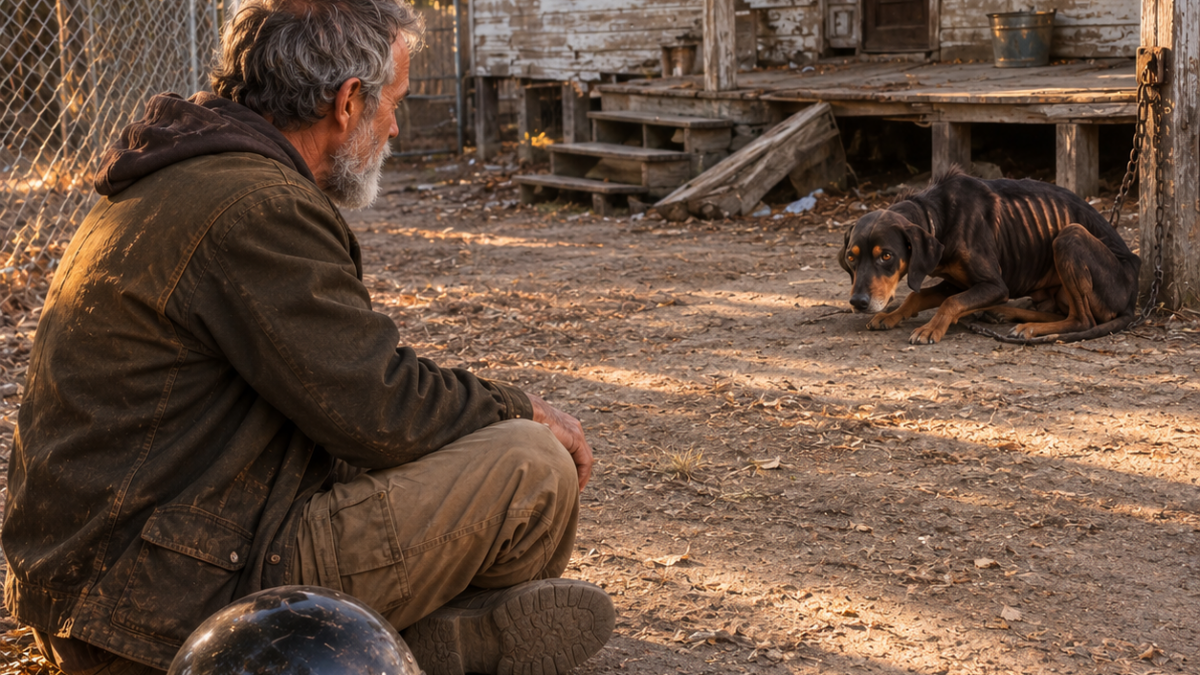
His head weighed almost nothing in my palm.
That bothered me.
A Rottweiler’s head should feel solid, heavy, almost ridiculous compared with the rest of the body. This one felt like bone covered by warm skin and coarse fur.
I kept my hand still.
“Okay.”
His eyes stayed half closed.
“No more crawling, old man.”
A truck engine sounded beyond the road.
He immediately lifted his head.
For one second, I thought he might stand.
Instead his body went rigid.
The vehicle stopped.
A sheriff’s cruiser.
Behind it, a white animal-control truck.
The dog tried to drag himself backward.
“Easy.”
I shifted between him and the gate.
“They’re with me.”
I don’t know why I said that.
They weren’t.
But I wanted him to hear the word *with*.
Not *for*.
Not *after*.
With.
Deputy Luis Martinez entered first. Maybe forty, calm face, no unnecessary movements.
Behind him came an animal-control officer named Beth Dugan carrying a catch pole and transport stretcher.
The moment the Rottweiler saw the pole, he made a sound I hadn’t heard before.
A growl.
Not strong.
But terrified.
Beth stopped instantly.
“All right.”
She lowered it.
“No pole.”
I liked her immediately.
She crouched.
“How long have you been with him?”
“Three hours.”
“Did he eat?”
“A few bites.”
“Water?”
“Some.”
“Can he stand?”
“Not that I’ve seen.”
She looked at his gums.
Then his eyes.
Her expression tightened.
“He needs a vet tonight.”
“That’s what I told dispatch.”
“I know.”
She gave me a tired look.
“I’m sorry.”
That surprised me.
“You’re here.”
“Yes.”
“Then save the apology for somebody who isn’t.”
She smiled faintly.
Deputy Martinez walked toward the house.
“Anyone live here?”
“Doesn’t look like it.”
“Property record says somebody owns it.”
“Who?”
“I’ll check.”
Beth unfolded the stretcher.
The dog panicked the moment we tried moving it beneath him.
He snapped once.
Not at us.
At air.
Then tried to crawl toward me.
Beth looked at me.
“He knows you.”
“For three hours.”
“Sometimes three hours is enough.”
She handed me a towel.
“Cover his eyes gently. Talk to him.”
I did.
“Hey, old man.”
His breathing was fast.
“You’re going for a ride.”
The words made me laugh despite everything.
“You’re going to hate mine if you think this truck is bad.”
We lifted him.
He cried once.
My stomach turned.
Then he went still.
Beth said:
“You coming?”
“To the vet?”
“Yes.”
I looked at my Harley outside the fence.
“Try stopping me.”
—
The emergency clinic was thirty-five minutes away.
I followed the animal-control truck the entire distance.
At every light I could see the old dog’s shape through the small rear window.
At the clinic, three people met us outside.
They carried him in.
Then doors closed.
That was the first moment since I climbed the fence that I had nothing to do.
I hated it.
I sat in the waiting room wearing dusty boots and a leather vest that smelled like heat and gasoline.
Beth sat across from me.
Deputy Martinez had stayed behind to check the property.
“What are you calling him?” Beth asked.
“I’m not.”
“You’ve been calling him something.”
“Old man.”
She smiled.
“Can’t put that on paperwork.”
“Why not?”
“Because one day somebody will call him in a cheerful waiting room and six elderly gentlemen will stand up.”
Fair.
I looked toward the treatment-room door.
“He probably already has a name.”
“Maybe.”
“Chip?”
“They’ll scan.”
I nodded.
“What happens if he has an owner?”
Beth’s expression changed slightly.
“Depends.”
“On?”
“Whether we find them.”
“And whether they’re the ones who did this?”
“That too.”
I leaned back.
I had already decided I hated a person I didn’t know.
That is dangerous.
Sometimes justified.
Still dangerous.
Then the veterinarian came out.
Dr. Sarah Coleman.
Young compared with me.
Everyone is.
She held a clipboard.
“He’s stable.”
I exhaled.
“How stable?”
“Better question.”
She sat across from me.
“Severely dehydrated. Malnourished. Significant muscle wasting. Pressure sores. His kidney values are elevated, but that may improve with hydration. We found evidence of arthritis, especially hips and spine.”
“Age?”
“Probably ten or eleven.”
“Anything else?”
Her face tightened.
“His neck.”
“What?”
“There are old scars around it.”
“Chain?”
“Possibly.”
“Recent?”
“No.”
She paused.
“He also has abrasions on his front paws consistent with repeatedly scratching or digging at something.”
The gate.
The porch.
A door.
Trying to reach somewhere.
I swallowed.
“Can he recover?”
“Yes.”
That answer came faster.
“Not guaranteed, but yes.”
“Good.”
“There’s another thing.”
“What?”
“He has a microchip.”
Beth leaned forward.
“Registered?”
Dr. Coleman nodded.
“Name is Mack.”
I looked toward the treatment-room door.
“Mack.”
Somehow it fit.
“Owner?”
Dr. Coleman looked at Beth.
“Henry Lawson.”
“Address?”
She read it.
Same house.
The abandoned house.
I felt cold despite the air conditioning.
“So his owner lives there?”
“Registration says he did.”
I looked at Beth.
“Did.”
—
Deputy Martinez called twenty minutes later.
Beth put him on speaker.
“House is empty.”
“For how long?”
“Neighbor says at least six weeks.”
My jaw tightened.
“Six weeks?”
Martinez continued.
“Electricity disconnected. No running water. Mailbox full.”
“Where’s Henry Lawson?”
“Don’t know yet.”
A woman across the road, Nora Jenkins, told Martinez that Henry was an elderly widower who had lived there for thirty years.
Mack was his dog.
She remembered them walking together every evening.
Then an ambulance came one morning in late spring.
Henry never returned.
A younger man arrived afterward.
Loaded boxes.
Moved furniture.
Came and went for a couple weeks.
Then vanished.
“What younger man?” I asked.
“Neighbor thinks nephew.”
“Name?”
“She doesn’t know.”
“What about Mack?”
Martinez paused.
“She says Mack remained in the yard.”
My anger rose.
“Did she feed him?”
“Sometimes.”
“Sometimes?”
Beth looked at me sharply.
I ignored her.
“People heard this dog crying for a week.”
Martinez said:
“I know.”
“Then why—”
“Sir.”
His voice stayed calm.
“We’re going to figure that out.”
I stopped.
Because he was right.
Anger needed direction.
Not targets chosen too early.
Still, I said:
“Figure it out fast.”
—
Mack stayed at the clinic for five days.
I visited every one.
The first morning, he didn’t lift his head when I entered.
Then I said:
“Hey, old man.”
His tail moved.
One inch.
I nearly embarrassed myself crying in front of Dr. Coleman.
By day two, Mack ate boiled chicken from my hand.
Day three, he stood.
Only for four seconds.
His back legs trembled.
Then he sat.
I applauded like a fool.
Mack looked embarrassed.
“You did four seconds.”
He stared.
“Don’t get arrogant.”
Day four, we walked ten feet.
Day five, almost thirty.
That afternoon Beth called.
“We found Henry.”
I stopped walking.
Mack stopped with me.
“Alive?”
“Yes.”
That one word hit harder than I expected.
“Where?”
“A rehabilitation and nursing facility in Tyler.”
“Why didn’t he come home?”
“Stroke.”
I looked at Mack.
He was sniffing a patch of grass beside the clinic.
“Does Henry know about him?”
Silence.
Then Beth said:
“He thinks Mack is dead.”
—
Henry Lawson was eighty-one.
The stroke had affected his left side and his speech, but his mind was sharp.
Beth arranged the visit.
I asked if I could come.
She looked at me.
“You realize you’re not officially part of this case?”
“Yes.”
“And you intend to behave as if you are.”
“Yes.”
She sighed.
“Fine.”
We did not bring Mack.
Not yet.
First we needed answers.
Henry sat in a wheelchair beside a window overlooking a courtyard.
His silver hair was carefully combed. One hand rested uselessly against his leg.
When Beth introduced herself and said we wanted to ask about his dog, Henry’s whole face changed.
“Mack?”
The word came slowly.
“Yes,” Beth said.
Henry looked down.
“He died.”
My stomach tightened.
“Who told you?”
Henry struggled with the answer.
“Caleb.”
“Who’s Caleb?”
“Nephew.”
There it was.
Beth leaned closer.
“What did Caleb tell you?”
Henry’s right hand gripped the wheelchair arm.
“House.”
He swallowed.
“Mack… got loose.”
Another breath.
“Truck hit.”
His eyes filled.
“No body.”
“Did you ask to see him?”
Henry nodded.
“Caleb said… bad.”
His mouth twisted.
“Wouldn’t let me.”
I looked at Beth.
She stayed professional.
“Mr. Lawson, I need to tell you something.”
Henry stared.
“Mack is alive.”
The old man didn’t react.
Not at first.
Then his face emptied completely.
“What?”
“He’s alive.”
Henry’s hand began shaking.
“No.”
“Yes.”
“No.”
He looked at me.
I stepped forward.
“I found him at your house.”
Henry’s eyes filled instantly.
“House?”
“In the yard.”
He made a broken sound.
“How long?”
That question hurt.
“We’re still figuring that out.”
Henry looked toward the window.
Then back.
“Alive?”
“Yes.”
“Here?”
“Not here. Veterinary clinic.”
He closed his eyes.
Tears rolled down both cheeks.
“My boy.”
I had heard grown men cry before.
On highways.
At funerals.
In hospital rooms.
Something about an eighty-one-year-old man crying for an old Rottweiler made me look away.
Henry whispered:
“He waited.”
I didn’t answer.
Because yes.
He had.
—
Henry wanted to see Mack immediately.
The nursing facility agreed to an outdoor visit two days later.
Dr. Coleman worried the emotional excitement might be physically taxing for both dog and man.
Beth said:
“Which one?”
“Both.”
Fair.
We brought Mack in my pickup.
Not the Harley.
I owned one.
I just preferred pretending otherwise.
He wore a red harness because anything around his neck made him nervous.
When we arrived, Mack stepped out slowly.
He sniffed the air.
Then froze.
Henry was fifty feet away in his wheelchair.
He hadn’t spoken yet.
Mack stared.
His ears rose.
Henry said:
“Mack.”
Quiet.
Barely more than breath.
The old Rottweiler took one step.
Then another.
Then his body changed.
For the first time since I knew him, his tail lifted.
He began pulling me.
“Mack.”
Henry held out his good hand.
I dropped the leash.
Mack ran.
Not fast.
Not cleanly.
His hips were weak and his stride uneven.
But he ran.
Henry leaned forward.
Mack collided gently with his legs and tried to climb into the wheelchair.
Henry wrapped his arm around him.
“Oh, buddy.”
Mack whimpered.
Henry pressed his face against his head.
“I’m sorry.”
Mack licked his chin.
“I’m sorry.”
I stood ten yards away.
Beth beside me.
She wiped her eyes.
I pretended not to notice.
Henry kept saying:
“I didn’t leave.”
Again.
Again.
“I didn’t leave you.”
Mack didn’t need the sentence.
But Henry did.
—
We stayed almost an hour.
When it was time to go, Henry looked at me.
“You taking him?”
The words came slowly.
“Back to the clinic.”
“No.”
His expression sharpened.
“Home.”
I swallowed.
“Your home?”
Henry looked down.
He knew.
He couldn’t return.
The property had steps.
No accessible bathroom.
His doctors said he needed long-term care.
He looked at Mack.
Then at me.
“Your home.”
I froze.
“I—”
“You came.”
Three words.
I knew what he meant.
Everybody heard Mack.
I crossed the fence.
That did not automatically make me the right home.
“I ride motorcycles.”
Henry stared at me.
“So?”
“I’m seventy-two.”
He raised one eyebrow.
“So?”
“I live alone.”
Henry looked at Mack.
Then back at me.
“Not now.”
That shut me up.
—
I agreed to foster.
Only foster.
That distinction lasted about forty-eight hours.
Mack came home with me on a Wednesday afternoon.
My house sat on two acres outside Longview.
One story.
Fenced back lot.
Detached garage.
The place had been Helen’s and mine for twenty-six years.
After she died, I changed almost nothing.
Her mug remained in the cabinet.
Her gardening gloves in a drawer.
Her side of the closet mostly empty but not all the way.
Grief turns houses into museums if you let it.
Mack walked inside and stopped.
He sniffed.
Kitchen.
Hall.
Living room.
Then he found Helen’s old recliner.
He circled once.
Lay beside it.
I stared.
“Really?”
Tail moved once.
“Fine.”
That became his spot.
—
The first night was difficult.
Mack woke every hour.
Walked to the front door.
Whined.
Returned.
At two in the morning I opened it.
He went outside.
Walked to the driveway.
Looked toward the road.
I understood.
“You think Henry’s coming.”
Mack stared down the lane.
I sat on the porch step.
“He can’t.”
The dog sat beside me.
“He didn’t leave you.”
Mack looked toward the darkness.
“He didn’t know.”
I wondered how much of human language dogs understand.
Probably less than we want.
More than we assume.
Either way, I kept talking.
“He didn’t leave you.”
The dog leaned slightly against my knee.
We stayed there until almost three.
—
The investigation moved while Mack recovered.
Caleb Lawson was fifty-two.
Henry’s sister’s son.
He lived in Dallas.
Worked in residential contracting.
Had temporary power of attorney after Henry’s stroke.
That meant access to the house.
Bank account.
Bills.
Mack.
Beth called me.
“Caleb says he rehomed the dog.”
I laughed.
“Where?”
“He can’t remember the man’s last name.”
“Convenient.”
“He says a friend of a friend took him.”
“Then how did Mack end up locked in Henry’s yard?”
“He says maybe the dog escaped and returned.”
“From Dallas?”
“We don’t know where this supposed person lived.”
“Because he doesn’t exist.”
“Probably.”
“Can you prove it?”
“Not yet.”
That phrase became the soundtrack of the next several weeks.
Not yet.
—
The neighbors complicated everything.
I went back to Henry’s house with Beth.
Not officially as investigator.
As Mack’s foster and witness.
Nora Jenkins lived across the road.
Seventy-six.
Small woman.
Sharp eyes.
She looked ashamed before we even asked.
“You heard him?”
“Yes.”
“How long?”
She stared at the floor.
“About a week crying like that.”
“And before?”
“He barked some.”
“Did you feed him?”
“Once or twice.”
“Why not call sooner?”
“I thought somebody else had.”
That sentence.
Somebody else.
The same sentence I had told myself from my motorcycle.
I couldn’t condemn her without condemning myself.
She continued.
“Caleb came around after Henry went to rehab. Said Mack was mean.”
“He isn’t.”
“I know that now.”
“What did Caleb tell everyone?”
“That he had arrangements.”
“What arrangements?”
“Boarding place.”
“Did you see anyone take Mack?”
“No.”
“Did you see Caleb feed him?”
“First couple weeks.”
“Then?”
“He stopped coming.”
There it was.
“What happened to the water?”
Nora looked toward Henry’s yard.
“Outdoor faucet was on for a while.”
“Then?”
“City shut it off after the bill went unpaid.”
“And Mack?”
Her eyes filled.
“I put water over the fence twice.”
“Twice?”
She started crying.
“I know.”
I stopped.
Because shame had already reached her.
And because I had ridden away too.
The story’s ugliest truth was not that one man might have abandoned a dog.
It was that dozens of people heard suffering and distributed responsibility until nobody felt individually required to act.
That included me.
—
A man named Dennis Price lived two houses down.
He had something better than memory.
Security cameras.
One aimed partly toward Henry’s road.
We reviewed footage.
Caleb’s truck appeared regularly during the first three weeks after Henry’s stroke.
Then less.
Then not at all.
But one video mattered.
Caleb backed into Henry’s driveway late at night.
Mack appeared in the yard.
Caleb opened the rear door of the truck.
Took out a bag of dog food.
Then placed something near the back fence.
A chain.
Even from distance we could see him secure Mack.
My jaw clenched.
“He chained him.”
Beth paused the video.
“Looks like it.”
“Why?”
“Keep watching.”
Caleb entered the house.
Loaded boxes.
Furniture.
Tools.
Then came back outside.
Mack tried to approach.
Caleb kicked toward him.
Not clearly making contact.
But enough to make Mack recoil.
Then Caleb left.
The chain remained.
The next morning footage showed Mack digging.
Pulling.
Twisting.
Hours later, he got loose.
That explained the scars on his neck.
He had freed himself.
But the fence kept him inside the property.
For weeks.
The house was empty.
Henry gone.
Caleb gone.
Mack remained.
Waiting.
—
Then Henry’s attorney found something.
Her name was Rebecca Sloan.
She had handled Henry’s will and finances for years.
When Henry recovered enough cognitively to review accounts, she noticed withdrawals.
Not huge at first.
Then repeated.
Caleb had used Henry’s debit card for building supplies.
Restaurant charges.
Gas.
Storage fees.
Some legitimate.
Many not.
More interestingly, he had submitted invoices from a business called **Pine Hollow Canine Care**.
Boarding.
Veterinary transportation.
Medication.
Food.
For Mack.
The invoices totaled more than eight thousand dollars.
I stared at the copies.
“He charged Henry for boarding Mack while Mack starved in the yard?”
Rebecca’s expression stayed professional.
“That appears possible.”
“Possible?”
“I’m an attorney.”
“Right.”
Beth tapped the business address.
“Pine Hollow.”
She searched.
No state registration.
No business license.
The phone number connected to a prepaid mobile.
The address belonged to a vacant storage unit.
Fake.
The invoices were fake.
The dog-care expenses were fake.
Caleb wasn’t merely neglecting Mack.
He appeared to be stealing from Henry using the dog as one of his excuses.
My anger became very calm.
That is the dangerous kind.
—
Mack’s health improved.
He gained eleven pounds in the first month.
Then another six.
His coat began to shine.
He learned my schedule.
Coffee at six.
Walk at six thirty.
Garage at seven.
If I rolled the Harley out, Mack appeared.
The first time I started it, he panicked.
He ran to the porch.
Trembling.
I killed the engine.
“Okay.”
I sat beside him.
“Too loud.”
His breathing slowed.
For three days, I didn’t ride.
That was unheard of.
Then we started slower.
Roll the bike out.
No engine.
Next day, engine for two seconds.
Treat.
Stop.
Again.
Eventually Mack tolerated the sound.
Then liked sitting nearby while I worked on it.
He never rode.
I’m not insane.
Mostly.
But he became part of every morning.
—
Henry called me from the nursing facility every Sunday.
His speech improved.
Not fully.
Enough.
First question always:
“Mack?”
I would turn the phone.
Mack knew Henry’s voice.
Tail.
Every time.
Henry smiled.
“You eating?”
Mack stared.
“He eats better than I do.”
Henry laughed.
“You riding?”
“Yes.”
“With dog?”
“No.”
Henry looked disappointed.
“You’re a bad influence.”
I liked him.
—
Then Caleb called me.
I don’t know how he got my number.
Probably public records.
“Are you the biker with my uncle’s dog?”
My grip tightened.
“Mack isn’t your dog.”
“He belongs to Henry.”
“Correct.”
“I have power of attorney.”
“Not anymore.”
Silence.
Rebecca had already filed to terminate his authority.
Caleb’s tone changed.
“Family matter.”
“You left that dog to starve.”
“I did not.”
“There’s video.”
Pause.
“Video of what?”
Wrong question.
He should have said no.
Instead he wanted to know what we had.
I smiled despite myself.
“Enough.”
“You don’t know what was going on.”
“Then explain.”
“My uncle was going into long-term care. The house had to be cleared. Dog was aggressive.”
“He put his head in my hand after three hours.”
“You didn’t know him before.”
“Neither did you, apparently.”
“Look, old man—”
I laughed.
“Careful. At seventy-two I find that accurate, not insulting.”
He hung up.
—
Two days later, Caleb came to my house.
That changed everything.
It was nearly eight at night.
I was in the garage.
Mack lay near the open door.
A truck rolled into the driveway.
Mack stood instantly.
His body went rigid.
Not barking.
Frozen.
Caleb stepped out.
I recognized him from the surveillance footage.
He walked toward the garage.
Mack backed away.
That told me more than any statement.
I stepped between them.
“You need to leave.”
Caleb held up both hands.
“I’m just here to get the dog.”
“No.”
“He belongs to my uncle.”
“Your uncle transferred temporary care to me through the rescue.”
“Temporary.”
“Yes.”
“So give him back.”
“To Henry?”
“Family.”
“Not a place.”
Caleb’s jaw tightened.
“Mack.”
The dog flinched.
Then Caleb whistled.
Mack backed into the garage.
I felt anger rise.
“What did you do to him?”
“Nothing.”
“Then why is he afraid of you?”
“He’s always been weird.”
I almost laughed.
The dog was afraid of one specific man and that man called the dog weird.
Classic.
Caleb stepped toward Mack.
I blocked him.
“I said leave.”
“You threatening me?”
“No.”
I looked at the security camera above the garage.
“I’m documenting you.”
His eyes followed mine.
He stopped.
Good.
I had installed cameras after Helen died because of break-ins in the area.
Best money I ever spent.
Caleb lowered his voice.
“You don’t understand my uncle.”
“What about him?”
“He wasted money.”
“His money.”
“On a dog. On that house. On everybody except family.”
There it was.
Resentment.
Not necessity.
“He gave you power of attorney because he trusted you.”
“He was senile.”
“No.”
“He had a stroke.”
“Not the same thing.”
Caleb looked toward Mack.
“He would’ve spent ten grand keeping that useless old animal alive.”
I felt something inside me go cold.
“Useless?”
Mack’s ears lowered.
Caleb continued.
“He’s old. Bad hips. What was I supposed to do?”
“Feed him.”
“You think that’s the whole problem?”
“Yes.”
At minimum.
“Yes.”
Caleb laughed.
“People like you get sentimental over animals.”
“People like you use sentiment as an insult when basic decency would be inconvenient.”
His face changed.
Then he said the sentence that buried him.
“I left enough food for a week.”
Silence.
He realized it.
I didn’t move.
“You left enough food for a week?”
“I didn’t mean—”
“How long did you expect Henry to be gone?”
He stared.
I continued.
“Six weeks?”
“No.”
“Two months?”
“Stop twisting my words.”
“You said you left enough food for a week.”
Mack growled.
Caleb pointed.
“See? Dangerous.”
I looked back.
Mack wasn’t looking at Caleb.
He was looking at me.
Worried.
I said:
“No.”
I turned toward him.
“You’re safe.”
Mack stopped growling.
Caleb laughed nervously.
“Crazy old man.”
Sheriff’s lights appeared at the end of my driveway.
His face changed.
I had called Deputy Martinez before stepping outside.
Caleb left without Mack.
He did not leave without providing investigators a very useful recording.
—
The next week, the judge formally removed Caleb from Henry’s financial authority.
A forensic accountant reviewed the accounts.
The eight thousand dollars in fake dog-care expenses became more than thirty thousand in questionable charges overall.
Building materials purchased for Caleb’s contracting jobs.
Personal insurance.
Travel.
Storage units.
Cash withdrawals.
The dog was not the whole fraud.
Mack was simply one of the lies.
Henry sat in the nursing facility while Rebecca explained the numbers.
His face stayed still.
Then he asked:
“Mack money?”
Rebecca nodded.
“Some.”
Henry looked at me.
“He starved him.”
“Yes.”
“And charged me?”
“Yes.”
Henry closed his eyes.
I expected anger.
Instead he said:
“My sister raised him better.”
Caleb’s mother had died years earlier.
That hurt Henry more than losing money.
Family betrayal usually does.
—
The county charged Caleb with animal cruelty and abandonment based on the evidence available, while financial investigators pursued exploitation and fraud allegations related to Henry’s accounts.
The house became part of a civil dispute.
Caleb argued he had spent money maintaining it.
Rebecca produced photographs.
Broken porch.
Overgrown yard.
Unpaid utilities.
Not impressive maintenance.
Then another witness came forward.
A contractor named Miles Reece.
He had helped Caleb clear Henry’s house.
Miles said Mack followed them constantly.
“He kept sitting by Henry’s bedroom.”
My chest tightened.
“What happened?”
“Caleb got angry.”
“Why?”
“Dog wouldn’t stay outside.”
“What did he do?”
“Kicked him once.”
“Where?”
“Side.”
“Hard?”
Miles looked ashamed.
“Hard enough I told him to stop.”
“Then?”
“He put Mack outside and chained him.”
That matched the video.
“Did you ask about food?”
“Caleb said someone would come.”
“Did they?”
“I don’t know.”
“Why didn’t you check?”
Miles looked at me.
“Same reason you rode away the first time, probably.”
That landed.
Hard.
I wanted to be angry.
Couldn’t.
Because he was right.
—
The local news found the story.
Of course.
Old Rottweiler.
Starvation.
Seventy-two-year-old biker climbs fence.
Elderly owner in nursing home.
Fraud investigation.
They had everything they needed.
One headline:
**72-YEAR-OLD BIKER SAVES STARVING ROTTWEILER AFTER NEIGHBORS HEARD DOG CRY FOR A WEEK**
I hated it.
Not because it was false.
Because it made me sound better than I was.
I had heard him too.
And ridden away.
During the interview, the reporter asked:
“Do you consider yourself a hero?”
“No.”
She looked surprised.
“Why not?”
“Heroes don’t wait three days because helping is inconvenient.”
The camera operator lowered his camera slightly.
I continued.
“I’m the guy who finally went back.”
That became the quote people shared.
Good.
Because the story was not about me being exceptional.
It was about how ordinary people excuse inaction.
And how ordinary people can decide to stop.
—
Donations arrived.
Food.
Beds.
Money for Mack’s care.
I refused personal money.
Second Chance Rescue created a neglect-response fund instead.
Beth called it the **Mack Fund**.
I complained.
“Dog doesn’t need a fund.”
“Other dogs do.”
“Then call it something else.”
“No.”
“Why?”
“Because you’re annoying.”
Fair.
The fund paid for emergency boarding when animals were discovered on abandoned properties and owners were hospitalized, jailed, or deceased.
That mattered more than a headline.
—
Caleb hated the publicity.
He posted online that I had trespassed.
True.
He said Mack was dangerous.
False.
He said Henry wanted the dog euthanized because of age.
Henry almost threw his phone when Rebecca showed him.
Then Henry did something I did not expect.
He agreed to a video interview.
Speech slow.
Left side weak.
But clear enough.
The reporter asked:
“Did you ever authorize anyone to euthanize Mack?”
Henry stared into the camera.
“No.”
“Did you ask your nephew to rehome him?”
“No.”
“What did you ask?”
Henry struggled.
Then said:
“Take care… of my boy.”
That clip spread everywhere.
Caleb deleted his posts.
Screenshots stayed.
The internet remembers better than people.
Sometimes too well.
That time, useful.
—
The criminal case took almost a year.
During that year, Mack became mine.
Officially.
Henry signed the adoption transfer after his doctors confirmed he would not be able to return to independent living.
I protested.
He told me:
“You love him.”
“Yes.”
“He loves you.”
I looked at Mack.
He was sleeping beside my chair.
“Probably tolerates me.”
Henry smiled.
“Same thing at your age.”
I laughed.
Then Henry became serious.
“Promise.”
“What?”
“Bring him.”
“Here?”
He nodded.
“Visit.”
“Of course.”
“And when…”
He stopped.
I knew.
“When you’re gone?”
Henry shook his head.
“When I am.”
My throat tightened.
“Henry.”
“Promise.”
“I promise.”
—
Mack settled into my life like he had always been there.
I started taking shorter rides.
At first I told myself it was because Texas heat was getting worse.
Lie.
I didn’t like leaving him long.
Eventually, I bought a used sidecar.
That is where the story got ridiculous.
No, I did not immediately put an old Rottweiler inside and drive down the highway.
We trained for months.
Stationary.
Engine off.
Treats.
Then engine on.
Then ten feet.
Driveway.
Around the property.
Mack hated the goggles I bought him.
So did I.
We compromised.
No goggles.
Slow local roads only.
Harness and secure restraint.
The first real ride was three miles.
Mack sat in the sidecar like a king who had accidentally been assigned a motorcycle gang.
People waved.
I laughed so hard my ribs hurt.
For the first time since Helen died, riding felt like I was going somewhere instead of away from somewhere.
That difference mattered.
—
Henry loved the sidecar.
I brought Mack to the nursing facility wearing a small red bandanna.
Henry saw us through the window and laughed until he coughed.
“You’re crazy.”
“Probably.”
“Mack?”
“Also.”
Mack climbed carefully beside his wheelchair.
Henry scratched his chest.
“Motorcycle dog.”
Tail.
“Your mother would hate this.”
I blinked.
“Whose mother?”
Henry looked confused.
“Dog.”
I laughed.
“Probably.”
Those visits became monthly.
Then twice monthly.
Sometimes Henry and I barely talked.
We sat outside.
Mack between us.
That was enough.
—
The trial came in late spring.
Caleb faced separate proceedings for financial exploitation and fraud, while the animal-cruelty case focused on what happened to Mack.
The prosecutor asked me to testify.
I hated the idea.
Did it anyway.
First question:
“Describe the condition in which you found Mack.”
I did.
Ribs.
Dehydration.
Weakness.
Unable to stand.
Empty water.
No food.
Then:
“Did you hear him before that day?”
“Yes.”
“When?”
“Three days earlier.”
“What did you do?”
I looked at the jury.
“Rode away.”
The prosecutor paused.
“Why?”
“Because I told myself somebody else had probably called.”
“Had they?”
“Not effectively.”
“What made you return?”
“Shame.”
The courtroom was quiet.
Caleb’s attorney probably liked that.
On cross-examination:
“You trespassed onto private property.”
“Yes.”
“You had no warrant.”
“No.”
“You are not a veterinarian.”
“No.”
“You had no knowledge of who was responsible for the dog.”
“Correct.”
“So when you called authorities claiming neglect, you were making assumptions.”
“No.”
He frowned.
“The dog was starving on an abandoned property with no water.”
I looked at him.
“That part didn’t require an assumption.”
—
Nora Jenkins testified.
She cried.
The defense asked:
“You fed the dog.”
“Twice.”
“So he was not without food.”
She looked ashamed.
“Not enough.”
“Others may have fed him.”
“Maybe.”
“So you cannot say Mr. Lawson’s nephew intentionally deprived him.”
“No.”
Then Nora looked toward Caleb.
“But I can say I heard that dog cry every night and kept believing somebody else would fix it.”
She swallowed.
“That’s my shame. It doesn’t make his actions better.”
That was powerful because she did not pretend innocence.
—
Miles testified about the chain.
Dennis provided video.
Dr. Coleman explained Mack’s condition.
The defense suggested an elderly dog could lose weight naturally.
Dr. Coleman remained calm.
“Not to that degree without underlying disease or calorie deprivation.”
“Did he have cancer?”
“No.”
“Severe kidney failure?”
“No.”
“Untreated diabetes?”
“No.”
“So?”
“He was starving.”
Simple.
The lawyer moved on.
—
The garage recording played.
My voice.
Caleb’s.
Then:
**I left enough food for a week.**
Silence.
The prosecutor asked Caleb later what he meant.
He claimed frustration.
Imprecise language.
He said he had arranged for someone to feed Mack after that.
“Who?”
He gave a first name.
No last name.
No number.
No record.
No witness.
Then the prosecutor showed security footage.
No visitor.
Days.
Weeks.
Nothing.
The only humans visible near the property were neighbors approaching the fence occasionally and delivery drivers turning around.
Caleb’s invisible caretaker apparently never arrived.
—
The financial case was worse for him.
Fake invoices.
Pine Hollow Canine Care.
The prosecution traced the prepaid phone number used on the invoices.
Activated by Caleb.
Storage address rented by Caleb.
Document metadata from a laptop recovered from his office.
Files named:
**Mack_boarding_March**
**Mack_vet_April**
**Mack_food_May**
Some invoice dates covered periods after Mack had already been rescued and was living with me.
That was almost insulting.
He billed Henry for Mack’s “premium senior boarding” while Mack was asleep beside my Harley.
The jury did not miss that.
—
Henry testified by video.
The prosecutor asked:
“Did you authorize Caleb Lawson to abandon Mack at your property?”
“No.”
“Did you believe Mack was being cared for?”
“Yes.”
“Why?”
“Caleb said.”
“Did you pay for care?”
Henry’s mouth tightened.
“Yes.”
“Would you have paid whatever was reasonably needed?”
“Yes.”
Then the prosecutor asked:
“What did Mack mean to you?”
Objection.
Relevance.
The judge allowed a limited answer.
Henry looked toward the camera.
“My wife… died.”
Long pause.
“Mack stayed.”
That was all.
I lowered my head.
No further explanation needed.
—
Caleb was convicted on multiple counts tied to financial exploitation and fraudulent documentation, along with the animal cruelty and abandonment findings supported by the evidence.
Not every accusation stuck.
Enough did.
At sentencing, Henry submitted a statement.
I didn’t know what it said until the prosecutor read it.
**My nephew did not steal money from me alone. He took advantage of the fact that I could not walk back through my own front door and see what was happening. I believed my dog was safe because family told me he was safe. Mack waited for me until his body almost failed. I cannot get those weeks back. I ask the court to make sure Caleb understands that helplessness is not permission.**
The room stayed silent.
Then I was asked if I wanted to speak.
I did.
I stood.
Looked at Caleb.
I had imagined this moment.
Imagined rage.
Imagined telling him exactly what I thought of a man who could leave an old dog in summer heat with one week of food.
Instead, I said:
“I rode past.”
Caleb looked confused.
“So did other people.”
I swallowed.
“That doesn’t excuse what you did.”
Pause.
“But I don’t want this story turned into one evil man and one good rescuer because that would let everyone else learn nothing.”
The judge watched.
“Mack cried for days.”
I continued.
“Somebody created the suffering. A whole lot of us allowed it to continue because we thought responsibility belonged to someone else.”
I looked at Caleb.
“You were responsible for leaving him.”
Then toward the courtroom.
“I was responsible for the day I heard him and kept riding.”
My voice tightened.
“The difference is I got another chance to turn around.”
I sat down.
—
Caleb received prison time on the financial offenses, supervision afterward, restitution obligations, and animal-ownership restrictions tied to the cruelty case.
Henry recovered part of the stolen money through restitution and civil proceedings.
Not all.
Money rarely returns cleanly.
The house was sold after the legal disputes ended.
A young family bought it.
Before closing, they asked if I wanted anything from the yard.
I said no.
Then changed my mind.
The old plastic bowl.
The empty one.
I took it home.
Not as a sentimental trophy.
As a reminder.
Empty bowls make no noise.
That was part of the problem.
Mack had to.
—
Henry died eleven months after the trial.
I knew it was coming.
He had another stroke.
Then pneumonia.
The nursing facility called me at six in the morning.
“He’s asking for Mack.”
I loaded the dog into the truck.
No sidecar.
Too cold.
We drove ninety minutes.
Henry was barely conscious.
His breathing rattled.
Mack entered the room.
Stopped.
Then walked straight to the bed.
Nurse lowered the rail.
Mack put his front paws against the mattress.
Henry’s eyes opened.
“Mack.”
The dog licked his hand.
Henry smiled.
Barely.
“Boy.”
Mack whined.
Henry looked at me.
“You came.”
“Yes.”
He tried to lift his hand.
Couldn’t.
I moved Mack closer.
Henry’s fingers touched his fur.
“Good.”
One breath.
“Home?”
I understood.
“He lives with me.”
Henry’s eyes moved toward Mack.
“Good home?”
My throat closed.
“Best I can give him.”
Henry smiled.
“Enough.”
He died that evening.
Not while we were there.
Maybe I’m glad.
Maybe not.
There’s no correct answer.
But he saw Mack.
Mack saw him.
The last lie Caleb told them was finally dead before Henry was.
That mattered.
—
For three days after Henry died, Mack waited near my front door.
That frightened me.
He ate.
Drank.
Walked.
But every evening, he lay facing the driveway.
I sat beside him.
“He’s not coming.”
Mack’s ears moved.
“I know you’ve heard that before.”
That hurt.
“You waited once.”
I touched his shoulder.
“You don’t have to do it again.”
The third night, Mack left the door.
Walked into the living room.
Lay beside Helen’s old chair.
I sat on the floor.
He put his head on my leg.
We stayed there.
Two widowers and one dog who had lost his person twice.
Not a cheerful group.
But a family.
—
Henry’s will surprised me.
He left most of what remained to his sister’s grandchildren and a local veterans organization.
A smaller amount went to Second Chance’s neglect-response fund.
Then Rebecca read one paragraph:
**To the man who climbed my fence when everyone else waited, I leave my motorcycle tools, because according to the nurses he has more motorcycles than judgment.**
I laughed so hard I cried.
Henry owned an old tool chest from his younger years.
Good tools.
Better than mine in some cases.
Inside one drawer, I found a photograph.
Henry at thirty.
Motorcycle.
Triumph.
Leather jacket.
I stared.
That old man had never mentioned he used to ride.
On the back:
**Some roads teach you where you are going. Others only teach you to turn around.**
I framed it.
—
Mack grew into retirement with me.
Or I grew further into retirement with him.
We rode short roads.
Sat outside diners where dogs were allowed.
Visited Second Chance.
Children loved him.
At first, adults feared him because of his size and breed.
Mack solved that by leaning against their legs until they had no choice but to pet him.
One little girl asked:
“Was he bad before?”
“No.”
“Why was he so skinny?”
“People failed him.”
She thought.
“Did he forgive them?”
Children ask dangerous questions.
I looked at Mack.
“I don’t think dogs use that word.”
“What word do they use?”
I smiled.
“Today.”
She accepted that.
Maybe she was wiser than me.
—
The Mack Fund grew.
Local businesses donated.
Bikers especially.
That part still makes me laugh.
A photo of Mack sitting beside my Harley circulated through riding groups.
Soon, riders from three counties organized an annual benefit ride for abandoned animals.
First year:
Thirty-seven motorcycles.
Second:
Eighty-two.
Third:
More than one hundred fifty.
Leather.
Chrome.
Tattoos.
Gray beards.
Dog food stacked higher than my truck bed.
Second Chance volunteers initially looked terrified.
Then they discovered middle-aged bikers cry easily around puppies.
Never tell them I said that.
At the end of every ride, I told Mack’s story.
Not Caleb’s.
Mack’s.
And I always included the part where I rode away.
People need that part.
Otherwise they think kindness belongs to a special category of people.
It doesn’t.
Sometimes kindness is just shame corrected in time.
—
One year, a rider named Big Mike came to me afterward.
Six foot five.
Arms like tree trunks.
He said:
“I heard a dog last month.”
My stomach tightened.
“What happened?”
“Neighbor’s backyard.”
“And?”
“I ignored it.”
He looked embarrassed.
“Then I heard your story.”
“What did you do?”
“Called welfare check.”
“And?”
“Owner was hospitalized. Dog had been alone two days.”
“Alive?”
“Yes.”
He smiled.
“Got him out.”
I looked at Mack.
“That’s why we tell it.”
Not because of inspiration.
Because stories change what people do next time.
That is useful.
—
Mack aged.
At thirteen, arthritis worsened.
At fourteen, hearing faded.
His muzzle turned almost entirely gray.
The vet called him “a senior gentleman.”
Mack farted in the exam room.
I said:
“Gentleman.”
Dr. Coleman laughed.
He developed a heart murmur.
Then kidney disease.
Nothing dramatic at first.
Medication.
Diet.
More water.
Shorter walks.
No more sidecar.
That one hurt me more than him.
The last time I rolled the Harley out for a ride without him, Mack stood on the porch.
I felt guilty.
Then he yawned.
Apparently he had retired before I admitted it.
—
I retired the bike more often too.
Not completely.
Never completely.
But I started understanding something.
For decades I thought freedom meant movement.
No schedule.
Open highway.
Anywhere but where I had been.
Helen understood that about me.
Sometimes tolerated it.
Sometimes hated it.
After she died, I rode farther.
Thought distance would thin grief.
It didn’t.
Mack did more for me by sleeping beside a chair than ten thousand highway miles had done.
Freedom isn’t always leaving.
Sometimes it is finally having somewhere you want to return to.
—
On the fifth anniversary of Mack’s rescue, we rode to Henry’s grave.
I took the truck.
Mack couldn’t climb into the sidecar anymore.
I brought the old empty bowl.
Don’t ask why.
At the cemetery, I sat beside Henry’s stone.
Mack lay in the grass.
I said:
“You’d hate what I did to your dog.”
No answer.
“Chicken twice a week.”
Mack lifted his head.
“Too many treats.”
Tail.
“Your fault.”
I placed the bowl beside the stone for a minute.
Then picked it up again.
Not leaving trash.
I said:
“He didn’t wait for you forever.”
My throat tightened.
“He learned.”
Mack put his head on my boot.
“So did I.”
—
Caleb eventually got out.
People asked how I felt.
Nothing dramatic.
He moved to another part of Texas.
Court records followed him.
His contracting business never fully recovered.
He paid restitution slowly.
Sometimes late.
I could have followed every update.
Didn’t.
I had already spent enough life thinking about people who were gone or people I wished had acted differently.
Caleb’s punishment mattered.
His future did not belong in my head.
That was Mack’s lesson too.
He never sat around hating Caleb.
Once he was safe, he got busy being alive.
Humans are slower learners.
—
Then, one summer afternoon, Caleb wrote me a letter.
I almost threw it away.
Instead I opened it.
Three pages.
No dramatic confession.
No demand for forgiveness.
He wrote that Henry had always made him feel like a disappointment.
That when Henry became sick, Caleb saw the account balances and convinced himself he was “owed” something.
He admitted Mack became part of that resentment.
The dog represented everything Henry cared about that wasn’t him.
Then:
**I left food because I told myself that made what I was doing less cruel. I know now that leaving a week of food for an animal you know will be alone longer than a week is not care. It is timing the suffering.**
I read that line twice.
Then:
**I don’t expect you to forgive me. I’m not sure I deserve to ask about Mack. I hope he had more good years than I gave him bad weeks.**
I folded the letter.
Mack was asleep nearby.
He had.
Many more.
I never replied.
Not because I wanted Caleb to suffer.
Because the letter didn’t require an answer.
Sometimes accountability is speaking without expecting the person harmed—or the person who witnessed it—to make you feel better afterward.
—
Mack’s final illness came slowly.
That was a mercy.
Then quickly.
That was too.
One October morning, he refused breakfast.
Rottweiler refusing chicken?
Bad sign.
Dr. Coleman came to the house.
Bloodwork.
Ultrasound.
Mass near the spleen.
At his age, with his heart and kidneys, aggressive surgery would be dangerous.
Maybe possible.
Maybe not kind.
I asked:
“How much time?”
She hated that question.
“Without surgery? Weeks, possibly a few months.”
“With?”
“If it’s malignant, uncertain.”
“Recovery?”
“Hard.”
I looked at Mack.
He was lying beside Helen’s chair.
Tired.
I had spent years thinking love meant not giving up.
Then rescue work taught me something harder.
Sometimes not giving up on an animal means giving up on your own demand for more time.
I chose comfort care.
—
For five weeks, Mack lived like a retired king.
Eggs.
Chicken.
Short walks.
Sunlight.
Biker friends visiting.
Nora Jenkins came.
She was eighty-one by then.
She sat beside him.
“I’m sorry.”
Mack sniffed her hand.
She cried.
“I should’ve come sooner.”
I sat across from her.
“So should I.”
She looked at me.
“I still hear him sometimes.”
“So do I.”
We had both learned the same lesson the hard way.
Mack licked her fingers.
No judgment.
Dogs are better at not wasting the present.
—
Beth came.
Deputy Martinez came.
Dr. Coleman obviously came.
Big Mike brought a ridiculous steak.
I said:
“He can’t eat all that.”
Mack ate half.
Big Mike looked smug.
“Shows what you know.”
“Get out.”
The Harley riders came in small groups because I refused to let my yard become a rally.
Mack enjoyed every visitor.
Then slept for hours.
—
One evening I carried the old wool blanket from my saddlebag into the living room.
The same blanket I had brought across Henry’s fence.
It had been washed a hundred times.
Still smelled faintly like garage.
I spread it beneath Mack.
He sniffed.
Maybe remembered.
Maybe not.
I sat beside him.
“You know something?”
His eyes moved.
“I almost kept riding.”
Tail moved once.
“I need you to understand that.”
Ridiculous sentence to a dog.
Still.
“I heard you.”
My throat tightened.
“And I left.”
Mack pushed his nose into my hand.
Same gesture as that first day.
I started crying.
“I’m sorry.”
He rested there.
I had spent years telling other people not to make rescue stories about heroes.
Now the dog was doing what dogs do best.
Refusing my preferred version of guilt.
He didn’t care who I had been on Tuesday.
He knew who stayed on Friday.
Maybe we deserve to judge ourselves by the whole timeline too.
—
The final day came after a storm.
Cool morning.
Wet pine smell.
Mack couldn’t stand without help.
He looked at me and I knew.
No drama.
Knowing.
Dr. Coleman arrived around ten.
Beth came because she had known him from the beginning.
I asked Henry’s former nurse, Grace, to join by phone.
She had loved him.
We placed Mack on the wool blanket beside Helen’s chair.
The old empty bowl sat on a shelf across the room.
I don’t know why I kept it.
Maybe because some objects become warnings.
Dr. Coleman asked:
“Ready?”
“No.”
She waited.
I laughed weakly.
“Do it anyway when I say.”
I leaned over Mack.
“You were loud.”
His tail moved.
“Whole neighborhood heard you.”
Another movement.
“Bunch of cowards.”
Beth gave me a look.
“Including me.”
That was important.
I stroked his gray face.
“You kept yelling anyway.”
His breathing was slow.
“And eventually one stubborn old fool turned around.”
I put my open palm beneath his chin.
Mack lowered his head into it.
Exactly like the first day.
I broke.
Completely.
“I’m here.”
That was the first thing I had told him that mattered.
Now it was the last.
“I’m here.”
Dr. Coleman gave the sedative.
Mack relaxed.
No pain.
No hunger.
No fence.
No empty house.
No waiting.
Just my hand.
I whispered:
“Henry’s not waiting anymore.”
Another breath.
“Helen’s probably somewhere telling him you shed too much.”
Beth laughed through tears.
I continued.
“You did good, old man.”
Mack exhaled.
The final medication entered.
His breathing slowed.
Then stopped.
His head never left my palm.
—
I stayed on the floor for almost an hour.
Seventy-seven by then.
Knees furious.
Didn’t care.
Beth finally sat beside me.
“You okay?”
“No.”
“Good.”
I looked at her.
“Good?”
“Means he mattered.”
Fair.
—
Mack’s ashes went into a plain wooden box.
No fancy urn.
On the front:
**MACK LAWSON-MERCER**
I had adopted him legally under my last name, but Henry deserved to remain there too.
Below:
**SOMEBODY FINALLY CAME.**
I stared at that inscription for a week.
Then had it changed.
Because it was wrong.
Mack’s story wasn’t only that somebody came.
It was that somebody should have come sooner.
The final engraving became:
**MACK LAWSON-MERCER**
**HE CRIED UNTIL SOMEONE LISTENED.
MAY WE LISTEN SOONER.**
Better.
Harder.
True.
—
At the next annual motorcycle benefit, we had two hundred eighteen riders.
Mack was gone.
His photograph stood near the registration table.
I almost canceled the ride.
Then remembered the point.
Dogs still existed behind fences.
Owners still went to hospitals.
Neighbors still assumed somebody else had called.
Rescue organizations still ran short-staffed.
People still needed reminding.
So we rode.
At the end, I stood in front of a crowd of leather jackets and chrome.
I told the story again.
But differently.
“When I first told this story, people called me the man who saved Mack.”
I paused.
“That isn’t the part I want you to remember.”
Everyone went quiet.
“I heard him Tuesday.”
Pause.
“I came back Friday.”
Another.
“Three days.”
I looked across the crowd.
“Mack didn’t need a hero.”
My voice tightened.
“He needed Tuesday me to act like Friday me.”
Nobody moved.
“So if you hear something tonight, see something tomorrow, notice an old person disappear and a dog still in the yard—don’t wait to become the better version of yourself three days later.”
I looked at Mack’s photograph.
“Go back now.”
That became the mission of the ride.
Not fundraising alone.
Action.
—
The Mack Fund eventually helped more than a hundred animals.
Not because I ran it.
You couldn’t pay me enough to manage paperwork.
Second Chance did.
Emergency water checks.
Temporary foster placement.
Vet care.
Welfare checks.
Support for pets whose elderly owners were hospitalized.
One year, the fund paid for three cats belonging to an eighty-eight-year-old woman after she broke her hip.
She came home six weeks later.
All three were waiting.
I cried when Beth sent the picture.
No shame.
—
The old Lawson house was renovated.
The family that bought it kept the pecan tree.
Replaced the fence.
One afternoon, they invited me over.
Their little boy had a dog.
Golden retriever.
Spoiled beyond reason.
There was a stainless-steel water station on the porch.
Automatic refill.
The boy said:
“My dad says it can’t ever be empty.”
I looked at the father.
He shrugged.
“Your story.”
I had to walk away for a minute.
That was revenge too.
Not against Caleb.
Against repetition.
One empty bowl caused another house to keep one full.
That matters.
—
I still ride.
Less.
My Harley is older than several people who work at Second Chance.
So am I.
One morning, years after Mack died, I was on a county road when I heard barking behind a shed.
Not crying.
Barking.
I slowed.
Old instinct.
For half a second, I thought:
Probably fine.
Then laughed inside my helmet.
“Nope.”
I turned around.
Dog was fine.
Owner working behind the shed.
Embarrassing.
Perfect.
I would rather stop one hundred times for nothing than ride past the one time somebody needs me.
Mack changed that equation forever.
—
People ask whether I regret riding away the first morning.
Yes.
That answer should be simple.
I regret it.
I also stopped believing regret is valuable by itself.
Regret that doesn’t change behavior is just another way to remain focused on yourself.
Mack needed water.
Not my shame.
So I learned to convert one into the other.
That is what I hope Caleb eventually did too.
Not because I owe him forgiveness.
Because the world has enough people feeling bad about what they did and not enough people behaving differently afterward.
—
The most satisfying part of Mack’s story was never the trial.
Not Caleb losing money.
Not prison.
Not the public embarrassment.
Those things mattered because consequences protect others.
But if you ask what felt like justice, I remember a morning about two years after I brought Mack home.
I was outside drinking coffee.
Harley beside the garage.
Mack asleep on the porch.
The gate was open.
Wide open.
I had forgotten to latch it after taking trash out.
When I noticed, panic shot through me.
“Mack!”
He lifted his head.
The open road was twenty yards away.
Nothing between him and it.
For weeks after rescue, any opening had made him search.
Any vehicle sound made him stand.
He had once spent days staring down a road for Henry.
That morning, Mack looked at the open gate.
Then at me.
Then put his head back down.
He could leave.
He didn’t.
Not because he was trapped.
Because he was home.
I quietly walked over and closed the gate.
Not because I was afraid he’d run.
Because I understood what I had just witnessed.
The dog who had nearly died waiting for someone to return had finally stopped believing that love was always somewhere down the road.
It was on the porch.
It was in the kitchen.
It smelled like coffee, motor oil, arthritis medication, and chicken hidden inside pills.
It was me.
And he was enough for me too.
—
For most of my life, motorcycles taught me that if you don’t like where you are, you can start an engine and go somewhere else.
Mack taught me the opposite lesson.
Sometimes the bravest thing is stopping.
Hearing.
Turning around.
Crossing a fence.
Sitting three hours on hot concrete beside an animal that doesn’t trust you yet.
Making the phone call twice when the first person says tomorrow.
Staying.
That is another kind of freedom.
The freedom to become someone you respect before the road runs out.
—
I still keep Henry’s photograph near the old tool chest.
Young man.
Motorcycle.
Smile.
On the back:
**Some roads teach you where you are going. Others only teach you to turn around.**
I understand it now.
That Tuesday road taught me to turn around.
Friday, I finally did.
And because I did, I met Henry.
Mack lived.
A fraud was exposed.
A rescue fund was built.
Hundreds of animals got help.
Neighbors started calling sooner.
Bikers began carrying microchip-scanner information and local animal-control numbers during charity rides.
None of that makes the Tuesday decision good.
Good outcomes don’t retroactively bless bad choices.
But a mistake does not have to remain only a mistake.
Sometimes it can become a direction.
—
If Mack could tell the story, I doubt he would mention court.
Or money.
Or my Harley.
Dogs are practical.
He might remember hunger.
Heat.
An empty bowl.
The sound of vehicles that weren’t Henry’s.
Then footsteps crossing the yard.
A voice.
“Hey, old man. I see you.”
Maybe that was the beginning.
Not when I fed him.
Not when authorities arrived.
When somebody finally acknowledged that his suffering belonged to the world around him.
I see you.
Those words sound small.
They aren’t.
Seeing creates responsibility.
That was why I rode away the first day.
I had seen him enough to know helping might be required.
So I pretended I hadn’t seen enough.
We do that more often than we admit.
—
Mack spent the last years of his life with a full bowl.
That sounds ordinary.
It should be ordinary.
A full bowl.
Clean water.
Medication.
A soft place to sleep.
A human who returns.
No chain.
No locked yard with an empty house.
No week of cries crossing a road while people assume another person has made the call.
Ordinary care became his happy ending.
And I think that is what people sometimes misunderstand about rescue.
They expect the ending to be dramatic because the beginning was.
But the goal is the opposite.
The goal is for the animal’s life to become boring.
Breakfast.
Nap.
Walk.
Sunlight.
Another nap.
Steal chicken.
Grow old.
Complain about rain.
Sleep beside a chair.
That was Mack’s revenge against every person who treated his life as disposable.
He got to become boring.
He got to age.
He got to belong.
—
The last time I held his head, it rested in the same hand he had chosen on that concrete slab years earlier.
I did not know that frightened, starving dog yet.
He did not know me.
We had three hours of conversation he didn’t understand and one open palm.
Still, he decided to cross the final few feet.
Maybe he had simply run out of strength.
Maybe he smelled the food.
Maybe dogs understand intentions better than we deserve.
I don’t know.
What I do know is that when Mack lowered his head into my hand the first time, his eyes said something I couldn’t escape:
**Don’t leave again.**
So I didn’t.
Not that afternoon.
Not during the investigation.
Not when the bills grew.
Not when he woke me at two in the morning.
Not when old age became inconvenient.
Not when goodbye hurt.
I stayed.
And maybe that is the only answer I could ever give for the Tuesday when I failed him.
Friday onward.
I stayed.
—
For one week, Mack’s cries crossed walls, fences, yards, and a country road while everyone waited for someone else to become responsible.
Eventually somebody did.
I wish I could say that person was brave.
He wasn’t.
He was late.
But late people can still open gates.
Late people can still carry water.
Late people can still call again.
Late people can still become family.
And if there is one thing Mack taught this old biker before the road gets too short for many more lessons, it is this:
When suffering is close enough for you to hear it, it has already become your business.
Don’t wait for somebody else.
Don’t wait for tomorrow.
Don’t keep riding because turning around is inconvenient.
Because sometimes the sound behind that fence grows quieter each day.
And sometimes, if you are lucky, you still have time to turn around before it stops.








