PART 2: A Pit Bull Guarded the Same Old Basketball for 4 Years—Then I Looked Into His Eyes and Realized Whose Dog He Was
PART 2
For several seconds, I couldn’t move.
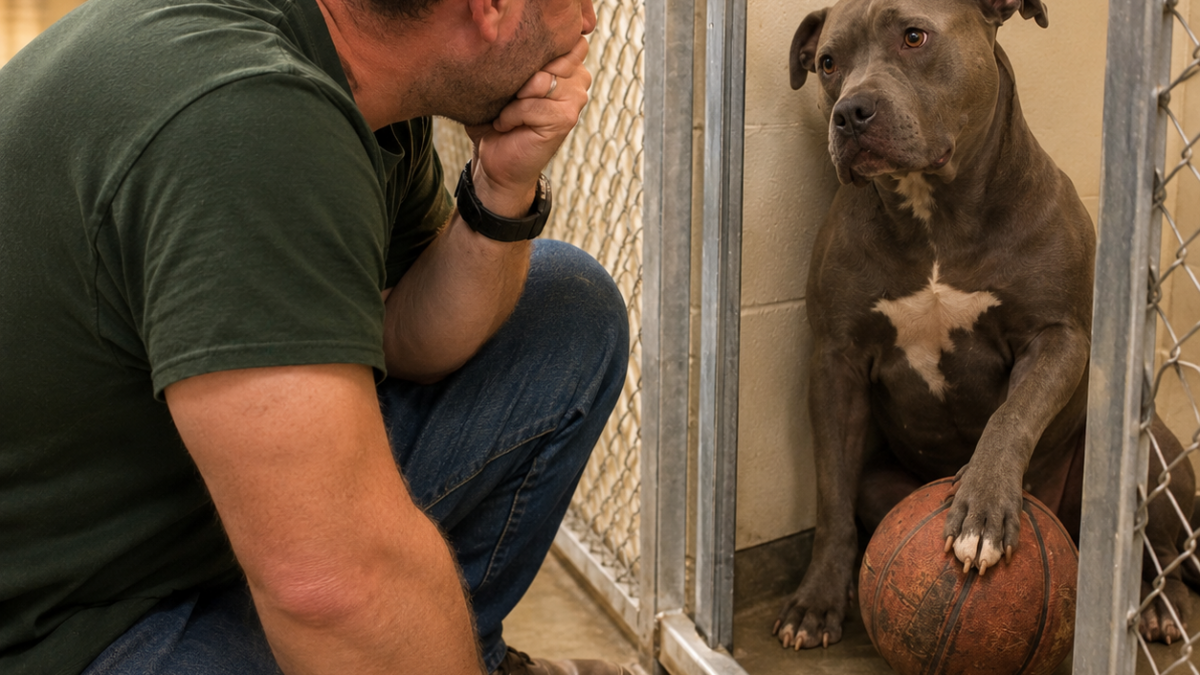
Rufus stood on the other side of the kennel door, shaking from nose to tail, his eyes locked on mine. Then he made that sound again—a deep, broken whine that seemed to come from somewhere far beneath his ribs.
Jake grabbed my sleeve.
“Dad… you know him?”
I nodded, but my throat had closed so completely that no words came out.
Emma stared at me.
“You know Rufus?”
I finally managed to whisper, “His name really is Rufus.”
Her face changed.
“What do you mean?”
“That was his name before he came here.”
I lowered myself until I was sitting directly on the shelter floor.
Rufus pushed his nose through the gap beneath the kennel door.
I touched it.
His tail moved.
Once.
Twice.
Then harder.
“Oh my God.”
I hadn’t realized I said it out loud until Jake crouched beside me.
Rufus suddenly began pawing at the gate.
Not aggressively.
Desperately.
Emma reached for the latch.
“Let me bring him into the meeting room.”
I looked up.
“Please.”
She hesitated.
“Do you know who owned him?”
The question hit me harder than I expected.
“Yes.”
“Who?”
I looked at Rufus.
“My best friend.”
Jake became very still.
He knew about Marcus.
Not everything. Eight-year-olds don’t need every detail adults carry. But he had seen photographs. He knew Uncle Marcus wasn’t really his uncle, but that I called him that anyway.
Emma opened the kennel.
Rufus came out so fast she nearly lost the leash.
Then he hit me.
All seventy-something pounds of him.
I went backward onto the floor.
He climbed halfway across my chest, whining, licking my face, pressing his head under my chin so violently that Jake started laughing and crying at the same time.
“Dad! He remembers you!”
I wrapped both arms around Rufus.
That old dog smelled like disinfectant, dog shampoo, and the faint mustiness of a kennel blanket.
I didn’t care.
“Hey, buddy.”
He whined.
“Hey.”
I buried my face against his neck.
“I know.”
Four years.
Four years, and he remembered.
Emma stood nearby with one hand over her mouth.
Jake touched Rufus’s back carefully.
“Is this Uncle Marcus’s dog?”
I nodded.
“Yeah.”
“The one in your pictures?”
“Yeah.”
Jake looked at the basketball still inside the kennel.
Then back at me.
“The basketball dog?”
A laugh escaped me through tears.
“Yeah.”
“The basketball dog.”
—
Marcus and I had met when we were thirteen.
He moved into the house two doors down from mine during the summer before eighth grade. On his first day in the neighborhood, I saw him shooting baskets alone in the driveway with a ball tucked under one arm and another at his feet.
I had walked over and said, “You any good?”
Marcus replied, “Better than you.”
He had never seen me play.
Naturally, I hated him immediately.
By dinner, we were friends.
By high school, everybody assumed we were brothers.
Marcus was tall, loud, impossible to embarrass, and loyal in a way you don’t appreciate properly until you get older and realize how rare it is.
He was there when I wrecked my first car.
I was there when his mother died.
He stood beside me at my wedding.
I stood beside him when his engagement fell apart.
When Jake was born, Marcus showed up at the hospital carrying a tiny basketball and a shirt that said:
**MY UNCLE IS COOLER THAN MY DAD.**
I told him I hated it.
Jake wore it until he outgrew it.
Marcus found Rufus when the dog was barely a year old.
Or maybe Rufus found Marcus.
Nobody ever knew for sure.
Marcus had gone to an outdoor basketball court one evening after work. When he finished playing, this skinny gray pit bull was sitting under his truck.
No collar.
No tags.
No owner.
Marcus bought him a cheeseburger.
That was the beginning.
He had Rufus scanned, checked shelters, posted online, and waited through the required stray period.
Nobody claimed him.
So Rufus became his.
Marcus loved that dog with an intensity he pretended was casual.
“He’s just a dog,” he used to say while ordering Rufus a custom orthopedic bed.
“Just a dog,” I would repeat.
“He has joint needs.”
“He’s two.”
“Preventative care.”
The basketball came later.
It had originally belonged to Marcus.
Old Spalding ball.
He used it for years.
One afternoon Rufus grabbed it from the driveway.
Marcus chased him.
Rufus decided this was the greatest game ever invented.
After that, the ball became his.
Rufus didn’t really fetch it.
He kidnapped it.
Marcus would bounce it.
Rufus would chase.
Then clamp his teeth around it and refuse to return it.
Eventually the ball stopped holding air properly.
Marcus kept it anyway.
“It’s his now.”
That was the ball sitting in the kennel.
I knew because Marcus had written his initials near the valve in black marker.
**M.R.**
Marcus Reed.
I didn’t need to check.
But I did.
Emma brought the ball into the meeting room.
Rufus followed it with his eyes.
She placed it beside him.
I turned it slowly.
The faded letters were still there.
M.R.
My hands began shaking.
Jake whispered, “That’s Uncle Marcus?”
“Yeah.”
Emma sat across from me.
“I think you need to tell me what happened.”
So I did.
—
Marcus died four years earlier.
Three days before his thirty-fifth birthday.
It happened suddenly.
He had been driving home from work when another driver ran a red light and hit the driver’s side of his truck.
Marcus died before the ambulance reached the hospital.
There are phone calls that divide your life into before and after.
That was one.
I remembered standing in my kitchen holding my phone while Jake, then four years old, played with blocks in the living room.
I remembered someone saying Marcus’s name.
Hospital.
Accident.
Sorry.
Then nothing made sense for a while.
Marcus never married.
His parents were already gone.
His closest living relative was his older half sister, Vanessa.
They weren’t especially close.
That was putting it politely.
Vanessa was nine years older than Marcus. They had different fathers and had spent long stretches of adulthood barely speaking.
But legally, after Marcus died, she handled most of his estate.
That included Rufus.
I had asked about him.
I remembered it clearly.
It was maybe two weeks after the funeral.
I was at Marcus’s house helping pack a few things when I asked:
“What happens to Rufus?”
Vanessa didn’t even look up from a box.
“I found a place.”
“What place?”
“A private rescue.”
“Which one?”
“Outside the county.”
“I can take him.”
That finally made her look at me.
“You have a four-year-old and a small house.”
“So?”
“He’s a pit bull.”
I hated the way she said it.
Like breed and danger were the same word.
“He knows me.”
“He needs professional placement.”
“Marcus would want—”
“Marcus didn’t leave instructions naming you.”
That ended the conversation.
Or I allowed it to.
That distinction haunted me later.
Vanessa told me Rufus had gone to a rescue specializing in bully breeds.
I believed her.
Why wouldn’t I?
I was grieving.
My marriage was already under strain.
Jake was four.
Work was chaos.
Marcus’s death had left a hole I didn’t know how to stand near without falling into it.
So when Vanessa said Rufus was safe, I accepted it.
I never asked for an address.
Never visited.
Never checked.
For four years, I believed he was somewhere else.
Happy.
Maybe adopted.
Maybe living with a family.
And all that time—
he had been here.
—
Emma opened Rufus’s shelter record on a computer.
The intake date made my stomach turn.
Three days after Marcus’s funeral.
Three days.
I stared at it.
“Where did you find him?”
“Animal control picked him up near Mill Creek Road.”
“That’s twelve miles from Marcus’s house.”
Emma nodded.
“He was walking along the shoulder carrying the basketball.”
“Carrying it?”
“Yes.”
“One of the officers wrote it in the intake notes because it was unusual.”
She turned the screen.
The note read:
**Adult male pit bull located approximately 7:40 a.m. near abandoned manufacturing access road. Dog reluctant to approach until officer retrieved damaged basketball found beside animal. Dog carried ball into transport vehicle.**
My mouth went dry.
Jake was reading over my arm.
“Someone left him there?”
Emma looked at me carefully.
“We don’t know.”
But we both knew what the possibilities were.
I asked about the microchip.
“It was registered?”
“Yes.”
“To Marcus?”
“Marcus Reed.”
“So why didn’t anyone call his family?”
“We tried the listed number.”
Emma opened another page.
“Disconnected.”
“Address?”
“His old apartment. Not the house he owned when he died.”
Marcus had adopted Rufus years before buying the house.
He had never updated the chip.
Of course.
“Did anyone search his name?”
“Animal control did.”
Her voice became quieter.
“They found an obituary.”
I stared at her.
“And?”
“They attempted to contact next of kin listed through public information.”
My stomach tightened.
“Vanessa?”
Emma nodded.
“There’s a note.”
She scrolled.
**Message left. No response.**
Another.
**Second attempt. Voicemail full.**
Another.
**Certified notice returned unclaimed.**
I sat back.
There was a strange roaring in my ears.
Jake looked worried.
“Dad?”
“I’m okay.”
I wasn’t.
Vanessa had told me she placed Rufus with a rescue.
Three days after Marcus’s funeral, he was picked up alone on an industrial road.
The shelter tried to contact her.
She never responded.
That was bad.
But it wasn’t proof she had abandoned him.
Not yet.
Emma kept reading.
“There’s something else.”
“What?”
“Rufus wasn’t immediately available for adoption.”
“Why?”
“He shut down.”
She looked toward him.
“He wouldn’t eat unless the basketball was in his kennel. He growled when staff tried to remove it. Not aggressive in general, just protective of the ball.”
“How long?”
“Almost seven months before behavior staff felt comfortable listing him.”
“And nobody wanted him?”
“People wanted him.”
Her expression turned sad.
“They just didn’t keep choosing him.”
Rufus had been adopted once.
Returned after nine days.
The family said he was too withdrawn.
A second foster lasted three weeks before their landlord objected to the breed.
After that, Rufus spent most of four years in the shelter.
Four years.
Jake reached for Rufus’s head.
The dog leaned into his hand.
My son whispered:
“You were waiting.”
I looked away because those two words hurt more than anything Emma had said.
—
We didn’t leave without him.
Technically, the adoption couldn’t happen in five minutes.
There were forms.
A home check.
Medical disclosures.
The shelter had policies.
I understood.
I hated them anyway.
When Emma explained that the earliest we could finalize would be Monday, Jake looked personally betrayed by bureaucracy.
“But he knows Dad.”
“I know.”
“And Dad knows him.”
“I know.”
“So he’s already ours.”
Emma smiled.
“I like your legal reasoning.”
Jake crossed his arms.
“Thank you.”
I left Rufus that afternoon only after promising him I would come back.
I know dogs don’t understand full sentences the way people do.
But Rufus understood departure.
That terrified me.
The moment I stood, he picked up the basketball.
When I reached the door, he followed.
Emma held the leash.
Rufus stopped.
His eyes stayed on me.
I crouched.
“I’m coming back.”
His tail didn’t move.
“Monday.”
He stared.
Jake hugged him.
“We’re coming back.”
Rufus looked at Jake.
Then me.
Finally he sat.
Basketball between his front paws.
I barely made it to the parking lot before crying.
—
That evening, Jake asked about Marcus.
Not the simplified version.
The real one.
We sat at the kitchen table.
“Was he your best friend?”
“Yes.”
“Like your best friend ever?”
“Yeah.”
“Why didn’t I remember him?”
“You were little.”
“Did he like me?”
I smiled.
“He thought you were the greatest thing on earth.”
“More than Rufus?”
“Close.”
Jake considered that.
“What happened after Uncle Marcus died?”
I told him as carefully as I could.
That Vanessa had handled Marcus’s things.
That she told me Rufus was safe.
That I believed her.
Jake frowned.
“So she lied?”
“I don’t know yet.”
“He was at the shelter.”
“Yes.”
“She said he wasn’t.”
“Yes.”
“That sounds like lying.”
Eight-year-olds are inconveniently efficient.
I rubbed my forehead.
“It does.”
Jake was quiet.
Then:
“Are you mad?”
“Yes.”
“At her?”
“Yes.”
“At yourself?”
That surprised me.
“Why would you ask that?”
“Because you look mad the way you look when you forget something.”
I stared at my son.
Children see far more than adults like to believe.
“Yes.”
“I’m mad at myself too.”
“Why?”
“Because I should have checked.”
Jake thought about that.
Then he said:
“But she was a grown-up.”
I almost laughed.
“So was I.”
“But she told you he was safe.”
“Yes.”
“That means she was supposed to tell the truth.”
I didn’t answer.
Jake slid off his chair.
“Monday we bring Rufus home.”
“Yes.”
“And then you figure out the other stuff.”
I smiled.
“That’s the plan.”
He nodded.
“Good.”
Sometimes parenting is pretending you are giving stability to a child who has just simplified your entire emotional crisis in fifteen seconds.
—
Monday afternoon, Rufus came home.
The shelter staff gathered in the lobby.
I hadn’t expected that.
Emma had tears in her eyes.
Another volunteer handed Jake a bag of treats.
Someone gave Rufus a new bed.
Emma brought out the basketball last.
Rufus immediately stepped toward it.
“Can’t forget this.”
“No.”
I took it carefully.
The surface was more fragile than I realized.
One side had split enough that I could see the inner rubber lining.
“How has this survived four years?”
Emma laughed.
“We’ve repaired it twice.”
“You repaired a dead basketball?”
“Rufus had priorities.”
When we walked toward the exit, Rufus stopped at the glass doors.
His body went stiff.
I worried he thought this was another temporary foster.
I crouched.
“Home.”
Jake stood beside me.
“Come on, Rufus.”
He lifted the basketball with both hands.
That did it.
Rufus followed.
At the car, Rufus refused to climb into the back seat until Jake put the ball inside first.
Then he jumped in.
Jake fastened himself beside him.
For the entire drive home, Rufus kept one paw resting on the ball.
—
The first week taught me more about grief than the previous four years had.
Rufus remembered things.
Not everything.
But enough.
He knew the word “outside.”
He knew “place.”
He still responded to the hand signal Marcus used for stay.
The first time I accidentally used it, Rufus froze.
So did I.
Marcus had always raised two fingers and turned his palm outward.
I did it without thinking.
Rufus sat.
My chest hurt.
Jake noticed.
“That was Uncle Marcus’s thing?”
“Yeah.”
“Show me.”
So I did.
Slowly, Marcus began returning to our house through a dog.
Not as a ghost.
As habits.
Commands.
Stories.
Memories I had stopped telling because I thought grief became healthier if you stopped touching it.
Rufus disagreed.
Every time he did something familiar, another story came out.
The way Marcus let him sleep on the couch even after swearing he wouldn’t.
The time Rufus stole an entire rotisserie chicken.
The summer Marcus bought him a children’s wading pool and then complained Rufus preferred the mud beside it.
Jake absorbed all of it.
One night he said:
“I feel like I know Uncle Marcus now.”
That nearly broke me.
—
Rufus slept in Jake’s room by the second week.
I didn’t plan it.
I had bought a dog bed for the living room.
Rufus ignored it.
Jake spread a blanket beside his own bed.
Rufus lay down there.
Decision made.
The basketball went with him.
Always.
At night it rested beside his chest.
If Jake moved it while cleaning, Rufus watched.
Never growled at Jake.
Never snapped.
But watched.
I told him not to mess with it.
“That ball matters.”
“I know.”
“More than a toy.”
“I know.”
Jake treated it with the seriousness of a museum artifact.
Then one afternoon I came home and found him sitting on the floor beside Rufus with a brand-new basketball.
Not Rufus’s.
A new one.
“What are you doing?”
“Experiment.”
That word never reassures a parent.
“What experiment?”
Jake bounced the new ball once.
Rufus’s ears lifted.
Jake rolled it.
Rufus watched.
Then looked at the old ball.
Jake rolled the new one again.
Rufus stood.
Took one step.
Then stopped.
For a second I thought he would return to the old ball.
Instead, he nudged the new one.
Jake’s face lit up.
“Dad.”
“I see.”
He rolled it again.
Rufus chased.
Slowly.
Awkwardly.
But he chased it.
The old basketball remained by the bed.
For the first time in four years, Rufus played with another one.
I went into the kitchen so Jake wouldn’t see me cry.
—
Two weeks later, the shelter posted a reunion story online.
Emma asked first.
I agreed.
The photograph showed Jake sitting on our front porch with Rufus leaning against him. The old basketball sat between Rufus’s paws.
The caption explained that Rufus’s new adopter had unexpectedly recognized him as the dog belonging to a best friend who died years earlier.
The post spread.
Local news picked it up.
Then a regional station called.
I almost refused.
Jake wanted to do it.
“Rufus can be famous.”
“He doesn’t know what famous means.”
“Even better.”
We agreed to a short segment focused on shelter adoption.
The reporter filmed Rufus playing with Jake in our backyard.
They filmed the old ball.
They filmed me telling Marcus’s story.
The piece aired on Thursday.
Vanessa called Friday morning.
I hadn’t heard her voice in nearly three years.
“Daniel.”
That’s my name.
I hadn’t introduced myself earlier because it didn’t matter.
But the way Vanessa said it made it sound like an accusation.
“Vanessa.”
“What are you doing?”
I almost laughed.
“What am I doing?”
“With Rufus.”
My grip tightened on the phone.
“I adopted him.”
“You had no right.”
For a few seconds, I genuinely thought I had misunderstood.
“No right?”
“He was Marcus’s property.”
“Marcus is dead.”
“I’m the executor of the estate.”
“Four years ago.”
“That dog belongs to the estate.”
“He spent four years in a shelter.”
Silence.
Then:
“I placed him with an organization.”
“No.”
“You don’t know what happened.”
“I know exactly when he entered the shelter.”
She said nothing.
“Three days after Marcus’s funeral.”
More silence.
“They found him alone near Mill Creek.”
“I was told he was transferred.”
“By who?”
Another pause.
“People handling it for me.”
“What people?”
“I don’t remember.”
I could hear my own heartbeat.
Then I asked:
“What rescue did you place him with?”
She became defensive.
“This was four years ago.”
“You told me it specialized in bully breeds.”
“It did.”
“Name?”
“Daniel—”
“Name.”
She snapped.
“I don’t need to answer to you.”
That was when I knew.
Not suspected.
Knew.
Something was wrong.
“Why are you calling?”
“Because you’re creating a public spectacle involving my brother’s estate.”
“No.”
I looked at Rufus asleep near Jake’s backpack.
“I’m giving his dog a home.”
“Take down the interviews.”
“Why?”
“Because this is a private family matter.”
“Marcus was my family.”
“You weren’t blood.”
There are statements people make that cannot hurt you in the way they intend because they reveal too much about themselves.
I said:
“Stay away from Rufus.”
Then I hung up.
—
Twenty minutes later, another call came.
Unknown number.
I almost ignored it.
“Mr. Bennett?”
“Yes.”
“My name is Samuel Ortiz. I represented Marcus Reed’s estate.”
I sat down.
“What?”
“I saw the story about Rufus.”
Something in his voice made my stomach tighten.
“We need to talk.”
“About what?”
“About a provision in Marcus’s will.”
I closed my eyes.
“Rufus?”
“Yes.”
Mr. Ortiz asked whether I could come to his office.
I went that afternoon.
The office was downtown, on the sixth floor of a building I had probably passed a hundred times without noticing.
Samuel Ortiz was in his sixties, with silver hair and careful eyes.
He placed a folder on the table.
“I handled the probate work after Marcus died. His sister Vanessa was appointed personal representative, but there was also a pet-care provision.”
I stared at him.
“A what?”
“Marcus set aside money for Rufus.”
The room seemed to tilt.
“How much?”
“Thirty thousand dollars.”
I sat back.
“What?”
“Marcus executed the will about two years before his death.”
“Why did nobody tell me?”
“You were not named as trustee.”
“Who was?”
“Vanessa.”
Of course.
Ortiz continued.
“The funds were to be used for Rufus’s food, veterinary care, housing, and reasonable related expenses. Upon Rufus’s death, any remainder would pass to a local animal rescue.”
I thought about the shelter.
Four years.
Food.
Medical care.
Staff.
All paid by donations and county funding.
Not Vanessa.
“What happened to the money?”
Ortiz’s face became grim.
“That is the problem.”
He opened the folder.
Annual statements.
Expenses.
Boarding.
Veterinary care.
Medication.
Training.
The entries continued for years.
Year one: $6,800.
Year two: $5,300.
Year three: $4,900.
Year four: nearly $4,000.
I stared at the numbers.
“But Rufus was at the shelter.”
“Yes.”
“Every year.”
“Yes.”
“So who was she paying?”
Ortiz looked at me.
“That is what I intend to find out.”
I felt cold.
“Did you verify any of this?”
“Trust administration was handled through reports and submitted receipts. Some payments were reimbursed to Vanessa. At the time, nothing on the face of the documentation appeared obviously fraudulent.”
“Receipts from where?”
He slid copies toward me.
**Oak Ridge Canine Haven.**
I had never heard of it.
Neither had he until Vanessa submitted invoices.
Ortiz said the documents included an address outside the county.
“Does it exist?”
“It did once.”
“Once?”
“The organization dissolved six years ago.”
Two years before Marcus died.
I stared at him.
“So the receipts are fake.”
“They appear to be.”
My anger became very calm.
That was worse than shouting.
Vanessa had not simply abandoned Rufus.
She had apparently abandoned him and then spent four years submitting paperwork claiming she was paying for his care.
Twenty-something thousand dollars.
While he slept in a shelter kennel with a broken basketball.
Ortiz said:
“If the records are what they appear to be, this may involve breach of fiduciary duty, fraud, and potentially other offenses.”
I barely heard him.
All I could picture was Rufus behind steel bars.
Four years.
And Vanessa being reimbursed for a bed he never slept in.
Food he never ate.
Veterinary care he never received.
I whispered:
“She got paid to pretend he was safe.”
Ortiz didn’t answer.
He didn’t need to.
—
I went home and stood in Jake’s doorway that night.
Rufus was asleep beside him.
The old basketball rested near his front legs.
Jake had one hand hanging off the mattress.
His fingers touched Rufus’s back.
I thought about Marcus.
I remembered something he once said after too many beers during a backyard cookout.
“If something happens to me, don’t let Vanessa sell my stuff before I’m cold.”
I laughed at the time.
Marcus laughed too.
Then he pointed at Rufus.
“But seriously. Somebody better take care of this idiot.”
I had said:
“I’ve got him.”
A joke.
A casual promise.
I had forgotten it until that moment.
I sat in the hallway and cried so quietly I hoped Jake wouldn’t wake.
I had not gotten him.
For four years.
I had trusted someone else.
Rufus paid for that trust.
The next morning, Jake found me making coffee.
“You look bad.”
“Thank you.”
“Did you sleep?”
“Not much.”
He climbed onto a stool.
“Is it about Rufus?”
“Yes.”
I told him part of what we learned.
Not the legal details.
Just that Marcus had left money for Rufus and someone may have used it dishonestly.
Jake frowned.
“So she got money for taking care of him when she wasn’t?”
“Yes.”
“That’s stealing.”
“Probably.”
“From Rufus?”
“Yes.”
He looked offended in a way only an eight-year-old can.
“You can’t steal from a dog.”
“Apparently people can.”
“Well, they shouldn’t.”
“No.”
Jake took a long drink of orange juice.
“What happens now?”
I looked toward Rufus.
“We prove it.”
—
Vanessa did not make that easy.
Within a week, I received a letter from an attorney demanding that I return Rufus to the estate.
I laughed when I read it.
Then I stopped laughing.
The letter claimed the shelter had no right to adopt him because he was estate property and had never been intentionally surrendered.
That argument created a problem.
Not a large one.
But enough to scare me.
What if some technicality mattered?
What if somebody decided Rufus legally belonged to Vanessa as trustee?
Jake saw the letter on the counter.
“Can she take him?”
“No.”
“You sound unsure.”
I hated how well my son read me.
“I’m getting a lawyer.”
That answer satisfied neither of us.
Emma connected me with an attorney who volunteered with the shelter.
Her name was Rachel Kim.
She read the letter.
Then Rufus’s intake records.
Then the four-year stray/adoption history.
Then Marcus’s will.
Finally she leaned back.
“I don’t think she’s getting the dog.”
“Think?”
“Daniel.”
“I hate lawyers when they use that word.”
She smiled slightly.
“Then don’t ask legal questions.”
“Rachel.”
“She has problems.”
“What kind?”
“First, Rufus was legally processed as an unclaimed stray under county procedures years ago. Second, Vanessa received notice attempts. Third, she made no claim during the required period. Fourth, she has apparently spent years representing that Rufus was somewhere else.”
“Meaning?”
“She cannot easily argue the shelter unlawfully kept an animal she simultaneously claimed she had personally arranged to board elsewhere.”
That helped.
A little.
“And the trust?”
Rachel’s expression changed.
“The trust is where her bigger problems start.”
—
Mr. Ortiz hired a forensic accountant.
I didn’t know such people existed outside crime shows.
Apparently they do.
Her name was Priya Shah.
She traced payments.
Vanessa had reimbursed herself from Rufus’s care fund based on invoices supposedly issued by Oak Ridge Canine Haven.
The invoices looked professional.
Same logo.
Sequential numbers.
Descriptions.
Boarding.
Dental cleaning.
Vaccinations.
Behavior training.
But Oak Ridge had closed before Marcus died.
Its former director was living in Arizona.
She had never heard of Rufus.
Never issued those invoices.
The address on the paperwork belonged to a storage facility.
One listed veterinarian had retired nine years earlier.
Another had never worked with Oak Ridge at all.
Forgery.
It became difficult to call it anything else.
Then Priya found something worse.
One year, Vanessa claimed $1,870 in emergency veterinary treatment for Rufus after “gastrointestinal illness.”
The date on the invoice corresponded to a week when Rufus was documented at the shelter receiving an annual vaccine clinic.
The shelter had photographs.
Date-stamped.
Rufus.
Basketball.
Kennel number.
He was physically in one place while Vanessa claimed he was receiving expensive treatment eighty miles away.
Rachel looked at the documents.
“That is very, very bad for her.”
I said:
“Good.”
Rachel glanced at me.
I didn’t apologize.
—
The news story continued circulating.
Most people reacted kindly.
Then strangers began leaving comments about Vanessa.
Her name had not been published.
I refused to provide it.
I didn’t want an online mob.
I wanted facts.
That distinction mattered to Marcus.
He hated bullies.
He also hated sloppy thinking.
If I was going to fight for Rufus, I wanted to do it in a way Marcus would respect.
Vanessa did not share that restraint.
She posted publicly.
She wrote that her late brother’s dog had been “taken through a paperwork mistake” and that a former friend was exploiting grief for attention.
Former friend.
That hurt more than I expected.
Not because of Vanessa.
Because Marcus was dead and could not correct her.
Jake was too young for social media, but one of his friend’s parents saw the post.
The rumors started.
A reporter called me.
I declined comment.
Rachel said:
“Good.”
“I want to answer.”
“I know.”
“She’s lying.”
“I know.”
“She’s making me look like I stole him.”
Rachel smiled.
“Then let her keep talking.”
“Why?”
“People who are lying and angry often become generous with evidence.”
I hated that she was right.
—
Three nights later, someone came to my house.
It was 10:40 p.m.
Jake was asleep.
I was in the living room with Rufus when he suddenly lifted his head.
Not barked.
Just froze.
Then came a knock.
I looked through the window.
Vanessa.
I nearly didn’t open the door.
Then I remembered the camera above the porch.
Everything would be recorded.
I opened the inner door but kept the storm door locked.
“What are you doing here?”
“Give me Rufus.”
No greeting.
No hesitation.
I almost admired the audacity.
“No.”
“He belongs to Marcus’s estate.”
“He belongs in this house.”
“You’re making this harder than it needs to be.”
Rufus appeared behind me.
The moment he saw Vanessa, something happened.
His body lowered.
Tail tucked.
He backed away.
I noticed.
So did she.
She looked annoyed.
“Rufus.”
He moved farther behind me.
“Come here.”
Nothing.
She snapped her fingers.
He flinched.
That single movement erased whatever doubt remained inside me.
“What did you do to him?”
Vanessa’s eyes narrowed.
“Nothing.”
“He’s afraid of you.”
“He’s dramatic.”
I stared at her.
A dog who had slept beside Marcus’s basketball for four years.
Dramatic.
“Leave.”
“I am not leaving without the dog.”
“You are.”
She grabbed the storm-door handle.
Locked.
“Daniel.”
“Take your hand off my door.”
“You have no idea what Marcus wanted.”
That sentence made something inside me break loose.
“I know he wanted Rufus cared for.”
Her face changed.
Tiny.
But enough.
“I know about the trust.”
Silence.
Real silence.
Not conversational.
The kind where truth enters a room and everyone feels it.
Vanessa removed her hand from the door.
“What trust?”
I almost smiled.
“That’s the answer you’re going with?”
She looked toward the driveway.
“Samuel had no right to discuss estate matters with you.”
There it was.
She knew.
I said:
“Oak Ridge closed before Marcus died.”
Her face drained.
The porch camera captured everything.
She stepped backward.
“You don’t understand the arrangement.”
“Then explain it.”
“I paid people privately.”
“With fake invoices?”
“They weren’t fake.”
“Then bring the people to court.”
Her anger returned.
“This is exactly why Marcus never trusted you with serious things.”
That one almost landed.
Almost.
Then Rufus moved.
He stepped beside me.
Not behind me.
Beside.
The old basketball was in his mouth.
Vanessa stared at him.
Something ugly flashed across her face.
“I should’ve gotten rid of that stupid ball too.”
I stopped breathing.
She realized it.
Too late.
“What?”
“Nothing.”
“No. Say it again.”
She backed toward the steps.
“You’re twisting my words.”
“What did you mean by ‘too’?”
She turned.
I opened the storm door.
“Vanessa.”
She spun around.
“Do you know what it was like dealing with everything after Marcus died? The house, the bills, the dog, the probate? You were nowhere.”
“I offered to take him.”
“You had a child and no money.”
“I offered.”
“He was a burden.”
Rufus growled.
Low.
Vanessa looked at him.
“I drove him to a rescue.”
“You drove him to Mill Creek.”
She froze.
I hadn’t told her where he was found.
Not publicly.
Not once.
The porch seemed to become very still.
I said:
“How do you know where he was?”
She stared at me.
Then realized what she had done.
A car turned onto the street.
Vanessa walked quickly toward her vehicle.
I didn’t stop her.
I didn’t need to.
The camera had recorded everything.
—
Rachel watched the video the next morning.
Twice.
Then once more.
“She said Mill Creek.”
“Yes.”
“That location has never been publicly reported?”
“No.”
“Shelter post?”
“No.”
“News?”
“No.”
“Good.”
I looked at her.
“Good?”
“Very.”
“She admitted dumping him.”
“Not directly.”
“She knew where he was.”
“Yes.”
“And ‘gotten rid of the ball too.’”
“Yes.”
Rachel paused the video on Vanessa’s face.
“This won’t prove every element by itself.”
Of course lawyers ruin satisfying moments.
“But combined with everything else?”
She smiled.
“It’s getting difficult to imagine a version of events where she looks innocent.”
—
Emma found another piece.
The shelter had changed software systems two years earlier.
Some older attachments hadn’t migrated cleanly.
A volunteer was helping digitize records when she discovered a scanned animal-control incident sheet connected to Rufus’s intake.
An officer had noted a witness.
A truck driver named Walter Briggs.
Walter had seen a dark SUV stopped near Mill Creek early that morning.
A woman stood near the open rear hatch.
A gray dog was beside her.
Walter assumed the dog was being walked.
When he passed again twenty minutes later, the SUV was gone.
The dog remained.
Carrying a basketball.
Partial plate:
**7KJ—**
Vanessa had owned a black SUV at the time.
Old DMV records still existed.
Plate began:
**7KJ.**
Not proof alone.
Again.
But facts were gathering.
One by one.
Patiently.
Like Rufus had waited.
—
Walter was seventy-one now.
Retired.
He remembered the dog more clearly than the woman.
“Thing that stuck with me was the basketball.”
Rachel asked:
“Why?”
“Dog carried it like a kid carries a teddy bear.”
He looked at me.
“Gray pit?”
“Yes.”
“Big head?”
“Yes.”
“White patch here?”
He touched beneath his chin.
My throat tightened.
“That’s him.”
Walter shook his head.
“I thought about that dog for weeks.”
“Why didn’t you stop?”
“I was working. Figured owner was nearby.”
He looked ashamed.
“Then animal control called asking what I saw.”
“You helped.”
“Not enough.”
I understood that guilt too well.
“You saw the SUV.”
“Yes.”
“Could you identify the driver?”
“Four years later? No.”
Fair.
Then he said:
“But I remember something else.”
“What?”
“She threw the basketball.”
I froze.
“What?”
“She took it from the back of the SUV and tossed it toward the grass. Dog ran after it.”
Walter’s face hardened.
“Then she got in and drove off.”
My hands closed into fists beneath the table.
The ball.
She used Marcus’s ball to get Rufus out of the vehicle.
The one thing he would always chase.
She threw it.
He ran.
She left.
That explained why Rufus was found with it.
For four years I had thought the basketball was merely what remained of Marcus.
Now I understood it had also been the tool Vanessa used to abandon him.
I had to leave the room.
—
I drove to the cemetery.
Marcus’s grave was under a maple tree.
I hadn’t visited in months.
I sat on the grass.
For a long time, I said nothing.
Then:
“I’m sorry.”
Wind moved through the leaves.
“I should’ve checked.”
I knew there would be no answer.
That was part of grief.
Every conversation eventually became a monologue.
“I believed her.”
My voice broke.
“She used your stupid ball.”
I laughed once.
Then cried.
“I know you’d be furious.”
I wiped my face.
“And you’d probably tell me to stop acting like everything was my responsibility.”
Marcus had done that when he was alive.
I could hear him.
**You got a hero complex, Bennett. Relax.**
“I’ve got him now.”
That mattered.
I looked at the name on the stone.
“Jake loves him.”
I smiled.
“Rufus sleeps in his room.”
Another pause.
“He plays basketball again.”
That was the sentence that finally gave me some peace.
Not because justice had happened yet.
Because life had.
—
Vanessa was removed as trustee while the matter was investigated.
The court appointed an independent fiduciary.
Remaining money in Rufus’s trust was frozen.
There was less than six thousand dollars left.
Of the original thirty thousand.
Rufus had received almost none of it.
The county prosecutor opened a fraud investigation after Ortiz submitted the forged records and accounting discrepancies.
Vanessa’s attorney changed.
The aggressive letters stopped.
Then came an offer.
She would withdraw any claim to Rufus if we agreed not to participate in efforts to recover trust money beyond the remaining balance.
Rachel read the proposal aloud.
I laughed.
“No.”
“Expected.”
“She stole from him.”
“Legally, the injured parties include the trust and remainder beneficiary.”
“The shelter.”
“Yes.”
Marcus had designated a rescue organization as remainder beneficiary.
That organization had since merged with the county shelter foundation.
Meaning every dollar Vanessa fraudulently took from Rufus also reduced what would eventually have gone to help animals like him.
That part would have made Marcus furious.
Rachel asked:
“What do you want?”
“Everything returned.”
“That may not happen.”
“As much as legally possible.”
“Okay.”
“And Rufus stays with me.”
“That part is already very strong.”
“Not strong.”
I looked at her.
“Permanent.”
Rachel nodded.
“Permanent.”
—
Vanessa tried one more time.
Not at my house.
At Jake’s school.
That was the moment my restraint nearly ended.
I received a call from the front office one afternoon.
A woman had arrived claiming to be Jake’s aunt.
She said there was a family emergency.
The school refused to release him because she was not listed.
Thank God.
Then she asked whether Jake’s father still owned “the gray dog.”
Staff became suspicious.
They called me.
By the time I reached the school, Vanessa was gone.
Jake was safe.
I was shaking.
Not afraid.
Angry enough that I didn’t trust myself to speak.
Rachel met me outside.
“I’m getting an order.”
“She went near my son.”
“I know.”
“She used my son.”
“I know.”
“No.”
I turned toward her.
“You keep saying you know.”
Rachel didn’t flinch.
“Because I do.”
Her voice stayed calm.
“And this is the moment you let the law do exactly what it is designed to do.”
I breathed.
“You do not call her.”
I said nothing.
“You do not drive to her house.”
Nothing.
“You do not give her attorney any reason to portray you as unstable.”
I finally said:
“I hate being responsible.”
Rachel almost smiled.
“Most adults do.”
A temporary restraining order was issued the next morning.
Vanessa was prohibited from approaching my home, Jake’s school, or contacting us directly.
The school incident did something else.
It destroyed whatever sympathy I still had for her.
Before, part of me had wondered whether grief and pressure after Marcus’s death had broken her judgment.
After that, I stopped searching for excuses she had never asked for.
—
The civil hearing over Rufus came first.
Vanessa still claimed she had intended to place Rufus with a rescue and that an unidentified transport person must have abandoned him.
Her lawyer argued she had relied on others.
Rachel asked:
“Who?”
Vanessa could not provide a name.
“Phone number?”
No.
“Email?”
No.
“Payment?”
Cash.
“Receipt?”
No.
“Organization?”
Oak Ridge.
Which had not existed.
Rachel then produced the porch recording.
Vanessa’s voice filled the courtroom.
**I drove him to a rescue.**
Then:
**I should’ve gotten rid of that stupid ball too.**
Then my question:
**You drove him to Mill Creek.**
And the pause.
The judge watched Vanessa.
Rachel called Walter Briggs.
He described the SUV.
The woman.
The ball.
The dog.
The vehicle leaving.
Then Emma testified about Rufus’s intake date.
Three days after Marcus’s funeral.
The county’s failed attempts to reach Vanessa.
Four years of shelter residence.
Finally Rachel asked:
“Ms. Porter, during those four years, did anyone associated with Marcus Reed’s estate pay for Rufus’s care?”
Emma answered:
“No.”
“Did Vanessa Reed ever visit him?”
“No.”
“Call?”
“Not in the records.”
“Send food?”
“No.”
“Pay veterinary costs?”
“No.”
The judge looked toward Vanessa.
I will remember that look.
Not anger.
Disappointment.
Sometimes that is worse.
—
The court permanently rejected Vanessa’s ownership claim.
Rufus was legally mine.
Not conditionally.
Not pending appeal.
Mine.
Rachel handed me the signed order outside.
I stared at the page.
Jake was waiting with Emma and Rufus near the courthouse lawn.
I walked toward them.
Jake ran first.
“What happened?”
I held up the paper.
“He’s staying.”
Jake’s face exploded into a smile.
“Forever?”
“Forever.”
He threw both arms around Rufus.
Rufus nearly knocked him down.
Emma cried.
I didn’t.
Not until Jake pulled the old basketball from his backpack.
He had insisted on bringing it.
He placed it in front of Rufus.
“You’re home.”
Rufus looked at the ball.
Then at Jake.
Then did something none of us expected.
He stepped over it.
Walked to Jake.
And leaned his entire body against him.
The ball stayed on the grass.
Emma whispered:
“Oh my God.”
For four years, that ball had been the one thing Rufus refused to leave.
That day, he left it behind to follow my son.
—
The fraud case took longer.
Months.
Financial crimes are painfully uncinematic.
Paperwork.
Bank records.
Subpoenas.
Account statements.
Experts.
Nobody bursts into court with the final receipt while dramatic music plays.
Truth arrives in binders.
But it arrived.
Priya traced nearly twenty-four thousand dollars in false reimbursements.
Some money had paid Vanessa’s credit-card debt.
Some went toward a luxury vacation.
Some toward a down payment on a vehicle.
The fake invoices had been created on her personal laptop.
Metadata connected them directly.
The Oak Ridge logo had been copied from an archived website.
One supposedly handwritten veterinarian signature had been cut from an old public document.
The evidence became overwhelming.
Then investigators found email drafts.
Vanessa had written to herself:
**Rufus boarding invoice April**
and attached a blank template.
Another:
**Need 3 months vet / meds before accounting due.**
There was no innocent explanation left.
Her attorney negotiated.
She eventually entered a guilty plea to fraud-related charges and admitted misusing trust funds.
The judge ordered restitution.
She received a custodial sentence followed by supervised release, along with financial penalties and a civil judgment connected to the trust losses.
I’m not going to pretend the number of months mattered to me as much as I expected.
By then, Rufus was home.
Jake was happy.
The shelter foundation recovered a substantial portion through restitution and settlement.
Vanessa lost control of Marcus’s remaining estate matters.
What mattered most was that the official record finally said what four years of shelter notes could not.
She had been trusted to protect something Marcus loved.
She chose money instead.
—
At sentencing, I was allowed to make a statement.
I almost declined.
Then I thought about Rufus sleeping beside that basketball.
I stood at the lectern.
Vanessa sat behind her attorney.
I didn’t look at her at first.
I looked at the judge.
“Four years ago, my best friend died.”
My voice shook slightly.
“He left behind a dog named Rufus and money intended to make sure that dog was safe.”
I paused.
“Rufus spent those four years in a shelter.”
I explained the ball.
How Marcus played basketball.
How Rufus stole it.
How Vanessa used it to lure him from her SUV.
How Rufus carried it when animal control found him.
Then:
“For four years, he slept beside the same object because it was the last thing he had that smelled like the person who loved him.”
Vanessa looked down.
I continued.
“I used to think I wanted revenge.”
The courtroom was silent.
“I wanted the person responsible to feel what he felt. Abandoned. Confused. Waiting for somebody who never came.”
I finally looked at her.
“But Rufus taught me something.”
She met my eyes.
“He didn’t need you to suffer.”
Another pause.
“He needed you to stop having power over his life.”
I looked back at the judge.
“That happened.”
I stepped away.
That was the only revenge speech I ever needed.
—
Vanessa never apologized to me.
Not really.
Months later, through her attorney, she sent a letter.
I opened it once.
She wrote about grief.
Stress.
Debt.
Feeling trapped by Marcus’s responsibilities.
She said she never intended Rufus to remain lost.
She claimed she believed someone would find him quickly.
Maybe that was true.
Maybe not.
At the bottom she wrote:
**I know Marcus would hate me for what happened.**
I stared at that sentence for a long time.
Then folded the letter.
I didn’t answer.
Forgiveness is not always a conversation.
Sometimes it is simply deciding somebody no longer gets space inside your daily life.
—
Rufus changed after the case ended.
Not overnight.
That would make a prettier story.
It wouldn’t be true.
He still slept near the old basketball.
But not touching it.
Then several feet away.
Then one morning Jake found the ball still in the hallway while Rufus was asleep upstairs.
We both noticed.
Neither of us said anything.
A month later, Rufus started choosing the new basketball more often.
Jake would roll it across the yard.
Rufus chased it.
Grabbed it.
Refused to return it.
Exactly like Marcus described.
One Saturday, I sat on the porch while Jake ran in circles trying to recover the ball.
“Rufus! Come on!”
Rufus sprinted away.
Jake yelled:
“Dad! He’s cheating!”
I laughed so hard I had to put down my coffee.
For one second, I was twenty-three again.
Marcus stood in a driveway yelling:
“Give me the ball, you idiot!”
Rufus was younger.
I was younger.
Nobody was dead.
Then the moment passed.
But it didn’t hurt the way it used to.
Memory had changed.
It was no longer only proof of what I lost.
It had become part of what Jake was receiving.
—
The shelter used part of the recovered restitution to renovate a kennel wing.
Emma called me when the plaque was installed.
I expected something formal about donors.
Instead, beside the entrance was a small metal plate.
**THE RUFUS ROOM**
Below it:
**FOR THE DOGS WHO ARE STILL WAITING FOR SOMEONE TO RECOGNIZE THEIR WORTH.**
I stared at it.
“You named a room after him?”
Emma shrugged.
“He lived here longer than some employees.”
“That’s terrible.”
“Yes.”
She smiled.
“But now he’s useful.”
“He was always useful.”
“You know what I mean.”
The renovated room had softer lighting.
Larger spaces.
Noise reduction.
Areas for long-term dogs to decompress.
Rufus walked through it during the opening.
Several staff members recognized him.
They cried.
Rufus cared mostly about a jar of treats on the counter.
That felt appropriate.
—
Jake became obsessed with Marcus’s stories.
At bedtime he would ask:
“Tell me one I don’t know.”
I ran out eventually.
Then I started remembering new ones.
Marcus setting a toaster on fire.
Marcus trying to cut his own hair before graduation.
Marcus getting thrown out of a rec-league game for arguing with a referee who was seventeen.
Jake loved that one.
“Was Uncle Marcus bad?”
“He was loud.”
“Same thing?”
“Sometimes.”
Rufus usually lay between us.
The basketball rested in the corner.
I began to understand something.
For years after Marcus died, I had thought talking about him would keep me stuck.
Actually, silence had kept me stuck.
Rufus reopened the door.
Jake gave me a reason to walk through it.
—
A year after we adopted Rufus, Jake had a school assignment.
Write about someone who taught you something important.
He wrote about Rufus.
I expected some eight-year-old sentence like dogs are loyal.
Instead, he wrote:
**Rufus taught me that waiting a long time does not mean nobody is coming.**
I read it twice.
Then sat at my desk pretending I had something in my eye.
Jake stood in the doorway.
“You’re crying.”
“No.”
“You always say that.”
“I have allergies.”
“To homework?”
“Severe.”
He rolled his eyes.
Then asked:
“Do you think Rufus knew we were coming?”
“No.”
That answer surprised him.
“Then why did he keep waiting?”
I thought about it.
“Maybe he wasn’t waiting for us specifically.”
“For who?”
“Someone safe.”
Jake looked at Rufus.
“Same thing.”
Maybe.
—
The old basketball finally split open almost two years after Rufus came home.
Jake found it one morning.
The outer shell had cracked completely along one seam.
He looked devastated.
“Dad.”
I examined it.
No repair was going to make it usable again.
Rufus sniffed it.
Nudged it once.
Then walked away.
Jake watched him.
“He doesn’t care?”
“I think he cares.”
“He just left it.”
I looked at Rufus.
He had gone to the living room and climbed onto the couch beside Jake’s backpack.
“He doesn’t need to guard it anymore.”
Jake became quiet.
“What do we do with it?”
I had an idea.
We cleaned it carefully.
I cut a clear acrylic display box to size.
Inside, I placed the basketball.
Behind it, a photograph.
Marcus sitting on the edge of his driveway years earlier.
Rufus beside him.
Marcus had one hand resting on the dog’s head.
The basketball sat under Rufus’s paw.
Same ball.
Under the photograph, I put a small brass plate.
**MARCUS & RUFUS**
Jake read it.
“Can we put something else?”
“What?”
He thought.
Then said:
**FOUND EACH OTHER TWICE.**
I swallowed.
“That’s better.”
So that’s what we engraved.
—
Rufus grew older.
Gray appeared around his muzzle.
His hips became stiff.
The shelter veterinarian estimated he was probably around eleven when we adopted him, older than anyone originally thought.
That meant our time might be shorter.
I tried not to count.
Jake didn’t.
Children are better at living inside time instead of measuring it.
Rufus still walked him to the school-bus stop every morning.
Still waited near the window in the afternoon.
Still stole socks.
Still believed couches were his legal property.
One afternoon Jake came home upset because another kid at school made fun of him.
Rufus climbed onto the couch beside him.
Jake buried his face against Rufus’s neck.
I stood in the kitchen and watched.
The dog Marcus loved was now comforting my son.
There are connections too complicated to call coincidence without feeling dishonest.
—
When Rufus was thirteen, he developed a tumor.
The veterinarian removed it.
Benign.
We celebrated.
At fourteen, another appeared.
This one wasn’t.
Cancer.
Slow-growing at first.
We had options.
Medication.
Surgery.
Monitoring.
We did what made sense.
Not everything possible.
Everything kind.
Rufus got another good year.
A full year.
Jake turned eleven.
Rufus attended his birthday wearing a ridiculous paper hat for approximately seven seconds.
We took a photograph.
That picture became one of my favorites.
Jake grinning.
Rufus looking deeply offended.
—
The final winter came quietly.
Rufus stopped climbing the stairs.
So Jake began sleeping downstairs.
I told him he didn’t have to.
He said:
“Rufus slept next to me when I was little.”
“You’re still little.”
“I’m eleven.”
“Exactly.”
He moved his pillow to the couch.
Every night Rufus slept on the rug beside him.
The new basketball—no longer new—rested nearby.
Not because Rufus guarded it.
Because Jake kept it there.
One night I found Jake awake.
“You okay?”
“Yeah.”
“You’re lying.”
He stared at Rufus.
“Is he going to die?”
There are moments as a parent when every answer feels cruel.
“Yes.”
“When?”
“I don’t know.”
“Soon?”
“Probably.”
Jake cried quietly.
I sat beside him.
After a while he asked:
“Was Uncle Marcus scared when he died?”
“I don’t know.”
“Was Rufus sad?”
“Yes.”
“Will he be sad when Rufus dies?”
I looked at him.
“What do you mean?”
“If they see each other.”
I understood.
I’m not a man with strong opinions about what happens after death.
Marcus used to joke I had enough trouble understanding what happens before it.
But children deserve honesty without having hope taken from them.
“I don’t know what happens.”
Jake nodded.
“But?”
I looked at Rufus.
“But if there’s somewhere people and dogs get to find each other again, Marcus has probably been complaining for years that we took too long.”
Jake laughed through his tears.
“Yeah.”
Rufus lifted his head.
Looked at us.
Tail thumped once.
—
We knew it was time in early March.
Rufus stopped eating.
Not even chicken.
That was the sign.
He loved chicken with the kind of devotion normally reserved for religion.
The vet came to our house.
Emma came too.
She asked first.
I said yes.
She had known Rufus for four years before we did.
She deserved to say goodbye.
Jake sat on the floor.
Rufus rested on a blanket between us.
I brought the display case from the shelf.
Not because Rufus needed to see it.
Because I did.
Marcus’s photograph.
Old basketball.
**FOUND EACH OTHER TWICE.**
Emma touched the glass.
“I remember when he wouldn’t let us move it six inches.”
Jake smiled sadly.
“He has another one now.”
The newer basketball sat near the couch.
Rufus didn’t look at either.
He was looking at Jake.
The veterinarian explained what would happen.
Jake nodded.
Then moved closer.
He rested one hand on Rufus’s head.
I held the other.
Emma touched his shoulder.
The first medication made Rufus relax.
His breathing slowed.
Jake whispered:
“You were worth waiting for.”
I looked away.
Rufus’s eyes became heavy.
I leaned close.
“Hey, buddy.”
One ear moved.
Same as the shelter.
Four years earlier.
“Marcus would be proud of you.”
My voice broke.
“Actually, Marcus would say you’re spoiled.”
Jake laughed softly.
I continued.
“You took care of him.”
A breath.
“Then you waited.”
Another.
“Then you took care of Jake.”
His tail moved once.
I whispered:
“You don’t have to wait anymore.”
The veterinarian gave the final medication.
Jake kept talking.
“I’m here.”
Another breath.
“Dad’s here.”
Slower.
“Emma’s here.”
Then Jake said:
“And Uncle Marcus knows where you are.”
Rufus breathed out.
And was still.
—
We cried for a long time.
There is no graceful version of grief when a dog has carried two generations of your family through loss.
Eventually Emma asked:
“What do you want to do with the newer basketball?”
Jake picked it up.
He looked at Rufus.
Then at me.
“Can we take it to Uncle Marcus?”
I knew what he meant.
The next afternoon, we went to the cemetery.
Jake carried the basketball.
We stood beside Marcus’s grave.
Jake placed the ball near the headstone.
I almost told him we shouldn’t leave objects there.
Then decided rules could wait five minutes.
He touched Marcus’s name.
“Rufus is with you now.”
I stood behind him.
Wind moved through the trees.
Jake continued:
“But you can’t keep this ball forever because the cemetery people will throw it away.”
I laughed.
Even while crying.
He sat down.
“Dad?”
“Yeah?”
“Do you think Uncle Marcus is mad at you?”
“For what?”
“For not finding Rufus sooner.”
The question hurt.
I looked at the stone.
Then at my son.
“No.”
“How do you know?”
“I don’t.”
I paused.
“But Marcus knew me.”
Jake waited.
“He’d know I would’ve come if I knew.”
Jake nodded.
“So you can stop being mad at yourself.”
Eleven years old.
Still inconveniently efficient.
I sat beside him.
“I’m working on it.”
“Work faster.”
I laughed.
“Sounds like Marcus.”
—
The trust closed after Rufus died.
There was still money left because of the restitution recovered from Vanessa.
Under Marcus’s will, the remainder went to the shelter foundation.
It funded medical treatment and long-term foster support.
Emma sent me updates for years.
A senior shepherd’s surgery.
A bonded pair kept together.
A dog with behavioral issues placed in an experienced foster home.
Every time, she wrote:
**Rufus money at work.**
Marcus would have loved that.
Not the phrase.
The result.
His mistake—trusting Vanessa—didn’t get the last word.
Neither did her fraud.
The money eventually did what he intended.
It took the long way.
So did Rufus.
But it got there.
—
Vanessa completed her sentence and supervision.
I heard through Samuel that she moved to another state.
I never saw her again.
Years later, she sent one final envelope.
Inside was a photograph.
Marcus and Rufus.
I had never seen it.
Marcus was lying on the floor of his living room.
Rufus had his head across Marcus’s chest.
Both appeared asleep.
On the back, Vanessa had written:
**He did love that dog. I know I failed him. I’m sorry.**
I stared at the photograph for a long time.
Then I put it in the display case.
Not because I forgave everything.
Not because an apology erased four years.
But because the photograph belonged to Rufus’s story.
Vanessa’s mistake had taken enough.
I wasn’t going to let it take a picture too.
—
Jake is older now.
Much older than the eight-year-old who ran through the shelter calling me every six seconds.
He still remembers that day.
Mostly the moment Rufus pressed his forehead against the kennel bars.
The shelter renovated again recently.
The Rufus Room is still there.
Emma is now the shelter director.
Jake volunteers there on Saturdays.
The first time he told me, I smiled.
“Dogs help kids learn responsibility.”
He stared at me.
“What?”
“That’s what you told me when you were eight.”
“I was right.”
“Unfortunately.”
He works mostly with long-term dogs.
The ones people walk past.
The nervous ones.
The older ones.
The ones with strange habits.
A shepherd who carries a blanket everywhere.
A terrier that refuses to eat without someone nearby.
A hound that howls when left alone.
Jake never laughs at the habits.
He always asks the same question.
“What happened before?”
That came from Rufus.
—
The basketball display still sits in our living room.
People notice it immediately.
An old cracked ball in a clear case beside a photograph of a man and a gray pit bull.
It looks strange unless you know.
Sometimes visitors ask:
“Why a basketball?”
The answer can be short.
It belonged to my best friend.
Then his dog.
Then it spent four years in a shelter because it was the only piece of home that dog had left.
But that answer still doesn’t explain everything.
That basketball carried Rufus through abandonment.
It helped animal control catch him.
It helped me recognize him.
It exposed a lie.
It became evidence.
Then eventually Rufus stopped needing it.
That last part matters most.
For years I thought loyalty meant holding on.
Rufus taught me loyalty can also mean finally feeling safe enough to let go.
—
I sometimes replay the shelter memory.
Jake beside me.
Emma behind us.
Rufus lying in that final kennel.
The old ball near his nose.
If I had chosen another Saturday, maybe somebody else would have adopted him.
Maybe nobody would.
Maybe he would have spent another year there.
Life is full of terrifying accidents like that.
A turn down one hallway.
A child stopping in front of one kennel.
A dog lifting his head.
Recognition.
Everything after that came from a few seconds.
I went to the shelter believing I was doing something for Jake.
Give him a dog.
Teach him responsibility.
Bring some noise back into the house.
Instead, I found the last living piece of a friendship I had spent four years trying not to grieve properly.
Rufus gave Marcus back to me in fragments.
A hand signal.
A stolen ball.
A memory.
A story told to my son.
And then, somehow, that old dog gave my son something from Marcus too.
Not an object.
A relationship with someone he barely remembered.
That is a strange kind of inheritance.
Maybe the best kind.
—
There is one moment I return to more than any other.
Not the hearing.
Not Vanessa’s sentencing.
Not the day Rufus legally became mine.
Not even the goodbye.
It was the moment after the judge confirmed Rufus could stay with us forever.
Jake placed Marcus’s old basketball on the courthouse grass.
For four years, Rufus had protected that ball like losing it would mean losing Marcus for a second time.
Then Rufus looked at it.
Looked at Jake.
And walked past the ball.
Toward my son.
At the time, I thought he was choosing Jake over Marcus.
I understand now that wasn’t it.
Dogs don’t replace people that way.
Neither do we.
Rufus wasn’t abandoning the past.
He was finally trusting the future.
Marcus was inside the ball, metaphorically.
Inside the smells and memories Rufus had guarded.
But Jake was standing in front of him.
Alive.
Waiting.
Home.
And Rufus was ready.
After four years in a kennel, he was finally ready to stop guarding what he had lost and start following what he still had.
I think about that whenever grief tells me letting go is betrayal.
It isn’t.
Rufus proved that.
You can remember the person who is gone and still love the person standing in front of you.
You can carry the past without sleeping beside it every night.
You can lose almost everything and still recognize home when it finally opens the door.
—
So when people ask me how we chose Rufus, I usually correct them.
We didn’t.
Not really.
Jake and I walked into a shelter looking for a dog.
At the end of the hallway was an old pit bull who had already been waiting four years with a basketball between his paws.
He looked at me.
I looked at him.
And for one impossible second, the years disappeared.
I saw Marcus’s driveway.
Summer nights.
Two idiots arguing about basketball.
A gray dog refusing to give the ball back.
Then I saw the kennel again.
And I understood that some promises don’t disappear just because you forgot you made them.
Sometimes they wait.
Quietly.
Patiently.
For years if necessary.
Until you finally walk through the right door.
Rufus waited four years.
I wish he hadn’t had to.
But when I found him, he still remembered me.
And by the time he left this world, he no longer slept beside an old basketball because it was the only piece of family he had left.
He had Jake.
He had me.
He had a home.
And somewhere between that shelter kennel and our living room, the dog who spent four years guarding the past finally learned he didn’t have to guard anything anymore.
He was safe.
He was loved.
And this time, nobody was leaving him behind.








