PART 2: A One-Eyed, Three-Legged Cat Waited 437 Days—Then I Drove 14 Hours After Seeing 11 Seconds of Him
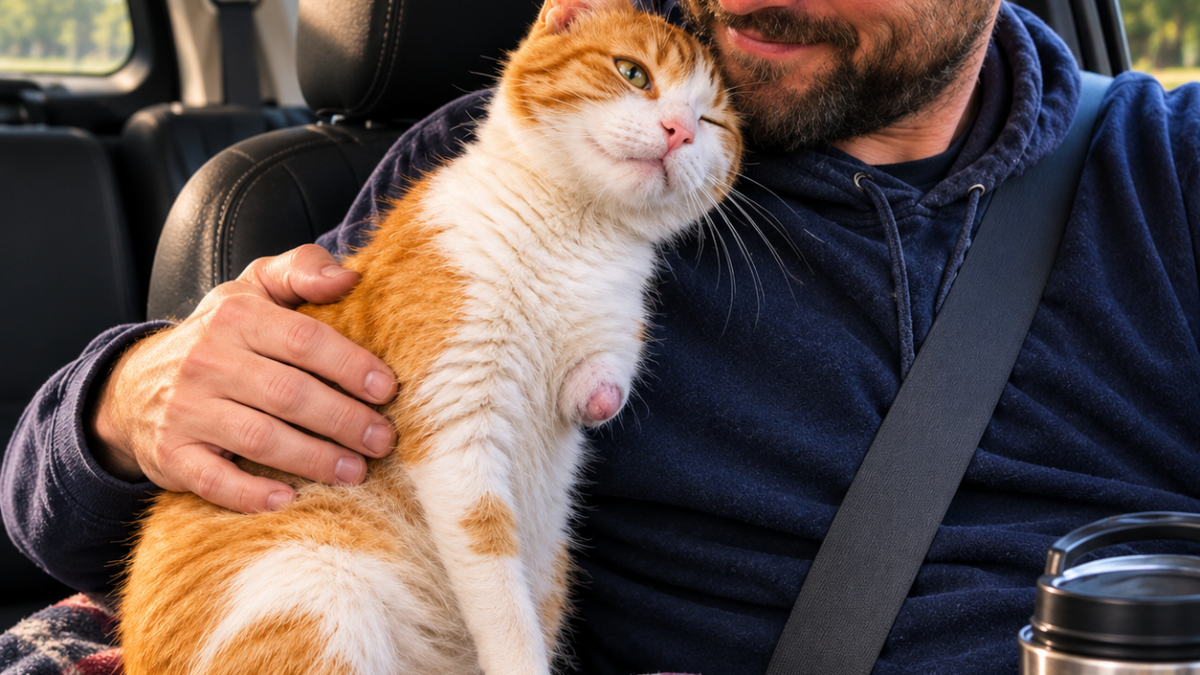
At two in the morning, I watched an eleven-second shelter video of a one-eyed, three-legged cat who had spent 437 days waiting for somebody to choose him, and before the clip ended, I already knew I wasn’t going back to sleep.
I lived seven hours away in Indianapolis, had never heard of the tiny Mississippi shelter that posted him, and had absolutely no sensible reason to believe I should be the person who changed his life.
But when the orange-and-white cat pushed his face against a volunteer’s fingers through the kennel bars, something about that tiny gesture hit a place in me I had spent years pretending didn’t hurt.
My name is Kevin.
That night, I wasn’t searching for a cat.
I wasn’t searching for anything, really.
I was lying on my couch with the lights off, scrolling through my phone because sleep had become one of those things that seemed simple for everybody except me. I had work in a few hours. My coffee mug from the previous morning was still on the table, and the television was playing silently because I hadn’t bothered turning it off.
Then the video appeared.
No dramatic music.
No professionally edited rescue montage.
Just a shelter kennel.
A volunteer’s hand.
And an orange-and-white cat balancing on three legs as he pushed his cheek through the bars.
I nearly scrolled past.
Then I noticed his face.
His right eye was gone.
His front left leg was gone too.
But he wasn’t hiding at the back of the kennel.
He was leaning toward the person filming him.
Purring.
Loudly.
I turned up the volume.
The phone’s microphone had captured it clearly.
That soft, ridiculous little motor filled my dark apartment.
I watched the video again.
Then a third time.
Only after that did I read the caption.
“Oliver has been here for 437 days. He’s missing his front left leg and his right eye. He’s the sweetest cat we’ve ever cared for. Not a single person has asked about adopting him.”
I stared at the number.
Four hundred thirty-seven days.
I opened the comments.
People wrote things like, “Poor baby,” and, “I hope somebody gets him.”
There were hearts.
Sad faces.
Promises to share.
What I didn’t see was anyone saying, “I’m coming.”
I clicked on the shelter’s page.
Southern Mississippi.
I actually laughed under my breath.
“Of course.”
I was in Indianapolis.
I pulled up the route anyway.
Seven hours.
Give or take.
I put the phone down.
“This is stupid.”
The apartment gave me no argument.
I picked the phone back up.
I watched Oliver again.
He pushed his face against that hand as if he had done it a thousand times before.
As if every time a human walked past his kennel, he still believed this might finally be the one who stopped.
That was the part I couldn’t shake.
Four hundred thirty-seven days meant more than a year of footsteps passing him.
More than a year of kennel doors opening for other animals.
More than a year of people looking.
And choosing something else.
I knew something about that feeling.
Maybe that was why I checked the shelter’s opening hours.
Nine a.m.
At 8:57 the next morning, I was sitting in my car outside work with the shelter’s phone number already typed into my screen.
At exactly nine, I called.
A woman answered on the fourth ring.
“County Animal Services, this is Melissa.”
“Hi. I’m calling about Oliver.”
There was a pause.
“The orange cat?”
“The one with three legs.”
“Oh.”
Her voice changed slightly.
“Yeah. Oliver’s still here.”
“I want to adopt him.”
Another pause.
This one longer.
“Okay. Are you local?”
“No.”
“How far away are you?”
I looked through my windshield.
“Indianapolis.”
Silence.
Finally she said, “Indiana?”
“Yeah.”
“Sir, we’re in Mississippi.”
“I know.”
“You’re calling about Oliver from Indiana?”
“Yes.”
I heard movement on her end, then a muffled voice.
Someone asked her something.
She covered the phone, but not well enough.
“He says he’s coming from Indiana for Oliver.”
Another voice responded, “Seriously?”
Melissa came back.
“I’m sorry. Are you genuinely serious?”
I looked at the photograph I had saved from their post.
Oliver’s one eye seemed fixed directly on the camera.
“Yes.”
“When were you thinking of coming?”
I answered before common sense had another chance to interfere.
“Tomorrow.”
There was another quiet moment.
Then Melissa said something I hadn’t expected.
“Can I ask you to hold for just a second?”
“Sure.”
The line went silent.
Thirty seconds passed.
Then a minute.
When she returned, her voice sounded different.
Softer.
“Kevin?”
“Yeah?”
“I just went back to Oliver’s kennel.”
I sat straighter.
“Is he okay?”
“He’s fine.”
She took a breath.
“But I think you should know something before you drive seven hours down here.”
PART 2
My hand tightened around the phone.
“What?”
Melissa hesitated just long enough to make every bad possibility rush into my head.
Was he sick?
Had something changed overnight?
Had somebody else adopted him?
“Oliver has been here a long time,” she said. “A really long time.”
“I know. Four hundred thirty-seven days.”
“Right.”
I waited.
She continued carefully.
“He does well with people. He loves attention. He’s probably one of the most affectionate cats we have. But I don’t want you driving all the way from Indiana because of one video and expecting him to be… I don’t know. Perfect.”
I almost laughed.
“I saw the missing eye.”
“That isn’t what I mean.”
“Then what do you mean?”
“He’s been in a shelter for more than a year. He’s comfortable with us because he knows us. A new person, a new home, a fourteen-hour travel day—that’s a lot. He may hide. He may be scared. He may not act anything like he did in the video at first.”
I looked down at my steering wheel.
“That doesn’t change anything.”
“You haven’t met him.”
“No.”
“And you understand he has only three legs.”
“Yes.”
“He’ll probably need some accommodations as he gets older.”
“Okay.”
“His remaining front leg takes more strain than it would on a four-legged cat.”
“I understand.”
“We’d give you all his medical information.”
“Good.”
Another silence.
Then she asked, “Why Oliver?”
I didn’t have an answer I could make sound logical.
So I told her the truth.
“I watched him.”
“I know.”
“No. I mean I watched him, and everybody kept saying they hoped somebody would take him.”
I swallowed.
“I realized I was somebody.”
Melissa didn’t speak for several seconds.
Then I heard her exhale.
“All right.”
“All right what?”
“We’ll start the application.”
I completed it from my phone during lunch.
Employment information.
Housing.
Veterinary references, which I didn’t have because I didn’t currently own a pet.
Whether animals were allowed in my apartment.
Yes.
Whether I understood the responsibilities associated with adopting an animal with physical disabilities.
Yes.
Whether I intended to declaw him.
Absolutely not.
Whether I would return him if he had difficulty adjusting.
I stopped at that question.
There was a box for explanation.
I typed:
I am driving seven hours to pick him up. I’m not bringing him back because he needs time to learn my apartment.
I reread it.
It sounded defensive.
I left it anyway.
Melissa called that afternoon.
“You’re approved.”
I stood from my desk.
“Seriously?”
“Seriously.”
“That’s it?”
“Well, we called your landlord.”
“You called him already?”
“You said you wanted to leave at four tomorrow morning.”
I smiled.
“I do.”
“He confirmed pets are allowed. Your references checked out.”
Then I heard amusement in her voice.
“And apparently your boss thinks you’re crazy.”
I frowned.
“You called my boss?”
“He was one of the references you gave us.”
I had forgotten.
“What did he say?”
“That if you’re willing to drive fourteen hours for a cat you’ve never met, we’re welcome to him.”
I laughed.
“That sounds like Mark.”
Melissa laughed too.
Then her voice softened.
“We’ll have Oliver ready.”
That evening, I should have gone directly home and slept.
Instead, I went to a pet store.
I stood inside the entrance holding a shopping cart and realized I had no idea what I was doing.
An employee in a green apron approached me.
“Need help?”
“I need cat stuff.”
She smiled.
“That narrows it down.”
“I don’t have a cat.”
She glanced at the empty cart.
“But you’re getting one?”
“Tomorrow.”
“Kitten or adult?”
“Adult.”
“Long hair?”
“No.”
“Any special needs?”
I hesitated.
“He has three legs.”
Her expression didn’t change.
“Okay.”
“And one eye.”
Still nothing dramatic.
“Okay.”
That reaction immediately relaxed me.
Not “poor thing.”
Not “oh my God.”
Just okay.
She helped me choose a low-sided litter box that would be easy for Oliver to step into.
Food bowls with rubber bases.
A scratching pad.
A bed.
A carrier, although the shelter had already said they’d send him home in one.
A small set of carpeted pet steps so he could reach the couch without needing to jump.
Toys.
Food.
A soft blanket.
I kept adding things.
At one point, the employee looked into my cart.
“You know the cat doesn’t actually know how much money you spend, right?”
“Good.”
“Why is that good?”
“Because I’m already embarrassed.”
She laughed.
When I reached the register, I had spent far more than planned.
Back at my apartment, I put everything out.
I positioned the bed in the living room.
Then moved it.
Then moved it back.
I placed the litter box in the bathroom.
Then decided that was too far from the living room.
Then realized I was reorganizing my entire apartment for an animal who had never seen me.
At eleven, I finally sat down.
My phone was on the coffee table.
Oliver’s video was still open.
I watched it once more.
Eleven seconds.
I wondered how many people had seen it.
How many had paused.
How many had felt sad.
How many had kept scrolling.
I wasn’t judging them.
I had kept scrolling past hundreds of animals before.
That was what bothered me.
Why him?
I didn’t know.
And underneath that question was another one I was less comfortable with.
Why did the sentence “not a single person has asked about adopting him” affect me so much?
I knew the answer.
I just didn’t like looking at it directly.
There are kinds of loneliness you can talk about without feeling exposed.
Being single.
Living alone.
Working too much.
Moving to a city where you don’t know many people.
Those were easy.
The harder truth was that I knew what it was like to be evaluated quietly and found lacking.
Not because of one dramatic rejection.
Because of dozens of little ones.
Jobs I nearly got.
Relationships where I was good enough until someone more exciting came along.
Friendships that disappeared when I stopped being the person who always made the first call.
Rooms where people were polite to me without ever really choosing me.
None of that was comparable to what Oliver had endured.
I knew that.
But when I saw him leaning into the volunteer’s fingers after 437 days of being passed over, I understood something about the stubbornness of still wanting affection.
That part felt familiar.
At 3:20 the next morning, my alarm rang.
I was already awake.
By four, I was on Interstate 65 heading south.
Indianapolis was still dark behind me.
I had coffee in the cup holder, Oliver’s empty carrier strapped into the passenger seat just in case, and seven hours of highway ahead.
For the first hour, I felt ridiculous.
Not regretful.
Just aware of how the story would sound if it went badly.
Man drives seven hours to adopt internet cat.
Internet cat hates man.
Man drives seven hours home while cat screams.
At a gas station in Kentucky, I called Melissa.
“You don’t have to check in,” she said.
“I know.”
“He’s still here.”
“I know.”
“You think we’re going to give him away in the next four hours?”
“Maybe somebody finally realizes he’s great.”
She laughed.
“Kevin, I promise you Oliver will be waiting.”
I looked south down the highway.
“Okay.”
Then she added, “Actually, he is waiting.”
“What does that mean?”
“One of the volunteers got here early. She told him today’s his day.”
My throat tightened unexpectedly.
“You told the cat?”
“We talk to all of them.”
“Does he understand English?”
“Selective English.”
I laughed.
“See you soon.”
The farther south I drove, the more nervous I became.
That surprised me.
I had made the decision.
The adoption was approved.
There was no real uncertainty left.
Yet somewhere in northern Mississippi, my stomach started twisting.
What if Oliver was afraid of me?
What if I had mistaken a good eleven-second clip for a connection that didn’t exist?
What if I walked through those shelter doors and felt nothing?
Worse, what if he felt nothing?
I became angry with myself for even thinking that.
The entire point was supposed to be giving him a home.
Not demanding some magical recognition scene in return.
He didn’t owe me gratitude.
He didn’t owe me affection.
He didn’t owe me the behavior from the video.
He had spent 437 days in a kennel.
If he wanted to spend the first month beneath my couch, then beneath my couch was where he could live.
I repeated that to myself for the last hundred miles.
By the time I reached the shelter, it was shortly after eleven.
The building was smaller than I expected.
Low brick walls.
A faded sign near the road.
A fenced dog area behind it.
Nothing about the place suggested that I had just driven through four states to reach it.
I parked.
Turned off the engine.
Then sat there.
Seven hours of momentum disappeared in one second.
I looked through the windshield.
“Come on, Kevin.”
I opened the door.
The moment I walked inside, a woman behind the desk looked up.
Her eyes widened.
“Indianapolis?”
I smiled.
“I’m guessing you’re Melissa.”
She came around the counter.
“You actually came.”
“You thought I wouldn’t?”
She gave me an apologetic smile.
“We’ve had people promise to come from twenty minutes away and never show up.”
That sentence followed me as she led me down the hallway.
Dogs barked from another room.
A phone rang somewhere near reception.
The air smelled like disinfectant and dry food.
Then Melissa stopped.
“He’s not in his kennel.”
My heart dropped.
“What?”
She immediately laughed.
“No, no. We moved him up front.”
“That was cruel.”
“Sorry.”
She pushed open another door.
A blue plastic carrier sat on a chair.
Beside it was a thick folder.
On top, someone had taped a handwritten note.
OLIVER — GOING HOME.
I stared at those two words.
Going home.
Melissa watched me.
“You okay?”
“Yeah.”
“You haven’t even met him yet.”
“I know.”
She opened the carrier door.
For a few seconds, nothing happened.
Then I saw orange fur.
Oliver turned around awkwardly inside the carrier.
That was the first time his missing leg became fully real to me.
His left shoulder ended smoothly beneath his fur.
His right eye was gone, the socket long healed and covered by skin and orange-white hair.
His remaining eye was a deep amber.
He looked at me.
I crouched.
“Hey, Oliver.”
He sniffed.
I held out one finger.
He leaned forward.
Then he pressed the side of his face against my hand.
Exactly like the video.
I froze.
Oliver pushed harder.
His purr started almost immediately.
Loud.
Ridiculously loud.
Melissa laughed behind me.
“There it is.”
I didn’t answer.
I couldn’t.
For seven hours, I had told myself not to expect anything.
No cinematic recognition.
No immediate bond.
No proof that I had done the right thing.
Then Oliver did the same small thing that had made me get into my car in the first place.
He pushed his face into my hand.
My eyes burned.
I looked down because I didn’t want Melissa seeing it.
She saw it anyway.
“He does that.”
“Yeah.”
“To everybody he likes.”
“Don’t ruin this for me.”
She laughed.
“Sorry.”
I scratched beneath Oliver’s chin.
His purr grew louder.
And just like that, the fourteen-hour question became easy.
I would have driven farther.
Melissa walked me through Oliver’s medical records.
He had arrived at the shelter after being found injured near a rural road.
No one knew exactly what had happened.
His front left leg had been too badly damaged to save.
His right eye had also been severely injured.
Surgery had removed both.
The shelter had expected his recovery to be difficult.
Instead, Oliver adapted quickly.
He learned to balance.
Learned to jump short distances.
Learned to use the litter box without trouble.
And, according to Melissa, started demanding attention almost immediately.
“So why has he been here 437 days?”
I already knew the answer.
But I needed to hear it.
Melissa looked through the kennel-room window.
“People see what’s missing.”
I said nothing.
“They walk through. They ask about kittens. They ask for cats that look a certain way. Sometimes someone stops at Oliver’s kennel and says he’s sweet.”
“But?”
“But then they keep walking.”
“Not one application?”
She shook her head.
“Not one serious adoption application before yours.”
That made me angry in a way I couldn’t quite justify.
Nobody had done anything wrong by choosing another animal.
Every adoption was good.
Every cat who left mattered.
Still, I looked at Oliver and thought about 437 nights in the same building.
“Did he ever get depressed?”
Melissa considered the question.
“Sometimes.”
“What did that look like?”
“He’d have quieter days.”
She closed the folder.
“Especially after busy adoption events.”
I looked at her.
She continued.
“The shelter would be full in the morning. Then families would come through. By the end of the day, five or six kennels might be empty.”
“And his wasn’t.”
“No.”
My jaw tightened.
“He watched them leave?”
“All of them do.”
I looked at Oliver.
He was now washing one paw.
Melissa said quietly, “But he never stopped coming to the front of the kennel when somebody walked past.”
That hurt more than anything else she had told me.
Not the amputation.
Not the eye.
The fact that after more than a year of being passed over, he still came forward.
He still tried.
I signed the final paperwork.
Melissa showed me his medication history.
His vaccination record.
His feeding schedule.
His favorite treats.
Then one of the volunteers came in.
She was an older woman named Patrice.
The second she saw Oliver’s carrier, she pressed both hands to her mouth.
“You’re the Indiana man.”
Apparently I had become a category.
“That’s me.”
She looked at me with narrowed eyes.
“You better be good to him.”
“I plan to.”
“No, I’m serious.”
“So am I.”
She stared another second.
Then she hugged me.
I wasn’t prepared for it.
“Okay,” I said, awkwardly returning it.
She stepped back and wiped her eyes.
“I’ve cleaned that boy’s kennel almost every Saturday for a year.”
Oliver meowed from the carrier.
Patrice crouched.
“Oh, don’t start.”
He pushed his face toward the door.
She put her fingers through the bars.
His purr returned.
“You know you’re leaving, don’t you?”
I looked at Melissa.
“Does everybody talk to him like he’s human?”
“Yes.”
“Good.”
Patrice looked at me.
“He likes to sleep with one paw stretched straight out.”
“Okay.”
“He doesn’t like the vacuum.”
“Understandable.”
“He’ll steal chicken.”
“I’ll protect my chicken.”
“And if he climbs somewhere and can’t figure out how to get down, he’ll pretend that was his plan.”
I smiled.
“That sounds familiar.”
Patrice looked at me more carefully.
“Familiar how?”
I shrugged.
“Nothing.”
She didn’t press.
We carried Oliver outside.
Before I loaded him into the car, I opened the carrier door.
“I just want to check him.”
Melissa nodded.
I reached inside.
Oliver immediately pressed his head against my palm again.
Same gesture.
Same rumbling purr.
I laughed.
“All right. I get it.”
He stepped forward as though he intended to climb out.
“Not yet.”
He disagreed.
I tried putting him back.
He came forward again.
Eventually I secured him for the first few miles.
The shelter staff stood near the door as I pulled away.
I glanced in the rearview mirror.
Three of them were waving.
One was crying.
That was when the full weight of 437 days hit me.
Oliver hadn’t simply lived at that shelter.
People there loved him.
They had kept him alive.
Fed him.
Cleaned his kennel.
Paid for surgeries.
Waited.
Shared his picture.
Posted his video.
And now they were trusting me to become the person they had spent 437 days hoping would show up.
No pressure.
Twenty minutes into the drive, Oliver began objecting to the carrier.
Not screaming.
Not panicking.
Just one deliberate meow every thirty seconds.
“Buddy, you’ve got six and a half hours left.”
Meow.
“I know.”
Meow.
“You’re safer in there.”
Meow.
“You’re very persuasive.”
At the next rest area, I stopped.
I closed every door and window, then opened the carrier.
Oliver stepped out.
Three legs made him move differently, but not helplessly.
His back legs did most of the work while his remaining front leg placed itself carefully ahead.
He sniffed the passenger seat.
Then the dashboard.
Then the center console.
He climbed onto it.
Sat down.
And looked at me.
“No.”
He blinked.
“You’re going back in the carrier.”
I picked him up gently.
He purred while I returned him.
Five minutes later, the meowing started again.
At the next fuel stop, I tried once more.
Same result.
He climbed directly onto the center console.
“Oliver.”
He curled one back leg under himself.
“I’m serious.”
He closed his eye.
I stared at him.
“You have known me for less than an hour.”
Purr.
“You cannot already be this manipulative.”
Purr.
Eventually, I gave up.
I arranged the blanket so he had a stable place to sit and kept one hand near him whenever traffic slowed or turned.
For most of the drive, Oliver sat on the center console.
Sometimes he slept.
Sometimes he looked out the windshield.
Sometimes he leaned against my arm.
Seven hours earlier, I had driven south alone.
Now I was talking to a one-eyed tripod cat like we’d been commuting together for years.
Somewhere in Tennessee, my phone rang through the car speakers.
Mark.
My boss.
“You get the cat?”
“He’s sitting beside me.”
“So you drove seven hours and he actually existed.”
“Yes, Mark.”
“Need proof.”
“I’m driving.”
“Send a picture when you stop.”
“Why?”
“Office pool.”
I frowned.
“What office pool?”
“Half of us thought you’d change your mind.”
“You bet on me?”
“Technically we bet on whether you’d return with the cat.”
“Who won?”
“Me.”
I shook my head.
“You’re terrible.”
“What does he look like in person?”
I glanced at Oliver.
“Like the video.”
“Sad?”
“No.”
That answer surprised even me.
Oliver didn’t look sad.
Different, yes.
His missing eye was obvious.
His missing leg was impossible not to notice.
But once he was sitting beside me, those things stopped being the center of his appearance.
“He looks comfortable,” I said.
Mark was quiet for a moment.
“Good.”
Then he asked, “You happy?”
That question caught me off guard.
“I’ve had him three hours.”
“That’s not what I asked.”
I looked at Oliver.
His head was resting against my forearm.
“Yeah.”
The word came out softer than I expected.
“Yeah, I think I am.”
We reached Indianapolis around 8:30 that evening.
Fourteen hours on the road.
My back hurt.
My coffee had been terrible.
I’d eaten lunch from a gas station.
And somehow it felt like the shortest long drive I’d ever made.
I carried Oliver upstairs.
The moment I put his carrier down in my apartment, he stopped purring.
He stared through the open door.
New smells.
New sounds.
New room.
I sat on the floor.
“Take your time.”
He stepped out.
First the remaining front paw.
Then his back legs.
He sniffed the carpet.
Looked at me.
Then began exploring.
I had expected him to hide.
Instead, he inspected the living room.
Then the kitchen.
Then the bathroom.
Then the bedroom.
Every corner.
Every doorway.
He moved slowly but deliberately, like a building inspector with unusually low standards.
When he found the litter box, he climbed inside, sniffed it, then climbed back out.
When he saw the little staircase I’d bought for the couch, he ignored it completely and jumped onto the couch without using it.
I stared at the expensive stairs.
“Excellent purchase.”
Oliver washed his face.
Eventually, after almost half an hour of inspecting his new territory, he returned to the living room.
I sat down.
He climbed onto the couch.
Turned in a circle.
Then curled beside my leg.
Within two minutes, he was asleep.
Just like that.
No ceremony.
No dramatic moment.
No understanding of how far I had driven.
He simply decided the couch was safe.
I looked around the apartment.
Nothing had changed.
Same furniture.
Same lamp.
Same dishes in the sink.
Same silence outside.
Yet the room felt different.
Not louder.
Fuller.
I stayed awake long after Oliver fell asleep.
At one point, he rolled slightly onto his side.
The missing leg faced upward.
The empty eye faced me.
There was no way to look at him without seeing what he had lost.
But for the first time, I understood why the shelter workers didn’t speak about him with pity.
Oliver wasn’t waiting for someone to rescue a broken cat.
He had already survived.
He was waiting for somebody to recognize the rest of him.
The next morning, I woke on the couch.
I hadn’t intended to sleep there.
Oliver was still against my leg.
When I moved, his eye opened.
“Morning.”
He stretched his remaining front leg straight ahead.
Patrice had been right.
Then he stood and walked directly toward the kitchen.
“You’ve been here twelve hours and already know where food lives.”
He looked back at me.
“Fair enough.”
I took a picture after breakfast.
Oliver was asleep on the couch.
One eye closed.
The side where his front leg was missing faced the camera.
He looked completely relaxed.
I sent it to Melissa.
Her response came almost immediately.
OH MY GOD.
Then:
Can we post this?
I wrote back:
Absolutely.
An hour later, the shelter uploaded the original eleven-second video beside the new photograph.
Their caption was simple.
“Oliver waited 437 days. Kevin drove 14 hours. Some things just take time.”
The post spread farther than anyone expected.
At first, I didn’t know.
I was working.
Oliver was home, probably sleeping somewhere he wasn’t supposed to be.
Then my phone started vibrating.
Messages.
Notifications.
Friend requests from people I didn’t know.
Mark walked into my office holding his phone.
“Congratulations.”
“For what?”
“You’re internet cat guy now.”
“No.”
“Yes.”
“No.”
He turned the phone toward me.
The post had been shared thousands of times.
Comments poured underneath it.
Most were kind.
Some made me uncomfortable.
“You’re a hero.”
“Faith in humanity restored.”
“This man deserves everything good in life.”
I didn’t feel like a hero.
I had spent money on gasoline and driven a car.
The people at the shelter had cared for Oliver for 437 days.
They had helped him survive surgery.
They cleaned his kennel.
They posted his photograph again and again.
I had simply arrived at the end of their work.
Then I saw one question repeated in different forms.
Why drive that far for a cat with one eye and three legs?
Why not adopt closer to home?
Why Oliver?
I stared at those questions.
The first few times, I ignored them.
Then someone wrote:
“I think it’s wonderful, but I’m genuinely curious. Why drive fourteen hours for a disabled cat you’ve never met?”
I started typing.
Deleted it.
Started again.
Deleted that too.
I could have said the video touched me.
True.
I could have said Oliver deserved a home.
True.
I could have said distance didn’t matter.
Also true.
But none of those answers explained why I had been awake at three in the morning looking at driving routes to Mississippi.
So I typed the only answer that did.
“I’ve been passed over too. You know it when you see it.”
Then I put my phone away.
I didn’t think much about it.
By lunch, Mark returned.
“What did you do?”
“What?”
“Your comment.”
“What about it?”
He held out the phone.
Thousands of people had reacted to it.
Screenshots were being reposted.
People were sharing stories underneath it.
A man wrote about losing his job after becoming disabled.
A woman wrote about being divorced after a cancer diagnosis.
Someone described growing up in foster care.
Another person talked about adopting an elderly dog everyone had overlooked.
The comment had somehow spread farther than the original shelter post.
I felt exposed.
Not celebrated.
Exposed.
Mark pulled up a chair.
“You okay?”
“I didn’t mean for that to become a thing.”
“What did you think would happen?”
“I thought about six people would read it.”
He smiled.
“You posted it under a viral cat story.”
“I am learning how the internet works.”
He looked at me for a moment.
“You’ve never really talked about that.”
“About what?”
“Being passed over.”
I shrugged.
“Nothing to talk about.”
He gave me a look.
“Okay.”
He knew better.
So did I.
That evening, I went home earlier than usual.
Oliver met me at the door.
Or tried to.
He wasn’t exactly graceful at high speed.
Three-legged cats develop remarkable balance, but enthusiasm occasionally outran his coordination.
He hopped quickly around the corner, slid slightly on the hardwood, corrected himself, then continued as if nothing had happened.
I dropped my keys.
“Very dignified.”
He meowed.
I sat on the floor.
Oliver pressed his forehead into my chest.
My phone kept vibrating in my pocket.
I ignored it.
“I caused a problem today.”
Purr.
“Apparently telling strangers you have emotional issues is popular.”
Purr.
“I should’ve just said you were cute.”
Oliver climbed partly into my lap.
I laughed.
For all the attention the story received, our actual life became ordinary surprisingly fast.
And that was the part I liked best.
Oliver had no interest in being inspirational.
He wanted breakfast.
He wanted the warm patch of sunlight beside the living-room window.
He wanted the blanket folded a specific way.
He wanted my laptop closed whenever he decided my hands should be petting him instead.
The little stairs I had purchased remained mostly decorative.
He used them when he felt like it, which was rarely.
He learned to jump onto the couch using his back legs and right front paw.
The first few times, I stood close, terrified he’d fall.
He looked insulted by my concern.
I started researching tripod cats.
Everything I read repeated the same point: don’t treat them as fragile if they aren’t.
Protect their joints.
Control their weight.
Provide easier access where useful.
But let them be cats.
That became my rule.
Oliver wasn’t my project.
He wasn’t evidence that I was a good person.
He wasn’t an inspirational story that lived in my apartment.
He was a cat.
A deeply opinionated one.
He hated closed bathroom doors.
He loved rotisserie chicken.
He believed 4:55 a.m. was a perfectly appropriate breakfast time.
He could somehow occupy seventy percent of a queen-size bed despite weighing eleven pounds.
And he had no concept of personal space.
Within two weeks, he started sleeping against my chest.
Within three, he had learned the sound of my car in the parking lot.
By the end of the first month, I couldn’t remember what I had done in the evenings before he arrived.
The shelter called periodically.
Mostly Melissa.
“How’s our boy?”
“Your boy has discovered kitchen counters.”
“With three legs?”
“Do not underestimate him.”
She laughed.
“We warned you.”
“You absolutely did not warn me about this.”
“How’s the eye?”
“Fine.”
“Mobility?”
“Too good.”
“Eating?”
“Like I’m running out of food tomorrow.”
“Sounds like Oliver.”
Then she would become quiet for a second.
“Send pictures.”
I always did.
Sometimes I sent too many.
One evening, Patrice called from the shelter.
Melissa had given her my number after asking permission.
“How is he really?”
I understood the question.
Not the Facebook version.
Not the photograph.
Really.
“He’s good.”
“Any hiding?”
“First night, no. A little when the vacuum comes out.”
“He always hated that.”
“He sleeps beside me.”
“Oh.”
Her voice cracked slightly.
I waited.
She cleared her throat.
“Sorry.”
“You miss him.”
“We all do.”
I looked toward the couch.
Oliver was upside down with one back leg in the air.
“I could bring him down sometime.”
“To Mississippi?”
“Maybe.”
“That cat already did enough traveling.”
I smiled.
“Fair.”
She became quiet again.
“You know, Kevin, we had people say we should stop posting him.”
My smile disappeared.
“What?”
“Not staff. People online. They’d say nobody was going to drive to adopt a cat like that. Said we should focus on the more adoptable animals.”
“More adoptable?”
“That’s how some people talk.”
I felt anger rise.
“What did you say?”
“That Oliver had a home somewhere. We just hadn’t found it yet.”
I looked at him.
“And you were right.”
“We got lucky.”
“No.”
I shook my head even though she couldn’t see me.
“You kept posting.”
For a long moment, neither of us spoke.
Then Patrice said, “Maybe both.”
That conversation stayed with me.
Because I began thinking about what “passed over” actually meant.
It wasn’t always cruelty.
Usually it wasn’t.
Nobody had stood in front of Oliver’s kennel and said he didn’t deserve a home.
They had simply chosen someone else.
Again.
And again.
And again.
Rejection doesn’t always arrive as an insult.
Sometimes it is just a door opening for somebody beside you.
Then closing again before you reach it.
I knew that version.
Years earlier, I’d spent almost a decade working for another company.
I was dependable.
Always early.
Took weekend shifts.
Trained new employees.
Three times, I applied for management positions.
Three times, someone else was selected.
The first time, I accepted it.
The second time hurt.
The third time, my supervisor had asked me to train the man who got the job.
I remembered sitting across from him while he said, “Don’t take it personally.”
That phrase had always amazed me.
As though decisions about your life became impersonal because the other person said so.
Eventually I left.
I took a lower-paying position at Mark’s company.
Within two years, I was doing better than I ever had before.
But some part of that old feeling stayed.
Useful enough to keep.
Not valuable enough to choose.
There had been a relationship too.
Sarah.
We were together almost four years.
I thought we’d get married.
She eventually told me that she loved me but didn’t see a future with me.
Six months later, she was engaged to someone else.
I never hated her for it.
People are allowed to know what they want.
But the experience left an ugly little question behind.
What is it about me that people don’t choose?
I never said that aloud.
Not to Mark.
Not to friends.
Certainly not to strangers on the internet.
Until Oliver.
“I’ve been passed over too.”
Six words.
Somehow easier to type to strangers than say to someone sitting across from me.
Oliver didn’t understand any of that.
He just knew when I got quiet.
When I sat too long on the couch without turning on the television, he’d climb beside me.
Then he’d press his head beneath my hand.
The same gesture.
Every time.
Months passed.
The viral attention faded.
That was a relief.
Oliver didn’t become less important because people stopped sharing his photograph.
In fact, I think that was when he became truly mine.
Not because paperwork said so.
Because our life stopped being a story anyone else was watching.
There were vet appointments.
Hair on furniture.
A shattered coffee cup after he misjudged a jump.
The night he threw up on my comforter at three in the morning.
The afternoon he stole a chicken breast from a plate and somehow carried it across the kitchen on three legs.
“That’s impressive,” I told him while taking it away.
He growled.
“You are not a tiger.”
Another growl.
“You are eleven pounds.”
He disagreed.
The first time Oliver fell badly, I panicked.
He had tried jumping from the back of the couch to a window ledge.
His remaining front paw slipped.
He landed awkwardly.
I was across the room before he even stood.
“Oliver!”
He limped two steps.
My stomach dropped.
I called the emergency vet before he had time to decide whether he was actually hurt.
The veterinarian examined him.
Nothing broken.
Minor strain.
“Keep him quiet for a few days.”
I almost laughed.
“How?”
The veterinarian looked at Oliver.
Oliver was currently attempting to climb out of the carrier.
“Good point.”
That scare forced me to confront something I had tried not to think about.
Oliver’s body had limitations.
His remaining front leg did more work.
His spine compensated for an uneven gait.
As he aged, arthritis could become a problem.
I couldn’t love that away.
So I changed the apartment.
Rugs went onto slippery floors.
Low platforms replaced some higher jumps.
I moved a chair near the bedroom window so he could climb in stages.
I finally convinced him to use the couch stairs by putting treats on every step.
The first time he used them without bribery, I felt absurdly proud.
“You realize normal people don’t applaud cats for walking upstairs.”
Oliver looked at me.
“Fine. You’re exceptional.”
On the anniversary of his adoption, the shelter posted his story again.
437 days.
Fourteen hours.
One year home.
Melissa sent me the post.
Underneath, someone had commented:
“Sometimes the one nobody wants is exactly the one somebody needs.”
I stared at it.
It sounded sentimental.
The sort of phrase I normally would have rolled my eyes at.
Yet Oliver was sleeping across my feet while I read it.
I wondered whether I had saved him.
People kept saying I had.
But the word never felt accurate.
The shelter saved him.
The surgeons saved him.
The volunteers saved him hundreds of times, one meal and one cleaned kennel at a time.
I had given him a permanent address.
What had he given me?
That answer was harder.
He had made my apartment feel like somewhere I wanted to go home to.
He had forced routine into evenings that used to blur together.
He had made silence comfortable instead of empty.
Most importantly, Oliver had changed the question I kept asking myself.
Why wasn’t I chosen?
I began realizing how much of my life I had spent waiting for other people to answer that.
Employers.
Partners.
Friends.
As though being chosen by someone else was the only proof that I mattered.
Oliver didn’t fix that in one dramatic moment.
He simply made the idea harder to believe.
Because every evening when I opened my apartment door, he chose me.
Not metaphorically.
Literally.
He could stay on the couch.
Stay by the window.
Stay in the bedroom.
Instead, he came toward me.
One eye.
Three legs.
Moving faster than looked sensible.
Every single day.
The strangest thing happened about eighteen months after the adoption.
I received an email from a man I didn’t know.
His name was Thomas.
He wrote that he had seen Oliver’s story when it first went viral.
At the time, his family had recently lost their elderly cat.
His twelve-year-old daughter had wanted another, but Thomas said he wasn’t ready.
Then his daughter showed him my comment.
“I’ve been passed over too. You know it when you see it.”
Months later, they adopted a senior black cat from their local shelter.
The cat had been there almost a year.
Thomas attached a photograph.
An old black cat was sleeping beside a little girl.
At the bottom of the email, he wrote:
I don’t know if you realize your decision traveled farther than fourteen hours.
I sat at my kitchen table reading that line three times.
Oliver jumped onto the chair beside me.
I scratched his head.
“You caused trouble.”
Purr.
Then more messages appeared over the years.
Not hundreds.
Just occasional ones.
A three-legged dog adopted in Ohio.
A deaf cat in Pennsylvania.
A twelve-year-old shelter dog in Illinois.
People didn’t always say Oliver was the reason.
And I didn’t want him to become some mascot used to make people feel guilty about which animal they adopted.
Every animal deserved a good home.
But if his story made somebody pause at the kennel everyone else walked past, I was glad.
One December, three years after I brought him home, I drove back to Mississippi.
Not because anything was wrong.
I had vacation time.
Melissa had been asking for years.
And Patrice had recently retired from regular volunteering after knee surgery.
I decided Oliver should visit.
This time, the drive south was different.
He hated the carrier just as much as before.
Eventually, at a rest stop, I let him sit secured beside me in his travel bed.
He slept most of the way.
When we reached the shelter, I carried him inside.
Melissa came around the counter so fast she nearly knocked over a chair.
“No way.”
Oliver looked at her.
She crouched.
“Oliver?”
His ear moved.
Then Patrice appeared from the hallway.
She had come in specifically because she knew we were visiting.
For a second, she just stood there.
Her eyes filled immediately.
“Oh, baby.”
I placed Oliver on the floor.
He looked around.
The building had changed.
New paint.
Different furniture.
But some smells must have been familiar.
He froze.
I worried bringing him back had been a mistake.
Then Patrice knelt.
“Hey, handsome.”
Oliver stared.
She extended her hand.
For several seconds, nothing happened.
Then he moved toward her.
Three-legged hop.
Another.
Another.
He pressed his face into her palm.
Patrice started crying.
“I knew you remembered me.”
Melissa was crying too.
I looked away.
“I drove fourteen hours again just for everybody to cry.”
Patrice laughed through tears.
“Shut up, Indiana.”
They took us to the kennel where Oliver had spent most of those 437 days.
It was empty.
I stood outside it.
Oliver was in my arms.
The kennel looked smaller than I had imagined.
A metal door.
A narrow bed.
Space for bowls.
That’s all.
“He lived here?”
Melissa nodded.
“For most of it.”
Four hundred thirty-seven nights.
I touched Oliver’s back.
His body relaxed against my chest.
“Did he see the front door from here?”
“No.”
“Good.”
“Why good?”
“I don’t know.”
Maybe because I didn’t want to imagine him watching families leave.
Patrice stood beside me.
“You know, on your adoption day, I didn’t believe you were real.”
I looked at her.
“What?”
“Not until you walked through the front door.”
“Why?”
“Because people promised things.”
Her face tightened.
“We’d get comments. Messages. ‘I’m coming tomorrow.’ ‘Save him for me.’ ‘I wish I lived closer.’”
She looked at Oliver.
“After a while, you stop celebrating until the paperwork is signed.”
I thought about Melissa asking whether I was genuinely serious.
Now I understood.
Patrice smiled.
“You were the one crazy person who actually came.”
“That’s going on my gravestone.”
She laughed.
We stayed for two hours.
Oliver received enough treats to damage his dietary plan.
Staff members who remembered him came in from other parts of the building.
Everyone wanted a photograph.
At one point, a young couple entered looking for a cat.
They walked along the kennels.
I watched without meaning to.
They stopped at one containing a gray cat with a cloudy eye.
The woman crouched.
The cat came forward.
Her boyfriend looked at the information card.
“She’s eight.”
The woman put her fingers through the bars.
The cat rubbed against them.
I felt something twist inside me.
Melissa noticed me watching.
“Don’t.”
“Don’t what?”
“Turn this into Oliver Part Two in your head.”
I smiled.
“Wasn’t.”
“You absolutely were.”
Twenty minutes later, the couple asked for an adoption application.
For the gray cat.
I looked at Melissa.
She raised one eyebrow.
“Don’t say it.”
I didn’t.
But I smiled all the way back to the hotel.
The next morning, before starting home, I received a message.
The gray cat had been adopted.
I looked at Oliver.
“Apparently this is your revenge tour.”
He yawned.
That word—revenge—made me think.
People love revenge stories because they promise balance.
Someone hurts you.
Someone dismisses you.
Someone treats you like you’re worthless.
Then one day you prove them wrong.
I used to imagine that kind of moment.
I imagined walking into my old company after becoming wildly successful.
Imagined Sarah seeing me years later and regretting leaving.
Imagined every person who had chosen somebody else realizing they had made a mistake.
But standing in that hotel room with Oliver, I realized something uncomfortable.
That kind of revenge still required me to care what those people thought.
Oliver didn’t.
He didn’t need 437 people to regret walking past his kennel.
He needed one person to stop.
Once that happened, the others no longer mattered.
That was a much better kind of victory.
Not making the people who overlooked you suffer.
Reaching a point where their opinion no longer decides the shape of your life.
I carried that home with me.
A year later, Mark called me into his office.
I assumed something was wrong.
He pushed a folder across the desk.
“What’s this?”
“Open it.”
Inside was a promotion offer.
Operations supervisor.
More responsibility.
Better pay.
A position I had not applied for.
I looked at him.
“Why me?”
Mark leaned back.
“That’s an annoying question.”
“I’m serious.”
“So am I.”
He listed the reasons.
Reliability.
Training younger employees.
Customer relationships.
Problem solving.
Then he stopped.
“You know what I didn’t say?”
“What?”
“Because nobody else wanted the job.”
I stared at him.
He knew.
Of course he did.
He had read the comment.
He had known me long enough to understand more than I said.
“You’re not the backup choice, Kevin.”
The room became very quiet.
I looked down at the offer.
Years earlier, I had trained the man who received the promotion I wanted.
I had driven home that evening feeling smaller than when I’d arrived.
This time, nobody had overlooked me.
Nobody had settled for me.
I was being asked.
Chosen.
The old version of me would have treated that as proof.
See? I finally mattered.
Instead, I thought about Oliver.
I realized I had mattered before the folder was pushed across the desk.
The promotion was good.
It wasn’t a verdict.
I accepted it.
That night, I celebrated with takeout.
Oliver stole part of my chicken.
Some traditions matter.
As he grew older, the veterinarian’s warnings about his joints became more relevant.
At nine, Oliver developed arthritis in his right shoulder.
Nothing severe at first.
Just stiffness.
He stopped jumping onto the bed.
The pet stairs returned.
This time, he used them.
Every morning, I gave him medication hidden inside food.
He knew it was there.
I knew he knew.
We both pretended otherwise.
At eleven, his jumps became shorter.
His naps became longer.
His orange fur lightened around his face.
His one eye remained bright.
People who saw him for the first time still noticed the missing pieces.
I barely did anymore.
To me, Oliver was the cat who stole chicken.
The cat who screamed outside the bathroom.
The cat who slept with his one front leg stretched across my arm.
The cat who waited beside the apartment door when I came home.
The cat who had somehow turned an eleven-second video into more than a decade of my life.
On the tenth anniversary of his adoption, the Mississippi shelter posted him again.
They used the old photograph from the first night—the one where he was sleeping on my couch.
Beside it, they posted a picture I’d taken that week.
Oliver, older now, sitting in sunlight beside the window.
Their caption read:
“3,650 days home after waiting 437 days.”
Melissa called me.
“Do you realize he’s become our longest-running success story?”
“That’s because you won’t stop posting him.”
“We’re proud.”
“He’s arrogant enough.”
“I blame you.”
“You started it.”
There was a pause.
Then she said, “Kevin?”
“Yeah?”
“Thank you.”
I looked at Oliver.
He was sleeping.
“For what?”
“You came.”
Simple words.
But I remembered the first phone call.
Are you genuinely serious?
I remembered the seven-hour drive south.
The carrier on the desk.
GOING HOME written across the top.
“You kept him there long enough for me to find him.”
Melissa’s voice softened.
“That was our job.”
“Driving was mine.”
We left it there.
Years moved faster after that.
They always do when you want them to slow down.
Oliver developed kidney disease in his later years.
Manageable at first.
Special food.
More veterinary visits.
Fluids eventually.
There were good months.
Then harder ones.
I had always promised myself I wouldn’t let fear of losing him become a reason to keep him here in pain.
That promise is easy when the animal is young.
Much harder when your veterinarian sits across from you and says the words you’ve been avoiding.
One winter morning, Oliver stopped eating.
Not even chicken.
That frightened me more than any test result ever had.
I sat beside him.
“Come on.”
He smelled the piece in my hand.
Turned away.
The vet ran tests.
His kidneys had worsened dramatically.
We adjusted treatment.
For several days, he improved.
Then declined again.
One night, I found him trying to climb the little steps to my bed.
He made it halfway.
Stopped.
I picked him up.
He normally disliked being helped when he thought he could do something himself.
This time he simply leaned against me.
I lay down.
Oliver settled on my chest.
His purr was quieter now.
Still there.
That same sound.
The sound my phone had captured from a Mississippi kennel more than a decade earlier.
I stayed awake listening to it.
I thought about 437 days.
Fourteen hours.
Eleven seconds.
All those numbers that had once seemed important.
They weren’t anymore.
The only number that mattered was how many days we had gotten after the waiting ended.
Thousands.
The next morning, I called the vet.
I knew.
She knew.
Oliver probably knew.
I sat with him during the appointment.
There was no kennel.
No back room.
No moment when he was alone.
I held him against my chest.
His head rested beneath my hand.
The vet gave him a sedative first.
His body relaxed.
His one eye became heavy.
I scratched the place beneath his chin that had started everything.
His purr returned.
Weak.
But unmistakable.
“You did good, buddy.”
My voice broke.
“You did so good.”
His eye closed.
I pressed my forehead against his.
“You don’t have to wait anymore.”
Those were the last words I said before he fell asleep.
Afterward, I drove home alone.
Fourteen years earlier, I had made seven hours of that journey with an empty passenger seat and seven hours with Oliver beside me.
This time, even a twenty-minute drive felt unbearable.
I entered the apartment.
His steps were still beside the bed.
His food bowl was still in the kitchen.
A toy mouse lay beneath the coffee table.
I sat on the couch.
The same couch from his first night.
For the first time since I brought him home, the apartment felt like it had before him.
Too quiet.
I thought about removing everything immediately.
I couldn’t.
So I didn’t.
Weeks later, a package arrived from Mississippi.
Inside was a framed photograph.
Oliver’s original shelter picture.
The one from before the video.
He was sitting inside his kennel, younger, thinner, staring toward the camera with his one amber eye.
Behind the photograph, Melissa had written:
437 days waiting.
Then he found Kevin.
I stared at it for a long time.
Then I took out a pen.
Underneath her sentence, I added:
No. We found each other.
I placed the frame beside the photograph from his first night on my couch.
For months, I had no interest in adopting another animal.
People asked.
I said no.
Oliver was not a space that needed filling.
He was Oliver.
Then, nearly a year later, Melissa sent me a message.
No pressure, she wrote.
That phrase immediately made me suspicious.
Attached was a photograph.
A twelve-year-old orange cat.
Both eyes.
All four legs.
But diabetic.
Owner deceased.
Seven months in the shelter.
I laughed through tears.
Melissa wrote:
I swear I’m not doing this to you.
I replied:
You absolutely are.
She sent back:
Maybe.
I stared at the picture.
Then at Oliver’s frame.
I didn’t drive south the next morning.
This isn’t that story.
Healing wasn’t a repeat of the first miracle.
I took time.
Asked questions.
Thought about whether I was ready.
Three weeks later, however, I found myself heading south on Interstate 65.
Again.
When I walked through the shelter doors, Melissa was laughing before I reached the desk.
“You really need to stop doing this.”
“You sent me the picture.”
“I said no pressure.”
“You’re a liar.”
She hugged me.
The older orange cat was named Franklin.
He didn’t rub his face against my hand.
He hissed at me.
I laughed.
“That feels more realistic.”
Melissa grinned.
“Still want him?”
I looked into the carrier.
Franklin stared back suspiciously.
“Yeah.”
The drive home took almost eight hours because of traffic.
Franklin complained for six of them.
Oliver would have been offended by the lack of dignity.
That night, Franklin hid beneath my bed.
For four days, he barely came out except to eat.
On the fifth evening, I sat on the couch reading.
I heard movement.
Franklin walked into the room.
He stopped ten feet away.
Then five.
Then two.
He climbed onto the far end of the couch.
Not beside me.
Not yet.
That was enough.
I glanced toward Oliver’s framed photograph.
For years, people had told me I saved him.
They were wrong in one important way.
Rescue sounds like something one person does while the other receives it.
That wasn’t our story.
Oliver gave me something I hadn’t known I needed.
He taught me that being passed over isn’t the same as being worthless.
That waiting is not proof nobody is coming.
That scars, missing pieces, age, disappointment, and rejection don’t determine what happens after someone finally sees you clearly.
Most of all, he taught me that there is a huge difference between spending your life asking why nobody chose you and deciding what you will choose for yourself.
I chose to make a phone call.
I chose to drive south.
I chose Oliver.
And for thousands of days afterward, that stubborn one-eyed, three-legged cat chose me back.
The eleven-second video is still saved on my phone.
I’ve changed phones several times, but I always transfer it.
Every once in a while, I watch it.
Oliver stands behind those kennel bars.
A volunteer reaches toward him.
He leans forward.
Presses his face into her fingers.
And purrs.
He doesn’t know that somewhere hundreds of miles away, a tired man in Indianapolis is about to stop scrolling.
He doesn’t know that his 437th day in the shelter is almost over.
He doesn’t know that by the following night, he’ll be asleep on a couch in a home he has never seen.
And I don’t know any of it either.
I’m just sitting alone in a dark apartment at two in the morning, staring at a cat everybody else had passed by.
Eleven seconds later, I watch the video again.
Then once more.
And somewhere between the second viewing and the third, without realizing it yet, neither of us is waiting anymore.
[END OF STORY]








