PART 2: A Mud-Covered Dog Was Trapped 12 Feet Up a Tree—Then the Tattooed Biker Who Climbed to Her Felt Puppies Moving
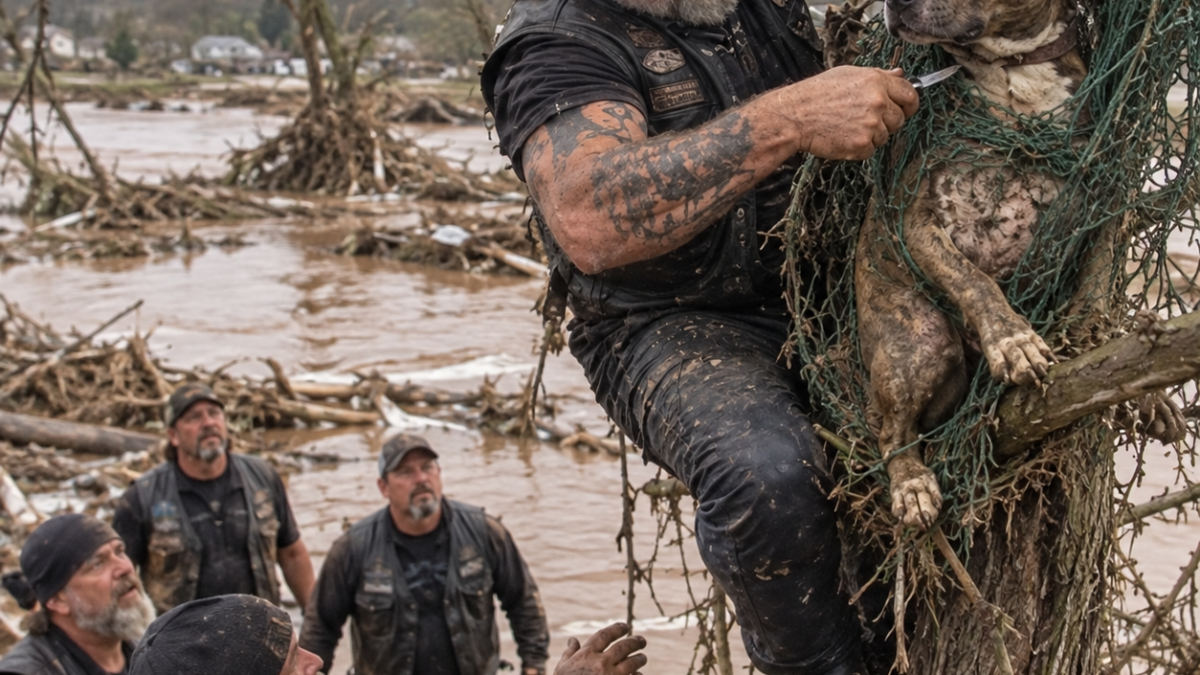
Only one mud-covered paw was still moving inside the fishing net hanging twelve feet above the ground when I stopped my motorcycle.
I thought I was climbing that tree to save one exhausted dog, but the moment I cut the last strand and felt something move beneath my hand, every man below me went silent.
And before that afternoon was over, we would discover that the flood was only part of what she had survived.
My name is Luc Mercier, though most of the men I ride with call me Hawk.
At sixty, I’ve spent enough years working around storms, broken power lines, and fallen trees to know what floodwater leaves behind.
It leaves evidence everywhere.
Plastic bags twisted around high branches.
Furniture where furniture should never be.
Pieces of fences wrapped around tree trunks.
Photographs buried in mud.
Entire lives carried hundreds of yards from where they belonged.
That afternoon, twelve of us were riding slowly along what remained of a farm road in southwestern France.
We weren’t there for fun.
Four days of flooding had torn through villages along the river, and our motorcycle club had turned our saddlebags and support van into a delivery system.
Water.
Blankets.
Medicine.
Dry clothes.
Whatever people needed.
Marc was riding behind me when I raised my fist.
Every engine went quiet.
“What is it?” he called.
I pointed.
At first, even he didn’t see her.
The tree stood beyond a stretch of mud where the river had been two days earlier.
A kitchen chair was jammed against its trunk.
Broken boards hung from the lower branches.
And almost twelve feet above us, something green moved in the wind.
An old fishing net.
Inside it was a dog.
“Jesus,” Marc whispered.
She was brindle beneath the mud, with a white patch across her chest and one nearly black ear.
The net had twisted around her so tightly that her legs were pinned against her body.
Her head hung over one side.
For a terrible second, I thought we were too late.
Then her front paw moved.
Once.
Barely.
I was off the bike before anyone said another word.
“Get the climbing rope.”
Marc stared at the mud between us and the tree.
“Hawk, that ground’s soup.”
“I know.”
“And that branch looks half dead.”
“I know that too.”
I tied the rope around my waist.
For thirty-seven years, I had climbed poles and trees after storms as a utility technician.
My knees weren’t what they used to be.
My shoulders complained every morning.
But some skills stay in your hands long after the rest of your body starts negotiating with you.
“Keep the line tight,” I told them.
Nobody argued.
I crossed the mud and reached the trunk.
The closer I got, the more I could smell her.
River silt.
Wet fur.
Fear.
She opened her eyes when the branch shifted beneath my weight.
Amber eyes.
Exhausted eyes.
She watched the knife in my hand.
“It’s all right, girl,” I whispered.
No growl.
No snap.
She didn’t even have enough strength for that.
I started cutting.
One strand at a time.
The net had bitten deeply around her hind legs and belly.
If I cut too much too quickly, she would drop.
If I took too long, I wasn’t sure she would remain conscious.
Below me, Marc called up.
“How bad?”
“Bad.”
Another strand snapped.
Then another.
I slid my left arm beneath her chest.
Her entire body trembled.
“I’ve got you.”
I cut the final knot.
She collapsed against me.
And that was when I felt it.
Movement.
Not the dog shaking.
Something underneath my palm.
Then another movement in a different place.
I froze.
Her abdomen tightened hard against my arm.
I looked down.
“Hawk?” Marc called.
I didn’t answer immediately.
I moved my hand carefully across her swollen belly.
There it was again.
More than one.
Small bodies.
Moving.
My throat went dry.
“Guys…”
Marc stepped closer to the base of the tree.
“What?”
Another contraction rolled through the dog.
This time she cried out.
I pulled her against my chest.
“She’s pregnant.”
Nobody below spoke.
Then I looked at the distance to the ground.
At the unstable branch.
At the exhausted dog in my arms.
And at the rope that suddenly seemed far too thin.
Marc’s face changed.
“How pregnant?”
The dog contracted again.
I felt something shift beneath my hand.
I tightened my grip around her.
“Pregnant enough that we may not have time to get her down.”
PART 2
For several seconds, the only sound was water dripping from the branches.
Then Marc said, “Tell me what you need.”
That was why I trusted him.
No panic.
No useless questions.
Just tell me what you need.
“Blanket.”
“Got it.”
“Get the support van as close as possible.”
“The mud—”
“Then stop before it sinks.”
“Done.”
“And call the emergency veterinary clinic.”
Marc was already reaching for his phone.
The dog shifted against my chest.
Another contraction passed through her.
She let out a weak, broken whine.
“Easy,” I whispered. “Not up here. You hear me? You wait five minutes.”
I knew how ridiculous that sounded.
Dogs don’t schedule labor because an old biker asks politely.
Still, I talked to her.
I had learned years earlier that silence makes frightening situations worse.
Humans need a voice when the lights go out.
Animals do too.
Below me, six men spread a heavy moving blanket beneath the tree.
Others pulled the climbing line tighter.
Marc shouted, “Clinic says bring her straight in. They have somebody waiting.”
“How far?”
“Twenty-eight minutes if the roads are clear.”
The roads were not clear.
Half the bridges in the area had inspection restrictions, and two village streets were still covered in mud.
“Tell them she’s in active labor.”
“I did.”
The veterinarian came onto the call.
Marc put her on speaker.
A woman’s voice rose from his phone.
“Luc, can you hear me?”
“Barely.”
“My name is Dr. Isabelle Renard. Do not attempt to deliver puppies in the tree unless there is absolutely no alternative.”
“That was not high on my list.”
A couple of men below laughed nervously.
Dr. Renard continued.
“Can the dog stand?”
“No.”
“Conscious?”
“Yes.”
“Breathing normally?”
“Fast.”
“Any visible bleeding?”
I checked as carefully as I could.
“No.”
“Any fluid?”
“Not that I can see.”
“Then get her down slowly and keep her level. If she begins delivering during descent, stop and tell me.”
Easy for her to say.
I adjusted the rope.
The dog’s head rested against my shoulder.
Up close I could see an old scar running across her muzzle.
There were newer abrasions along her neck.
And beneath the mud, something was still around her collar area.
At first I assumed it was another piece of net.
Then my fingers touched metal.
A short piece of chain.
Broken at one end.
That detail stayed in my mind.
But I had no time to think about it.
“Ready?” Marc shouted.
“Ready.”
I looped a second line around the dog’s body using part of the cut net as temporary support, then secured her against my chest.
“Slow,” I told the men.
The rope tightened.
I shifted my weight toward the trunk.
The first three feet were manageable.
Then the branch cracked.
Not broke.
Cracked.
Every man below froze.
“Don’t stop,” I said.
“Hawk—”
“Keep tension.”
The dog whimpered.
“I know, sweetheart.”
Another contraction.
Harder.
Her back legs jerked.
I could feel the muscles in her abdomen tightening.
“Move.”
I lowered one boot to another branch.
It bent.
Mud made the trunk slick beneath my hand.
The rope cut into my waist.
Eight feet.
Six.
Four.
Then my boot slipped.
I dropped perhaps a foot.
The men caught the line.
Pain shot through my shoulder.
The dog cried out.
“I’ve got her!”
Marc was directly beneath me now.
“Give her to me.”
“No. Blanket first.”
“We’ve got it.”
I lowered until his hands reached her.
Four men took her weight together.
The moment she left my arms, I realized how hard I had been holding my breath.
They placed her on the blanket.
I climbed down.
My knees nearly folded when my boots hit the mud.
Marc crouched beside the dog.
“She’s contracting again.”
I knelt.
The chain around her neck was more obvious now.
A rusted collar buckle.
About eighteen inches of broken chain.
One of the bikers, Thierry, touched it.
“She was tied up.”
“Looks like it.”
“During the flood?”
“I don’t know.”
The dog cried again.
No time.
We lifted the blanket.
Six men carried her across the mud like pallbearers who had decided the body wasn’t allowed to die.
That thought came into my head and never left.
When we reached the road, the support van was waiting.
We had removed boxes of bottled water to make space on the floor.
I climbed into the back with the dog.
Marc jumped behind the wheel.
Thierry came with me.
“Everyone else continues the deliveries,” I ordered.
Marc glanced in the mirror.
“You sure?”
“Those villages still need supplies.”
No one liked separating, but that was why we had come.
The others mounted their bikes.
As the van moved away, I watched them disappear behind us.
Then the dog pushed her nose beneath my hand.
“Hey.”
Her eyes opened.
“You need a name.”
Thierry looked at me.
“She needs a veterinarian.”
“She can need two things.”
He studied her brindle coat.
“What about Tempête?”
Storm.
I shook my head.
“She’s had enough storm.”
Another contraction hit.
She stretched her neck and whimpered.
I leaned over her.
“All right. Forget the name. Breathe.”
Thierry stared at me.
“You realize you’re telling a dog to breathe.”
“She’s doing better than you.”
“I’m not giving birth.”
“Then stop complaining.”
Ten minutes into the drive, fluid appeared.
I called Dr. Renard directly.
“She’s progressed.”
“How much?”
“Fluid. Stronger contractions.”
“Any puppy visible?”
“Not yet.”
“How is she responding?”
“Tired.”
“If a puppy appears and remains stuck for more than a few minutes, tell me immediately. Otherwise, let her push.”
I put the phone down beside me.
The dog’s head rested in my lap.
Outside, destroyed fields slid past the windows.
Brown water stood where crops had been.
Fence posts leaned at impossible angles.
Once we had to turn around because a fallen tree blocked a road.
Marc slapped the steering wheel.
“Ten minutes lost.”
“Find another way.”
“I am.”
The dog suddenly lifted her head.
Her body tightened.
Then she began pushing.
Not a contraction anymore.
Pushing.
Thierry’s face turned pale.
“Hawk.”
“I see it.”
“You’ve done this before?”
“No.”
“Neither have I.”
“Excellent. Two experts.”
I looked.
A small dark shape was visible.
My heart started hammering.
“Call Renard.”
Thierry grabbed the phone.
The veterinarian answered immediately.
“Puppy visible,” I said.
“Is the mother pushing effectively?”
“Yes.”
“Then don’t pull unless I instruct you.”
The van bounced over a patch of damaged road.
“Marc!”
“Sorry!”
The dog strained.
The puppy moved slightly farther out.
Then stopped.
Another contraction.
Nothing.
Another.
Still nothing.
“How long?” Dr. Renard asked.
“Maybe two minutes.”
“Does the sac appear intact?”
“Yes.”
“Let her work.”
The mother looked at me.
I don’t know what she wanted.
Help.
Permission.
Reassurance.
Maybe nothing more complicated than not being alone.
I held her head.
“You survived a flood. You survived a tree. You can do this.”
Another contraction.
The puppy slid free.
For one horrifying second, it did not move.
Thierry whispered, “Oh no.”
I tore the sac open around its face the way Renard instructed.
Rubbed it with a towel.
Cleared its nose.
“Come on.”
Nothing.
“Come on.”
Then it coughed.
A tiny squeak filled the van.
Thierry made a sound I had never heard from a fifty-five-year-old man with tattoos covering both arms.
He started crying.
“Shut up,” he said when he saw me looking.
“I didn’t say anything.”
The mother turned.
She sniffed the puppy.
Licked it once.
Then again.
The puppy wriggled toward her belly.
Dr. Renard’s voice came through the phone.
“Good. Keep the puppy warm. More may come quickly.”
They did.
The second puppy arrived eight minutes later.
The third came just as Marc shouted that he could see the clinic.
By then the back of our disaster relief van had become a delivery room.
There was mud everywhere.
Towels everywhere.
Thierry was holding a puppy inside his leather jacket because we had run out of dry cloth.
The mother was exhausted but responsive.
When the van stopped, the rear doors opened immediately.
Dr. Renard stood there with two veterinary technicians.
Her eyes moved from me to Thierry to the puppies.
“You’ve been busy.”
“Your timing needs work,” I told her.
She smiled.
“Bring her in.”
We carried the dog inside.
The puppies went with her.
Three alive.
But the ultrasound showed more.
“Four remaining,” Dr. Renard said.
I stared at the monitor.
“Seven?”
“Assuming we’re counting correctly.”
“Can she deliver them?”
“That’s what I’m worried about.”
The mother’s contractions had weakened.
Her temperature was low.
She was badly dehydrated.
And once Renard cleaned enough mud from her body to examine her properly, we saw just how thin she was.
Her swollen belly had hidden it.
Her ribs were visible.
The muscles over her hips had wasted away.
Her paws were raw.
There were pressure wounds beneath the collar.
And that broken chain was not simply caught around her neck.
It belonged to her.
Dr. Renard stared at it for several seconds.
“She was tethered.”
“That’s what we thought.”
She touched the irritated skin beneath the collar.
“Not briefly.”
Something cold moved through me.
Outside the clinic, whole villages had been evacuated before the river peaked.
Emergency warnings had been issued repeatedly.
People had taken livestock where they could.
Neighbors had opened barns.
Farmers had moved cattle uphill.
And someone had apparently left this dog chained somewhere low enough for floodwater to reach her.
“We don’t know that yet,” Renard said when I voiced the thought.
“Chain didn’t grow around her neck.”
“No. But we don’t know when it broke or where she was.”
She was right.
I didn’t like it.
But she was right.
The fourth puppy arrived naturally.
A brindle male.
The fifth came thirty minutes later.
Then nothing.
Renard checked again.
Two remained.
One heartbeat was strong.
The other was slowing.
“We need to make a decision.”
“What decision?”
“Emergency cesarean.”
My stomach tightened.
“Risk?”
“For a healthy dog? Manageable. For her? Higher.”
“And if you don’t?”
“We could lose puppies and possibly her.”
I looked through the treatment-room window.
The dog lay on her side.
Five newborn puppies were gathered beside her.
She had survived floodwater.
A net.
A tree.
A delivery in a moving van.
Now she needed surgery.
“Do it.”
Renard looked at me.
“I need authorization from whoever is assuming responsibility for the stray.”
“Then put my name down.”
“This may be expensive.”
“Put my name down.”
Thierry stood beside me.
“Our club.”
I turned.
“What?”
“We’re paying.”
“Thierry—”
“You think the others will vote no?”
He pulled out his phone.
The group message already contained responses.
Marc had sent one photograph of the first puppy from the van.
Replies were pouring in.
PAY WHATEVER IT COSTS.
SAVE HER.
CLUB FUND.
I swallowed.
“Do it,” I repeated.
Renard nodded.
They took her into surgery.
That was when I finally sat down.
My hands started shaking.
Not during the climb.
Not while the branch cracked.
Not while a puppy was stuck halfway into the world.
Afterward.
That is often how fear works.
It waits until you have permission to feel it.
Thierry sat beside me.
For ten minutes neither of us spoke.
Then he said, “Name.”
“What?”
“She still needs one.”
I leaned my head against the wall.
“You rejected Storm.”
“I rejected naming her after the worst thing that happened to her.”
“So?”
I thought about the tree.
The mud.
The tiny paw moving.
“She kept holding on.”
Thierry nodded.
“Hope?”
“Too obvious.”
“Faith?”
“Too dramatic.”
A nurse walked past carrying towels.
Thierry suddenly said, “Naya.”
“Why Naya?”
“My granddaughter likes that name.”
“That is your reasoning?”
“Yes.”
I looked through the operating-room doors.
“Naya.”
It sounded gentle.
The dog had known enough harshness.
“Naya it is.”
The surgery lasted nearly an hour.
When Renard came out, she pulled down her mask.
“Naya made it.”
I stood.
“The puppies?”
“Both alive.”
Seven.
Seven puppies.
All alive.
I laughed.
I didn’t intend to.
It just came out.
Thierry hugged me so hard my injured shoulder screamed.
“Idiot!”
“You’re alive.”
“My shoulder may not be.”
He released me.
Renard smiled.
“The smallest puppy required resuscitation, but she’s breathing independently now. The next twenty-four hours matter.”
“And Naya?”
“Exhausted. Malnourished. Anemic. But stubborn.”
“That I believe.”
We stayed until after midnight.
Before leaving, Renard let me see her.
Naya lay beneath warm blankets.
Seven puppies were arranged against her body.
For the first time since I had seen her in that tree, she looked peaceful.
Her eyes opened when I entered.
I crouched.
“Hey, Naya.”
Her tail moved once beneath the blanket.
A tiny movement.
Enough.
“I’ll come back tomorrow.”
I had no idea then how much trouble that promise would cause.
By sunrise, photographs of the rescue had spread through our local community.
Not because we posted some dramatic story.
A farmer had photographed us beneath the tree from the far side of the flooded field.
Someone else had seen the van arrive at the clinic.
Our club page posted a simple update saying an injured pregnant dog had been rescued during flood-relief deliveries and was receiving veterinary care.
People recognized the tree.
Then someone recognized the dog.
The first message came to the club administrator around eight that morning.
I KNOW HER.
Her name isn’t Naya.
She belongs to a man named Alain Vautrin.
I read it twice.
The sender was a woman named Claire Moreau from a nearby village.
She sent a photograph.
There was no doubt.
Same brindle coat.
Same white chest.
Same dark ear.
Same scar across the muzzle.
But in the photograph she was healthier.
Standing beside a rusty wire enclosure.
A heavy chain attached to her collar.
Her name, Claire said, had been Bella.
I called her.
“Where did you take this picture?”
“Behind Vautrin’s property.”
“When?”
“About six weeks ago.”
“What kind of property?”
There was a pause.
“He breeds dogs.”
“Professionally?”
Another pause.
“He says he does.”
That answer told me enough.
Claire lived two houses away.
She had complained before.
Several dogs were kept in outdoor pens.
Some were tethered.
Puppies appeared regularly.
Then disappeared.
Vautrin sold them through online advertisements.
“Did you report it?”
“Yes.”
“To whom?”
“The municipality. Once to an animal welfare group.”
“What happened?”
“He cleaned the property before an inspection.”
I looked at the photograph again.
“Was Bella pregnant then?”
“Probably. He bred her repeatedly.”
My jaw tightened.
“Where was she when the evacuation happened?”
“I don’t know.”
“Did Vautrin evacuate?”
“Yes.”
“With his dogs?”
“Some.”
That word landed hard.
Some.
“What does that mean?”
“I saw his van leave before the water came up. There were cages inside. I don’t know how many dogs.”
“And Bella?”
“I never saw her leave.”
I closed my eyes.
“Claire, I need you to tell this to animal protection authorities.”
“I will.”
“And send me every photograph you have.”
“Luc?”
“Yes?”
“He’s going to want those puppies.”
I said nothing.
“He sells dogs,” she continued. “Seven puppies could mean thousands of euros to him.”
“He abandoned their mother.”
“I know.”
“But he can’t just walk into a clinic and take them.”
Claire’s silence worried me.
“You don’t know Alain.”
I was about to.
At eleven twenty that morning, Dr. Renard called.
Her voice was tight.
“Luc, the person claiming to own Naya is here.”
I was already reaching for my jacket.
“Don’t give her to him.”
“I’m not handing over a critically ill animal in the middle of treatment without verifying ownership and welfare status.”
“I’m coming.”
“Luc.”
“What?”
“Do not come here looking for a confrontation.”
“I am coming to see my dog.”
“She isn’t technically your dog.”
“You named her Naya on the chart.”
“You named her Naya.”
“Exactly.”
“Luc.”
“I’ll behave.”
There was a pause.
“That answer did not reassure me.”
I reached the clinic twenty minutes later.
Marc and Thierry arrived at almost the same time.
I hadn’t called them.
They had seen the club message.
“Why are you here?” I asked.
Marc shrugged.
“Emotional support.”
“For whom?”
“The other guy.”
“Go home.”
“No.”
We entered.
A man stood at the reception desk.
Mid-forties.
Expensive rain jacket.
Clean boots despite everything outside.
Alain Vautrin.
I recognized him from a photograph Claire had sent.
He turned.
His eyes moved over our leather jackets.
“Him?” he asked the receptionist, pointing at me.
I ignored him.
“Is Naya okay?”
Renard stepped from the hallway.
“Stable.”
Vautrin frowned.
“Her name is Bella.”
I finally looked at him.
“You left Bella chained in a flood zone?”
“I didn’t leave her anywhere.”
“Then how did she end up with a broken chain around her neck twelve feet up a tree?”
His jaw tightened.
“Floods break things.”
“They also reveal things.”
Marc touched my elbow.
A reminder.
Behave.
Vautrin turned toward Renard.
“I have photographs proving she’s mine. I want my dog and puppies.”
Renard remained calm.
“Naya is recovering from emergency surgery. None of the animals are medically cleared for release.”
“You don’t get to rename my property.”
Property.
Not dog.
Property.
I felt my hands close.
Thierry quietly stepped between us.
Not because he thought Vautrin would attack me.
Because he knew I might forget my promise.
Renard’s expression cooled.
“Mr. Vautrin, animal welfare authorities have been notified because of the condition in which she was found.”
His face changed.
Only slightly.
But enough.
“This is ridiculous. She was caught in a natural disaster.”
“Her nutritional condition predates the flood.”
“You don’t know how long she was missing.”
“We can discuss that with the investigator.”
He looked at me.
“You called them?”
“I didn’t need to.”
That was partly true.
Claire had already contacted them.
Renard had made her own report because of the chain wounds and malnutrition.
Vautrin pointed toward the hallway.
“Those puppies are valuable.”
There it was.
Not how is she?
Not did she survive surgery?
Not are the puppies healthy?
Valuable.
Renard heard it too.
Her eyes narrowed.
“I think we’re finished for today.”
“You can’t keep my animals.”
“You may address custody with the appropriate authorities.”
He turned toward the door.
Before leaving, he stopped beside me.
“You people found something that belongs to me.”
I stared at him.
“No.”
His mouth tightened.
“No?”
“We found something you failed.”
For a second I thought he might swing at me.
He didn’t.
He left.
Marc released a breath.
“Excellent behaving.”
“I didn’t touch him.”
“Your standards are inspiring.”
I looked at Renard.
“What happens now?”
“Now we document everything.”
That became more important than anger.
Every wound.
Every blood result.
Every photograph.
Every gram of body weight.
The broken chain.
The collar.
The scar tissue beneath it.
Animal welfare officer Élodie Martin came that afternoon.
She was small, serious, and impossible to intimidate.
She interviewed me.
Thierry.
Marc.
Renard.
Then Claire.
She visited the location where we had found Naya.
Two days later, floodwater dropped enough for investigators to reach Vautrin’s property.
What they found changed the situation completely.
Three outdoor kennels remained behind the house.
One had been torn open by water.
Another contained a chain bolted to a concrete slab.
The broken end matched the size and corrosion pattern of the chain still attached to Naya’s collar.
Near the kennels were bowls filled with flood silt.
No raised shelter.
No safe platform.
No evidence that Naya could have escaped before the chain failed.
The image made me physically sick.
I imagined the water rising.
First around her paws.
Then her legs.
Her belly heavy with puppies.
The chain pulling.
No person coming.
The current growing stronger.
Somehow, something broke.
Maybe the chain.
Maybe the bolt.
Maybe part of the enclosure.
She was swept away.
Through fences.
Branches.
Debris.
Until an old fishing net caught her high in that tree as the river rose beneath her.
For once, being trapped may have saved her.
If the net had not caught her, the flood might have carried her much farther.
Élodie found more.
Vautrin had evacuated three other dogs.
Why those three?
Records and advertisements suggested they were younger breeding animals with current litters planned.
Naya was older.
And pregnant with what appeared to be her fourth litter.
A former employee named Mathieu came forward after photographs circulated.
He said Naya had been bred repeatedly.
He said she had become thin after her previous litter.
He said Vautrin had talked about selling her after this one.
“He called her a machine,” Mathieu told investigators.
That sentence reached me later.
I wished it hadn’t.
Naya wasn’t a machine.
I had held her while she shook with fear.
I had felt her protect seven lives inside a body barely strong enough to protect itself.
At the clinic, she became stronger each day.
The puppies did too.
We gave them temporary names because seven unnamed puppies became impossible to discuss.
Marc named the first male River.
Thierry named one little female Miette because she was tiny.
There was Hugo.
Luna.
Pepper.
Milo.
And the smallest survivor from the surgery, a little brindle female with a white mark shaped roughly like a crooked star.
I named her Ember.
“You rejected Storm but chose Ember?” Marc asked.
“An ember means something survived.”
He looked at the tiny puppy sleeping against Naya.
“All right. I’ll allow it.”
“You have no authority here.”
“Neither do you.”
Naya did.
The moment one puppy squeaked, her head came up.
If a technician moved one for weighing, she watched.
Not aggressively.
Carefully.
The dog who had nearly died still kept track of every baby.
On the fourth day, I sat beside her pen.
She stood for the first time.
Her legs shook.
I extended my hand.
“Come on.”
One step.
Then another.
She reached me.
Pressed her forehead against my chest.
And stayed there.
I did not realize Renard was watching from the doorway.
“She trusts you.”
“I cut her out of a tree.”
“Sometimes animals remember who was there when the pain stopped.”
I looked down at Naya.
“What’s going to happen to her?”
“That depends on the custody case.”
My stomach sank.
“You’re telling me Vautrin could get her back?”
“I’m telling you ownership and protective custody have legal processes.”
“He left her chained.”
“Which investigators are documenting.”
“He wants the puppies.”
“I know.”
“What if the system decides—”
“Luc.”
Renard crouched opposite me.
“Do not borrow trouble from tomorrow.”
“I’ve worked emergency repair for thirty-seven years. Trouble is usually more manageable when you anticipate it.”
“Then anticipate intelligently. Help us build evidence. Don’t start a war in my parking lot.”
I almost smiled.
“Fine.”
The problem was that Vautrin had already started his own kind of war.
He posted online.
According to him, a group of bikers had “stolen” his valuable pregnant dog during flood chaos.
He claimed Naya had broken loose before he could rescue her.
He said our club was exploiting disaster photographs for attention.
He even suggested we intended to sell the puppies ourselves.
The post spread.
People who had never been anywhere near the flooded villages began choosing sides.
Some believed him.
Some did not.
I wanted to respond immediately.
Marc stopped me.
“Evidence first.”
“He called us thieves.”
“Evidence first.”
“He’s saying Naya was healthy.”
“Evidence first.”
“I hate when you become reasonable.”
“I’ve been practicing.”
So we said almost nothing.
Our club released one statement:
The dog and puppies are under veterinary care and the relevant authorities are investigating. Our only concern is their welfare.
That was it.
No insults.
No threats.
No photographs of Vautrin.
It drove him crazy.
He posted again.
And again.
Every new post contradicted something from the previous one.
First Naya had escaped the morning of evacuation.
Then she had escaped the night before.
First he had searched for her.
Then he claimed roads were too dangerous to search.
Then someone found an old community post from flood morning.
Vautrin had posted a photograph from a town nearly fifty miles away.
Timestamped hours before water reached its peak.
He was safe.
He had left early.
And there was no Naya in the photograph of the three dogs he had brought with him.
Claire provided security-camera footage from her house.
At 6:42 that morning, Vautrin’s van drove past.
Three dog crates were visible.
At 6:57, flood barriers closed the lower road.
Naya remained behind.
That footage mattered.
But another discovery mattered even more.
Mathieu, the former worker, had saved text messages.
One from the night before the evacuation warning.
Vautrin had asked him to come move the animals.
Mathieu replied that he was already evacuating his mother and couldn’t.
Vautrin responded:
I’ll take the three important ones. Bella can stay in the back run. Chain should hold.
When Élodie showed me the message later, I read it twice.
Then a third time.
Chain should hold.
The chain hadn’t held.
Thank God.
If it had, Naya would have drowned on that concrete slab.
I handed the phone back.
Élodie watched me.
“Say whatever you’re thinking.”
“No.”
“Why?”
“Because Renard says I’m supposed to behave intelligently.”
For the first time, Élodie smiled.
“She gave you good advice.”
“What happens to him?”
“The file goes to the prosecutor.”
“And Naya?”
“Temporary protective custody remains.”
“Temporary.”
“For now.”
I hated those two words.
For now.
Naya knew nothing about legal procedure.
She knew food arrived several times a day.
She knew the puppies were beside her.
She knew I visited every afternoon.
She knew that when I entered the room, I usually had chicken.
Within two weeks she began gaining weight.
Her coat changed once the river mud was gone.
The brindle pattern became beautiful.
The white on her chest was brighter than I remembered.
Her scar remained.
I was glad.
Not because I wanted her marked by pain.
Because a scar is proof that a wound closed.
Ember nearly died on day twelve.
I arrived at the clinic to find Renard leaning over an incubator.
The puppy had stopped nursing effectively.
Her blood sugar had dropped.
Her temperature had fallen.
Naya paced outside the treatment space.
“What’s happening?”
Renard didn’t look up.
“She’s fading.”
The words hit me harder than I expected.
“Fix it.”
“We’re trying.”
I crouched beside Naya.
She pushed against the door.
“You can’t go in.”
She whined.
“I know.”
For two hours, technicians warmed Ember gradually, gave glucose, fluids and supplemental feeding.
Naya refused food.
She watched the treatment room.
I stayed beside her.
At one point she rested her head on my boot.
The same dog who had survived for seven puppies seemed to understand that one was missing.
“She’s coming back,” I told her.
I had no right to promise that.
I did it anyway.
Near sunset, Renard carried Ember out wrapped in a towel.
“Better.”
Naya stood.
Renard placed the puppy beside her.
Naya sniffed every inch of her.
Then began licking her so intensely we had to make her slow down.
Ember squeaked.
Naya froze.
Then lay down around her.
I turned away.
Thierry had arrived without me hearing him.
He saw my face.
“You crying?”
“Dust.”
“In a veterinary clinic?”
“Very unusual dust.”
“Of course.”
Ember survived.
After that, she became unstoppable.
By five weeks old she was the smallest puppy and the loudest.
She climbed over her brothers.
Stole toys.
Bit my boot laces.
Once she grabbed Thierry’s beard.
He screamed so loudly Naya barked at him.
“Your daughter attacked me,” he told her.
Naya wagged her tail.
“She approves,” I said.
The custody hearing was scheduled when the puppies were almost six weeks old.
Vautrin’s attorney argued that whatever negligence had occurred, ownership remained with Vautrin until a final criminal determination.
The prosecutor argued the animals should remain protected because returning them would expose them to the person accused of abandonment and neglect.
I was called as a witness.
I hated courtrooms.
Give me a storm-damaged transmission tower any day.
At least power lines don’t ask trick questions.
Vautrin sat across the room wearing a suit.
He looked more respectable than he had at the clinic.
That seemed to be the point.
His attorney asked me how I had found Naya.
“In a fishing net in a tree.”
“How high?”
“About four meters.”
“You are not a veterinarian?”
“No.”
“You cannot state medically how long she had been malnourished?”
“No.”
“You cannot personally testify that Mr. Vautrin attached the chain found around her neck?”
“No.”
“You did not witness the dog at his property on the morning of the flood?”
“No.”
He nodded as if he had accomplished something.
Then he asked, “You have become emotionally attached to this animal, correct?”
“Yes.”
“You have publicly called her Naya despite knowing her legal owner called her Bella?”
“Yes.”
“So you want to keep her from my client.”
I looked at Vautrin.
Then back at the attorney.
“I want her kept from whoever left her chained where a river could reach her.”
“Objection.”
The judge looked at me.
“Mr. Mercier, answer only the question.”
“I apologize.”
The attorney tried again.
“You want Mr. Vautrin to lose ownership.”
I considered my answer.
“I want the court to decide based on what happened to the dog.”
That was the safest truth.
Dr. Renard testified next.
That changed the room.
She explained Naya’s body condition.
The pressure injuries from prolonged tethering.
The dehydration.
The anemia.
The physical strain of repeated pregnancies.
The state of her paws.
The emergency surgery.
The seven puppies.
Vautrin’s attorney suggested the flood itself explained most injuries.
Renard remained calm.
“A flood explains mud, acute trauma and entanglement. It does not explain chronic muscle loss.”
“Could pregnancy contribute?”
“Yes.”
“So her condition might have been natural for a pregnant dog.”
“No.”
The attorney paused.
Renard continued.
“Pregnancy can change body condition. It does not make severe malnutrition appropriate or inevitable.”
Then came the photographs.
Claire’s images.
Naya chained weeks before the flood.
The kennel.
The concrete slab.
Then the investigators’ photographs afterward.
The matching broken chain.
And finally the text message.
I’ll take the three important ones. Bella can stay in the back run. Chain should hold.
The courtroom went silent.
Vautrin leaned toward his attorney.
His attorney whispered something back.
The prosecutor asked Élodie, “Was the back run within the mandatory evacuation zone?”
“Yes.”
“Was Mr. Vautrin notified?”
“Yes.”
“How?”
“Automated alert, municipal notice, and direct neighborhood notification.”
“Did he evacuate?”
“Yes.”
“With animals?”
“Three dogs.”
“Was Naya among them?”
“No.”
The prosecutor displayed Claire’s camera image of the van.
Three crates.
Then Vautrin’s social-media photograph from fifty miles away.
Three dogs.
No Naya.
There are moments when revenge feels loud in your imagination.
You picture shouting.
A fist on a table.
Someone finally being humiliated.
The reality was quieter.
Vautrin simply stopped looking confident.
The judge ruled that Naya and her puppies would remain in protective custody and could not be returned to him while the animal welfare case proceeded.
Temporary, technically.
But everything had changed.
Outside the courthouse, reporters waited.
I tried to walk past.
One called my name.
“Mr. Mercier, do you feel vindicated?”
I stopped.
I thought about Naya lying beneath seven puppies.
“No.”
The reporter seemed surprised.
“What do you feel?”
“That I need to get back to the clinic.”
That night I sat beside Naya.
“You won today.”
She chewed chicken.
She was unimpressed.
“You could at least pretend to understand.”
She put one muddy paw on my knee.
“Fine.”
The puppies reached eight weeks.
Families began asking about adoption.
Hundreds of people had followed their story by then.
Renard and the rescue organization screened applicants carefully.
No first-come-first-served chaos.
No impulse adoptions because the puppies were famous.
Fenced homes.
Veterinary references.
Plans for training.
Agreement to sterilization when medically appropriate.
And lifetime return clauses.
Naya was different.
Many people wanted her because of the story.
I didn’t trust that.
A dog is not a souvenir from a viral rescue.
She needed someone who would still love her after people stopped talking about the tree.
Emily—my sister, not my wife; she had spent years reminding me that my house looked like “a garage with bedrooms”—called one night.
“You’re keeping her.”
“I didn’t say that.”
“You don’t need to.”
“I ride motorcycles.”
“So?”
“I travel.”
“You’re retired.”
“Partly.”
“You own a house with a fenced yard.”
“Small yard.”
“One dog doesn’t need a cattle ranch.”
“I’ve never owned a dog by myself.”
“You’ve attended every veterinary appointment for six weeks.”
“That’s different.”
“You have seventeen photographs of her on your phone.”
“How do you know?”
“You accidentally sent twelve to the family group.”
I looked across my living room.
There was already a dog bed near the fireplace.
I had bought it three days earlier.
For no reason, apparently.
The next afternoon, I asked Renard.
“You think she’d live with me?”
Renard smiled too quickly.
“You rehearsed that question.”
“No.”
“You absolutely rehearsed it.”
“Just answer.”
“Yes.”
“That’s all?”
“What do you want? A compatibility report?”
“Maybe.”
“She trusts you. You understand her medical needs. You show up. You have appropriate housing. You’re financially stable. Your club has already threatened to form a visitation schedule.”
“They did what?”
“Thierry asked whether Wednesdays were available.”
I rubbed my face.
“What about separation from the puppies?”
“Naya will be ready when they are old enough.”
I looked through the glass.
The puppies were asleep.
All except Ember.
Ember was trying to climb Naya’s head.
Naya gently pushed her away.
“She might enjoy retirement.”
“She deserves it.”
That sentence decided it.
Not because I was rescuing her.
We had already done that.
Because Naya had spent enough of her life being useful to other people.
Producing puppies.
Chained in a run.
Valued for what she could generate.
I wanted the rest of her life to require nothing from her.
No job.
No litters.
No guarding.
No proving herself.
Just being a dog.
“I want her.”
Renard corrected me.
“You want to adopt her.”
I understood.
“Right. I want to adopt her.”
The criminal case against Vautrin continued for months.
Investigators found records of unregistered sales.
Veterinary care that had been delayed or skipped.
Other former customers came forward.
One family reported purchasing a puppy that became critically ill within forty-eight hours.
Another former worker described overcrowded pens.
Nothing was as cinematic as finding a dog hanging in a tree.
Most neglect isn’t cinematic.
It is repetitive.
Cheap.
Ordinary.
A skipped examination.
A dirty water bowl.
A chain instead of a walk.
Another litter because another litter means money.
That ordinariness disturbed me more than any dramatic cruelty could have.
Vautrin eventually tried another strategy.
He offered to surrender Naya if authorities allowed him to retain a claim to the puppies.
When I heard that, I actually laughed.
Not because it was funny.
Because it was so perfectly predictable.
He no longer cared about the mother.
He wanted what she produced.
The prosecutor rejected the proposal.
The puppies were placed under the same protective order.
One by one, after legal clearance, they went home.
River went to a retired teacher with a huge garden.
Luna went to a young couple who already had an older rescue dog.
Pepper joined a family with two teenagers.
Hugo went to a vineyard owner who promised never to let him near the grapes themselves.
Milo went to an emergency-room nurse.
Miette went to an elderly widow who had lost her dog the year before.
That left Ember.
I knew what Thierry was going to say before he opened his mouth.
“No.”
He looked offended.
“I haven’t said anything.”
“You’re adopting Ember.”
“I might be.”
“You already bought a pink collar.”
“It could be for someone else.”
“You are a fifty-five-year-old mechanic with three sons and no other dogs.”
“I like pink.”
Ember climbed into his lap.
He looked down.
She bit his thumb.
His face softened.
“See? She picked me.”
“You’re both irritating. Perfect match.”
So Ember went home with Thierry.
Which meant Naya never completely lost her.
Every Wednesday, just as threatened, Thierry brought Ember to my house.
The first reunion lasted forty-seven minutes.
For forty-six of them, Ember harassed her mother.
Naya eventually climbed onto my couch to escape.
“You’re allowed to discipline your child,” I told her.
Naya closed her eyes.
“Fine. I’ll do nothing.”
She had discovered couches.
That became a problem.
Technically, she had her own bed.
In practice, she had my couch.
Then my armchair.
Then, despite my firm rules, the bottom half of my bed.
The first storm after she came home revealed what remained inside her.
Rain struck the windows around midnight.
Thunder rolled over the hills.
I woke to scratching.
Naya was not beside the bed.
I found her in the hallway.
Panting.
Her body low.
She was trying to squeeze behind a cabinet.
I sat on the floor.
“Naya.”
She would not come.
Another thunderclap.
She shook.
I didn’t reach for her.
I remembered Grace from another rescue story someone had once told me—how frightened dogs sometimes need an open hand more than a grabbing one.
So I sat.
Twenty minutes.
Thirty.
Eventually she crawled out.
Not toward the bed.
Toward me.
She pressed herself against my chest.
I wrapped one arm around her.
“Different rain.”
Her heart hammered.
“This rain stays outside.”
We slept on the hallway floor.
My back punished me for three days.
Worth it.
The next storm, she still trembled.
But she came to me.
The one after that, she climbed onto the couch and watched the window.
A year later, thunder woke me at two in the morning.
Naya was asleep.
That was healing.
Not forgetting.
Learning that the present doesn’t always repeat the past.
The final court hearing came almost eleven months after the flood.
By then, Naya looked nothing like the dog from the tree.
She had gained healthy weight.
Her coat shone.
Her eyes were bright.
She had been spayed after recovery.
No more litters.
Ever.
The seven puppies were healthy.
Vautrin’s breeding operation had already closed during proceedings.
At the hearing, the court confirmed permanent forfeiture of his ownership rights over Naya and the puppies.
He was convicted on multiple animal welfare violations arising from the abandonment and conditions documented during the investigation.
He was prohibited from operating the breeding business and from keeping animals under the conditions set by the court.
There were financial penalties.
Additional oversight.
The legal details mattered.
But one moment mattered more to me.
After the hearing, Vautrin walked past me outside.
We hadn’t spoken since the clinic.
He stopped.
I expected anger.
Instead, he looked tired.
“You got what you wanted.”
I looked at him.
“No.”
His eyes narrowed.
“What?”
“I wanted you to go back for her before the river came.”
He said nothing.
“That’s what I wanted.”
His jaw tightened.
“It wasn’t that simple.”
“You drove three dogs out.”
“You don’t know what was happening.”
“I know enough.”
He looked away.
I thought about insulting him.
I had imagined that moment more than once.
All the lines I could deliver.
All the anger I could unload.
But suddenly I didn’t want to give him any more space in Naya’s story.
So I said only one thing.
“She survived you.”
Then I walked away.
If there was revenge in the story, that was not it.
The real revenge happened three days later.
Our club organized another supply ride.
Not for flood victims this time.
For an animal shelter.
We loaded dog food, cleaning supplies, blankets and medical items.
I brought Naya.
She wore a red harness.
No chain.
When we reached the old farm road, I slowed.
The tree was still there.
Most flood debris had been cleared.
Grass had returned.
The river was inside its banks.
I parked.
Thierry arrived behind me with Ember in a sidecar setup approved for dogs.
“You sure about this?”
“No.”
We walked toward the tree.
Naya stopped twenty yards away.
Her ears changed position.
She smelled the air.
Ember bounced beside her, completely unaware.
Naya looked toward the branches.
I watched carefully.
Her body stiffened.
For several seconds, she would not move.
I crouched.
“We can leave.”
She looked at me.
“Nothing to prove.”
That was important.
Survival doesn’t create an obligation to revisit pain.
I turned back toward the motorcycles.
Then I felt tension on the leash.
Naya moved forward.
One step.
Then another.
Slowly, she approached the tree.
The old fishing net was gone.
I had cut most of it away that day.
A remaining green strand was still twisted high around one branch.
Naya sniffed the trunk.
Then the ground.
Ember rushed forward and tried to chase a butterfly.
Naya watched her puppy.
Her tail moved.
Once.
Twice.
Then she walked past the tree.
Not around it.
Past it.
Toward the riverbank.
Thierry stood beside me.
“That’s it?”
“What were you expecting?”
“I don’t know. Music?”
I laughed.
Naya reached a patch of grass.
She rolled onto her back.
All four legs went into the air.
Ember jumped on her.
They wrestled.
Mud covered them within minutes.
Thierry groaned.
“My bike.”
“Your problem.”
He looked at Naya.
“Hawk?”
“Yeah?”
“You know what I think?”
“That would be a first.”
“I think this is revenge.”
I watched Naya chase Ember across the grass.
“What is?”
“This.”
He pointed.
“Guy treated her like a breeding machine. Left her chained. Now she spends Wednesday afternoons ruining my upholstery.”
I smiled.
“That is pretty good.”
But her story still had one more turn.
The following spring, southwestern France experienced another week of heavy rain.
Nothing close to the previous flood.
Still, emergency teams prepared.
Our club volunteered again.
This time the local animal welfare office contacted us directly.
They needed help moving kennels, transporting pet food and checking isolated properties where owners had requested assistance.
We had become, somehow, the tattooed old men people called when animals needed transportation.
Marc blamed me.
“This used to be a motorcycle club.”
“It still is.”
“I carried three goats yesterday.”
“On a motorcycle?”
“In the van.”
“Then stop complaining.”
Naya came with me only when conditions were safe.
At one rural house, an elderly man named Bernard was refusing evacuation because he could not transport his aging shepherd mix.
“I’m not leaving Max.”
The emergency worker argued.
Bernard crossed his arms.
Max stood beside him.
I understood immediately.
“Fine,” I said.
The worker looked at me.
“Fine?”
“We take both.”
The club van transported Bernard and Max together.
Naya sat behind them.
At the shelter, Bernard stroked her head.
“Good dog.”
He noticed the scar across her muzzle.
“What happened to her?”
I told him a shortened version.
He looked at Naya for a long time.
“Flood took my wife’s garden last year.”
“I’m sorry.”
“Things grow back.”
He touched Naya’s ear.
“Sometimes.”
I remembered that.
Things grow back.
Not everything.
Some losses remain losses.
But trust can grow back.
Strength can grow back.
A coat can grow over ribs.
A dog who once panicked at thunder can sleep through rain.
A tiny puppy whose heart nearly stopped can grow into an energetic animal who steals tools from Thierry’s garage.
And an old biker who believed his useful years were mostly behind him can discover that life has other jobs waiting.
Two years after I climbed the tree, our club met at my house.
Naya moved among twelve leather jackets as though she had founded the organization.
Technically, she had become our mascot.
I hated the word mascot because it made her sound decorative.
She was more like management.
Anyone carrying food reported directly to her.
Ember arrived with Thierry.
Mother and daughter greeted each other nose to nose.
Ember was almost Naya’s size by then.
Same brindle coloring.
Different face.
No fear of storms.
No memory of floodwater.
That mattered.
Ember had inherited Naya’s eyes but not her trauma.
I think that may be one of the most beautiful forms of victory there is.
The next generation knowing the history only because someone tells them.
Not because they have to survive it themselves.
Renard came to the gathering.
So did Élodie.
Claire brought photographs.
Even Mathieu, the former kennel worker, came.
For a long time he stayed near the gate.
Finally he approached me.
“I should have done something sooner.”
I knew exactly what he meant.
About Vautrin.
About Naya.
“Maybe.”
He looked surprised by my answer.
Most people probably expected me to tell him it wasn’t his fault.
Life is rarely that simple.
He had seen things.
He had kept working there.
But he had also saved the messages.
He had eventually testified.
Both things could be true.
“I was afraid of losing my job,” he said.
“I understand.”
“That doesn’t make it right.”
“No.”
He looked toward Naya.
“Can I see her?”
“That’s her decision.”
He crouched several feet away.
Naya noticed him.
For a moment I wondered whether she remembered.
Dogs remember scent far better than we do.
Her body became cautious.
Mathieu extended no hand.
He simply sat.
“I’m sorry, Bella,” he whispered.
I almost corrected the name.
Then I stopped.
Bella had been hers too.
A name from another life.
Naya approached.
Slowly.
She sniffed him.
Mathieu started crying.
Naya stepped away.
She did not comfort him.
She did not owe him that.
Instead, she walked back to me and sat against my leg.
I scratched her chest.
Mathieu wiped his face.
“Fair enough.”
I respected him more for saying that.
Forgiveness is another thing humans sometimes demand from survivors because it makes observers comfortable.
Naya didn’t need to forgive anybody.
She only needed to be safe.
That evening, after everyone left, I sat outside with her.
Sunset turned the hills orange.
She lay across my boots.
“You caused a lot of trouble.”
Her ear moved.
“Court hearings. Vet bills. Club meetings.”
Her tail thumped.
“Thierry bought a sidecar because of your daughter.”
Another thump.
“You don’t care.”
She rolled onto her side.
I looked at the scar on her muzzle.
Still there.
The white chest.
The dark ear.
The strong body that had once hung almost motionless above a flooded field.
Sometimes strangers recognized her.
They would ask whether she was “the tree dog.”
I never liked that description.
It reduced her to the worst photograph of her life.
Naya was not the tree dog.
She was the dog who loved roast chicken.
The dog who hated vacuum cleaners.
The dog who stole my side of the couch the second I stood up.
The dog who could identify Thierry’s motorcycle by sound before it turned into the street.
The dog who buried treats in my garden and then forgot where.
The dog who once carried one of my work gloves around for three days.
The dog who learned that rain was not always coming to kill her.
She was many things.
The tree was one afternoon.
Her life was everything afterward.
On the third anniversary, we did not return to the tree.
We went somewhere better.
A wide meadow above the river valley.
Dry ground.
Open sky.
Seven families came.
River.
Luna.
Pepper.
Hugo.
Milo.
Miette.
Ember.
All seven puppies.
The reunion was complete chaos.
I had wondered whether Naya would recognize every one of them after so much time.
I still don’t know exactly what she understood.
But when the seven dogs ran toward her, something happened.
Naya froze.
Seven tails.
Seven different adult bodies.
Seven lives that once fit against her belly.
Ember reached her first.
Then River.
Then the others.
Within seconds, Naya disappeared beneath a crowd of dogs sniffing, jumping, wagging and circling.
Everyone laughed.
Renard stood beside me.
“You realize the odds could have been very different.”
“I know.”
“One critically malnourished mother. Active labor. Flood trauma. Emergency surgery.”
“I know.”
“Seven puppies.”
“I know, Isabelle.”
She smiled.
“I like reminding you.”
I watched them.
“Why?”
“Because you still look surprised.”
I was.
I probably always would be.
Naya escaped a chain because floodwater broke something intended to hold her.
She survived the current.
She survived being thrown through debris.
A fishing net caught her.
Twelve men stopped.
One old utility worker climbed.
Seven puppies lived.
That sequence was so improbable that even years later I sometimes woke thinking I had exaggerated it in memory.
Then Naya would be asleep beside my bed.
Proof.
During the reunion, Ember stole a sandwich from Thierry.
He chased her.
She ran directly behind Naya.
Thierry pointed.
“Control your child.”
“She’s three years old.”
“She’s your family.”
“You adopted her.”
“I regret everything.”
Ember ate the sandwich.
Naya wagged her tail.
I laughed until my stomach hurt.
Later, the dogs settled across the grass.
Seven grown puppies.
One mother.
Eight survivors.
The families exchanged stories.
River had learned to open doors.
Luna slept with a stuffed rabbit.
Pepper was afraid of the neighbor’s tiny cat.
Hugo loved riding in tractors.
Milo volunteered as a therapy dog with his owner.
Miette slept beneath her adopter’s kitchen table.
Ember still attacked Thierry’s beard.
Seven ordinary lives.
That was the miracle.
Not that they became famous.
Not that newspapers covered the rescue.
Not even that the court case created consequences.
They became ordinary dogs.
They worried about dinner.
Beds.
Toys.
Walks.
Squirrels.
That was what Naya had nearly been denied.
Ordinary life.
The sun lowered.
One by one, families left.
When only Thierry, Ember, Naya and I remained, we walked toward the motorcycles.
Thierry stopped.
“Do you ever think about what would’ve happened if we took the other road that day?”
“Yes.”
Too often.
“We almost did.”
“I know.”
A bridge closure had forced us onto that farm road.
Five minutes earlier or later, maybe we would not have noticed her paw move.
I used to torture myself with those possibilities.
Eventually I stopped.
Not because they weren’t frightening.
Because Naya didn’t live in possibilities.
She lived in what happened.
We took the road.
We saw her.
We stopped.
That was enough.
Years later, my shoulders became worse.
My knees too.
I finally stopped pretending I was still the utility climber I had been at thirty.
One afternoon Marc pointed toward a tree in my yard.
“Could you still climb that?”
“Yes.”
“You paused.”
“I was calculating.”
“You were lying.”
“Go home.”
Naya was older too.
Gray appeared around her muzzle, softening the scar.
She no longer ran as long.
Ember still visited.
Whenever the younger dog became too energetic, Naya gave her one look.
Motherhood authority apparently survives retirement.
During thunderstorms, Naya occasionally woke and came to my room.
No shaking anymore.
She just checked.
I would touch her head.
“Different rain.”
Then she returned to sleep.
That phrase became ours.
Different rain.
Different house.
Different life.
Different ending.
The last time I visited the flood memorial in the village, there were photographs of rescue crews, damaged homes, farmers helping neighbors, firefighters carrying children, volunteers stacking supplies.
One photograph showed our club.
Twelve motorcycles.
Mud everywhere.
Men standing beneath a tree.
High above us was a green net.
You had to look closely to see Naya.
Someone had written beneath the photograph:
NO ONE IS LEFT BEHIND.
I stood there longer than I expected.
A woman beside me recognized me.
“You’re the biker.”
“One of them.”
“The one who climbed.”
“Yes.”
She smiled.
“Is the dog still alive?”
I smiled back.
“She’s at home stealing my chair.”
The woman laughed.
“Good.”
Yes.
Good.
That was the word.
Not heroic.
Not miraculous.
Good.
Sometimes good is enough.
I rode home.
Naya was waiting at the window.
When my motorcycle entered the driveway, she disappeared from view.
By the time I opened the door, she was there.
Tail moving.
Older.
Slower.
Still her.
I knelt.
She pressed her forehead against mine.
For one second, I remembered the first time I held her.
Twelve feet above the earth.
Mud covering everything.
Her body limp against my chest.
Seven unborn lives moving beneath my hand.
I remembered whispering that I had her.
At the time, I meant physically.
Don’t fall.
I’ve got you.
But rescue turned out to be larger than bringing an animal down from a tree.
The tree was only the beginning.
Saving her meant surgery.
Evidence.
Court hearings.
Nightmares during storms.
Teaching her that food would always come again.
Giving her a home where nobody measured her value by the number of puppies she produced.
And eventually understanding that she wasn’t supposed to spend her life being grateful to me.
I was grateful to her.
Naya changed the club.
After her rescue, we started carrying animal emergency kits during disaster-response rides.
Slip leads.
Collapsible bowls.
Thermal blankets.
Basic first aid supplies.
We trained with local rescue workers.
What began as twelve men delivering bottled water became something more organized.
Over the next several years we helped move dozens of animals during fires, floods and severe storms.
Dogs.
Cats.
Goats.
Once, two terrified geese that Marc still refuses to discuss.
All because one paw moved inside a net.
That is what I think about now.
How enormous things sometimes begin with something almost invisible.
One paw.
One person noticing.
One motorcycle stopping.
One rope tied around an old man’s waist.
One veterinarian saying, “Bring her in.”
One witness deciding to send a photograph.
One former worker finally handing over the messages he had saved.
One judge looking at evidence and saying she would not go back.
One frightened dog eventually sleeping through rain.
People later asked whether I enjoyed seeing Vautrin lose his breeding operation.
I would be lying if I said there was no satisfaction.
There was.
But punishment was not the part that stayed with me.
This was:
One summer evening, years after the flood, I opened the back door.
Naya ran outside.
Not fast anymore.
But happy.
Ember was visiting.
The two of them moved across my yard together.
Naya stopped in the grass and rolled onto her back.
Her paws kicked into the air.
Ember jumped around her.
Nothing held Naya’s neck.
Nothing trapped her legs.
Nothing required her to produce another litter.
Nothing stopped her from going wherever she wanted.
She chose to stay.
With me.
That was the revenge worth remembering.
A man had once looked at her and seen something disposable when she stopped being convenient.
Life answered by giving her years of being treasured for absolutely no reason other than that she existed.
He had left her chained while floodwater rose.
Years later, she could walk through an open gate and still turn around because she knew where home was.
He had valued her puppies as money.
Those puppies grew up in homes where their value could not be calculated.
He had called her a breeding machine.
She retired to a couch she believed belonged entirely to her.
He had decided which animals were “important.”
Naya survived long enough to prove that he had never understood the meaning of the word.
I sat on the porch.
Naya came over and lowered herself beside me.
Ember curled against her.
The sky darkened.
Far away, thunder rolled over the valley.
Naya lifted her head.
I waited.
Another rumble.
She looked toward the house.
Then at me.
Her body remained relaxed.
“Different rain,” I said.
Her tail touched the porch once.
Then she closed her eyes.
I rested my hand on the brindled fur over her shoulder.
The flood had taken fences.
Roads.
Furniture.
Fields.
Homes.
It had nearly taken Naya.
Instead, in one strange way, it broke the chain that had kept her in a life she never chose.
I would never call the flood a blessing.
Too many people lost too much.
But I could look at the dog sleeping beside me and admit that sometimes survival carries you somewhere you never imagined reaching.
Naya never understood court rulings.
She never read Vautrin’s messages.
She didn’t know strangers had argued online about whether she belonged to him.
She didn’t know twelve bikers had voted unanimously to empty part of their club emergency fund for her surgery.
She didn’t know seven families still sent me birthday photographs every year.
She knew simpler things.
My motorcycle meant I was home.
Thierry’s motorcycle meant Ember was coming.
The refrigerator door sometimes meant chicken.
Thunder no longer meant drowning.
An open hand meant comfort.
A leash meant a walk, not captivity.
A collar meant someone wanted her safe, not chained.
And home meant she could sleep.
Maybe that was enough.
Maybe, in the end, those were the only facts that mattered to her.
I am Luc Mercier.
Most people still call me Hawk.
I spent thirty-seven years climbing damaged structures after storms, convinced that the job was always about restoring what weather had broken.
Then, at sixty years old, I climbed one more tree.
There was a dog tangled in a fishing net.
Only one muddy paw was moving.
I thought I was rescuing one animal.
Then I put my arm beneath her body and felt seven tiny lives moving inside.
I had no idea that somewhere beneath all that mud was not merely a dying dog.
There was a mother.
Seven puppies.
An investigation.
A courtroom.
Eight second chances.
And a future that had been hanging by a few strands of green fishing net.
I cut those strands.
But Naya did the harder part.
She kept living.
She lived long enough for the truth about that broken chain to come out.
Long enough to watch every puppy grow.
Long enough to learn that rain could simply be rain.
Long enough to become old.
Long enough to sleep beside me without fear.
And whenever someone asks me what the strongest thing I ever saw during all those years working after storms was, I don’t talk about concrete poles.
Steel towers.
Flood barriers.
Or men lifting things they had no business being able to lift.
I tell them about a brindle dog twelve feet above the ground.
Exhausted.
Starving.
Trapped.
Her body almost finished.
Seven puppies still moving inside her.
And one muddy paw that refused to stop.
Because sometimes strength doesn’t roar.
Sometimes it barely moves.
But it moves.
And that can be enough for somebody to see it.
Enough for somebody to stop.
Enough for somebody to climb.
Enough to change everything.








