PART 2: A Mud-Covered Dog Blocked My Car With a Pink Backpack—What He Led Me To Changed Three Lives Forever
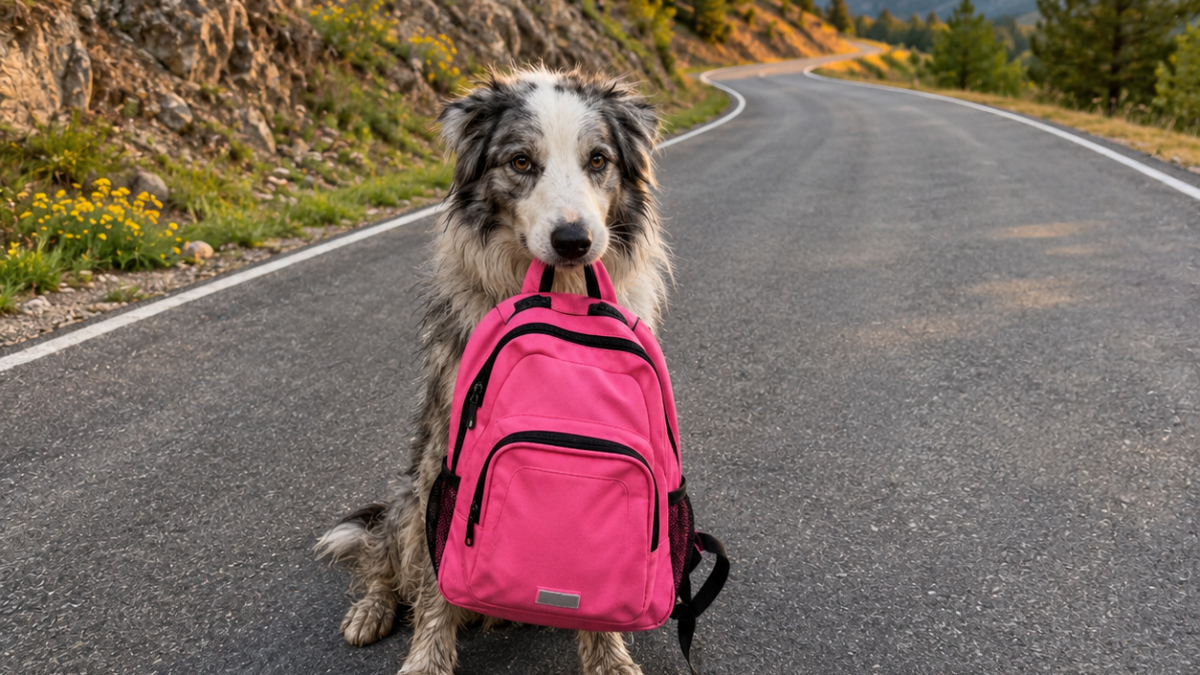
PART 2
At first, I thought it was a pile of clothes.
Blue fabric.
Dark pants.
A pale hand resting against the ground.
Then the figure moved.
“Oh my God.”
A woman was sitting against the base of a large gray boulder.
Her jacket was torn down one sleeve. Her hair was stuck to her face with sweat and moisture. Dirt covered one side of her cheek.
And her left leg—
I had to look away for half a second.
It was bent at an angle legs aren’t supposed to bend.
Her eyes opened when she heard me.
For several seconds, she just stared.
Then her gaze moved past me.
To the dog.
To the backpack.
Her mouth opened.
“My bag.”
Her voice barely existed.
“He took my bag.”
I dropped to my knees beside her.
“Don’t move.”
A weak laugh escaped her.
“I wasn’t planning on it.”
“Are you hurt anywhere besides your leg?”
“My hip. My shoulder. Mostly the leg.”
“How long have you been here?”
She swallowed.
“All night.”
My stomach tightened.
“What happened?”
“I slipped.”
Her voice shook as she spoke.
“Yesterday evening. I was coming down from the ridge. The trail was wet. I stepped on a rock and…”
She closed her eyes.
“I fell.”
“How far?”
“I don’t know. Fifteen feet? Twenty?”
She looked toward the slope behind us.
“I remember hitting the ground. I tried standing up once.”
Her face tightened.
“That was a mistake.”
I pulled off my jacket and placed it carefully around her shoulders.
She grabbed the front of it with shaking fingers.
“Thank you.”
“What’s your name?”
“Margaret.”
“I’m Rachel.”
Her gaze went back to the dog.
He had sat down several feet away.
Quiet.
Watching us.
“He came last night,” Margaret whispered.
“What?”
“The dog.”
She lifted one trembling hand toward him.
“Sometime after dark.”
I looked at him again.
“He’s yours?”
“No.”
Margaret shook her head.
“I’ve never seen him before.”
That made me pause.
“He just showed up?”
“I was yelling.”
She breathed carefully through a wave of pain.
“For hours. At first I thought someone would hear me. A hiker. A ranger. Anybody.”
Her lips trembled.
“After sunset, it got cold. Really cold.”
I could see it in her face now.
Not only pain.
Exhaustion.
The terrifying emotional emptiness that comes after a person has spent too many hours believing nobody is coming.
“And then I heard something in the trees,” she continued.
“I thought it might be a coyote.”
A faint smile touched her lips.
“But it was him.”
The Border Collie lowered his head slightly, almost as if he knew we were talking about him.
“He walked over and sat right there.”
Margaret pointed toward a patch of flattened grass beside the rock.
“He stayed with me.”
“All night?”
“For a while.”
She looked at the backpack.
“Then he grabbed that.”
“You tried stopping him?”
“I yelled.”
She almost laughed again.
“I called him every bad name I could think of.”
Despite everything, I smiled.
“I thought he was stealing my food.”
The smile vanished from her face.
“Then he disappeared.”
Her eyes filled.
“I thought… I thought even the dog had left me.”
The clearing became very quiet.
Only the faint sound of wind through the pines.
Margaret looked at me.
“But he didn’t leave, did he?”
I couldn’t answer immediately.
Because suddenly I understood.
The dog hadn’t wandered onto the road carrying a random object.
He had chosen the brightest thing near Margaret.
Something visible.
Something unnatural enough to make a driver stop.
He had carried it through the woods.
Found the road.
Waited.
And when someone finally came—
he had led that person back.
I looked at him.
His fur was muddy.
His body was thin.
His paws were scratched.
He looked like a dog the world had forgotten.
But somehow, when he found a stranger who needed help, he hadn’t walked away.
“No,” I whispered.
“He didn’t leave you.”
Margaret began to cry.
Not loudly.
She simply covered her mouth with one hand while tears slipped down her cheeks.
I took out my phone.
One bar.
Then none.
I lifted it higher.
One bar again.
“Come on.”
I tried emergency services.
The call failed.
I moved toward the edge of the clearing.
Tried again.
Failed.
“Rachel.”
Margaret’s voice was suddenly sharper.
I turned.
She had gone even paler.
“I’m really cold.”
That frightened me more than anything she’d said.
I hurried back.
“Stay with me.”
I wrapped my jacket tighter around her.
“Look at me.”
She tried.
“Margaret.”
“I’m here.”
“Tell me something.”
“What?”
“Anything.”
She breathed out.
“I hate hiking.”
I laughed before I could stop myself.
Her eyes opened a little wider.
“I mean it.”
“You’re telling me that now?”
“Seems like an appropriate time.”
I laughed again.
So did she.
Then she winced.
“Don’t make me laugh.”
“Sorry.”
The dog stood.
He moved closer and sat beside Margaret.
She reached weakly toward him.
Her fingers touched the fur on his neck.
“You troublemaker.”
His tail tapped the ground once.
I moved ten yards uphill.
Two bars.
I dialed again.
This time a voice answered.
“911, what’s your emergency?”
Relief nearly knocked the breath out of me.
I gave them everything I could.
The road.
The approximate mile marker.
How long we’d walked.
The direction.
The terrain.
The dispatcher told me not to move Margaret unless the location became dangerous.
“We have rescue personnel responding.”
“How long?”
“We’re working on locating you.”
“How long?”
“I can’t give you an exact—”
“She’s been out here all night.”
My voice cracked.
“Please.”
“We’re coming.”
I closed my eyes.
“Okay.”
I went back to Margaret.
“They’re coming.”
Her face crumpled.
“Really?”
“Really.”
She reached for my hand.
I took hers.
It was freezing.
For the next forty-five minutes, I kept her talking.
I learned she was forty-five years old.
A landscape architect.
She lived alone.
Her husband, Daniel, had left three years earlier after eighteen years of marriage.
No children.
No nearby family.
She had always wanted to hike the mountains, but Daniel hated hiking.
After their divorce, she spent nearly two years waiting for friends to join her.
Someone always had work.
Children.
Plans.
Reasons.
Finally, Margaret had become tired of waiting.
“So I came alone,” she said.
“Bad decision?”
She looked at her leg.
“I’ve made better ones.”
Then she glanced at the dog.
“But maybe not.”
“What do you mean?”
“If I’d come with someone, I wouldn’t have needed him.”
I studied her.
“And if you hadn’t needed him?”
She looked at the thin gray-and-white dog beside her.
“Then maybe nobody would have found him.”
That sentence stayed with me.
At the time, I didn’t understand why.
Later, I would.
We heard voices before we saw anyone.
“Rescue!”
I jumped to my feet.
“Here!”
The dog barked for the first time.
One loud, sharp bark.
Then another.
“Over here!”
Orange jackets appeared between the trees.
Four rescue workers entered the clearing carrying medical equipment and a collapsible stretcher.
Everything after that happened quickly.
They checked Margaret’s blood pressure.
Cut fabric around her injured leg.
Wrapped her in thermal blankets.
Started an IV.
One paramedic looked at the injury and gave a low whistle.
“You’re lucky.”
Margaret turned her head toward the dog.
“Yes.”
The paramedic followed her gaze.
“Is he yours?”
Margaret smiled weakly.
“I don’t know yet.”
They stabilized her leg.
When they lifted her onto the stretcher, she cried out.
The dog sprang forward.
A rescuer blocked him gently.
“Easy, boy.”
“He’s okay,” Margaret gasped.
“He’s with me.”
The dog stopped struggling.
He stood beside the stretcher.
Watching.
For a moment, his eyes met mine.
There was something almost calm in them now.
His job was finished.
The rescuers carried Margaret through the woods.
I stayed beside them.
After maybe a hundred yards, I remembered the dog.
I turned.
He wasn’t behind us.
“Wait.”
I stepped away from the group.
“Buddy?”
Nothing.
I ran back several yards.
“Hey!”
Trees.
Mist.
Silence.
Then I saw him.
He stood far behind us between two pines.
Watching.
“Come on!”
I crouched and held out my hand.
“You can come.”
He didn’t move.
Margaret called weakly from the stretcher.
“Is he there?”
“Yeah.”
“Bring him.”
I looked toward her.
When I looked back—
the dog was gone.
I ran toward the spot.
“Hey!”
Nothing.
I pushed through branches.
“Come back!”
Only wet leaves and empty forest.
He had vanished.
Exactly as suddenly as he had appeared.
### 1
I rode to the hospital with Margaret.
I could have returned to my SUV.
Technically, my part was over.
But leaving felt wrong.
Maybe I needed to know she survived.
Maybe I needed to understand what had just happened.
Or maybe, after three months of moving through my own life without feeling connected to anything, I finally had somewhere I wanted to be.
The doctors confirmed what we already suspected.
A badly fractured tibia.
Sprained shoulder.
Dehydration.
Mild hypothermia.
A few cuts.
Nothing that wouldn’t heal.
But the emergency-room doctor looked at Margaret’s chart and then at me.
“Another four or five hours out there could have been dangerous.”
Margaret heard him.
Her eyes closed.
“If the dog hadn’t found Rachel…”
The doctor didn’t finish the sentence.
Nobody needed him to.
I sat beside Margaret’s hospital bed until nearly noon.
She slept.
I watched rain begin tapping against the window.
And I kept thinking about gray fur disappearing between the trees.
Eventually, a nurse convinced me to go get something to eat.
When I returned, Margaret was awake.
Her first question wasn’t about her leg.
“Where is he?”
I knew immediately.
“The dog?”
“Yes.”
“He disappeared before we reached the road.”
Her expression fell.
“You didn’t get him?”
“I tried.”
“Did you look?”
“For a few minutes. Rescue wanted to get you out.”
Margaret stared at the blanket covering her legs.
I expected disappointment.
Instead, she said quietly, “He’s still out there.”
“Probably.”
“He might be hungry.”
“He definitely looked hungry.”
“He could be hurt.”
“His paws were cut.”
She looked at me.
The intensity in her eyes surprised me.
“When I get out of here, I’m going back.”
“You should probably learn to walk again first.”
A small smile.
“Then I’ll limp back.”
“Margaret.”
“I mean it.”
“I know.”
“No, you don’t.”
She shifted slightly and grimaced.
“That dog had no reason to help me.”
“Maybe he likes pink backpacks.”
She didn’t laugh.
“He could have kept walking.”
Her voice softened.
“He didn’t.”
I thought about that.
About how easily people walk past each other every day.
How often we decide someone else’s pain is none of our business.
And this starving stray had stayed with a stranger in the dark.
Margaret looked out the window.
“I owe him.”
“You survived.”
“That’s why I owe him.”
### 2
I left the hospital that afternoon.
The rain had stopped.
For the first time since I’d started traveling, I felt strange getting back into my SUV alone.
The passenger seat was empty.
My coffee cup was still on the floor where it had fallen that morning.
I picked it up and stared at the brown stain in the carpet.
Twelve hours earlier, my biggest concern had been where I would sleep that night.
Now somewhere in those mountains, a dog I didn’t own had become impossible to stop thinking about.
I returned to the place where he’d blocked the road.
I parked.
Waited.
Nothing.
I opened a can of tuna from my travel food supply and placed it near the trees.
“This is ridiculous,” I told myself.
Then I sat on my hood for almost an hour.
He never came.
The next morning, the tuna was gone.
That meant nothing.
Could have been a raccoon.
A fox.
Anything.
Still, I left another can.
Three days later, Margaret called me.
“I have surgery tomorrow.”
“How are you?”
“I’ve been better.”
“You sound better.”
“Drugs.”
I smiled.
Then she said, “Did you go back?”
I hesitated.
“How did you know?”
“Because you’ve been thinking about him too.”
She was right.
“Yes.”
“Anything?”
“No.”
Silence.
Then: “Don’t stop looking.”
“I can’t stay here forever.”
“I know.”
I looked around the motel room where I was staying.
My suitcase was open on the floor.
I had nowhere else to be.
“I’ll look a few more days.”
“Thank you.”
After we hung up, I realized something uncomfortable.
Margaret had said I couldn’t stay forever.
But I wasn’t sure what I was returning to.
An apartment full of boxes?
Job applications I had stopped opening?
Friends whose lives continued normally while mine seemed to have stalled?
That evening, I drove into a small town near the mountain and printed a picture I’d taken without realizing it.
During the rescue, just before the dog disappeared, I had snapped one photograph of the clearing.
Margaret was mostly obscured by rescuers.
But in the background stood the Border Collie.
Thin.
Mud-streaked.
Watching.
I enlarged the image.
Then I made flyers.
**HAVE YOU SEEN THIS DOG?**
I left my number.
No reward.
I didn’t know what reward made sense for finding someone who had already given away more than anyone could repay.
I posted flyers at a gas station, a diner, a feed store, a ranger station, and a small grocery store.
People were polite.
Mostly indifferent.
Until I reached a weathered little house near the river.
An older woman was sweeping her porch.
She looked at the photograph for several seconds.
“I’ve seen him.”
My heart jumped.
“Where?”
“Riverbank.”
“When?”
“Couple mornings ago.”
“Are you sure?”
She pointed at the picture.
“That white streak on his face. Same dog.”
“Does he come often?”
“Now and then.”
“Does anyone own him?”
She shook her head.
“Not that I know of.”
“How long has he been around?”
The woman leaned on the broom.
“Months, maybe longer.”
“Does he let people near him?”
A dry laugh.
“Not unless you’re carrying a broken woman, apparently.”
I stared at her.
She raised an eyebrow.
“Small towns talk.”
“Oh.”
“Heard what happened.”
She gave me the flyer back.
“You looking to adopt him?”
“I’m not sure.”
“Someone should.”
I looked toward the mountains.
“Someone wants to.”
### 3
Margaret spent eleven days in the hospital.
Two weeks after the rescue, she called me again.
“I’m out.”
“That was fast.”
“I threatened to escape.”
“I believe that.”
“I have crutches.”
“Congratulations.”
“And a car.”
“Margaret.”
“And tomorrow morning I’m going back.”
I closed my eyes.
“You can barely walk.”
“Exactly. So you’ll have an advantage if I try anything stupid.”
“What makes you think I’m coming?”
“Because if you weren’t, you would have said no already.”
At six the next morning, I met her in the parking lot of a roadside diner.
She was standing beside an old silver sedan, balancing awkwardly on crutches.
When she saw me, she grinned.
“You came.”
“You’re impossible.”
“So I’ve been told.”
“By doctors?”
“Mostly ex-husbands.”
I loaded her crutches into my SUV.
“You’re not driving.”
“I can drive.”
“Your left leg is in a cast.”
“So?”
“So get in.”
She obeyed, muttering something about authoritarian strangers.
We drove toward the mountain.
For a while, neither of us spoke.
Then Margaret said, “I was scared you wouldn’t come.”
I glanced at her.
“You could have asked normally.”
“I did.”
“You emotionally blackmailed me.”
“Effective, wasn’t it?”
I smiled.
Then she became serious.
“I don’t want to do this alone.”
Those words changed the mood instantly.
I looked back at the road.
“You don’t have to.”
When we reached the place where I’d first seen the dog, Margaret stared through the windshield.
“Here?”
“Right here.”
I pulled onto the shoulder.
“He was standing exactly where that patch of sunlight is.”
Margaret opened her door.
I walked around to help her.
She lowered herself onto the pavement.
For nearly a minute, she just stood there on her crutches.
Then she whispered, “He came all this way.”
I hadn’t thought about it like that.
The clearing was at least fifteen minutes through steep forest.
Maybe more for a dog carrying a backpack.
And he hadn’t simply reached the road.
He had remained there.
Waiting for a vehicle.
Waiting for someone willing to stop.
Margaret looked toward the trees.
“Show me.”
“What?”
“The route.”
“You can’t hike that.”
“Rachel.”
“No.”
“I survived the fall.”
“And I’m not helping you create a sequel.”
She sighed.
“Fine.”
We searched along the road instead.
We called.
We left food.
We drove slowly past access roads and trailheads.
Nothing.
The second day, nothing.
The third day, still nothing.
Margaret became quieter.
At a small convenience store, she bought three different kinds of dog treats.
“He might be picky.”
“He ate whatever he could find in the woods.”
“You don’t know that.”
“He looked like a skeleton with fur.”
“Which means he deserves choices.”
I couldn’t argue.
On the fourth morning, we went to the river.
The older woman had said the dog appeared around sunrise.
So we arrived before dawn.
The air was painfully cold.
Mist floated over the water.
Margaret sat on a flat rock with her cast stretched in front of her.
I sat beside her.
A pile of dog food rested between us.
We waited.
Twenty minutes.
Forty.
An hour.
The sun rose behind the trees.
Margaret’s shoulders sank.
“Maybe he moved on.”
“Maybe.”
“I hate that answer.”
“Me too.”
She picked up a handful of kibble.
Then I heard it.
A twig snapping.
I turned.
Nothing.
Another sound.
Closer.
“Margaret.”
She froze.
Between two trees, perhaps fifty feet away, stood a dog.
Gray.
White.
Thin.
His ears were raised.
My breath caught.
“That’s him.”
Margaret made a sound somewhere between a laugh and a sob.
The dog didn’t move.
Neither did we.
Margaret slowly placed the food on the ground.
“Hi.”
Her voice broke.
“Hey, sweetheart.”
One step.
The dog moved forward.
Then stopped.
Margaret wiped tears from her cheek.
“I know you.”
Another step.
“I know you probably don’t know me anymore.”
His nose lifted.
“You found me when nobody else could.”
Another step.
“You stayed when you didn’t have to.”
The dog was thirty feet away now.
“I came back.”
His ears twitched.
Margaret’s hands shook.
“I came back for you.”
Suddenly, he ran.
Margaret gasped.
I expected him to go to her.
He didn’t.
He ran directly to me.
He stopped at my knees.
Sat.
And placed his head against my thigh.
I couldn’t breathe.
“Hey.”
My hands hovered above him.
Then I touched his head.
He closed his eyes.
Behind me, Margaret whispered, “He remembers you.”
I sank to my knees.
“You crazy little genius.”
His tail began moving.
Slowly at first.
Then faster.
I scratched behind his ears.
“You scared us.”
The dog pressed closer.
Then he lifted his head.
Looked at Margaret.
For several seconds, neither moved.
Margaret held out one hand.
“It’s me.”
The dog walked toward her.
Carefully.
Almost cautiously.
He sniffed her fingers.
Her hand trembled beneath his nose.
Then he licked her once.
One small lick across the knuckles.
Margaret broke.
She bent forward as far as her cast allowed and wrapped her arms around his neck.
“Oh, God.”
The dog stood still.
Then leaned into her.
Margaret cried into his fur.
“You came back.”
I looked away because suddenly my own eyes were burning.
“No,” I said softly.
“We came back.”
### 4
We took him straight to a veterinarian.
The dog hated the car at first.
He stood with all four paws stiff against the back seat, eyes wide.
Margaret kept one hand on him.
“You saved my life. You can survive a Honda.”
He eventually sat.
Then, ten minutes later, placed his chin on her lap.
At the clinic, the veterinarian scanned him for a microchip.
Nothing.
No collar.
No identification.
No evidence anyone was actively searching for him.
The vet estimated he was around three years old.
Underweight.
Minor cuts.
One older scar along his right hind leg.
Otherwise healthy.
“He’s surprisingly well socialized for a stray,” the veterinarian said.
“Meaning?” Margaret asked.
“Meaning he probably had human contact at some point.”
“Could someone own him?”
“Possibly.”
Margaret’s face changed.
The vet noticed.
“We’ll check lost-pet records. Legally, you’ll need to follow the stray-hold requirements before permanent adoption.”
Margaret nodded.
But her hand tightened around the dog’s neck.
“What happens until then?”
“If you’d like to foster him, that’s possible.”
“I would.”
The answer came so fast the veterinarian smiled.
“You didn’t think about that very long.”
“I had all night on a mountain to think about it.”
“What are you calling him?”
Margaret looked at me.
I shrugged.
“He needs a name.”
She studied the dog.
He looked back.
“Lucky.”
I raised an eyebrow.
“Original.”
“I almost died.”
“Fair.”
She rubbed his ears.
“Lucky.”
The dog’s tail moved.
Margaret smiled.
“See?”
“He would have wagged if you called him Dishwasher.”
“Don’t ruin this.”
The veterinarian laughed.
Lucky went home with Margaret that afternoon.
Technically, it was temporary.
Emotionally, it was over.
He belonged with her.
The first night, Margaret called me at 2:13 a.m.
I answered in panic.
“What happened?”
“He won’t sleep.”
“What?”
“He keeps walking around the house.”
“Margaret.”
“He checks the windows.”
I sat up in bed.
“Is he barking?”
“No.”
“Whining?”
“No.”
“Then go to sleep.”
“I think he’s guarding me.”
There was something in her voice.
Something fragile.
I became fully awake.
“Where is he now?”
“Bedroom doorway.”
“Can you see him?”
“Yes.”
“Then you’re okay.”
Silence.
“Rachel?”
“Yeah?”
“I haven’t slept well since the accident.”
“I know.”
“I keep waking up thinking I’m still outside.”
I swallowed.
“Maybe Lucky does too.”
Margaret breathed slowly.
Then she said, “Maybe we can learn together.”
The next morning she sent me a photograph.
Lucky asleep on the floor beside her bed.
One paw touching the bottom of her cast.
### 5
The mandatory waiting period passed.
Nobody claimed him.
Margaret signed the adoption papers.
Lucky officially became hers.
But life after a rescue isn’t a movie.
You don’t roll credits the moment everybody gets home.
Margaret struggled.
Her leg healed slowly.
Physical therapy hurt.
Some nights, she woke from nightmares.
Sometimes she refused to hike even short paved trails.
Lucky had problems too.
He panicked when doors slammed.
He ate too quickly.
For the first month, he hid pieces of food under furniture.
Whenever Margaret left the house, even briefly, he paced.
Whenever she returned, he greeted her as though she’d survived a war.
They were both afraid of being abandoned.
Neither knew how to say it.
So they said it through routines.
Margaret filled his bowl every morning at seven.
Lucky sat beside her during breakfast.
At noon, they took a slow walk.
At night, he slept beside her bed.
Week by week, something changed.
His ribs disappeared beneath healthy muscle.
His coat became glossy.
The scratches healed.
He learned that food would always return.
Margaret learned something similar.
She began trusting that tomorrow would come.
I visited often.
More often than I had intended.
At first, I told myself I was checking on Lucky.
Then I admitted I liked being there.
Margaret had rented a small house close to the mountains.
A wooden porch wrapped around the front.
Pine trees bordered the yard.
Lucky could spend hours racing through the grass.
The first time I saw him run at full speed, I laughed so loudly Margaret came outside.
“What?”
“Look at him.”
Lucky made a huge circle around the yard, ears bouncing.
“He looks ridiculous.”
“He looks happy.”
That shut me up.
Yes.
He did.
Happy.
Safe.
Wanted.
I wondered what that felt like.
Margaret must have read something in my face.
“You’re still not working?”
“No.”
“Looking?”
“Sometimes.”
“That means no.”
I leaned against the porch railing.
“I don’t know what I want.”
“You don’t have to.”
“That’s easy for you to say.”
She lifted her cast.
“I recently fell off a mountain.”
“Point taken.”
She handed me a cup of coffee.
“I spent eighteen years building my life around someone else’s preferences.”
“Daniel?”
She nodded.
“He hated dogs.”
I looked at Lucky.
“Clearly a man of terrible judgment.”
That got a laugh.
“He hated the mountains too.”
“Then why did you marry him?”
“He made me laugh.”
She looked out at the trees.
“And when you’re twenty-six, sometimes you think being loved is the same thing as being understood.”
I said nothing.
Margaret continued.
“When he left, I thought the worst part would be loneliness.”
“Wasn’t it?”
“No.”
She looked at me.
“The worst part was realizing I’d forgotten what I liked.”
That hit harder than I expected.
Because that was exactly how unemployment felt.
Without deadlines, meetings, job titles, performance reviews—
I didn’t know who I was.
Margaret smiled faintly.
“Maybe getting lost isn’t always bad.”
I glanced toward the woods.
“You almost froze to death while lost.”
“Yes.”
“Terrible motivational speaker.”
“Still alive, though.”
Lucky ran onto the porch.
He dropped something at my feet.
A gardening glove.
Margaret groaned.
“Lucky.”
He looked proud.
“Apparently he still enjoys stealing personal belongings.”
I picked up the glove.
“Maybe he’s trying to save somebody.”
“He saved one person. Now he thinks he’s a professional.”
### 6
The story became public almost by accident.
A local reporter heard about Margaret’s rescue from one of the paramedics.
He called her.
She refused an interview.
He called again.
She refused again.
Then he asked whether he could write about the dog.
Margaret agreed immediately.
“You wouldn’t talk about yourself,” I told her.
“I’m boring.”
“You survived a night with a broken leg.”
“Lucky carried a backpack.”
“Fair.”
The article ran on a Sunday.
**STRAY DOG LEADS DRIVER TO INJURED HIKER**
There was a picture of Lucky sitting on Margaret’s porch.
Within two days, a television station called.
Then another.
People sent letters.
Dog treats.
Toys.
A pink collar.
Someone mailed Margaret a replacement pink backpack.
She never used it.
Because she still had the original.
The one Lucky had carried.
Mud stains remained along the bottom.
A tooth mark pierced one strap.
Margaret hung it on a hook near her front door.
“You could wash that,” I said once.
“No.”
“It smells like forest.”
“Exactly.”
“It probably has organisms growing on it.”
“Rachel.”
“I’m just saying.”
She touched the backpack.
“This is evidence.”
“Of what?”
“That it happened.”
Her voice softened.
“That I wasn’t imagining it.”
I understood.
Trauma does strange things to memory.
Sometimes the worst events become unreal after enough time passes.
You begin questioning details.
Did it really hurt that badly?
Was I really that scared?
Was I really alone?
The backpack answered all of that.
Yes.
It happened.
And so did the rescue.
Lucky became something of a local celebrity.
He didn’t care.
He preferred tennis balls.
One Saturday, a group from a nearby animal rescue organization visited Margaret.
They brought a woman named Claire, who specialized in evaluating dogs for search-and-rescue aptitude.
Claire watched Lucky solve food puzzles.
Hide-and-seek games.
Scent exercises.
Then she looked at Margaret.
“This dog has exceptional problem-solving ability.”
Margaret folded her arms.
“I could have told you that.”
Claire smiled.
“He also appears strongly motivated by locating people.”
“Meaning?”
“Meaning he might be trainable.”
“For what?”
“Search work.”
Margaret stared.
I stared.
Lucky stole a sandwich from my plate.
Claire pointed.
“Impulse control needs work.”
### 7
The idea seemed absurd.
A stray dog who had accidentally saved a hiker becoming a trained search dog sounded too perfect.
Too neat.
Real life rarely organizes itself into satisfying circles.
But Claire insisted.
They started slowly.
Basic obedience.
Recall.
Scent tracking.
Searching small wooded areas.
Lucky loved it.
The moment the search harness came out, his entire body changed.
Focused.
Alert.
Ready.
Exactly the way he’d looked on the mountain road.
Margaret watched the first training session from a folding chair.
Her leg was still healing.
Claire hid a volunteer behind a cluster of trees.
Lucky was given the volunteer’s glove to smell.
“Find.”
He took off.
Thirty seconds later, barking erupted from the trees.
Margaret covered her mouth.
Claire smiled.
“He understands the game.”
I stood beside Margaret.
“You okay?”
She nodded.
Then whispered, “That wasn’t a game when he found me.”
No.
It wasn’t.
Over the next several months, Margaret recovered.
Lucky trained.
And I stayed.
I rented a small apartment in town instead of continuing my road trip.
I found freelance marketing work.
Then part-time work helping the local rescue organization with fundraising and communications.
For the first time in months, I woke up with somewhere to go.
Not because I had to.
Because I wanted to.
One afternoon, I was designing flyers at the rescue office when Margaret walked in with Lucky.
“You have a degree in this, right?”
“In marketing?”
“Yes.”
“Technically.”
She placed a folder on my desk.
“What is this?”
“A job opening.”
I looked at the page.
A regional nonprofit needed a communications director.
Animal welfare.
Public education.
Fundraising.
Community outreach.
I looked up.
“No.”
“You haven’t read it.”
“I know what you’re doing.”
“Excellent. Saves time.”
“Margaret.”
“You’re good at this.”
“I was good at selling products people didn’t need.”
“You helped this shelter raise twelve thousand dollars last month.”
“That was different.”
“Why?”
Because it mattered.
I didn’t say it.
Margaret saw the answer anyway.
“Apply.”
“I don’t have nonprofit experience.”
“You have experience.”
“They’ll choose somebody else.”
“Maybe.”
She shrugged.
“Let them make that mistake.”
I stared at the application.
Lucky rested his chin on my knee.
“You two planned this.”
Margaret smiled.
“He wrote the cover letter.”
I applied.
Three weeks later, I got the job.
### 8
A year after the morning on the mountain road, Margaret asked me to hike with her.
I thought she was joking.
She wasn’t.
“Same trail?”
“Part of it.”
“No.”
“Rachel.”
“No.”
“Lucky is coming.”
“Still no.”
“Claire is coming.”
“No.”
“It’s a marked group hike.”
I hesitated.
She smiled.
“Got you.”
The morning of the hike, Margaret arrived wearing new boots.
Lucky wore his search harness.
The original pink backpack hung from Margaret’s shoulders.
I stared at it.
“You’re taking that?”
“Yes.”
“You said you’d never use it.”
“I changed my mind.”
“Why?”
She adjusted the straps.
“Because I don’t want it to represent the place where I almost died.”
She looked toward the trail.
“I want it to represent the place where I came back.”
We walked slowly.
The forest looked different in daylight.
Smaller somehow.
Less threatening.
When we reached the trail junction near where Margaret had fallen, she stopped.
Her breathing changed.
Lucky immediately moved beside her.
She touched his neck.
“I’m okay.”
Claire offered to turn around.
Margaret shook her head.
“No.”
We continued.
Eventually we reached the clearing.
The boulder was exactly as I remembered.
Gray.
Cold.
Ordinary.
Margaret stood several feet away.
She didn’t approach at first.
Then she walked to it.
Placed one hand against the stone.
Lucky sat beside her.
I stayed back.
Some moments belong to other people.
After a while, Margaret called me.
“Rachel.”
I went to her.
She pointed at a patch of grass.
“That’s where I thought I was going to die.”
I didn’t know what to say.
She looked at Lucky.
“And that’s where he decided I wasn’t.”
Tears filled her eyes.
“But there’s something I’ve never told you.”
“What?”
“When he left with the backpack…”
She took a shaky breath.
“I was angry.”
“At him?”
“Yes.”
She laughed softly.
“I yelled after him. I told him to come back. I called him stupid.”
Lucky tilted his head.
Margaret stroked his face.
“I thought everyone eventually left.”
Her voice cracked.
“Daniel left. Friends drifted away. My parents died. And then this dog appeared when I was terrified, sat beside me, and left too.”
She wiped her eyes.
“I remember thinking, of course.”
I touched her shoulder.
“But he wasn’t leaving.”
“No.”
“He was getting help.”
She nodded.
“That changed something in me.”
“What?”
Margaret looked at me.
“Sometimes someone walks away because they’ve abandoned you.”
She looked toward the path Lucky had taken that night.
“And sometimes they walk away because they’re trying to save you.”
For a long time, none of us spoke.
Then Lucky suddenly walked toward the trees.
Margaret laughed nervously.
“Don’t even think about it.”
He turned around.
In his mouth was a stick.
I laughed.
The tension broke.
Margaret threw the stick.
Lucky chased it.
The clearing that had once held terror filled with laughter.
And I knew that was the real victory.
Not forgetting what happened.
Not pretending it didn’t hurt.
Coming back and making a different memory.
### 9
Lucky completed his search-and-rescue certification the following spring.
The ceremony wasn’t dramatic.
No television cameras.
No giant crowd.
Just volunteers, handlers, dogs, instructors, and families standing in a field outside the training center.
Claire read each dog’s name.
When she called Lucky, Margaret walked forward with him.
I clapped until my hands hurt.
Claire handed Margaret a certificate.
Then she looked at Lucky.
“You were doing this before we met you, weren’t you?”
Lucky wagged.
Everyone laughed.
Later, Margaret framed the certificate.
She placed it beside the pink backpack.
Lucky participated mostly in training exercises at first.
Then came his first real call.
A seventy-two-year-old man with early dementia had wandered from a rural property before sunset.
By midnight, temperatures were falling.
Search teams were called.
Margaret phoned me.
“Lucky’s going.”
I sat straight up.
“Tonight?”
“Yes.”
“Are you going?”
“With Claire.”
“You’re certified as a handler?”
“Assistant handler.”
“When did that happen?”
“I don’t tell you everything.”
“You absolutely tell me everything.”
“Apparently not.”
I drove to the search command area.
I wasn’t allowed beyond the staging point.
For three hours, I waited.
It brought everything back.
The mountain road.
The clearing.
Margaret’s frozen hand.
The desperate feeling of not knowing whether help would arrive in time.
At 2:47 a.m., a radio crackled.
A volunteer turned.
Then smiled.
“Found him.”
I jumped up.
“Alive?”
“Alive.”
Twenty minutes later, Lucky emerged from the dark forest beside Claire and Margaret.
Mud covered his paws.
His tongue hung out.
His eyes were bright.
Margaret saw me.
She started crying before she reached me.
“He found him.”
I hugged her.
“He found him.”
“The man had fallen near a creek.”
She laughed through tears.
“Lucky wouldn’t leave him.”
Of course he wouldn’t.
A medic passed us.
“Good dog.”
Lucky’s tail wagged.
Margaret knelt.
“You know what you did?”
Lucky licked her face.
She laughed.
“You don’t care, do you?”
He cared about the sandwich in my hand.
Some things never changed.
### 10
Years passed.
The story stopped feeling extraordinary every day.
And somehow that made it more meaningful.
Extraordinary things don’t remain extraordinary forever.
Eventually they become family stories.
Inside jokes.
Photos on refrigerators.
Old scars.
Objects hanging by the door.
Margaret’s leg healed, though she carried a faint limp when the weather turned cold.
She returned to hiking.
Never recklessly.
Never alone.
Lucky became an experienced search dog.
He helped locate lost hikers, missing children, and an elderly woman who had wandered from a campground.
Not every search ended happily.
That was the hardest part.
But Margaret learned that saving one life doesn’t mean you can save everyone.
Lucky seemed to understand too.
After difficult searches, he would become unusually quiet.
Margaret would bring him home, remove his harness, sit on the porch, and rest one hand against his back.
They took care of each other.
As for me, I stayed with the nonprofit.
One year became three.
Three became five.
Eventually, I became executive director.
The woman who once drove through the mountains because she had nowhere to go ended up building her life in the same town where she’d accidentally found a reason to stop.
I bought a small house.
Margaret lived fifteen minutes away.
We became the kind of friends who didn’t knock before entering.
Lucky never stopped greeting me.
Even when his muzzle began turning white.
Even when his running slowed.
Whenever I sat on Margaret’s porch, he would eventually come over and place his head on my lap.
Exactly as he’d done beside the river.
One autumn evening, Margaret and I sat watching leaves move across the yard.
Lucky was twelve by then.
Old for a Border Collie.
He slept more.
His hearing wasn’t perfect.
But his eyes were still the same.
Direct.
Intelligent.
Impossible to ignore.
Margaret looked at him.
“You know what scares me?”
I knew.
But I made her say it.
“Losing him.”
I put my cup down.
“He’s still here.”
“I know.”
Her voice trembled.
“But one day…”
“Margaret.”
“I don’t know how to repay him.”
“You already did.”
“How?”
“You gave him a home.”
She shook her head.
“He gave me my life.”
“And you gave him his.”
She looked at me.
I nodded toward Lucky.
“He wasn’t safe when we found him. He was starving. Alone. Sleeping outside.”
Margaret’s eyes filled.
“You think that was enough?”
“More than enough.”
Lucky opened one eye.
Then closed it again.
I smiled.
“Also, based on his body language, he thinks you could improve the snack schedule.”
Margaret laughed.
It was a small laugh.
But it helped.
### 11
Lucky retired from active search work at thirteen.
There was a little ceremony.
This time, there were cameras.
By then his story had become well known across several counties.
Children sent drawings.
Former search volunteers came.
Families of people he’d helped locate attended.
One man approached Margaret holding the hand of a little girl.
She was eight years old.
Lucky had helped find her three years earlier after she wandered from a family campsite.
The girl knelt carefully beside him.
“Do you remember me?”
Lucky sniffed her.
Then licked her cheek.
She giggled.
Her father began crying.
Margaret cried too.
I pretended I had something in my eye.
At the end of the ceremony, Claire spoke.
“Search dogs don’t understand medals. They don’t understand headlines. They don’t understand how many people know their names.”
She looked at Lucky.
“They understand a task.”
“Find someone.”
“Stay.”
“Bring them home.”
My throat tightened.
Because that was Lucky’s entire life.
Find someone.
Stay.
Bring them home.
First Margaret.
Then me, in a different way.
Then strangers.
Again and again.
When the ceremony ended, Margaret removed Lucky’s harness.
“For the last time,” she whispered.
She kissed the top of his head.
“You’re done, buddy.”
Lucky immediately stole a hot dog from a nearby folding table.
Claire sighed.
“Retirement suits him.”
### 12
Lucky died peacefully eighteen months later.
I wish I could tell you there was some miracle.
That extraordinary dogs get extraordinary endings.
They don’t.
They get the same painful bargain the rest of us get.
A limited amount of time.
Margaret called me one morning.
Her voice told me before her words did.
“Rachel.”
I was already grabbing my keys.
“I’m coming.”
Lucky was lying on his favorite blanket near the fireplace.
His breathing was slow.
Margaret sat beside him.
She had one hand on his chest.
When I entered, Lucky opened his eyes.
His tail moved once.
Just once.
I knelt beside him.
“Hey, buddy.”
His eyes stayed on me.
That same look.
Fourteen years had changed his body.
Not that look.
I rubbed his head.
“You remember me?”
His tail moved again.
Margaret laughed through her tears.
“He does.”
“Good.”
I leaned closer.
“Because I remember you too.”
I told him things dogs can’t understand.
Or maybe they understand better than we think.
I told him he had been brave.
That he had been good.
That Margaret was okay.
That I was okay.
That he didn’t need to search for anyone anymore.
Margaret pressed her forehead to his.
“You found me.”
Her voice broke.
“You found me when I couldn’t even find myself.”
Lucky breathed out.
She held him.
“I love you.”
He died with his head resting across both our hands.
For a long time, nobody moved.
The house felt impossibly quiet.
No nails clicking against the floor.
No collar jingling.
No tail against furniture.
Nothing.
Eventually, Margaret stood.
She walked toward the entryway.
The pink backpack was still there.
Faded now.
The neon color softened by years of sunlight.
She took it from the hook.
“I want to put something in it.”
“What?”
Lucky’s old search harness.
His retirement certificate.
His favorite worn tennis ball.
A photograph of the three of us by the river.
She placed them inside.
Then zipped the bag closed.
“I’m not putting this away,” she said.
“You don’t have to.”
She hung it back on the hook.
And there it remained.
### 13
Six months after Lucky died, Margaret called me before sunrise.
I answered.
“You okay?”
“Yes.”
Pause.
“Come hiking with me.”
I sat up.
“Today?”
“Yes.”
“Where?”
She didn’t answer.
She didn’t have to.
At six in the morning, we parked on the same mountain road where everything had begun.
The world looked almost exactly as it had that first day.
Mist.
Wet pavement.
Sunlight touching the ridge.
For a few seconds, I could almost see him.
Thin.
Muddy.
Pink backpack between his teeth.
Waiting.
Margaret stood beside me.
She was carrying the backpack.
“You brought it.”
“Yes.”
We entered the forest.
We walked slowly.
Neither of us spoke much.
When we reached the clearing, sunlight was spreading across the grass.
The old boulder remained.
Margaret sat beside it.
Not where she’d been trapped.
On top of it.
She removed the backpack.
Opened it.
Inside was Lucky’s old tennis ball.
She held it in both hands.
“I’ve been thinking,” she said.
“Dangerous.”
She smiled.
“I want to start something.”
“What?”
“A fund.”
“For?”
“Search-dog training.”
I looked at her.
“And emergency equipment for rural rescue teams.”
“That sounds expensive.”
“I have savings.”
“You shouldn’t spend all your savings.”
“I won’t.”
She glanced at me.
“You’ll raise the rest.”
“Oh, so this is why I’m here.”
“Yes.”
“Manipulative.”
“Effective.”
I laughed.
Then she became serious.
“I don’t want Lucky’s story to end with Lucky.”
That sentence settled over the clearing.
“What are you calling it?”
Margaret looked at the pink backpack.
“The Lucky Fund.”
I nodded.
“Terrible branding.”
“You can fix it.”
“No. It’s perfect.”
She looked surprised.
I sat beside her.
For a while we listened to the forest.
Birds.
Wind.
A distant stream.
Then Margaret placed Lucky’s tennis ball beside the boulder.
“You think we should leave that?”
“Yes.”
“An animal will steal it.”
She smiled.
“Good.”
We stood.
Before leaving, Margaret touched the stone.
“Thank you,” she whispered.
I wasn’t sure whether she was talking to the mountain.
To Lucky.
To life.
Maybe all three.
### 14
The Lucky Fund grew faster than either of us expected.
People remembered the story.
Donations came from across the country.
Small amounts mostly.
Five dollars.
Twenty dollars.
A hundred.
Children held lemonade stands.
A local school organized a charity walk.
One family donated in honor of a father Lucky had helped find.
Within three years, the fund had helped train seventeen search dogs and purchased thermal blankets, tracking equipment, radios, medical supplies, and protective gear for volunteer rescue teams.
At the entrance of the training center was a photograph.
Lucky standing beside Margaret.
Beneath it were four words:
**FIND. STAY. BRING HOME.**
I visited often.
Sometimes young dogs training in the field reminded me of him.
One Border Collie in particular had the same intense stare.
During a demonstration, the dog grabbed a bright orange training pouch and ran toward a hidden volunteer.
I laughed.
The trainer looked at me.
“What?”
“Nothing.”
But it wasn’t nothing.
For one second, I was thirty-four again.
Unemployed.
Aimless.
Driving a mountain road.
And there he was.
Blocking my path.
### 15
People sometimes ask whether I believe Lucky knew exactly what he was doing that first morning.
Scientists might explain it through herding instincts.
Problem solving.
Scent association.
Learned behavior.
Maybe they’re right.
Maybe Lucky didn’t understand the concept of rescue in the human sense.
Maybe he didn’t think:
This woman will die unless I find another person.
Maybe he simply knew something was wrong.
Maybe he knew Margaret couldn’t follow.
Maybe he grabbed the backpack because it smelled strongly of her.
Maybe he reached the road because roads contain people.
Maybe he blocked my car because movement gets attention.
All of that is possible.
But I’ve never needed a perfect explanation.
I know what happened.
A woman was injured and alone.
A dog stayed with her.
Then he left.
He carried something bright.
He found a road.
He waited.
He stopped me.
He made sure I followed.
And he led me directly back.
Whatever word you use for that—
instinct,
intelligence,
luck,
love—
the result is the same.
Margaret lived.
Lucky found a home.
And I stopped wandering.
Years after his death, I still drive that mountain road sometimes.
Usually early in the morning.
I park at the shoulder.
Get out.
Stand exactly where Lucky once stood.
Cars pass now and then.
Most drivers never know what happened there.
It’s just pavement to them.
Trees.
A bend in the road.
But I see something else.
I see the moment my life changed.
I used to believe important moments announced themselves.
A phone call.
A wedding.
A promotion.
A death.
Something obvious enough to divide your life into before and after.
I was wrong.
Sometimes the most important moment of your life is standing silently in the middle of a road.
Covered in mud.
Holding a pink backpack.
Waiting to see whether you’ll stop.
### Epilogue
Margaret still lives near the mountains.
She’s older now.
So am I.
She eventually adopted another dog, though it took years.
A mixed-breed rescue named Milo.
She loves him fiercely.
But she has never compared him to Lucky.
“You don’t replace family,” she told me.
“You make room for more.”
The original pink backpack still hangs in her entryway.
The fabric is faded.
One zipper sticks.
There’s a tear near the bottom.
She has been offered replacements dozens of times.
She refuses.
Once, during dinner, I asked why she still kept it by the front door instead of protecting it in a box.
She looked at me as though the answer were obvious.
“Because doors are where you keep things that remind you to go somewhere.”
I laughed.
“That sounds suspiciously poetic.”
“I’ve had years to practice.”
Then she became quiet.
“When I was lying out there that night, I thought my life had narrowed down to that one rock.”
She looked toward the backpack.
“I thought everything I’d done, everything I’d wanted, everything I’d postponed—it was all over.”
Milo rested his chin on her knee.
Margaret scratched behind his ears.
“Lucky didn’t just bring help.”
She looked at me.
“He brought the rest of my life.”
I understood.
Because in a different way, he’d brought mine too.
Had I not lost my job, I wouldn’t have been on that road.
Had Margaret not decided to hike alone, she wouldn’t have fallen there.
Had Lucky passed her by, she might not have survived.
Had he carried something less visible, I might not have stopped.
Had I chosen fear over curiosity, I might have driven around him.
So many ordinary choices.
So many tiny moments.
All connecting.
People like to call those things fate.
I don’t know if I believe in fate.
But I believe in stopping.
I believe in paying attention.
I believe that when something living stands in front of you asking—without words—for help, the world becomes a little better every time someone decides not to look away.
Lucky taught me that.
He never gave speeches.
Never understood newspaper articles.
Never knew people called him a hero.
He just saw someone who needed help.
And he helped.
Maybe that’s why his story stayed with so many people.
Because underneath everything complicated about life, most of us still understand that simple choice.
Stay.
Help.
Go back for someone.
Years later, on the anniversary of the rescue, Margaret and I returned to the clearing one last time.
We brought no cameras.
No reporters.
No ceremony.
Only ourselves.
Near the boulder, half buried beneath leaves, I noticed something round.
I bent down.
A faded tennis ball.
Cracked.
Dirty.
Chewed along one side.
I stared at it.
“No way.”
Margaret turned.
“What?”
I held it up.
Her hand flew to her mouth.
It was Lucky’s ball.
The one she’d left there years earlier.
Some animal had moved it.
Weather had buried it.
Time had almost erased it.
But somehow it had remained.
Margaret took it from me.
For several seconds, she said nothing.
Then she started laughing.
Not crying.
Laughing.
“He sent it back.”
“You know that’s not scientifically—”
“Rachel.”
I stopped.
She held the old tennis ball against her chest.
“Let me have this.”
I smiled.
“Fine.”
We sat beside the boulder until sunset.
On the hike back, Margaret carried the ball inside the pink backpack.
When we reached the road, the sky was turning purple.
We stood for a moment where my SUV had stopped all those years ago.
Margaret looked down the empty pavement.
“Do you ever wonder what would’ve happened if you hadn’t stopped?”
“Yes.”
“All the time?”
“Not anymore.”
“Why?”
I looked toward the trees.
“Because I did.”
That was enough.
Maybe that’s the lesson I’ve carried longest.
Our lives are full of roads we almost didn’t take.
People we almost didn’t meet.
Calls we almost didn’t answer.
Doors we almost didn’t open.
Dogs we almost drove past.
We rarely know which ordinary decision will become the one we remember forever.
That morning, I thought I was wandering because my life had fallen apart.
Margaret thought she was alone because everyone eventually left.
Lucky was a stray who seemed to belong nowhere.
We were three lost creatures moving through the same mountains for completely different reasons.
Then, for one moment, our paths crossed.
Lucky found Margaret.
Lucky found me.
Margaret gave Lucky a home.
Lucky gave Margaret another chance.
And somehow, without meaning to, they gave me a direction.
People still call Lucky the dog who saved a stranded hiker.
That’s true.
But it isn’t the whole truth.
He saved more than one person.
He saved Margaret’s life.
He saved himself from a lonely life in the woods.
And in a quieter way, one nobody wrote about in the newspapers, he saved me from becoming a woman who kept driving simply because she was afraid to stop.
I came to those mountains believing I had lost everything that gave my life structure.
I left understanding that purpose isn’t always something you find by searching harder.
Sometimes it finds you.
Sometimes it stands in your path.
Sometimes it looks you straight in the eyes.
And sometimes it carries a neon-pink backpack between its teeth.
So whenever someone asks me whether that strange morning was coincidence, I tell them the same thing.
Maybe.
Maybe not.
But I know this:
A muddy stray dog once stood in the middle of a mountain road and refused to let me pass.
I stopped.
I followed him.
And on the other side of those trees, three lives were waiting to begin again.








