PART 2: A Lost German Shepherd Puppy Refused to Leave One Car Tire—Then I Learned Who He Had Been Waiting For
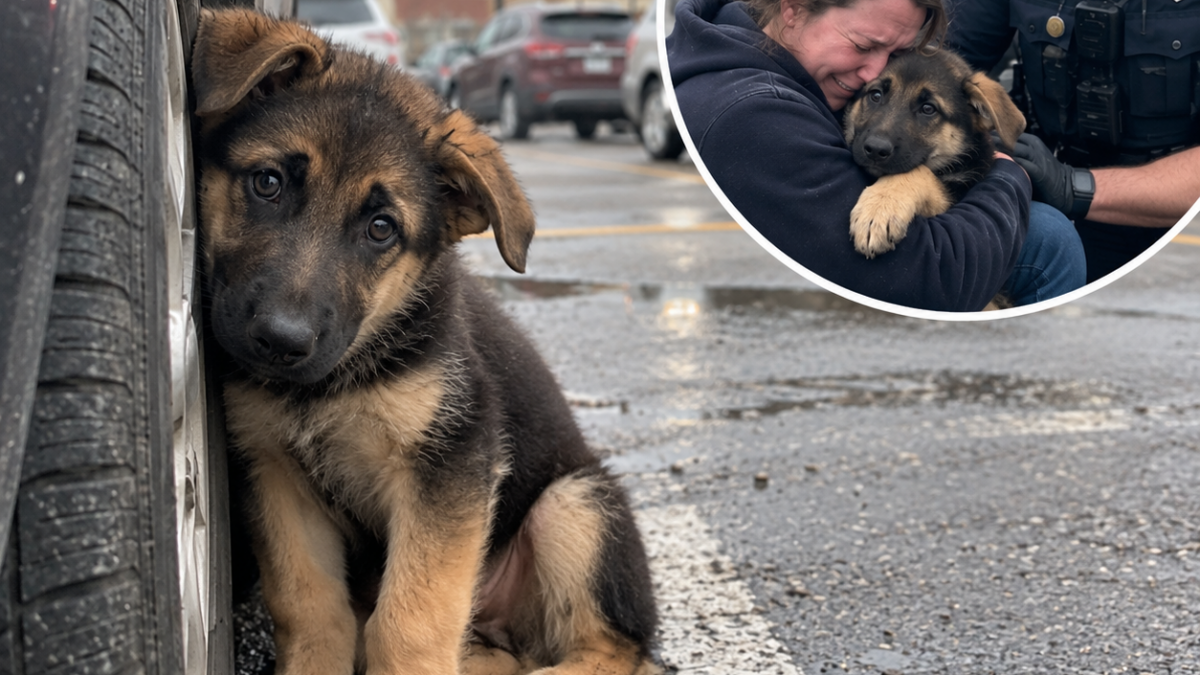
The German Shepherd puppy was pressed so tightly against the front tire that I honestly thought he would rather die there than let anyone pull him away.
Every time I reached toward him, he cried harder—not because he feared me, but because he seemed terrified that leaving that wheel would cost him the one thing he had left.
I had been a police officer for eleven years, but nothing prepared me for what happened when the owner of that gray car finally came running through the supermarket doors.
My name is Daniel Mercer.
I was thirty-four years old, and most Sunday mornings on patrol were predictable.
Noise complaints.
Parking disputes.
The occasional shoplifting call.
Nothing heroic.
Nothing that followed you home.
That morning, the sky was clear and the town was barely awake when I pulled into a supermarket parking lot for coffee.
I had one hand on the patrol car door when I heard it.
A thin, broken cry.
I stopped.
There it was again.
Not an adult dog barking.
A puppy.
I followed the sound between two rows of parked vehicles until I saw a small German Shepherd crouched beside a gray sedan.
He was painfully thin.
His fur was dusty.
His paws looked raw.
But the strangest thing was the way he held himself against the front wheel.
He wasn’t hiding underneath the car.
He wasn’t looking for food.
He was hugging that tire.
I crouched several feet away.
“Hey, buddy.”
His ears twitched.
“It’s okay. I’m not going to hurt you.”
I slowly extended my hand.
The puppy looked at me, then pressed himself harder against the rubber.
A heartbreaking whine escaped him.
I tried again.
“Come on. Let’s get you somewhere safe.”
Same reaction.
That was when something clicked.
He wasn’t refusing rescue.
He was refusing to leave.
I sat on the asphalt beside him.
For nearly ten minutes, I watched people walk past with grocery carts while that puppy kept glancing toward the supermarket entrance.
Again.
Again.
Again.
He was waiting.
And somehow, that car mattered.
I copied the plate number and went inside.
The store manager, George, listened while I explained.
“You think the dog’s theirs?”
“I think that puppy would let himself starve beside that tire before walking away from it.”
George immediately picked up the microphone.
The announcement echoed through the store.
We asked the owner of the gray sedan to come to the front entrance.
Then I waited.
One minute.
Two.
Three.
I kept looking through the glass doors toward the parking lot.
The puppy was still there.
Then a woman in her early fifties approached me carrying a paper grocery bag.
Her face was tired, almost hollow.
“Officer?”
“Yes, ma’am?”
“You called for the owner of the gray sedan?”
I nodded.
“Is something wrong?”
“There is a puppy beside your car.”
She froze.
“A German Shepherd.”
The grocery bag slipped from her fingers.
An orange rolled across the floor.
“What did you say?”
“A young German Shepherd. He won’t leave your front wheel.”
Her face lost all color.
“Oh my God.”
She ran.
I followed.
The moment we reached the row of cars, the puppy lifted his head.
For one second, neither of them moved.
Then the woman whispered one word.
“Otis?”
The puppy exploded forward.
He stumbled twice because his legs were weak, but he kept running.
The woman dropped to her knees.
Otis crashed into her chest.
She wrapped both arms around him as he licked her face, whining so loudly that shoppers stopped around us.
“I found you,” she sobbed. “I found you. Oh, baby, I found you.”
I had responded to deaths without crying.
I had delivered terrible news to families and somehow kept my voice steady.
But standing beside that gray sedan, watching a starving puppy bury his face against that woman’s neck, I had to look away.
When she finally lifted her eyes toward me, tears covered her cheeks.
“His name is Otis,” she said. “He’s been missing for thirty-one days.”
Thirty-one days.
I looked at the raw pads of his feet.
His ribs.
The tire.
“You think he recognized your car?”
She nodded.
Then her expression changed.
Fear replaced relief.
“Officer, there’s something else.”
I looked at her.
She tightened her arms around Otis.
“For a month, I thought he climbed out of my car by accident.”
She swallowed.
“But three days ago, someone gave me something that made me realize I was wrong.”
PART 2
I stared at Claire for a moment.
Otis was still trembling in her arms, though the sound coming from him had changed.
Before, beside the tire, it had been a thin, desperate cry.
Now it was softer.
Almost like he was trying to talk to her.
His nose pushed beneath her chin.
His paws hooked awkwardly around her shoulders.
He was afraid she might disappear again.
“What did someone give you?” I asked.
Claire looked around the parking lot.
Several shoppers had slowed down to watch us.
A little girl was holding her mother’s hand ten feet away, staring at Otis with tears in her eyes.
Claire lowered her voice.
“Security footage.”
My attention sharpened immediately.
“From where?”
“The bakery where he disappeared.”
I glanced at Otis.
“Claire, let’s get him somewhere safe first.”
She nodded.
I helped her stand.
The moment her knees straightened, Otis panicked.
His front legs tightened around her.
“It’s okay,” Claire whispered. “I’m not putting you down. I’m right here.”
She repeated it three times.
I’m right here.
I’m right here.
I’m right here.
Those words stayed with me.
I called dispatch and told them I had located a possibly stolen dog and was transporting the owner to an animal hospital.
My supervisor gave me permission.
Claire followed my patrol car.
I watched her gray sedan in the rearview mirror the entire way.
At every stoplight, I could see Otis sitting in the passenger seat with his body pressed against Claire’s arm.
The veterinary clinic was only nine minutes away.
Dr. Priya Patel met us near the entrance after I called ahead.
The second Claire carried Otis inside, the clinic staff became quiet.
Anyone who has worked around animals long enough recognizes prolonged neglect.
Otis’s ribs were visible beneath his black-and-tan coat.
The pads of his paws were cracked.
There were healing scratches along his belly.
A small patch of fur was missing near his neck.
His hip bones showed when he moved.
Dr. Patel placed him on the examination table.
“Do you know how long he’s been missing?”
“Thirty-one days,” Claire said.
The veterinarian looked at her.
“Thirty-one?”
Claire nodded.
Dr. Patel’s expression softened.
“Okay. We’re going to take this slowly.”
She checked his gums.
Temperature.
Heart rate.
Hydration.
She ran careful hands over his legs and spine.
Otis tolerated almost everything as long as Claire remained within touching distance.
Whenever Claire stepped even half a pace away, his head lifted.
“Separation anxiety,” Dr. Patel said quietly.
Claire’s eyes filled again.
“He didn’t have that before.”
“He’s been through something.”
That was obvious.
What wasn’t obvious was exactly what.
Dr. Patel ordered fluids, bloodwork, a stool test and X-rays because of tenderness near one hind leg.
While a technician prepared everything, Claire sat on the floor beside Otis’s blanket.
I sat across from her.
“Tell me what happened.”
She took a breath.
“My name is Claire Bennett. I’m fifty-one. I work at Westfield Public Library.”
She looked at Otis.
“I live alone.”
There was something in the way she said those three words.
Not self-pity.
Just fact.
The kind of fact that had been true long enough to become part of the furniture.
She told me she had been married.
Her husband’s name was Martin.
He died six years earlier from a sudden brain aneurysm.
One morning he was drinking coffee in their kitchen.
By that evening, Claire was sitting under fluorescent hospital lights being told he wasn’t coming home.
They had never had children.
For the first year after Martin’s death, relatives called constantly.
Friends brought food.
People invited her places.
Then life resumed for everyone else.
Claire’s life did not.
She went to work.
Came home.
Watered the flowers.
Read.
Slept badly.
Repeated.
Her father developed cancer two years later, so she spent much of the next eighteen months caring for him.
After he died, the silence returned.
“It sounds dramatic when I say it out loud,” she told me. “But I had forgotten what it felt like to be expected home.”
Then Otis appeared.
It happened on a rainy Thursday night.
Claire had stayed late at the library helping prepare for a weekend children’s program.
On her way home, she noticed a cardboard box near an abandoned service station.
She almost ignored it.
Then she saw the box move.
She stopped her car.
Inside was a German Shepherd puppy, maybe eight weeks old, soaked and shaking.
No collar.
No blanket.
Nothing.
“I remember picking him up,” Claire said. “He was so cold. But the second I put him under my coat, he stopped trembling.”
She laughed weakly.
“Then he peed on me.”
I smiled.
“Good first impression.”
“Excellent.”
She took him to an emergency veterinarian.
He had parasites and was underweight but otherwise healthy.
Claire reported him found.
No one claimed him.
She checked for a microchip.
Nothing.
After the legal holding period passed, she adopted him.
She named him Otis.
For the next two months, Otis reorganized Claire’s world.
He woke her at five-thirty every morning because he apparently believed sunrise was an emergency.
He dragged socks through the house.
He stole paperbacks from the bottom shelf.
He once carried an entire loaf of bread into the backyard and buried half of it beneath her roses.
“He ruined my garden,” Claire said.
“But you kept him.”
“Of course I kept him.”
Otis had made the house noisy again.
That mattered.
Claire began walking in the neighborhood every evening.
Neighbors she had never spoken to started greeting her.
Children asked to pet Otis.
People at the library wanted photographs.
The little dog had done what grief counselors, dinner invitations and years of polite conversation had not managed.
He pulled Claire back into the world.
Then, one month earlier, he disappeared.
“I stopped at Dawson’s Bakery after work,” Claire said.
“I remember that day because it was Martin’s birthday.”
She looked embarrassed.
“I always buy the cinnamon rolls he liked. Silly tradition.”
“Not silly.”
She nodded gratefully.
“I parked near the front. Otis was in the passenger seat. It wasn’t hot. I cracked the window.”
“How long were you inside?”
“Four minutes. Maybe five.”
When Claire returned, Otis was gone.
The passenger window was lower than she remembered.
At first, she assumed he had somehow pushed it down.
She called his name.
Checked beneath cars.
Ran behind the bakery.
Nothing.
She drove around until after midnight.
The next morning, she printed two hundred flyers.
By that evening, his face was on telephone poles, store windows and social media pages.
Claire contacted every shelter within fifty miles.
She drove to each one personally.
She called veterinarians.
Animal control.
Rescue groups.
Police.
For the first few days, everyone was encouraging.
Then came false sightings.
A German Shepherd puppy behind a school.
Another near the river.
One walking beside a highway.
Claire followed every report.
Once, she drove forty miles at two in the morning because a truck driver thought he had seen Otis near a rest area.
It was another dog.
The owner lived nearby.
Another time, she spent three hours crawling through brush behind an abandoned warehouse after someone reported hearing a puppy crying.
She found two raccoons.
By the second week, people started using different language.
Not “when you find him.”
“If you find him.”
A shelter worker gently suggested Claire prepare herself for the possibility that Otis had been struck by a vehicle.
A neighbor suggested someone might have kept him.
Claire’s cousin told her she needed sleep.
Her supervisor insisted she take two days off.
She used those two days to search.
“I couldn’t stop,” Claire said. “Every time I imagined stopping, I pictured him somewhere waiting for me.”
Otis lifted his head from the blanket.
Claire immediately touched him.
“I was right.”
I didn’t say anything.
There was nothing useful to say.
Then she told me about Tyler.
Tyler Mason was seventeen.
He worked afternoons at Dawson’s Bakery.
Three days earlier, the owner had replaced part of the store’s security system.
Tyler was helping transfer old footage.
He remembered Claire.
Everyone at the bakery remembered Claire because she had returned almost daily after Otis vanished, asking customers whether they had seen anything.
Tyler searched the archive.
He found the recording.
At 5:14 p.m., Claire’s gray sedan entered the parking lot.
At 5:15, Claire walked into the bakery.
Less than one minute later, a dark blue pickup entered the frame.
It parked two spaces away.
A man stepped out.
Baseball cap.
Work boots.
Dark sweatshirt.
He approached Claire’s car.
Looked through the passenger window.
Walked away.
Then returned.
He slid his fingers through the opening at the top of the glass.
Worked the window down farther.
Reached inside.
A small German Shepherd jumped toward him.
The man grabbed Otis.
Carried him to the pickup.
Put him inside.
Drove away.
Claire took out her phone.
Her hands shook as she found the file.
“Tyler sent it to me.”
I watched.
Once.
Twice.
Then again.
The man’s face wasn’t clear.
But the truck was.
Older dark blue Ford.
White metal toolbox across the bed.
Long dent near the passenger-side rear wheel.
A faded logo on the door.
I froze the frame.
Green something.
Lawn Services.
“You gave this to police?”
“Yesterday.”
“Who took the report?”
“Sergeant Carter.”
Lewis Carter.
Good officer.
Methodical.
Not the kind of man who dismissed anything simply because it involved an animal.
I sent him a message.
Call me when you can. Possible connection to Bennett stolen dog case.
Three minutes later, my phone rang.
“What’s up?”
I explained.
When I described the truck, Lewis stopped me.
“White bed toolbox?”
“Yes.”
“Dent behind passenger rear wheel?”
“Yes.”
“Blue Ford?”
“Yeah.”
Silence.
Then Lewis said, “Daniel, we’ve got another case with that truck.”
I stood.
“What case?”
“French Bulldog stolen from a fenced yard twelve days ago.”
Claire heard me.
Her face changed.
Lewis continued.
“And maybe a Beagle from last month. Doorbell footage caught a similar vehicle.”
“You have a plate?”
“No. That’s the problem.”
“I’ve got a clearer business logo.”
“Send everything.”
I did.
Thirty minutes later, Lewis called again.
“Green Horizon Lawn Services.”
“You know it?”
“Local landscaping company. Owner’s clean. But one of the trucks matches.”
“Who drives it?”
“Owner’s nephew. Travis Cole.”
The name meant nothing to me.
Lewis pulled the record.
Twenty-nine.
Two prior theft arrests.
One conviction for receiving stolen property.
A misdemeanor animal-neglect citation four years earlier that had been dismissed after the witness stopped cooperating.
“Think we’ve got enough?”
“To talk to him? Sure. Search warrant? Not yet.”
I hated that answer even though it was correct.
Police work is rarely about what you strongly suspect.
It’s about what you can prove.
By afternoon, Dr. Patel returned with preliminary results.
Otis was dehydrated and underweight.
He had mild anemia.
His hind leg showed no fracture.
The scratches were superficial.
There was no evidence of severe internal injury.
“He’s been very lucky,” she said.
Claire laughed through tears.
“Lucky?”
Dr. Patel glanced at Otis.
“Maybe stubborn is the better word.”
Otis spent that night at the clinic.
Claire hated leaving him.
The moment a technician took his leash, he panicked.
He twisted around.
Whined.
Scrambled toward Claire.
She followed him into the treatment area until staff gently explained they needed room.
Claire knelt.
She held Otis’s face between her hands.
“Listen to me.”
His breathing was fast.
“I am coming back.”
He stared at her.
“I am coming back.”
She kissed his forehead.
“I promise.”
Only then did she leave.
In the parking lot, she sat inside her car without starting the engine.
I was about to return to patrol when I noticed.
I walked over.
She rolled down the window.
“I left him again.”
“No.”
“He doesn’t know that.”
“You told him you’re coming back.”
“What if he doesn’t believe me?”
I looked toward the clinic.
“Claire, that dog believed in you for thirty-one days.”
She lowered her eyes.
“I think he’ll give you one night.”
That made her smile.
Barely.
But it was enough.
The investigation moved quickly after that.
Lewis and two detectives visited Green Horizon Lawn Services.
The business owner, Ronald Cole, was Travis’s uncle.
Ronald looked horrified when they showed him the bakery footage.
He confirmed the truck belonged to the company but was normally assigned to Travis.
“Could anyone else drive it?”
“Sometimes.”
“Who?”
Ronald listed four employees.
All four were interviewed.
Three had clear alibis.
The fourth admitted using the truck occasionally but was working at a commercial property across town when Otis disappeared.
GPS records from his work phone supported him.
That left Travis.
Detectives found him at an apartment complex.
At first, he denied being near Dawson’s Bakery.
Then they mentioned the truck.
He said employees shared vehicles.
Then they showed him a still image of the man.
He stared at it.
“Could be anybody.”
“Is that your jacket?”
“No.”
“Your boots?”
“Half the guys in this town wear those.”
They asked whether he had ever seen Otis.
“No.”
They asked whether he had picked up any stray dogs.
“No.”
Then Lewis showed him a better frame.
The man was turning toward the camera.
Not enough for facial recognition.
Enough to see a tattoo on the side of his neck.
A dark shape.
Travis had a matching tattoo.
His story shifted.
“Okay. Maybe I was there.”
“Maybe?”
“I don’t remember every parking lot I stop in.”
“Did you take the dog?”
Travis crossed his arms.
“I thought it was abandoned.”
Lewis later told me he almost laughed.
“Abandoned inside someone’s locked car?”
“The window was open.”
“Owner was inside the bakery.”
“I didn’t know that.”
“You watched her walk inside.”
Travis said nothing.
“Where’s the dog?”
“Don’t know.”
“You took him.”
“He got out.”
“Where?”
“Later.”
“Where?”
“Somewhere around Industrial Road.”
“When?”
“That night.”
“Why didn’t you report him missing?”
Travis shrugged.
Lewis described that shrug to me three times.
He hated it.
“Why didn’t you take him to animal control?”
“I was going to.”
“Why didn’t you?”
“Didn’t get around to it.”
“Why did you remove him from somebody else’s car?”
“I told you. I thought he was abandoned.”
The interview ended without an arrest.
Claire did not take that well.
I called her after Otis came home from the veterinary clinic.
She answered on the first ring.
“Did they arrest him?”
“Not yet.”
“Why?”
“We need stronger evidence.”
“He admitted taking Otis.”
“He claims he thought Otis was abandoned.”
“That’s ridiculous.”
“Yes.”
“So why is he free?”
“Because ridiculous isn’t the legal standard.”
Silence.
Then Claire said something I didn’t expect.
“I want to go to his house.”
“No.”
“I want him to see Otis.”
“Claire.”
“I want him to see what he did.”
“Do not contact him.”
“He stole my dog.”
“I know.”
“He let him starve.”
“We don’t know everything yet.”
“I know enough.”
Her voice was shaking now.
“I want him scared.”
That sentence worried me.
“Claire, listen carefully. You have Otis back. We are building a case. Do not give Travis anything he can use to turn this around.”
She was silent.
“Promise me.”
“I hate him.”
“You can hate him from your house.”
Another pause.
Finally, “Fine.”
It wasn’t enthusiastic.
But it was enough.
For three days, investigators collected footage from nearby businesses.
A gas station camera caught Travis’s truck leaving Dawson’s Bakery eight minutes after Claire arrived.
A traffic camera captured the plate.
Another camera showed Travis himself at a convenience store twenty minutes later.
Otis wasn’t visible.
Then came the breakthrough.
Detective Andrea Mills searched online sale listings.
She found an archived advertisement posted two days after Otis disappeared.
Young German Shepherd. Male. Smart. Ready for good home.
Six hundred dollars.
No registration papers.
Cash only.
The listing account used a fake name.
But the contact phone number traced to a prepaid phone.
That phone had connected repeatedly to the same cell tower serving Travis’s neighborhood.
Still circumstantial.
Then Andrea found another advertisement.
French Bulldog.
The animal resembled the dog stolen twelve days earlier.
Another.
Beagle.
Similar to the missing Beagle.
Then a recovered message exchange.
A prospective buyer had asked for additional photographs of the German Shepherd.
The seller sent three.
In one, Otis’s red collar was visible.
Claire had bought that collar.
She still had the receipt.
The pattern was forming.
But the best evidence came from a man named Harold Pierce.
Harold had answered the German Shepherd advertisement.
He remembered the seller because something felt wrong.
“He wanted cash,” Harold told investigators.
“That’s not unusual.”
“No, but I asked for vaccination paperwork. He kept changing the subject.”
“Did you meet him?”
“Yes.”
“Where?”
“A gas station.”
“Can you identify him?”
Harold looked at the photo lineup.
He pointed to Travis.
“That guy.”
“What happened?”
“I asked where the dog came from.”
“He said it belonged to his sister.”
“Then?”
“I asked why his sister wasn’t there.”
“He got irritated.”
“Did you see the dog?”
“Yes.”
“How did he act?”
Harold hesitated.
“Scared.”
“Scared of you?”
“No. Scared of him.”
That mattered.
Harold had walked toward Otis.
The puppy backed away.
Travis grabbed him by the collar.
Otis flattened against the ground.
Harold decided not to buy.
“Something didn’t feel right.”
“Did Travis say anything?”
“He told me he’d take five hundred.”
“And you declined?”
“Yes.”
“He dropped to four hundred.”
Harold still refused.
The next day, the listing disappeared.
Now we had evidence of motive.
Steal dogs.
Sell them.
Quick cash.
But one question remained.
What happened to Otis after Harold refused?
A search warrant answered part of it.
Police searched a small rental property Travis used behind an old storage yard.
The main house was nearly empty.
The detached equipment shed was not.
There were six wire crates.
Food bowls.
Collars.
Leashes.
Cheap bags of dog food.
Some old veterinary medication with labels removed.
Investigators found black-and-tan fur caught on one crate.
A section of fencing behind the shed had been bent upward.
Beneath it was a shallow hole.
Big enough for a puppy.
Lewis called me from the property.
“He escaped.”
“You sure?”
“Looks like it.”
“Any dogs there?”
“One.”
My stomach tightened.
“What kind?”
“Mixed breed. Female. Maybe three years old.”
“Condition?”
“Thin. Scared. Alive.”
Animal control took her.
She had no chip.
Later, she was connected to a missing-dog report from another county.
Her owner had been searching for seven weeks.
That reunion was private.
I never met them.
But Andrea told me the dog recognized the woman’s voice before she even entered the room.
The charges against Travis grew.
Still, Claire wanted answers about Otis.
Where had he gone after escaping?
How did a three-month-old puppy survive?
How did he reach the supermarket?
We would never know every step.
But strange things started happening after a local news station briefly covered the investigation.
People called.
A mechanic said he had seen a skinny German Shepherd behind his shop three weeks earlier.
He had left food outside.
A restaurant employee remembered a puppy near the dumpsters.
A woman living near St. Matthew’s Church had seen one sleeping beneath the back steps during a storm.
A school crossing guard saw a similar puppy walking south along Jefferson Avenue.
We mapped the sightings.
The line wasn’t straight.
Otis had wandered.
Backtracked.
Circled.
But he was gradually moving toward Claire’s neighborhood.
Then we found something that made Claire cry harder than anything else.
A gas station camera recorded Otis four days before I found him.
It was late afternoon.
The puppy entered the corner of the frame.
Thin.
Limping slightly.
He sniffed near a trash can.
Then a gray sedan drove through the intersection.
Claire’s sedan.
Otis froze.
His head lifted.
The car continued.
Otis ran.
He chased it down the sidewalk.
For one block.
Two.
Then disappeared from camera.
When I showed Claire, she covered her mouth.
“That was me.”
“Yes.”
“I was coming from the shelter.”
I nodded.
“I had checked again.”
“I know.”
“He saw me?”
“Yes.”
“And I didn’t see him.”
“You couldn’t have known.”
She cried.
“I was looking for him while he was chasing me.”
I sat beside her at her kitchen table.
Otis was beneath it, sleeping with his head resting on Claire’s foot.
“Claire.”
She wiped her face.
“He wasn’t wandering.”
“What do you mean?”
“He was trying to get home.”
I looked at the map again.
The gas station.
Her neighborhood.
The supermarket.
Then I understood.
Claire shopped at that supermarket almost every Sunday.
She had taken Otis there several times, leaving him with a friend outside while she picked up groceries.
The parking lot wasn’t random.
Maybe he followed her car partway.
Maybe he lost the scent.
Maybe he remembered the supermarket.
Maybe he wandered there hoping to find her.
We couldn’t prove it.
But on Sunday morning, he did find the gray sedan.
That was enough.
He found something he knew.
The tire smelled like roads they had traveled together.
The car smelled like Claire.
So he stopped.
After a month of moving, he stopped.
He pressed himself against the wheel and waited.
He didn’t know Claire was twenty yards away buying groceries.
He only knew the one thing in front of him belonged to her.
And if he stayed there long enough, maybe she would come back.
That realization changed Claire.
Until then, guilt had consumed her.
She blamed herself for leaving him in the car.
For not seeing him at the gas station.
For every cold night he spent outside.
After watching that video, something shifted.
“He remembered me.”
“Yes.”
“He knew I hadn’t left him?”
“I think so.”
She looked down at Otis.
“He still trusted me.”
He opened one eye.
His tail tapped the floor.
The arrest came six days later.
I wasn’t present.
Lewis and Andrea took Travis into custody at his uncle’s landscaping business.
He resisted verbally.
Insisted everyone was overreacting.
Said they were “just dogs.”
Lewis told me those words nearly caused Ronald Cole to throw his own nephew out of the building before officers could.
Ronald had three dogs himself.
He cooperated fully with investigators.
He also fired Travis.
Travis was charged initially in connection with Otis and two other stolen animals.
More cases were reviewed.
Some couldn’t be proven.
Evidence has limits.
Emotion doesn’t.
When Claire learned he had been arrested, she sat on her porch with Otis beside her.
I expected celebration.
Instead, she cried.
“You okay?”
“I thought this would feel better.”
“What did you think it would feel like?”
“Like winning.”
I sat on the step.
“Does it?”
“No.”
Otis pushed his nose into her hand.
Claire looked at him.
“This is winning.”
I nodded.
“That’s probably closer.”
She still wanted justice.
Not because she needed Travis destroyed.
Because she needed someone to say what happened mattered.
The case took months.
During that time, Otis healed.
Physically first.
Emotionally took longer.
He gained weight quickly.
His coat became thick and glossy.
His cracked paw pads healed.
But he hated being left alone.
The first time Claire stepped outside to collect mail and closed the door, Otis scratched at it until she returned.
The first time she tried leaving him with a neighbor for twenty minutes, he paced constantly.
Car rides were worse.
Claire opened the passenger door one morning.
Otis froze.
His legs stiffened.
He backed away.
She didn’t force him.
Instead, she sat on the driveway.
For fifteen minutes, they did nothing.
The next morning, she placed treats near the car.
Then on the floorboard.
Then on the seat.
Eventually Otis climbed inside.
Claire sat beside him without driving.
The following day, she started the engine.
Another day, they drove to the end of the street.
Then around the block.
Slowly, Otis learned that a car did not mean someone would take him.
More importantly, he learned that Claire always came back.
Every departure became a ritual.
Claire knelt.
Touched his chest.
“I’m coming back.”
Sometimes she went to the mailbox.
Sometimes work.
Sometimes the grocery store.
But she always said it.
And she always returned.
One evening, three months after the reunion, I visited Claire to bring paperwork from the prosecutor’s office.
Otis met me at the door carrying one of Claire’s slippers.
“Is that evidence?” I asked.
Claire rolled her eyes.
“He steals one every time I come home.”
“Criminal tendencies.”
“He learned from you.”
“That’s defamatory.”
Otis dropped the slipper at my feet.
I threw a tennis ball into the backyard.
He ran after it.
For the first time, I saw him sprint without fear.
Not running from something.
Running because he was happy.
There is a difference.
You can see it.
The court process began the following spring.
Travis pleaded not guilty at first.
His attorney argued he had believed Otis was abandoned.
Then prosecutors produced the video showing Claire exiting the vehicle moments before Travis approached.
The defense argued Travis intended to rescue the puppy.
Prosecutors produced the online advertisement.
The defense claimed Travis later decided to rehome him.
Prosecutors produced Harold Pierce.
Then the other stolen dogs.
Then the crates.
Then location data from Travis’s phone.
His attorney’s arguments became smaller each time new evidence appeared.
Claire attended every major hearing.
She carried a photograph of Otis in her purse.
Not the thin dog I found.
A photo from before the theft.
Otis sitting in her garden with one ear standing and the other flopped sideways.
“That was three days before,” she told me.
“Before he disappeared?”
“Yes.”
“Why bring it?”
“So I remember who this is about.”
At sentencing, nearly a year after the supermarket reunion, Claire was allowed to give a victim-impact statement.
The courtroom was full.
Owners from two other cases were there.
One woman had recovered her dog.
Another still had not.
Travis sat beside his attorney.
He looked smaller than I expected.
Not physically.
Just ordinary.
That was unsettling.
People who cause enormous pain rarely look enormous.
Claire walked to the front.
Her hands shook.
She unfolded two pages.
For several seconds, she couldn’t speak.
The judge waited.
Then Claire looked directly at Travis.
“For thirty-one days, I woke up wondering whether Otis was alive.”
The room went still.
“I woke before sunrise because shelters opened early. I drove after dark because someone said they had seen a German Shepherd beside a highway. I climbed through ditches. I walked behind buildings. I looked inside drainage pipes.”
She swallowed.
“I learned how many black trash bags look like dogs from a distance.”
Nobody moved.
“I learned how many people will call a grieving stranger and lie about having her dog because they think it’s funny.”
Her voice shook.
“I learned what it feels like to hear a bark outside at two in the morning and run barefoot into the street because, for half a second, you believe.”
Claire looked down.
Then back up.
“You took him in less than ninety seconds.”
She paused.
“Ninety seconds for you became thirty-one days for me.”
Travis stared toward the table.
Claire continued.
“During those thirty-one days, Otis was hungry. He was frightened. His feet were injured. He slept outside. He was offered for sale to strangers.”
She took a breath.
“But I’m lucky.”
Her voice softened.
“My dog came home.”
She turned slightly toward the other victims.
“Some people here have not been that lucky.”
Then she looked back at Travis.
“I spent months imagining what I would say if I ever stood in the same room with you.”
That got his attention.
“I thought I wanted you to hurt.”
The prosecutor glanced at Claire.
She continued.
“I wanted you to feel every hour I felt. Every morning I woke up without him. Every night I wondered whether he was cold.”
Her fingers tightened around the paper.
“But then Otis came home.”
She smiled faintly.
“And I realized I don’t want to spend the rest of his life thinking about you.”
Travis looked away.
“I don’t need revenge.”
Claire’s voice was stronger now.
“I need accountability.”
She placed the pages on the lectern.
“Because when you steal an animal, you don’t steal an object.”
The judge watched her carefully.
“You steal routines. You steal safety. You steal the sound someone expects to hear when they open their front door.”
Her eyes filled.
“For me, you stole the only living thing waiting for me at home.”
A woman behind me began crying.
Claire continued.
“But you didn’t get to keep that.”
She looked directly at Travis.
“He came back.”
That was the most powerful sentence in the entire hearing.
He came back.
Not shouted.
Not dramatic.
Certain.
Travis eventually received a sentence that included incarceration, probation, restitution and restrictions involving ownership, possession, breeding and sale of animals.
Some people thought the sentence was too light.
Others thought it was severe.
Claire didn’t argue about the number.
Outside the courthouse, she stood in the sunlight.
I asked, “How do you feel?”
“Tired.”
“That’s it?”
She smiled.
“Very tired.”
Then we heard barking.
Across the lawn, Claire’s neighbor Martha was walking Otis toward us.
The second Otis saw Claire, his whole body changed.
Tail.
Ears.
Posture.
He pulled.
Martha laughed and released the longer section of the leash.
Otis ran.
Claire crouched.
He crashed into her so hard she nearly fell backward.
She laughed into his fur.
I watched them.
And I realized something.
That was the part Travis could never touch.
He had stolen thirty-one days.
He had caused fear.
Pain.
Anger.
But he could not rewrite what Claire and Otis were to each other.
The court case ended.
Their life continued.
For Claire, that became the best revenge.
Not seeing Travis punished.
Living well enough that one day she could go hours without remembering his name.
Then days.
Then weeks.
Otis grew.
By age two, he was nearly eighty pounds and absolutely convinced he was still small enough to sit in Claire’s lap.
He wasn’t.
He tried anyway.
He completed obedience training.
Then a local trainer suggested therapy-dog certification.
Claire laughed when she first told me.
“Otis? Therapy?”
“Why not?”
“He ate my gardening glove yesterday.”
“He’s multidimensional.”
She enrolled him.
Otis surprised everyone.
In public, he was calm.
Gentle.
Intuitive.
At the library, he seemed to understand exactly who needed him.
A boy named Evan had difficulty reading aloud.
Other children made him nervous.
During a library reading program, Claire invited Evan to read to Otis.
The boy sat on the floor with a book about dinosaurs.
He whispered at first.
Otis rested his head on the boy’s shoe.
Evan read louder.
When he mispronounced a word, Otis didn’t laugh.
Didn’t correct him.
Didn’t become impatient.
He just stayed.
By the end of the month, Evan was reading whole pages aloud.
His mother cried when she thanked Claire.
Claire told me afterward, “It’s strange.”
“What is?”
“The dog I thought needed saving keeps saving everybody else.”
There was Mr. Jenkins too.
Seventy-four.
Widower.
Visited the library every Tuesday but rarely checked out books.
He sat by the window.
Spoke to almost no one.
Otis began lying beside his chair.
The first week, Mr. Jenkins ignored him.
The second, he touched his head.
The third, he brought a dog biscuit.
Within two months, he was telling Claire stories about the Labrador he owned when his wife was alive.
Then stories about his wife.
Then stories about his life.
One Tuesday, Mr. Jenkins didn’t come.
Claire worried.
She called.
He had fallen at home.
His daughter eventually convinced him to move closer to family.
Before leaving town, he visited the library once more.
He knelt beside Otis.
“Good boy,” he whispered.
Then he looked at Claire.
“He reminded me I wasn’t finished talking.”
Claire cried after he left.
Otis didn’t understand why.
He brought her a slipper.
Years passed.
I received a promotion.
Then transferred into community policing.
Claire became assistant director of the library.
Otis developed a reputation around town.
People recognized him at farmers markets.
Children shouted his name.
Claire hated when local reporters called him “the miracle dog.”
“He’s not a miracle,” she would insist.
“He’s a menace who opens the pantry.”
She once sent me a photo of Otis sitting beside an empty bag of treats.
Caption: SUSPECT REFUSES TO COOPERATE.
I replied: LAWYER UP.
That became our joke.
But beneath the ordinary humor, there were things Otis never fully forgot.
He disliked dark blue pickup trucks.
Not every one.
But sometimes, if one slowed near the sidewalk, he moved closer to Claire.
He hated crates with metal doors.
He tolerated them during veterinary visits but never relaxed.
And parking lots remained complicated.
Whenever Claire parked and stepped out, Otis watched her carefully.
She never left him alone in the car again.
Not even for thirty seconds.
If she had to enter a store, he stayed home.
If he traveled with her, someone remained with him.
Some people told her she was being excessive.
She didn’t care.
“He waited once,” she told me. “He doesn’t need to prove anything twice.”
On the anniversary of his reunion each year, Claire drove to the supermarket.
Not to make a spectacle.
She parked in approximately the same row.
Then she and Otis walked around the block.
Afterward, she bought him a plain hamburger from a nearby diner.
The first year, I joined them.
We stood near the place where I had found him.
The lot looked completely ordinary.
Cars.
Carts.
Oil stains.
A discarded receipt moving in the wind.
“How strange,” Claire said.
“What?”
“That a place can look so ordinary after the worst and best moment of your life happened there.”
I understood.
Police officers know that feeling.
We drive past intersections where lives ended.
Apartments where children were found safe.
Houses where people received news that split their lives into before and after.
Everyone else sees a building.
You see a memory.
Otis sniffed the front wheel of Claire’s sedan.
Then walked away.
Claire watched him.
“He doesn’t care anymore.”
“Good.”
“He knows I’m here.”
That was better.
Several years after the court case, something unexpected happened.
I was finishing paperwork at the station when Lewis Carter walked into my office.
He had retired six months earlier.
He looked strange without a badge.
“You busy?”
“Always.”
“Got something for you.”
He handed me an envelope.
Inside was a letter.
No return address.
I read the first line.
Officer Mercer,
You don’t know me, but you helped investigate my brother.
I looked at Lewis.
“Travis?”
He nodded.
The letter was from Travis Cole’s younger sister, Rebecca.
She wrote that she had spent years furious at police, prosecutors and everyone involved in Travis’s arrest.
Their mother blamed everyone except Travis.
Rebecca did too.
Then, after his release, Travis returned to the family.
For a while, he behaved.
Then he began stealing again.
Tools.
Equipment.
Money.
Eventually from relatives.
Rebecca caught him taking jewelry from their mother’s bedroom.
When confronted, Travis blamed everyone else.
He always had.
Rebecca wrote:
I realized the dogs weren’t some misunderstanding.
My brother takes what he wants and invents a reason afterward.
She apologized.
Not on Travis’s behalf.
On her own.
She explained that her family had accused Claire publicly of exaggerating the case.
Rebecca had repeated those accusations.
Now she regretted it.
At the bottom was one sentence:
I hope the German Shepherd is okay.
I drove to Claire’s house after work.
She read the letter twice.
“What do you think?” I asked.
She folded it carefully.
“I think his sister finally stopped carrying his excuses.”
“Want to respond?”
Claire thought about it.
“Yes.”
She wrote only four sentences.
Rebecca,
Otis is safe and loved. What happened hurt us deeply, but I don’t blame you for your brother’s decisions. I hope you build a life that doesn’t require you to defend things you know are wrong. Take care of yourself.
Claire sealed the envelope.
“That all?”
“Yes.”
“No anger?”
“I’ve already given that family enough of my life.”
I admired that.
Not because forgiveness is mandatory.
It isn’t.
Some harm does not deserve a neat emotional resolution.
But Claire understood something important.
Revenge can keep the person who hurt you permanently present.
She wanted Travis gone.
Not dead.
Not suffering forever.
Gone from her thoughts.
That was freedom.
When Otis was eight, gray hairs appeared around his muzzle.
I refused to acknowledge them.
“He’s getting old,” Claire said.
“No.”
“Daniel.”
“Lighting issue.”
“He groans when he stands.”
“Dramatic personality.”
“His face is gray.”
“Wisdom.”
Claire laughed.
But we both knew.
Dogs measure time differently than we do.
They enter our lives at full speed.
Then, unfairly soon, they slow down.
At nine, Otis developed arthritis.
Medication helped.
Walks became shorter.
He retired from regular library visits.
Children who had learned to read beside him were teenagers now.
Some returned just to see him.
Evan came one afternoon.
He was sixteen.
Taller than Claire.
He sat on the library floor beside the dog who once listened to him stumble through dinosaur books.
Evan was taking advanced English classes.
He wanted to become a teacher.
He brought Otis a new blanket.
“You helped me,” he whispered.
Otis licked his hand.
At ten, Claire noticed him refusing breakfast.
That was alarming.
Otis had never refused food voluntarily in his life.
She took him to Dr. Patel.
The same veterinarian who examined him after the parking lot reunion was still practicing.
Tests were ordered.
Then imaging.
A mass appeared.
Cancer.
Claire called me that evening.
“Daniel.”
I knew from her voice.
“What happened?”
She tried to answer.
Couldn’t.
I drove over.
Otis was in the backyard beneath the maple tree.
He raised his head when he saw me.
Tail thump.
I sat beside him.
“Hey, partner.”
His muzzle was almost completely gray.
I remembered a tiny puppy with raw paws.
It felt impossible that the body beside me belonged to the same animal.
Claire sat in the grass.
“They can operate.”
“That’s good.”
“But they don’t know if it’s spread.”
“Then we take one thing at a time.”
She nodded.
Surgery bought him nearly a year.
A good year.
Not perfect.
Good.
There were slow mornings.
Medication.
Vet appointments.
But there were also hamburgers.
Garden naps.
Library visits.
One ridiculous afternoon when Otis stole an entire roast from Claire’s kitchen counter and somehow regained the speed of a puppy when she chased him.
She called me furious.
“He ate forty dollars of beef.”
“He has cancer, Claire.”
“That does not make him innocent.”
“Jury might sympathize.”
“I’m changing the locks.”
Otis survived the incident.
The roast did not.
Then the cancer returned.
This time surgery wasn’t an option.
Claire knew before the veterinarian finished explaining.
“How long?”
“No one can say exactly.”
“Is he hurting?”
“Not right now.”
That became the standard.
Not how long.
Is he hurting?
When the answer became yes more often than no, Claire made the decision every good animal owner fears.
She called me.
“Could you come?”
I was at her house in twenty minutes.
Otis was lying near the living-room window.
His favorite blanket beneath him.
The same red collar sat on the table.
The collar from the stolen-dog photograph.
Claire had kept it all those years.
I sat on the floor.
Otis lifted his head.
His tail moved once.
“Hey, buddy.”
He placed his chin on my leg.
Claire sat opposite me.
For a long time, we said nothing.
Finally she whispered, “Do you think he remembers?”
“The parking lot?”
“Yes.”
“Probably not the way we do.”
She stroked his ear.
“I hope not.”
“I think he remembers what came after.”
She looked at me.
“What?”
“Home.”
That broke her.
She leaned down and pressed her forehead to his.
“You came home,” she whispered.
Otis breathed slowly.
“You came all the way home.”
The veterinarian arrived just before sunset.
She explained each step.
Claire listened.
Then asked for another minute.
She held Otis’s face.
“I made you a promise once.”
His eyes stayed on hers.
“I said I would come back.”
Her voice broke.
“And I did.”
She kissed his head.
“So you don’t have to wait anymore.”
I looked toward the window because I couldn’t watch.
But then I realized that was cowardly.
Otis had never looked away from the people he loved.
Neither would I.
I put one hand on his shoulder.
Claire kept her hand against his chest.
He died quietly.
At home.
No cage.
No fear.
No parking lot.
No one taking him away.
His last experience was exactly what he had spent his whole life searching for.
Claire.
Home.
Hands he trusted.
Afterward, Claire sat beside him for almost an hour.
The veterinarian didn’t rush her.
Neither did I.
Eventually Claire whispered, “The house is going to be quiet.”
I knew what she meant.
Not physically.
Deeply.
The kind of quiet that had existed before Otis.
I stayed late.
Before leaving, I noticed one of Claire’s slippers in the hallway.
For years, Otis carried one whenever she came home.
I picked it up.
Claire saw.
She smiled through tears.
“He didn’t take it today.”
“No.”
She touched it.
“Leave it there.”
So I did.
Two weeks later, Claire invited me over.
On the kitchen table was a wooden box containing Otis’s ashes.
Beside it sat his collar.
His therapy-dog tag.
The tennis ball.
And a photograph from the supermarket parking lot.
I had never seen the photo.
Someone had taken it during the reunion.
Claire was kneeling.
Otis was wrapped around her.
I stood behind them.
The gray sedan filled the background.
The front tire was visible.
Claire tapped the picture.
“For years, I hated that wheel.”
“Why?”
“Because I imagined him alone beside it.”
She looked toward the backyard.
“Now I love it.”
“That seems strange.”
“It was the place where he stopped being lost.”
I said nothing.
She continued.
“He had no address. No phone number. No way to ask for help. But he found one thing that belonged to me and decided that was enough.”
She smiled.
“He trusted I would return.”
Months passed.
The house became quiet.
Claire hated it.
She continued going to work.
Continued tending her garden.
Continued living.
But the energy Otis had brought was gone.
I didn’t suggest another dog.
People often do that too quickly.
Loss isn’t an empty parking space.
You don’t fill it with the next available thing.
Then one Saturday Claire called.
“Are you working?”
“No.”
“Come to the animal shelter.”
“Why?”
“Just come.”
I drove there.
Claire was standing beside a kennel.
Inside was a scruffy brown-and-white dog with cloudy eyes, a bent left ear and a body shaped like someone had assembled several different breeds without reading the instructions.
“What is that?” I asked.
Claire glared.
“Her name is Rosie.”
“I meant breed.”
“No one knows.”
Rosie was eight.
Maybe nine.
She had been at the shelter almost eleven months.
Families wanted puppies.
Or young dogs.
Or prettier dogs.
Rosie had arthritis.
She snored.
She needed dental work.
She also looked at Claire the way exhausted creatures sometimes look at people who feel familiar.
“You’re taking her home.”
Claire looked offended.
“I haven’t decided.”
Rosie pressed herself against the kennel gate.
Claire put her fingers through.
The dog’s tail moved.
“You’re taking her home.”
“Stop.”
“Already bought a bed?”
Silence.
“Claire?”
“It was on sale.”
I laughed for the first time in weeks.
Rosie went home that afternoon.
She was nothing like Otis.
She hated tennis balls.
Loved carrots.
Refused to sleep on the expensive bed Claire bought and instead chose the rug beside the refrigerator.
She had no interest in slippers.
She barked at mailboxes.
She snored loudly enough to wake herself.
And she gave Claire something she desperately needed.
A reason to say, “I’m home.”
The first night, Rosie slept beneath the kitchen table.
The second, outside Claire’s bedroom.
The third, beside the bed.
The fifth, on the bed.
“Otis trained me badly,” Claire complained.
“No,” I said. “He trained you perfectly.”
One year after Otis died, Claire and I returned to the supermarket.
Just us.
Rosie stayed home because crowded parking lots made her nervous.
We stood near the spot.
Cars came and went.
A teenager pushed shopping carts.
Someone argued over a parking space.
Nothing magical happened.
That was appropriate.
Claire looked at the asphalt.
“I spent years thinking this was where the story started.”
“Wasn’t it?”
“No.”
“Where then?”
“The cardboard box.”
She smiled.
“No. Maybe before that.”
She looked at me.
“I think the story is just people deciding not to walk past something that needs them.”
I thought about her stopping in the rain.
Me stopping in the parking lot.
Tyler checking security footage.
Harold refusing to buy a dog that didn’t feel right.
Mechanics leaving food outside.
Shelter workers answering Claire’s calls.
Detectives collecting evidence.
Strangers reporting sightings.
No single person saved Otis.
A chain of ordinary people did small things.
Enough small things became a road home.
By then, I had spent more than twenty years in law enforcement.
Young officers sometimes asked why I stayed.
There are days when the job wears you down.
You see selfishness.
Cruelty.
People hurting people.
You learn how easily lives can split apart.
But I’ve also seen the other thing.
The thing that doesn’t make headlines as often.
Neighbors carrying children out of burning apartments.
Strangers doing CPR.
People returning wallets filled with cash.
Teenagers staying with injured animals until help arrives.
Communities searching all night for missing elderly residents.
And one tiny German Shepherd puppy refusing to leave a car wheel because something inside him said:
This belongs to her.
She will come back.
I kept Claire’s first photograph of Otis inside my locker until I retired.
On my final day, I emptied everything.
Extra uniform.
Old citations.
A coffee mug with a cracked handle.
Pens that didn’t work.
Then the photograph.
Young Otis.
Strong.
Sitting beneath the maple tree.
Claire’s hand on his shoulder.
I stood there holding it.
A rookie officer named Martinez walked past.
He stopped.
“Your dog?”
“No.”
“Family?”
I thought about it.
“Sort of.”
He looked confused.
So I told him the story.
Not every detail.
Just the supermarket.
The tire.
The announcement.
Claire running.
Otis recognizing her.
When I finished, Martinez smiled.
“That’s why you became a cop?”
“No.”
“Then why keep the picture?”
I slipped it into my wallet.
“Because it’s why I stayed.”
Years later, Claire sent me another photograph.
Rosie had died peacefully at twelve.
Claire waited six months.
Then adopted two senior dogs together because the shelter refused to separate them.
One was named Hank.
The other was June.
In the photograph, Claire sat on her porch with both dogs leaning against her legs.
Behind her hung a framed picture of Otis.
On the back she wrote:
He taught me that loving again isn’t replacing anyone.
I keep that picture too.
I’m older now.
Retired.
My knees hurt when it rains.
I drink too much coffee even though I no longer have night shifts to blame.
Sometimes I drive past the supermarket.
The building has been renovated.
The parking lines changed.
George retired.
Dawson’s Bakery closed years ago.
Green Horizon Lawn Services belongs to someone else.
The city changed.
That’s what cities do.
But memory does not obey construction permits.
Whenever I pass that lot, I still see him.
Tiny.
Thin.
Pressed against a gray tire.
Waiting.
I still hear Claire say his name.
Otis?
I still see his ears rise.
His body launch forward.
I still see groceries fall from her hands.
I still hear that dog crying against her shoulder.
And even now, after everything I’ve witnessed, I cannot think about it without feeling something tighten in my chest.
People sometimes ask what happened to Travis.
He served his sentence.
After release, he got into more trouble.
Nothing involving Claire or Otis again.
Eventually I stopped following his life.
That was deliberate.
He had already occupied too much space in a story that wasn’t really about him.
He was the person who caused the wound.
He wasn’t the reason it healed.
There is a difference.
The story belongs to Claire.
To Otis.
To everyone who helped.
That’s the ending I prefer.
Not a criminal suffering forever.
A woman learning to laugh in her house again.
A dog sleeping safely beside her bed.
A child reading confidently because a patient German Shepherd listened.
An old man remembering he still had stories worth telling.
An elderly shelter dog getting a home because Claire’s heart had learned it could survive loving something temporary.
That was Otis’s revenge.
Life continued without permission from the person who tried to damage it.
Joy came back.
Slowly.
Stubbornly.
Completely.
And if you ask me what I learned from eleven years as a police officer before that Sunday, I could give you a hundred answers.
Stay alert.
People lie.
Details matter.
Evidence matters.
Never assume.
But Otis taught me something my training academy never did.
Hope can be practical.
It doesn’t always look inspiring.
Sometimes hope is an exhausted puppy with bloody paws walking another block.
Sometimes it’s a woman checking the same shelter for the twentieth time.
Sometimes it’s a seventeen-year-old bakery employee deciding to look through old security footage when nobody asked him to.
Sometimes it’s a police officer delaying his coffee because he hears something crying between parked cars.
Hope is not always believing everything will turn out well.
Sometimes it’s refusing to stop doing the next useful thing before you know how the story ends.
Otis didn’t know Claire would be inside that supermarket.
Claire didn’t know Otis would ever find her car.
I didn’t know the weak sound I heard would lead to a theft investigation.
Tyler didn’t know one video would connect multiple missing dogs.
Harold didn’t know refusing a suspicious sale would make him an important witness.
None of us knew.
We just did the next thing.
And somehow those things connected.
One afternoon, not long before Claire moved to another town to be closer to her niece, she gave me something.
A small frame.
Inside was the supermarket photograph.
On the bottom, beneath the image, she had written one sentence.
HE WAITED BECAUSE HE BELIEVED I WOULD COME BACK.
I stared at it.
“Claire, you should keep this.”
“I have another.”
“Still.”
“I want you to have it.”
“Why?”
She smiled.
“Because he waited for me.”
Then she pointed toward me.
“But you were the one who noticed.”
I tried to argue.
She wouldn’t allow it.
So the photograph sits on the shelf in my home now.
People who visit ask about it.
Some see a woman hugging a dog.
Some notice the police uniform.
Some see the car.
Almost nobody notices the tire.
I always do.
That ordinary black tire.
The thing Otis chose when he had nothing else.
The thing that smelled enough like home to make him stop running.
Sometimes I wonder what was going through that puppy’s mind.
Animals don’t think in sentences the way we do.
He probably didn’t tell himself a story about loyalty.
He didn’t understand thirty-one days as a number.
He didn’t know he was becoming a lesson I would carry for decades.
He smelled Claire.
Or remembered the car.
Or simply felt safe beside something familiar.
Maybe that’s all.
Maybe that’s even better.
Because love doesn’t need to understand itself in order to be real.
It just pulls.
Toward the voice.
Toward the door.
Toward the car.
Toward home.
Claire once told me Otis saved her long before she saved him.
I understand that now.
He entered a quiet house and gave someone a reason to hurry home.
Then when the world pulled them apart, both of them refused to accept that separation as final.
That is the part I remember.
Not that a puppy was stolen.
Not that a criminal was punished.
Those are facts.
The heart of the story is simpler.
He kept looking.
She kept looking.
Eventually, they looked up at the same moment.
And found each other.
I have seen larger things in my career.
More expensive investigations.
More serious crimes.
More dramatic rescues.
But nothing has ever felt bigger than the second that little German Shepherd heard Claire whisper his name.
Because before that moment, he was lost.
After it, he wasn’t.
That is how quickly a life can change.
One voice.
One person.
One familiar word.
Otis?
And suddenly thirty-one days of hunger, fear and wandering were behind him.
He ran.
She knelt.
And the distance between them disappeared.
If I live to be a hundred, I will remember the sound Claire made when he reached her.
It wasn’t exactly crying.
It wasn’t laughter.
It was what happens when grief and relief collide too fast for the human body to decide which one it is experiencing.
She held him as if she could repair every mile he had walked simply by refusing to let go.
Maybe, in a way, she did.
Not the past.
You can’t repair the past.
But she gave him everything after.
Ten years of breakfasts.
Walks.
Tennis balls.
Library floors.
Garden naps.
Car rides that ended safely.
A hand reaching for him every morning.
A voice saying every time she left:
I’m coming back.
And every time, she did.
Until the final day.
Then it was her turn to stay.
That’s the image I carry now.
Not the tire.
Not the courtroom.
Not even the reunion.
Claire on the floor beside an old gray-muzzled German Shepherd, keeping the promise they had spent a lifetime building.
You don’t have to wait anymore.
There are stories that end because the characters win.
There are stories that end because somebody loses.
This one ended the only way a story about real love can.
With loss, yes.
But not regret.
Otis got home.
He stayed home.
He grew old there.
And the woman who once thought her house would remain silent forever spent ten years complaining about dog hair, missing slippers, muddy floors and a seventy-pound animal stealing half her bed.
She would have taken another ten.
Another twenty.
But she got enough to understand that the thirty-one terrible days were not the definition of his life.
They were only the road between two homes.
The first home was the one Claire gave him when she found him shivering inside a cardboard box.
The second was the one he found for himself when he recognized her gray car and refused to leave.
Everything after that was borrowed time.
Beautiful, ordinary, priceless borrowed time.
And that is why when someone asks me whether I believe in miracles, I don’t talk about impossible things.
I talk about small things aligning.
A puppy surviving one more night.
A woman choosing one supermarket that Sunday.
A police officer deciding he wants coffee.
A cry loud enough to hear.
A manager willing to make an announcement.
A dog raising his head.
A woman saying one name.
Maybe miracles are not violations of nature.
Maybe they’re moments when enough ordinary choices happen in the right order to give love one more chance.
I don’t know.
I’m a retired cop, not a philosopher.
But I know what I saw.
I saw a starving German Shepherd puppy curled against a tire as if it were the last safe place on earth.
I saw him refuse food from strangers because he wouldn’t risk leaving.
I saw him stare at a supermarket entrance because somewhere inside his exhausted little body he believed the person he loved would appear.
And then she did.
For thirty-one days, Otis searched for Claire.
For thirty-one days, Claire searched for Otis.
Neither knew how close they had come to each other.
Neither knew whether the other was still looking.
Neither quit.
The city was bigger than either of them.
The odds were terrible.
But eventually a gray sedan, a supermarket parking lot and one ordinary Sunday morning put them back in the same place.
I was simply lucky enough to witness it.
And long after the badges, court files and case numbers faded from memory, one thing remains clear.
Travis Cole took a puppy.
He frightened him.
Tried to sell him.
Separated him from the person he trusted most.
But he failed at the one thing that mattered.
He couldn’t make Otis forget where home was.
He couldn’t make Claire stop searching.
He couldn’t turn thirty-one days into forever.
And in the end, the little dog he treated like property became more loved than Travis could ever have imagined.
He became part of a library.
Part of children’s lives.
Part of an old widower’s healing.
Part of my career.
Part of Claire’s heart.
Part of a story that outlived the crime that began it.
That, to me, is justice.
Not simply that the man who did wrong faced consequences.
But that the life he tried to reduce to six hundred dollars became priceless.
Otis lived.
Otis loved.
Otis was loved.
And for the rest of his life, whenever Claire opened her front door, there was no question about where he belonged.
Home.
Exactly where he had been trying to go all along.








