PART 2: A Dying Mother Dog Led Four Bikers Into the Provence Heat—What We Found Under Her Collar Changed Everything
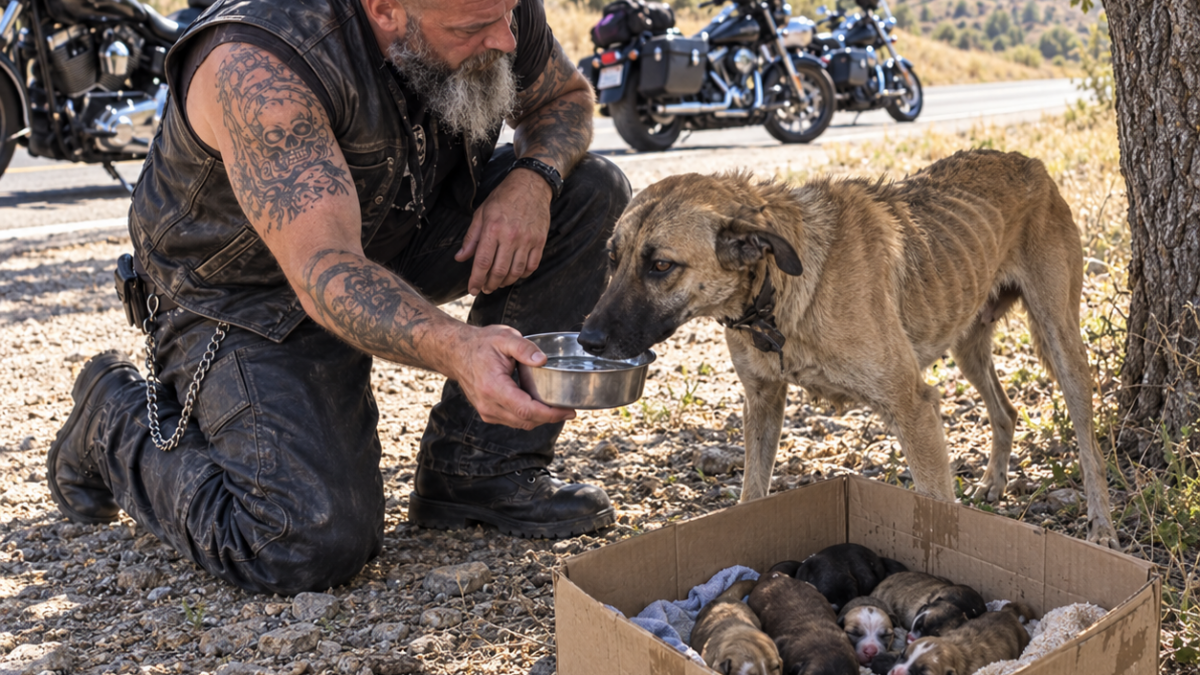
That dog was dying in front of me, but she still refused the water in my hand.
Five newborn puppies were trapped inside a collapsing cardboard box under a Provence sun hot enough to burn through leather, and two of them had already stopped moving.
And when the exhausted mother looked past us toward our motorcycles again, I realized there was something about this roadside rescue we still didn’t understand.
My name is Marc Delorme, but everyone in our riding group calls me Bear. At fifty-two, with a shaved head, a gray beard hanging halfway down my chest, old tattoos covering both arms, and enough weight on me to make most café chairs complain, I’ve gotten used to people deciding what kind of man I am before I’ve said a word.
The sandy-colored shepherd mix in front of me didn’t care.
She cared about the box.
It was August 19, almost noon, somewhere deep in the Provence backcountry. The temperature display on my motorcycle read 109°F. Even through my gloves, the metal zipper on my saddlebag felt hot enough to sting my fingers.
The box had been shoved beneath an old evergreen oak several miles from the nearest village. One side had collapsed inward, and the damp cardboard bottom was beginning to tear. Five tiny puppies lay pressed together inside a strip of shade barely wider than a dinner plate.
Three moved weakly.
Two didn’t move at all.
I reached toward the smallest one.
The mother stepped between us.
She was painfully thin, her ribs sharp beneath dusty fur, her dark muzzle gray around the edges. One ear folded slightly forward, and she was favoring her right hind leg. Every time she shifted her weight, the paw left a faint pink mark in the dust.
She could barely stand.
Still, she planted herself between a newborn puppy small enough to fit in my palm and a biker who weighed well over two hundred pounds.
“Easy, sweetheart,” I whispered.
Her eyes dropped to the water bottle in my other hand.
I poured some into the cap and touched one drop to the smallest puppy’s gums.
Nothing.
Another drop.
Still nothing.
Behind me, Julien had taken off his leather jacket and was holding it over the box to make a larger patch of shade. Thierry soaked two bandanas with water. Bernard, the biggest man in our group after me, crouched close enough to help but far enough away not to frighten her.
Our four motorcycles ticked softly as their engines cooled.
There were no houses nearby.
No passing cars.
Only cicadas screaming in the trees and the shimmering road disappearing through the hills.
“Come on, little one,” Julien murmured.
The mother watched my hands without blinking.
We had offered her water three times already.
Each time, she’d lowered her muzzle toward it.
Each time, she’d turned away and returned to the puppies.
At first we’d assumed she was afraid of us.
But she hadn’t stumbled across us by accident.
Ten minutes earlier, she’d burst from a roadside ditch directly in front of my motorcycle.
I’d hit the brakes.
She had run ahead of us.
Then turned around.
A hundred yards later, she’d done it again.
Run.
Look back.
Slow down whenever we slowed.
When I finally stopped, she doubled back, stood in the road in front of my bike, barked once, then ran away again.
Always in the same direction.
She hadn’t wandered onto our route.
She had been leading us.
I pressed two fingers gently against the smallest puppy’s chest.
For a moment, I felt nothing.
Then something fluttered.
Once.
So faintly I wondered if I’d imagined it.
I began rubbing the puppy carefully with a dry cloth while Thierry held the water.
The tiny body was frighteningly hot.
“Is he breathing?” Bernard asked.
“I don’t know.”
The mother pushed her nose beneath my wrist.
I thought she was trying to take the puppy away from me.
Instead, she licked the top of his head.
Then she touched each puppy with her nose.
One.
Two.
Three.
Four.
Five.
She returned to the smallest.
A tiny sound came from the box.
Not a cry.
More like air escaping.
The puppy’s front paw twitched.
Bernard turned his face toward the road and dragged one enormous hand through his beard.
“Again.”
I touched another drop of water to the puppy’s gums.
This time, he swallowed.
The mother saw it.
Something in her shoulders finally loosened.
Then her front legs buckled.
I caught part of her weight before she collapsed beside the box.
Her eyes remained open, fixed on the puppies.
“Easy,” I said. “We’ve got them.”
I reached beneath her neck to loosen the collar.
That was when my fingers touched something hard hidden beneath the worn leather.
At first I thought it was part of the buckle.
Then I turned the collar over.
There was a second piece of metal fastened on the inside, deliberately positioned where nobody would see it unless the collar came off.
I wiped the dust away with my thumb.
There were words engraved on it.
And the moment I read them, I stopped breathing.
PART 2
The little metal plate was no bigger than two postage stamps laid side by side.
It wasn’t a normal identification tag. Those usually hung from a ring where anyone could see them. This one had been riveted directly to the inside of the leather collar, pressed against the dog’s fur as if somebody wanted it hidden.
I tilted it toward the light.
DOMAINE SAINT-ROCH
NALA — FEMALE 14
A. VAUTRIN
LOT 7
Bernard leaned over my shoulder.
“What the hell is ‘Female Fourteen’?”
“I don’t know.”
But I didn’t like the answer forming in my head.
Julien did.
“Breeding dog.”
Nobody said anything for a second.
The cicadas kept screaming.
The mother—Nala, if the plate was telling the truth—lay on her side, panting so hard her entire body shook with each breath.
Thierry took out his phone.
One bar of service appeared, disappeared, then came back.
“Search the name.”
“I’m calling a vet first.”
He was right.
Whatever that metal plate meant could wait.
The puppies couldn’t.
Thierry walked twenty yards uphill before he got enough signal to reach an emergency veterinary clinic outside Apt. He spoke quickly in French, explaining the heat, the puppies, the collapsed mother, and the fact that we were on motorcycles with no safe way to transport six overheated animals.
The woman on the other end asked for our location.
Thierry sent a pin.
Her answer changed his face.
“What?” I asked.
“They’re sending someone.”
“How long?”
“Twenty-five minutes if the road’s clear.”
I looked into the box.
Twenty-five minutes felt like a year.
The smallest puppy had moved again, but the fifth one hadn’t.
Julien knelt beside me.
“Show me what you’re doing.”
I explained what little I knew. Gentle cooling. Shade. Tiny amounts of fluid along the gums. No ice. No sudden temperature shock.
We weren’t veterinarians.
We were four men who knew how to patch a tire in the rain, rebuild a carburetor, stop serious bleeding until an ambulance arrived, and argue for an hour about the correct way to cook sausages over a campfire.
But none of us had ever tried to keep newborn puppies alive on the side of a road in 109-degree heat.
So we did the only thing we could.
We became very careful.
Bernard moved his motorcycle so the rear storage case blocked some of the reflected heat from the asphalt. Julien stretched his jacket between two bikes, creating a larger patch of shade. Thierry rationed the coolest water we had, dampening cloths instead of pouring water directly over the puppies.
I stayed beside Nala.
Once the collar was loosened, she breathed a little easier.
I slid the water cap beneath her muzzle.
“Your turn now.”
She smelled it.
Then she looked at the box.
I understood.
“They’re here.”
Her eyes stayed on mine.
“We aren’t leaving them.”
I don’t know whether dogs understand sentences.
I know she understood something.
She lowered her muzzle.
And finally drank.
Only three mouthfuls.
Then she stopped.
But it was enough to make Bernard swear softly and look away again.
The man could bench-press more than any of us, had broken his nose twice in bar fights when he was young, and had once ridden sixty miles with two cracked ribs because he refused to abandon his motorcycle.
Five dehydrated puppies were destroying him.
“Don’t start crying, princess,” Julien said.
Bernard pointed one thick finger at him.
“If you tell anyone, I’ll bury your bike.”
Julien smiled.
Then the fifth puppy moved.
Barely.
A tiny curl of the body.
I saw it first.
“Wait.”
Everyone froze.
I slipped two fingers beneath him.
The movement came again.
Weak.
But real.
“He’s alive.”
Bernard sat down hard in the dust.
All five.
For the first time since we’d found the box, all five were alive.
That didn’t mean they were safe.
The veterinary van arrived eighteen minutes later.
I know because I checked my watch every thirty seconds.
It came around the bend far too fast, a white Renault with a green veterinary cross on the door, gravel spraying beneath the tires.
A woman in blue scrubs jumped out before the van had completely stopped.
She introduced herself as Dr. Claire Morel.
She was probably forty, small, sun-browned, with dark hair pulled into a hurried knot. A younger veterinary assistant named Luc followed her carrying two insulated cases.
Claire took one look at the box.
Her expression tightened.
“How long have they been here?”
“We don’t know.”
“Mother drinking?”
“A little.”
“Vomiting?”
“No.”
“Seizures?”
“No.”
She listened to Nala’s heart, checked her gums, then moved to the puppies.
Her hands were fast but gentle.
The smallest one made another weak sound.
Claire glanced at me.
“You did well not to pour cold water over them.”
“Are they going to make it?”
“I’m not making promises on the side of a road.”
Fair answer.
She lifted the fifth puppy.
“This one worries me most.”
I looked at the smallest.
“Not him?”
“Him too.”
“That’s a terrible answer.”
“It’s the honest one.”
I liked her immediately.
We moved the puppies into a padded carrier while Luc set up fluids for Nala. The moment we lifted the first puppy from the cardboard box, Nala tried to stand.
Her legs failed.
She tried again.
Claire put a hand against her chest.
“They’re coming with us.”
Nala struggled harder.
I knelt beside her.
“Hey.”
Her eyes snapped toward me.
I pointed at the carrier.
“Babies.”
Then at the van.
“Babies go there.”
Yes, I knew how ridiculous I sounded.
But Nala followed my hand.
Claire lifted the carrier into the van.
Nala stopped struggling.
“Smart girl,” Claire whispered.
Then Luc found the blood.
It wasn’t just the paw.
There was dried discharge beneath Nala’s tail, partly hidden by dust.
Claire’s expression changed again.
“When did she give birth?”
“No idea.”
She pressed gently along Nala’s abdomen.
The dog flinched.
Claire looked at me.
“We need to move.”
“What’s wrong?”
“Possibly infection. Possibly retained tissue. Possibly nothing. But she’s severely dehydrated, exhausted, underweight, and nursing five puppies in extreme heat. That’s enough.”
We lifted Nala onto a stretcher.
She weighed almost nothing.
That might be the part I remember most.
Not the heat.
Not the box.
Not even the collar.
The weight.
A shepherd-sized dog should have felt substantial between four men.
Nala felt like a blanket with bones inside it.
As Claire closed the van doors, I remembered the metal plate.
“Doctor.”
She turned.
I showed it to her.
“Domaine Saint-Roch mean anything?”
Her eyes stopped on the name.
Not long.
Maybe half a second.
But long enough.
“You know it.”
“I know of it.”
“What is it?”
“Dog breeder.”
Julien had been right.
“What kind?”
She looked toward the van.
“Mostly shepherd crosses and working-line dogs. They’ve advertised litters for years.”
“Good reputation?”
Claire’s mouth tightened.
“Let’s save these animals before we discuss reputations.”
Then she climbed in and drove away.
We stood beneath the oak with the empty box at our feet.
There should have been relief.
Instead, I felt colder than I had all morning.
Thierry picked up the box carefully.
“Don’t throw that away.”
“I wasn’t going to.”
There was a printed shipping label on the bottom, half destroyed by moisture.
I hadn’t noticed it before because the puppies had been lying over it.
Bernard crouched.
The label had been torn, but part of an address remained visible.
SAINT-ROCH.
Nobody said anything.
Julien finally broke the silence.
“Could be coincidence.”
“Could be.”
“You don’t believe that.”
“No.”
Neither did he.
We wrapped the box inside a plastic groundsheet and strapped it to the back of Bernard’s motorcycle.
Then we rode toward Apt.
For the first time in twenty years of riding together, nobody passed anybody.
Nobody accelerated through the bends.
Nobody stopped for coffee.
We rode in a straight, quiet line behind that veterinary van as if the six lives inside it were pulling us by a rope.
At the clinic, Claire’s staff moved faster than I thought possible.
The puppies went into temperature-controlled incubators. Nala was placed on fluids. Blood was drawn. Her injured paw was cleaned. She was given medication for pain, and Claire ordered an ultrasound.
We filled the waiting room.
Four large men in leather gear surrounded by posters of cats and rabbits.
A little girl came in carrying a guinea pig and stared at Bernard for so long that her mother apologized.
Bernard smiled at her.
The girl hid behind her mother’s coat.
“See?” Julien whispered. “Terrifying.”
“Shut up.”
Twenty minutes passed.
Then forty.
I walked outside twice because sitting still felt impossible.
On my third trip back through the reception area, I heard a puppy cry from somewhere behind the doors.
I stopped.
The receptionist looked up.
“That’s a good sound.”
“Which one?”
She smiled.
“With newborns, any one.”
An hour after we arrived, Claire came out.
We all stood.
“Sit down.”
Nobody sat.
She sighed.
“Fine. The mother is stable for the moment. Her temperature is coming down. Her kidneys are stressed, but we’re not seeing immediate organ failure. She’s severely dehydrated and malnourished. She has an infected wound on her rear paw, likely several days old.”
“And the puppies?”
“Three are responding well.”
Three.
My stomach dropped.
“The other two?”
“Still critical.”
“But alive?”
“Yes.”
Bernard closed his eyes.
Claire continued.
“The smallest male—the one you were working on—has begun nursing reflex movements. That’s encouraging. The other weak puppy is a female. Her heart rate is improving.”
“So all five could make it?”
“They could.”
That word was enough.
Then Claire looked at me.
“There’s something else.”
Of course there was.
She held a handheld scanner.
“The mother is microchipped.”
“Registered?”
“Yes.”
“To Saint-Roch?”
Claire didn’t answer immediately.
That was answer enough.
“Name?”
“Nala.”
I looked at the metal plate in my hand.
The plate was real.
“Owner?”
“Alain Vautrin. Domaine Saint-Roch.”
“Can you call him?”
“I already did.”
Every head turned toward her.
“And?”
Claire folded her arms.
“He said Nala disappeared six months ago.”
I stared at her.
“Six months?”
“That’s what he said.”
Julien spoke first.
“She has newborn puppies.”
“Exactly.”
“Did you tell him that?”
“Yes.”
“And?”
“He said she must have been bred by whoever stole her.”
It was possible.
Technically.
Dogs get stolen.
Dogs get lost.
Strange things happen.
But Claire wasn’t finished.
“I asked when he last reported her missing.”
Silence.
“He didn’t.”
“Maybe he forgot,” Thierry said, though his voice made it clear he didn’t believe it.
Claire shook her head.
“Then I asked whether he wanted to reclaim her after medical stabilization.”
“And?”
“He told me she wasn’t his responsibility anymore.”
Bernard leaned forward.
“That’s not what he just said.”
“No.”
“If she’s stolen, she’s his dog. If she’s not his responsibility, then she’s not stolen.”
“No.”
“Which story is he going with?”
Claire looked at him.
“That is an excellent question.”
I put the metal plate on the table.
“What does Female Fourteen mean?”
Claire studied it.
“I can’t prove what it means.”
“But you have an idea.”
“Commercial breeders sometimes identify breeding females numerically. Not always. The number itself proves nothing.”
“What about Lot Seven?”
“Could mean litter, kennel section, breeding group, inventory code.”
Inventory.
The word turned my stomach.
I looked through the glass door toward the treatment area.
Somewhere behind it, Nala was lying beneath a drip after nearly killing herself trying to keep five newborn puppies alive.
“Can we report this?”
Claire nodded.
“I already have.”
That afternoon, two gendarmes came to the clinic.
Captain Élodie Martin did most of the talking.
She was in her late thirties, maybe early forties, with an expression that suggested she had very little patience for people who confused confidence with truth. Her partner photographed the collar, the hidden plate, and the cardboard box. He sealed the label portion in an evidence bag.
Élodie asked us to tell the story separately.
That impressed me.
She didn’t assume we were honest just because we’d brought the dogs in.
She made each of us describe where we’d first seen Nala, how she behaved, how far she’d led us, how the box was positioned, and what we’d touched.
When my turn came, she asked the same question three different ways.
“Did you see a vehicle near the tree?”
“No.”
“Any tracks?”
“Some tire marks, but the road is used.”
“Did you see anyone leave?”
“No.”
“Did you move the box?”
“Only enough to keep it from collapsing while we worked.”
“Did you search the surrounding area?”
“Not beyond a few yards. We were focused on the dogs.”
“Did you remove anything from the box?”
“No.”
“The collar?”
“Only after she collapsed.”
She made a note.
Then she looked up.
“What do you want to happen, Monsieur Delorme?”
I hadn’t expected that.
“What?”
“People who find animals like this often already have a theory. Sometimes they decide what happened before evidence exists. I want to know whether you’re going to become a problem for my investigation.”
Julien coughed into his fist.
Bernard smiled.
I leaned back.
“I want whoever put those dogs under that tree held responsible.”
“If it was Vautrin?”
“Then Vautrin.”
“If it wasn’t?”
“Then whoever it was.”
She watched me for another second.
Then nodded.
“Good answer.”
Before leaving, she told us one thing very clearly.
“Do not go to Domaine Saint-Roch.”
Bernard looked almost offended.
“We weren’t planning to.”
All three of us turned toward him.
“What?”
Élodie’s eyes narrowed.
“You were absolutely planning to.”
Bernard shrugged.
“Maybe for coffee.”
“Don’t.”
“Fine.”
She pointed at all four of us.
“No confrontations. No trespassing. No threats. No social media accusations. You found the dogs. You may become witnesses. Act like witnesses.”
That last sentence stayed with me.
So we waited.
For two days, our entire world became the clinic.
The three stronger puppies improved first. They began wriggling, crying, and fighting for space against the heated bedding as soon as their temperatures stabilized.
The little female who’d been unresponsive took longer.
The smallest male took longest of all.
Claire started calling him Number Five because he was the fifth puppy she’d examined.
Bernard hated that.
“He needs a proper name.”
“He’s three days old.”
“So?”
“Do you name every patient?”
“I don’t work here.”
“Exactly.”
On the third morning, Claire let us see them through the nursery window.
Nala was lying on her side beneath a clean blanket.
She looked smaller without the dust.
More fragile.
Her sandy coat had darkened where the nurses cleaned her. Her injured paw was wrapped in white bandage. Fluids ran through a line in her front leg.
Five puppies pressed against her belly.
Five.
The smallest male was nursing.
I don’t mind admitting what happened next.
I cried.
Not dramatically.
No sobbing.
Just one tear that reached my beard before I could wipe it away.
Bernard saw it.
He leaned close.
“If you tell anyone I cried, I’ll bury your bike.”
I laughed.
It was the first time any of us had laughed since the oak tree.
Then Nala raised her head.
Across the room, through glass, noise, and the smell of disinfectant, she saw us.
Her tail moved once.
A tiny thump against the blanket.
Then again.
Julien pressed his palm against the glass.
“She remembers.”
Of course she remembered.
We weren’t the ones who saved her.
She had saved herself and her puppies long enough to find help.
We were simply the people who happened to understand when she asked.
That should have been the end of our part in the story.
It wasn’t.
On the fourth day, Alain Vautrin walked into the clinic.
I knew who he was before anyone said his name.
He looked nothing like the villain my imagination had created.
No dirty clothes.
No cruel eyes.
No rough manner.
He was about my age, maybe younger, neatly dressed in pale trousers and a pressed linen shirt. His hair was silver at the temples. He wore expensive sunglasses and smelled faintly of aftershave.
He looked like the owner of a vineyard that hosted elegant weddings.
He walked toward reception with a leather folder beneath one arm.
“I’m here for my dog.”
Claire was behind the desk.
She didn’t move.
“Which dog?”
“Nala.”
I happened to be sitting in the corner with Bernard.
We’d come to check the puppies and deliver puppy formula the clinic had ordered through a local association.
Vautrin didn’t recognize us.
Not yet.
Claire folded her hands.
“You previously said Nala was no longer your responsibility.”
“That was before I spoke with my attorney.”
There are sentences that tell you more about a person than an hour of conversation.
That was one of them.
Claire stayed calm.
“Nala is currently being held pending an investigation into suspected abandonment.”
“I know.”
“Then you know I cannot release her to you.”
“My attorney disagrees.”
“Your attorney is welcome to speak to the authorities.”
Vautrin placed the folder on the counter.
“Doctor, I would prefer not to make this unpleasant.”
Bernard shifted beside me.
I put my hand on his arm without looking at him.
Claire didn’t need us.
She was doing just fine.
“Then don’t.”
Vautrin’s smile disappeared.
“That dog was stolen.”
“You told me that.”
“I have records.”
“Excellent. Give them to the gendarmerie.”
“I am the legal owner.”
“Then the investigation should be very simple.”
His jaw tightened.
He turned slightly.
That was when he saw the four motorcycle helmets lined along the wall.
Then he saw me.
Recognition moved across his face.
Not personal recognition.
Context.
He understood who we were.
“The bikers.”
I stood.
“The dog’s name is Nala.”
His eyes flicked toward my hands.
Maybe he expected anger.
I had plenty.
But Élodie’s words were in my head.
Act like witnesses.
So I smiled.
“Mr. Vautrin.”
“You’re the one who took her collar.”
“I loosened it while she was collapsing.”
“That collar belongs to me.”
“The gendarmerie has it.”
That surprised him.
Just enough.
Then he recovered.
“This entire situation is being exaggerated. Nala wandered off months ago. If someone abandoned her puppies, I’d like to know who.”
I walked closer.
“Me too.”
He looked at me.
For three long seconds neither of us spoke.
Then a puppy cried behind the treatment-room door.
Vautrin’s eyes moved toward the sound.
Nothing changed in his face.
No concern.
No relief.
No question about whether they were alive.
He hadn’t asked once.
Not once.
“How many?” he said finally.
“Five,” Claire answered.
“Pure?”
Claire stared at him.
“What?”
“Are they purebred?”
I heard Bernard inhale.
I squeezed his forearm hard.
Vautrin glanced at us again, saw the expression on Bernard’s face, and decided that was a good moment to leave.
“Tell the authorities I’ll cooperate.”
He picked up his folder.
At the door he turned toward me.
“You should be careful about involving yourself in things you don’t understand.”
I almost laughed.
Instead I said, “That’s why I’m waiting for the people who do understand them.”
His face hardened.
Then he left.
Bernard waited until the door closed.
“Can I involve myself now?”
“No.”
“Just a little?”
“No.”
Claire looked at both of us.
“Thank you.”
“For what?”
“Not making my waiting room famous.”
That evening, Captain Martin called.
“Did Vautrin threaten you?”
“Depends what you call a threat.”
“Tell me exactly what he said.”
I repeated it.
She was quiet.
“Anything else?”
“He wanted the dog.”
“I know.”
“He asked whether the puppies were purebred before asking whether they were alive.”
Another pause.
“That may tell you something about his character. It does not tell me who left the box.”
“I understand.”
“Good.”
Then her voice changed slightly.
“We found something near the tree.”
I stood up from my kitchen chair.
“What?”
“A piece of plastic from a broken rear light.”
“From his van?”
“I didn’t say that.”
“But you’re checking.”
“I didn’t say that either.”
I smiled despite myself.
“You’d be terrible at poker.”
“So would you, Monsieur Delorme. Good night.”
The next morning, somebody slashed both tires on my motorcycle.
Not one.
Both.
I found it at six thirty outside my house.
The front tire had a clean cut through the sidewall.
The rear had two.
There was no note.
No message.
No camera on that side of my building.
I stood there looking at the damage for a long time.
My first feeling wasn’t fear.
It was satisfaction.
That worries me now when I think about it.
Because someone who slashes your tires believes he has frightened you.
What he’d actually done was confirm that somebody wanted us uncomfortable.
I called Élodie before I called the repair shop.
She arrived twenty minutes later.
“You have enemies?”
“I’m a biker with an ex-wife and three decades of opinions. How long do you have?”
“I’m serious.”
“So am I.”
She photographed the tires.
“Anyone threaten you recently?”
“Only one.”
“You cannot prove this is connected.”
“I know.”
“Good.”
She looked toward my building.
“Any cameras nearby?”
“The bakery across the street.”
We walked over.
The owner, a man named Philippe who had known me since I was sixteen, let us view the overnight footage.
At 2:13 a.m., a dark figure entered frame.
Helmet.
Jacket.
Gloves.
No visible face.
He crouched beside my bike for less than a minute.
Then disappeared.
Élodie replayed the footage.
“Professional?”
“No.”
“How do you know?”
“He cut the sidewalls. You don’t need skill for that.”
“Could you recognize his build?”
“No.”
“Walk?”
“No.”
She paused.
“Motorcycle?”
“No. He came on foot.”
Philippe leaned over the counter.
“There’s another camera at the pharmacy.”
The pharmacy camera caught the same person two streets away.
This time, just before he left frame, a vehicle appeared behind him.
A white van.
Too far away for the license plate.
But on its side was a dark shape.
A logo, maybe.
Élodie enlarged the frame.
It became a blur of pixels.
Still, I knew what everyone in the room was thinking.
“Don’t say it,” she warned.
“I didn’t.”
“Your face said it.”
“My face is expressive.”
“Your face is irritating.”
Philippe laughed.
She didn’t.
Three days later, the smallest puppy opened his eyes.
Too early for proper vision, Claire explained. More reflex than sight.
It didn’t matter.
Bernard named him Ember.
“Because he looked dead and then started glowing again.”
Claire rolled her eyes.
But the name stayed.
The weak female became Olive because Julien insisted every dog rescued in Provence should have at least one regional cliché attached to the story.
The others became Biscuit, Pepper, and Mistral.
Nala improved every day.
Once she could stand without swaying, Claire let us sit with her in an outdoor enclosed yard behind the clinic.
I went in first.
Nala walked toward me slowly.
For one terrible second, I wondered if she wouldn’t remember.
Then she pressed her head against my chest.
That nearly finished me.
I sat down on the ground.
She leaned her entire weight against me.
Not much weight yet.
But more than before.
“You did it,” I whispered.
Her tail thumped.
“No, that’s wrong.”
I scratched behind her ear.
“We did it.”
She lifted her head at the sound of puppies crying inside.
Immediately alert.
Still mother first.
Always mother first.
A week after the rescue, we learned why Vautrin had become nervous.
Captain Martin asked us to come to the station.
We sat across from her in a plain interview room while she opened a file.
“The broken piece of rear light found near the oak was from a Renault Trafic manufactured within a specific range of years.”
Thierry leaned forward.
“Vautrin owns a Renault Trafic.”
“So do approximately half the tradesmen in southern France.”
“Fair.”
“However, his van has damage to the left rear light.”
Nobody moved.
Élodie continued.
“He says the damage happened several weeks ago.”
“Did it?”
“We have not established that.”
“Anything else?”
She placed a photograph on the table.
It showed the cardboard box.
The shipping label had been cleaned and photographed under different light.
More of the printing was visible now.
Domaine Saint-Roch.
A delivery date.
Four days before we found the dogs.
“Dog food shipment,” she said. “Delivered directly to Vautrin’s property.”
Bernard’s jaw tightened.
“He put them in his own box.”
“Possibly.”
“Come on.”
“Possibly.”
She gave him a look that shut him up.
“There’s more.”
Another photograph.
A fuel station.
White van.
Timestamp: 8:42 a.m., August 19.
The morning we found Nala.
“The station is twelve kilometers from your location,” Élodie said.
The image showed Alain Vautrin standing beside the van.
“How far from his kennel?”
“Thirty-eight kilometers.”
“What was he doing there?”
“He says he was buying fuel.”
“Where was he going?”
“He has not provided a consistent answer.”
My pulse began to rise.
“What time did we find Nala?”
“Approximately 11:47.”
“So three hours.”
“Approximately.”
Bernard leaned back.
“We have him.”
Élodie’s eyes moved toward him.
“No. We have a man near a place where his registered dog and a box from his property were found. That is evidence. It is not the same thing as proof of abandonment.”
She took out another sheet.
“But then his former employee called us.”
That changed everything.
Her name was Sophie Arnaud.
Twenty-nine years old.
She had worked at Domaine Saint-Roch for fourteen months before quitting in June.
At first, she refused to meet us.
That was reasonable.
We were witnesses, not investigators.
But she agreed to speak with Élodie.
What she brought with her was enough to turn a roadside rescue into a much larger case.
Photographs.
Messages.
Veterinary invoices.
Breeding logs.
And a notebook.
Vautrin had advertised Saint-Roch as a small family breeding program.
According to Sophie, that hadn’t been true for years.
There were too many females.
Too many litters.
Too little space.
Dogs that stopped producing profitable puppies were sold cheaply, transferred unofficially, or simply disappeared from the records.
Most weren’t abandoned.
Sophie was careful about that.
Some went to other breeders.
Some were rehomed.
Some outcomes she didn’t know.
But Nala?
She knew Nala.
She knew exactly who Nala was.
“Female Fourteen,” she told Élodie.
The hidden collar plate was an internal kennel identifier.
Nala had produced five litters.
The puppies under the oak were her sixth.
That made Vautrin’s claim that she’d disappeared six months earlier impossible.
Sophie had photographed her at Saint-Roch eleven days before we found her.
Pregnant.
Very pregnant.
The photograph was timestamped.
There was no argument.
No six-month disappearance.
No stolen dog.
No mystery owner.
Nala had been at his property eleven days earlier.
But even that wasn’t what broke the case.
Nine days before the puppies were born, Sophie had received a message from another former employee who still occasionally helped at Saint-Roch.
The message included a photograph.
Nala in a kennel.
And one sentence.
Boss says if this litter comes out weak, she’s done.
I read that sentence twice when Élodie later showed it to us.
She’s done.
Three words.
Nothing illegal by themselves.
Nothing even clear.
But I could suddenly see Nala standing on that road again.
Running despite the injured paw.
Looking back at our motorcycles.
Refusing water until a puppy swallowed.
She’s done.
I wanted Vautrin to say those words to my face.
That was the first moment I understood why Élodie had warned us not to confront him.
I was not afraid I would hit him.
I was afraid I would enjoy wanting to.
So I stayed away.
For a while.
The investigation expanded.
Officials inspected Domaine Saint-Roch.
What they found wasn’t the horror movie people imagine when they hear “bad breeder.”
That almost made it worse.
The kennels weren’t covered in filth.
The dogs weren’t skeletal.
There weren’t bodies hidden in freezers.
Everything was just acceptable enough from a distance.
Clean concrete.
Metal runs.
Water bowls.
Vaccination folders.
Professional signage.
But behind the polished front were overcrowded breeding records, inconsistent veterinary care, dogs with untreated skin problems, females bred too frequently, incomplete transfer records, and several animals whose identification status didn’t match the paperwork.
There were twenty-seven dogs on the property.
Seven were nursing or pregnant females.
One old male had a tumor on his shoulder that Sophie said had been visible for months.
A shepherd named Cleo had worn a damaged collar so long that the skin beneath it had become infected.
Two dogs were temporarily removed immediately for treatment.
The others remained while authorities reviewed the operation.
Vautrin blamed Sophie.
Then Claire.
Then us.
He told anyone who would listen that four intimidating bikers were trying to destroy his business over a misunderstanding.
He claimed Nala had been taken from his property and planted near the road.
That was a creative theory.
It was also stupid.
Because if someone had stolen a pregnant dog from him, waited until she delivered, starved her, placed her and the puppies under a tree, and somehow planted a dog-food box from his own property there, they would have needed access to his kennel, his supplies, his dog, and his schedule.
It made the circle of possible suspects smaller, not larger.
Still, people believed him.
Some did, anyway.
Saint-Roch had sold puppies for years.
Families posted photographs of healthy dogs they’d bought from Vautrin.
People said he’d always been kind to them.
They said one bad photograph shouldn’t destroy a man’s life.
And they were right about one thing.
One photograph shouldn’t.
That’s why the case needed evidence.
Facts.
Dates.
Records.
Not rage.
Then the intimidation started.
Julien found an envelope pushed beneath his workshop door.
Inside was a photograph of his daughter getting into her car.
No message.
Nothing else.
He called Élodie before he called me.
That told me how serious it was.
His daughter was thirty-one, an adult with a family of her own, but that didn’t matter.
You put a photograph of someone’s child inside an unmarked envelope, you know exactly what message you’re sending.
For the first time, Bernard didn’t joke about visiting Saint-Roch.
He wanted to.
I could see it.
So did I.
We met that night at my house.
Four motorcycles outside.
Four angry men inside.
Bernard paced my kitchen.
“Police are doing nothing.”
“They’re investigating.”
“Someone photographed his daughter.”
“I know.”
“We know who.”
“No, we don’t.”
He slammed one hand onto my table.
“Come on, Bear.”
“No.”
He stared at me.
I stood.
I’m a large man.
Bernard is larger.
We’ve known each other for twenty-eight years.
It was the closest we’d ever come to fighting.
“If we go there,” I said, “what happens?”
“We talk.”
“Bull.”
“We talk.”
“And if Vautrin insults us?”
Bernard said nothing.
“If he laughs?”
Nothing.
“If he says something about Julien’s daughter?”
His jaw flexed.
“Exactly.”
Julien sat at the table, silent.
Thierry spoke from the corner.
“We go there angry, we give him exactly what he needs.”
Bernard turned.
“And what are we supposed to do?”
“Win.”
“How?”
Thierry pointed at the folder Élodie had told us not to discuss publicly.
“By not being the idiots in his story.”
That quieted the room.
Julien looked at Bernard.
“He wants four violent bikers.”
Bernard’s shoulders dropped.
“So we don’t give him four violent bikers.”
“No.”
“What do we give him?”
I answered.
“Four witnesses.”
That became our revenge.
Not fists.
Not broken windows.
Not threats.
Documentation.
We photographed every suspicious vehicle near our homes.
We installed cameras.
We saved every message.
We turned over every anonymous call.
When Vautrin’s attorney sent us a letter accusing us of defamation, we gave it to the investigators.
When fake accounts began posting that we’d stolen puppies to raise money, we didn’t answer.
When a local online page claimed Nala had been “rescued from thieves,” Claire released only the veterinary facts she was legally allowed to release.
Nala had arrived severely dehydrated.
She had given birth recently.
She had been underweight.
Five newborn puppies had suffered heat stress.
Her registered owner had initially told the clinic she had been missing for six months.
Facts.
Facts are slower than anger.
But they are heavier.
Three weeks after the rescue, Nala was strong enough to leave the clinic.
The legal question was where she would go.
Vautrin wanted her returned.
The animal welfare association wanted temporary custody.
I wanted something I didn’t say out loud.
I wanted her home with me.
Captain Martin called.
“Would you be willing to foster her?”
I tried to sound normal.
“For how long?”
“Potentially months.”
“Fine.”
“You need to understand she remains connected to an active case.”
“Fine.”
“You may need to bring her to evaluations.”
“Fine.”
“You cannot transfer ownership.”
“Fine.”
“Are you capable of saying anything except fine?”
“Yes.”
“What?”
“When do I pick her up?”
Élodie laughed for the first time since I’d met her.
“Tomorrow.”
I didn’t sleep.
My house had never been prepared for a dog.
By midnight it looked like a pet store had exploded.
Bed.
Bowls.
Food.
Lead.
Harness.
Blankets.
Toys.
Baby gates.
A ridiculous stuffed rabbit Bernard insisted she needed.
At two in the morning I realized I had bought three different brushes.
Nala had short fur.
I kept all three.
When I arrived at the clinic, Claire brought Nala through the door on a blue leash.
She had gained almost nine pounds.
Her ribs were still visible, but no longer frighteningly so. Her paw had healed enough that she used it normally. Her eyes looked brighter.
She saw me.
Stopped.
Then ran.
Not fast.
Not gracefully.
But directly into me.
I went down on one knee and she climbed halfway into my chest.
Claire pretended to reorganize paperwork while I buried my face in Nala’s neck.
“You ready?” I whispered.
Her tail hammered against my leg.
Claire handed me a bag.
“Medication. Feeding schedule. No long walks yet.”
“Yes, doctor.”
“And Marc?”
I turned.
“She may have separation anxiety. She may pace. She may guard food. She may wake at night. She has been under chronic stress.”
“I understand.”
“No, you don’t.”
That got my attention.
Claire softened.
“I’m not criticizing you. I’m telling you not to take it personally if she struggles. Rescue isn’t a single moment. The dramatic part happens under the tree. The difficult part happens afterward.”
She was right.
Nala didn’t sleep the first night.
She walked from my bedroom to the front door.
Front door to kitchen.
Kitchen to living room.
Living room back to bedroom.
Every fifteen minutes.
At three thirty, I gave up and sat on the kitchen floor.
She stood in the doorway watching me.
I patted the tile.
“Come on.”
She didn’t.
I lay down.
A fifty-two-year-old, two-hundred-plus-pound biker lying on his kitchen floor at three thirty in the morning because a nervous dog wouldn’t settle.
Ten minutes later, I felt something warm against my back.
Nala.
She curled beside me.
We slept there until sunrise.
For the next week, she searched my house for puppies.
That was the hardest part.
The puppies were still too fragile to leave the clinic, and for medical reasons Claire had separated Nala from them gradually once supplemental feeding began.
At home, Nala heard any small sound and went looking.
Under the table.
Behind the sofa.
Into the bathroom.
Once she heard a puppy crying on a television advertisement and ran directly into the screen.
I turned it off.
“I’m sorry.”
She looked at me.
I sat on the floor beside her.
“They’re okay.”
I couldn’t prove she understood.
But saying it mattered to me.
Three days later, Claire arranged a supervised visit.
The moment Nala entered the clinic nursery, five tiny bodies began squeaking.
She rushed toward them.
Ember crawled over two siblings trying to reach her.
Nala lay down.
Five puppies disappeared against her belly.
Claire stood beside me.
“Look at that.”
I couldn’t speak.
“You keeping her?”
“If I’m allowed.”
“Thought so.”
“And Ember.”
Claire turned.
“You said one dog.”
“I lied.”
“You live alone.”
“Exactly. Plenty of room.”
“You have a small house.”
“Plenty of emotional room.”
She shook her head.
“You bikers are exhausting.”
But she was smiling.
The case against Vautrin strengthened in October.
A mechanic came forward.
He had repaired Vautrin’s Renault two days after we found Nala.
Left rear light.
The invoice was dated August 21.
Vautrin had paid cash.
The mechanic still had the damaged housing in a scrap bin because he hadn’t emptied it that week.
Forensic comparison wasn’t dramatic like television.
No instant computer match.
No flashing graphics.
Just technicians measuring broken plastic edges.
The piece found near the oak fitted the missing section.
Perfectly.
That placed his van at the tree.
Vautrin changed his story again.
Now he said he’d found Nala wandering on the morning of August 19 and had tried to bring her back to Saint-Roch.
According to him, she panicked in the van and escaped near the oak.
“What about the puppies?” Élodie asked him.
He said he hadn’t known she had any.
“What about the cardboard box from your property?”
He said someone must have taken it.
“Why didn’t you report finding Nala?”
He said he’d been busy.
“Why did you later say you hadn’t seen her in six months?”
He said he’d been confused.
“Why was the van light broken exactly where debris was found?”
He said he’d backed into a stone wall somewhere else.
A man can survive one lie.
Sometimes two.
The trouble starts when every lie needs another one standing behind it.
Then came the veterinary records.
One of Vautrin’s former veterinarians kept detailed notes.
Nala had been brought in after her fourth litter with a recommendation that she not be bred again for at least eighteen months.
She had lost too much weight.
Vautrin bred her eight months later.
After the fifth litter, another note warned of uterine inflammation.
That litter had produced only three puppies.
Two survived.
Nala should have been retired.
Instead, she became pregnant again.
The five puppies beneath the oak were worth money if they were healthy.
If they weren’t?
According to Sophie, Vautrin had already decided Nala was “done.”
But we still didn’t know exactly what happened on August 19.
The answer came from a man named Rémi.
He was seventeen when he began doing odd jobs at Saint-Roch.
By the time of the rescue he was nineteen.
Quiet kid.
Worked mornings cleaning kennels and carrying food.
He had been afraid to talk.
Vautrin had given him cash work.
Rémi thought admitting what he’d seen might get him in trouble.
Sophie convinced him otherwise.
He sat with investigators and told them everything.
Nala had gone into labor early on August 19.
Vautrin had found her in a storage kennel just after dawn.
Five puppies.
Two weak.
Nala bleeding.
Vautrin called nobody.
He waited.
By eight o’clock, he decided the litter wouldn’t be profitable.
Rémi heard the argument between Vautrin and Vautrin’s wife.
She wanted him to call a veterinarian.
Vautrin refused.
The emergency visit would cost too much.
Nala herself might need surgery.
More money.
More risk.
Rémi offered to drive her to the clinic.
Vautrin told him to clean the kennels and mind his business.
Then he put the puppies into a cardboard dog-food box.
Nala followed.
Vautrin loaded all of them into the white van.
Rémi thought he was finally going to the vet.
He wasn’t.
“Did you see him return?” Élodie asked.
“Yes.”
“With Nala?”
“No.”
“With the puppies?”
“No.”
“What did he say?”
Rémi looked down.
“He said Female Fourteen was no longer an issue.”
I learned those details months later.
At the time, Élodie only told us they now had a direct witness.
That was enough.
Vautrin was questioned again.
Then charged.
The intimidation investigation remained separate.
They never proved he personally slashed my tires.
But they did identify the man who delivered the photograph to Julien.
His name was Pascal Renard.
He had worked occasionally for Saint-Roch transporting dogs.
Phone records showed several calls between Renard and Vautrin around the dates of the incidents.
Renard eventually admitted Vautrin had asked him to “make the bikers nervous.”
That phrase became important.
Not because it was the worst thing Vautrin had done.
Because it showed intent.
He hadn’t been defending himself from false accusations.
He had been trying to scare witnesses.
The morning they arrested him for questioning in connection with witness intimidation, Bernard called me at six thirteen.
“Coffee.”
“It’s six in the morning.”
“Coffee.”
“Where?”
“The square.”
I knew what he meant.
A café in Apt opened early for workers.
When I arrived, all three of them were already there.
Bernard pushed an espresso toward me.
“He’s in custody.”
“I heard.”
Julien stared into his coffee.
Nobody celebrated.
That surprised me.
For weeks we’d imagined that moment.
The man who left Nala and her puppies beneath that oak.
The man who sent someone near Julien’s family.
The man who’d lied over and over.
Finally cornered.
I expected satisfaction.
Instead, I felt tired.
Thierry said it first.
“I thought this would feel better.”
“It doesn’t,” Julien answered.
Bernard looked at me.
“Why?”
I knew.
Because Vautrin being afraid didn’t erase Nala’s fear.
It didn’t remove the hours those puppies spent under the sun.
It didn’t give Nala back the healthy years she’d lost producing litters.
Punishment wasn’t restoration.
Those are different things.
“We haven’t finished,” I said.
Bernard raised an eyebrow.
“What does finished look like?”
I thought about Nala asleep on my kitchen floor.
“She never goes back.”
That became the goal.
The court proceedings took months.
Real justice is slow.
Painfully slow.
There were hearings.
Veterinary assessments.
Ownership arguments.
Financial records.
Statements.
Expert testimony.
Vautrin’s lawyer argued that abandoning the animals had never been proven because Rémi’s testimony was unreliable.
Rémi had accepted cash wages.
Rémi disliked Vautrin.
Rémi couldn’t see inside the van after it left.
All true.
Then the prosecutor laid out the chain.
Nala was photographed pregnant at Saint-Roch eleven days before the rescue.
She gave birth at Saint-Roch, according to Rémi.
Vautrin loaded her and the puppies into his van.
His van appeared on camera near the area.
A piece of its broken light was found beside the oak.
A box delivered to Saint-Roch four days earlier was found beneath the puppies.
Vautrin repaired that broken light two days later.
He initially denied seeing Nala for six months.
Then changed his story when evidence placed him nearby.
His former employee had messages showing he’d wanted to stop spending money on Nala if the litter was weak.
The veterinarian had warned against further breeding.
And when the clinic first called him?
He didn’t ask whether Nala would survive.
He asked whether the puppies were purebred.
I testified on a cold morning in February.
The courtroom was smaller than I expected.
Vautrin sat at a table in a dark suit.
For months, I’d imagined looking at him.
When the moment came, I looked mostly at the judge.
I told the story exactly as it happened.
The road.
The heat.
The dog running in front of the motorcycles.
The way she kept looking back.
The box.
The puppies.
The water.
The collar.
The collapse.
Vautrin’s attorney stood.
“Mr. Delorme, you have publicly expressed strong feelings about my client, correct?”
“I’ve expressed strong feelings about what happened to the dogs.”
“Do you dislike Mr. Vautrin?”
“I don’t know him.”
“That’s not what I asked.”
I looked at Vautrin for the first time.
“Then yes.”
A few people shifted behind me.
His attorney smiled slightly.
“So you are biased.”
“I’m angry.”
“Same thing.”
“No.”
He paused.
I continued before he could stop me.
“Bias would be changing what I saw because I’m angry. I’m telling you what I saw even though I’m angry.”
His smile disappeared.
“Did you see my client place those animals beneath the tree?”
“No.”
“Did you see his van?”
“No.”
“Did you see him anywhere near the scene?”
“No.”
“So your testimony cannot establish that my client abandoned Nala.”
“No.”
He nodded as though he’d won something.
“My testimony establishes what condition she was in when she found us.”
That mattered.
Because Claire testified next.
She was devastating.
Not dramatic.
Not angry.
Precise.
She explained Nala’s body condition, dehydration, heat stress, infected paw, postpartum condition, weight, bloodwork, and the state of the puppies.
She explained what likely would have happened without intervention.
“How long?” the prosecutor asked.
Claire looked toward the judge.
“In those temperatures, with that level of dehydration, I would not expect the weakest puppies to survive the afternoon.”
“And Nala?”
“Possibly longer.”
“How much longer?”
“I cannot say responsibly.”
“What was her most immediate risk?”
Claire answered without hesitation.
“She was exhausting herself attempting to protect and remain near the litter instead of seeking water.”
I stared at the table.
That sentence hurt worse than anything else in the trial.
She could have left.
Nala had been strong enough to reach the road.
She could have found shade somewhere.
Perhaps water.
She didn’t.
She kept going back.
Five puppies.
Five.
Even when her own body was failing.
Then Rémi testified.
Vautrin stared at him the entire time.
Rémi’s hands shook.
He was only nineteen.
I remembered being nineteen.
At nineteen, I thought courage meant not being afraid.
At fifty-two, I knew better.
Courage is being afraid and standing there anyway.
Rémi told the court what he’d seen.
When he finished, Vautrin’s lawyer attacked every weakness in his story.
Why hadn’t he called police immediately?
Why had he kept working at Saint-Roch?
Why had he accepted cash?
Why had he waited until another former employee contacted investigators?
Rémi’s voice grew smaller.
Then the lawyer asked the question that changed the room.
“If you believed Mr. Vautrin intended to harm those animals, why did you do nothing?”
Rémi looked down.
For a long moment, nobody spoke.
Then he said, “Because I was scared of him.”
Vautrin’s lawyer spread his hands.
“Scared?”
“Yes.”
“Mr. Vautrin never assaulted you.”
“No.”
“Never threatened to assault you.”
“No.”
“Then what exactly were you scared of?”
Rémi raised his eyes.
“Losing my job.”
The lawyer almost smiled.
Then Rémi continued.
“My mother was sick. I was paying part of the rent. I needed the money. He knew that.”
The room became completely still.
“He used to say people who talked too much didn’t work long around him.”
The lawyer objected.
The judge allowed Rémi to finish explaining context.
Rémi swallowed.
“I kept telling myself he was taking Nala to the vet. Even after he came back without her, I told myself maybe he left her at a clinic. Then I saw the rescue report.”
He looked toward me.
“I recognized her.”
His voice broke.
“I should have spoken sooner.”
Vautrin didn’t look at him anymore.
He looked at the table.
The trial lasted several days.
When the judgment finally came, the courtroom was full.
Vautrin was found responsible for abandoning Nala and the litter and convicted on animal-welfare offenses connected to their treatment. The court also considered violations connected to the breeding operation, recordkeeping, and the intimidation of witnesses.
The sentence wasn’t some movie version of revenge.
No twenty-year prison term.
No judge shouting from the bench.
Reality rarely gives you that.
But it gave us enough.
Vautrin lost legal custody of Nala.
He lost the right to keep the seized animals connected to the case.
He was prohibited from operating a breeding business for years under the terms imposed on him.
He faced financial penalties and restitution.
The authorities ordered the transfer of several dogs from Saint-Roch to recognized welfare organizations.
And the business that had turned breeding females into numbered inventory closed.
Female Fourteen disappeared from the records.
Nala stayed.
That was the part I cared about.
Outside the courthouse, reporters waited.
I wanted nothing to do with them.
Then one asked, “Mr. Delorme, do you feel you got revenge?”
I stopped.
That word.
Revenge.
For months, I’d used it inside my own head.
I looked at the courthouse doors.
Then at Bernard, Julien, and Thierry.
Then at Nala’s photograph on my phone.
“No,” I said.
The reporter looked disappointed.
“What do you call it?”
I thought about the metal plate hidden beneath her collar.
Female Fourteen.
“She got her name back.”
That was all I said.
But privately?
There was revenge.
Just not the kind Vautrin understood.
His whole business had depended on animals being silent.
They couldn’t describe where they’d been.
They couldn’t show invoices.
They couldn’t contradict paperwork.
They couldn’t sit in a courtroom and tell a judge what happened.
He’d built his confidence around that silence.
Nala found four men on motorcycles.
That was his mistake.
Not because we were bikers.
Because we became witnesses.
And once witnesses started talking, every lie he’d stacked around himself became another wall that could collapse.
By spring, all five puppies were healthy.
Ember remained smaller than the others.
He also became, according to Claire, “an outrageous menace.”
He chewed the corner off one of my kitchen cabinets.
Destroyed two motorcycle gloves.
Stole Bernard’s wallet.
Ate half of a printed insurance document.
And once somehow managed to drag one of my boots into the backyard without waking me.
I kept him.
Obviously.
Nala pretended she disapproved of him.
She would lie on the rug while Ember raced through the house, giving me a tired expression that seemed to say, Do you see what I have endured?
Then he’d crawl beside her.
She would wash his ears.
Every time.
Olive went home with Claire’s veterinary assistant, Luc.
Mistral was adopted by a retired schoolteacher and her husband outside Avignon.
Pepper went to a family with a large fenced orchard.
Biscuit went to Sophie’s sister.
We made sure the puppies’ adopters knew the full story.
Not because we wanted them treated like fragile victims.
Because they deserved homes where nobody would ever decide their lives were worth only what they could produce.
The other dogs removed from Saint-Roch took longer.
Some needed medical care.
Some needed behavior work.
One of the older breeding females had never walked on grass.
The first time volunteers took her into a field, she froze.
She put one paw down.
Then another.
Then rolled onto her back.
That video broke Bernard.
He called me after watching it.
“Don’t say anything.”
“I haven’t.”
“I’m serious.”
“About what?”
Silence.
Then: “Good.”
We started helping the rescue association.
At first, just transportation.
Food.
Kennel repairs.
Fundraising rides.
Bernard built dog houses.
Thierry repaired fencing.
Julien used his workshop to fabricate shade frames.
I handled the unskilled labor, which mostly meant carrying heavy things while everyone else told me where to put them.
One Saturday in May, Claire showed up at the shelter carrying the old collar.
The evidence hold had been released.
I stared at it.
“You want it?”
“No.”
She looked surprised.
“You sure?”
I touched the worn leather.
For months, that collar had been the beginning of everything.
Domaine Saint-Roch.
Nala.
Female Fourteen.
Lot Seven.
“No.”
“What should we do with it?”
“Cut the plate off.”
Claire found a screwdriver.
The rivets fought us.
Bernard finally used pliers.
The metal plate dropped onto the workbench.
He looked at me.
I picked up the leather collar.
Then I walked outside.
Nala was lying beneath a tree while Ember attempted to murder a tennis ball.
I knelt beside her.
She lifted her head.
I held the old collar out.
She sniffed it once.
Then turned away.
That was all.
No dramatic reaction.
No trembling.
No recognition I could see.
Just one sniff.
Then she rested her head against my knee.
I threw the collar into the trash.
The plate was different.
I kept that.
Not as a trophy.
As a reminder.
It’s mounted inside a small wooden frame above my workbench.
I scratched one line beneath it myself.
NALA — NOT A NUMBER.
The following August, almost exactly one year after we found her, the four of us rode the same road.
Temperature was lower.
Still hot.
Provence in August doesn’t apologize for itself.
Nala rode in Thierry’s van behind us because I refused to put her in any kind of motorcycle carrier, no matter how many ridiculous photographs Bernard showed me online.
Ember came too.
We stopped beneath the old oak.
For a while, nobody spoke.
The place looked ordinary.
That bothered me.
I had expected the landscape to remember.
Some scar on the road.
A mark beneath the tree.
Something.
But grass had grown where the cardboard box had sat.
The dirt was pale and dry.
Cicadas screamed from the branches.
Cars passed occasionally.
The world had moved on.
Nala jumped down from the van.
She stood still.
I watched her carefully.
She smelled the ground.
Walked around the tree.
Stopped near the place where we’d found the box.
My chest tightened.
Then Ember jumped from the van and attacked a fallen branch.
Nala looked at him.
He dragged the branch backward, tripped over it, rolled into the dust, jumped up, and immediately began fighting it again.
Nala walked over.
She took the branch from his mouth.
Ember stared at her in outrage.
Bernard laughed so hard he had to sit on his motorcycle.
“Still his mother.”
“Always.”
We had brought something with us.
Not flowers.
Not a sign.
A stainless-steel water station.
Thierry had gotten permission from the local municipality and a landowner whose property bordered the road. Hikers, cyclists, stray dogs—anything passing could use it.
We installed it beneath a patch of shade a short distance from the road.
Bernard filled the reservoir.
Water ran into the basin.
Nala heard it.
She approached carefully.
For a second, I remembered the first time I’d held that plastic bottle cap beneath her mouth.
She’d looked at the water.
Then at the puppies.
Water.
Puppies.
And she’d chosen them.
Again.
Again.
Again.
Now she lowered her head and drank.
As much as she wanted.
No box behind her.
No starving puppies.
No man deciding whether she was worth a veterinarian’s fee.
Just water.
Shade.
And four aging bikers pretending none of us were emotional.
Julien looked at me.
“You ever think about what would have happened if we took the other road?”
There had been another road that morning.
Ten kilometers earlier we’d nearly turned toward Forcalquier for lunch.
Bernard had wanted steak.
Thierry wanted shade.
I had insisted we continue another half hour.
If we’d turned?
I knew the answer.
But I didn’t want to say it.
“No.”
Julien nodded.
“Me neither.”
That evening we stopped at a small restaurant.
Nala slept beneath my chair.
Ember slept on Bernard’s boot.
Halfway through dinner, a young couple approached our table.
They looked nervous.
“Excuse me,” the woman said.
I expected her to complain about the dogs.
Instead she pointed toward Nala.
“Is that her?”
I knew what she meant.
“Yes.”
Her eyes filled.
“We adopted one of the Saint-Roch dogs.”
I stood.
“Which one?”
“Cleo.”
The dog with the infected collar.
“How is she?”
The woman’s partner pulled out his phone.
Photographs.
Cleo on a sofa.
Cleo asleep beside a fireplace.
Cleo running on a beach.
Cleo wearing a ridiculous yellow raincoat.
In the last photograph, she was stretched across their bed between them.
“She snores,” the man said.
“Like a chainsaw,” the woman added.
I laughed.
“Good.”
“Good?”
“Means she’s sleeping deeply.”
The woman knelt beside Nala but didn’t touch her.
“She started all this, didn’t she?”
I looked down.
Nala was awake now.
Watching us.
“No.”
The woman looked confused.
“Then who?”
“Nala only saved her puppies.”
I thought about Sophie.
Rémi.
Claire.
Élodie.
The veterinary staff.
The volunteers.
The adopters.
Even Julien’s frightened daughter, who had insisted her father continue cooperating after someone tried to scare their family.
“Everybody else just stopped looking away.”
That night, when I got home, I left the back door open while I unloaded the van.
Nala went straight to the kitchen.
Ember followed.
I heard his bowl scrape across the floor.
Then a crash.
Then silence.
That kind of silence means trouble.
I walked inside.
Ember was standing beside my overturned trash bin.
One of my old motorcycle gloves was in his mouth.
“Really?”
He froze.
Nala looked at him.
Then at me.
Ember ran.
I chased him through the kitchen, living room, hallway, bedroom, and back into the kitchen.
He shot beneath the table.
I got down on one knee.
“Give me the glove.”
His tail wagged.
“Ember.”
Faster.
Nala walked over.
She looked beneath the table.
Ember released the glove immediately.
I stared at her.
“You could’ve done that five minutes ago.”
She yawned.
I sat on the floor.
Ember climbed into my lap with absolutely no shame.
Nala settled beside us.
Sometimes people ask whether I believe she knew what she was doing when she ran into the road that August morning.
Whether she intentionally found help.
Whether she understood motorcycles meant people.
Whether she made a decision to lead us to the puppies.
I’m not an animal behaviorist.
I can’t prove any of it.
I can tell you only what I saw.
A dog who could barely stand ran in front of four motorcycles.
When we slowed, she slowed.
When we stopped, she came back.
She barked once.
Then she ran toward the oak.
She refused water until one of her puppies swallowed.
When we moved the puppies, she tried to follow.
When she was finally safe enough to stop fighting, she collapsed.
People can debate instinct.
Intelligence.
Maternal behavior.
Coincidence.
I don’t care.
To me, Nala asked for help.
And for once, the right people understood the question.
Months after the trial, Rémi came to visit.
He arrived at my house carrying a bag of dog treats.
He looked older.
Not much.
But enough.
Nala met him at the gate.
He stopped.
His face changed.
“She remembers me.”
“Maybe.”
He crouched slowly.
Nala approached.
She smelled his hands.
Then his trousers.
Then she pushed her head beneath his palm.
Rémi started crying.
No attempt to hide it.
“I’m sorry,” he whispered.
Nala leaned against him.
He looked at me.
“I should have stopped him.”
“You were nineteen.”
“I was still there.”
“You spoke.”
“Too late.”
I sat on the step beside him.
“Maybe.”
He looked at me.
I didn’t tell him what he wanted to hear.
I wasn’t going to say none of it was his responsibility.
Sometimes people do fail.
Fear makes us quiet.
Money makes us compromise.
Authority makes us doubt ourselves.
Rémi knew something was wrong and stayed silent longer than he wished he had.
That truth mattered.
But another truth mattered too.
“When you finally spoke,” I said, “you stayed in that courtroom while a lawyer tried to make you ashamed of being afraid.”
Rémi wiped his face.
“Didn’t feel brave.”
“It never does.”
Nala sat between us.
Ember appeared carrying one of my socks.
I pointed.
“Drop it.”
He ran.
Rémi laughed.
That was the first time I’d heard him laugh.
He eventually began volunteering with the rescue.
Sophie did too.
Claire remained Claire, which meant she insulted us whenever we ignored instructions and then worked twice as hard as anyone to help.
Captain Martin came to one of our fundraising rides in civilian clothes.
Bernard nearly fell over.
“You own jeans?”
She stared at him.
“Would you like me to reopen the investigation into your personality?”
He backed away.
“Coffee?”
“Yes.”
We raised enough money that day to renovate six kennels.
A local carpenter donated lumber.
A hardware store gave us fencing at cost.
The same mechanic who had kept Vautrin’s broken rear light repaired our rescue van for free.
Nothing about it erased what happened beneath the oak.
That wasn’t the point.
You don’t erase cruelty.
You build something larger beside it.
Two years later, the rescue opened a shaded neonatal room for abandoned mothers and litters.
Claire asked what we should call it.
Bernard suggested “The Bear Den.”
Everyone rejected that immediately.
Julien suggested “Nala House.”
I liked it.
Claire liked something simpler.
“The Oak Room.”
So that became its name.
Above the door hangs a photograph.
Not the photograph of Nala beneath the tree.
Not the box.
Not the dehydrated puppies.
I never wanted suffering to become her identity.
The photograph shows Nala one year later, standing in a field with Ember beside her.
She’s heavier.
Healthy.
Both ears lifted by the wind.
Mouth slightly open.
Eyes bright.
Ember is looking in the wrong direction, because Ember has never looked in the correct direction for a photograph in his life.
Underneath is one sentence.
SHE FOUND THE ROAD.
That’s enough.
Nala is older now.
Gray is beginning to appear around her dark muzzle.
She doesn’t run as far.
On hot days she prefers the tile floor near the kitchen door.
Ember is still an idiot.
A wonderful idiot.
He weighs almost sixty pounds and somehow continues to believe he’s small enough to sleep on my chest.
Every August 19, the four motorcycles meet at sunrise.
We ride the back roads.
We stop beneath the oak.
We refill the water station.
Then we sit there for a while.
Four men who once thought we’d remember that day because two puppies looked dead inside a cardboard box.
We were wrong.
I remember Nala’s eyes.
That’s what stayed with me.
Not panic.
Not helplessness.
Demand.
She looked at four strangers as if failure wasn’t an option.
As if she had already done her part.
Run toward the road.
Find someone.
Bring them back.
Now it was ours.
Maybe that’s why the hidden plate bothered me so much.
Female Fourteen.
Two words and a number meant to reduce an entire life to usefulness.
But there beneath that tree, Nala was never a number.
She was a mother.
She was injured.
She was starving.
She was exhausted.
And she still kept moving.
Vautrin believed the weakest things around him would stay weak.
The dogs.
The employees.
The frightened young worker.
The people he intimidated.
He was wrong about all of them.
That was the revenge.
Nala survived.
Five puppies survived.
Rémi spoke.
Sophie produced the records.
Claire documented the injuries.
Élodie followed the evidence.
Julien refused to be frightened away.
Bernard somehow managed not to punch anyone.
Thierry kept every photograph, receipt, date, and message until the paperwork weighed more than his motorcycle helmet.
And I?
I took home the dog who had once been called Female Fourteen.
Sometimes, late at night, Nala still wakes suddenly.
She lifts her head.
Listens.
Then looks toward me.
I say the same thing every time.
“Everybody’s here.”
She settles again.
Ember snores beside her.
The house becomes quiet.
And I think about that August afternoon when she finally drank from the bottle cap only after the smallest puppy swallowed.
I used to believe we rescued six dogs that day.
I don’t anymore.
Nala rescued five puppies.
Then she led four men beneath an old oak tree and reminded us what we were capable of becoming when something helpless depended on us.
We just followed her home.








