PART 2: A Dog Walked 47 Miles to a Hospital and Waited at the Doors—Then We Learned Who He Was Waiting For
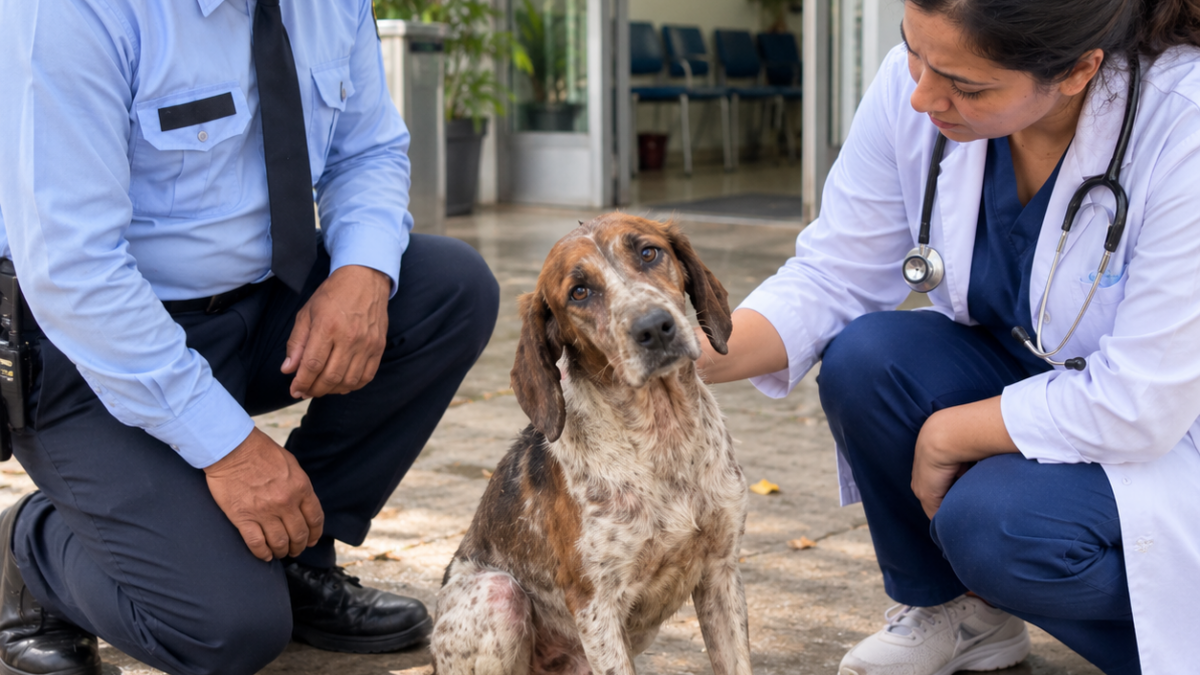
PART 2
The administrator leaned back in his chair.
“Mark, it isn’t about whether we have hearts.”
“I didn’t say it was.”
“You’re making it sound that way.”
“I’m saying there has to be a safe option.”
“There may not be.”
I looked toward Claire.
She had come with me because she knew the patient.
“What’s his condition?” the administrator asked.
Claire answered carefully.
“Improving. He was admitted in serious condition, but he’s stable now.”
“Can he leave the room?”
“Not yet.”
“Then the dog cannot go upstairs.”
I exhaled.
That was fair.
Hospitals cannot become emotional free-for-alls because one security guard feels strongly about a dog.
I knew that.
But the dog didn’t know policies.
He knew only that the person who had apparently been his entire world had vanished.
And somehow, through a journey I still cannot explain, he had ended up at the right building.
I said, “Then when the patient is strong enough, bring him down.”
The administrator looked at me.
“To the lobby?”
“Outside.”
Claire nodded immediately.
“Wheelchair. Main courtyard. No clinical area.”
The administrator rubbed his forehead.
“I need infection control, nursing, his doctor, and probably risk management.”
“Good.”
He looked at me.
“You sound pleased.”
“That means it isn’t impossible.”
“It means I didn’t say yes.”
“You also didn’t say no.”
Claire laughed.
The administrator did not.
But several hours later, he called.
“If the patient’s physician clears him for a short supervised visit outside, and animal control confirms the dog is not showing signs of illness or aggression, we may be able to arrange something.”
I smiled.
“Thank you.”
“Do not thank me yet.”
I already had.
The next problem was the dog.
Animal control came to scan him.
No chip.
They examined him from a distance first.
Then closer.
He was exhausted.
Mildly dehydrated.
His pads were worn.
There were tiny cracks in two of them, consistent with traveling a long distance over rough surfaces.
No obvious aggression.
No sign he wanted anything except the doors.
The officer looked at me.
“Forty-seven miles?”
“That’s where the owner lives.”
“Dogs do strange things.”
“Can they really track someone that far?”
He shrugged.
“Dogs have reached homes across much longer distances. We can explain parts of navigation. Not every individual case.”
“So you’re saying miracle?”
“I’m saying don’t make me professionally endorse a miracle.”
I laughed.
He smiled.
“Call it determination.”
That suited me.
The dog needed a name in our conversations, so I asked Claire what the patient called him.
She checked.
“Buddy.”
I should have guessed.
There are probably a million dogs named Buddy.
That one earned it.
The patient’s name was Walter.
Sixty-six years old.
Widower.
Retired mechanic.
Lived alone in a small house outside town.
Claire told me he had been found after a neighbor noticed his truck hadn’t moved and called for a wellness check.
Walter had collapsed.
An ambulance took him.
The house was secured.
Buddy apparently disappeared before anyone realized he needed to be contained.
Nobody knew whether he escaped through a gate, slipped past responders, or followed the ambulance for part of the route before losing it.
What we knew was that roughly a day later, Buddy had appeared at our hospital.
And stayed.
I wanted to meet Walter.
Claire said I could if he agreed.
He did.
I entered the room near the end of my shift.
Walter looked exactly like someone who had recently had a frightening medical crisis.
Pale.
Thinner than he probably should have been.
Tired.
But alert.
A framed photograph sat on the table beside his bed.
Buddy.
Younger in the photo.
Clean coat.
Bright eyes.
Standing beside Walter on what looked like a fishing dock.
I pointed.
“That him?”
Walter’s face changed.
“Buddy.”
Just one word.
But love was inside it.
“He’s outside.”
Walter stared at me.
“What?”
“Your dog.”
He tried to sit up too quickly.
Claire placed a hand near his shoulder.
“Easy.”
Walter ignored her.
“You found him?”
“He found us.”
“What do you mean?”
I pulled a chair close.
“He’s been sitting outside the hospital.”
Walter’s eyes filled immediately.
“No.”
“Yes.”
“How?”
“I was hoping you could tell me.”
Walter pressed one hand over his mouth.
“He was home.”
“Apparently not for long.”
“How did he get here?”
“We think he walked.”
Walter shook his head.
“No.”
“That’s what his paws look like.”
He turned his face away.
For a moment, none of us spoke.
Then Walter whispered, “Seventy-five kilometers.”
“About that.”
“He hates cars.”
I blinked.
“What?”
“He won’t ride unless I make him.”
Claire smiled.
“Well, apparently he hates being left behind more.”
Walter laughed once.
Then started crying.
Not loudly.
Tears simply moved down his face.
“Is he okay?”
“Tired.”
“Eating?”
“Yes.”
“Drinking?”
“Yes.”
“Did he get hurt?”
“His paws are sore. Otherwise he appears okay.”
Walter looked toward the window even though the entrance was several floors below.
“I thought I’d lost him.”
“You haven’t.”
Walter closed his eyes.
“You don’t understand.”
“Then tell me.”
He opened them.
“My wife, Helen, died four years ago.”
“I’m sorry.”
“I stopped doing much after that.”
His voice became softer.
“People came around for a while. Then life goes back to normal for everybody else.”
I knew that truth.
Grief is crowded at first.
Then eventually quiet.
Walter continued.
“My brother lives two states away. No children. Friends got their own problems.”
He looked at the photograph.
“Buddy was at the county shelter.”
“How long after your wife died?”
“Maybe six months.”
“Why did you get him?”
“I didn’t.”
I waited.
“Helen did.”
I frowned.
“She was already gone?”
Walter nodded.
“Before she died, she kept telling me I’d turn into a hermit.”
A tiny smile appeared.
“She knew me.”
He looked at the photograph again.
“She left a note with my sister-in-law. Said if I went six months without getting myself a dog, my sister-in-law was supposed to drag me to the shelter.”
I laughed softly.
“Did she?”
“She did.”
“And Buddy?”
“He was sitting at the back.”
Walter smiled.
“Everybody else barking. Jumping. Buddy just watched.”
“How old?”
“About two.”
“Why him?”
Walter thought.
“Same reason he chose me, I guess.”
“What reason?”
“He looked lonely.”
That line stayed with me.
Two lonely creatures.
One widower.
One shelter dog.
Somehow they had built a life.
Fishing.
Morning coffee.
Walks.
A yard.
A bed near Walter’s chair.
According to Walter, Buddy slept beside his bedroom door every night.
If Walter stayed up late, Buddy stayed awake.
If Walter drove to the lake, Buddy came along despite supposedly hating cars.
If Walter got sick, Buddy refused to leave the bed.
Then one night Walter disappeared in an ambulance.
From Buddy’s point of view, the only human who had ever truly belonged to him vanished.
So he went looking.
“How did he know where to come?” Walter asked.
“I don’t know.”
“Did he follow the ambulance?”
“Maybe partway.”
“He couldn’t follow seventy-five kilometers.”
“I know.”
Walter stared at me.
Then smiled through tears.
“Stubborn bastard.”
I laughed.
“That I can confirm.”
Walter wanted to see him immediately.
His doctor said no.
Walter became furious.
“I’m sitting up.”
“You’re also recovering,” Claire told him.
“I can get in a wheelchair.”
“Not safely today.”
“Tomorrow.”
“We’ll assess tomorrow.”
“You keep telling that dog tomorrow?”
I looked at Walter.
“I tell him every morning you’re still here.”
Walter’s face softened.
“You talk to him?”
“Somebody has to.”
He wiped his eyes.
“What does he do?”
“Stares at the doors.”
Walter looked away again.
That evening, I sat beside Buddy outside.
Rain had stopped.
His coat was damp around the edges.
I had bought him a cheap padded mat.
He ignored it for several hours.
Eventually he lay on it.
Progress.
I scratched behind his ear.
“He knows you’re here.”
Buddy opened his eyes.
“Walter knows.”
Tail thump.
“Doctor says not today.”
Buddy looked at the doors.
“Yeah. I gave him the same look.”
The next morning, Buddy was still there.
Of course.
But something changed.
He had begun recognizing hospital staff.
Claire could approach.
So could I.
One of the cafeteria workers brought plain cooked chicken with approval from animal control.
Buddy became her immediate friend.
A maintenance worker found a larger water dish.
A pediatric nurse donated a blanket from her car.
Nobody officially decided Buddy belonged to the hospital entrance.
It simply happened.
People started asking at the security desk.
“How’s the dog?”
“Still waiting.”
“How’s his owner?”
“Improving.”
A patient’s daughter brought him a toy.
Buddy ignored it.
A child leaving outpatient care placed a biscuit in front of him.
Buddy ate that.
The child smiled.
“My dog likes those.”
Buddy wagged.
The mother cried.
Hospitals make people emotionally vulnerable.
Apparently dogs outside them do too.
The biggest argument happened on day five.
A deputy administrator saw a small crowd around Buddy.
“This cannot become an attraction.”
He was right about one thing.
People were stopping.
Taking photographs.
Some tried to approach too quickly.
Buddy tolerated it but looked uncomfortable.
I started moving people along.
The deputy administrator said, “Maybe animal control should take him into temporary care.”
“No.”
He looked at me.
“No?”
“If he leaves, Walter could come down tomorrow and Buddy won’t be here.”
“He can be brought back.”
“You don’t know that.”
“We cannot have an unsupervised dog living at the entrance.”
“He’s not unsupervised.”
“Mark, you have a job.”
“I’m aware.”
He crossed his arms.
“This is a hospital, not a kennel.”
Something in me tightened.
Before I could answer, Claire did.
“He walked seventy-five kilometers to reach one patient. I think we can manage a water bowl for another twenty-four hours.”
The administrator stared.
Claire had been there twenty years.
She had the terrifying calm of someone who no longer worried about impressing management.
The deputy administrator sighed.
“If risk management complains, I’m giving them your number.”
Claire smiled.
“They already have it.”
Buddy stayed.
That afternoon, Walter’s physician cleared him for a short wheelchair visit the following morning if his vital signs remained stable.
I went to tell Buddy.
“Tomorrow.”
He looked at me.
“I mean it this time.”
Tail thump.
I barely slept that night.
Which was ridiculous.
I had seen larger moments at the hospital.
Babies born after emergencies.
Families reunited after accidents.
People walking out after months of rehabilitation.
Why was I nervous about one old man and one dog?
Maybe because anticipation had built for days.
Maybe because Buddy’s faith made all of us afraid reality would somehow disappoint him.
What if Walter looked too different?
Hospital gown.
Wheelchair.
Weight loss.
Medical equipment.
Would Buddy recognize him?
What if the excitement was too much for Walter?
What if Buddy jumped?
What if he became frightened?
We planned everything.
Nurse present.
Physician aware.
Outdoor courtyard rather than interior corridor.
Leash on Buddy.
Wheelchair brakes.
Short visit.
No crowd if possible.
The “no crowd” part failed immediately.
People knew.
Nurses appeared near windows.
Reception staff found reasons to stand by the entrance.
Maintenance slowed down.
Even the deputy administrator happened to be walking through the lobby at exactly the right time.
I saw him.
He saw me.
Neither mentioned it.
Buddy sat in his usual spot.
I arrived early.
“Today.”
His ears lifted.
I sat beside him.
For maybe twenty minutes, nothing happened.
Then Claire appeared behind the glass.
She looked at me.
Nodded.
My chest tightened.
The automatic doors opened.
A nurse came out first.
Buddy stood.
Then the wheelchair crossed the threshold.
Walter.
For one second, Buddy did nothing.
Absolute stillness.
His body went rigid.
Walter saw him.
His hands rose to his mouth.
“Buddy.”
I don’t know whether the dog heard the name.
Maybe he heard the voice.
Maybe scent reached him.
Maybe recognition does not need explaining.
Buddy’s entire body transformed.
His tail began moving.
Slow once.
Then violently.
He took one step.
Stopped.
Walter leaned forward.
“Buddy!”
That was enough.
The dog ran.
Not the tired shuffle we had watched all week.
Ran.
I held the leash loosely enough that he could reach the wheelchair safely.
Buddy made a sound I had never heard from him.
Half whine.
Half cry.
Something raw.
He reached Walter.
Rose carefully onto his front legs.
Then seemed to remember the wheelchair and dropped back down.
Walter bent as far as he safely could.
Buddy placed his head directly into Walter’s hands.
Walter broke.
There is no more elegant way to say it.
The man sobbed.
His shoulders shook.
His hands buried themselves in Buddy’s dusty coat.
“You came.”
Buddy licked his wrist.
“You came all this way.”
More licking.
“You stupid dog.”
Buddy whined.
Walter laughed and cried at the same time.
“I’m sorry.”
That changed the air.
Buddy licked his face.
Walter kept saying it.
“I’m sorry.”
“I’m sorry.”
“I’m sorry I left.”
Of course Walter had not chosen to leave.
But grief does not always care about logic.
He had vanished from Buddy’s world.
Now he was apologizing as though he had broken a promise.
Buddy seemed uninterested in the apology.
He had what he wanted.
Walter.
That was all.
People around us cried.
Claire openly.
One nurse tried to hide it and failed.
The cafeteria worker stood behind a pillar with both hands over her mouth.
Even the deputy administrator wiped his eyes and then immediately pretended to check his phone.
I looked away.
Some moments become cheap if you stare too hard.
I gave them space.
Buddy pushed his head under Walter’s hand.
Walter stroked him.
Again.
Again.
Again.
The visit was supposed to last ten minutes.
It lasted fifteen.
Then the nurse gently said, “Walter, we need to get you back upstairs.”
Walter’s grip tightened around Buddy’s collar.
“No.”
Claire crouched.
“Just for now.”
Walter looked at me.
“You’re leaving him here?”
“I’ll stay with him.”
“You promise?”
“Yes.”
Buddy heard the wheelchair moving.
He tried to follow.
I held the leash.
“Buddy.”
He pulled.
Walter twisted around.
“Stay!”
Buddy froze.
One word.
His person’s word.
He sat.
The wheelchair rolled inside.
Buddy watched until the elevator corridor swallowed Walter from view.
Then he looked at me.
I expected desperation.
Instead, he lay down.
Right there.
Head on his paws.
I crouched.
“You believe me now?”
Buddy closed his eyes.
He slept for almost three hours.
Deeply.
For the first time since arriving.
That might have been the most moving part.
Not the reunion.
The sleep afterward.
For days, Buddy had maintained a vigil because he did not know whether Walter was alive.
Now he knew.
His body finally allowed itself to stop.
The next few days changed Walter too.
Claire told me he ate better.
Participated more in physical therapy.
Complained more.
Apparently that was a good sign.
“He wants to get discharged because of Buddy.”
“Motivation.”
“He asked the doctor if stubbornness speeds recovery.”
“What did the doctor say?”
“Not clinically.”
I laughed.
Walter was brought down one more time before discharge.
Buddy’s reaction was enthusiastic but less desperate.
He greeted him like a dog expecting another tomorrow.
That difference mattered.
Expectation.
The first reunion had been relief from uncertainty.
The second was trust.
You will come back.
Walter was discharged four days later.
By then, Buddy had become unofficially famous inside the hospital.
I tried keeping the departure quiet.
Impossible.
Staff gathered near the entrance.
A nurse wheeled Walter out while another carried his belongings.
Buddy stood.
Tail moving.
Walter wore normal clothes.
Still pale.
Still weak.
But smiling.
“Ready?”
Walter looked at Buddy.
“More than ready.”
Buddy walked beside the wheelchair toward the parking area.
A neighbor had come to drive them home.
When they reached the vehicle, Buddy hesitated.
Walter laughed.
“Told you. Hates cars.”
I opened the back door.
Buddy looked at Walter.
Walter tapped the seat.
“Get in.”
Buddy climbed.
No argument.
I leaned against the door.
Walter looked at me.
“I don’t know how to thank you.”
“You don’t.”
“I mean it.”
“So do I.”
He looked toward Buddy.
“If you’d called animal control and sent him away…”
“I almost did.”
“But you didn’t.”
I shrugged.
“He was better at waiting than I was at getting rid of him.”
Walter smiled.
Then became serious.
“He’s the only family I’ve got.”
I looked at him.
“Maybe fix that.”
Walter frowned.
“What?”
“You’ve got people.”
“No.”
“You have a neighbor who came to pick you up.”
Walter looked toward the driver.
“You have nurses who know too much about your life.”
He smiled.
“You have at least one security guard who has cleaned up after your dog twice.”
Walter laughed.
“And apparently half the hospital cried over you.”
He shook his head.
“I’m not good at people.”
“Buddy wasn’t good at hospitals.”
Walter looked at me.
“Fair.”
I closed the door.
Buddy placed his head over the seat toward Walter.
Walter rested one hand on him.
The car left.
I expected the story to end there.
It didn’t.
Two weeks later, Walter returned.
Not as a patient.
He walked through the entrance carrying a leash.
Buddy beside him.
The entire reception desk lit up.
Claire happened to be nearby.
“Look who survived us.”
Walter smiled.
Buddy pulled toward her.
She crouched.
He licked her hand.
Walter found me at the security desk.
“Brought you something.”
He handed me a paper bag.
Inside was coffee.
And a small box.
I opened it.
A metal tag.
Not a dog tag.
A cheap engraved keychain.
It said:
HE WAITED. YOU LISTENED.
I stared at it.
Walter shrugged.
“Too sentimental?”
“Yes.”
“I can take it back.”
I closed my hand around it.
“No.”
He smiled.
We sat outside for twenty minutes.
Walter told me about Buddy’s journey as best he could reconstruct it.
A neighbor had seen the dog leave the property the morning after Walter was hospitalized.
Someone at a roadside diner later remembered a dusty hunting dog drinking from a puddle.
Another person thought they saw him near the old county road.
No one could prove his exact route.
Seventy-five kilometers remained an estimate between Walter’s home and the hospital.
Buddy could have traveled more.
Less if he found shortcuts.
We would never know.
“Why here?” I asked.
Walter looked at Buddy.
“Maybe he followed the ambulance at first.”
“Could he smell you?”
“For seventy-five kilometers?”
“Probably not directly.”
Walter smiled.
“Then maybe he’s smarter than us.”
Buddy yawned.
That seemed possible.
Walter began visiting occasionally.
Not often.
Enough that Buddy became familiar to staff even when nobody was sick.
That led to something unexpected.
Hospital administration developed a clearer procedure for special animal visits when medically appropriate.
Not a free-for-all.
Not “bring your pets to ICU.”
A structured exception process.
Physician approval.
Infection-control review.
Outdoor or designated areas when possible.
Vaccination and behavior requirements.
The administrator called me into his office months later.
“This is partly your fault.”
“What?”
He handed me the draft policy.
I read it.
“You made a pet-visitation protocol?”
“For exceptional cases.”
I looked at him.
“You said the hospital wasn’t a place for dogs.”
“It isn’t.”
I pointed at the document.
“This seems dog-adjacent.”
He sighed.
“One case revealed a gap.”
I smiled.
“Buddy won.”
“Do not tell anybody I said that.”
“You didn’t.”
He pointed at me.
“Exactly.”
The first patient to use the protocol after Walter was a woman in rehabilitation following a long hospitalization.
Her daughter brought her elderly Labrador to a designated courtyard.
I happened to be working.
The dog walked slowly toward the woman’s wheelchair.
She cried.
The daughter cried.
I thought about Buddy.
One animal had waited outside long enough to make an institution reconsider a small piece of itself.
That felt like a satisfying kind of revenge against the rules that had initially said no.
Not breaking rules.
Improving them.
Walter’s health continued improving.
Then life did what life always does.
It complicated things.
About eight months after the hospitalization, Walter showed up alone.
I noticed immediately.
“Where’s Buddy?”
“At the vet.”
My stomach tightened.
“What happened?”
“Nothing dramatic.”
He sat near the desk.
“Arthritis.”
“How old is he?”
“About eleven now.”
I had assumed younger because of the strength it took to reach the hospital.
Walter smiled.
“He’s stubborn, not young.”
“Is he okay?”
“Medication. Weight management. Shorter walks.”
He looked down.
“Doctor says he’s getting old.”
I understood what he was really saying.
Walter had already lost his wife.
Buddy had become the life raft afterward.
Now time was threatening that too.
“You knew dogs age.”
“I know.”
“Knowing is useless.”
Walter looked at me.
“Exactly.”
Buddy recovered from the arthritis flare.
A few weeks later, he returned.
Moving slower.
Still tail wagging.
He touched his nose against my hand.
“You’re getting expensive.”
Walter said, “Tell me about it.”
Buddy sat beside him.
I noticed something different in Walter.
He no longer looked like a man whose entire social world ended at the leash.
Claire came down on her break.
A maintenance worker waved.
Two volunteers knew his name.
Walter had joined a cardiac rehabilitation group.
One of the men from that group sometimes drove him.
His neighbor checked in regularly.
Slowly, without anyone announcing it, Buddy’s journey had pulled Walter outward too.
That mattered.
The dog had crossed distance to find his person.
Then somehow made his person less alone after they returned home.
One afternoon, Walter admitted something.
“I almost moved after Helen died.”
“Where?”
“Nowhere specific. Just away.”
“Why?”
“Every room had her in it.”
“But you stayed.”
“Buddy.”
He scratched the dog’s ears.
“The shelter counselor told me routine would be good for him.”
Walter laughed.
“Truth was routine was good for me.”
Morning walk.
Breakfast.
Vet appointments.
Evening walk.
Someone waiting at the door.
“I thought I rescued him because Helen made me go.”
He looked at Buddy.
“Turns out she knew exactly what she was doing.”
I smiled.
“Sounds like your wife.”
“You never met her.”
“I’ve heard enough.”
Walter laughed.
Two years passed.
Buddy slowed more.
His hospital journey became local legend among staff.
New employees thought parts were exaggerated.
“Forty-seven miles?”
“Approximately.”
“Did anyone track him?”
“No.”
“So how do we know?”
“We know where Walter lived and where Buddy appeared.”
“But not exact path?”
“No.”
I became careful telling the story.
I did not want love to turn into mythology.
The facts were powerful enough.
Walter was hospitalized.
Buddy disappeared from home.
A dog matching him appeared outside the hospital after traveling from the area where Walter lived.
His paws showed signs consistent with long travel.
He waited.
Walter identified him.
They reunited.
That was enough.
You do not need to make truth bigger to make it meaningful.
Buddy became a certified therapy dog later.
That surprised everyone.
Especially me.
He had always been calm.
Gentle.
Focused on people.
Walter worked with a trainer.
They completed evaluations.
Health checks.
Behavior assessment.
Eventually, Buddy returned to the hospital wearing a therapy-dog vest.
I laughed when I saw him.
“You found a loophole.”
Walter grinned.
“He can come inside now.”
Buddy walked through the same automatic doors he had once stared at from the sidewalk.
I followed.
For the first time.
He did not rush.
Did not search.
He walked beside Walter.
They visited rehabilitation patients.
Waiting areas.
Staff rooms.
Buddy seemed especially drawn to people sitting alone.
He would approach quietly.
Stop.
Wait.
If they reached out, he moved closer.
If not, he stayed at a respectful distance.
One day, I watched him sit beside an older man whose wife was in surgery.
The man had been staring at the floor for twenty minutes.
Buddy stopped beside him.
The man looked down.
Touched his head.
Then started crying.
Walter sat nearby.
No speech.
No advice.
Buddy just stayed.
Later I said, “He’s good at this.”
Walter nodded.
“He knows waiting.”
That line almost broke me.
Buddy knew waiting.
Waiting outside a shelter once.
Waiting beside a widower.
Waiting outside a hospital.
Waiting beside strangers in pain.
Maybe dogs do not turn trauma into philosophy the way people do.
But their behavior can still teach us.
Walter and Buddy became regular volunteers.
Not weekly forever.
Enough.
The hospital that had originally hesitated to let one dog meet one patient now had staff who knew Buddy by name.
The deputy administrator who had wanted him removed once kept treats in his desk.
I caught him.
“You have dog treats?”
He looked defensive.
“For therapy animals.”
“Of course.”
“Official use.”
“Absolutely.”
Buddy sat.
The administrator gave him one.
I folded my arms.
“This is embarrassing for you.”
“Leave.”
I laughed.
That was my revenge.
Not against a villain.
Against every rigid assumption that compassion and procedure could not coexist.
Buddy had forced us to find a better middle.
Walter changed too.
He became more talkative.
Started bringing coffee for volunteers.
Sometimes stayed after therapy visits talking with families.
Claire said, “That dog socialized him.”
I said, “Helen socialized him from beyond the grave.”
Walter heard.
“You two enjoy yourselves.”
“Yes.”
He smiled anyway.
Then came the winter when Buddy began struggling.
He was around thirteen.
Maybe older.
Shelter records had never been exact.
His hips hurt.
Medication helped less.
His hearing declined.
Walter stopped therapy visits.
He called me.
“Didn’t want you wondering.”
“How is he?”
“Still eating.”
“That sounds like Buddy.”
“Sleeping more.”
“Pain?”
“Managed.”
Silence.
I asked, “How are you?”
Walter exhaled.
“Not managed.”
I understood.
“You want me to come over?”
The old Walter would have said no.
This Walter said, “Yeah.”
That may have been Buddy’s greatest work.
Not the miles.
Not the waiting.
Teaching Walter to say yes when someone offered to stay.
I drove to their house.
First time I had been there.
Small place.
Quiet road.
A porch.
Two chairs.
Photographs inside.
Helen.
Walter younger.
Buddy at the lake.
A framed picture from the hospital reunion someone had printed for them.
Buddy lay on a thick bed near the fireplace.
He lifted his head when I entered.
Tail moved.
Slow.
I sat beside him.
“Hey, traveler.”
He sniffed my hand.
Walter brought coffee.
We sat.
For an hour, we talked about everything except death.
Eventually Walter said, “I don’t know how to do this.”
“You’ve done it before.”
“With Helen.”
“Yes.”
“That nearly killed me.”
“I know.”
“Buddy was why it didn’t.”
I looked at the old dog.
Walter’s voice shook.
“What do I do when the reason I survived Helen is gone?”
There was no good answer.
I refused to give him a cheap one.
“You let the people he brought into your life help.”
Walter looked at me.
“That’s not the same.”
“No.”
I nodded toward Buddy.
“He didn’t replace Helen.”
Walter looked down.
“No.”
“Nothing replaces anybody.”
I leaned back.
“But you survived without replacing her.”
Walter rubbed his face.
“You’ve gotten annoyingly wise.”
“I work hospital security. We absorb wisdom through fluorescent lighting.”
He laughed.
Buddy’s eyes closed.
We sat in silence.
Several months passed.
Good weeks.
Bad days.
Medication changes.
Walter sent updates.
Buddy eating chicken.
Buddy refusing regular food.
Buddy sleeping in the sun.
Buddy walking half a block.
Then a quarter.
Then only the yard.
Eventually Walter called early one morning.
“He won’t eat.”
My stomach tightened.
“Anything?”
“Not even chicken.”
“I’m coming.”
When I arrived, Claire was already there.
So was Walter’s neighbor.
That was important.
Years earlier, Walter might have faced that morning alone.
Now he could not.
Buddy lay on his bed.
His breathing was calm but tired.
The veterinarian had already examined him.
Advanced age.
Organ decline.
Pain becoming difficult to control.
The conversation nobody wants.
Walter sat beside Buddy.
One hand on his back.
“I kept telling him to stay.”
His voice cracked.
Claire crouched beside him.
“You can stop.”
Walter looked at her.
“Stop what?”
“Asking him to stay for you.”
Walter broke.
He lowered his forehead against Buddy’s head.
“I’m sorry.”
Buddy’s tail moved once.
I looked away.
That gesture had once meant hope outside the hospital.
Now it meant something quieter.
I’m here.
Walter chose an at-home goodbye.
The veterinarian returned that afternoon.
The room was full but not crowded.
Walter.
Claire.
The neighbor.
Me.
Buddy on his bed.
A photograph of Helen nearby.
Walter had placed it there without explanation.
No one asked.
Buddy ate one final piece of roast beef.
Of course.
Walter laughed through tears.
“Too good for chicken now?”
Buddy swallowed.
Then rested.
Walter held his face.
“You walked all that way.”
His hands shook.
“You crazy, beautiful dog.”
Buddy’s eyes stayed on him.
“I wasn’t worth seventy-five kilometers.”
I spoke before I could stop myself.
“Apparently he disagreed.”
Walter laughed and cried at the same time.
“You always have to say something.”
“Occupational hazard.”
Then I became quiet.
This was theirs.
Walter whispered to Buddy.
“You saved me after Helen.”
His voice almost disappeared.
“You saved me twice.”
Buddy breathed.
Walter stroked him.
“You don’t have to do it again.”
The first medication made Buddy sleepy.
His muscles relaxed.
Walter kept one hand beneath his head.
“You found me.”
Another breath.
“And I found you.”
Buddy’s eyes closed.
Walter kissed him between the ears.
“I’m staying.”
That line destroyed me.
Because Buddy’s whole story had been about staying.
Outside doors.
Across distance.
Through loss.
Through aging.
Now Walter was returning it.
“I’m staying until the end.”
He did.
Buddy died with Walter holding him.
No hospital doors between them.
No forty-seven miles.
No uncertainty.
Just home.
Afterward, Walter did not move for a long time.
Nobody rushed him.
Finally, he whispered, “He waited for me.”
I nodded.
“Now you waited for him.”
Walter looked toward me.
His face was wet.
“That supposed to make it better?”
“No.”
“Good.”
We sat.
Grief does not need to be improved immediately.
Sometimes it simply needs witnesses.
The funeral home did not take dogs, obviously.
Buddy was cremated through the veterinary service.
Walter kept the ashes.
Weeks later, he brought part of them to the lake.
He invited me.
Claire came.
His neighbor.
A man from cardiac rehab.
Several hospital staff.
More people than Walter would have believed he had years earlier.
We stood near the dock from the photograph.
Walter held the small container.
“Helen liked this place too.”
He scattered some ashes near the trees where Buddy used to sleep while Walter fished.
The rest he kept.
“No speech?” I asked.
Walter looked at me.
“You do enough talking.”
Everyone laughed.
Then Walter said something anyway.
“He spent his whole life making sure I wasn’t alone.”
He looked around.
“Guess he did a pretty good job.”
That was all.
Enough.
Walter continued volunteering at the hospital.
Without Buddy, at first.
That was difficult.
People asked.
He had to tell the story repeatedly.
Then a therapy-dog handler named Maria invited him to accompany her on visits.
Walter said no.
The old reflex.
A week later, he changed his mind.
He began helping coordinate patient visits rather than handling a dog himself.
He was good at talking to lonely people.
Maybe because he knew the territory.
One afternoon, I found him sitting beside an older patient in the courtyard.
No dog.
Just Walter.
The patient’s wife had died months earlier.
They were talking about fishing.
I walked past.
Walter saw me.
I did not interrupt.
Later I said, “You’re the therapy animal now.”
He stared at me.
“I regret ever meeting you.”
I laughed.
But he smiled.
The hospital eventually added Buddy’s story to volunteer orientation.
Carefully.
Not as a legend about magical navigation.
As a story about attachment, patient-centered care, and finding safe flexibility when rules allow it.
The photograph used was not Buddy waiting in the rain.
It was Buddy walking beside Walter in his therapy vest.
I liked that.
The waiting mattered.
What came after mattered more.
Years passed.
Claire retired.
The deputy administrator became a senior administrator.
He still denied having kept dog treats.
I still had photographic evidence.
Walter aged.
So did I.
The hospital renovated the main entrance.
For several weeks, construction barriers covered the exact spot where Buddy had waited.
When they finished, the benches were new.
The awning larger.
Everything looked different.
I stood outside on opening morning.
Walter joined me.
“That where he sat?”
“About there.”
We looked.
Nothing marked the spot.
Walter said, “Good.”
I glanced at him.
“Good?”
“I don’t want him remembered only for waiting.”
I understood.
“What do you want?”
Walter thought.
“For going home.”
That answer stayed with me.
People romanticize waiting.
Loyalty.
Sacrifice.
Distance.
But the goal of waiting is not to wait forever.
The goal is reunion.
Home.
Buddy did not walk seventy-five kilometers because suffering was noble.
He walked because someone he loved was missing.
And when he found Walter, he did not want a monument.
He wanted his person back.
That was all.
Walter died years later.
Not dramatically.
A different hospitalization.
A different season.
He was older.
His health had declined.
This time he was not alone.
His neighbor came.
Claire came despite being retired.
His rehab friend visited.
I sat with him once.
He looked toward the hospital entrance.
“Funny.”
“What?”
“First time I was here, Buddy was outside.”
I nodded.
“Now?”
He smiled faintly.
“I know he isn’t.”
I knew what he meant.
Walter had changed.
He no longer needed to imagine loyalty as something physically waiting beyond a door.
He had internalized it.
Carried it.
I asked, “Still have his ashes?”
“On the shelf beside Helen.”
“Good company.”
“The best.”
Walter died several days later with people around him.
Not Buddy.
Not Helen.
But people.
Real people who had become family because one dog once refused to leave the entrance.
After the service, his sister-in-law gave me a small envelope.
Inside was the keychain.
HE WAITED. YOU LISTENED.
I stared at it.
“He wanted you to have it back,” she said.
“I never gave it to him.”
“He borrowed it.”
I laughed.
“Sounds like Walter.”
She smiled.
“There’s a note.”
I opened it.
Walter’s handwriting was shaky.
Mark—
You were wrong about one thing.
Buddy didn’t just find me.
He found all of you.
Thanks for not sending him away.
—W
I stood in the parking lot for a long time.
I still carry that keychain.
Not every day.
But often.
The engraving has worn down.
The edges are scratched.
The words remain readable.
HE WAITED. YOU LISTENED.
I used to think listening meant hearing words.
Working security in a hospital teaches otherwise.
People communicate through silence.
Body language.
Where they sit.
Who they watch for.
Who they call.
Who they refuse to call.
Buddy taught me the same lesson without speaking once.
He sat.
He stayed.
He looked at the doors.
Everything important was already there.
We just had to notice.
People still ask whether I truly believe Buddy walked the full seventy-five kilometers.
I tell them exactly what I know.
Walter lived about seventy-five kilometers from the hospital.
Buddy disappeared from home after Walter’s emergency transport.
He arrived exhausted, with road-worn paws, and refused to leave the hospital entrance.
We could never reconstruct every kilometer.
Maybe he followed roads.
Maybe he cut across land.
Maybe someone unknowingly gave him a ride for part of the distance.
Maybe he followed the ambulance farther than anyone saw.
I do not know.
The mystery is not the point.
The point is that he went looking.
And he succeeded.
I no longer need the distance to be mathematically perfect for the love to be real.
That dog knew one human being as home.
That human disappeared.
Buddy acted.
Then waited.
For days.
Until the doors opened and home rolled toward him in a wheelchair.
I have seen thousands of people come through those doors since.
Some return home.
Some do not.
Some arrive surrounded by family.
Some arrive with nobody.
I notice the lonely ones more now.
Buddy did that to me.
If an old man sits alone too long, I ask whether someone has been called.
If a frightened spouse looks lost, I walk them where they need to go instead of pointing.
If a family argues because they are exhausted, I try to remember fear often sounds like anger.
Tiny things.
Nothing heroic.
Listening.
That was Buddy’s legacy in me.
The hospital changed too.
The animal-visitation process remained.
Over the years, dogs came to say goodbye.
Dogs came to encourage rehabilitation.
A cat once came in a carrier to visit a long-term patient in a controlled area.
I joked that Buddy would have objected to the cat.
Walter would have laughed.
The policy never became reckless.
Rules remained.
Sanitation.
Medical approval.
Risk assessment.
That mattered.
Compassion works better when it survives procedure.
Buddy taught us not to abolish the door.
Just to know when it could be opened.
One afternoon, many years later, a young security officer called me over.
“There’s a dog outside.”
My heart stopped for half a second.
Not Buddy.
Of course not.
A little terrier with a collar had wandered near the entrance.
The tag had a phone number.
Easy resolution.
We called.
The owner arrived twenty minutes later, frantic.
The terrier exploded with joy.
The young officer laughed.
“Dogs are something else.”
I looked at the doors.
“Yeah.”
He asked, “What?”
“Nothing.”
I watched the owner kneel.
Dog jumping.
Tail moving.
Ordinary reunion.
Beautiful.
I thought about Buddy.
I thought about Walter.
And for once, memory did not hurt.
It felt complete.
There had never been a villain in their story.
No person to punish.
No courtroom revenge.
Their enemy was separation.
Distance.
Rules that did not know what to do with love arriving on four exhausted paws.
Time.
Eventually death.
None of those enemies were defeated forever.
But they were defeated long enough.
Long enough for Buddy to see Walter again.
Long enough for Walter to recover.
Long enough for them to go home.
Long enough for Buddy to become a therapy dog.
Long enough for Walter to become part of a community.
Long enough for both of them to stop being alone.
That was enough.
If you want to call it revenge, then this was theirs:
Distance said they should stay separated.
Buddy walked anyway.
The hospital doors said animals stayed outside.
Compassion found a safe way through.
Grief told Walter that Helen’s death had ended the important part of his life.
Buddy proved there was another chapter.
Old age eventually told Buddy his body could not continue.
Walter stayed beside him to the end.
Loneliness tried to reclaim Walter afterward.
But by then Buddy had filled his life with people.
Every force that tried to isolate them lost ground.
Not forever.
Nothing wins forever.
But enough.
I still work some shifts near the main entrance even though my role has changed over the years.
Sometimes early in the morning, before the traffic starts, I stand where Buddy used to sit.
The doors open.
Close.
Open.
Close.
Nobody else notices the spot.
There is no plaque.
No photograph.
No sign saying a dog once waited there through rain and heat because the only person he loved was somewhere inside.
I prefer it that way now.
The story does not belong to concrete.
It belongs to what happened after.
A wheelchair crossed the threshold.
A tired dog stood.
Recognition happened.
And for one moment, every rule, mile, illness, lonely year, and terrible night that had separated those two became smaller than the distance between Walter’s hands and Buddy’s head.
That distance closed.
That is the image I keep.
Not Buddy alone.
Buddy arriving.
Walter crying.
Buddy’s head in his hands.
The tail that would not stop moving.
A man whispering, “You really came.”
Yes.
He did.
And then, years later, when Buddy could no longer stay, Walter returned the favor.
He stayed.
That was their whole story.
One found.
One waited.
Then both learned how to remain.
And after everything I have seen in eleven years of hospital work, that is still one of the clearest definitions of family I know.
Not blood.
Not paperwork.
Not who is easy to love when everything is going well.
Family is who keeps looking when you disappear.
Who waits when the doors stay closed.
Who recognizes you even when sickness has changed your face.
Who stays when staying becomes inconvenient.
And sometimes, if you are very lucky, family is a dusty dog who walks farther than anyone can explain simply because somewhere ahead of him is the only person who ever made the world feel like home.
Years after Buddy was gone, I still found myself looking toward those hospital doors whenever they opened.
It had become instinct.
A patient would leave in a wheelchair.
A family would walk in carrying flowers.
A child would press both hands against the glass while waiting for someone inside.
And for one second, before my mind caught up, I would expect to see a brown-and-white hunting dog sitting outside.
Waiting.
Watching.
Believing.
Of course, the space was always empty.
Buddy had been gone a long time.
Walter too.
But some absences do not disappear.
They simply become part of the architecture.
The hospital had changed.
The entrance had been renovated twice.
The security desk was larger.
The old vending machines were gone.
New automatic doors replaced the ones Buddy had stared through.
Many of the nurses who had watched that reunion had retired.
Younger employees knew the story only because someone else had told it to them.
Sometimes they got details wrong.
“He walked a hundred miles, right?”
“About forty-seven.”
“I heard he lived outside for a month.”
“Days.”
“Didn’t he break into the hospital?”
“No.”
“Was Walter dying?”
“He was recovering.”
I corrected the story whenever I could.
Not because the exaggerations bothered me personally.
Because Buddy did not need them.
The truth was already enough.
A dog lost the only person he had.
He left home.
He traveled farther than any of us understood.
He found the right hospital.
Then he sat outside and waited until the human world finally figured out how to reunite him with the person he loved.
You don’t improve that by making it bigger.
You cheapen it.
The ordinary truth was extraordinary enough.
One morning, a new security officer named Daniel found me in the break room.
He was young.
Maybe twenty-five.
Still wore his uniform too neatly.
“Can I ask you something?”
“Sure.”
“Is the Buddy story actually true?”
I looked at him.
“Depends which version you heard.”
“The dog who waited outside for an old man.”
“Yes.”
“And you were here?”
“Yes.”
Daniel hesitated.
“My mom told me that story when I was a kid.”
I stared.
“What?”
“She saw it online somewhere.”
I laughed.
“You were a kid?”
“Not little. Maybe middle school.”
“That is an extremely rude way to tell me I’m old.”
He smiled.
“Sorry.”
“No, you’re not.”
He sat across from me.
“What was he really like?”
Nobody had asked me that in a long time.
Not what happened.
Not how far he traveled.
What was he like?
I thought about it.
“Quiet.”
Daniel seemed surprised.
“That’s it?”
“Mostly.”
“He sounds dramatic in the story.”
“He wasn’t.”
I leaned back.
“He didn’t bark constantly. Didn’t jump on everybody. Didn’t perform.”
“Then how did you know he wanted Walter?”
“That was the point. We didn’t at first.”
I told Daniel about Buddy’s eyes.
About how he watched the doors.
How he stood every time they opened.
How he ate but always returned to the same spot.
How he tolerated rain because leaving mattered less to him than missing the person who might come through those doors.
Daniel listened.
Then he said, “My dog would forget me for a cheeseburger.”
I laughed.
“Probably not.”
“He definitely would.”
“You’d be surprised what animals remember.”
Daniel looked toward the hallway.
“My dad’s sick.”
The sentence changed everything.
“How sick?”
“Cancer.”
I waited.
He looked at the table.
“He’s doing treatment. We’re not… I mean, we don’t know.”
“I’m sorry.”
Daniel nodded.
“He has a dog.”
Of course.
A black Lab named Moose.
His father had adopted him six years earlier.
Daniel showed me a photograph.
Big dog.
Gray beginning around the muzzle.
Standing beside an older man on a dock.
The similarity hit me hard enough that I had to look twice.
“Your father fishes?”
“All the time.”
I handed the phone back.
“Buddy’s owner did too.”
Daniel smiled.
“I know. That’s why Mom remembered the story.”
For several weeks, Daniel and I spoke occasionally about his father.
Nothing dramatic.
Treatment days.
Good appetite.
Bad nausea.
Another scan.
Moose sleeping beside the recliner whenever Daniel’s father came home exhausted.
Then one afternoon Daniel arrived for work looking pale.
“What happened?”
“Dad got admitted last night.”
I straightened.
“How bad?”
“Complications from treatment.”
“Is he stable?”
“For now.”
“And Moose?”
“With my mom.”
He paused.
“He won’t eat.”
There it was again.
The old pattern.
A dog whose world had changed overnight.
Daniel rubbed both hands across his face.
“Mom says he keeps sleeping by the front door.”
I could hear Walter’s voice in my head.
Buddy was home.
Then he wasn’t.
I said, “Bring something home that smells like your father.”
Daniel looked at me.
“What?”
“A shirt. Blanket. Something he has had with him.”
“You think that helps?”
“I think familiar scent can sometimes help an anxious dog. It won’t explain anything to him, but it may comfort him.”
Daniel nodded.
Then I added, “And don’t turn this into another Buddy story.”
He smiled faintly.
“What does that mean?”
“Moose does not need to walk forty-seven miles to prove anything.”
That mattered.
Buddy’s journey had become beautiful in memory because it ended safely.
It had also been dangerous.
Cars.
Heat.
Dehydration.
Exhaustion.
Luck had carried part of that story whether people wanted to admit it or not.
Loyalty should never require an animal to suffer if humans can prevent it.
The next day Daniel brought home one of his father’s sweatshirts.
Moose slept on it.
He began eating again.
A week later, Daniel asked whether the hospital’s animal-visitation procedure still existed.
I smiled.
“It does.”
He stared at me.
“You already know why I’m asking.”
“Yes.”
The medical team reviewed everything.
His father’s condition.
The designated courtyard.
Moose’s vaccination records.
Temperament.
The usual steps.
No romantic shortcuts.
Buddy had taught the hospital compassion.
He had also taught us that compassion worked best when somebody built a procedure around it afterward.
The visit was approved.
I stood near the courtyard when Daniel brought Moose.
The dog looked nothing like Buddy.
Much larger.
Black coat.
Heavy chest.
A face that made him look permanently worried.
He entered pulling slightly at the leash.
Then Daniel’s mother pushed his father through the courtyard door in a wheelchair.
Moose stopped.
Exactly as Buddy had.
I felt the past reach forward.
Daniel’s father whispered, “Moose.”
The Lab surged.
Not wild.
Focused.
He reached the chair and pressed his entire body against the man’s knees.
Daniel’s father bent over him.
No one spoke.
I looked away.
Not because the moment wasn’t beautiful.
Because I had already learned that reunion belongs first to the people inside it.
Afterward, Daniel found me near the desk.
His eyes were red.
“So that’s what you saw.”
“Something like it.”
“I thought I understood the Buddy story.”
“And?”
“I didn’t.”
I nodded.
“No. You understand it differently now.”
That was how stories survive honestly.
Not because everyone feels exactly what the first witness felt.
Because each person reaches it from their own life.
Daniel’s father eventually returned home.
Moose did not have to walk anywhere.
Humans carried him safely.
That felt like progress.
Buddy’s legacy was not teaching dogs to make impossible journeys.
It was teaching people not to wait until animals were forced to.
Years later, when Daniel took over more responsibility in security, he became the one explaining the hospital’s visitation process to families.
I heard him once.
A woman was frustrated because she could not simply bring her dog into a medical unit.
Daniel said gently, “We’ll see what can be done safely.”
Not no.
Not yes without thought.
What can be done safely.
Buddy had changed the vocabulary.
I smiled from across the lobby.
Then came my own retirement.
I had imagined it for years.
Sleeping later.
No radio clipped to my belt.
No parking disputes.
No relatives demanding exceptions I could not give.
No fluorescent lights at three in the morning.
But when the day actually arrived, I felt strangely unsettled.
Eleven years had become twenty-three.
The hospital had consumed nearly half my adult life.
On my final shift, Claire came back to visit.
Her hair was completely silver now.
She carried coffee.
“You look terrible.”
“Retirement suits me.”
“You haven’t retired yet.”
“Emotionally.”
She laughed.
Daniel joined us.
Several nurses.
Maintenance staff.
People from departments I barely knew.
Someone produced a cake.
I hate retirement cakes.
They make a person feel as though everyone has been secretly counting down until they leave.
Then Daniel handed me a small wrapped box.
Inside was a wooden frame.
The photograph showed Walter’s first reunion with Buddy.
Not the most dramatic second.
Not the exact moment Buddy ran.
A quieter one.
Walter in the wheelchair.
Buddy’s head resting in his hands.
My own figure stood several feet away in the background.
I had never seen that photograph.
“Where did you get this?”
“Claire.”
I looked at her.
“You kept it?”
“Walter gave me a copy.”
My throat tightened.
On the bottom of the frame, someone had engraved:
THE DOOR OPENED.
I laughed softly.
“Subtle.”
Claire said, “You hate sentimental things.”
“I do.”
“You’re crying.”
“I have allergies.”
Everyone laughed.
After the little gathering, I carried the frame outside.
I stood near Buddy’s old spot.
The afternoon was bright.
Cars moved through the drop-off lane.
People came and went.
Nothing special.
I thought about Walter’s answer years earlier when I asked how he wanted Buddy remembered.
Not for waiting.
For going home.
That mattered more as I prepared to leave the hospital myself.
Maybe all long chapters need that.
Not a permanent vigil.
A departure.
A going home.
I placed one hand on the outer wall near the entrance.
Twenty-three years.
Then I walked to my car.
No dog followed.
For some reason, that made me smile.
At home, retirement took adjustment.
The first week felt like vacation.
The second felt wrong.
By the third, my wife told me I had reorganized the garage twice.
“You need something to do.”
“I have things to do.”
“You alphabetized paint.”
“That is useful.”
“You have three cans.”
I eventually started volunteering with a local senior-support program.
Not because of Buddy.
At least that was what I told myself.
The program connected volunteers with older adults who lived alone and needed occasional help.
Transportation.
Grocery pickup.
Small household tasks.
Conversation.
My first assignment was an eighty-year-old man named Frank.
Widower.
One daughter across the country.
Lives alone.
And yes.
He had a dog.
Of course he did.
A shaggy little terrier named Molly.
The first time I entered Frank’s house, Molly barked at me for ten straight minutes.
“Very loyal,” I said.
Frank laughed.
“She hates everybody.”
“Excellent.”
“She’ll like you eventually.”
It took five visits.
Then Molly sat beside my shoe.
On visit eight, she climbed into my lap without permission.
Frank pointed.
“Traitor.”
I said, “I’ve seen this before.”
Over the next year, Frank and I became friends.
Real friends.
Not volunteer and assignment.
We talked about baseball.
Marriage.
The strange loneliness of retirement.
The fear of becoming dependent.
One afternoon he said, “I hate asking my daughter for help.”
“Why?”
“She has a life.”
“So?”
“I don’t want to be a burden.”
I thought about Walter.
Then Buddy.
Then Daniel.
Then myself.
“You know what a burden is?”
Frank raised an eyebrow.
“What?”
“Something you carry without choosing.”
He waited.
“People who love you usually want the choice.”
Frank became quiet.
Then smiled.
“That sounds suspiciously wise.”
“I stole it from a dog.”
He looked at Molly.
“She never said that.”
“Different dog.”
Eventually I told him the whole story.
Frank listened.
When I finished, he scratched Molly’s head.
“Seventy-five kilometers?”
“Approximately.”
“And he knew the hospital?”
“Somehow he got there.”
Frank shook his head.
Then said, “I hope Molly doesn’t love me that much. She’d get hit by a truck.”
Exactly.
I laughed.
“That may be the most sensible response anyone has ever had.”
The lesson had matured.
At first, Buddy’s story made me admire extreme loyalty.
Then it made me admire reunion.
Eventually, it taught me prevention.
Build enough connection around people that neither person nor animal has to make an impossible journey alone.
When Frank later needed surgery, we had a plan.
His daughter flew in.
I kept Molly overnight.
The hospital knew his support network.
Nobody disappeared without explanation.
Molly stayed with me.
She ate.
Slept.
Waited.
Two days later, Frank video-called her.
I held the phone badly.
Molly heard his voice.
Her ears lifted.
She sniffed the screen.
Frank laughed.
“Ugly little thing.”
Molly licked the phone.
He cried.
Technology.
Planning.
People.
No seventy-five kilometers.
Buddy would have approved.
Or maybe he would have been offended that another dog got an easier assignment.
The framed photograph remained in my study.
Sometimes visitors asked about it.
I told the story.
Shorter every year.
Not because it mattered less.
Because eventually the details became less important than the shape.
A man disappeared.
A dog searched.
People noticed.
A door opened.
They went home.
That was the shape.
One winter evening, my granddaughter sat on the floor near the photograph.
She was eight.
“Grandpa, is that the famous dog?”
“Famous?”
“Mom said you knew a famous dog.”
I laughed.
“His name was Buddy.”
“Did he really walk all the way to your hospital?”
“He traveled a very long way.”
“Why?”
“Because Walter was there.”
“Did Walter tell him?”
“No.”
“Then how did he know?”
There it was.
The question nobody had ever answered.
“I don’t know.”
Children dislike uncertainty.
She frowned.
“Maybe magic.”
“Maybe.”
“You don’t believe in magic?”
“I worked at a hospital too long.”
She considered this.
Then pointed at the picture.
“But that happened.”
“Yes.”
“So maybe that’s magic.”
I looked at Walter’s hands around Buddy’s face.
“Maybe.”
She climbed onto the chair beside me.
“What happened to them?”
“They got old.”
“Then?”
“They died.”
Her face fell.
Children also dislike endings.
“That’s sad.”
“Yes.”
“Then why is it a good story?”
That question stopped me.
I had spent years telling people what Buddy taught me.
Waiting.
Family.
Loyalty.
Connection.
But an eight-year-old had reduced the whole thing to the hardest problem.
If everyone dies, why is the story good?
I looked at her.
“Because they found each other first.”
She waited.
“Walter was lonely. Buddy was lonely. They became family.”
“But they still died.”
“Yes.”
“Then what?”
“They had years together before that happened.”
She looked at the photograph again.
“Good years?”
“Very good years.”
She nodded.
“Okay.”
That was apparently enough.
Maybe it should have been enough for adults too.
We spend enormous effort judging endings by whether loss occurs.
Loss always occurs eventually.
The better question is what happened before it.
Buddy got Walter.
Walter got Buddy.
Then both got us.
A hospital.
A community.
People who remembered.
A policy changed.
Families reunited with pets safely later.
Daniel’s father.
Moose.
Frank.
Molly.
My granddaughter hearing the story.
One act of loyalty kept producing smaller acts of attention decades later.
That was the part I had never anticipated.
Buddy’s journey did not end when he reached the hospital.
It did not end when Walter went home.
It did not end when Buddy died.
Stories continue through behavior.
Somebody remembers.
Then behaves differently.
That is how a life leaves evidence.
Not only photographs.
Choices.
One person waits instead of walking away.
One administrator looks for an exception instead of giving an automatic no.
One son brings a sweatshirt home to an anxious dog.
One volunteer tells an old man asking for help does not make him weak.
Small consequences.
Real ones.
I visited the hospital one final time on the twenty-fifth anniversary of the day Buddy arrived.
Nobody officially recognized the date.
I had written it down years earlier.
Claire came with me.
Daniel met us outside.
He was head of security now.
His uniform fit less neatly.
Good sign.
We stood near the entrance.
Daniel said, “Want to see something?”
He led us through the lobby to the courtyard.
There was a new bench.
Small plaque.
I groaned before reading it.
“Tell me you didn’t.”
Claire smiled.
The plaque said:
FOR THOSE WHO WAIT, AND THOSE WHO COME BACK.
No names.
No Buddy.
No Walter.
I read it twice.
“That’s acceptable.”
Daniel laughed.
“High praise.”
“Whose idea?”
“Staff committee.”
“Meaning you.”
“Maybe.”
I sat on the bench.
Claire sat beside me.
Daniel remained standing.
For a while, none of us spoke.
A therapy dog came through the courtyard with a handler.
Golden retriever.
Young.
The dog stopped near us.
I held out my hand.
He sniffed.
Then rested his head against my knee.
Claire looked at me.
“Careful.”
“What?”
“You’ll adopt him.”
“He has an owner.”
“Never stopped you emotionally.”
I laughed.
The dog moved on.
I watched him enter through the doors.
Buddy once could not.
Now there was a system.
That was not sentimental.
That was institutional memory.
The strongest memorial was not the bench.
It was procedure improved by compassion.
I stood.
“Ready?”
Claire nodded.
We walked back toward the parking lot.
At the entrance, I stopped one last time.
Not because I expected to see Buddy.
I finally understood I never had to.
He had already arrived.
That part of the story was complete.
The important question was whether the rest of us had learned how to arrive for one another.
Sometimes yes.
Sometimes no.
Human beings remain inconsistent.
Dogs too, probably.
But I had become better at noticing.
Better at waiting.
Better at asking.
Better at staying.
That was enough.
As I reached my car, my granddaughter called.
“Grandpa?”
“Hey.”
“Mom says you’re at the hospital.”
“I was.”
“The Buddy hospital?”
I laughed.
“Yes.”
“Did you see another magic dog?”
“No.”
She sounded disappointed.
Then I looked back.
Automatic doors opening.
Closing.
A nurse pushing an old man in a wheelchair.
His daughter walking beside him.
A therapy dog trotting through the courtyard.
Daniel holding the door for somebody with crutches.
Claire standing under the awning, waving at me.
Ordinary things.
I smiled.
“Actually, maybe.”
“What?”
“Nothing.”
I got into the car.
Before starting the engine, I touched the old keychain attached near the ignition.
The engraving was almost smooth now.
HE WAITED. YOU LISTENED.
For years, I thought those words described one week of my life.
Now I knew better.
They were instructions.
Wait long enough to understand.
Listen even when nothing is being said.
Do not confuse rules with indifference.
Do not confuse independence with strength.
Do not assume people who say they are fine need nobody.
And when someone you love disappears behind a door you cannot open, do not underestimate what it means simply to remain nearby until it opens again.
Buddy had lived that truth before any of us could explain it.
He crossed whatever distance stood between him and home.
Walter eventually did the same in his own way.
So did I.
That is why, when I remember Buddy now, I no longer picture the exhausted dog outside the hospital.
I picture the car leaving after Walter’s discharge.
Buddy in the back seat.
Walter’s hand resting on him.
Both going home.
Because waiting was never the ending.
Love was.
And sometimes the most powerful thing love can say is not, “I will never lose you.”
Nobody can promise that.
It is something quieter.
Something Buddy seemed to understand better than any of us.
“I will look for you.”
“I will wait for you.”
“And while I still can, I will come back.”








