PART 2: A Dog Waited Beside an Abandoned Pickup for Five Days—Then I Opened the Tailgate and Understood Why He Wouldn’t Leave
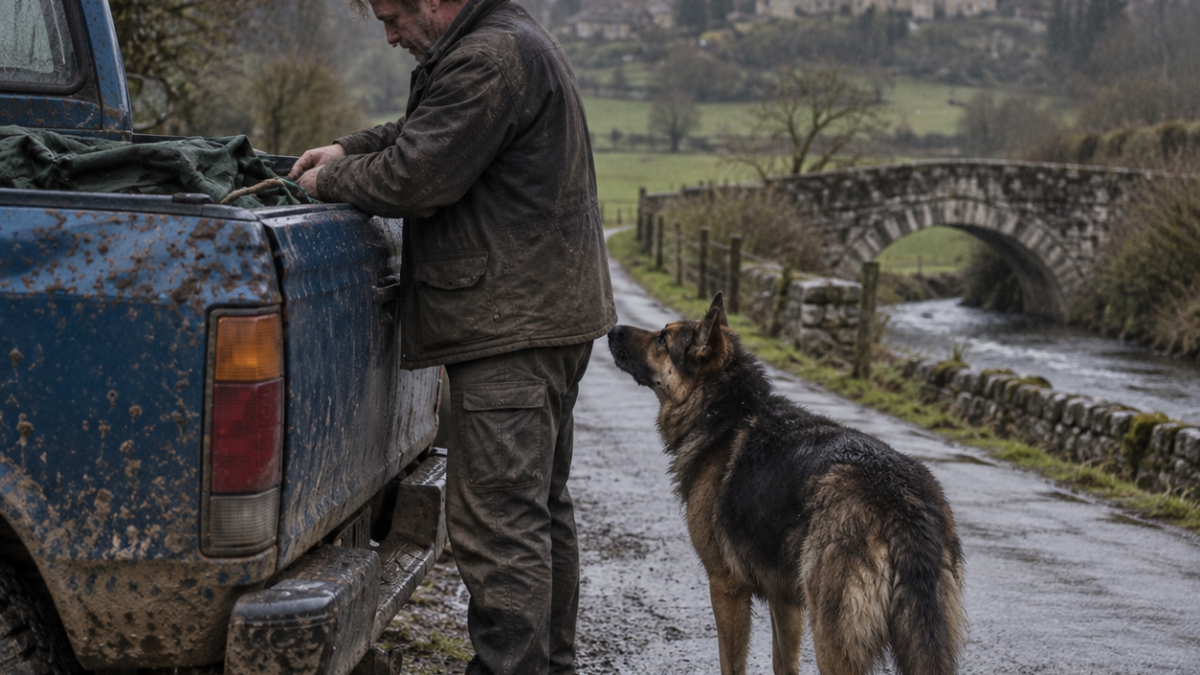
For five straight mornings, the same shepherd mix sat beside an abandoned blue pickup, staring down the road as if he believed someone was still coming back.
He ignored the food I threw him, endured two nights of rain, and grew thinner without ever moving more than a few yards from the truck.
On the fifth morning, he finally left the driver’s door, walked me to the tailgate, and looked at me as if everything depended on what I did next.
My name is Marc Delmas. I was fifty-four then, and for more than eleven years I had driven a delivery truck through the same rural roads of Haute-Loire, passing the same stone bridges, isolated farms, fields and villages where phone service sometimes disappeared for miles.
My life had become just as predictable as my route.
I had been separated from Claire, the mother of my son, for four years. We had tried getting back together twice and failed twice. Our son, Lucas, stayed with me every other weekend. The rest of the time, I lived alone in a small rented house near my brother’s land, ate too many reheated dinners and rarely spoke after six in the evening unless a customer called.
The Monday I first saw the pickup, I was thinking only about coffee.
It was still dark when my headlights found an old blue truck parked crooked on the shoulder a few miles past a stone bridge.
No hazard lights.
No open door.
No person nearby.
Beside the driver’s door sat a black-and-tan shepherd mix, maybe sixty-five pounds, ears raised and eyes fixed on the road behind him.
He didn’t look lost.
He looked like he was waiting.
I slowed down.
Then kept driving.
Maybe his owner had walked to a nearby farm for help. Maybe someone was bringing fuel. Maybe there was a perfectly ordinary explanation.
Tuesday morning, the truck was still there.
So was the dog.
Same place.
Same posture.
Same stare down the road.
By Wednesday, I was uncomfortable enough to slow nearly to a stop.
I had a sandwich in my work bag, so I tore off a piece and tossed it onto the gravel.
In my mirror, I saw the dog approach it.
He sniffed.
Then left it untouched and returned to the driver’s door.
Thursday came after a night of steady rain.
His coat was soaked flat against his body.
Mud covered his paws.
I could see the beginning of his ribs.
Still he sat there.
Waiting.
I thought about him all day.
Friday morning, I couldn’t drive past again.
I parked my delivery truck fifty yards ahead and walked back.
The dog saw me.
No barking.
No growling.
No tail wag.
He simply watched.
“Hey, buddy.”
I crouched several feet away.
He stepped forward just far enough to smell my fingers once.
Then he turned his head toward the pickup.
That was when I noticed the odor.
It came from the rear.
Sour.
Heavy.
Not exactly the smell I had feared when I first saw an abandoned vehicle sitting there for days, but disturbing enough that I stood up slowly.
The pickup bed had a faded canvas cover stretched over it.
I walked toward the tailgate.
The dog followed me.
For five days, I had seen him beside the driver’s door.
Now, for the first time, he abandoned that spot completely.
I touched the handle.
The dog came right beside me.
He looked at the tailgate.
Then at my face.
There was something almost unbearable in his expression.
Not aggression.
Not fear.
Expectation.
“Is this what you want?”
His ears lifted.
I pulled the handle.
The latch released.
The dog pushed his nose toward the opening.
I lowered the tailgate a few inches.
The smell grew stronger.
Then I heard something inside.
A faint scraping sound.
I froze.
The dog whined.
It was the first sound I had heard him make all week.
I lowered the tailgate farther.
Something shifted beneath an old tarp.
Not much.
But enough.
Whatever was back there had been trapped inside that pickup for five days.
And suddenly I understood that the dog beside me had not simply been waiting for somebody to come back.
He had been waiting for somebody to finally open the rear.
PART 2
I dropped the tailgate the rest of the way.
The canvas cover kept most of the morning light out, so at first I saw only shapes: a rusted toolbox, two empty feed sacks, a coil of rope, an overturned plastic bucket and a dark green tarp wedged against the front of the truck bed.
The dog jumped up with his front paws against the tailgate.
He couldn’t climb all the way in.
One of his legs trembled from exhaustion.
Then the tarp moved.
I stepped backward.
“Hello?”
Ridiculous word.
But it was the only one that came.
Another scraping sound.
The dog whined again.
This time louder.
I pulled out my phone and switched on the flashlight.
The beam crossed the tarp.
Something pale appeared underneath it.
Fur.
“Jesus.”
I climbed halfway onto the tailgate and pulled the tarp back.
A second dog was lying underneath.
She was smaller than the shepherd beside me, maybe forty-five pounds, mostly cream-colored with gray around her face. Some kind of older retriever mix.
Her body was wedged between the toolbox and the side of the truck bed.
One hind leg was trapped beneath a fallen metal jack.
Her coat was filthy.
Her eyes were open.
Barely.
She lifted her head perhaps half an inch.
The shepherd outside nearly climbed over me.
“Easy.”
He pressed his chest against my back.
The female dog tried to move.
A weak cry escaped her.
“Okay. Okay.”
I turned toward the shepherd.
“You stayed for her.”
He looked past me.
His entire body was shaking.
I had spent five days assuming he was waiting for the person who had parked the pickup.
Maybe he had been.
But whatever hope remained for that person had become secondary to this.
He had known another dog was trapped in the back.
And he had refused to leave her.
I called emergency services first because I didn’t know who else to call.
The dispatcher transferred me to the gendarmerie after I explained that the abandoned vehicle contained an injured animal but no person.
Then I called the nearest veterinary clinic.
A woman answered.
I described the dog.
“Do not pull the leg free if the jack is putting pressure on it,” she said. “You could cause more damage.”
“What do I do?”
“Keep her still. Is she conscious?”
“Yes.”
“Breathing normally?”
“Fast.”
“Bleeding?”
“I can’t see much.”
“We’ll send someone if we can, but we’re fifteen kilometers away.”
“I can bring her.”
“Only if you can move her safely.”
I looked at the metal jack.
Probably thirty pounds.
The dog’s leg disappeared beneath it.
The shepherd had finally managed to climb into the truck bed.
He lay down beside her.
Not on her.
Not crowding.
Just close enough that his nose touched the side of her face.
She closed her eyes.
For the first time since I arrived, her breathing seemed to slow.
I sat on the tailgate.
“You two know each other.”
The shepherd looked at me.
“Yes. Another brilliant observation.”
My delivery route was already ruined.
I didn’t care.
I called my supervisor, Gérard.
“Marc?”
“I’m going to be late.”
“How late?”
“I found two dogs.”
Silence.
“What?”
“Long story.”
“You’re supposed to be at Saint-Paulien in twenty minutes.”
“I know.”
“Marc.”
“One is trapped in the back of an abandoned pickup.”
Another silence.
Then Gérard surprised me.
“Are police coming?”
“Yes.”
“Then stay.”
I blinked.
“Stay?”
“You think I want you driving while thinking about dying dogs?”
“They’re not dying.”
“Good. Keep it that way. Call me later.”
He hung up.
Ten minutes later, a gendarmerie vehicle pulled in behind the pickup.
Two officers got out.
The older one introduced himself as Sergeant Laurent Besson.
He looked at the blue truck.
“How long has it been here?”
“Five days, at least.”
“You reported it before?”
“No.”
He gave me a look.
I immediately felt guilty.
“I thought the owner was nearby.”
“For five days?”
“I know.”
The second officer checked the front registration plate.
Besson walked to the rear.
The shepherd lifted his head.
“Does he bite?”
“Hasn’t tried.”
“That’s not an answer.”
“He’s exhausted.”
Besson climbed onto the tailgate carefully.
When he saw the female dog, his expression changed.
“Damn.”
“We need to get the jack off her.”
He examined it.
“We can lift it vertically.”
Another vehicle arrived.
Not the veterinarian.
A local firefighter.
Apparently Besson had requested help.
Between the three of us, we stabilized the dog while the firefighter lifted the jack.
The moment the pressure came off her leg, she screamed.
The shepherd reacted instantly.
He lunged forward.
Not at us exactly.
At the movement.
Besson raised one arm.
“Easy!”
I caught the shepherd around the chest.
For half a second I wondered whether he would bite me.
He didn’t.
He twisted desperately, eyes fixed on the female dog.
“Hey!”
I tightened my grip.
“We’re helping her.”
He stopped fighting.
Not because he understood the words.
Because she had stopped crying.
We slid a blanket beneath her and lifted carefully.
Her injured leg hung at an unnatural angle.
The shepherd jumped down from the pickup and followed us.
When we placed her in the back of my delivery truck, he jumped in without invitation.
Besson laughed.
“Guess he’s going too.”
“I guess.”
Before I left, Besson stopped me.
“The truck is registered to an Alain Mercier.”
“Local?”
“Village of Saint-Martin-de-Fugères.”
I knew it.
Maybe twenty minutes away.
“Can you contact him?”
“We’ll try.”
I looked at the abandoned pickup.
“Why would someone leave dogs here?”
Besson shrugged.
“Don’t decide the crime before we know there is one.”
That sentence would matter later.
At the clinic, the female dog was taken immediately for X-rays.
The shepherd refused to enter a separate room.
He paced.
Scratched at the treatment-room door.
Whined until I finally sat on the floor beside him.
“You stayed five days. You can wait another hour.”
He pressed his shoulder against me.
The receptionist scanned him for a microchip.
There was one.
The screen showed:
RANGER — MALE — OWNER: ALAIN MERCIER.
So he had a name.
“Ranger.”
His head came up.
I smiled.
“Ranger.”
The tail moved.
Once.
Then twice.
“Good. One mystery solved.”
The older female dog had a chip too.
BELLE.
Same owner.
Alain Mercier.
The veterinarian, Dr. Pauline Roussel, joined me in the waiting area after almost an hour.
“How bad?”
She sat down.
“Belle’s dehydrated. She has a fracture in the lower hind leg, but the bone hasn’t broken through the skin. There’s significant swelling and bruising. She’s also underweight.”
“Can you fix it?”
“Yes.”
I exhaled.
“She’ll probably need surgery, but she should recover.”
“And Ranger?”
“Exhausted. Dehydrated. Mild paw injuries. Nothing severe.”
I looked toward him.
He was lying under my chair.
“How did Belle survive five days back there?”
Dr. Roussel looked at me.
“We found a torn bag of dry food in the truck bed. And the canvas cover leaked rainwater into the plastic bucket.”
“She drank rainwater?”
“Probably.”
“Ranger?”
“He must have found water somewhere nearby.”
“But he didn’t eat the sandwich I threw him.”
“He may have eaten at night. Or he may simply have been too stressed when you were watching.”
I rubbed my face.
Five days.
Five mornings.
I had driven past.
“What about the smell?”
“Urine. Infection around the injured leg. Wet food. Dirty bedding.”
Relief and shame arrived together.
I had feared something worse.
A body.
A dead person.
But that didn’t mean the situation was harmless.
My phone rang.
Sergeant Besson.
“We found Alain Mercier.”
“Is he okay?”
“He’s alive.”
The way he said it made me straighten.
“Where?”
“Rehabilitation center outside Le Puy.”
“What happened?”
“Stroke three weeks ago.”
I looked down at Ranger.
The dog lifted his head.
“Does he know his dogs are missing?”
Besson was silent for a moment.
“That’s where things get strange.”
“What?”
“According to the center, Mr. Mercier believes his nephew placed both dogs in a boarding kennel.”
I stopped breathing for a second.
“His nephew?”
“Thierry Mercier.”
“And the pickup?”
“Mr. Mercier believes Thierry has it.”
I turned toward the treatment-room door.
“Then who left it on the road?”
“That’s what we’re finding out.”
There are moments when a story shifts beneath your feet.
Until then, I had imagined a lonely accident.
An owner who went for help and never returned.
Maybe hospitalization.
Maybe confusion.
Something sad but explainable.
Now another person had entered the picture.
A nephew.
A promise.
A boarding kennel that did not appear to exist.
“Can I see Alain?”
Besson hesitated.
“You’re not family.”
“I know.”
“You’re the delivery driver who found the animals.”
“I know.”
“Why do you want to see him?”
I looked at Ranger.
Because his dog had waited five days beside a truck.
Because Belle had been trapped beneath a jack.
Because somewhere in a rehabilitation room, an old man apparently believed they were safe.
“I think he deserves to know.”
Besson was quiet.
“I’ll speak to the center.”
That afternoon, I went home later than usual.
My house felt different.
Too quiet.
I had spent half the day hearing Ranger’s nails on clinic floors.
Now there was only the refrigerator humming and rain against the windows.
My son Lucas called around seven.
Claire had apparently told him I missed work because of dogs.
“You rescued a dog?”
“Two.”
“Two?”
“Complicated.”
“Can I see them?”
“Not mine.”
“That wasn’t the question.”
He was sixteen.
Old enough to understand everything and young enough to ignore most explanations.
“They’re at the vet.”
“Can we go Saturday?”
“If they’re still there.”
“Dad.”
“What?”
“You’re doing that thing.”
“What thing?”
“Answering like you don’t want to say yes because then you’ll have to care.”
I stared at my kitchen wall.
“Your mother teaches you these sentences?”
“No. She says worse.”
I laughed.
“Fine. Saturday.”
“Good.”
Before hanging up, Lucas asked:
“Did the owner abandon them?”
“I don’t know.”
“What do you think?”
I thought about Besson’s warning.
Don’t decide the crime before we know there is one.
“I think something happened.”
That was all I could honestly say.
The next morning, I drove my regular route.
The blue pickup was gone.
Police had towed it.
The shoulder was empty.
I slowed anyway.
For five days, Ranger had been part of the landscape.
Now his absence felt strange.
At lunch, Besson called.
“You can see Mr. Mercier tomorrow afternoon if he agrees.”
“He agreed?”
“He heard you found Ranger and Belle.”
Pause.
“He started crying.”
I swallowed.
“Tomorrow.”
I told Lucas.
He asked to come.
Claire surprisingly agreed.
“Maybe it’ll be good for him,” she said.
“For Lucas?”
“For you.”
“What’s that supposed to mean?”
“You’ve spent four years turning every emotion into a practical task.”
“That’s not true.”
“Marc, when your father died, you reorganized the garage.”
“It needed organizing.”
She laughed.
Not cruelly.
Tiredly.
“Take Lucas.”
So I did.
Saturday afternoon, Lucas and I visited the clinic first.
Ranger heard us before we reached his kennel.
He stood.
Tail moving.
Not wildly.
But enough.
Lucas crouched.
“Hey.”
Ranger hesitated.
Then approached.
He sniffed Lucas’s hands.
My son stayed still.
“You’re smarter than I was.”
“I watched videos.”
“Of course you did.”
Ranger leaned into him.
Lucas looked at me with a grin.
“He likes me.”
“He’s emotionally compromised.”
“Jealous?”
“No.”
Belle was recovering from surgery.
When Lucas saw the bandage around her hind leg, his smile disappeared.
“Someone did this?”
“We don’t know.”
“She didn’t trap herself under a jack.”
“The jack may have fallen while the truck was moving.”
“Who was driving?”
“We don’t know yet.”
Lucas looked at Ranger.
“Why didn’t he leave?”
I watched the dog lie near Belle’s kennel.
“Because she was there.”
My son was quiet.
Then:
“That’s kind of amazing.”
Yes.
It was.
We reached the rehabilitation center around three.
Alain Mercier was seventy-eight.
Thin.
Gray-haired.
One side of his body still weaker from the stroke.
He sat in a wheelchair beside a window.
The moment we entered, his eyes moved past me.
“Ranger?”
I realized he thought we had brought the dog.
“No. He’s at the clinic.”
Alain’s face fell.
“Belle?”
“Recovering from surgery.”
His good hand gripped the armrest.
“Surgery?”
I looked toward the nurse.
She nodded slightly.
He needed the truth.
“We found them with your pickup.”
“Where?”
“On the departmental road past the stone bridge near Chaspinhac.”
His face changed.
“That’s twenty kilometers from home.”
“Yes.”
“What were they doing there?”
Ranger had been beside the driver’s door.
Belle trapped in the back.
Five days.
I explained slowly.
Alain closed his eyes.
“No.”
“Mr. Mercier—”
“No.”
His voice shook.
“Thierry said kennel.”
Lucas shifted beside me.
Alain opened his eyes.
“My nephew. He said he took them to a place near Brioude.”
“Do you know the name?”
“No.”
“He showed you paperwork?”
Alain’s face tightened with frustration.
His speech was slower after the stroke.
“Phone. He showed me… picture. Dogs. Kennel.”
“A photograph?”
“Yes.”
I exchanged a look with Lucas.
“Did you see Ranger and Belle in the photograph?”
Alain hesitated.
“No. Building. Sign.”
A generic picture.
Maybe downloaded from the internet.
Alain began breathing faster.
The nurse moved closer.
“Mr. Mercier, we can stop.”
“No.”
He looked at me.
“Ranger waited?”
“Yes.”
“For me?”
The question hurt.
I sat across from him.
“I think at first he did.”
Alain swallowed.
“And Belle?”
“He knew she was trapped.”
His eyes filled.
“They’ve been together eleven years.”
That explained the rest.
“They were puppies together?”
“No. Ranger younger. Belle belonged to my wife.”
His voice softened.
“After she died, Ranger slept beside Belle.”
“Your wife?”
“Élise.”
Alain looked toward the window.
“Belle was hers. Ranger mine. After Élise died, they became… one thing.”
He smiled weakly.
“Always together.”
Lucas sat in a chair near the wall.
He was listening more carefully than I had seen him listen to most adults.
Alain looked at me again.
“Can I see them?”
“Dr. Roussel said Belle needs a few days before she can travel.”
“Ranger?”
“I’ll ask.”
A tear ran down Alain’s cheek.
“I told him I’d be back.”
Ranger.
“When you went to the hospital?”
He nodded.
“Ambulance. He tried follow.”
His voice broke.
“I told him stay.”
I thought about that roadside.
Ranger sitting by the driver’s door.
Waiting.
Maybe the command had stayed inside him.
Stay.
Alain had told him to stay on the farm.
Then Thierry had taken him away.
Ranger had still been waiting for the only person whose command mattered.
But when he realized Belle was trapped, waiting became something else.
Guarding.
Lucas asked softly:
“Did your nephew know how much they meant to you?”
Alain’s eyes hardened.
“Yes.”
That was the first time I saw anger in him.
“He knew.”
On the drive home, Lucas stared out the window.
“You think Thierry dumped them.”
“I think police are going to find out.”
“But you think it.”
“Yes.”
“Why?”
“Because Alain believed they were in a kennel.”
“Maybe Thierry paid someone else.”
“Possible.”
“And that person did it.”
“Possible.”
Lucas looked at me.
“You always talk like a lawyer when you’re angry.”
“I’m not angry.”
“You’re gripping the steering wheel like you want to crush it.”
I loosened my hands.
“Good observation.”
Sunday, Ranger visited Alain.
The rehabilitation center allowed us into a small enclosed garden.
I went because Dr. Roussel asked me to help transport him.
Lucas came too.
Ranger was nervous in the car.
He paced.
Whined.
Pressed his nose to the windows.
The moment we pulled into the center parking lot, he changed.
His ears lifted.
He started panting faster.
I didn’t know whether he recognized the smell, the building or simply sensed something.
When the nurse rolled Alain into the garden, Ranger froze.
Alain lifted his good hand.
“Ranger.”
The dog exploded.
There is no better word.
He pulled free of my loose grip before I even understood what was happening.
He crossed the grass.
Not barking.
Not growling.
A sound came from his throat halfway between crying and breathing.
Alain opened his arm.
Ranger jumped against the wheelchair carefully enough not to knock it over but hard enough that the nurse grabbed the handles.
“Ranger.”
The dog pressed his face under Alain’s chin.
Alain buried his hand in the fur behind his neck.
“I’m sorry.”
Ranger’s entire body shook.
“I’m sorry.”
Lucas turned away.
I pretended not to see him wipe his face.
Alain looked at me over Ranger’s back.
“Five days?”
“Yes.”
Ranger licked his cheek.
“I’m sorry, boy.”
I sat on a nearby bench.
I had seen dogs greet owners before.
Nothing like that.
Because this wasn’t simply happiness.
There was relief in it.
The terrible question Ranger had carried beside that pickup had finally been answered.
Alain was alive.
He had not chosen to leave.
But the reunion did not solve the central problem.
Who had?
Sergeant Besson called me the next evening.
“We found the kennel photograph.”
“What?”
“The image Thierry showed Alain.”
“And?”
“Stock photo from a boarding facility near Clermont-Ferrand.”
My stomach tightened.
“Did Thierry contact them?”
“No.”
“Any kennel?”
“We haven’t found one.”
“What does Thierry say?”
“That he paid a man named Pascal to take the dogs.”
“Full name?”
“He says he doesn’t know.”
“Phone?”
“Prepaid number. No longer active.”
“Of course.”
“Marc.”
“I know. Let you work.”
Besson paused.
“We also found something in the pickup.”
“What?”
“A service-station receipt.”
“From when?”
“Night before you first saw the truck.”
“Where?”
“Near Le Puy.”
“That doesn’t prove Thierry drove it.”
“No.”
“But?”
“But we requested camera footage.”
The following week, Belle came out of surgery recovery.
Ranger returned to the clinic and immediately lay beside her kennel.
She smelled him through the bars.
Her tail moved.
Once.
Then kept going.
Dr. Roussel opened the kennel carefully.
Belle limped forward on three legs.
Ranger stood.
They touched noses.
Then Belle pressed her forehead into his chest.
Ranger lowered his head over hers.
I heard Lucas whisper behind me:
“Okay. That’s worse than the old man.”
I looked at him.
He was crying openly now.
“You’re very emotional lately.”
“Shut up.”
He hugged me.
Unexpectedly.
It lasted about two seconds.
Then he stepped away as if embarrassed.
But those two seconds stayed with me.
Maybe Claire had been right.
I had turned too much of life into tasks.
Feed dog.
Drive truck.
Pay bill.
Pick up son.
Drop off son.
Repair fence.
Buy groceries.
I liked things that could be completed.
Emotion was never complete.
It sat around.
Waited.
Asked questions.
Ranger seemed built for that kind of waiting.
I wasn’t.
The service-station footage arrived.
Thierry was visible.
He bought fuel.
The blue pickup was at the pump.
Ranger could be seen sitting in the cab.
That destroyed his claim that an unknown Pascal had collected the dogs earlier that day.
So Thierry changed his story.
Now he said he had intended to drive the dogs to a kennel himself, but the pickup developed mechanical problems. A friend picked him up. He claimed Ranger escaped before he could return, and he did not know Belle was trapped beneath the jack.
There were immediate problems.
Why didn’t he call police?
Why didn’t he call Alain?
Why didn’t he call roadside assistance?
Why didn’t he return the next day?
Why did he tell Alain the dogs were already safely boarded?
Thierry’s answer:
He panicked.
I had begun to hate that word.
People used panic as if it erased the decisions that followed.
One bad moment?
Maybe.
Five days?
That was a sequence.
Besson agreed.
Investigators checked Thierry’s phone.
Location data placed him near the roadside where the pickup was found.
Then twenty minutes later at a café in a nearby village.
A friend’s car appeared on the café’s camera.
The friend eventually admitted picking Thierry up.
“What did he tell you?” police asked.
“Truck died.”
“What about the dogs?”
“He said they’d been handled.”
“Did you see them?”
“No.”
The pickup itself was examined.
Mechanically, it was fine.
Old.
Ugly.
But functional.
There had been no breakdown.
Another lie collapsed.
Then investigators found the part that turned animal abandonment into something larger.
Thierry had reported Alain’s pickup stolen.
Not immediately.
Two days after leaving it.
He filed the report with an insurance claim.
He said it disappeared from outside Alain’s farm.
He claimed tools were in the back.
Several expensive tools.
Most did not exist.
The insurance company had already started processing the claim.
The dogs were never mentioned.
Besson called me.
“He tried to use the truck too.”
“What do you mean?”
“Looks like he abandoned it, then decided he might as well claim insurance.”
I sat in my kitchen.
Ranger and Belle were still at the clinic.
My house had become strangely empty without them even though they had never lived there.
“Why?”
“Money.”
“That simple?”
“Usually more complicated and more simple at the same time.”
Then came the bank accounts.
Alain had given Thierry limited authority to handle bills after the stroke.
Thierry used the debit card for groceries.
Fuel.
Pharmacy expenses.
At first, reasonable.
Then cash withdrawals.
Five hundred euros.
Eight hundred.
A thousand.
Electronics.
Restaurant charges.
A transfer to an account investigators later identified as belonging to Thierry’s girlfriend.
Alain had not authorized those.
The dogs became part of a bigger pattern.
Not the beginning.
Not the end.
Just the moment somebody finally looked.
When Besson told Alain, I was present.
I wish I hadn’t been.
The old man did not shout.
That would have been easier.
He looked confused.
“Thierry?”
The sergeant nodded.
“Some transactions appear unauthorized.”
Alain stared at his weak hand.
“He is my sister’s boy.”
“I understand.”
“After she died, I helped him.”
Nobody spoke.
Alain continued.
“Job. Rent. Car.”
His face folded in a way that made him suddenly look much older.
“I helped him.”
Ranger was lying beside his wheelchair.
Alain placed his hand on the dog’s back.
“And he left them.”
The sentence was almost a whisper.
That was what hurt him most.
Not the money.
Not the insurance.
The dogs.
Because money could be explained as greed.
Leaving Ranger and Belle meant something more intimate.
Thierry knew what they were to Alain.
He knew Belle had belonged to Élise.
He knew Ranger had slept beside Alain’s bed since the funeral.
And he still left them on a roadside.
Alain began crying.
“I trusted him with them.”
Ranger stood.
He pushed his nose beneath Alain’s hand.
The old man looked down.
“I trusted him with you.”
I had to leave the room.
Outside, Lucas was waiting.
He had come with me because it was his weekend.
“You okay?”
“No.”
He nodded.
“Me neither.”
We sat on a bench.
Then Lucas said:
“You know what’s weird?”
“What?”
“Thierry probably thought they were just dogs.”
I looked at him.
“Yeah.”
“To Alain, they’re like… the last part of his wife.”
I swallowed.
“Yeah.”
Lucas stared at the floor.
“People can hurt you way worse when they know what matters.”
I didn’t have an answer.
My sixteen-year-old son had summarized betrayal better than I could.
Thierry was arrested later that week.
Not because of me.
Not because of some dramatic confrontation.
Paperwork.
Bank records.
Video.
Insurance documents.
False statements.
Phone data.
And the abandoned dogs.
He was released pending proceedings under restrictions.
That should have made me feel better.
It didn’t.
Because Ranger and Belle still had nowhere permanent to go.
Alain could not return to his farmhouse alone.
His right side remained weak.
Doctors expected improvement but not full independence soon.
The rehabilitation center did not allow residents to keep large dogs.
Alain’s farm needed maintenance.
There was no close family member he trusted anymore.
A temporary rescue placement was possible.
Separating Ranger and Belle was not.
Dr. Roussel made that clear.
“They’re bonded.”
Lucas looked at me.
“No.”
I said it before anyone asked.
Dr. Roussel smiled.
“I didn’t say anything.”
“You were about to.”
Élodie—the clinic’s rescue liaison—was standing beside her.
She smiled too.
“You have a fenced yard?”
“Small.”
“House?”
“Rental.”
“Landlord allows dogs?”
“One dog.”
Ranger looked at me.
Belle was lying beside him, bandaged leg stretched out.
I pointed.
“That is two dogs.”
Lucas said, “I can call the landlord.”
“No.”
“You hate phone calls.”
“Lucas.”
“You’d say it wrong.”
“There is no right way to ask someone whether you can temporarily house sixty kilos of emotional damage.”
Élodie raised a hand.
“That’s actually not bad.”
I glared at her.
The landlord said yes.
Apparently his exact words were:
“Your brother keeps goats next door. Two dogs won’t be the thing that destroys my property.”
Temporary.
That mattered.
I repeated it three times.
Temporary foster.
Until Alain recovered.
Until the rescue found another arrangement.
Until something.
Ranger entered my house as if he had inspected it previously.
Belle took longer.
Her leg was still healing.
We placed a thick bed near the heater.
Ranger chose the floor beside it.
First night, neither slept much.
Neither did I.
Every vehicle passing on the road made Ranger stand.
At midnight, he went to the front door.
Waited.
At 1:30, again.
Three.
Four.
“He’s waiting for Alain,” Lucas whispered from the couch.
He had insisted on sleeping downstairs.
“Yes.”
“What do we do?”
“Nothing.”
“That sucks.”
“Yes.”
At five, I woke to find Ranger sitting beside my chair.
He looked at me.
Then toward the door.
“Not today.”
His ears lowered.
“I’m sorry.”
Belle lifted her head.
Ranger returned to her.
The next morning, I called Alain from the kitchen.
The rehabilitation nurse held the phone for him.
“Can you talk to Ranger?”
Alain laughed.
“Talk?”
“He’s waiting.”
“Put phone.”
I turned on speaker.
“Ranger.”
The dog’s head snapped up.
Alain’s voice came through.
“Boy.”
Ranger ran toward the phone.
He pushed his nose against it.
“Ranger, stay with Marc.”
I felt my throat tighten.
“Stay.”
Ranger whined.
“Belle needs you.”
The dog looked toward Belle.
Then back at the phone.
Alain’s voice broke.
“I’m coming back when I can.”
Ranger lay down beside the phone.
We stayed that way for ten minutes.
Afterward, something changed.
Not magically.
He still checked the door.
But he began eating normally.
He slept longer.
He explored the yard.
Lucas taught him to bring a tennis ball.
Technically Ranger taught Lucas to throw it again.
Belle healed slowly.
Her first steps without the heavy splint were awkward.
Ranger moved at her pace.
If she stopped, he stopped.
If she stumbled, he came alongside her.
One morning I watched them cross my yard.
Belle limping.
Ranger half a step behind.
I thought about those five days.
What kind of loyalty makes an animal choose hunger beside a truck instead of leaving?
Maybe it wasn’t complicated.
Maybe Ranger simply didn’t have the concept of abandoning Belle.
Humans build arguments.
Money.
Convenience.
Fear.
Responsibility.
Dogs sometimes reduce everything to one fact.
She is mine.
So I stay.
Lucas became obsessed with them.
Every weekend he arrived with something.
Dog treats.
A new brush.
A ridiculous padded bed Ranger ignored.
A ramp for Belle that he built with my brother.
Claire noticed.
“He talks about you more now.”
“Who?”
“Lucas.”
My stomach tightened.
“What does he say?”
“That you and Ranger fixed the fence.”
“That I burned dinner.”
“That Belle stole your sock.”
I smiled.
Claire continued.
“He used to say your weekends were boring.”
“They were.”
“I know.”
“Thank you.”
“You know what I mean.”
I did.
My relationship with my son had become polite after the separation.
Not bad.
That almost made it worse.
No shouting.
No dramatic estrangement.
Just less.
He arrived Friday.
We ate.
Watched television.
He used his phone.
Sunday I drove him home.
Ranger and Belle disrupted that.
Dogs need walks.
Medicine.
Cleaning.
Training.
They create conversations.
Lucas started staying near me instead of disappearing into the spare room.
One evening we were fixing Belle’s ramp.
He asked:
“Why did you and Mom really split?”
I almost dropped the drill.
“We’ve told you.”
“You said you stopped being good together.”
“That’s true.”
“That means nothing.”
He was sixteen.
He deserved more.
“We got tired.”
He waited.
“Your mother wanted me to talk more.”
“That sounds right.”
“I wanted her to stop asking me to talk.”
“That also sounds right.”
I smiled.
“Eventually, every problem became proof that the other person was the problem.”
“Did you cheat?”
“No.”
“Mom?”
“No.”
“Then why couldn’t you fix it?”
I looked toward Ranger.
He was lying beside Belle.
“Sometimes people leave before anything dramatic happens.”
Lucas followed my eyes.
“Like mentally.”
“Yeah.”
He nodded slowly.
“Ranger wouldn’t.”
“No.”
That landed harder than he intended.
Or maybe exactly as hard as he intended.
“What are you saying?”
“Nothing.”
“Lucas.”
He picked up a screw.
“I just think you’re good at leaving without going anywhere.”
I stared at him.
Then laughed once.
Not because it was funny.
Because my son had apparently inherited his mother’s ability to say the sentence I least wanted to hear.
He was right.
I had stayed physically present in many places after emotionally checking out.
Marriage.
Friendships.
My father’s final years.
Even with Lucas sometimes.
Ranger had waited beside a truck until his body started consuming itself.
I was not suggesting humans should imitate dogs literally.
But the contrast embarrassed me.
That weekend, I talked to my son more than usual.
Not perfectly.
Just more.
Thierry’s case moved slowly.
Real legal proceedings do.
Months.
Reports.
Interviews.
Financial analysis.
His lawyer argued the dogs had been left only because Thierry believed somebody would find them quickly.
The prosecutor asked why he had told Alain they were in a kennel.
No answer.
His lawyer argued the pickup was left because Thierry feared mechanical failure.
Mechanic’s inspection contradicted that.
He argued the insurance claim was filed because he genuinely believed someone might steal the vehicle after he left it.
Then why claim it had been stolen from Alain’s farm?
Another contradiction.
And the bank transactions were harder.
Thierry insisted Alain had authorized cash withdrawals.
Alain denied it.
Some amounts were impossible to establish either way.
Others were clearly unrelated to Alain’s needs.
The evidence did not produce one cinematic revelation.
It accumulated.
Like water behind a door.
Then another person came forward.
Thierry’s former girlfriend, Mélanie.
She had received one of the transfers.
At first she refused to cooperate.
Then police informed her the transfer could become part of the fraud investigation.
She changed her mind.
She showed messages.
One said:
“Old man won’t notice until he’s home, if he ever gets home.”
Another:
“Need to clear the animals and truck before estate stuff gets complicated.”
Estate stuff.
Alain wasn’t dead.
But Thierry was already thinking as though he were.
The message made me sick.
Mélanie had replied:
“What are you doing with the dogs?”
Thierry:
“Not my problem.”
That became one of the most important lines in the case.
Not my problem.
Ranger had spent five days living by the opposite rule.
Belle is my problem.
Alain is my problem.
Stay.
Thierry’s lawyer later argued the phrase was casual frustration.
Maybe.
Words alone are ambiguous.
Actions less so.
Thierry had taken the dogs.
Driven the pickup to a remote shoulder.
Placed Belle in the rear.
The jack had likely fallen during the drive because it was not secured.
Investigators could not prove he knew she was injured before walking away.
But he knew both dogs were still with the truck.
His friend confirmed it.
That changed everything.
The friend, Nicolas, had initially said he never left the café parking lot.
Phone records proved otherwise.
Eventually he admitted picking Thierry up directly from the road.
“Were the dogs there?”
“Yes.”
“Both?”
“One outside.”
“Did Thierry mention the second?”
“He said she was in back.”
“Why didn’t you take them?”
Nicolas looked ashamed.
“He said he’d handle it.”
“Did he?”
“No.”
“What did you think when you left?”
Nicolas swallowed.
“I thought somebody would come.”
There it was again.
Somebody.
The most dangerous imaginary person in the world.
Somebody will stop.
Somebody will call.
Somebody will help.
For five days, everyone drove past.
Including me.
Eventually I became somebody.
That did not make the earlier four days disappear.
When I testified months later, Thierry’s lawyer asked exactly that.
“You saw the vehicle Monday?”
“Yes.”
“Yet you continued driving.”
“Yes.”
“Tuesday?”
“Yes.”
“Wednesday?”
“Yes.”
“Thursday?”
“Yes.”
“So for four days you did exactly what you now criticize my client for doing.”
The courtroom went quiet.
I hated him for the question.
Because there was truth in it.
Not equal truth.
But enough.
I looked at Thierry.
Then back at the lawyer.
“I kept driving because I believed the owner was coming back.”
“And Mr. Mercier may have believed someone else would assist the animals.”
“No.”
“How can you know his belief?”
“Because he knew the owner wasn’t coming back.”
The lawyer paused.
I continued.
“Alain was in rehabilitation. Thierry knew that. I didn’t.”
“Still, you left the dog there four times.”
“Yes.”
I swallowed.
“I wish I hadn’t.”
That was all.
No defense.
No excuse.
I had driven past.
The difference was what happened when I finally understood.
The lawyer moved on.
But I remembered the question.
Responsibility isn’t only useful when it belongs to the villain.
Sometimes you have to take your share too.
Karim—another driver who used the same road—later told me he had seen Ranger once.
He thought it belonged to a nearby farm.
A woman remembered the truck but assumed it had broken down.
A cyclist had stopped, but Ranger refused food.
Everybody had a reason.
Not evil reasons.
Ordinary ones.
That frightened me more.
Neglect is often built from ordinary assumptions stacked one on top of another.
Somebody else knows.
Somebody else called.
Somebody else will stop.
Ranger survived those assumptions.
Belle nearly didn’t.
By the time the hearing came, Alain had improved enough to walk short distances with a cane.
He insisted on attending.
I drove him.
Ranger and Belle stayed with Lucas at my house.
Before we left, Alain bent carefully and touched each dog.
“Home soon.”
Ranger looked at him.
I could tell the words meant something now.
Not exact language.
Pattern.
Tone.
Promise.
Home soon.
At court, Thierry looked different than I remembered from the one photograph I had seen.
Forty-two.
Clean-shaven.
Dark jacket.
Tired.
He did not look cruel.
That matters.
I think people prefer cruelty to have a face.
Then we can avoid becoming it accidentally.
Thierry looked like someone you might ask to hold a door.
Someone who might help you move furniture.
Someone who had made many selfish decisions and then built more decisions to protect the first ones.
Alain looked at him.
Thierry looked away.
The prosecutor presented the timeline.
Stroke.
Limited financial authority.
Promise to kennel the dogs.
Fuel-station footage.
Remote road.
Friend pickup.
Dogs left behind.
False kennel photograph.
Insurance claim.
Bank transfers.
Messages to Mélanie.
False theft report.
One fact followed another.
Thierry’s defense tried to separate them.
The dogs were a mistake.
The insurance report was confusion.
The bank transactions were authorized.
The messages were dark humor.
Each piece innocent if viewed alone.
The prosecution argued they formed a pattern.
Alain testified.
He moved slowly to the witness chair.
His voice still carried the slight hesitation left by the stroke.
That made every sentence feel deliberate.
“My nephew told me Ranger and Belle were safe.”
“Did you authorize him to abandon them?”
“No.”
“Did you authorize him to report your pickup stolen?”
“No.”
“Did you give him permission to withdraw cash for personal use?”
“No.”
Thierry’s lawyer stood.
“Mr. Mercier, your memory after your stroke was impaired, correct?”
“Some.”
“You had moments of confusion.”
“Yes.”
“You sometimes forgot conversations.”
“Yes.”
“So it is possible you gave Thierry broader permission than you now remember.”
Alain looked toward his nephew.
“No.”
“How can you be certain?”
Alain’s good hand tightened around his cane.
“Because I trusted him.”
The lawyer waited.
Alain continued.
“If I told him he could take money, he would not need lie.”
Silence.
Then:
“If I told him he could leave dogs, he would not need show me fake kennel.”
That was the clearest sentence of the trial.
Simple.
Unavoidable.
The lawyer sat down.
Nicolas testified.
Mélanie testified.
Besson.
The insurance investigator.
The mechanic.
Then me.
Then Dr. Roussel, who described Belle’s condition and explained that the fracture could have occurred when the unsecured jack struck or trapped her during transport.
Could she prove Thierry deliberately injured Belle?
No.
Could she prove Belle was already injured when he walked away?
Not with certainty.
That mattered.
The prosecutor did not overstate it.
The case was strong enough without inventing things.
What could be proven was abandonment.
False statements.
Fraud-related conduct.
Misuse of Alain’s funds.
Those were enough.
Then Thierry testified.
I expected him to deny everything.
He didn’t.
Not anymore.
He admitted driving the truck.
Admitted leaving it.
Admitted Ranger was outside.
Admitted knowing Belle remained in the back.
His defense became emotional rather than factual.
He said he had been overwhelmed.
His mother—Alain’s sister—had died two years earlier.
He had debt.
He had been helping Alain after the stroke and resented that nobody else stepped in.
He had lost work.
The dogs were difficult.
Belle had soiled the garage.
Ranger paced and barked.
The farm needed attention.
The rehabilitation center kept calling.
Bills were coming.
He panicked.
For the first time, I almost felt sorry for him.
Almost.
Then the prosecutor asked:
“Why did you not call an animal shelter?”
Thierry stared at the desk.
“They asked for information.”
“What information?”
“Vaccines. Medical records.”
“Which were at your uncle’s house.”
“Yes.”
“Why not retrieve them?”
No answer.
“Why not call a veterinarian?”
“Money.”
“You had access to your uncle’s account for his care.”
Thierry said nothing.
“You withdrew eight hundred euros two days before abandoning the dogs.”
“That was for expenses.”
“You transferred six hundred to your girlfriend.”
Silence.
“Why not spend a fraction of that placing the animals safely?”
Thierry’s voice changed.
“I was angry.”
“At the dogs?”
“At everything.”
“What did Ranger do?”
Nothing.
“What did Belle do?”
Nothing.
“What had your uncle done?”
Thierry looked toward Alain.
“Expected me to fix his life.”
Alain closed his eyes.
The prosecutor waited.
“So you left the two animals he loved on a remote road.”
Thierry’s face tightened.
“I thought someone would find them.”
The prosecutor nodded.
“Somebody did.”
He looked toward me.
“Five days later.”
Thierry lowered his head.
No more questions.
The judgment took time.
There were multiple charges and financial issues.
Ultimately, Thierry was convicted on the supported counts involving animal abandonment, false reporting and financial misconduct connected to Alain’s accounts and the insurance claim. He was ordered to repay money, faced criminal penalties and restrictions, and was prohibited for a significant period from owning or having sole responsibility for animals.
The insurance claim was denied.
The false theft report became part of the record.
Alain revoked every remaining authority Thierry had over his affairs.
People later called that revenge.
It wasn’t.
The court did not return five days to Ranger.
It did not remove Belle’s fracture.
It did not erase the moment Alain learned what his nephew had done.
Consequences are not time machines.
But they did something valuable.
They stopped Thierry from rewriting the story.
He had not placed the dogs responsibly.
The truck had not been stolen.
The withdrawals had not all been for Alain.
The kennel did not exist.
Truth became the official record.
That mattered more than I expected.
Outside the courthouse, Thierry approached Alain.
Besson was nearby.
So was I.
Thierry stopped several feet away.
“Uncle.”
Alain did not answer.
Thierry’s eyes filled.
“I’m sorry.”
Alain looked at him for a long time.
Then said:
“You left Élise’s dog.”
Thierry flinched.
Of everything he had done, that was the wound Alain could not step around.
Belle.
Élise’s dog.
A living connection to his dead wife.
Thierry swallowed.
“I know.”
“No.”
Alain shook his head.
“You know now.”
He turned away.
Thierry said:
“I thought you weren’t coming home.”
Alain stopped.
So did I.
Thierry continued.
“I thought the farm would be sold. I thought you’d end up in care. I thought everything was over.”
Alain looked back.
His face was calm.
“That is when you show who you are.”
Nothing dramatic followed.
No shouting.
No punch.
Alain walked away.
I helped him into my delivery van.
For several minutes he said nothing.
Then:
“I raised him after sister died.”
I looked at him.
“Partly.”
“He lived with us one year.”
His voice broke.
“Élise loved him.”
That made it worse.
Betrayal often does.
It rarely comes from strangers.
The people capable of reaching the most important parts of you are usually the people you once let close.
Back at my house, Ranger recognized Alain’s cane tapping the porch before he saw him.
He ran to the door.
Belle followed more slowly.
When Alain entered, both dogs surrounded him.
Ranger pressed against his good side.
Belle leaned against his legs.
Alain lowered himself carefully onto the chair Lucas had placed near the entrance.
“Home.”
Ranger’s tail hit the wall.
Alain laughed.
Not a weak rehabilitation-center laugh.
A real one.
“Home.”
There was only one problem.
It wasn’t Alain’s home.
It was mine.
His farmhouse remained unsafe for him alone.
The doctors were clear.
He needed assistance.
Stairs were difficult.
Driving was uncertain.
He could not manage two dogs by himself yet.
We all knew it.
Nobody wanted to say it.
Finally Alain did.
“They stay with you.”
I looked at him.
“Temporary.”
He smiled.
“You have said temporary six months.”
“It is temporary.”
Lucas coughed.
I glared.
Alain looked at Ranger.
“He chooses already.”
“That dog has poor judgment.”
Ranger placed his head on my knee.
Lucas started laughing.
Traitor.
Alain’s daughter, Sophie, lived near Toulouse.
She had been estranged from Thierry and had only recently learned the full situation. She offered to move Alain closer to her.
He refused at first.
His farm.
His wife’s grave.
His village.
His memories.
Then reality did what arguments couldn’t.
Winter arrived.
Alain slipped once in the rehabilitation garden.
Nothing serious.
Enough.
He agreed to move into a small accessible cottage near Sophie, with home-care support.
Dogs were allowed.
That should have solved everything.
Ranger and Belle could go with him.
I told myself that repeatedly.
This was the good ending.
Owner recovered.
Dogs returned.
Family repaired.
My house went back to normal.
Then the day came.
Alain had been discharged.
His daughter arrived with a large vehicle.
We packed Ranger’s bed.
Belle’s medication.
Food bowls.
Leashes.
Toys.
Lucas stood in the kitchen pretending not to care.
“You okay?”
“Yeah.”
“You’re holding Ranger’s tennis ball.”
He looked down.
“Oh.”
I smiled.
“Keep it.”
“No.”
“For when they visit.”
“They’re moving four hours away.”
“Then for memory.”
He put it in his pocket.
Alain sat in the passenger seat outside.
Ranger jumped into the back immediately.
Belle needed help.
I lifted her.
She licked my cheek.
“Don’t.”
Tail wag.
“You’re making this worse.”
I set her inside.
Ranger looked through the open door at me.
“You’re going home.”
He stood.
Then jumped back out.
“Ranger.”
He walked to my porch.
Sat.
Alain called from the vehicle.
“Ranger.”
The dog looked toward him.
Then at me.
Again.
Alain’s face changed.
He opened the passenger door with difficulty.
I helped him out.
He walked toward Ranger with his cane.
“Boy.”
Ranger stood.
Alain touched his neck.
“You come.”
Ranger looked at him.
Then toward the open front door of my house.
Belle began whining from the vehicle.
Ranger went to her.
Good.
He put his front paws inside.
Then came back out.
Alain stood very still.
I could see the moment he understood before I did.
“He has two homes.”
I shook my head.
“No.”
“Yes.”
“Alain—”
He looked at me.
“You gave him life while I could not.”
“I fed him.”
“You stayed.”
That word.
Stayed.
The word Ranger had been teaching all of us.
Alain sat on the porch chair.
He looked suddenly tired.
Lucas came outside.
“What’s happening?”
Nobody answered.
Ranger sat between us.
Alain rubbed his ears.
“Belle goes with me.”
My chest tightened.
“Ranger stays.”
“No.”
I said it immediately.
“They belong together.”
“They love together.”
Alain nodded.
“But Belle needs quiet now. Ranger needs work.”
He smiled.
“Your boy runs him.”
Lucas looked shocked.
Alain continued.
“Ranger watches door for Marc when he leaves.”
I said nothing.
“Belle watches me.”
That was true.
Whenever Alain visited, Belle attached herself to him.
Ranger greeted him wildly.
Loved him.
Then eventually returned to wherever I was.
I had refused to see the difference.
Alain had not.
“Separate them?”
I asked.
“Not far.”
“Four hours.”
“Sophie says visit.”
Lucas suddenly spoke.
“We can meet halfway.”
We all looked at him.
“Every month. Or something.”
Alain smiled.
“Good plan.”
Ranger went to Belle’s door.
They touched noses.
Belle licked his muzzle.
He whined.
I nearly changed my mind.
Then Belle returned to Alain’s side.
Ranger returned to mine.
Choice made.
Not by us entirely.
By them too.
Alain and Belle moved south.
Ranger stayed with me.
Temporary foster lasted eight months.
Adoption took eleven minutes.
Lucas signed his name as secondary contact even though he was still a minor.
Claire laughed when I told her.
“You adopted a dog.”
“Apparently.”
“You used to complain when I wanted a cat.”
“I still don’t want a cat.”
“Growth has limits.”
Ranger changed our lives.
Not dramatically every day.
That’s the thing.
The biggest changes become ordinary.
Morning walks.
Dog hair.
A bowl near the kitchen door.
Lucas spending more weekends with me even when technically it was Claire’s time.
Then staying extra nights.
Then helping at my brother’s farm because Ranger loved running along the fence.
Claire started coming by for coffee when she picked Lucas up.
At first ten minutes.
Then twenty.
We did not get back together.
That mattered too.
Not every repaired relationship needs romance.
We became better divorced people.
Better parents.
Friends, eventually.
The old failure stopped needing to be anyone’s fault.
Ranger helped because he created neutral ground.
Claire could insult my cooking.
I could accuse her of giving Ranger too many treats.
Lucas could laugh at both of us.
Family changed shape without disappearing.
Once a month, we drove to meet Alain and Belle.
Sometimes halfway.
Sometimes all the way to Sophie’s cottage.
The first reunion nearly tore my arm off.
Ranger saw Belle across a field and ran.
She limped toward him.
They circled each other.
Sniffed.
Then leaned together.
Alain watched.
“Still one thing.”
“Yes.”
Then Ranger came back to me.
Belle returned to Alain.
Two homes.
One family.
That arrangement lasted almost three years.
Alain grew weaker.
Not suddenly.
Age.
Stroke damage.
Heart trouble.
Belle aged too.
Her muzzle became almost entirely white.
She slept more.
One spring morning, Sophie called.
“Belle isn’t doing well.”
We drove down that day.
Lucas was nineteen by then.
University.
He skipped a class.
“Important lecture?”
“No.”
“Liar.”
“Probably.”
Ranger knew something was wrong when we entered.
Belle was lying on a blanket beside Alain’s chair.
She lifted her head.
Ranger approached slowly.
No explosion this time.
No running.
He lay down beside her.
Exactly the way he had in my delivery truck years earlier.
Their bodies touched.
Belle closed her eyes.
Alain rested his hand on both dogs.
“She waited too.”
I looked at him.
“What?”
“When Élise was sick.”
He smiled sadly.
“Belle waited outside bedroom every night.”
Of course she did.
They had all been built from the same stubborn material.
Stay.
Belle died the following morning.
At home.
Alain beside her.
Ranger beside her.
Lucas and I in the room.
Sophie too.
The veterinarian was gentle.
Afterward, Ranger would not move.
I sat on the floor.
“Come on.”
Nothing.
I touched his shoulder.
He looked at Belle.
Hours seemed hidden inside that look.
The pickup.
Rain.
The clinic.
My house.
Fields.
Monthly reunions.
Years.
“You stayed.”
His ears moved.
“You stayed the whole time.”
I sat beside him.
“So will I.”
We waited.
Eventually Ranger stood.
Walked to Alain.
Put his head on the old man’s knee.
Alain cried.
“Good boy.”
Belle’s ashes were placed beside Élise’s.
That was Alain’s request.
“Her dog,” he said.
“Always.”
Six months later, Alain died in his sleep.
Ranger and I attended the small funeral.
Yes, I brought the dog.
Nobody objected.
Ranger sat beside me.
When Sophie placed Alain’s cane near the coffin before burial, Ranger stood.
He sniffed it.
Then lay down.
Lucas put one hand on his back.
I thought about the first question Alain had asked me.
Ranger waited?
Yes.
He had.
But in the end, Alain had come back enough times for Ranger to learn something important.
People can leave without abandoning you.
Death and betrayal are not the same thing.
One is loss.
The other is a choice.
Ranger understood loss better than any creature I knew.
He also understood the difference between leaving and not returning by choice.
Years passed.
Ranger grew old.
His black muzzle became gray.
His ears softened.
He stopped jumping into my delivery truck and waited for me to lift him.
I left delivery work at sixty and moved into maintenance supervision at a local agricultural cooperative.
Better hours.
Less driving.
Lucas finished school and became an electrician.
He rented a place thirty minutes away.
Ranger still lost his mind every time Lucas visited.
Claire joked that the dog had raised him better than we had.
She may have been right.
Thierry’s name occasionally resurfaced.
He served the penalties imposed, repaid part of what he owed and spent years rebuilding financially.
I saw him once.
Not in court.
At a gas station.
Ranger was with me.
Thierry froze.
So did Ranger.
I felt the leash tighten.
But Ranger didn’t bark.
Didn’t growl.
He stepped closer to me.
Thierry looked older.
Ashamed.
“You still have him.”
“Yes.”
“How is he?”
“Old.”
Thierry nodded.
“And Belle?”
I considered lying.
Then didn’t.
“She died.”
His eyes dropped.
“I’m sorry.”
I believed him.
That annoyed me.
It is easier when people remain exactly as bad as you need them to be.
Thierry said:
“I think about that road.”
I looked at him.
“Good.”
He flinched.
I softened slightly.
“What do you think about?”
He took a breath.
“That I could’ve turned around.”
I said nothing.
“I was less than ten minutes away when Nicolas asked if I was sure.”
My stomach tightened.
I had never known that.
“What did you say?”
Thierry looked toward Ranger.
“I said they weren’t my problem.”
There it was.
The sentence from Mélanie’s messages.
Not my problem.
Thierry rubbed his face.
“I wish I could take that back.”
“You can’t.”
“I know.”
Ranger looked up at me.
Thierry asked:
“Does he hate me?”
I almost laughed.
“No.”
“How do you know?”
“Because I don’t think Ranger wastes much time on you.”
The answer surprised both of us.
But it was true.
Ranger’s life had become enormous after Thierry.
Fields.
Lucas.
Alain.
Belle.
My house.
Road trips.
Sleeping by the stove.
Stealing sausages from my brother.
Chasing a fox once and regretting it instantly.
Thierry was one terrible day.
Maybe several.
Not the whole story.
Thierry nodded.
“That’s probably fair.”
He looked at Ranger.
“I’m sorry, boy.”
Ranger turned his head toward me.
Not Thierry.
Me.
I said:
“Come on.”
We left.
I expected satisfaction.
Instead, I felt something quieter.
Closure is an overused word.
But sometimes it is simply realizing the person who hurt you no longer occupies the largest room in the story.
Thierry didn’t.
Ranger did.
Belle did.
Alain did.
Lucas did.
Even I did.
The revenge had never been Thierry’s punishment.
It was everything he failed to prevent by walking away.
Ranger got a home.
Belle got years with Alain.
Alain learned the truth before it was too late.
Money was recovered.
The false insurance claim failed.
Lucas and I became closer.
A dog abandoned beside a truck somehow turned my silent house into the place everyone gathered on Sundays.
Thierry left them because he saw responsibility as a burden.
The burden became my best years.
That was consequence enough.
Ranger’s final winter came when he was almost fourteen.
His hips were failing.
His heart was weakening.
He slept beside the woodstove.
Lucas visited every weekend.
Sometimes Claire came too.
One Saturday, Ranger struggled to stand.
Lucas immediately knelt.
“Hey, old man.”
Ranger licked his wrist.
I called Dr. Roussel.
She was still practicing.
When she arrived, she sat beside him for a long time.
“He’s tired, Marc.”
I knew.
“When?”
“That’s your decision.”
Worst sentence in the world.
I looked at Ranger.
He had spent his life waiting for other people to decide what happened next.
Alain told him stay.
Thierry drove him away.
I opened the tailgate.
Now one final decision belonged to me.
I hated it.
Lucas stayed overnight.
At dawn, I woke and found Ranger at the front door.
He could barely stand.
“What?”
He looked at his leash.
I laughed.
“No.”
Tail movement.
“You can’t walk.”
He looked again.
Lucas appeared behind me.
“He wants the road.”
“What road?”
Then I knew.
The pickup.
The stone bridge.
That roadside.
I had not taken Ranger there in years.
We loaded him into the car.
Claire met us halfway after Lucas called her.
No one questioned why.
The road looked almost the same.
Fields.
Stone bridge.
Trees.
The shoulder where the old pickup had sat was wider now after maintenance work.
I parked.
Ranger lifted his head.
I opened the door.
Lucas and I helped him out with a support harness.
His nose worked immediately.
Old smells were gone.
Of course.
But maybe memory didn’t need them.
He stood on the gravel.
Exactly where I had first seen him beside the driver’s door.
For several minutes, none of us spoke.
Ranger looked down the road.
Waiting posture.
Even old.
Even weak.
My chest tightened.
“Alain isn’t coming.”
His ears moved.
“Belle isn’t in the truck.”
Lucas looked away.
I crouched.
“You don’t have to wait anymore.”
Ranger turned toward me.
There was no pickup now.
No trapped Belle.
No absent owner.
Only me.
Lucas.
Claire.
Morning light.
I touched the gray fur around his face.
“Everyone got home.”
That was what I wanted him to know.
Alain had come back.
Belle had come back.
Lucas came back every weekend.
I came home every night I could.
Everyone Ranger had waited for had found him again in one way or another.
“You did it.”
He leaned forward.
His forehead rested against mine.
We stayed like that.
Then Ranger sat.
Slowly.
Looked at the road one final time.
And turned toward the car.
Ready.
Dr. Roussel came to my house that afternoon.
Ranger lay on his bed.
Lucas on one side.
Me on the other.
Claire near his feet.
My brother came too.
I placed Ranger’s old collar beside him.
The one from Alain’s farm.
Sophie had given it to me after Alain died.
Ranger smelled it.
Tail movement.
I whispered:
“You stayed five days.”
His eyes opened.
“That was enough.”
I stroked his ear.
“You don’t have to stay for us.”
Lucas started crying.
I kept my hand on Ranger’s chest.
“You can go find Belle.”
I don’t know whether I believe animals reunite somewhere.
That day I wanted to.
“You can go.”
His breathing slowed.
Then stopped.
No struggle.
No fear.
Just stillness.
My house became unbearably quiet.
For weeks, I heard Ranger where he wasn’t.
Nails in the hallway.
Collar against the water bowl.
A sigh beside the stove.
Grief is strange.
You know something is gone.
Your body keeps expecting it.
Lucas visited more.
Claire brought food.
My brother stopped asking whether I was okay and simply sat.
I began walking every morning even without a dog.
At first it felt pointless.
Then necessary.
One Sunday, Lucas arrived carrying a wooden box.
“What’s that?”
“Open it.”
Inside was a small metal plaque.
Not fancy.
He had made it himself.
It read:
RANGER
HE WAITED UNTIL EVERYONE GOT HOME.
I had to sit down.
“Where are you putting it?”
“The roadside.”
“No.”
“Why?”
“Public land.”
“I already asked the municipality.”
I looked at him.
“You did?”
“They approved a small marker near the pull-off.”
“How?”
“I explained.”
“What did you explain?”
Lucas shrugged.
“That some dog waited there five days and changed our family.”
I laughed through tears.
“Sounds ridiculous.”
“Pretty much.”
We installed it the next week.
Small.
Low.
Near the stone bridge.
Most drivers never notice.
That’s fine.
It isn’t a monument.
It’s a reminder.
Sometimes I stop there.
Not often.
I read the words.
I remember a wet Thursday morning when I drove past because I had deliveries.
I remember Friday when I finally stopped.
The tailgate.
The smell.
Belle beneath the tarp.
Ranger looking at me as if he had been waiting specifically for my hand to find that latch.
For years I wondered why he chose Friday.
Why not approach another person?
Why not leave the truck and find help?
Maybe he tried.
Maybe people misunderstood.
Maybe he simply believed the pickup was the last place Alain could find him.
We will never know.
But I know what happened when I touched the tailgate.
Ranger stood.
Walked around the truck.
Joined me.
Now.
Open.
He had waited until someone finally understood where to look.
That has become the lesson I carry.
Problems are not always where people are staring.
Everyone saw the dog by the driver’s door.
The real emergency was behind the truck.
Everyone later focused on Thierry’s greed.
The deeper wound was Alain’s broken trust.
I spent years thinking my failed marriage was the central problem in my family.
The deeper problem was how quietly I had withdrawn from my son.
Ranger had a strange talent for forcing attention toward what was actually trapped underneath everything else.
I became better at that after him.
Not perfect.
Better.
When Lucas struggled after losing his first serious relationship, I did not tell him to move on.
I sat.
When Claire’s mother became ill, I did not offer practical advice first.
I listened.
When my brother admitted his farm was losing money, I didn’t tell him what he should have done differently.
I asked what he needed.
Those sound like small changes.
They were not small for me.
Ranger taught me that staying is an action.
Not a passive thing.
You stay awake.
You stay present.
You stay when leaving would protect you from discomfort.
You stay until somebody sees what needs opening.
Years after the court case, Thierry wrote Alain’s daughter Sophie a letter.
She sent me a copy only because one paragraph mentioned Ranger.
Thierry wrote:
“I thought responsibility was something people forced onto me. I resented every person and animal who needed something. The dog I abandoned understood responsibility better than I did. He had no bank account, no legal obligation, no promise anyone could enforce. He simply stayed because Belle could not get out.”
I read that line several times.
Then I folded the letter.
Did it redeem Thierry?
No.
Redemption is not a document.
It’s what someone does afterward.
I heard he later volunteered with a community debt-assistance program, mostly administrative work.
Maybe guilt.
Maybe genuine change.
Maybe both.
I didn’t investigate.
His life was no longer mine to monitor.
That was another lesson.
Justice does not require permanent obsession.
Sometimes accountability happens.
Then you let the person carry it.
Ranger’s plaque weathered.
The letters faded slightly.
Lucas repainted them once.
By then he was married.
He had a daughter.
My granddaughter, Élise.
Yes.
Lucas chose the name partly because of Alain’s wife after hearing the story too many times.
When Élise was four, Lucas brought her to the roadside.
She pointed at the plaque.
“Who’s Ranger?”
Lucas looked at me.
“You tell her.”
I crouched beside my granddaughter.
“He was a dog.”
She waited.
“He waited here for his family.”
“How long?”
“Five days.”
“That’s a lot.”
“Yes.”
“Did they come?”
I looked toward the road.
“Eventually.”
She frowned.
“That’s not an answer.”
Definitely Lucas’s child.
I smiled.
“Some of them did. Some he found later.”
“Did he get a house?”
“Yes.”
“Food?”
“Yes.”
“A bed?”
“Too many.”
She considered it.
“Then good.”
Exactly.
Then good.
Children reduce stories to their useful parts.
Was he safe?
Was he loved?
Did somebody come?
Yes.
Then good.
The revenge, court case, money and betrayal matter because they protect the truth.
But the emotional ending is simpler.
Ranger did not die beside that pickup.
Belle did not die under the jack.
Alain did not spend his final years believing his dogs had forgotten him.
Lucas did not remain a polite stranger who visited me twice a month.
And I did not remain the man who kept driving past everything uncomfortable because I assumed somebody else would stop.
All of those endings were possible.
None happened.
Because on the fifth morning, I finally pulled over.
I wish I had stopped Monday.
I will always wish that.
People sometimes expect rescue stories to leave you feeling heroic.
This one left me humble.
Ranger was the hero.
Belle survived.
Alain endured betrayal without allowing it to erase every person he still trusted.
Lucas told me truths I had been avoiding.
Claire chose cooperation over old resentment.
Besson followed paperwork until lies ran out of places to hide.
Dr. Roussel repaired what she could.
I opened a tailgate.
Important?
Yes.
Heroic?
No.
I was simply late to the work Ranger had already begun.
Maybe that is why I keep the old latch.
After police released the pickup, Alain’s daughter sold it for parts.
Before it went, she asked whether I wanted anything.
I almost said no.
Then I removed the tailgate handle.
It sits in a drawer in my kitchen.
Rusty.
Heavy.
Ordinary.
Sometimes Lucas sees it and shakes his head.
“You’re weird.”
“Yes.”
“Keeping garbage.”
“Family tradition.”
The handle reminds me of the second before everything changed.
My fingers touching cold metal.
Ranger standing.
Moving from the driver’s door.
Coming to me.
Now.
Open.
I thought I was opening the back of an abandoned truck.
Really, I was opening a story several people had tried to close.
Thierry wanted the dogs gone.
Insurance wanted a stolen vehicle report.
The road wanted traffic to keep moving.
Time wanted everyone to forget.
Ranger refused.
For five days, he kept the story in place.
He sat beside the truck and waited for a witness.
That witness happened to be me.
I once asked Besson why Ranger had never been mentioned in the first abandoned-vehicle report.
“What report?”
he asked.
Exactly.
There hadn’t been one.
Nobody officially reported the pickup before Friday.
Dozens of vehicles passed.
No report.
That frightened me.
Not because people were bad.
Because everyone was busy.
Life creates a dangerous kind of invisibility around things that do not immediately belong to us.
Not my vehicle.
Not my dog.
Not my problem.
Ranger’s entire story is what happens when someone eventually changes that sentence.
Not my dog.
But I can stop.
Not my truck.
But I can look.
Not my family.
But I can call.
Not my problem.
But maybe it is my responsibility for five minutes.
Five minutes can become a life.
I am in my sixties now.
I don’t drive delivery routes anymore.
My mornings are slower.
My granddaughter visits.
Lucas complains I spoil her.
I tell him that is the job.
On certain Fridays, I drive toward the stone bridge.
I park near Ranger’s plaque.
Sometimes someone has left a dog treat there.
Sometimes flowers.
Once, a child left a tennis ball.
I took the ball home.
Couldn’t leave it in the rain.
It sits beside the tailgate handle.
One old piece of metal.
One faded tennis ball.
Very valuable museum.
On the tenth anniversary of the day I opened the pickup, Lucas came with me.
So did Claire.
We stood near the marker.
No ceremony.
No speeches.
Lucas brought coffee.
Better coffee than the cheap stuff I drank years earlier.
Claire looked at me.
“You know what I remember?”
“What?”
“When Lucas called and said you were fostering two dogs.”
I laughed.
“You told him I’d lose my mind.”
“I did.”
“You did lose your mind.”
“Temporary.”
She smiled.
“You said temporary for eight months.”
“Technical issue.”
Lucas pointed at the plaque.
“He changed everything.”
Claire looked at our son.
Then me.
“Yes.”
She paused.
“Maybe not everything.”
“What?”
“Maybe he just forced us to notice what was already there.”
That sounded right.
The love for Lucas had always been there.
Buried under disappointment.
Routine.
Failure.
Silence.
Like Belle under the tarp.
Alive.
Waiting for someone to lift the thing trapping it.
I hated how poetic Claire had become.
I told her.
She said retirement was making me soft.
Maybe.
We drank coffee.
Cars passed.
Nobody knew why three adults were standing beside a small plaque near a stone bridge.
That was fine.
Ranger never cared about recognition.
He cared about who was still there.
Before we left, I touched the plaque.
HE WAITED UNTIL EVERYONE GOT HOME.
I used to think that meant Alain and Belle.
Now I think it meant all of us.
Alain found his dogs again.
Belle found safety.
Lucas found a father who finally stopped hiding behind routine.
Claire and I found a way to become family without trying to repair a marriage that no longer fit.
I found a life with more people in it.
Even Thierry, in whatever imperfect way, eventually found the place where excuses stopped working.
Ranger spent five days beside a truck waiting for something.
At first I believed he waited for Alain.
Then I believed he waited for Belle to be freed.
Years later, I think he was waiting for both.
Someone he loved had disappeared down one road.
Someone else he loved was trapped behind him.
So Ranger placed himself between absence and responsibility.
He would watch the road.
He would guard the truck.
He would not choose one love over the other.
He would wait until help came.
That is why, when my fingers finally touched the tailgate handle, he stood.
Not to stop me.
To join me.
He looked at the door.
Then at me.
Now.
Open.
I did.
Belle lived.
Ranger stayed.
Alain learned the truth.
And the man who thought he was simply abandoning two inconvenient animals discovered that loyalty has witnesses.
Sometimes justice arrives in a courtroom.
Sometimes it arrives as bank records, surveillance footage and a judge refusing to accept another excuse.
But the better ending came years later.
A gray old dog asleep beside my stove.
My son entering without knocking.
Belle safe beside Alain hundreds of miles away.
A tennis ball rolling beneath my kitchen table.
A house that no longer felt silent.
Thierry’s punishment ended.
Ranger’s consequences never did.
They kept spreading.
Into my family.
Into Lucas’s life.
Into the way I treat people now.
Into a little roadside plaque.
Into a four-year-old girl asking whether the dog eventually got a bed.
Yes.
He did.
He got the bed.
He got the food.
He got the house.
He got the boy who threw the ball too far.
He got the old man who came back.
He got years of reunions with Belle.
He got every ordinary thing somebody once decided was too much trouble to give him.
And on his final morning, when he stood on that roadside one last time, he did not have to stare down the road wondering who had left.
We were all there.
That is the ending I choose to remember.
Not the truck.
Not the betrayal.
Not the five days.
Ranger looking away from the road.
Turning toward us.
Ready to go home.
Because after spending his life waiting for everyone else, he finally knew he didn’t have to wait anymore.








