PART 2: A Desperate Dog Begged Strangers to Follow Him—What I Found Behind That Abandoned Door Broke My Heart
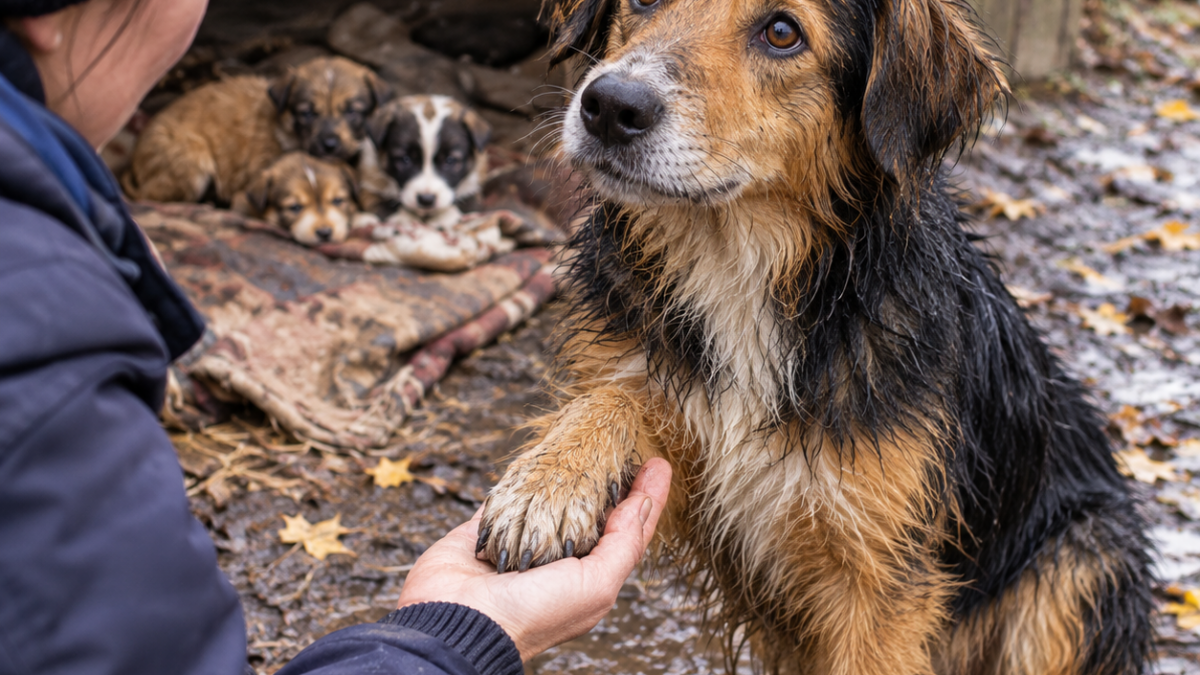
A soaked little dog kept throwing himself in front of strangers as if one person—just one—had to understand what he was trying to say. Everyone brushed past him until he grabbed the edge of my jacket, looked me straight in the eyes, and ran toward an abandoned building like he was begging me to follow. I had no idea that the next few minutes would pull me into a secret someone had worked very hard to leave behind.
It was a cold October morning, the kind that makes the whole city look gray before the day has properly begun. A fine drizzle hung in the air, and the wind tore the last yellow leaves from the trees along the small neighborhood park where I had just finished my walk. I had my hands buried in my coat pockets and my head lowered against the rain, thinking only about getting home, making coffee, and warming up.
That was when I noticed the dog near the sidewalk. He was small, reddish brown, and soaked to the skin. His fur was tangled into wet spikes, his ribs showed faintly beneath his coat, and mud covered his paws. At first, I assumed he was lost and frightened. Then I realized he was doing something very strange.
Every time someone approached, he ran toward them. He never barked aggressively or jumped. Instead, he whimpered, touched a shoe or pant leg with one paw, then darted several yards toward an old abandoned building beside the park. He would stop there, turn around, stare at the person, and wait.
Nobody followed. A woman with an umbrella stepped around him without looking down. Two teenagers laughed and kept walking. An older man waved him away with a grocery bag. Another man shouted, “Get out of here!” so sharply that the little dog flattened his ears and backed away. For a few seconds, I thought that would finally make him give up.
It didn’t. As soon as the man disappeared around the corner, the dog returned to the sidewalk and began searching the faces of strangers again. That was what made me stop. He wasn’t begging for food, and he wasn’t trying to be petted. He was asking for something.
I watched him approach a woman in a red coat, whine, tap her boot, then race back toward the same abandoned building. When she ignored him, he stood in the rain with his head lowered for barely two seconds before trying again with the next person. There was desperation in the way he moved.
“Hey, buddy,” I called softly.
His head snapped toward me. For a moment, he froze. His eyes were enormous and dark, and even from several feet away I could see how exhausted he was. Rainwater dripped from his ears, and his chest rose and fell too quickly.
I crouched and said, “What is it?”
He took two cautious steps toward me. I held out my hand, but he didn’t sniff it. Instead, he came close enough to catch the bottom edge of my jacket gently between his teeth and pulled once.
When I stood, he immediately released me and ran toward the abandoned building. Halfway there, he stopped, turned, and looked back. When I stayed where I was, he ran to me again, pawed at my shoe, made a small sound deep in his throat, and raced away.
“All right,” I whispered. “I’m coming.”
The change in him was immediate. He ran ahead but never so far that he lost sight of me, looking over his shoulder every few steps to make sure I was still there.
The building had once been some kind of storage warehouse. Most of its windows were boarded over, and weeds grew through cracks in the pavement. Behind it stood a smaller wooden shed that leaned heavily to one side, its roof black with rot.
The dog went straight to it. Broken boards, old cardboard boxes, and pieces of construction debris were piled against the lower half of the door. He began scratching frantically, then pressed his nose to a narrow gap near the bottom.
That was when I heard it: a whimper so faint I almost mistook it for the wind. Then another came from behind the door, and my stomach tightened.
I knelt beside the broken entrance. The smell hit me first—wet wood, mold, urine, and something sour enough to make my throat close. The little dog whined and shoved his nose against the gap while I pulled away one loose board, then another.
The opening widened enough for me to shine my phone flashlight inside. At first, all I saw were overturned boxes, splintered wood, and a collapsed shelf.
Then something moved beneath the debris.
I leaned closer.
And my breath stopped.
PART 2
Two eyes reflected the light from my phone.
They belonged to a dog.
She was lying on her side beneath the collapsed wooden shelf, her body wedged between a stack of rotten boards and the wall. She was larger than the reddish-brown dog outside, maybe forty-five pounds, with a pale golden coat so dirty that parts of it looked gray.
Then something moved against her stomach.
A tiny head appeared.
Then another.
Puppies.
“Oh my God.”
The little dog beside me began whining harder.
I moved the flashlight slowly.
There were four puppies curled against the trapped dog’s belly.
Three were moving.
The fourth wasn’t.
For a second, I forgot how to breathe.
The mother raised her head when she saw me. She tried to shift her body, and a low cry came from her throat.
“Don’t move,” I whispered automatically. “Please don’t move.”
Of course she had no idea what I was saying.
But the little reddish-brown dog did something that nearly broke me.
He squeezed through the narrow opening beside my arm, crawled across the debris, and went straight to her.
He licked her face.
The mother closed her eyes.
Then he turned to the puppies and nudged each one with his nose.
When he reached the puppy that wasn’t moving, he nudged harder.
Nothing.
He whimpered.
Once.
Then again.
I pulled out my phone and called emergency animal services.
The dispatcher answered almost immediately.
“I need help at the old warehouse beside Brookfield Park,” I said. “There’s a dog trapped inside a collapsing shed. She has puppies. I think one of them may be dead.”
The words sounded unreal even as I said them.
The dispatcher asked whether the building was stable.
“No.”
“Do not enter farther than you already have.”
“I can see them.”
“Rescue is on the way.”
“How long?”
“We have a unit nearby.”
Rain struck the roof harder.
I looked up.
Water was dripping through gaps in the rotten boards.
The mother dog shivered.
I removed my coat.
There was no way to reach her without crawling through the opening.
The dispatcher had specifically told me not to.
I stared at the unmoving puppy.
Then at the roof.
Then at the mother.
I made a decision I probably shouldn’t have made.
I crawled inside.
What He Had Been Trying to Tell Us
The floor was covered in nails, broken glass, and rotting wood. I pushed my coat ahead of me, using it as a barrier between my hands and the debris.
The reddish-brown dog stood beside the mother.
He didn’t bark at me.
He didn’t growl.
He simply watched.
Up close, I could see that the wooden shelf had fallen across the mother dog’s hindquarters. Most of its weight appeared to be resting on a pile of boxes, which may have been the only reason she hadn’t been crushed.
Still, she couldn’t get out.
I slid my coat around the puppies.
The mother lifted her head sharply.
“It’s okay.”
Her eyes followed my hands.
I moved slowly.
One puppy crawled toward my sleeve.
Another made a weak squeaking sound.
The fourth still did not move.
I touched him.
Cold.
My heart sank.
Then I felt something.
A tiny breath.
Barely there.
“He’s alive.”
The reddish dog stared at me.
“He’s alive, buddy.”
I scooped the puppy into my hands and opened my sweatshirt enough to hold him against my chest.
He was so cold that I could barely feel his body heat.
I rubbed him carefully with the fabric.
“Come on.”
The mother watched.
“Come on, little guy.”
Nothing.
I rubbed again.
The reddish dog moved closer and sniffed him.
Then the puppy made the smallest sound I had ever heard.
A tiny, broken squeak.
I nearly cried.
“There you are.”
Outside, I heard voices.
“Ma’am?”
“Back here!”
Flashlights appeared through the opening.
Two animal control officers and three firefighters had arrived.
One of the firefighters looked inside.
“You crawled in there?”
“Yes.”
He closed his eyes for a second.
“You need to come out.”
“The mother’s trapped.”
“We’ll get her.”
“The puppy is hypothermic.”
That changed his expression.
“Pass him to me.”
I wrapped the puppy in my sweatshirt and carefully handed him through the gap.
The reddish dog followed him toward the doorway.
Then stopped.
He looked back at the mother.
He refused to leave.
The firefighters widened the opening and began removing boards one at a time.
The work was painfully slow.
Every time they shifted something, the mother trembled.
One firefighter crawled beside me.
“We need to stabilize the shelf before we lift it.”
“How long?”
“As long as it takes to keep her from getting crushed.”
I nodded.
The little reddish dog pressed himself against her face.
That was when I noticed something.
She was licking him.
Not randomly.
Not because he was nearby.
She knew him.
They belonged together.
Whether he was the father of the puppies or simply her companion, I didn’t know.
But I suddenly understood what I had seen on the sidewalk.
He hadn’t been lost.
He hadn’t been asking strangers to rescue him.
He had escaped.
And then he had spent God knew how long trying to bring someone back.
The Rescue
It took forty-three minutes to free her.
I know because I watched every minute pass on my phone.
The firefighter used a hydraulic jack to lift the broken shelf just enough for another rescuer to pull debris away from the dog’s back legs.
The mother tried to stand.
She collapsed instantly.
“Easy,” one of them said.
They slid a rigid board beneath her and lifted her carefully.
The reddish dog followed so closely that one of the rescuers nearly stepped on him.
We carried the puppies out next.
All four were alive.
The weakest one was already wrapped in warming blankets inside the animal control vehicle.
A woman named Denise from the county rescue unit looked at the mother dog’s gums and shook her head.
“She’s dehydrated.”
“Can she walk?”
“Not right now.”
“What about her legs?”
“We won’t know until the vet takes X-rays.”
The mother dog lay on the stretcher.
The reddish dog stood beside her.
Denise reached for him.
He backed away.
“It’s okay, sweetheart.”
He backed farther.
I crouched.
“Hey, buddy.”
His eyes went to me.
I held out my hand.
This time, he sniffed it.
Then he came forward.
Denise looked at me.
“I think you’re his person right now.”
“I met him an hour ago.”
“Apparently he doesn’t care.”
I swallowed.
“Neither do I.”
I lifted him.
He was lighter than I expected.
Far too light.
The moment I placed him inside the vehicle beside the mother, he curled against her neck.
She sighed.
Not a whimper.
Not a cry.
Just one long breath.
As if the emergency was finally over.
I wish it had been.
It wasn’t.
The Veterinary Clinic
The county transported all six dogs to North Creek Animal Hospital.
I drove behind them.
I had planned to go home after my walk.
Instead, I sat in a veterinary waiting room wearing wet jeans and no sweatshirt because a half-frozen puppy was using mine.
A technician came out after twenty minutes.
“You’re the woman who found them?”
“The little dog found them.”
She smiled faintly.
“Fair enough.”
“How are they?”
“The puppies are being warmed. Mom is getting X-rays and fluids. The reddish dog is dehydrated and underweight but stable.”
“The smallest puppy?”
Her smile disappeared.
“He’s critical.”
I looked toward the treatment room.
“Can I see them?”
“Not yet.”
So I waited.
An hour passed.
Then two.
I called work and told my manager I wouldn’t be coming in.
“What happened?” she asked.
“I followed a dog into an abandoned building.”
There was a long pause.
“You know what? I’m not even going to ask. Take the day.”
At eleven forty-three, a veterinarian named Dr. Laura Kim came into the waiting room.
She sat across from me.
That scared me immediately.
Doctors sit down when the news is complicated.
“The mother dog has a fractured pelvis,” she said. “Fortunately, it appears stable enough that we may be able to manage it without surgery.”
“Will she walk?”
“I think so. She’s also severely dehydrated, underweight, anemic, and nursing four puppies, which has taken a lot out of her.”
I nodded.
“And the puppies?”
“Three are responding well.”
“And the fourth?”
Dr. Kim looked at me.
“He’s fighting.”
Not good.
Not hopeless.
Somewhere in between.
“What about the other dog?”
“The little reddish one?”
“Yes.”
“He has abrasions on his paws, probably from digging or running on rough surfaces. No fractures. He’s exhausted.”
“Do you think he’s related to them?”
Dr. Kim smiled.
“Biologically? I can’t tell you by looking.”
“He acts like he is.”
“That I can tell you.”
She opened her tablet.
“There’s something else.”
My stomach tightened.
“What?”
“The mother has a microchip.”
For the first time that morning, I felt relief.
“That’s good, right?”
“Sometimes.”
The way she said it made the relief disappear.
“Who owns her?”
“The chip is registered to a commercial breeding operation.”
I stared at her.
“Commercial?”
She turned the screen toward herself.
“Mercer Family Kennels.”
I had heard the name.
Not because I knew anything about dogs.
Because I had seen the signs.
Puppies for sale.
Purebred family companions.
Healthy litters.
Home raised.
There was a property outside town with a long gravel driveway and a large wooden sign near the highway.
I had driven past it dozens of times.
“You’re saying she came from there?”
“That’s what the registration says.”
“Have you contacted them?”
“Animal control will.”
“What about the other dog?”
“No chip.”
“The puppies?”
“Too young.”
I looked toward the treatment-room door.
“Why would a breeder leave them in a shed?”
Dr. Kim’s expression hardened.
“That’s a question for animal control.”
We Named Him Rusty
By that afternoon, the smallest puppy’s temperature had stabilized.
Barely.
Denise from animal control returned to the clinic and found me still sitting there.
“You haven’t gone home?”
“No.”
“Why?”
I looked at her.
“I’m waiting.”
“For what?”
“I don’t know.”
She laughed softly.
“I’ve met your type before.”
“What type?”
“The type that accidentally gets involved.”
I wanted to argue.
Then she handed me a cup of coffee.
I accepted it.
“Did you reach the owner?”
Her expression changed.
“We reached the number on the microchip registration.”
“And?”
“Disconnected.”
“That’s it?”
“We’re working on it.”
I glanced toward the back.
“Does the little dog have a name?”
“Not that we know of.”
“He needs one.”
“Go ahead.”
I thought about his wet reddish coat.
“Rusty.”
Denise nodded.
“Fits.”
We eventually called the mother Maggie.
The puppies were too medically fragile for official names at first, but the clinic staff gave them temporary nicknames so they could keep their charts straight.
Blue.
Pip.
Rosie.
And the smallest one, the puppy who had almost stopped breathing in my hands, became Bean.
That evening, Dr. Kim let me see Rusty.
He was lying inside a large kennel on a blanket.
The door opened.
He raised his head.
When he saw me, his tail moved.
Only once.
But it moved.
I sat on the floor.
“You made a mess of my morning.”
His tail moved again.
Then he looked toward the kennel beside his.
Maggie was there.
She was sleeping.
The puppies were in a heated incubator nearby.
Rusty stood, walked to the side of his kennel closest to Maggie, and lay down.
I understood.
“I know.”
He rested his chin on his paws.
“You weren’t trying to save yourself.”
His eyes slowly closed.
“You were trying to save everybody else.”
The First Clue
The following afternoon, Denise called me.
“I need to ask you something.”
“Okay.”
“When you entered the shed, did you see any containers?”
“What kind?”
“Dog food. Water jugs. Medication. Anything.”
I closed my eyes and pictured the room.
“There was an empty plastic bowl near the wall.”
“Anything else?”
“A torn feed bag.”
“What color?”
“I don’t know. White and green, maybe.”
“Did you touch it?”
“No.”
“Good.”
“Why?”
There was a pause.
“We found a receipt inside.”
I sat down.
“What kind of receipt?”
“Pet supply store. Dated three days before you found the dogs.”
My skin prickled.
“So somebody had been there recently.”
“Looks that way.”
“Could the dogs have wandered in?”
“Maggie couldn’t have moved far with that pelvic injury.”
“What are you saying?”
“I’m saying we’re no longer treating this as six stray dogs who happened to shelter in an abandoned building.”
I gripped the phone harder.
“Someone put them there.”
“We believe so.”
“And blocked the door?”
“Possibly.”
The image returned instantly.
Wet boards.
Boxes.
Construction debris.
A pile pressed against the entrance.
Rusty had been small enough to squeeze through a gap.
Maggie hadn’t.
My stomach turned.
“Who would do that?”
“That’s what we’re trying to find out.”
Maggie Woke Up Looking for Her Puppies
I visited the clinic after work.
Maggie was awake.
The moment a technician moved one puppy away for weighing, she tried to stand.
Her injured pelvis wouldn’t support her.
She cried out and collapsed.
Rusty went wild.
He barked from the neighboring kennel, clawing at the door.
The technician quickly returned the puppy.
Maggie stopped struggling.
Rusty stopped barking.
Everyone in the room stared at him.
Dr. Kim looked at me.
“I think we have our answer.”
“What?”
“You were wondering whether he belonged with them.”
She nodded toward Rusty.
“He does.”
Later, we opened the barrier between their recovery spaces.
Rusty walked straight to Maggie.
He sniffed each puppy.
Then he lay beside her.
Maggie rested her head across his back.
I had to look away.
Some people imagine animals love simply because we want them to.
After years around rescues, Dr. Kim had seen enough to be more cautious about humanizing behavior.
But even she whispered, “Well, there you go.”
That night, Bean crashed.
His blood sugar dropped.
His temperature fell again.
The clinic called me at 1:12 a.m.
I drove there in sweatpants.
Dr. Kim was already working on him.
He fit inside her two hands.
Maggie could hear him crying from the other room.
She became frantic.
Rusty stood beside her.
He did something I will never forget.
He licked her face.
Again and again.
Every time she tried to rise, he pressed against her shoulder until she settled.
As if he understood that there was nothing either of them could do except wait.
Bean survived the night.
At sunrise, Dr. Kim leaned against the wall and closed her eyes.
“He’s ridiculous.”
“What?”
“He should not be doing this well.”
I laughed through tears.
“Maybe he takes after Rusty.”
The Man Who Came to the Clinic
Three days later, I was visiting when shouting erupted in the lobby.
A man’s voice.
Loud.
Angry.
“I said those are my dogs.”
I froze.
Denise, who happened to be there collecting records, turned toward the door.
“Stay here.”
Of course I followed her.
The man at the front desk was in his early fifties, broad-shouldered, with a dark work jacket and a baseball cap bearing the words MERCER FAMILY KENNELS.
My heart began pounding.
He slapped his hand against the counter.
“You have no right to hold my property.”
Dr. Kim stepped from the hallway.
“Sir, lower your voice.”
“I’m here for Maggie and the puppies.”
Not Rusty.
I noticed that immediately.
Denise noticed too.
“You’re Wade Mercer?”
He looked at her uniform.
“Who are you?”
“County Animal Services.”
His entire posture changed.
Only a little.
But enough.
Denise continued.
“Are you claiming ownership of the female dog and four puppies recovered from the Brookfield warehouse?”
“Yes.”
“Do you also own the reddish-brown male?”
His eyes moved past us.
He saw Rusty through a glass door.
His expression became strange.
Recognition.
Then irritation.
“No.”
Rusty saw him.
Every hair along Rusty’s back rose.
He didn’t bark.
He retreated.
All the way to the back wall.
That frightened me more than barking would have.
Denise watched closely.
“You’ve never seen that dog?”
“No.”
Rusty began trembling.
I looked at Wade.
“You’re lying.”
His eyes snapped toward me.
“Who the hell are you?”
“The person Rusty found.”
“Rusty?”
“The dog you’ve supposedly never seen.”
His jaw tightened.
Denise stepped between us.
“Ms. Bennett, please.”
Wade pointed toward the treatment area.
“I want my dogs.”
Denise’s voice remained calm.
“They are currently being held as part of an active neglect and abandonment investigation.”
“Abandonment?”
He laughed.
“I didn’t abandon anything.”
“How did Maggie end up in that shed?”
“No idea.”
“You’re her registered owner.”
“She got loose.”
“With four nursing puppies?”
He shrugged.
“Animals do strange things.”
“And a fractured pelvis?”
“Maybe she got hit by a car.”
I felt my hands curl into fists.
Denise didn’t move.
“When did you last see her?”
Wade hesitated.
“Couple weeks.”
“Two weeks?”
“Something like that.”
“You didn’t report her missing.”
“I figured she’d come back.”
“With four puppies?”
He looked annoyed.
“I’m done answering questions.”
Denise nodded.
“That’s your choice.”
He turned toward Dr. Kim.
“Give me my dogs.”
“No.”
The word was quiet.
Wade stared at her.
Dr. Kim stood perfectly still.
“You can leave now.”
His face reddened.
“You think you can steal a three-thousand-dollar litter from me?”
Silence.
Complete silence.
Denise tilted her head.
“A three-thousand-dollar litter?”
Wade realized too late what he had said.
I saw it happen.
The anger vanished from his eyes.
Calculation replaced it.
Denise pulled out her notebook.
“How do you know the value of the puppies if you haven’t seen Maggie in weeks and didn’t know where she was?”
Wade stepped backward.
“I’m calling my lawyer.”
“Excellent.”
He left.
The front door slammed behind him.
For several seconds, nobody spoke.
Then Denise looked at me.
“Did you hear him say that?”
“Every word.”
“Good.”
She wrote it down.
The Story Wade Told
Wade’s attorney contacted the county the next morning.
According to the new version of events, Maggie had escaped from Mercer Family Kennels nearly two weeks earlier.
She had supposedly been pregnant when she escaped.
Wade claimed he had searched for her privately but had not filed a missing-dog report because he expected her to return.
There were immediate problems with that story.
Dr. Kim estimated the puppies were roughly ten days old when we found them.
Which meant Maggie would have given birth after supposedly escaping.
Except there was no evidence she had walked miles from Mercer’s property.
More importantly, her fractured pelvis was not new.
Imaging showed signs of healing.
She had been injured before the puppies were born.
Walking the distance from Wade’s kennel to the abandoned warehouse would have been nearly impossible.
Then there was Rusty.
Wade insisted he had never seen him.
Rusty’s body disagreed.
Whenever Wade’s voice played on a recording from the clinic security system, Rusty’s ears flattened.
When Denise showed him Wade’s baseball cap in an evidence bag, he backed away.
Behavior alone couldn’t prove ownership.
But it told us where to look.
Investigators obtained permission to inspect Mercer Family Kennels.
What they found changed everything.
Behind the White Fence
Mercer Family Kennels looked beautiful from the road.
That was the first thing that shocked me.
White fencing.
Fresh paint.
A large wooden sign.
Pictures online showed puppies sitting on blankets, children holding fluffy dogs, and smiling families beside Wade.
The website used words like ethical.
Responsible.
Family-raised.
Loved from birth.
Animal control entered the property with a warrant related to Maggie’s case.
Behind the main house was another building.
The public never saw that part.
There were twelve kennels inside.
Some were clean.
Some weren’t.
Eight adult dogs lived there.
Several had untreated skin infections.
One had an injured paw.
Another was painfully thin.
Then investigators found a small room at the back.
Inside were veterinary documents.
Breeding records.
Sales records.
And photographs.
One photograph showed Maggie.
Beside her was Rusty.
I saw the picture later.
They were younger.
Maggie’s coat was clean.
Rusty sat beside her wearing a blue collar.
On the back, written in black marker, were two words.
MAGGIE + RED.
Red.
That had been Rusty’s name.
Wade had lied directly to an investigator.
He knew him.
Not only that.
Records identified Rusty as one of the male dogs Wade had used for breeding.
For years.
When Rusty became older and less profitable, his name disappeared from the records.
Maggie’s breeding history was worse.
Litter after litter.
One almost every year.
Her final pregnancy had apparently been accidental—or inconvenient.
Because the records ended before the four puppies were born.
There was a handwritten note next to Maggie’s name.
HIP BAD.
NO MORE.
I stared at those words until they blurred.
Hip bad.
No more.
Not “needs treatment.”
Not “retire.”
Not “find home.”
Just no more.
As if she were a broken machine.
The Camera Across the Street
The strongest evidence came from a place nobody expected.
Across from the abandoned warehouse was a small auto repair shop.
It had been closed the morning I found Rusty because the owner was on vacation.
But a camera mounted above the garage doors recorded the street twenty-four hours a day.
The owner gave investigators the footage.
At 11:47 p.m., two nights before Rusty stopped me, a white cargo van pulled behind the abandoned building.
Its license plate was difficult to read.
The driver stepped out.
Wade Mercer.
Even in grainy black-and-white video, there was no mistaking the shape of his face.
He opened the rear doors.
First he removed Maggie.
She couldn’t walk properly.
He dragged her using a looped leash.
Then he carried a cardboard box.
The puppies.
Finally, Rusty jumped from the van.
Wade tried to grab him.
Rusty dodged away.
The camera showed Wade kicking toward him.
He missed.
Rusty ran behind the building.
Wade disappeared into the shed with Maggie and the box.
Nine minutes later, he came out alone.
He began stacking debris against the entrance.
My hands went cold.
He wasn’t simply leaving them.
He was making it harder for them to get out.
Then he entered the van.
Rusty appeared.
He ran toward it.
The video had no sound.
But I watched him chase the van for nearly half a block.
Wade drove away.
Rusty followed until he disappeared from the camera.
Denise stopped the recording.
I stared at the frozen screen.
“He came back.”
“What?”
“Rusty.”
Denise nodded.
“He must have.”
He had chased the person who abandoned them.
Then, sometime during that cold night, he returned to the shed.
He found a gap.
He got inside.
And when he realized Maggie and the puppies couldn’t follow him out, he went looking for a human.
That was what he had been doing when I saw him.
For possibly two days.
Running between the shed and the sidewalk.
Asking person after person.
Being ignored.
Being shouted at.
Going back.
Trying again.
I covered my mouth.
“He never left them.”
Denise’s eyes were wet too.
“No.”
Wade Was Arrested
The arrest happened the following morning.
Animal cruelty.
Abandonment.
Providing false information during an investigation.
Additional charges were under review.
The county also obtained temporary custody of the dogs remaining at his kennel.
Wade’s attorney immediately went on the offensive.
He claimed the video was misleading.
He claimed he had left Maggie in the shed temporarily because she was “aggressive” and unsafe around his other dogs.
He claimed he intended to return.
He claimed the boards outside the entrance had already been there.
He claimed Rusty had attacked livestock.
He claimed nearly everything except responsibility.
Then his attorney attacked me.
Not directly.
Through court documents.
I was described as an emotionally involved civilian who had interfered with evidence.
That part hurt because it was technically possible that crawling into the shed had disturbed the scene.
I began wondering whether I had damaged the case.
Denise called me one evening.
“You did what you believed was necessary to save a freezing puppy.”
“But I moved things.”
“We documented what we could.”
“What if his lawyer uses that?”
“He will.”
My stomach dropped.
“Great.”
“Claire.”
“Yes?”
“The video exists.”
I closed my eyes.
“He put them there.”
“Yes.”
“He blocked the door.”
“The footage shows him moving debris.”
“He lied about Rusty.”
“Yes.”
“And you have his records.”
“Yes.”
“Then why am I still terrified he’ll get away with it?”
Denise was quiet for a moment.
“Because you care what happens.”
Bean Finally Opened His Eyes
While the legal battle grew uglier, Bean did something far more important.
He opened his eyes.
I happened to be there.
Dr. Kim called me into the puppy room.
“Look.”
Bean was lying beside Maggie.
His eyes were barely open, tiny dark slits.
I started laughing.
“That’s it?”
Dr. Kim looked offended.
“Excuse me?”
“I expected something dramatic.”
“He nearly died six times.”
“Five.”
“Six.”
“When was six?”
“Tuesday.”
“You didn’t tell me.”
“You needed sleep.”
I picked Bean up carefully.
He fit against my chest.
Maggie watched me.
She no longer panicked when I touched her puppies.
That trust meant more than I knew how to explain.
Rusty walked over and sniffed Bean.
Bean squeaked.
Rusty immediately licked his face.
Dr. Kim sighed.
“He’s going to be obnoxiously protective, isn’t he?”
“He earned the right.”
Maggie Took Her First Steps
Three weeks after the rescue, Maggie stood without assistance.
Only for a few seconds.
Dr. Kim had warned us not to expect a straight line of recovery.
Some days Maggie improved.
Other days she seemed exhausted.
She had spent too long underweight, injured, pregnant, nursing, and frightened.
Her body had been asked to survive more than it should have.
Physical therapy began slowly.
We used a support sling beneath her abdomen.
At first, she hated it.
Rusty walked beside her.
Every time Maggie stopped, he stopped.
Every time she moved, he moved.
One afternoon she took eight steps.
Then twelve.
Then eighteen.
I crouched at the opposite end of the rehabilitation room.
“Come on, Maggie.”
She looked at me.
Rusty stood beside her.
“Come on, sweetheart.”
She took one step.
Then another.
Her back legs shook.
Halfway across the room, I expected her to stop.
Instead, Rusty moved slightly ahead.
Maggie followed him.
When she reached me, I wrapped my arms around her neck.
She froze.
I immediately loosened my hold.
Then her head lowered onto my shoulder.
Dr. Kim looked away.
“You’re crying again.”
“So are you.”
“I have allergies.”
“In November?”
“Very aggressive allergies.”
The Threat
The first direct threat came four days before the custody hearing.
I found an envelope under my windshield wiper after leaving work.
There was no stamp.
No name.
Inside was a single sheet of paper.
STOP MAKING THIS YOUR BUSINESS.
That was all.
I stood in the parking lot staring at the words.
My first instinct was anger.
My second was fear.
I looked around.
Nobody.
I called Denise.
“Don’t touch it more than you already have.”
“Too late.”
“Put it in a plastic sleeve if you have one.”
“I work at a library. Of course I have one.”
That made her laugh.
Only briefly.
Then her voice became serious.
“Claire, listen to me. Do not confront Wade.”
“I wasn’t planning to.”
“Do not go near his property.”
“I won’t.”
“If anyone follows you, call police.”
The reality settled into my chest.
“This is getting ridiculous.”
“No. It’s getting serious.”
Police collected the note.
There was no usable fingerprint.
No proof Wade had left it.
His attorney denied any involvement.
I told myself it didn’t matter.
Then someone slashed one of my tires.
That mattered.
Rusty Came Home With Me
By then, the clinic needed space.
Maggie still required medical supervision, but Rusty was healthy enough for foster care.
The county asked whether I would take him temporarily.
I said yes before Denise finished the question.
The first night in my house, Rusty refused to sleep.
I put a dog bed beside my couch.
He paced from the front door to the back door.
Front.
Back.
Front.
Back.
Every few minutes, he looked at me.
“You’re safe.”
He didn’t believe me.
At midnight, I lay on the couch.
Rusty stood at the front door.
At one, he stood at the back.
At two thirty, I woke to silence.
I looked down.
He was lying beside the couch.
Not on the bed.
On the floor.
His chin rested on my slipper.
The next morning, I opened the back door.
Rusty stepped onto the porch.
Then he turned immediately to check whether I was still there.
“I’m not leaving.”
He walked into the yard.
He sniffed the grass.
Then hurried back.
For the first week, he never stayed outside unless he could see me.
I eventually understood why.
He had watched a van drive away once.
He wasn’t taking chances again.
The Hearing
The temporary custody hearing was held six weeks after the rescue.
Wade arrived wearing a suit.
It was strange seeing him without his kennel jacket.
He looked ordinary.
That bothered me.
We like villains to look like villains.
It makes the world easier to understand.
But Wade looked like someone who might stand behind you at a grocery store.
Someone who might hold a door open.
Someone who might smile in family photographs.
His attorney argued that the dogs were valuable property wrongfully seized by the county.
Valuable property.
I looked down at my hands.
The judge reviewed the evidence.
Microchip records.
Veterinary reports.
Breeding records.
The security footage.
Photographs from the kennel.
Wade’s attorney tried to explain the abandoned building.
“My client intended the location as a temporary shelter.”
The judge looked over her glasses.
“A collapsing structure without food or potable water?”
“My client intended to return.”
“He blocked the entrance.”
“That characterization is disputed.”
The county attorney played the video.
Nobody spoke.
We watched Wade drag Maggie from the van.
We watched him carry the puppies inside.
We watched him stack debris.
Then we watched Rusty chase the van.
The judge’s expression changed.
Wade’s attorney stood.
“Your Honor—”
“Sit down.”
He sat.
The video ended.
The judge looked at Wade.
“You represented through counsel that this was a temporary arrangement.”
Wade said nothing.
“Did you intend to return that night?”
His lawyer touched his arm.
Wade remained silent.
The judge continued.
“Did you seek veterinary care for the injured female before leaving her there?”
Silence.
“Did you leave food?”
Nothing.
“Water?”
Nothing.
“Any means of contacting you?”
Nothing.
The judge looked at the county attorney.
“Temporary custody remains with the county. None of these animals are to be returned to Mr. Mercer pending disposition of the criminal matter.”
I exhaled for what felt like the first time in an hour.
Then Wade turned.
His eyes found me.
The look he gave me was not loud.
It was worse than loud.
It was a promise.
The Break-In
Two nights later, someone tried to enter the veterinary clinic.
At 2:17 in the morning, the rear alarm went off.
Police arrived within minutes.
The person had already fled.
The lock showed fresh damage.
Nothing had been taken.
At first, nobody could prove who had done it.
Then police found a truck parked behind a closed grocery store three blocks away.
Wade’s truck.
He claimed it had been stolen.
The keys were in his pocket.
That changed the investigation.
Security footage from a nearby intersection showed the same truck driving toward the clinic shortly before the alarm.
It still wasn’t enough to prove Wade himself had touched the door.
Then Dr. Kim found something on the ground near the damaged lock.
A baseball cap.
MERCER FAMILY KENNELS.
When Denise told me, I actually laughed.
Not because the situation was funny.
Because after weeks of Wade insisting everyone else was stupid, careless, emotional, dishonest, or confused, he had apparently lost his own branded hat while sneaking around a veterinary clinic at two in the morning.
His attorney called it circumstantial.
Police called it evidence.
Wade was arrested again, this time on charges related to attempted unlawful entry.
His bail conditions became much stricter.
A no-contact order followed.
For the first time since finding the note on my car, I slept through the night.
Rusty didn’t.
At three in the morning, I woke to him sitting beside my bed.
I reached down.
He rested his chin in my hand.
“You know something I don’t?”
His tail moved.
“Probably.”
The Puppies Grew
By December, the puppies looked nothing like the fragile creatures from the shed.
Blue was enormous.
Pip had discovered barking and seemed determined to practice professionally.
Rosie climbed everything.
Bean remained the smallest.
He also had the biggest personality.
The puppy who had once been too weak to lift his head now stole blankets from his siblings and dragged food bowls across the room.
Dr. Kim called him a menace.
She adored him.
Maggie began walking without a sling.
She had a slight limp.
She probably always would.
But she could walk.
Rusty returned to the clinic three times a week so he could see her and the puppies.
The first reunion after a two-day separation almost destroyed me.
The moment Maggie saw him, her tail began moving so hard that her entire body wiggled.
Rusty ran to her.
They touched noses.
Then he inspected every puppy.
Bean bit his ear.
Rusty tolerated it.
I sat on the floor.
Dr. Kim watched from the doorway.
“You know you have a problem.”
“What?”
“You’re going to adopt him.”
“I’m fostering him.”
“Sure.”
“I am.”
“Claire.”
“I am.”
Rusty walked over and climbed into my lap.
Dr. Kim folded her arms.
I looked down at him.
“This proves nothing.”
The People Wade Had Fooled
Once the case became public record, former customers began contacting investigators.
The picture of Mercer Family Kennels started to change.
One family had purchased a puppy that developed severe hip problems before its first birthday.
Another had been promised health records that never arrived.
A woman named Jennifer had worked at the kennel for six months.
Her statement became crucial.
She told investigators that Wade had a pattern.
Dogs that produced profitable litters stayed.
Dogs that became old, sick, infertile, or expensive disappeared.
“Where did they go?” the investigator asked her.
Jennifer said Wade always claimed they had been rehomed.
“Did you ever meet the adopters?”
“No.”
“Did you ever see paperwork?”
“No.”
“Did you believe him?”
Jennifer cried when she answered.
“At first.”
There were eleven dogs whose final outcomes could not be confirmed.
Eleven.
We never learned what happened to all of them.
That fact still bothers me.
But Jennifer remembered Rusty.
“Red,” she called him.
“He was sweet.”
She remembered Maggie too.
“She always stayed close to him.”
According to Jennifer, when Maggie’s hip deteriorated, Wade refused to spend money on diagnostic imaging.
A few weeks later, Maggie became pregnant.
Wade was furious.
Not because she was sick.
Because he thought the litter might cost more than it would earn.
Jennifer left the kennel not long afterward.
Months later, Rusty and Maggie ended up in the shed.
The pieces fit together.
And Wade’s story collapsed.
Maggie Was Finally Cleared for Foster Care
Three months after I found them, Dr. Kim called me.
“Maggie can leave.”
I nearly dropped my phone.
“You’re serious?”
“As long as her foster understands medication, activity restrictions, and follow-up therapy.”
“I understand all of that.”
Silence.
“Laura?”
“You already have Rusty.”
“Yes.”
“And now you want Maggie.”
“Yes.”
“Your house is small.”
“Yes.”
“You said you weren’t adopting Rusty.”
“I’m not.”
“You bought him a personalized food bowl.”
“That was on sale.”
“It says RUSTY.”
“It was a very specific sale.”
She started laughing.
That Saturday, Maggie came home.
Rusty knew before I opened the car door.
He began screaming.
Not barking.
Screaming.
Maggie answered from the back seat.
I opened the door.
Rusty ran down the walkway.
Maggie tried to jump from the car.
“Absolutely not.”
I helped her down.
The moment her paws touched the ground, Rusty reached her.
For almost a minute, they circled each other, whining, licking faces, wagging so hard they could barely stand.
Then Maggie noticed my house.
She stopped.
Rusty ran to the front door.
Looked back.
Exactly the way he had looked at me beside the abandoned warehouse.
Come on.
Maggie followed him.
I stood behind them with tears streaming down my face.
He had led me to her once.
Now he was leading her home.
Maggie’s First Bed
Maggie didn’t understand the couch.
She didn’t understand dog beds either.
The first night, she lay on the kitchen floor.
I put a thick orthopedic bed beside her.
She sniffed it.
Walked around it.
Then returned to the tile.
Rusty climbed onto the bed.
Maggie watched him.
He turned in a circle.
Lay down.
Looked at her.
Maggie stood.
She placed one paw on the cushion.
Then another.
Slowly, carefully, she lowered herself beside him.
Rusty shifted to make room.
Within ten minutes, both were asleep.
I sat on the kitchen floor and watched them.
The bed cost forty-two dollars.
I would have paid four thousand.
Wade’s Last Attempt
By spring, prosecutors had assembled a case strong enough that Wade’s attorney began discussing a plea agreement.
Wade refused.
He wanted trial.
I was told I might testify.
The idea terrified me.
Then, two weeks before jury selection, something happened that ended almost every argument his defense had left.
A county investigator received a message from an anonymous email address.
Attached were photographs.
One showed Maggie inside the kennel months before the abandonment.
Another showed Rusty.
Another showed Wade loading both dogs into the white van.
Then came a short video.
Jennifer had recorded it on her phone before she quit.
She had never sent it because she was afraid.
In the video, she confronted Wade about Maggie.
“She needs a vet.”
“She needs to stop costing me money.”
“She can barely walk.”
“Then she’s no good to me.”
“What are you going to do with her?”
Wade looked directly at the camera.
“Not your problem.”
His own voice.
His own face.
His own words.
There was nothing left to reinterpret.
I watched the video once.
Only once.
Denise watched me afterward.
“You okay?”
“Yes.”
“You don’t look okay.”
“I’m thinking about Rusty.”
“What about him?”
I swallowed.
“He knew.”
Denise frowned.
“Knew what?”
“He knew humans could be cruel.”
I thought of that wet morning.
“He had every reason not to trust anyone.”
I looked at her.
“And he still went looking for us.”
Justice
Wade changed his plea four days before trial.
Guilty.
Not to everything prosecutors had originally sought, but enough.
Multiple counts related to animal neglect and abandonment.
Attempted unlawful entry.
False statements tied to the investigation.
The kennel license was revoked.
He was prohibited from operating a breeding business.
He was barred from owning or possessing animals for a lengthy period under the court order.
He was ordered to pay substantial restitution toward veterinary expenses and the county’s cost of caring for the seized dogs.
He received jail time followed by supervised probation.
Some people wanted more.
I understood.
When you know what happened inside that shed, almost any sentence feels too small.
No judge could return Maggie’s health.
No fine could erase Rusty’s terror.
No court order could explain what happened to every dog that disappeared from Wade’s records.
But punishment was only part of justice.
The other dogs from Mercer Family Kennels were legally surrendered.
Every one of them received veterinary treatment.
Every one eventually went to a rescue or adoptive home.
The wooden sign beside Wade’s driveway came down.
Mercer Family Kennels disappeared.
The website vanished.
The breeding operation ended.
The business that had turned animals into inventory was gone.
And the dog Wade had dismissed as “Red,” the dog he tried to leave behind as if he were worthless, had been the one who brought everything down.
Not because Rusty attacked him.
Not because anyone took revenge with violence.
Rusty simply refused to disappear.
He escaped.
He returned for his family.
He found the sidewalk.
And he kept asking humans for help until one finally listened.
That was all it took.
The Puppies Went Home
Blue was adopted first.
A firefighter named Mike had been part of the crew that freed Maggie from beneath the shelf.
His wife came to visit.
Then his children.
Blue climbed into their daughter’s lap and fell asleep.
The adoption was basically over at that point.
Pip went to a retired teacher who had recently lost her senior dog.
Rosie was adopted by one of the veterinary technicians.
Bean stayed longest.
Partly because Dr. Kim kept inventing medical reasons to delay his adoption.
“He needs another weight check.”
“You weighed him yesterday.”
“I don’t trust yesterday.”
A week later:
“I want to monitor his gait.”
“He’s running in circles.”
“Suspicious circles.”
Finally, I walked into the clinic and found adoption paperwork on her desk.
Applicant:
Laura Kim.
I started laughing.
“You hypocrite.”
She covered the paper.
“You saw nothing.”
“You called me predictable for adopting Rusty.”
“I have not adopted Bean.”
“Your name is on the form.”
“Preliminary research.”
Bean ran into the room carrying one of her socks.
I pointed.
“He lives with you.”
“Temporary arrangement.”
“Of course.”
She adopted him officially that afternoon.
I Failed at Fostering
My own adoption decision happened without ceremony.
Denise came to my house carrying paperwork.
Rusty was asleep on my couch.
Maggie was beside him.
“You know why I’m here.”
“To admire my excellent interior design?”
“No.”
“The dogs?”
“Yes.”
“What about them?”
“They’re legally available.”
I looked at Rusty.
He opened one eye.
Maggie didn’t move.
Denise placed two adoption forms on my table.
“You can sign them or I can start reviewing applicants.”
I stared at her.
“You would let someone else adopt them?”
“Of course.”
“Together?”
“If possible.”
“Where?”
“We have several good applicants.”
I hated every imaginary person instantly.
Denise smiled.
“There it is.”
“What?”
“The face.”
“What face?”
“The face people make right before they admit they’ve already adopted the dog emotionally.”
“I haven’t.”
“Claire.”
Rusty got off the couch.
He walked over.
Placed his chin on my knee.
Maggie followed and sat beside him.
I looked at them.
Then at Denise.
“Do you have a pen?”
She handed me one immediately.
“You brought your own pen?”
“I’ve done this before.”
I signed both forms.
Rusty Bennett.
Maggie Bennett.
I stared at the names.
Something inside me settled.
“Okay.”
Denise smiled.
“Okay.”
Maggie leaned against my leg.
Rusty licked my hand.
I had gone for a walk one cold October morning.
I came home months later with a family.
Returning to the Shed
I avoided the abandoned warehouse for almost a year.
I drove different streets.
Walked different routes.
The place held too many memories.
Then one October morning, almost exactly a year after I first saw Rusty, I decided to go back.
I brought both dogs.
The warehouse was being demolished.
The city had finally declared the structures unsafe.
Most of the shed was already gone.
Only part of one wall remained.
Rusty saw the property from across the street.
He stopped.
Maggie stopped beside him.
I felt the leash tighten.
“We don’t have to.”
Rusty stared.
His ears moved forward.
Then backward.
Maggie pressed against him.
For nearly a minute, none of us moved.
Then Rusty took one step.
I followed.
Maggie followed him.
We crossed the street.
He approached the place where the shed had stood.
There was no door anymore.
No pile of boards.
No collapsed shelf.
Just mud, broken concrete, and yellow caution tape.
Rusty sniffed the ground.
Maggie stood beside him.
I expected fear.
Instead, Rusty lifted his leg and peed on the remains of the shed.
I burst out laughing.
A construction worker turned around.
“Everything okay?”
“Perfect.”
Maggie sniffed the same spot.
Then walked away.
Rusty followed her.
That was it.
No dramatic breakdown.
No trembling.
No looking back.
The place that had nearly killed them no longer mattered.
Because it wasn’t home.
It had never been home.
Home was waiting across town.
Two orthopedic beds.
A ridiculous collection of toys.
A backyard.
A refrigerator containing chicken I pretended wasn’t specifically for them.
A couch I had once sworn dogs would never be allowed on.
And me.
Rusty Still Stopped Strangers
There was one behavior Rusty never completely lost.
He liked people.
That surprised me more than anything.
After everything humans had done to him, he still believed strangers might be worth meeting.
At the park, he sometimes walked toward people and touched their shoes with his paw.
The first time he did it, my heart nearly stopped.
A woman looked down.
“Oh, hello.”
Rusty wagged.
Then he looked at me.
I laughed.
“He used to do that for a different reason.”
The woman scratched his ears.
“What reason?”
I looked at Rusty.
“It’s a long story.”
He leaned against her leg.
She smiled.
“Well, he’s very persuasive.”
“You have no idea.”
Maggie Learned to Run
Maggie’s hip never fully recovered.
She always walked with a slight unevenness.
Dr. Kim warned me that arthritis would eventually become a bigger problem.
But one spring morning, something extraordinary happened.
A squirrel ran across my backyard.
Maggie saw it.
Her entire body changed.
Ears forward.
Eyes wide.
Tail up.
The squirrel ran.
Maggie ran too.
Not gracefully.
Not quickly.
But she ran.
Rusty ran beside her.
For six or seven seconds, both dogs raced across the yard.
I stood on the porch screaming.
“Go, Maggie!”
She reached the fence long after the squirrel had disappeared.
Then she turned toward me.
Her mouth was open.
Her tail wagged.
Rusty bounced around her like he had personally arranged the entire event.
I laughed until I cried.
For years, Maggie’s body had been valued only for what it could produce.
Puppies.
Money.
More puppies.
That morning, her body belonged only to her.
She ran because she wanted to.
Nothing more.
Nothing less.
The Letter
Two years after Wade’s conviction, I received a letter.
The return address was the correctional facility where he had served part of his sentence.
He had already been released by the time it arrived.
I almost threw it away unopened.
Then curiosity won.
The letter was short.
He didn’t apologize.
Not really.
He wrote that the media had “destroyed his reputation.”
He said people had misunderstood breeding.
He claimed that losing his business had ruined his life.
Near the end was one sentence that made my hands stop shaking.
I hope you’re happy with what you did.
I read it again.
Then I looked across the room.
Rusty was asleep upside down on my couch.
All four paws in the air.
Maggie was beside the window, lying in a patch of sunlight.
I looked back at the letter.
Was I happy?
No.
I wasn’t happy that Maggie had suffered.
I wasn’t happy Rusty had spent two days begging strangers to help.
I wasn’t happy eleven dogs remained unaccounted for.
I wasn’t happy that Bean had almost died.
But was I sorry Wade had lost the business that made those things possible?
Not for a second.
I took a piece of paper.
I considered answering.
I wanted to write about the freezing shed.
The fractured pelvis.
The puppies.
The security footage.
The dogs seized from his property.
I wanted to ask whether he remembered Rusty chasing his van.
Then I looked at Maggie sleeping in the sunlight.
I tore up the blank paper.
Wade didn’t deserve another minute of their lives.
I threw his letter away.
That was the final revenge.
Not hatred.
Indifference.
He no longer mattered.
Three Years Later
Rusty’s muzzle began turning gray.
Maggie’s had already gone almost white.
Bean visited often because Dr. Kim and I had become friends.
He grew into a sturdy, ridiculous dog with no understanding that he had once been the size of a potato.
Whenever he visited, Maggie still cleaned his ears.
Rusty still inspected him.
Bean tolerated both of them with the weary patience of an adult child visiting embarrassing parents.
The other puppies occasionally returned for reunions.
Blue was huge.
Pip still barked.
Rosie remained a climber.
All four were healthy.
Every year, we took a photograph.
Maggie in the middle.
Rusty beside her.
The four grown puppies surrounding them.
The first photograph was chaotic.
The second was worse.
By the third year, we stopped trying to make everyone look at the camera.
Those photographs became my favorite things in the house.
The Morning Maggie Couldn’t Stand
Time does what cruelty couldn’t.
It catches everyone.
Maggie was older than we initially believed.
We estimated she was somewhere between ten and twelve when I found her.
By our fourth winter together, her arthritis had worsened.
Medication helped.
Physical therapy helped.
Warm blankets helped.
Rusty helped most.
He still slept against her.
Then one February morning, Maggie tried to stand and couldn’t.
I heard her nails scrape against the floor.
Rusty began whining.
I ran downstairs.
“Maggie?”
She looked at me.
Her eyes were calm.
That frightened me.
I helped her upright.
Her back legs folded.
I carried her to the car.
Rusty came with us.
Dr. Kim examined her.
X-rays.
Bloodwork.
More tests.
Then she sat beside me.
I recognized the look immediately.
“No.”
“Claire.”
“No.”
Rusty stood beside Maggie’s blanket.
He had been trembling for twenty minutes.
Dr. Kim spoke softly.
“Her pain is becoming difficult to control.”
“We can change medication.”
“We have.”
“Then change it again.”
“We can keep trying.”
“Good.”
She touched my arm.
“But there may come a point where we’re keeping her here because we’re afraid to let her go.”
I hated her for saying it.
For nearly five seconds.
Then I hated myself because I knew she was right.
I looked at Maggie.
She was watching Rusty.
He lay beside her.
She rested her muzzle across his paws.
The same way she had in the clinic years earlier.
I began crying.
“How long?”
“Maybe days. Maybe a few weeks. I can’t promise.”
“I want her home.”
Dr. Kim nodded.
“Then take her home.”
Maggie’s Last Good Day
Three days later, the sun came out.
It had been cloudy for nearly a week.
Maggie loved sunlight.
I carried her bed into the backyard.
Rusty followed.
I helped Maggie onto the cushion.
She lifted her face.
Closed her eyes.
Warm sunlight touched her white muzzle.
Bean came.
So did Blue, Pip, and Rosie.
Their families stood quietly near the porch.
At first, I worried it would overwhelm her.
It didn’t.
Maggie smelled each one.
Bean lay beside her.
Blue rested nearby.
Pip, incredibly, stayed quiet.
Rosie licked Maggie’s ear.
Rusty sat on the other side.
For one afternoon, the whole family was together.
Not in a breeding kennel.
Not in a collapsing shed.
Not trapped.
Not for sale.
Just together.
I sat in the grass.
Dr. Kim sat beside me.
“She did pretty well.”
I nodded.
“She got four years.”
“Four good years.”
“It doesn’t feel like enough.”
“It never does.”
Late in the afternoon, the other dogs went home.
Maggie was exhausted.
I lay beside her.
Rusty pressed against her back.
The sun began dropping behind the trees.
I ran my hand over Maggie’s head.
“You did everything you were supposed to do.”
Her eyes opened.
“You raised your babies.”
Her tail moved once.
“You survived him.”
Another tiny movement.
“You found us.”
Technically Rusty had found me.
But Maggie had done her part.
She had stayed alive long enough for him to bring help.
I kissed her forehead.
“You can rest now.”
Dr. Kim came that evening.
Maggie died at home.
Her head was in my lap.
Rusty’s nose touched hers.
The last sound she heard was me telling her she was loved.
The last place she saw was home.
Rusty Grieved
For three weeks, Rusty searched for her.
That was harder to watch than I expected.
He checked her bed.
The backyard.
The hallway.
He stood beside the front door whenever a car pulled in.
At night, he wandered.
I moved Maggie’s blanket beside his bed.
He slept on it.
Bean began visiting more often.
The first time he came after Maggie died, he searched the entire house.
Then he walked to Rusty.
They touched noses.
Bean lay down beside him.
Rusty rested his head across Bean’s back.
I left the room because I couldn’t watch without crying.
Eventually, Rusty stopped searching.
He didn’t forget.
Neither did I.
But grief changed shape.
It became quieter.
Five Years After the Rain
Five years after I first followed Rusty, the old warehouse property looked completely different.
The city had cleared it.
A nonprofit later leased part of the land for a small community garden and dog-friendly green space.
Someone who knew Rusty’s story donated a bench.
There was a small plaque.
Not his entire story.
Just a sentence:
FOR THE DOG WHO KEPT ASKING UNTIL SOMEONE LISTENED.
The first time I saw it, I cried.
Of course.
Rusty was older now.
His legs were stiff.
He walked slowly.
But when we entered the park, he recognized the path.
I knew he did.
He stopped near the sidewalk where I had first seen him.
People passed.
A young man jogging.
A woman pushing a stroller.
An elderly couple.
Rusty watched them.
Then he walked toward the woman with the stroller.
He gently touched her shoe with one paw.
My heart stopped.
She looked down.
“Oh, aren’t you sweet?”
Rusty wagged his tail.
Then, instead of running toward the old shed, he turned and walked back to me.
The woman smiled.
“Is he yours?”
I looked at him.
“Yes.”
Rusty stood beside my leg.
“He is.”
She scratched his ears.
“He seems special.”
I swallowed.
“He is.”
The Lesson Rusty Left Me
People sometimes asked why nobody helped him sooner that morning.
I used to wonder the same thing.
I was angry at the people who walked around him.
Angry at the man who shouted.
Angry at everyone who saw a wet, frightened dog behaving strangely and decided it wasn’t their problem.
Then I realized something uncomfortable.
On another morning, I might have been one of them.
If I had been late for work.
If I had been on the phone.
If it had been raining harder.
If I had looked the other direction.
That thought stayed with me.
We imagine life-changing moments will announce themselves.
They rarely do.
Sometimes they look like an inconvenience.
A strange noise.
A dog near a sidewalk.
Someone asking for help in a language we don’t understand.
Rusty had no words.
So he used everything he had.
His paws.
His voice.
His eyes.
His teeth gently pulling my jacket.
Then he trusted me to follow.
His Final Winter
Rusty lived almost six years after the morning we met.
The last winter was quiet.
He slept more.
His hearing weakened.
His eyesight became cloudy.
But his appetite remained ridiculous.
He still loved chicken.
Still hated carrots.
Still insisted my couch belonged to him.
Bean visited almost every weekend.
By then, even Bean’s muzzle had begun showing gray.
One evening, Rusty stood at the back door.
I opened it.
Snow covered the yard.
He walked outside slowly.
Stopped.
Lifted his nose.
Then looked back at me.
I put on my coat and followed.
We stood together.
No urgency.
No frightened puppies.
No collapsing building.
No one chasing a van.
Just an old dog and the woman he had once chosen from a sidewalk.
I crouched beside him.
“You know, you ruined my life.”
Rusty looked at me.
“I had plans.”
His tail moved.
“I was going to drink coffee that morning.”
Another wag.
“Go home.”
He leaned against me.
“Read a book.”
I wrapped my arm around him.
“Instead, I got you.”
He licked my chin.
I laughed.
“Terrible deal.”
The Last Walk
His final decline came gently.
Not like Maggie’s.
No sudden crisis.
Rusty simply became tired.
One morning, I took him to the park.
We moved slowly.
When we reached the bench with his plaque, I sat down.
Rusty lay beside my feet.
A little boy approached with his father.
“Can I pet him?”
I looked at Rusty.
His tail moved.
“Yes.”
The boy crouched.
Rusty lifted his head.
The boy scratched behind his ears.
“What’s his name?”
“Rusty.”
“Is he a good dog?”
I looked down.
There are questions with answers too large for words.
“Yes.”
The boy smiled.
“How good?”
I laughed.
“The best.”
His father called him.
The boy ran away.
Rusty watched him go.
Then rested his head on my shoe.
Just like his first night in my house.
Goodbye
Two weeks later, Dr. Kim came to my home.
Bean came with her.
Rusty was lying on his bed beside the window.
The afternoon sun fell across him.
I sat beside him.
Bean touched noses with his father.
At least, that was what we had always believed Rusty was.
Biology no longer mattered.
He had been Bean’s father in every way that counted.
Bean lay beside him.
Dr. Kim checked Rusty’s heart.
Then she looked at me.
I nodded.
I had already made the decision.
That did not make it easier.
I held Rusty’s face.
“You know what you did?”
His cloudy eyes stayed on mine.
“You saved them.”
His breathing was slow.
“You saved Maggie.”
I kissed his forehead.
“You saved the puppies.”
My voice broke.
“And you saved me too, somehow.”
His tail moved against the blanket.
Once.
Just once.
That was Rusty.
Even at the end, he answered.
Dr. Kim gave him the medication.
I kept talking.
I told him about that rainy morning.
About the jacket he grabbed.
About how annoying he had been.
About Maggie.
About Bean.
About Blue, Pip, and Rosie.
About the house.
The yard.
The couch.
The life we had somehow built from one terrible morning.
His breathing slowed.
Then stopped.
I held him for a long time.
Bean stayed beside us.
Dr. Kim cried openly.
Nobody blamed allergies this time.
What Happened to Wade Mercer
Years had passed since the court case.
Wade never reopened the kennel.
The prohibition attached to his sentence kept him away from the breeding business during its term, and by the time it expired, his reputation was gone.
Former customers knew.
Local rescues knew.
Veterinarians knew.
The cheerful photographs and polished advertisements could no longer hide what had existed behind the white fence.
I saw him once.
Only once.
It was outside a hardware store.
He recognized me.
I recognized him.
We stood perhaps thirty feet apart.
For a moment, the old anger returned.
The shed.
Maggie’s broken pelvis.
Bean’s cold body.
Rusty chasing the van.
The note on my windshield.
The clinic door.
Everything.
Wade looked older.
Smaller somehow.
He didn’t approach.
Neither did I.
Then something strange happened.
I realized I felt nothing.
No need to confront him.
No need to remind him what he had lost.
No need to win one final argument.
His punishment had already happened.
He had tried to discard six living creatures in a place where nobody would find them.
Instead, those six animals exposed everything he had tried to hide.
His kennel disappeared.
His dogs were taken away.
His lies became evidence.
His business collapsed.
His name became connected not to beautiful puppies, but to the suffering behind them.
And Rusty—the dog he considered useless enough to abandon—became the reason it all happened.
I turned away.
That was the last time I saw Wade Mercer.
The Photograph on My Wall
There is a photograph hanging in my living room.
Most visitors think it’s simply a picture of two dogs.
Rusty is lying in the grass.
Maggie is beside him.
Behind them are four puppies.
Blue.
Pip.
Rosie.
Bean.
Nobody is looking at the camera.
Rusty is staring at something off to the side.
Maggie is licking Bean’s ear.
Blue is climbing over Pip.
Rosie is halfway out of the frame.
It is technically a terrible photograph.
I love it.
Because every animal in it was supposed to disappear.
Instead, they lived.
I Still Think About That Morning
Sometimes, when rain falls in October, I think about the exact second I almost kept walking.
That is the part of the story that scares me most.
Not Wade.
Not the shed.
Not the court case.
The possibility that I might not have stopped.
I had no special training.
No rescue experience.
No reason to think the dog knew something I didn’t.
I simply noticed that he kept asking.
And for some reason, I listened.
If I hadn’t, maybe somebody else would have.
I hope so.
But I will never know.
What I do know is that Rusty refused to accept the answer people kept giving him.
No.
Go away.
Not my problem.
Leave me alone.
He heard those answers again and again.
And then he tried one more person.
Me.
The Door Is Gone Now
The old shed no longer exists.
The boards are gone.
The rotten roof is gone.
The place where Maggie lay trapped beneath the shelf is now covered with grass.
Sometimes Bean and I still visit.
He is an old dog now.
Dr. Kim pretends he isn’t.
“You’re getting gray,” I tell him.
“He’s distinguished.”
“He snores.”
“Distinguished dogs snore.”
“He steals food.”
“Metabolic requirement.”
“He ate half my sandwich.”
“Medical necessity.”
Some things never change.
When Bean walks through the grass where the shed once stood, I think about the tiny cold puppy I held inside my sweatshirt.
He should not have survived.
But he did.
Maggie should not have been able to raise four healthy puppies with a fractured pelvis.
But she did.
Rusty should not have trusted humans after the way one had treated him.
But he did.
That was the miracle.
Not that I saved them.
That they had enough hope left to ask.
The Truth About Revenge
For a long time, people described what happened to Wade as Rusty’s revenge.
I understood why.
There was something satisfying about it.
Wade threw Rusty away.
Rusty brought investigators to everything Wade wanted hidden.
Wade tried to silence the evidence.
Rusty became the story everyone remembered.
But I eventually stopped thinking of it as revenge.
Revenge would mean Wade remained at the center of Rusty’s life.
He didn’t.
Freedom was better.
Rusty got a backyard.
Maggie got sunlight.
Their puppies got families.
Bean got an absurdly devoted veterinarian.
Blue got children who let him sleep on their beds.
Pip got a retired teacher who talked to him all day.
Rosie got hiking trails and a technician who spoiled her shamelessly.
Wade got consequences.
That was enough.
The One Thing I Would Change
If I could return to that rainy morning, there is only one thing I would do differently.
I would stop sooner.
I wouldn’t spend those first minutes wondering whether Rusty was annoying people.
I wouldn’t assume he was lost.
I wouldn’t wait for someone else to notice.
I would look into those frightened eyes and say immediately:
Show me.
Because that was all he wanted.
Someone willing to follow.
Epilogue
The bench near Brookfield Park is still there.
So is Rusty’s plaque.
FOR THE DOG WHO KEPT ASKING UNTIL SOMEONE LISTENED.
Every October, I leave a small bouquet beside it.
Not because Rusty is buried there.
His ashes are beneath the maple tree in my backyard beside Maggie’s.
I leave the flowers because that sidewalk was where our lives met.
Mine.
His.
Maggie’s.
Four puppies who had not even opened their eyes.
A veterinarian named Laura.
A rescue officer named Denise.
Families who did not yet know they would someday bring those puppies home.
None of us knew the others existed that morning.
Rusty connected us.
One desperate little dog in the rain.
Sometimes I sit on that bench and watch people walk past.
Dogs pull at leashes.
Children run ahead of parents.
Cars move through the intersection.
Life continues.
I think about Rusty standing there soaked and exhausted, trying one stranger after another.
I think about what must have been inside his mind during those hours.
Maybe nothing as complicated as the story I have built around him.
Maybe simply:
She’s back there.
They’re back there.
Come with me.
Please.
And finally, somebody did.
I wish I could tell him one more time that I understood.
I wish I could feel his paw against my shoe again.
I wish I could watch him turn toward the warehouse and look over his shoulder.
But grief doesn’t give us repetitions.
It gives us memories.
So I hold on to the one that matters most.
A cold sidewalk.
A soaked reddish-brown dog.
People rushing past.
Then his eyes finding mine.
He came toward me.
He caught the edge of my jacket between his teeth.
And he pulled.
That tiny gesture changed six lives immediately.
Eventually, it changed dozens more.
But on that morning, none of that mattered yet.
There was only Rusty.
There was only the rain.
And somewhere behind a broken wooden door, there was a family waiting for him to come back with help.
He did.
Rusty kept his promise.
And from the moment I followed him, I spent the rest of his life trying to keep mine.








