PART 2: A Delivery Driver Saw Three Chained Dogs and Made One Call—What We Found Behind That House Changed Eleven Lives
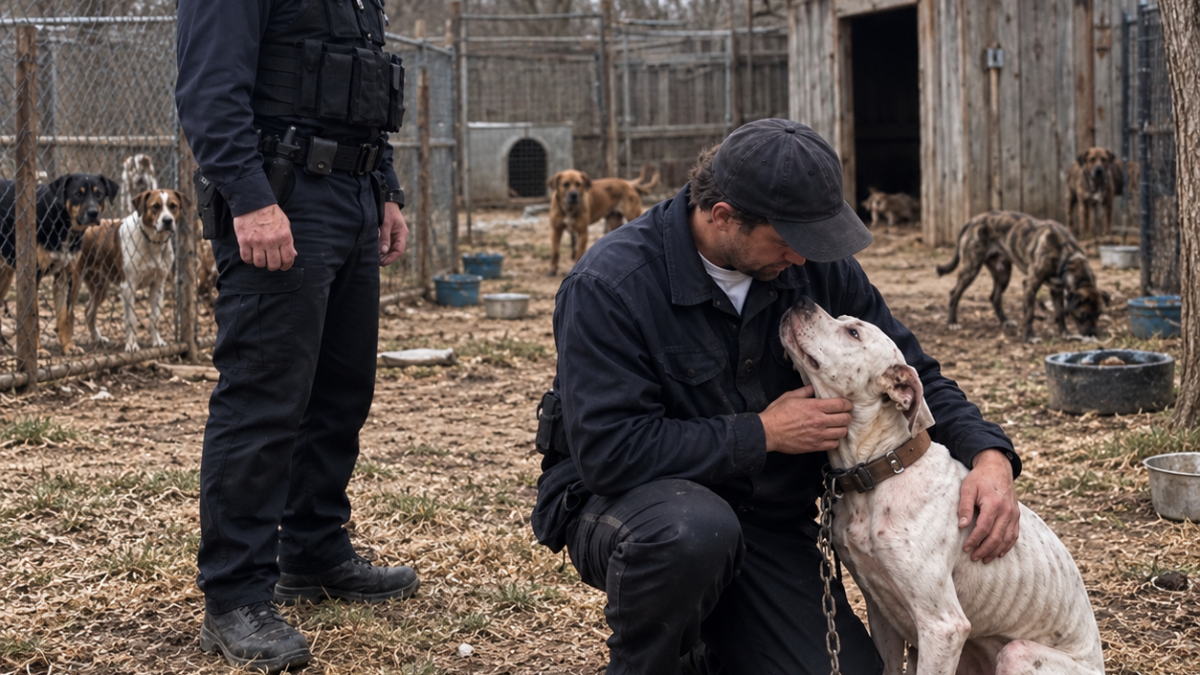
PART 2
We called her Clover.
I was the one who suggested the name.
There was nothing particularly poetic about the decision at the time. I had been standing in the temporary shelter filling out transfer paperwork while a veterinarian examined her under harsh fluorescent lights.
Someone asked what we were going to call Dog Number Seven.
I looked through the open kennel door at the little white patch on her chest.
It had three uneven sections.
Almost like a clover leaf.
“Clover,” I said.
Dr. Emily Parker looked over her glasses at me.
“Clover?”
“Better than Number Seven.”
She gave a tired smile.
“Clover it is.”
The name sounded hopeful.
The dog did not.
Clover sat in the farthest corner of the examination room with her legs tucked beneath her and her eyes fixed on the floor.
She hadn’t made a sound during transport.
The other dogs had responded in different ways.
One whined constantly.
Another pressed his nose against the metal door of the transport crate.
Two trembled so badly we had covered their kennels with blankets.
But Clover had simply curled into herself and disappeared.
Not physically.
Emotionally.
I had seen human beings do the same thing.
People who had lived through violence sometimes stopped reacting because reacting had once made things worse.
Dr. Parker ran her hands gently over Clover’s body.
She examined her teeth, paws, ears, ribs and neck.
Every few seconds, she stopped and wrote something on her chart.
Finally, I asked the question I’d been avoiding.
“How bad?”
She exhaled.
“Severely underweight. Dehydrated. Multiple old scars. Skin infection. Muscle loss. There are signs of repeated trauma.”
I looked toward Clover.
“Can she recover?”
“Physically?”
“Yes.”
“Probably.”
The word probably bothered me.
“And mentally?”
Dr. Parker was silent for several seconds.
“That’s harder.”
She crouched near Clover.
“This dog has spent a long time learning that people bring pain, restraint, hunger or fear. You don’t erase that in a week.”
Clover looked up briefly.
Then she lowered her head again.
Dr. Parker continued.
“But she’s alive.”
She glanced at me.
“That matters.”
It did.
Over the next several days, the case expanded.
The homeowner returned and was arrested after officers executed a search warrant.
I won’t use his real name.
I don’t want his name to take up more space in this story than the animals he hurt.
For the sake of telling what happened, I’ll call him Mercer.
Mercer was forty-seven.
He had no dramatic criminal record.
No terrifying reputation in the neighborhood.
To most people nearby, he was simply a private man who kept to himself.
That was part of what disturbed everyone.
Nobody had known.
Or at least nobody admitted knowing.
The evidence recovered from the property changed the case from neglect to something much more serious.
There were detailed records.
Schedules.
Photos.
Equipment.
Names.
Contacts.
Veterinary supplies that had not been prescribed by any licensed veterinarian connected to the property.
The investigators believed the dogs had been used in organized animal fighting and breeding operations.
The exact history of every animal would never be known.
But the evidence showed enough.
This was not accidental cruelty.
It was a system.
And systems leave paper trails.
For the first two weeks, I should have stayed emotionally detached.
That would have been healthier.
Probably more professional, too.
But every afternoon after my shift, I found myself driving to the temporary shelter.
At first, I told myself I was checking on evidence animals connected to an active investigation.
Nobody believed that excuse.
Especially Dr. Parker.
On my third visit, she saw me standing outside Clover’s kennel.
“You know she isn’t going anywhere tonight, right?”
“I’m checking her condition.”
“You checked it yesterday.”
“Things change.”
She folded her arms.
“They do.”
I ignored the look she gave me.
Clover was pressed against the back wall.
I opened the kennel door but didn’t enter.
“Hey, girl.”
Her eyes lifted.
That was all.
I sat on the floor outside the kennel.
For twenty minutes, I said nothing.
The following day, I did the same thing.
Then again the next day.
I had learned years earlier that frightened people hated being rushed.
I figured frightened dogs probably did too.
Sometimes I brought paperwork.
I would sit on the floor beside Clover’s kennel and write reports.
Other times I read quietly.
Once, because I had nothing else with me, I read sections of the vehicle code aloud.
Dr. Parker walked past and stopped.
“Are you reading traffic statutes to a traumatized dog?”
“She seems interested.”
Clover was asleep.
Emily looked at her.
“She’s unconscious.”
“She finds Chapter Four soothing.”
That was the first time anyone laughed in that hallway.
Clover opened one eye.
For several days, nothing seemed to change.
Then something tiny happened.
I arrived after an unusually long shift and sat outside the kennel.
Clover stood.
Until then, whenever I arrived, she stayed in the back corner.
That night she took three steps forward.
Then stopped.
I kept my eyes on the report in my hand.
My heart was beating stupidly fast.
Three steps.
That was all.
But those three steps felt more important than arrests I had made.
Five minutes later, she lay down near the kennel door.
Not beside me.
But closer.
The next afternoon she did it again.
By the end of the second week, she was eating while I sat nearby.
Dr. Parker noticed.
“She usually waits until the room is empty.”
“I know.”
“She’s changing.”
I looked through the kennel bars.
Clover was chewing slowly, watching me between bites.
“Maybe.”
Emily shook her head.
“No. Not maybe.”
Then came the jacket.
It was a rainy Thursday.
I had stopped by after work, tired enough that I accidentally left my patrol jacket draped across a chair before stepping out to take a phone call.
When I returned, Dr. Parker was standing in the hallway with a strange expression.
“What?”
She pointed silently toward Clover’s kennel.
My jacket was gone.
For half a second, I assumed someone had moved it.
Then I looked inside.
Clover was lying on top of it.
Her chin rested on the folded sleeve.
My badge patch was beneath one paw.
She looked ridiculously comfortable.
I crouched.
“Well, that’s department property.”
Her ears moved.
“You planning on giving that back?”
She lifted her head.
Then she stood.
I expected her to retreat.
Instead she walked to the kennel door.
I slowly opened it.
She stepped into the hallway.
Dr. Parker didn’t move.
Neither did I.
Clover walked directly toward me.
She stopped against my boots.
Then sat.
I lowered myself to one knee.
My hand shook slightly when I extended it.
“Your choice,” I whispered.
She sniffed my fingers.
Once.
Twice.
Then she leaned forward and placed the weight of her head into my palm.
Her eyes closed.
I couldn’t speak.
There are moments in police work when the importance of what has happened doesn’t arrive until later.
This one arrived immediately.
Clover wasn’t simply allowing herself to be touched.
She was testing a possibility.
Maybe this hand would not hurt her.
Maybe this person would not drag her somewhere.
Maybe trust did not always end badly.
I rubbed my thumb gently along the side of her face.
“You’re okay,” I whispered.
Clover exhaled.
Behind me, I heard Dr. Parker quietly leave the hallway.
She later claimed she had somewhere else to be.
I’m fairly certain she was crying.
I wasn’t far behind.
From that day forward, Clover changed in increments.
Not dramatically.
Healing almost never happens dramatically.
Movies like to show a frightened dog suddenly running across a field after one act of kindness.
Real life is slower.
Clover learned that food arrived every morning.
She learned nobody would take it away.
She learned a leash could mean a walk rather than restraint.
She learned a raised hand could hold a treat.
She learned doors could open outward.
Most importantly, she learned she was allowed to say no.
If she backed away during an examination, Dr. Parker stopped.
If she became uncomfortable during a walk, we waited.
For an animal whose entire life had been controlled, choice was medicine.
The other rescued dogs began recovering too.
We gave them temporary names because their original names were either unknown or connected to records from the property.
There was Duke, a broad-headed brown dog who discovered tennis balls and immediately became obsessed with them.
Molly, who refused to sleep unless she had two blankets.
Scout, who initially hid whenever a man entered the room.
Benny, who cried the first time he saw grass.
Rosie, who became attached to one particular animal-control officer and followed her everywhere.
Tank, despite his name, was terrified of squeaky toys.
We laughed more than I expected.
That mattered too.
But while the dogs recovered, Mercer’s attorneys began fighting.
They challenged the search.
They questioned chain of custody.
They claimed some equipment had innocent purposes.
They attempted to characterize the dogs’ condition as the result of parasites and poor breeding rather than deliberate abuse.
That part made me angry.
Evidence can be argued.
Photographs can be interpreted.
Words can be twisted.
But I had carried Clover out of that building.
No attorney could convince me I had misunderstood the weight of her body.
I knew what starvation felt like in my arms.
Then Mercer made his first serious mistake.
He tried to get the dogs back.
The petition arrived through his attorney approximately six weeks after the rescue.
Temporary custody of seized animals can become complicated while a criminal case is pending, and Mercer’s lawyer argued that the government had unlawfully deprived him of valuable property.
Valuable property.
That phrase appeared repeatedly.
I read the filing twice.
Then I drove to the shelter.
Clover was lying on a blanket chewing a rubber toy.
I stood outside her enclosure with the paperwork in my hand.
Dr. Parker noticed my expression.
“What happened?”
“He wants them back.”
She froze.
“All of them?”
“His attorney filed for return pending trial.”
Emily stared at me.
“You’re joking.”
“I wish.”
Clover dropped the toy and approached the gate.
I crouched automatically.
She pushed her nose through the bars.
Dr. Parker looked down at her.
“They can’t send her back there.”
“They won’t.”
“You don’t know that.”
I stood.
“No.”
I looked at the papers again.
“But we’re going to make damn sure the judge understands exactly what sending them back would mean.”
The hearing was scheduled for the following week.
For the first time since the rescue, I saw the delivery driver again.
His name was Daniel Ruiz.
He entered the courthouse wearing the same kind of work boots I remembered, though this time he wore a clean button-down shirt instead of his delivery uniform.
He looked uncomfortable.
“You James?”
“Yeah.”
He held out his hand.
“Daniel.”
“I remember.”
He smiled nervously.
“I’ve never testified before.”
“You’re not on trial.”
“Feels like I am.”
“That feeling never completely goes away.”
He looked toward the courtroom doors.
“His lawyer called me nosy.”
I frowned.
“What?”
“In one of the statements.”
Daniel pulled a folded copy from his pocket.
“He said I entered an area where I wasn’t invited and misinterpreted what I saw.”
“Did you enter the property?”
“No. I stood where I was supposed to make the delivery.”
“Then tell the truth.”
“That simple?”
“Usually.”
He considered that.
Then nodded.
When the hearing began, Mercer sat beside his attorney wearing a dark suit.
He looked ordinary.
That bothered me.
I think people expect cruelty to have a particular face.
It doesn’t.
Sometimes cruelty wears work boots.
Sometimes it wears a suit.
Sometimes it smiles at the judge.
Mercer’s attorney argued first.
He said the animals represented a substantial financial investment.
He said some had breeding value.
He said continued government custody caused economic damage.
Economic damage.
I looked at the photographs in the evidence binder.
Clover’s ribs.
Duke’s infected neck.
Molly’s scars.
Economic damage.
When our side presented the veterinary records, the courtroom became quiet.
Dr. Parker testified for nearly an hour.
She remained clinical.
Professional.
Precise.
She described dehydration percentages.
Body-condition scores.
Muscle atrophy.
Untreated wounds.
Chronic stress behavior.
Then Mercer’s lawyer asked a question that changed the mood of the room.
“Doctor, isn’t it true that many rescued animals appear frightened simply because they have been removed from familiar surroundings?”
Emily looked at him.
“Yes.”
“So fear is not evidence of abuse.”
“Not by itself.”
“Thank you.”
“I wasn’t finished.”
His expression tightened.
The judge looked over.
“Let her finish.”
Dr. Parker folded her hands.
“Fear alone is not evidence of abuse. But fear combined with severe malnutrition, untreated injuries, restraint lesions, scars consistent with repeated trauma, dehydration and documented environmental conditions is highly significant.”
The lawyer attempted to interrupt.
She continued.
“And a dog closing her eyes and collapsing when approached is not normal discomfort from an unfamiliar room.”
I knew she was talking about Clover.
“It is learned helplessness.”
The courtroom went silent.
Daniel testified next.
Mercer’s attorney tried to make him seem dramatic.
“You’re not trained in animal welfare, correct?”
“No.”
“You’re not a veterinarian?”
“No.”
“You’re not a police officer?”
“No.”
“You had no warrant?”
“No.”
“Yet you decided something criminal was occurring.”
Daniel shook his head.
“No.”
The attorney paused.
“No?”
“I decided something looked wrong.”
“And based solely on that assumption, you contacted police.”
Daniel looked toward the judge.
“I saw three dogs so thin I could count their ribs from the driveway.”
He turned back to the lawyer.
“One tried to stand up and fell.”
The lawyer shifted.
“But you didn’t know their medical history.”
“No.”
“You didn’t know whether they were receiving treatment.”
“No.”
“You didn’t know what was inside the outbuilding.”
“No.”
The attorney spread his hands.
“Then what exactly did you know?”
Daniel didn’t hesitate.
“I knew I could either make a phone call or pretend I hadn’t seen them.”
Silence.
“That was enough for me.”
The judge denied Mercer’s request.
The dogs would remain in protective custody.
Outside the courtroom, Daniel leaned against the wall and exhaled.
“My hands are shaking.”
“You did fine.”
“I thought lawyers only talked like that on television.”
“They wish.”
He laughed.
Then his expression became serious.
“How’s the little white one?”
“Clover?”
“You named her?”
“Yeah.”
“How is she?”
“Getting better.”
He looked relieved.
“Good.”
I started to leave.
“Officer?”
I turned.
Daniel rubbed the back of his neck.
“I keep wondering something.”
“What?”
“If I’d been five minutes earlier or five minutes later, maybe they would’ve been inside. Maybe I wouldn’t have seen anything.”
I knew where his mind was going.
“Daniel.”
“Yeah?”
“You were there when you were there.”
He looked at me.
“That’s all any of us get.”
The criminal case continued for months.
Investigators followed the records recovered from Mercer’s property.
Several names led nowhere.
Others led to additional warrants.
One man in another county was arrested.
Another individual accepted a plea agreement.
The network was not enormous, but it had been active longer than anyone initially suspected.
That discovery changed Mercer’s posture.
He stopped looking confident.
His attorney stopped describing the matter as a misunderstanding.
Instead, they began negotiating.
But there was one thing Mercer apparently couldn’t tolerate.
Losing control.
People like him often mistake control for strength.
When control disappears, they panic.
One evening, I received a call from the shelter.
It was Dr. Parker.
“Someone was outside.”
I was already reaching for my keys.
“Who?”
“I don’t know. A man in a pickup. He sat across the street for twenty minutes.”
“Did he approach?”
“No.”
“Plate?”
“One of the volunteers got part of it.”
I arrived fifteen minutes later.
Clover was in the back room.
Emily met me at the entrance.
“You think it was connected?”
“I don’t know.”
“But you’re worried.”
“Yes.”
So were prosecutors.
Security was increased.
Access lists were tightened.
Cameras were installed.
Nothing happened for four days.
Then, at 2:13 in the morning, a man tried to enter the shelter’s rear yard.
The security alarm triggered before he reached the kennels.
Police detained him two blocks away.
He claimed he had been looking for somewhere to sleep.
The evidence suggested otherwise.
On his phone was a message from a number investigators later connected to one of Mercer’s associates.
The message contained a photograph of the shelter.
That changed everything.
Prosecutors added witness-tampering and obstruction-related allegations to the broader investigation.
Mercer denied involvement.
Whether he personally ordered anyone to approach the shelter was never established beyond dispute.
But the intimidation attempt accomplished the exact opposite of what whoever planned it intended.
The county moved the dogs to protected foster locations.
The court tightened restrictions.
And the prosecutor stopped discussing a lenient plea.
When I arrived the morning after the incident, Clover was temporarily housed in Dr. Parker’s office.
She was pacing.
I entered slowly.
“Hey.”
She stopped.
Her eyes locked on me.
Then she crossed the room so quickly I barely had time to kneel.
She pressed herself against my chest.
I put one arm around her.
“I know.”
She trembled.
“I know.”
For several minutes, I sat on the floor holding a dog who months earlier wouldn’t allow a human hand near her.
That was when I became angry in a way I had not allowed myself to become before.
Not reckless anger.
Not revenge.
Something colder.
I wanted the case finished.
I wanted every photograph entered.
Every record authenticated.
Every lie answered.
Every legal shortcut avoided.
Because there is a kind of revenge that destroys you along with the person you hate.
And then there is accountability.
Accountability is slower.
Less satisfying in the moment.
But it lasts.
From then on, I treated every detail of the case like glass.
Nothing sloppy.
Nothing emotional on paper.
Dates.
Times.
Evidence numbers.
Statements.
Photographs.
Chain of custody.
Because if Mercer walked away, it would not be because we had failed to care.
The trial began almost four months later.
By then, Clover had gained sixteen pounds.
Her coat had changed.
That surprised me.
I had assumed her fur was naturally dull.
It wasn’t.
Healthy Clover had a white chest, a dark gray back and bright brown eyes.
Her ears stood differently.
Her entire posture had changed.
She still startled at sudden metallic sounds.
Chains were especially difficult.
One afternoon a maintenance worker dropped a length of chain near the shelter.
Clover collapsed to the floor.
I found her behind a desk shaking.
I sat several feet away.
“Nothing’s happening.”
She watched me.
“You’re here.”
I placed my hand on the floor.
“You decide.”
After two minutes, she crawled forward.
After five, she rested her head against my wrist.
Progress did not mean forgetting.
It meant learning that the memory no longer controlled what came next.
During the trial, the prosecutor called me early.
I described the scene.
The three chained dogs.
The outbuilding.
The equipment.
The condition of the animals.
Mercer’s attorney tried to challenge my emotional objectivity.
“You became personally attached to one of the animals, correct?”
“Yes.”
“You visited her repeatedly.”
“Yes.”
“You gave her a name.”
“Yes.”
“So your perception of this case became emotional.”
I looked toward the jury.
“My opinion of what happened on that property comes from evidence.”
“But you cared about the animal.”
“Yes.”
“Deeply.”
“Yes.”
He turned toward the jury as though he had proven something.
I added, “Caring about a victim doesn’t change the length of a chain.”
He stopped.
The prosecutor looked down, hiding the beginning of a smile.
The judge instructed me to answer only what was asked.
“Yes, Your Honor.”
Mercer’s attorney recovered.
“No further questions.”
Dr. Parker testified again.
This time, photographs of each dog were displayed.
Nobody in the courtroom spoke while they appeared.
Duke.
Molly.
Scout.
Benny.
Rosie.
Tank.
Clover.
Eleven living animals reduced to evidence numbers because someone had treated them like equipment.
Then came the records.
Dates.
Weights.
Pairings.
Financial entries.
Instructions.
The defense suggested alternative explanations.
The prosecutor dismantled them one by one.
Daniel testified on the third day.
He wore the same blue shirt he had worn at the custody hearing.
Before entering the courtroom, he said, “Lucky shirt.”
“You were terrified last time.”
“Still lucky.”
During cross-examination, Mercer’s lawyer returned to the same argument.
“You made assumptions.”
Daniel remained calm.
“I made a phone call.”
“Based on assumptions.”
“Based on what I saw.”
“You could have misunderstood.”
“Yes.”
The attorney looked surprised.
“You admit that?”
“Of course.”
Daniel leaned slightly toward the microphone.
“That’s why I called people whose job was to find out.”
The prosecutor later told me that answer was one of the strongest moments of the trial.
Daniel had never claimed to be a hero.
Never claimed expertise.
He had simply refused to use uncertainty as an excuse to ignore suffering.
On the fifth day, Mercer testified.
Against his attorney’s advice, according to rumors.
He described himself as an experienced breeder.
He claimed several animals had arrived already injured.
He said the chains were necessary because the dogs were aggressive.
Then the prosecutor asked about Clover.
A photograph appeared on the screen.
The image had been taken the day of the rescue.
Clover sat in the corner of the shed.
Small.
Thin.
Eyes lowered.
“Was this dog aggressive?”
Mercer shifted.
“She could be.”
“Did she ever bite you?”
“I don’t remember.”
“Any documented bite?”
“No.”
“Did she attack officers during the rescue?”
“I wasn’t there.”
“She did not.”
The prosecutor stepped closer.
“Did she attack the veterinarian?”
“I wouldn’t know.”
“She did not.”
Another photograph appeared.
Clover’s neck.
A deep restraint injury was visible.
The prosecutor waited.
“Was that necessary?”
Mercer said nothing.
“Mr. Mercer?”
“She pulled against the chain.”
“Constantly?”
“I don’t know.”
“You owned her.”
“Yes.”
“You controlled where she lived.”
“Yes.”
“What she ate.”
“Yes.”
“Whether she received medical care.”
“Yes.”
“How long the chain was.”
Mercer’s lawyer stood.
“Objection.”
“Overruled.”
The prosecutor looked directly at Mercer.
“You controlled almost every part of that animal’s existence, didn’t you?”
Mercer’s jaw tightened.
“I took care of my dogs.”
The prosecutor turned toward the photograph.
“No.”
His voice remained quiet.
“That is what this trial is about.”
The jury deliberated for nearly seven hours.
Those seven hours felt longer than the investigation.
I sat in the hallway.
Daniel bought vending-machine coffee and handed me one.
“This stuff might qualify as evidence of cruelty.”
I tasted it.
“You’re not wrong.”
Dr. Parker paced.
The prosecutor disappeared repeatedly into an office.
Then the bailiff opened the door.
“Verdict.”
Everyone stood as the jury returned.
Mercer stared straight ahead.
The foreperson held a sheet of paper.
The first guilty verdict came.
Then another.
Then another.
Animal cruelty.
Conspiracy-related offenses.
Violations connected to organized animal fighting activity.
Evidence and obstruction counts tied to the broader case.
Not every charge resulted in conviction.
But enough did.
By the time the clerk finished reading, Dr. Parker had tears on her face.
Daniel stared at the floor.
I didn’t feel triumphant.
That surprised me.
I had imagined feeling something explosive.
Vindication.
Victory.
Instead I felt exhausted.
Mercer was taken into custody pending sentencing.
As officers escorted him past us, he glanced in my direction.
For half a second, our eyes met.
There was anger in his face.
Maybe hatred.
I felt nothing.
Because something finally became clear.
This had never been about beating him.
It had always been about making sure he could never do it again.
At sentencing, the judge imposed incarceration, financial penalties, restitution and a permanent prohibition on owning or possessing animals under the applicable orders.
The investigation also resulted in forfeiture of equipment and assets connected to the operation.
The property where we had found the dogs was eventually sold as legal proceedings continued.
Mercer’s lawyer argued that the punishment was excessive.
The judge disagreed.
Then she said something I still remember.
“These animals could not leave.”
She looked toward Mercer.
“They could not report what was happening to them.”
She paused.
“The fact that they were unable to speak does not mean their suffering was invisible.”
Daniel was sitting two rows behind me.
The judge continued.
“The only reason this conduct ended is because an ordinary citizen noticed something was wrong and chose to act.”
Daniel looked down immediately.
He hated attention.
After court, reporters waited outside.
Several approached him.
He refused interviews.
One reporter asked, “Do you consider yourself a hero?”
Daniel actually laughed.
“No.”
“Why not?”
“I delivered a package.”
“And called police.”
“Anybody should’ve done that.”
The reporter said, “But you did.”
Daniel stopped.
For once, he didn’t have an answer.
Later, when the cameras were gone, he found me beside my patrol car.
“I hate that word.”
“What word?”
“Hero.”
“Why?”
He shrugged.
“Heroes do big things.”
“You made a phone call.”
“Exactly.”
I leaned against the car.
“Eleven dogs are alive because of that phone call.”
He stared across the courthouse parking lot.
“I still just made a call.”
“Maybe that’s the point.”
He looked at me.
“Maybe we make being decent sound too complicated.”
Daniel thought about that.
Then he nodded.
“Maybe.”
With the criminal case resolved and custody issues settled, adoption planning began.
Nine of the eleven dogs eventually entered carefully screened homes.
Not immediately.
Some needed months of rehabilitation.
One needed specialized veterinary treatment.
Another required a home without other animals.
Every placement was deliberate.
Duke went to a firefighter and his wife.
His tennis-ball obsession became legendary.
Molly went to a retired schoolteacher who bought her an unreasonable number of blankets.
Scout was adopted by a quiet man who lived alone and understood patience.
Benny went to a family with a fenced acre of land.
The first photograph they sent showed him sleeping in the middle of the yard.
Apparently he had spent two hours outside before realizing nobody was going to force him back inside.
Rosie remained with the animal-control officer she had chosen.
Tank became the shelter’s unofficial ambassador because despite his frightening appearance, he loved children and remained terrified of squeaky toys.
And then there was Clover.
Everyone assumed I would adopt her.
Including me.
I had begun looking at apartments with pet-friendly policies.
I had even bought a dog bed.
It was hidden in the trunk of my car because I didn’t want anyone making fun of me.
Dr. Parker found out anyway.
“You bought her a bed?”
“No.”
“James.”
“It was on sale.”
“You bought the dog a bed.”
“It was heavily discounted.”
She smiled.
“You’re hopeless.”
Maybe I was.
But there was a problem.
My schedule.
Long shifts.
Overnight calls.
Court appearances.
Unpredictable hours.
Clover trusted me.
That did not necessarily mean my home was best for her.
Dr. Parker forced me to confront that.
“Love isn’t always keeping,” she said.
I didn’t like that sentence.
“It sounds like something printed on a coffee mug.”
“It can still be true.”
I looked through the window at Clover sleeping.
“What if she thinks I’m abandoning her?”
“She won’t.”
“How do you know?”
“Because you’re going to choose the right home.”
The right home appeared three weeks later.
Margaret and Thomas Bennett were both in their late sixties.
They had been married forty-one years.
Their previous dog had died the year before.
They lived in a small house outside town with a large fenced yard, oak trees and a porch that wrapped around two sides.
When they first visited Clover, Margaret did something almost nobody else had done.
Nothing.
She entered the room, sat in a chair and waited.
She didn’t call Clover.
Didn’t reach toward her.
Didn’t make kissing noises.
Thomas sat beside his wife.
Clover watched them for ten minutes.
Then she walked toward Margaret.
Slowly.
Margaret kept her hands in her lap.
Clover stopped beside her knee.
She sniffed.
Margaret whispered, “Hello.”
Clover sat down.
Thomas looked at me.
I saw tears forming in his eyes.
Later, he explained why.
Their old dog had done the exact same thing the first day they adopted him.
“We promised ourselves we wouldn’t rush into another dog,” Thomas said.
Margaret smiled.
“That promise lasted eleven months.”
I visited their house before approving the placement.
The backyard was enormous.
There was a covered porch.
A quiet room prepared with a bed.
No chains.
No outdoor kennels.
No chaos.
Just peace.
I hated how perfect it was.
That sounds selfish.
It was selfish.
I wanted Clover.
But wanting someone and being best for them are different questions.
The day we took her to Margaret and Thomas’s home, Clover rode in the back seat beside me.
She had learned to enjoy car rides.
Her nose stayed near the cracked window.
When we pulled into the driveway, she stood.
Margaret and Thomas waited on the porch.
I opened the rear door.
Clover jumped down.
Then froze.
The open yard stretched in front of her.
No leash pulled tight.
No chain stopped her.
She looked at me.
Then Margaret.
Then the grass.
“Go ahead,” I whispered.
Clover took one step.
Then another.
She walked ten feet into the yard.
Stopped.
Looked back.
I nodded.
She continued.
At the center of the yard, beneath a patch of warm afternoon sunlight, she sat.
For several seconds she did nothing.
Then she lifted her face toward the sky.
Her eyes closed.
The breeze moved through the grass.
I heard Margaret inhale beside me.
“Oh, sweetheart.”
She walked slowly toward Clover.
Then she sat on the ground.
Clover opened her eyes.
She moved toward Margaret.
And rested her head across the older woman’s lap.
Exactly as she had once rested it in my hand.
I turned away.
Thomas stood beside me.
“You okay?”
“Fine.”
“You don’t look fine.”
“Dust.”
He looked around the perfectly green yard.
“A lot of dust out here.”
“Terrible.”
He smiled.
Then he placed one hand on my shoulder.
“You can visit whenever you want.”
That almost made it worse.
I knelt before leaving.
Clover approached.
She pushed her face into my chest.
I rubbed behind her ears.
“You know I’m coming back, right?”
Her tail moved.
“Don’t forget me.”
It moved again.
Margaret laughed softly.
“She won’t.”
I stood and walked toward my car.
Halfway there, I turned.
Clover was beside Margaret.
She wasn’t following me.
For one terrible second, that hurt.
Then I understood.
She wasn’t following me because she didn’t have to.
She felt safe.
That was the whole point.
One year passed.
I visited often.
Clover transformed.
She learned to chase squirrels without ever catching one.
She developed an irrational hatred of the garden hose.
She slept upside down with all four legs in the air.
She stole Thomas’s socks.
She discovered peanut butter.
She gained enough confidence to bark at the mail carrier, which I found deeply ironic considering a delivery driver had saved her life.
Daniel eventually met her.
I arranged it without telling him exactly why I wanted him to come.
He arrived at Margaret and Thomas’s house one Saturday afternoon.
Clover ran toward the gate barking.
Daniel stopped.
“That’s her?”
“That’s Clover.”
He stared.
“No.”
“Yes.”
“That tiny dog from the shed?”
“The same one.”
Clover approached him cautiously.
Daniel crouched.
She sniffed his hand.
Then walked away.
He laughed.
“Guess she’s not impressed.”
“She has standards.”
We sat on the porch drinking lemonade.
Daniel watched Clover chase a butterfly across the yard.
For a long time, he said nothing.
Then he rubbed his eyes.
“You okay?”
“Allergies.”
“Sure.”
He laughed.
“I really thought she was going to die.”
“So did I.”
He watched her again.
“Eleven.”
“Yeah.”
“All because I happened to be making that delivery.”
I shook my head.
“No.”
He looked at me.
“Not because you happened to be there.”
“Then what?”
“Because you stopped.”
That difference mattered.
Thousands of people see things every day.
Someone crying in a parking lot.
A child alone where they shouldn’t be.
An animal in distress.
Smoke coming from a neighbor’s window.
A person struggling beside the road.
Most situations turn out to have explanations.
Some don’t.
Daniel didn’t know what was behind Mercer’s gate.
He didn’t need to.
He only needed to care enough to ask someone to check.
Months later, I was walking Clover through a local park when she suddenly stopped.
Margaret and Thomas were out of town for the afternoon, and I had volunteered to take her.
A group of children was playing soccer on a field.
Clover watched them.
Her ears lifted.
A little girl kicked the ball too hard.
It rolled across the grass and stopped several yards from us.
The girl ran toward it.
Then noticed Clover.
“Can I pet your dog?”
I hesitated.
Clover had improved dramatically around people, but I never forced interactions.
I knelt beside her.
“She gets to decide.”
The girl nodded seriously.
She held out her hand.
Clover sniffed it.
Then stepped forward.
The girl gently touched Clover’s shoulder.
Clover’s tail moved.
Within seconds, she was leaning against the child.
The little girl laughed.
“She likes me!”
“I think she does.”
The soccer ball rolled again.
Clover bounced after it.
For a few seconds she played.
Actually played.
No fear.
No hesitation.
Just a dog in the grass chasing a ball with children.
I stood there remembering the first day.
The chains.
The dirt.
The shed.
The way she had closed her eyes when I reached toward her because she thought my hand meant pain.
Now she was running toward hands because she expected affection.
That is what freedom looked like.
Not dramatic.
Not loud.
A dog chasing a soccer ball.
I thought that would be the end of Clover’s story.
I was wrong.
Nearly eighteen months after the rescue, I received a call from the district attorney’s office.
One of Mercer’s associates was appealing part of his case and attempting to recover property seized during the investigation.
Among the items were records tied to several dogs whose origins had never been determined.
Clover was one of them.
Buried inside those files investigators discovered something we had missed.
A breeder identification number.
It led to a veterinary clinic three states away.
The clinic still had old records.
Clover had originally been named Daisy.
She had been purchased legally as a puppy by a family when she was approximately ten weeks old.
Eight months later, she disappeared from their fenced yard.
The family reported her stolen.
They searched for months.
Posters.
Shelters.
Online groups.
Nothing.
Eventually they assumed she was dead.
The detective handed me the file.
“There’s a phone number.”
I stared at it.
“Still active?”
“We checked.”
My stomach tightened.
“Who owns it?”
“A woman named Sarah Mitchell.”
I called that evening.
A woman answered.
“Hello?”
“Mrs. Mitchell?”
“Yes?”
“My name is Officer James Carter.”
Immediately her voice changed.
“Is something wrong?”
“No, ma’am.”
I looked at Clover’s photograph on my desk.
“I’m calling about a dog you reported missing several years ago.”
Silence.
Then a whisper.
“Daisy?”
That one word nearly broke me.
“Yes.”
I heard her sit down.
I don’t know how I knew.
Maybe from the sound of the chair.
“Oh my God.”
“She’s alive.”
Sarah began crying.
Not loud.
Not dramatic.
The kind of crying that comes when grief you buried suddenly opens.
“You found her?”
“Yes.”
“Where has she been?”
That question was harder.
“I’d rather explain in person.”
She understood from my tone.
“Oh.”
Her voice changed again.
“Oh, no.”
“She’s safe now.”
“Is she hurt?”
“She’s recovered.”
“Can I see her?”
I closed my eyes.
“Yes.”
But the situation was complicated.
Sarah and her family had loved Daisy.
There was no doubt.
They had photographs.
Veterinary records.
Her original collar.
Pictures of Daisy sleeping beside Sarah’s son, Ethan, who had been eight when she disappeared.
Now Ethan was nearly thirteen.
But Clover had another family now.
Margaret and Thomas.
Legally, the adoption had been completed through court-authorized procedures after ownership forfeiture.
Nobody was going to arrive and simply take her.
Still, Margaret cried when I told her.
Thomas sat beside her in silence.
Finally Margaret asked, “Did they love her?”
“Yes.”
“Did they look for her?”
“For months.”
She wiped her face.
“Then they deserve to know she survived.”
We arranged a meeting.
Sarah arrived with her husband, Michael, and Ethan.
Ethan carried a small red collar.
The moment Clover entered the room, Sarah covered her mouth.
“She’s older.”
I nodded.
Ethan knelt.
“Daisy?”
Clover stopped.
Everyone stopped.
Her ears moved.
Ethan’s voice broke.
“Daisy, it’s me.”
For several seconds, Clover remained still.
Then she approached.
Slowly.
She sniffed Ethan’s hand.
Then his jacket.
Then the collar.
Something changed.
Her tail moved.
Once.
Twice.
Ethan began crying.
Clover stepped forward and licked his face.
He wrapped his arms around her.
“Daisy.”
Sarah sobbed.
Michael turned away.
Margaret was crying beside me.
Thomas had both hands pressed against his mouth.
Clover moved between them all.
Old family.
New family.
No fear.
Only recognition and affection.
Eventually Sarah looked at Margaret.
“I’m not here to take her.”
Margaret looked surprised.
Sarah wiped her eyes.
“We lost her years ago.”
She watched Clover sitting beside Ethan.
“You gave her back a life.”
Margaret shook her head.
“James and the others did that.”
“No.”
Sarah reached for her hand.
“You gave her a home.”
The two women embraced.
From that day forward, Clover had two families.
Sarah’s family visited several times a year.
Ethan brought the old red collar but never put it around Clover’s neck.
Instead Margaret framed it beside a photograph from her puppy years.
Beneath it sat another picture.
Clover in the garden.
Free.
The story eventually appeared in the local paper.
The headline focused on Clover.
But Daniel’s name was mentioned too.
He hated that.
When I saw him several months later, he was delivering packages again.
Same route.
Same kind of van.
He recognized my patrol car and waved.
I pulled over.
“You still stopping when you see trouble?”
He laughed.
“I try not to see trouble.”
“Doesn’t work like that.”
“No.”
He became serious.
“How’s Clover?”
“Running two families now.”
“What?”
I told him.
He stood beside his van smiling.
“Good for her.”
Then he looked toward the houses lining the street.
“You know what’s strange?”
“What?”
“I don’t remember what I delivered that day.”
I smiled.
“Probably wasn’t important.”
“No.”
He looked at me.
“I remember the address. The dogs. The gate. Everything.”
Then he tapped the side of his van.
“But the package?”
He shook his head.
“Not a clue.”
Life is strange that way.
We spend enormous amounts of energy worrying about things we will forget.
Deadlines.
Packages.
Appointments.
Arguments.
Then one ordinary decision follows us forever.
Years have passed since I first carried Clover into sunlight.
I’m still a police officer.
Dr. Parker still works with rescue animals.
Daniel still delivers packages, although people occasionally recognize him now.
Margaret and Thomas still spoil Clover shamelessly.
Sarah’s family still calls her Daisy sometimes.
She responds to both names.
Maybe that’s appropriate.
Daisy belonged to the life she should have had.
Clover belonged to the life she fought to rebuild.
One afternoon, I visited Margaret and Thomas.
Clover was sleeping on the porch.
She had gray around her muzzle now.
I sat beside her.
Her eyes opened.
Her tail thumped once against the wood.
“Getting old, girl.”
She placed her head on my knee.
For a while, I listened to the wind moving through the oak trees.
No barking.
No chains.
No frightened silence.
Just birds.
Leaves.
A lawn mower somewhere in the distance.
Thomas stepped onto the porch carrying coffee.
“She still does that every time you come.”
“What?”
“Puts her head on you.”
I rubbed behind Clover’s ears.
“She remembers.”
Thomas sat beside me.
“Do you think she remembers the bad things?”
“Yes.”
He looked surprised by how quickly I answered.
“You’re sure?”
“I think animals remember fear.”
I looked down at her.
“But I think they remember safety too.”
Clover sighed.
Thomas smiled.
“That sounds right.”
Before leaving, I walked into the yard.
Near the back fence stood an old oak tree.
Margaret had placed a small garden stone beneath it.
There was no dramatic inscription.
Just eleven small paw prints painted around the edge.
One for each dog.
No names.
No explanation.
They didn’t need one.
Nine had found homes.
One remained permanently connected to the shelter.
And Clover had somehow ended up with more family than any dog could reasonably manage.
Mercer lost his freedom for a time.
He lost his operation.
He lost the legal right to keep animals.
He lost the control he had used to hurt creatures who could not fight back.
For a while, I thought that was the revenge this story needed.
I was wrong.
His punishment mattered.
Justice mattered.
But the greatest answer to what he did was happening in places he would never control.
Duke sleeping beside a firefighter’s boots.
Molly buried beneath three blankets.
Benny stretched across a sunny lawn.
Rosie riding beside the animal-control officer who adopted her.
Tank greeting children at the shelter.
And Clover sleeping peacefully beneath an oak tree.
Cruelty had tried to reduce those dogs to fear.
It failed.
That was the real victory.
Several years after the rescue, Clover’s health began declining.
Nothing dramatic.
Age.
Arthritis.
Slower mornings.
Longer naps.
Margaret called me one winter evening.
“She’s okay,” she said immediately.
That is never a reassuring way to begin a phone call.
“What happened?”
“She had trouble getting up.”
I drove over.
Clover was lying beside the fireplace.
When she saw me, her tail moved.
I sat beside her.
“Hey, girl.”
She tried to stand.
“Don’t.”
I lowered myself to the floor.
She rested her head in my palm.
Exactly the way she had years before.
Margaret sat on the couch crying quietly.
Thomas stared into the fire.
Dr. Parker examined Clover the following morning.
Arthritis.
Some kidney issues.
Nothing immediately terminal.
Medication helped.
She improved.
We got another year.
A good year.
She walked slowly.
Slept often.
Still stole socks.
Still hated garden hoses.
Still leaned into children whenever they pet her.
On her final spring, Daniel came to visit.
He hadn’t seen her in months.
Clover walked toward him slowly.
“She remembers me now,” he said.
“No.”
He looked disappointed.
I smiled.
“She just likes everybody now.”
Daniel laughed.
“I’ll take it.”
He sat in the grass.
Clover lowered herself beside him.
Daniel ran one hand along her back.
“I’m glad I stopped.”
I looked at him.
He wasn’t smiling anymore.
“So am I.”
That summer, Clover declined rapidly.
Dr. Parker told us what we already knew.
Her body was tired.
There would be no heroic treatment.
No unnecessary suffering just because we were afraid to say goodbye.
Margaret called Sarah.
Sarah came with Michael and Ethan.
I called Daniel.
He asked if he should come.
“Yes.”
Everyone who had been part of Clover’s second life gathered in Margaret and Thomas’s backyard.
Not because Clover understood the occasion.
We did.
She lay on her favorite blanket beneath the oak tree.
Ethan sat on one side.
Margaret on the other.
Thomas held her paw.
Sarah stroked her ears.
Daniel remained a few feet away, crying openly this time and making no attempt to blame allergies.
I sat near Clover’s head.
Dr. Parker knelt beside us.
Clover looked around.
So many people.
Years ago, she had hidden from every human who approached.
Now she was surrounded by hands she trusted.
I placed my palm beneath her chin.
Her head settled into it.
“You did good, girl.”
Her eyes stayed on me.
“You don’t have to be afraid anymore.”
Her tail moved once against the blanket.
Dr. Parker gave us time.
Then Clover fell asleep peacefully beneath the tree where she had spent so many afternoons.
The silence afterward was unbearable.
Margaret bent over her.
Thomas wrapped his arms around his wife.
Ethan buried his face against his father.
Daniel walked toward the fence.
I stayed where I was.
My hand remained beneath Clover’s head.
I had held her when she thought every human hand meant pain.
Now I held her after years of knowing those same hands could mean home.
That difference was her life.
We buried her ashes beneath the oak tree.
Margaret added one word to the garden stone.
Clover.
Nothing else.
She didn’t need a long inscription.
Everyone who knew her understood.
A month later, Daniel and I met for coffee.
He stared into his cup.
“I keep thinking about that package.”
I smiled sadly.
“The one you don’t remember?”
“Yeah.”
He looked up.
“Imagine if I’d been in a hurry.”
I didn’t answer.
“If I’d looked at my schedule and thought, not my problem.”
He shook his head.
“Eleven dogs.”
“Yes.”
“And Clover.”
“Yes.”
He swallowed.
“I didn’t save her whole life.”
“No.”
His face tightened.
“I just made a call.”
I leaned forward.
“Daniel.”
He looked at me.
“That call gave other people the chance to do the rest.”
He sat back.
Maybe that was the lesson Clover left with all of us.
Nobody saved her alone.
Daniel noticed.
We responded.
Animal-control officers removed the dogs.
Dr. Parker treated them.
Prosecutors built the case.
Jurors listened.
A judge imposed consequences.
Volunteers rehabilitated frightened animals.
Families opened their homes.
Margaret and Thomas loved Clover through old age.
Sarah and Ethan loved the dog she had been before she disappeared.
A hundred small acts connected.
That is how eleven lives changed.
Not because one perfect hero arrived.
Because enough ordinary people refused to look away.
I still pass Mercer’s old property sometimes.
The house belongs to another family now.
The outbuilding is gone.
The yard has been rebuilt.
One afternoon, I drove past and saw a boy playing fetch with a golden retriever where those three chained dogs had once been sitting.
The dog ran across the entire lawn.
No chain stopped him.
The boy threw the ball.
The dog chased it.
I pulled over a little farther down the road.
For a minute, I simply watched.
Then I thought about Clover.
The tiny dog who once closed her eyes when I reached toward her.
The dog who later chased soccer balls with children.
The dog who slept in sunlight.
The dog who had two names and two families.
The dog whose entire future changed because a delivery driver stood beside a gate and decided that something he saw was not somebody else’s problem.
People sometimes ask me what the hardest part of police work is.
They expect me to talk about danger.
That isn’t my answer.
The hardest part is seeing how much suffering can exist behind ordinary walls.
Quiet streets.
Clean houses.
Closed doors.
The world can hide terrible things very well.
But I’ve also seen the opposite.
I have seen how quickly darkness begins to lose when one person turns on a light.
Daniel’s light was a phone call.
Mine was entering a backyard.
Dr. Parker’s was refusing to give up on an animal who had stopped trusting people.
Margaret and Thomas’s was opening their home.
Clover’s was something even harder.
She chose to trust again.
That may have been the bravest thing any of us did.
I’m James Carter.
I’m still a police officer.
I’ve forgotten hundreds of calls.
Noise complaints.
Minor accidents.
Arguments between neighbors.
Reports that blurred together with time.
But I will never forget the afternoon a delivery driver waited beside a gate.
I will never forget eleven silent dogs.
I will never forget lifting Clover and realizing how frighteningly little she weighed.
And I will never forget the first time she placed her head in my hand.
Because that moment taught me something no academy ever did.
Justice is not always a courtroom.
Sometimes justice is a full food bowl.
A soft bed.
An unlocked gate.
A sunny yard.
A child laughing while a dog runs beside her.
Sometimes justice is an old dog sleeping without fear beneath an oak tree.
And sometimes the difference between cruelty continuing and eleven lives beginning again is one ordinary person deciding:
I may not be responsible for everything I see.
But I refuse to pretend I saw nothing.
By the time Clover reached her final spring, she had become the kind of dog no one would have recognized from the photographs taken on the day we rescued her.
Her muzzle had turned gray.
She moved more slowly when she got up from her bed, and on cold mornings Thomas sometimes had to place one hand beneath her chest to help her stand.
But she was still Clover.
She still stole Thomas’s socks when he left them beside his recliner.
She still waited in the kitchen whenever Margaret opened a jar of peanut butter.
She still barked suspiciously at the garden hose and then retreated behind the porch railing as though she had successfully defeated a dangerous enemy.
And every time I drove up their gravel driveway, she somehow knew before I even opened the car door.
Her ears would lift.
Her tail would begin hitting the floor.
Then she would walk toward me as quickly as her aging legs allowed.
I always crouched before she reached me.
“Hey, girl.”
She would push her forehead against my chest.
That had become our greeting.
Years earlier, she had closed her eyes because she expected a human hand to hurt her.
Now she actively searched for one.
That difference still had the power to stop me cold.
One Saturday afternoon, I found Margaret sitting on the porch while Clover slept beside her chair.
Thomas was repairing a loose section of fence near the vegetable garden.
The oak tree above us had just begun producing new leaves.
I sat down beside Margaret.
“She had a rough morning,” she said.
I looked at Clover.
“What happened?”
“Couldn’t get up at first.”
My chest tightened.
“Did you call Emily?”
“She’s coming tomorrow.”
Clover opened one eye when she heard Dr. Parker’s name.
Margaret smiled.
“She still knows.”
“She knows everything.”
I lowered my hand.
Clover stretched her neck and rested her chin against my fingers.
Her breathing was slower now.
Deeper.
For a moment neither Margaret nor I spoke.
Then she said, “Do you ever think about the first day?”
“All the time.”
“I’ve seen the pictures.”
Her voice softened.
“But I almost wish I hadn’t.”
I understood.
The photographs were difficult even for those of us who had been there.
Clover in the corner.
Head lowered.
Body skeletal.
The raw mark around her neck.
The empty expression in her eyes.
Margaret looked toward the yard.
“When people meet her now, they see an old dog who likes sunshine.”
“That’s what she is.”
“I know.”
She smiled through tears.
“But sometimes I look at her and think about how close she came to never getting any of this.”
Thomas heard the last sentence as he approached.
He leaned the hammer against the porch.
“She got it.”
Margaret looked up.
“What?”
“This.”
He gestured toward the house.
“The yard. The porch. Us. James showing up whenever he wants free coffee.”
“I bring my own coffee.”
“Once.”
Margaret laughed.
Thomas sat beside Clover.
“We can’t change what happened before.”
He stroked the side of her neck.
“But she got everything after.”
That sentence stayed with me.
She got everything after.
Maybe that was what healing really meant.
Not erasing the past.
Building enough good after it that the past no longer owned every part of the story.
Dr. Parker examined Clover the next morning.
I went with Margaret and Thomas.
Emily listened to her heart.
Checked her kidneys.
Moved her back legs carefully.
Clover tolerated the examination with the dignity of an elderly woman inconvenienced by an unnecessary appointment.
When Emily finished, she sat on the floor beside her.
“The arthritis has progressed.”
Margaret clasped her hands.
“Is she hurting?”
“Sometimes.”
“Can we control it?”
“For now.”
Thomas asked the question nobody wanted to ask.
“How much time?”
Emily shook her head.
“I don’t know.”
Weeks.
Months.
Maybe longer.
Animals do not read calendars.
We changed her medication.
Thomas built a small wooden ramp beside the porch steps.
Margaret added rugs through the hallway so Clover would not slip on the hardwood floor.
Sarah brought a padded orthopedic bed.
Ethan, now almost grown, arrived carrying the faded red collar Clover had worn when she had still been Daisy.
He sat beside her for nearly an hour.
“You know me, right?” he whispered.
Clover licked his wrist.
Ethan laughed.
“I’m taking that as yes.”
She had accumulated people over the years.
That might have been the most beautiful part of her recovery.
A dog once isolated on a short chain now had too many people worried about her.
Daniel came one afternoon after finishing his delivery route.
He had changed very little.
Same work boots.
Same tired expression.
Same tendency to look embarrassed whenever anyone mentioned what he had done.
Clover was lying beneath the oak tree.
Daniel approached slowly.
“Hey, troublemaker.”
Her tail thumped.
He looked at me.
“She remembers me?”
“Maybe.”
“Maybe?”
“She also does that when Thomas opens cheese.”
Daniel shook his head.
“You never let me have anything.”
He sat beside her.
For a long time, he ran his fingers gently through the fur behind her ears.
Then he became quiet.
“I still think about that day.”
“I know.”
“You know what bothers me?”
“What?”
“How easy it would’ve been not to stop.”
I didn’t answer.
Daniel looked toward the road.
“I had deliveries left.”
He gave a small laugh.
“I was behind schedule too.”
Clover lifted her head.
Daniel placed his hand on her shoulder.
“I remember looking at those dogs and thinking maybe there was an explanation.”
“That’s normal.”
“I almost convinced myself there was.”
That was the first time he had told me that.
“I thought maybe they were sick. Maybe the owner was treating them. Maybe I was overreacting.”
He swallowed.
“Then the one under the tree tried to stand.”
I remembered.
The dog had barely made it onto his front legs before collapsing.
Daniel looked down.
“I thought, if I leave and I’m wrong, I wasted five minutes.”
His voice tightened.
“But if I leave and I’m right…”
He stopped.
Clover pushed her nose beneath his hand.
Daniel smiled.
“So I called.”
“You made the right choice.”
“I got lucky.”
“No.”
He looked at me.
“You chose.”
There was a difference.
Luck had put him on that street.
Choice had made him stop.
Clover’s health remained stable through most of the summer.
We began treating ordinary days as gifts without saying so aloud.
Margaret sent photographs constantly.
Clover asleep in the garden.
Clover staring through the kitchen window.
Clover wearing a ridiculous birthday bandanna.
Clover lying in front of a fan during a heat wave.
Then one morning in August, my phone rang before sunrise.
Margaret.
My stomach tightened before I answered.
“James?”
Her voice was trembling.
“I’m here.”
“She can’t stand.”
I was dressed and out the door within minutes.
When I arrived, Thomas was sitting on the floor beside Clover’s bed.
Margaret was kneeling near her head.
Clover’s breathing was shallow.
Her eyes opened when I entered.
Her tail moved once.
That tiny movement nearly broke me.
I sat beside her.
“Hey, girl.”
She tried to lift her head.
“Don’t.”
I slid my hand beneath her cheek.
She relaxed against my palm.
Exactly as she had done the first time she trusted me.
Dr. Parker arrived shortly afterward.
She examined Clover quietly.
Nobody asked questions while she worked.
We already understood.
Finally Emily sat back.
Her eyes were wet.
“She’s very tired.”
Margaret began crying.
Thomas wrapped one arm around her.
“Can we fix it?” he asked.
Emily shook her head.
“We can make her comfortable.”
Thomas looked down at Clover.
“That’s not what I asked.”
“I know.”
Silence.
“Can we fix her?”
“No.”
The word hung in the room.
No courtroom had ever felt as quiet.
Margaret pressed her face against Thomas’s shoulder.
I stared at Clover.
Years ago, I had fought to keep someone from controlling her life through cruelty.
Now loving her meant refusing to control the end simply because we weren’t ready.
Margaret asked, “Is she suffering?”
Emily answered softly.
“Yes.”
That settled it.
Nobody wanted another day if the price of that day belonged entirely to Clover.
Sarah and Michael arrived first.
Ethan came directly from work.
Daniel arrived still wearing his delivery uniform.
We carried Clover outside on her favorite blanket and placed her beneath the oak tree.
The same tree where she had spent hundreds of peaceful afternoons.
The sun came through the branches in broken patches.
A warm breeze moved across the yard.
Clover lifted her nose once.
I wondered what she smelled.
Grass.
Flowers.
The people around her.
Maybe nothing.
Maybe everything.
Ethan knelt beside her.
He held the old red collar.
“I brought this.”
Clover sniffed it.
Sarah covered her mouth.
Ethan touched his forehead to Clover’s.
“I looked for you.”
His voice broke.
“For so long.”
Clover licked his chin.
He laughed while crying.
“I know. I know.”
Margaret sat on Clover’s other side.
“You gave us more than we gave you.”
Thomas shook his head.
“No question.”
Daniel stood several feet away.
I motioned toward him.
“Come here.”
He hesitated.
“This is family.”
“So are you.”
That stopped him.
He slowly approached and knelt.
Clover smelled his hand.
Daniel rubbed her head.
“I guess we finally got introduced properly.”
He laughed once.
Then tears filled his eyes.
“I’m sorry I didn’t find you sooner.”
I put a hand on his shoulder.
“You found her when it mattered.”
Dr. Parker prepared everything quietly.
She had done this many times.
That didn’t make it easy.
When she was ready, she looked at us.
Margaret nodded.
Clover’s head rested in my palm.
I could feel every slow breath.
I leaned close.
“You remember that first day?”
Of course she couldn’t answer.
“I picked you up and you weighed almost nothing.”
Her eyes remained on mine.
“You thought I was going to hurt you.”
My throat tightened.
“But you gave us another chance anyway.”
Her tail moved slightly.
“That was brave.”
I rubbed my thumb along her face.
“You were so brave.”
Emily administered the sedative.
Clover’s body slowly relaxed.
No panic.
No fear.
Just sleep arriving.
Margaret stroked her back.
Thomas held one paw.
Sarah whispered Daisy.
I whispered Clover.
Both names belonged to her.
The puppy who had been loved.
The dog who had been stolen.
The survivor we found.
The old girl who finally knew safety.
As Clover’s eyes became heavy, she pushed her head a little deeper into my hand.
I bent close.
“No more chains.”
My voice cracked.
“Ever.”
Her breathing slowed.
“No more fear.”
One breath.
Then another.
“You’re home.”
And then she was gone.
For several seconds, nobody moved.
The world did something cruel in moments like that.
It continued.
A bird called from another tree.
A car passed on the road.
Leaves moved overhead.
Somewhere, someone started a lawn mower.
But beneath that oak tree, our world had stopped.
Margaret collapsed against Thomas.
Sarah held Ethan.
Daniel walked toward the fence, wiped his face with both hands, then came back because he didn’t want to be alone.
I kept my palm beneath Clover’s head.
I remembered another room.
Fluorescent lights.
A kennel.
A dog afraid to eat while humans watched.
I remembered the jacket she had stolen.
The first touch.
Her first walk across grass.
Her first tail wag.
The custody hearing.
The trial.
The day Margaret sat quietly and let Clover decide whether to approach.
The day Ethan called her Daisy and something buried deep inside her recognized him.
An entire life lived between two moments in my hand.
Fear.
And peace.
That was enough.
Weeks later, we gathered beneath the oak tree again.
Margaret had placed a new stone beside the one with eleven paw prints.
This one had only her name.
Clover.
Sarah placed the old red collar beneath a small glass memorial box inside the house.
Ethan brought a photograph of Daisy as a puppy.
I brought the first photograph taken after her recovery, standing in sunlight with her head lifted.
Thomas looked at the two pictures.
“Same dog.”
Margaret nodded.
“Two lives.”
“No.”
I looked at Clover’s stone.
“One life.”
Just a life with a terrible middle.
A year after Clover died, I passed Mercer’s old property during patrol.
The house had new owners.
The outbuilding was gone.
A wooden swing set stood where part of it had once been.
I slowed the patrol car.
A boy was playing fetch with a golden retriever in the yard.
The dog ran from one end of the property to the other.
Full speed.
Tongue out.
Tail high.
The boy threw the ball again.
The dog raced after it.
Nothing stopped him.
No chain.
No locked shed.
No frightened voice calling him back.
I pulled over farther down the road.
I stayed there for a minute.
Then I thought about the eleven dogs.
Duke with his tennis balls.
Molly and her blankets.
Scout sleeping beside the man who understood silence.
Benny stretched across the lawn.
Rosie choosing her own person.
Tank greeting children despite his ridiculous fear of squeaky toys.
And Clover.
Clover under the oak tree.
Clover stealing socks.
Clover leaning into a little girl’s hands.
Clover answering to Daisy and Clover because love had found her twice.
For years, I thought Mercer’s sentence was the ending.
Prison.
Fines.
The permanent ban on possessing animals.
The collapse of his operation.
I thought justice meant watching a courtroom take his control away.
I was wrong.
That mattered.
But it wasn’t the best part.
The best part was what happened afterward.
The cruelty stopped, but the lives continued.
That was the revenge no one could undo.
Mercer had tried to teach those dogs that the world was made of chains, hunger and fear.
The rest of their lives proved him wrong.
Daniel still delivers packages.
Every so often, he texts me after seeing an animal somewhere.
Most of the time there is an innocent explanation.
Once it was an old dog sleeping beside a garage.
Another time it was a horse that looked thin from the road but was already receiving veterinary treatment.
Daniel always apologizes when nothing is wrong.
I always tell him the same thing.
“Never apologize for checking.”
He laughs.
“You cops say that until I call you at two in the morning.”
“I reserve the right to complain.”
But I mean it.
Because I know what one phone call can become.
Clover taught me that courage does not always look like charging into danger.
Sometimes courage is smaller.
Slower.
Less dramatic.
Sometimes it is a delivery driver standing beside a van, staring through a gate and deciding not to convince himself that suffering is somebody else’s responsibility.
Sometimes it is a veterinarian sitting quietly beside a dog who refuses to eat.
Sometimes it is a judge reading evidence carefully.
Sometimes it is an older couple opening their home.
Sometimes it is a frightened animal placing her head into a human hand one more time despite everything people have taught her.
I still think about that first touch.
I probably always will.
Her body was tense.
Her eyes were half closed.
She could have backed away.
Instead, Clover leaned forward.
Just an inch at first.
Then all the way.
Her head settled into my palm.
She made a decision.
Trust.
Years later, beneath the oak tree, she made that same motion one final time.
There was no fear left in it.
Only familiarity.
Safety.
Home.
That is the ending I choose to remember.
Not the shed.
Not Mercer.
Not the photographs.
Not even the courtroom.
Clover in the sunlight.
Old.
Loved.
Surrounded by people who would have done anything to keep her, yet loved her enough to let her go when staying became painful.
A dog who once had nothing eventually had so many people saying goodbye that there wasn’t enough room beneath one tree.
And whenever someone asks me whether one person can actually change anything, I think about Daniel standing beside that gate.
I think about eleven dogs.
I think about Clover.
Then I give them the only answer I know is true.
You may never know how much depends on the moment you decide not to walk away.








