PART 2: A Car Hit a Mother Dog Carrying Her Puppy—Then the Driver Left Them in the Rain
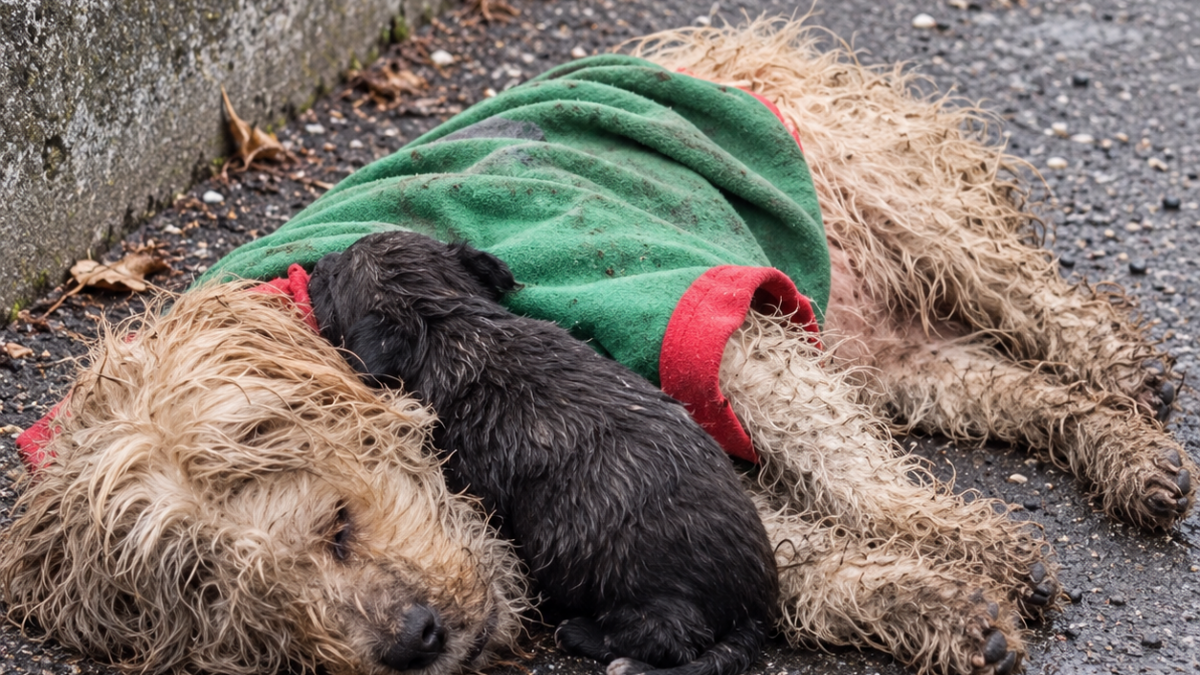
PART 2
“There’s no major internal bleeding.”
For several seconds, I didn’t understand the sentence.
I had prepared myself for something terrible because of the veterinarian’s expression, and when the words finally registered, my knees almost gave out.
“No internal bleeding?”
“Nothing significant that we can see right now,” Dr. Evan Hale said. “Her lungs appear clear. I’m not seeing the kind of abdominal trauma I was afraid of when you carried her in.”
I pressed one hand against the wall.
“What about her head?”
“We’re still evaluating her neurologically, but there’s no obvious skull fracture.”
I closed my eyes.
The relief came so hard it hurt.
Behind the treatment-room doors, I could hear metal trays moving and quiet voices giving instructions.
“What about the puppy?”
“The puppy appears uninjured.”
I opened my eyes again.
“Really?”
Dr. Hale nodded.
“Cold, frightened and hungry, but physically she looks remarkably good.”
I let out a breath I hadn’t realized I was holding.
Then I asked the question that had been sitting inside me since Natalie collapsed on the road.
“Why can’t the mother stand?”
His expression changed.
“That’s what we’re trying to understand.”
The initial X-rays showed trauma around her pelvis and one rear leg, along with extensive bruising. There was no catastrophic fracture that explained complete paralysis, which meant the veterinary team needed to consider swelling, nerve trauma and shock.
“She may regain function as the inflammation decreases,” Dr. Hale said. “But I don’t want to promise something before we know.”
I nodded.
“I’d rather know the truth.”
“So would I.”
A technician walked past carrying the puppy wrapped in a warm towel.
The baby was so small that almost her entire body disappeared inside it.
Her eyes were open.
She made a tiny sound.
“Can I see her?”
“In a minute. We’re warming her first.”
I watched until she vanished around the corner.
Only then did I notice that my hands were shaking violently.
The woman who had driven us to the hospital was still sitting in the waiting room.
I had completely forgotten she was there.
She stood when I walked back out.
“Are they alive?”
“Yes.”
She pressed both hands against her chest.
“Thank God.”
“I don’t even know your name.”
“Rosa.”
“I’m Maya.”
She smiled faintly.
“I gathered that from the nurse asking you five times.”
I laughed for the first time since the accident.
It came out strangely.
Half laugh, half sob.
Rosa handed me several paper towels.
“You’re covered in mud.”
“And blood.”
“That too.”
I looked at the brown-red streak on my jacket.
Natalie’s blood.
The sight brought the road back immediately.
The car.
The driver.
The way he had dragged her to the shoulder.
Then left.
My relief turned into anger so quickly it surprised me.
“Did you see the car?”
Rosa asked.
I looked up.
“The one that hit her?”
She nodded.
“Dark sedan?”
“Yes.”
“I was two vehicles behind it.”
My pulse jumped.
“Did you get the plate?”
“Not all of it.”
She pulled out her phone.
“I have a dashcam.”
For the first time since arriving at the hospital, something other than Natalie’s survival filled my mind.
“You recorded it?”
“Maybe.”
Rosa unlocked the phone.
“My camera saves continuously. I don’t know if the rain made the plate unreadable.”
I stared at her.
“Please don’t delete anything.”
“I won’t.”
The receptionist overheard us.
“If this was a hit-and-run involving an animal and the driver knowingly left an injured dog, you should contact animal control and the police.”
I looked toward the treatment-room doors.
“I’m not leaving.”
“You don’t have to.”
She slid a card toward me.
“We can make the call.”
Within half an hour, an animal-control investigator named Officer Luis Grant arrived.
He was a broad-shouldered man in his early fifties with rainwater still clinging to his jacket.
He listened as I described what happened.
I told him about the car striking Natalie.
The driver stopping.
Dragging her body.
Returning to his vehicle.
Leaving.
“Did he speak to anyone?”
“No.”
“Did he look at the puppy?”
“Yes.”
“You’re certain?”
“I watched him.”
Luis wrote something down.
“He knew there were two animals?”
“He had to.”
“Did he appear injured?”
“No.”
“Was the vehicle disabled?”
“No.”
“Anything distinctive?”
“Dark gray or black sedan. Rear passenger-side taillight looked cracked.”
Rosa stepped closer.
“My dashcam may have more.”
Luis looked at her.
“May I see it?”
The three of us stood over the phone.
Rosa found the recording.
Rain covered the windshield in waves.
Traffic moved slowly.
Then the dark sedan appeared ahead.
The impact itself was partly blocked by another vehicle.
But the sedan stopped.
A figure got out.
Through the rain, we could see him bend down.
Then drag something from the roadway.
My stomach twisted.
I didn’t want to watch.
Luis paused the footage.
“Can you zoom?”
Rosa enlarged the image.
The plate was smeared by rain and motion.
Three characters were visible.
Maybe four.
Luis nodded.
“That’s something.”
I pointed at the driver.
“That’s him.”
“Can you identify him again if you see him?”
“I think so.”
He looked directly at me.
“Don’t say yes because you’re angry.”
“I’m not.”
That wasn’t entirely true.
I was furious.
But I also remembered the man’s face.
Not perfectly.
Enough that I believed I would recognize him.
Luis continued.
“We’ll pull nearby traffic cameras if they exist.”
I glanced toward the treatment area.
“What can happen to him?”
“If the evidence supports what you described, leaving the scene could carry consequences under local traffic and animal-cruelty laws. Dragging an injured animal instead of seeking care may matter too.”
“May?”
“We investigate first.”
I hated that word.
Investigate.
It sounded slow.
Natalie’s pain had not been slow.
The car had taken seconds.
The driver’s decision to leave had taken seconds.
But accountability apparently required patience.
I looked at the video again.
“He saw her puppy.”
Luis closed his notebook.
“If the evidence confirms it, we document it.”
That afternoon, the hospital staff asked whether I wanted to name the dogs for their records.
I stared through the glass at the mother.
She was lying beneath warming blankets.
An IV line ran into her front leg.
Her eyes were open now.
The puppy was in a separate heated enclosure while the staff made sure Natalie remained stable enough for contact.
“I don’t know.”
“You rescued them,” the technician said. “You can choose temporary names.”
I thought about my grandmother.
Her name had been Natalie.
She was five feet tall and had once chased a burglar out of her backyard with a garden rake.
“Call the mother Natalie.”
The technician smiled.
“And the puppy?”
I looked at the tiny brown bundle.
She was curled like a cookie.
“Cookie.”
That was how they became Natalie and Cookie.
Not two unidentified street dogs.
Not Case A and Case B.
Natalie and Cookie.
By evening, Natalie was more alert.
Her temperature had stabilized.
She could move both front legs normally.
When Dr. Hale tested sensation in her rear feet, she reacted.
“That’s good,” he said.
“How good?”
“It means the nerves aren’t completely unresponsive.”
“Will she walk?”
“Maya.”
“I know. You can’t promise.”
“Correct.”
I sat beside Natalie’s kennel.
She watched me.
Cookie was still in the warming unit across the room.
Natalie kept turning her nose toward every little sound the puppy made.
“She knows.”
Dr. Hale looked over.
“She definitely knows her puppy is nearby.”
“Can they be together?”
“Soon.”
“How soon?”
“When I’m confident Natalie won’t roll awkwardly or injure the puppy because she can’t control her lower body well yet.”
I understood.
But Natalie did not.
Every time Cookie cried, the mother tried to lift herself.
Her front legs pushed against the blanket.
Her back legs dragged.
Then she fell.
“Easy,” I whispered.
Natalie tried again.
“Your baby is here.”
Another cry came from the warming unit.
Natalie’s ears went forward.
Dr. Hale looked at the technician.
“Bring the puppy closer.”
The technician lifted Cookie carefully.
She placed her in a small padded basket beside Natalie’s kennel where the two dogs could see and smell each other through the bars.
Cookie immediately began crying louder.
Natalie’s entire expression changed.
Her eyes widened.
Her nose pushed through the kennel bars.
Cookie crawled toward her.
Their noses touched through the metal.
Natalie closed her eyes.
I covered my mouth.
Nobody in the room spoke.
Cookie pressed herself against the bars.
Natalie licked her forehead through the gap.
Once.
Again.
Again.
I had watched animals reunite before.
This felt different.
Maybe because I had seen Cookie crying beside her mother on the road.
Maybe because I had believed Natalie might die before reaching the hospital.
Maybe because Natalie had been carrying that puppy when the car struck her.
She had been trying to protect her baby.
And even after the impact, even after the rain and the strangers and the hospital, the first thing she wanted when she could finally focus was her daughter.
Dr. Hale cleared them for a supervised reunion twenty minutes later.
The technician opened Natalie’s kennel.
Cookie was placed beside her chest.
The puppy crawled directly under her mother’s chin.
Natalie lowered her face over the tiny body.
Cookie stopped crying.
Just like that.
Silence.
Natalie’s breathing changed.
Slower.
Deeper.
She licked Cookie’s back.
Cookie burrowed closer.
Then, for the first time since the accident, Natalie slept.
Not unconscious.
Not collapsed from pain.
Slept.
Her puppy tucked against her.
I stood behind the glass until my legs ached.
Rosa had gone home by then, but she texted me.
How are they?
I sent a photograph of Natalie and Cookie sleeping together.
Rosa replied almost immediately.
That was worth ruining my car seats.
I smiled.
Then I noticed another message.
From Luis.
We found a second camera. Call when you can.
I stepped into the hallway.
“What did you find?”
“A convenience store about three blocks from the accident has an exterior camera facing traffic.”
“And?”
“The sedan passed eighteen seconds after leaving you.”
“Plate?”
“Clearer.”
My heart began pounding.
“Do you know who owns it?”
“We’re working on it.”
“Luis.”
“That’s all I can tell you tonight.”
“Was it him?”
“We have a likely registration.”
“Who?”
“Maya.”
I closed my eyes.
“You’re as irritating as every investigator I’ve ever met.”
“How many investigators do you know?”
“One.”
“And yet your sample size is apparently sufficient.”
Despite myself, I laughed.
“Call me when you can actually tell me something.”
“I will.”
The next morning, Natalie surprised everyone.
When the technician supported her abdomen with a sling, Natalie moved one rear foot.
Not much.
But it moved deliberately.
Dr. Hale crouched beside her.
“Do that again.”
Natalie stared at him.
“Very scientific,” I said.
He ignored me.
He touched her paw.
Natalie pulled it back.
His expression brightened.
“What?”
“Neurologic function is improving.”
“Meaning?”
“Meaning I’m more optimistic than I was yesterday.”
I looked at Natalie.
“You hear that?”
Natalie was looking at Cookie.
The puppy was nursing.
A tiny rhythmic movement of her mouth against her mother’s belly.
Natalie seemed completely uninterested in medical optimism.
Her baby was eating.
That was enough for her.
Over the next forty-eight hours, the difference was extraordinary.
Natalie still couldn’t walk normally, but she could brace herself.
She could move one rear leg.
Then the other.
Her appetite returned.
She drank on her own.
Cookie gained weight.
Every few hours, when the puppy woke, she crawled across the blanket toward Natalie.
Natalie cleaned her obsessively.
Dr. Hale joked that Cookie was going to lose fur from being washed so often.
“She’s making up for lost time,” I said.
He nodded.
“Probably.”
On the third day, animal control returned.
Luis wasn’t alone.
A police officer named Serena Walsh came with him.
That made my stomach tighten.
“What happened?”
Serena spoke first.
“We identified the registered owner of the sedan.”
“Who?”
“David Rourke.”
The name meant nothing to me.
“Does he admit driving?”
“We interviewed him this morning.”
“And?”
Luis looked at Serena.
Then at me.
“He says he hit a dog.”
My hands curled into fists.
“He admits it?”
“He admits the collision.”
“And leaving?”
“He says he believed the dog was already dying and moved her out of the road to prevent another accident.”
For a moment I couldn’t speak.
Then I laughed.
There was no humor in it.
“He thought she was dying, so he left her?”
“That’s his statement.”
“He saw Cookie.”
“He says he didn’t realize there was a puppy.”
“That is a lie.”
Luis held up one hand.
“Maybe. But remember what I told you. We prove what we can.”
“I watched him look directly at her.”
“Then that will be part of your statement.”
Serena continued.
“He also says he was frightened by the gathering crowd and left because he thought people were becoming hostile.”
“There was no crowd until after he left.”
“We know the timeline.”
I stared at her.
“So what happens?”
“We’re reviewing potential charges.”
“Reviewing.”
“Yes.”
I looked through the glass at Natalie.
She was trying to reposition herself so Cookie could nurse.
“Can I ask you something?”
Serena nodded.
“If I hit a person, dragged them to the curb and drove away because I thought they were dying, would ‘I got scared’ be enough?”
Her expression remained professional.
“No.”
“Then why does it sound like an excuse here?”
“It isn’t an excuse.”
She paused.
“It’s his statement.”
That distinction mattered.
Not emotionally.
Legally.
I had begun learning there were many sentences I hated that were still necessary.
That’s his statement.
We need evidence.
We can’t promise.
We’re reviewing.
They sounded weak until you understood what they protected.
A case built on anger could collapse.
A case built on evidence could survive.
I wanted Rourke to face consequences that survived.
So I stopped arguing.
Mostly.
“What else do you need from me?”
“That,” Serena said, “is more useful.”
I gave another formal statement.
Rosa submitted the original dashcam file.
The store provided its recording.
Police obtained additional footage from a pharmacy farther down the road.
That camera showed the sedan passing with a damaged front bumper.
It also captured the driver looking down at something in the passenger seat.
Investigators later discovered that his phone records showed activity shortly after the collision.
Whether he had been using the phone at the exact moment of impact could not initially be proven, but it became part of the broader investigation.
The car itself was examined.
Dog hair was found on the damaged front section.
There was no dispute anymore that Rourke’s vehicle had struck Natalie.
The question was what he had done immediately afterward and whether his conduct violated applicable law.
Meanwhile, Natalie had another battle.
Her rear left leg began swelling.
Dr. Hale feared a hidden soft-tissue injury had become more obvious as the initial inflammation shifted.
An ultrasound showed a deep hematoma.
No surgery was required, but it meant more pain medication and stricter rest.
Natalie hated strict rest.
By Day Four, she had decided the entire hospital existed to prevent her from following Cookie.
Whenever a technician moved the puppy for weighing, Natalie tried to stand.
“Your child is coming back,” I told her.
She ignored me.
Cookie was placed on a scale.
Natalie whined.
“She’s six feet away.”
Whine.
“She is literally safer than either of us.”
Another whine.
Dr. Hale walked in.
“Motherhood.”
“Obsessive motherhood.”
“Same thing sometimes.”
Cookie was returned.
Natalie immediately relaxed.
I laughed.
“You’re impossible.”
Her tail moved for the first time.
One small sweep against the blanket.
I froze.
“Did you see that?”
Dr. Hale looked over.
“See what?”
“Her tail.”
Natalie wagged again.
I started crying.
Dr. Hale stared at me.
“You carried an injured dog through traffic without panicking, but a tail wag does this?”
“Shut up.”
“I’m a medical professional.”
“You’re an annoying medical professional.”
He smiled.
Natalie wagged again.
That small movement became the hospital’s favorite milestone.
Not standing.
Not eating.
The tail.
Because it meant more than muscle function.
It meant she was beginning to feel safe.
On Day Five, she took three supported steps.
The sling held some of her weight.
Her rear legs shook.
But they moved.
Cookie was placed several feet ahead on a blanket.
Natalie saw her.
She stepped.
One.
Two.
Three.
Then collapsed gently into the sling.
Cookie squeaked.
Natalie tried again.
“Enough,” Dr. Hale said.
Natalie disagreed.
“She gets that from you,” he told me.
“I have known her five days.”
“Still.”
We practiced twice daily.
Cookie became the world’s smallest physical therapist.
Place puppy a few feet away.
Let Natalie see her.
Natalie moved.
The progress was slow enough that I noticed every fraction.
One extra step.
A steadier rear paw.
Less trembling.
A longer period standing.
By Day Seven, she crossed half the treatment room.
By Day Nine, she could walk with minimal support.
Her gait was awkward.
One rear leg swung wider than the other.
But she was walking.
The first time she reached Cookie without the sling, the puppy climbed beneath her chest.
Natalie stood over her like a roof.
I turned away.
Dr. Hale noticed.
“Again?”
“Don’t.”
“You know the hospital has tissues.”
“I hate you people.”
“You keep coming back.”
“I have no choice.”
“Sure.”
Outside the hospital, the investigation became uglier.
A witness came forward after a local news report mentioned the collision without showing graphic images.
He had been standing beneath an awning near the road.
He told investigators he saw Rourke looking at his phone moments before the impact.
That alone did not prove distraction beyond doubt, but it strengthened the timeline.
Then Rosa remembered something.
“He almost hit me earlier.”
We were in the hospital cafeteria when she said it.
“What?”
“Before Natalie.”
She put down her coffee.
“Maybe a mile before. He drifted halfway into the other lane.”
“Why didn’t you say that?”
“I didn’t think about it. Everything happened so quickly.”
“Was he on his phone?”
“I couldn’t see.”
She called Serena immediately.
Police retrieved additional traffic footage.
One camera showed Rourke’s sedan drifting within its lane shortly before the collision.
Another showed it accelerating through a yellow light.
None of those details alone were dramatic.
Together, they built a picture.
Not necessarily of someone who intended to hit Natalie.
I never believed he had deliberately aimed at her.
The collision itself appeared to be negligence.
What happened afterward was different.
He stopped.
He saw the injured animal.
He moved her body.
He chose not to seek help.
That choice became the center of the case.
I struggled with that distinction because my anger wanted everything to be deliberate.
Anger likes simple villains.
Reality is usually more complicated.
A careless driver could still make a cruel decision after an accident.
A person could panic and still be responsible for what panic made them choose.
I didn’t need Rourke to be a monster.
I needed the truth to be enough.
Two weeks after the accident, Natalie was discharged into temporary foster care.
By then she could walk without a sling for short distances.
Cookie was thriving.
Her belly had become round.
Her cries had transformed from desperate roadside sounds into demanding little squeaks whenever milk was not delivered quickly enough.
I volunteered to foster them.
Dr. Hale objected immediately.
“You work full-time.”
“I can manage.”
“You live in an apartment.”
“I have an elevator.”
“You have never raised a nursing puppy.”
“I have Google.”
He stared at me.
“That sentence is exactly why you shouldn’t.”
In the end, the rescue organization partnered with an experienced foster named June Matthews.
June was sixty-three, retired, and had fostered more than seventy dogs.
Her house had washable floors, a fenced yard and an entire spare bedroom that looked more professional than some veterinary recovery spaces.
I went with Natalie and Cookie when they left the hospital.
June knelt several feet away.
Natalie watched her carefully.
“No rush,” June said.
Cookie crawled across the blanket.
June smiled.
“Well, you’re in a hurry.”
Natalie’s ears lifted.
June didn’t reach for her.
She let Natalie approach first.
After a minute, the mother sniffed her hand.
Then leaned slightly into her fingers.
“That’ll do,” June whispered.
The first night, I barely slept.
At 11:20, I texted June.
How are they?
She sent a photo.
Natalie asleep.
Cookie tucked against her belly.
At 1:03 a.m., I texted again.
Still okay?
June replied:
Go to bed.
At 6:12:
Update?
She sent:
If you text me at 1 a.m. tonight, I’m fostering you too and confiscating your phone.
I laughed.
Natalie’s foster period lasted longer than expected because her rear leg needed continued rehabilitation.
I visited every few days.
Each time she looked different.
The ribs became less visible.
Her coat softened.
The haunted expression faded.
Cookie changed even faster.
Within weeks, she transformed from a trembling wet bundle into a round, ridiculous puppy with oversized paws and no respect for personal space.
She climbed Natalie.
Bit Natalie’s ears.
Stole Natalie’s food.
Used Natalie’s tail as a toy.
Natalie tolerated everything.
Almost.
The first time Cookie climbed directly onto her face while she was sleeping, Natalie stood up and moved to another bed.
Cookie followed.
Natalie moved again.
Cookie followed.
On the third attempt, Natalie looked at June with an expression so tired and human that we burst out laughing.
“Welcome to motherhood,” June said.
Cookie sneezed.
Natalie sighed.
By the fourth week, Natalie could walk around the yard normally.
Her gait still had a slight unevenness when she became tired, but Dr. Hale expected further improvement.
We brought her back for follow-up imaging.
He watched her walk down the hallway.
“Well.”
“What?”
“You know what.”
“I want you to say it.”
He rolled his eyes.
“She’s doing exceptionally well.”
I smiled.
“Thank you.”
“I wasn’t complimenting you.”
“Still counts.”
Cookie waddled behind her mother.
Dr. Hale crouched.
“And you have become extremely fat.”
June gasped.
“Healthy.”
“Round.”
“Healthy.”
Cookie attacked his shoelace.
“Violent too.”
I laughed.
For the first time, the hospital felt like a place connected to something good.
Then Serena called.
“Rourke has been charged.”
I walked outside before answering fully.
“With what?”
She listed several charges related to leaving the scene, failure to render appropriate assistance under the applicable laws, reckless driving allegations supported by the evidence, and animal-cruelty-related conduct tied to knowingly abandoning a severely injured animal.
The exact wording was more complicated.
The meaning wasn’t.
There would be a case.
I looked through the clinic window.
Natalie was standing beside Cookie.
“What happens now?”
“Court.”
“When?”
“It will take time.”
Of course.
Healing faster than justice again.
Rourke’s attorney challenged nearly everything.
He argued Natalie was a stray and therefore Rourke could not reasonably know who to contact.
The prosecution’s response was simple: emergency services, animal control or any nearby veterinary facility would have been options.
He argued that moving Natalie from the road demonstrated concern.
The prosecution argued that moving a gravely injured animal and then abandoning her in the rain did not satisfy any reasonable standard of assistance.
He claimed the gathering crowd frightened him.
Video showed most people arrived after his vehicle had already begun leaving.
He denied seeing Cookie.
Rosa’s dashcam did not show his eyes clearly enough to prove exactly where he looked.
But my testimony mattered there.
I had watched him pause.
I had watched his head turn.
I had watched the puppy move near Natalie.
Could I prove what he understood inside his mind?
No.
Could I describe what I saw?
Yes.
That became the line I learned never to cross.
Say what happened.
Not what you want it to mean.
Months passed.
Cookie was weaned.
Natalie was spayed after she recovered completely.
The rescue began evaluating adoption applications.
Everyone assumed Natalie and Cookie would be adopted together.
Then Dr. Hale said something I hadn’t considered.
“Do they need to be?”
I stared at him.
“They’re mother and daughter.”
“They are.”
“She nearly died protecting her.”
“She did.”
“So they stay together.”
He leaned against the counter.
“Maybe.”
I frowned.
“What does that mean?”
“It means we should evaluate their behavior rather than build a human story around them.”
I hated him for being right before he finished.
He continued.
“Cookie is becoming independent. Natalie sometimes seeks space from her. Keeping them together might be wonderful if the right home appears, but separating after weaning isn’t automatically cruel.”
I looked through the glass.
Cookie was chewing a rope toy.
Natalie was asleep twelve feet away.
Cookie did not appear emotionally devastated.
“That feels wrong.”
“Because you remember the road.”
“Yes.”
“So do I.”
He softened.
“But the goal isn’t preserving the most emotional photograph forever. The goal is giving each dog the best life.”
We considered both options.
Then something unexpected happened.
June decided she wanted Natalie.
Only Natalie.
“I’m too old for a puppy,” she said.
“You foster puppies constantly.”
“Exactly. I know what they become at 2 a.m.”
“But Natalie?”
June looked toward the yard.
Natalie was lying beneath a maple tree.
“I think she’s home.”
My chest tightened.
“And Cookie?”
“We find Cookie her own family.”
I expected Natalie to panic when Cookie eventually left for trial adoption.
She searched the house for about fifteen minutes.
Then June gave her a piece of chicken.
Natalie ate it and fell asleep.
I was offended on Cookie’s behalf.
“You could at least pretend to suffer.”
June laughed.
“You’re projecting.”
“I know.”
Cookie was adopted by a young couple named Erin and Michael who lived twenty minutes away.
They already had a gentle two-year-old dog named Jasper.
Cookie met him.
Within ten minutes, she was hanging from his ear.
Jasper looked at us as if asking what he had done to deserve this.
“Perfect,” Erin said.
That was Cookie’s home.
June kept Natalie.
The dog who had once lain helpless beside a road now had a quiet house, a yard, orthopedic beds in three rooms and a retired woman who believed chicken was a valid food group.
Natalie visited Cookie several times during the first year.
Their reunions were joyful.
Cookie bounced into her mother.
Natalie sniffed her.
They ran.
They rested.
Then they returned to their separate homes without distress.
That helped me understand something I had resisted.
Saving them did not mean freezing them forever in the moment when we found them.
Their lives were allowed to grow beyond that scene.
The court case finally reached a decisive stage almost nine months after the collision.
By then, Natalie no longer needed medication.
Cookie had doubled, then tripled in size.
The rain from that afternoon belonged to another season.
I almost hated how normal the world had become.
Then I entered the courthouse and saw Rourke sitting behind his attorney.
He looked ordinary.
That disappointed me.
I had imagined someone who visibly carried the ugliness of what he had done.
Instead, he wore a navy shirt.
Clean shoes.
Glasses.
He could have been waiting at a bank.
That was when I realized why people misunderstand cruelty.
They expect it to belong to monsters.
Sometimes it belongs to ordinary people making selfish choices.
The prosecution played Rosa’s video.
The courtroom watched the car stop.
Rourke exit.
Natalie lying in the road.
His body bending.
Her body sliding toward the curb.
Then him returning to the car.
Leaving.
There was no sound from where I sat.
But I heard Cookie anyway.
I heard her roadside cries in my memory.
The next video showed his car passing the convenience store.
Another established the timeline.
The witness described seeing the sedan drift and seeing the driver appearing distracted.
The defense questioned whether the witness could truly know what Rourke was doing.
He admitted he couldn’t.
That mattered.
Truth mattered even when it weakened the clean version of the story.
Then I testified.
The prosecutor asked where I was standing.
What I saw.
How Natalie looked.
Where Cookie was.
Whether the driver spoke to me.
“No.”
“Did he ask anyone to call for help?”
“No.”
“Did he remain at the scene?”
“No.”
“Did you observe him look toward the dogs?”
“Yes.”
The defense attorney stood.
“You were upset.”
“Yes.”
“Very upset.”
“Yes.”
“It was raining heavily.”
“Yes.”
“Visibility was poor.”
“Not so poor that I couldn’t see the injured dog.”
He paused.
“You had never met Mr. Rourke before.”
“No.”
“You saw him for seconds.”
“Yes.”
“So when you say he looked toward the puppy, you cannot tell this court what he actually saw.”
“No.”
That seemed to surprise him.
“You agree?”
“I can tell you where his head turned. I can’t tell you what happened inside his mind.”
The prosecutor looked at me.
So did Serena.
I continued.
“But I can tell you the puppy was beside Natalie. I can tell you she was moving. I can tell you she was crying. And I can tell you he left.”
The defense attorney sat down shortly afterward.
Dr. Hale testified about Natalie’s condition.
He described trauma, shock, mobility loss, pain and the risk that untreated injuries could have deteriorated.
The prosecutor asked a crucial question.
“If she had remained beside that road without medical care, could she have died?”
“Yes.”
“From what?”
“Shock. Exposure. Complications from trauma. Internal injuries can also evolve after the initial event, although in this case she was fortunate not to have major internal bleeding.”
“Would leaving her in cold rain have improved her condition?”
“No.”
There was almost something absurd about needing that sentence spoken aloud in court.
But law builds itself from things that must be established clearly.
The defense emphasized that Rourke had moved Natalie out of traffic.
Dr. Hale agreed that removing her from immediate danger of a second collision was beneficial.
Then the prosecutor asked:
“Would moving her ten feet and abandoning her constitute adequate care for a severely injured animal?”
Dr. Hale answered simply.
“No.”
The case did not end with a dramatic jury verdict.
Rourke eventually accepted a plea agreement rather than risk conviction on every contested count.
Some charges were reduced.
Others remained.
He accepted responsibility for leaving the scene and failing to secure assistance after the collision, along with penalties connected to his driving conduct.
He received a combination of fines, probation conditions, community service, restitution for a substantial portion of Natalie’s emergency veterinary expenses and a period of license suspension under the driving-related disposition.
The court also imposed requirements intended to address the animal-welfare aspect of the case.
I had imagined wanting prison.
Then I had imagined wanting humiliation.
For months, I imagined a hundred versions of revenge.
None felt adequate.
Before sentencing, the court allowed statements.
I brought no photograph of Natalie on the road.
I refused to make the worst moment of her life the only image associated with her.
Instead, I carried two photographs.
The first showed Natalie asleep beneath June’s maple tree.
The second showed Cookie standing beside Jasper in Erin and Michael’s backyard.
Both alive.
Both safe.
When my name was called, I walked to the front.
My hands shook.
I looked at Rourke.
Then at the judge.
“The afternoon I met Natalie, I thought I was watching a dog die.”
The courtroom became still.
“She was lying in cold rain. Her puppy was beside her crying.”
I placed the photographs on the podium.
“For months, I thought about what punishment would make me feel better.”
I paused.
“I imagined a lot of things.”
Rourke kept his eyes down.
“Then Natalie recovered.”
I held up her photograph.
“She learned to walk normally again.”
I raised Cookie’s.
“Her puppy grew up.”
I looked toward the judge.
“And I realized the part of this story I wanted to protect was not the collision.”
I breathed.
“It was everything that came after.”
“The driver had a few minutes in Natalie’s life.”
“June has years.”
“Cookie has a family.”
“Doctors had hours of work.”
“Rescuers had weeks.”
“Investigators had months.”
“One bad decision was followed by hundreds of good ones.”
I looked toward Rourke.
“That does not erase what happened.”
My voice steadied.
“But it puts it in its proper size.”
He finally looked at me.
“I wanted revenge because I wanted him to understand helplessness.”
I shook my head.
“Now I want something simpler.”
“I want him to remember that when an injured living thing was directly in front of him, he chose convenience.”
“No court can force a person to become compassionate.”
“But the law can tell him that walking away has consequences.”
I stepped back.
That was enough.
Outside the courthouse, June waited in the parking lot with Natalie.
I hadn’t asked her to bring her.
When I saw the dog, I stopped.
Natalie saw me.
Her tail began moving.
Then she ran.
Not fast.
She never became a speed demon after the accident.
But she ran.
Across the small patch of grass.
Directly toward me.
I knelt.
She reached me and pushed her head against my chest.
“Oh, Mama.”
My voice broke.
June came closer.
“How did it go?”
“It’s over.”
“Really over?”
I nodded.
She exhaled.
“Good.”
Natalie licked my chin.
I laughed.
The courthouse stood behind us.
For almost a year, I had imagined that building as the place where Natalie’s story would end.
I was wrong.
Her story had already moved somewhere else.
Into June’s house.
Cookie’s yard.
Sunny afternoons.
Food bowls.
Vet checkups.
Ordinary mornings.
The court had dealt with the man.
Life dealt with Natalie.
And life, finally, had become gentle.
A year after the accident, we arranged a reunion between Natalie and Cookie.
Cookie was no longer tiny.
She came racing across Erin’s backyard like a brown cannonball and nearly knocked Natalie over.
Natalie recovered, sniffed her daughter and immediately corrected her with one sharp motherly bark.
Everyone laughed.
Cookie froze.
Then wagged.
Natalie walked away.
Cookie followed.
“Some things never change,” June said.
They spent the afternoon together.
Cookie chased Jasper.
Natalie rested beneath a patio table.
Eventually Cookie came over and lay beside her.
For several minutes, mother and daughter slept shoulder to shoulder.
I took one photograph.
No rain.
No road.
No blood.
No crowd holding phones.
Just two dogs sleeping in sunlight.
That became the photograph I kept.
Years passed.
Natalie aged gracefully.
The injury left a slight stiffness in her rear leg during cold weather, but otherwise she lived normally.
June bought a heated orthopedic bed.
Then another.
Then one for the kitchen because apparently walking fifteen feet to the living room was unacceptable hardship.
“She owns the house,” I said.
“I’m aware.”
“You’re enabling her.”
“Probably.”
Natalie loved watermelon.
Hated baths.
Feared the vacuum.
Adored older men with baseball caps for reasons nobody understood.
Whenever June opened the refrigerator, Natalie appeared instantly.
“You were hit by a car and still move faster for cheese than anything else.”
Natalie wagged.
June looked at me.
“You’re one to talk.”
I smiled.
She was right.
Cookie developed into a confident adult dog.
She had Natalie’s eyes.
That was the first thing everyone noticed.
Whenever she visited, I sometimes saw the newborn puppy crying beside the roadside superimposed over the strong young dog she had become.
But that image faded too.
Memory changes when enough good things happen afterward.
The road stopped being their definition.
One summer afternoon, I returned to the exact location where I found them.
I hadn’t planned to.
I was driving nearby and recognized the grocery store.
The road had been resurfaced.
The drainage gutter had been repaired.
A new bus shelter stood near the shoulder.
Traffic passed normally.
I parked.
I walked to the spot.
There was nothing there.
No marker.
No stain.
No evidence.
For a long time, I stood beneath the heat and listened to cars.
Then I thought about the people who had filmed.
For months I had been furious with them.
Part of me still was.
It is difficult to understand how anyone can see suffering and choose a camera before compassion.
But I learned later that one of the videos had helped confirm the timeline.
A young man who had been filming eventually gave police the original recording.
His video showed Rourke’s car beginning to pull away before most of the crowd gathered, contradicting the claim that an aggressive crowd forced him to flee.
The same act I had hated became evidence.
That did not excuse standing there instead of helping.
But reality again refused to remain simple.
A teenager from that crowd later began volunteering with a local animal rescue.
She told me she had felt ashamed after watching herself in someone else’s recording.
“I stood there,” she said.
“You did.”
“I didn’t know what to do.”
“You could have asked.”
“I know that now.”
She looked down.
“I think about it all the time.”
I understood.
“You can’t redo that minute.”
She nodded.
“But you can decide what you do next time.”
She became good at rescue.
Very good.
Two years later, she was the person who crawled beneath a parked truck to pull out an injured kitten.
Maybe that was part of Natalie’s story too.
Not because Natalie needed to suffer to teach anyone.
She didn’t.
But once suffering existed, people still had choices about what came after.
Some learned.
Some changed.
Some stayed.
Natalie’s life eventually became wonderfully boring.
That is something rescue stories rarely emphasize.
Boring is a victory.
Boring means breakfast at seven.
A walk at eight.
Napping at ten.
Barking at a mail carrier.
Dinner.
Another nap.
No hospital.
No courtroom.
No road.
No desperate running between cars asking strangers for help.
Just ordinary life.
On rainy days, Natalie refused to go outside.
The first time June told me that, my chest tightened.
“Do you think she remembers?”
June looked through the window.
Natalie stood three feet from the open back door, staring at rain with obvious disgust.
“Maybe.”
Natalie backed away from the threshold and walked toward her bed.
June closed the door.
“Or maybe she just hates getting wet.”
I smiled.
I preferred that explanation.
Not every behavior had to belong to trauma.
Not every fear had to become a scar.
Sometimes a dog hated rain because rain was annoying.
Years after the accident, Rourke’s name stopped coming up.
That surprised me most.
For so long, I thought anger would preserve him forever.
Instead he faded.
His court case became paperwork.
His sentence ended.
His fines were paid.
His license was eventually eligible for reinstatement after the required period.
The world continued.
At first that felt unfair.
Then I realized Natalie’s world had continued too.
Far more beautifully.
The man who left her beside a road became a small part of her history.
June became every morning.
Cookie became family from a distance.
Dr. Hale became yearly checkups.
I became the person who visited with unauthorized snacks.
Rosa remained in touch and came to one of Natalie’s adoption anniversaries.
When Natalie saw her, she walked over immediately.
Rosa knelt.
“You probably don’t remember me.”
Natalie sniffed her.
Then licked her nose.
Rosa cried.
“Great,” I said. “Now everyone does it.”
She laughed.
“My van still smells like wet dog when it rains.”
“Impossible.”
“I swear.”
“That car seat should be in a museum.”
Rosa scratched Natalie’s neck.
“Best mess I ever made.”
That sentence stayed with me.
Best mess I ever made.
Because rescue is messy.
Physically.
Emotionally.
Legally.
There are wet clothes.
Blood.
Mud.
Vet bills.
Arguments.
Court dates.
Fear.
Uncertainty.
There is rarely a clean heroic moment where everything turns right.
There are dozens of imperfect people making small choices.
Rosa stopping the van.
A technician warming Cookie.
Dr. Hale ordering scans.
June opening her home.
Erin and Michael adopting a wild puppy.
Luis preserving evidence.
Serena building the case.
A witness deciding to speak.
Each action was ordinary by itself.
Together, they changed two lives.
Five years after the accident, Natalie’s muzzle had turned almost white.
June called me one autumn morning.
“She’s slowing down.”
I drove over that afternoon.
Natalie was lying in the backyard beneath the same maple tree from the photograph I had shown in court.
She lifted her head when I came through the gate.
Her tail moved.
Slowly.
I sat beside her.
“Hey, Mama.”
She put her chin on my knee.
June brought coffee.
“She still walks twice a day.”
“How far?”
“End of the block.”
“That counts.”
“She thinks so.”
Natalie closed her eyes while I rubbed her ears.
We talked about Cookie.
Cookie was healthy.
Spoiled.
Still terrorizing Jasper, though Jasper had learned to hide behind furniture when she became too energetic.
June laughed.
“Natalie got the peaceful retirement.”
“She earned it.”
We both went quiet.
Then June said, “Do you ever think about the driver?”
“Not much.”
“Really?”
“Not anymore.”
She looked surprised.
“I thought you hated him.”
“I did.”
“What changed?”
I looked down at Natalie.
“This.”
June waited.
I continued.
“He got one afternoon.”
I touched Natalie’s gray muzzle.
“She got all these years.”
That was the balance I had been trying to understand since the courthouse.
Punishment had mattered.
Accountability mattered.
But my satisfaction did not come from imagining Rourke miserable.
It came from watching Natalie become old.
That was the revenge.
Not his pain.
Her time.
A person had looked at her broken beside a road and decided her life was not worth the inconvenience of stopping.
Every birthday afterward proved that decision wrong.
Every meal.
Every nap.
Every walk.
Every time June complained about dog hair.
Every photograph of Cookie.
Every gray hair around Natalie’s muzzle.
He had treated her like a life that could be abandoned.
She responded by having a very long life.
There was something almost defiant about it.
One winter, Natalie developed arthritis in the hip that had taken the worst of the collision.
Dr. Hale recognized her immediately when we entered the clinic.
“Well, look who finally got old.”
June frowned.
“She is elegant.”
“She’s ancient.”
Natalie wagged.
“See?” he said. “She agrees.”
X-rays showed degenerative changes.
Nothing unexpected.
Medication helped.
June added rugs to the house so Natalie wouldn’t slip.
She built a ramp beside the porch.
Natalie refused to use it for three days.
Then cheese was placed at the top.
She reconsidered her principles.
“She’s corrupt,” I said.
“Motivated.”
“Bribed.”
“Motivated.”
At almost eleven, Natalie still visited Cookie occasionally.
Their reunions became calmer.
Cookie had gray around her own muzzle by then.
The first time I noticed it, I nearly lost my mind.
“You cannot both be old.”
Erin laughed.
“That’s generally how time works.”
“I reject it.”
Natalie and Cookie lay together under a tree.
For a brief second, Cookie tucked her face beneath her mother’s neck.
Exactly as she had in the hospital.
I took no photograph.
Some moments didn’t need evidence.
I simply watched.
Natalie died many years after the accident.
Not beside a road.
Not beneath cold rain.
Not surrounded by strangers holding phones.
She died at June’s house on a warm spring morning.
Her body had been failing slowly.
Arthritis had worsened.
Her appetite declined.
One weekend, she stopped wanting chicken.
That was when June knew.
She called me.
Then Dr. Hale.
He came to the house.
Natalie lay on her favorite bed near an open window.
Birds were singing outside.
June sat on the floor.
I sat on the other side.
Natalie opened her eyes when I touched her cheek.
Her tail moved once.
I smiled through tears.
“You still know me.”
Of course she did.
June whispered into her fur.
“You were such a good girl.”
I thought about the road.
The words bothered me suddenly.
Good girl.
Natalie had never owed us goodness.
She had never needed to earn rescue by being gentle.
She deserved help because she was alive.
Because she suffered.
Because help was possible.
So I leaned closer.
“You never had to earn any of this.”
Her eyes stayed on mine.
“You were worth stopping for.”
That was what I wanted her life to say.
Not brave.
Not grateful.
Worth stopping for.
Dr. Hale gave the medication slowly.
Natalie relaxed.
No panic.
No struggle.
June kept one hand against her chest.
I held her face.
Her breathing softened.
Then stopped.
Cookie was brought over later that afternoon.
She sniffed Natalie’s blanket.
Then lay beside it.
Erin sat with her.
Nobody rushed them.
Nobody recorded.
Nobody needed proof.
We buried Natalie’s ashes beneath June’s maple tree.
A small stone marked the place.
No dramatic inscription.
Just:
Natalie
Loved Completely
That was enough.
A few weeks later, June handed me a box.
Inside were photographs.
Hospital pictures.
Foster pictures.
Birthday pictures.
One photograph stopped me.
Natalie was lying beside Cookie in the hospital.
Cookie was tiny.
Her face pressed against Natalie’s chest.
Natalie’s eyes were closed.
I remembered taking that picture.
It had been less than twenty-four hours after the accident.
I placed it beside a later photograph.
Natalie beneath the maple tree.
Gray muzzle.
Peaceful.
Years between them.
That was her story.
Not the distance between one side of a road and another.
The distance between those two photographs.
A mother carrying her baby.
A car.
A terrible choice.
A stranger who ran instead of filming.
A van that stopped.
A hospital.
A reunion.
A recovery.
An investigation.
A courtroom.
A foster home.
A daughter growing up.
Years of ordinary mornings.
Then a peaceful goodbye.
For a long time, I believed the most important moment was when I picked Natalie up from the road.
I was wrong.
There was no single most important moment.
The first was Rosa stopping.
Then the technician warming Cookie.
Then Dr. Hale finding no internal bleeding.
Then Natalie moving her foot.
Then her first supported step.
Then June opening her door.
Then Cookie finding her family.
Then witnesses speaking.
Then a court deciding that abandonment had consequences.
Then thousands of ordinary moments nobody would ever put in a rescue video.
Those were the ones that mattered most.
Because dramatic rescue may save a life for one afternoon.
Ordinary love keeps saving it every day afterward.
I kept one final picture on my desk.
Not Natalie injured.
Not Rourke in court.
Not even the hospital reunion.
It was Natalie years later walking beside June.
Her body was older.
Her pace slow.
Sunlight covered the sidewalk.
Nothing dramatic was happening.
That was exactly why I loved it.
The mother dog who once lay unable to stand had grown old enough to walk slowly.
The puppy who cried beside her had grown into a dog with a family of her own.
The man who left them became a case number and a fading memory.
And the rain-soaked road that once looked like the end became only one afternoon in a life that continued for years.
The day I found Natalie, dozens of people were watching her through screens.
I used to remember that with anger.
Now I remember something else.
Eventually, somebody put the phone down.
Somebody ran.
Somebody stopped the car.
Somebody opened the hospital door.
Sometimes that is how a terrible story changes direction.
Not because the terrible thing didn’t happen.
Because the next person chooses differently.
Natalie never knew about the courtroom.
She never knew what charges were filed.
She never knew how many hours investigators spent watching traffic footage.
She did not care about restitution.
She did not understand revenge.
She understood simpler things.
Warm blankets.
Cookie’s smell.
June’s voice.
Food.
Grass.
Sunlight.
A hand scratching behind her ears.
A bed that belonged to her.
A door that always opened again.
Maybe that was the clearest lesson she left me.
Justice belongs to people.
Safety belongs to the animal.
We fought for both.
And in the end, the part that mattered most to Natalie was the part the law could never provide.
Home.
The driver left her in the rain believing he could drive away from what happened.
He eventually learned that choices follow you.
But Natalie taught me something larger.
Cruelty may create the first chapter.
It does not automatically earn the ending.
She survived the road.
She found her daughter again.
She walked.
She healed.
She grew old.
And years after the rain stopped, when almost every scar had disappeared beneath her fur, Natalie proved something with every quiet morning she woke beside the people who loved her.
The life someone treated as disposable had been precious all along.
There was one more thing I didn’t understand until long after Natalie was gone.
For years, I had believed the ending of her story belonged to the day she died peacefully beneath June’s hand, surrounded by people who knew her name and understood exactly how much her life mattered.
But that wasn’t really the ending.
A few months after Natalie’s ashes were placed beneath the maple tree, I returned to June’s house on a quiet Saturday morning. The weather was almost painfully beautiful, blue sky stretching over the backyard where Natalie had spent so many afternoons sleeping in the shade. I carried coffee for June and a small framed photograph I had finally gotten around to printing.
It showed Natalie and Cookie together years earlier.
Cookie was still young, leaning against her mother’s shoulder while Natalie looked toward the camera with the calm, slightly tired expression she seemed to wear whenever her daughter became too energetic.
June stared at the photograph for a long time.
Then she smiled.
“She spent half her life pretending Cookie exhausted her.”
“She did exhaust her.”
“True.”
We walked outside.
The stone beneath the maple tree was clean.
June had placed a few small flowers beside it.
I sat in the grass.
For several minutes, neither of us spoke.
There are some kinds of grief that become quieter with time without actually becoming smaller. They stop demanding your attention every hour. They stop arriving like a physical blow. But then you see an empty dog bed, a leash hanging by the door, or sunlight falling on a patch of grass where someone used to sleep, and suddenly the absence is sitting beside you again.
June looked toward the porch.
“I still open the refrigerator expecting her to appear.”
I smiled.
“She probably heard refrigerators opening three houses away.”
“I dropped chicken on the floor last week and waited.”
“For her?”
June nodded.
“Then I remembered.”
Her eyes filled.
I touched her arm.
“She had a good life.”
“I know.”
That answer was immediate.
Certain.
And maybe that was the gift Natalie had left us.
There were no questions about whether she had been loved enough after the rescue.
No wondering whether we should have visited more.
No guilt about whether June had given her comfort.
Natalie had been loved loudly, constantly and sometimes ridiculously.
She had three beds.
Then four.
She had a winter coat she hated.
She had birthday chicken.
She had a ramp built because she refused to admit stairs had become difficult.
She had people rearrange their homes around her aging body.
Her ending hurt because love always makes endings hurt.
But it did not feel unfinished.
That afternoon Cookie arrived.
Erin opened the gate, and the older dog came walking in slowly.
She had gray around her eyes now.
For one second, seeing her standing there took me back to the puppy beside the road.
The crying baby.
The rain.
Her tiny body pressed against Natalie.
Then Cookie wagged and walked toward us.
June knelt.
“There’s my troublemaker.”
Cookie leaned into her.
Then something happened none of us expected.
She walked directly to the maple tree.
She sniffed the grass around Natalie’s stone.
Then she lay down.
Erin covered her mouth.
“Oh.”
Cookie rested her chin between her paws.
We stood several feet away.
Nobody called her back.
Nobody tried to decide what she understood.
Dogs experience absence differently from us, and I learned years ago not to turn every animal behavior into a human story.
Maybe Cookie recognized Natalie’s scent on the stone.
Maybe she simply liked the shade.
Maybe something deeper remained between memory and smell that none of us could measure.
Whatever the reason, she stayed there almost twenty minutes.
June eventually sat beside her.
Cookie rolled slightly toward her.
June rubbed her chest.
“Your mama was something else.”
Cookie closed her eyes.
That was when I realized Natalie had left more behind than photographs.
Cookie existed because Natalie had carried her.
That sounds obvious until you remember the road.
Natalie had been struck while carrying her baby somewhere.
We never discovered exactly where she was going.
Maybe she had been moving Cookie from an unsafe hiding place.
Maybe she had found shelter on the other side.
Maybe she was searching for food.
Whatever the reason, her final act before the collision had been motherhood.
She had been protecting something smaller than herself.
And years later, that puppy was lying beneath the tree where Natalie rested.
That mattered to me.
Not as a perfect circle.
Real lives are rarely that neat.
But as evidence of continuation.
Natalie’s body had stopped.
Something she protected kept going.
Cookie lived several more years.
Her life was different from her mother’s.
She had never learned the habits of a stray.
She expected food on schedule.
She expected doors to open.
She expected soft places to sleep.
Rain annoyed her, but it never frightened her.
Traffic was simply noise outside a window.
She grew up believing people were mostly safe because the people around her made that belief possible.
That may have been one of Natalie’s greatest victories.
Cookie inherited none of the road.
She inherited the life that came after it.
Erin once told me that Cookie had one strange habit.
Whenever she found something small—usually a sock, sometimes a toy—she carried it from room to room very carefully.
Never chewing it.
Never shaking it.
Just carrying it.
The first time Erin mentioned this, we looked at each other.
Neither of us said what we were thinking.
Maybe it meant nothing.
Maybe it was simply Cookie being Cookie.
But I pictured Natalie crossing the road with her tiny daughter held carefully in her mouth.
Then I pictured Cookie carrying a worn sock through a safe house years later.
Something about it made me smile.
Time kept moving.
The teenage girl who had once stood among the crowd filming Natalie became a veterinary assistant.
Her name was Leah.
I saw her one afternoon at Dr. Hale’s clinic wearing scrubs.
At first I didn’t recognize her.
She recognized me.
“Maya?”
I turned.
She looked nervous.
“I don’t know if you remember me.”
Then I did.
“You were there.”
She nodded.
“The road.”
“Yes.”
For a second, shame crossed her face.
“I still think about it.”
“You told me that before.”
“I know.”
She looked toward the treatment rooms.
“That’s why I’m here.”
I glanced at her scrubs.
“You work here?”
“Three days a week. I’m applying to vet-tech school.”
I smiled.
“That’s good.”
She seemed surprised by the lack of anger in my voice.
“I thought you’d hate me forever.”
“I was angry.”
“You had a right to be.”
“Probably.”
She looked down.
“I watched instead of helping.”
“Yes.”
I did not soften the truth.
She deserved honesty more than comfort.
Then I continued.
“But you didn’t keep doing that.”
Her eyes lifted.
“One terrible choice doesn’t have to become your entire identity either.”
That sentence surprised me even as I said it.
Because suddenly I was thinking not only about Leah.
I was thinking about Natalie.
About how fiercely I had resisted allowing her identity to remain trapped in the road.
The injured dog.
The mother abandoned in the rain.
The victim.
If I believed Natalie deserved to become larger than the worst thing that happened to her, then maybe people who failed could become larger than their failure too—if they actually changed what they did next.
Leah had changed.
She became the person who ran toward injured animals.
Months later, Dr. Hale told me she stayed nearly two hours past the end of her shift because a frightened stray wouldn’t allow anyone close enough to place an IV catheter.
“She sat on the floor with him,” he said.
“For two hours?”
“Almost.”
“What happened?”
“He eventually put his head in her lap.”
I thought about Natalie.
The phones.
The crowd.
The one young woman standing there recording because she didn’t know what else to do.
Then the same person sitting quietly on a clinic floor years later because she finally did.
“That’s a good ending,” I said.
Dr. Hale shook his head.
“Not ending.”
He smiled slightly.
“Progress.”
He was right.
Again.
The strangest thing about Natalie’s story was how many people it continued changing after she was gone.
Rosa began carrying an old blanket and pet first-aid kit in her vehicle.
She said she hoped never to use either.
Then one winter she found a dog limping beside a highway entrance and used both.
Luis later helped his department develop clearer instructions for handling injured animals at traffic scenes.
Serena started keeping the number of the twenty-four-hour veterinary hospital in her work phone because, as she told me, “Apparently emergencies do not respect business hours.”
June fostered two more adult dogs after Natalie died.
She refused puppies.
“Never again,” she insisted.
Then a six-month-old beagle arrived for “three days.”
He stayed permanently.
We never let her forget it.
Cookie visited once.
The young beagle bounced around her until Cookie gave him the exact exhausted look Natalie used to give Cookie.
I laughed so hard I had to sit down.
June pointed.
“See?”
“I see it.”
“She became her mother.”
“Poor dog.”
Cookie ignored us and went to sleep.
There was something deeply comforting about watching ordinary behaviors repeat themselves.
Not trauma.
Not suffering.
Small family habits.
A look.
A sleeping position.
The way Cookie stood near the refrigerator.
The way she sighed when younger dogs climbed over her.
Natalie’s legacy wasn’t dramatic.
It lived in tiny things.
Several years after Natalie’s death, I was asked to speak at a local animal-welfare event about bystander response.
I nearly declined.
I didn’t want to turn Natalie into a symbol.
She had spent enough of her life being defined by one terrible scene.
But June convinced me.
“Tell them about what changed the story,” she said.
So I did.
I stood in a community hall with maybe eighty people.
No dramatic music.
No giant photograph of Natalie injured.
I used only one picture.
Natalie as an old dog.
White muzzle.
Standing beneath the maple tree.
I told them about the road.
But I did not spend long there.
Instead, I told them what happened after.
I told them that the difference between a tragedy and a rescue had been a sequence of ordinary decisions.
Someone reported an injured animal.
Someone ran toward her.
Someone stopped a vehicle.
Someone opened a hospital door.
Someone preserved video.
Someone investigated.
Someone fostered.
Someone adopted.
And then, day after day, someone filled a food bowl.
I looked around the room.
“You may never be the person who performs surgery.”
Nobody moved.
“You may never investigate a cruelty case or testify in court.”
I pointed toward Natalie’s photograph.
“But almost anyone can choose not to walk past.”
That was all I wanted them to remember.
Not that everyone should become a rescuer.
Not that people should recklessly enter traffic or put themselves in danger.
But that help begins with action.
Call.
Stop somewhere safe.
Contact professionals.
Move from spectator to participant in whatever responsible way is possible.
Afterward, an older man approached me.
“My wife and I saw a dog hit years ago.”
He paused.
“We kept driving.”
I didn’t know what to say.
He looked toward Natalie’s picture.
“I still remember him.”
His voice cracked.
“I wish I’d stopped.”
I thought about telling him he couldn’t change it.
That was true.
But incomplete.
So I said the thing Natalie had taught all of us.
“Then stop next time.”
He nodded.
Maybe he did.
I never found out.
Eventually, even Cookie became old.
Her hips stiffened.
Her hearing weakened.
Erin added rugs.
Michael built a small step to help her onto the couch.
The pattern repeated.
People changing their lives around an aging dog because her comfort mattered.
When Cookie died, she was almost entirely gray around the muzzle.
Erin called me afterward.
“She went in her sleep.”
I closed my eyes.
“Was Michael there?”
“Both of us.”
“And Jasper?”
“He’s been gone two years.”
I had forgotten.
Time had carried everyone forward.
Erin took a breath.
“She was on our bed.”
There was a long silence.
Then she said, “She never knew a bad home.”
That sentence hit me harder than I expected.
She never knew a bad home.
Natalie had known hunger.
Cold.
Traffic.
Pain.
Abandonment.
Cookie knew a warm bed.
That was the inheritance Natalie bought with survival.
After Cookie died, Erin gave me her collar.
I placed it beside Natalie’s blue bandana.
Mother and daughter.
Two pieces of fabric.
Two lives that almost ended together beside a road.
I sometimes opened the drawer and looked at them.
Not often.
I didn’t need relics to remember.
But they reminded me of distance.
From rain to warmth.
From roadside to home.
From panic to old age.
That distance was measured in years.
One afternoon I drove past the road again.
Traffic was heavier than I remembered.
People crossed near the new signal.
A food-delivery driver waited beneath the bus shelter.
Nothing about the place looked special.
I pulled into a nearby parking lot.
I sat in the car.
Rain had started.
Soft at first.
Then heavier.
For a moment, I heard Cookie crying again in my memory.
I saw Natalie unable to stand.
I saw phones raised.
I saw Rourke’s car disappearing.
Then another memory came.
Natalie asleep beneath June’s tree.
The first image faded.
The second stayed.
That was when I understood something I wished I had known from the beginning.
We cannot choose every chapter that enters our lives.
Natalie certainly couldn’t.
She didn’t choose the road.
The driver.
The impact.
The rain.
But once she survived, her story became surrounded by choices.
And enough people chose kindness that cruelty lost its position as the defining force.
It remained true.
It remained wrong.
It remained part of the record.
But it stopped being the center.
That is what a satisfying ending actually meant to me.
Not pretending the terrible thing never happened.
Not believing punishment magically repaired suffering.
Not forcing forgiveness.
The ending was proportion.
One cruel afternoon.
Years of love.
One person who drove away.
Many who stayed.
A few minutes of helplessness.
Thousands of mornings where Natalie woke somewhere safe.
If you measured her whole life honestly, the road was real.
But it was small.
Home was bigger.
When I finally drove away that afternoon, I did not look back at the roadside.
I thought about Natalie’s final spring morning instead.
Open window.
Birds outside.
June’s hand on her chest.
My palm beneath her cheek.
A dog who had once been left to die now so completely surrounded by love that there was no empty space around her at all.
And I thought of Cookie years later, dying peacefully in a bed because her mother had survived long enough to give her the chance to have a life.
That was the part no speeding car could erase.
Natalie had been carrying her puppy when the world knocked her down.
She could not stand.
She could not carry Cookie another step.
So other people carried them both.
And from that moment forward, the weight was never hers alone again.
That was the real ending.
Not revenge.
Not court.
Not even survival.
It was the fact that after the worst moment of Natalie’s life, she never had to face another hard moment by herself.
And neither did Cookie.








