PART 2: A Car Crushed This 10-Week-Old Puppy and Left Her Crawling for Three Days—Then Mishti Refused to Give Up
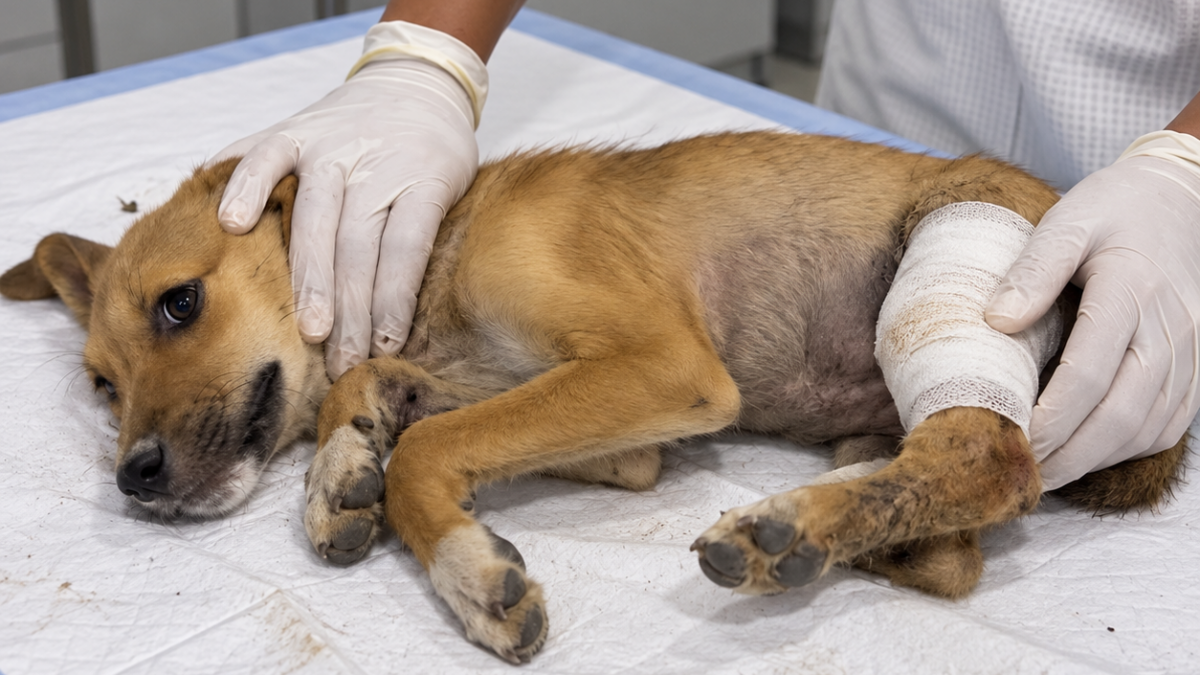
The puppy lying beside the road was so small that at first I thought the bundle in the dust was a piece of cloth someone had thrown away.
Then she lifted her head, dug her front paws into the ground, and dragged the rest of her body toward me because her back legs could no longer carry her.
I had rescued injured animals before, but nothing prepared me for what the veterinarian would tell me about this ten-week-old puppy—or how hard she would fight after hearing none of it.
Her name would eventually become Mishti.
When I first saw her, she had no name.
She was approximately two and a half months old, filthy from the roadside and so exhausted that even lifting her head looked painful.
People nearby told us she had been hit by a car.
Not that morning.
Three days earlier.
For three days, that tiny puppy had somehow remained alive beside the road.
She couldn’t stand.
She couldn’t limp away.
She couldn’t even pull both back legs properly beneath herself.
So she had adapted in the only way available to her.
She dragged herself.
When she wanted water, she dragged herself.
When the sun became unbearable, she tried to drag herself toward shade.
When traffic passed a few feet away, she pressed herself against the ground because she had nowhere else to go.
I crouched several feet from her.
“Hey, sweetheart.”
Her eyes moved toward me.
Her body immediately became tense.
I extended one hand but didn’t touch her.
She had already learned something no puppy should learn that young—that the world could hurt without warning.
“It’s okay.”
She tried to move away.
Her front paws scratched through the dust.
The rest of her body followed awkwardly behind.
That was when I saw the extent of the damage.
My stomach dropped.
I removed my scarf, folded it beneath her as gently as I could, and lifted her.
She was frighteningly light.
For the first few seconds, she struggled.
Then she stopped.
Her head fell against my arm.
I remember whispering the same sentence over and over during the drive.
“Just stay with me.”
At the veterinary clinic, everything happened quickly.
Temperature.
Blood.
X-rays.
Fluids.
Pain medication.
The veterinarian’s expression became more serious with every result.
Finally, he asked me to step into the hallway.
“How bad?” I asked.
He hesitated.
That hesitation scared me more than an immediate answer would have.
“Her hemoglobin is dangerously low.”
I looked through the glass at the tiny puppy on the examination table.
“What else?”
“Her kidney and liver values are poor. She’s severely weakened. There are multiple fractures.”
He paused.
“And one hind leg has been damaged beyond what we can realistically save.”
My throat tightened.
He continued.
“Her tail is also badly injured.”
“Then operate.”
“We can’t.”
I stared at him.
“What do you mean you can’t?”
“If we anesthetize her in this condition, she may not survive.”
For a moment, every sound in the clinic disappeared.
I had believed getting her off that road was the rescue.
It wasn’t.
We had only reached the beginning.
Mishti needed surgery to survive the damage already done to her.
But she first had to become strong enough to survive the surgery itself.
We returned to her bedside.
She opened her eyes when I touched the blanket.
“You hear that?” I whispered.
“You have another job.”
Her eyes remained on me.
“You have to eat.”
That first night, she barely did.
The second day, she took a few bites.
Then came the smallest victory imaginable.
A bowl was placed in front of her.
Mishti lowered her head.
She ate.
Not much.
But enough that I turned away because I didn’t want anyone to see me crying.
A few hours later, she drank water on her own.
Her body was still broken.
The operation still waited ahead.
Nothing had been solved.
Yet something inside that little puppy had changed.
The next morning, when I entered the room, Mishti raised her head.
I moved closer.
Her eyes followed me.
And then, from beneath the blanket, what remained of her injured tail made one tiny movement.
A wag.
Just once.
The veterinarian standing behind me whispered, “That’s a very good sign.”
I looked down at Mishti.
For the first time since I had lifted her from the roadside, I allowed myself to believe something that had seemed impossible three days earlier.
Maybe she wasn’t simply surviving.
Maybe this little puppy had decided she wanted her life back.
PART 2
That tiny movement of Mishti’s tail lasted less than a second.
It still felt enormous.
I had spent the previous days watching numbers on laboratory reports as if they were predictions of the future.
Hemoglobin.
Creatinine.
Liver enzymes.
Body temperature.
Weight.
Every figure seemed capable of deciding whether Mishti would live long enough to reach the operation she desperately needed.
But that morning, none of those numbers mattered as much to me as one weak little wag.
I crouched beside her.
“Do that again.”
Mishti stared at me.
“Come on.”
Nothing.
One of the veterinary assistants laughed softly.
“She doesn’t perform on command.”
“I saved her from the road. I think I’m entitled to a second wag.”
Mishti lowered her head.
The assistant smiled.
“Apparently she disagrees.”
That was the first joke we had made since her arrival.
Until then, every conversation about Mishti had contained words like critical, unstable, fracture, anemia, infection, surgery and risk.
The possibility that she might one day become an ordinary irritating puppy still seemed almost impossible.
But something had begun changing.
Slowly.
Her appetite improved first.
At the beginning we had to encourage every bite.
I would sit beside her bowl and talk as though negotiating with a stubborn child.
“One more.”
Mishti sniffed the food.
“One.”
She turned her face away.
“You have no idea how expensive this food is.”
Her ears twitched.
“Exactly. Show some appreciation.”
Sometimes she ate.
Sometimes she didn’t.
But day by day the amount increased.
The veterinary team designed her meals carefully because her weakened liver and kidneys needed support without overwhelming her fragile system.
Her body had essentially been trying to survive on emergency reserves.
Three days beside the road had taken almost everything she had.
The accident had done the visible damage.
Hunger, dehydration and untreated pain had done the rest.
There was another problem.
Mishti had spent so long dragging herself that the skin beneath parts of her body had become badly irritated.
Even ordinary movement caused discomfort.
We padded everything around her.
Blankets beneath her chest.
Soft towels beneath her hips.
Dressings around the wounds.
She hated having them changed.
The first time I helped the staff, she tried to bite me.
It wasn’t much of a bite.
More of an exhausted warning from a puppy who barely had enough energy to open her mouth.
I pulled my hand away.
“All right.”
She stared at me.
“I deserved that.”
The veterinary assistant beside me said, “Actually, I’m happy she tried.”
“Why?”
“Because angry puppies usually have energy.”
I looked at Mishti.
“You hear that? Being rude is medically encouraged.”
She blinked.
Over the next several days, she became considerably more rude.
I loved every second of it.
When someone touched a sore area, she protested.
When her meal was late, she noticed.
When I entered with food, her head came up immediately.
The puppy who had barely reacted to the world on the roadside was beginning to have opinions about it.
That meant she was returning.
But each improvement carried a shadow.
The damaged leg was still there.
So was the injured tail.
The doctors cleaned and monitored both constantly, trying to prevent infection while Mishti’s blood values improved.
No one pretended we could wait forever.
One afternoon the veterinarian called me into his office.
He placed the newest results beside the previous ones.
“Her hemoglobin is coming up.”
I leaned toward the report.
“Enough?”
“Not yet.”
My hope dropped.
“But it’s moving in the right direction.”
“How long?”
“A few more days if she continues responding.”
“And if she doesn’t?”
He removed his glasses.
“We’ll reassess.”
I hated that word.
Reassess usually meant there were choices nobody wanted to discuss yet.
I looked through the open doorway.
Mishti was asleep.
A volunteer had placed a small pink blanket beneath her head.
She looked impossibly young.
“How much pain is she in?”
“We’re controlling it as well as we safely can.”
“That isn’t what I asked.”
The veterinarian looked at me.
“A lot.”
I closed my eyes.
There was something unbearable about knowing that an animal was hurting while also knowing the painful part could not yet be removed because her body wasn’t strong enough.
It felt cruel even when it was medically necessary.
“We’re asking her to wait,” I said.
“Yes.”
“She doesn’t know why.”
“No.”
I looked back at her.
“She only knows it hurts.”
He nodded.
That night, I stayed longer than usual.
The clinic had become quiet.
Most of the daytime staff had gone.
Mishti lay in a recovery enclosure near the nurses’ station.
I pulled a chair beside her.
“You’ve got a terrible deal, you know that?”
Her eyes opened.
“You were supposed to be learning where people hide shoes.”
Her ears moved.
“Chewing furniture.”
She blinked.
“Annoying somebody at three in the morning.”
I rested my fingers against the blanket.
“Not this.”
Mishti moved her nose toward my hand.
For the first time, she sniffed me without immediately pulling away.
I held still.
She moved closer.
Then she rested the side of her face against my fingers.
I didn’t move for almost ten minutes.
That was the beginning of trust.
Not dramatic.
Not immediate.
Mishti had every reason to be suspicious of hands.
Hands had lifted her from the road, yes.
But hands also held her still for needles.
Hands cleaned painful wounds.
Hands turned her body when she wanted to remain still.
Hands examined areas that hurt.
She couldn’t distinguish medical necessity from danger.
All she could decide was whether the people around her seemed likely to cause pain or comfort.
So I stopped trying to make her love us.
I simply stayed predictable.
I approached slowly.
I spoke before touching her.
I let her smell my hands.
If I needed to move her, I did it carefully.
If something was going to hurt, I didn’t lie with an overly cheerful voice.
“I know.”
That became another sentence she heard often.
“I know, baby.”
During dressing changes.
During injections.
During physical examinations.
“I know.”
Not that I truly knew what she felt.
But I wanted her to understand that somebody recognized it.
Maybe animals don’t understand sentences the way humans do.
They understand consistency.
Tone.
Presence.
Mishti learned that after the pain stopped, my hand remained.
That mattered.
On the sixth day, she finished an entire small meal.
The veterinary assistant called me even though I was already on my way.
“You’re not going to believe this.”
“What happened?”
“She cleaned the bowl.”
“All of it?”
“Every piece.”
“Are you sure another dog didn’t sneak in?”
She laughed.
“Come see.”
When I arrived, Mishti was sleeping.
The empty bowl sat nearby.
I photographed it.
An empty bowl.
That was the picture I sent to the other volunteers.
No one needed an explanation.
Everyone knew what it meant.
The next blood test was better.
Still abnormal.
But better.
The following test improved again.
Then came the morning the veterinarian finally said the words we had been waiting to hear.
“I think she’s ready.”
I stared at him.
“For surgery?”
“Yes.”
My relief lasted perhaps two seconds.
Then fear replaced it.
“When?”
“Tomorrow morning.”
I looked toward Mishti.
She was trying to pull a corner of her blanket toward herself.
Suddenly I wanted more waiting.
Another week.
Another test.
More strength.
Anything that could guarantee she would wake up afterward.
The veterinarian must have seen my face.
“There is still risk.”
“How much?”
“I can’t give you an exact percentage.”
“Would waiting make it safer?”
“At some point waiting becomes more dangerous than operating.”
I knew what he meant.
The damaged tissue itself could become life-threatening.
Mishti had reached the point where courage did not mean delaying.
It meant going forward.
That evening, I bought her a small stuffed elephant.
The toy was ridiculous.
Almost as big as she was.
I placed it beside her.
She smelled it.
Then ignored it.
“That cost money.”
No reaction.
“You are extremely ungrateful.”
She went to sleep.
I left the elephant anyway.
The operation was scheduled early the next morning.
I barely slept.
By six, I was at the clinic.
Mishti had been fasting.
She was angry about that.
For the first time, I saw her attempting to reach the empty food bowl with real determination.
The assistant laughed.
“Yesterday you were worried she wouldn’t eat.”
“Today she thinks we’re starving her.”
“That’s progress.”
I sat beside Mishti.
“You can hate me after surgery.”
She looked at me.
“Deal?”
She put one paw onto my wrist.
I swallowed.
The veterinarian came to collect her.
He explained everything again.
The damaged hind leg would be amputated at a level that allowed proper healing and future mobility.
The injured tail would also need to be removed because the tissue could not recover.
They would monitor blood loss carefully.
Her small size made anesthesia more delicate.
Every sentence made my chest tighter.
Finally he said, “We’ll take good care of her.”
I nodded.
I had no useful words.
When the technician lifted Mishti, she looked back toward me.
That was the worst part.
Her eyes remained on mine while they carried her through the door.
“Come back,” I whispered.
The door closed.
Waiting during surgery is a strange kind of helplessness.
There is absolutely nothing useful to do.
You cannot help the surgeon.
You cannot help the animal.
You cannot hurry time.
You simply exist between two pieces of information.
Before.
And whatever comes after.
I walked outside.
Sat down.
Stood up.
Bought coffee.
Forgot to drink it.
Checked my phone.
Put it away.
Walked back inside.
At one point a receptionist said, “We’ll call you the moment we know.”
“I know.”
“You’ve asked three times.”
“I know.”
She smiled kindly.
Nobody was annoyed.
They understood.
An hour passed.
Then another.
I began imagining every possible complication despite repeatedly telling myself not to.
Finally the surgery door opened.
The veterinarian stepped out.
His mask hung beneath his chin.
I stood before he spoke.
“She’s awake.”
Those two words almost took my knees out from under me.
“She made it?”
“She made it.”
I pressed both hands against my face.
The veterinarian continued explaining the procedure.
It had gone well.
There had been blood loss, but it was controlled.
The amputation sites looked clean.
Mishti was being monitored closely.
I heard perhaps half of it.
The only sentence my mind kept repeating was:
She’s awake.
When they finally allowed me near the recovery area, Mishti looked smaller than ever.
Bandages covered the surgical sites.
Her eyes were half open.
She was disoriented from anesthesia.
I sat beside her.
“Hey.”
One ear moved.
“It’s me.”
Her eyes found my face.
For a few seconds, nothing happened.
Then her front paw moved weakly across the blanket.
I placed my fingers beneath it.
“You did it.”
I cried then.
I didn’t care who saw.
“You actually did it.”
Mishti slept most of that day.
The first twenty-four hours after surgery were difficult.
She was uncomfortable.
Confused.
Every time she tried to reposition herself, her balance had changed.
A puppy’s body learns movement almost automatically.
Mishti now had to relearn it.
Her tail was gone.
One hind leg was gone.
The entire geometry of her body had changed while she slept.
The first time she attempted to rise, she toppled onto her side.
My instinct was to catch her immediately.
The physiotherapy assistant stopped me.
“Wait.”
“She’ll fall.”
“Onto padding.”
Mishti pushed herself up again.
She tipped.
Tried again.
The assistant crouched nearby.
“She has to understand where her center is now.”
Watching that tiny puppy struggle against her own balance was almost harder than watching her lie still.
On the road, helplessness had been forced upon her.
Now recovery required effort.
Mishti pushed with both front legs.
Her remaining back leg moved beneath her.
For half a second, she stood.
Then fell.
I whispered, “Good girl.”
Again.
She stood.
Fell.
Again.
She became frustrated.
A tiny sound escaped her throat.
I reached forward.
The therapist shook her head.
“Let her try.”
Mishti planted her paws.
Pushed.
Her body shook.
She stood.
One second.
Two.
Three.
Then she dropped onto the blanket.
The entire room celebrated as though she had crossed a finish line.
The assistant clapped.
I laughed.
Mishti looked offended by our excitement.
“Three seconds,” I told her. “You’re showing off.”
The next day she managed five.
Then she took one strange hopping step.
Then another.
It wasn’t graceful.
But neither had dragging herself across the roadside been graceful.
The difference was everything.
This movement was taking her somewhere.
The surgical wounds needed time.
Her muscles needed rebuilding.
The remaining hind leg had to become stronger.
Her front legs had to compensate differently.
We had to protect her joints because young three-legged dogs can sometimes overwork the limbs they still have.
The rehabilitation plan grew almost as detailed as the medical chart had been.
Short supported movements.
Rest.
Gentle range-of-motion exercises.
Controlled surfaces.
No slippery floors.
No jumping.
Mishti considered these rules optional.
Once her pain decreased, her personality arrived all at once.
The quiet puppy disappeared.
In her place emerged a creature who wanted to investigate absolutely everything.
The first object she attacked was the stuffed elephant.
I walked into the room and found her gripping its ear.
“You ignored that for a week.”
She tugged harder.
“Oh, now it’s interesting?”
The elephant lost the argument.
That toy became her companion.
She dragged it around despite the fact that it was nearly her size.
Whenever volunteers cleaned her area, they had to move Mishti and the elephant together or she complained.
She also discovered treats.
That changed everything.
Until then, rehabilitation had required patience.
After she learned treats existed, Mishti became the most cooperative patient in the building.
“Stand.”
She stood.
Treat.
“Step.”
She stepped.
Treat.
“Come.”
She came.
Treat.
Within days, she recognized the treat container from across the room.
One volunteer accidentally opened it while attending another dog.
Mishti appeared from behind a blanket like a tiny three-legged detective.
We laughed until tears came.
This was the puppy who had almost died.
Now she was committing snack-related crimes.
I began bringing her home occasionally once the veterinarian permitted short foster visits.
The first evening was terrifying for me.
I had prepared the room as if expecting an infant.
Rugs covered the tile.
Cushions blocked the furniture.
Her bed was on the floor.
Water nearby.
Pee pads arranged in three different locations.
Her stuffed elephant waited in the middle.
I carried Mishti inside.
She looked around.
Then she immediately peed beside the nearest pad.
Not on it.
Beside it.
I stared.
She stared.
“You missed by two inches.”
Her face showed no regret.
“After everything I’ve done.”
Mishti hopped away.
Within twenty minutes, she had inspected the entire room.
Within thirty, she discovered a loose corner of a rug.
Within forty, she began chewing it.
That was one of the happiest evenings of my life.
I kept catching myself smiling at things that would normally annoy me.
A stolen sock.
A tipped water bowl.
The sound of something suspiciously quiet coming from another room.
Mishti was finally experiencing the troubles of puppyhood.
Ordinary trouble.
Beautiful trouble.
The first night, I put her bed beside mine.
She stayed in it for approximately six minutes.
Then I heard a soft scratching sound.
I looked down.
Mishti was standing beside the bed.
“You cannot climb up here.”
She scratched again.
“No.”
She stared at me.
“Doctor’s orders.”
She made a tiny whine.
I sat up.
“You’re manipulative.”
Another whine.
I lifted her carefully and placed her beside me.
“This is a medical exception.”
Mishti curled against my side.
Within seconds, she was asleep.
I stayed awake.
Not because I was afraid she would move.
Because I could feel her breathing.
That sound felt like a gift.
On the roadside, I had wondered whether she would survive the drive.
Now she was asleep against my ribs, dreaming.
I wondered what puppies dream about.
Food, probably.
Maybe running.
That thought hurt.
Would Mishti ever run?
The veterinarian had said many three-legged dogs became remarkably mobile once they adapted.
But Mishti had lost the leg before she had even fully developed normal coordination.
Nobody could promise exactly how she would move as an adult.
The next morning, she provided her own answer.
I placed her on the lawn.
She sniffed the grass.
Then she hopped forward.
Slowly.
One step.
Another.
Then something caught her attention.
A leaf moved across the yard.
Mishti stared.
The wind pushed the leaf.
Mishti launched herself after it.
I panicked.
“Mishti!”
She moved faster.
Not running the way a four-legged dog ran.
But moving.
Fast.
Free.
She chased the leaf across half the yard before losing her balance and rolling gently onto the grass.
My heart stopped.
Mishti immediately got up and attacked the leaf.
I started laughing.
“You nearly killed me.”
She chewed the leaf.
“Worth it?”
Apparently yes.
That afternoon, I sent a video to the clinic.
The physiotherapy assistant replied immediately.
SLOWER.
Then another message arrived.
But this is fantastic.
Mishti’s recovery accelerated.
Her wounds healed cleanly.
Her blood work gradually normalized.
Her coat became softer.
Her weight increased.
Her ribs disappeared beneath healthy puppy growth.
Even her face changed.
When I first found her, her eyes seemed too large for her head because the rest of her body was so thin.
Weeks later she looked rounder.
Brighter.
Younger somehow.
That sounds strange because she actually was older.
But suffering had made her look ancient.
Safety returned her puppy face.
The emotional recovery took a different path.
Certain sounds frightened her.
Vehicles were the worst.
The first time I tried walking her near a quiet lane and a motorcycle passed in the distance, Mishti flattened herself against the ground.
Her entire body shook.
I immediately crouched.
“It’s okay.”
She tried to crawl toward me.
I picked her up.
That reaction told us something.
Whatever memory she carried from the accident remained.
We changed the plan.
No forcing.
No dragging her toward roads to “get used to it.”
Trust could not be rebuilt by creating more fear.
Instead, we began far away.
Mishti sat in my arms while distant traffic passed.
Treat.
A vehicle sound.
Treat.
A car visible from far away.
Treat.
Then home.
Sessions lasted only a few minutes.
Weeks passed.
Her trembling decreased.
Eventually she could stand in a yard while traffic moved beyond the gate.
Then she could walk near a quiet street.
She still watched cars carefully.
Maybe she always would.
I didn’t need her to forget.
I only needed fear to stop controlling every step.
Other things frightened her less.
People, surprisingly, became one of her favorite discoveries.
Once Mishti decided humans could be trusted, she became aggressively affectionate.
There is no other way to describe it.
Visitors entered.
Mishti approached.
If they ignored her, she followed.
If they sat, she leaned.
If they crouched, she attempted to climb into their lap.
One of the clinic volunteers joked that Mishti had two modes.
Sleeping.
And demanding love.
Children especially fascinated her.
She would sit several feet away and watch them.
Because of her small size and medical history, we supervised every interaction carefully.
But once a child sat calmly on the floor, Mishti approached.
She would sniff their hands.
Then push her forehead under them.
Pet me.
That was the instruction.
She had learned to ask for what she wanted.
There was extraordinary healing in that.
The puppy who once tried to become invisible beside the road now expected kindness.
The foster period stretched through the month.
I knew from the beginning Mishti would eventually need a permanent home.
That was the agreement.
Rescue.
Treatment.
Recovery.
Foster.
Adoption.
Simple on paper.
It did not feel simple anymore.
Every morning Mishti greeted me as if we had been separated for years instead of one night.
She learned the sound of my keys.
The location of the treat box.
The exact cabinet where her food was stored.
She slept against my ankle while I worked.
She followed me from room to room with that uneven little three-legged rhythm.
Tap.
Tap.
Hop.
Tap.
Tap.
Hop.
That sound became part of the house.
One afternoon a coordinator called.
“We have an application.”
My stomach tightened.
“For which dog?”
There was a pause.
“You know which dog.”
I looked across the room.
Mishti was attempting to pull stuffing from the elephant.
“No.”
“No?”
“I mean… tell me.”
The family lived in Jodhpur.
They had experience with rescued animals.
They had spoken to the veterinary team.
They understood Mishti’s long-term needs.
Safe flooring.
Weight management.
Joint care.
Routine checkups.
Extra attention as she grew.
They weren’t looking for a perfect puppy.
They were specifically willing to care for Mishti.
“They sound good,” I said.
“They do.”
I hated how disappointed I felt.
The coordinator knew me well enough to notice.
“You okay?”
“Fine.”
“You don’t sound fine.”
I watched Mishti.
“I knew this was coming.”
“You did.”
“That doesn’t mean I have to like it.”
“No.”
There was no pressure to decide immediately.
The family would undergo the same process as everyone else.
Calls.
Home verification.
References.
Discussion about veterinary care.
We were careful.
Mishti had fought too hard for us to become careless at the final step.
A few days later, I spoke with the family by video call.
A woman named Priya answered first.
Her husband Arjun joined her.
Their daughter sat nearby.
They asked good questions.
Not superficial ones.
“How much exercise will she be able to handle when she’s older?”
“Does she need supplements?”
“What kind of floors are safest?”
“Is there a risk to her remaining hind leg?”
“Does she get frightened by cars?”
That question got my attention.
“Yes.”
Priya nodded.
“We live away from the main road. Our front gate stays closed.”
Arjun added, “And we won’t walk her near traffic until she’s comfortable.”
I relaxed slightly.
Their daughter asked, “What does she like?”
That question was harder.
“Food.”
They laughed.
“Seriously.”
“What kind?”
“All kinds.”
“What toy?”
I turned the camera toward the stuffed elephant.
Mishti had fallen asleep with one paw across it.
The girl smiled.
“Can she bring that?”
My throat tightened.
“Yes.”
“Good.”
After the call, I sat beside Mishti.
“You’re causing problems.”
She woke.
“Someone wants you.”
Her tail area moved instinctively even though there was no tail there anymore.
Dogs find ways to express happiness with their whole body.
I rubbed her ears.
“They seem nice.”
Mishti licked my wrist.
“You could act slightly sad.”
She did not.
The final veterinary examination came the following week.
The doctor compared her latest blood results to those from the first day.
I could hardly believe they belonged to the same animal.
Her hemoglobin had recovered dramatically.
Kidney and liver values were far better.
The surgical wounds had healed.
She was gaining strength in the remaining limbs.
He watched her walk across the examination room.
Tap.
Tap.
Hop.
Tap.
Then Mishti saw the treat jar.
Her speed doubled.
The veterinarian laughed.
“She has figured it out.”
“Food motivation.”
“That will make training easier.”
He examined the remaining hind leg.
“We need to protect this.”
“I know.”
“Keeping her lean will be important. Extra weight puts more strain on the remaining joints.”
“We’ve explained everything to the family.”
“Good.”
He stroked Mishti’s head.
She immediately tried to investigate his pocket.
“She has certainly changed.”
I looked at him.
“Did you think she’d make it?”
He hesitated.
“The first day?”
“Yes.”
He looked down at Mishti.
“Honestly?”
“Honestly.”
“No.”
I had expected the answer.
It still hurt.
“How close?”
“Very.”
He touched the examination table.
“The anemia alone worried us. Combined with the trauma and organ values…”
He stopped.
“She was in serious trouble.”
Mishti found something edible in his pocket.
“Hey.”
He rescued the treat.
“She doesn’t seem interested in the medical history.”
“That’s because she plans to charge you for emotional damages.”
The veterinarian smiled.
“I’d pay.”
When we returned home, I took Mishti into the yard.
She chased another leaf.
She had never forgiven leaves for moving without permission.
I sat on the ground.
Watching.
Her gait was unusual.
Her body tilted slightly with each stride.
But there was nothing tragic about it.
That distinction mattered to me.
People saw three legs and sometimes immediately felt sadness.
I understood.
I had felt it too.
But Mishti didn’t spend her days grieving a leg she no longer had.
She spent them using the three she did.
Dogs have a remarkable relationship with reality.
They do not compare every moment to a life that might have existed.
Mishti woke up.
There was food.
People.
A toy elephant.
Sunlight.
A yard.
That was her world.
She took it.
Completely.
The adoption date was scheduled.
I had one week left.
Seven days.
Suddenly ordinary routines became painful.
The sound of her eating.
Her morning greeting.
Her habit of sleeping beneath my chair.
I began mentally labeling moments.
Last Monday.
Last Tuesday.
Stop it, I told myself.
She isn’t dying.
She is going home.
But fostering creates a strange kind of grief.
You spend weeks convincing an animal that they are safe with you.
Then, if you have done your job correctly, you place them in somebody else’s arms.
People sometimes ask how foster families can do it.
My answer is that I never found an easy way.
You do it because keeping every animal would eventually mean helping no new ones.
A foster home is supposed to be a bridge.
Mishti had crossed hers.
That should have made me happy.
It did.
It also hurt.
Both things could be true.
On the night before she left, I packed her belongings.
Medication records.
Veterinary reports.
Food.
Pee pads.
Blankets.
Her harness.
The elephant.
I placed the toy into the bag.
Mishti immediately pulled it out.
“No.”
She dragged it away.
“That is literally yours.”
She stared.
“I’m packing it for you.”
She carried it beneath the table.
I laughed despite myself.
“All right.”
I sat down.
Mishti approached.
She placed the elephant beside my leg and climbed halfway into my lap.
She was getting heavier.
Healthy.
I ran my hands along her back.
“Tomorrow’s a big day.”
Her eyes began closing.
“You’re going to Jodhpur.”
No response.
“There’s a family waiting.”
She yawned.
“They have a daughter.”
Mishti rested her chin on me.
“They know about the treats.”
One eye opened.
“I knew that would get you.”
I smiled.
Then my voice caught.
“You’re going to be okay.”
That sentence wasn’t for her.
It was for me.
The journey from Meerut to Jodhpur was long.
We arranged transportation carefully so Mishti would remain comfortable.
I went with her for the handoff.
I told everyone I wanted to explain her routines personally.
That was true.
It was also an excuse.
I needed to see where she was going.
Mishti handled travel better than expected.
She slept for long stretches.
We stopped regularly for water and bathroom breaks.
At one stop, she walked across a patch of grass and immediately began searching around a discarded food wrapper.
“You have food.”
She ignored me.
“You ate an hour ago.”
Still searching.
“You’re moving to a family that thinks you’re dignified.”
Mishti found a crumb.
“Fraud.”
As the miles passed, I watched landscapes change outside.
My emotions changed too.
Fear.
Pride.
Sadness.
Hope.
Then back to fear.
What if she didn’t understand?
What if she waited for me?
What if she refused food?
What if the new family loved her but she didn’t trust them?
What if I was making a mistake?
Every foster caregiver I knew had asked those questions.
The answer was always the same.
Give the animal a chance to build another bond.
Love was not a finite resource.
Mishti had learned to trust me.
That meant she could learn to trust someone else.
When we arrived in Jodhpur, Priya and Arjun were waiting.
So was their daughter, Anaya.
The girl had apparently been watching from the window because she reached the gate before her parents.
She stopped herself from running directly toward Mishti.
That mattered.
We had explained that sudden approaches sometimes frightened her.
Anaya sat several feet away.
She placed both hands in her lap.
Mishti looked at her.
Then at me.
Then back at the girl.
Priya smiled.
“We can wait.”
No one called Mishti.
No one grabbed her.
We simply waited.
Mishti took one step.
Tap.
Another.
Hop.
She sniffed Anaya’s shoe.
The girl did not move.
Mishti sniffed her fingers.
Anaya whispered, “Hi.”
Mishti moved closer.
Then she placed her front paws against the girl’s leg.
Anaya looked at me.
“Can I touch her?”
“Yes.”
She slowly stroked Mishti’s shoulder.
Mishti leaned into her.
Priya covered her mouth.
Arjun smiled.
I looked away.
My eyes had filled unexpectedly.
We spent several hours there.
I inspected everything even though the rescue coordinator already had.
The floors had rugs.
The gate was secure.
Her bed was placed away from stairs.
Food and water were ready.
The family had found a veterinarian nearby and already made an introductory appointment.
Anaya had made a small sign above Mishti’s sleeping area.
WELCOME HOME, MISHTI.
For a second, that nearly undid me.
I knelt beside her bed.
“You’re spoiled already.”
Mishti was investigating a bag of treats.
Priya laughed.
“She found those quickly.”
“She has advanced detection skills.”
We reviewed the medical history again.
Warning signs.
Joint care.
Weight.
Diet.
Fear around traffic.
Regular blood checks initially.
Everything.
Finally there was nothing left to explain.
I looked at the time.
I had to leave.
That moment always comes too quickly.
I crouched.
“Mishti.”
She came toward me immediately.
Of course she did.
I picked her up.
She placed her front paws against my chest.
I pressed my face against the top of her head.
For weeks I had been strong because she needed me to be practical.
Now I couldn’t.
“You were supposed to be temporary.”
Mishti licked my chin.
“That was very inconvenient.”
Anaya giggled softly behind me.
I continued whispering.
“You scared all of us.”
Mishti squirmed.
“You cost everybody sleep.”
She licked me again.
“And now you’re leaving.”
My voice broke.
I held her tighter.
“But that’s good.”
I swallowed.
“This is good.”
Priya stepped closer.
“We’ll take care of her.”
I nodded.
“I know.”
“And you can check on her whenever you want.”
“That may be a mistake.”
She smiled.
“You can check every day.”
“I might.”
I lowered Mishti.
For half a second, she stayed beside my feet.
My heart wanted that.
Then Anaya picked up the stuffed elephant.
“Mishti?”
Mishti turned.
The elephant moved.
Mishti forgot me immediately and chased it.
Everyone laughed.
I laughed too.
Through tears.
That was the best possible betrayal.
She followed the girl into the living room.
I stood in the doorway.
Mishti attacked the elephant.
Anaya sat beside her.
Priya watched both of them.
Arjun placed the treat box on a shelf Mishti couldn’t reach.
Already learning.
I stepped outside.
Mishti didn’t follow.
I had imagined that hurting.
Instead, there was relief inside the pain.
She wasn’t following because she wasn’t frightened.
She believed she belonged there.
That was what I had wanted from the beginning.
During the trip back, my phone rang.
Priya.
My stomach dropped.
I answered immediately.
“What happened?”
She laughed.
“Nothing happened.”
“You cannot call a rescuer thirty minutes after an adoption and begin with silence.”
“I’m sorry.”
“What is it?”
“I thought you’d want to know.”
She sent a photograph.
Mishti was asleep.
Her body was stretched across Anaya’s lap.
The elephant was beneath her chin.
I stared at the picture for a long time.
“She ate?” I asked.
“All of dinner.”
“Water?”
“Yes.”
“Bathroom?”
“Used the pee pad.”
“Actually on it?”
Priya laughed.
“Exactly on it.”
“Traitor.”
“What?”
“She spent a month pretending she didn’t understand those.”
Another photograph arrived.
Mishti on her back.
Three legs in the air.
Completely relaxed.
My chest loosened.
That was when I knew.
She was home.
The updates continued.
At first, every day.
Then several times a week.
Videos.
Photographs.
Small stories.
Mishti discovered the kitchen.
Mishti learned where treats were stored.
Mishti stole Anaya’s sock.
Mishti fell asleep during a video call.
Mishti barked at her own reflection.
Mishti learned to climb onto a low cushion by herself.
Mishti gained weight.
Mishti went for her first comfortable neighborhood walk.
Each update transformed the image I carried from the roadside.
The dirt.
The injured body.
The puppy dragging herself.
Those memories remained.
But new ones grew around them.
Mishti in a yellow harness.
Mishti sunbathing beside a window.
Mishti hopping across a carpet because she heard the treat container.
Mishti asleep under a blanket with only her nose visible.
Three months after the adoption, Priya sent me a video that I watched perhaps twenty times.
Anaya stood at one end of a hallway.
Mishti waited at the other.
“Come on!”
The little dog launched herself forward.
Tap-hop.
Tap-hop.
Faster.
Faster.
Her ears bounced.
Her mouth was open.
She reached Anaya and jumped against her knees.
The girl laughed and dropped onto the floor.
Mishti climbed into her lap.
I watched again.
Then again.
This was the animal I had wondered might never walk.
Now the question was how to slow her down.
Her follow-up veterinary reports were excellent.
The remaining hind leg looked strong.
Her weight stayed within the target range.
Her organ values had normalized.
There were no complications from the amputations.
The doctor in Jodhpur told the family that Mishti had every reason to live an active life if they continued protecting her joints.
They did.
They became obsessive.
Rugs everywhere.
No uncontrolled jumping from furniture.
Regular exercise without exhaustion.
Good food.
Checkups.
The kind of obsessive care I could appreciate.
One evening, months after Mishti left, I found her old pink blanket in a storage box.
I stopped.
It still had a small tear in one corner from the first time she had tried to play.
I sat holding it.
Rescue creates strange souvenirs.
An empty medicine bottle.
A chewed toy.
A blanket.
A photograph of an empty food bowl.
Objects that mean absolutely nothing to anyone else.
I remembered that first week.
Waiting for blood results.
Begging her to eat.
Watching her struggle to stand.
I remembered believing the operation would be the end of the hard part.
It wasn’t.
Then I remembered believing learning to walk would be the end.
It wasn’t.
Then the adoption.
Then letting go.
Rescue did not happen in a single moment.
It was hundreds of small decisions.
Somebody noticed her.
Somebody stopped.
Somebody lifted her.
A driver rushed her to a clinic.
A veterinarian chose not to operate too early.
Assistants cleaned wounds.
Volunteers prepared meals.
Donors paid bills.
Someone stayed beside her when she was afraid.
Physiotherapists helped her balance.
A foster home gave her somewhere quiet to heal.
A family hundreds of miles away said yes.
That was the truth behind every miraculous rescue story.
There usually was no miracle.
There was work.
And timing.
And people refusing to quit.
Mishti herself provided the rest.
A year after I found her, I traveled to Jodhpur again.
I didn’t tell Anaya exactly when I would arrive because she wanted to surprise Mishti.
I was nervous.
That embarrassed me.
Would she remember?
Dogs remember scent extraordinarily well, everyone told me.
Still, a year is a long time in the life of a young dog.
Mishti had a family now.
Daily routines.
New smells.
New people.
Maybe I belonged only to an earlier chapter.
That would have been okay.
I told myself that repeatedly.
When I reached the house, Priya met me outside.
“She’s sleeping.”
“Should we wake her?”
“No.”
We entered quietly.
Mishti was curled on a cushion in the living room.
She had grown.
Not dramatically.
She was still small.
But the fragile puppy proportions were gone.
Her chest had filled out.
Her coat shone.
Muscle was visible in her remaining hind leg.
Anaya sat nearby trying not to smile.
I stood five feet away.
“Mishti.”
One ear lifted.
Her eyes opened.
For a second she stared.
Then she exploded.
There is no other word.
She launched herself from the cushion and came across the room at a speed that made me instinctively reach forward.
Her entire body wiggled.
No tail required.
“Hey!”
She jumped against me.
I dropped to the floor.
Mishti climbed into my lap.
She licked my face.
My hands.
My chin.
Anything she could reach.
Anaya laughed.
“She remembers!”
I couldn’t answer.
I was crying.
Mishti pressed herself beneath my arms.
I hugged her.
“You remember me?”
Of course she did.
Not because I was extraordinary.
Because I had been there during a period when her entire world had changed.
I had been part of the smell of safety.
Priya filmed the reunion.
Later she sent the video.
I almost couldn’t watch it.
In the recording, I looked overwhelmed.
Mishti looked perfectly certain.
No hesitation.
Just recognition.
After the excitement settled, she led me through her kingdom.
The kitchen first.
Obviously.
Then her bed.
Then the sunny corner beside the window.
Then Anaya’s room.
She hopped onto a low padded platform beside the bed and looked at me proudly.
“You have furniture now?”
Anaya said, “That’s hers.”
“All of it?”
“Pretty much.”
Priya laughed.
“She runs the house.”
“That sounds right.”
We walked outside.
Mishti crossed the yard.
Her movement was so natural now that after several minutes I almost stopped noticing the missing leg.
That was perhaps the greatest compliment to her recovery.
Not that the loss had vanished.
It hadn’t.
But it no longer dominated every image.
She was not “the three-legged puppy” to her family.
She was Mishti.
The dog who begged during breakfast.
The dog who hated baths.
The dog who slept under Anaya’s blanket.
The dog who could hear a snack packet from another room.
The dog who sometimes refused to walk in the rain because wet paws were apparently unacceptable.
Her disability was part of her.
It was not all of her.
That afternoon, Anaya brought out the stuffed elephant.
It looked terrible.
One ear had been repaired twice.
The stuffing was uneven.
Its trunk was nearly detached.
“You kept this?”
Anaya looked offended.
“It’s her favorite.”
Mishti grabbed the elephant.
I laughed.
“That thing survived longer than expected.”
We sat in the yard until evening.
At one point Mishti settled beside me.
She put her head on my leg.
The same way she had after surgery.
I ran my hand across her ears.
“You did pretty well.”
Her eyes closed.
Anaya sat on the other side.
“She’s my best friend.”
I looked at the girl.
“Take care of her.”
“I do.”
“I know.”
She became serious.
“My mom told me how you found her.”
I nodded.
“Was she really dragging herself?”
“Yes.”
“Did nobody help for three days?”
“That’s what we were told.”
Anaya looked down at Mishti.
Her expression changed.
“I hate that.”
“So do I.”
“Why didn’t anyone stop?”
I had no answer.
Maybe people didn’t notice.
Maybe they assumed someone else would help.
Maybe they were busy.
Maybe they were afraid of an injured dog.
Maybe they believed one puppy was not their responsibility.
There are a thousand excuses available when we need them.
“I don’t know.”
Anaya stroked Mishti’s shoulder.
“I would stop.”
“I believe you.”
That evening, I thought about those three days more than I had in months.
Mishti could not tell us what happened.
We did not know exactly which vehicle hit her.
We did not know whether the driver realized the extent of the injury.
We did not know how many people passed.
I had once felt angry about those unknown people.
For a while, I imagined finding the driver.
Demanding an explanation.
How do you strike a puppy and leave?
How does anyone see something so small on the road and continue?
But anger had nowhere useful to go.
There was no reliable license plate.
No witness who could identify the vehicle.
No person to confront.
And more importantly, Mishti didn’t need revenge.
She needed treatment.
Then strength.
Then a home.
The best answer to the cruelty of those three roadside days was not another act of cruelty.
It was every day that came after.
That was the revenge life gave her.
The road had taken a leg and a tail.
Mishti answered by learning to run.
The accident had taught her hands could mean fear.
She answered by crawling into people’s laps.
Three days of being unseen had almost killed her.
She answered by becoming the center of an entire family’s world.
Pain had tried to make her life smaller.
Mishti made it enormous.
That was enough for me.
Before leaving Jodhpur, I went outside alone.
The evening was warm.
I could hear Anaya laughing inside.
Then Mishti barked.
A second later the door opened.
She came hopping toward me.
“Did you think I left?”
She stopped beside my leg.
I crouched.
“You know I have to go.”
Mishti licked my wrist.
The first goodbye had nearly broken me because I was afraid.
This goodbye was different.
I knew exactly what I was leaving behind.
A healthy dog.
A family.
A safe house.
A girl who loved her.
I hugged Mishti.
“You don’t need me anymore.”
She pushed closer.
I smiled.
“That’s the whole point.”
When I stood, she followed me toward the gate.
Anaya appeared behind us.
“Mishti!”
The dog looked back.
Then at me.
Then at the girl.
I opened the gate.
“Go.”
Mishti turned.
She hopped toward Anaya.
The girl crouched.
Mishti jumped into her arms.
I left smiling.
Over the following years, Mishti grew into adulthood.
I continued receiving updates.
Her energy never disappeared.
Neither did her obsession with food.
One video showed her sitting perfectly still beside a cupboard.
Priya’s voice came from behind the camera.
“There are no treats left.”
Mishti continued staring at the cupboard.
“Mishti.”
Nothing.
“You ate them.”
Mishti glanced at the camera.
Then back at the cupboard.
I laughed so hard I replayed it three times.
Another photograph showed Mishti at a family celebration wearing a small floral collar.
Another showed her asleep beside Anaya while the girl studied.
Another showed her sitting beside the front door waiting for Arjun to return.
Mishti had learned the rhythm of a home.
She knew when people left.
She knew they came back.
That may sound ordinary.
For her, it was extraordinary.
Nobody left her beside a road anymore.
Nobody disappeared when she was helpless.
People came back.
Every time.
As she matured, the family remained careful with her remaining joints.
Swimming became one of her favorite forms of exercise when they found a safe place for her to practice.
The first time she entered shallow water, she looked betrayed.
Then she discovered movement was easier without all her weight on her legs.
Within a few sessions, she loved it.
Priya sent me a video.
Mishti paddled toward Anaya.
Three legs working furiously.
Her face completely serious.
When she reached the girl, she tried to climb onto her.
Anaya laughed.
“Mishti! You can swim!”
The dog looked as though she had personally invented the activity.
I remembered a veterinarian once wondering whether she would survive anesthesia.
Now she was swimming.
Years passed.
Our rescue group helped many more animals.
Some stories ended beautifully.
Others didn’t.
That is the part people rarely understand.
You cannot save every animal.
Sometimes help arrives too late.
Sometimes medicine reaches its limit.
Sometimes a body is too damaged.
Those losses accumulate.
There were days when I wondered whether continuing was worth the heartbreak.
Then someone would send me a photograph of Mishti.
Or another rescued dog would take its first step.
Or a frightened animal would eat from a human hand for the first time.
And I would remember.
Success does not erase loss.
Loss does not erase success either.
Mishti existed.
That mattered.
One monsoon season, several years after her adoption, Priya called me unexpectedly.
My mind immediately imagined the worst.
“Is Mishti okay?”
“Yes.”
The answer came quickly enough that I breathed again.
“What happened?”
“Something interesting.”
She sent me a video.
Rainwater had collected near a wall in their yard.
A tiny kitten was crouched beneath a low ledge, soaked and crying.
Mishti stood several feet away.
She was barking toward the house.
Not at the kitten.
Toward the humans.
In the next part of the video, Arjun came outside.
Mishti led him directly to the kitten.
They brought it inside.
I watched the video twice.
Then I called.
“She found it?”
“Yes.”
“And wouldn’t come inside?”
“Not until Arjun followed.”
I laughed.
“That sounds familiar.”
“What?”
“She knows what it means when somebody can’t get themselves somewhere safe.”
The kitten recovered and went to another home.
Mishti returned to her normal occupation of locating treats.
But that little incident affected me.
We like to imagine rescued animals understand gratitude the way humans do.
I don’t know whether that is true.
Probably not in the sentimental way we describe it.
But experience changes behavior.
Mishti knew distress.
She knew helplessness.
Whether she connected that history to the kitten, no one could say.
What mattered was simple.
She noticed.
She called someone.
Someone came.
The opposite of what had happened to her.
There was something beautifully complete about that.
When Mishti was around six, I visited again.
She was no longer the endlessly energetic puppy.
Still playful.
Still food obsessed.
But calmer.
Anaya was older too.
The two had grown up together.
On the wall of Anaya’s room hung several photographs.
School events.
Family trips.
Friends.
And Mishti.
Mishti as a tiny puppy.
Mishti after surgery.
Mishti wearing a harness.
Mishti sleeping.
Mishti swimming.
One photograph stopped me.
It was the first image taken after she arrived in Jodhpur.
Anaya sat on the floor.
Mishti leaned against her leg.
The stuffed elephant lay between them.
“You kept that picture?”
Anaya said, “It’s my favorite.”
“Why?”
“Because that was when she became mine.”
I looked at her.
“Technically she had been adopted about twenty minutes earlier.”
“You know what I mean.”
I did.
Then she pointed toward another photograph.
It was one I had never seen.
Mishti was standing on three legs in the sunlight.
Her head high.
Mouth open.
Almost smiling.
“That’s mine,” Anaya said.
“You took it?”
“Yes.”
“I was doing a photography assignment.”
“It’s good.”
“My teacher asked us to take a picture that meant strength.”
I looked at Mishti.
She was sleeping on the floor.
“So you photographed her.”
“Of course.”
I swallowed.
People often associate strength with something large.
Muscle.
Power.
Noise.
But one of the strongest creatures I had ever met weighed only a few kilograms when I found her.
Strength had looked like a puppy eating three bites of food.
Drinking alone.
Standing for three seconds.
Trying again after falling.
Trusting another hand.
That changed my definition permanently.
As Mishti aged, the family adjusted again.
Three-legged dogs can live full lives, but compensation takes a toll over time.
Her remaining limbs had carried extra responsibility for years.
The veterinarian began monitoring early arthritis.
They added joint support.
Modified exercise.
More rugs.
A softer bed.
Mishti accepted all improvements as her rightful luxury.
When Priya bought her an orthopedic bed, Mishti smelled it, circled twice and immediately fell asleep.
Arjun sent me a message.
She has officially retired from hardship.
I saved it.
That was exactly what I wanted for her.
Retirement from hardship.
Mishti had done enough fighting before she was three months old.
The rest of her life did not need to prove anything.
Sometimes survival stories become unfair because we expect survivors to keep being inspirational forever.
Mishti didn’t owe us inspiration.
She owed us nothing.
She was allowed to be lazy.
Demand snacks.
Refuse rain.
Snore.
Steal blankets.
Become old.
That was the victory.
Years after I first lifted her from the roadside, I happened to travel through Meerut near the same area where she had been found.
I stopped.
I wasn’t entirely sure why.
The road had changed.
Shops had opened.
Traffic was heavier.
The exact place was difficult to identify.
But I knew approximately where it had been.
I stood beside the road for a few minutes.
Cars passed.
Motorcycles.
Trucks.
People moving quickly through ordinary days.
I tried to picture her there again.
Ten weeks old.
Broken.
Dragging herself.
For years that image had filled me with anger.
That day, something else arrived.
Perspective.
The puppy who had been left there no longer existed.
Not because Mishti was gone.
Because she had become so much more.
That road represented three days.
Her home represented years.
Pain had occupied a fraction of her life.
Love had taken the rest.
I took out my phone.
There was a photograph Priya had sent the previous week.
Mishti lay beneath a fan with her stomach exposed, sleeping shamelessly.
I held the image toward the road.
It was a ridiculous gesture.
Nobody saw.
“Look at you.”
Traffic continued.
I smiled.
“You won.”
Not against a person.
Not against the driver.
Not against the road.
Against the ending that accident had tried to write for her.
Mishti had refused it.
When I reached home that night, I found the old photograph of her first empty bowl.
I placed it beside a recent image from Jodhpur.
On the left:
A hospital enclosure.
Thin puppy.
Bandages.
Empty bowl.
On the right:
Adult Mishti on a sofa, one paw resting on Anaya, staring at someone who apparently had food.
Between those photographs were thousands of ordinary moments.
That was a life.
Eventually, as happens with every animal we love, Mishti became a senior.
Her face lightened.
The fur around her muzzle faded.
She moved more carefully.
Long chases across rooms became shorter bursts.
She still appeared whenever a snack packet opened.
Age could apparently affect everything except hearing related to food.
Anaya went to college but remained close enough to return home regularly.
Priya told me Mishti recognized the sound of her daughter’s vehicle.
Before Anaya reached the door, Mishti would be waiting.
One winter evening, I received a video.
Anaya entered carrying a bag.
Mishti was asleep.
“Mishti?”
Her head rose.
For a second she looked confused.
Then recognition came.
Her entire body began moving.
She tried to hurry.
Her older legs couldn’t move as quickly.
Anaya dropped the bag and sat on the floor.
Mishti reached her.
The girl—no longer really a girl—wrapped both arms around the dog.
I watched silently.
It reminded me of my own reunion years earlier.
Dogs measure time differently.
But love leaves recognizable patterns.
Mishti remembered.
Always.
During one of her senior checkups, the veterinarian found increased strain in the remaining hind leg.
Nothing catastrophic.
But enough to require more caution.
Priya called.
“She’s frustrated.”
“Why?”
“We’ve reduced her walks.”
I laughed.
“She’s always been offended by medical instructions.”
“She wants to go farther.”
“Tell her the original veterinarian gave the same advice years ago.”
“She doesn’t respect authority.”
“That is also established.”
They bought a small supportive mobility harness.
At first Mishti hated it.
Then she realized the harness allowed her to walk farther with less effort.
Her opinion changed immediately.
She began standing beside it when she wanted to go outside.
That was Mishti.
Adapt.
Use what helps.
Continue.
When I next visited, we walked together.
Slowly.
Mishti wore the support harness.
Anaya held one side.
I walked beside them.
The three of us moved through a quiet park.
A young dog ran past.
Mishti watched.
For a moment, I expected sadness.
Again I had imposed human feelings onto her.
Mishti simply sniffed a bush.
That lesson returned.
She did not spend her life comparing herself to four-legged dogs.
We did that for her.
Mishti was busy being Mishti.
She walked until she was tired.
Then Anaya carried her home.
That evening, I sat beside her bed.
“You know, the first time I carried you, you fit right here.”
I indicated my forearm.
Mishti slept.
“You were filthy.”
No reaction.
“And mean.”
One eye opened.
“Okay, not mean.”
The eye closed.
“Terrified.”
That was more accurate.
I touched her head.
“You trusted us anyway.”
Her breathing remained deep.
That was perhaps the part of her story that moved me most after all those years.
Not survival.
Trust.
Bodies sometimes heal because medicine works.
Bones mend.
Blood values improve.
Wounds close.
But trust cannot be prescribed.
Mishti had to choose it.
Again.
And again.
With every meal.
Every touch.
Every person.
By trusting, she exposed herself to the possibility of being hurt another time.
She did it anyway.
That was courage.
When Mishti became much older, Priya and I had the conversation every rescuer eventually has with an adoptive family.
Quality of life.
Pain.
Mobility.
Appetite.
Joy.
We discussed signs to watch.
The goal was not to count days.
It was to protect good ones.
For months, Mishti remained stable.
Slow.
But happy.
Then one summer, arthritis worsened significantly.
Medication helped less.
She slept longer.
Walks became shorter.
Anaya moved home temporarily to help.
I traveled to Jodhpur when Priya told me Mishti had begun refusing food.
Walking through their door felt like stepping into several points in time at once.
Anaya greeting me as an adult.
Priya with more gray in her hair.
And Mishti lying on a soft bed near the window.
Old.
Small.
Still unmistakably her.
I crouched.
“Mishti.”
Her eyes opened.
For half a second, I feared there would be no recognition.
Then she lifted her head.
Her whole body made the faint movement that had replaced a tail wag all those years ago.
My throat closed.
“Hey, baby.”
She tried to stand.
“No.”
I moved beside her.
“You don’t have to.”
Mishti rested her head against my wrist.
The room disappeared.
I was back at the clinic.
Tiny puppy.
Pink blanket.
My fingers beneath her cheek.
Only now years had passed between those two touches.
Anaya sat beside me.
“She knew you.”
I nodded.
Mishti smelled my hand.
Then, unbelievably, she looked toward my bag.
I started laughing.
“Seriously?”
Priya smiled through tears.
“She thinks you brought treats.”
“I did.”
I removed a small packet approved by the veterinarian.
Mishti ate one.
Only one.
But of course she did.
Food had been her first great victory.
Perhaps it was fitting.
We spent that evening telling stories.
The missed pee pad.
The destroyed elephant.
The first run after a leaf.
The cupboard stare.
Swimming.
The rescued kitten.
Every story was familiar.
Still we told them.
When you know goodbye is coming, repetition becomes precious.
There is no such thing as hearing a beloved story too many times.
The veterinarian visited the next morning.
Mishti had advanced arthritis.
Other age-related problems had appeared.
Treatment could perhaps extend time.
But not restore comfortable days.
Priya asked the question quietly.
“Are we helping her or keeping her?”
The veterinarian did not answer quickly.
That told us enough.
Finally she said, “I think she is very tired.”
Anaya began crying.
Mishti looked toward her.
Even then.
Still noticing.
Still caring about somebody else’s distress.
I put my hand on Mishti’s shoulder.
Years earlier, we had postponed surgery because she was too weak to survive.
Back then, every choice had been about giving her more time.
Now love required asking whether more time was still a gift.
That is the cruel symmetry of caring for animals.
At the beginning, you fight death.
At the end, sometimes you must stop fighting long enough to protect them from suffering.
The family chose to let Mishti go at home.
On her bed.
Beside the window she loved.
No clinic smells.
No frightening journey.
Anaya placed the old stuffed elephant beside her.
I almost laughed when I saw it.
It had been repaired so many times that very little original elephant remained.
“You still have that?”
Anaya wiped her face.
“Of course.”
Mishti smelled it.
Then she rested her chin against its damaged head.
Priya sat behind her.
Arjun held one front paw.
Anaya lay beside her.
I sat near her head.
The veterinarian explained each step.
When she was ready, she looked at us.
I wasn’t.
None of us were.
But Mishti was tired.
That mattered more.
I leaned close.
“You remember that empty bowl?”
Her eyes rested on me.
“You scared me so badly.”
A breath.
“And then you ate.”
My voice broke.
“You just kept eating.”
Anaya laughed through tears.
“That definitely never stopped.”
I smiled.
“No.”
I stroked Mishti’s face.
“You learned to stand.”
Another breath.
“You learned to run.”
I looked at her three legs.
“You made everybody stop feeling sorry for you.”
My tears fell onto the blanket.
“You had a good life.”
Priya whispered, “The best.”
I nodded.
“The best.”
The veterinarian administered the sedative.
Mishti relaxed.
Her breathing became slower.
The tension left her body.
For a moment she looked young again.
Not physically.
Peacefully.
Like the puppy asleep beside me during that first foster night.
I placed my palm beneath her face.
“You don’t have to drag yourself anywhere anymore.”
That sentence broke everyone.
Anaya sobbed.
I kept going because Mishti deserved voices she knew around her.
“No more balancing.”
“No more sore joints.”
“No more roads.”
Her eyes were almost closed.
“Just rest.”
The final medication followed.
Her breathing slowed.
Then stopped.
Mishti died surrounded by the people who had built the life around her.
The puppy nobody stopped for during three terrible days left this world with four people touching her and a veterinarian crying beside them.
There was no loneliness.
No roadside dust.
No traffic passing.
Only home.
For a long time, none of us moved.
Anaya’s hand remained on Mishti’s back.
Priya held her husband.
I kept my fingers beneath Mishti’s cheek.
Eventually I looked at that battered stuffed elephant.
I remembered buying it before surgery.
Mishti had ignored it.
Then attacked it.
Then carried it across two cities and most of her life.
Funny what survives.
We had Mishti cremated.
The family kept most of her ashes.
Anaya placed some beneath a flowering tree in the yard.
She buried the stuffed elephant there too.
At first I protested.
“You kept that all these years.”
“That’s why.”
She touched the earth.
“It should stay with her.”
We stood quietly.
Then Anaya looked at me.
“You saved her.”
I shook my head.
“No.”
“You did.”
“I picked her up.”
“You stopped.”
That word.
Stopped.
For years, I had focused on the people who hadn’t.
Anaya focused on the person who had.
I looked at the tree.
“Lots of people saved her.”
“The doctors.”
“Yes.”
“You.”
“Yes.”
“My parents.”
“Yes.”
Anaya wiped her face.
“And Mishti.”
I smiled.
“Mostly Mishti.”
We laughed.
That was how I wanted the conversation to end.
Not with the accident.
With her fight.
Several weeks after returning home, I found myself looking through old files.
Mishti’s first veterinary report.
I had forgotten how bad the numbers were.
Dangerously low hemoglobin.
Compromised kidney values.
Poor liver function.
Multiple fractures.
Severe trauma to the hind limb.
Tail injury.
Every clinical phrase described a puppy whose future was measured in uncertainty.
Then I opened the final photograph Priya had sent before Mishti’s health declined.
She was lying beside Anaya.
Gray muzzle.
Eyes half closed.
Comfortable.
Old.
I placed the images side by side.
The first and last chapters.
People call rescue stories miracles.
I understand why.
But Mishti’s life taught me something more useful.
A miracle is easy to admire because it sounds instantaneous.
Her recovery was not.
It was one meal.
Then another.
One blood test.
One safe night.
One operation.
One attempt to stand.
One fall.
Another attempt.
One hop.
One run.
One adoption.
One ordinary day multiplied thousands of times.
That is how her life was saved.
Not all at once.
Piece by piece.
Years later, our rescue organization received another call about an injured puppy near a road.
Different animal.
Different place.
When I arrived, several people were already standing nearby.
Someone had placed water out.
A shopkeeper had moved traffic away from the dog.
A young man had called a veterinarian.
I knelt beside the puppy.
For one second, I thought about Mishti.
Then I got to work.
Later, the young man asked me, “Do you think he’ll survive?”
I looked at the frightened animal.
“I don’t know.”
He seemed disappointed.
People want certainty during rescue.
We rarely have it.
I continued.
“But surviving starts here.”
“Here?”
“With somebody stopping.”
He nodded.
We lifted the puppy.
As we carried him toward the vehicle, I realized Mishti’s story had changed me in one final way.
For years, I had been angry about those three days when she was ignored.
Now I understood the answer was not to remain angry forever.
The answer was to make stopping contagious.
One person stops.
Another sees them.
Next time, they stop.
A child hears the story.
Years later, they stop.
A family teaches compassion.
Someone else stops.
That is how the world changes for animals like Mishti.
Not because cruelty disappears.
Because indifference becomes less acceptable.
I still return to Jodhpur occasionally.
The flowering tree in the family’s yard has grown.
The first time I visited after Mishti died, I stood beneath it with Anaya.
No dog came hopping toward me.
That absence felt enormous.
Anaya touched the trunk.
“I still hear her sometimes.”
“What do you mean?”
“The sound of her walking.”
Tap.
Tap.
Hop.
I knew exactly what she meant.
“I hear it too.”
She smiled.
“Mom still reaches for the treat cupboard at five.”
“Habit.”
“She says she expects Mishti to appear.”
“She probably always will.”
Anaya looked toward the house.
“I used to feel sad when people called her disabled.”
“Why?”
“Because it sounded like they thought something was missing from her life.”
I nodded.
“And nothing was missing.”
“No.”
She smiled through tears.
“She had everything.”
That sentence followed me home.
Mishti had everything.
Not four legs.
Not a tail.
Everything that mattered.
Food.
Safety.
Play.
Pain relief.
People.
A family.
Time.
So much time compared with the few hours we initially feared she had.
That became the ending I carried.
Not revenge against the driver.
Not anger toward the people who passed.
A deeper answer.
Mishti lived.
She grew.
She played.
She became mischievous.
She crossed hundreds of miles to a family that wanted her.
She watched a child become an adult.
She grew gray.
She became old enough to develop the ordinary problems of old dogs.
Think about that.
The puppy we feared would not survive surgery lived long enough for us to worry about arthritis.
I cannot imagine a more satisfying victory.
The accident took one leg.
Life gave her thousands of steps on the other three.
The road took her tail.
Her entire body learned to wag.
Pain stole the first weeks of puppyhood.
A family gave her years.
Three days of neglect almost became her entire story.
Instead they became a paragraph.
Whenever I remember Mishti now, I rarely see the roadside first.
I see the leaf.
The one she chased across the foster yard.
I see her launching herself forward.
Unbalanced.
Awkward.
Joyful.
Falling into the grass.
Getting up immediately.
Attacking the leaf as though nothing unusual had happened.
That was Mishti.
She did not wait for life to become perfect before enjoying it.
She used what she had.
Three legs.
A stubborn heart.
People willing to help.
And an appetite capable of bankrupting a rescue organization.
Maybe that is why her story still reaches me.
She never became whole because a missing leg somehow returned.
She was whole because losing it did not make the rest of her life incomplete.
The last time I stood beneath her tree, I placed my hand against the trunk.
“Your elephant is under there.”
Wind moved through the leaves.
“You know, that thing was expensive.”
I smiled.
“You never appreciated anything.”
The yard remained quiet.
Then I heard laughter from inside.
Anaya and her mother.
Life continuing.
Exactly as it should.
I looked down at the place where Mishti rested.
“I’m glad I stopped.”
That was all.
On the drive away, I thought about the tiny puppy who had tried to drag her broken body toward me years earlier.
At the time, I believed she was asking to be rescued.
Maybe she was simply trying to survive one more minute.
Either way, I reached her.
She reached me.
And everything afterward grew from that distance closing.
One frightened puppy.
One person kneeling in the road.
One pair of hands finally lifting her instead of passing by.
If Mishti taught me anything, it was that the worst moment of a life does not deserve the power to write the final sentence.
A crushed body was not her ending.
Losing a leg was not her ending.
Losing her tail was not her ending.
Surgery was not her ending.
Even my goodbye when she went to Jodhpur was not her ending.
Her story continued through thousands of mornings when she woke inside a home where someone was happy to see her.
Thousands of meals.
Thousands of touches.
Thousands of ridiculous searches for treats.
Years of being called by name.
Years of being expected.
Years of belonging.
And when the final day eventually came, Mishti did not have to drag herself toward safety anymore.
Safety had been built around her.
She lay inside it.
She closed her eyes inside it.
She left surrounded by it.
For a puppy who once spent three days beside a road waiting for somebody to notice, I can think of no better ending.
Mishti was noticed.
Mishti was carried.
Mishti was healed.
Mishti was loved.
And most importantly, Mishti lived.








