PART 2: A Black Lab Waited 2 Days in the Rain After His Homeless Owner Said, “Stay Here—I’ll Come Back”… What Happened Next Broke Everyone’s Heart**
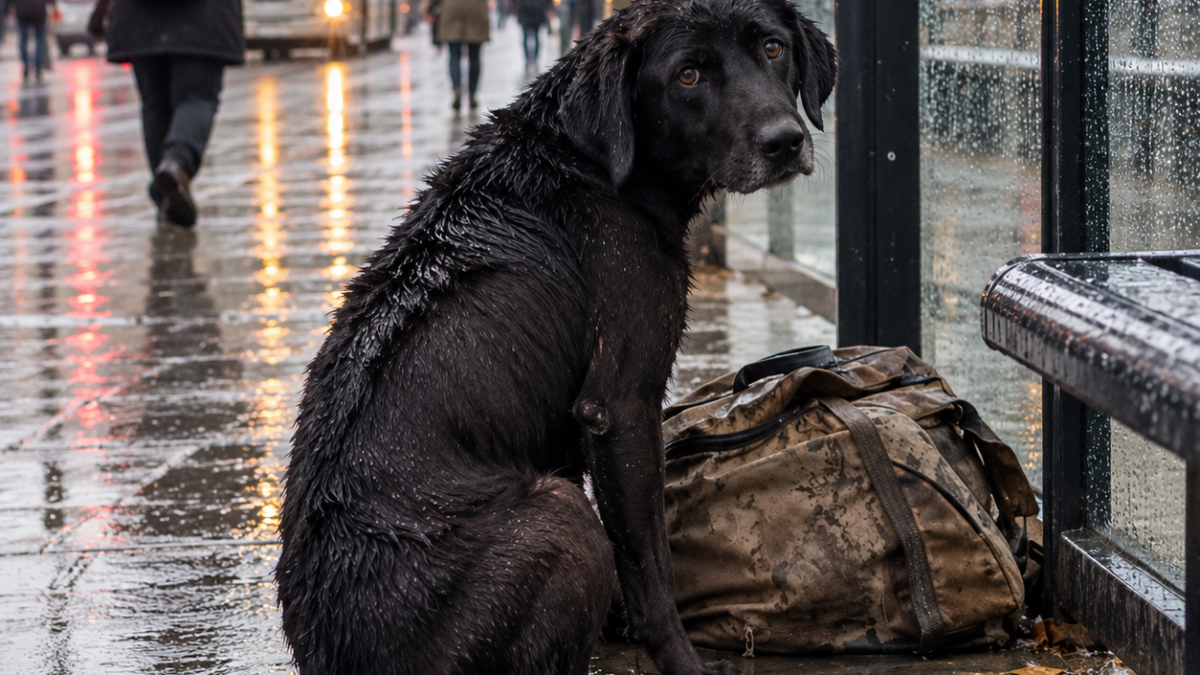
PART 2
The first page was a photocopy of a payroll statement.
The second was a handwritten list of dates.
Fourteen of them.
Beside each date, Daniel had written the number of hours he had worked for a company called Mercer Restoration & Contracting.
Ten hours.
Eleven and a half.
Nine.
Twelve.
Some Saturdays.
Two Sundays.
At the bottom of the page, he had written a total.
Two hundred and seventeen unpaid hours.
Behind that was a letter from a legal aid clinic acknowledging that Daniel had contacted them about wages he claimed he had never received.
Then there was something else.
A photograph.
Not of Bear.
Not of Daniel.
It showed a construction site.
A temporary platform had partially collapsed beside an apartment building. A section of railing hung sideways. Broken boards were scattered underneath.
On the back Daniel had written:
APRIL 17 — TOLD MERCER THIS WASN’T SAFE.
Another photograph showed Daniel’s left hand wrapped in gauze.
Another showed bruising along his shoulder.
The final document was a termination notice.
EMPLOYEE VOLUNTARILY ABANDONED POSITION.
I read that line twice.
Then I looked at the wet dog beside me.
“No,” I said quietly.
Bear raised his head.
I don’t know why I spoke to him as though he understood every word, but at that moment he was the only witness I trusted.
“He didn’t abandon anything, did he?”
Bear leaned against the bag.
That answer was good enough for me.
I called my supervisor.
“Lisa, I need transportation support and an emergency kennel placement.”
“For the client?”
“For his dog.”
There was silence.
“Emma.”
“I know.”
“You’re supposed to be doing outreach assessments.”
“I am doing one.”
“For a Labrador?”
“For a man in intensive care who might wake up with literally nothing left except this Labrador.”
She sighed.
Lisa had supervised me for six years. She knew the tone in my voice.
“What do you need?”
“A large crate, towels, and someone from county animal services who won’t treat him like a stray.”
“I’ll make the call.”
“Thank you.”
“And Emma?”
“Yeah?”
“Don’t promise anything you can’t deliver.”
I looked at Bear.
Too late.
I had already decided I was going to try.
By late afternoon, the temperature had dropped.
Bear was shivering visibly.
A county animal welfare officer named Miguel Santos arrived with a van.
He approached carefully.
“He bite?”
“Not that I’ve seen.”
“Growl?”
“No.”
“Eat?”
“No.”
Miguel looked at the untouched food.
“That concerns me more than the biting would.”
We placed the crate near Bear.
The moment he saw it, he stood.
It was the first time I had seen him move more than a few inches.
For one hopeful second I thought he might walk toward us.
Instead, he moved closer to the bench and sat again.
Miguel lowered his voice.
“He thinks we’re taking him away from here.”
“I know.”
“We may have to.”
“Give me a minute.”
I sat on the pavement in front of Bear.
My jeans were already soaked, so it made no difference.
“Bear.”
His ears shifted.
“I found Daniel.”
He stared at me.
“He’s alive.”
I felt foolish saying it.
Then something happened.
Bear’s breathing changed.
Not dramatically.
Just a small whine deep in his throat.
The first sound I had heard him make.
“He’s sick,” I continued. “He can’t come back here tonight.”
Bear lowered his head.
“I know he told you to stay.”
My voice cracked.
God, I hated that.
I had spent years learning how to sit across from people facing eviction, addiction, abuse, unemployment, grief, and death without letting my emotions become another problem they had to manage.
But this dog was destroying every professional wall I had built.
“I’m asking you to trust me instead.”
Bear looked toward the road.
Then toward me.
I put my hand inside the crate.
“I promise I’ll keep looking after him.”
Miguel glanced at me but said nothing.
I whispered, “And I won’t leave you wondering.”
Bear remained still for several seconds.
Then he stood.
He walked to the crate.
Stopped.
Looked back toward the street one final time.
And stepped inside.
Miguel slowly closed the door.
During the drive to the shelter, I sat in the back beside the crate with my fingers through the bars.
Bear rested his chin against them.
His entire body trembled.
Not violently.
Just continuously.
“He’s exhausted,” Miguel said.
“I think he’s scared he broke the rule.”
“What rule?”
“Stay here.”
Miguel looked at Bear in his mirror.
“Dogs are better at promises than people.”
At the shelter, Bear refused dinner.
He refused water until nearly midnight.
I stayed.
Every time the front door opened, he stood.
Every single time.
A volunteer would enter.
Bear would look.
Then sit again.
A staff member would pass.
Bear would look.
Then sit.
Eventually I pulled a plastic chair beside his kennel.
“You know he’s not walking through that door tonight.”
Bear put his nose against the bars.
“I wish I could explain hospitals to you.”
His eyes stayed on mine.
So I tried anyway.
“Daniel is sleeping somewhere with machines around him. People are helping him breathe. They’re giving him medicine. And he is not choosing to be away from you.”
Bear blinked slowly.
I reached through the bars.
His head settled beneath my palm.
“You weren’t abandoned.”
That word mattered to me.
Maybe because I had heard it too often in my work.
Abandoned by family.
Abandoned by employers.
Abandoned by landlords.
Abandoned by systems designed with so many cracks that a human being could disappear through them one lost paycheck at a time.
Daniel’s documents were sitting in the passenger seat of my car.
And I kept thinking about that sentence.
DO NOT LET THEM SAY I WALKED AWAY.
At 6:15 the next morning, I was outside the intensive care unit.
The nurse who met me was named Patrice.
“You’re the social worker with the dog?”
“That is apparently who I am now.”
That earned the smallest smile.
“Mr. Reed is still sedated. We reduced it overnight, but he hasn’t properly awakened.”
“What happened to him?”
“I can’t disclose everything without consent, but you’re listed through the hospital social services department now, so I can tell you what affects discharge planning.”
She checked the hallway before continuing.
“He came in with severe cardiac arrhythmia, dehydration, malnutrition, and an infection that had apparently been untreated for some time.”
I stared through the glass.
Daniel looked smaller than the man in the photograph.
His beard had streaks of gray.
Several monitors surrounded the bed.
“Was he going to die?”
Patrice didn’t give me false reassurance.
“He was extremely sick.”
I stepped into the room.
For a long time, I simply stood there.
This was the man Bear had nearly starved himself waiting for.
On the bedside table sat everything Daniel now officially owned.
One plastic hospital bag containing his shoes.
A belt.
A rain jacket.
Thirty-seven cents.
I pulled the chair closer.
“Mr. Reed?”
Nothing.
“My name is Emma Hart.”
The monitor continued its steady rhythm.
“I found Bear.”
His right hand moved.
Barely.
I stopped.
“Daniel?”
No response.
I leaned closer.
“Bear is safe.”
His fingers moved again.
Patrice, standing near the doorway, saw it too.
“I’m going to keep him safe,” I said. “He waited for you exactly where you told him to wait.”
A tear appeared at the corner of Daniel’s closed eye.
I will never forget that.
People can explain it medically if they want.
Reflex.
Medication.
Neurological response.
Maybe they’re right.
But I saw that tear.
And I knew.
“He heard you,” Patrice whispered.
I stayed another twenty minutes.
Before I left, I placed the photograph of Daniel and Bear on his bedside table.
Then I returned to the shelter.
Bear was sitting at the gate.
Of course he was.
I knelt.
“I saw him.”
His ears lifted.
“He’s alive.”
Bear stepped toward me.
“He’s still sick, but he’s alive.”
For the first time since I had found him, Bear pressed his entire body against me.
Not excitedly.
Not wildly.
He simply leaned.
All eighty pounds of him.
I wrapped both arms around his neck.
“That’s right,” I whispered. “You were right to wait.”
That evening, Bear ate half a bowl of chicken and rice.
The next morning, he finished breakfast.
It sounds like a small thing.
It wasn’t.
It felt like the first victory.
The second came three days later.
Daniel opened his eyes.
The hospital called while I was driving.
I pulled into a grocery store parking lot before answering.
“Ms. Hart?”
“Yes.”
“This is Patrice from St. Vincent.”
My hands tightened around the steering wheel.
“Is he—”
“He’s awake.”
I closed my eyes.
“Is he okay?”
“He’s confused. Weak. But he’s awake.”
Then Patrice laughed softly.
“And you should probably know the first clear word we got from him.”
I already knew.
“Bear?”
“Bear.”
I laughed and cried at the same time.
When I entered Daniel’s room an hour later, his eyes followed me.
He looked older awake.
More frightened too.
“Emma?” he whispered.
“Yes.”
Patrice had apparently told him my name.
I pulled up the photograph.
“I brought proof.”
Daniel looked at Bear’s face.
His lower lip shook.
“He stayed?”
“For two days.”
Daniel shut his eyes.
“Oh, God.”
“He waited beside your bag.”
“I told him…”
“I know what you told him.”
His hand covered his face.
“I thought I’d be back.”
“I know.”
“I didn’t know they were taking me.”
“You were unconscious.”
“He hates sirens.”
The sentence was so ordinary that it broke me.
Daniel was lying in intensive care after almost dying, and his concern was that his dog hated sirens.
“He’s okay,” I said.
Daniel looked at me again.
“Is he eating?”
“He is now.”
“Where?”
“County shelter, private recovery kennel.”
Fear immediately crossed his face.
“They won’t put him down?”
“No.”
“They won’t give him away?”
“No.”
“You promise?”
“I promise.”
Daniel breathed out slowly.
Then he asked, “My bag?”
“I have it.”
Everything changed in his expression.
Not relief.
Alarm.
“You opened it?”
“I needed to identify you.”
He stared toward the window.
“The papers?”
“I found those too.”
His jaw tightened.
“Throw them away.”
That surprised me.
“Why?”
“Because it’s finished.”
“Daniel—”
“Please.”
“I saw the wage records.”
His eyes hardened.
“You shouldn’t have.”
“I saw the termination letter too.”
“I said throw it away.”
“Why did they say you abandoned your job?”
He looked at me for a long moment.
Then he turned his head.
“Because dead men don’t argue with paperwork.”
“You’re not dead.”
“Almost.”
“And you can argue now.”
A bitter smile touched his mouth.
“You think I didn’t try?”
That was when Daniel Reed finally told me how he had ended up at that bus stop.
He had not always been homeless.
Five years earlier, Daniel had rented a small duplex outside Akron.
He worked construction.
He paid his bills.
He owned an old Ford pickup that rattled above fifty miles an hour but started every morning.
Bear had been a six-month-old rescue when Daniel adopted him.
“He chewed through half my kitchen,” Daniel told me.
For the first time, he smiled.
“Baseboards, cabinet corner, phone charger. Ate one boot.”
“Only one?”
“Left the other one untouched like a threat.”
Then his smile disappeared.
Two years earlier, Daniel had taken a job with Mercer Restoration & Contracting.
The company handled apartment repairs, storm damage, roofing, and municipal rehabilitation projects.
The owner, Grady Mercer, had built a reputation as a businessman who could finish jobs cheaply and quickly.
Daniel said there was a reason for that.
Mercer cut corners.
Constantly.
Cheap materials.
Missing safety equipment.
Workers paid late.
Overtime shifted into cash payments that sometimes never arrived.
Men categorized as subcontractors even when they worked full schedules under company supervision.
“You reported him?”
“Eventually.”
Daniel looked at his hands.
“The platform in that photograph collapsed the day after I told him somebody was going to get hurt.”
“Were you on it?”
“Partly.”
He held up his left hand.
Two fingers did not fully straighten.
“I fell about nine feet. Could’ve been worse.”
“Did you file workers’ compensation?”
“Tried.”
“What happened?”
“Company said I wasn’t an employee on that project.”
“But you have pay stubs.”
“Not for that week.”
Daniel laughed without humor.
“Funny coincidence.”
He missed work while his hand healed.
Then several paychecks arrived short.
Daniel complained.
Mercer promised to fix them.
He didn’t.
Daniel complained again.
Mercer removed him from the schedule.
When Daniel requested his unpaid wages, the company mailed him a notice stating that he had voluntarily abandoned his position.
“Then my truck died,” Daniel said.
“How quickly did you lose the apartment?”
“Three months.”
He had savings.
Not much.
He used them.
Then he used a credit card.
Then another.
He sold the truck for parts.
He found day labor.
Warehouse shifts.
Roofing jobs.
Anything.
But he was already experiencing episodes of chest pain and dizziness.
He ignored them because medical appointments cost money and missed shifts cost more.
Bear ate every day.
Daniel sometimes didn’t.
“That dog never knew we were broke,” he said.
I looked at him.
“He probably knew.”
Daniel smiled faintly.
“Yeah. Probably.”
He had contacted legal aid about Mercer.
A volunteer attorney had begun reviewing the paperwork.
Then Daniel lost his phone.
Missed two appointments.
Changed shelters.
Started sleeping outside because one facility would not accept Bear.
The case went quiet.
“So you gave up?”
“What else was I supposed to do?”
“Continue.”
Daniel looked almost angry.
“With what address?”
“We’ll figure that out.”
“With what phone?”
“I’ll find one.”
“With what money?”
“That part may actually be in your bag.”
He stared at me.
I pulled the wage records from my folder.
“Daniel, I’m not an attorney. I’m not promising you’ll win anything.”
He said nothing.
“But you kept these documents for a reason.”
His face changed.
“I kept them because I wanted proof I hadn’t imagined it.”
“That matters.”
“To who?”
“To you.”
He looked away.
“And maybe now,” I said, “to somebody with the authority to do something about it.”
That afternoon, with Daniel’s permission, I called the legal aid clinic listed on the letter.
A woman named Nina Brooks answered.
When I said Daniel Reed’s name, she went silent.
“We’ve been trying to locate him for almost eight months.”
“He’s been homeless.”
“I know.”
“He almost died three days ago.”
Another silence.
“Is he alive?”
“Yes.”
“Then tell him Nina still has his file.”
The next morning, Nina came to the hospital.
She was in her forties, direct, fast-talking, and carrying a binder thick enough to stop a door.
Daniel looked at it.
“What’s that?”
“Your problem,” she said.
Then she placed another binder beside it.
“And this is Grady Mercer’s problem.”
Daniel almost smiled.
Nina had not stopped working entirely when Daniel disappeared.
His complaint had similarities to complaints from other Mercer employees.
Four workers had reported unpaid overtime.
Two said they had been falsely classified.
One claimed he had been fired after reporting unsafe scaffolding.
Another had been injured and pressured not to file a claim.
“Why didn’t anybody do anything?” Daniel asked.
“They are now.”
“Because I nearly died?”
“No. Because documentation accumulates slowly.”
Nina opened the binder.
“And because you kept records.”
Daniel stared at the pages.
“I’m nobody.”
Nina shook her head.
“No. You’re a witness.”
For the next week, Daniel improved.
Slowly.
Bear did too.
I began showing Daniel short videos from the shelter.
Bear eating.
Bear sleeping.
Bear carrying the same red rubber ball around the kennel.
Daniel watched every video repeatedly.
One afternoon I showed him a clip of Bear refusing to surrender the ball to Miguel.
Daniel laughed so hard he had to hold his chest.
“That’s his.”
“Apparently.”
“I bought that at a dollar store four Christmases ago.”
“It looks like it.”
“You should see the expensive toys people gave him.”
“He ignored them?”
“Completely.”
“Of course.”
Daniel watched the clip again.
Then his smile faded.
“What happens when I get discharged?”
There it was.
The question I had been dreading.
Recovery did not solve homelessness.
The hospital could stabilize Daniel’s heart.
Legal aid could pursue Mercer.
The shelter could care for Bear temporarily.
But eventually somebody had to answer the simplest question in the world.
Where do they go?
Most emergency shelters available to single men in our county did not allow animals except qualifying service animals.
Daniel would not surrender Bear.
I knew that before asking.
“No.”
“Daniel, I’m exploring options.”
“No shelters without him.”
“I’m not suggesting—”
“I stayed outside last winter because they wouldn’t take him.”
“I understand.”
“No, you don’t.”
His voice rose.
A nurse glanced through the doorway.
Daniel lowered it again.
“You don’t understand what he did for me.”
“Tell me.”
He stared at the blanket.
“My wife died seven years ago.”
I had not known he had been married.
“Her name was Claire.”
I sat down.
“Cancer. Fast.”
Daniel swallowed.
“Everybody says fast like it’s mercy. It wasn’t.”
I let him continue.
“After she died, I stopped coming home. Worked late. Slept on the couch. Didn’t answer anybody. My sister kept telling me to get a dog.”
“Bear?”
“Eventually.”
He smiled faintly.
“He was the ugliest puppy at the rescue.”
“That seems rude.”
“He was.”
Daniel laughed.
“Big feet. Too much skin. Ears going different directions.”
He rubbed his face.
“The first night I brought him home, he crawled onto the couch and slept against my chest.”
Daniel paused.
“First full night I’d slept in eleven months.”
Now I understood.
Bear was not Daniel’s pet in the casual sense people sometimes use that word.
Bear was the bridge between Daniel’s old life and the life he had somehow survived.
“When I lost the apartment,” Daniel said, “people told me to surrender him.”
“But you didn’t.”
“He was the reason I kept getting up.”
I nodded.
“So we find somewhere that takes both of you.”
Daniel studied my face.
“You say things like they’re easy.”
“They aren’t.”
“Then why say them?”
“Because difficult and impossible are different words.”
He considered that.
“Social worker line?”
“No. Stubborn Irish mother line.”
That earned another smile.
Finding housing was harder than saying we would.
Every program had rules.
Waiting lists.
Income requirements.
Pet restrictions.
Deposits.
Background checks.
Paperwork.
Daniel had an expired ID.
No current address.
No working phone.
No active bank account.
No proof of regular income.
No family locally.
One supportive-housing program had an opening but prohibited animals over fifty pounds.
Bear weighed seventy-eight.
I asked whether they could make an exception.
They said no.
Another landlord accepted dogs but wanted three months’ rent plus a pet deposit.
Another apartment was affordable but located forty miles from Daniel’s medical care.
Another required employment verification.
Every door seemed to come with a smaller door inside it.
Then Grady Mercer appeared.
I met him for the first time in Daniel’s hospital room.
I walked in and found a man wearing a tailored navy jacket sitting beside the window.
Daniel looked furious.
The stranger stood.
“Ms. Hart?”
“Yes.”
“Grady Mercer.”
I stopped.
There are people whose names enter a room before they do.
His had.
“What are you doing here?”
“I came to check on Daniel.”
Daniel laughed.
“No, you didn’t.”
Mercer ignored him.
“I heard one of my former employees had suffered a medical emergency.”
“How?”
“I have contacts.”
Nina had specifically warned Daniel not to discuss the wage claim with Mercer without counsel.
I reached for my phone.
“You need to leave.”
Mercer lifted both hands.
“I’m not causing trouble.”
Daniel stared at him.
“You caused plenty.”
“Daniel, I came as a courtesy.”
“You fired me.”
“You stopped reporting to work.”
“My hand was broken.”
“That’s not how our records reflect the situation.”
I saw Daniel’s heart monitor increase.
“Mr. Mercer, this conversation is over.”
Mercer turned toward me.
“This is between Daniel and me.”
“No. This is a hospital room, and he is my client.”
Daniel spoke.
“What do you want?”
Mercer reached into his jacket.
He pulled out an envelope.
That was when I understood.
Money.
“Daniel,” I said, “don’t.”
Mercer placed the envelope on the table.
“A little assistance.”
Daniel looked at it.
“How much?”
“Five thousand.”
I almost laughed.
Mercer continued quickly.
“No admission of liability. Nothing like that. Just help from someone who remembers that Daniel worked hard for us.”
Daniel looked at him.
“What do I sign?”
Mercer’s face barely changed.
But it changed enough.
“A standard release.”
I stepped between them.
“No.”
Daniel looked at me.
I said, “Call Nina.”
Mercer’s expression hardened.
“This doesn’t concern you.”
“You showed up in the hospital room of a seriously ill former employee with five thousand dollars and paperwork.”
“I came to help.”
“Then leave the money and take the paperwork.”
He smiled.
Not kindly.
“That’s not how assistance agreements work.”
Daniel picked up the envelope.
For one terrifying second I thought desperation might win.
Five thousand dollars was enormous to a man with six dollars in his wallet.
It could mean a motel.
Food.
Medicine.
A deposit.
Bear.
Mercer knew that.
That was why he was there.
Daniel opened the envelope.
Removed the check.
Then he saw the document beneath it.
He read the first page.
His face went completely still.
“What does it say?” I asked.
Daniel looked at Mercer.
“It says I agree all wages were paid.”
Mercer leaned forward.
“It’s a comprehensive settlement.”
“It says the platform accident was my fault.”
“Standard language.”
Daniel turned another page.
“It says I waive every complaint.”
“You get immediate money.”
Daniel stared at the check.
Then something astonishing happened.
He tore it in half.
Mercer stood.
“You should think carefully.”
Daniel tore it again.
“I have.”
“You don’t have a home.”
“No.”
“You don’t have a job.”
“No.”
“You have medical bills you can’t pay.”
“Probably.”
Mercer’s face reddened.
“And you’re throwing away five thousand dollars because some legal aid lawyer convinced you you’re getting rich?”
Daniel placed the torn pieces back into the envelope.
“No.”
“Then why?”
Daniel’s voice was quiet.
“Because for two days my dog sat in the rain waiting for me because he trusted one sentence I said.”
Mercer frowned.
Daniel continued.
“And I’m done signing lies.”
He handed the envelope back.
“Get out.”
Mercer left.
I immediately called Nina.
By dinner, she had filed a notice documenting the attempted settlement contact.
“Was he allowed to do that?” Daniel asked her over speakerphone.
“Offering settlement isn’t automatically improper,” Nina said. “Showing up without going through counsel when he knew you were represented may create issues depending on what exactly happened. More importantly, do not sign anything he sends.”
“I won’t.”
Nina paused.
“Daniel?”
“Yeah?”
“You did the right thing.”
After we hung up, Daniel stared at the hospital door.
“That felt expensive.”
“It may have been.”
He rubbed his forehead.
“Five thousand dollars.”
“I know.”
“Bear could’ve had a yard.”
I sat beside him.
“Maybe Bear will still get one.”
Daniel laughed.
“You really don’t quit.”
“No.”
“That must be exhausting.”
“For everyone around me.”
Two days later, someone called the county shelter and claimed Bear had been neglected.
Miguel contacted me immediately.
“The caller said Daniel routinely left him outside without food.”
“That’s nonsense.”
“We know.”
“Who called?”
“Anonymous.”
I didn’t have to ask who I suspected.
Miguel was careful.
“We can’t assume it was Mercer.”
“I can.”
“You can think it.”
“Fine.”
“The important thing is Bear’s examination is clean. Mild weight loss from refusing food, some dehydration when he arrived, but otherwise excellent condition.”
“Can the complaint affect Daniel getting him back?”
“Not based on what we have.”
I drove straight to the shelter.
Bear was sleeping when I entered.
He woke, recognized me, and retrieved his red ball.
“You’re becoming expensive paperwork too,” I told him.
He dropped the ball at my feet.
The next attack came through Daniel’s reputation.
Mercer’s attorney sent legal aid a written response claiming Daniel had been unreliable, frequently absent, and possibly impaired while working.
Daniel read it twice.
Then he became silent.
Nina closed the document.
“This is their version.”
“They’re calling me a drunk.”
“They’re implying possible impairment.”
“I don’t drink.”
“I know.”
“Claire’s father was an alcoholic. I haven’t touched liquor in eighteen years.”
“I believe you.”
Daniel stood and walked to the window.
“This is what they do.”
“What?”
“They make you embarrassed enough to disappear.”
Nina looked at him.
“Then don’t disappear.”
Daniel’s shoulders stiffened.
“What happens if I fight?”
“They produce their records. We produce ours. Other workers may testify. The state may investigate payroll practices.”
“And if I lose?”
“You still told the truth.”
Daniel turned.
“That doesn’t pay rent.”
“No.”
Nina did not soften reality.
“I won’t lie to you, Daniel. There is no guaranteed courtroom moment where the villain confesses and everyone applauds. These cases can be slow. They can be ugly.”
“Then why do it?”
“Because they are counting on you asking that question.”
That sentence stayed with him.
Three weeks after his collapse, Daniel was cleared for discharge.
We still had no permanent apartment.
But we had something.
A nonprofit called Haven Bridge operated four small transitional units for medically vulnerable adults.
One had become available.
Pets were allowed.
When I told Daniel, he did not celebrate.
He asked one question.
“Bear can come?”
“Yes.”
“All the way inside?”
“Yes.”
“Not a kennel outside?”
“Inside.”
He started crying.
Not dramatically.
He simply lowered his face into his hands.
I sat beside him.
After a moment he said, “Sorry.”
“For what?”
“This.”
“Daniel, you almost died.”
“That’s not why I’m crying.”
“I know.”
The next day, I drove Daniel to the shelter.
I had imagined Bear would go insane when he saw him.
Jumping.
Barking.
Running.
I was wrong.
Bear was sitting near the kennel door when we entered.
He looked up.
Saw Daniel.
And froze.
Daniel stopped too.
“Hey, buddy.”
Bear stood.
Slowly.
His entire body began trembling.
Daniel crouched.
Bear took one step.
Then another.
Then another.
He did not run.
It was almost as if he could not trust what his eyes were telling him.
“Come here,” Daniel whispered.
Bear reached him.
He sniffed Daniel’s hands.
His hospital clothes.
His shoes.
Then he lifted his nose toward Daniel’s face.
Daniel touched his cheek.
That was all it took.
Bear pushed forward so hard Daniel nearly fell backward.
Daniel wrapped both arms around him.
Bear made a sound I had never heard from a dog before.
Half whine.
Half cry.
Then he began licking Daniel’s face while Daniel laughed and sobbed into his fur.
“I came back,” Daniel kept saying.
“I told you I would.”
Everyone in that hallway cried.
Miguel.
Two shelter technicians.
A teenage volunteer.
Me.
Nobody tried to hide it.
Bear eventually sat directly on Daniel’s feet.
Daniel scratched behind his ears.
“You waited.”
Bear leaned harder against him.
Daniel looked at me.
“He really stayed there two days?”
“Almost exactly.”
“Jesus.”
“You gave him an instruction.”
“I didn’t mean two days.”
“Apparently you forgot to specify a deadline.”
Daniel laughed through tears.
Before they left, Miguel handed Daniel the red ball.
Daniel stared at it.
“Where’d you get this?”
“Came in with Bear’s property.”
Daniel squeezed it.
“I thought we lost this last winter.”
Miguel smiled.
“Apparently he’s better at keeping things than you are.”
Haven Bridge’s apartment was small.
One bedroom.
Old linoleum.
A secondhand couch.
A kitchen table donated by a church.
Daniel walked inside like somebody entering a mansion.
Bear immediately inspected every room.
Then he returned to the front door.
Daniel looked worried.
“What’s he doing?”
“Probably figuring out where the exit is.”
Bear lay down against the door.
Daniel smiled.
“No.”
He understood.
“He’s making sure I don’t leave without him.”
The first night, I left groceries in the refrigerator and Daniel’s medications organized on the counter.
He stood awkwardly beside the door.
“I don’t know how to thank you.”
“You don’t need to.”
“Yes, I do.”
“Then stay alive.”
He nodded.
“I’ll work on that.”
“And answer your phone.”
The nonprofit had provided him with a basic prepaid phone.
Daniel held it up.
“I have been informed approximately seventeen times.”
“And go to cardiology.”
“Eighteen.”
“And—”
He laughed.
“Go home, Emma.”
I pointed at Bear.
“Make sure he eats.”
Daniel looked offended.
“He eats better than I do.”
“That is exactly the problem.”
Over the next two months, Daniel rebuilt his life in increments so small most people would not have noticed them.
A replacement driver’s license.
A bank account.
A library card.
A used winter coat.
A primary care physician.
A folding bicycle.
A part-time maintenance job at Haven Bridge after the property manager discovered Daniel knew how to repair almost anything.
Bear went with him whenever the work order allowed it.
And the case against Mercer grew.
Nina located seven former employees willing to speak.
Two produced text messages complaining about unpaid overtime.
One had photographs of unsafe equipment.
Another had copies of work schedules proving employees listed as “independent contractors” were assigned mandatory shifts.
Daniel’s pay records became part of a larger wage investigation.
Mercer fought everything.
He denied.
Delayed.
Blamed accountants.
Blamed supervisors.
Blamed former employees.
Then one Friday morning, he made a mistake.
He blamed Daniel publicly.
Mercer Restoration was bidding on a city rehabilitation contract worth several million dollars.
During the public comment portion of a procurement meeting, a local reporter asked about the pending labor investigation.
Mercer responded that the complaints came from “disgruntled former workers with personal problems.”
The quote appeared online.
Daniel read it at my office.
Personal problems.
He stared at those two words.
“I guess homelessness counts.”
“Don’t respond publicly,” Nina warned.
Daniel placed the phone down.
“I wasn’t going to.”
“Good.”
“I’m going to testify.”
Nina looked at him.
“You’re sure?”
“No.”
“That wasn’t what I asked.”
Daniel glanced at Bear, who was lying beneath the conference table.
Then he nodded.
“Yes.”
The administrative hearing took place six weeks later.
Daniel wore a donated charcoal suit that was slightly too large.
He hated the tie.
Bear could not enter the hearing room because he was not a service dog.
So I waited with him in the hallway while Daniel testified.
Every few minutes, Bear lifted his head toward the closed door.
“You’ve done this before,” I whispered.
He looked at me.
“Waiting.”
Through the wall I could hear only fragments.
Nina asking questions.
Daniel answering.
Mercer’s attorney objecting.
Then Daniel’s voice grew louder.
I could not hear every word.
But I heard one sentence clearly.
“I did not walk away.”
Bear stood.
His ears pointed toward the door.
Inside, Daniel continued.
“I was injured. Then I was shorted on pay. I asked for what I had earned. They stopped scheduling me. After that, they wrote paperwork saying I abandoned the job. I didn’t abandon it.”
There was a pause.
“I lost my apartment trying to survive what they called voluntary.”
The hallway went silent again.
Bear sat beside the door.
Nearly three hours later, Daniel came out.
His face was pale.
I stood.
“How did it go?”
He loosened his tie.
“I threw up in the bathroom.”
“That wasn’t my question.”
“I answered everything.”
Nina emerged behind him.
“He did well.”
Daniel pointed at her.
“That is lawyer language. It means nothing.”
“It means you did well.”
Mercer walked past us moments later.
His eyes landed on Bear.
Then Daniel.
He stopped.
I expected anger.
Instead, he looked tired.
“You could’ve taken the settlement.”
Daniel looked at him.
“You could’ve paid me when I worked.”
Mercer’s jaw tightened.
“You think you’re going to destroy everything I built?”
Daniel shook his head.
“No.”
Mercer seemed surprised.
Daniel continued.
“I think you built it yourself.”
Mercer walked away.
Daniel watched him disappear down the hall.
Bear pressed against his leg.
“Come on,” Daniel said. “Let’s go home.”
There was no instant victory.
Nina had warned us.
Weeks passed.
Then months.
Investigators reviewed payroll.
Interviewed workers.
Compared tax records.
Requested job-site schedules.
The city temporarily postponed awarding Mercer a new contract while reviewing whether the company met vendor compliance requirements.
Mercer blamed Daniel.
Daniel stopped caring.
Something had changed.
He was working twenty hours a week at Haven Bridge.
His heart condition was controlled.
He had gained fifteen pounds.
He was saving money.
Every morning he walked Bear three miles.
Every Friday he called me, whether he needed anything or not.
Sometimes our entire conversation was:
“You alive?”
“Yep.”
“Bear?”
“Yep.”
“Medication?”
“Yep.”
“Fine. Goodbye.”
Then, almost seven months after I found Bear at the bus stop, Nina called.
“Can you get Daniel into your office this afternoon?”
“Why?”
“Because I enjoy making social workers nervous.”
“Nina.”
“We have a determination.”
My stomach dropped.
“Good or bad?”
“Bring Daniel.”
“That is evil.”
“I’m an attorney.”
Daniel arrived forty minutes early.
Bear came too.
Nina placed a folder on the table.
Daniel did not touch it.
“Well?”
Nina sat across from him.
“The state found that Mercer Restoration failed to properly pay you for documented hours during the period we claimed.”
Daniel stared.
“How many?”
“Not all of them.”
His shoulders fell slightly.
“But enough.”
She turned the paper around.
The amount included unpaid wages, statutory penalties applicable to portions of the claim, and a negotiated resolution connected to the injury dispute.
It was more money than Daniel had possessed at one time in years.
He stared at the number.
Then he looked at Nina.
“That’s mine?”
“Yes.”
“All of it?”
“After fees that are being separately covered through the program structure, the amount listed there is yours.”
Daniel read it again.
Bear put his head on Daniel’s knee.
“What happened to Mercer?”
“The company entered a broader settlement over several wage claims. There are compliance requirements, recordkeeping requirements, and additional penalties connected to other workers.”
“Did he lose the city contract?”
“He withdrew his bid.”
Daniel nodded.
I expected triumph.
Instead, he looked almost sad.
“That’s it?”
Nina leaned back.
“What were you expecting?”
“I don’t know.”
“Thunder?”
“Maybe.”
“No thunder.”
Daniel rubbed Bear’s ears.
“Feels quieter than I thought.”
“That’s usually how justice feels,” Nina said. “More paperwork than lightning.”
Daniel laughed.
Then his eyes filled.
“I can get an apartment.”
“Yes.”
“One that’s mine.”
“Yes.”
“With him.”
Nina smiled.
“With him.”
Daniel cried.
Not because Mercer had lost.
Because Daniel had finally gotten something back.
Three weeks later, we toured a one-bedroom apartment on the second floor of a brick building overlooking a park.
The landlord allowed dogs.
There was a pet deposit.
Daniel could pay it.
There was a security deposit.
Daniel could pay that too.
The rent was manageable with his maintenance income and a housing subsidy he qualified for during his transition.
Daniel walked to the living-room window.
Below us was a patch of grass surrounded by maple trees.
Bear pressed his nose against the glass.
“He likes it,” I said.
Daniel smiled.
“He likes squirrels.”
“Same thing.”
The landlord handed Daniel the lease.
Daniel froze before signing.
I noticed immediately.
“You okay?”
He looked at the paper.
“Last time I signed something important, it was an eviction repayment agreement.”
“You don’t have to rush.”
Daniel read every page.
Every line.
Every clause.
Then he signed his name.
Bear sneezed.
Daniel laughed.
“Was that approval?”
“I think he wants co-tenancy.”
The day Daniel moved in, he owned almost nothing.
A bed.
A couch.
Two pans.
Four plates.
A television somebody had donated.
And Bear.
Yet he stood in the center of that apartment looking richer than anyone I knew.
A year passed.
Daniel stayed employed.
Then Haven Bridge promoted him to full-time facilities coordinator.
It turned out that a man who had spent years repairing apartments for other people was exceptionally good at keeping supportive housing buildings running.
He also had something most maintenance workers didn’t.
He knew what it felt like to be the tenant afraid to ask for help.
He noticed things.
The older woman whose refrigerator had stopped cooling but who worried complaining might cost her apartment.
The veteran whose heater rattled all night but who refused to submit a work order because he “didn’t want to be trouble.”
The young father who patched his own leaking sink with duct tape because he assumed repairs would be charged against his deposit.
Daniel fixed things before they became disasters.
Bear followed him around the office.
Unofficially.
Officially, Bear spent his days in Daniel’s workspace and received an unreasonable number of treats from every employee in the building.
One Tuesday morning, Daniel called me.
“You busy?”
“Yes.”
“Good.”
“That usually means you want something.”
“I need you at the bus stop.”
My chest tightened.
“What happened?”
“Nothing bad.”
“Daniel.”
“Just come.”
I arrived twenty minutes later.
The bus stop looked almost exactly as I remembered it.
Same plexiglass shelter.
Same convenience store.
Same cracked pavement.
But there was a new bench.
A small group stood nearby.
Miguel.
Nina.
Lisa.
Patrice from the hospital.
Several Haven Bridge employees.
Daniel stood beside Bear.
“What is this?” I asked.
Daniel pointed at the bench.
A small metal plaque had been attached to the back.
It read:
FOR EVERYONE WHO HAS EVER WAITED FOR SOMEONE THEY LOVE TO COME HOME.
I stared at it.
Daniel shoved his hands into his coat pockets.
“Haven Bridge donated the bench.”
“You arranged this?”
“Some of it.”
Nina said, “He has become extremely annoying.”
“Learned from the best,” Daniel replied, looking at me.
Bear walked to the exact place where his old canvas bag had rested.
He sniffed the pavement.
Then sat.
Everybody fell silent.
Daniel looked down at him.
“Remember this place?”
Bear looked up.
Daniel crouched.
“I’m sorry I made you wait so long.”
Bear licked his chin.
Daniel laughed.
Then his expression changed.
“I never told you something,” he said to me.
“What?”
“What I remember from the ambulance.”
I listened.
“I woke up for maybe ten seconds. Everything was blurry. Bear was trying to climb in.”
Daniel looked toward the street.
“I knew I was sick. I honestly thought I might die.”
“That’s why you told him to stay?”
“Partly.”
He swallowed.
“The paramedic told me they couldn’t let him ride loose in the ambulance. And I was afraid if he followed us into traffic, he’d get hit.”
“So you told him to stay.”
Daniel nodded.
“I figured someone would come back in twenty minutes. Police. Animal control. Anybody.”
“But no one did.”
“No.”
His voice hardened briefly.
“Everybody assumed he belonged to somebody else.”
I thought about how often that happened to people too.
Everybody assumed somebody else would help.
Somebody else would call.
Somebody else would notice.
Daniel looked at Bear.
“I was trying to protect him for twenty minutes.”
He smiled sadly.
“He turned it into two days.”
I sat beside him on the new bench.
“You know what bothers me most?”
“What?”
“If that woman across the street hadn’t called…”
Daniel didn’t finish.
Neither did I.
We both knew.
Sometimes a life changes because somebody does something heroic.
But more often, it changes because somebody makes one phone call.
A year and a half after the day I met them, Daniel invited me to dinner.
His apartment looked different now.
Books on shelves.
Photographs on the walls.
Plants in the windows.
A proper dining table.
Bear’s toys everywhere.
On one wall hung the old photograph I had found in the canvas bag.
Daniel and Bear.
Family forever.
Beside it was another photograph.
Daniel kneeling at the shelter while Bear pressed his face into his chest on the day they reunited.
Underneath them sat a shadow box.
Inside was the torn envelope from Mercer.
Not the check.
Just the envelope.
“You kept that?” I asked.
Daniel shrugged.
“Reminder.”
“Of Mercer?”
“No.”
He shook his head.
“Of the day I finally stopped being afraid of losing what I had and started fighting for what I deserved.”
That answer stayed with me.
People later called what happened to Mercer revenge.
His company became smaller after the investigations.
Several contracts disappeared.
He paid settlements.
He spent a lot of money on attorneys.
Workers who had been afraid to speak began filing their own claims.
But Daniel never celebrated any of that.
His revenge, if you wanted to call it revenge, was much simpler.
Mercer had once reduced him to a line on a termination form.
VOLUNTARILY ABANDONED POSITION.
Daniel answered that lie by rebuilding a life no form could erase.
He worked.
He paid rent.
He helped people.
He took his medication.
He bought Bear absurdly expensive dog food.
He saved money.
He laughed again.
And he stopped apologizing whenever someone helped him.
That last one took the longest.
After dinner, Daniel carried the plates into the kitchen.
Bear immediately stood.
He followed Daniel three steps.
Then returned to me.
“You know,” I said, “he still watches you every time you leave the room.”
Daniel looked over his shoulder.
“I know.”
“Does that bother you?”
“No.”
He dried his hands.
“I always come back.”
A few minutes later, Daniel walked downstairs to take out the trash.
Bear went to the apartment door.
He sat.
Exactly the way he had sat at the bus stop.
Straight back.
Front paws together.
Eyes fixed forward.
I felt an old ache rise in my chest.
“Bear.”
His ear moved.
“You know he’s coming back.”
Bear continued watching the door.
Thirty seconds later, footsteps sounded in the hallway.
Bear stood.
The lock turned.
Daniel entered.
Bear’s tail began beating against the wall.
“There you are,” Daniel said.
He reached down and touched Bear’s head.
“I told you I’d come back.”
Bear leaned against his leg.
Daniel looked at me.
I was crying.
Again.
He smiled.
“Still doing that?”
“Apparently.”
I stood and put on my coat.
At the door, I looked back.
Daniel was sitting on the couch.
Bear had climbed beside him and placed his head across Daniel’s lap.
The room was warm.
Dinner dishes were drying beside the sink.
Rain tapped lightly against the window.
But nobody was outside waiting anymore.
I had spent most of my career believing my job was about solving problems.
Housing.
Benefits.
Food.
Transportation.
Medical appointments.
Documents.
Those things matter.
They matter enormously.
But Daniel and Bear taught me something I had forgotten.
Sometimes the most important thing you can give somebody is not an answer.
It is proof that somebody noticed they were still there.
A woman noticed a dog sitting at a bus stop.
A dog refused to stop believing his owner would return.
A sick man kept a bag full of documents because some tiny part of him still believed the truth might matter.
A lawyer refused to close an old file.
A shelter worker made room.
A nurse listened.
A housing program bent where it could without breaking.
None of us saved Daniel alone.
Daniel saved pieces of himself too.
He had kept evidence when throwing it away would have been easier.
He had refused five thousand dollars when he desperately needed it because accepting it required signing a lie.
He had walked into a hearing afraid and told the truth anyway.
He had taken his medicine.
Gone back to work.
Signed another lease.
Trusted another future.
And every step of the way, Bear had been there.
Years from now, people will probably replace that bus shelter.
The convenience store may close.
The bench may be moved.
The little plaque may rust.
Most people who pass that corner will never know why it was placed there.
They will never know about the black Labrador who sat beside a battered canvas bag through two days of cold rain.
They will never know about the homeless man lying unconscious in intensive care while his dog obeyed the last sentence he had heard.
They will never know about the payroll records hidden underneath a towel.
Or the torn settlement check.
Or the tiny apartment overlooking the park.
But I will.
My name is Emma Hart.
I am a social worker.
I have seen people disappear inside systems that were supposed to notice them, and I have seen people come back from places everyone assumed were the end.
Yet whenever someone asks me which case I remember most, I do not think first about courtrooms, hospitals, housing programs, or money.
I think about a rainy bus stop.
I think about an old canvas bag.
And I think about a black Labrador named Bear staring down a wet street because the person he loved had given him one instruction.
Stay here.
I’ll come back.
Daniel did come back.
Maybe not in twenty minutes.
Maybe not before the rain.
Maybe not before Bear got hungry, cold, frightened, and tired.
But he came back.
And after everything Daniel lost—his job, his home, his health, his savings, his dignity for a while, and almost his life—the one thing he had protected with his final conscious words was still there when he returned.
His family.
Years later, Bear’s muzzle began turning gray.
Daniel’s did too.
Whenever Daniel left the apartment to check the mail, Bear still sat by the door.
He still waited.
Only now there was no fear in it.
Because he had learned the ending.
The footsteps always returned.
The key always turned.
The door always opened.
And Daniel Reed always came home.
Years later, Bear’s muzzle had turned almost completely silver.
The black fur around his eyes had faded too, giving him the soft, tired expression of an old man who had seen enough of the world to understand which things mattered and which things did not. He moved more slowly now. Stairs took time. Winter mornings were harder on his hips. Sometimes Daniel had to wait at the bottom of the apartment steps while Bear stood at the top, gathering the courage to make the descent one careful paw at a time.
Daniel never rushed him.
“Take your time, buddy,” he would say. “I’m not going anywhere.”
Those words had become something of a ritual between them.
I’m not going anywhere.
They were different from the words Daniel had spoken at the bus stop all those years earlier, yet somehow they carried the same promise.
Stay here. I’ll come back.
Only now, neither of them had to be afraid of whether the promise would be kept.
Daniel’s life had changed in ways that would have seemed impossible on the morning I found Bear soaked beneath that bus shelter.
He still worked at Haven Bridge.
He had started there fixing broken sinks, replacing cabinet hinges, patching drywall, and crawling beneath old boilers. Within a few years, he had become the facilities supervisor for three properties.
People trusted him because Daniel understood something many people working in housing never learned from manuals.
A leaking faucet was sometimes just a leaking faucet.
But sometimes it was the thing keeping a frightened tenant awake because she thought reporting it might get her evicted.
A broken heater was sometimes just mechanical failure.
But sometimes it was an elderly man sitting beneath three blankets because he was too embarrassed to ask for help.
Daniel remembered exactly what it felt like to believe that asking for something basic made you a burden.
So he noticed.
He knocked on doors.
He followed up.
He kept spare space heaters.
He carried dog treats in one pocket and work gloves in the other.
And whenever someone apologized for needing help, Daniel always gave the same answer.
“You live here. You’re allowed to need things.”
I heard him say it once while I was visiting Haven Bridge.
The words stopped me in the hallway.
Because I remembered the man in the hospital bed who had once looked at me and said, I’m nobody.
Now he spent his days reminding other people that they mattered.
Justice had not made Daniel rich.
The settlement from Mercer Restoration had given him enough to pay debts, rebuild his credit, buy a reliable used truck, and create a small emergency fund.
But Daniel had been careful.
Almost painfully careful.
The man who once carried everything he owned in a canvas bag now kept every receipt in labeled envelopes.
Rent.
Utilities.
Veterinary care.
Medical expenses.
Savings.
He checked his bank account twice every morning.
He never missed a payment.
For the first year after getting his apartment, he kept three months of dog food stacked in a closet because he was terrified that one bad week could take everything away again.
Eventually, I convinced him that six unopened forty-pound bags might be excessive.
Bear disagreed.
The years softened some of Daniel’s fear.
Not all of it.
Certain things stayed.
Whenever an unfamiliar number appeared on his phone, his shoulders tightened.
Whenever an official-looking envelope arrived, he opened it standing beside the kitchen counter as though preparing for impact.
Whenever his truck made a strange sound, he immediately calculated how many weeks he could survive without transportation.
Trauma does not disappear simply because the emergency ends.
Sometimes it remains hidden inside ordinary moments.
But Daniel learned to recognize it.
And, more importantly, he learned that fear did not have to make his decisions anymore.
The old canvas bag remained in the top of his bedroom closet.
I discovered that one afternoon when I was helping him clear out winter clothes.
“You still have this?”
Daniel looked toward the bag.
For a moment, his expression changed.
“I tried throwing it away twice.”
“But?”
“Couldn’t.”
I pulled it down.
The fabric was faded almost gray in places.
One zipper was broken.
A dark water stain still marked the bottom where it had sat in the rain beside Bear.
Daniel touched the handle.
“That bag used to be everything.”
“I remember.”
“Two shirts. Socks. Dog food. Claire’s picture. My paperwork.”
“And six dollars.”
He smiled.
“Six whole dollars.”
Bear was lying beside the bed.
When I placed the bag on the floor, he raised his head.
Then something remarkable happened.
The old dog slowly stood.
He walked over.
Sniffed it once.
And sat beside it.
Exactly as he had done at the bus stop.
Daniel stopped breathing for a second.
“Bear.”
Bear looked at him.
Daniel crouched painfully beside his dog.
“You remember?”
Bear placed one paw against the bag.
Daniel lowered his head.
I quietly stepped into the hallway.
Some moments do not belong to witnesses.
A few minutes later, Daniel called me back.
His eyes were red.
“I’m keeping it.”
“I figured.”
“But not in the closet anymore.”
That night, he cleaned the bag carefully.
A week later, he brought home a deep wooden display box.
Inside he placed the old bag, the photograph marked Daniel and Bear — Family Forever, the original hospital wristband, and a copy of the determination from the wage case.
At the bottom, Daniel placed a small handwritten card.
It said:
WE LOST ALMOST EVERYTHING.
WE DID NOT LOSE EACH OTHER.
That display hung in Daniel’s hallway for the rest of Bear’s life.
Bear was eleven when the first serious health problem appeared.
Daniel called me at 5:42 one morning.
He did not say hello.
“Emma, he fell.”
I sat up immediately.
“What happened?”
“He tried getting off the couch and his back legs gave out.”
“Is he conscious?”
“Yes.”
“Breathing normally?”
“Yes.”
“Can he stand?”
“I don’t know. I’m scared to make him.”
His voice sounded exactly as it had in the hospital years earlier.
Small.
Terrified.
“Call the emergency veterinarian. I’m coming.”
By the time I reached Daniel’s apartment, Bear was lying on a blanket.
Daniel sat beside him.
One hand rested on Bear’s chest.
“I’m sorry,” Daniel whispered continuously.
Bear looked more confused than injured.
The veterinarian diagnosed severe arthritis and a spinal issue common in older large dogs.
No immediate surgery.
Medication.
Weight management.
Physical therapy.
Shorter walks.
Daniel listened like someone receiving military orders.
“How long does he have?”
The veterinarian hesitated.
“There’s no exact answer. He’s an older dog, Mr. Reed. But this isn’t necessarily the end.”
Daniel looked down at Bear.
“What do I do?”
“Make him comfortable. Keep him moving safely. Watch his quality of life.”
Daniel nodded.
Then he asked the question I knew was coming.
“Will he hurt?”
“We can manage most of it.”
“Promise?”
“I promise we’ll help you manage it.”
From that day forward, Bear’s world changed.
Daniel built a ramp for the apartment steps.
Then he rebuilt it because the incline was too steep.
Then he rebuilt it again because Bear disliked the texture.
“You know,” I told him, “most dogs don’t get custom engineering.”
Daniel shrugged.
“Most dogs didn’t wait two days for me.”
He bought orthopedic bedding.
Rubber-backed rugs so Bear would not slip.
A harness with handles to support his back legs.
A heated pad approved by the veterinarian.
Medication organizers.
Supplements.
And eventually a folding wagon.
Daniel pretended he hated the wagon.
Bear pretended he hated it too.
But every Saturday morning, Daniel pulled him through the park.
Bear sat upright like royalty.
Children stopped to pet him.
Old people smiled.
Other dogs sniffed curiously at the strange elderly Labrador traveling by carriage.
One little girl asked Daniel, “Why doesn’t he walk?”
“He does,” Daniel said. “He’s just earned the right to take breaks.”
That became Bear’s final chapter.
Not tragedy.
Not yet.
Rest.
Warm mornings.
Slow afternoons.
Park benches.
Chicken hidden inside medicine.
Daniel reading beside him.
The same red rubber ball placed near his bed even though Bear no longer had the energy to chase it.
Then, one autumn evening, Daniel called me again.
This time his voice was calm.
Too calm.
“Emma.”
I knew.
“What did the vet say?”
“He’s tired.”
I closed my eyes.
“How tired?”
Daniel took several seconds.
“Enough.”
I drove over.
Bear was lying beneath the living-room window.
Outside, leaves moved across the sidewalk.
Daniel sat beside him.
“He hasn’t eaten since yesterday.”
I lowered myself onto the rug.
Bear’s eyes opened.
His tail moved once.
Just once.
“Hey, old man.”
His nose touched my hand.
Daniel stared at the floor.
“I don’t know how to do this.”
“No one does.”
“What if it’s too soon?”
“You asked the veterinarian?”
“Three times.”
“And?”
“She said keeping him longer would be for me.”
Daniel’s face crumpled.
“I owe him everything.”
“No.”
He looked at me.
“You loved him. That isn’t a debt.”
“He waited for me.”
“I know.”
“What kind of person lets go of a dog who waited like that?”
“The kind who refuses to make him suffer just because saying goodbye hurts.”
Daniel cried then.
Quietly.
He rested his forehead against Bear’s.
For almost an hour, none of us spoke.
The veterinarian came to the apartment because Daniel could not bear the thought of Bear’s last moments happening beneath fluorescent lights in a clinic.
She spread a soft blanket near the couch.
Daniel placed Bear’s favorite red ball beside him.
Then he brought down the old canvas bag.
I looked at him.
“You’re sure?”
“He guarded this for me once.”
Daniel set it beside Bear.
“I want him to know I kept it.”
The veterinarian explained everything before beginning.
Daniel nodded.
He lay down on the floor beside Bear.
He wrapped one arm around him.
Bear’s head rested against Daniel’s chest exactly as Daniel had once described their first night together after Claire died.
The circle had closed.
Daniel whispered into his ear.
“You were supposed to be the ugly puppy.”
Bear breathed slowly.
“You destroyed my kitchen.”
Another breath.
“You ate my boot.”
Daniel laughed through tears.
“You saved my life.”
Bear’s eyes remained on him.
Daniel pressed his face against the silver fur.
“And I came back, buddy.”
His voice broke.
“I told you I’d come back.”
Bear exhaled.
Daniel continued stroking his head.
“You don’t have to wait anymore.”
Those were the last words Bear heard.
You don’t have to wait anymore.
The room became very quiet.
Outside, somewhere on the street below, a dog barked.
A car passed.
The refrigerator hummed.
Life continued with an almost offensive normality.
Daniel held Bear for a long time.
Nobody hurried him.
Eventually, he whispered, “He’s gone.”
I put my hand on his shoulder.
“Yes.”
Daniel nodded.
But he did not let go.
Not yet.
A week later, we returned to the bus stop.
Just Daniel and me.
Bear’s ashes were in a simple wooden box.
Daniel did not scatter them.
He could not.
Instead, he carried Bear’s collar.
The new bench was still there.
So was the plaque.
FOR EVERYONE WHO HAS EVER WAITED FOR SOMEONE THEY LOVE TO COME HOME.
Daniel sat down.
For several minutes, he stared at the place beside the shelter where Bear had waited years earlier.
“I thought losing him would put me back where I started.”
“Did it?”
Daniel considered the question.
“No.”
He touched the collar.
“I’m sad.”
“I know.”
“I mean really sad.”
“I know.”
“But I have a home to go back to.”
“Yes.”
“I have work Monday.”
“Yes.”
“I have people who’ll call if I disappear.”
“Yes.”
Daniel smiled faintly.
“You’re one of them.”
“Unfortunately.”
He laughed.
Then he looked again at the pavement.
“He taught me how to stay.”
That sentence struck me harder than almost anything Daniel had ever said.
Bear had waited physically at a bus stop.
But Daniel had spent years learning another kind of waiting.
Staying through grief.
Staying through humiliation.
Staying through fear.
Staying alive when disappearing felt easier.
The dog everyone remembered because he refused to leave had ultimately taught his owner not to leave either.
Several months later, Daniel adopted another dog.
Not immediately.
He resisted.
“I’m not replacing Bear.”
“You couldn’t.”
“Then why get another one?”
“Because replacement isn’t the point.”
Eventually, a shelter volunteer called him about a seven-year-old black Lab mix whose owner had died.
The dog had been surrendered by relatives who could not keep him.
His name was Charlie.
Daniel visited him three times before signing the adoption papers.
On the first visit, Charlie barely looked at him.
On the second, he accepted one treat.
On the third, Daniel sat on the floor and waited.
Charlie eventually walked over and rested his head on Daniel’s knee.
Daniel called me that evening.
“I think Bear sent me a difficult one.”
“That seems consistent.”
Charlie moved into the apartment the next day.
The old canvas bag remained hanging on the wall.
Bear’s collar hung beneath it.
Daniel never removed either.
Years later, when Daniel finally moved into a small house with a fenced backyard, those two things were the first items he carried inside.
Not the television.
Not the furniture.
Not the dishes.
The bag.
The collar.
The photograph.
Family forever.
By then, the bus stop story had become something people at Haven Bridge told new employees.
Most told it wrong.
Stories change as they travel.
Some said Bear waited three days.
Some said five.
Some said Daniel had been declared dead.
One version claimed Bear chased the ambulance for a mile.
Daniel always corrected them.
“Two days,” he would say.
“He didn’t chase anything. He stayed.”
That distinction mattered.
Because Bear’s loyalty had never been dramatic.
It had been still.
Quiet.
Patient.
That was what made it unforgettable.
He simply believed.
And sometimes I think that was the greatest gift he gave all of us.
Not proof that dogs are loyal.
We already knew that.
Bear showed us something harder.
He showed us that keeping one promise can become another creature’s entire world.
Daniel had said he would return.
Bear believed him.
And because Bear believed him, Daniel spent the rest of his life becoming the kind of man who returned.
Returned phone calls.
Returned favors.
Returned kindness.
Returned to work after hard days.
Returned to doctors when he was frightened.
Returned to people who needed help.
Returned home.
Every single night.
For years afterward, whenever rain began falling hard enough to blur the streetlights, I thought about that bus stop.
I imagined Bear sitting beside the bag.
Soaked.
Hungry.
Cold.
Watching every car.
Every pedestrian.
Every movement in the distance.
Waiting for one face.
I used to think the saddest part of that story was that Bear waited so long.
I don’t anymore.
The saddest story would have been if Daniel never came back.
But he did.
And because he did, the waiting became something else.
Not abandonment.
Not tragedy.
A promise fulfilled late.
And maybe that is why, after everything I witnessed in my career, Daniel and Bear remained the story I carried closest.
Because life does not always keep its promises on time.
Sometimes people get lost.
Sometimes illness interrupts.
Sometimes poverty delays everything.
Sometimes injustice pushes good people so far down that even standing feels impossible.
Sometimes the ambulance doors close before you can explain.
But being delayed is not the same as being gone.
Daniel returned to Bear.
Bear returned Daniel to himself.
And in the end, when Bear finally became too tired to wait for anything more, Daniel was there beside him.
Not in a hospital.
Not across town.
Not behind closing doors.
Right there.
Holding him.
Keeping the last promise personally.
Years earlier, Bear had sat beneath the rain because Daniel told him:
Stay here.
I’ll come back.
At the end of Bear’s life, Daniel whispered something different.
You don’t have to wait anymore.
I’m already here.
And this time, neither of them had to wait for the other to come home.








