PART 2: A 40-Day-Old Puppy Waited Beside the Road for 24 Hours—Still Wearing the Leash of the Person Who Left Him
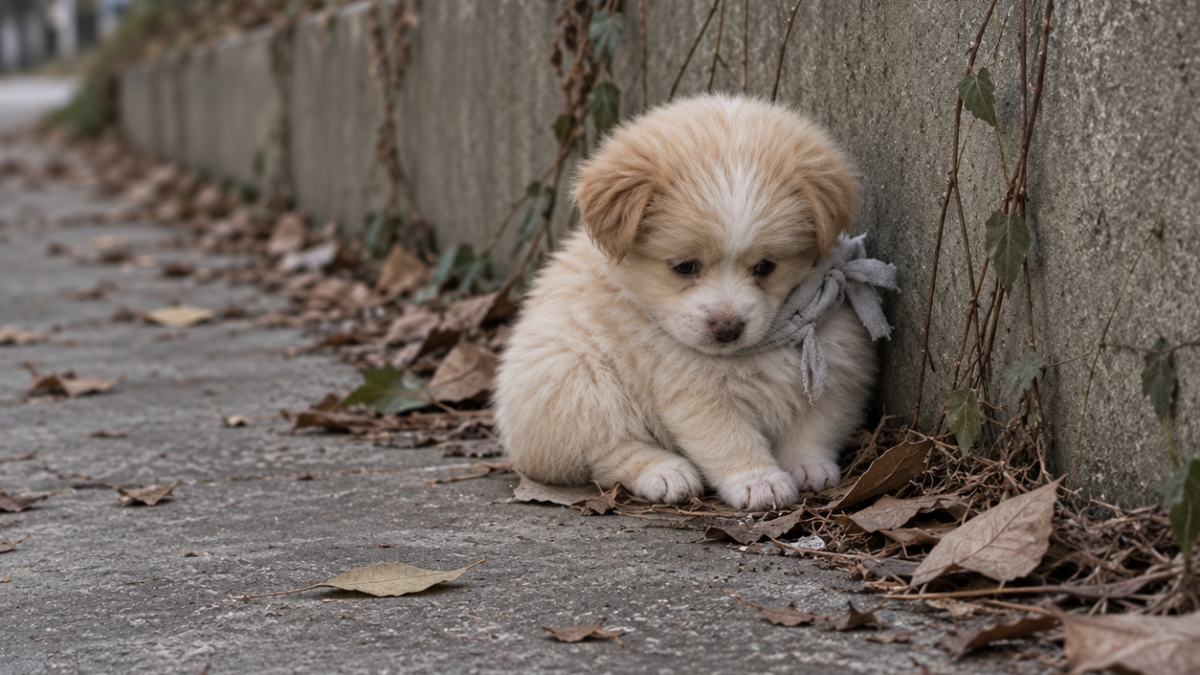
PART 2
I took three photographs.
I wish I’d taken better ones.
At the time, I wasn’t thinking about evidence or social media or whether anyone would eventually ask exactly what the puppy looked like when I found him.
I was thinking about getting him off the side of the road.
In the first picture, he was lying with his head on his front paws.
In the second, he had lifted his face toward me.
The leash was visible beside him.
In the third, he was trying to stand.
That photograph hurt the most.
His legs looked too thin even for a puppy.
He managed perhaps two steps before sitting again.
“Okay.”
I put my phone away.
“You’re not staying here another night.”
He didn’t resist when I lifted him.
That scared me.
Most puppies that age squirm.
They lick.
They chew fingers.
They wriggle because the world is still new and everything is exciting.
This one simply collapsed against my chest.
He was warm, but not comfortably warm.
Too warm.
His little heart was beating fast.
I carried him to my car and wrapped him in the old sweatshirt I kept behind the seat.
Then I poured water into a shallow plastic container.
He drank.
Too quickly.
“Slow.”
I pulled it away after several seconds.
He looked at me.
Not angry.
Not confused.
Just desperate.
I offered it again.
Same thing.
That’s when I realized he might have gone a long time without water.
I photographed the location before leaving.
The utility pole.
The shoulder.
The ditch.
The dirt where he’d been lying.
Then I posted his picture to a neighborhood group.
FOUND PUPPY near East Warren Road. Very young. Wearing collar and leash. Has apparently been in same location since at least yesterday morning. Looking for owner information.
I didn’t accuse anyone.
Not yet.
I wanted facts.
Within minutes, comments appeared.
Poor baby.
Take him to a vet.
I’ve never seen him.
Please don’t return him without proof.
Then one woman named Maya Nguyen commented:
I’m ten minutes away. Is he still there?
I replied:
He’s with me now.
She messaged immediately.
Can I come help?
I hesitated.
I didn’t know Maya.
Her profile showed a young woman, maybe in her twenties, smiling beside several dogs.
I typed:
I’m taking him to a clinic.
Her response came almost instantly.
Which one? I’ll meet you.
Twenty-five minutes later, I walked into Green Valley Animal Hospital carrying the puppy in my sweatshirt.
Maya arrived before I’d finished filling out the intake form.
She came through the door wearing jeans, running shoes, and a gray sweater thrown over what looked like work clothes.
“Is that him?”
“Yeah.”
She stopped several feet away.
Her face changed.
“Oh.”
The puppy looked at her.
Maya crouched instead of reaching.
“Hi, sweetheart.”
His eyes followed her.
“How old do you think he is?” I asked.
“Maybe six weeks?”
The receptionist looked over.
“Doctor will estimate.”
Maya sat beside me.
“You saw him yesterday too?”
“Morning.”
“And he was in the same spot today?”
“Exactly the same spot.”
Her jaw tightened.
“You thought someone was coming back.”
It wasn’t a question.
“Leash made me think somebody had to be nearby.”
“I would’ve thought the same.”
That helped more than I expected.
I’d been blaming myself since finding him again.
What if he’d wandered into traffic overnight?
What if the weather had turned?
What if someone crueler had found him?
Twenty-four hours is a very long time when you’re forty days old.
The veterinary technician called us in.
“Who’s the owner?”
Neither of us answered.
Finally I said, “Nobody, apparently.”
The technician looked at the puppy.
“Okay. Let’s start with what we know.”
She weighed him.
Under six pounds.
The veterinarian, Dr. Elena Ramirez, examined his teeth and body development.
“Five to six weeks.”
Maya looked at me.
“So forty days, roughly.”
“Around there,” Dr. Ramirez said.
“He shouldn’t even be away from his mother yet, should he?”
“Ideally, no. Not this young.”
The puppy’s temperature was elevated.
He was mildly dehydrated.
His belly looked rounder than the rest of him, which Dr. Ramirez said could suggest parasites.
Then she listened to his lungs.
Her expression shifted.
“What?”
Maya asked.
“I want to run a few tests.”
“What’s wrong?”
“Could be nothing serious. But he’s lethargic, feverish, and I don’t love his breathing.”
The puppy underwent a fecal test, bloodwork, and screening for common infectious illnesses.
I stood outside the exam room with Maya.
“How does this work?” she asked.
“What?”
“Who pays?”
I hadn’t thought that far.
“I will.”
“No.”
“I found him.”
“That doesn’t mean you’re responsible for everything.”
“Neither are you.”
Maya looked through the door window.
“Maybe that’s the problem.”
“What is?”
“Everyone assumes somebody else is responsible.”
I didn’t have an answer.
When Dr. Ramirez returned, the news wasn’t catastrophic.
But it wasn’t good.
The puppy had intestinal parasites, dehydration, and a respiratory infection that needed treatment.
The good news was that he tested negative for parvovirus.
I think both of us physically exhaled.
“Can he go home?” Maya asked.
Dr. Ramirez nodded.
“If someone can monitor him. Medication, hydration, small meals, warmth. And quarantine him from other dogs for now.”
Maya said, “He can come with me.”
I looked at her.
She looked back.
“What?”
“You met him thirty minutes ago.”
“So did you.”
“I saw him yesterday.”
“Congratulations. You’re one day more qualified.”
Despite everything, I laughed.
It was the first time since pulling over that I had.
“You have dogs?”
“My sister does. I don’t right now.”
“Apartment?”
“Small house.”
“Fenced yard?”
“Yes.”
Dr. Ramirez glanced between us.
“I’m going to pretend this adoption interview isn’t happening in my exam room.”
“It’s not an adoption,” Maya said immediately.
The puppy sneezed.
Maya looked at him.
“Temporary.”
Dr. Ramirez smiled.
“Of course.”
We bought medication.
Puppy food.
A soft bed.
Bowls.
A heating pad designed for animals.
Maya picked out a small stuffed bear.
“You know he’s going to destroy that eventually.”
“That would be great.”
She placed it in the basket.
“If he gets healthy enough to destroy things, I’ll buy him ten.”
At the register, I tried to pay.
Maya pushed my card away.
“Split it.”
“Why?”
“Because we’re both here.”
So we split it.
Then we stood in the parking lot holding a puppy neither of us had owned that morning.
“What do we call him?”
I asked.
Maya looked toward a coffee shop across the street.
Then at his cream-and-brown fur.
“Latte.”
I frowned.
“Seriously?”
“Look at him.”
I looked.
The name fit.
“Fine.”
She smiled.
“Latte.”
His ear moved.
And that was how a nameless puppy beside a highway became Latte.
Maya took him home that evening.
I followed in my car.
I told myself I only wanted to make sure he settled in.
That wasn’t entirely true.
I couldn’t stop thinking about the way he’d remained in the same place for more than a day.
Dogs don’t understand abandonment the way humans describe it.
They don’t think, That person betrayed me.
But they understand absence.
They understand routines.
Smells.
Voices.
Hands.
A puppy knows when the person who held the leash disappears.
Latte had waited because waiting was all he knew how to do.
Maya’s house was small and neat.
She placed his new bed in a corner of the living room.
Latte sniffed it.
Then sat on the floor beside it.
“That’s for you,” she said.
Nothing.
She put the stuffed bear inside.
Latte stared.
Then lay on the floor again.
Maya looked at me.
“Maybe he doesn’t know what a bed is.”
That possibility hit too hard.
She picked him up and placed him gently on the cushion.
Latte froze.
Then slowly lowered himself.
His body disappeared halfway into the soft fabric.
Maya sat beside him.
“Better?”
He closed his eyes.
Within thirty seconds, he was asleep.
Neither of us moved for a long time.
Eventually I whispered, “You’re keeping him.”
Maya shook her head.
“Temporary.”
“Sure.”
“I mean it.”
I looked at the puppy.
“So do I.”
For the first few days, Latte mostly slept.
Maya sent me updates.
A photograph of him wrapped in a blanket.
A video of him reluctantly eating.
A message after he took his medication without fighting.
Another when he finally had enough energy to wag his tail.
I visited after work.
On the third evening, he recognized me.
At least I think he did.
His head lifted before I said anything.
Then his tail made one weak sweep across the bed.
“Hey.”
I crouched.
“Look at you.”
Maya came from the kitchen carrying a tiny bowl.
“He ate almost all his lunch.”
“Almost?”
“He hid two pieces behind the blanket.”
I looked at Latte.
“Planning for winter?”
His tail moved again.
Maya sat down.
“He cries if I leave the room.”
“Separation anxiety?”
“Maybe.”
She looked tired.
“He follows me to the bathroom. Kitchen. Laundry room. Yesterday I went outside to bring in a package and he screamed.”
“Like barking?”
“No. Screamed.”
I looked at Latte.
He was watching Maya, not me.
Always watching her.
“He’s afraid you’re going to disappear.”
“I know.”
Maya’s voice softened.
“I leave doors open now.”
That became their first routine.
Doors open.
Maya visible.
Food at predictable times.
Medicine.
Sleep.
Repeat.
After a week, Latte’s fever disappeared.
His breathing improved.
His appetite returned.
And once his body had enough energy, something else appeared.
Personality.
A lot of personality.
The puppy who had barely lifted his head beside the road discovered socks.
Specifically Maya’s socks.
Clean.
Dirty.
He didn’t care.
He would steal one and run beneath the coffee table.
“Latte!”
His little body would freeze.
“Give it back.”
He’d stare.
Then run.
The first time Maya sent me that video, I watched it six times.
Not because it was extraordinary.
Because it was ordinary.
A puppy misbehaving.
Exactly what he should have been doing all along.
He discovered toys next.
The stuffed bear lasted eleven days.
Maya sent me a photograph of white stuffing covering the floor.
Caption:
You owe me ten bears.
I replied:
I distinctly remember you making that promise.
Latte sat in the middle of the destruction looking completely innocent.
His eyes were different.
That was the biggest change.
The sadness wasn’t entirely gone.
Sometimes something still triggered it.
The sound of a leash clip.
A car door closing.
Being left alone for even a few minutes.
But increasingly, his face held curiosity.
Mischief.
Demand.
Joy.
At his two-week checkup, he had gained more than a pound.
Dr. Ramirez listened to his lungs.
“Much better.”
Maya practically glowed.
“Can he start going outside?”
“Controlled areas. Avoid high-risk dog spaces until vaccinations are complete.”
“Can he meet my sister’s dog eventually?”
“After we finish vaccinations and his infection is fully resolved.”
Latte sat on the exam table chewing the corner of a paper towel.
Dr. Ramirez took it away.
“Definitely feeling better.”
Latte barked.
A tiny, ridiculous sound.
We all stared.
He barked again.
Maya’s face lit up.
“That’s the first time he’s barked!”
Latte seemed surprised by his own voice.
Then he tried again.
“Bark!”
Dr. Ramirez laughed.
“Wonderful. You’ve activated him.”
We had.
There was still another question, though.
Who left him?
My original neighborhood post kept circulating.
No one claimed Latte.
But people began sending information.
One person said they’d seen a man with a puppy near that road.
Another thought the leash looked familiar.
Most tips were useless.
Rumors.
Wrong dogs.
People guessing.
Then a message arrived from a woman named Isabel.
I know that puppy.
I stared at the screen.
I responded immediately.
How?
Her reply took ten minutes.
Long enough for me to imagine everything.
Finally:
I think he belonged to my neighbor’s boyfriend.
I called her.
Isabel lived about three miles from where Latte had been abandoned.
She sounded nervous.
“I don’t want trouble.”
“I’m not looking for trouble.”
That wasn’t completely true.
I was looking for truth.
“Can you describe the puppy?”
“Brown face. Cream chest. White on two paws.”
That matched.
“What about the collar?”
“Blue.”
Latte’s collar was blue.
“Leash?”
“Black nylon. Red stitching.”
I looked at the photograph on my phone.
Black leash.
Red stitching.
My stomach tightened.
“What’s the boyfriend’s name?”
Isabel hesitated.
“Tyler Brennan.”
“Why do you think Latte was his?”
“They got him maybe two weeks before you found him.”
“They?”
“My neighbor, Kayla, and Tyler. Except Kayla didn’t really want a puppy. Tyler brought him home.”
“Where from?”
“I don’t know.”
“Why would they get rid of him?”
“He cried at night.”
I closed my eyes.
A forty-day-old puppy cried at night.
Of course he did.
Isabel continued.
“Kayla complained. Tyler complained. Then one day the puppy was gone.”
“What did they say happened?”
“Tyler said he gave him away.”
“To who?”
“Didn’t say.”
“When?”
She gave me the date.
Same day I first saw Latte beside the road.
My hands tightened around the phone.
“Would you tell animal control this?”
Silence.
“Isabel?”
“I’m scared they’ll know it was me.”
“Why?”
“Tyler has a temper.”
That changed things.
I told her not to contact him.
Then I called county animal control.
The officer assigned was Rebecca Sloan.
She came to Maya’s house the next afternoon.
Latte barked at her shoelace.
Rebecca crouched.
“This is the victim?”
Maya smiled.
“Very dangerous.”
Latte attacked the lace again.
Rebecca took photographs of his collar and leash.
Then she documented the veterinary records.
Estimated age.
Condition at discovery.
Illness.
Location.
Timeline.
“You saw him there on two consecutive days?”
She asked me.
“Yes.”
“Same place?”
“Within a few feet.”
“Leash still attached?”
“Yes.”
“Any food or water?”
“Not the second day. I left some water the first morning.”
Rebecca wrote.
“Could he have wandered there?”
“He was too young to travel far, but I can’t prove he didn’t.”
“That’s fair.”
Then she spoke to Isabel separately.
Her statement was more useful than she’d initially suggested.
She had a photograph.
It had been taken from her backyard about a week before Latte disappeared.
Kayla was standing outside.
At her feet was a puppy.
Blue collar.
Black leash with red stitching.
Same cream chest.
Same white paws.
Latte.
Rebecca asked the obvious question.
“Could Tyler say the puppy ran away?”
“He could.”
“And then somebody found him three miles away.”
“Yes.”
It would be difficult to prove abandonment from the photograph alone.
But it was enough to investigate.
Rebecca visited Tyler Brennan.
He denied owning Latte.
Then she showed him the photograph.
According to her later report, he changed his explanation.
The puppy belonged to Kayla.
Kayla told Rebecca the puppy belonged to Tyler.
They both claimed he’d been given away.
To whom?
Neither could provide a name.
Receipt?
No.
Text messages?
No.
Social media?
No.
Nothing.
Rebecca wasn’t satisfied.
But suspicion is not proof.
Latte had been left with a loose leash.
There was no camera directly overlooking the roadside.
No witness had seen Tyler physically place him there.
For several weeks, the investigation stalled.
I hated that.
Every time I visited Maya, Latte was getting better.
He had learned his name.
He learned “sit” because Maya used tiny pieces of chicken.
He learned “paw” by accident after slapping her hand impatiently while waiting for another piece.
“Good paw!”
Maya said.
Latte immediately repeated it.
Within two days, he understood the trick.
“He’s a genius.”
She told me.
“He’s food-motivated.”
“Still genius.”
He also developed a strange habit.
If another puppy barked on Maya’s phone, Latte would race over.
Not happy.
Jealous.
Maya once played a video of her sister’s new foster puppy.
Latte stopped chewing his toy.
His ears lifted.
The other puppy barked through the speaker.
Latte climbed straight onto Maya’s lap.
Then wedged himself between her and the phone.
“Excuse me?”
Maya laughed.
The other puppy barked again.
Latte placed both paws on Maya’s chest.
“No other puppies allowed?”
He licked her chin aggressively.
I nearly fell off the couch laughing.
“The abandoned roadside dog has become possessive.”
“He’s not possessive.”
Another bark came from the phone.
Latte growled at it.
Maya sighed.
“Okay. Slightly.”
That was the beautiful part.
He had enough security to become ridiculous.
Enough love to become spoiled.
Enough confidence to complain about competition he didn’t actually have.
His first tiny sweater arrived because the weather turned cold.
Maya bought one.
Then three.
Then six.
“You know dogs have fur.”
I told her.
“Latte gets cold.”
“He’s wearing a yellow hoodie.”
“He looks good.”
Latte did look good.
Annoyingly good.
He strutted through the living room in it like he’d personally designed the thing.
His photograph from the roadside remained on my phone.
I occasionally looked at both pictures.
Same puppy.
One lying with his face in dirt.
One standing in a yellow hoodie with his tail curled up and a toy in his mouth.
The difference wasn’t just health.
It was expectation.
The roadside puppy expected nothing.
This puppy expected dinner at six.
Expected Maya to return from the bathroom.
Expected the good blanket.
Expected to be picked up.
Expected somebody to care what happened to him.
That was trust rebuilding itself.
Then Rebecca called.
“We got something.”
I stepped out of work.
“What?”
“A convenience-store camera.”
My heart jumped.
“What does it show?”
“The store is about half a mile from where Latte was found.”
“I know it.”
“The camera faces part of East Warren Road.”
“Can you see the utility pole?”
“No.”
My hope dropped.
“But we can see vehicles.”
She paused.
“We pulled footage from the morning you first noticed Latte.”
I waited.
“At 5:47 a.m., a dark gray Honda Civic stops on the shoulder.”
“Tyler drives a Civic?”
“Registered to Tyler Brennan.”
I stopped breathing.
“Can you see him?”
“Not clearly enough for facial identification.”
“What happens?”
“Driver exits. Opens passenger door. Something small is placed on the ground.”
My stomach tightened.
“The car remains there for fifty-four seconds.”
“And?”
“It drives away.”
“Does the puppy chase it?”
Another pause.
“For about ten feet.”
I closed my eyes.
That image was worse than the photograph.
“Then what?”
“He stops.”
“Can you see the leash?”
“The image isn’t good enough.”
“But it’s Tyler’s car.”
“It’s registered to him. We still need to establish who was driving.”
“Come on, Rebecca.”
“I know.”
“What more do you need?”
“Enough that a defense attorney can’t say Kayla borrowed the car or someone else used it.”
I hated procedure when it slowed down something that felt obvious.
But Raider—no, Latte deserved a case that couldn’t be dismissed because we were impatient.
Rebecca obtained additional footage from a gas station seven minutes earlier.
This camera was better.
Tyler was visible.
He paid for fuel.
His Civic was at the pump.
And through the passenger window, investigators could see a small puppy.
Blue collar.
They couldn’t see the leash.
They didn’t need to.
Timestamp:
5:39 a.m.
Eight minutes before his car stopped near the roadside.
Then Rebecca found one more piece.
A text message.
Kayla had voluntarily allowed investigators to review part of her conversation with Tyler after they told her the video existed.
At 5:21 that morning, she’d written:
What are you doing with the puppy?
Tyler replied:
Getting rid of the problem.
At 6:03:
Where is he?
Tyler:
Not our problem anymore.
That was it.
I read the screenshots at Rebecca’s office.
“Not our problem anymore.”
She nodded.
I felt something cold settle in me.
This wasn’t someone panicking.
Not a puppy accidentally escaping.
Not a young couple overwhelmed and making a bad surrender decision.
He had placed a forty-day-old animal beside a road before sunrise and driven away.
With the leash still attached.
Why the leash?
That question haunted me.
Rebecca had a theory.
“He may have intended someone to think the owner was nearby.”
Exactly what I’d thought.
The leash had delayed me.
Not because I didn’t care.
Because it created an explanation.
Someone must be coming back.
Maybe Tyler had counted on that.
Maybe he assumed anyone who saw Latte would think exactly what I did.
Not abandoned.
Temporarily unattended.
By the time the truth became obvious, Tyler would be long gone.
That realization made me furious with him.
And with myself.
Maya saw it immediately.
When I came over that evening, she handed me Latte without asking.
He climbed into my lap and started chewing the drawstring on my sweatshirt.
“You look angry.”
“I am.”
“At Tyler?”
“At myself.”
“Why?”
“I left him there.”
Maya’s expression hardened.
“No.”
“For an entire day.”
“You saw a puppy with a collar and leash. You waited. You looked around. You gave him water.”
“I still left.”
“Because you believed somebody was coming back.”
“I was wrong.”
“Because somebody deliberately created a situation designed to make people think exactly that.”
Latte tugged the string.
Maya gently pulled it from his mouth.
“You went back.”
“That doesn’t erase twenty-four hours.”
“No.”
She sat beside me.
“But blaming yourself doesn’t erase them either.”
I looked down.
Latte had curled against my stomach.
“He was right there.”
“And now he’s right here.”
That became another sentence I remembered.
Now he’s right here.
Rebecca charged Tyler Brennan with animal abandonment and cruelty-related offenses available under county law.
The case wasn’t a dramatic felony prosecution.
Latte had fortunately survived.
His illness was treatable.
But the evidence was strong enough for consequences.
Tyler didn’t take that well.
He posted online.
Claimed the puppy had been “rehomed.”
Said rescue people had twisted the story.
Accused Maya of stealing the dog.
That was almost funny.
Then it stopped being funny.
He messaged her directly.
Give my dog back.
Maya showed me the screen.
“You’ve got to call Rebecca.”
“I already did.”
Another message arrived.
You people made this into something it wasn’t.
Then:
He’s mine legally.
Maya looked toward Latte.
He was asleep in his bed.
“What if he tries to take him?”
“He won’t.”
“You don’t know that.”
She was right.
Rebecca advised her to stop responding and preserve everything.
Animal control’s legal custody paperwork had already been established after the found-animal holding period expired without a legitimate claim.
Tyler had denied ownership initially.
His sudden demand created more trouble for him, not less.
Still, Maya was scared.
She installed a doorbell camera.
I helped her change the side-gate lock.
For a few days, Latte went outside only with one of us.
Then Tyler did something incredibly stupid.
He came to Maya’s house.
It was 8:14 on a Saturday morning.
The doorbell camera recorded the entire encounter.
Maya didn’t open the door.
“Go away.”
She spoke through the camera.
Tyler stood on the porch.
“I want the dog.”
“You told animal control he wasn’t yours.”
“I didn’t say that.”
He had.
Repeatedly.
“The dog is under rescue custody.”
“He’s mine.”
Latte heard voices and barked from inside.
Tyler looked toward the door.
“There. That’s him.”
“Leave.”
“I paid for him.”
That sentence would matter later.
Maya stayed inside.
“Leave or I’m calling police.”
Tyler stepped closer.
“You’re going to regret this.”
Maya called.
I arrived fifteen minutes later, but officers were already there.
Tyler was gone.
He hadn’t broken in.
He hadn’t physically threatened her beyond the vague statement.
But the video became evidence.
Most importantly, he had said:
I paid for him.
After telling investigators the dog wasn’t his.
Rebecca almost smiled when she heard it.
“People make my job easier sometimes.”
Latte had no idea any of this was happening because of him.
His world was expanding.
Vaccinations completed.
Infection cleared.
Parasites gone.
Weight healthy.
He met Maya’s sister’s dog, a gentle golden retriever named Sophie.
The first introduction was careful.
Latte hid behind Maya’s leg.
Sophie approached slowly.
Sniff.
Latte froze.
Sophie walked away.
Latte followed.
Ten minutes later, he was biting Sophie’s ear.
Sophie looked at us with the exhausted patience of an older sibling.
Maya laughed.
“He likes her.”
Sophie sighed.
Latte attacked again.
“I’m not sure she likes him.”
By the end of the afternoon, both were asleep touching paws.
I photographed them.
Another ordinary miracle.
Maya started formal adoption paperwork soon afterward.
This time she didn’t pretend it was temporary.
The rescue coordinator asked why she wanted to adopt him.
Maya looked offended.
“Have you met him?”
The coordinator laughed.
“Yes.”
“Then why is this a question?”
“Formality.”
Latte sat beneath Maya’s chair chewing a tennis ball almost as large as his head.
The adoption was approved.
The new microchip registration listed:
Name: Latte.
Owner: Maya Nguyen.
When Maya received the confirmation email, she cried.
“I don’t know why this is making me emotional.”
“I do.”
“It just says my name.”
“Exactly.”
For the first time in Latte’s short life, the person connected to his name wasn’t someone willing to leave him beside a road.
It was someone who had stayed.
Every morning.
Every medication dose.
Every frightened cry.
Every meal.
Every accident on the carpet.
Every destroyed sock.
Every absurd sweater.
Maya’s name meant home.
Tyler’s case went to court several months later.
I testified.
So did Maya.
So did Dr. Ramirez.
Rebecca presented the videos.
The defense tried to create uncertainty.
Maybe Tyler intended to return.
Maybe somebody was supposed to collect the puppy.
Maybe there had been an arrangement that fell apart.
The prosecutor asked a simple question.
“Who?”
Tyler couldn’t provide a name.
The defense argued Latte had been left only briefly.
Then the prosecutor showed my first photo.
Taken after I’d seen him alone that morning.
Then my second-day photo.
Nearly twenty-four hours later.
Same leash.
Same location.
Same puppy.
Then came the convenience-store video.
Tyler buying fuel.
Latte in the passenger seat.
Then the roadside footage.
Civic stopping.
Driver exiting.
Small animal placed on shoulder.
Vehicle leaving.
Then the texts.
Getting rid of the problem.
Not our problem anymore.
Then Tyler’s own recorded words on Maya’s porch:
I paid for him.
The defense suddenly had very little room.
Dr. Ramirez testified about Latte’s age.
“Approximately five to six weeks.”
“Could a puppy that age safely care for itself beside a roadway?”
“No.”
“Could it reliably find water?”
“No.”
“Food?”
“No.”
“Regulate temperature?”
“Not well, particularly if ill.”
“Was Latte ill?”
“Yes.”
“What did he have?”
She listed everything.
Respiratory infection.
Parasites.
Dehydration.
Lethargy.
The prosecutor asked, “What could have happened if he remained there?”
Dr. Ramirez answered carefully.
“Progressive dehydration, worsening infection, hypoglycemia, exposure, trauma from a vehicle, predation. There were multiple serious risks.”
The courtroom became very quiet.
Then she added:
“At that age, twenty-four hours is a significant amount of time.”
Tyler’s attorney asked whether the illness could have existed before Tyler left him.
“Yes.”
That sounded helpful to the defense for about three seconds.
Then Dr. Ramirez continued.
“Which would mean abandoning him was even more dangerous.”
Maya squeezed my hand.
Tyler testified.
Like many people caught between evidence and consequences, he had developed a version of events that placed responsibility everywhere except himself.
The puppy cried constantly.
Kayla complained.
The apartment situation was difficult.
He was working long hours.
Money was tight.
He intended for someone to find Latte.
The prosecutor stopped.
“You intended for a stranger to find him?”
Tyler hesitated.
“I knew people used that road.”
“At 5:47 in the morning?”
“Eventually somebody would see him.”
“Why didn’t you take him to a shelter?”
“I didn’t know where.”
“Did you own a phone?”
“Yes.”
“Could you search for an animal shelter?”
His attorney objected.
Overruled.
Tyler looked irritated.
“I was stressed.”
“Did you call animal control?”
“No.”
“Any rescue?”
“No.”
“Veterinary clinic?”
“No.”
“Did you knock on a neighbor’s door and ask them to help?”
“No.”
“Did you post online that you needed somebody to take the puppy?”
“No.”
“Instead, you put him beside East Warren Road.”
Tyler shifted.
“I figured someone would take him.”
The prosecutor held up the black leash with red stitching.
“You left this attached.”
“Yes.”
“Why?”
Tyler looked down.
“I don’t know.”
“You testified you expected someone to find him.”
“Yes.”
“Would a passerby seeing a puppy wearing a leash reasonably believe an owner might still be nearby?”
His attorney objected.
The judge sustained it.
The prosecutor rephrased.
“Why not remove the leash?”
“I said I don’t know.”
Then she showed my statement.
I had waited because I thought someone had to be nearby.
The exact illusion Tyler’s actions created.
No one needed to prove he’d planned that specific effect.
The jury—or in this case, the judge under the applicable procedure—only needed to determine whether he’d knowingly abandoned a vulnerable animal.
The evidence was overwhelming.
The ruling came that afternoon.
Guilty.
Tyler was ordered to pay fines and restitution for veterinary costs, placed under probation conditions, and prohibited from possessing or acquiring animals for a defined period.
He was also required to complete community service unrelated to direct animal handling.
It wasn’t some enormous prison sentence.
Latte had survived.
The charges reflected that.
Part of me wanted more.
I’d be lying if I said otherwise.
I wanted Tyler to understand twenty-four hours.
Twenty-four hours hungry.
Twenty-four hours waiting.
Twenty-four hours watching every car and thinking maybe this one would stop.
But justice isn’t supposed to recreate suffering.
It’s supposed to answer it.
The real consequence for Tyler wasn’t something the judge announced.
It came afterward.
His name was attached to the public record.
When he later attempted to adopt another dog through a local rescue after his prohibition period approached its end, the rescue found the case history and denied him.
Another organization did the same.
Eventually several area shelters added his information to their internal screening alerts where legally permitted.
He had once treated a puppy as something disposable.
Now the systems built to protect animals knew his name.
That felt appropriate.
But even that wasn’t the ending I cared about.
The ending was Latte.
By six months old, the tiny roadside puppy had become a small tornado.
His legs seemed too long for him.
His ears never decided whether they wanted to stand up or flop.
He loved cheese.
Hated bananas.
Barked at his reflection.
Feared the vacuum cleaner but chased the broom.
Learned sit, paw, down, spin, wait, and—eventually—come.
“Eventually” deserves emphasis.
Maya would call:
“Latte, come!”
He’d look at her.
Then run the opposite direction.
“Latte!”
Faster.
The first time he returned immediately, Maya celebrated like he’d won a championship.
“Good boy!”
Latte jumped against her.
I shook my head.
“You’ve lowered your standards dramatically.”
“He came when called.”
“After six months.”
“Progress.”
His jealousy became legendary.
If Maya watched another dog video, Latte appeared.
If she hugged Sophie, Latte inserted himself between them.
Once, Maya’s cousin visited with a tiny Pomeranian.
The moment Maya picked up the Pomeranian, Latte sat three feet away staring at her.
No barking.
No whining.
Just betrayal.
“Latte.”
Nothing.
“Come here.”
He turned his head away.
I started laughing.
Maya put the Pomeranian down.
Latte immediately climbed into her lap.
“Are you serious?”
He licked her face.
“You’re emotionally manipulative.”
More licking.
“I created a monster.”
She absolutely had.
A happy one.
For Latte’s first birthday, Maya threw a small party.
I told her this was ridiculous.
Then I arrived carrying a gift.
“You’re a hypocrite.”
She said.
“It’s a practical gift.”
“What is it?”
“A stuffed coffee cup.”
“Very practical.”
Latte destroyed it within eighteen minutes.
Maya had made a dog-safe cake.
Sophie attended.
Dr. Ramirez stopped by.
Rebecca came after her shift.
Isabel, whose courage had helped identify Tyler, was invited too.
She hadn’t seen Latte since he was tiny.
When he ran toward her, healthy and excited, she covered her mouth.
“That’s him?”
“That’s him.”
“Oh my God.”
Latte jumped against her leg.
She knelt and held him.
“I should’ve called somebody sooner.”
The guilt in her voice sounded painfully familiar.
I sat beside her.
“You helped.”
“I heard him crying next door.”
“You helped.”
“I knew Tyler was impatient.”
“You gave Rebecca the photograph.”
“But—”
“No.”
I looked toward Latte.
“He has enough people blaming themselves for what one person chose to do.”
Isabel stared at me.
Then nodded.
I had needed Maya to teach me that.
Now I could give it to someone else.
That was another thing Latte changed.
He didn’t just recover.
He redistributed compassion.
People who met him became softer.
More alert.
Less willing to assume someone else would intervene.
My own habits changed.
Whenever I saw an animal near a road, I stopped if it was safe.
Not recklessly.
Not in traffic.
But I checked.
I called.
I paid attention.
Sometimes it was nothing.
A neighborhood dog loose for five minutes.
A cat that lived nearby.
Once, I spent twenty minutes trying to rescue what turned out to be a very convincing black trash bag.
Maya never let me forget that.
“Did it have a leash?”
“Shut up.”
“Was it dehydrated?”
“You’re blocked.”
Another time, I found an actual dog.
Older terrier.
No collar.
I called the number on a lost-dog post.
His family had been searching for seven hours.
When his owner arrived, she cried so hard she could barely speak.
I watched her carry him to the car.
And I thought about the morning I’d seen Latte.
People ask whether one rescue really changes anyone.
Yes.
Sometimes it changes exactly one person enough that another animal gets found later.
That’s enough.
Latte grew into an adult dog who remained smaller than we’d initially expected.
About twenty-two pounds.
Compact.
Fast.
Ridiculously expressive.
Maya documented everything.
His first trip to the beach.
He hated waves.
His first snow.
He tried to eat it.
His first pumpkin.
He barked at it for four minutes.
His first overnight trip.
He refused to sleep until Maya put his bed beside hers.
His first grooming appointment.
He returned wearing a bandana and behaving as if he’d survived war.
His first time staying with me while Maya attended a wedding.
That one revealed something neither of us expected.
Maya dropped him off in the morning.
She gave me his food.
Bed.
Toys.
Medication for occasional allergies.
Three pages of instructions.
“Maya.”
“What?”
“He is a dog.”
“I know.”
“You wrote his preferred bedtime.”
“He likes routine.”
“You wrote ‘tell him I’ll be back.'”
“He understands.”
“No, he doesn’t.”
Latte looked between us.
Maya crouched.
“I’ll be back tomorrow.”
His tail wagged.
Then she walked toward the door.
Latte followed.
She stepped outside.
The door closed.
Latte froze.
His expression changed instantly.
The tail stopped.
He looked at the door.
Then at me.
Then back at the door.
“Maya’s coming back.”
He sat.
For the next hour, he barely moved.
My stomach tightened.
I’d seen that posture before.
Roadside.
Waiting.
I tried treats.
Nothing.
Toy.
Nothing.
Walk.
He came reluctantly, then pulled toward my car as though he thought I might take him to her.
That evening, he finally ate.
At bedtime, he lay beside the front door instead of in his bed.
I sat next to him.
“She’s coming back.”
His eyes stayed on the door.
I suddenly understood something.
Latte had healed enormously.
But some experiences become part of how an animal understands the world.
One person had disappeared.
The fear that another might do the same had never completely vanished.
So I slept on the couch near the door.
The next morning, Maya arrived earlier than planned.
Her key turned.
Latte exploded.
He screamed.
Barked.
Spun.
Jumped.
He ran so fast across the hardwood he slid into a chair.
Maya dropped her bag.
“Latte!”
He launched himself against her.
She sat on the floor.
He crawled into her lap and pressed his entire body against her.
Maya looked at me over his head.
Her eyes were wet.
“Was he okay?”
“Mostly.”
“Mostly?”
“He waited.”
Her face changed.
I didn’t need to explain.
She held him tighter.
“I came back.”
Latte licked her chin.
“I’ll always come back.”
Obviously, none of us can promise always.
Life doesn’t allow that.
But from that day forward, Maya worked carefully on separation training.
Tiny absences.
Thirty seconds.
Then a minute.
Then five.
She returned before panic took over.
She used cameras.
Treat puzzles.
Routine.
No dramatic goodbyes.
No dramatic reunions.
Months passed.
Latte learned.
Not perfectly.
But enough.
Eventually Maya could leave for dinner and come home to find him asleep.
The first time she sent me a screenshot from the camera showing Latte snoring on the couch while she was away, she wrote:
LOOK.
I replied:
A dog sleeping. Historic.
She called me.
“You don’t understand.”
I did.
A puppy who once waited more than twenty-four hours for someone who never returned had finally become confident enough to sleep when his person left.
He believed she’d come back.
That was enormous.
Several years passed.
Latte became one of those dogs everyone in Maya’s neighborhood knew.
Children asked to pet him.
The mail carrier carried treats.
The elderly man two houses down saved bits of plain chicken for him.
Maya claimed she was strict about his diet.
Nobody believed her.
I certainly didn’t.
Latte had an entire drawer of clothes.
Not one sweater.
A drawer.
Raincoat.
Winter coat.
Two hoodies.
A ridiculous plaid shirt.
Halloween costume.
A tiny bow tie.
I opened the drawer once.
“This is financially irresponsible.”
Maya crossed her arms.
“He has social obligations.”
“He’s a dog.”
“He gets invited places.”
“Because you dress him like a middle manager.”
Latte stood nearby wearing a green sweater.
I pointed.
“You’re part of the problem.”
He sneezed.
Maya laughed.
His happiest trick remained “paw.”
He had expanded it into negotiation.
Want a treat?
Paw.
Want dinner faster?
Paw.
Want the door opened?
Paw against Maya’s leg.
Want attention?
Paw directly on your face if necessary.
One evening I was talking to Maya and stopped petting him.
A small paw landed on my knee.
I ignored it.
Another tap.
“Latte.”
Tap.
“I’m talking.”
Tap.
Finally he climbed halfway into my lap.
Maya smiled.
“He has boundaries.”
“He has demands.”
“Same thing.”
His life became gloriously spoiled.
And that mattered because of where it began.
Sometimes Maya still received messages from people who remembered the original post.
Is that the roadside puppy?
How is he?
She’d send a current picture.
Latte in pajamas.
Latte at the beach.
Latte sleeping upside down.
Latte wearing birthday glasses he clearly hated.
People responded with hearts.
But Maya and I rarely shared the most important moments publicly.
The ordinary ones.
Latte waking up and stretching.
Latte waiting beside his full water bowl.
Latte falling asleep before Maya returned from the kitchen.
Latte leaving a toy in the yard because he knew it would still be there tomorrow.
Safety is often boring.
That’s why it’s beautiful.
Then, nearly four years after Latte’s rescue, something unexpected happened.
I was driving home from work on East Warren Road.
I hadn’t thought about the exact roadside spot in months.
I passed the utility pole.
Something made me slow down.
There was a dog there.
My heart slammed.
Not Latte.
A larger dog.
Black.
Adult.
No leash.
I pulled into a safe area and called animal control immediately.
The dog ran when I approached.
I didn’t chase.
Rebecca wasn’t working that evening, but another officer arrived.
Together we eventually contained the dog.
He had a microchip.
His family lived less than a mile away.
Gate blown open during afternoon wind.
He’d been missing six hours.
His owner arrived shaking.
“Thank you.”
She hugged the dog.
“I’ve been driving everywhere.”
I stood beside the utility pole afterward.
Same dirt.
Same ditch.
Different ending.
This time, someone was looking.
I took a photograph of the empty shoulder and sent it to Maya.
She knew immediately.
Her response:
Come over.
When I arrived, Latte ran to the door.
Four years old.
Healthy.
Loud.
“Woo!”
“Wrong rescue dog.”
I laughed.
He jumped against my leg.
Maya poured coffee.
We sat outside.
“I found another dog there.”
“I know.”
“His family was looking.”
“Good.”
I stared at Latte.
“He wouldn’t survive five minutes out there now.”
Maya smiled.
“He’d demand an Uber.”
Latte rolled onto his back.
I scratched his stomach.
“Remember when you waited beside that road?”
His tail thumped.
Of course he didn’t understand.
Maybe he remembered the feeling.
Maybe not.
“Do you think dogs forget?”
I asked.
Maya thought about it.
“I don’t think forgetting is the goal.”
“What is?”
She looked down at Latte.
“Giving them enough good memories that the bad ones aren’t the whole story.”
I never forgot that.
Latte’s story was no longer abandonment.
Abandonment was one day.
A terrible day.
Maybe two.
His life became thousands of days afterward.
Breakfasts.
Walks.
Naps.
Socks.
Toys.
Vet visits.
Birthdays.
Rainstorms.
Car rides.
Visitors.
Maya coming home.
Again.
Again.
Again.
That is how you defeat one cruel memory.
Not by erasing it.
By outnumbering it.
Tyler eventually completed his sentence and probation.
For a while, we heard nothing about him.
Then Rebecca called Maya years later.
Not because Tyler had done anything to Latte.
Because he’d attempted to obtain a dog through an online classified advertisement.
His original prohibition had expired, but the rescue community still knew his history.
The seller happened to recognize his name.
They contacted a local shelter for guidance.
There was no legal basis to stop him forever once his formal restriction ended.
That frustrated me.
Maya surprised me.
“Let it go.”
“What?”
“Not the monitoring. Not protecting animals. But him.”
“You aren’t angry?”
“Of course I am.”
She looked at Latte.
“But I don’t want Tyler to own any more space in this dog’s life.”
I understood.
Revenge had already happened.
Not through suffering.
Through irrelevance.
Tyler had wanted to get rid of a problem.
Instead, Latte became loved by an entire community.
Tyler’s decision had been documented.
His excuses had failed.
The dog he discarded became somebody’s family.
And Tyler became a footnote.
There was something satisfying about that.
Latte grew older.
Not old.
Just older.
The round puppy face lengthened.
His body filled out.
The little floppy ears settled into one up, one down.
Maya claimed it made him look distinguished.
It made him look confused.
He remained healthy aside from occasional allergies.
Then, when he was seven, he developed a small lump on his side.
Maya panicked.
She called me before the vet.
“There’s a lump.”
“How big?”
“Pea.”
“Soft?”
“Kind of.”
“Call Dr. Ramirez.”
“I am.”
“It’s probably—”
“Don’t say probably.”
I remembered the same woman calmly taking home a feverish abandoned puppy.
Now a pea-sized lump had destroyed her emotional stability.
Dr. Ramirez examined it.
Fatty growth.
Benign.
Maya cried.
Latte received chicken.
I received six messages about how stressful the day had been.
“You understand you’ve become exactly the kind of dog owner you used to make fun of.”
I told her.
“I never made fun of dog owners.”
“You own birthday hats.”
“Latte likes them.”
“He absolutely does not.”
Latte was sitting nearby wearing one.
His expression confirmed my position.
Years went by in that quiet way they do when nobody is fighting for survival anymore.
Latte turned eight.
Then nine.
Gray appeared around his muzzle.
He still stole socks but didn’t run as fast.
His naps became longer.
His jealousy remained ridiculous.
When Maya fostered a puppy temporarily through the same rescue that had helped Latte, he behaved as though she’d committed treason.
The puppy, Beans, climbed into Maya’s lap.
Latte stared.
Then walked over.
Placed one paw on Maya.
Beans stayed.
Latte placed the second paw.
“There’s room for everybody.”
Maya said.
Latte pushed himself between them.
Beans licked his ear.
Latte looked horrified.
I laughed until I cried.
Within three days, Latte was sleeping beside Beans.
By the end of the week, he was letting the puppy steal his toys.
Maya caught him doing something else.
Beans cried one night after being placed in his crate.
Latte got out of his own bed.
Walked over.
Lay beside the crate.
The puppy stopped crying.
Maya sent me the video.
No caption.
None needed.
The puppy who once cried when people left rooms had become the dog who stayed beside another frightened puppy.
That felt like a circle closing.
Beans eventually went to a permanent family.
Latte watched him leave.
Then walked back inside and fell asleep.
No panic.
He understood leaving differently now.
Sometimes goodbye meant abandonment.
But not always.
Sometimes goodbye meant someone was going home.
When Latte turned ten, Maya and I returned to East Warren Road with him.
We’d talked about doing it for years.
Finally we decided.
The road had changed.
The convenience store had a new sign.
Part of the empty lot had become a small warehouse.
The utility pole had been replaced.
But the shoulder remained.
We parked safely.
Latte stepped from the car.
His muzzle was white now.
He sniffed the grass.
No obvious reaction.
No fear.
No recognition that we could see.
Maya held his leash.
A new leash.
Bright blue.
Not the old black one.
Rebecca had kept the original during the court case, then later returned it.
Maya stored it in a box.
She never used it.
We walked toward the approximate place where I’d first seen him.
Latte sniffed.
Then found something far more important.
A discarded french fry.
“No!”
Maya pulled him back.
I laughed.
“Trauma overcome.”
“He has no standards.”
We sat in the grass.
Cars passed.
Latte settled between us.
I looked at the road.
“I still hate that I left.”
Maya sighed.
“Ten years.”
“I know.”
“You went back.”
“I know.”
“You’ve told how many people to stop blaming themselves?”
“Several.”
“Try listening to yourself.”
I scratched Latte’s chest.
“He could’ve died.”
“But he didn’t.”
“Because I got lucky.”
“Because you noticed him.”
I looked at her.
“Twice.”
She smiled.
“Then maybe the first time planted the thing that made you come back the second.”
That was true.
His face had followed me all day.
Something in me had already known the situation wasn’t right.
I just hadn’t trusted it soon enough.
Maybe that’s another lesson animals teach us.
Pay attention to the discomfort you can’t explain.
Sometimes your brain is still inventing reasonable stories while another part of you has already noticed the truth.
Latte lifted his head.
A car passed.
He watched it.
Then looked at Maya.
No waiting.
No searching.
His person was already beside him.
We stayed until sunset.
Before leaving, Maya took something from her bag.
A small metal marker.
Not large.
Nothing dramatic.
We placed it in the ground far enough from the roadway to be safe.
It read:
LATTE WAITED HERE.
SOMEONE CAME BACK.
I stared at it.
“That’s going to make people think the owner came back.”
Maya frowned.
“Good point.”
She looked at me.
“You came back.”
“That’s different.”
“Exactly.”
We eventually replaced it with:
LATTE WAITED HERE.
THIS TIME, SOMEONE STOPPED.
Better.
Latte sniffed the marker.
Then peed three feet away from it.
Maya stared at him.
“Beautiful tribute.”
“Very moving.”
We laughed all the way back to the car.
At twelve, Latte developed arthritis.
Nothing terrible at first.
Stiffness.
Slower stairs.
Less jumping.
Maya bought steps for the couch.
He refused them.
Instead, he stood beside the couch and stared at her until she lifted him.
“You can use the steps.”
Latte stared.
“You’re capable.”
Stare.
She picked him up.
I watched.
“He’s trained you extremely well.”
“I don’t know what you’re talking about.”
He slept more.
Still jealous.
Still demanding.
Still performed paw for food even when nobody asked.
At thirteen, his hearing weakened.
He no longer heard Maya’s key immediately.
Sometimes she’d enter and find him asleep.
Then he’d wake.
See her.
His face would transform.
Every time.
Old body.
Puppy joy.
He would struggle to stand.
Maya rushed over.
“You don’t have to get up.”
He did.
He always did.
Tail moving.
Because she came back.
She always came back.
His final year was gentler than we’d feared.
Kidney values began changing.
Medication.
Special diet.
More veterinary visits.
Maya adjusted everything.
Water bowls in multiple rooms.
Non-slip rugs.
Night lights.
A ramp to the yard.
He resisted the ramp for approximately two days.
Then discovered it required less effort and accepted this technological advancement.
Dr. Ramirez had known him almost his entire life.
At one appointment, she examined his white muzzle.
“You were the saddest little thing I’d seen that month.”
Latte licked her fingers.
“Then you became one of the most spoiled.”
Maya smiled.
“As intended.”
His decline accelerated one winter.
He stopped finishing breakfast.
That frightened Maya more than any lab result.
Latte loved food.
Always had.
She called me.
“He’s not eating.”
“Nothing?”
“Half.”
“Did you call Ramirez?”
“Appointment at two.”
I went with her.
Bloodwork showed his kidneys were worsening.
There were options.
Fluids.
Medication adjustments.
Appetite support.
Supportive care.
We tried.
For several weeks, Latte improved.
He ate chicken.
Walked slowly around the yard.
Slept in patches of sun.
Then one morning, he fell trying to get to the water bowl.
Maya called.
I could barely understand her.
I drove over.
Latte was on his bed.
His breathing was calm.
But he looked tired.
The exact word hit me with terrible force.
Tired.
The puppy beside the road had looked defeated.
This wasn’t defeat.
This was a dog who had lived.
There is a difference.
Maya sat on the floor.
“I don’t know if it’s time.”
Latte rested his head against her leg.
I didn’t answer for a while.
“What does Ramirez say?”
“That we could hospitalize him.”
“And?”
“Maybe stabilize him for a few days.”
“Maybe?”
She nodded.
“But he hates the hospital now. He gets confused.”
“What does she think is kindest?”
Maya cried.
“She said home.”
That told us.
Dr. Ramirez came to Maya’s house that evening.
The same veterinarian who had examined a feverish six-week-old puppy now sat beside a thirteen-year-old dog in the living room he’d ruled for nearly his entire life.
Maya had laid his favorite blanket near the window.
Latte wore no sweater.
No birthday hat.
Just his blue collar.
I sat on one side.
Maya on the other.
Dr. Ramirez gave him a small piece of chicken.
He ate it.
Maya laughed through tears.
“Of course now you eat.”
His tail tapped once.
She took out her phone.
On it was the first photograph I’d posted.
Tiny puppy.
Roadside.
Head down.
Leash beside him.
Maya stared at it.
“I hate this picture.”
“So do I.”
She swiped.
Next photograph.
Latte in his yellow hoodie.
Next.
Latte with Sophie.
Next.
Birthday.
Next.
Beach.
Next.
Snow.
Next.
Beans asleep against him.
Next.
Latte gray-faced on the couch.
Hundreds.
Thousands.
Bad memory outnumbered.
Maya put the phone down.
“Do you think he knows how much I love him?”
I almost laughed.
“Maya.”
“I mean it.”
“He has an entire clothing drawer.”
She smiled weakly.
“That’s not an answer.”
I looked at Latte.
He was resting against her.
“He spent more than a decade waking up and finding you there.”
Her face crumpled.
“That’s the answer.”
She bent over him.
“I came back.”
Latte’s eyes opened.
“I always came back.”
She kissed his head.
“I’m here now too.”
Dr. Ramirez prepared the first injection.
A sedative.
Latte relaxed.
His head became heavy in Maya’s lap.
I rubbed his ears.
“You know something?”
I whispered.
“I owe you an apology.”
Maya looked at me.
“I should’ve picked you up the first morning.”
Her hand touched my arm.
I continued.
“I’ve carried that for thirteen years.”
Latte breathed softly.
“But maybe you don’t need it.”
I looked at him.
“Maybe I do.”
His eyes were almost closed.
“I’m sorry you waited.”
My voice broke.
“I’m sorry somebody taught you that people disappear.”
Another breath.
“And I’m glad Maya taught you something else.”
Maya kissed him again.
Dr. Ramirez quietly asked, “Ready?”
Maya cried.
Then nodded.
I put my hand on Latte’s shoulder.
Maya held his face.
The final medication went in.
She kept speaking.
“You’re home.”
His breathing slowed.
“You’re home.”
Another breath.
“I’m right here.”
Then stillness.
No roadside.
No traffic.
No empty leash.
No waiting.
Latte died with the person he trusted holding him.
The leash was still attached to his collar.
But this time, there was someone holding the other end.
That detail destroyed me.
Maya stayed on the floor for a long time.
So did I.
Eventually she whispered:
“Thirteen years.”
“Yeah.”
“He got thirteen years.”
I looked at the photographs around the room.
“Good ones.”
She nodded.
“Really good ones.”
Latte’s ashes returned two weeks later.
Maya placed them beside his first collar.
The old black leash from the court case stayed in the box.
She considered throwing it away.
Then changed her mind.
“Why keep it?”
I asked.
“Because it doesn’t mean what Tyler wanted it to mean anymore.”
“What does it mean?”
She looked at Latte’s urn.
“That a leash only matters because of who’s holding the other end.”
Years earlier, Tyler had let go.
Maya hadn’t.
Not through medication.
Fear.
Destroyed furniture.
Jealousy.
Training.
Vet bills.
Aging.
Kidney disease.
Not even at the end.
I understood.
On the anniversary of Latte’s rescue, Maya and I returned to East Warren Road without him.
The marker was still there.
Weathered.
LATTE WAITED HERE.
THIS TIME, SOMEONE STOPPED.
Someone had placed a small bunch of flowers beside it.
Neither of us knew who.
Maya touched them.
“People remember him.”
“Yeah.”
We sat near the shoulder.
Cars passed.
At one point, a young man slowed because he saw us.
“You okay?”
He called through his window.
“We’re fine.”
He waved and continued.
Maya smiled.
“People stop.”
“Sometimes.”
“More than we think.”
I looked at the empty patch of ground where Latte had once rested his tiny head.
There was something I had misunderstood for years.
I thought the worst part of Latte’s story was that he’d waited more than twenty-four hours.
It wasn’t.
The worst part was that someone had convinced a tiny puppy waiting was reasonable.
That if he stayed where he’d been left, the person would come back.
That loyalty could fix abandonment.
But the best part of his story was also waiting.
Because later, waiting became safe.
Maya left the room.
Latte waited.
She returned.
Maya went to work.
Latte waited.
She came home.
Maya went to the store.
She came back.
One hour.
Three hours.
A wedding overnight.
She came back.
Years of repetition replaced one terrible lesson.
People can leave.
And still return.
That was Latte’s recovery.
Not the medication.
Not the weight gain.
Not the tricks.
Trust.
The first time I met him, he barely lifted his head because the person he’d trusted had disappeared.
The last years of his life, he could sleep through Maya unlocking the front door.
He didn’t need to watch constantly anymore.
He knew.
Home was not a roadside.
Love was not a leash somebody dropped.
And waiting did not always end in heartbreak.
People still occasionally ask me about the puppy from that old neighborhood post.
The one left beside East Warren Road.
They usually remember the first photograph.
I don’t.
Not anymore.
When I think of Latte, I see the yellow hoodie.
The ridiculous jealousy.
His little paw demanding attention.
His refusal to come when called.
His hatred of bananas.
The way he slept beside Beans’s crate.
The way one ear stood while the other folded.
The white muzzle.
The steps to the couch he refused to use.
The last blue leash.
Thirteen years is a lot of memories.
One day of cruelty didn’t deserve to own them.
That was Tyler’s final defeat.
He had reduced Latte to “the problem.”
The court reduced Tyler’s excuses to evidence.
But life turned Latte into something much bigger.
Family.
A neighbor’s favorite dog.
A veterinarian’s long-term patient.
A frightened foster puppy’s protector.
My reminder to stop when something doesn’t feel right.
Maya’s shadow.
Maya’s spoiled little boy.
Loved.
Wanted.
Remembered.
If revenge means making someone suffer exactly as they made another suffer, then no, we never got that kind of revenge.
And I’m glad.
But if revenge means taking everything cruelty tried to decide about a life and proving it wrong, Latte got more revenge than I could have imagined.
Tyler said he was a problem.
Latte became joy.
Tyler decided he wasn’t worth keeping.
Maya kept him for thirteen years.
Tyler left him sick beside a road.
Latte grew old in a warm house.
Tyler dropped the leash.
Maya held it until his final breath.
And maybe the part that satisfies me most is this:
Tyler probably forgot exactly what Latte looked like as a puppy.
People who discard animals often do.
Maya remembered everything.
The first meal.
The first bark.
The first tail wag.
The first sweater.
The first trick.
The first night Latte slept without checking whether she was still in the room.
Every birthday.
Every gray hair.
Every medicine dose.
Every goodbye.
That’s what being wanted means.
Not one dramatic rescue.
Thousands of ordinary decisions to stay.
I had once believed the most important thing I did for Latte was going back to that roadside.
It wasn’t.
That was only how his story changed direction.
The important thing came afterward.
Maya stayed.
The veterinarians stayed.
The rescue stayed.
People kept showing up until the puppy who had once placed his head on the dirt because he expected nothing began demanding chicken, blankets, toys, attention, and his preferred place on the couch.
That’s the ending I choose to remember.
Not a tiny puppy abandoned beside traffic.
An old dog asleep in Maya’s living room while she stepped into the kitchen.
He didn’t lift his head.
Didn’t follow.
Didn’t panic.
Didn’t watch the door.
He simply slept.
Because somewhere along the way, Latte had finally stopped wondering whether the person he loved would disappear.
He knew she was coming back.
And for the rest of his life, she always did.








