PART 2: A 12-Year-Old Girl Found a Cat Hanging From a Broken Window—Then She Realized the Tiny Body Was Still Breathing
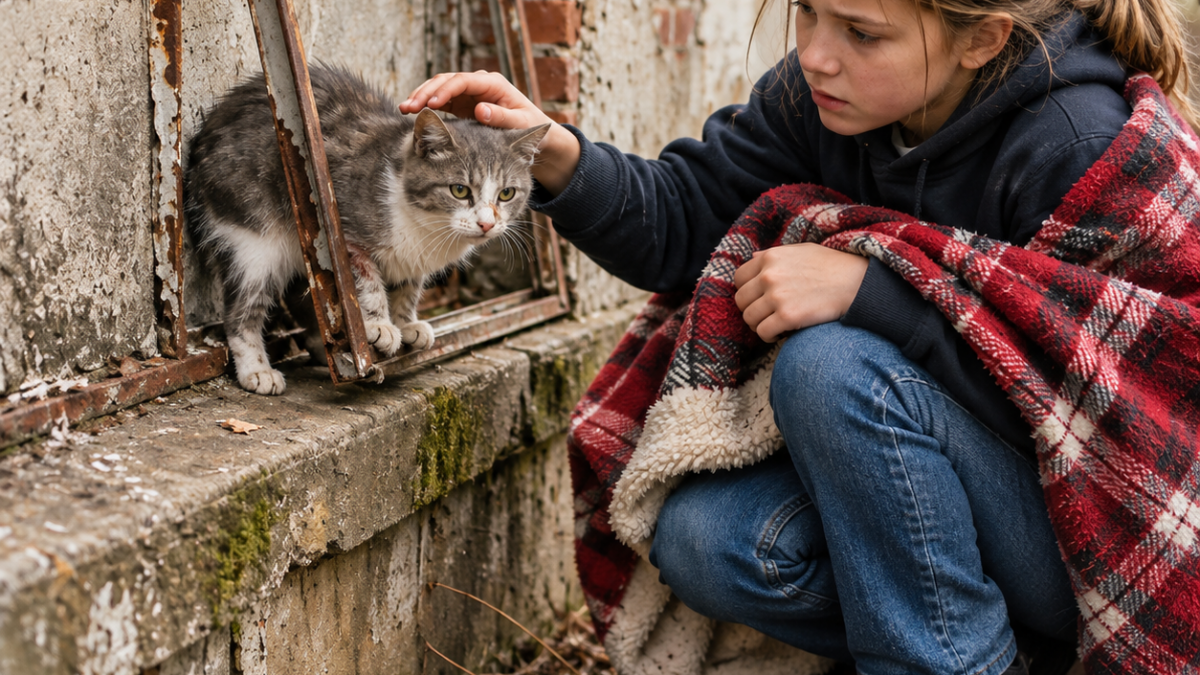
PART 2
## The Longest Few Minutes of My Life
My mother was probably only six or seven minutes away.
It felt like an hour.
The cat grew heavier in my arms, not because her body changed, but because she stopped helping herself.
At first, her back paws had kept trying to find the ledge.
Then the movements became slower.
Finally, one paw slipped completely.
I shifted my jacket higher beneath her chest.
“Stay with me.”
Her eyes opened.
Closed.
Opened again.
I didn’t know enough about animals to understand shock, blood loss, nerve damage, or exhaustion.
I knew one thing.
Animals that are okay don’t hang silently from broken windows.
My right hand hurt where she’d scratched me.
I was grateful for the pain.
It gave me something else to think about.
Then I heard tires.
My mother’s car entered the school parking lot much faster than it normally did.
She parked badly.
The driver’s door opened.
My mother came running around the corner still wearing house slippers beneath her jeans.
Years later, that detail still makes me smile.
She hadn’t taken time to put on shoes.
She saw me first.
Then the cat.
Her face changed.
“Oh, sweetheart.”
I wasn’t sure whether she meant me or the cat.
Probably both.
She knelt beside us.
“What happened?”
“I don’t know.”
“Did you pull her?”
“No.”
“Good.”
“She keeps falling.”
My mother put one hand beneath the jacket to help support the cat.
The cat flinched.
“Easy.”
Mom looked at the trapped paw.
Her expression became more serious.
“We can’t move that.”
“I know.”
“I’m calling someone.”
## The Rescue Call
My mother called a local animal rescue organization first.
She explained everything.
Cat hanging from a broken window.
Leg trapped in metal.
Bleeding.
Unable to support herself.
Old school storage building.
The woman on the other end immediately told her:
“Do not pull the leg free.”
“We haven’t.”
“Keep supporting the body.”
“My daughter is.”
“How long?”
“We don’t know.”
“We’re sending someone with extraction tools. If the cat becomes unresponsive, call back immediately.”
My mother hung up.
“How long?”
“Ten minutes maybe.”
I stared at her.
“She doesn’t have ten minutes.”
Mom looked at the cat.
Then at me.
“She has us for ten minutes.”
That became enough.
## Talking to Her
We talked constantly.
Not because we knew it helped medically.
Because silence felt unbearable.
“Hey, kitty.”
Her ear moved.
“See? She’s listening.”
My mother touched my shoulder.
“She knows you’re here.”
I don’t know if that was true.
I believed it.
A bus drove past the far side of the school.
My bus.
I actually saw it.
For one absurd second, I thought:
I’m missing school.
Then I looked at the cat hanging from my arms.
Nothing about school mattered.
## The First Adult Who Walked Past
A custodian came around the building carrying keys.
He stopped.
“What happened?”
“Cat’s trapped,” Mom said.
He looked toward the window.
“I told them that frame was loose.”
My mother turned.
“What?”
He seemed to realize he’d said something important.
“That window’s been damaged for a while.”
“How long?”
“I don’t know. Months.”
My stomach tightened.
Mom’s voice changed.
“Months?”
The custodian looked uncomfortable.
“I put in a repair request.”
“When?”
“September, I think.”
It was November.
My mother stared at the metal around the cat’s leg.
“Someone knew this was broken?”
He nodded slowly.
That was the first moment our rescue became more than an accident.
But we didn’t have time to argue.
Not yet.
## The Rescue Team Arrives
Two people came in a marked rescue vehicle.
A woman named Karen and a man named Luis.
Karen took one look at the cat.
“Good job supporting her.”
I felt ridiculous pride.
Luis examined the window.
“Don’t move her yet.”
“I won’t.”
Karen put on gloves and gently took more of the cat’s weight from me.
The cat gave another weak hiss.
“That’s okay, sweetheart.”
Luis opened a tool case.
Pliers.
Small pry tools.
Cutters.
Padding.
He studied the frame.
“If I bend this side, it may tighten the other.”
Karen nodded.
“Then cut?”
“Maybe.”
I held my breath.
## The Extraction
Luis placed a padded barrier between the cat’s paw and one edge of metal.
Then he began working the opposite side.
Millimeter by millimeter.
Metal creaked.
The cat tensed.
Karen kept one hand around her shoulders.
My mother held me back because I kept leaning closer.
“Let them work.”
“I want to see.”
“You can see from here.”
The cat suddenly screamed.
I jumped.
Luis froze.
“Stop.”
Everyone stopped.
He checked the paw.
Still trapped.
“Did I make it worse?”
Karen looked.
“No new bleeding.”
He exhaled.
“Different angle.”
He changed tools.
This time he loosened a screw hidden beneath rust.
The lower part of the frame shifted.
“Almost.”
The cat’s breathing became faster.
I whispered from behind them:
“You’re okay.”
Maybe she heard me.
Maybe she didn’t.
Then Luis lifted the metal.
Karen moved the paw.
And suddenly it was free.
Just like that.
After all that terror, freedom happened in less than one second.
The leg fell into Karen’s hands.
The cat didn’t move.
My heart stopped.
“Is she—”
Karen leaned close.
“Breathing.”
I nearly collapsed.
## The Towel
They wrapped her in a warm towel immediately.
Luis checked gum color.
Pulse.
Temperature.
Karen examined the leg without manipulating it much.
“Serious swelling.”
“Broken?” Mom asked.
“Possibly.”
“Can she lose the leg?”
Karen looked at us.
“We need imaging.”
I hated that answer.
It sounded too much like maybe.
The carrier door opened.
The cat went inside.
For the first time that morning, I wasn’t touching her.
My arms felt empty.
Cold air hit the place where my jacket had been.
I looked at the blood across my palm.
Then at the carrier.
“Can I go?”
Karen looked at Mom.
“If the clinic allows visitors.”
My mother nodded.
“We’re going.”
School was over for me that day.
## The Drive to the Clinic
We followed the rescue vehicle.
My mother called the school office while driving.
“My daughter will not be attending this morning.”
Pause.
“No, she isn’t sick.”
Another pause.
“She found an injured cat trapped in the storage building window.”
I watched her face.
Then:
“Yes. That storage building.”
She looked at me.
“I’d also like to speak with someone about the condition of that window.”
The tone mattered.
The office suddenly sounded much more interested.
## The Emergency Examination
At the veterinary clinic, the cat was taken directly to the back.
I wasn’t allowed in.
That felt unfair.
I’d held her while she bled.
Now a door could keep me away?
My mother explained:
“They need room to work.”
I sat in the waiting room with my blue jacket beside me.
Blood on one sleeve.
Gray fur stuck to the fabric.
My scratch stung.
Twenty minutes.
Thirty.
Forty.
Nobody came.
I started imagining terrible things.
Amputation.
Death.
The cat suddenly crashing after rescue.
What if the pressure from the frame had stopped bleeding and removing it caused more?
What if I had moved her wrong?
What if my jacket had pushed something?
I began crying.
My mother noticed.
“What’s happening?”
“What if I hurt her?”
“You didn’t.”
“You don’t know.”
“You supported her exactly the way they told us.”
“But before they told us.”
Mom took my hand.
“You stopped her from hanging by an injured leg.”
I looked at the blood on my palm.
“She scratched me.”
“Because she was scared.”
“I know.”
Then the veterinarian came out.
## Dr. Harris
Her name was Dr. Melissa Harris.
She sat across from us.
I immediately knew adults sit down when news is complicated.
“She’s alive.”
I breathed.
“Okay.”
“She is dehydrated and exhausted. Her trapped front leg has significant soft tissue damage.”
“Broken?”
“Yes.”
My stomach dropped.
“Where?”
“Near the lower part of the limb. There is also substantial swelling and compromised tissue from prolonged compression.”
“Can you fix it?”
“We’re going to try.”
Try.
Not will.
“Will she lose the leg?”
“It’s too soon to know.”
I looked at Mom.
She squeezed my shoulder.
Dr. Harris continued.
“The biggest concern right now is blood flow and nerve function.”
“What does that mean?”
“The metal compressed the limb for a long time. When circulation is restricted, tissue can become damaged. Even after we free the leg, we have to see what recovers.”
I swallowed.
“Does she feel it?”
“Some sensation appears to be present.”
“That’s good?”
“Yes.”
Finally.
A yes.
## How Long Had She Been There?
Dr. Harris couldn’t say exactly.
The dried blood suggested hours.
Possibly overnight.
The cold might actually have slowed some swelling.
Or made everything worse in other ways.
Nobody knew.
“Could she have died?”
I asked.
Dr. Harris looked at me carefully.
“Yes.”
My mother shifted.
I kept going.
“If I didn’t stop?”
She did not soften the answer.
“Very possibly.”
That was the first time I understood what had happened.
Not a rescue story.
A fork in time.
Walk past the building.
One ending.
Stop.
Another.
## The Cat Needed a Name
The rescue organization had to enter her into its records.
“Female domestic shorthair, gray-and-white, unknown owner.”
Karen asked me:
“You found her. Want to suggest a name?”
I froze.
Naming made everything serious.
“What if she dies?”
Karen understood.
“Then she still deserves a name.”
I thought about the window.
The cold.
The way she kept trying to pull herself up.
Then how suddenly she stopped.
“Hope.”
My mother smiled.
“Hope?”
I nodded.
The rescuer wrote it down.
**HOPE.**
## The First Night
Hope stayed at the clinic.
IV fluids.
Pain medication.
Antibiotics.
The leg was stabilized.
Doctors monitored circulation.
They cleaned the wounds.
She ate very little.
My mother drove me home.
Only then did I realize I was still wearing a sweatshirt with no winter jacket.
The jacket was in a plastic bag because of blood.
When we reached home, Mom looked at the clock.
“It’s almost noon.”
I had lived an entire day before lunch.
## School Calls
The principal called.
Not to ask why I missed class.
To ask what had happened.
My mother explained.
Then asked:
“How long was that window broken?”
Silence.
“I’ll need to check.”
“A custodian said he submitted a repair request in September.”
Another silence.
“I wasn’t aware.”
“Someone was.”
My mother rarely sounded angry.
That day she did.
“A cat almost tore her leg off because that frame was left hanging.”
The principal said they would investigate.
Mom answered:
“Please do.”
## I Couldn’t Sleep
That night, I saw Hope every time I closed my eyes.
Hanging.
Head down.
Eyes open.
I wondered what would have happened if she’d fallen completely.
Would the metal have torn through the leg?
Would she have bled out?
Would someone find her body later?
I got up.
Went to my mother’s room.
She was awake too.
“Can we call?”
“The clinic?”
I nodded.
It was after eleven.
Mom called.
A technician answered.
Hope was stable.
Sleeping.
Had eaten a little.
Leg warm.
Circulation present.
I repeated that phrase to myself.
Circulation present.
Like a prayer.
## The Next Morning
I went to school.
Everyone knew.
That was terrible.
A teacher hugged me.
A boy in my class said:
“You saved a cat.”
I didn’t like how it sounded.
“I called my mom.”
“You held it.”
“Yeah.”
“So you saved it.”
I didn’t know what to say.
Then someone asked:
“Did its leg fall off?”
Kids are direct.
“No.”
“Will it?”
“I don’t know.”
The question stayed with me all day.
## Behind the School Was Blocked Off
Orange tape surrounded the storage building.
Maintenance workers stood near the broken window.
I stopped.
One man had removed the entire damaged frame.
Another boarded the opening.
I stared.
If they could fix it that morning, why hadn’t they fixed it months earlier?
That was when anger replaced some of my fear.
## The Repair Request
My mother requested information from the district.
At first, nobody wanted to discuss it.
Then a school board member called.
A written maintenance request had indeed been filed weeks earlier.
Broken frame.
Sharp exposed metal.
Recommended replacement.
Marked:
**NON-URGENT.**
I stared at those words.
Non-urgent.
For the adult filling out paperwork, maybe.
For Hope?
It had become everything.
## Day Two at the Clinic
Hope’s swelling had increased before beginning to stabilize.
Dr. Harris showed us the X-ray.
A fracture.
Not completely shattered.
Good.
Blood supply?
Still present.
Nerve response?
Weak but detectable.
“We’re not talking amputation today.”
I almost shouted.
“Does that mean she keeps it?”
“It means today we are treating to save it.”
Good enough.
## Visiting Hope
They let me sit in a small room.
A technician brought Hope wrapped in a blanket.
She looked different.
Smaller.
Her leg was bandaged almost from shoulder to paw.
I held out my hand.
She stared.
I expected a hiss.
Instead, she smelled my fingers.
Then turned her head away.
I laughed.
My mother said:
“She remembers scratching you.”
“Probably proud.”
## Trust Isn’t Instant
I wanted Hope to recognize me dramatically.
Run into my arms.
Purr.
Something movie-like.
She didn’t.
She was scared.
Tired.
Medicated.
She tolerated me.
That’s all.
Real rescue doesn’t owe you gratitude.
I learned that at twelve.
## The Owner Search
The rescue checked microchip.
None.
Posted notices.
Contacted nearby homes.
No one claimed Hope.
A teacher said she’d seen a gray-and-white cat around the school several times.
Another student had seen her near dumpsters.
So she may have been living outdoors.
Maybe abandoned months earlier.
Maybe born stray.
We never knew.
## Day Three
Hope ate more.
Excellent.
Used litter box.
Excellent.
Attempted to remove bandage.
Annoying.
Excellent.
Dr. Harris smiled.
“She’s becoming difficult.”
“Good?”
“Very.”
I loved difficult.
## The School Board Meeting
My mother attended.
I went too.
I did not want to speak.
Then someone said:
“This was an unfortunate incident involving a stray animal.”
Something about the word unfortunate bothered me.
It made the whole thing sound like weather.
I raised my hand.
The adults looked surprised.
My mother whispered:
“You don’t have to.”
I stood anyway.
“I found her.”
The room went quiet.
I explained.
Not perfectly.
My voice shook.
I described the paw.
Blood.
How heavy her body felt when she stopped struggling.
Then I said:
“The window wasn’t just broken that morning.”
Nobody answered.
I continued.
“Someone reported it.”
A board member nodded.
“Yes.”
“Then why didn’t anyone fix it?”
That was the question.
No one had a satisfying answer.
## Accountability
The district did not become an evil institution overnight.
There was no villain twirling a mustache.
The problem was worse in a boring way.
A maintenance request entered a system.
It was classified as low priority.
Other repairs seemed more important.
Nobody rechecked the hazard.
Everyone assumed the old building would remain unused.
Nobody imagined a cat could become trapped.
Systems fail through assumptions.
The district ordered a full inspection of unused structures.
Broken windows repaired.
Loose metal removed.
Access restricted.
New hazard categories added.
Sharp exposed frames were no longer “non-urgent.”
That was the closest thing to revenge the situation needed.
The same word that had nearly cost Hope her leg changed.
## Day Five
The leg looked better.
Still swollen.
Still painful.
But tissue remained viable.
Dr. Harris said:
“I am much more optimistic.”
“About keeping it?”
“Yes.”
I cried.
Hope looked annoyed.
## The Cast
Hope needed more than a simple bandage.
The fracture required stabilization.
A lightweight splint was fitted.
She hated it immediately.
Tried walking backward.
Then sideways.
Then sat down and glared at everyone.
I laughed for the first time without guilt.
## Purring
One week after rescue, Hope purred when I touched her.
At least I think she did.
Very quiet.
I stopped breathing.
“Mom.”
“What?”
“Listen.”
She leaned closer.
Hope purred again.
Mom smiled.
“There.”
I cried.
Hope stopped because apparently emotion was unacceptable.
## My Scratch Healed Faster
The line on my palm faded.
That upset me.
It was silly.
But I liked having proof.
Something visible.
Eventually only a faint mark remained.
Hope’s wounds were still healing.
I felt guilty my body had gotten off easy.
## Two Weeks
Hope left the clinic for foster care.
The rescue volunteer was Karen, the same woman who had helped remove her from the window.
Her home had a quiet spare room.
Hope hid beneath the bed.
Normal.
No one forced her out.
Food.
Water.
Litter.
Soft blankets.
Time.
## The First Night in Foster
Karen sent me a photo.
Only two eyes under the bed.
Caption:
**Your girl is judging me.**
I smiled.
My girl.
The words mattered more than I expected.
## Physical Therapy
Because of the nerve compression, Hope’s paw didn’t move perfectly.
She placed it strangely at first.
Sometimes knuckled over.
The veterinarian taught Karen gentle exercises.
Touch paw.
Encourage proper placement.
Massage.
Slow walking.
No jumping.
Try telling a young cat not to jump.
Impossible.
## The First Real Setback
Three weeks after rescue, Hope stopped using the leg.
Completely.
Karen called.
We rushed to the clinic.
I thought:
Amputation.
Immediately.
Dr. Harris examined her.
Inflammation around the damaged tissues.
Possible pain flare.
No new fracture.
Medication adjusted.
Rest.
Forty-eight hours later, Hope used the paw again.
Recovery is cruel that way.
It makes you think every bad day is the beginning again.
It isn’t.
## The Window Investigation Becomes Public
A local newspaper heard about the story.
The headline focused on me.
**12-Year-Old Saves Cat Trapped in School Window.**
I hated it.
I hadn’t saved her alone.
My mom came.
Rescuers brought tools.
Veterinarians treated her.
The headline was easier than truth.
Then the article mentioned the prior maintenance request.
That created controversy.
Parents became angry.
Not because a cat had more value than a child, but because they imagined a child touching the same sharp metal.
What if a student climbed there?
What if someone cut an artery?
Suddenly the old storage building mattered.
Sometimes animals expose dangers humans ignored because humans hadn’t been hurt yet.
## The Principal Apologizes
The principal found me after school.
“I owe you an apology.”
I didn’t know what to do with that.
“For what?”
“The building should have been secured.”
I stared at him.
“Did you know?”
“Not personally.”
“Then why are you apologizing?”
He thought.
“Because I’m responsible for what happens on school property even when I don’t personally see every maintenance form.”
That sounded adult in a good way.
He continued:
“You did the right thing by stopping.”
I looked at my shoes.
“I almost pulled her out.”
“But you didn’t.”
“I wanted to.”
“You asked for help.”
I hadn’t realized asking for help could count as doing something.
At twelve, bravery looked like acting.
Hope taught me sometimes bravery is knowing when not to.
## One Month
The splint came off.
Hope took three steps.
Limped.
Used the paw.
We celebrated.
Dr. Harris said:
“Don’t expect perfect movement immediately.”
I didn’t.
Hope expected to climb a shelf.
Karen stopped her.
Hope complained.
Normal cat.
## The First Jump
She jumped onto a low couch.
Everyone panicked.
Hope sat there looking offended by our reaction.
Her leg held.
That night, Karen texted:
**Apparently medical clearance is optional.**
## Adoption Questions
The rescue began considering Hope’s future.
I didn’t like it.
“Future?”
My mom knew what I meant.
“You want her?”
I said nothing.
Our family had never owned a cat.
Dad was mildly allergic.
We had a dog named Rusty who had no experience with cats.
Our house wasn’t impossible.
But not simple.
Mom said:
“We can apply like anyone else.”
My heart jumped.
“Really?”
“Applying doesn’t mean yes.”
Good enough.
## Dad
My father had followed the whole story mostly through phone calls because he worked long shifts.
When I brought up adoption, he rubbed his face.
“Audra.”
“I know.”
“Vet bills.”
“I know.”
“Rusty.”
“I know.”
“Allergies.”
“I know.”
He looked at me.
“You’ve prepared arguments?”
“Yes.”
“Of course.”
## Trial Visit
The rescue allowed a carefully controlled introduction once Hope was healthier.
Rusty on leash.
Hope in carrier.
Rusty smelled.
Hope hissed.
Rusty backed away.
Excellent.
Second meeting.
Hope out, high perch available.
Rusty calm.
Third.
They ignored each other.
Ignoring is underrated in animal introductions.
## Dad’s Allergies
Mild.
Manageable.
He pretended disappointment.
We didn’t believe him.
## Hope Comes Home Temporarily
Foster-to-adopt.
One month trial.
Karen brought her.
I had cleaned my room three times.
Hope exited the carrier.
Walked around.
Smelled everything.
Then crawled beneath my bed.
Of course.
I lay on the floor.
“Remember me?”
No response.
“You scratched me.”
Eyes blinked.
“I forgive you.”
Still nothing.
## That Night
At 2:13 a.m., I woke because something jumped onto my bed.
Hope.
She stood near my feet.
I didn’t move.
She walked closer.
Her injured front paw made a slightly different sound against the blanket.
Tap.
Tap.
Soft tap.
She curled beside my knees.
I didn’t sleep for another hour because I was afraid moving would make her leave.
## Adoption
The trial lasted nineteen days before my father said:
“Are we pretending she’s leaving?”
My mother smiled.
I stopped breathing.
Dad continued:
“Because I’m buying the expensive litter if she’s staying.”
I screamed.
Hope ran out of the room.
Bad announcement strategy.
But yes.
She stayed.
## The Paper
I signed nothing because I was twelve.
My parents signed.
The rescue volunteer smiled.
“Official.”
I held Hope.
She tolerated it for six seconds.
Then left.
Perfect.
## The Window Scar
Hope’s leg remained slightly thicker around the old injury.
A small patch of fur grew differently.
That was all.
No amputation.
No permanent major disability.
A narrow escape.
## The Blue Jacket
My mother wanted to throw the jacket away.
Blood stains.
Metal dirt.
Cat hair.
I refused.
We washed it.
The stain faded.
I wore it for another winter.
Every time I put it on, I remembered her weight.
## The School Storage Building
The district eventually decided repairs weren’t enough.
The old building had too many structural issues.
It was closed permanently.
Later demolished.
I watched part of the demolition from a distance.
The broken window was already gone.
Still, seeing the wall come down felt strange.
My mother said:
“You okay?”
“Yes.”
Then:
“Good.”
Some places don’t need memorials.
## The New Safety Policy
Students were given an easier way to report hazards.
Teachers could flag urgent maintenance.
Custodians received authority to escalate exposed metal, broken glass, electrical risks, and structural hazards.
One small line in policy changed because of Hope.
I liked that more than the newspaper story.
## Someone Complains
Not everyone loved the attention.
One parent wrote online:
“All this over a stray cat?”
I read it.
Got angry.
My mother closed the laptop.
“Don’t.”
“They don’t get it.”
“No.”
“Hope almost died.”
“I know.”
“Why would someone say that?”
Mom looked at me.
“Because some people think care is a limited resource. Like if you care about an animal, you’re taking something away from humans.”
“That’s stupid.”
“Yes.”
We both laughed.
## Two Months
Hope ran.
Not far.
Not dramatically.
Across the hallway after a toy.
Her injured paw worked.
Slight limp when tired.
Otherwise normal.
I chased her.
Rusty barked.
Hope jumped onto the couch.
I stopped.
“You’re not supposed to jump.”
She stared.
Cats do not recognize medical authority.
## Trust
The biggest change wasn’t the leg.
It was her eyes.
Behind the school, every glance had been fear.
At home, her eyes became demanding.
Food.
Open door.
Move from my chair.
Pet me.
Stop petting me.
Normal.
That’s what healing looked like.
## The Rescue Team Visits School
The school invited Karen and Luis to speak about animal safety and emergency response.
Luis brought the tool he had used on the frame.
Students asked questions.
“Could you have cut her leg?”
“No.”
“Could she die?”
“Yes.”
“Why didn’t you pull?”
“Because trapped injuries can worsen when forced.”
Then he said:
“Audra did the most important thing.”
I wanted to disappear.
“She supported the animal and called for help.”
Not pulled.
Not fixed.
Stayed.
That mattered.
## My Classmates
For weeks, people called me Cat Girl.
I hated it.
Then didn’t.
One boy made scratching noises.
I ignored him.
A girl I barely knew brought me cat treats for Hope.
People are strange.
## Three Months
Final orthopedic follow-up.
Dr. Harris manipulated Hope’s leg.
Hope tried to bite her.
“Excellent.”
I stared.
“Trying to bite you is excellent?”
“Normal strength. Normal attitude.”
X-rays showed healing.
Fracture united.
No surgery needed.
Full function expected.
I cried again.
Dr. Harris probably thought I cried constantly.
She was correct.
## The Day Hope Went Back Behind the School
We didn’t take her outside loose.
Never.
But before the storage building was demolished, the rescue arranged a controlled visit for a local safety piece.
Hope in a carrier.
I didn’t love the idea.
She showed no obvious reaction.
Smelled.
Looked around.
We kept it brief.
The reporter asked:
“Do you think she remembers?”
I said:
“I hope she remembers everything after.”
That quote actually made the article.
I liked it.
## The Person Who Should Have Fixed the Window
For a while, I wanted one name.
Who saw the repair request?
Who marked it non-urgent?
Who decided to wait?
I wanted someone to blame.
My mother helped me understand something more complicated.
One secretary logged it.
One maintenance supervisor categorized it.
Budget shortages delayed certain repairs.
Nobody followed up.
No single person woke up and said:
“Let’s leave a dangerous window so a cat gets trapped.”
Responsibility can be shared.
That doesn’t mean responsibility disappears.
The district acknowledged the failure.
Changed procedure.
Paid for Hope’s early veterinary costs through an agreement after discussions with the rescue.
That mattered.
Not because money fixed the fear.
Because accountability should become action.
## Justice Without a Villain
That was my first experience understanding justice.
I had expected justice to mean:
Someone gets punished.
Instead, sometimes justice means:
The thing that hurt someone gets changed.
The system that ignored danger stops ignoring it.
The next hazard gets fixed faster.
No more cat has to hang from that window.
That was enough.
## Six Months
Hope became completely integrated into our home.
Rusty respected her.
Mostly.
Once he sniffed her food.
Hope slapped him.
No claws.
Warning.
Rusty never touched her bowl again.
Good communication.
## The Window Sound
For months, metallic scraping startled Hope.
If someone moved a folding chair, she’d freeze.
Was it because of the frame?
Maybe.
We stopped making unnecessary metal noises around her.
Over time, the reaction decreased.
## Her Paw
Sometimes she licked the old injury.
The vet said occasional sensitivity was possible.
In winter, she limped slightly more.
We added warm bedding.
That’s what living with history means.
Not pretending it vanished.
Adjusting around what remains.
## I Turned Thirteen
Hope slept through my birthday party.
Then appeared when cake plates were cleared.
No interest in me.
Interested in crumbs.
Normal.
## I Wrote About Her
Our English teacher assigned:
**Describe a moment that changed you.**
Everyone expected I would write about Hope.
I tried not to.
Wrote three sentences about something else.
Deleted them.
Then started:
*I learned that being brave can mean refusing to pull.*
That surprised me.
## The Essay
I wrote about how badly I wanted to free her myself.
How heroic that would have felt.
How dangerous it might have been.
How asking my mother for help felt like doing less.
But actually saved her from possible further injury.
My teacher wrote:
**Sometimes restraint is courage.**
I kept the paper.
## One Year
Rescue anniversary.
I put my old blue jacket on the floor.
Hope smelled it.
Then lay on it.
I cried.
My father said:
“Of course.”
“What?”
“She chooses the stained jacket over the expensive bed.”
Correct.
## The Scratch
By then, the scratch on my hand was gone.
Completely.
I was disappointed again.
Then Hope scratched me by accident during play.
New mark.
My mother said:
“There. Happy?”
I laughed.
## The Demolition
The storage building came down in spring.
Dust.
Machinery.
Metal.
The school put temporary fencing around everything.
I stood with my friends after class.
One asked:
“That’s where you found her?”
“Yes.”
“Which window?”
“Gone.”
Good.
## A Small Plaque?
Someone proposed a plaque.
I said no.
Hope didn’t need to be permanently connected to the place she nearly died.
Instead, the school placed a small notice near the main office:
**SEE A HAZARD? REPORT IT. SEE AN ANIMAL IN DISTRESS? TELL AN ADULT IMMEDIATELY.**
Better.
## Two Years
Hope became a confident adult cat.
Healthy weight.
Fast.
Terrible manners.
Loved sunbeams.
Hated closed bathroom doors.
Slept on homework.
Attacked pencil tips.
The leg worked.
She jumped too high.
Every time she landed, I still watched the paw.
Trauma trains humans too.
## My Mother Stops Watching
Eventually, Mom stopped glancing every time Hope jumped.
I didn’t.
Not for years.
## High School
I grew older.
Hope didn’t care.
Middle school.
High school.
Boy problems.
Tests.
Arguments with my parents.
Hope remained.
When I cried, she sometimes sat nearby.
Sometimes left.
She was a cat, not a therapist.
Still, presence mattered.
## Volunteering
At fourteen, I started volunteering with the rescue.
Not because I thought I was a hero.
Because I wanted to know what Karen and Luis had known that morning.
How to approach scared animals.
How to support injuries.
When not to move.
How to call professionals.
I cleaned cages.
Washed bowls.
Folded towels.
Rescue is mostly laundry.
That was another lesson.
## My First Rescue Call as a Volunteer
A kitten under a porch.
Not dramatic.
Healthy.
Scared.
We trapped it safely.
Someone said:
“Easy one.”
I thought about Hope.
No rescue feels small to the animal inside it.
## Luis Teaches Me Tools
When I was older, Luis showed me the type of metal cutter he’d used.
“Remember?”
“Yes.”
“You almost used your hands.”
“Yes.”
“Good thing you didn’t.”
“I know.”
He smiled.
“You learned fast.”
## The Jacket Eventually Became Too Small
I couldn’t wear it anymore.
I kept it anyway.
In a box.
Hope occasionally slept on it if I brought it out.
Maybe it smelled familiar.
Maybe cats like old fabric.
Either answer was enough.
## College
The hardest part of leaving home wasn’t my parents.
Sorry, Mom.
It was Hope.
She sat on my suitcase while I packed.
Classic.
At school, my mother sent pictures.
Hope on my bed.
Hope in my chair.
Hope near my door.
“She’s waiting for you,” Mom said.
Maybe.
Maybe she just liked the room.
Again.
Grief and love often choose the interpretation that helps.
## Coming Home
The first break, Hope heard me enter.
She walked into the hallway.
Stopped.
Then ran.
Actually ran toward me.
I knelt.
She headbutted my chin.
I cried.
My father said:
“You’ve been gone eight weeks.”
“Shut up.”
## Her Leg in Middle Age
Arthritis appeared earlier than normal in the injured joint.
Dr. Harris had warned us.
Medication as needed.
Weight control.
Warm beds.
Hope hated the weight-control portion.
## The Old X-Ray
I saw it again years later.
Tiny bones.
Fracture.
I could barely believe that was her.
Hope had become large in my memory.
The X-ray reminded me how small she’d been.
## Becoming an Adult
I eventually understood something I couldn’t at twelve.
Adults are not as certain as children think.
That morning, I had expected my mother to arrive knowing exactly what to do.
She didn’t.
She knew enough to call someone who did.
Karen knew animal rescue.
Luis knew metal.
Dr. Harris knew medicine.
Nobody knew everything.
Competence is often knowing who to call next.
## The Principal Retires
Years later, I saw the old principal at a community event.
He remembered me.
“How’s the cat?”
I laughed.
“Still alive.”
“Good.”
Then he said:
“That incident changed how we handled facilities reports.”
I didn’t know what to say.
He continued:
“You were right to ask why.”
That mattered more than the newspaper headline ever had.
## Hope at Ten
Gray around muzzle?
Cats don’t gray the same way dogs do, but her face changed.
Softer.
Older.
She slept more.
Still jumped.
Lower.
Arthritis.
Kidney values beginning to change slightly.
Normal aging.
I loved those words.
Normal aging.
The cat almost killed by a window made it to normal aging.
## The Rescue Organization
Karen retired from field rescue.
Luis eventually moved.
Dr. Harris remained.
I kept volunteering when I could.
Every November, someone remembered Hope.
Sometimes because I mentioned her.
Sometimes because the rescue posted an anniversary.
## The Story Gets Simplified
People told it wrong.
“Audra ripped a cat out of a window.”
No.
“Audra climbed the building.”
No.
“The cat lost her leg.”
No.
Stories become dramatic when repeated.
The truth was dramatic enough.
I held her.
Called Mom.
Waited.
Professionals freed her.
She kept her leg.
Truth mattered.
## Why I Corrected People
Because the lesson changes if you turn me into a superhero.
A twelve-year-old should not hear this story and think:
If you find a trapped animal, yank it free yourself.
No.
Support if safe.
Call adults.
Call rescue.
Don’t make injury worse.
My best decision was the one that felt least heroic.
Waiting.
## Hope’s Kidney Disease
At around twelve, kidney disease became more serious.
Diet change.
She hated it.
Subcutaneous fluids later.
My mother learned.
Then me.
Hope complained violently.
Still had opinions.
Good.
## Her Old Injury
Arthritis in the front leg became more noticeable.
She limped.
Pain medication helped.
We added small steps to furniture.
She refused them initially.
Then secretly used them.
Cats hate admitting humans are right.
## Coming Home More Often
As Hope aged, I visited more.
Work.
Life.
Distance.
Still, I came.
One night, she slept on my chest like she had never done as a young cat.
I barely breathed.
Same as when she first climbed onto my bed.
## The Building Is Gone
By then, students attending that school didn’t even know the storage building had existed.
I drove past once.
Grass.
New landscaping.
No window.
Perfect.
## The Policy Remains
I checked.
Hazard reporting system still existed.
Different technology now.
Digital forms.
Urgent categories.
Broken glass and exposed metal automatic priority.
Hope’s incident no longer mentioned in training.
It didn’t need to be.
Good systems outlive the stories that created them.
## My Mother Finds the Jacket
She was cleaning storage.
“Audra.”
“What?”
“Look.”
Blue winter jacket.
Small.
Faded.
One old brownish mark.
I touched it.
Hope smelled it.
Walked away.
Apparently nostalgia was human-only.
## The Last Good Year
Hope became very old.
Thin despite eating.
Kidneys.
Arthritis.
Hearing reduced.
She still loved sunlight.
Still sat near windows.
That detail bothered me at first.
Windows.
But to Hope, a window in a warm home wasn’t the broken frame behind school.
It was sun.
Birds.
Air.
Maybe we shouldn’t let one terrible version of something own every version.
## The First Bad Week
Hope stopped eating well.
Then drinking less.
Kidney values worsened.
Dr. Harris had retired by then, but another veterinarian knew her history.
We adjusted treatment.
She improved.
Months more.
Gift.
## My Fear
Every time Hope declined, I became twelve again.
Her head dropping.
Body heavy in my jacket.
I wanted to fix everything immediately.
Age doesn’t work like that.
You cannot rescue someone from every ending.
## The Question
Eventually, Mom called.
“She had a bad night.”
I drove home.
Hope lay in her bed.
Old.
Thin.
Still gray-and-white.
I sat beside her.
“Hey.”
Her eyes opened.
Those eyes.
For one second I was behind the school again.
Then she purred.
Quiet.
## Quality of Life
Pain.
Appetite.
Hydration.
Mobility.
Interest.
Rest.
Good days.
Bad.
The veterinarian explained.
I knew where the conversation was going.
I hated it.
“She fought so hard.”
The veterinarian said:
“She doesn’t have to keep fighting because she fought before.”
That broke me.
## The Last Morning
Sunlight came through the living room window.
Hope lay in it.
Of course.
My blue jacket was beneath her.
Mom had placed it there.
I laughed through tears.
“She actually likes it now?”
“Apparently.”
## No More Metal
The irony wasn’t lost on me.
Her life nearly ended at a window.
Her final peaceful morning happened beside one.
Different window.
Warm glass.
Safe frame.
Sunlight.
No trap.
## Home Euthanasia
We chose home.
I didn’t want her final trip to be stressful.
The veterinarian came.
Hope remained on the jacket.
Mom beside me.
Dad nearby.
Rusty had been gone for years.
Our house quieter now.
## My Hand
I placed my right hand near Hope’s face.
The hand she’d scratched.
No scar remained.
She smelled it.
Then pressed her nose against my palm.
I cried harder than I thought possible.
## “I’m Here”
The exact words returned.
“Hey, kitty.”
Her ear moved.
“I’m here.”
Years disappeared.
I was twelve again.
Except this time, she wasn’t trapped.
She wasn’t hanging.
She wasn’t alone.
## Goodbye
Sedation relaxed her body.
Her injured front leg stretched out comfortably.
The same leg.
Broken once.
Saved.
Used for more than a decade.
Jumped.
Ran.
Scratched.
Aged.
Now resting.
The veterinarian waited.
Then administered the final medication.
Hope’s breathing slowed.
I kept one hand beneath her chest.
Exactly where the jacket had been all those years before.
One breath.
Another.
Still.
## After
Nobody moved.
Then Mom touched the old jacket.
“You kept her from hanging that morning.”
I shook my head.
“We all did.”
That was important.
No hero.
A chain.
Me.
Mom.
Karen.
Luis.
Dr. Harris.
Hope.
## The Ashes
We kept them.
Small box.
Her name.
**HOPE**
Nothing else.
Enough.
## The Jacket
I didn’t bury it.
Didn’t throw it away.
It returned to storage.
Not as evidence.
Not as sacred relic.
Just mine.
But every time I see blue fabric in winter, I remember.
## The School Asked Me to Speak
Years later, after Hope died, the district invited me to speak during a student safety program.
Not about cats specifically.
About noticing.
I agreed.
I stood in front of teenagers.
Told them:
“I was twelve when I learned that stopping matters.”
I did not dramatize.
I told them the important part.
I almost pulled.
I didn’t.
I called.
I stayed.
## A Student Asked
“What if you’re scared?”
Good question.
“You can be scared and still call.”
“What if you don’t know what to do?”
“Then don’t pretend you do.”
“What if adults don’t listen?”
“Find another adult.”
That was the whole lesson.
## Revenge
People sometimes asked whether anyone was punished for leaving the window broken.
The answer wasn’t dramatic.
No one went to jail.
No one lost everything.
There was accountability.
Repairs.
Policy.
Cost.
Embarrassment.
Public questions.
The building closed.
Processes changed.
The person who had classified the window as low priority received retraining and later helped redesign the hazard system.
That was enough for me.
Because revenge against negligence is prevention.
The next broken frame got fixed.
That’s how you answer failure.
## What Hope Changed in Me
I thought rescuers were people who knew exactly what to do.
Now I knew rescuers were often people who simply refused to leave before someone more qualified arrived.
That changed my life.
## The Cat Behind the Window
Hope was never famous for long.
Good.
Her story circulated locally.
Then faded.
She became ours.
Not a symbol.
Not “the window cat.”
Hope.
## Ordinary Life
She threw up on carpet.
Woke us at night.
Destroyed curtains.
Stole turkey.
Refused medicine.
Sat on warm laundry.
Ignored expensive toys.
Loved cardboard.
That’s the life I wanted for her.
## The Most Important Transformation
Not broken leg to healed leg.
Terrified eyes to demanding eyes.
That’s what I remember.
## The Window
Metal had held her.
Later, windows became places where she slept.
That’s a better ending than anything I could have written at twelve.
## If I Could Return to That Morning
I would walk behind the storage building again.
Cold.
Backpack.
Bus coming.
Metal creak.
Tiny sound.
I’d see her.
I’d know exactly what was coming.
But I wouldn’t change the first thing I did.
“Hey, kitty.”
She’d look.
“I know.”
I would put down my backpack.
Take off the blue jacket.
Support her.
She’d scratch me.
I’d say:
“That’s okay.”
Then I’d tell my twelve-year-old self something.
Not Hope.
Me.
“You don’t need to know how to fix this.”
I would have needed to hear that.
“You just need to know it’s wrong to walk away.”
The bus would pass.
“Let it.”
“You’ll be late.”
“Let it.”
“Your hand will bleed.”
“Fine.”
“You’ll be scared.”
“Stay.”
“Adults will eventually arrive with tools you don’t have.”
“Let them.”
“The cat might lose her leg.”
“She won’t.”
“You don’t know that yet.”
“Exactly.”
Hope requires acting before you know the ending.
## The First Question
When I found her, I kept wondering:
How do I save her?
Wrong question.
The better question was:
What does she need from me right now?
Support.
A phone call.
Time.
That’s all I had.
It was enough to reach the next person.
## Chains of Rescue
People love single heroes because stories are easier that way.
Real rescue is a chain.
The delivery of one person to the next.
A child notices.
A mother drives.
Rescuers extract.
Veterinarians repair.
Foster cares.
Family stays.
If any link refuses responsibility, suffering continues.
Hope taught me that.
## The Custodian
I ran into him years later.
The custodian who had said he’d reported the window.
He recognized me.
“I always felt bad.”
“You reported it.”
“I should’ve pushed harder.”
He looked older.
Then:
“I do now.”
“What?”
“If I see something dangerous, I don’t just file the form. I follow up.”
There.
Another change.
## Guilt Into Action
That’s the only useful version.
## Hope Was Never Grateful
I want to make this clear.
Hope did not spend her life thanking us.
Excellent.
Animals should not owe lifelong gratitude for receiving basic compassion.
She loved us in the ordinary selfish way cats love.
Food.
Warmth.
Familiarity.
Choice.
Sometimes affection.
Sometimes no.
Perfect.
## The Scar Nobody Could See
Her physical scar became hidden beneath fur.
Mine disappeared.
The building disappeared.
Still, the morning remained.
Not trauma exactly.
Instruction.
## I Became the Adult
Years later, I was the person children called when they found animals.
That realization frightened me.
A kid once said:
“I don’t know what to do.”
I heard my own voice.
“Stay there. Don’t pull. I’m coming.”
My mother’s words.
Passed forward.
## That Is Legacy
Not fame.
Instructions.
## Hope’s Name
People thought we named her because we hoped she’d survive.
True.
But eventually the name meant something else.
Hope is not believing everything will be okay.
That is optimism.
Hope is deciding the next action matters even when you don’t know.
I learned that beside a broken window.
## THE END
I was twelve years old when I found a cat hanging from a broken window behind my school.
That sentence sounds dramatic now.
At the time, it felt confusing.
I was supposed to be thinking about the bus.
Homework.
Whether I had packed lunch.
Instead, there was blood on a metal frame and a tiny gray-and-white body hanging by one swollen leg.
I didn’t know how long she’d been there.
Didn’t know whether the leg was broken.
Didn’t know if she belonged to someone.
Didn’t know if she’d bite me.
Didn’t know whether supporting her body was enough.
I knew only that walking away felt wrong.
So I stopped.
That’s the entire beginning.
Not courage.
Not heroism.
Stopping.
Hope scratched me when I tried to help.
Good.
Pain made her afraid.
She didn’t know I was twelve.
Didn’t know what rescue meant.
Didn’t know my mother was coming.
She only knew another hand had reached toward an injured body.
For all she knew, I could make it worse.
So she defended herself.
The scratch healed quickly.
Her leg took much longer.
Sometimes I think that is unfair.
Humans like visible scars because they prove something happened.
Mine disappeared.
Hope carried the real evidence.
A joint that became arthritic earlier.
A slight limp in cold weather.
A patch of fur growing differently.
History stored in a body.
But she also carried something else.
Years.
She kept the leg.
That detail still makes me emotional.
On the first day, the veterinarian would not promise it.
Blood flow had been restricted.
Tissue was damaged.
Nerves compressed.
A fracture lay beneath the swelling.
There were legitimate reasons to fear amputation.
Then circulation remained.
The tissue stayed viable.
The fracture stabilized.
Nerves began responding.
Hope used the paw.
Then walked.
Then jumped before anyone gave permission.
Then ran.
Eventually she became an older cat whose veterinarian had to treat arthritis in the same leg.
I loved the arthritis.
Not because pain is good.
Because arthritis meant age.
Age meant time.
Time was what the broken window had almost stolen.
The school district changed too.
For a while, I wanted one adult to blame.
I wanted a simple villain.
Someone who looked at the maintenance request and decided:
I don’t care.
That’s not what happened.
A custodian reported the window.
A system categorized it.
Other work took priority.
An unused building seemed low risk.
Nobody followed up urgently.
Then an animal nearly died.
Negligence can be ordinary.
That’s what makes it dangerous.
The school could not undo Hope’s pain.
It could make the next dangerous window harder to ignore.
So procedures changed.
The building closed.
Hazards were reclassified.
Staff were given better ways to escalate danger.
Later, the structure was demolished completely.
I watched it disappear.
I thought I would feel triumphant.
I didn’t.
Just relieved.
There is no reason the place where someone almost died needs to remain forever.
Hope didn’t need the building.
Neither did I.
What mattered was what remained after it was gone.
A policy.
A habit of following up.
A rescue volunteer who knew exactly which tools to use.
A veterinarian who refused to promise more than medicine knew.
A mother who arrived in slippers because her child sounded scared.
And me.
Older.
Still stopping.
People sometimes ask what the most emotional moment was.
Freeing her paw?
No.
Hearing “she’ll keep the leg”?
Close.
Adoption?
Beautiful.
Her death?
Devastating.
But the moment I remember most clearly is the one before anyone else arrived.
Hope had stopped struggling.
Her head hung down.
All of her body weight wanted to fall against the trapped limb.
I pushed my folded jacket under her.
For several seconds, she did nothing.
Then I felt her breathe against my hands.
Tiny.
Fast.
Still there.
That was the moment.
Because I had no idea how the story ended.
No veterinarian had told me she’d live.
No rescuer had loosened the metal.
No adult had said I’d done the right thing.
There was only a dying cat and a twelve-year-old girl holding up some of her weight.
Sometimes people do the most important thing before they know it matters.
Years later, when Hope became old and sick, I held her again.
Different house.
Different window.
Same hands, older now.
The scratch long gone.
The blue jacket beneath her.
Her breathing slower.
No metal holding her.
No pain forcing her to struggle.
No bus coming.
No rush.
I said the same thing I’d said behind school.
“I’m here.”
That was all.
On the first morning, those words meant:
Don’t die before help comes.
On the last morning, they meant:
You don’t have to stay because I’m afraid to lose you.
Love changes its job over time.
At first, love held her up.
At the end, love let her rest.
Hope died in sunlight beside a safe window after more than a decade of ordinary cat life.
That sentence is the ending I would have wanted if someone could have shown it to me at twelve.
Not immortal.
Not forever young.
Not magically untouched.
Old.
Loved.
Home.
The broken frame had almost decided her life would end before I even knew she existed.
It didn’t.
The adults who failed to fix it had to face what neglect can cost.
They changed what they could.
The rescuers removed her safely.
The clinic repaired what medicine could repair.
My family gave her a home.
And Hope did the rest in the most cat-like way possible.
She lived as though none of us deserved credit.
I think she was right.
Saving someone doesn’t mean they owe you their life.
It means they get their life back.
And Hope got hers.
She used it to sleep in sunbeams.
Steal food.
Ignore expensive toys.
Terrify our dog.
Wake me at night.
Scratch furniture.
Complain about medicine.
Grow old.
That was the victory.
Not the newspaper article.
Not the school board meeting.
Not the building being demolished.
Not even the leg.
The victory was ordinary life.
So if someone asks what I learned that November morning, I don’t tell them children can be heroes.
That’s too simple.
I tell them this:
Look closer.
If something feels wrong, stop.
If you don’t know what to do, ask.
If you cannot fix the problem, support what you safely can until someone qualified arrives.
Don’t confuse not knowing with being useless.
And never underestimate the difference between the person who walks past and the person who stays.
I couldn’t repair a broken window.
I couldn’t set a fracture.
I couldn’t restore blood flow.
I couldn’t prescribe pain medication.
I couldn’t promise Hope would survive.
I could miss my bus.
I could ruin a jacket.
I could take a scratch.
I could call my mother.
And I could refuse to leave.
Sometimes saving a life begins exactly there.
Not with knowing everything.
Not with being fearless.
Not with doing something dramatic.
Just stopping long enough to notice that someone is still breathing.
**THE END**








