PART 2: A 12-Pound Chain Kept Him in a Dirt Circle for Six Years—Then I Knocked on the Door Next Door
PART 2
“He’s fine.”
That was his answer.
Not hello.
Not he’s old.
Not he likes being outside.
Just:
“He’s fine.”
I looked toward Cooper.
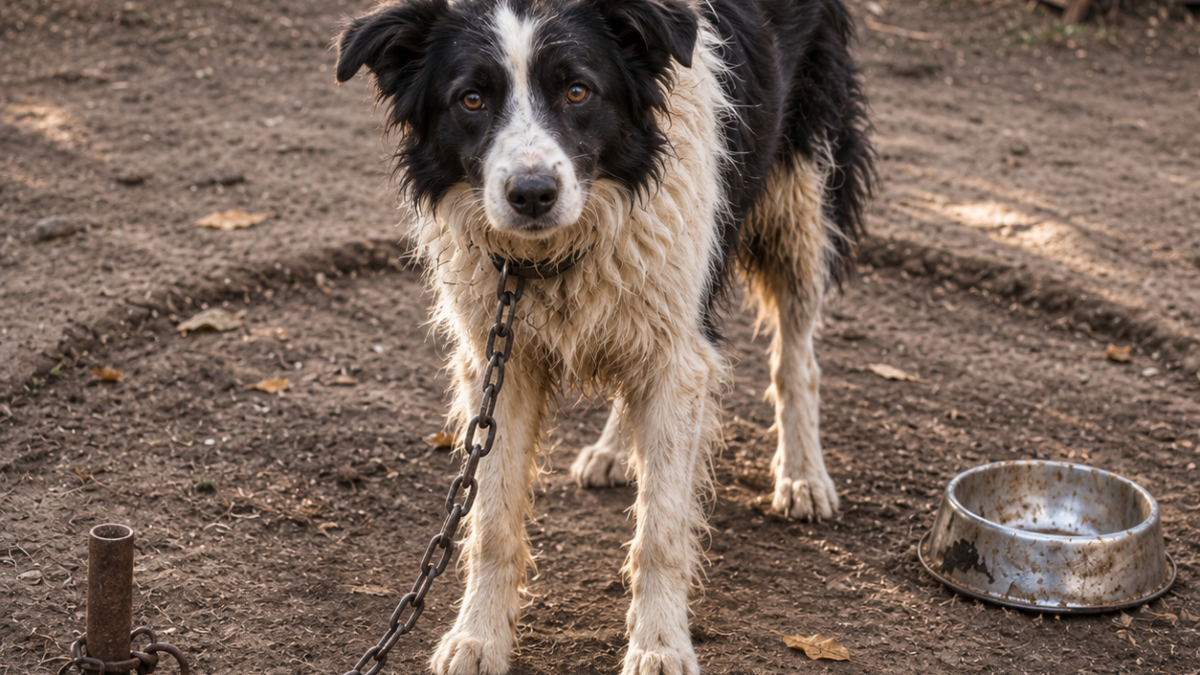
The dog was lying in the middle of that dirt circle with a twelve-pound chain beside him.
“He doesn’t look fine.”
The man’s eyes narrowed.
“You a vet?”
“No.”
“Then don’t worry about it.”
I felt heat rise in my chest, but Daniel had followed me and was standing several feet behind.
His presence reminded me not to turn this into a shouting match.
“I noticed his water bowl is empty.”
“He gets water.”
“It was empty most of the afternoon.”
“I said he gets water.”
I took a breath.
“How long has he been chained?”
The man stared at me.
“Why?”
“I’m just asking.”
“Six years.”
I honestly thought I’d misunderstood.
“Six?”
“Yeah.”
“As in six years?”
His irritation deepened.
“That’s what I said.”
I looked past him again.
Cooper was watching us.
“You’ve had him chained there for six years?”
“He runs.”
I looked back at him.
“Where?”
“What?”
“Where does he run?”
“If I let him loose, he takes off.”
“Have you tried fencing the yard?”
He laughed once.
“You paying for it?”
“No.”
“Then there you go.”
I tried another approach.
“Does he ever come inside?”
“No.”
“During winter?”
“He’s got fur.”
“During storms?”
“He’s got a doghouse.”
I glanced at the collapsing wooden structure.
“That?”
His face hardened.
“Lady, I don’t know where you came from, but around here people mind their own business.”
“My business is next door.”
“Exactly. Next door.”
He began closing the door.
“What’s his name?”
The door stopped.
He looked at me as though the question itself annoyed him.
“Cooper.”
Then he shut it.
I stood there for several seconds.
Daniel walked beside me.
“That went well.”
“Six years.”
“I heard.”
“Twelve pounds, maybe more.”
“What?”
“The chain.”
Daniel looked toward the yard.
“You weighed it from here?”
“No. But look at it.”
He did.
We could both see how Cooper had to shift his body before taking every step.
Daniel exhaled.
“Marina.”
“I know.”
“No, you don’t.”
I turned.
He gave me the look he used when he knew I was about to become obsessed with something.
“You can’t just go over there and cut it.”
“I wasn’t going to.”
“You were thinking it.”
“I was thinking a lot of things.”
“And most of them are illegal.”
I hated that he was right.
That night, rain started around eleven.
Not heavy at first.
A cold November rain.
I went to our bedroom window.
From there, I could see part of the neighboring yard under the security light.
Cooper stood beside the wooden shelter.
He tried to enter.
The chain caught around a post.
He backed up.
Tried again.
The rain intensified.
“Daniel.”
He came beside me.
Cooper circled the post one more time.
The chain shortened.
Now he could barely reach the entrance.
“He’s tangled.”
Daniel stared.
“Maybe they’ll come out.”
Nobody came.
Ten minutes passed.
Twenty.
Rainwater collected in the dirt.
Cooper finally lay down beside the structure instead of inside it.
I grabbed my coat.
Daniel caught my arm.
“Wait.”
“I am not watching him lie in freezing mud all night.”
“You can’t enter their property.”
“I can knock.”
We went back next door.
No answer.
I knocked again.
Lights were on inside.
A television flickered through the curtains.
I knocked harder.
Finally the door opened.
The man stared at me.
“What?”
“Cooper’s chain is wrapped around the post.”
“So?”
“He can’t get inside.”
“He’ll figure it out.”
I thought I’d heard every version of indifference.
That sentence still stunned me.
“He’s lying in the rain.”
“He’s a dog.”
“Exactly.”
The man’s face changed.
“Listen. I don’t need some city woman coming over here telling me how to keep an animal I’ve had longer than you’ve owned that house.”
“I don’t care how long you’ve had him.”
“Well, I do.”
“Then act like it.”
Daniel said quietly:
“Marina.”
Too late.
The man stepped onto the porch.
“What did you say?”
“I said if he’s been yours for six years, you should care that he’s cold.”
“You want the dog?”
The question came so abruptly that I stopped.
“What?”
“You care so much. Buy him.”
I stared.
“You’d sell him?”
“Everything has a price.”
My stomach turned.
“How much?”
Daniel looked sharply at me.
The man smiled.
“Five thousand.”
I almost laughed.
Not because it was funny.
Because I understood exactly what he’d done.
He had picked a number absurd enough to make me walk away.
“You don’t think he’s worth five thousand dollars,” I said.
His smile disappeared.
“You don’t know what I think.”
“You just told me he’s a dog who can figure out lying in freezing rain.”
He stepped closer.
“Get off my property.”
I did.
But I didn’t sleep.
The next morning, I began documenting everything.
Not trespassing.
Not confronting him.
Documenting.
From our side of the property line, I photographed the water bowl when it remained empty for hours.
I wrote down temperatures.
Rain.
Times Cooper received food.
Times someone approached him.
I photographed the chain from the fence line.
I documented the worn dirt ring.
Then I called animal control.
The woman who answered listened politely.
“Is the animal injured?”
“His neck looks damaged.”
“Does he have shelter?”
“Technically.”
“Food?”
“Once a day, from what I’ve seen.”
“Water?”
“Not consistently.”
“Is tethering illegal where we live?”
There was a pause.
“Not completely.”
My heart sank.
“What does that mean?”
“It depends on the conditions, tether length, weather, access to shelter and water, and whether there’s evidence of neglect.”
“He’s been tied in the same spot for six years.”
“I understand.”
“No, I’m not sure you do.”
Her voice remained patient.
“Ma’am, I can send an officer.”
“When?”
“As soon as one is available.”
“How soon?”
“I can’t guarantee.”
I looked through the window.
Cooper was standing at the edge of his circle.
“Please.”
Two days later, an animal control officer arrived.
His name was Harris.
I watched from our porch as he spoke to Cooper’s owner.
By then I’d learned the man’s name.
Travis Mercer.
Travis acted friendly.
Almost charming.
He filled the water bowl before Officer Harris entered the yard.
Of course he did.
He gave Cooper extra food.
Of course he did.
And when the officer inspected the shelter, Travis insisted Cooper preferred sleeping outside.
I stood at the fence wanting to scream.
Harris crouched near Cooper.
The dog lowered his head.
Harris examined the collar.
I could see his expression change.
After about twenty minutes, he came to our house.
“Are you the complainant?”
“Yes.”
He nodded.
“The situation isn’t good.”
“But?”
He sighed.
“There’s always a but, isn’t there?”
“Usually.”
“Can you take him?”
“Not today.”
Anger flashed through me.
“So what happens?”
“I issued written requirements. Fresh water at all times. Improved shelter. Lighter tether or approved containment. Veterinary evaluation for the neck.”
“And if he ignores it?”
“We follow up.”
“When?”
“Forty-eight hours.”
I looked at Cooper.
“He gets forty-eight more hours?”
“Marina.”
Harris’s voice softened.
“I know that doesn’t feel acceptable.”
“It isn’t.”
“I can’t seize someone’s animal because I don’t like how he lives.”
“Look at that circle.”
“I did.”
“He has walked the same circle for six years.”
“I know.”
“You know what that chain weighs?”
“I know it’s too heavy.”
“He lifts it every time he stands.”
Harris looked toward the yard.
“I’ll be back.”
I wanted more.
I wanted someone to unlock the collar immediately.
Instead, bureaucracy gave Cooper forty-eight hours.
Travis knew I had called.
That evening, he stood beside the fence.
“You happy?”
I was carrying groceries.
I stopped.
“What?”
“Government came out.”
“I called because Cooper needs help.”
“He doesn’t need help.”
“Then why did they order you to change his conditions?”
He spat into the dirt.
“People like you are the problem.”
“What kind of people?”
“People who move somewhere and think everybody needs to live the way you do.”
“I don’t care how you live.”
“You clearly do.”
“I care how the dog lives.”
“He’s property.”
The word hit me harder than I’d expected.
Property.
I looked at Cooper.
He was lying near his empty bowl.
“That’s the problem, isn’t it?”
Travis frowned.
“What?”
“You don’t see him as anything except property.”
He laughed.
“You think he has feelings?”
“I think he’s been staring at my house for four days because I’m the first person who’s spoken to him more than once.”
Travis’s face hardened.
“You stay away from him.”
“I haven’t touched him.”
“Don’t feed him.”
“I haven’t.”
“Don’t call him.”
I stared.
“Why?”
“He’s mine.”
I finally understood.
This wasn’t about concern.
It was ownership.
Control.
Cooper couldn’t cross the circle.
And Travis couldn’t tolerate even the idea that the dog might choose another human if given the chance.
The next morning, I went outside with coffee.
Cooper was sitting at the edge of the chain.
I stayed on my property.
“Morning, Cooper.”
His ears lifted.
That was all.
I sat on the steps.
“It’s cold.”
He watched.
“I know you’re not supposed to talk to strangers.”
His head tilted.
I smiled.
“Apparently I’m a bad influence.”
For thirty minutes, I said nothing else.
Then I went inside.
The following day, I did it again.
“Morning, Cooper.”
His tail moved.
Barely.
One sweep through the dirt.
It was the first time I’d seen it wag.
I almost cried.
Forty-eight hours passed.
Officer Harris returned.
The water bowl had been filled.
A cheap plastic shelter had appeared.
The chain had been replaced.
Not with freedom.
Just a slightly lighter chain.
I watched Harris speak to Travis.
Then Harris came to me.
“He complied with some requirements.”
“Some?”
“The neck still needs veterinary documentation.”
“And?”
“He says he scheduled an appointment.”
“Did he?”
“I’ll verify.”
“He’s still chained.”
“I know.”
“For six years.”
“I know.”
I wanted to hate Harris.
But he looked almost as frustrated as I felt.
“I’m building a case,” he said quietly.
That changed everything.
“A case?”
“Don’t repeat that.”
I nodded.
“If conditions deteriorate again, document them. Legally and safely.”
“What are you looking for?”
“A pattern.”
I looked toward Cooper.
“He has a circle six years deep.”
Harris followed my gaze.
“I know.”
Winter arrived early.
By December, temperatures dropped below freezing at night.
Travis moved Cooper’s shelter closer to a shed, but he did not bring him inside.
One morning I found the water bowl frozen solid.
I photographed it.
Another morning the chain was frozen into mud.
Photograph.
Cooper’s collar looked worse.
Photograph.
His body had started getting thinner.
Photograph.
The more I documented, the more helpless I felt.
Evidence was necessary.
Evidence was also a terrible substitute for action.
Then, three weeks before Christmas, Cooper stopped standing when I came outside.
“Cooper?”
His eyes opened.
His head lifted slightly.
But his body stayed down.
I dropped my coffee.
Daniel came running.
“What?”
“He won’t get up.”
I went to the fence.
“Cooper!”
His ears moved.
“Come on.”
Nothing.
Daniel called animal control.
I called Harris directly from the number he’d given me.
No answer.
I called again.
Then I saw Travis come outside.
He walked to Cooper.
Nudged him with his boot.
My entire body went cold.
“Get up.”
Cooper didn’t.
Travis nudged him again.
“Hey!”
I shouted across the fence.
Travis turned.
“Don’t kick him.”
“I didn’t kick him.”
“You shoved him with your foot.”
“He’s lazy.”
“Something’s wrong.”
Travis grabbed the chain.
Pulled.
Cooper’s head jerked.
I screamed.
“Stop!”
Daniel was already moving toward the gate.
Travis shouted:
“Stay off my land!”
“Then call a veterinarian!” I yelled.
“Mind your damn business!”
Cooper tried to stand.
His legs shook.
Then he collapsed.
I called 911.
I knew emergency services weren’t normally for animal welfare disputes.
I didn’t care.
I told the dispatcher there was an active animal cruelty situation and a confrontation developing.
Officer Harris arrived before the sheriff’s deputy.
He drove into the yard, got out, and went straight toward Cooper.
Travis started arguing immediately.
“He’s my dog.”
Harris ignored him.
He knelt.
Touched Cooper’s gums.
Checked his breathing.
Then looked at Travis.
“When did he last eat?”
“This morning.”
I shouted from the fence:
“No, he didn’t.”
Travis spun.
“Shut up!”
Harris stood.
“When did he last drink?”
“Today.”
“The bowl is frozen.”
“I was about to replace it.”
Harris’s voice changed.
“I’m taking the dog.”
Travis froze.
“No, you’re not.”
“Yes.”
“You need a warrant.”
“I have statutory authority to remove an animal in immediate danger.”
“You’re not taking my property.”
The deputy arrived.
That changed the atmosphere immediately.
Travis stepped backward.
Cooper tried to lift his head.
I had never seen anything so heartbreaking.
Six years tied to one spot, and even when help finally arrived, he didn’t understand what it was.
Harris approached him with a slip lead.
The moment he touched the rusted collar, Cooper flinched.
Harris stopped.
“Easy.”
Cooper looked at him.
Then at me.
Maybe I imagined that second part.
I don’t think I did.
Harris cut the old collar.
The sound was small.
A metallic snap.
But I will remember it forever.
Cooper’s neck was free.
For the first time in six years, nothing connected him to the stake in the dirt.
Still, he didn’t move.
That was the cruelest part.
His body was free.
His mind hadn’t caught up.
Harris lifted the chain away.
Cooper looked down at it.
Then he tried to stand.
One step.
He stopped.
He had reached the old boundary of his circle.
Nothing pulled him back.
Cooper froze.
Everyone went silent.
He took another step.
Then another.
His legs trembled.
I covered my mouth.
Cooper looked behind himself.
The chain remained on the ground.
He took one more step.
Outside the circle.
For the first time in six years.
I started crying.
Daniel put his arm around me.
Even the deputy looked away for a second.
Travis didn’t.
He said:
“This is ridiculous.”
Harris turned.
“No.”
His voice was cold.
“This is evidence.”
Cooper was taken to an emergency veterinary clinic.
I wasn’t technically his owner.
I wasn’t technically anything.
But Harris called me that evening.
“It’s bad.”
I sat down.
“How bad?”
“He’s severely dehydrated.”
I closed my eyes.
“Underweight. Skin infection around the neck. Significant scarring. Joint problems. Muscle wasting.”
“Will he live?”
Silence.
“Harris?”
“They think so.”
I started crying again.
“But?”
“He has heartworm.”
My stomach dropped.
“Can they treat it?”
“Yes, but he’s weak.”
“What else?”
“Old fractures.”
“What?”
“Ribs.”
I went completely still.
“Recent?”
“No. Healed.”
I thought about six years.
Six winters.
Six summers.
A life I knew almost nothing about beyond that circle.
Harris continued.
“The vet believes he’s probably eight or nine years old.”
“So he was chained from when he was young.”
“Yes.”
“Almost his whole life.”
“Yes.”
I stared out the window at the empty stake next door.
For the first time, there was no dog attached to it.
I should have felt relief.
Instead, the emptiness made me furious.
The next morning, Travis came to my door.
Daniel answered first.
I heard shouting and ran downstairs.
“You did this.”
Travis pointed at me.
“I called for help when your dog collapsed.”
“He was fine before you moved here.”
“No.”
“He was.”
“No, Travis. Nobody was looking.”
His face reddened.
“You think you’re taking him?”
“I don’t know.”
“You ain’t getting him.”
“I haven’t been offered him.”
“He’s coming home.”
The thought of Cooper returning to that stake turned my stomach.
“No.”
Travis stepped closer.
Daniel moved between us.
“Back up.”
Travis laughed.
“You scared?”
“No,” Daniel said. “I’m giving you a chance to make a good decision.”
Travis pointed past him.
“That dog belongs to me.”
I looked directly at him.
“If the court agrees after seeing his neck, the frozen water, the medical report, and six weeks of photographs, then you can tell the judge that.”
His face changed.
“You took pictures of my property?”
“From mine.”
“You’ve been spying on me.”
“I’ve been watching Cooper.”
“Delete them.”
“No.”
He took one more step.
Daniel didn’t move.
Neither did I.
Finally Travis said:
“You’re going to regret getting involved.”
Then he left.
For the first time, I was scared.
Not enough to stop.
But enough to install cameras.
Three nights later, one caught Travis walking toward our backyard at 1:18 a.m.
He stopped at the property line.
Looked at the cameras.
Then turned around.
Daniel saved the footage.
“Now we’re keeping everything.”
The cruelty case moved faster than I expected.
Maybe because of the veterinary findings.
Maybe because Harris had already documented previous warnings.
Maybe because my photographs gave dates and times.
Or maybe because Cooper’s body told a story nobody could dismiss.
Travis was cited on multiple animal welfare violations.
A hearing was scheduled to determine custody.
Until then, Cooper remained in protective care.
I asked Harris if I could visit him.
He hesitated.
Then smiled.
“I thought you would.”
The first time I saw Cooper at the clinic, I almost didn’t recognize him.
Without the chain, he looked smaller.
Not physically.
Emotionally.
As though the iron had somehow been part of his silhouette for so long that removing it revealed how fragile he actually was.
He was lying on a thick blanket.
There was an IV line in one leg.
A soft bandage covered his neck.
“Hey.”
His eyes opened.
His ears lifted.
I sat on the floor.
“Remember me?”
His tail moved.
Once.
Twice.
Then he tried to stand.
“No, no.”
I put my hand out but didn’t touch him.
“You don’t have to.”
He stood anyway.
Slowly.
Painfully.
Then he took a step toward me.
I held my breath.
Another step.
And another.
Nobody stopped him.
No chain tightened.
Cooper kept going until his nose touched my hand.
I cried so hard the vet technician handed me tissues without saying anything.
“Hi,” I whispered.
Cooper sniffed my fingers.
Then he leaned forward.
His forehead pressed against my palm.
It was the first time I touched him.
His fur was rough.
Warm.
Real.
“I’ve wanted to do that since the first day.”
His tail moved again.
Treatment took weeks.
Heartworm treatment couldn’t begin immediately because Cooper needed strength first.
He received antibiotics.
Fluids.
Pain medication.
Special food.
His neck slowly healed.
What nobody knew how to treat was the invisible six-foot radius around him.
At the clinic, Cooper rarely walked freely even when allowed.
He paced in circles.
Always the same approximate distance.
Turn.
Walk.
Turn.
Walk.
One of the technicians called me.
“You need to see this.”
I arrived during his exercise time.
They had him in a secure yard.
No leash.
No chain.
The gate was closed.
Cooper walked in a circle.
Round.
Round.
Round.
There was an entire yard available.
Grass.
Trees.
Sun.
He never crossed the imaginary line.
I crouched outside it.
“Cooper.”
He stopped.
“Come here.”
His ears lifted.
He took two steps.
Then turned.
“Come on.”
Nothing.
I sat down in the grass.
For twenty minutes, I waited.
Cooper paced.
Then stopped.
Looked at me.
Took one step beyond his invisible boundary.
Then another.
He shook.
Not dramatically.
Just enough that I could see it.
“Good boy.”
He came closer.
Five feet.
Four.
Three.
Then he suddenly retreated into the circle.
My heart sank.
The technician sat beside me.
“Don’t be disappointed.”
“He’s free.”
“His body is.”
I looked at her.
She nodded toward Cooper.
“His brain spent six years learning where pain happens.”
I swallowed.
“So how do we fix that?”
“By showing him where it doesn’t.”
That became our routine.
Every visit, I sat a little farther away.
Never pulling.
Never forcing.
Just waiting.
Some days he reached me.
Some days he didn’t.
Then came the first ball.
I brought a soft red tennis ball.
The technician laughed.
“Does he know what that is?”
“No idea.”
I rolled it gently.
Cooper watched it.
The ball stopped.
He looked at me.
Then at the ball.
Nothing.
I rolled it again.
He followed it with his eyes.
On the third try, he walked over and sniffed it.
“That’s it.”
He nudged it.
The ball moved.
Cooper jumped backward.
I laughed.
He stared.
Then approached again.
Nudged.
Jumped.
Nudged.
By the fifth time, his tail was wagging.
Not the tiny cautious motion I’d seen before.
A real wag.
His whole back end moved.
The technician whispered:
“Oh my God.”
I rolled the ball farther.
Past the imaginary boundary.
Cooper ran after it.
Three steps.
Four.
Five.
He stopped.
Looked down.
There was no chain.
Then he grabbed the ball.
And kept going.
I don’t know how to explain what it feels like to watch a dog discover that the world has no metal ending.
He didn’t run far.
Maybe thirty feet.
But to Cooper, it might as well have been another continent.
The custody hearing came while he was still recovering.
I attended with Daniel.
Travis arrived with an attorney.
He looked angry.
Not ashamed.
Angry.
His lawyer argued Cooper had been fed and sheltered, that outdoor tethering was not automatically illegal, and that Cooper’s medical conditions could have developed despite reasonable care.
Then Harris testified.
He described the frozen water.
The neck injury.
The previous compliance order.
The day Cooper collapsed.
The photographs were shown.
The circular trench.
The rusted collar.
The chain.
Then the chain itself was brought in as evidence.
Twelve pounds, six ounces.
The judge asked:
“How much did the dog weigh at removal?”
Harris checked his notes.
“Forty-four pounds, nine ounces.”
The judge stared at the chain.
Almost twenty-eight percent of his body weight.
Travis shifted in his seat.
Then the veterinarian testified.
Dehydration.
Malnutrition.
Chronic skin damage.
Severe muscle imbalance.
Heartworm disease that had gone untreated.
Old fractures.
Behavior consistent with prolonged confinement.
Finally, Travis testified.
His attorney asked:
“Did you love Cooper?”
“Yes.”
I actually felt sick.
“Did you intentionally harm him?”
“No.”
“Why was he tethered?”
“He ran away.”
“Did you provide food?”
“Yes.”
“Water?”
“Yes.”
“Shelter?”
“Yes.”
Then the county attorney stood.
“How often did Cooper enter your home?”
Travis frowned.
“He’s an outside dog.”
“So never?”
“He didn’t like indoors.”
“How do you know?”
“He just didn’t.”
“Had you ever brought him inside?”
“No.”
“So when you say he didn’t like indoors, you’re describing an environment he’d never experienced.”
Travis didn’t answer.
The attorney continued.
“Did Cooper ever receive heartworm prevention?”
“I don’t remember.”
“Vaccinations?”
“Probably.”
“Veterinary records?”
“I don’t have them.”
“When did a veterinarian last examine him before seizure?”
Silence.
“I don’t remember.”
“Five years?”
“I said I don’t remember.”
“Six?”
His lawyer objected.
The judge allowed the question.
Travis finally said:
“He was healthy.”
The attorney held up a photograph of Cooper’s neck.
“Does that look healthy?”
Travis stared.
“It looks worse in the picture.”
I gripped Daniel’s hand.
The attorney walked to the evidence table.
He lifted part of the chain.
Metal scraped against wood.
The sound filled the courtroom.
I was instantly back beside the fence.
Scrape.
Pause.
Scrape.
“How long was this attached to him?”
Travis said nothing.
“Mr. Mercer?”
“A while.”
“Six years?”
“Maybe.”
“And you considered this appropriate?”
“He was strong.”
The room went silent.
Not because it was a good answer.
Because it was so terrible.
The judge leaned forward.
“A dog being strong does not create permission to test how much suffering it can tolerate.”
Travis looked down.
The ruling came that afternoon.
Cooper would not be returned.
Travis permanently lost legal custody.
He was ordered to pay restitution for part of Cooper’s veterinary care.
He received fines and probation.
Most importantly to me, the court prohibited him from owning or possessing another dog during the probation period, with further restrictions subject to local law.
It wasn’t prison.
It wasn’t some dramatic movie punishment.
But when the judge ordered the chain retained as evidence and looked directly at Travis, she said something I will never forget.
“You repeatedly described this animal as your property.”
She paused.
“Ownership creates responsibility. It does not erase suffering.”
For six years, Travis had used ownership as the reason nobody could interfere.
In the end, ownership became the reason the court held him responsible.
That was enough revenge for me.
Or I thought it was.
Two weeks later, Harris called.
“Cooper is legally available for placement.”
My heart started pounding.
“Okay.”
“That’s all you’re going to say?”
“What do you want me to say?”
“I’ve been waiting two months for you to ask.”
“Ask what?”
Harris laughed.
“You know what.”
I did.
But suddenly I was terrified.
What if Cooper didn’t want a house?
What if he needed someone more experienced?
What if our home reminded him of the place next door?
What if Travis’s voice through the fence triggered him?
Daniel found me sitting at the kitchen table.
“What happened?”
“He’s available.”
Daniel sat opposite me.
“And?”
“I don’t know.”
He stared.
“You don’t know?”
“What if we’re not right for him?”
“Marina.”
“What?”
“You’ve visited that dog four times a week.”
“I know.”
“You bought him six toys.”
“Five.”
“You bought him a blue elephant last Tuesday.”
“That was educational.”
“It’s a stuffed elephant.”
“He liked it.”
Daniel smiled.
“Then what’s really wrong?”
I looked toward the neighboring yard.
The stake was still there.
“What if bringing him here is cruel?”
Daniel understood immediately.
“Because it’s next door.”
“Yes.”
“Then we remove what we can.”
“The yard isn’t the same yard.”
“He’ll smell it.”
“Maybe.”
“He’ll hear Travis.”
“Maybe.”
“What if he’s afraid?”
Daniel reached across the table.
“Then he’s afraid somewhere safe.”
That sentence decided it.
We applied to foster Cooper first.
Not adopt.
I told myself it was because we needed to see how he adjusted.
Everyone else knew I was lying.
The day he came home, Harris brought him personally.
Cooper stepped out of the vehicle wearing a wide padded harness.
No collar around his damaged neck.
The leash was almost weightless.
He stood on our driveway.
Looked toward the neighboring property.
His body froze.
The old chain stake was visible beyond the fence.
I crouched.
“Cooper.”
His eyes stayed on it.
His tail lowered.
“You don’t have to go there.”
He trembled.
Then a sound came from Travis’s property.
A door slammed.
Cooper dropped to the ground.
Flat.
I felt something inside me break.
Daniel knelt several feet away.
We didn’t touch him.
We waited.
Five minutes.
Ten.
Harris stood quietly behind us.
Eventually Cooper lifted his head.
I whispered:
“Come inside.”
The words felt enormous.
Inside.
For six years, that word had belonged to other creatures.
People.
Children.
Family.
Not Cooper.
We walked toward the front door.
At the threshold, he stopped.
One front paw touched the wood floor.
He pulled it back.
Tried again.
The surface was smooth.
Unfamiliar.
He sniffed.
Then placed both front paws inside.
His back paws remained on the porch.
Half in.
Half out.
I sat several feet inside.
“Take your time.”
Cooper stood there for almost two minutes.
Then he stepped completely across.
No chain.
No shouting.
Nothing happened.
He looked behind himself.
The door was still open.
I think that mattered.
He walked farther in.
The living room had a rug.
The first time Cooper touched it, he froze.
Then he lifted one paw.
Pressed it down.
Lifted it.
Pressed again.
Daniel laughed softly.
“Carpet.”
Cooper sniffed the entire edge.
Then, without warning, he rolled onto it.
Not carefully.
He dropped his shoulder and rubbed his entire body across the rug.
Back and forth.
His legs kicked.
I laughed until I cried.
Harris filmed ten seconds and then stopped.
“This is going in my collection of reasons I still do this job.”
That first night, Cooper refused the dog bed.
Of course he did.
I placed it near the couch.
He sniffed it.
Walked away.
He chose the floor beside the back door.
I remembered the dirt.
The hard ground.
The circle.
I didn’t force him.
Around midnight, I came downstairs.
Cooper was awake.
He stared at the door.
I sat nearby.
“Can’t sleep?”
His ears moved.
“Me neither.”
For an hour, we sat together.
Then I lay down on the rug.
Cooper watched.
Eventually, he stood.
Walked toward me.
Turned in a circle.
Then lay six feet away.
The next night, four feet.
The third night, beside the rug.
The fourth, he rested his head on the edge.
A week later, I woke at 2:00 a.m. because something heavy landed against my legs.
Cooper had climbed onto the rug beside me and fallen asleep touching my ankle.
I didn’t move for an hour.
During the day, new things scared him.
The washing machine.
Stairs.
The vacuum cleaner.
The reflection in the oven door.
Television.
A ceiling fan.
Once Daniel dropped a metal spoon.
Cooper ran into a corner and shook.
Metal sounds were the worst.
Chains.
Keys.
A leash buckle hitting a bowl.
Each sound sent him backward in time.
So we changed things.
Soft tags.
Fabric leashes.
Rubber bowls.
No chain anywhere.
The first time we took him into the fenced backyard, Cooper walked to the center and stopped.
Grass surrounded him.
He looked confused.
Then he began circling.
The same six-foot radius.
Round.
Round.
Round.
I sat twenty feet away.
Daniel rolled the red ball.
Cooper watched.
The ball crossed his invisible line.
His body tensed.
Then he took one step.
Another.
He went after it.
The next afternoon he ran farther.
A week later, he crossed the whole yard.
Then something happened I will remember even when I’m ninety.
Cooper ran.
Not cautiously.
Not because someone called him.
He just ran.
One end of the yard to the other.
Fast.
His red-and-white coat lifted in the wind.
His ears flattened.
His tail streamed behind him.
He turned.
Ran back.
Then again.
Daniel started laughing.
I started crying.
Cooper ran past us, eyes bright, mouth open.
He looked younger.
Not because his body had changed.
Because joy had reached his face.
For six years, his world had ended twelve feet from a stake.
Now he was running simply because the ground kept going.
At the far end of the yard, he stopped.
Looked back.
Then sprinted toward me.
He hit my knees so hard I almost fell.
I wrapped my arms around him.
For the first time, Cooper didn’t flinch when someone held him.
He leaned in.
His entire body.
All forty-nine pounds of him after weeks of proper food.
He rested his head against my chest.
“You’re okay.”
His tail thumped.
“You’re okay.”
The foster period lasted thirty days.
On day twenty-nine, Harris called.
“You filing the adoption paperwork tomorrow?”
“I suppose.”
“Marina.”
“What?”
“You’re ridiculous.”
“I wanted to be responsible.”
“You built him a ramp to your bed.”
“That was Daniel.”
Daniel shouted from the kitchen:
“Liar.”
Harris laughed.
The next morning, we signed.
Cooper Mercer became Cooper Hayes.
Technically, dogs don’t understand surnames.
I didn’t care.
The day he officially became ours, I took him outside.
I walked him near the fence.
Not too close.
The old stake remained in Travis’s yard.
The chain was gone.
We had asked the court whether we could have it after the case ended.
The answer was eventually yes.
I didn’t want to keep it.
I wanted one thing.
Daniel helped me build a small display for the local shelter’s education room.
Behind thick clear acrylic, we mounted a section of the rusted chain.
Under it, a plaque read:
**THIS CHAIN WEIGHED 12 POUNDS, 6 OUNCES.**
**THE DOG ATTACHED TO IT WEIGHED 44 POUNDS, 9 OUNCES.**
**HE SURVIVED SIX YEARS.**
**SURVIVAL IS NOT PROOF OF ACCEPTABLE CARE.**
I thought that would be the end of Travis.
It wasn’t.
A few months after Cooper’s adoption, Travis tried to get another dog.
Not secretly.
He applied through a local online rehoming group.
A woman was giving away a young shepherd mix.
She almost gave the dog to him.
Then someone recognized his name.
The woman contacted our shelter.
The shelter contacted Harris.
Harris reminded Travis that his probation prohibited him from possessing another dog.
The placement was stopped.
When Travis learned I’d been asked to confirm information from Cooper’s case, he confronted me at the fence.
“You won’t stop.”
I was gardening.
I stood.
“Stop what?”
“Messing with my life.”
“I didn’t apply for a dog.”
“People keep bringing up Cooper.”
“Yes.”
“It’s over.”
“For you.”
He stared.
“What does that mean?”
I looked at Cooper.
He was lying in our grass beneath a tree.
No chain.
No collar.
Just sunlight across his red fur.
“It means Cooper still wakes up when metal hits the floor.”
Travis rolled his eyes.
“He’s fine.”
“He’s getting there.”
“He always was dramatic.”
I stared at him.
“You really don’t understand anything.”
“What am I supposed to understand?”
“That the fact he survived you doesn’t mean you treated him well.”
His face changed.
I continued.
“You thought because he didn’t bite you, didn’t bark all night, didn’t run himself bloody against the chain, he was fine.”
Travis said nothing.
“But he’d stopped asking.”
“What?”
“When I met him, he didn’t bark at me.”
“So?”
“He didn’t pull toward me.”
“So?”
“He’d learned nobody came.”
Travis looked away.
“That isn’t peace.”
My voice became quieter.
“That’s surrender.”
For once, Travis had nothing to say.
He walked back toward his house.
Cooper lifted his head at the sound of the door.
Then put it down again.
That was victory.
Not Travis being embarrassed.
Not the fines.
Not the court ruling.
Not even losing the right to own another dog for a period of time.
The victory was that Cooper heard the man who had controlled his entire world for six years and chose not to care.
Spring came.
Then summer.
Cooper discovered sprinklers.
At first he hated them.
Then he realized he could bite the water.
For twenty minutes he attacked every stream like it had personally offended him.
Daniel recorded it.
I watched the video repeatedly.
He discovered snow the following winter in a completely different way.
He had known snow before.
But only from the circle.
Snow had once meant frozen chain.
Frozen water.
Cold dirt.
Now he ran through it.
Buried his face.
Came up covered in white.
Then ran again.
He discovered the couch.
That took only three months.
Once he learned it was allowed, he became impossible.
He stretched across all three cushions as though paying the mortgage.
Daniel would stand beside him.
“Move.”
Cooper opened one eye.
“Move.”
Nothing.
Daniel looked at me.
“This is your fault.”
“You taught him carpet.”
“That doesn’t lead naturally to property seizure.”
Cooper sighed dramatically.
Daniel sat on the floor.
I laughed so hard my stomach hurt.
He discovered chicken from the kitchen.
Real chicken.
Not scraps thrown into a metal bowl.
The first time I cooked it, Cooper sat six feet away, staring.
I placed a small piece into his bowl.
He looked at me.
Then the chicken.
Then me.
“It’s yours.”
He didn’t eat.
I walked away.
A moment later, I heard him.
When I looked back, the bowl was clean.
He licked it three more times.
He discovered car rides.
The first one terrified him.
He flattened himself against the seat.
But when we reached a quiet park and he realized the car had delivered him somewhere wonderful, his opinion changed.
Soon the sound of keys became complicated.
They still made him tense.
But if I picked up his harness at the same time, his tail began to wag.
Bad memory meeting new meaning.
That was Cooper’s recovery in one image.
Fear didn’t disappear.
Something better grew beside it.
A year after I first saw him, I took him to the ocean.
He had never seen water bigger than a bowl.
We arrived just after sunrise.
The beach was nearly empty.
Cooper walked onto the sand and immediately stopped.
His paws sank slightly.
He lifted one.
Looked at it.
Then stepped again.
The sound of the waves made him nervous.
He stood close to my leg.
“It’s okay.”
The first wave reached his feet.
He jumped backward.
I laughed.
He looked offended.
Another wave.
He approached.
Sniffed the foam.
Then retreated.
By the fourth wave, he chased it.
By the sixth, he was running.
Daniel unclipped the long line inside a secure dog-friendly section where we could safely give him room.
Cooper ran along the shoreline.
The sunrise turned his red coat gold.
Water splashed around his legs.
He looked enormous against the open horizon.
I thought about the circle.
The twelve feet.
The stake.
The exact place he had once believed the world ended.
Now there was an ocean in front of him.
No wall.
No fence.
No iron.
Only distance.
I started crying.
Daniel looked at me.
“You okay?”
“No.”
He smiled.
“Good no or bad no?”
I watched Cooper run into the shallow water and leap backward when a wave hit his chest.
“Good.”
He ran back toward us.
Then turned again.
Free.
Completely, visibly free.
Two years passed.
The scar around Cooper’s neck never disappeared.
His fur grew back around most of it, but a pale band remained where the collar had damaged the skin.
People sometimes asked about it.
I told them.
Not because I wanted sympathy.
Because Cooper’s story changed people.
One neighbor replaced a heavy tether with a fenced run.
Another family brought their outdoor dog inside during winter after seeing Cooper.
A local school invited Harris to speak about animal welfare.
The shelter used the chain display in training sessions.
And Cooper himself became strangely good with frightened dogs.
We began fostering occasionally.
Never animals in crisis beyond what we could handle.
Mostly shy shelter dogs who needed to learn that houses were safe.
The first was a little black dog named Milo.
He hid behind our dining table for two days.
Cooper didn’t bother him.
He simply lay six feet away.
On the third day, Milo moved closer.
On the fourth, their paws touched.
I watched from the doorway.
Daniel came beside me.
“Looks familiar.”
I nodded.
Cooper had once needed someone to sit outside his circle.
Now he was doing the same for someone else.
That might be my favorite part of his story.
Pain didn’t make him cruel.
It made him gentle.
Three years after his rescue, Travis sold the property.
The day the moving truck arrived, I felt more relief than I expected.
Cooper watched from our porch.
Travis carried boxes.
Furniture.
Tools.
Eventually, he walked into the yard where the stake still stood.
He kicked it.
Then tried pulling it from the ground.
It wouldn’t move.
Six years of pressure had driven it deep.
He grabbed a shovel.
Worked around it.
Finally, the metal post came loose.
A dark hole remained.
Travis tossed the stake into the truck.
For a moment, he looked toward our yard.
Cooper stood beside me.
Our eyes met.
Travis’s and mine.
Neither of us spoke.
Then he drove away.
The new owners arrived two weeks later.
A young couple with a little girl.
They asked about the bare circular patch in the yard.
I hesitated.
Then told them.
The woman covered her mouth.
The little girl listened quietly.
“Did the dog die?”
“No.”
“Where is he?”
I pointed.
Cooper was lying beneath our tree.
The girl smiled.
“Can I meet him?”
I looked at Cooper.
Then at her parents.
“If he wants to.”
She approached slowly.
Cooper stood.
For a second, I saw a flicker of the old dog.
Watchful.
Uncertain.
Then the girl crouched.
“Hi, Cooper.”
He walked toward her.
She held out her hand.
Cooper sniffed it.
Then leaned against her.
The girl laughed.
“You’re heavy.”
I nearly lost it.
Years earlier, Cooper’s world had ended on that property.
Now a child stood in the same place, hugging him.
The new owners planted grass over the circle.
It didn’t grow evenly at first.
The soil was too compacted.
Years of footsteps had changed it.
They aerated.
Added soil.
Seeded again.
Slowly, green appeared.
One afternoon, I looked over the fence and realized the circle was almost gone.
That surprised me.
For so long, I had treated that mark as evidence.
A scar on the earth.
Proof.
Part of me didn’t want it erased.
Then I looked at Cooper.
His neck scar remained.
His fear of metal remained.
His story remained.
We didn’t need the dirt to stay dead forever just to prove something terrible had happened there.
Healing isn’t betrayal.
Grass was allowed to grow.
Cooper was allowed to move on.
So was I.
When Cooper was around twelve, his joints began troubling him more seriously.
The years on the chain had taken a toll.
His hips stiffened.
His front legs carried arthritis.
The veterinarian explained that years of restricted movement and poor condition could have contributed.
I hated hearing it.
Even after all that time, part of Travis remained inside Cooper’s body.
Consequences written into bone.
We began medication.
Joint supplements.
Shorter walks.
A ramp beside the couch.
Daniel built it.
This time I admitted it.
Cooper still insisted on climbing the couch by himself when he felt good.
Pride.
He never lost that.
One evening, I found him standing by the back door.
I opened it.
He walked outside.
Slowly now.
He crossed the yard.
Stopped near the tree.
Then looked toward the neighboring property.
The circle was gone.
Children’s toys lay in the grass.
A swing hung from a branch.
There was no stake.
No chain.
Cooper sat down.
I sat beside him.
“You remember?”
His ears moved.
I touched his shoulder.
“Me too.”
He leaned against me.
For several minutes, we watched the sunset.
I thought about everything I had once wanted.
I had wanted to cut the chain myself.
I had wanted to scream at Travis.
I had wanted instant justice.
I had wanted the world to work faster than it does.
But real rescue had been slower.
Photographs.
Phone calls.
Warnings.
A freezing bowl.
A collapse.
A veterinarian.
A hearing.
Treatment.
Training.
Patience.
Hundreds of tiny moments where Cooper had to learn that freedom wasn’t another trick.
The chain came off in seconds.
The fear took years.
That’s the part people don’t always understand.
Rescue isn’t finished when the door opens.
Sometimes that’s when the real work begins.
Cooper had to learn that food would return tomorrow.
That water wouldn’t disappear.
That hands could touch without hurting.
That metal sounds didn’t always mean weight around his neck.
That doors could open both ways.
That humans could leave and come back.
That a leash could lead somewhere instead of keeping him in one place.
That grass was for running.
That rain could be watched from behind a window.
That thunder sounded different from a couch.
That a bed didn’t have to be earned.
That he could sleep so deeply his paws twitched.
That a person could say his name simply because they were happy he was in the room.
One night, years after his rescue, I woke because Cooper was dreaming.
His legs moved.
A soft sound came from his throat.
I reached down from the bed.
“Cooper.”
He woke immediately.
For one second, his eyes were frightened.
Then he saw me.
His body relaxed.
I rested my hand on his shoulder.
“It’s okay.”
He put his head back down.
Seconds later, he slept.
That was trust.
Not never being afraid.
Knowing where to look when fear came.
Cooper lived with us for six years.
Exactly as long as he’d spent on the chain.
I didn’t realize the symmetry until much later.
Six years confined.
Six years free.
His final summer was quiet.
He couldn’t run anymore.
But he still loved lying beneath the tree.
Still hated the vacuum.
Still loved chicken.
Still occupied too much of the couch.
And he still became excited whenever I held the old red ball.
He couldn’t chase it far.
So I rolled it gently toward him.
He’d place one paw on it.
Victory.
One September morning, he couldn’t stand.
I knew immediately.
Not because it had never happened before.
Because of the way he looked at me.
Tired.
Peaceful.
Ready in a way that terrified me.
Daniel helped carry him to the car.
At the veterinary clinic, tests confirmed what we already feared.
His body was failing.
Cancer.
Advanced.
We had missed it until the symptoms became severe.
The veterinarian explained options.
Treatment might buy time.
But not good time.
I stared at Cooper.
The scar around his neck was almost hidden beneath white-gray fur now.
His amber eyes looked back at me.
I thought about the first time I’d seen them across the fence.
Silent.
Resigned.
“Will he hurt?”
I asked.
“Eventually.”
“Is he hurting now?”
“Some.”
Daniel squeezed my hand.
I wanted six more years.
I wanted ten.
I wanted to take back the first six and give them to him.
I wanted to bargain with a universe that had already cheated him once.
But loving Cooper had taught me one thing.
Love cannot always make life longer.
Sometimes it makes the ending kinder.
We took him home.
For three days, Cooper ate chicken.
Real chicken.
As much as he wanted.
We carried him outside.
He lay beneath his tree.
The little girl next door, older now, came to see him.
She sat beside him.
“You’re a good dog.”
His tail moved.
Once.
Harris came too.
He had more gray hair.
He knelt.
“Hey, buddy.”
Cooper licked his hand.
Harris looked away.
“You remember the first day?”
I asked.
“Every detail.”
“The chain.”
“Still hate that sound.”
“Me too.”
He touched Cooper’s head.
“You did good.”
After he left, I realized something.
People kept telling Cooper he’d done well.
As if surviving had been an achievement.
Maybe it was.
But I wanted him to know something else.
“You didn’t have to be strong.”
Cooper looked at me.
“You shouldn’t have needed to be.”
His eyes softened.
“We were supposed to protect you.”
I pressed my forehead to his.
“I’m sorry nobody did sooner.”
On his final morning, we took him to the beach.
Not to run.
He couldn’t.
Daniel carried him down to the sand on a padded blanket.
The ocean was calm.
The sky was pale blue.
I sat beside Cooper.
The first wave came close but didn’t reach us.
He lifted his nose.
Salt air.
Wind.
Memory.
Maybe dogs remember places through scent more than anything else.
His ears moved.
His tail made one slow sweep.
“Remember?”
I rolled the red ball a few inches.
Cooper touched it with his paw.
I laughed and cried at the same time.
Daniel sat beside us.
For an hour, we watched the water.
Then we went home.
That afternoon, our veterinarian came to the house.
Cooper lay on the rug.
The same kind of rug he’d once been afraid to step on.
His head rested in my lap.
Daniel sat beside us.
The red ball was near his paw.
I whispered:
“You know something?”
Cooper breathed slowly.
“The first time I saw you, you couldn’t come any farther.”
My voice broke.
“You tried.”
I stroked his face.
“But the chain stopped you.”
His eyes stayed on mine.
“There isn’t one now.”
Tears fell onto his fur.
“There will never be one again.”
The veterinarian gave the medication.
Cooper relaxed.
I held him.
“Go wherever you want.”
His breathing slowed.
“No circle.”
Another breath.
“No fence.”
Another.
“No chain.”
I kissed his forehead.
“Run.”
Cooper took one final breath.
Then he was gone.
For a long time, Daniel and I stayed exactly where we were.
I kept my hand on Cooper’s chest even after it stopped moving.
Six years earlier, his body had belonged to a rusted chain.
Now his last sensation was my hand.
I don’t know whether that matters to a dog after death.
It mattered to me.
We buried Cooper beneath the tree where he had spent so many free afternoons.
Daniel made a marker.
I didn’t want anything complicated.
It read:
**COOPER**
**FOR SIX YEARS, THE WORLD ENDED AT A CHAIN.**
**THEN HE FOUND OUT IT DIDN’T.**
The shelter asked whether I wanted the chain display returned to us after Cooper died.
I said no.
Leave it there.
Not as Cooper’s memorial.
His life was more than what had been done to him.
Leave it as a warning.
A lesson.
Evidence for people who still believed an animal surviving something meant the situation was acceptable.
The real Cooper was not the chain.
He was the dog running toward the ocean.
The dog rolling on carpet.
The dog stealing Daniel’s place on the couch.
The dog teaching frightened foster animals how to sit near people again.
The dog biting sprinkler water.
The dog learning that car keys could mean adventure.
The dog sleeping with his paw against my foot.
The dog who once knew exactly how many steps he could take before pain stopped him.
And who later ran simply because he could.
Months after his death, I stood beside the fence.
The neighboring yard was green.
The circle had disappeared completely.
A little boy ran through the grass.
The swing moved in the breeze.
Nothing remained of the old stake.
I closed my eyes.
For a moment, I heard it again.
Scrape.
Clink.
Scrape.
The sound that had first brought me to the fence.
Then another sound replaced it in my memory.
Cooper running.
Paws hitting grass.
Fast.
Free.
Getting farther away from the place where he’d once been trapped.
That was the sound I chose to keep.
Travis had believed Cooper was property.
A thing that belonged to him because paperwork said so.
He believed food once a day was enough.
Water sometimes was enough.
A broken shelter was enough.
Twelve feet of dirt was enough.
He believed survival was enough.
He was wrong.
A life is not measured by whether a heart keeps beating.
Cooper’s heart had beaten for six years inside that circle.
But when the chain came off, I watched something else begin.
Curiosity.
Choice.
Joy.
Trust.
Home.
People sometimes asked whether I thought Cooper ever forgave Travis.
I don’t know.
I don’t think dogs think about forgiveness the way we do.
But I know something better happened.
Cooper became indifferent to him.
The man who had controlled every step stopped mattering.
Travis became background noise.
A door closing beyond a fence.
A voice Cooper no longer needed to obey.
And that, to me, was the most complete form of revenge imaginable.
Travis spent six years deciding how far Cooper could go.
In the end, he had to watch that dog run beyond every boundary he’d ever set.
He had to watch Cooper choose another home.
Another family.
Another life.
And after Travis left, even the ground stopped remembering him.
Grass grew over the circle.
The hole closed.
Children played there.
Life returned.
Cruelty did not get the last image.
Freedom did.
And whenever I think about Cooper now, I never picture him standing beside that rusted stake.
I picture the beach.
The sky.
The red ball.
The first wave rolling toward him.
And Cooper running beside the ocean with nothing dragging behind him.








