PART 2: 105 Degrees, No Shade—Then We Realized Why This Mother Cat Was Burning Herself on a Storm Drain
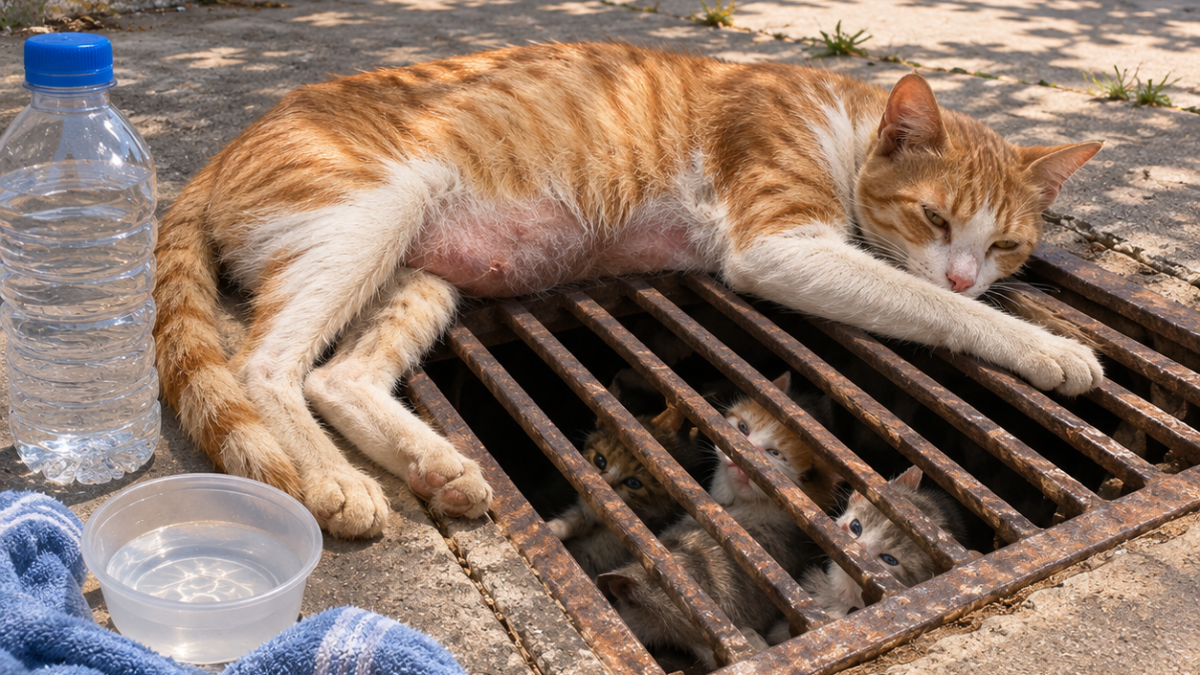
PART 2
She had been working with abandoned and feral cats in our county for fifteen years, and she had the calm, economical movements of someone who had learned that panicking only wastes time animals don’t have.
She placed two carriers in the thin strip of shade created by her van.
Then she crouched near the drain.
“How many?”
“Four,” Laura said.
“You sure?”
“As sure as we can be.”
Megan looked at the mother.
“She nursing?”
“Yes.”
“Eating?”
“Not that we’ve seen.”
“Water?”
“A little.”
Megan’s eyes moved over the cat’s belly.
Her expression changed.
“Jesus.”
I looked too.
Without the cat pressed flat against the metal, the damage was clearer.
The burns weren’t evenly spread.
Some places were pink.
Others angry red.
A few areas had begun blistering.
And the strange grid pattern was unmistakable.
Megan touched the fur near the edge of the injury without contacting the burned skin.
“Second degree in places.”
Laura covered her mouth.
“How long would she need to lie there for that?”
“In this heat?”
Megan looked at the sky.
“Hours.”
“How many?”
“Six. Maybe eight.”
I stared at the mother.
Six to eight hours.
Imagine holding your hand against a hot stove because moving it might expose your child to danger.
No animal thinks about sacrifice in those words.
No speeches.
No moral decisions.
Just instinct.
Need.
Stay.
But whatever language we used, the result was the same.
She had accepted injury to keep the kittens cooler.
Getting the kittens out was easier than getting their mother.
Megan removed the grate using a small pry bar from her van.
The metal was so hot she had to wrap the handle with a towel.
Once the opening was wide enough, she reached carefully inside.
First kitten.
Gray.
Tiny.
Crying.
The mother stood immediately.
Megan paused.
“It’s okay.”
The cat’s body trembled.
Megan placed the kitten inside a small carrier lined with towels, but left the door open so the mother could see.
Second kitten.
Black and white.
Third.
Mostly gray.
Fourth.
A tiny calico female.
All alive.
All dehydrated.
But moving.
When the last kitten emerged, the mother took one shaky step toward them.
Then collapsed.
Laura cried out.
Megan moved fast.
“She’s conscious.”
We lifted the carrier beside her.
The kittens cried.
The mother raised her head.
That was enough.
She tried standing again.
Megan looked at me.
“Help me get her into the van.”
The cat resisted until we moved the kittens first.
Then she followed.
Even half-conscious.
Even burned.
Even barely able to walk.
She would go wherever they went.
Megan called the veterinary clinic on the way.
Laura rode with her.
I followed in my truck.
At the clinic, a technician carried the kittens inside.
The mother saw them disappear through the door and began struggling in Megan’s arms.
“Bring the carrier back,” Megan said.
The technician stopped.
Megan put the mother into another carrier beside the kittens.
Instantly she settled.
The veterinarian, Dr. Priya Shah, examined the kittens first.
Heat stress.
Dehydration.
Fleas.
Underweight.
But surprisingly stable.
“Why surprisingly?” I asked.
Dr. Shah looked toward their mother.
“Because she did exactly what you think she did.”
Laura swallowed.
“She kept it cooler?”
“Yes.”
“By how much?”
“Impossible to know without measuring it at the time, but shading a metal grate from direct sun can change the temperature significantly.”
She looked at the mother.
“It may have been the difference.”
Then she examined her.
The news was worse.
Second-degree contact burns along the abdomen and inner thighs.
Cracked pads.
Severe dehydration.
Early heat exhaustion.
Mild anemia.
Flea burden.
She had likely not eaten properly in several days.
Possibly longer.
“She needs fluids.”
“Will she survive?” Laura asked.
Dr. Shah nodded.
“I think so.”
Laura closed her eyes.
The veterinarian added:
“But she needs to stay.”
“Obviously.”
“She may need sedation for wound cleaning.”
Laura looked at the carrier.
“Will the kittens stay with her?”
“If we can keep nursing safely, yes.”
That mattered.
The mother had spent the entire day injuring herself to protect them.
The last thing any of us wanted was to make her wake up and believe they were gone.
Megan sat with us afterward.
She had seen kittens in storm drains before.
Lots of them.
Texas cats use drainage systems because underground spaces stay cooler.
“What I haven’t seen,” she said, “is this.”
She showed us one of the photos she had taken.
The grate imprint.
Laura looked away.
“Would a cat really understand what she was doing?”
Megan shrugged.
“I don’t know if ‘understand’ is the right word.”
“Instinct?”
“Maybe.”
“Then why lie on the grate?”
Megan thought.
“Because whatever she tried before wasn’t working.”
That answer stayed with me.
Maybe the kittens cried when the sun moved overhead.
Maybe the drain became hotter.
Maybe the mother felt the temperature rising when she returned from searching for food.
Maybe she tried standing near the opening.
Then crouching.
Then eventually discovered that covering it with her body lowered the heat or stopped the kittens from crying.
We would never know the sequence.
But animals solve problems.
People sometimes forget that because animals solve them without explaining themselves afterward.
Megan asked whether we wanted updates.
Laura said yes before I could answer.
That night, we received a picture.
The mother cat was lying on a padded blanket with medication on her burns.
All four kittens were nursing.
Caption:
Everybody made it through the first night.
Laura stared at the photo for a long time.
Then she said:
“She needs a name.”
“Megan probably named her already.”
“I mean a real one.”
“What would you call her?”
Laura looked at the photograph.
“Shade.”
I laughed softly.
“That’s almost too obvious.”
“I know.”
“Kind of cheesy.”
“I know.”
I looked again.
The mother’s burned belly.
Four kittens tucked against her.
“Shade.”
Laura nodded.
“Shade.”
The name stayed.
For the next week, Shade became the center of our evenings.
Every night Megan sent updates.
Day two:
Shade ate half a can of food.
Day three:
She stood comfortably.
Day four:
The burns were healing without infection.
Day five:
Her kittens began gaining weight.
Day six:
Shade allowed Megan to touch her head.
Day seven:
She purred.
That one got Laura.
She sat at our kitchen table with the phone in her hand and cried.
“What?”
“She purred.”
“I can see that.”
“She spent all day burning herself and now she’s purring.”
I sat beside her.
“She’s safe.”
“I know.”
That was the problem.
Sometimes you don’t realize how much fear you’ve been carrying until safety finally gives you permission to feel it.
Shade’s story should have ended there.
Rescue.
Treatment.
Kittens survive.
Good homes.
Mother adopted.
Simple.
But three days later, Megan called me.
Not Laura.
Me.
“Are you home?”
“Yes.”
“Can you come by the clinic?”
“What happened?”
“Shade’s fine.”
My chest loosened.
“Then what?”
“Somebody recognized her.”
The woman waiting at the clinic was named Denise Parker.
She was in her late forties and worked at a feed store ten miles from the abandoned gas station.
The rescue had posted a photograph of Shade online asking whether anyone recognized her.
Denise did.
“She used to be called Misty.”
Megan folded her arms.
“Used to?”
Denise looked embarrassed.
“She belonged to a guy named Travis Boone.”
“Where?”
“Trailer place off Farm Road 116.”
I knew the area.
Old mobile homes.
Scrap yards.
Small ranch lots.
“Was she an indoor cat?”
“Sometimes.”
“Spayed?”
Denise shook her head.
“No.”
“Was she pregnant when you last saw her?”
Denise hesitated.
“Yes.”
Laura had joined us by then.
Her expression hardened.
“When?”
“Maybe three weeks ago.”
That changed everything.
Shade had not been a feral mother who happened to choose a storm drain.
She had belonged somewhere.
Recently.
“What happened?” I asked.
Denise sighed.
“Travis was moving.”
“Where?”
“Dallas, I think.”
“What about Shade?”
“He said he wasn’t taking her.”
Laura’s face changed.
“He left her?”
“I don’t know exactly.”
“You said you recognized her.”
“I did.”
“That means you knew he had her.”
“Yes.”
“Then where did she go?”
Denise looked at Megan.
“He told people she ran away.”
Megan’s voice was flat.
“Did you believe him?”
“No.”
“Why?”
“Because he hated that she was pregnant.”
Denise told us Travis had owned Shade for almost three years.
She arrived as a young stray.
He fed her.
Eventually she slept inside.
Then she had one litter.
Then another.
He gave the kittens away.
Never had her spayed.
“Why?” Laura asked.
Denise gave a tired laugh.
“Same reason people don’t fix anything until it becomes inconvenient.”
The latest pregnancy had angered him.
He was moving into an apartment.
His new girlfriend didn’t want animals.
A week before he left, Denise overheard him at the feed store.
“What am I supposed to do with a pregnant cat?”
One customer said to surrender her.
Travis replied:
“Shelter’s full.”
Another suggested calling rescue.
Travis laughed.
“I’m not filling out paperwork for a cat.”
Denise remembered that line because it bothered her.
Then Shade disappeared.
“So you think he dumped her?” I asked.
“I think it’s possible.”
Possible was not proof.
Megan knew that.
“Can you give us his number?”
Denise could.
She also gave us the address of the trailer he had vacated.
We did not call Travis immediately.
Megan contacted animal control.
Officer Carla Jennings met us at the gas station the next morning.
She inspected the area.
No carrier.
No food containers.
No blanket.
Nothing obvious.
The kittens being inside the drain suggested Shade had chosen it after arriving.
“How far could a pregnant cat travel?” Laura asked.
Carla shrugged.
“Miles, technically.”
“So she could’ve walked here.”
“Yes.”
“From Travis’s trailer?”
“About eight miles.”
Laura frowned.
“Possible?”
“Yes.”
“Likely in July?”
“Hard to say.”
No proof.
Again.
Then the owner of the abandoned gas station called.
The property belonged to a man named Walter Sloan, who lived in Houston.
He had installed two solar-powered trail cameras six months earlier because people kept dumping mattresses, tires, and trash on the property.
Carla almost dropped her pen.
“Are they still running?”
Walter didn’t know.
He gave permission to check.
We found the first camera dead.
The second had power.
Its memory card contained forty-three days of footage.
We watched it in Carla’s office.
Mostly boring.
Cars turning around.
Teenagers stopping at night.
Someone dumping a refrigerator.
Coyotes.
Then July 5.
9:17 p.m.
A red pickup entered the lot.
My pulse accelerated.
It stopped beside the sidewalk.
A man got out.
Even from the camera angle, Denise identified the truck as Travis’s.
Carla stopped her.
“We’ll confirm independently.”
She was right.
No assumptions.
The man opened the passenger door.
Reached inside.
Pulled out a plastic pet carrier.
Set it on the ground.
Opened the door.
A gray-and-white cat remained inside.
He tipped the carrier.
The cat slid out.
She was visibly pregnant.
Laura made a sound beside me.
The cat immediately tried to climb back into the carrier.
The man blocked her with his boot.
Not kicked.
Blocked.
Then lifted the empty carrier.
Walked toward the truck.
Shade followed.
The man got in.
Shade stood beside the passenger door.
The truck drove away.
Shade ran after it.
For maybe thirty yards.
Then stopped.
She stood in the empty lot.
Watching the truck disappear.
I felt sick.
Carla paused the video.
Nobody spoke.
Then she advanced the footage.
Shade stayed near the building.
Explored.
Disappeared.
Returned the next morning.
July 6.
Still pregnant.
July 7.
No longer pregnant.
She appeared from near the storm drain repeatedly.
July 8.
At 8:03 a.m., she lay across the grate.
At 9:12, she stood briefly.
Looked underneath.
Lay back down.
10:45.
Same.
Noon.
Same.
1:30.
Same.
3:07.
Laura’s car passed.
Shade did not move.
3:12.
Laura’s car returned.
I turned away.
It is one thing to know an animal suffered for hours.
Another to watch time stamps prove it.
Shade had lain there almost continuously from after eight in the morning until my wife stopped after three.
Seven hours.
The estimate was right.
Carla identified Travis from the vehicle registration and clearer footage.
She called him.
He denied everything.
Then she told him there was video.
His story changed.
He said Shade was a stray.
Then he said she had lived around his trailer but was never technically his.
Then he said he moved her because the landlord threatened to fine him.
Then he claimed he released her at the gas station because “cats survive outside.”
Carla asked:
“Did you know she was pregnant?”
“Yes.”
“Why not surrender her?”
“Shelters kill cats.”
Megan heard that later and nearly exploded.
Our county shelter had an active foster partnership.
Pregnant cats were not automatically euthanized.
Travis had never called.
Never asked.
Never tried.
The argument wasn’t principle.
It was convenience.
The abandonment citation was only the beginning.
Carla inspected the old trailer property after the landlord reported two other cats still living beneath the structure.
One was Shade’s earlier daughter, according to Denise.
Neither had food or water regularly available.
A neighbor had been feeding them.
Those cats entered rescue too.
Then Denise provided text messages.
Months earlier, she had told Travis:
You need to get Misty fixed.
He replied:
Not paying $200 for a cat that showed up free.
Later:
She’s pregnant again.
Travis:
Then somebody gets kittens.
A week before the dumping:
What are you doing with Misty when you move?
Travis:
Not my problem after Friday.
That sentence mattered.
Not because it was dramatic.
Because it showed intent.
Shade stayed at Megan’s house after leaving the clinic.
Officially foster care.
Megan had a dedicated cat room.
Shade’s burns needed cleaning twice a day.
At first, she hated treatment.
She growled.
Tried to crawl toward the kittens.
Megan would say:
“I know.”
Then place the kittens where Shade could see them.
Treatment became easier.
The burns healed from angry red to pink.
The grid marks remained.
Four pale lines crossing her belly.
Evidence written on skin.
Her paw pads recovered.
She began walking normally.
Then playing.
That surprised everyone.
One evening Megan sent a video of Shade chasing a string toy.
Laura watched it three times.
“She looks like a kitten.”
“She’s probably only three.”
“After all that.”
I understood what she meant.
We tend to look at suffering and assume it reveals an animal’s true identity.
It doesn’t.
Shade wasn’t “the burned mother cat.”
That was something that happened to her.
Underneath it was a young cat who attacked shoelaces, stole food, and slept upside down.
Survival is not personality.
Safety lets personality return.
The kittens grew.
Megan named them temporarily.
Sunny.
Ember.
Pebble.
Dot.
The rescue insisted adopters could rename them.
Laura insisted those names were perfect.
I stayed out of it.
Sunny was the boldest.
Ember screamed during meals.
Pebble followed Shade everywhere.
Dot, the tiny calico, had a habit of climbing Megan’s jeans.
By week six, the foster room was chaos.
Shade tolerated everything.
But something changed as the kittens became independent.
She stopped hovering.
She began leaving the room voluntarily.
Sleeping on Megan’s couch.
Sitting in windows.
Trusting that when she returned, the kittens would still be there.
Megan noticed before I did.
“She doesn’t check constantly anymore.”
Laura smiled.
“She knows they’re safe.”
Exactly.
At the gas station, Shade’s body had been the only barrier between her kittens and the heat.
In foster care, she learned there were walls.
Air-conditioning.
Water.
Humans.
She could finally stop being the entire shelter.
Travis did not appreciate becoming the villain in a local news story.
A reporter learned about the trail-camera footage through public records after charges were filed.
The headline:
CAT BURNED PROTECTING KITTENS AFTER OWNER DUMPS HER AT ABANDONED GAS STATION
It spread.
Farther than anyone expected.
People became furious.
Some went too far.
They found Travis’s social media.
Posted threats.
Megan immediately wrote publicly that threats helped nobody and could interfere with the case.
Laura agreed.
I did too.
We wanted consequences.
Not a mob.
There is a difference.
Travis responded with his own video.
He claimed Shade had always been an outdoor cat.
That she was “basically feral.”
That he had given her “a better chance” by leaving her near a drainage area.
That part infuriated me most.
He had not chosen the storm drain to save her.
The video showed him release her forty feet away.
Shade found the drain herself.
Then he said:
“I didn’t make her lie on hot metal.”
Technically true.
Morally empty.
He also claimed Laura exaggerated the burns.
So Dr. Shah provided veterinary records through proper legal channels.
Second-degree contact burns.
Pattern consistent with prolonged exposure to hot grate.
Severe dehydration.
Heat stress.
No exaggeration.
Then Travis made his worst mistake.
He messaged Denise.
You should have kept your mouth shut.
She saved it.
Then:
If they ask, tell them Misty ran off before I moved.
That transformed Denise from a worried witness into someone prosecutors could show had been asked to lie.
Travis later claimed he was angry and didn’t mean it.
Screenshots don’t care about mood.
A month after the rescue, Shade’s kittens began adoption interviews.
Every applicant wanted to know about the gas station.
Megan hated that.
“They’re not souvenirs from a sad story.”
She screened hard.
Indoor homes.
Veterinary references.
Commitment to spay/neuter.
No impulse adoptions because the kittens were “famous.”
Sunny went to a teacher with two older cats.
Ember to a young couple who had foster experience.
Pebble to a retired nurse.
Dot to a family whose eleven-year-old daughter had spent six months saving allowance for adoption fees.
The girl met Dot and whispered:
“I know your mom.”
Megan asked:
“What?”
The girl pointed to Shade.
“From the picture.”
Then she crouched near her.
“You did good.”
Shade sniffed her fingers.
The girl looked at Megan.
“Is she getting a home too?”
Megan froze.
“Eventually.”
The girl frowned.
“She should get the best one.”
That sentence followed Megan for weeks.
By September, all four kittens were adopted.
Shade remained.
Not because nobody wanted her.
Hundreds did.
But Megan kept delaying her adoption profile.
Medical recheck.
Behavior assessment.
Recovery.
Another week.
Another excuse.
I knew what was happening.
Laura did too.
Megan didn’t.
Or pretended not to.
One evening we were at her house when Shade climbed onto the kitchen chair beside her.
Then onto her lap.
Megan stopped talking.
Shade circled once.
Lay down.
Purred.
Megan’s hands hovered.
“You okay?” I asked.
“Shut up.”
Laura laughed.
“I didn’t say anything.”
“You were thinking it.”
Shade tucked her head beneath Megan’s arm.
Megan stared at us.
“I have three cats.”
Laura said:
“Four.”
“No.”
“Four.”
“She’s foster.”
Shade purred louder.
Megan looked down.
“You manipulative little furnace cover.”
I laughed so hard I nearly dropped my drink.
Two days later, Megan officially adopted her.
Name:
Shade Alvarez.
Perfect.
That should have been the ending.
It wasn’t.
The court hearing came in October.
Animal abandonment cases rarely produce dramatic cinematic justice.
No huge jury.
No dramatic confession.
But the evidence was unusually clear.
Trail-camera footage.
Texts.
Veterinary records.
Witnesses.
The other cats found at the trailer.
Travis entered a plea on animal abandonment and neglect-related charges rather than risk trial on the full set.
The judge reviewed the footage.
Shade following the truck.
Running.
Stopping.
I watched Travis look away.
Maybe embarrassment.
Maybe regret.
Maybe only discomfort at being observed.
We cannot read minds.
The judge could read evidence.
Before sentencing, Megan submitted a victim-impact statement on behalf of the rescue.
She did not dramatize.
That made it stronger.
Shade suffered second-degree burns across her abdomen because after being abandoned while pregnant, she had no safe structure available for her newborn kittens except a storm drain beneath an exposed metal grate. She remained on that grate until she experienced severe dehydration and heat stress. Four kittens survived. The fact that they survived does not reduce the risk created by the abandonment. It demonstrates how hard their mother worked to compensate for a danger she did not create.
Laura cried when she read it.
I did too.
Quietly.
Travis was ordered to pay veterinary restitution and fines, placed under probationary conditions, and restricted from owning or taking responsibility for animals for a period set by the court.
The surviving cats from his former property were legally transferred to rescue.
He was also required to complete community service.
People online complained.
“Not enough.”
Maybe.
No sentence could remove grid-shaped scars from Shade’s belly.
No fine could return those seven hours.
But the animal restriction mattered.
He lost the ability to casually repeat the same behavior with another cat.
That mattered more to me than spectacle.
Then came the part I considered the real revenge.
Megan received the restitution check.
It did not go into her pocket.
The rescue used it to purchase insulated outdoor shelters, reflective shade panels, collapsible water stations, and heat-safe transport carriers for community-cat volunteers.
The money from the man who had abandoned Shade helped keep other cats cool.
When Megan told me, I laughed.
“What?”
“That’s perfect.”
“What is?”
“He paid for shade.”
She stared.
Then smiled.
“Yeah.”
Travis had refused to spend money spaying one cat.
Eventually his money bought protection for dozens.
Life rarely balances the books so neatly.
That time, it did.
Shade changed Megan’s rescue work too.
Before her, Megan focused primarily on emergency trapping.
Afterward, she became obsessed with heat prevention.
Every June, she organized volunteers to map known community-cat colonies.
Water stations.
Reflective covers.
Shade structures.
Safe drainage access.
Public education about hot pavement and metal surfaces.
People thought cats always find cool places.
Usually they do.
Shade proved “usually” is not enough during extreme heat.
One afternoon Megan held up a metal bowl sitting in direct sun.
“Touch it.”
I did.
Pulled my hand away.
“Hot.”
“Exactly.”
Animals experience the same physics we do.
They just don’t get weather alerts.
The abandoned gas station changed too.
Remember Walter, the owner?
After seeing the footage, he called us.
“I feel terrible.”
“You didn’t dump her.”
“It’s my property.”
“An abandoned gas station isn’t a cat nursery.”
“I could’ve had shade there.”
I understood the impulse.
Everybody involved wanted to invent a version of the past where one small change solved everything.
Walter couldn’t change July 8.
But he could change the property.
He agreed to let rescue volunteers install two simple covered water stations along the edge of the lot until redevelopment.
He also replaced the storm-drain grate with a design that allowed airflow while reducing exposed heated metal directly above the ledge.
Later, the county required the site to be cleaned.
The old building came down.
A small roadside produce market eventually opened there.
The owners planted two live oaks.
Years later, they would become real shade.
Laura loved that.
“Shade got trees.”
“Shade got air-conditioning and a couch.”
“Other cats got trees.”
Fair.
One year after the rescue, we visited Megan.
Shade looked nothing like the cat from the grate.
Healthy weight.
Glossy coat.
Bright green eyes.
Her belly fur had grown back.
Mostly.
If you knew where to look, you could see pale lines beneath the thinner hair.
The grid.
Megan said:
“I hate those scars.”
Laura knelt beside Shade.
“I don’t.”
Megan looked at her.
“Why?”
“Because she survived them.”
I understood both sides.
Scars are not beautiful because pain happened.
Pain does not become good because somebody survives.
But scars can become evidence that pain did not get the final word.
Shade stretched across the rug.
Belly exposed.
Completely vulnerable.
That posture struck me.
At the gas station, her belly had been pressed against burning metal because danger forced her there.
Now she exposed the same belly because she felt safe.
That was the ending I wanted.
The four kittens came back for a reunion once.
Cats are not sentimental in the convenient human way, so it was less dramatic than people imagine.
Sunny hissed at Ember.
Dot hid under a chair.
Pebble recognized Megan more than Shade.
Shade sniffed everyone.
Then walked away and ate.
Perfect.
Laura was disappointed.
“They don’t remember?”
“Maybe.”
Megan shrugged.
“Or maybe they don’t need to perform it for us.”
That seemed right.
The miracle wasn’t a reunion scene.
It was that all five had ordinary lives.
Dot became especially important later.
Her adopter, the eleven-year-old girl named Sophie, grew fascinated by rescue work.
She began volunteering when she was old enough.
At sixteen, she started helping Megan with summer water stations.
At eighteen, she went to college to study veterinary technology.
One afternoon she told us:
“I picked it because of Shade.”
Megan pointed at Dot.
“Your cat?”
“No.”
Sophie smiled.
“Her mom.”
Shade was asleep on a chair nearby.
Unimpressed by career influence.
That is the strange thing about rescue.
You help one animal.
Then the effects travel through people.
Shade protected four kittens.
One kitten changed a girl.
The girl eventually helped hundreds more animals.
No animal knows its own legacy.
Probably better that way.
Travis disappeared from our lives after probation ended.
Mostly.
One summer, several years later, Megan received a letter.
No return address.
It was from him.
He wrote that he had seen another news story about Shade during a heat-safety campaign.
He said he wanted Megan to know he had not understood what would happen.
He said he thought the gas station had “places a cat could hide.”
Then:
I know that doesn’t make leaving her right. I kept telling myself she was independent because that was easier than admitting I was choosing convenience over responsibility.
Megan read it.
Then put it down.
Laura asked:
“Are you replying?”
“No.”
“Why?”
“What would I say?”
I didn’t know.
Megan continued:
“His apology isn’t mine to grade.”
She looked at Shade sleeping near the window.
“If he means it, he can live differently.”
That was enough.
Shade aged slowly.
At first she still mothered everything.
Foster kittens.
An injured juvenile cat.
Once, ridiculously, a stuffed toy that squeaked.
Megan worried.
“Is she getting stressed?”
Dr. Shah said:
“Watch the behavior.”
Shade groomed foster kittens.
Then walked away.
Slept.
Played.
Ate.
No obsessive guarding.
No panic.
Care without desperation.
Like other animals we had seen after trauma, she learned that responsibility could be shared.
Humans could warm bottles.
Humans could clean bedding.
Humans could keep water full.
Shade did not have to become the roof every time.
One foster kitten changed her.
His name was Theo.
Tiny orange male.
Found alone in a parking lot.
He screamed constantly.
Shade approached his crate the first night.
Megan watched closely.
Theo cried.
Shade sat beside him.
Did not climb in.
Did not panic.
Megan bottle-fed him.
Theo quieted.
Shade walked away.
Megan called Laura afterward.
“You know what she did?”
“What?”
“Nothing.”
Laura laughed.
“That sounds rude.”
“No.”
Megan started crying.
“She let me handle it.”
That was healing.
At the gas station, Shade had nobody.
Now she knew somebody else would get up.
Somebody else would bring water.
Somebody else would answer the cry.
She could rest.
By the time Shade was ten, she had developed arthritis.
The burns themselves did not cause major long-term problems, but the skin remained more sensitive.
Megan always checked it during summer.
Shade became an indoor-only cat with a screened porch.
The irony made us smile.
A cat once trapped under a Texas sun now had more shaded lounging options than most people.
Cooling mat.
Curtains.
Ceiling fans.
Three beds.
She ignored all three beds and slept in a cardboard box.
Of course.
Every July 8, Laura texted Megan.
How’s Shade?
And every year Megan sent a picture.
Shade in a window.
Shade on the couch.
Shade asleep.
Shade stealing chicken.
Nothing dramatic.
That was the point.
We did not celebrate the day she burned herself.
We celebrated the fact that the date became boring.
I learned that from rescue work.
The worst day does not deserve ownership of the calendar.
Sometimes you reclaim it by making it ordinary.
One July 8, the temperature reached 106.
Hotter than the original rescue day.
Megan sent a photograph.
Shade was stretched beneath an air-conditioning vent, asleep on her back.
Caption:
Still smarter than all of us.
Laura looked at it.
Then at me.
“Remember when she wouldn’t move off the grate?”
“Yes.”
“I thought she was going to die.”
“So did I.”
Laura stared at the photograph.
“She had no reason to trust us.”
“No.”
“But she did.”
“Eventually.”
She smiled.
“That word follows every rescue story.”
Eventually.
Eventually the towel created shade.
Eventually Shade stood.
Eventually the kittens came out.
Eventually the burns healed.
Eventually humans did their part.
The tragedy is that animals often have to survive until our eventually arrives.
Megan turned Shade’s story into a rule at the rescue.
Whenever volunteers saw an animal behaving strangely in heat, they were told:
Don’t assume the behavior is random. Ask what problem the animal may be solving.
That rule saved another litter two summers later.
A volunteer noticed a female cat repeatedly sitting beside a culvert rather than leaving after feeding.
Instead of assuming she simply lived there, he checked.
Three kittens were trapped behind debris after a storm.
Different story.
Same lesson.
Behavior is information.
Shade had been communicating with her entire body.
People drove past because none of us understood the message.
Laura carried guilt about almost passing her for years.
I tried telling her she came back.
She knew.
Still.
One night she said:
“If I’d gone another mile…”
“Don’t.”
“But—”
“You turned around.”
“I almost didn’t.”
“And I almost told you I was too tired to come.”
She looked at me.
“You wouldn’t have.”
“I don’t know.”
That was honest.
We like to rewrite ourselves after good decisions.
Pretend we were always the kind of person who would stop.
Laura wasn’t.
Not automatically.
She hesitated.
Then stopped.
That makes the choice more meaningful, not less.
Kindness is not always instinct.
Sometimes it is an argument you win against your own convenience.
The rescue later obtained a small thermal camera for summer response calls.
The first time Megan tested it, she drove to the old gas-station property before redevelopment.
Air temperature:
Concrete:
Metal grate:
156 in direct sun.
She sent us the reading.
I stared at the number.
Shade had lain on metal that could reach temperatures capable of causing serious burns quickly.
No wonder her belly looked the way it did.
Laura said:
“Don’t send that to me again.”
I understood.
Numbers sometimes make suffering too real.
But Megan used the photo in heat-safety training.
Not to shock.
To educate.
People understand “hot.”
They respond differently to 156.
The court-ordered restitution from Travis eventually ran out.
The rescue continued the heat program anyway.
A local hardware store sponsored reflective shelters.
A veterinary clinic donated water containers.
A motorcycle group—strangely enough—began carrying collapsible bowls during summer rides after hearing Shade’s story.
One rider said:
“We already stop for overheated bikes. Might as well stop for overheated animals.”
I liked him immediately.
Stories spread sideways.
You never know who will carry the next piece.
Shade’s health remained good until around twelve.
Then kidney disease.
Common in older cats.
Manageable at first.
Prescription food.
Extra water.
Medication.
Megan learned subcutaneous fluids.
Shade hated the needle.
Loved the reward afterward.
For two years, she did well.
Slower.
Thinner.
Still judgmental.
Still climbed onto Megan’s lap during rescue paperwork as though personally supervising operations.
One afternoon Megan called us.
“You should come.”
Laura knew immediately.
“Is it time?”
“Not today.”
But close.
We drove over.
Shade was lying on the screened porch.
Warm day.
Not dangerous.
A small fan moved air across the floor.
Megan sat beside her.
“She doesn’t want food.”
That scared me.
Shade had always wanted food.
Dr. Shah had already examined her.
Kidney failure had progressed.
Could hospitalize.
IV fluids.
Maybe buy days.
Maybe a couple weeks.
Megan asked:
“Would they be good?”
Dr. Shah had said:
“Some might.”
Megan looked at Shade.
“Some isn’t enough if the rest hurt.”
She chose hospice at home.
That decision broke her.
Still right.
For the next nine days, Shade ate what she wanted.
Chicken.
Tuna water.
A little salmon.
She slept on Megan.
Walked onto the porch.
Watched birds.
No foster kittens.
Megan suspended intake.
“For once, this house is about her.”
That felt appropriate.
Shade had spent her life making room for vulnerable animals.
Her final days belonged to Shade alone.
The kittens—adult cats now—were scattered across Texas.
Their adopters sent recent photographs.
Megan printed them.
Sunny sleeping on a child’s bed.
Ember on a windowsill.
Pebble enormous and overweight despite everyone insisting he was “just fluffy.”
Dot beside Sophie’s veterinary textbooks.
Megan placed the photos near Shade.
I asked:
“Do you think she knows?”
“No.”
Megan smiled.
“But I do.”
Sometimes memorials are for the living long before death.
Shade’s final morning came on a July day.
Not July 8.
I was grateful.
The forecast was ninety-four.
Warm.
But clouds.
Actual shade.
Megan called Dr. Shah.
Laura and I came.
Sophie came with Dot’s photograph.
No crowd.
Shade hated crowds.
She lay on a thick blanket in Megan’s living room.
Her belly was visible.
The pale grid scars remained.
Faint after all those years.
Laura touched near them.
Not the skin.
The fur.
“You became famous for the worst thing that happened to you.”
Megan shook her head.
“No.”
She looked at Shade.
“She became famous for what she did while it was happening.”
That was better.
Dr. Shah prepared the sedative.
Megan picked Shade up.
She settled into her arms.
No resistance.
Laura sat beside them.
I stayed nearby.
Megan whispered:
“You know what I named you after?”
Shade’s eyes were half closed.
“You never found any.”
Her voice broke.
“So you made your own.”
Shade purred.
Weak.
But unmistakable.
Megan laughed through tears.
“There it is.”
She kissed her head.
“You don’t have to cover anybody anymore.”
Those words destroyed Laura.
Me too.
“You don’t have kittens under you.”
Another purr.
“You don’t have to stay awake.”
Dr. Shah gave the sedative.
Shade relaxed.
Megan cradled her.
“You can move now.”
The sentence hit differently.
For hours on the grate, moving had felt impossible.
Moving meant exposing her babies.
Now there were no babies in danger.
No metal.
No sun.
No abandonment.
Only home.
Megan whispered:
“Everybody’s safe.”
Shade’s breathing slowed.
“Sunny’s safe.”
Another breath.
“Ember’s safe.”
Another.
“Pebble’s safe.”
Another.
“Dot’s safe.”
Her voice broke.
“And you’re safe.”
The final medication entered.
Shade exhaled.
Her body softened completely in Megan’s arms.
For the first time in her life with us, there was nothing left she needed to protect.
We stayed for a long time.
Eventually Megan looked at the faint lines across Shade’s belly.
“I spent years wishing those would disappear.”
Laura said:
“They almost did.”
“I know.”
Megan touched the fur.
“Now I’m glad I can still see them.”
Nobody needed to explain.
Shade had not been defined by the burns.
But the scars were part of the road home.
Megan had Shade cremated.
Her urn was simple.
Gray ceramic.
On the front:
SHADE
Underneath:
SHE COULDN’T FIND SHELTER,
SO SHE BECAME IT.
I told Megan I still thought the name was cheesy.
She smiled.
“You’re wrong.”
“I know.”
Sophie eventually graduated as a veterinary technician.
Her first full-time job was with Dr. Shah.
On her first day, she placed a small photograph of Shade near her workstation.
Not Dot.
Shade.
When Dr. Shah asked why, Sophie said:
“She’s why I learned that animals can be trying to solve something before we even understand there’s a problem.”
That sounded exactly like Megan.
Good things repeat too.
The old gas station is almost unrecognizable now.
There’s a produce market.
Two shade structures.
Trees growing.
A water station for dogs near the entrance.
The owners placed a small plaque beside the drainage area after hearing Shade’s story.
Nothing dramatic.
Just:
FOR SHADE — JULY 8
NOTICE WHAT OTHERS WALK PAST.
Laura cried the first time she saw it.
Then complained that they shouldn’t have made her cry in public.
Travis’s name is not on the plaque.
That matters to me.
For a while, he occupied too much of the story.
The man who dumped her.
The court case.
The texts.
The excuses.
Then time did what it should.
He became less important.
Shade became more.
Her kittens.
Megan.
Sophie.
The rescue heat program.
The cats helped because volunteers learned to look beneath culverts.
The animals protected by shade structures purchased partly with Travis’s restitution.
Cruelty became a paragraph.
The life built afterward became the story.
That is the kind of revenge I believe in.
People sometimes ask whether Shade “knew” she was sacrificing herself.
I don’t know.
Nobody does.
We need to be careful when we turn animals into tiny humans wearing fur.
Maybe Shade didn’t understand burns.
Maybe she didn’t consciously think:
If I lie here, the kittens will be cooler.
Maybe she only heard them crying.
Felt the heat.
Moved her body.
Noticed they quieted.
Stayed.
Then repeated.
That is already extraordinary enough.
Love does not become less meaningful because it is instinctive.
Humans also do countless loving things before putting language around them.
What I know is measurable.
105-degree air.
Concrete hot enough to burn.
Metal grate hotter still.
Second-degree burns.
Severe dehydration.
Four kittens alive beneath her.
Shade’s body covering the opening.
Seven hours captured on video.
Those are facts.
The meaning is what stayed with us.
A mother had almost nothing.
No owner.
No tree.
No awning.
No water.
No safe room.
No person.
She used the one thing she still had.
Herself.
And I think often about the people who drove past.
Because Laura did too.
That matters.
It would be easy to divide this story into good people and bad people.
Travis abandoned her.
Laura saved her.
Simple.
Life isn’t.
Laura nearly kept driving.
I might have if I had been alone.
People passed before her.
Maybe some thought Shade was dead.
Maybe some never saw her.
Maybe somebody noticed and assumed animal control had already been called.
The same excuses humans use around suffering everywhere.
Then Laura’s discomfort became stronger than convenience.
She turned around.
Sometimes that is the difference between tragedy and survival.
A U-turn.
Nothing heroic-looking about it.
I asked Laura once why she stopped.
She said:
“The way she was lying.”
“What about it?”
“Too deliberate.”
That answer fascinates me.
Shade’s act of protection made her visible.
Not movement.
Not noise.
Position.
A mother’s body arranged around a problem.
Laura didn’t know what it meant.
She simply noticed it meant something.
That is what attention is.
Not already knowing.
Being willing to look closer.
Years after Shade died, Megan still uses her photograph when training new volunteers.
But not the most graphic one.
Not the burns.
A picture taken three months later.
Shade asleep on Megan’s couch.
Belly exposed.
Paws loose.
Safe.
Megan asks:
“What do you see?”
New volunteers say:
“Relaxed cat.”
“Happy cat.”
“Pet cat.”
Then Megan tells them what came before.
That sequence matters.
Because rescue should not freeze an animal forever at the worst moment of its life.
Shade was not a burned cat forever.
She was a cat who later became spoiled.
Demanding.
Affectionate.
Annoying.
Loved.
She got to grow out of the headline.
That may be the best ending any rescued animal can have.
If there is one image that stays with me, though, it is still the grate.
Not the burns.
Not the video.
The moment after we created shade with the towel.
Shade finally stood.
Her legs shook.
She stepped aside.
And instead of running toward water or the nearest shadow, she sat less than a foot away from the opening.
Watching.
Even after we helped, she remained ready.
As if she didn’t yet believe anybody else could take over.
I understand that more now.
When you have been the only barrier between someone you love and danger, letting go of responsibility feels like danger too.
Shade had to learn that humans would stay.
Megan would feed.
Dr. Shah would treat.
The foster room would remain cool.
The kittens would not disappear when she slept.
Eventually, she learned.
That is why the final words Megan gave her were so perfect:
Everybody’s safe.
For years, that was what Shade needed to know.
Eventually, she did.
The four kittens outlived her.
Sunny became fourteen.
Ember thirteen.
Pebble nearly fifteen.
Dot lived the longest.
Sixteen.
Sophie was with her at the end.
She called Megan afterward.
“She’s gone.”
Megan cried.
Then asked:
“Was she comfortable?”
“Yes.”
“Were you there?”
“Yes.”
“Then Shade finished her job a long time ago.”
Sophie understood.
Dot had gotten sixteen years because a burned mother refused to move on a July afternoon.
Sixteen years of windows.
Beds.
Food.
Veterinary visits.
Christmas decorations she destroyed.
People she loved.
One day of suffering became decades of life spread across four kittens.
That is difficult to comprehend.
After Dot died, Sophie brought her ashes to Megan’s house.
Shade’s urn was still on the shelf.
Sophie placed Dot’s urn beside it for one evening.
Not permanently.
Just overnight.
She said:
“I know this is silly.”
Megan shook her head.
“No.”
They sat together.
Mother and daughter, in the human sense that mattered to them.
The next morning Sophie took Dot home.
No grand symbolism.
Just a quiet acknowledgment.
Shade had kept all four alive long enough for them to have stories far bigger than the drain.
The rescue’s heat program eventually became formal.
Every summer, volunteers distribute:
Reflective shelters.
Fresh-water systems.
Elevated feeding stations.
Cooling guidance.
Emergency trap protocols.
Maps of shaded locations.
We call it the Shade Project.
Megan fought the name for approximately twelve seconds.
Then surrendered.
The program has helped hundreds of cats.
Maybe thousands now.
The mother cat who had no shade became the name of a program built to provide it.
That feels almost too neat for real life.
But sometimes real life allows poetry.
I think about Travis only rarely now.
The last I heard, he moved out of state.
He complied with the court order.
No known new animal cases.
That is what I wanted.
Not eternal misery.
Different behavior.
If his apology was sincere, good.
If consequences alone changed him, also good.
The goal was never to create another suffering creature.
The goal was to prevent one.
That is justice at its most useful.
People sometimes want a harsher ending.
They ask:
“Did he go to jail?”
“How much did he lose?”
“Did everyone hate him?”
I understand the hunger for balance.
Shade suffered.
We want the person responsible to hurt equally.
But equality of suffering doesn’t heal burned skin.
It doesn’t put water in bowls.
It doesn’t cool pavement.
Useful consequences are better.
He paid restitution.
Lost the right to own animals for a period.
Carried a criminal record.
Could not repeat the behavior without stronger legal consequences.
His money funded protection.
His excuse became evidence.
His abandoned cat became famous for surviving him.
That was enough.
And if you want the most satisfying revenge—
it happened years later on an ordinary summer afternoon.
The temperature outside was 104.
Almost exactly like the day Laura found her.
Megan’s air-conditioning was running.
Shade was stretched across the kitchen floor directly beneath a vent.
Her belly faced upward.
The pale grate scars visible beneath thin fur.
A foster kitten wandered over and began crying.
Shade opened one eye.
Looked at the kitten.
Then looked at Megan.
Megan picked the kitten up.
Shade closed her eye again.
Went back to sleep.
That was everything.
Once, Shade had believed—or instinctively behaved as though—she alone had to become the shield.
Now a kitten cried.
Shade heard it.
And trusted someone else to stand up.
She rested.
The cat who had burned herself because nobody came had finally learned that somebody would.
That was her victory.
Laura still says Shade saved her kittens.
Megan says yes, but that isn’t the whole story.
Shade also changed the way every one of us notices suffering.
Laura turns around now.
I stop.
Megan trains.
Sophie treats.
Walter built shade.
The market keeps water outside.
Volunteers check storm drains.
People who never met Shade know her name because some stories do not end when the animal goes home.
They become instructions.
So if you ever hear this story summarized as:
A mother cat lay on a hot grate to save her kittens,
know that it is true.
But incomplete.
She was abandoned pregnant.
She found the only cool place she could.
She gave birth underground.
The temperature rose.
Her kittens cried.
She solved the problem with the only tool available.
Her body.
She stayed until her skin burned.
My wife almost passed.
Then turned around.
People arrived.
Water arrived.
Shade arrived.
Help arrived.
Late, but not too late.
Four kittens lived.
Their mother healed.
The man who left her faced consequences.
A rescue volunteer who had saved hundreds of animals became the one who couldn’t let this particular cat go.
And a cat once abandoned beside a dead gas station eventually spent summer afternoons sleeping beneath an air-conditioning vent with absolutely nothing beneath her body except a soft rug.
That is the ending I carry.
Not the burns.
Not the court.
Not the truck disappearing in the footage.
Shade asleep.
Belly exposed.
Scars faint.
No kittens under a grate.
No sun beating down.
No need to protect anybody.
Just rest.
Because in the beginning, Shade couldn’t find shade anywhere.
So she became it.
And in the end, after everything she had given—
she finally found enough shade for herself.








