Our 13-Year-Old Dog Was Swept Into a Flood—Then a 24-Year-Old Roofer Risked Everything to Bring Him Home
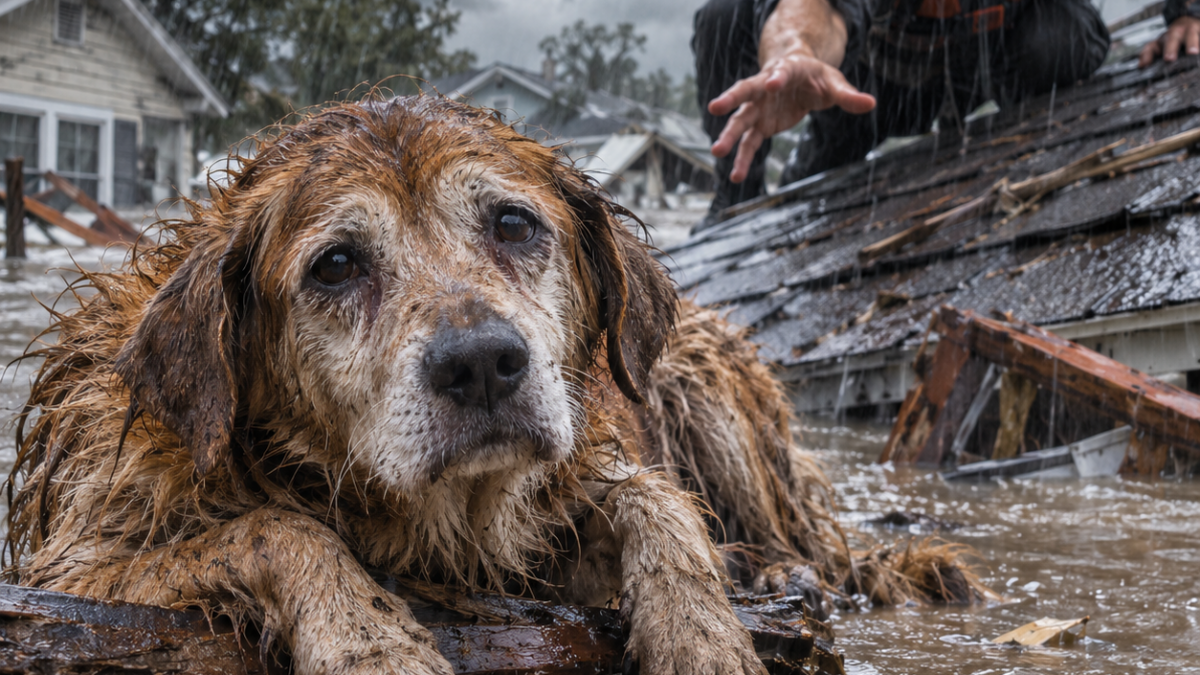
PART 2
The two roofers ran back uphill so fast that one of them nearly slipped in the mud.
The rest spread out along the riverbank.
The foreman introduced himself as Laurent, but I barely heard him.
All I could hear was Paco’s claws scraping against the bark.
Scratch.
Slip.
Scratch.
Every sound seemed quieter than the one before it.
“How long has he been in there?” Laurent asked.
“I don’t know. Five minutes. Maybe ten.”
Michel answered instead.
“Too long.”
Laurent stared at the current.
Nobody had to explain the danger to him.
These men worked on roofs every day. They understood height, balance, weak structures, and what happened when gravity suddenly stopped being negotiable.
But the river was different.
On a roof, a mistake meant falling downward.
Here, a mistake meant falling into water that would drag a man away before anyone could reach him.
Michel took one step toward Laurent.
“I can go.”
“No,” Laurent said immediately.
“That’s my dog.”
“And you already went in twice.”
“I said that’s my dog.”
Laurent turned and looked him directly in the eyes.
“And your wife is standing right there.”
Michel’s jaw tightened.
Neither man moved.
Then Laurent spoke more softly.
“She almost lost you already.”
Something in Michel’s face collapsed.
He looked at me.
I was still clutching the phone.
My whole body was shaking.
The operator kept telling me help was coming, but I had no idea what “coming” meant.
Five minutes?
Ten?
Twenty?
Paco might not have twenty seconds.
The two workers returned carrying a long aluminum extension ladder.
Fully opened, it was nearly thirty feet long.
Under normal circumstances, it was equipment.
That afternoon, it became a bridge.
The men cleared loose stones from the edge of the river.
They tested several positions.
Laurent pointed toward the fallen poplar.
“We need the far end on the trunk. Not the branch. The trunk.”
Four men lifted.
Two guided.
One shouted directions.
“Higher!”
“Left!”
“Watch that branch!”
The first attempt failed.
The end of the ladder struck a broken limb.
The current caught it immediately.
For one terrifying moment, the entire ladder twisted sideways.
The men pulled it back.
Michel closed his eyes.
Paco’s claws scraped the tree again.
I heard myself whispering.
“Please. Please. Please.”
I wasn’t sure who I was talking to.
God.
Paco.
The river.
Anyone who might listen.
“Again!” one of the roofers shouted.
The men lifted the ladder.
This time they moved it farther to the right.
The end stretched above the water.
For several seconds, it seemed impossibly long and thin.
Then—
Clang.
Metal struck wood.
“It’s on!”
“Hold it!”
They shifted the base.
Four men sat across the lower section to weigh it down.
Two others gripped the rails.
Laurent leaned over the edge, checking the far contact point.
“It’s touching the trunk.”
“Enough?” Michel asked.
Laurent did not answer immediately.
That silence told us everything.
Finally, he said, “It’ll have to be.”
The ladder trembled every time debris struck it.
Nobody spoke.
Then Laurent looked at his men.
“Someone has to go out there.”
The words changed the air.
Nine men had run toward a stranger’s screaming without hesitation.
They had carried the ladder down without being asked.
But this was different.
This required one man to leave the safety of the bank.
One man had to crawl twenty or thirty feet above a flooded river on an aluminum ladder resting against a wet tree.
No rope.
No harness.
No platform.
No second chance.
I remember looking at their faces.
These weren’t cowards.
Every one of them worked high above the ground for a living.
But rooftops had anchors.
Scaffolding.
Harnesses.
Known surfaces.
That river offered nothing.
A young man stepped forward.
“I’ll do it.”
Laurent turned.
“Bastien.”
The young man couldn’t have been much older than my oldest nephew.
Later I learned he was twenty-four.
He had only joined the roofing company a few months earlier.
He was the newest member of the crew.
The one who usually carried materials, cleaned up, and handled the simple jobs while he learned.
Laurent stared at him.
“You understand what you’re saying?”
Bastien nodded toward the ladder.
“I’m the lightest.”
“That doesn’t answer my question.”
“I understand.”
The two men stared at each other.
Then Bastien said something I will never forget.
“If we keep talking, that dog is going in.”
Laurent looked toward Paco.
One of Paco’s paws had begun shaking violently.
His muzzle was now inches above the water.
Laurent exhaled.
“Take everything off your belt.”
Bastien removed his tools.
His hammer.
Tape measure.
Utility knife.
Phone.
He placed them on a rock.
Then he rolled up his sleeves and knelt at the base of the ladder.
I noticed a tiny cut on one of his fingers.
Such a ridiculous detail.
But terror does strange things to memory.
It burns useless images into your mind.
Even now, I remember that cut.
A thin red line across his knuckle.
Because I realized those hands were about to become the only hands in the world capable of reaching my dog.
Bastien glanced at me.
“What’s his name?”
“Paco.”
He looked out at the old dog.
“Okay, Paco.”
His voice was calm.
“I’m coming to get you.”
Then he started crawling.
One knee.
One hand.
Another knee.
Another hand.
Slowly.
Carefully.
The ladder flexed beneath him.
Michel stood beside me.
He didn’t blink.
Nobody did.
Halfway across, Bastien stopped.
Water struck the lower rungs and sprayed his face.
“Still good?” he called.
Laurent crouched near the base.
“Still good. Don’t rush.”
Bastien continued.
Paco’s nose was almost touching the surface now.
“Paco,” I whispered.
The old dog lifted his head a fraction.
“Look at him, baby. Look at him.”
Bastien reached the last few rungs.
“Hey, buddy.”
Paco’s eyes moved toward him.
“Easy.”
Bastien stretched one hand toward the collar.
His fingers touched it.
For one second, hope surged through me so violently that my knees almost gave out.
Then Paco’s left paw slipped.
His body dropped sideways.
At the same instant, the ladder shifted against the tree.
Only a few inches.
But those few inches changed everything.
“BASTIEN!” Laurent screamed.
Bastien’s left hand locked around the ladder.
His right hand had Paco’s collar.
The dog’s body swung beneath him.
For a heartbeat, the entire world seemed frozen.
Bastien could protect himself.
Or he could hold Paco.
He couldn’t do both for long.
“LET GO OF THE DOG!” someone shouted.
I don’t know which worker said it.
Maybe it was instinct.
Maybe training.
Maybe fear.
I didn’t blame him.
Bastien was twenty-four years old.
Paco was thirteen.
If somebody had put those two lives on a scale, reason would have demanded that Bastien choose his own.
But Bastien didn’t let go.
He threw his right forearm through Paco’s collar and flattened his chest against the ladder.
The force nearly pulled his shoulder between the rungs.
Paco disappeared beneath the water.
“NO!”
I heard my own scream as if it came from somebody else.
Bastien grunted.
“Hold the ladder!”
Every man on the bank moved at once.
They leaned backward.
Grabbed rails.
Pressed their boots into mud.
Michel threw himself onto the base beside them despite his injured knee.
The ladder stopped moving.
Bastien’s face was inches above the rushing water.
“Paco!”
He pulled.
Nothing.
The dog’s wet body was too heavy.
“Come on!”
Bastien shifted his grip.
The ladder trembled.
Paco’s head broke the surface.
He coughed.
Or maybe choked.
I heard a strangled sound.
“He’s got him!” Michel shouted.
Not yet.
Bastien had Paco by the collar, but he couldn’t lift him high enough to place him on the ladder.
Paco weighed nearly seventy pounds when dry.
Now his fur was soaked, his body exhausted, and the river was pulling against him.
Bastien looked toward the bank.
“I NEED A ROPE!”
Nobody had one ready.
Laurent cursed.
“Roof line!”
One worker ran uphill.
Another ripped a coil of cord from the equipment they had carried down.
“Not enough!”
“Tie it!”
They knotted two lines together.
Every second felt obscene.
Too slow.
Too late.
Bastien kept one arm locked around Paco.
His other hand gripped a rung.
“Stay with me, buddy.”
Paco’s eyes were barely open.
“You hear me?”
The river smashed a branch into the fallen poplar.
The trunk shuddered.
I screamed.
Bastien tightened his hold.
“Come on, old man. Your people are right there.”
His people.
I don’t know why those words broke me.
Maybe because that was exactly what we were.
Paco had never been “just a dog.”
Not to us.
He had been there through Michel’s retirement.
Through my sister’s death.
Through the year I had surgery and couldn’t sleep unless Paco lay beside the bedroom door.
Through Christmas mornings and birthdays and quiet Sundays and arguments and reconciliations.
He had heard things we had never told another human being.
He had sat beside us without asking questions.
He had grown old while we grew old.
And now a stranger who had known him less than five minutes understood that he had people.
A worker crawled onto the first section of the ladder carrying the rope.
Laurent stopped him.
“No farther!”
He passed the rope forward.
Bastien caught it with one hand.
“What do you want me to do?” Michel yelled.
“Keep talking to him!”
Michel stepped as close to the water as Laurent allowed.
“Paco!”
The dog’s ears moved.
“Boy, look at me!”
Paco raised his head.
“That’s it!”
Michel’s voice cracked.
“You’re coming home. You hear me? We are not leaving without you.”
Bastien slipped the rope beneath Paco’s chest.
It took three attempts.
The first time, the river pulled it away.
The second, it caught on a branch.
The third, Bastien managed to loop it around the dog’s body just behind the front legs.
“Got it!”
“Is it secure?”
“Not enough!”
He tied a crude knot.
Then another.
His hands were shaking now.
“Pull when I tell you.”
Laurent gathered the line.
Five men formed behind him.
Michel joined them.
I grabbed the rope too.
Laurent looked at me.
“Madame—”
“I’m pulling.”
He saw my face and didn’t argue.
Bastien shifted Paco.
“Slow!”
We pulled.
The rope tightened.
Paco’s body rose against the current.
He yelped.
“Stop!”
We froze.
Bastien adjusted the loop.
“Again. Slow!”
We pulled.
Inch by inch, Paco moved away from the tree.
But now there was another problem.
The rope was dragging him through the water.
He had almost no strength to keep his head up.
“Higher!” Bastien yelled. “Keep the line high!”
The men lifted their arms.
Paco’s head rose.
He began moving toward us.
Ten feet.
Maybe fifteen.
Then the rope caught.
“No!”
Laurent pulled.
Nothing.
“It’s snagged!”
Bastien looked down.
The line had wrapped around one of the poplar branches beneath the water.
Paco stopped moving.
The current pushed him sideways.
The rope tightened across his chest.
Bastien stared toward the bank.
“I have to free it.”
“No!” Laurent shouted.
“I can reach it!”
“Bastien, stay on the ladder!”
“If we pull like this, we’ll choke him!”
Laurent’s face changed.
He knew the young man was right.
Bastien lowered himself onto his stomach.
He reached beneath the ladder.
The water was inches from his face.
His fingertips disappeared beneath the surface.
The rope wouldn’t move.
He reached farther.
“Bastien!” Laurent warned.
“I almost have it.”
A piece of debris struck the ladder.
Bastien’s chest slammed against the metal.
I heard someone swear.
Then Bastien’s arm plunged almost to the shoulder.
He twisted his wrist.
The rope came free.
“NOW!”
We pulled.
Paco moved.
This time nothing stopped him.
The men stepped backward.
Michel pulled despite the blood soaking through his torn pants.
I pulled until the rope cut into my palms.
Paco came closer.
Closer.
His paws hit the shallow gravel.
Michel dropped the rope and rushed forward.
“Paco!”
Two workers grabbed him before he could enter the current.
“Wait!”
The dog slid another few feet.
Then his body touched solid ground.
Michel fell to his knees.
He wrapped both arms around Paco.
My dog did not move.
The relief I had felt vanished.
“Paco?”
Michel rolled him gently onto his side.
His eyes were half closed.
His chest looked still.
“No.”
I fell beside him.
“No, no, no.”
Michel pressed his hands against Paco’s ribs.
“Come on, boy.”
Nothing.
“Paco.”
He pushed again.
“Come on.”
One of the workers knelt beside us.
“Turn his head down.”
We lowered Paco’s muzzle.
Water ran from his mouth.
He coughed once.
A terrible wet sound.
Then nothing.
Michel pressed again.
“Paco!”
Another cough.
His body jerked.
I put both hands against his face.
“Baby?”
Paco’s eyes opened.
Just slightly.
His tail moved once against the gravel.
Once.
That tiny movement destroyed whatever strength I had left.
I bent over him and cried into his wet fur.
Michel was crying too.
I had seen my husband cry only a handful of times in forty-two years.
At his father’s funeral.
When our daughter was born.
When our daughter moved overseas.
And now, kneeling in mud beside an old dog who had just come back from the river.
“He’s breathing,” somebody said.
“Keep him warm.”
Jackets appeared immediately.
One worker removed his sweatshirt.
Another gave us a work coat.
They wrapped Paco until only his nose showed.
Then I remembered Bastien.
I looked toward the river.
He was still out there.
The ladder shook beneath him.
Everyone had focused on Paco.
For several terrifying seconds, the man who had saved him had been almost forgotten.
“Bastien!”
He was crawling backward.
Slowly.
His arms trembled violently.
Laurent moved to the ladder.
“Don’t stand up.”
“I know.”
“Keep three points of contact.”
“I know!”
Bastien laughed once.
It wasn’t amusement.
It was exhaustion.
He crawled another rung.
Then another.
When he reached the bank, four men grabbed him at once.
They pulled him onto the gravel.
He rolled onto his back.
For several seconds, he simply stared at the gray sky.
Nobody spoke.
Then Laurent slapped his shoulder.
“You absolute idiot.”
Bastien laughed again.
“You’re welcome.”
One of the men sat down beside him.
“You scared ten years off my life.”
“Only ten?”
That broke the tension.
Several workers laughed.
Michel stood.
He limped toward Bastien.
The young man sat up.
My husband looked at him.
Then he tried to speak.
Nothing came out.
Michel had always been a man who knew what to say.
He could argue with mechanics.
Charm waitresses.
Tell stories for twenty minutes without losing his place.
But that afternoon, standing in front of the young roofer who had risked his life for our dog, words failed him.
Finally, Michel reached down and pulled Bastien into a hug.
Not a polite hug.
Not a handshake-turned-embrace.
He held him.
Bastien stiffened in surprise.
Then he put one arm around my husband.
“Thank you,” Michel whispered.
Bastien looked over his shoulder at Paco.
“He held on.”
Michel shook his head.
“You held on.”
The emergency crews arrived minutes later.
To us, it felt like an hour.
They checked Michel first.
His knee was cut badly, but nothing appeared broken.
Then they examined Bastien.
His shoulder had been wrenched while holding Paco’s collar, and the skin along his forearm was scraped raw.
But he was alive.
Finally they turned to Paco.
The moment one rescuer listened to his breathing, his expression became serious.
“We need to get him to a veterinarian.”
My stomach dropped.
“He’s breathing.”
“Yes, but he inhaled water.”
Michel looked at me.
Neither of us needed more explanation.
We carried Paco to the car wrapped in jackets that belonged to men whose last names I didn’t even know.
Before we left, I turned toward the roofers.
Nine muddy men stood beside the river.
Their workday was ruined.
Their clothes were wet.
One ladder was bent.
Bastien’s arm was bleeding.
And none of them looked annoyed.
I walked to Laurent.
“How do I repay you?”
“You don’t.”
“There has to be something.”
He shook his head.
“Take care of your dog.”
I looked at Bastien.
He was flexing his injured hand.
“And him?”
Laurent smiled faintly.
“I’ll yell at him later.”
“I heard that,” Bastien said.
For the first time since the riverbank collapsed, I laughed.
Then Paco made a weak sound from the back seat.
And we drove.
The nearest veterinary clinic that could take an emergency case was about twenty minutes away.
Michel drove.
I sat in the back with Paco.
Every few seconds, I placed my palm against his ribs.
Rise.
Fall.
Rise.
Fall.
I counted every breath.
At one point, his breathing slowed.
“Michel.”
“What?”
“I don’t like this.”
“What’s happening?”
“He’s breathing slower.”
Michel pressed harder on the accelerator.
“Talk to him.”
So I did.
“Paco.”
His eyes remained closed.
“You remember our kitchen?”
Nothing.
“You’re going back there.”
I stroked his white muzzle.
“And tonight you’re going to annoy me for cheese.”
His ear twitched.
“That’s right.”
My throat tightened.
“You still owe me thirteen years of cheese theft.”
Michel laughed weakly from the front.
Paco breathed again.
I kept talking.
I told him about the first day we brought him home.
He had been all paws and ears.
Michel had insisted he would never be allowed on the furniture.
Paco was sleeping on the sofa three nights later.
I reminded him of the time he stole an entire roast from the kitchen counter.
The Christmas he knocked over the tree.
The summer he disappeared for forty minutes and returned proudly carrying somebody else’s gardening glove.
I talked because silence felt dangerous.
As long as I spoke, Paco still belonged to the world of the living.
The veterinary staff were waiting when we arrived.
They took him from my arms before I could prepare myself.
A woman in green scrubs asked questions rapidly.
“How long was he submerged?”
“I don’t know.”
“Was he unconscious?”
“Maybe.”
“Did he cough water?”
“Yes.”
“Age?”
“Thirteen.”
“Any heart problems?”
“No.”
“Medications?”
I answered until the swinging doors closed behind them.
Then there was nothing to do.
That was almost worse than the river.
At the river, every second demanded something.
Call.
Pull.
Hold.
Scream.
Run.
At the clinic, we sat.
Michel’s wet clothes dripped onto the floor.
His hands shook.
I stared at the doors.
After fifteen minutes, he said, “I shouldn’t have stopped.”
I turned toward him.
“What?”
“At the river.”
“Michel.”
“I saw the water.”
“You couldn’t know.”
“I saw it.”
His eyes filled.
“You asked if it was safe.”
I knew what he was doing.
He was building a courtroom inside his head.
He was prosecutor, witness, judge, and defendant.
“I said we would stay away from the water,” he whispered.
“And then I opened the door.”
“Paco walked toward it.”
“I opened the door.”
I grabbed his hand.
“Stop.”
“If he dies—”
“Stop.”
He looked at me.
“You went in after him twice.”
“Not far enough.”
“The second time nearly killed you.”
“I should have kept going.”
I felt anger flare through the fear.
“No.”
He blinked.
“No what?”
“No, you should not have kept going.”
“He’s our dog.”
“And you are my husband.”
I squeezed his hand.
“I was standing there watching the river take one member of my family. Do you understand what it felt like when you stepped into that water too?”
Michel looked away.
“I thought I could reach him.”
“I know.”
“If Bastien hadn’t—”
His voice broke.
Neither of us finished the sentence.
If Bastien hadn’t heard us.
If those nine men had been working somewhere else.
If the ladder had slipped farther.
If Paco had missed the tree.
If.
If.
If.
There are days when your whole life seems to balance on that word.
The veterinarian came through the doors nearly forty minutes later.
We both stood at once.
“Mr. and Mrs.—”
“How is he?” I interrupted.
She looked exhausted but not devastated.
That gave me hope.
“He’s stable.”
Michel grabbed the back of a chair.
I covered my mouth.
The veterinarian continued.
“He inhaled a significant amount of water. His temperature is low, and with a dog his age, we’re worried about secondary complications, especially aspiration pneumonia.”
“Can we see him?”
“In a little while.”
“Is he going to live?”
She paused.
I hated that pause.
“I think he has a good chance.”
Not certainty.
A chance.
But after the river, a chance felt enormous.
They kept Paco overnight.
Michel and I went home without him.
I had never understood how much sound one dog made until the house became silent.
No nails against tile.
No collar tags.
No sigh near the kitchen door.
No old body turning three circles before lying down.
Michel stood in the hallway for a long time.
Paco’s empty bed was beside the radiator.
“I can’t do this,” he said.
“He’s not gone.”
“I know.”
“Then don’t bury him while he’s still fighting.”
Michel nodded.
At ten that night, the clinic called.
Paco was still stable.
At two in the morning, they called again.
His oxygen levels had dropped.
They were putting him in an oxygen cage.
I sat upright in bed.
“Is he dying?”
“We’re treating him.”
“That isn’t what I asked.”
The woman on the phone was silent for a moment.
“No. We don’t believe he’s dying right now.”
Right now.
I thanked her.
Then I hung up and cried.
Michel sat beside me.
Neither of us slept.
At six thirty, my phone rang again.
I answered before the second ring.
“Mrs. Martin?”
“Yes.”
“Paco had a better last two hours.”
I closed my eyes.
The nurse continued.
“His oxygen levels are improving.”
“Can we come?”
“Yes.”
We were dressed and out the door in less than five minutes.
Paco looked smaller in the oxygen enclosure.
Older.
More fragile.
An IV line ran into his front leg.
His fur had dried unevenly.
When he heard Michel’s voice, his eyes opened.
“Hey, boy.”
Paco lifted his head.
Only an inch.
But he lifted it.
Michel put his fingers against the clear wall.
Paco moved his nose toward them.
That was the moment I knew we might actually bring him home.
Not because of the machines.
Not because of the numbers.
Because Paco still recognized where home was.
It was us.
For three days, the veterinary team watched him.
He developed a mild lung infection.
They treated it.
His appetite disappeared.
Then returned.
The first thing he agreed to eat was chicken.
Michel brought it.
I accused him of bribery.
“I’m negotiating,” he said.
“With poultry?”
“It’s working.”
By the fourth morning, Paco stood without help.
His legs trembled.
He took three steps.
Stopped.
Then took two more.
The veterinary nurse began crying.
So did I.
On the fifth day, we brought him home.
I had imagined a dramatic moment.
Paco running through the front door.
Tail wagging.
Some cinematic return.
Reality was better.
Michel lifted him carefully from the car.
Paco stood on the driveway.
Sniffed the air.
Walked slowly toward the house.
At the kitchen door, he stopped.
Then he looked up at Michel.
Waiting.
Exactly as he had every morning for thirteen years.
Michel covered his face.
“Oh, come on, buddy.”
Paco wagged his tail.
Once.
Then twice.
That evening, I sat in my usual chair.
Paco stood in front of me.
He seemed to consider the effort required.
Then he lowered his head onto my knees.
I ran my fingers through the fur behind his ears.
“Welcome home.”
But there was one thing we still had to do.
We had to find Bastien.
The following Saturday, Michel and I drove back to the house above the river.
The weather had changed.
The rain was gone.
Sunlight spread across the fields.
The Creuse was still high, but the violent brown water had begun to settle.
I hated seeing it.
My stomach tightened the moment I heard the river.
Michel noticed.
“We don’t have to go down.”
“I know.”
We stayed near the house.
The roofing crew was working.
A man on the scaffolding spotted us.
“Hey!”
Several heads turned.
Laurent climbed down first.
Then the others.
Bastien appeared last.
His right arm was in a sling.
My heart sank.
“What happened?”
He looked at the sling.
“This?”
“Yes, this!”
He smiled.
“Sprained shoulder.”
“You said you were okay.”
“I was full of adrenaline.”
Michel pointed at him.
“You nearly tore your shoulder out saving my dog.”
Bastien shrugged.
“Apparently.”
I stepped toward him.
“That is not funny.”
His smile disappeared.
“No, ma’am.”
Then a familiar bark came from our car.
Every roofer turned.
Michel opened the rear door.
Paco stood inside.
The reaction from those men was something I wish I could have bottled.
They cheered.
Nine grown men.
Roofers.
Mud on their boots.
Tools hanging from their belts.
Cheering for an old dog.
Paco climbed down slowly.
When he saw Bastien, he stopped.
I watched his ears lift.
Bastien crouched.
“Well, look at you.”
Paco walked toward him.
Slowly.
One stiff step at a time.
Bastien held out his left hand.
Paco sniffed it.
Then he moved closer and pressed his head against Bastien’s chest.
Nobody spoke.
Bastien looked down.
His face changed.
He turned away slightly.
Laurent grinned.
“You crying?”
“No.”
“You’re definitely crying.”
“Shut up.”
Michel laughed.
I didn’t.
I was crying too hard.
Bastien scratched Paco behind the ears.
“You scared me, old man.”
Paco leaned harder against him.
We had brought food for the crew.
Sandwiches.
Pastries.
Coffee.
Far too much of everything.
Laurent looked at the bags.
“I told you that you didn’t owe us anything.”
“I know.”
“Then what is this?”
“Lunch.”
“For nine people?”
“For nine heroes.”
Laurent rolled his eyes.
“Don’t start that.”
“I’m sixty-three years old. You cannot tell me what to call you.”
That made the men laugh.
We ate together beside the house.
For the first time, we heard the rescue from their perspective.
They had been on the roof when they heard screaming.
At first, they assumed someone had been injured on the road.
Then one worker looked down and saw Michel running into the river.
They had dropped their tools almost immediately.
Laurent told us he had spent twenty-eight years roofing.
“I’ve seen men do stupid things on ladders,” he said.
Bastien looked at him.
“Here we go.”
Laurent pointed at him.
“But that was elite-level stupidity.”
Everyone laughed.
Then Laurent became serious.
“We nearly stopped him.”
I looked at Bastien.
“Really?”
“Of course,” Laurent said. “We didn’t know whether that ladder would hold. We didn’t know whether the tree would move. And if he fell…”
He looked toward the river.
Nobody needed him to finish.
I asked Bastien the question that had been bothering me for days.
“When Paco slipped, somebody yelled for you to let him go.”
The group became quiet.
Bastien nodded.
“I remember.”
“Why didn’t you?”
He stared down at Paco.
For several seconds, he said nothing.
Then he shrugged.
“I already had him.”
“That’s not an answer.”
Bastien rubbed Paco’s ear with his left hand.
“My father had a dog when I was a kid.”
Nobody interrupted.
“German shepherd. Named Rex.”
Bastien smiled faintly.
“He was huge. At least he seemed huge when I was seven.”
“What happened to him?”
“He got sick.”
His smile faded.
“My father worked nights. One afternoon Rex collapsed in the yard. I knew something was wrong, but I was a kid. I didn’t know what to do.”
He looked toward the river.
“He died before my dad got home.”
“I’m sorry.”
Bastien nodded.
“For years I remembered sitting beside him and feeling useless.”
He looked at me.
“When I saw Paco hanging there, I knew that look.”
“What look?”
“The one people have when they know they’re about to lose somebody and there’s nothing they can do.”
My throat tightened.
Bastien continued.
“I couldn’t fix it when I was seven.”
He touched Paco’s collar.
“This time I could.”
Michel looked away.
I reached across the table and placed my hand over Bastien’s.
“Your father raised a good man.”
Bastien swallowed.
“He’d probably call me an idiot too.”
Laurent lifted his coffee.
“Smart father.”
We laughed again.
But that conversation stayed with me.
For weeks afterward, strangers began hearing about what happened.
Someone had taken a photograph from the road during the rescue.
It showed the ladder stretched above the river.
Bastien was a small figure near the far end.
Paco was almost invisible beneath him.
The image spread through the local community.
People called Bastien brave.
A hero.
A man who had risked his life for a dog he didn’t know.
Bastien hated the attention.
When a local reporter asked him why he had done it, he answered with one sentence.
“The dog needed somebody.”
That was all.
No speech.
No performance.
The dog needed somebody.
Years later, I would still think about those four words.
We spend so much of our lives waiting to decide whether something is our responsibility.
Is that my problem?
Do I know that person?
Will somebody else handle it?
What do I get in return?
Nine men heard a woman screaming and came running.
They didn’t know me.
They didn’t know Michel.
They certainly didn’t know Paco.
They came anyway.
One afternoon in late autumn, several months after the rescue, Bastien visited our house.
By then his shoulder had healed.
Paco was moving more slowly.
The river had taken something out of him.
The veterinarian warned us not to expect him to return completely to the dog he had been before the accident.
At thirteen, recovery had limits.
But Paco was happy.
He ate.
He slept.
He followed Michel into the garden.
He still placed his head on my knees.
Bastien arrived carrying a small bag.
“What’s that?” I asked.
“Bribe.”
“For whom?”
Paco barked from the hallway.
Bastien smiled.
“Apparently he remembers me.”
Inside the bag was a large dog biscuit shaped like a bone.
Michel shook his head.
“You nearly die saving him and now you bring him presents?”
“That’s how friendships work.”
Paco ate half the biscuit.
Then carried the rest to his bed.
Bastien sat on the floor beside him.
We had dinner.
We talked about ordinary things.
His work.
His family.
Michel’s garden.
My cooking.
Nobody talked about the river until much later.
After dinner, Bastien stood at the window.
“Do you ever go back?”
“To the river?”
He nodded.
“No.”
Michel answered from behind us.
“I did.”
I turned.
“What?”
“Once.”
“When?”
“A few weeks ago.”
“Why didn’t you tell me?”
“Because I knew you’d worry.”
I folded my arms.
“I’m worrying retroactively.”
Michel smiled.
“I didn’t go near the water.”
“What did you do?”
He stared through the window.
“I stood where it happened.”
Bastien looked at him.
“Why?”
Michel took a long breath.
“I needed to see it when nobody was drowning.”
That sentence made perfect sense to me.
Fear can trap a place in time.
In my mind, that river would always be brown and violent.
Paco would always be slipping.
Michel would always be falling.
Bastien would always be stretched above the current.
Maybe Michel needed proof that the world had continued after that afternoon.
“I kept thinking about what I should have done differently,” Michel said.
Bastien nodded.
“Me too.”
I stared at him.
“You?”
“Sure.”
“You saved him.”
“I could’ve used a rope first.”
Laurent’s voice seemed to appear in my memory.
Elite-level stupidity.
Bastien smiled.
“You always see better options afterward.”
Michel nodded.
“That’s what I realized.”
He walked toward Paco and lowered himself carefully beside him.
“I spent weeks thinking I failed him because he fell in.”
Michel stroked the dog’s back.
“But accidents aren’t always failures.”
“No,” I said.
He looked at me.
“And surviving isn’t always something you do alone.”
The room became quiet.
Paco sighed.
His big head rested across Bastien’s boot.
That winter was gentle.
Paco turned fourteen.
We bought him a ridiculous cake from a pet bakery.
Laurent and three of the roofers came.
Bastien wore a paper birthday hat because I forced him.
Michel took photographs.
In one, Paco sat in the center of our kitchen surrounded by people who would never have met if not for the worst afternoon of our lives.
I kept that photograph.
It is still framed in our hallway.
Paco’s final year was quieter.
His hearing faded.
His walks became shorter.
He developed arthritis in his back legs.
Some mornings, Michel carried him down the front step.
But Paco never stopped waiting beside the kitchen door.
And every evening, no matter how slowly he moved, he came to my chair.
Head on my knees.
Always.
The following spring, almost eleven months after the river, Paco stopped eating breakfast.
That alone terrified us.
Paco had never rejected breakfast in his life.
Not once.
Michel offered chicken.
Nothing.
Cheese.
Nothing.
Paco drank a little water and returned to his bed.
We took him to the veterinarian.
The news was not dramatic.
That almost made it harder.
There was no single enemy.
No injury to repair.
No infection to defeat.
His heart was weaker.
His kidneys were failing.
His body was simply becoming old.
The veterinarian explained options.
Medications.
Fluids.
Comfort care.
Maybe weeks.
Maybe months.
I listened.
Michel held Paco’s paw.
We brought him home.
For the next six weeks, our world became very small.
And very precious.
We stopped planning farther ahead than tomorrow.
On good days, Paco walked to the end of the garden.
On bad days, Michel carried him.
Bastien visited twice.
The second time, he sat beside Paco for nearly an hour.
Before he left, he pressed his forehead against the old dog’s head.
“You’re allowed to rest now, buddy.”
I went into the kitchen and cried where they couldn’t see me.
Three days later, Paco stopped standing.
The veterinarian came to our house.
That had been my one request.
I didn’t want Paco’s last memory to be a metal table or fluorescent lights.
He had spent fourteen years giving us home.
He deserved to leave from it.
We placed his bed beside my chair.
Michel sat on one side.
I sat on the other.
Paco’s head rested on my knees.
Exactly where it had rested thousands of evenings before.
I stroked the white fur around his muzzle.
Michel whispered into his ear.
“You were a good boy.”
Paco breathed slowly.
I bent down.
“You can go.”
Those were the hardest three words I have ever said.
“You don’t have to hold on this time.”
Michel began crying.
So did the veterinarian.
I kept stroking Paco’s ears.
“You already came back to us once.”
His chest rose.
Fell.
“You gave us more.”
Another breath.
“More than enough.”
His tail moved once.
Barely.
Then Paco became still.
For several minutes, neither Michel nor I moved.
The house was silent.
I remembered the river.
His claws against the tree.
His body refusing to let go.
Bastien reaching toward him.
All those people pulling one rope together.
Paco had fought so desperately to stay with us that day.
Now, almost a year later, we had to love him enough to tell him he no longer needed to fight.
That night, I sat in my chair.
For the first time in fourteen years, there was no head on my knees.
I thought grief would feel empty.
Instead, it felt heavy.
Every room contained him.
His water bowl.
His collar.
A scratch beside the kitchen door.
A patch of flattened grass where he liked to sleep in the sun.
Michel wandered through the house without purpose.
Finally, he sat beside me.
“I miss the sound of him.”
“So do I.”
We held hands.
Then somebody knocked.
It was Bastien.
I hadn’t called him.
Michel had.
He came inside carrying nothing.
No flowers.
No food.
Just himself.
He saw Paco’s empty bed.
His face crumpled.
“Oh.”
I nodded.
“He went peacefully.”
Bastien sat down.
For several minutes, the three of us said almost nothing.
Then he reached into his jacket.
“I do have something.”
He handed Michel a small object wrapped in cloth.
Inside was Paco’s old collar.
I stared at it.
“How did you—”
“You gave it to me when he got the new one.”
I had forgotten.
After the river, Paco’s original collar had been damaged.
Bastien had asked whether he could keep it for a while.
I assumed he wanted it as a memory.
But now a small metal plate had been attached to it.
Engraved into the plate were five words.
**HE HELD ON. SO DID WE.**
I covered my mouth.
Michel turned away.
Bastien looked embarrassed.
“I know it’s probably stupid.”
“No.”
My voice came out broken.
“No, it isn’t.”
He placed the collar in my hands.
I ran my thumb across the words.
He held on.
So did we.
That was Paco’s story.
But it was also ours.
For months, people had told Bastien that he saved our dog.
They were right.
But not completely.
Paco had saved things too.
He reminded nine men on an ordinary workday that courage could be spontaneous.
He turned strangers into friends.
He forced Michel and me to confront how fragile an ordinary afternoon could be.
He showed us that sometimes love is not enough to prevent terrible things from happening.
But love can determine what happens next.
Two weeks after Paco died, Michel asked me to go somewhere with him.
I knew where before he said it.
The river.
My first instinct was no.
Then I looked at the collar hanging beside our kitchen door.
“Okay.”
We drove to the same gravel road.
The Creuse was calm.
Almost offensively calm.
Sunlight flashed on the surface.
Birds moved through the trees.
The fallen poplar was still there, although several branches had broken away.
I stood at the top of the path.
My legs would not move.
Michel held out his hand.
“We can leave.”
“No.”
I took his hand.
We walked down.
Every step brought back an image.
Paco wandering toward the water.
The ground collapsing.
Michel running.
The ladder.
Bastien.
The rope.
But the closer we came to the river, the more something changed.
The place was no longer only where Paco almost died.
It was also where nine strangers stopped working.
Where a twenty-four-year-old man decided somebody else’s old dog mattered.
Where my husband learned he couldn’t save everything alone.
Where dozens of hands pulled in the same direction.
Michel and I stood on the gravel.
“This is where he fell,” he said.
“I know.”
“And there’s the tree.”
“I know.”
For several minutes, we listened to the water.
Then Michel laughed softly.
“What?”
“I was remembering the roast.”
I smiled.
“The one he stole?”
“Whole thing.”
“You left it too close to the edge.”
“It was in the middle of the counter.”
“He was motivated.”
Michel laughed harder.
Soon I was laughing too.
Standing beside the river where I had once screamed until my throat bled, I laughed so hard tears ran down my face.
Maybe grief does that.
It returns memories to you one by one.
At first, every memory hurts.
Then slowly, if you are lucky, the pain stops owning all of them.
Before we left, Michel took something from his pocket.
A small wooden tag.
He had carved Paco’s name into it.
He tied it high on a tree near the path.
Not near the water.
High enough to remain safe during floods.
Under Paco’s name, Michel had carved a date.
And below the date:
**HE CAME HOME.**
I stood beside him.
“Yes,” I whispered.
“He did.”
Years have passed since that afternoon.
Laurent eventually retired.
Several members of the roofing crew moved to other companies.
Bastien became a foreman.
He still visits us.
He got married.
Michel embarrassed him during the wedding toast by telling the entire room that the groom once crawled across a ladder over a flooded river to save an old dog.
Bastien covered his face.
His wife cried.
Then she told me she had already heard the story at least fifty times.
On their first anniversary, they adopted a dog.
A scruffy brown rescue with oversized paws.
They named him Paco.
I pretended to be angry.
“You couldn’t choose another name?”
Bastien smiled.
“There wasn’t another name.”
The second Paco grew into a large, clumsy dog who liked stealing shoes.
The first time Bastien brought him to our house, the dog walked into the living room, sniffed around, and dropped his head onto my knees.
For a few seconds, I couldn’t breathe.
Bastien saw my face.
“I can move him.”
I put my hand on the dog’s head.
“No.”
I scratched behind his ear.
“He’s exactly where he belongs.”
Sometimes people still ask me what I remember most about the rescue.
They expect me to say the ladder.
Or the flood.
Or the moment Bastien caught Paco.
But that is not what I remember most.
I remember hands.
Michel’s hand gripping a root while the current tried to take him.
Paco’s paws clawing at wet bark.
The roofers’ hands holding the ladder.
Bastien’s scraped hand reaching for a dog he had never met.
My hands around the rope.
Michel’s hands wrapped around Paco when his body finally reached the shore.
So many hands.
That is what saved him.
Not one hero.
Not one miracle.
A chain of people refusing to let go.
And maybe that is why, whenever someone tells me Paco was lucky that day, I always correct them.
“Yes,” I say.
“He was.”
Then I think of nine men dropping their tools.
I think of a young roofer crawling above brown water.
I think of Michel screaming our dog’s name.
I think of a thirteen-year-old animal who had almost no strength left but still found enough to hook two paws over a tree.
And I add:
“So were we.”
Because Paco gave us fourteen years.
But on one terrible Saturday beside a flooded river, he gave us something else.
He showed us what people can become when somebody—human or animal—is in trouble and everyone stops asking whether helping is convenient.
The river tried to pull him away.
Age tried to weaken him.
Fear tried to freeze us.
And for one horrible moment, it looked as though all of it would win.
But Paco held on.
Bastien held on.
Nine strangers held the ladder.
Michel and I held the rope.
And somehow, together, we brought our old dog home.
Not forever.
Nothing we love stays forever.
But long enough.
Long enough for another birthday.
Long enough for more chicken stolen from Michel’s plate.
Long enough for warm afternoons in the garden.
Long enough for hundreds more slow walks from the kitchen door to my chair.
Long enough for me to feel that heavy white muzzle resting on my knees and understand that ordinary moments are never ordinary once you know they can disappear.
And long enough for Paco to leave this world knowing the most important thing any living creature can know.
That when the ground gave way beneath him…
when the water became too strong…
when his tired legs could no longer carry him…
he was not alone.
Someone came for him.
And we never let him go.








