Nobody Wanted the Broken Little Dog Found in the Trash—Then Fairy Took One Step That Silenced Everyone
part 2
The next morning, I carried Fairy to the veterinary hospital.
She weighed so little that I could hold her comfortably against one arm.
That terrified me.
Dogs are supposed to feel substantial.
Warm.
Alive.
Fairy felt fragile.
Like pressure in the wrong place might break something.
Dr. Harris met us in the exam room.
He had worked with our rescue for years, and I knew his expressions.
There was the expression for routine problems.
The expression for fixable emergencies.
And the one he wore when he first saw Fairy.
That one meant he was already calculating everything that might be wrong.
“How old?”
“Best guess? Under a year.”
He looked surprised.
“She’s young.”
“I know.”
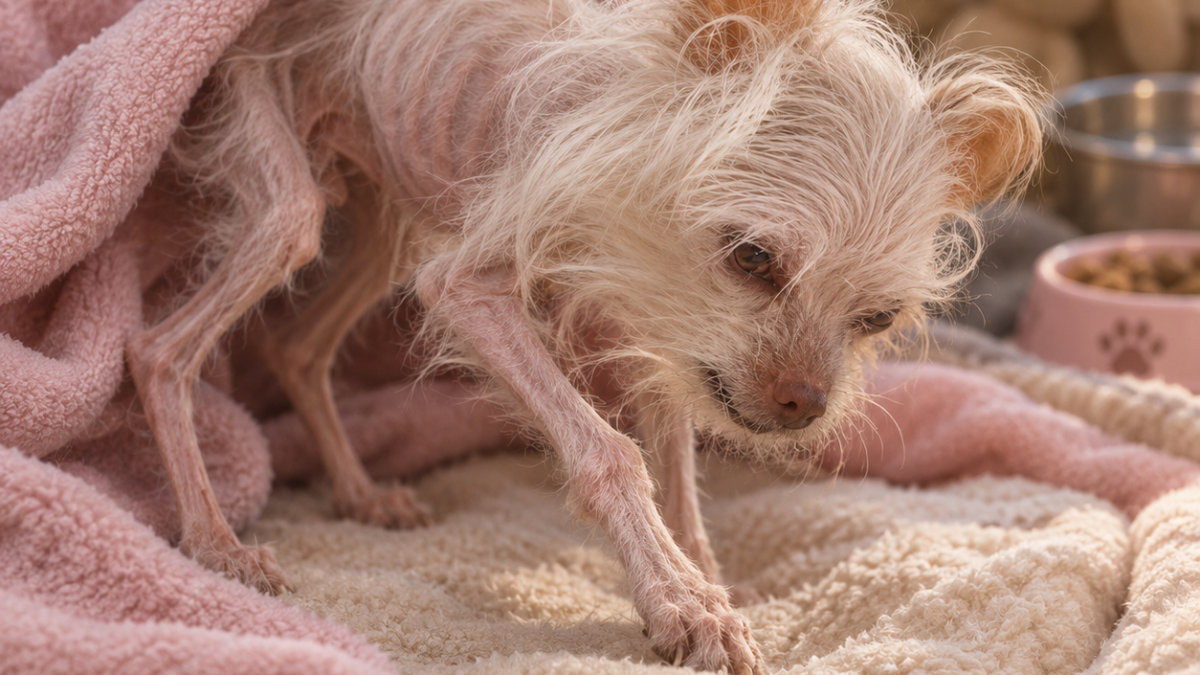
Fairy’s face made her seem older because starvation had hollowed everything.
Dr. Harris ran his fingers gently along her spine.
Fairy’s muscles tightened.
“Pain?”
“Some.”
He moved lower.
Fairy’s back legs twitched.
That tiny movement made me lean forward.
“Did you see that?”
“I did.”
“So she can feel them?”
“I’m checking.”
He pinched gently between two toes.
Fairy’s leg pulled.
“Deep pain response is present.”
My heart jumped.
“That’s good.”
“It’s better than no response.”
That was Dr. Harris.
Never cruel.
Never falsely optimistic.
“Can she walk again?”
“I haven’t even taken X-rays.”
“But maybe?”
“Maybe.”
That word became the beginning of Fairy’s second life.
Maybe.
Maybe she could stand.
Maybe she could rebuild muscle.
Maybe the injury wasn’t as catastrophic as it looked.
Maybe the dog everyone had walked past wasn’t finished.
We took radiographs.
Bloodwork.
Parasite tests.
Nutritional assessment.
Everything.
The results told a complicated story.
Fairy had signs of an old spinal injury, likely involving trauma that had healed imperfectly.
There was no fresh fracture.
No obvious indication that surgery would immediately solve everything.
Her rear legs had severe muscle wasting.
That meant she hadn’t been using them normally for a long time.
Maybe weeks.
Maybe months.
Her front legs had become stronger because she had been compensating.
But the rest of her body had deteriorated from malnutrition.
“What’s the first step?” I asked.
Dr. Harris looked at Fairy.
“Food.”
I almost laughed.
“That’s it?”
“Nutrition. Hydration. Rest. Parasite treatment. Pain control.”
“And physical therapy?”
“Eventually.”
“Why not now?”
“Because she doesn’t have enough fuel to rebuild anything.”
Fairy was lying on the table, watching us.
Dr. Harris continued.
“People see a dog like this and want immediate progress. Standing. Walking. Big milestones.”
He pointed gently toward her ribs.
“Her body is trying to survive.”
I nodded.
“So survival first.”
“Exactly.”
We went home with medications and a feeding schedule.
Small meals.
High quality.
Several times a day.
No sudden overfeeding.
No pushing exercise too hard.
No forcing Fairy into the version of recovery we wanted.
That sounded simple.
It wasn’t.
Fairy had one major disagreement with the treatment plan.
She wanted all the food.
Immediately.
The first evening, she finished her portion and stared at the empty bowl.
“That’s it.”
She stared.
“No.”
Fairy licked the bowl.
“You ate.”
She pushed the bowl with her nose.
“You cannot manipulate me.”
She looked up.
I added one spoonful.
Our first battle.
Fairy won.
But food also frightened her.
I discovered that several days later.
One of our other foster dogs walked past her bowl.
Fairy froze.
Her body went rigid.
Then she threw herself over the food.
Not aggressive.
Protective.
Her eyes widened.
Her breathing quickened.
The other dog wasn’t even interested.
I removed him from the room.
Fairy kept eating.
Fast.
Too fast.
I sat several feet away.
“No one is taking it.”
She didn’t understand.
Not yet.
So meals became private.
Door closed.
Quiet.
Same place.
Same bowl.
Enough food.
Every time.
The point wasn’t only calories.
We were teaching her that breakfast was not a miracle.
It would happen again.
Lunch would come.
Dinner too.
Tomorrow.
The day after.
Security begins when survival stops feeling temporary.
For the first week, Fairy slept constantly.
Eat.
Medication.
Rest.
Bathroom.
Rest.
Tiny exercises.
Rest.
She tired so easily that moving several feet could wipe her out.
To encourage her rear legs, I placed tiny pieces of food on the floor just beyond her reach.
Fairy stared at them.
Then at me.
“You want it?”
Of course she did.
She stretched her neck.
Not enough.
She planted her front paws.
Dragged herself forward.
Her back legs followed awkwardly.
One inch.
Then another.
She reached the food.
Ate it.
Collapsed.
I wanted to cry.
Instead I placed another piece slightly farther away.
“One more?”
Fairy glared.
Then moved.
Those were our first rehabilitation sessions.
No fancy equipment.
No dramatic music.
Chicken on a floor.
A dog too stubborn to quit.
Afterward, she would sleep for an hour.
Sometimes two.
I worried I was doing too much.
Our rehabilitation therapist, Laura, came twice a week.
She watched Fairy move.
“How bad?”
I asked.
Laura smiled.
“You always ask questions that don’t have one answer.”
“I’m talented.”
She gently supported Fairy’s pelvis.
“She has neurological deficits. Muscle loss. Poor balance.”
“So bad.”
“But.”
I looked at her.
“But what?”
“She tries to correct her foot placement.”
I didn’t understand.
Laura repositioned Fairy’s back paw incorrectly.
Fairy slowly tried to move it.
“See?”
“Yes.”
“Her nervous system is still communicating.”
Hope is dangerous when you work in rescue.
It can make you imagine guarantees where there are none.
I forced myself to stay practical.
“What does that mean?”
“It means I have something to work with.”
That was enough.
We started supported standing.
A towel sling beneath Fairy’s abdomen.
My hands under her chest.
Laura aligning her back legs.
“Ready?”
Fairy didn’t know what the word meant.
But she knew food.
Laura held chicken near her nose.
Fairy pushed upward.
Her front legs straightened.
Her rear paws touched the mat.
For half a second, her body rose.
Then collapsed.
“Good.”
I looked at Laura.
“That was half a second.”
“Yesterday she had zero.”
Fair.
We tried again.
One second.
Rest.
Again.
Two seconds.
Fairy panted.
“Done.”
I reached for the chicken.
Fairy snapped it out of my hand.
Laura laughed.
“Motivation intact.”
That first month taught me patience in units so small they felt ridiculous.
Half a pound gained.
A paw placed correctly.
Three seconds standing.
Five.
A tail wag when I entered the room.
Fairy’s personality appeared slowly.
At first, she watched everything.
Doors.
Hands.
Footsteps.
Sudden movements made her flatten herself.
If I reached over her too quickly, she ducked.
If something metal clanged, she shook.
I didn’t know what had happened before she ended up among garbage.
I stopped trying to invent a story.
Animals don’t need us to explain their trauma to respect it.
They need us to respond to what is in front of us.
So I moved slowly.
Spoke before touching.
Let Fairy smell objects.
Gave her choices whenever I could.
Want to sit outside?
Fine.
Want to stay inside?
Fine.
Want affection?
Come closer.
Don’t?
I’ll wait.
The first time Fairy crawled into my lap, I nearly ruined it by reacting.
We were sitting outside.
Sunlight covered part of the patio.
Fairy loved the sun.
She would close her eyes and tilt her face upward.
That afternoon, I sat beside her reading.
Fairy shifted.
Dragged herself closer.
Then closer.
Eventually her head rested on my thigh.
I stopped breathing.
Don’t move.
She sighed.
I rested one hand beside her.
Not on her.
Several minutes passed.
Fairy pushed her nose under my wrist.
Fine.
Permission granted.
I scratched her cheek.
She closed her eyes.
I thought about all the people who had walked past her kennel.
Again, I didn’t blame them.
But they had missed this.
Fairy wasn’t a medical problem.
She was a dog.
Funny.
Stubborn.
Hungry.
Afraid.
Affectionate.
The broken body had been the first thing anyone saw.
But it wasn’t the whole animal.
By week three, her belly had begun filling out.
Her ribs were still visible.
But not every single one.
Her hip bones looked less sharp.
Her face softened.
I took photographs every few days.
At first, I thought nothing was changing.
Then I put the first picture beside the newest one.
“Oh.”
Fairy’s eyes looked different.
Not physically.
Emotionally.
In the first photograph, they tracked every person in the room as though danger could arrive from anywhere.
In the new photograph, she was looking at a treat.
Priorities.
Laura added new exercises.
Supported steps.
Weight shifting.
Gentle massage.
Range-of-motion work.
Fairy hated some of it.
Especially anything involving her rear paws.
She tolerated it because Laura had chicken.
“You’re corrupting her.”
Laura smiled.
“Positive reinforcement.”
“Bribery.”
“Science.”
Fairy agreed with science.
Then we had our first setback.
One morning, Fairy wouldn’t get up.
Not even with food.
My heart dropped.
I checked her temperature.
Normal.
Food?
She sniffed.
Turned away.
That terrified me more than anything else.
Fairy refusing food meant something was wrong.
I called Dr. Harris.
Within an hour, we were at the clinic.
Bloodwork.
Exam.
X-rays.
Nothing catastrophic.
But Fairy had developed gastrointestinal inflammation, likely from a combination of dietary changes, medications, and her fragile condition.
She needed rest.
Modified food.
Different medication.
No rehab for several days.
I sat beside her that night feeling defeated.
“We were doing so well.”
Fairy slept.
I knew recovery wasn’t supposed to be straight.
Knowing doesn’t protect you emotionally.
You still panic when progress stops.
For three days, Fairy barely exercised.
On day four, she ate normally.
Day five, she pushed herself upright again.
I almost applauded.
Laura stopped me.
“Don’t make every movement a performance.”
That annoyed me.
Then I understood.
Fairy didn’t need to live under constant emotional pressure from humans desperately hoping for miracles.
She needed permission to simply exist.
So I stopped celebrating every single attempt out loud.
Internally?
Different story.
Internally, I held a parade.
Fairy returned to therapy.
Her standing improved.
Ten seconds.
Fifteen.
Twenty.
Then one morning, she surprised us.
I was holding the sling.
Laura was in front.
Fairy stood.
Laura moved the treat.
Fairy shifted one rear paw.
Placed it forward.
Then the other.
Not dragging.
A real step.
I stopped breathing.
Laura looked at me sharply.
Don’t react.
Fairy took another.
Her back trembled.
Third.
Then she sat down.
Laura gave her the treat.
“Good girl.”
I turned away.
Cried silently.
Fairy chewed.
Completely unaware that she had just changed the emotional climate of the room.
After that, progress came more visibly.
Not faster.
Visible.
One step became three.
Three became five.
Fairy’s legs strengthened enough that the sling became loose rather than supportive.
Then one afternoon, Laura removed it.
“What are you doing?”
“Seeing something.”
“That sounds dangerous.”
“Relax.”
Fairy stood between us.
No sling.
Her back legs shook.
But held.
Laura backed up.
“Fairy.”
Fairy’s ears lifted.
Chicken.
Of course.
She stepped.
One.
Pause.
Two.
Her hips swayed.
Three.
She stumbled.
Caught herself.
Four.
Reached Laura.
I burst into tears.
Laura laughed.
“Now you can react.”
I knelt.
Fairy turned.
Started toward me.
No sling.
No hands.
Nothing holding her.
Step.
Step.
Step.
She reached my knees.
I picked her up.
“Look at you.”
Fairy licked my face.
I cried harder.
That was the video everyone later loved.
The first independent walk.
People saw thirty seconds.
They didn’t see the weeks of food.
The nights Fairy tried to stand and fell.
The diarrhea.
The medication.
The massage.
The fear.
The tiny pieces of chicken placed exactly six inches apart.
Transformation compresses well on video.
Real recovery doesn’t.
Fairy’s story was mostly repetition.
And love is often repetition.
Again.
Again.
Again.
Until one day, the impossible thing looks ordinary.
At the shelter, they heard Fairy had started walking.
One of the staff members who had cared for her before our rescue asked if she could visit.
Her name was Maria.
She arrived carrying a toy.
When Fairy saw her, she hesitated.
Maria sat down.
“Hey, little girl.”
Fairy’s tail moved.
Maria’s face crumpled.
“She remembers me.”
Maybe.
Fairy walked toward her.
Still awkwardly.
Still with a sway.
But walked.
Maria covered her mouth.
“The last time I saw her, she couldn’t do that.”
Fairy reached her.
Maria hugged her gently.
“I thought nobody would take you.”
The words weren’t cruel.
They were honest.
Fairy licked her chin.
Maria cried.
I looked away.
That was the first time I understood what Fairy’s “revenge” would really be.
Not punishment.
Not finding whoever had failed her.
Not dramatic confrontation.
Walking.
Living.
Becoming impossible to dismiss.
Everyone who had looked at Fairy and seen only a future of suffering had been wrong.
Not maliciously.
But wrong.
Fairy had more chapters.
And she intended to use all of them.
The next milestone was the yard.
Until then, I had carried Fairy outside and placed her in the grass.
She loved sunlight.
Loved smells.
Loved watching the other dogs.
But running?
Impossible.
At least I thought so.
Then one morning, she saw Peanut.
Peanut was a small foster terrier with terrible manners and excellent speed.
He ran past carrying a stuffed duck.
Fairy lifted her head.
Peanut ran back.
Fairy’s front legs moved.
Then the back.
She took several fast steps.
Almost a trot.
“Fairy?”
Peanut passed again.
Fairy followed.
Her back end bounced awkwardly.
But she accelerated.
I stood.
“Fairy!”
She ignored me.
Peanut turned.
Fairy turned too.
Not gracefully.
She nearly fell.
Recovered.
Kept going.
It wasn’t running the way other dogs ran.
Not yet.
But to Fairy, it was flight.
Her mouth opened.
Tongue out.
Eyes bright.
The dog who once couldn’t lift herself was chasing another dog across grass.
Peanut lost the duck.
Fairy reached it.
Grabbed one corner.
Peanut grabbed the other.
Tug.
I started laughing.
Laura was going to kill me for letting her overdo it.
Worth it.
Fairy slept almost four hours afterward.
I sent Laura the video.
Her response:
**YOU LET HER DO WHAT?**
Then:
**Send the longer version.**
Fairy had made another friend.
Trust spread.
At first, she trusted me.
Then Laura.
Then Maria.
Then other dogs.
Visitors.
Children frightened her because they moved unpredictably.
So I never forced interaction.
One neighbor’s daughter, Emma, became our breakthrough.
Eight years old.
Quiet.
She sat on the grass twenty feet from Fairy.
No reaching.
No calling.
Just reading a book.
Fairy watched her.
Next day, Emma returned.
Fifteen feet.
Next week, ten.
One afternoon, Fairy walked over.
Sniffed the book.
Emma stayed still.
Fairy sniffed her hand.
Emma whispered:
“Hi.”
Fairy licked one finger.
That was it.
Friendship.
Later, Emma asked:
“Why was she scared?”
“I don’t know exactly.”
“Did someone hurt her?”
“Maybe.”
“Is she still scared?”
“Sometimes.”
Emma thought.
“But she comes to me.”
“Yes.”
“Then maybe scared doesn’t mean forever.”
I stared at her.
Children sometimes arrive at the truth without all the unnecessary language adults build around it.
“No,” I said. “It doesn’t.”
Fairy eventually reached a healthy weight.
Dr. Harris looked at the scale.
“That’s enough.”
I frowned.
“What?”
“No more trying to put weight on her.”
“But she was starving.”
“Was.”
The word mattered.
Was.
Fairy stared at the treat jar.
Dr. Harris pointed.
“She is now at risk of becoming spoiled.”
“Too late.”
Fairy barked.
We both looked at her.
Her first clear bark in the clinic.
Dr. Harris laughed.
“Definitely too late.”
Her gait never became perfect.
That was important.
Recovery didn’t mean erasing the injury.
Fairy’s back still had a slight curve.
Her rear legs were weaker than her front.
When tired, she dragged one paw slightly.
She could not walk endless distances.
Stairs were difficult.
But she walked.
She played.
She ran in her own crooked, joyful way.
We added rugs for traction.
Low steps.
A ramp to the couch.
Fairy ignored the ramp for two weeks.
Then discovered the couch had blankets.
Suddenly the ramp became acceptable.
She loved sleeping close.
Not on top of me.
Beside.
Shoulder pressed against my leg.
Sometimes I woke and found one paw resting on my ankle.
Checking connection.
At six months in rescue, I started thinking about adoption.
That was the goal.
Foster.
Rehabilitate.
Find home.
I had done it before.
Dozens of times.
Fairy was different.
Not because she needed more.
Because somewhere during the months of helping her stand, my house had become organized around her presence.
The ramp.
The rugs.
The food station.
The sunny bed.
My schedule.
Her therapy exercises.
Peanut had been adopted.
Other fosters came and went.
Fairy stayed.
I told myself I was waiting for the perfect applicant.
Then applications came.
One couple had a quiet house.
Excellent veterinary references.
No stairs.
They met Fairy.
She liked them.
I should have been thrilled.
Instead, I felt physically sick.
After the visit, my friend Rachel looked at me.
“You’re not giving her to them.”
“Why?”
“Because you look like you’re attending a funeral.”
“They’re great.”
“I know.”
“They could give her a wonderful home.”
“I know.”
I crossed my arms.
“This is rescue.”
Rachel stared.
“Is it?”
I hated her.
“What is that supposed to mean?”
“It means Fairy already has a wonderful home.”
I looked toward the living room.
Fairy was asleep in her bed.
“That’s not the point.”
“What is the point?”
“Fostering saves more dogs.”
“Yes.”
“And if I keep every difficult one—”
“You don’t.”
“I could.”
“You haven’t.”
Fairy opened one eye.
Rachel pointed.
“That one kept you.”
Ridiculous.
I went to bed angry.
At two in the morning, Fairy woke and walked toward the bedroom.
No scraping.
No dragging.
Walked.
She reached the edge of the bed.
I lowered my hand.
Fairy pushed her head beneath it.
I remembered the first night.
Push.
Fall.
Try again.
The dog beside me now had crossed a hallway on her own because she wanted to know where I was.
The adoption application remained unanswered until morning.
Then I called the couple.
I explained.
“I think I need to withdraw Fairy.”
The woman was quiet.
Then laughed.
“I wondered.”
“You did?”
“She spent the entire visit looking at you.”
I started crying.
“I’m sorry.”
“Don’t be.”
She paused.
“Do you know what convinced us she was safe?”
“What?”
“The way she slept when you sat beside her.”
That destroyed me.
Fairy became officially mine that week.
The paperwork felt absurdly simple compared with everything that had come before.
Name: Fairy.
Sex: Female.
Status: Adopted.
Adopter: Me.
One signature.
Done.
I carried the paper home.
Fairy tried to eat the corner.
“Respect the law.”
She wagged.
No respect.
The shelter staff sent congratulations.
Maria visited again.
This time Fairy ran—actually ran—toward her.
Maria laughed and dropped to her knees.
“No way.”
Fairy collided gently into her.
Maria hugged her.
“Look at you!”
The words echoed the ones everyone said.
Look at you.
Not poor Fairy.
Not broken Fairy.
Look at you.
That was the comeback.
But life wasn’t finished testing us.
Almost a year after Fairy’s rescue, she suddenly lost strength in one rear leg.
It happened after an ordinary walk.
She came inside.
Ate.
Rested.
Then struggled to rise.
My heart stopped.
“No.”
I knew regression could happen.
Old spinal injuries could create future problems.
But knowing did nothing.
I carried her to the car.
Dr. Harris examined her.
New imaging.
Neurological tests.
Waiting.
Waiting is different when you’ve already seen a miracle.
You become greedy.
You want guarantees that miracles stay.
Dr. Harris returned.
“No new major injury.”
I exhaled.
“Then why?”
“Inflammation. Possibly strain. Her biomechanics are abnormal.”
“Will she walk?”
“Most likely.”
Most likely.
Better than maybe.
We rested.
Medication.
Reduced activity.
Back to supported exercises.
Fairy was furious.
She had discovered freedom.
Now I was restricting it.
She barked at the gate.
“Doctor’s orders.”
Bark.
“You can’t sue.”
Bark.
“Very persuasive.”
Within two weeks, she improved.
Within a month, she was back outside.
But the setback taught me something important.
Fairy’s recovery wasn’t a ladder.
It was a landscape.
Good days.
Bad days.
Plateaus.
Regression.
Adaptation.
There would never be a finish line where I could declare her permanently fixed.
That wasn’t required.
She didn’t need to be fixed.
She needed a life that worked with the body she had.
So we adjusted.
Shorter walks.
More strengthening.
Fewer reckless Peanut-style races.
Fairy disagreed with the last rule.
Years passed.
The garbage photograph became harder to connect with the dog in front of me.
Fairy’s coat grew thick and soft.
Her body became compact and strong.
Her face filled out.
Her eyes remained large.
But now they usually contained demands.
Food.
Walk.
Outside.
Attention.
She learned words.
“Chicken.”
Dangerous word.
“Car.”
Exciting.
“Vet.”
Suspicious.
“Bed.”
Acceptable.
“Bath.”
Betrayal.
Fairy hated water.
The first bath after she became healthy enough was a war crime in her opinion.
She stared at me afterward from inside three towels.
“You smell better.”
Silence.
“You’ll forgive me.”
No.
Dinner solved the diplomatic crisis.
Fairy became part of our rescue’s education events.
Not because I wanted to display her disability.
Because people needed to see what rehabilitation actually looked like.
When someone asked:
“Did she recover completely?”
I answered:
“Define completely.”
Could she walk?
Yes.
Run?
Yes.
Did she still have weakness?
Yes.
Need accommodations?
Sometimes.
Was she happy?
Absolutely.
Complete wasn’t a medical word in Fairy’s life.
It was emotional.
She had enough.
Enough mobility to reach the people she loved.
Enough strength to play.
Enough safety to sleep.
Enough trust to approach strangers.
Enough comfort to enjoy sunlight.
That was complete.
One shelter volunteer who had met Fairy before our rescue attended an event.
She stood near the edge of the crowd.
Afterward, she approached.
“I remember her.”
Fairy sniffed her shoe.
The woman crouched.
“I thought she’d be euthanized.”
The words hurt.
She immediately added:
“I’m sorry.”
“No. It’s okay.”
“I didn’t think anyone would take her.”
“Neither did most people.”
She touched Fairy’s shoulder.
“You proved us wrong.”
I looked at Fairy.
“No.”
Fairy wagged.
“She did.”
That became the line people repeated.
She proved us wrong.
Fairy didn’t know.
Dogs aren’t interested in human predictions.
That may be one of their greatest advantages.
Fairy had never read her prognosis.
Never heard the whispers at the shelter.
Never knew people thought she was too complicated.
She knew hunger.
Then food.
Fear.
Then safety.
Weakness.
Then movement.
Alone.
Then not alone.
The rest was human noise.
At three years after rescue, Fairy did something I never expected.
She completed a charity walk.
Not the full distance.
We had permission to join for a shorter accessible section.
Half a mile.
For Fairy, it was enormous.
I brought a stroller in case she tired.
She hated the stroller.
At the starting area, people noticed her uneven gait.
Some smiled.
A few recognized her story.
Fairy ignored everyone.
She wanted smells.
We started.
Slow pace.
Fairy walked.
Her back legs swayed.
Quarter mile.
I checked.
“Want the stroller?”
Fairy kept going.
Another hundred yards.
Rest.
Water.
Continue.
Near the end, a group of children began cheering.
“Fairy!”
I started crying.
Fairy assumed cheering meant food.
Increased speed.
Of course.
She crossed the small finish marker.
Then immediately attempted to steal someone’s snack.
Heroic.
We raised enough money that day to help cover rehabilitation care for three other dogs.
That mattered more than the walk.
Fairy’s recovery had become resources for another animal.
One was a young dog with a fractured pelvis.
Another had neurological weakness.
The third was elderly and needed hydrotherapy.
I met their fosters.
Every one asked the same question.
“How did you know Fairy would recover?”
“I didn’t.”
That answer disappointed some people.
They wanted certainty.
There wasn’t any.
“I knew she deserved the chance to show us.”
That’s different.
Rescue isn’t betting only on guaranteed winners.
Sometimes the ethical choice is treatment even when the ending isn’t known.
As long as suffering can be managed and quality of life remains possible, uncertainty doesn’t automatically mean stop.
Fairy had taught me that.
Then, four years after I found her, we received a message from someone claiming to recognize her.
I almost ignored it.
We had received similar messages before.
People see common markings.
Imagine connections.
But this person sent a photograph.
A small cream dog.
Thin, but healthier than Fairy had been.
Same white patch across the chest.
Same dark spot near one ear.
My stomach tightened.
The message said:
**I think this dog used to live behind our old apartment building.**
I replied carefully.
**Where?**
The address was several miles from where Fairy had originally been found.
Possible.
The woman explained.
A family had owned several dogs.
One small female often stayed outside.
Then the family moved.
The dog disappeared around the same time.
“Did they take her?” I asked over the phone.
“I assumed so.”
“Why do you think Fairy is that dog?”
“Her back.”
My chest tightened.
“What about it?”
“She got hurt.”
“How?”
“I don’t know.”
The woman remembered seeing the dog dragging her rear legs weeks before the family moved.
She had asked the owner.
He said the dog had fallen.
“Did they take her to a vet?”
“I don’t know.”
I contacted animal control.
Not because I wanted revenge.
Because if Fairy had been owned, the history mattered.
Microchip?
None.
Records?
We searched.
Eventually, an old low-cost vaccination record surfaced.
The photograph attached to the record looked very much like Fairy.
Same markings.
Same approximate age.
The registered owner was a man named Raymond Cole.
Investigators contacted him.
He admitted owning a dog similar to Fairy.
He claimed she had run away.
“When?” I asked the officer later.
“Approximately six weeks before she was found.”
“Did he report her missing?”
“No.”
“Search?”
“He says yes.”
“Any proof?”
“No.”
The old neighbor gave a statement.
She remembered Fairy’s back injury.
Remembered the dog being left outside.
Remembered the family moving.
No one had seen them actively abandon her.
No camera.
No direct evidence.
The truth might remain incomplete forever.
That frustrated me.
I wanted a clean story.
Someone responsible.
A consequence.
Fairy deserved an explanation.
But Fairy didn’t need one.
She was asleep on my couch when the officer called with the final update.
“There’s insufficient evidence for a cruelty charge tied directly to the spinal injury.”
I closed my eyes.
“What about abandonment?”
“Also difficult to prove.”
“So nothing?”
“We can document the history. But no, not the kind of case you’re hoping for.”
I looked at Fairy.
Her paws twitched in sleep.
Years earlier, that answer would have enraged me.
Now?
It still hurt.
But less.
The officer said:
“I’m sorry.”
I sighed.
“She doesn’t know.”
“What?”
“Fairy.”
I smiled sadly.
“She doesn’t know we failed to solve the mystery.”
“Maybe that’s okay.”
It was.
Humans are obsessed with explaining pain.
Animals are more interested in whether pain is happening now.
Fairy woke.
Looked at me.
Tail wag.
I put down the phone.
“Walk?”
Fairy exploded off the couch.
That was her verdict.
The former owner later contacted the rescue himself.
He wanted to know whether Fairy was “really his old dog.”
I didn’t want to speak to him.
Eventually, I agreed to one phone conversation with the rescue coordinator present.
“She looks like her,” he said after seeing updated photos.
I stayed quiet.
“I didn’t dump her.”
“No one said you did.”
“People online will think I did.”
“We haven’t named you.”
He exhaled.
“She ran away.”
“After the back injury?”
Silence.
“It wasn’t that bad.”
I felt my anger rise.
“She couldn’t walk when she was found.”
“That was later.”
“Maybe.”
“It wasn’t my fault.”
Maybe true.
Maybe not.
I had no evidence.
So I didn’t accuse.
Instead I asked:
“Why didn’t she see a veterinarian when she first had trouble walking?”
He hesitated.
“Money.”
I had heard that answer before in rescue.
Sometimes it was genuine desperation.
Sometimes an excuse.
“Did you contact a rescue?”
“No.”
“Shelter?”
“No.”
“Low-cost clinic?”
“No.”
“I thought she’d get better.”
Fairy had.
Eventually.
Because other people intervened.
He asked:
“Can I see her?”
I looked toward the living room.
Fairy was asleep in sunlight.
“No.”
He became defensive.
“She’s my dog.”
The rescue coordinator stepped in.
“She was legally transferred through the shelter system years ago after the required stray process. She has an adoptive owner.”
Silence.
“Me,” I said.
He exhaled.
“You kept her?”
“Yes.”
“She walks?”
I looked at Fairy.
“She runs.”
That quieted him.
For several seconds, neither of us spoke.
Then he said:
“I didn’t think she would.”
There it was.
The sentence.
I didn’t know whether he meant it cruelly.
Probably not.
But it landed like a verdict.
I didn’t think she would.
I smiled.
“Neither did a lot of people.”
He asked for a photograph.
I hesitated.
Then sent one.
Fairy running in the yard.
Mouth open.
Ears back.
Legs uneven but moving.
He replied only:
**Wow.**
That was the closest thing to revenge I ever needed.
Not because I wanted him to suffer.
Because Fairy existed in a form he hadn’t imagined.
Everyone who had reduced her to weakness had to update their picture.
She was not the dog beside garbage anymore.
Not the shelter case nobody selected.
Not the broken back.
Not the useless legs.
Fairy was movement.
Years passed.
Fairy turned seven.
Then eight.
The old spinal injury created arthritis earlier than we wanted.
We adapted.
Pain management.
Supplements.
Rehab check-ins.
A warm orthopedic bed.
More ramps.
Fairy learned that age could be negotiated.
She still ran.
Short bursts.
Especially for food.
One morning, I opened the treat cabinet.
Fairy appeared from another room at impossible speed.
I stared.
“Interesting.”
She wagged.
“You limp when we’re walking.”
Nothing.
“But chicken cures you?”
Tail faster.
Medical miracle.
At nine, Fairy started swimming therapy.
She initially hated water.
Still.
Laura, now gray-haired but just as patient, placed Fairy in the warm therapy pool wearing a flotation vest.
Fairy looked betrayed.
“I remember you,” Laura said.
Fairy paddled.
“Still dramatic.”
Fairy tried to climb out.
Eventually, she learned that swimming reduced pressure on her spine.
Her legs strengthened.
She still hated the vest.
One session, Emma—the little girl who had once gained Fairy’s trust—visited.
Except Emma wasn’t eight anymore.
She was seventeen.
Fairy recognized her.
Tail wag.
Emma knelt.
“Hi, old lady.”
Fairy pushed her face into Emma’s chest.
Emma cried.
“So she remembers.”
I smiled.
“Maybe.”
Emma stroked Fairy’s back.
“Scared doesn’t mean forever.”
I looked at her.
“You remember that?”
“I remember everything about her.”
Fairy’s life had expanded beyond me.
That’s another thing rescue does.
One animal creates connections.
Veterinarians.
Volunteers.
Neighbors.
Children.
People who otherwise would never know one another.
A dog found in garbage became a thread running through dozens of lives.
At ten, Fairy developed a benign growth.
Surgery removed it.
The recovery frustrated her.
Restricted movement again.
Fairy barked at the exercise pen.
“You’ve survived this before.”
Bark.
“You’re not negotiating.”
Bark.
“No.”
She won extra chicken.
Technically negotiation.
At eleven, her eyesight began declining slightly.
Nothing dramatic.
She compensated.
At night, we used small lights.
Kept furniture in predictable places.
Fairy knew the house better than I did.
At twelve, her hearing became selective.
I say selective because she could not hear:
“Fairy, come inside.”
But somehow could hear a cheese wrapper from three rooms away.
Science remained mysterious.
She became softer with age.
As a young dog, Fairy liked affection but often maintained some space.
As an older dog, she wanted contact.
Bed beside my chair.
Head on my foot.
Body against my leg.
Sometimes I wondered whether age removed whatever last pieces of fear she’d been carrying.
Or maybe she had simply spent enough years safe to become demanding.
I preferred the second explanation.
The shelter where Fairy had once waited invited us to an anniversary event.
I almost declined.
Then Maria called.
“Please come.”
So we did.
The building had been renovated.
New kennels.
Better enrichment.
More foster partnerships.
Fairy entered slowly.
Her back legs stiff.
But she walked.
Several older staff members remembered.
One woman gasped.
“Fairy?”
Tail wag.
People gathered.
I hated the attention at first.
Then I saw their faces.
Not pity.
Joy.
One young volunteer asked:
“Is this the dog who couldn’t stand?”
Maria smiled.
“Yes.”
The volunteer knelt.
Fairy approached.
“How?”
She looked at me.
I looked at Fairy.
“Food.”
Everyone laughed.
“Therapy. Time. A lot of people. And mostly because she kept trying.”
Maria shook her head.
“Nobody picked her.”
The room went quiet.
She touched Fairy’s head.
“Everyone wanted an easier dog.”
Fairy licked her.
Maria laughed through tears.
“She got the last laugh.”
Exactly.
Fairy’s revenge was not anger.
It was showing up.
Years after people walked past her kennel, she walked back through the shelter door on her own legs.
That’s the kind of ending no court could improve.
The shelter later created a special foster program for medically fragile dogs.
They used Fairy’s photograph on the first training slide.
Not the garbage photo.
The running photo.
Underneath:
**Don’t predict an animal’s whole future from one terrible day.**
I cried when I saw it.
Fairy’s life had changed shelter policy more than any accusation ever could.
Volunteers received training on mobility cases.
Foster homes were recruited specifically for neurological and orthopedic dogs.
Equipment was purchased.
Slings.
Ramps.
Rehabilitation supplies.
Dogs who might previously have seemed “too much” had somewhere to go.
Fairy had no idea.
She was sleeping during the presentation.
Appropriate.
At thirteen, Dr. Harris retired.
For his final week, I brought Fairy.
She walked slowly into the exam room.
Dr. Harris sat on the floor.
“Well, look who outlasted my career.”
Fairy sniffed him.
Then demanded treats.
He gave one.
“Remember what you told me?” I asked.
“What?”
“Maybe.”
He smiled.
“Good word.”
“You said maybe she’d walk.”
“And she did.”
Fairy ate another treat.
Dr. Harris ran his hands gently along her spine.
“She’s old.”
“Don’t.”
“That’s medicine.”
“I reject medicine.”
He laughed.
“Her body has worked very hard for a long time.”
That sentence made me emotional.
Worked hard.
Yes.
Every step Fairy took had required more calculation than a healthy dog’s.
Muscles compensating.
Nerves adapting.
Balance correcting.
Thousands of ordinary movements that her body had to earn.
“How much longer?”
Dr. Harris looked at me.
“Don’t do that.”
“You always hate my questions.”
“Because you’re asking me to predict life again.”
Fair.
He touched Fairy’s head.
“She’s comfortable now.”
“Yes.”
“Then today is good.”
That became our philosophy.
Today is good.
At fourteen, Fairy’s back legs weakened significantly.
Not suddenly.
Gradually.
Walks became shorter.
Running stopped.
I mourned it more than she did.
She still wanted outside.
So I bought a stroller.
Young Fairy would have considered it an insult.
Old Fairy loved it.
She sat upright.
Nose in the wind.
Queen.
People smiled.
Sometimes they’d ask:
“Can’t she walk?”
“She can.”
“Then why the stroller?”
“Because she gets tired.”
Simple.
Mobility aid wasn’t defeat.
Fairy had taught me that too.
She walked when she wanted.
Rode when she needed.
At the park, I would lift her out near the grass.
She would sniff.
Walk fifty feet.
Stop.
Look at me.
Stroller.
Deal.
One afternoon, a little boy asked if Fairy was “broken.”
His mother looked horrified.
I crouched.
“No.”
The boy pointed to her back legs.
“They don’t work right.”
“Right.”
“So broken.”
I thought about it.
“Do you have anything that doesn’t work perfectly?”
He considered.
“My tooth fell out.”
His mother laughed.
“Are you broken?”
“No.”
“Fairy isn’t either.”
He accepted this immediately.
Adults could learn.
At fifteen, Fairy developed kidney disease.
Early.
Manageable.
Diet.
Medication.
Blood tests.
I had been through aging pets before.
Still hurt.
Fairy hated the new food.
I negotiated with approved toppers.
She studied me like a hostage negotiator.
A little chicken.
Kidney diet.
Deal.
She ate.
At sixteen, mornings became difficult.
Her body stiff.
I warmed her bed.
Massaged her legs.
Helped her stand.
The strange symmetry wasn’t lost on me.
Our relationship began with me helping her rise.
Now, years later, I did it again.
But everything around the act had changed.
Back then:
Fear.
Unknown future.
Bones.
Garbage.
Now:
Gray muzzle.
Full belly.
Home.
Sixteen years of memories.
Same hands under her body.
Different life.
Fairy still greeted me.
Sometimes she couldn’t stand quickly enough.
So her tail did the work.
Thump.
Thump.
I would kneel.
“Don’t get up.”
Tail faster.
“Stay.”
Fairy tried anyway.
Of course.
Still trying.
Always.
One winter, Emma returned from college.
Fairy was almost completely deaf by then.
Emma entered quietly.
Fairy didn’t notice.
Emma knelt.
Touched the floor gently.
Fairy turned.
Saw her.
Then her whole face changed.
She pushed herself upright.
Walked three uneven steps.
Emma started crying.
“She knows me.”
Fairy pressed against her.
Emma held her.
I thought of the eight-year-old girl sitting ten feet away with a book.
All that time.
Trust accumulates.
Fairy had become a calendar.
You could measure people’s lives by when they met her.
Children became adults.
Volunteers retired.
Dogs she knew came and went.
Fairy stayed.
Until she couldn’t.
Her final decline began quietly.
Less appetite.
Longer sleep.
One morning, she did not want to stand.
I offered chicken.
She ate.
So not emergency.
Not yet.
A week later, she stopped finishing chicken.
That was emergency.
Bloodwork showed worsening kidney function.
Her body was failing in several small ways at once.
The veterinarian—Dr. Harris’s former associate—explained options.
Fluids.
Medication adjustments.
Support.
We tried.
Fairy rallied.
Three good weeks.
Sunlight.
Food.
Short walks.
One afternoon, she even barked at a delivery driver.
I laughed.
“Still protecting the kingdom.”
Fairy wagged.
Then the bad days returned.
More than the good.
She struggled to settle.
Panting.
Weakness.
Confusion at night.
I slept beside her.
Just like the beginning.
Full circle again.
At two in the morning, Fairy pushed herself up.
Her legs failed.
I caught her.
“No.”
She tried again.
I held her.
“You don’t have to do that anymore.”
Fairy looked at me.
I cried.
All her life, trying had saved her.
Trying to stand.
Trying to eat.
Trying to walk.
Trying to trust.
But there comes a point when love has to tell someone:
You can stop.
The next morning, I called the veterinarian.
Not for an appointment.
For the conversation.
Quality of life.
Pain.
Comfort.
Good days.
Bad days.
The questions every animal guardian hates.
Fairy ate half her breakfast.
Enjoyed ten minutes in sunlight.
Then slept.
I looked at the calendar.
Seventeen years since rescue, give or take.
No one had known her exact age.
Seventeen years of maybe.
Maybe she’d survive.
Maybe she’d walk.
Maybe she’d trust.
Maybe she’d get adopted.
Maybe she’d have a life.
She had turned every maybe into enough.
The veterinarian came to the house two days later.
I invited Maria.
Laura.
Emma.
Not everyone could come.
Rachel did.
Fairy lay on her favorite bed near the patio doors.
Sunlight touched her face.
Perfect.
She had always loved sun.
I fed her small pieces of chicken.
The kidney diet rules no longer mattered.
Fairy ate three.
Refused the fourth.
“Okay.”
I put it down.
Laura sat beside her.
“Remember when you made me chase you?”
Fairy didn’t hear.
Laura stroked her.
“You were impossible.”
Maria cried openly.
“I still remember that kennel.”
Emma held Fairy’s front paw.
Rachel stayed behind me.
The veterinarian explained.
I nodded.
Fairy breathed slowly.
I touched her back.
The same curve.
Older now.
Bones beneath muscle that had once been nonexistent.
Scars hidden under fur.
A whole history beneath my hand.
“I’m sorry nobody picked you.”
My voice broke.
Fairy’s eyes opened.
“No.”
I laughed through tears.
“That’s not right.”
I kissed her forehead.
“I’m glad nobody did.”
Maria laughed softly.
“Because then I got you.”
Fairy’s tail moved.
One weak thump.
Everyone in the room cried harder.
The sedative relaxed her.
Her body softened.
For the first time since the beginning, Fairy’s legs carried no tension.
No effort.
She didn’t need to hold herself up.
I placed my hand beneath her chest.
The same way I had during that first meal.
“Remember?”
Of course she didn’t.
Or maybe dogs remember in ways we don’t understand.
“You couldn’t eat without help.”
She breathed.
“Then you started walking.”
Another breath.
“Then running.”
Her eyes closed.
“Then you stayed.”
The veterinarian waited.
No hurry.
That mattered.
Fairy had spent too much of life fighting clocks she didn’t understand.
Now time belonged to her.
I whispered:
“You proved everyone wrong.”
Then corrected myself.
“No.”
My forehead touched hers.
“You didn’t owe us proof.”
That was the truth.
Fairy never had to become a miracle to deserve rescue.
She deserved help when she couldn’t stand.
Before the comeback.
Before the running.
Before the happy ending.
Her value was never dependent on recovery.
The final medication went in.
I kept my hand on her chest.
Breathing.
Slow.
Slower.
Then still.
The room remained silent.
The veterinarian listened.
Looked at me.
“She’s gone.”
I knew.
Still, I said:
“No.”
One word.
Instinct.
Then I broke.
Seventeen years earlier, Fairy had been lying among garbage and couldn’t lift herself.
People had walked past her shelter kennel because her future looked frightening.
Now the room was full of people grieving because she had filled their lives for nearly two decades.
That contrast was almost unbearable.
Maria kissed Fairy’s head.
“They were wrong.”
I knew what she meant.
Everyone who thought Fairy had no future.
Wrong.
But again, Fairy’s value wasn’t the fact that she exceeded expectations.
Still, there was satisfaction in the life she built after being underestimated.
The most beautiful kind of revenge.
Time.
After Fairy died, I couldn’t move her ramp.
It stayed beside the couch.
Weeks.
Her bed too.
The food bowl disappeared first because seeing it empty hurt.
The ramp stayed.
One afternoon, the rescue called.
A small dog with a neurological injury had arrived.
Couldn’t manage stairs.
They needed equipment.
“Do you still have Fairy’s old ramp?”
I stared at it.
“Yes.”
“Could we borrow it?”
My first thought:
No.
Fairy’s.
Then I laughed at myself.
Fairy didn’t need ramps anymore.
Another dog did.
I brought it to the rescue.
The dog was named Bean.
Tiny.
Terrified.
Rear legs weak.
The sight hit me hard.
Not exactly Fairy.
Enough.
Bean wouldn’t use the ramp.
Of course.
I sat several feet away.
Put one tiny piece of chicken near the bottom.
Another farther up.
The foster looked at me.
“Does this work?”
I smiled.
“Eventually.”
Bean sniffed.
One paw on the ramp.
Chicken.
Next paw.
Chicken.
I cried quietly.
Again.
Again.
Again.
Fairy’s ramp became Bean’s.
Then another dog’s.
The rescue established a rehabilitation fund in Fairy’s name.
I resisted at first.
“Don’t make it sentimental.”
Rachel laughed.
“You created an entire rescue philosophy because of this dog.”
“I did not.”
“You absolutely did.”
They called it **Fairy’s Second Step Fund.**
It helped cover physical therapy, mobility aids, diagnostic imaging, and foster supplies for dogs with neurological or orthopedic conditions.
The first year, eleven animals received help.
The second, twenty-three.
Not every dog walked.
Important.
One remained permanently paralyzed and thrived in a wheelchair.
One regained partial function.
Another eventually walked normally.
One elderly dog simply became comfortable enough to enjoy his last six months.
Success looked different for each.
That was Fairy’s final lesson.
Recovery isn’t only walking.
Sometimes success is pain control.
Trust.
Comfort.
A wheelchair.
A warm bed.
One more good afternoon.
The shelter added Fairy’s story to volunteer training.
The line beneath her photograph remained:
**Don’t predict an animal’s whole future from one terrible day.**
Years later, I visited.
New staff.
Different dogs.
Fairy’s photo still there.
A volunteer pointed.
“You knew her?”
I smiled.
“Yeah.”
“Was she really found in garbage?”
“Yes.”
“And she ran later?”
“Yes.”
“That’s amazing.”
I looked at the photograph.
Fairy running in grass.
Mouth open.
Sunlight.
“She was.”
The volunteer said:
“I wish I could’ve met her.”
I touched the edge of the frame.
“She would’ve asked if you had chicken.”
That was enough.
Sometimes people still ask about the former owner.
Whether he was punished.
Whether we ever learned exactly how Fairy was injured.
No.
Not completely.
There was no cinematic arrest.
No dramatic confession.
No perfect justice.
For a long time, that bothered me.
Then Fairy grew older.
The unknown person became smaller.
Fairy’s life became larger.
Eventually, the unanswered questions occupied almost no room at all.
That was another kind of revenge.
Whoever failed Fairy became irrelevant.
Fairy became unforgettable.
Someone may have left her behind.
But hundreds of people later knew her name.
Someone may have thought her injury made her worthless.
Her story later funded therapy for other injured animals.
People once walked past her kennel.
Years later, volunteers studied her photograph before caring for dogs just like her.
No punishment could have been more satisfying than seeing the thing once dismissed become the reason others were saved.
But my favorite memory has nothing to do with the shelter.
Or the fund.
Or the former owner.
It’s one ordinary morning.
Fairy was maybe six.
I opened the back door.
She ran outside.
Not perfectly.
Never perfectly.
Her back legs bounced slightly.
One paw dragged for half a second.
She corrected.
Kept going.
A bird landed near the fence.
Fairy saw it.
Accelerated.
The bird flew.
Fairy stopped.
Looked upward.
Then turned toward me.
I called:
“Fairy!”
She ran back.
Straight toward me.
That was the miracle.
Not simply that she could run.
That she had someone to run toward.
The first Fairy I knew had spent all her strength trying to push herself up while surrounded by garbage.
No one knew where she belonged.
No one knew whether anyone was waiting.
The old Fairy knew exactly where home was.
She could leave the yard.
She didn’t.
She came back.
Every time.
People love transformation pictures.
Before.
After.
But Fairy’s transformation was never really her body.
The deepest change was invisible.
At first, she watched every hand.
Every door.
Every person.
Later, she slept while I left the room.
That’s trust.
At first, every bowl of food looked like it might be the last.
Later, she walked away with food still in it.
That’s security.
At first, she pushed herself up because lying down outside might have meant dying.
Later, she stayed in bed because she knew someone would help if she needed it.
That’s home.
At first, nobody chose her.
Eventually, she became the center of an entire circle of people who would have chosen her a thousand times.
That’s love.
I keep Fairy’s first photograph in a folder.
Not framed.
I rarely look at it.
Skin and bones.
Garbage.
Eyes too large.
The photograph on my wall is different.
Fairy is running.
Emma is in the background.
Laura is laughing.
I’m kneeling with my arms open.
Fairy is coming toward me.
Her legs aren’t straight.
Her body isn’t symmetrical.
The image is slightly blurry.
Perfect.
Because Fairy was moving too fast.
That’s how I want to remember her.
Not as the dog who couldn’t stand.
As the dog who couldn’t wait to reach us.
Fairy began her story surrounded by things people had decided they no longer wanted.
Trash bags.
Broken boxes.
Discarded objects.
For a while, she was treated as though she belonged among them.
Then someone stopped.
A shelter gave her a kennel.
A rescue gave her another chance.
A veterinarian gave us a maybe.
Food gave her strength.
Therapy gave her tools.
Time gave her muscle.
People gave her safety.
Fairy did the rest.
The dog nobody chose became the dog nobody could forget.
The dog who couldn’t stand learned to walk.
Then run.
Then grow old.
And when her legs finally stopped carrying her after all those years, she didn’t fall beside garbage.
She rested on a soft bed in sunlight.
Surrounded by the people she had spent a lifetime learning to trust.
I was still beside her.
Exactly where I had promised to be.
Fairy never needed revenge.
But if she had, I think she got it.
Every step.
Every meal.
Every nap in the sun.
Every person who learned not to judge the next broken dog too quickly.
Every animal helped by the fund carrying her name.
And every time she ran toward me with that crooked little body moving as fast as it could.
That was her answer to everyone who looked at her and saw an ending.
They were wrong.
Fairy was only getting started.








