My Granddaughter Found My Missing Dog in a Bakery Photo 7 Years Later—Then One Whistle Exposed the Lie My Ex-Husband Had Told Me
# **My Granddaughter Found My Missing Dog in a Bakery Photo 7 Years Later—Then One Whistle Exposed the Lie My Ex-Husband Had Told Me**
My ten-year-old granddaughter had only wanted to show me a photograph from a local bakery, but the moment I saw the old honey-colored dog sitting beside an elderly woman at the Saturday market, I recognized the torn edge of his left ear, the white patch on his chest, and the face I had spent seven years trying to force myself to forget.
My ex-husband had sworn Paco disappeared during the July 14 fireworks while I was visiting my sick mother, and for years I had lived with the guilt of imagining him terrified somewhere in the dark, never knowing that twenty kilometers away another woman had been calling him Filou, feeding him breakfast, walking him to the market, and loving him as her own.
But when I finally stood in front of that gray-muzzled dog and used the three-note whistle I had taught him as a puppy, the red leash suddenly snapped tight in Madeleine’s hands—and in that instant I understood that finding Paco again was not going to give me back the life I had lost, because first I would have to learn what really happened the night he supposedly ran away.
My name is Jeanne, and for seven years I kept a faded blue leash in the back of a drawer.
Not because I honestly believed Paco would return.
I simply could never throw it away.
In July 2019, Paco was almost three, a honey-colored Labrador mix with one damaged ear from an enthusiastic collision with a hedge while chasing a ball.
He knew every part of my routine.
Saturday morning meant market.
The moment I picked up my shopping bag, Paco planted himself at the front door.
When we passed the bakery, he always sat outside as though he had a scheduled appointment.
I had raised him from a puppy.
He had been beside me through good days, but more importantly, through the years when my marriage to Marc was slowly becoming something neither of us knew how to repair.
We argued about money.
The house.
My mother.
My work.
And Paco.
Especially Paco.
“You care more about that dog than you do about me,” Marc sometimes said.
I thought he was joking.
I stopped laughing when he repeated it.
The weekend of July 14, 2019, I drove to Vichy because my mother had been hospitalized.
I was gone two days.
When I returned, Paco was gone.
Marc told me fireworks had frightened him.
“He pushed through the gate and ran,” he said. “I chased him, Jeanne. I couldn’t catch him.”
I searched until my legs hurt.
Shelters.
Veterinarians.
Roads.
Facebook groups.
Posters in shop windows.
Someone called about a honey-colored dog near a highway.
I drove there immediately.
Wrong dog.
Marc stopped helping after several days.
“You have to accept it,” he told me. “Dogs disappear.”
Our marriage ended that autumn.
I moved.
Years passed.
But every July 14, the first explosions in the sky brought Paco back into my mind.
Was he frightened?
Had someone found him?
Had he died waiting for me somewhere?
Then, in October 2026, my granddaughter Léa walked into my kitchen holding her phone.
“Grandma, why is Paco called Filou in this picture?”
I thought she was confused.
Then I looked.
An elderly woman stood beside a bakery stall.
At her feet sat an old dog.
Gray muzzle.
Honey coat.
Left ear torn exactly where Paco’s had been torn.
White patch on the chest.
I stopped breathing.
The caption read:
**Our faithful Filou has accompanied Madeleine to the market for almost seven years.**
Almost seven years.
My hands began shaking.
The bakery was only about twenty kilometers from my home.
I sent a message.
The owner answered later:
**I’ll contact Madeleine, but I should warn you: she loves this dog very much.**
The next morning, an older woman called.
“You’re the lady who says she knows Filou?”
“Yes.”
“He was called Paco.”
Silence.
Then her voice hardened.
“I adopted him from a shelter. I stole nothing.”
“I’m not accusing you.”
My throat tightened.
“I only want to see him.”
We met Saturday at the market.
I arrived almost an hour early.
At nine, I saw Madeleine approaching in a beige coat, holding a red leash.
Paco walked beside her.
Older.
Slower.
But Paco.
I showed her photographs.
She studied them carefully.
“It looks like him.”
“Look at the ear.”
She did.
“The chest.”
Madeleine swallowed.
She crouched.
“Filou, look at the lady.”
He turned toward me.
I whispered:
“Paco?”
He stared for several seconds.
Then looked away.
It felt as though I had lost him all over again.
Seven years.
Maybe I had become nothing but an old smell in a forgotten room.
Then I remembered our whistle.
Two short notes.
One long.
I crouched on the market stones.
Raised two fingers to my lips.
And whistled.
Paco froze.
His head lifted.
His body went rigid.
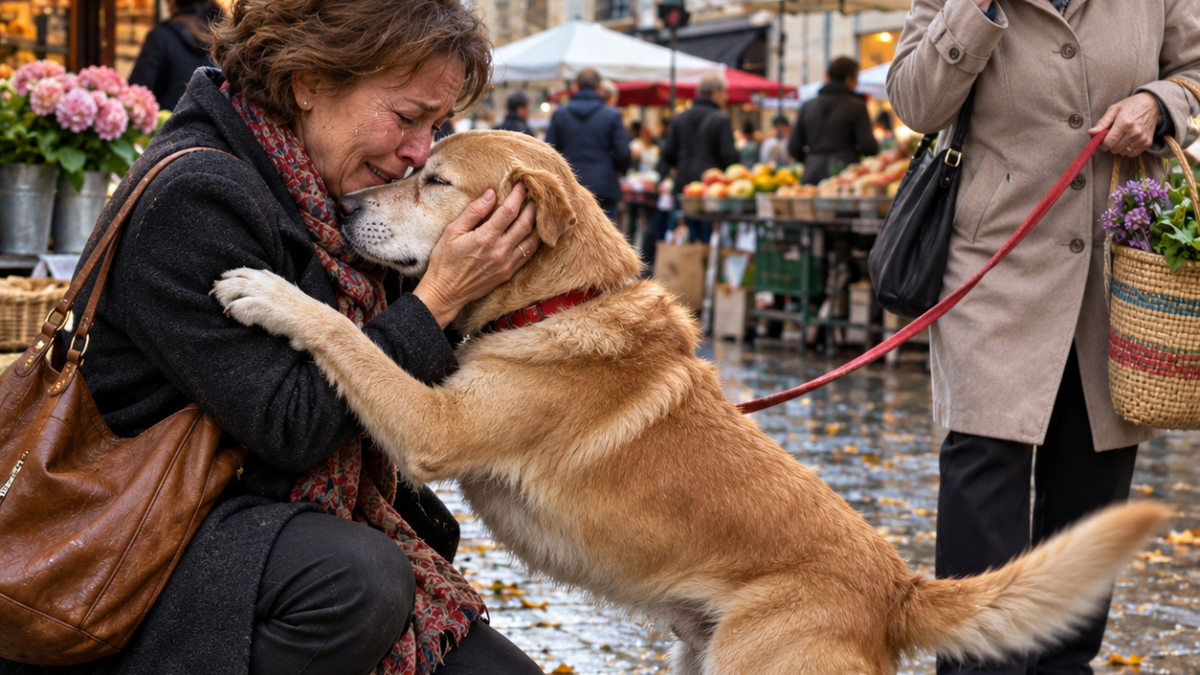
Then the red leash snapped tight in Madeleine’s hands.
—
## **[END OF FACEBOOK OPENING — CONTINUE STORY BELOW]**
For one second, nobody moved.
Not me.
Not Madeleine.
Not even Paco.
The market continued around us as though nothing extraordinary had happened.
Someone laughed near a vegetable stand.
A vendor called out the price of apples.
A child dragged his mother toward a table of pastries.
And in the middle of all that ordinary noise, a dog who had lived almost seven years under another name stared directly at me.
“Paco.”
I barely breathed the word.
His ears moved.
I whistled again.
Two short notes.
One long.
The leash pulled so hard Madeleine had to take a step forward.
“Filou?”
He ignored her.
For the first time since I had arrived, his entire attention belonged to me.
Then he ran.
Madeleine let go before the collar could choke him.
Paco crossed the few yards between us and hit me so hard I nearly fell backward.
I dropped to my knees.
“Paco.”
He made a sound I had never forgotten.
A high, breathless whine he used to make whenever I came home after being gone too long.
His nose went everywhere.
My hands.
My coat.
My face.
My hair.
He pushed his head beneath my chin exactly the way he had done when he was young.
I wrapped both arms around him.
Seven years disappeared.
For a few seconds, I was back in my old kitchen.
My mother was still alive.
My marriage had not yet ended.
Paco was three.
His leash hung beside the door.
Nothing had been broken yet.
Then I heard Madeleine crying.
That brought me back.
I looked over Paco’s shoulder.
She stood exactly where he had left her.
The red leash hung from one hand.
Her face had gone pale.
I understood immediately.
My reunion was her nightmare.
Paco heard her sniff.
He turned.
For a second, I felt something selfish rise inside me.
No.
Stay.
Please stay with me.
Then Madeleine whispered:
“Filou.”
Paco walked back to her.
Not running.
Not frantic.
He placed his head against her thigh.
She touched his ear.
I sat on the pavement and felt my heart split into two completely incompatible emotions.
He remembered me.
And he loved her.
Both were true.
Léa had come with me that morning, along with my daughter Sophie, who was waiting a few feet away because I had asked them to give Madeleine and me space.
My granddaughter approached slowly.
“Grandma?”
“I’m okay.”
I wasn’t.
Paco noticed her.
He sniffed.
Léa crouched.
“You’re really Paco.”
Sophie stood behind her, crying quietly.
She had been sixteen when Paco disappeared.
He had slept outside her bedroom whenever she was sick.
She whispered his name.
Paco turned.
Something seemed to register.
He approached.
Sniffed.
His tail moved.
Sophie covered her mouth.
“Oh my God.”
She knelt.
“Hi, buddy.”
Paco licked her wrist.
That was all it took.
My daughter broke.
“I thought you were dead.”
Madeleine looked from Sophie to me.
Then at the photographs still clutched in my hand.
Any doubt she had was disappearing.
She sat on a bench near the bakery stall.
“I think we need to talk.”
We did.
Not there in the middle of the market.
The bakery owner, Marion, recognized Madeleine and led us to a small table inside after the morning rush.
Paco lay between our chairs.
Not beside me.
Not beside Madeleine.
Between us.
Appropriate.
Madeleine held the red leash loosely.
I kept the old blue one inside my bag.
I had brought it without understanding why.
Now it felt almost ridiculous.
A piece of nylon I had protected for seven years while the dog it belonged to had grown old somewhere else.
Madeleine spoke first.
“I adopted him in August 2019.”
My head snapped up.
“August?”
“Yes.”
Paco supposedly disappeared July 14.
Less than a month.
“Where?”
“From a shelter outside Angers.”
“Which one?”
She told me.
I knew the name.
I had called that shelter.
Twice.
My stomach tightened.
“I contacted them.”
“When?”
“After he disappeared.”
Madeleine looked confused.
“Maybe he hadn’t arrived yet.”
“Maybe.”
But something felt wrong.
She continued.
“They told me he’d been surrendered.”
I stopped breathing.
“What?”
Madeleine seemed to realize the significance only after the word left her mouth.
“Surrendered?”
I repeated.
“Yes.”
“Not found?”
“No.”
My hands became cold.
“What exactly did they say?”
“It was seven years ago, Jeanne.”
“Please.”
Madeleine looked at Paco.
“He’d been brought in by a man.”
My daughter Sophie sat straighter.
“What man?”
“I don’t know.”
“Did they say he was the owner?”
Madeleine hesitated.
“I think so.”
I felt the room tilt.
For seven years, Marc had told me Paco pushed through the gate during fireworks.
I had believed my dog had run away.
I had believed I failed him because I left for Vichy.
I had searched roads.
Ditches.
Shelters.
And while I was doing that, somewhere there had been paperwork.
A man.
A surrender.
I looked at Paco.
“Did they give you any documents?”
“Yes.”
“Do you still have them?”
Madeleine’s expression became guarded.
“I probably do.”
Sophie leaned forward.
“Madeleine, please.”
The older woman looked at my daughter.
“This dog has lived with me for almost seven years.”
“I know.”
“You need to understand that before we go any further.”
Sophie softened.
“We do.”
“No, I don’t think you do.”
Madeleine’s voice shook.
“My husband died eight years ago. I adopted Filou because my house had become so quiet I stopped wanting to come home.”
Paco lifted his head when she said his name.
“He was frightened when I first met him. Wouldn’t eat unless someone sat near him. Kept watching doors.”
I closed my eyes.
Of course he did.
“He slept beside my bed the first month,” she continued. “Then beside the front door. Eventually he started following me everywhere.”
She stroked his back.
“He is not simply a dog I happen to own.”
“I know.”
“Do you?”
I looked at her.
“Yes.”
My answer surprised both of us.
“Because he wasn’t simply a dog to me either.”
Silence.
There was no enemy sitting at that table.
That made everything harder.
If Madeleine had been cruel, selfish, dishonest, the story would have been simple.
She wasn’t.
She had saved the dog I lost.
Or perhaps the dog taken from me.
We did not know yet.
I asked:
“Can we see the shelter papers?”
Madeleine looked at Paco for a long moment.
Then nodded.
“Come to my house.”
Her home was ten minutes from the market.
Small.
Stone.
Flowers around the windows.
A red blanket on the sofa covered in honey-colored fur.
Two water bowls.
One orthopedic dog bed near the fireplace.
Photographs of Paco everywhere.
Paco beside a Christmas tree.
Paco in a field.
Paco sleeping with his head on Madeleine’s slipper.
Paco younger, muzzle still gold.
Filou.
Seven years of Filou.
I walked slowly through the living room and understood something painful.
While I had been imagining Paco suffering, he had been loved.
That should have relieved me.
It did.
And it hurt.
Madeleine opened a cabinet and took out a plastic folder.
“His documents.”
My hands shook when she gave it to me.
Vaccination records.
Adoption contract.
Microchip registration.
Then the original intake sheet.
Date:
**July 16, 2019.**
Two days after the fireworks.
My heart began pounding.
Sophie looked over my shoulder.
“Mom.”
I read.
**Male Labrador mix. Approx. 3 years. Name provided: Paco.**
I stopped.
They knew his name.
If he had been found wandering, how would they know his name?
Then:
**Owner surrender.**
My vision blurred.
I had to sit down.
Madeleine whispered:
“Jeanne…”
I kept reading.
Reason for surrender:
**Family circumstances. Unable to keep.**
The surrendering party’s name was partly obscured on Madeleine’s photocopy.
But the signature was visible.
M. Delorme.
Marc Delorme.
My ex-husband.
Sophie saw it.
“No.”
I heard her before I fully understood.
“No.”
She grabbed the paper.
“That’s Dad.”
Madeleine sat.
Léa looked between us, frightened by adults suddenly becoming silent.
I took the document back.
Marc’s signature.
I knew it.
I had watched him sign checks.
School papers.
Mortgage forms.
Birthday cards he barely bothered to write.
Same long first stroke.
Same compressed last name.
My body started shaking.
“He gave Paco away.”
Sophie stood.
“He told us Paco ran away.”
“He surrendered him.”
“Why?”
I knew.
Or thought I knew.
You love that dog more than me.
The sentence returned from seven years earlier.
I felt sick.
Madeleine whispered:
“Maybe there’s an explanation.”
I looked at her.
“What explanation?”
“I don’t know.”
“He gave my dog to a shelter while I was at my mother’s hospital and then watched me search for him.”
I was standing now.
“He watched me put posters everywhere.”
My voice rose.
“He drove with me twice.”
Sophie was crying.
“He knew.”
“Yes.”
“He knew where Paco was.”
“Yes.”
“He told me you needed to accept he was gone.”
I covered my face.
Seven years of July fireworks.
Seven years wondering whether Paco died because I was not home.
Seven years carrying guilt for a gate that apparently had nothing to do with anything.
And Marc had known.
A strange sound came from me.
Half laugh.
Half sob.
Madeleine came closer.
Paco stood immediately.
He pressed against my leg.
Then hers.
Again.
Between us.
I touched the damaged ear.
“Did he know I was looking?”
No one could answer.
Not Paco.
Not Madeleine.
But Marc could.
I pulled out my phone.
Sophie caught my wrist.
“Mom.”
“I’m calling him.”
“Not like this.”
“How should I call him?”
“You’re shaking.”
“I have been shaking for seven years!”
Léa looked frightened.
That stopped me.
My granddaughter was ten.
She did not need to watch me destroy her grandfather over a kitchen table.
Even if part of me desperately wanted to.
I put the phone down.
“Not here.”
We went home with copies of the documents.
Not Paco.
That surprised people later.
They asked why I didn’t simply take him.
Because he wasn’t a suitcase.
Because the dog sitting in Madeleine’s house had lived there longer than he had ever lived with me.
Because when I stood to leave, Paco followed me toward the door—then stopped when Madeleine remained behind.
He looked back at her.
Then at me.
His body became tense.
I knew that feeling.
Choose.
We were already putting it on him.
I crouched.
“You stay.”
Paco came closer.
I kissed his head.
“I found you.”
Those words mattered.
Not:
I got you back.
I found you.
Then I left.
I cried almost the entire drive home.
At my house, I opened the drawer.
Blue leash.
Still there.
I placed it on the kitchen table beside the shelter intake sheet.
One object represented the story I believed.
The other represented what actually happened.
Sophie sat across from me.
“Are you going to call Dad?”
“Yes.”
“Can I be here?”
“He’s still your father.”
“I know.”
“You don’t have to choose.”
She looked angry.
“Why does everyone keep saying that today?”
Fair.
I dialed.
Marc answered on the fourth ring.
“Jeanne?”
We rarely spoke anymore.
Only occasionally regarding Sophie, though she was an adult and barely required that.
“I found Paco.”
Silence.
Not confusion.
Not:
What?
Not:
Impossible.
Silence.
That was the first confirmation.
I closed my eyes.
“Marc.”
His breathing changed.
“Where?”
“You knew he was alive.”
No answer.
“You surrendered him July 16, 2019.”
Still nothing.
“I have the paperwork.”
Finally:
“Jeanne…”
My entire body went cold.
“You lied.”
“It wasn’t that simple.”
“It is exactly that simple.”
“No.”
“Then explain.”
He sighed.
That sound nearly made me throw the phone.
“I was angry.”
“At me?”
“Yes.”
“So you punished the dog?”
“I didn’t hurt him.”
“You took him away.”
“I brought him to a shelter.”
“While I was caring for my hospitalized mother.”
“You were never home.”
“For two days!”
“It wasn’t only those two days.”
Here it came.
Seven years late.
“You had time for your mother. The dog. Sophie. Everyone except me.”
I laughed.
Not because it was funny.
Because the cruelty of blaming Paco for a failing marriage was almost too absurd to absorb.
“So you gave him away.”
“I thought…”
“What?”
Marc stopped.
“What did you think?”
“I thought if he was gone, maybe things would change.”
Sophie stood up.
She could hear him through the speaker.
Her face went white.
Marc continued:
“I realized afterward it was stupid.”
“Afterward?”
“Yes.”
“How long afterward?”
“A few days.”
“Then why didn’t you bring him back?”
“I went back.”
My heart stopped.
“What?”
“The shelter said they’d already started the process.”
“That is a lie.”
“I’m telling you—”
“You knew his location.”
“Yes.”
“And you let me search.”
Silence.
“Why?”
“Because by then I didn’t know how to tell you.”
That answer.
Cowardice disguised as complexity.
I whispered:
“So every day that I cried, every road I drove, every shelter I called—you knew.”
“I was ashamed.”
“No. You were protecting yourself.”
“Jeanne—”
“You let me believe fireworks took him.”
“I’m sorry.”
“Don’t.”
“I am.”
“Seven years later?”
“I’ve regretted it.”
Sophie suddenly spoke.
“Dad?”
Marc went silent.
“Sophie?”
“You knew I was searching too.”
His voice changed.
“I know.”
“I was sixteen.”
“I know.”
“I made posters.”
“I know.”
“You helped me tape one to the pharmacy window.”
Marc started crying.
I heard it.
For one second, part of me wanted to feel satisfied.
I didn’t.
Sophie asked:
“How could you stand there?”
“I don’t know.”
“You knew Paco wasn’t lost.”
“Yes.”
“Then everything you said…”
“I was wrong.”
She shook her head.
Léa was upstairs, thankfully.
Sophie’s voice became quieter.
“I don’t know who you are.”
Then she ended the call.
I stared at the phone.
That was the confrontation I had imagined would make me feel avenged.
It didn’t.
It made my kitchen feel smaller.
Sophie sat down.
“I hate him.”
“No.”
She looked at me sharply.
“Don’t tell me how to feel.”
“You’re right.”
I corrected myself.
“Feel whatever you feel tonight. Just don’t decide the rest of your relationship tonight.”
“Why are you defending him?”
“I’m not.”
I looked at the shelter paper.
“What he did was cruel.”
“Yes.”
“But he is still your father, and you get to decide what that means with time.”
She started crying.
“I thought he searched with us.”
“So did I.”
That was one of the deepest wounds.
Not Paco.
The performance.
Marc had stood beside our grief while knowing exactly where it came from.
That night, I didn’t sleep.
At three in the morning, I opened old photographs.
Paco as a puppy.
Paco asleep on my legs.
Paco beside Sophie.
Marc in the background of some.
I tried to find signs.
Hatred.
Jealousy.
Something.
Photographs are terrible witnesses.
Everyone smiles.
The next morning, I called the shelter.
An employee found archived records.
The original manager had retired, but the intake was still documented.
Marc had presented himself as Paco’s owner.
His identification matched the household address.
Paco’s microchip registration had been incomplete.
My old mobile number was listed incorrectly by one digit.
I had never known.
Because Marc presented ownership documents and said the family could no longer keep the dog, the surrender was accepted.
“Did anyone try contacting me?”
The employee was apologetic.
“There’s no note of another owner being listed.”
That hurt differently.
Marc had not needed a complicated conspiracy.
He only needed paperwork and my absence.
I asked:
“Did he come back?”
The employee searched.
“There is a note dated July 22.”
My chest tightened.
“What does it say?”
“Previous owner requested information. Advised dog had entered adoption pathway.”
“So he did return.”
“Yes.”
That did not absolve him.
It somehow made everything worse.
He had experienced one moment where he could have confessed.
He didn’t.
“What happened next?”
“Paco was adopted August 3.”
“By Madeleine?”
“Yes.”
I closed my eyes.
Twenty days.
That was how quickly one life became another.
The shelter worker said:
“I’m sorry.”
“It wasn’t your fault.”
Still, the organization reviewed the old file.
They had since changed several procedures around multi-adult households and ownership verification.
It did not change 2019.
But perhaps it mattered for someone else.
Madeleine called that afternoon.
“How are you?”
“Terrible.”
“Did you speak to him?”
“Yes.”
She was quiet.
“And?”
“He admitted it.”
“Oh.”
“He was jealous.”
Madeleine’s voice changed.
“Of a dog?”
“Of everything.”
I laughed bitterly.
“Apparently Paco was simply easier to remove than the rest of us.”
“He sounds like an idiot.”
I stopped.
Then laughed.
A real laugh.
“Madeleine.”
“What?”
“You’re supposed to be the gentle one.”
“I’m eighty-two. I no longer waste time.”
That was how our friendship began.
Anger shared over tea.
We agreed to meet again.
This time at her house.
Paco recognized my car before I even reached the gate.
At least I think he recognized the sound.
His head appeared behind the fence.
Tail moving.
I opened the gate.
“Paco.”
He came.
No whistle needed.
That destroyed me more than the dramatic market reunion.
Because now it wasn’t memory being awakened.
It was new memory forming.
He remembered that I had returned.
I sat on the grass.
He leaned against me.
Madeleine came outside carrying coffee.
“He waited near the window this morning.”
“For me?”
“I’m choosing to believe for the mailman.”
“Cruel woman.”
She smiled.
We talked about the thing both of us feared.
Custody.
Ownership.
Rights.
The word itself felt ugly.
Legally, Madeleine’s adoption was valid.
She had cared for Paco almost seven years.
I could potentially pursue claims against Marc, depending on what exactly had been represented at surrender, but taking Paco from Madeleine would be another matter entirely.
She didn’t hide behind law.
That mattered.
“If you want him back,” she said, “I need you to tell me.”
I looked at her.
“What would you do?”
“Cry.”
“Madeleine.”
“I would.”
She put down her coffee.
“Then I would ask what is best for him.”
My throat tightened.
“And what do you think that is?”
“I don’t know yet.”
Paco was asleep between us.
She continued.
“He’s old.”
I hated the word.
“He has arthritis.”
I had noticed his slower gait.
“His heart is good, but his kidneys need monitoring. He sleeps most afternoons. New places tire him.”
I looked toward him.
“I missed all of that.”
“You missed years.”
She said it gently.
Still hurt.
“I know.”
“He knows this house.”
“I know.”
“He knows me.”
“I know.”
“And he knows you.”
That was the impossible part.
Madeleine reached down.
Paco’s tail moved without his head lifting.
“I think we should let him show us.”
“How?”
“Slowly.”
So we did.
No courtroom.
No dramatic dog forced to choose between two women calling from opposite sides of a room.
We were not monsters.
I began visiting.
Twice a week.
Then three times.
Sometimes with Léa.
Sometimes alone.
Paco quickly relearned the old whistle.
But I stopped using it constantly.
I did not want to turn memory into a test.
Do you remember this?
Do you remember me?
Do you remember our couch?
Love is exhausting when every moment becomes an exam.
Instead, I let him build something new.
On my fourth visit, I brought the blue leash.
Madeleine looked at it.
“That’s old.”
“Seven years.”
“You kept it?”
“Yes.”
She touched the frayed handle.
“Why?”
“I don’t know.”
I clipped it to Paco’s collar.
He sniffed it.
No dramatic reaction.
Of course.
Humans assign history to objects.
Dogs often care more about the walk.
We went to the market.
Madeleine held the red leash looped over my blue one.
Two leashes.
One dog.
Léa laughed.
“This looks ridiculous.”
It did.
Eventually I asked:
“Can Paco spend an afternoon with me?”
Madeleine went silent.
My stomach tightened.
“Too soon?”
“No.”
She stared toward the kitchen.
“I’m afraid.”
I understood.
“What if he wants to stay?”
That was the question.
Not:
What if he panics?
What if he gets sick?
What if he remembers too much?
What if he chooses you?
I took her hand.
“I’ll bring him back.”
“Promise?”
I almost laughed at how childish we had become.
“Yes.”
Paco came to my house the following Saturday.
He had never seen it.
I had moved after the divorce.
No old smells.
No familiar rooms.
I thought that would make the visit easier.
Instead, I was disappointed.
A stupid part of me had imagined bringing him “home.”
But this wasn’t his old home.
That house had been sold years earlier.
The kitchen where he slept under the table belonged to another family.
The garden where he chased balls no longer belonged to me.
You cannot restore a life by reproducing the actors.
Time remodels everything.
Paco entered cautiously.
Sniffed.
Room by room.
Léa followed him.
“Where should his water be?”
“Kitchen.”
She filled a bowl.
Paco drank.
Then wandered into my living room.
He found the sofa.
Sniffed.
Looked at me.
I patted the cushion.
“Come on.”
He was too old to jump comfortably.
I had not thought of that.
Madeleine had a small ramp beside her sofa.
My chest hurt.
Seven years of details.
I lifted him carefully.
He settled beside me.
Then did something he used to do every evening.
He placed one paw across my ankle.
I stopped breathing.
Léa whispered:
“Grandma.”
“I know.”
I cried quietly.
Paco slept.
For nearly two hours.
When he woke, he looked around.
Then went to the front door.
My heart dropped.
Did he want Madeleine?
Probably.
I checked the time.
We had agreed on four.
It was only three fifteen.
Paco whined once.
I understood.
“Okay.”
We went back early.
When Madeleine opened her gate, Paco’s tail exploded.
He walked directly to her.
I felt jealousy.
There.
Ugly.
Immediate.
Madeleine looked at me and knew.
“I’m sorry.”
“Don’t be.”
“He missed me.”
“I know.”
She touched my arm.
“He missed you for seven years.”
That sentence stopped me.
Maybe.
Maybe dogs do not miss in the long, narrative way humans do.
But he remembered.
That was enough.
Our arrangement grew.
One afternoon at my house.
Then a full day.
Then one overnight.
The first overnight was Madeleine’s idea.
“I have a medical appointment early.”
“You could leave him with me.”
“That’s what I’m asking.”
She sounded annoyed because fear often disguises itself as irritation.
Paco slept beside my bed.
At two in the morning, I woke because he was moving.
He walked to the bedroom door.
Whined.
I sat up.
“Paco?”
He looked toward me.
Then door.
Madeleine.
Of course.
I got out of bed.
Sat on the floor.
“You miss her.”
He leaned against me.
“So do I when she talks too much.”
Paco sighed.
I stroked his gray muzzle.
“You love her.”
His eyes closed.
“I’m learning to be okay with that.”
That was perhaps the hardest thing.
I had spent seven years believing love for Paco belonged to me because loss had frozen my claim.
But love does not wait in storage.
Madeleine had been there.
Every breakfast.
Every veterinary appointment.
Every storm.
Every aging year.
She had earned his trust honestly.
Marc stole years from me.
Madeleine did not.
I refused to confuse the two.
Then Marc asked to meet.
I said no.
He asked again.
No.
Then he wrote a letter.
I left it unopened for three days.
Finally Sophie said:
“You should read it.”
“Why?”
“Because otherwise you’ll spend another seven years wondering what he would have said.”
I hated that she was right.
The letter was six pages.
Marc apologized.
Poorly at first.
He explained his jealousy.
His resentment.
How powerless he felt during the final years of our marriage.
How he convinced himself Paco was “part of the problem.”
Then one paragraph stopped me.
**When you came home and asked where he was, I almost told you. Then I saw how frightened you were, and I knew if I admitted what I had done, you would leave immediately. So I lied. The first lie lasted five minutes. The second lasted a day. After a week, telling the truth felt impossible. I let cowardice become a life.**
That was the most honest thing Marc had ever said about it.
Not mistake.
Not misunderstanding.
Cowardice.
He wrote:
**I went back to the shelter because I wanted to undo it without telling you. They told me Paco was already being prepared for adoption. I should have confessed. Instead I told myself he would get a good home and that maybe losing him would somehow fix us. By the time I understood that I had destroyed the marriage more completely than the dog ever could, I was too ashamed to say why.**
I read the sentence twice.
Then:
**I do not expect forgiveness. I only want Sophie to know her mother was never responsible for Paco’s disappearance. Jeanne searched because she loved him. I knew because I was afraid.**
I cried.
Not for Marc.
For the version of myself who had spent seven years hearing fireworks and imagining a frightened dog running because I chose to visit my dying mother.
That woman deserved the truth.
I called Marc.
“I read it.”
He was quiet.
“Thank you.”
“Don’t thank me.”
“Okay.”
“I’m not forgiving you.”
“I know.”
“Maybe someday I’ll stop being angry.”
“I don’t deserve that.”
“That isn’t your decision.”
Silence.
Then:
“Can I see Paco?”
“No.”
The answer came instantly.
Marc did not argue.
“Okay.”
“Why do you want to?”
“I don’t know.”
“Guilt?”
“Yes.”
“Then seeing him would be for you.”
Another silence.
“Yes.”
“Paco doesn’t owe you relief.”
He started crying.
I felt nothing satisfying.
That surprised me.
I had imagined revenge as Marc finally suffering.
But suffering did not restore one Saturday walk.
It did not give Paco back his younger body.
It did not erase my guilt.
Pain is terrible currency.
You cannot buy back time with it.
I told Marc:
“You want to do something useful?”
“Yes.”
“Tell Sophie the truth without excuses.”
“I will.”
“And help the shelter.”
“What?”
“The one where you left him.”
“I don’t understand.”
“Donate. Volunteer. Pay for an adoption fee. I don’t care. Turn guilt into something that doesn’t end with you.”
He was silent for a long time.
Then said:
“Okay.”
I did not check immediately.
Months later, I learned he had started volunteering one Saturday each month.
Cleaning kennels.
Walking dogs.
Not Paco.
Other dogs.
I laughed when the shelter manager told me.
“He hates cleaning.”
“He does it badly.”
“Good.”
That was enough revenge for me.
Make the man who treated a dog as disposable spend his Saturdays cleaning bowls for animals somebody else discarded.
No humiliation required.
Reality had better irony.
Meanwhile, Paco became part of both our lives.
Madeleine and I developed a schedule.
Tuesday afternoons with me.
Saturday market together.
One overnight every other week.
Then more.
People in the village became confused.
“Whose dog is he?”
Madeleine would answer:
“His own.”
I hated how good that answer was.
One Saturday the bakery owner laughed when she saw us.
“Filou-Paco is here.”
Madeleine said:
“Paco-Filou.”
I corrected:
“Paco.”
She glared.
We had reached the stage of friendship where unnecessary arguments became entertainment.
Paco did not care.
He answered to both names if cheese was involved.
My granddaughter Léa called him “Paco Filou.”
That solved everything.
The old blue leash eventually stayed at Madeleine’s house beside the red one.
We stopped treating it like a relic.
That mattered.
Objects become less painful when they return to ordinary use.
Then, a year after we found Paco, Madeleine fell.
Not badly.
A kitchen fall.
Bruised hip.
No fracture.
But at eighty-three, falls create questions.
Her daughter lived far away.
She had no nearby family.
The doctor recommended she stop living completely alone.
Madeleine refused.
Of course.
I sat in her kitchen while she complained.
“They think I’m ancient.”
“You are ancient.”
“I’m eighty-three.”
“Exactly.”
“Jeanne.”
“You fell.”
“I slipped.”
“Same floor.”
“Traitor.”
Paco slept beneath the table.
I asked:
“What happens if you fall when he’s here?”
“He barks.”
“At whom?”
She stared.
Fair.
That was when our arrangement changed again.
Instead of Paco visiting me, I began staying with Madeleine some nights.
Then she stayed with me after a minor procedure.
Our friendship became almost ridiculous.
Two older women linked by one stolen dog.
Léa called us “the Paco committee.”
Sophie called us “joint management.”
Madeleine called everyone annoying.
Then Paco’s kidneys worsened.
Not suddenly.
One blood test.
Then another.
The veterinarian explained chronic kidney disease.
Manageable.
For now.
Diet.
Medication.
Monitoring.
Madeleine looked devastated.
I held her hand.
She pulled away.
“I’m fine.”
“No, you’re not.”
“Neither are you.”
True.
Paco sat between us in the exam room.
The veterinarian said:
“He’s old.”
Both of us replied:
“We know.”
Too sharply.
The vet smiled.
“All right.”
We adjusted.
Special food.
Water everywhere.
Shorter walks.
Regular tests.
Paco remained happy.
That was the important part.
He still wanted the market.
Still waited outside the bakery.
Still recognized my whistle, though I used it rarely now.
One morning, a young dog ran past us.
Paco tried to follow.
His back legs disagreed.
He stumbled.
I caught him.
“Absolutely not.”
Madeleine laughed.
“In his mind he is four.”
“In his knees he is ninety.”
“Like us.”
Fair.
By then, our story had spread through the village.
Not the ugly parts at first.
People knew an old dog had reunited with his first family after seven years.
Eventually someone posted about it online.
Then a local reporter contacted us.
I refused.
Madeleine accepted.
Traitor.
The reporter asked:
“Who owns Paco now?”
Madeleine said:
“Wrong question.”
I smiled.
She continued:
“He has two women who argue about his food and one veterinarian who wishes we would stop calling.”
The reporter laughed.
Then asked me:
“Do you hate your ex-husband?”
I did not like the question.
“No.”
“After what he did?”
“I hate what he did.”
“Difference?”
“Yes.”
“What would justice look like?”
I looked at Paco.
He was asleep under the table.
“Justice is that he lived well.”
The reporter waited.
“That’s all?”
“No.”
I thought of Marc cleaning kennels.
“Justice is also that the person who treated him like a problem eventually had to look directly at what that choice meant.”
That answer was quoted.
Marc saw it.
He texted only:
**Fair.**
Two years after our reunion, Paco stopped wanting long market walks.
We began driving.
He still insisted on getting out near the bakery.
Routine.
One Saturday, he walked slowly to the usual spot and sat.
The bakery owner came outside with water.
“Morning, old man.”
Paco wagged.
I looked at Madeleine.
“Remember the first photograph?”
She nodded.
“That’s where Léa found him.”
Madeleine smiled.
“Your granddaughter caused all this.”
“She does enjoy trouble.”
Léa was twelve by then.
She came running from the car.
“Paco!”
He stood.
Slowly.
She crouched.
He walked into her arms.
She had not known him as a young dog.
Yet by then, Paco belonged to her childhood too.
Not the first half.
The second.
That taught me something.
Lost time is not the only time available.
You cannot fill old years.
You can create new ones.
That became important because Paco began declining.
Kidneys.
Arthritis.
A small heart murmur.
Nothing dramatic alone.
Together, age.
We tracked good days.
Breakfast eaten?
Yes.
Walk wanted?
Yes.
Comfort?
Yes.
Interest in people?
Very yes.
Good day.
One winter morning, Madeleine called me.
“Come.”
That was all.
I knew from her voice.
Paco had collapsed trying to get up.
He recovered within minutes but looked exhausted.
The veterinarian examined him.
Bloodwork had worsened.
Fluid support.
Medication.
Maybe weeks.
Maybe months.
The old answer.
Madeleine asked:
“Can he still be happy?”
“Yes.”
“For how long?”
“We watch.”
So we watched.
Not anxiously every second.
At least we tried.
Paco still surprised us.
Two days after the collapse, he stole half a sandwich from Léa.
I celebrated.
She did not.
“That was mine.”
“He’s alive.”
“That does not make theft legal.”
“Extenuating circumstances.”
Paco ate beautifully that evening.
Then had two tired days.
Then a good one.
The rhythm of old age.
Eventually Madeleine and I discussed something neither wanted.
“Where should he be at the end?”
She asked first.
My throat closed.
“With whoever he wants.”
“How do we know?”
We didn’t.
Then Madeleine said:
“Both.”
That was the obvious answer.
Both.
The final crisis came on a Sunday morning.
Paco refused breakfast.
Then water.
He stood and fell.
Madeleine called.
I was there within fifteen minutes.
Paco lay on the red blanket.
His eyes opened when I entered.
Tail.
Barely.
I sat beside him.
“Hey.”
He lifted his nose.
I did not whistle.
No test.
No need.
He knew.
Madeleine sat on his other side.
“I called the vet.”
“Good.”
“I think…”
Her voice broke.
I took her hand.
“I know.”
The veterinarian came.
He examined Paco quietly.
Listened to his heart.
Checked hydration.
Looked at us.
Hospitalization could perhaps stabilize him temporarily.
But the kidneys were failing badly.
His body was tired.
Madeleine asked:
“Would he come home?”
The veterinarian hesitated.
“Maybe.”
“Would he feel better?”
Another hesitation.
“For a little while, possibly.”
I looked at Paco.
He did not want breakfast.
Did not want water.
Did not try to stand.
But when Madeleine touched him, his tail moved.
When I spoke, his ears moved.
The life was still there.
The body was not cooperating.
I asked:
“If he were your dog?”
Veterinarians hate that question.
He answered anyway.
“I would let him go before this becomes frightening.”
Madeleine cried first.
Then me.
We arranged it at home.
No clinic.
No unfamiliar room.
Sophie came.
Léa came.
She was fourteen now.
Tall.
Older than I wanted.
She carried something.
The blue leash.
“Why do you have that?”
“It was in your drawer again.”
I laughed through tears.
Apparently I had moved it back during one visit without remembering.
Léa placed it beside Paco.
Madeleine brought the red leash.
Two leashes.
Blue.
Red.
Side by side.
Paco did not care.
Of course.
Humans need symbols.
Dogs need people.
We gave him people.
Madeleine stroked his gray face.
“You were supposed to be my dog.”
I smiled.
“He was supposed to be mine.”
Paco breathed slowly.
“Apparently he disagreed with ownership.”
Madeleine laughed.
Then leaned down.
“Thank you.”
My throat closed.
“For what?”
“For giving him a first life.”
I shook my head.
“You gave him the second.”
She looked at me.
“Both were his.”
Yes.
Léa sat near his back.
Sophie held his paw.
I rested one hand on his chest.
The veterinarian administered the first medication.
Paco relaxed.
The tension left his old joints.
His breathing became soft.
Madeleine whispered:
“Filou.”
His ear moved.
I smiled.
“Paco.”
Another tiny movement.
Then Léa did something I did not expect.
She whistled.
Two short notes.
One long.
Paco’s eyes opened.
Not wide.
Just enough.
His tail moved once.
I broke.
“Oh, sweetheart.”
Léa cried.
“He heard.”
“Yes.”
Madeleine covered her face.
The veterinarian waited.
No one rushed us.
I leaned close to Paco.
Seven years of questions disappeared.
I no longer needed to know whether he remembered every Saturday market with me.
Whether he had missed me.
Whether he understood why I disappeared.
Whether he ever forgave anything.
Those were human questions.
The only thing that mattered was where he was now.
Safe.
Loved.
Surrounded.
I whispered:
“You didn’t run away.”
My voice shook.
“I know now.”
That sentence was for me.
The younger Jeanne.
The woman driving roads after July 14.
The woman checking ditches.
The woman blaming herself.
“You didn’t leave me.”
I kissed his ear.
“And I never stopped looking.”
Madeleine put her hand over mine.
Then the veterinarian administered the final medication.
Paco took one breath.
Another.
Then was still.
For several seconds, no one moved.
Two women sat on opposite sides of the same dog.
One had loved him first.
One had loved him longest.
Neither love defeated the other.
That was the ending.
Or I thought it was.
Marc learned Paco had died from Sophie.
He asked whether he could come to the cremation appointment.
I said no.
Not to punish him.
Because the moment belonged to us.
Later, he sent a letter.
Not to me.
To the shelter.
Inside was a donation large enough to cover several senior-dog adoption fees.
The note said:
**For the dogs someone decides are inconvenient before realizing what they have taken away.**
The shelter manager showed me.
I sat quietly.
“Do you want the note?”
“No.”
“Why?”
“He finally understood.”
That was enough.
Marc continued volunteering.
Sophie eventually spoke to him again.
Their relationship never returned to what it had been.
Truth has consequences.
But it existed.
That was better than a beautiful lie.
Madeleine and I remained friends.
At first, being together without Paco felt strange.
Our entire relationship had been built around him.
Then we discovered we liked each other.
Mostly.
She still had terrible opinions about coffee.
I still thought she overcooked vegetables.
Every Saturday, we met at the bakery.
The first several times, both of us looked automatically toward the spot outside where Paco had sat.
Empty.
Then one morning another old dog was there with its owner.
Madeleine froze.
I touched her hand.
“It’s okay.”
“I know.”
We went inside.
The bakery owner had framed the photograph that started everything.
Madeleine.
Market basket.
Paco beside her.
Underneath was a second photograph.
Me.
Madeleine.
Léa.
Paco between us.
The caption read:
**Sometimes finding what you lost doesn’t mean taking it back. Sometimes it means learning the life it lived while you were apart.**
I cried.
Madeleine complained it was too sentimental.
Then cried harder than I did.
A year after Paco died, Léa asked me:
“Grandma, do you still hate Grandpa Marc?”
“No.”
“Did you forgive him?”
I thought carefully.
“Not completely.”
“Can you not hate someone and still not forgive them?”
“Yes.”
She considered that.
“Complicated.”
“Adults specialize in that.”
She smiled.
Then asked:
“Was Paco happier with Madeleine?”
There it was.
The question I had once feared most.
I looked at my granddaughter.
“He was happy with her.”
“But happier?”
“I don’t know.”
“Does it bother you?”
“Not anymore.”
That was true.
At first, I wanted proof that Paco had loved me more.
What an ugly little human need.
As if love were a competition with a winner.
Time corrected me.
Madeleine had been there when I could not be.
Not because I chose absence.
Because Marc chose it for me.
That difference mattered.
But Paco did not spend seven years waiting beside a window for justice.
He lived.
He ate.
He walked.
He aged.
He loved.
Good.
That was exactly what I should have wanted for him.
The real theft was never that Paco loved another person.
The theft was my right to know he was alive.
Marc took that.
He took the chance to decide.
To visit.
To fight.
To say goodbye to the younger Paco.
Those years were gone.
That truth remained painful.
But Marc did not get the final word.
He intended Paco’s disappearance to remove something from my life.
Instead, seven years later Paco brought Madeleine into it.
He gave Léa a story about recognition and loyalty.
He forced Sophie and her father to confront a lie that had shaped their relationship.
He pushed a shelter to review how it documented ownership.
He made Marc spend his Saturdays helping dogs he once would have considered someone else’s problem.
That was the only “revenge” I needed.
The lie became useful after it was exposed.
Not excused.
Useful.
There is a difference.
The following July 14 was the first one after Paco died.
Fireworks started just after dark.
For seven years, those sounds had made my stomach tighten.
I always pictured Paco running.
Terrified.
Lost.
That night I sat on my balcony.
Léa was beside me.
The first explosion lit the sky.
I flinched automatically.
Then remembered.
Paco had not run.
Not that night.
He had been taken.
The old story broke.
I started crying.
Léa held my hand.
“What’s wrong?”
“Nothing.”
She knew better.
I said:
“For years I thought this was the night I lost him.”
She looked at the fireworks.
“But it wasn’t.”
“No.”
“When did you lose him?”
That question was harder.
“When someone I trusted decided for me.”
Léa squeezed my hand.
Then:
“When did you find him?”
I smiled.
“On your phone.”
She looked very pleased with herself.
“Basically I rescued the whole family.”
“Do not become unbearable.”
“Too late.”
We laughed.
A firework exploded overhead.
For the first time since 2019, the sound did not belong to guilt.
Only memory.
Eventually Madeleine became less mobile.
I began driving her to the market.
She hated that.
“I can walk.”
“You can complain while sitting in the car.”
“I walked here with Filou for years.”
“Paco.”
“Filou.”
We never resolved that.
At eighty-five, she moved into a smaller apartment near her niece.
Before leaving her house, she called me.
“I found something.”
“What?”
“Come.”
Inside the hall closet was a box of Paco’s things.
Old toys.
Vet records.
A worn red collar.
And a photograph I had never seen.
Paco asleep on Madeleine’s sofa within weeks of adoption.
Still young.
Muzzle gold.
He looked exhausted.
One paw rested on Madeleine’s slipper.
I stared.
“That was August 2019?”
“Yes.”
My chest hurt.
The month I was still posting missing-dog notices.
Madeleine touched the photograph.
“I almost didn’t show you.”
“Why?”
“I thought it might hurt.”
“It does.”
“I’m sorry.”
“No.”
I looked at Paco’s sleeping face.
“It also helps.”
“How?”
“He was safe.”
That was something I could finally prove to the woman I had been in 2019.
Paco was not starving in a ditch.
He was sleeping on a red sofa beside an elderly woman who thought his name was Filou.
The truth hurt.
But it was kinder than my imagination had been.
I took a photograph of the photograph.
Not the original.
That belonged to Madeleine.
We divided Paco’s objects naturally.
She kept the red collar.
I kept the blue leash.
Léa kept the rope ball he had loved in his younger years.
Sophie kept one of his tags.
No legal document.
No argument.
Memory did not need exclusive ownership either.
Years later, when Madeleine died, her niece called me.
She was ninety.
Peaceful.
In her belongings was an envelope with my name.
Inside was the red collar.
And a note.
**Jeanne, I was terrified the day you whistled because I thought I was about to lose him. Instead, I gained you. Keep the red collar beside the blue leash. He spent his life between two stories, and neither should erase the other.**
I sat at my table and cried for a long time.
Then I opened the drawer.
The blue leash was still there.
Of course.
I placed the red collar beside it.
For once, I did not hide them at the back.
I left the drawer easy to open.
Léa was older by then.
Almost grown.
She visited one afternoon and found me looking at them.
“You still have that leash?”
“Yes.”
“You know normal people throw things away.”
“I raised your mother. I accept no criticism from this family.”
She laughed.
Then became quiet.
“Do you think Paco knew he had two names?”
“Probably.”
“Which one did he like?”
“Whichever person saying it had food.”
She nodded.
“Smart.”
Very.
The story people tell about Paco now is usually the dramatic version.
Dog missing seven years.
Granddaughter recognizes him online.
Old whistle.
Reunion.
Ex-husband’s lie exposed.
Those are the parts people remember.
But that isn’t the part I think matters most.
The important part came after the whistle.
When Paco ran to me.
Then returned to Madeleine.
For one second, I wanted to see that as betrayal.
Then I understood.
He had not spent seven years frozen in the moment I lost him.
He had continued becoming himself.
That is what living creatures do.
We are the ones who preserve them in photographs.
Young.
Missing.
Waiting.
Dogs do not live inside our unfinished stories.
Paco had a new name because he had a new life.
He still remembered the old one.
Both could exist.
That realization saved me from making the same mistake Marc had made.
Marc believed love was scarce.
If I gave too much to Paco, Marc believed there was less for him.
So he removed Paco.
Years later, I nearly made the same emotional calculation.
If Paco loved Madeleine, perhaps that meant he had forgotten me.
Wrong.
Love is not a room with one chair.
Paco had space.
More than we did.
The most satisfying moment of the entire story did not happen during my confrontation with Marc.
It happened months later at the market.
Marc had been volunteering at the shelter long enough that word spread.
A man who recognized him asked:
“Are you the guy who gave away his wife’s dog?”
Marc could have denied it.
Become angry.
Walk away.
Instead he said:
“Yes.”
The man stared.
“That was horrible.”
Marc answered:
“I know.”
Then he continued cleaning a kennel.
That was all.
I heard about it later.
And strangely, I felt something release.
Accountability is sometimes quiet.
No courtroom.
No screaming.
No public destruction.
Just a person who can no longer hide from the sentence:
I did it.
It was wrong.
Then doing something better afterward.
Marc never got Paco back either.
That mattered.
Actions have endings.
But he did get the chance to become someone who would not make the same decision again.
I was satisfied with that.
Not because he deserved comfort.
Because more suffering would not have helped a single dog.
Paco’s life had already taught us what mattered.
Do better with the time left.
I sometimes think about the day he disappeared.
Except now I picture it accurately.
I was in Vichy beside my mother’s hospital bed.
Marc was angry.
Paco was home.
A decision was made.
A car drove to a shelter.
A form was signed.
Then days later, Madeleine entered that shelter carrying grief of her own.
She saw a honey-colored dog who watched the door.
Maybe she thought she was choosing him.
Maybe he chose her.
It doesn’t matter.
She took him home.
Meanwhile, I searched.
Two stories running parallel.
Mine built from loss.
Hers built from arrival.
Neither woman knew the other existed.
For seven years.
Then a bakery posted a photograph.
And a ten-year-old child looked closely.
That is how fragile our lives are sometimes.
One photograph not posted, and I might never have known.
One granddaughter not curious enough to ask:
“Grandma, why is Paco called Filou?”
And I might have died believing fireworks stole my dog.
Instead, I got the truth.
Painful.
Late.
But truth.
And I got something I never expected.
More time with Paco.
Not seven years returned.
Nothing can do that.
But afternoons.
Markets.
Overnights.
Walks.
The weight of his gray head on my knee.
The chance to say his name and have his ears move.
The chance to tell him:
I didn’t stop looking.
Maybe he did not understand the sentence.
I did.
That was enough.
If I could speak to the version of myself from July 2019, the woman standing on a dark road calling Paco’s name until her voice failed, I would tell her:
He is alive.
He is confused, but safe.
Someone kind will find him.
He will grow old.
You will see him again.
You will learn the truth, and the truth will hurt differently from the lie.
You will want revenge.
Then you will discover revenge cannot return time.
But truth can remove guilt.
Accountability can stop repetition.
Love can survive being shared.
And one day, many years from now, you will open a drawer and find a blue leash beside a red collar.
You will not see them as symbols of two women fighting over one dog.
You will see a whole life.
The beginning.
The middle you missed.
The ending you were allowed to share.
Paco belonged to neither story completely.
He belonged to his own life.
We were simply lucky enough to be part of it.
And whenever I remember that Saturday market, I do not stop at the moment the red leash tightened.
I remember what happened next.
Paco ran to me.
Then he went back to Madeleine.
Then, eventually, he learned he no longer had to choose.
So did we.








