My Dog’s Sixth Puppy Couldn’t Even Stand—Then I Saw What She Did in the Middle of the Night…
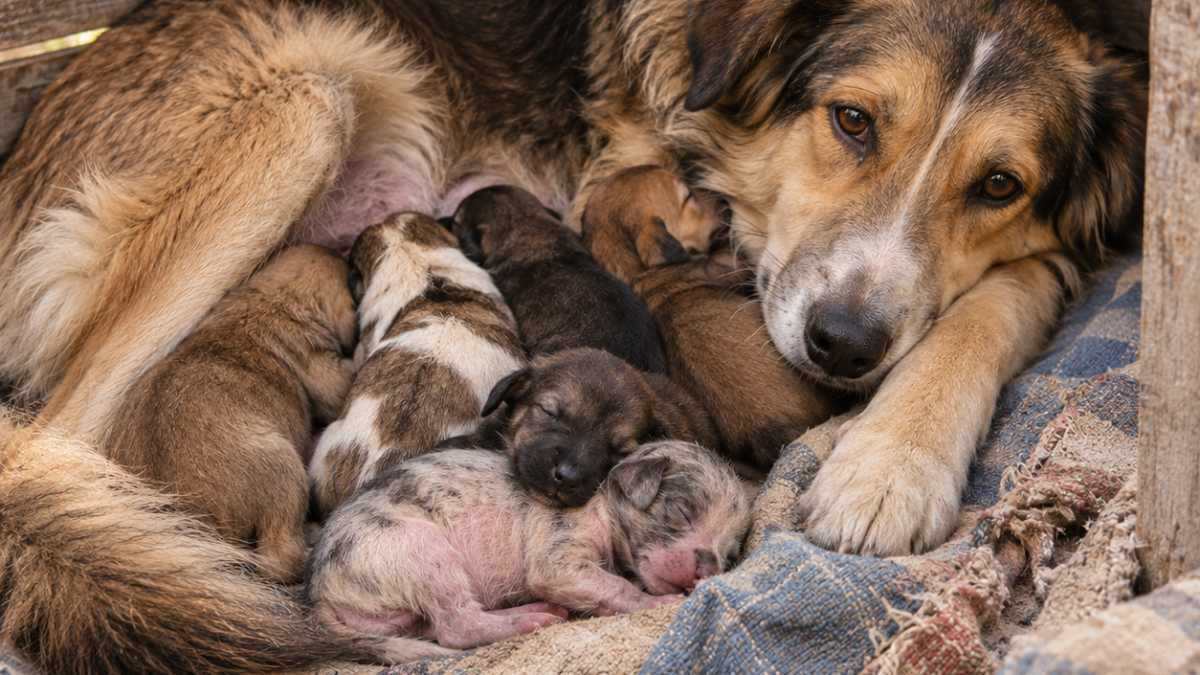
PART 2
He opened his mouth.
A tiny sound came out.
Barely louder than a breath.
“Oh, little guy…”
I reached down carefully.
My hands trembled as I lifted him.
He weighed almost nothing.
I could feel his heartbeat against my palm.
Fast.
Fragile.
His mouth opened again.
That same thin cry came out.
I looked toward Daisy.
Then I looked back at him.
Something inside me sank.
I knew immediately that something was wrong.
I didn’t know what.
I wasn’t a veterinarian.
But I knew this puppy was going to face a completely different beginning from his brothers and sisters.
The others already crawled confidently across Daisy’s stomach.
This puppy couldn’t even push himself forward.
I picked up my phone and called Dr. Harris.
He answered almost immediately.
“What’s happening?”
“There’s another puppy.”
“That makes six?”
“Yes, but…”
I looked down.
“But he’s different.”
“Different how?”
“His front legs. They look bent. And he’s much smaller.”
There was a short silence.
“Is he breathing normally?”
“I think so.”
“Is he responsive?”
“He’s making little noises.”
“That’s good.”
“Good?”
“It means he’s trying.”
I swallowed.
“What do I do?”
“Keep him warm. Let Daisy clean him if she will. Most importantly, see whether he can nurse.”
That was when another fear hit me.
“What if she rejects him?”
Dr. Harris paused.
“It can happen. Sometimes mothers focus on the strongest puppies. But don’t assume she will. Give her the chance.”
I looked toward Daisy.
She was busy cleaning one of the healthy puppies.
“Okay.”
“If he can’t nurse, call me back.”
After I hung up, I sat on the floor beside the box.
I held the little puppy close to my chest for warmth.
I had heard stories about animals rejecting babies that were sick or weak.
Nature could be beautiful.
But nature could also be brutally practical.
Daisy had five healthy puppies that needed her.
Would she sense something was wrong with this one?
Would she push him away?
I didn’t know.
And suddenly, that possibility frightened me more than anything else.
I looked down at him.
His small body moved with each breath.
“You deserve a chance,” I whispered.
I didn’t even realize I had said it out loud.
I slowly lowered him into the box.
At first, Daisy didn’t react.
The puppy lay several inches from her.
He tried to move.
His back legs pushed.
His front legs twisted awkwardly beneath him.
He managed to move less than an inch.
Then he stopped.
His mouth opened.
A tiny whimper escaped.
Daisy’s head lifted immediately.
I froze.
She looked toward him.
Then she stood slightly and leaned over.
She sniffed him.
Once.
Twice.
Her nose traveled from the top of his head along his back.
I held my breath.
“Come on, Daisy…”
She sniffed his legs.
Then she licked his face.
The puppy moved slightly.
Daisy licked him again.
And again.
Then something happened that caused the tension in my shoulders to disappear all at once.
She gently nudged him toward her stomach.
He slid across the blanket.
When he struggled, Daisy used her nose again.
She pushed him closer.
Finally, his mouth found her.
He began nursing.
Weakly at first.
Then with more determination.
I covered my mouth with my hand.
“Oh, Daisy.”
She looked at me.
I swear there was something in her expression.
Not confusion.
Not fear.
Something calmer.
As if she were saying, Of course he belongs here.
He is mine.
For the next few hours, I barely moved from beside the box.
The five healthy puppies were active.
They crawled over one another constantly.
Every time the smallest puppy found a comfortable position, one of the others seemed to push him aside.
I gently helped him back several times.
By midnight, exhaustion was catching up with me.
Daisy seemed calmer.
The puppies were feeding.
Even the smallest one had managed to nurse several times.
I placed another blanket beside the box and lay on the floor.
“I’m staying right here,” I told Daisy.
She lowered her head.
For the first time all evening, I closed my eyes.
I don’t know how long I slept.
Maybe forty minutes.
Maybe two hours.
What woke me was a sound.
A tiny whimper.
I opened my eyes.
The room was dark.
For a moment, I didn’t remember where I was.
Then I heard it again.
A weak cry.
I sat up instantly.
My heart began racing.
The puppy.
I reached for the lamp.
My hand missed the switch the first time.
Then the light came on.
I looked into the box.
The five healthy puppies were asleep together in a warm pile.
But the smallest puppy wasn’t with them.
My heart stopped.
“Where is he?”
I leaned closer.
Then I saw him.
And I froze.
Daisy had moved away from the group.
She had curled herself around the little puppy near the opposite side of the box.
Her body formed a protective circle around him.
The puppy was pressed against her chest.
Daisy was licking his face slowly.
Whenever he stopped moving, she nudged him.
Whenever he tried to crawl and failed, she moved closer.
But that wasn’t what stunned me.
She had deliberately positioned herself so that he could nurse without competing against his stronger siblings.
The other five were sleeping comfortably together.
But Daisy had separated herself from them for one reason.
Him.
The weakest puppy.
The one I had been afraid she might reject.
Instead, she had chosen to give him extra attention.
I sat there silently.
Daisy looked at me.
Then she lowered her head and began licking him again.
My eyes burned.
“You knew,” I whispered.
She had known exactly what he needed.
Maybe not in the way humans understand medical problems.
Maybe she didn’t know what was wrong with his legs.
But she knew he was weaker.
She knew he struggled.
And instead of leaving him behind, she made room for him.
I stayed beside them until morning.
Every few minutes, I checked the puppy.
He was still breathing.
Still nursing.
Still fighting.
At sunrise, I called Dr. Harris.
“I need you to see him.”
“Bring him in when we open.”
“Can Daisy come too?”
There was a pause.
“If she’s calm, yes.”
“She won’t leave him.”
“Then bring her.”
I placed Daisy and the puppies carefully into a large padded crate.
The smallest puppy rode in a small towel-lined basket right beside Daisy.
During the entire drive, Daisy kept her nose touching him.
At the clinic, a veterinary technician named Rachel came into the room.
She smiled when she saw the litter.
Then her expression changed when she noticed the small puppy.
“Oh.”
That single word scared me.
Dr. Harris entered a few minutes later.
He washed his hands and examined the puppy carefully.
He checked his heart.
His lungs.
His mouth.
His spine.
Then his legs.
Daisy watched every movement.
When Dr. Harris lifted the puppy too far away from her, she stood.
“It’s okay,” I told her.
She remained tense.
Dr. Harris noticed.
“She’s protective.”
“You should’ve seen her last night.”
“What happened?”
I explained everything.
How she had separated him from the others.
How she curled around him.
How she gave him a chance to nurse alone.
Dr. Harris smiled.
“She’s a good mother.”
“Is he going to survive?”
The smile faded slightly.
He looked back at the puppy.
“I can’t promise you that.”
My chest tightened.
“What’s wrong with him?”
“It looks like he has congenital deformities in both front limbs. We’ll need imaging later to understand exactly how the bones developed.”
“Can it be fixed?”
“Maybe improved.”
“Improved?”
“He may never walk exactly like the other puppies.”
I looked at the tiny animal in his hands.
“But can he have a normal life?”
Dr. Harris hesitated.
“A happy life and a normal life aren’t always the same thing.”
That sentence stayed with me.
He continued.
“If his heart and organs are healthy, and if he keeps eating and gaining weight, we can work with the mobility issues.”
“So there’s hope?”
“There’s definitely hope.”
I exhaled.
“How much?”
Dr. Harris gave me a serious look.
“That depends on him.”
He nodded toward Daisy.
“And her.”
When we returned home, I began keeping records.
Every morning and every evening, I weighed all six puppies.
The healthy puppies gained weight quickly.
The smallest puppy gained much more slowly.
I named him Milo.
I don’t know why.
The name simply came to me one morning.
“Milo,” I said.
His tiny ears twitched.
Daisy looked at me.
“Milo it is.”
The next week became one of the longest weeks of my life.
Every few hours, I woke to check whether Milo was breathing.
I monitored his feeding.
I adjusted his position.
I made sure the stronger puppies didn’t constantly push him away.
But I quickly realized I wasn’t doing most of the work.
Daisy was.
She seemed to create a special routine around him.
She fed all the puppies.
She cleaned all of them.
She slept beside them.
But when Milo cried, she reacted differently.
Immediately.
No hesitation.
Even if she was eating across the room, she would stop and return to the box.
Sometimes she would gently move one of the other puppies aside so Milo could reach her.
Once, I saw one of his larger brothers crawl directly over him.
Milo squeaked.
Daisy used her nose to push the larger puppy away.
I laughed.
“Okay, Mom. Message received.”
Milo had a bodyguard.
By the second week, his personality began to emerge.
He was stubborn.
Incredibly stubborn.
His legs might not have worked properly, but apparently no one had told Milo that.
Whenever his brothers and sisters crawled toward the edge of the box, he followed.
Or tried to.
He pushed with his back legs.
His chest dragged against the blanket.
His front legs folded awkwardly beneath him.
He would move an inch.
Rest.
Move another inch.
Rest again.
Sometimes it took him five minutes to travel the same distance the others covered in seconds.
But he never stopped.
One afternoon, I sat watching him struggle toward Daisy.
His sister reached her first.
Then his brother.
Then another puppy.
Milo kept pushing.
“You can do it.”
He stopped.
His little head dropped onto the blanket.
I thought he had given up.
Then Daisy stood.
She walked to him.
She could easily have picked him up with her mouth.
She didn’t.
Instead, she lay down directly in front of him.
Close enough to encourage him.
Far enough that he still had to move.
Milo lifted his head.
He pushed.
Once.
Twice.
Again.
Finally, he reached her.
I stared at Daisy.
“You’re making him work for it.”
She licked his head.
I laughed quietly.
“You’re smarter than I am.”
At his three-week appointment, Dr. Harris seemed surprised.
“He’s gaining.”
“Not as fast as the others.”
“No, but he’s gaining consistently. That matters.”
He examined Milo’s front legs again.
“We’ll do X-rays when he’s a little older.”
“Can we help him before then?”
“Yes.”
He showed me simple exercises.
Gentle stretches.
Careful movements designed to keep Milo’s joints flexible.
“Nothing aggressive,” he warned. “If he pulls away or seems uncomfortable, stop.”
Every evening, I sat on the floor and worked with Milo.
Daisy always watched.
At first, Milo hated it.
The moment I touched his front leg, he squirmed.
“I know.”
He squeaked.
“I know, buddy.”
He tried to bite my finger with a mouth that barely had teeth.
“Very scary.”
Daisy watched me with suspicious eyes.
“I’m helping him.”
She leaned closer.
“I promise.”
Eventually, she seemed to accept the routine.
Sometimes she lay beside us while I moved Milo’s legs gently.
Afterward, she always licked him.
By four weeks, the other puppies were beginning to stand.
That was when things became difficult.
They discovered their legs almost overnight.
Suddenly the box was chaos.
Puppies stumbled everywhere.
They wrestled.
They climbed.
They fell over one another.
They chased Daisy.
Milo watched.
At first, I thought I was imagining it.
But then I realized he really was watching them.
He would sit as upright as he could, supported mostly by his back legs and chest.
His eyes followed his siblings around the room.
One puppy ran past him.
Milo tried to follow.
He pushed forward.
His front legs collapsed.
His chin hit the blanket.
He tried again.
Same result.
Again.
Again.
Again.
Finally, he let out a frustrated cry.
Daisy immediately came over.
I reached for him.
Then I stopped.
Something about the way he looked at the others made me hesitate.
He didn’t look hurt.
He looked angry.
“Are you mad?”
Milo pushed again.
He moved forward.
Then again.
Slowly, awkwardly, stubbornly.
His siblings were already on the other side of the room.
But Milo kept going.
It took nearly ten minutes.
When he finally reached them, the puppies immediately climbed all over him.
I expected him to cry.
Instead, he opened his mouth and grabbed his brother’s ear.
His brother squealed.
I burst out laughing.
“Oh, you’re fine.”
Daisy wagged her tail.
For the first time since Milo had been born, I allowed myself to imagine a future.
Not just tomorrow.
Not just the next feeding.
A real future.
I imagined Milo growing up.
Running somehow.
Playing.
Sleeping on the couch.
Getting into trouble.
I wanted that future so badly it scared me.
Because hope had a price.
The more I believed he could survive, the more terrified I became of losing him.
And just when I started to relax, everything went wrong.
It happened on a rainy Tuesday night.
Milo was almost five weeks old.
I noticed he wasn’t interested in food.
The puppies had begun transitioning to soft puppy food.
Normally, Milo attacked the little dish as though he hadn’t eaten in months.
That night, he turned his head away.
“Not hungry?”
I offered him a small amount from my finger.
Nothing.
Daisy sniffed him.
Then she began licking his face.
My stomach tightened.
I touched his body.
He felt warm.
Too warm.
I grabbed the thermometer Dr. Harris had recommended keeping nearby.
When I saw the number, my heart started pounding.
I called the emergency clinic.
Twenty minutes later, I was driving through heavy rain with Milo wrapped in a towel beside me.
Daisy was in the back seat.
I hadn’t planned to bring her.
But when I carried Milo toward the door, Daisy blocked my path.
She whined.
“I have to take him.”
She followed me.
“Daisy.”
She refused to move.
I looked at the clock.
“Fine. Come on.”
At the clinic, the veterinarian on duty examined Milo.
His temperature was high.
His breathing was faster.
The veterinarian listened to his chest for a long time.
“I’m concerned about an infection.”
My mouth went dry.
“What kind?”
“Possibly respiratory.”
“Can you treat it?”
“Yes, but because he’s small and already vulnerable, I’d like to keep him overnight.”
The words hit me harder than I expected.
“Overnight?”
“We need to monitor him.”
I looked at Milo.
Then at Daisy.
She was standing near the examination table.
Milo cried.
Daisy immediately stood on her back legs, trying to reach him.
The veterinarian looked at her.
“She’s his mother?”
“Yes.”
“She’s very attached.”
“You have no idea.”
A technician came to take Milo.
Daisy began whining loudly.
The sound broke something inside me.
“It’s okay,” I told her.
It wasn’t okay.
She watched the technician carry Milo through the door.
Then she looked at me.
I had never seen Daisy look confused before.
She walked to the door where Milo had disappeared.
She sniffed underneath it.
Then she looked back at me.
“We have to go home.”
She wouldn’t move.
“Daisy.”
Nothing.
I crouched beside her.
“They’re helping him.”
She stared at the door.
“I promise.”
Eventually, I had to lead her away.
That night was worse than the night Milo had been born.
Daisy paced constantly.
She checked the puppy area.
She sniffed every blanket.
She went from room to room looking for him.
The other puppies slept.
Daisy didn’t.
Neither did I.
At two in the morning, my phone rang.
I grabbed it before the first ring finished.
“Hello?”
It was the emergency veterinarian.
“Milo’s stable.”
I closed my eyes.
“Stable is good?”
“Yes. His temperature has come down slightly. We started medication and fluids.”
“Is he breathing okay?”
“He’s doing better.”
“Can I come?”
There was a pause.
“You can visit in the morning.”
I looked at Daisy.
“His mother is losing her mind.”
The veterinarian laughed softly.
“I believe you.”
The next morning, Daisy and I arrived before visiting hours.
When the technician carried Milo into the room, Daisy made a sound I had never heard before.
Half whine.
Half cry.
She rushed forward.
Milo’s entire body seemed to wake up.
He began squirming.
Daisy smelled every inch of him.
Then she began licking his face so aggressively that the technician laughed.
“Okay, Mom. Let him breathe.”
I sat on the floor and cried.
I didn’t care who saw.
Milo stayed at the clinic one more night.
Then he came home.
For the next two weeks, I followed his medication schedule with military precision.
Seven in the morning.
Three in the afternoon.
Eleven at night.
Daisy never missed a dose either.
The moment she saw the medicine bottle, she would sit beside me and watch.
Milo recovered.
And somehow, after being sick, he seemed even more determined than before.
At seven weeks old, Dr. Harris finally took detailed X-rays.
I waited in the examination room with Daisy while Milo was in the imaging area.
When Dr. Harris returned, he had several images on a tablet.
He sat beside me.
“I have good news and complicated news.”
“Start with the good.”
“His spine looks good. His shoulders look stable. His back legs are strong.”
I nodded.
“And the complicated news?”
He showed me the images.
“The bones in his front legs didn’t develop normally. Surgery might be an option when he’s older, but I’m not convinced it would give him normal front-leg function.”
“So what does that mean?”
“It means we focus on mobility rather than perfection.”
I looked at him.
“What does that mean?”
“It means we help Milo move in whatever way works best for Milo.”
He explained that some dogs with front-limb deformities learned to adapt.
Others benefited from braces.
Physical therapy.
Custom devices.
Carts.
“What kind of cart?”
“A small support frame with wheels.”
I pictured Milo in some giant machine.
“He’s going to hate that.”
Dr. Harris smiled.
“Probably.”
He was right.
The first cart arrived two weeks later.
It was tiny.
Lightweight.
Almost ridiculous-looking.
Two small wheels.
A padded chest support.
Adjustable straps.
I placed Milo inside it.
He froze.
For three full seconds, he didn’t move.
Then he looked at me.
If dogs could curse, I am certain Milo cursed at me.
“Just try.”
He tried to back out.
The cart moved backward.
Milo panicked.
He twisted.
I caught him.
“Okay. Okay.”
Daisy walked over.
She sniffed the cart.
Milo stared at her.
Then one of his brothers ran past.
Milo’s head snapped around.
His brother grabbed a toy and ran.
Milo pushed with his back legs.
The wheels moved.
He stopped.
I stopped breathing.
He pushed again.
The cart rolled forward.
His brother ran farther.
Milo pushed harder.
Suddenly, he was moving.
Not smoothly.
Not quickly.
But moving.
His ears lifted.
He pushed again.
The cart rolled across the floor.
His brother turned.
Milo accelerated.
The next thirty seconds were chaos.
Milo crashed into a pillow.
Turned around accidentally.
Rolled directly into Daisy.
Then chased his brother underneath the kitchen table and got the cart stuck between two chairs.
I laughed so hard I had to sit down.
“Milo!”
He barked.
His first real bark.
Daisy wagged her tail furiously.
Within three days, Milo learned to turn.
Within a week, he learned to stop.
Within two weeks, he learned something no one had taught him.
Speed.
Milo became dangerous.
Not medically.
To furniture.
He tore through the house like a tiny race car.
If he heard the refrigerator open, he arrived before Daisy.
If one of his siblings stole a toy, he chased them.
If the doorbell rang, he rolled toward the front door at full speed, barking as though he weighed one hundred pounds instead of eight.
For the first time, I stopped seeing the cart.
I stopped seeing his legs.
I saw Milo.
Just Milo.
Stubborn.
Funny.
Fearless.
A little annoying.
Completely alive.
Eventually, the time came to find homes for the other puppies.
That part was harder than I expected.
I interviewed everyone carefully.
Maybe too carefully.
I asked about yards.
Work schedules.
Veterinary care.
Other animals.
I rejected several people.
My sister told me I was acting like an overprotective parent.
“She’s right,” Dr. Harris said when I complained to him.
“You’re supposed to support me.”
“I support you. You’re still overprotective.”
One by one, the puppies went to their new families.
Every goodbye hurt.
Daisy seemed to notice each absence.
She searched briefly.
Then settled.
When the final healthy puppy left, only Milo remained.
I sat beside Daisy that night.
Milo was asleep between us.
“You know he’s staying, right?”
Daisy rested her chin on my leg.
“I don’t think anyone could convince me otherwise.”
I had no intention of giving Milo away.
By then, he belonged to me in a way I couldn’t explain.
Maybe because I had spent so many nights afraid he wouldn’t survive.
Maybe because I had watched Daisy fight for him.
Maybe because every time someone looked at him and saw a problem, Milo seemed determined to prove he was a personality instead.
There was one person, however, who had never believed in him.
His name was Grant.
Grant lived several miles away and had owned the male dog that fathered Daisy’s litter.
He wasn’t cruel.
At least, I didn’t think he saw himself that way.
But Grant had a very practical view of animals.
Too practical.
When Milo was only three days old, Grant had stopped by to see the puppies.
The moment he saw Milo, his expression changed.
“That one’s not right.”
I felt my body stiffen.
“He has some problems with his front legs.”
Grant crouched beside the box.
Milo was nursing.
Daisy watched him closely.
Grant shook his head.
“You’re going to spend a fortune.”
“I didn’t ask.”
“I’m just saying.”
“Then don’t.”
He stood.
“I’ve seen puppies like that.”
“Have you?”
“They usually don’t make it.”
I remember looking at Milo.
Daisy immediately moved one paw protectively in front of him.
Grant shrugged.
“Nature knows.”
“What does that mean?”
“It means sometimes you shouldn’t interfere.”
I looked at him.
“You think I should let him die?”
“I think you should be realistic.”
That conversation stayed with me for months.
Not because I thought Grant was right.
But because his words represented the thing I feared most.
Every time Milo struggled, I heard them.
They usually don’t make it.
Every time Milo got sick, I heard them.
Nature knows.
Every time a medical bill arrived, I heard them.
You’re going to spend a fortune.
But Milo survived.
And survived.
And survived.
By six months old, he had outgrown his first cart.
His second cart was stronger.
Lighter.
Better fitted.
He could race across grass.
He could navigate the sidewalk.
He could even go on short hikes over smooth trails.
People stared.
Children especially.
Most children loved him immediately.
“What happened to his legs?”
“He was born that way.”
“Does it hurt?”
“No.”
“Can I pet him?”
“If he lets you.”
Milo always let them.
Adults were more complicated.
Some looked at him with sympathy.
I hated that.
Milo didn’t want sympathy.
He wanted attention.
Preferably snacks.
One afternoon, a woman stopped us at the park.
“Oh, poor baby.”
Milo immediately rolled toward her.
She crouched.
“Poor little thing.”
Milo stole the glove from her hand.
Then raced away.
I laughed.
The woman stared.
“Does he always do that?”
“Yes.”
She started laughing too.
“Maybe he’s not so poor.”
“No,” I said. “He definitely isn’t.”
As Milo grew, Daisy changed too.
She stopped treating him like a fragile puppy.
That surprised me.
When he was small, she protected him constantly.
But once he became stronger, she expected him to behave like any other dog.
If he stole her food, she corrected him.
If he annoyed her while she was sleeping, she moved away.
If he rolled into her too aggressively while playing, she pushed him over with her nose.
Milo adored her anyway.
They slept together every night.
Usually with Milo pressed against her side.
The dog who couldn’t use his front legs grew into the most confident animal I had ever known.
Then, almost one year after his birth, something unexpected happened.
I received a message from Grant.
Haven’t seen the little disabled pup in a while. How’s he doing?
I stared at the screen.
Part of me wanted to ignore it.
Another part of me wanted to send exactly one sentence.
He’s alive.
Instead, I sent a picture.
Milo was wearing his cart, standing on a trail beside Daisy.
His tongue hung out.
His ears were up.
He looked ridiculously happy.
Grant replied almost immediately.
No way.
I didn’t answer.
A minute later:
That’s him?
Yes.
He can move like that?
Yes.
A few minutes passed.
Then:
I’d like to see him sometime.
I almost laughed.
Months earlier, Grant had looked at Milo and seen a mistake.
Now he wanted to see the result.
I thought about saying no.
Then I looked at Daisy.
Then Milo.
Maybe there was something satisfying about letting reality speak for itself.
Come by Saturday afternoon.
Grant arrived at two.
Milo heard his truck and raced toward the front door.
“Slow down!”
He ignored me.
Grant stepped onto the porch.
When I opened the door, Milo rolled forward immediately.
Grant stared.
For once, he had nothing to say.
Milo sniffed his shoes.
Then rolled around him.
Grant crouched slowly.
“Hey, little guy.”
Milo licked his hand.
Grant looked up at me.
“He doesn’t remember me.”
“He was three days old.”
“Right.”
Daisy came to the doorway.
Grant smiled.
“Hey, Mama.”
Daisy gave him a cautious sniff.
Then walked back inside.
Grant watched Milo roll through the yard.
“He’s fast.”
“Very.”
Milo spotted a ball.
I threw it.
He raced after it.
Grant stood silently.
Milo reached the ball.
He grabbed it.
Turned.
Came racing back.
The cart bounced over the grass.
He dropped the ball at my feet.
Grant shook his head.
“I really thought…”
“I know what you thought.”
He looked uncomfortable.
“I wasn’t trying to be cruel.”
“I know.”
“I just didn’t think he’d have any quality of life.”
Milo barked at me.
I threw the ball again.
He raced away.
Grant watched.
“Seems like he has plenty.”
“He does.”
There was a long silence.
Then he said something I didn’t expect.
“I was wrong.”
I looked at him.
Grant wasn’t the kind of man who admitted that easily.
“I was completely wrong.”
I didn’t smile.
I didn’t need to.
Milo returned with the ball.
He rolled directly toward Grant this time.
Dropped it at his boots.
Then barked.
Grant bent down and picked it up.
“You want me to throw it?”
Milo barked again.
Grant threw.
Milo raced after it.
Grant laughed.
And just like that, the thing I had imagined as revenge for months became something different.
I had imagined wanting Grant to feel embarrassed.
I had imagined repeating every careless thing he had said.
I had imagined asking him whether “nature knew” now.
But standing there, watching Milo chase the ball, I realized none of it mattered.
Milo had already answered him.
Not with anger.
Not with revenge.
With life.
A few months later, Milo faced another challenge.
His growing body put more pressure on his shoulders.
Dr. Harris noticed mild irritation where the cart support touched his chest.
“We need to adjust his equipment.”
“Is it serious?”
“Not yet. But we stay ahead of it.”
We began working with a canine rehabilitation specialist named Elena.
The first time Elena met Milo, she sat on the floor without touching him.
Milo rolled over.
Sniffed her.
Then tried to steal a treat pouch from her waist.
She laughed.
“I like him.”
“He likes your food.”
“That counts.”
Elena taught me exercises that strengthened Milo’s back, core, and shoulders.
She introduced hydrotherapy.
The first session terrified me more than Milo.
He wore a flotation vest.
Elena carried him into a shallow therapeutic pool.
Milo panicked for about five seconds.
Then his back legs started kicking.
He moved through the water.
His front legs floated gently.
Daisy watched from the side.
Milo swam toward me.
“You’re swimming!”
He splashed water directly into my face.
Elena laughed.
“Good motivation.”
Within weeks, swimming became Milo’s favorite activity.
He could move without the cart.
Without dragging.
Without struggling.
In the water, his body was free.
I used to sit beside the pool and watch him.
Sometimes I remembered the newborn puppy lying almost motionless in my palm.
The tiny mouth opening.
The faint cry.
The bent legs.
The fear.
If someone had shown me this future then, I might not have believed it.
One afternoon after therapy, Elena asked me something.
“Have you ever considered sharing his story?”
“What do you mean?”
“Schools. Rescue groups. Therapy programs.”
I laughed.
“Milo?”
“Why not?”
“He steals socks.”
“That doesn’t disqualify him.”
“He screams when the vacuum turns on.”
“Still not disqualified.”
I looked at Milo.
He was asleep upside down beside Daisy.
“What would he do?”
“Mostly exist.”
“That’s the program?”
Elena smiled.
“You’d be surprised how powerful that can be.”
A local elementary school had a program where volunteers brought animals to meet children during special reading and wellness events.
Elena knew one of the coordinators.
A month later, Milo and I visited for the first time.
I was nervous.
Milo wasn’t.
The moment we entered the classroom, twenty children stared.
One little boy raised his hand before I even said anything.
“Why does he have wheels?”
“Because his front legs developed differently before he was born.”
“Is he broken?”
The room became quiet.
I looked at Milo.
He was sniffing the floor.
“No,” I said. “He’s different.”
The boy considered that.
“Does he know?”
I smiled.
“I’m pretty sure he does.”
Another child asked, “Is he sad?”
Milo chose that moment to grab a stuffed toy from a desk.
The class burst into laughter.
“No,” I said. “I don’t think sad is the word.”
Afterward, a girl stayed behind.
She was quiet.
Maybe eight years old.
She had braces on both legs.
She stood several feet from Milo.
“Can I touch him?”
“Of course.”
She knelt.
Milo rolled toward her slowly.
For once, he didn’t jump.
Didn’t steal anything.
Didn’t bark.
He simply rested his head against her knee.
The girl stroked his ears.
“My legs are different too,” she said.
I felt my throat tighten.
Milo looked up at her.
She smiled.
“My brother says I walk funny.”
I didn’t know what to say.
Before I could answer, she continued.
“But Milo walks funny too.”
I nodded.
“He does.”
“He doesn’t care.”
“No.”
She smiled again.
“Maybe I shouldn’t either.”
I looked away for a second because I didn’t want her to see my eyes filling with tears.
When we got home, Daisy sniffed Milo from head to tail as though demanding a full report.
“You wouldn’t believe what your son did today,” I told her.
Milo collapsed beside her.
Daisy licked his face.
Years passed.
Not many.
But enough for puppyhood to become memory.
Milo grew into an adult dog.
His cart changed several times.
His personality didn’t.
He remained stubborn.
Food-obsessed.
Fearless.
Affectionate.
He continued visiting schools occasionally.
He became known at the veterinary clinic.
The moment we entered, technicians called his name.
“Milo!”
His tail would start beating against the side of the cart.
Dr. Harris often joked that Milo had become the clinic’s most expensive celebrity.
“He’s paying you in publicity,” I said.
“He’s paying me in stolen pens.”
Milo had once taken a pen from the examination table and refused to return it.
Daisy aged.
Slowly at first.
Gray appeared around her muzzle.
She slept more.
Her walks became shorter.
Milo noticed before I did.
When he was younger, he would race ahead of her.
Now he began matching her speed.
If Daisy stopped to rest, Milo stopped too.
The roles had reversed.
The mother who had once slowed down for her weak puppy now had a grown son who slowed down for her.
One evening, I watched them cross the backyard.
Daisy moved carefully.
Milo rolled beside her.
Every few feet, he looked back.
When Daisy stopped beneath the maple tree, Milo stopped.
He positioned himself beside her.
She lay down.
Milo lowered himself from the cart.
Then dragged himself the final few inches until his body touched hers.
I stood at the kitchen window.
And suddenly I was back in that room years earlier.
The dark.
The tiny cry.
The lamp switching on.
Daisy curled around the smallest puppy.
Protecting him.
Keeping him warm.
Giving him his own space to nurse.
She had been there for him from his first night.
Now he was there for her.
Daisy’s health declined when she was eleven.
At first, it was arthritis.
Then kidney problems.
Medication helped.
Diet changes helped.
But age kept moving forward.
I knew what was happening.
I hated knowing.
One night, Daisy refused dinner.
Milo ate his portion.
Then noticed her bowl was untouched.
He rolled over.
Sniffed it.
I expected him to eat hers too.
Old Milo would have.
Instead, he looked at Daisy.
Then backed away.
He lay beside her bowl.
Waiting.
“Come on, girl.”
Daisy lifted her head.
She looked tired.
I carried the bowl closer.
She ate a few bites.
Milo watched.
Only after Daisy finished did he eat what remained.
I sat on the floor between them.
“You two are going to destroy me.”
Milo put his head in my lap.
Daisy placed hers beside him.
That became our routine.
When Daisy struggled, Milo stayed close.
When she slept, he slept nearby.
When she went to the veterinarian, Milo came too.
Dr. Harris had treated both of them for years.
During one appointment, he listened to Daisy’s heart.
Then he looked at me.
His expression told me before he spoke.
“We’re getting close.”
I looked down.
“Close to what?”
I knew.
He knew I knew.
He pulled a chair closer.
“She’s comfortable right now. But there may come a point soon when she isn’t.”
I looked at Daisy.
Milo was lying beside her.
“What am I supposed to do?”
“You make the decision she can’t make for herself.”
“That’s not fair.”
“No.”
“She saved him.”
Dr. Harris glanced at Milo.
“I know.”
“She never gave up on him.”
“I know.”
“How am I supposed to give up on her?”
“You’re not.”
I looked at him.
“Helping her avoid suffering isn’t giving up.”
I hated the sentence.
Because I knew it was true.
Daisy gave us several more good weeks.
Then one morning, she couldn’t stand.
I carried her outside.
Milo followed.
I placed Daisy on a blanket beneath the maple tree.
The sun was warm.
She lifted her nose.
Smelled the air.
Milo rolled close.
I sat beside them.
For almost an hour, we stayed there.
No emergency.
No rushing.
Just sunlight.
Birds.
Leaves moving.
Daisy breathing quietly.
I called Dr. Harris.
He came to the house that afternoon.
I had asked him if it could happen at home.
He said yes.
When he arrived, Milo barked at him like always.
Dr. Harris crouched.
“Hey, troublemaker.”
Milo wagged his tail.
Then Dr. Harris walked toward Daisy.
His expression changed.
I sat beside her.
Milo was on the other side.
Dr. Harris explained everything.
I barely heard him.
My hand remained on Daisy’s head.
“You were a good girl,” I whispered.
Her eyes opened slightly.
Milo moved closer.
His nose touched hers.
And then something happened that almost broke me.
Daisy licked his face.
Once.
Slowly.
The same way she had the night he was born.
Milo froze.
She licked him again.
Then rested her head.
I started crying.
“I remember,” I whispered. “I remember you doing that.”
Dr. Harris looked away.
I leaned down.
“You took care of him.”
My voice shook.
“You took care of all of us.”
Daisy’s breathing slowed.
Milo kept his nose against her.
When she was gone, he stayed there.
He didn’t understand.
Or maybe he understood better than I wanted to believe.
For the next several days, he searched for her.
He went to the place where her bed had been.
He sniffed the backyard.
At night, he stared toward my bedroom door.
Daisy had always slept there.
I moved her blanket beside Milo’s bed.
He sniffed it.
Turned in a circle.
Then lay down on top of it.
I sat beside him.
“I miss her too.”
For weeks, the house felt wrong.
Too quiet.
There were no soft footsteps behind me.
No brown eyes watching me from the doorway.
No Daisy.
Milo changed.
He became quieter.
Not permanently.
His personality slowly returned.
But something in him had shifted.
He had lost the first creature who ever believed in him.
I understood that feeling.
Months later, the elementary school invited Milo back.
I almost declined.
I didn’t feel ready.
Then I remembered Daisy.
If there was one thing she had taught me, it was that loving something meant helping it keep moving.
So Milo and I went.
The classroom was different.
New children.
New teacher.
But the same questions.
“Why does he have wheels?”
“Was he born like that?”
“Does it hurt?”
“Can he run?”
I answered.
Then one boy asked a question no one had asked before.
“Who taught him to be brave?”
I opened my mouth.
Nothing came out.
I looked at Milo.
He was sitting in his cart, watching me.
For a second, I saw the newborn again.
Then Daisy.
Curled around him.
Keeping him alive.
I swallowed.
“His mom did.”
The boy looked surprised.
“A dog?”
“Yes.”
“What did she do?”
“She never treated him like he didn’t belong.”
The room was quiet.
“When he was born,” I continued, “he was smaller than all the other puppies. His front legs were different, and he couldn’t move the way they could. I was afraid his mother might reject him.”
“Did she?”
“No.”
I smiled.
“She did the opposite.”
I told them about that first night.
The faint cry.
The light.
The five healthy puppies sleeping together.
Daisy curled around Milo.
Giving him extra time to eat.
Keeping him warm.
Helping him survive.
One little girl raised her hand.
“So his mom saved him?”
“Yes.”
I looked at Milo.
“She gave him the first chance.”
When the visit ended, several children hugged him.
One boy whispered something into Milo’s ear.
I didn’t ask what.
Some things belong between a child and a dog.
On the drive home, I stopped at the park.
The same park where people had once looked at Milo with pity.
I took his cart from the trunk.
Strapped him in.
He immediately began pulling toward the trail.
“Still impatient.”
He looked back at me.
Then barked.
“All right.”
We started walking.
Milo rolled ahead.
Not too far.
He had learned that lesson from Daisy.
He would move twenty feet.
Stop.
Look back.
Wait.
Then continue.
We reached the top of a small hill.
I sat on a bench.
Milo stopped beside me.
The afternoon sun fell across his face.
His muzzle had started showing a little gray.
Not much.
But enough for me to notice.
“No.”
He looked at me.
“Don’t you start getting old too.”
He panted happily.
I laughed.
“That wasn’t permission.”
I pulled out my phone.
There was a photograph I kept in a special folder.
Daisy and Milo.
He was only a few weeks old.
Tiny.
His front legs curled.
Daisy’s head rested beside him.
I looked from the photo to Milo.
Years ago, I had thought the tragedy was that he had been born different.
I was wrong.
There had never been a tragedy in Milo’s difference.
The tragedy would have been believing that difference made his life less valuable.
Daisy never believed that.
Not for one second.
Humans had looked at Milo and immediately calculated the problems.
Cost.
Difficulty.
Time.
Uncertainty.
Pain.
Daisy looked at him and saw one thing.
Her puppy.
That was enough.
I used to think she had performed some extraordinary act that first night.
And maybe she had.
But over the years, I began to see it differently.
Daisy hadn’t thought she was doing anything extraordinary.
She was simply loving the puppy in front of her.
The one who needed her most.
Maybe that was what made it extraordinary.
Milo nudged my hand.
“You hungry?”
His ears lifted instantly.
I laughed.
“Of course.”
I reached into my pocket and pulled out a small treat.
He ate it in half a second.
“Some things never change.”
We continued along the trail.
Near the parking lot, I noticed a man standing with a dog.
It took me a moment to recognize him.
Grant.
He raised his hand.
“Milo?”
Milo looked.
Then started rolling toward him.
Grant laughed.
“He remembers me now.”
“Probably remembers you throw the ball.”
“That counts.”
Grant crouched.
Milo greeted him enthusiastically.
Then Grant looked at me.
“How old is he now?”
I told him.
He shook his head.
“I still think about what I said when he was born.”
“You don’t have to.”
“I do.”
He stroked Milo’s head.
“I almost feel ashamed.”
I considered that.
“Feeling ashamed doesn’t help anyone.”
“What does?”
“Learning.”
Grant nodded.
He looked at Milo.
“You taught me something, buddy.”
Milo tried to steal the tennis ball from Grant’s dog.
I laughed.
“Very inspirational.”
Grant smiled.
Before we left, he stopped me.
“You know, if you had listened to me…”
I knew exactly what he meant.
I looked down at Milo.
He had the tennis ball in his mouth now.
Somehow he had successfully stolen it.
“Yes.”
“He wouldn’t be here.”
“No.”
Grant was silent.
Then he said, “I’m glad you didn’t.”
So was I.
We went home.
That night, Milo climbed onto his bed.
Daisy’s old blanket was still there.
Faded.
Washed hundreds of times.
But still his favorite.
He circled once.
Then settled.
I turned off the lights.
Before going upstairs, I looked back.
Milo’s head rested on the blanket.
For a moment, the house felt peaceful.
Not empty.
Different.
The way Milo was different.
Not less.
Just changed.
I thought about the night he was born.
How afraid I had been.
How certain I was that something terrible was about to happen.
Five healthy puppies sleeping in a pile.
One tiny puppy separated from them.
Then the light revealing Daisy wrapped around him.
At the time, I thought the surprise was that she hadn’t rejected him.
Years later, I understood the real surprise.
I had expected her to measure his worth by his weakness.
She never did.
That was a human fear.
Not hers.
To Daisy, Milo had never been the defective puppy.
Never the disabled puppy.
Never the expensive puppy.
Never the hopeless puppy.
He was simply her baby.
And from the first night of his life, she made sure he knew it.
Milo lived many good years after Daisy was gone.
He continued visiting children.
He continued stealing things.
He destroyed three more dog beds.
Two remote controls.
One pair of expensive shoes.
And, for reasons I still don’t understand, a paperback dictionary.
Dr. Harris joked that Milo was living purely to make every pessimistic prediction look ridiculous.
Maybe he was.
His body required more care as he aged.
We adjusted his cart.
Added softer supports.
Shortened his walks.
Continued swimming.
There were difficult days.
But there were far more good ones.
And Milo never seemed interested in the life he didn’t have.
He was too busy living the one he did.
On his birthdays, I always gave him a special meal.
Chicken.
Rice.
A little pumpkin.
And one small piece of cheese, even though Dr. Harris insisted I stop spoiling him.
“You created this problem,” I told him.
“How?”
“You told me he might not survive.”
“That was years ago.”
“I’m still compensating.”
Milo barked.
“See? He agrees.”
Eventually, even Milo grew old.
His eyes became cloudy.
His hearing weakened.
He slept more.
His cart stayed parked near the door most days.
But every morning, I helped him outside.
He would sit beneath Daisy’s maple tree.
Yes, I had started calling it Daisy’s tree.
I couldn’t help it.
Milo always chose the same spot.
One autumn morning, I sat beside him.
Leaves covered the grass.
He rested against my leg.
I stroked the gray fur around his ears.
“You weren’t supposed to make it, remember?”
His tail moved once.
“You weren’t supposed to have a good life.”
Another small wag.
“You really ruined everyone’s predictions.”
He sighed.
I looked up through the branches.
For years, I had told Milo’s story as though it were about survival.
It wasn’t.
Not really.
Survival was only the beginning.
His story was about being given a chance before anyone knew what the ending would be.
That was the difficult part.
It’s easy to celebrate someone after they succeed.
It’s easy to believe in them once they prove themselves.
Daisy believed in Milo before there was proof.
Before the cart.
Before therapy.
Before the school visits.
Before he became strong.
Before we knew he would survive his first week.
She believed in him when he was nothing more than a tiny body in a blanket, unable to stand.
That kind of love asks for no guarantee.
I think about that often.
Maybe because life gives us so few guarantees.
We want certainty before we invest our hearts.
We want evidence before we hope.
We want promises that our effort will matter.
Daisy wanted none of those things.
Milo cried.
She went to him.
Milo struggled.
She made space.
Milo was weaker.
She stayed closer.
Simple.
The most important lessons usually are.
Near the end of Milo’s life, Grant visited again.
He was older too.
He sat on the floor beside Milo.
“Remember me?”
Milo lifted his head.
His tail moved.
Grant smiled.
“I’ll take that as a yes.”
He stayed for nearly an hour.
Before leaving, he looked at me.
“You know what bothers me?”
“What?”
“I used to think kindness toward animals meant being realistic.”
I waited.
“I thought avoiding difficulty was kindness.”
He looked at Milo.
“Sometimes it probably is. But I didn’t even give him a chance in my mind.”
“You didn’t know.”
“I could have.”
I shook my head.
“We all learn.”
Grant smiled faintly.
“You sound nicer about it than you did ten years ago.”
“I had practice.”
Milo eventually reached a point where getting through the day became harder than enjoying it.
I recognized the signs because Daisy had taught me.
I didn’t want to.
But I did.
Dr. Harris had retired by then.
His daughter, Claire, had taken over much of the clinic.
But when he heard about Milo, he came.
“I had to see the troublemaker.”
Milo was lying on Daisy’s blanket beneath the maple tree.
Dr. Harris sat beside him.
“You really did it, buddy.”
I looked at him.
“Did what?”
“Everything.”
He rubbed Milo’s ear.
“Everything we hoped.”
For once, Milo didn’t try to steal anything.
I sat beside him.
The air was warm.
Exactly the kind of afternoon Daisy had loved.
I told Milo the same thing I had told Daisy years earlier.
“You were a good boy.”
Then I laughed through tears.
“Most of the time.”
His tail moved.
“You were impossible.”
Another wag.
“You cost me more money than my first car.”
Dr. Harris laughed quietly.
Milo looked at me.
I rested my forehead against his.
“And I’d do it again.”
That was the truth.
Every night without sleep.
Every veterinary bill.
Every exercise session.
Every medicine schedule.
Every broken object.
Every moment of fear.
I would do all of it again.
Because none of those things were the story.
They were simply the price of being present for the story.
Before Milo was gone, I whispered one final thing.
“Go find your mom.”
I don’t know what I believe animals understand about death.
I don’t know what comes afterward.
But I know what I hoped.
I hoped somewhere, somehow, the tiny puppy Daisy had protected that first night found her again.
I hoped she recognized him.
Not as the weak puppy.
Not as the puppy who needed help.
As Milo.
Her son.
The dog who lived a life no one expected.
Afterward, I buried Milo’s ashes beneath Daisy’s maple tree.
I placed a small stone there.
Nothing dramatic.
Just two names.
DAISY & MILO
Underneath them, I had four words engraved.
SHE GAVE HIM A CHANCE.
For weeks, I wondered whether I had chosen the right words.
Then one afternoon, a family stopped near the tree.
They had come to visit because their daughter remembered Milo from school.
She was older now.
A teenager.
I recognized her after a moment.
She was the little girl who had worn braces on both legs.
The one who told me her brother said she walked funny.
She stood in front of the stone.
“You remember me?”
“I do.”
She smiled.
“I remembered Milo.”
She looked different.
Older.
More confident.
She no longer wore the braces.
“You told me something once,” she said.
“What?”
“You told me Milo didn’t care that he moved differently.”
I smiled.
“That sounds like something I would’ve said.”
“I thought about it a lot.”
She glanced at the stone.
“I had surgery later. Then another one. I hated physical therapy.”
“I’m sorry.”
“Every time I wanted to quit, my mom reminded me about the dog with wheels.”
My throat tightened.
“She did?”
The girl laughed.
“Constantly. It was annoying.”
“That sounds like a mom.”
She crouched beside the stone.
“I wanted to say thank you.”
I looked at Daisy’s name.
Then Milo’s.
“You just did.”
After the family left, I sat beneath the tree alone.
For the first time, I realized how far that single night had reached.
Daisy’s choice had looked small.
One mother dog.
One fragile puppy.
One quiet room.
But that choice had become Milo’s life.
Milo’s life had touched children.
Families.
Veterinarians.
People who had underestimated him.
People who needed to see that different didn’t mean hopeless.
Even Grant had changed.
All because Daisy had heard one weak cry in the night and moved closer instead of farther away.
That was it.
That was where everything began.
Not with a miracle.
Not with some dramatic rescue.
With a mother refusing to abandon the weakest member of her family.
I still have the first photograph I took of Milo.
He fits almost entirely in my hand.
His front legs curl awkwardly beneath him.
His eyes are closed.
He looks unbelievably fragile.
Beside him, Daisy’s nose touches his head.
Whenever someone sees that photograph, they usually say the same thing.
“He was so tiny.”
Yes.
He was.
Then they ask, “Did you know he would survive?”
No.
I didn’t.
That is the part of the story people sometimes miss.
I had no guarantee.
Daisy had no guarantee.
Dr. Harris had no guarantee.
Nobody knew.
We simply kept going.
One feeding.
One night.
One veterinary visit.
One exercise.
One tiny movement at a time.
That’s how Milo lived.
Maybe that’s how most of us live.
Not knowing the ending.
Just deciding what we’re willing to do before we know.
If I could return to that first night, I know exactly what I would tell the frightened version of myself standing beside the box.
I would tell him to stop staring at Milo’s legs.
I would tell him not to mistake difficulty for tragedy.
I would tell him that the smallest puppy in the room was going to become the loudest personality in the house.
I would tell him there would be fear.
Bills.
Sickness.
Tears.
Loss.
But also laughter.
Parks.
Children.
Swimming.
Stolen gloves.
Destroyed furniture.
Birthday chicken.
And more love than he could imagine.
Most of all, I would tell him to watch Daisy carefully.
Because she already knew what he still had to learn.
Love does not ask whether someone is perfect before moving closer.
That lesson began with a tiny cry in the middle of the night.
I woke up afraid the weakest puppy was dying.
I switched on the light expecting the worst.
Five healthy puppies were sleeping together.
And on the other side of the box, Daisy was curled around the one everyone else might have considered broken.
She had pulled him close.
She had given him space to eat.
She had kept him warm.
She had chosen him when he needed choosing most.
That image stayed with me for the rest of their lives.
And I think it always will.
Because sometimes the most powerful thing you will ever witness isn’t someone becoming strong.
It’s someone being loved while they’re still weak.
Milo never became the dog he might have been if his front legs had developed normally.
He became something else.
He became himself.
And that was more than enough.
Years after both of them were gone, I still sometimes woke during the night and thought I heard a faint puppy cry.
For one confused second, I would expect to walk into that room again.
I would expect to see Daisy.
The puppies.
The blankets.
Milo fighting his way toward her.
Of course, the house stayed quiet.
But I never felt completely sad when it happened.
I would close my eyes.
And remember.
The smallest puppy.
The strongest mother.
And the night I learned that sometimes the ones who seem to need the most are capable of giving the most back.
Daisy gave Milo his first chance.
Milo gave all of us something in return.
He taught me never to decide the value of a life by how difficult its beginning looks.
He taught Grant that being practical without compassion can become cruelty.
He taught children that moving differently doesn’t mean living less.
And he taught me that courage doesn’t always look like standing on four strong legs.
Sometimes courage looks like a tiny puppy dragging himself forward one inch at a time because the person—or the mother—he loves is waiting for him on the other side.
That is how I remember Milo.
Not as the puppy who couldn’t stand.
But as the dog who never stopped moving forward.
And Daisy?
I remember her exactly as I saw her that first night.
Curled around her smallest baby.
Protecting him from the cold.
Giving him the time he needed.
As if the entire world could wait until he caught up.
Maybe that was the greatest gift she ever gave him.
She never asked Milo to become like the others.
She simply made sure he had enough love, enough time, and enough space to become himself.
And in the end, he did.
He became more than the frightened predictions.
More than the X-rays.
More than the cart.
More than the weakness everyone noticed first.
He became family.
He became joy.
He became a story people carried home with them.
And even now, when I pass beneath the maple tree and see those two names carved into stone, I remember the words I whispered to Milo when he was only minutes old.
“I’m not giving up on you.”
At the time, I thought I was making him a promise.
I know better now.
Daisy had already made it first.








