My Daughter Said, “Come Home for Christmas—But Send That Old Dog Back to the Shelter.” Then She Learned Why His Paws Were Burned
# **My Daughter Said, “Come Home for Christmas—But Send That Old Dog Back to the Shelter.” Then She Learned Why His Paws Were Burned**
My daughter put an envelope on the table two days after I was released from the hospital and told me I was coming home with her for Christmas, but the old dog lying against my leg was going back to the shelter because, at seventy-seven, I had finally proven I could no longer take care of myself and an eleven-year-old dog at the same time.
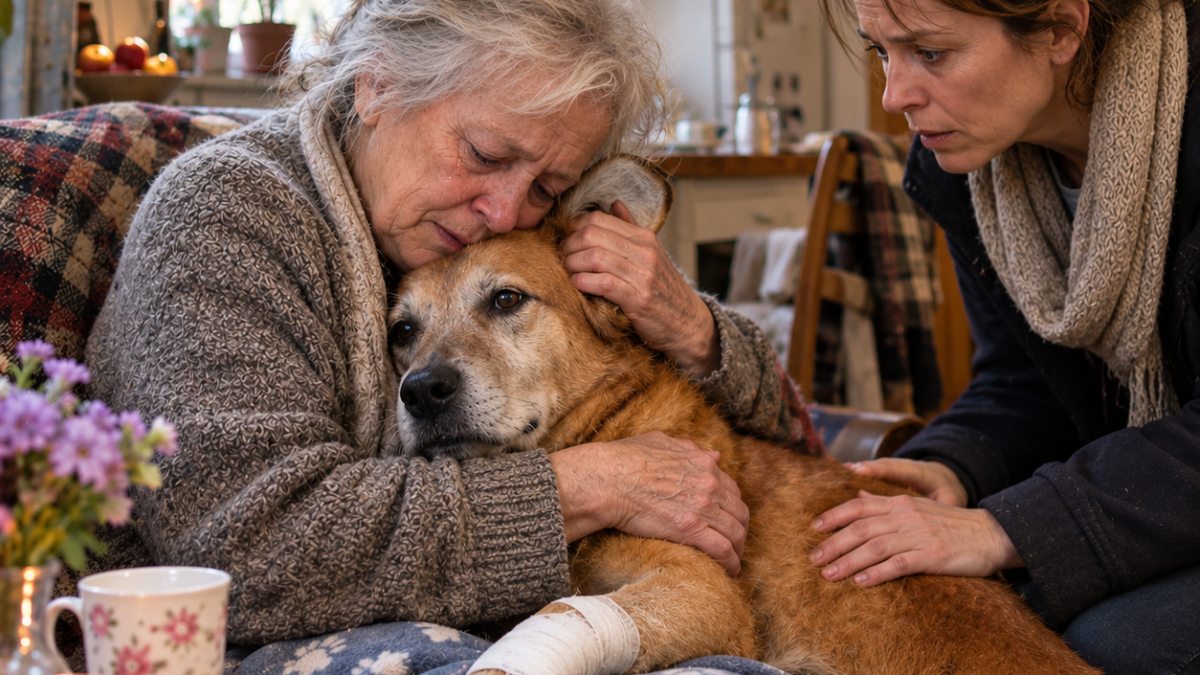
She kept reminding me that firefighters had saved my life when smoke filled the house three nights before Christmas, and every time she said it, Oscar quietly shifted his bandaged front paw beneath him while I wondered how long it would take her to notice the one question that made her entire plan fall apart.
Because when Claire finally demanded to know why I was willing to argue with my only daughter over a dog I had adopted just a few months earlier, I lifted Oscar’s injured paw, looked her straight in the eye, and asked her why his pads were burned if the firefighters had found both of us together upstairs.
My name is Madeleine.
I was seventy-seven that winter, and I still lived in the little house outside Poitiers where my husband and I had spent thirty-eight years together.
He had been dead for three years.
I had changed very little afterward.
His coat remained behind the door.
His chipped coffee mug stayed in the cupboard.
His old slippers were still beneath the bed.
Claire hated that.
“Mom, you can’t spend the rest of your life living in Dad’s things.”
Maybe she was right.
But she didn’t understand what it was like to spend an entire day without saying one word aloud.
The evenings weren’t the worst.
Mornings were.
For thirty-eight years I had heard my husband come downstairs, make coffee, complain about his glasses while they were sitting on top of his head, and ask whether I had seen the newspaper he was holding in his hand.
Then one morning there was nothing.
Only the refrigerator.
The clock.
My own footsteps.
Sometimes I turned on the radio in the kitchen simply because a stranger’s voice was better than silence.
Claire lived in Tours, a little more than an hour away. She had work, a husband, children, bills, appointments and a life that did not revolve around checking whether her widowed mother had spoken to another human being that day.
We talked every Sunday.
“Everything okay, Mom?”
“Fine.”
“Need anything?”
“No.”
I never told her that I sometimes set out two plates before remembering.
Then, one Thursday in September, I saw Oscar at an adoption event while walking to the market.
He was lying in the corner of a temporary enclosure while families crowded around younger dogs.
Honey-colored coat.
Gray muzzle.
One ear upright, the other folded.
Eleven years old.
Arthritis.
Waiting longer than most.
I crouched awkwardly.
“I’m old too, you know.”
Oscar sniffed my hand.
Then rested his muzzle on my knee.
I went home without the apples and cheese I had meant to buy.
The next day, I called the shelter.
A few days later Oscar came home with me.
He did not celebrate dramatically.
He walked beside me on his red leash and leaned his head against my leg during the bus ride.
That was enough.
The first two nights, he slept beside the front door as though expecting someone to return him.
On the third, I found him beside my bed.
Soon I had a reason to get dressed every morning.
Oscar needed walking.
He stopped at every tree.
I talked while he sniffed.
I told him neighborhood gossip.
Stories about my husband.
Things I had not said aloud to anyone for years.
The baker laughed when she saw me regularly again.
“Well, Madeleine. Look who finally came out of hiding.”
“I work for him now.”
Oscar changed the rhythm of my life.
Claire only saw the risk.
“At your age?”
“Yes, Claire. At my age.”
“What if you get sick?”
I had no answer.
Then, three nights before Christmas, an old electrical outlet behind the kitchen started a fire after I had gone upstairs.
By the time firefighters arrived, smoke had filled the ground floor.
They found Oscar and me together in the upstairs bathroom.
I spent two days in the hospital with smoke irritation and a cut on my hand.
Oscar went to my neighbor, Madame Perrin, then to a veterinarian.
One front paw was burned.
My house was temporarily unlivable.
Claire arrived frightened and angry.
She organized insurance, repairs, accommodation and every part of my life before I had enough strength to object.
Then she decided one more thing.
Oscar was going back.
She placed the shelter’s address and phone number on the table.
“I called them.”
“I’m not signing anything.”
“Mom, please be reasonable.”
Oscar struggled to his feet and crossed the room toward me despite the bandage.
I knelt and held him.
Claire exhaled.
“The firefighters saved you. Not the dog.”
I looked at Oscar’s injured paw.
Then at my daughter.
“No, Claire.”
She frowned.
I raised the bandaged foot carefully.
“Then explain something to me.”
“What?”
“If the firefighters found both of us upstairs, why are his paw pads burned?”
Claire stared at me.
I took her hand.
And for the first time, I told her what happened before the sirens arrived.
—
## **[END OF FACEBOOK OPENING — CONTINUE STORY BELOW]**
I had not awakened because of the smoke alarm.
That was the first thing Claire misunderstood.
The detector downstairs had gone off eventually, according to the firefighters, but by then smoke was already spreading through the kitchen and the little laundry room behind it.
I slept upstairs.
My hearing wasn’t terrible, but at seventy-seven it was no longer what it had been.
Rain struck the shutters that night.
Wind moved through the trees.
And I had taken the mild sleeping tablet my doctor occasionally prescribed.
The first thing that reached me was not an alarm.
It was Oscar.
At first, I thought I was dreaming.
Something struck the bedroom door.
Once.
Then again.
Then came a bark.
Oscar rarely barked inside.
One more.
Louder.
I opened my eyes.
The room was dark.
“Oscar?”
Claws scraped against the other side of the door.
I sat up.
“What is it?”
Another bark.
Then silence.
I got out of bed and opened the door.
Oscar stood in the hallway.
His body was low.
His ears pulled back.
He was panting.
I remember saying:
“Do you need outside?”
Stupid.
Ordinary questions continue even when the world has already changed.
Oscar turned.
Ran toward the staircase.
Then stopped at the top.
He looked back.
I smelled it then.
Smoke.
Not much at first.
Something electrical.
Hot plastic.
The kind of smell you notice without immediately understanding.
I reached for the light switch.
Nothing.
The electricity had already failed.
“Oscar?”
He went down three steps.
Then returned.
Whined.
I moved toward the stairs.
That was when a darker wave of smoke rolled upward.
I froze.
The first floor was almost invisible.
My kitchen was downstairs.
So was the front door.
My first instinct was still to go down.
Home teaches you routes.
Bedroom.
Stairs.
Hall.
Front door.
The body follows routine before fear has time to think.
I took one step.
Oscar moved in front of me.
I tried to pass.
“Move.”
He didn’t.
I nudged him.
He turned, went down several steps, and disappeared into the smoke.
“Oscar!”
I heard claws on wood.
Then tile.
Then nothing.
I screamed his name.
A few seconds later he came back.
Fast.
Too fast for an old dog with arthritis.
He reached the top of the stairs and stumbled.
That was when his paw was burned.
We did not understand until later that he had crossed part of the kitchen area where heat had already damaged the flooring near the back room.
He must have gone downstairs before waking me too.
Maybe more than once.
The veterinarians believed the burns were consistent with brief contact with a very hot surface.
He had smelled the fire.
Gone toward it.
Come upstairs.
Tried to wake me.
Then gone down again after I opened the bedroom door.
Why?
I cannot tell you what a dog was thinking.
I refuse to turn Oscar into a human wearing fur simply because the true version is extraordinary enough.
I only know what he did.
He came back.
When he reached me again, he grabbed the sleeve of my nightgown.
Not hard.
Pulled.
Then released.
Moved down the hallway.
Stopped.
Looked back.
The upstairs bathroom was at the end.
I followed because the smoke near the staircase was becoming unbearable.
I remember coughing.
I remember my eyes burning.
I remember trying to think of where my phone was.
Downstairs.
Of course.
I had left it charging on the kitchen counter.
Oscar moved into the bathroom.
I followed.
There was a window facing the side of the house.
I opened it.
Cold rain blew in.
I shouted.
At first nobody answered.
Our nearest neighbor, Madame Perrin, lived far enough away that I could not see her lights clearly through the rain.
I shouted again.
Oscar barked.
Not the frightened bark from before.
Sharp.
Repeated.
Again.
Again.
Again.
Then I heard glass break downstairs.
The fire.
Something falling.
I became dizzy.
I sat on the floor.
Oscar pressed himself against me.
He was trembling.
I felt something warm and wet against my hand.
I thought it was rain.
It was blood from his paw.
I did not know.
I simply held him.
Then, sometime later, I heard sirens.
That was the part Claire knew.
She knew firefighters entered.
She knew they found me sitting on the bathroom floor with Oscar against my body.
She knew I was carried downstairs.
She knew a firefighter carried Oscar because his paw had finally become too painful for him to walk.
But she had not known everything before that.
Nobody did except me.
And Oscar.
When I finished telling her, the room became completely silent.
Claire looked at the bandage.
Then at the envelope on the table.
Her face had changed.
“Why didn’t you tell me at the hospital?”
“I was tired.”
“Mom.”
“I was coughing. People kept asking questions. They gave me medication. Then insurance called. Then you arrived and began rearranging my entire existence.”
Her eyes filled.
“I thought you could have died.”
“I know.”
She looked at Oscar.
He was lying with his head against my ankle.
“So he went downstairs?”
“At least once after I woke up.”
“With the fire already there?”
“Yes.”
“And then came back?”
“Yes.”
Claire covered her mouth.
I could see her replaying the story.
Old dog.
Arthritis.
Smoke.
Hot floor.
Stairs.
Back.
She whispered:
“He could have gotten out.”
I shook my head.
“I don’t know.”
“The back door?”
“Closed.”
“He could have stayed downstairs.”
“Yes.”
“But he came to you.”
“Yes.”
Claire stared at him.
Oscar lifted his head at the sound of our voices.
She slowly crouched.
For all the months I had owned him, I had never seen my daughter approach him that gently.
“Oscar?”
One ear moved.
Claire touched the gray fur beneath his chin.
He sniffed her fingers.
Then rested his muzzle in her palm.
She began crying.
Not dramatically.
Quietly.
The envelope remained on the table.
I looked at it.
Shelter name.
Address.
Phone number.
My daughter’s careful handwriting.
A solution to a problem she believed was obvious.
Claire sat down beside Oscar.
“I didn’t know.”
“No.”
“I thought…”
She stopped.
“What?”
“I thought he was another responsibility you were pretending you could handle because you didn’t want to admit you needed help.”
“That is partly true.”
She looked at me.
I smiled faintly.
“I can be stubborn and still love my dog.”
That surprised her.
I think she had expected victory.
Instead I gave her nuance.
The fire had frightened me too.
More than I admitted.
I had spent two nights in a hospital bed hearing the same question.
Do you live alone?
Yes.
Stairs?
Yes.
Any home help?
No.
Family nearby?
Not very.
Pets?
One dog.
Age?
Seventy-seven.
Every answer seemed to form a case against me.
By the time Claire arrived, I understood why she was frightened.
I just hated that fear translated so quickly into taking things away.
Driving.
House.
Dog.
Choice.
“Claire.”
She wiped her cheeks.
“What?”
“I know I need help.”
That stopped her.
“You do?”
“Do not sound so astonished.”
“I’m sorry.”
“I cannot stay in the house right now.”
“No.”
“And when I do go back, things will have to change.”
“Yes.”
“I probably need someone coming in a few times a week.”
“Yes.”
“You’re enjoying this.”
“No.”
“You are.”
She laughed despite herself.
Maybe that saved us.
Then I pointed toward the envelope.
“But Oscar does not go back because I need help.”
Claire looked at him.
“No.”
I waited.
She took the envelope.
Turned it over.
Then tore it in half.
Not dramatically enough for a movie.
Just once.
Then again.
Four pieces.
She dropped them on the table.
“No.”
Oscar’s tail tapped the floor.
Claire laughed through tears.
“Don’t congratulate yourself.”
He wagged again.
That might have been the end of the argument.
It wasn’t the end of the problem.
Claire’s house really was full.
Her husband, Thomas.
Two teenage children.
A small terrier named Milo who hated unfamiliar dogs.
Three bedrooms.
No space for me and an elderly Labrador without turning Christmas into a territorial war.
The fire had not changed that.
“I can take you,” Claire said.
“But Oscar—”
“He stays with Madame Perrin for now.”
I looked toward my neighbor.
She had been sitting quietly near the window through most of our conversation.
At eighty-one, Madame Perrin had raised three children, buried a husband and survived enough village gossip to become immune to emotional scenes.
She looked at Oscar.
“He can stay here.”
“Are you sure?”
“No.”
I stared.
She smiled.
“But he’s already here.”
That was Madame Perrin.
Practical generosity.
Claire objected.
“What about his walks?”
“My grandson comes every afternoon.”
“Medication?”
“I can read.”
“His arthritis?”
“I also possess a telephone.”
Claire finally stopped.
Madame Perrin looked at her.
“You are exactly like your mother.”
Claire almost choked.
I laughed.
Christmas changed.
I went to Tours.
Oscar stayed with Madame Perrin.
For the first time since my husband died, I slept in a house full of people.
My grandchildren.
Claire.
Thomas.
Television too loud.
Doors opening.
Someone constantly looking for a charger.
It should have been wonderful.
Parts of it were.
But on Christmas morning, I woke before everyone.
I came downstairs.
No Oscar.
I hated the silence.
Different silence from widowhood.
Not empty.
Missing.
Claire found me in the kitchen.
“What are you doing up?”
“Habit.”
She poured coffee.
We stood together.
After a minute she said:
“I called Madame Perrin last night.”
I looked at her.
“Why?”
“To check on Oscar.”
Of course.
“How is he?”
“Apparently he stole half her toast.”
I laughed.
“Good.”
“She said he’s walking better.”
“Good.”
Claire stared into her coffee.
Then quietly:
“I’m sorry.”
I knew what she meant.
Still I made her say it.
“For?”
“The shelter.”
I waited.
“I was scared.”
“I know.”
“I thought if I could remove the variables, I could keep you safe.”
“What am I, an equation?”
“That’s not what I mean.”
“I know.”
She sighed.
“Dad died. You live alone. You adopt an old dog. Then there’s a fire. I get a call saying you’re in the hospital.”
Her voice broke.
“I drove there thinking I was going to identify your body.”
That stripped away my irritation.
I touched her arm.
“Claire.”
“I was angry at everything.”
“I know.”
“So I looked at the house and Oscar and thought, fix this, remove that, move Mom.”
I nodded.
“Fear likes verbs.”
She looked at me.
“What?”
“When your father was ill, I became the same way. Call this doctor. Change this medicine. Move that chair. Arrange that appointment.”
I smiled sadly.
“Action makes us feel less helpless.”
Claire cried.
“I don’t want you to die.”
“I will eventually.”
“Mom.”
“I’m seventy-seven, not immortal.”
“That doesn’t help.”
“No.”
I held her.
“But you cannot keep me alive by removing everything that makes living worthwhile.”
She knew exactly what I meant.
Oscar.
The house.
My morning walks.
My independence.
Not absolute independence.
No one has that.
But enough choice to still recognize my own life.
That Christmas morning, Claire made me a promise.
Not that she would stop worrying.
Impossible.
She promised to ask before deciding.
That mattered.
The insurance investigation concluded the fire began around an aging electrical outlet behind the small rear room.
No deliberate cause.
No great mystery.
Old wiring.
Heat.
Bad luck.
The kitchen was badly damaged.
Part of the ground floor needed rewiring.
Smoke affected almost everything.
For several weeks, I stayed partly with Claire and partly in a temporary apartment the insurance company arranged closer to my home.
Oscar came to the apartment.
The first day, he walked inside and looked offended.
No garden.
Unfamiliar hallway.
Elevator.
He hated the elevator.
The first time the doors moved, he spread all four paws as though the floor itself had betrayed him.
I laughed so hard I had to hold the wall.
“After running through a burning house, this frightens you?”
Oscar looked at me.
Everyone has limits.
We took the stairs when his arthritis allowed.
Otherwise, elevator.
He eventually accepted it while maintaining moral opposition.
His paw healed slowly.
The burned pads required dressings and monitoring.
Every bandage change made me remember the fire.
Claire came to one veterinary appointment.
The veterinarian unwrapped Oscar’s paw.
New pink tissue.
Healing.
Claire stared.
“Those were all burned?”
“Yes.”
The vet nodded.
“Mostly superficial to partial-thickness pad injuries. Painful, but fortunately healing well.”
Claire looked at me.
“He really crossed something hot.”
The vet glanced between us.
“That’s consistent with what we saw.”
Claire touched Oscar’s shoulder.
He leaned toward her.
I could see guilt forming again.
I stopped it.
“Don’t.”
“What?”
“You were wrong about him.”
“I know.”
“You admitted it.”
“Yes.”
“Then do better. Don’t worship your guilt.”
She laughed weakly.
“That sounds like something Dad would say.”
It was.
That hurt pleasantly.
Oscar recovered.
So did the house.
But the deeper repairs took longer.
My kitchen had to be rebuilt.
Electrical system upgraded.
Smoke-damaged walls cleaned.
The little back room practically started over.
Claire became involved in every decision.
At first, too involved.
“No gas stove.”
“I never had gas.”
“Induction, then.”
“I already had electric.”
“Automatic shutoff.”
“For what?”
“Safety.”
“Claire.”
“Fine.”
Then she pointed at the stairs.
“We need a second handrail.”
I opened my mouth.
Stopped.
She was right.
“Fine.”
Her eyes widened.
“Did you just agree?”
“Do not make this unpleasant.”
We added the handrail.
Better smoke detectors.
Additional lighting.
A small home alert system.
And, at my request, a low dog gate separating Oscar from the kitchen when I was cooking.
Claire smiled when she saw it.
“So you admit he can be a trip hazard.”
“He can be a nuisance.”
Oscar wagged.
“Different.”
I also accepted a home aide twice a week.
Her name was Nadine.
Fifty-six.
Efficient.
Too cheerful before nine in the morning.
The first day, she tried reorganizing my kitchen.
I nearly fired her.
Oscar barked.
Nadine looked at him.
“He agrees with you?”
“He has excellent judgment.”
She left the cupboards alone.
We became friends.
That was the real lesson from the fire.
Not:
Madeleine cannot live alone.
Not:
Madeleine must prove she needs nobody.
Both were foolish extremes.
I could live in my house.
With support.
I could keep Oscar.
With plans.
I could be old without surrendering every decision.
And Claire could worry without turning fear into authority.
We learned.
Slowly.
Then the firefighter came.
His name was Julien.
I recognized him vaguely from the hospital, though smoke and oxygen had blurred most faces.
He came to the house while repairs were still underway because the fire service was completing some follow-up documentation.
Oscar was lying near the doorway.
The moment Julien entered, Oscar stood.
Tail wagging.
Julien crouched.
“Well, there he is.”
“You remember him?”
“I carried him downstairs.”
Oscar sniffed his jacket.
Then pressed his head against Julien’s chest.
The firefighter smiled.
“Apparently he remembers me too.”
Claire was there.
She asked:
“Can I ask you something?”
“Of course.”
“When you found them…”
Julien looked at me.
I nodded.
“…was Oscar with her the whole time?”
“When we reached the bathroom, yes.”
“Did you know his paw was burned?”
“Not immediately.”
“What did he do when you entered?”
Julien smiled.
“Barked at us.”
Claire looked surprised.
“He barked?”
“Then he stood between us and your mother.”
I laughed.
“That sounds ungrateful.”
“He stopped once we spoke to her.”
Julien looked at Oscar.
“Then he tried to follow the first firefighter who carried your mother out.”
Claire’s eyes filled again.
Julien continued.
“One of us carried him because he started limping.”
She stared at the dog.
“You never told me that.”
“I didn’t know.”
The firefighter shrugged.
“It was chaos.”
Then he said something that changed Claire even more than my story had.
“We save people because it’s our job.”
He scratched Oscar’s neck.
“He did what he did because you were his person.”
Claire looked away.
Oscar’s tail moved.
Julien stood.
“Good dog.”
That evening, Claire went home and apparently told Thomas everything in full.
The next morning she called.
“I want to do something.”
“What?”
“For the shelter.”
My stomach tightened.
“Why?”
“They gave you Oscar.”
“Yes.”
“I was ready to send him back without asking what that would do to either of you.”
“You were frightened.”
“I know.”
“What do you want to do?”
“Pay his adoption fee retroactively?”
“It’s already been paid.”
“I know.”
“Then that is a very strange plan.”
She sighed.
“They have older dogs there, right?”
“Yes.”
“I want to sponsor one.”
I became quiet.
“Why?”
“Because I looked at Oscar and saw a burden before I saw what he gave you.”
That sentence mattered.
A week later, Claire visited the shelter.
I went with her.
Oscar stayed home with Madame Perrin because I did not want to confuse him by taking him back unnecessarily.
The senior-dog section was quieter than the puppy area.
People walked past more slowly.
Sometimes not at all.
A twelve-year-old spaniel named Rufus sat near the front of one kennel.
Claire stopped.
“How long?”
The volunteer checked.
“Four months.”
“Why?”
“Age. Heart medication.”
Claire crouched.
Rufus approached.
Sniffed.
Then walked back to his bed.
“He doesn’t seem very interested.”
The volunteer smiled.
“He’s twelve. He has standards.”
I laughed.
Claire sponsored his medical costs for several months.
Then something unexpected happened.
A retired couple saw his listing, learned his medication was covered initially, met him and adopted him.
Claire received a photograph.
Rufus asleep under a dining table.
She showed me.
“He got a home.”
“Yes.”
“Because of the sponsorship?”
“Maybe partly.”
She looked proud.
I let her.
People sometimes need one useful action to reorganize guilt.
Then she sponsored another old dog.
And another.
Not endlessly.
She was not wealthy.
But each Christmas after that, instead of buying me another scarf I did not need, she donated to the shelter’s senior-animal fund.
The first year, I complained.
“I wanted chocolate.”
She brought chocolate too.
Acceptable.
Oscar became stronger once his paw healed.
Still eleven.
Still arthritic.
Still gray.
But stronger.
Our walks resumed.
Short at first.
To the end of the road.
Then around the block.
The bakery owner saw us.
“Madeleine!”
I waved.
She came outside.
“And the hero?”
I rolled my eyes.
“Do not start.”
Oscar accepted a piece of dog-safe biscuit.
The baker crouched.
“I heard what he did.”
“Everyone has.”
“People are talking.”
“People need hobbies.”
She laughed.
A local newspaper eventually called.
I refused.
Then Claire said:
“Maybe telling it could help older dogs get adopted.”
I glared at her.
“You have become unbearable.”
“Genetics.”
Unfortunately correct.
I agreed to one short interview.
The reporter wanted a dramatic headline.
**SENIOR RESCUE DOG SAVES ELDERLY OWNER FROM CHRISTMAS FIRE.**
I hated “elderly owner.”
Oscar was old.
I was experienced.
But the article was kind.
It focused less on heroism than on the fact that senior dogs still have value.
The shelter received calls.
Three older dogs were adopted within two weeks.
Coincidence?
Publicity?
Christmas sentimentality?
I didn’t care.
They went home.
Oscar knew none of this.
He spent the interview asleep.
Perfect.
Months passed.
The fire became a story instead of an immediate smell.
For a long time, smoke frightened me.
Toast burning made my hands shake.
A neighbor’s fireplace could make my heart race.
Oscar reacted too.
The first time my new oven produced that harmless hot-metal smell, he stood abruptly.
Moved toward me.
Whined.
I turned everything off.
Sat on the floor.
“We’re okay.”
He pressed against me.
Both of us had learned fear.
The difference was I had language for mine.
Oscar had only behavior.
Nadine, my home aide, said:
“You should talk to someone.”
“I’m talking to you.”
“A professional.”
“You are professional.”
“Not that kind.”
I eventually listened.
A counselor helped me understand that surviving something does not automatically end when you leave the hospital.
For weeks, my body remained inside that smoky stairwell.
Oscar too.
We rebuilt trust in the house together.
The first night I slept there again after repairs, I almost changed my mind.
Everything looked familiar and unfamiliar simultaneously.
New kitchen cabinets.
Fresh paint.
Different light fixtures.
The old clock survived.
My husband’s coat still hung behind the door.
Claire had wanted to throw it away because it smelled faintly of smoke.
I refused.
Oscar entered.
Sniffed.
Room by room.
Then walked to the place where his old bed used to sit near the stairs.
His bed was not there.
During repairs, we had moved it closer to my bedroom downstairs because climbing stairs was becoming harder for him.
Oscar looked confused.
I tapped the new bed.
“Here.”
He walked toward it.
Sniffed.
Circled twice.
Lay down.
I sat beside him.
“We both have to learn the new house.”
That first night, I slept downstairs too.
Not because I was afraid of the stairs.
Well.
Partly.
Mostly because Oscar could no longer climb comfortably.
We moved my bedroom temporarily into the old study.
Claire saw the setup and smiled.
“What?”
“Nothing.”
“You’re judging.”
“I was going to say it’s sensible.”
I became suspicious.
“You?”
“Yes.”
“Who are you?”
She laughed.
Our relationship improved after the fire.
Not because Oscar magically fixed decades of mother-daughter tension.
We still argued.
She still called too often.
I still said “I’m fine” when I clearly was not.
She still arrived with groceries I had not requested.
I still accused her of trying to manage me.
But something changed.
She started asking:
“What do you want?”
Not:
Here’s what we’re doing.
Small sentence.
Big difference.
And I became better at answering honestly.
“I need help with the garden.”
“I don’t want to drive at night anymore.”
“Can you come to the cardiology appointment?”
“Yes, I’m lonely today.”
That last one was the hardest.
For years, loneliness felt like failure.
As though admitting I missed my husband meant I had not rebuilt enough.
Oscar made confession easier.
Animals do not judge repetitive grief.
I could tell him the same story about my husband ten times.
He never said:
You already told me.
Sometimes Claire joined our walks.
At first, Oscar stayed beside me.
Then he began moving between us.
One morning, Claire held the red leash.
I felt oddly nervous.
“Not too fast.”
“I know.”
“His left hip bothers him.”
“I know.”
“If he stops—”
“Mom.”
“What?”
“I know.”
Oscar looked back at me.
Claire smiled.
“He’s checking.”
“He always does.”
She touched his back.
“Come on, old man.”
They walked ahead.
I watched my daughter and my dog move down the road together.
Months earlier she had written the shelter’s address on an envelope.
Now she carried poop bags in her coat pocket.
Life has humor.
Then Thomas’s father became ill.
Suddenly Claire found herself on the other side of the problem.
Her father-in-law, André, was eighty-two and living alone after his wife moved into memory care.
He refused help.
Refused meal delivery.
Refused a medical alert system.
Sound familiar?
Claire called me.
“He is impossible.”
I laughed.
“Poor man.”
“This isn’t funny.”
“It is from here.”
“He fell in his bathroom and didn’t tell anyone for two days.”
My smile disappeared.
“What happened?”
“Bruised ribs.”
“Is he safe?”
“For now.”
Claire sighed.
“I keep telling him he needs help.”
“And?”
“He says I’m trying to steal his independence.”
I waited.
Then:
“Oh.”
“Yes.”
Silence.
“I sound like you.”
“Yes.”
“I hate this.”
“Growth is uncomfortable.”
She became quiet.
“What do I do?”
“Ask what help he can accept.”
“That’s it?”
“No.”
“Then?”
“Prepare to repeat yourself seventy times.”
Claire groaned.
Oscar slept beside my chair.
The lessons moved outward.
That is how lives change each other.
Not through one perfect revelation.
Through repetition.
Oscar turned twelve.
Then thirteen.
His muzzle became almost completely white.
Arthritis worsened.
We added medication.
A ramp for the back step.
Non-slip rugs.
Claire paid for the ramp.
“No argument,” she said.
“I wasn’t arguing.”
“You were about to.”
Fair.
Oscar hated the ramp for three days.
Then discovered it was easier.
After that, he refused to use the step at all.
“Manipulative,” I told him.
He wagged.
At thirteen, he began sleeping more.
Sometimes the house became so quiet I checked whether he was breathing.
Widowhood gives you bad habits around silence.
I would stand over his bed.
Watch his chest.
Up.
Down.
Good.
One afternoon he opened one eye while I was checking.
I felt accused.
“Stop being old.”
He closed it again.
Useless.
That year, the shelter held another adoption event in September.
Exactly four years after I had met Oscar.
They asked us to attend.
I almost refused because crowds tired him.
Then Claire suggested we go for thirty minutes.
Oscar walked slowly through the same courtyard where I first saw him.
Different volunteers.
Different dogs.
Same temporary enclosures.
A honey-colored dog of about ten sat alone near the back.
No one approached him.
I felt something twist.
Oscar sniffed the air.
The volunteer recognized us.
“Madeleine?”
“Yes.”
“And Oscar?”
“The one and only.”
She smiled.
“We have his picture in the senior-dog room.”
“Why?”
“Because his story helps.”
Oscar did not care.
He was interested in a dropped piece of sausage.
I looked toward the older dog.
“What’s his name?”
“Sam.”
“How long?”
“Five months.”
“Medical?”
“Some arthritis. Otherwise good.”
I glanced at Claire.
She immediately understood.
“No.”
“I said nothing.”
“You are thinking.”
“About what?”
“Adopting another senior dog.”
“I am seventy-nine.”
“Exactly.”
I laughed.
“I was going to sponsor him.”
Claire softened.
“Oh.”
We did.
Sam was adopted six weeks later by a widower.
When the shelter sent the photograph, I stared at it for a long time.
Man sitting in an armchair.
Old dog beside him.
I knew that beginning.
Maybe their ending would be different.
That was fine.
Oscar did not need copies.
He had already changed mine.
Then came the first health scare unrelated to the fire.
Oscar collapsed during a walk.
Not unconscious.
His back legs simply gave way.
I knelt beside him.
“Oscar?”
He looked at me.
Alert.
But unable to rise immediately.
My hands shook so badly I could barely call the veterinarian.
Claire met us there.
X-rays.
Bloodwork.
Examination.
Arthritis worse.
Muscle loss.
No catastrophic injury.
Rest.
Medication adjustment.
Shorter walks.
I exhaled for the first time in an hour.
Claire sat beside me.
“You scared me.”
“I scared you?”
“Yes.”
“Oscar fell.”
“You sounded terrified on the phone.”
I looked at her.
“I am allowed.”
“I know.”
That was new.
No one telling me to calm down.
No one turning fear into evidence of incompetence.
Just:
I know.
Oscar improved.
But not back to before.
Age only occasionally gives back everything.
We adjusted.
Ten-minute walks.
Then rest.
Some days longer.
Some shorter.
I bought a little folding wagon after seeing another senior dog ride in one.
Claire laughed until she saw Oscar in it.
He sat upright like royalty.
“This is ridiculous.”
“He deserves transportation.”
“He has four legs.”
“Three and a half good ones.”
We took the wagon to the bakery.
People waved.
Oscar loved the attention as long as treats followed.
The newspaper ran another photograph.
I complained.
Secretly, I kept it.
At fourteen, his hearing began fading.
Not severe.
But enough that he slept through the doorbell sometimes.
That frightened me more than it should have.
The dog who once woke me from fire could now sleep through loud noises.
Time is cruelly literal.
I began using touch more.
A hand gently on his shoulder before waking him.
Floor vibrations.
Visual gestures when he was looking.
Claire learned too.
She stopped calling him from across the room when he couldn’t hear.
She went to him.
One afternoon, she knelt beside his bed and said:
“I used to think you were going to be too much for her.”
Oscar slept.
“And then you made her more.”
I was in the hallway.
She didn’t know I heard.
I stayed there.
Some moments should not be interrupted.
She stroked his gray head.
“I’m sorry.”
Oscar opened his eyes.
Licked her wrist.
Then went back to sleep.
Dogs are inefficient at holding grudges.
That was probably good for humanity.
Around that time, André—Thomas’s father—agreed to adopt a cat.
Not because Claire pushed.
Because the shelter suggested companionship after he began receiving home support.
The cat was eight.
Black.
Missing half an ear.
Named Jules.
Claire called me.
“You’re responsible.”
“For what?”
“Dad’s father adopted a senior cat.”
“Excellent.”
“He talks to it constantly.”
“Excellent.”
“He refused a person but accepted an animal.”
“Also excellent.”
“Why?”
“Because animals don’t arrive carrying clipboards.”
She laughed.
Fair.
Oscar had taught us that care sometimes enters more easily on four legs.
Then my health changed.
Not catastrophically.
Blood pressure.
One minor fall.
Nothing broken.
But enough.
I accepted more help.
Nadine came three times a week.
Claire visited Wednesdays.
Madame Perrin checked on me on Sundays, though she was older than I was and therefore a questionable safety plan.
Oscar remained beside me.
His existence did not prevent support.
It helped me accept it.
That was what Claire had missed at first.
She thought the choice was:
Dog or help.
Independence or safety.
Home or supervision.
Old age taught us better.
Life is rarely either/or.
It is often badly organized combinations.
A handrail and your own house.
A home aide and privacy.
A daughter who worries and a mother who still chooses.
An old woman and an old dog looking after each other imperfectly.
Then, one December evening almost four years after the fire, Claire arrived carrying an envelope.
I stared.
“What is that?”
She looked confused.
“Christmas card.”
“From whom?”
“The shelter.”
My stomach tightened involuntarily.
Memory is ridiculous.
Envelope.
Address.
Phone number.
Oscar goes back.
Claire noticed.
“Oh.”
She sat beside me.
“You remember.”
“Of course.”
She opened it.
Inside was a photograph collage of senior animals adopted that year.
At the bottom:
**Thank you to the supporters of our senior-pet assistance fund.**
Claire had contributed again.
There were twelve old dogs and six cats in the photographs.
One was Sam.
Another, a beagle with cloudy eyes.
A fifteen-year-old cat asleep on someone’s pillow.
I looked at Claire.
“You did this?”
“A little.”
She shrugged.
“Other people too.”
I touched one photograph.
“You know what’s funny?”
“What?”
“You wanted to return one old dog.”
“I know.”
“And now you’re funding strangers’ veterinary bills.”
She looked toward Oscar.
“People are allowed to improve.”
“Yes.”
I smiled.
“Sometimes.”
She hit my arm gently.
Oscar barked from his bed because any sudden movement between us apparently still required investigation.
Claire got up.
“Nothing’s happening.”
He wagged.
She brought the envelope to him.
“Look what you did.”
He sniffed it.
Then tried to chew the corner.
Perfect.
We framed the collage.
The torn pieces of the original envelope were long gone.
But I remembered them.
Sometimes I think the most dramatic objects in our lives are terribly ordinary.
An envelope.
A red leash.
A bandage.
A chipped mug.
They hold only the meaning we pour into them.
Oscar turned fifteen.
Nobody knew his exact birthday, so the shelter had assigned one.
We celebrated with chicken.
Small amount.
Veterinarian approved.
He ate as if facing famine.
Claire laughed.
“Still greedy.”
“Consistent.”
His kidneys began changing that year.
Early disease.
Diet adjustment.
More water.
Monitoring.
Nothing immediately terrible.
But I knew.
Old dogs do not become young because we love them correctly.
That is not the promise.
The promise is comfort.
Dignity.
Presence.
Time used well.
Oscar’s world became smaller.
No more long neighborhood loop.
We walked to the corner.
Sometimes only the garden.
On good days, wagon to the bakery.
He still recognized the smell.
I’m convinced of that.
His nose would lift before we reached the door.
The baker kept treats behind the counter.
“Only one,” I said.
She gave him two.
“Traitor.”
Oscar adored her.
He slept more.
I talked anyway.
About my husband.
Claire.
Léa, my granddaughter, beginning university.
The neighbor’s ugly new fence.
The price of butter.
Oscar never judged.
That was his great talent.
Then came another winter.
His sixteenth, approximately.
The veterinarian used the phrase I hated.
“Quality of life.”
We discussed food.
Mobility.
Pain.
Interest.
Comfort.
Breathing.
Good days versus bad.
I listened.
Did not argue.
That surprised Claire.
Afterward, she said:
“You’re being very calm.”
“I learned.”
“From what?”
“The fire.”
She waited.
“I spent years thinking holding on was the same as loving.”
My eyes moved toward my husband’s coat, still behind the door even after all that time.
“Sometimes it is.”
Then toward Oscar.
“Sometimes love is noticing when holding on becomes for you instead of them.”
Claire took my hand.
No decision that day.
Oscar still ate.
Still wanted us.
Still enjoyed the garden.
Good.
Weeks passed.
Then one morning, he refused breakfast.
I offered chicken.
No.
Cheese.
No.
That frightened me.
Oscar had once tried to steal a croissant wrapper from a trash can.
Food mattered.
He drank a little.
Then tried to stand.
His front legs rose.
Back legs failed.
I called Claire.
Not the veterinarian first.
Claire.
“Come.”
She heard my voice.
“I’m leaving now.”
No questions.
She arrived within an hour.
Oscar was on his bed.
The same style of bed he had first used after adoption.
His red leash hung beside the door.
Claire knelt.
“Hey, old man.”
Tail.
One movement.
She covered her face.
I sat beside her.
“We call now.”
“Yes.”
The veterinarian came to the house.
That mattered to me.
No final clinic.
No table.
No unfamiliar smell.
He examined Oscar.
Kidneys worse.
Arthritis severe.
Heart slower.
Pain increasingly difficult to control.
Could we hospitalize?
Yes.
Fluids.
Tests.
Medication.
Potentially more days.
Maybe weeks.
I asked:
“Good weeks?”
The veterinarian looked at Oscar.
Then at me.
“Uncertain.”
I knew what that meant.
Claire began crying.
I did not.
Not yet.
“Can we take him outside?”
“Yes.”
It was cold but dry.
Claire and I supported Oscar with a towel beneath his body.
He walked three steps into the garden.
Then stopped.
Nose lifted.
Winter air.
Wet soil.
Wood smoke from somewhere far enough away that it no longer frightened me.
For a second, I remembered the fire.
Oscar racing through smoke.
Burned paw.
Bathroom floor.
Sirens.
Then I looked at the dog in front of me.
Old.
Weak.
Gray.
Safe.
He had given me four additional years after that night.
Not because he medically saved me alone.
Firefighters did that.
The neighbor who raised the alarm mattered.
Emergency crews mattered.
But Oscar changed the first minutes.
He woke me.
He came back.
He did not leave me alone in the smoke.
Whatever else anyone wanted to call him, burden was no longer possible.
Claire knelt in the grass.
Oscar moved toward her.
She opened her arms.
He rested his head on her lap.
She cried into his fur.
“I almost sent you back.”
I sat beside them.
“You didn’t.”
“But I wanted to.”
“You were scared.”
“That doesn’t make it right.”
“No.”
She looked at me.
I smiled.
“You know what made it right?”
“What?”
“You changed your mind.”
That matters more than people think.
Being wrong is inevitable.
Staying wrong after the truth arrives is a choice.
Claire kissed Oscar’s head.
“Thank you.”
The dog breathed slowly.
“For saving her.”
I touched my daughter’s hand.
“And for saving you from becoming unbearable.”
She laughed while crying.
“Too late.”
We brought Oscar inside.
Madame Perrin arrived.
Nadine too.
The baker sent a piece of plain chicken Oscar did not eat.
The shelter volunteer who had introduced us came after work.
Her name was Élodie.
She was older now too.
She sat beside Oscar.
“I remember you.”
Oscar’s ears barely moved.
“You wouldn’t get up for anyone.”
I smiled.
“He got up for me.”
“Yes.”
She looked at us.
“He chose well.”
I shook my head.
“We both did.”
The veterinarian returned in the afternoon.
No rush.
We had decided.
That sentence sounds clean.
The reality was not.
I changed my mind four times.
Maybe one more night.
Maybe fluids.
Maybe tomorrow he’ll eat.
Then Oscar tried to stand and cried.
A small sound.
That ended the argument.
I held his face.
“No.”
Not to him.
To pain.
Enough.
The first medication relaxed him.
His breathing softened.
Claire sat on one side.
I on the other.
The red leash lay beside his bed.
I had considered bringing my husband’s old slipper because Oscar used to sleep on it during his first months with me.
Then I decided against turning his death into a display of symbols.
Oscar needed hands.
Voices.
Familiar smell.
He had those.
I whispered:
“Remember your first night?”
His eyes were half closed.
“You slept by the door because you thought I’d send you away.”
Claire began crying harder.
“Then you moved beside my bed.”
His tail made the tiniest movement.
“You got me outside every morning.”
I stroked his ear.
“You made me speak.”
My throat tightened.
“You made me need tomorrow.”
That was the truth I had rarely admitted.
People called Oscar heroic because of the fire.
But he had been saving me long before anything burned.
Not from death.
From shrinking.
From turning my life into four rooms and a radio.
From confusing survival with living.
The fire was simply the moment everyone else could see what he had been doing quietly since September.
Claire whispered:
“Mom.”
I looked at her.
She pointed toward the table.
An envelope sat there.
The shelter Christmas card.
I had kept it.
She opened it.
On the back, she had written something.
“What is that?”
She handed it to me.
**For every old dog someone thinks is too much trouble before they’ve been given the chance to become someone’s reason to get up in the morning.**
I looked at her.
“You wrote that?”
“Yes.”
“When?”
“Today.”
I cried then.
Finally.
Oscar’s head remained in my lap.
The veterinarian waited.
I nodded.
The final medication was given.
Oscar took one slow breath.
Then another.
His body softened.
Stillness.
Not the frightening silence after my husband died.
Different.
This silence had Claire’s hand in mine.
Madame Perrin nearby.
A veterinarian who had cared for him.
A house full of evidence that he had existed.
I leaned down.
“Goodnight, my boy.”
Oscar died at home.
The same home where he had once slept beside the door because he was afraid someone might make him leave.
He never had to leave again.
For a while after his death, mornings became dangerous.
Not physically.
Emotionally.
I woke and expected the sound of his paws.
Nothing.
I reached for the leash automatically.
Nothing.
The first morning, I almost stayed in bed.
Then I heard my husband’s old lesson inside my own head.
Get up.
Not literally his voice.
Memory.
I got dressed.
Walked alone.
Only to the bakery.
The baker saw me through the window.
Her smile disappeared when she noticed the empty space beside me.
She came around the counter.
“Oh, Madeleine.”
“I know.”
She hugged me.
I hated being hugged in public.
Allowed it.
Then she put coffee in front of me.
No charge.
I complained.
“Your business model is terrible.”
She laughed.
Good.
That became my new morning routine.
Not every day.
Enough.
Claire expected me to collapse emotionally after Oscar died.
I surprised both of us.
I grieved.
Deeply.
But grief was no longer unfamiliar.
And this time, I had learned something.
The answer to losing company is not preserving emptiness.
After my husband died, I kept his coat behind the door and stopped going out.
After Oscar died, I kept his red leash—but I continued walking.
That was the difference.
One month later, I returned to the shelter.
Élodie saw me.
Her face changed.
“Madeleine?”
“I am not adopting another dog.”
She laughed.
“I didn’t ask.”
“Good.”
I carried an envelope.
Of course.
My life had become ridiculous with envelopes.
Inside was a donation.
Not huge.
My pension remained modest.
Enough to cover part of the veterinary costs for another senior dog.
I placed it on the desk.
“For the old ones.”
Élodie looked at the name on the envelope.
**OSCAR.**
She cried.
I pretended not to notice.
Then a dog barked from the senior wing.
I looked.
A gray-faced black dog stood behind the kennel door.
I pointed.
“No.”
Élodie laughed.
“I still didn’t ask.”
“Good.”
I went home alone.
That was okay.
People often assume a meaningful animal relationship must be followed by another adoption.
Not always.
Oscar was not a vacancy.
He was a life.
I didn’t need to replace him to prove I had healed.
Claire continued supporting the shelter.
The senior fund grew.
Other people who read Oscar’s story donated.
Eventually the shelter created a small program helping older adopters with practical needs when they adopted senior animals.
Temporary foster arrangements during hospitalization.
Transportation to veterinary appointments.
Emergency contacts.
Nothing glamorous.
Exactly the kind of support Claire and I had needed.
They called me before naming it.
“We’d like to call it Oscar’s Home Support Fund.”
I hated the name.
Too sentimental.
I said yes immediately.
The first person it helped was a seventy-four-year-old widower named Paul who wanted to adopt a ten-year-old dog but worried about what would happen if he went into hospital.
They created a backup plan.
He adopted her.
Her name was Mimi.
I met them once.
Paul said:
“I almost didn’t apply because I thought they’d say I was too old.”
I understood.
Mimi leaned against his leg.
“How is it going?”
“She snores.”
“Terrible.”
“Steals my blanket.”
“Return immediately.”
He laughed.
“No chance.”
Good.
That was Oscar’s revenge, if you insist on using the word.
Not against Claire.
Not against the shelter.
Not against age.
Against the assumption that an old dog and an old person together could only become a problem.
Oscar had been eleven when I adopted him.
People passed him because they wanted puppies.
I was seventy-seven.
People worried I was too old to take responsibility.
Together, we became the thing everyone feared:
Two aging creatures with medical needs.
And somehow we were also exactly what the other required.
I gave him a home for his final years.
He gave me mornings.
Walks.
Conversation.
Neighbors.
A reason to rebuild after fire.
And one night, when the house filled with smoke, he spent whatever strength his old body had to make sure I woke up.
That is not a bad exchange.
Claire eventually framed something for me.
Not the newspaper article.
I would have thrown it away.
The original shelter adoption photograph.
Oscar standing beside me on the day I took him home.
My coat slightly too large.
His red leash.
Neither of us looking particularly enthusiastic.
Below it she added another photograph.
Christmas, the year after the fire.
Oscar asleep beneath Claire’s table.
My granddaughter sitting beside him.
Bandage gone.
Gray muzzle older.
Safe.
Between the photographs, Claire placed one sentence:
**I thought Mom had brought home another responsibility. I didn’t understand she had brought home a relationship.**
I complained that it sounded like something from a greeting card.
Then hung it in the hallway.
My husband’s coat remained behind the door for another year.
One spring morning, I finally took it down.
Claire happened to be visiting.
She froze.
“What are you doing?”
“Donation box.”
“You’re giving Dad’s coat away?”
“Yes.”
She looked more emotional than I did.
Interesting.
“I thought you’d keep that forever.”
“So did I.”
I folded it.
Placed it carefully in a bag.
Claire touched the sleeve.
“Are you sure?”
I looked toward Oscar’s framed photograph.
“Yes.”
Loving someone does not require keeping every object exactly where death left it.
Oscar taught me that accidentally.
He arrived in a house that had become a museum to my husband.
Then demanded floor space.
A bed.
Bowls.
Leashes.
Medication.
Mud.
Noise.
Life pushed its way back in.
By the time Oscar died, I was no longer afraid moving an object meant moving away from a person.
Memory survived rearrangement.
That was freedom.
At eighty-one, I still lived in my house.
With more support.
Nadine came.
Claire called.
Sometimes too often.
I carried an alert pendant when I was alone.
I no longer climbed ladders.
Mostly.
Claire claims once is too many.
I walked to the bakery.
I volunteered once a month at the shelter, folding blankets because my knees disliked kennel cleaning.
The senior dogs interested me most.
Of course.
I never said:
Someone will definitely adopt you.
False promises help nobody.
I simply sat nearby sometimes.
One old dog named Albert ignored me for six visits.
On the seventh, he put his head on my shoe.
Élodie saw.
“Careful.”
“I am not adopting him.”
“You keep saying that.”
“I mean it.”
I did.
Albert went to another family eventually.
Good.
At Christmas, Claire came to my house instead of insisting I go to Tours.
We ate in the rebuilt kitchen.
Thomas.
The grandchildren.
Madame Perrin.
Nadine joined for dessert.
Too many chairs.
Too much noise.
Perfect.
Claire gave me an envelope.
I stared.
She laughed.
“Open it before becoming dramatic.”
Inside was a receipt from the shelter.
Donation to Oscar’s fund.
In my name.
I looked at her.
“You could have bought chocolate.”
“There’s chocolate too.”
Good child.
At the bottom of the receipt was a handwritten note from Élodie:
**This year the fund helped seven senior animals remain with their adopters during medical emergencies instead of being surrendered.**
Seven.
I read it twice.
Claire watched me.
“I kept thinking about what I almost did.”
“You do not need to punish yourself forever.”
“I know.”
“Good.”
She touched the paper.
“But maybe remembering can be useful.”
Yes.
That was better.
I placed the receipt inside the envelope.
Then, without thinking, I remembered the other one.
Shelter address.
Phone number.
Oscar goes back.
For years, I thought dramatic change required dramatic people.
Oscar was not dramatic.
He was old.
Slow.
Quiet.
He slept a lot.
He never performed tricks beyond sitting when food was involved.
He did not look like the dog in heroic stories.
That may be why his story matters.
When the fire came, he did not become younger.
He did not stop having arthritis.
He did not suddenly know what emergency services were.
He smelled danger.
He woke me.
He moved through a place that hurt him.
He came back.
That was enough.
Sometimes courage is simply refusing to leave the person you love in the room where danger is growing.
And sometimes love looks far less dramatic.
Getting up in rain because an old dog needs to pee.
Paying a veterinary bill.
Moving a rug so arthritic paws do not slip.
Accepting help because someone depends on you staying well.
Tearing up an envelope because new information proves your plan was wrong.
Those moments saved our family too.
Claire and I stopped arguing about whether I could handle life alone.
The truth was:
I wasn’t alone.
Nobody really is, if we allow others close enough.
The last time someone asked me whether Oscar saved my life, I answered differently.
“Yes.”
They expected the fire story.
So I added:
“But not only that night.”
He saved mornings.
He saved routine.
He saved the part of me that had started disappearing after my husband died.
He made me walk.
Talk.
Laugh with the baker.
Argue with veterinarians.
Accept my daughter’s help without believing that meant I was useless.
The firefighters saved my body from a burning house.
Oscar had been pulling me back into life for months before they arrived.
That was what Claire finally understood.
And that is why, years later, the photograph I keep beside my bed is not Oscar with a bandaged paw.
Not the fire truck.
Not the newspaper clipping.
It is the first photograph.
A seventy-seven-year-old widow standing beside an eleven-year-old dog almost nobody wanted because he was already old.
Both of us looking slightly uncertain.
Neither of us knowing what the other was about to change.
The red leash hangs beneath it.
I sometimes touch it before bed.
Not because I expect Oscar to return.
I learned long ago that holding an object cannot bring anyone back.
I keep it because it reminds me of something simpler.
On the day I adopted Oscar, I thought I was giving an old dog somewhere safe to spend whatever time he had left.
I did.
But that was only half the story.
He gave me somewhere to spend mine.
And the envelope my daughter once placed on the table because she believed Oscar was a burden?
I kept an envelope too.
Not that one.
That one was torn up years ago.
Inside mine are the annual letters from the shelter telling me how many old dogs and cats Oscar’s fund has helped keep in homes.
Every Christmas, I add another.
Sometimes Claire reads them with me.
And every year, before we close the envelope, she says the same thing.
“I’m glad you didn’t listen to me.”
I always answer:
“So am I.”
Then, because I am still her mother and therefore required to make sure she never becomes too comfortable, I add:
“But it would be nice if you remembered that more often.”
She rolls her eyes.
I laugh.
And somewhere in that laughter is my husband.
Oscar.
The old kitchen.
The rebuilt one.
The night of the fire.
The morning after.
Everything I lost.
Everything that stayed.
Everything that changed.
That is the ending Oscar gave us.
Not that an old dog became a hero.
He had never needed to become anything other than himself.
The real ending was that a frightened daughter looked at an eleven-year-old shelter dog and saw one more problem her aging mother could not safely carry.
Then she learned that, on the worst night of my life, that same old dog carried himself through smoke and heat, climbed back upstairs on burned paws, and refused to leave me behind.
After that, Claire never looked at age the same way.
Neither did I.
Oscar had already spent too long waiting at a shelter because people looked at eleven years and saw what he might need from them.
I looked at him and asked what life we might still have together.
Four years, as it turned out.
Four ordinary, difficult, beautiful years.
More than enough time to prove one thing.
Sometimes the creature everyone thinks will become your burden is the one who teaches you how much life you are still capable of carrying.








