My 8-Year-Old Vanished Into a Flooded River—Then Our Old Dog Went After Him and Refused to Let Go
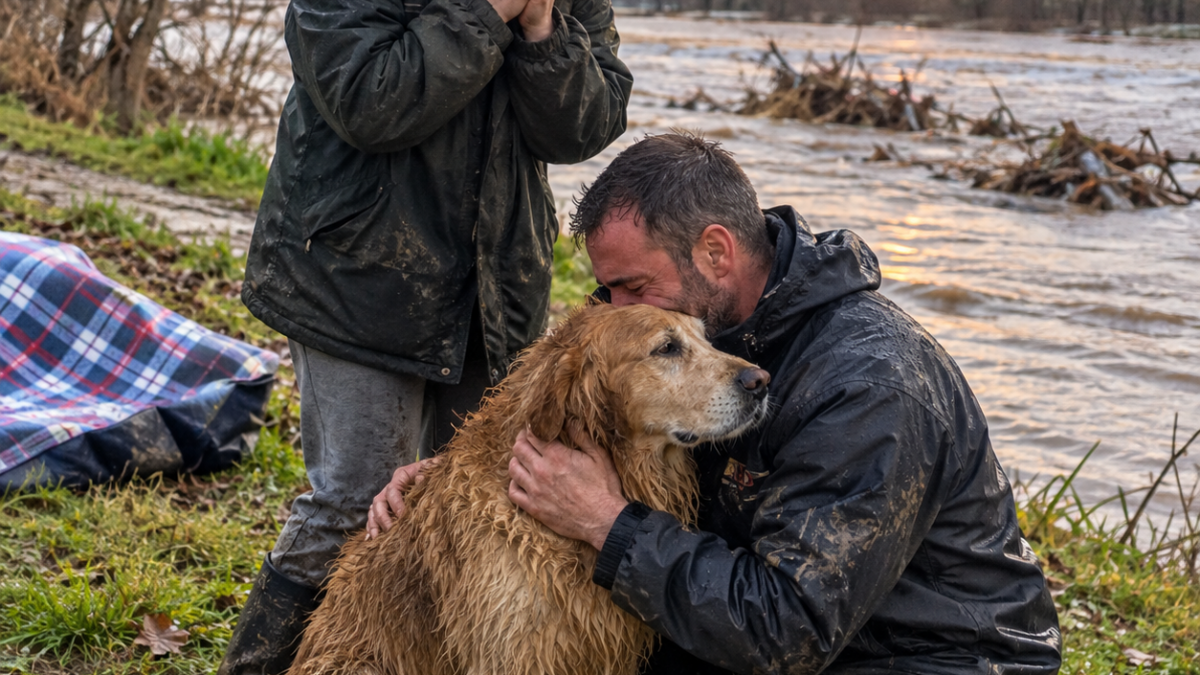
PART 2
The sound reached me even over the river.
A dull, terrible crack.
Nestor’s shoulder hit the first rock.
His body folded sideways.
Lucas disappeared behind him.
I screamed so hard my throat burned instantly.
“NESTOR!”
For half a second, all I could see was white water.
Then Lucas’s face appeared again.
So did Nestor’s.
And somehow—somehow—his jaws were still clamped around that blue collar.
He had not let go.
Julien was already running downstream.
“Stay with Camille!” he shouted.
I looked back.
Our daughter stood beside the overturned cooler, frozen in place.
She wasn’t crying.
That frightened me almost as much as the river.
Her little hands were pressed over her mouth.
“Mommy,” she whispered.
I ran to her, grabbed her shoulders and pulled her farther from the bank.
“Stay here. Stay on the blanket. Do not move.”
“But Lucas—”
“Daddy’s getting him.”
I said it with absolute certainty.
I had none.
Then I ran.
There are moments when your body does things your mind doesn’t remember ordering.
I remember mud under my shoes.
Branches striking my arms.
The river flashing between the trees.
I remember hearing Julien yelling Lucas’s name somewhere ahead of me.
But I don’t remember breathing.
The river curved around the rocks and widened slightly beyond them.
A fallen tree stretched partly across the water about forty yards downstream.
Lucas and Nestor were being pushed toward it.
At first I thought that might save them.
Then I saw the branches.
They formed a tangled wall.
If Lucas went underneath them, the current could pin him below the surface.
Julien saw it too.
He ripped off his jacket while running.
A man farther down the path had heard us shouting.
He came sprinting toward the river.
“What happened?”
“My son!”
The man looked once at the water and understood everything.
He grabbed Julien’s arm.
“Don’t go straight in! It’ll take you too!”
Julien tore free.
“That’s my boy!”
“I know. But look!”
The stranger pointed downstream.
There was a shallow gravel bar extending from the opposite bend.
If Julien entered where we stood, he would be swept into the same channel.
If he ran another thirty yards, he might reach the slower water near the bend.
Might.
That word became our entire world.
Nestor struck another rock.
This one spun him almost completely around.
Lucas’s head dipped beneath the surface.
I heard myself make a sound I had never made before and hope never to make again.
Then Nestor surfaced.
Still holding him.
His front legs paddled unevenly now.
One barely seemed to move.
“Come on, boy,” Julien whispered.
It wasn’t really a command.
It sounded like a prayer.
The stranger ran with him.
I followed until my shoes sank ankle-deep in mud.
Ahead of us, another couple stood near the trail.
The woman had already pulled out her phone.
“I’m calling emergency services!”
Her husband was removing his belt.
“Do you have a rope?” Julien yelled.
“Car!”
The man pointed toward the parking area.
Too far.
No time.
Lucas and Nestor were seconds from the fallen tree.
Then something happened that I still struggle to explain without crying.
Nestor stopped trying to swim toward shore.
He changed direction.
Instead, he pushed himself slightly upstream.
At first it made no sense.
Then I saw what he was doing.
There was a gap between two branches of the fallen tree.
A narrow one.
Just wide enough.
Nestor was fighting to line Lucas up with it.
“He sees the opening,” the stranger beside Julien said.
Whether that was true or whether we desperately needed to believe it, I don’t know.
But Nestor shifted again.
Lucas was crying now.
“Nes! Nes!”
That was what he had called the dog since he was a toddler.
“Nes!”
Nestor reached the tree.
His body hit a branch.
The branch bent.
Lucas slammed against him.
The polo collar stretched until I thought it would tear.
Then the branch snapped.
They went through.
Not underneath.
Through.
And came out on the other side.
Julien entered the water.
“Julien, no!”
But he had chosen the slower edge near the gravel bar.
The current reached his knees.
Then his thighs.
He planted each foot carefully, leaning upstream.
The stranger held his belt from behind.
Another man arrived and grabbed the stranger around the waist.
A human chain.
Julien reached farther.
“Lucas!”
My son saw him.
“Dad!”
That single word almost destroyed me.
Lucas released one fistful of Nestor’s fur and reached toward Julien.
Too far.
“Hold the dog!” Julien screamed. “Lucas, hold Nestor!”
Lucas obeyed.
The current pushed them closer.
Julien stretched until half his body was over the water.
The stranger shouted, “That’s far enough!”
Julien ignored him.
His fingers touched Lucas’s wrist.
Slipped.
Touched again.
Then closed around it.
“I have him!”
The three men pulled.
The river fought back.
Lucas screamed.
For one horrifying second, his polo shirt tightened around his throat because Nestor still had the collar.
“Nestor, let go!” Julien yelled.
The dog didn’t.
“Nestor!”
Nothing.
He had been given one job by instinct, fear, love, whatever word you want to use.
Do not let go of the boy.
And he wasn’t going to stop just because a human voice told him the danger had changed.
Julien grabbed Lucas under one arm.
The stranger pulled harder.
Lucas came toward the bank.
Nestor came with him because he still had the shirt.
Then all four of them collapsed onto the gravel.
Lucas coughed.
Once.
Twice.
Then violently.
Water poured from his mouth.
I fell beside him.
“Lucas.”
His eyes opened.
“Mom?”
That word brought me to my knees.
I wrapped myself around him.
I wanted to hold every part of him at once.
His face.
His shoulders.
His hands.
I kept touching him as if my hands needed proof.
“You’re here,” I said.
I said it over and over.
“You’re here. You’re here.”
Lucas began sobbing.
“I’m sorry.”
“No.”
“I went for Camille’s cup.”
“No, sweetheart.”
“I’m sorry.”
“You don’t apologize. You hear me? You do not apologize.”
Then Lucas suddenly stopped crying.
His eyes moved past me.
“Nestor.”
I turned.
Nestor was lying on his side ten feet away.
He wasn’t moving.
Julien crawled toward him.
“Nestor?”
Nothing.
His fur was dark with water and mud.
One side of his chest rose.
Fell.
Then seemed to stop.
Lucas tried to stand.
I held him.
“No, stay down.”
“Nestor!”
His voice cracked.
The dog’s ear twitched.
That tiny movement caused all of us to shout at once.
“He’s breathing!”
The woman on the phone hurried toward us.
“Emergency crews are coming. They said keep the boy warm and don’t move the dog if he may have spinal injuries.”
Julien knelt beside Nestor.
Blood ran from a cut above the dog’s eye.
His front right leg lay at an angle that made my stomach turn.
There was another scrape along his ribs.
But his eyes opened.
Slowly.
He looked confused at first.
Then he saw Lucas.
His tail moved.
Once.
Just one weak thump against the gravel.
Lucas started crying harder.
“I’m here, Nes.”
Nestor’s tail moved again.
The first firefighters arrived less than ten minutes later.
It felt like an hour.
They wrapped Lucas in thermal blankets and checked his breathing, pupils, oxygen level and temperature.
One paramedic kept asking questions.
“What’s your name?”
“Lucas.”
“How old are you?”
“Eight.”
“Do you know where you are?”
Lucas looked at the river.
“Yes.”
“Do you remember what happened?”
He nodded.
Then he pointed toward Nestor.
“My dog saved me.”
The paramedic followed his finger.
“I think he did.”
Another emergency worker knelt beside the dog.
“Is there an animal clinic nearby?”
“There’s one near Annecy,” I said.
“How far?”
“Twenty minutes. Maybe less.”
The firefighter looked at Nestor’s gums, listened to his breathing, and carefully felt along his ribs.
“He needs a veterinarian immediately.”
Lucas grabbed my sleeve.
“Mom, don’t leave him.”
“I won’t.”
“You promise?”
“I promise.”
Lucas needed hospital evaluation because he had swallowed water and had been submerged more than once.
Nestor needed emergency veterinary care.
For the first time since he fell into the river, Lucas and his dog had to go in different directions.
He hated it.
“No!”
He tried to sit up when the paramedics lifted the stretcher.
“Nestor comes with us.”
“Buddy,” Julien said, leaning over him, “Nestor needs a dog doctor.”
“He’ll think I left him.”
The sentence hit everyone.
Even the paramedic looked away.
I bent close enough that our foreheads touched.
“He knows you didn’t leave him.”
“How?”
“Because the last thing he saw was you safe.”
Lucas shook his head.
“You don’t know that.”
He was right.
So I stopped pretending.
“No,” I whispered. “I don’t. But I’m going with him.”
Lucas stared at me.
“You stay with Nestor?”
“Yes.”
“Until I come?”
“Yes.”
He swallowed.
“Tell him I’m coming.”
“I will.”
Julien went with Lucas to the hospital.
I went with Nestor.
A firefighter helped lift him onto a rigid board.
Nestor whimpered for the first time.
That sound hurt almost more than seeing him hit the rocks.
He had gone through that entire river without making a sound.
Now that Lucas was safe, he finally allowed himself to hurt.
I rode in the back seat of the stranger’s SUV because emergency animal transport wasn’t available.
His name was Marc.
He was one of the men who had helped Julien form the human chain.
His wife stayed behind with Camille until my neighbor could come get her.
I sat beside Nestor in the cargo area with my hand on his wet neck.
“Lucas is safe,” I kept telling him.
His eyes were half closed.
“You did it.”
His breathing was shallow.
“Don’t you quit now.”
His eyes moved toward me.
“Nestor, listen to me. That boy is going to want you home. So you don’t get to save him and then leave us. That is not the deal.”
Marc glanced at me in the mirror.
He didn’t say anything.
I’m grateful for that.
There are times when people try to comfort you because silence makes them uncomfortable.
Marc understood silence.
We reached the veterinary clinic in eighteen minutes.
Two technicians came out with a gurney.
“What happened?”
“River accident. Blunt trauma. Possible broken leg. He was submerged.”
“How long?”
“I don’t know.”
That answer terrified me.
They rushed him inside.
A veterinarian named Dr. Morel met me in an exam room.
She was calm in the way people become when panic is part of their profession.
“We’re going to stabilize him first. Oxygen, IV access, pain control, chest imaging. Then we’ll know more.”
“His leg—”
“We see it.”
“He hit rocks.”
“We’ll check for internal bleeding.”
“He swallowed water.”
“We’ll check his lungs.”
I grabbed her sleeve before she could leave.
“My son was drowning.”
She stopped.
“He went after him.”
Her expression changed.
Not dramatically.
Just enough.
“This dog?”
“Yes.”
“He pulled him out?”
“He held his shirt all the way downstream.”
She looked through the glass door toward the treatment area.
Nestor lay surrounded by staff.
“Then we’ll do everything we can for him.”
For the next hour, I sat in a plastic chair staring at my phone.
Julien sent messages from the hospital.
**Lucas is awake.**
Then:
**Chest X-ray okay so far. Observation for water aspiration.**
Then:
**He keeps asking about Nestor.**
I typed back:
**They’re doing scans. No answer yet.**
I deleted the next sentence three times before sending it.
**Tell him Nestor is fighting.**
Julien replied almost immediately.
**Lucas says tell him he still owes him half a sandwich.**
I laughed.
It came out as a sob.
That morning, Lucas had secretly fed Nestor pieces of ham beneath the picnic table.
I had pretended not to notice.
Now I would have given anything to watch him do it every day for the rest of my life.
Dr. Morel finally returned.
She sat beside me.
People in hospitals sit down before bad news.
I knew that.
My stomach tightened.
“Nestor has several injuries.”
I closed my eyes.
“His right shoulder is badly bruised, and there’s a fracture in the lower front leg. He also has two fractured ribs.”
I pressed my fingers against my mouth.
“But?”
“There’s no obvious spinal injury.”
I opened my eyes.
“No internal abdominal bleeding.”
I inhaled.
“And his lungs?”
“That is what concerns me most tonight. He inhaled water. Right now his oxygen level is acceptable with support, but aspiration pneumonia can develop later.”
“Is he going to die?”
She didn’t give me a comforting lie.
“I don’t know.”
The room seemed to tilt.
“What can I do?”
“Let us treat him.”
“I promised Lucas I would stay.”
“You can.”
So I stayed.
At 9:14 that night, Julien called.
Lucas had been admitted overnight for observation.
“He’s stable,” Julien said. “They think we got lucky.”
Lucky.
I looked through the glass at Nestor lying beneath an oxygen hood.
“He keeps asking me to put him on video.”
“Can we?”
I asked the technician.
She hesitated.
“No excitement.”
“He won’t get excited. He can barely lift his head.”
We made the call.
Lucas appeared on the screen wearing a hospital gown.
His hair was still damp.
A small oxygen sensor glowed red on his finger.
“Mom?”
“I’m here.”
“Show me.”
I turned the phone.
Nestor lay on a blanket with an IV taped to one leg.
For a second, Lucas said nothing.
Then he whispered, “Nes.”
Nestor’s eyes opened.
His head lifted less than an inch.
“Nes, it’s me.”
The dog’s tail moved beneath the blanket.
Once.
Lucas covered his face.
Julien put an arm around him.
“You saved me,” Lucas said.
Nestor watched the phone.
“I’m sorry you got hurt.”
His voice broke.
I had to turn away.
Then Lucas said the thing I remember most.
“You can stop being brave now.”
The room went completely quiet.
Even the technician standing beside me froze.
Lucas sniffed.
“Dad says doctors are taking care of me. Your doctors are taking care of you. So you don’t have to do anything else.”
Nestor’s eyes slowly closed.
Lucas whispered, “Just come home.”
That became our prayer.
Just come home.
The next morning Lucas was discharged.
The doctors warned us to watch him carefully for coughing, breathing problems, unusual fatigue or fever.
Julien drove him straight to the veterinary clinic.
Camille came too.
She carried Nestor’s favorite sock.
Not a toy.
An actual sock he had stolen from Julien months earlier.
We had tried to throw it away twice.
Nestor kept finding it.
The clinic staff allowed the children into a quiet room.
Nestor had been taken off oxygen briefly.
His breathing was still rough, but stable.
Lucas walked in first.
The dog smelled him before he saw him.
His head lifted.
His tail began thumping.
Lucas stopped.
For two seconds they simply looked at each other.
Then Lucas went down on his knees.
“You idiot,” he whispered.
Nestor tried to stand.
Three people said, “No!” at the same time.
He collapsed back onto the blanket.
Lucas laughed through tears.
“You already did enough.”
He put one hand beside Nestor’s face.
The dog licked his fingers.
Camille stepped forward holding the sock.
“I brought your baby.”
That was what she called it because Nestor carried the sock around the house like a puppy.
She placed it beside him.
Nestor sniffed it.
Then rested his chin on it.
Dr. Morel looked at me.
“I think he approves.”
For the first time in twenty-four hours, the four of us laughed.
But the danger wasn’t over.
That afternoon, Nestor developed a fever.
His breathing rate increased.
A second chest X-ray showed changes consistent with aspiration pneumonia.
Dr. Morel called me at home.
“We’re starting antibiotics and increasing respiratory support.”
My knees weakened.
Lucas heard enough of the conversation to understand.
“Is he worse?”
“He has an infection.”
“Because of the river?”
“Yes.”
“Can they fix it?”
“They’re trying.”
Lucas disappeared upstairs.
I found him sitting on the floor of his bedroom twenty minutes later.
Nestor’s bed was beside him.
He had pulled the dog’s blanket around his shoulders.
“I made him go in.”
“No, you didn’t.”
“I fell.”
“You slipped.”
“If I didn’t go after the cup—”
“Lucas.”
He looked at me.
I sat on the floor.
“You made a mistake.”
His lower lip trembled.
“You went too close to the river. We told you not to. That part matters, and we are going to talk about it.”
He stared at his hands.
“But making a mistake is not the same thing as wanting something terrible to happen.”
“He got hurt because of me.”
“He got hurt saving you.”
“That’s the same thing.”
“No.”
I waited until he looked up.
“It isn’t.”
“How?”
“Because Nestor made a choice.”
“He’s a dog.”
“Yes.”
“They don’t choose like us.”
“Maybe not exactly like us. But I watched him turn around after the river pulled him away from you. I watched him go back.”
Lucas’s eyes filled.
“He could’ve gone to shore?”
“Yes.”
“And he came back?”
“Yes.”
I hadn’t told him that part before.
He began crying silently.
I pulled him against me.
“He loved you enough to go back.”
For the next two nights, Nestor remained hospitalized.
Lucas wrote him notes.
Actual notes.
The first said:
**NESTOR, PLEASE EAT.**
The second:
**I WILL GIVE YOU MY HAM FOREVER.**
The third:
**YOU ARE NOT OLD. DAD IS OLDER.**
Julien read that one and said, “Unnecessary.”
It was the first time Lucas smiled.
On the fourth morning, Dr. Morel called.
“Nestor ate.”
I nearly dropped the phone.
“How much?”
“Not enough for me to be impressed medically.”
She paused.
“But enough for me to be encouraged.”
“What did he eat?”
“Chicken.”
I laughed.
“Of course he did.”
His fever began to fall.
His oxygen requirement decreased.
The pneumonia was responding.
The fractures still needed weeks of healing, and his shoulder injury would require rehabilitation, but for the first time Dr. Morel used the sentence we had been terrified to hope for.
“I think he’s going home.”
Lucas heard it from the kitchen.
He screamed so loudly Camille screamed too, although she didn’t know why.
Three days later, we brought Nestor home.
The clinic staff had decorated his discharge bandage with tiny blue paw prints.
Lucas insisted on carrying his medicine bag.
Camille carried the stolen sock.
Julien carried Nestor.
The dog hated being carried.
Under normal circumstances, he would have squirmed until he was dropped.
That day, he placed his chin over Julien’s shoulder like an exhausted child.
We had moved his bed into the living room.
Lucas slept beside him the first night.
So did Camille.
By midnight I found both children curled up on blankets around the dog.
Nestor was awake.
He looked at me.
His eyes followed me toward the doorway.
Then back to the children.
The furry bodyguard was on duty again.
Even with a cast.
Recovery took months.
Nestor had to be kept calm, which was difficult because Nestor had never agreed with anyone’s definition of calm.
Once his ribs healed, he began physical therapy for his shoulder.
At first he hated the underwater treadmill.
The first time the technician switched it on, Nestor stared at her with an expression that clearly said he had already had enough water for one lifetime.
Lucas stood outside the glass.
“You saved me in water,” he told him. “You can walk in a little bit.”
Nestor sighed dramatically.
Then walked.
The physical injuries healed more predictably than the emotional ones.
Lucas began having nightmares.
Sometimes he woke screaming that he couldn’t find the riverbank.
Other nights he woke because he could still feel his shirt tightening around his neck.
He stopped wanting to take baths.
He refused to walk near moving water.
If rain became heavy, he watched the drainage ditch outside our house as if it might climb through the window.
Nestor changed too.
Before the accident, he loved streams.
He would charge into shallow water after sticks.
Afterward, the sound of fast-moving water made him stiffen.
The first time we walked near a small creek, he planted all four paws on the trail and refused to continue.
Lucas noticed.
“He’s scared too.”
“Yes.”
“Dogs can be scared after?”
“Of course.”
Lucas stared at him.
“I thought brave means not scared.”
Julien crouched beside him.
“No. Brave usually means scared and doing what you have to do anyway.”
Lucas thought about that for a long time.
Then he sat beside Nestor.
“Okay,” he said. “We can both be scared.”
That became the beginning of their recovery.
Not pretending.
Not forcing.
Just small steps.
Our family counselor encouraged Lucas to talk about the accident rather than avoid every reminder.
We practiced water safety.
We enrolled both children in stronger swimming lessons once Lucas was ready.
Not immediately.
Months later.
At first, he could barely stand beside the pool.
He gripped my hand.
“I don’t want to.”
“You don’t have to today.”
“But I should.”
“You don’t have to prove anything.”
He looked at Nestor, who was waiting outside with Julien because dogs weren’t allowed near the pool deck.
Then he took one step forward.
“I want to learn.”
His instructor never pushed him into deep water.
For weeks, Lucas practiced breathing.
Floating.
Reaching for the side.
Getting out safely.
The first time he swam ten feet independently, he came out of the pool shaking.
But smiling.
“Nestor would’ve beaten me.”
“Absolutely,” Julien said.
Lucas rolled his eyes.
“He cheats.”
“How does a dog cheat at swimming?”
“Four legs.”
Fair argument.
Life slowly began to feel ordinary again.
But something about the day at the river kept bothering Julien.
It bothered me too.
Not Lucas’s fall.
We knew exactly how that happened.
What bothered us was what we learned afterward.
The stranger who helped Julien—Marc—called two weeks after the accident.
“I thought you should know something.”
“What?”
“I walk that trail three times a week.”
I waited.
“That section of bank where Lucas fell?”
My stomach tightened.
“Yes?”
“It had partially collapsed during storms earlier that month.”
“What do you mean?”
“There used to be a wooden safety rail farther back from the edge.”
I sat down.
“I didn’t see one.”
“That’s because part of it broke.”
“When?”
“Before your accident.”
I went silent.
Marc continued carefully.
“I’m not saying this changes what happened. Kids still need to stay away from rivers. But I reported that damaged section.”
“To whom?”
“The company contracted to maintain the recreation area.”
“When?”
“Nine days before Lucas fell.”
Nine days.
I wrote the number on the back of an envelope without knowing why.
“Did they answer?”
“Yes.”
“What did they say?”
“They said the area would be inspected.”
“Was it?”
“I don’t know.”
“Do you still have the message?”
“Yes.”
That conversation opened a door I wish had never existed.
I contacted the local office responsible for the trail.
At first, the response was polite.
Then vague.
Then defensive.
A representative named Bernard called.
“We’re very sorry about your son.”
“Thank you.”
“But the river was visibly high.”
“I know.”
“And parents are responsible for supervising children.”
“I know that too.”
“There are general warning signs at trail entrances.”
“I saw them.”
“Then I’m not sure what you’re asking.”
I looked across the living room.
Lucas was lying on the floor doing homework beside Nestor.
The dog’s front leg was still bandaged.
“I’m asking whether someone reported a broken barrier nine days before my son fell.”
Silence.
“I would have to check.”
“Please do.”
“There are many maintenance reports.”
“This one involves the exact bank where an eight-year-old entered a flooded river.”
Another silence.
“I’ll look into it.”
He didn’t call back.
I called again.
Then again.
Eventually I received an email.
The wording was careful.
The report had been “logged.”
The location had been “scheduled for assessment.”
Due to weather-related maintenance demands, “repairs had not yet been completed.”
I read that sentence four times.
Repairs had not yet been completed.
There was no mention of a temporary barrier.
No mention of closure tape.
No mention of a warning placed at that specific damaged section.
I became furious.
Not because I wanted someone else to carry all our guilt.
Julien and I had taken our children near a swollen river.
We had told them to stay back, but we had still chosen that picnic area.
Lucas had ignored us.
Those facts were ours.
We never denied them.
But another fact belonged to someone else.
They knew the protective barrier was broken.
And they left the area open.
Julien wanted to hire a lawyer immediately.
I didn’t.
Not yet.
“What do you want?” he asked.
“I want to know the truth.”
“They’re not going to hand you documents because you ask nicely.”
“Then we keep asking.”
We requested the maintenance record.
The first version we received was incomplete.
Two pages.
One showed Marc’s report.
Another showed a work-order number.
But something was missing.
The work-order sequence jumped.
I stared at it.
“Why does it go from 1847 to 1849?”
Julien leaned closer.
“Where’s 1848?”
Exactly.
We asked.
No response.
We asked again.
A week later, the contracting company sent another file.
Work order 1848.
I opened it at our kitchen table.
**Riverside safety rail—storm damage.**
The note underneath was short.
**Recommend temporary closure of adjacent picnic access pending repair.**
Date: eight days before our accident.
I felt cold.
“Julien.”
He read it.
Then read it again.
“They recommended closing it.”
“Yes.”
“Was it closed?”
“No.”
Another line showed the supervisor’s response.
**Defer. Weekend traffic expected. Use existing general flood signage.**
Julien pushed his chair back so hard it struck the wall.
“They kept it open because they expected visitors?”
“We don’t know why.”
“It says weekend traffic.”
“I know what it says.”
“Our son nearly died.”
“I know.”
“Nestor nearly died.”
“I know.”
He walked into the hallway.
Then came back.
“I want them held responsible.”
This time I agreed.
We spoke with an attorney.
She warned us about something important in our first meeting.
“If your goal is to prove that nobody in your family made a mistake, I can’t help you.”
“That’s not our goal,” I said.
“Good.”
She folded her hands.
“Because you did take children near a visibly swollen river.”
“We know.”
“And your son crossed a boundary you had given him.”
“Yes.”
“But that does not automatically erase a maintenance duty if a known protective barrier was damaged and a specific closure recommendation was ignored.”
Julien leaned forward.
“So what happens?”
“We gather facts.”
The process was slow.
Painfully slow.
Records.
Emails.
Inspection schedules.
Photographs.
Weather reports.
Witness statements.
We learned the damaged rail had protected a section of bank that looked grassy and gradual from above but dropped sharply beneath the vegetation.
We learned two previous visitors had reported the slippery edge.
We learned a maintenance technician had placed temporary cones there after the storm.
The cones disappeared within twenty-four hours.
Nobody replaced them.
Then we found something that made my anger turn into something harder.
There had been another internal email.
Sent three days before our picnic.
A field employee wrote:
**Barrier still unrepaired. With forecast rain, recommend tape and temporary closure before weekend.**
The supervisor answered:
**Team overloaded. Prioritize parking/access cleanup. Existing signs sufficient.**
I read those words at midnight while Nestor slept at my feet.
Existing signs sufficient.
I looked at the scar above his eye.
At the patch of fur that still hadn’t fully grown back over his shoulder.
Then I walked upstairs and stood outside Lucas’s bedroom.
The door was open.
Nestor used to sleep there during thunderstorms.
Now Lucas slept with his own door open every night because closed rooms made him remember being underwater.
I went back downstairs.
Julien was waiting.
“Well?”
I handed him the paper.
His jaw tightened.
“That’s it.”
“What?”
“That’s the part I can’t forgive.”
I knew exactly what he meant.
Not the broken rail.
Things break.
Not the storm.
Nobody controls weather.
Not even the delayed repair.
Emergencies happen.
Crews get overloaded.
It was the conscious choice to leave a known hazard exposed after someone specifically warned them what the weekend rain could do.
Our attorney did not use dramatic language.
She simply said, “This matters.”
The maintenance contractor initially denied wrongdoing.
Their insurer argued that the river itself was an obvious natural hazard.
That was partly true.
Our lawyer never disputed it.
Then they argued that a barrier would not necessarily have prevented Lucas from approaching the slope.
Also possible.
Then they argued that our own supervision was the primary cause.
That one hurt.
Because guilt already lived inside me.
For months, I had replayed every second.
Why did I look inside the picnic bag?
Why wasn’t I standing closer?
Why didn’t I catch him?
Why did we stay after noticing the high water?
Their questions were legal strategy.
My brain had been asking the same questions every night.
One evening after a meeting, I sat in the car and cried.
“I did this,” I told Julien.
He turned toward me.
“No.”
“I brought them there.”
“We both did.”
“I saw the river.”
“So did I.”
“I should’ve packed up.”
“So should I.”
“I’m his mother.”
“And I’m his father.”
I wiped my face angrily.
“That doesn’t make me feel better.”
“It isn’t supposed to.”
He reached across the console.
“We made a bad judgment. Lucas made a bad judgment. The maintenance company made a bad judgment.”
I looked at him.
“Only one of those judgments came after written professional warnings.”
That distinction eventually became central to the case.
But our legal fight was not the hardest part.
The hardest part came from Lucas.
He overheard adults talking.
Children always do.
One afternoon, he came into the kitchen holding a printout.
“Are you suing because of me?”
My heart sank.
“Where did you get that?”
“Dad’s desk.”
Julien closed his eyes.
“Lucas—”
“Are you?”
“Yes,” I said.
He looked frightened.
“Am I going to court?”
“Probably not.”
“Do I have to tell them I disobeyed?”
“No one is asking you to lie.”
“I did disobey.”
“Yes.”
His eyes filled.
“So they’re right.”
“Who?”
“The people saying it was my fault.”
Julien stood.
“Absolutely not.”
“But I went near it.”
I pulled out a chair.
“Sit.”
He didn’t want to.
I waited.
Eventually he sat.
“You did something unsafe.”
He nodded.
“That matters.”
Another nod.
“But adults responsible for a public place can also make unsafe choices.”
He looked confused.
“Two things can be true?”
“Yes.”
He stared toward the living room where Nestor slept.
“If I had listened, he wouldn’t have gotten hurt.”
“Probably.”
His face crumpled.
I took his hands.
“And if the damaged area had been closed the way their own worker recommended, we probably wouldn’t have been sitting there.”
He stared at me.
“Then whose fault is it?”
That question was too large for an eight-year-old.
So I gave him the answer I wished adults gave more often.
“It doesn’t have to belong to only one person.”
He was quiet.
“Am I bad?”
“No.”
“Were you bad for taking us there?”
“No.”
“Were those workers bad?”
“Most of them? No.”
“Then why are you angry?”
“Because people can be good people and still make choices they need to answer for.”
He thought about that.
Then he asked, “Is Nestor angry?”
Julien laughed softly.
“Nestor is mostly angry that we stopped giving him table food.”
That broke the tension.
Lucas smiled.
Nestor opened one eye from across the room as if hearing his name had activated him.
A year after the accident, the case moved toward mediation.
By then Nestor could walk normally most days.
He had a slight limp after long outings.
He hated deep water permanently.
And he had developed one new habit.
Whenever Lucas left the house, Nestor followed him to the door and watched until he disappeared from sight.
Every single time.
If Lucas went to school, Nestor watched the car.
If Lucas rode his bike, Nestor stood behind the fence.
If Lucas walked upstairs, the dog often followed.
We joked about his promotion from bodyguard to surveillance officer.
But none of us really laughed at the reason.
The mediation took place in a plain conference room.
No courtroom.
No dramatic jury.
Just long tables, legal folders, bottled water and people speaking carefully.
The contractor’s representatives began with an offer.
Our attorney slid the paper toward us.
Julien barely looked at the number.
“What are the conditions?”
She read.
Confidentiality.
No admission of fault.
No public release of internal maintenance records.
I looked at her.
“They want the documents buried.”
“That is one effect.”
“No.”
Julien turned toward me.
“You’re sure?”
“Yes.”
Our attorney was cautious.
“You need to understand that refusing a settlement carries risk.”
“I understand.”
“You may receive less later.”
“I understand.”
“You could lose.”
“I understand.”
She watched me.
“What matters most?”
I thought of the river.
Of another family spreading a blanket on the same grass.
Another child chasing a cup.
Another parent believing a general warning sign was enough.
“I want the hazard fixed.”
“It already has been.”
“I want the procedure fixed.”
That became the point we refused to surrender.
Money could pay medical bills.
It could cover therapy.
It could reimburse Nestor’s surgery and rehabilitation.
But I wanted the next field employee who wrote **close this area** to be heard.
The negotiations lasted all day.
At one point the contractor’s regional manager entered the room.
I had seen his name on one of the emails.
He looked exhausted.
He sat across from us.
“I want to say personally that what happened to your family was terrible.”
Julien said nothing.
I asked, “Did you know about the recommendation?”
He glanced at his attorney.
Then back at me.
“Not before the accident.”
“Did the supervisor report to you?”
“Yes.”
“Was the supervisor disciplined?”
His attorney interrupted.
“We’re not going to discuss personnel matters.”
I looked at the manager.
“Then tell me something you can discuss.”
He waited.
“Would that area stay open today under the same circumstances?”
“No.”
That was the first answer all day that mattered.
“Why not?”
“Because our procedure changed.”
“After Lucas?”
He nodded.
“Yes.”
I swallowed.
“What changed?”
“Specific barrier damage adjacent to high-water conditions now requires temporary closure until physical inspection.”
I felt Julien’s hand close around mine beneath the table.
“And missing temporary barriers?”
“Must be replaced within two hours of notification.”
“Written closure recommendations?”
“Require regional approval to override.”
I leaned back.
That was what I had wanted to hear.
Not revenge.
Not humiliation.
Not someone losing everything.
A system that would behave differently because my son and my dog almost died.
The eventual settlement covered Lucas’s medical care and therapy, Nestor’s veterinary expenses, and future treatment connected to his injuries.
Part of the agreement also allowed us to speak publicly about the safety changes.
There was no dramatic confession.
No villain escorted from the room.
Real life rarely gives you scenes that neat.
But the supervisor who had overridden the closure recommendation no longer controlled field safety decisions.
The riverside site received a new barrier extending beyond the unstable bank.
High-water closure rules became stricter.
And the warning at the trail entrance was replaced by something impossible to misunderstand.
**RIVER ACCESS CLOSED DURING FLOOD CONDITIONS.**
Months later, Marc sent us a photograph of the new barrier.
His message said:
**Looks different now.**
I showed Lucas.
He stared at the picture for a long time.
“Did we do that?”
“You helped.”
“Nestor too?”
“Mostly Nestor.”
Lucas smiled.
“Good.”
Two years passed.
Then three.
Nestor’s muzzle turned almost completely white.
His limp became more noticeable in winter.
He still stole socks.
He still hated the vacuum cleaner.
He still followed Lucas everywhere.
The relationship between them changed as Lucas grew older.
Before the river, Lucas had loved Nestor the way children often love dogs—as a playmate.
After the river, there was something quieter between them.
Trust, maybe.
Debt, though I hated that word.
Recognition.
Lucas knew there was one creature on earth who had seen him disappearing into danger and had gone after him without considering the cost.
That knowledge shaped him.
When Lucas was eleven, his class had to write an essay titled **The Bravest Person I Know.**
He asked me, “Can mine be a dog?”
“Ask your teacher.”
His teacher allowed it.
He wrote about Nestor.
He did not exaggerate.
In fact, his version was painfully simple.
**I was scared in the river. Nestor was scared too because he got hurt, but he came anyway. I think bravery is when somebody is scared and still decides that you matter more than the scary thing.**
The teacher called me after reading it.
“I cried.”
“So did I.”
“May I display it?”
I asked Lucas.
He shrugged like it wasn’t a big deal.
“Sure.”
But he made one correction first.
The teacher had circled the sentence **Nestor saved my life** and written **Powerful!**
Lucas crossed out the exclamation point.
“Why?” I asked.
“Because it wasn’t exciting when it happened.”
That answer stayed with me.
People love rescue stories after everyone survives.
They sound cinematic.
Heroic.
Beautiful.
But inside the moment, there is nothing beautiful about believing your child may die.
There is only terror.
Years later, Lucas understood that better than most adults.
When he turned twelve, he wanted to return to the river.
I didn’t.
Julien didn’t either.
We had visited nearby trails, but never that section.
Lucas had avoided asking.
Then one Saturday morning, he came downstairs and said, “I think I want to see it.”
I knew exactly what he meant.
“Why now?”
“I don’t know.”
Nestor was asleep near the kitchen table.
Lucas looked at him.
“I just don’t want it to be the place that scares me forever.”
Our therapist had said something similar.
You cannot force a traumatic place to become harmless.
But sometimes returning safely can separate the memory from the present.
So we went.
Camille came.
Nestor came.
The weather was dry.
The river was low and clear.
Nothing like that day.
Still, my hands shook when we reached the trail.
The new barrier stood firm along the bank.
Beyond it, the river moved quietly.
Lucas stopped twenty feet away.
Nestor stopped with him.
For a while, neither moved.
Then Lucas took another step.
Nestor didn’t.
He planted his paws.
Lucas looked down.
“It’s okay, Nes.”
The dog stared at the water.
His body was rigid.
Lucas crouched.
“You don’t have to.”
I felt tears rise.
The boy Nestor had once dragged from that river was now kneeling on the trail telling an old dog he didn’t have to be brave.
Lucas sat beside him.
They stayed there for ten minutes.
Eventually Nestor moved forward.
One step.
Then another.
They stopped at the barrier.
Lucas did not touch the railing.
He simply looked.
“That’s where?”
Julien pointed downstream.
“We think you went in around there.”
“And the rocks?”
“Farther around the bend.”
Lucas nodded.
We walked to the overlook.
The rock that had injured Nestor was still there.
Of course it was.
Rivers don’t remember.
Rocks don’t apologize.
Nature does not know who you love.
Lucas stared at it.
“That one?”
“I think so.”
He put one hand on Nestor’s back.
The dog leaned against his leg.
“I hate it.”
I understood.
Then Lucas exhaled.
“But it didn’t win.”
Julien looked away quickly.
So did I.
We had brought something with us.
Not flowers.
Not a plaque.
Lucas thought both would be strange.
Instead, he brought the red plastic cup.
Camille’s cup.
The original one.
The ridiculous little object that had started everything.
I had found it days after the accident inside the picnic bag.
Apparently someone from the rescue scene had picked it up and packed it with our belongings.
I almost threw it away.
Lucas asked me to keep it.
Now he held it.
Camille laughed.
“You still have that ugly thing?”
“It nearly killed me.”
“The cup didn’t push you.”
“I know.”
“You went after it.”
“I know.”
“You were dumb.”
“Camille.”
“What? He was.”
Lucas laughed.
“She’s right.”
He placed the cup inside a trash bin near the trail.
“There.”
“That’s your big ceremony?” Julien asked.
“Yep.”
“You kept it for four years to throw it in a public trash can?”
“Yep.”
Julien shook his head.
“I raised a strange child.”
Lucas looked at Nestor.
“He helped.”
We laughed.
Then Nestor did something unexpected.
He walked toward the edge of the trail where a small drainage stream entered the river.
Not the river itself.
Just a narrow ribbon of water over stones.
He stopped.
Sniffed.
Put one paw in.
Then pulled it back.
Lucas waited.
Nestor tried again.
One paw.
Then two.
The water barely covered his toes.
Nothing dramatic happened.
No applause.
No miraculous transformation.
He stood there for three seconds.
Then stepped out.
Lucas smiled.
“Good job.”
That was enough.
We left.
For years afterward, people who heard the story asked whether Nestor “knew” what he was doing.
They asked whether dogs understand rescue.
Whether he was acting from instinct.
Whether he believed Lucas was a member of his pack.
Whether training mattered.
Whether Labradors naturally swim toward struggling people.
I don’t know.
I am not an animal behaviorist.
I know only what I saw.
My son fell into violent water.
Our dog entered it.
The current separated them.
The dog turned back.
He grabbed Lucas’s shirt.
He took the rocks on his own body.
And he did not release the collar until my husband had our child in his arms.
Call it instinct.
Call it loyalty.
Call it attachment.
In our house, we called it Nestor.
He lived four more years after the accident.
By then Lucas was twelve.
Then thirteen.
Then fourteen.
Nestor slowed down.
He needed help getting into the car.
Stairs became difficult.
His injured shoulder developed arthritis earlier than the other one.
Dr. Morel had warned us that might happen.
Lucas became responsible for his medication.
Every morning before school:
One tablet hidden inside cheese.
Nestor knew.
He always knew.
He ate the cheese and spit the tablet onto the floor.
Lucas would stare at him.
“Seriously?”
Tail wag.
“Again?”
Tail wag.
“Fine.”
More cheese.
The tablet disappeared.
When Nestor turned ten, we held a birthday picnic.
Not near water.
Lucas insisted.
We went to a field behind our house.
Camille made a paper crown.
Nestor ate part of it.
At eleven, he started sleeping more.
At twelve, his hearing faded.
Thunder no longer sent him to Lucas’s room because he couldn’t hear it well.
But somehow, if Lucas came through the front door, Nestor always knew.
His head would rise before anyone spoke.
His tail would tap the floor.
At thirteen, the veterinarian found a mass near his spleen.
We had choices.
Surgery might buy time.
It also carried risk because of his age.
Lucas came to the appointment.
He was fourteen then.
Tall.
Nearly as tall as Julien.
Dr. Morel still worked at the clinic.
She remembered everything.
“I want you to understand,” she told us, “this decision should be about his comfort, not about repaying him.”
Lucas stared at Nestor.
“He saved me.”
“I know.”
“I owe him.”
Dr. Morel shook her head gently.
“No.”
Lucas looked at her.
“Love isn’t a debt.”
He said nothing.
She continued.
“If you spend his last months forcing painful treatment because you believe you owe him suffering in exchange for what he did, that isn’t repayment.”
Lucas’s eyes filled.
“Then what is?”
“Listening when he tells you he’s tired.”
That conversation was harder for Lucas than the legal case.
Harder than returning to the river.
Maybe even harder than learning to swim again.
Because saving someone feels active.
Letting go feels like failure.
We chose treatment that prioritized comfort.
Nestor gave us six good months.
Then came a January morning when he did not get up for breakfast.
Lucas found him.
“Nes?”
The dog lifted his head.
His tail moved once.
That old signal.
I’m here.
Lucas sat beside him.
“He’s not okay.”
We knew.
Dr. Morel examined him that afternoon.
The mass had likely ruptured slowly.
His abdomen was filling with blood.
Surgery at his age, in his condition, offered little chance of meaningful recovery.
The room became very quiet.
Lucas asked the question none of us could.
“Is he hurting?”
“Yes.”
“Can you stop it?”
“We can keep increasing medication for a short time.”
“How short?”
She looked at me first.
Then at Lucas.
“Hours. Maybe a day. But he will get weaker.”
Lucas stared at the floor.
Nestor rested his head on Lucas’s shoe.
I thought of that blue polo collar.
Of brown water.
Of teeth that would not let go.
Lucas bent down.
For a long time, he whispered into Nestor’s ear.
I didn’t hear all of it.
Only pieces.
“You did enough.”
The same words he had spoken from his hospital bed.
“You don’t have to be brave.”
My chest broke open.
Lucas stroked the white fur around Nestor’s eyes.
“I’m safe.”
Nestor breathed slowly.
“I’m okay.”
Another breath.
“You can stop watching me.”
Julien turned away.
Camille cried openly.
Lucas pressed his forehead to Nestor’s.
“I know how to swim now.”
That was the sentence that undid me.
Dr. Morel gave us time.
When we were ready, she placed the catheter.
Nestor was on a blanket from home.
The same faded blanket he had slept on during his recovery years before.
Lucas held his head.
I held one paw.
Julien held the other.
Camille sat against his back.
Before the final medication, Dr. Morel asked, “Are you ready?”
No one is ready.
Lucas answered anyway.
“Yes.”
Then he looked at Nestor.
“Hey, Nes.”
The dog’s eyes moved toward him.
Lucas smiled through tears.
“You got me home.”
Nestor’s tail moved once.
Lucas whispered:
“Now we’ve got you.”
Dr. Morel administered the medication.
His breathing slowed.
Then stopped.
There was no river.
No panic.
No rocks.
No shouting.
Just four people around an old dog who had spent his life making sure everyone else got home safely.
For several weeks afterward, our house felt wrong.
Too quiet.
No nails clicking down the hallway.
No stolen socks.
No dramatic sigh beside the dinner table.
Lucas kept looking toward the front door when he came home.
Habit.
One afternoon, I found him sitting on Nestor’s empty bed.
He was holding something blue.
The polo shirt.
The one from the river.
I had stored it in a box because I couldn’t throw it away.
The collar was stretched and torn.
Tiny punctures remained where Nestor’s teeth had held it.
“I found this upstairs,” Lucas said.
“I forgot we still had it.”
“I didn’t.”
He ran his thumb across the holes.
“Can I keep it?”
“It’s yours.”
He nodded.
Then he said, “I used to hate this shirt.”
“Why?”
“Because when I saw it, I remembered being underwater.”
“And now?”
He touched the torn collar.
“Now I remember he didn’t let go.”
Years passed.
Lucas grew up.
He became a stronger swimmer than any of us expected.
Not because he loved water.
He respected it.
There is a difference.
As a teenager, he volunteered with a local water-safety organization.
Later, he completed lifesaving training.
The first time I watched him practice pulling a mannequin toward the side of a pool, I had to leave the viewing area.
The sight of his arm hooked beneath the mannequin’s shoulder brought the river back too quickly.
Afterward, he found me outside.
“You okay?”
“Yes.”
“You left.”
“I know.”
He understood.
He always did.
When he was seventeen, he gave a water-safety talk to younger students.
He never began with his own story.
He began with simple facts.
Moving water is stronger than it looks.
Flood conditions change familiar places.
Barriers matter.
Warnings matter.
Children move quickly.
Adults make mistakes.
Then near the end, if someone asked why he cared so much, he would show them a photograph.
A honey-colored dog with a bent ear.
Nestor.
Sometimes the children laughed because Nestor looked goofy.
Lucas liked that.
He didn’t want people to think heroes had to look heroic.
Years after Nestor died, the safety barrier near the river was replaced again.
The municipality invited families to a community water-safety event.
Marc attended.
So did Dr. Morel.
By then Lucas was a young man.
He stood beside the river without shaking.
I noticed.
I didn’t say anything.
There was a small sign near the trail.
Not about Nestor.
We never wanted that.
It simply explained why access might close after heavy rain and urged visitors never to cross barriers during flood conditions.
Lucas read it.
“Better than before.”
“Much.”
Marc joined us.
He looked at Lucas and smiled.
“You’re taller than your dad.”
Julien immediately objected.
“He is not.”
Lucas grinned.
“Almost.”
Marc pointed toward the river.
“You remember much?”
“Enough.”
“You remember me?”
“Dad told me you were one of the people holding him.”
Marc nodded.
“Your dog did the hard part.”
Lucas looked downstream.
“Yeah.”
Marc became quiet.
“I’ve thought about him a lot.”
“So have I.”
We walked to the bend.
The rocks were still there.
They always would be.
Lucas stood with his hands in his pockets.
Then he asked me, “Do you ever think about what would’ve happened if he wasn’t with us?”
I hated the question.
“Yes.”
“Me too.”
“Not often, I hope.”
He smiled faintly.
“Less than before.”
We watched the water.
“Mom?”
“Yeah?”
“I don’t think he knew he was being heroic.”
“Probably not.”
“I think he just saw me.”
I looked at him.
He continued.
“I think everybody else saw a dangerous river. He just saw me in it.”
That was the best explanation I ever heard.
Because that was what love had looked like that afternoon.
Not fearless.
Not perfect.
Not magical.
Focused.
One frightened living creature recognizing another living creature he loved and refusing to let the current decide what happened next.
I still have photographs from the picnic before Lucas fell.
There is one I almost deleted.
Lucas is sitting cross-legged on the blanket.
Camille is beside him.
Nestor is behind them, looking away from the camera.
The river is visible through the trees.
Nothing in the photograph warns you what will happen minutes later.
That used to terrify me.
Now it reminds me of something else.
Most life-changing moments arrive without warning.
The ordinary day before the phone call.
The normal breakfast before the accident.
The joke before the fear.
The dog stealing a piece of ham before becoming the reason your child survives.
If I could return to that afternoon, I would change many things.
I would choose another picnic spot.
I would leave when I saw the swollen water.
I would stand between Lucas and the slope.
I would never let Camille’s cup roll anywhere near that river.
But there is one thing I would never change.
Nestor would still be with us.
Because when my eight-year-old boy disappeared into brown, violent water, our old dog didn’t wait for permission.
He didn’t calculate whether he was strong enough.
He didn’t know that rocks were waiting around the bend.
He simply went.
The river struck him.
He went back.
The current separated them.
He went back.
The rocks injured him.
He held on.
And when my husband finally pulled Lucas toward shore, Nestor’s teeth were still locked into that stretched blue collar.
For years, I thought the most important part of the story was that Nestor saved my son from drowning.
I was wrong.
The part that stayed with Lucas was simpler.
When he was terrified, something he loved came after him.
When he was being carried away, something refused to let him disappear.
And when the world became stronger than an eight-year-old boy could fight alone, an old honey-colored dog with one bent ear held on until help could reach them.
Lucas still keeps that torn blue polo.
The tooth marks remain in the collar.
He once told me he would never repair them.
“Why would I?” he said.
“That’s the part that matters.”
He was right.
Some scars are reminders of pain.
Some are reminders that you survived.
And some are proof that, when the current tried to take you, somebody loved you enough not to let go.
[END OF FULL STORY]








