I Went to the Shelter for One Old Dog—Then He Pushed His Best Friend Toward Me Like He Was Saying Goodbye
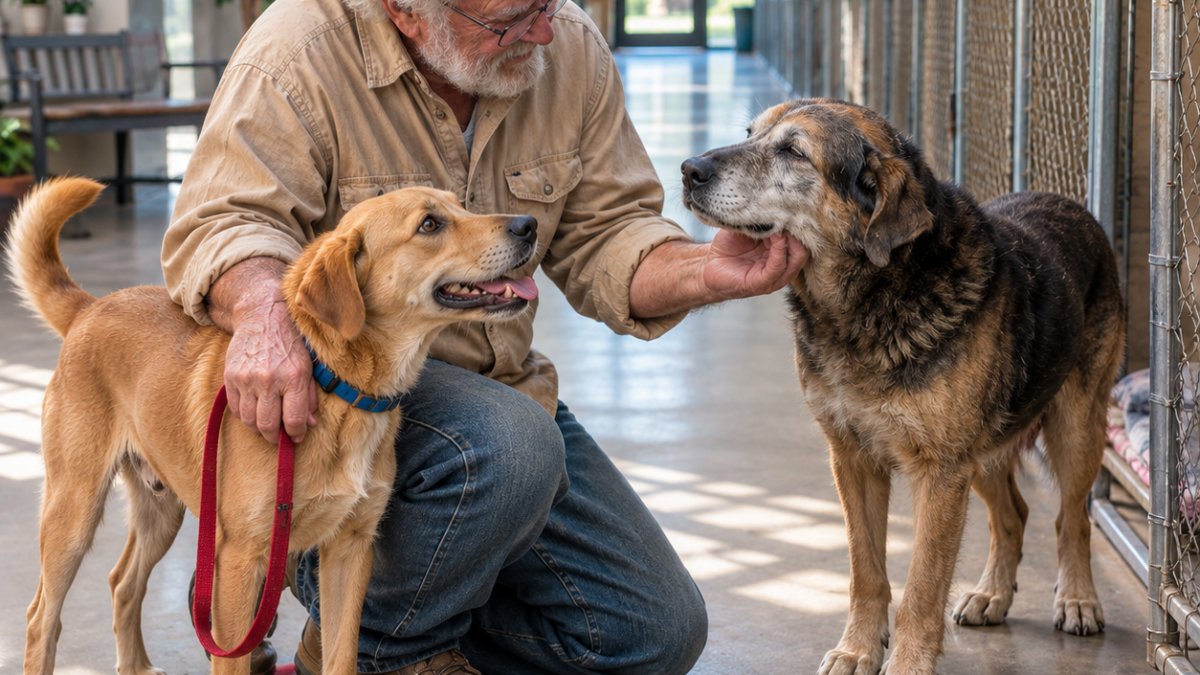
PART 2
Emma stared at me for several seconds.
“You’re serious.”
“I’ve been married forty-seven years. I know what serious looks like.”
A smile slowly appeared.
“Mr. Bennett—”
“Harold.”
“Harold, two dogs are a lot.”
“I’ve noticed.”
“George is energetic.”
“So was Eleanor.”
Emma laughed.
“Frank has ongoing medical needs.”
“So do I.”
“His arthritis medication alone is about eighty dollars a month.”
“I spend more than that on cable channels I don’t watch.”
She tried not to smile.
“And there’s something else.”
I looked at her.
“What?”
“They’re very bonded.”
“That part seems obvious.”
“No. I mean extremely bonded. George won’t eat if Frank is separated too long. Frank panics if George cries. We tried housing them in neighboring kennels once when Frank needed medical observation.”
“How’d that go?”
“George tore the corner off a plastic food bowl.”
I looked at him.
He wagged.
“You look proud of yourself.”
Emma sighed.
“Frank barked for six hours.”
I looked at Frank.
He looked innocent.
“Fine.”
I stood slowly.
“Where do I sign?”
The adoption process took longer than I expected.
Background questions.
Veterinary references from dogs I hadn’t owned in years.
A home-safety form.
A discussion about fences.
Then Emma asked the most annoying question.
“What happens to George and Frank if something happens to you?”
I went quiet.
At seventy-four, people ask questions like that differently.
When you’re thirty, they mean vacation.
At seventy-four, they sometimes mean death.
“My daughter.”
“Has she agreed?”
“No.”
Emma raised one eyebrow.
“She will.”
“You should call her.”
I sighed.
Claire answered on the second ring.
“Dad?”
“I’m at the animal shelter.”
Silence.
“Why?”
“I’ve adopted two dogs.”
Another silence.
Then, “Two?”
“Yes.”
“You went there for one.”
“I know.”
“What happened?”
“One of them was manipulative.”
“Which one?”
“The old one.”
Emma covered her mouth to hide a laugh.
Claire asked, “How old?”
“Frank is around ten or eleven. George is maybe four.”
“Dad.”
“I know.”
“Do they have medical issues?”
“One does.”
“Dad.”
“I can hear your tone.”
“You’re seventy-four.”
“Thank you for reminding me.”
“And you hate getting up before eight.”
“That was before I had responsibilities.”
“You’ve had them for twenty minutes.”
I looked at Frank and George.
George had his chin on Frank’s shoulder.
“I need to ask you something.”
Claire immediately became serious.
“What?”
“If something happens to me, will you take them?”
She didn’t answer immediately.
That hurt.
Then she said quietly, “Of course I will.”
I swallowed.
“Both?”
“Both.”
“No separating them.”
“No separating them.”
Emma checked a box on the form.
Twenty minutes later, I signed my name.
Then she handed me two leashes.
I stood there looking at them.
“What?”
Emma smiled.
“Congratulations.”
“That’s it?”
“That’s it.”
“They’re mine?”
“They’re yours.”
Frank leaned against George.
George tried to walk in three directions at once.
I stared at both dogs.
“I may have made a terrible mistake.”
Emma laughed.
“Most good adoptions start that way.”
The ride home confirmed it.
George hated sitting still.
He climbed into the front seat.
Then the back.
Then halfway into the front again.
Frank simply lay across the back seat like a retired general who had seen enough nonsense.
“George.”
He licked my ear.
“George.”
He put one paw on my shoulder.
“Your name is going to become a swear word.”
Frank sighed.
I looked at him through the mirror.
“You know exactly what I’m talking about.”
His tail tapped once.
When we reached my house, George jumped out and almost pulled me into the hydrangeas.
Frank climbed down carefully.
Then he stopped.
He looked at the porch.
Then the windows.
Then the garden.
Something about his face changed.
Recognition?
Not of the place.
Of something.
Home, perhaps.
I opened the front door.
George charged inside.
Frank did not.
He stood on the threshold.
I turned.
“Come on.”
He looked up at me.
My chest tightened.
I stepped back outside.
Then I walked in beside him.
“Together.”
Frank crossed the threshold.
That first evening was chaos.
George found Eleanor’s gardening gloves and carried one through the living room.
I took it away.
He found the other.
Frank discovered the rug in front of the fireplace and decided it belonged to him.
I put down dog beds.
Neither dog used them.
At dinner, George ate quickly.
Frank ate slowly.
George finished, walked over to Frank’s bowl, then sat beside him without touching a single bite.
He just waited.
Frank finally looked up.
George licked his face.
I stood at the kitchen counter watching them.
“Were you always like this?”
Frank returned to eating.
George waited.
Something about it reminded me of Eleanor and me during her final years.
She had arthritis in her hands.
Some mornings, buttons defeated her.
She’d get angry when I tried to help.
So I learned not to.
I just stayed close.
Maybe that’s what love becomes after enough time.
Not grand gestures.
Not speeches.
Just staying close enough to help without being asked.
That night, I turned off the downstairs lights and went toward my bedroom.
George followed.
Frank tried.
He made it halfway up the stairs.
Then stopped.
His rear legs shook.
I came down.
“No.”
He looked embarrassed.
“You stay downstairs.”
George immediately returned to him.
I looked at both dogs.
“Well.”
Five minutes later, I was carrying blankets into the living room.
I slept on the couch.
Frank slept beside it.
George slept with his head across Frank’s back.
At three in the morning, I woke to the sound of snoring.
Loud snoring.
I looked down.
Frank.
“Eleanor, you sent me a defective one.”
George opened one eye.
For the first time since my wife died, I laughed in the dark.
The next morning, I woke before sunrise.
George was sitting six inches from my face.
I opened my eyes.
He licked my nose.
“Absolutely not.”
He wagged.
“No.”
He licked me again.
Frank remained asleep.
“You’re supposed to be the calm one.”
George sneezed.
I got up.
And that was how my house began breathing again.
It happened slowly.
Then all at once.
There were bowls in the kitchen.
Leashes by the door.
Hair on the couch.
Muddy pawprints in the hallway.
George learned that the backyard was his kingdom.
Frank learned exactly where morning sunlight landed on the living-room carpet.
I learned that two dogs can somehow occupy eighty percent of a queen-sized bed despite being specifically forbidden from entering the bedroom.
Claire visited the following weekend.
She stood in my doorway and stared at George.
Then Frank.
Then me.
“You look different.”
“I’m wearing the same shirt.”
“That’s not what I mean.”
George approached her.
Claire crouched.
“Which one manipulated you?”
I pointed at Frank.
Frank wagged.
She scratched under his chin.
“He looks innocent.”
“He isn’t.”
George pushed between them.
Claire laughed.
Then she looked around my house.
Her expression changed.
“What?”
“Nothing.”
“Claire.”
She touched the back of Eleanor’s chair.
“It doesn’t feel so quiet.”
I looked toward the dogs.
“No.”
It didn’t.
Three weeks passed.
Then Emma called.
Her voice sounded wrong.
“Harold?”
“Yes?”
“Are George and Frank with you?”
I looked toward the backyard.
George was rolling in grass.
Frank was watching him from the porch.
“Yes.”
“Keep them inside today.”
I stood straighter.
“Why?”
“We’ve got a problem.”
“What kind of problem?”
“A man came to the shelter claiming they belong to him.”
I felt cold.
“He’s wrong.”
“I know.”
“Then what’s the problem?”
Emma hesitated.
“He says the person who surrendered them didn’t have legal authority.”
“Who is he?”
“Craig Bell.”
The name meant nothing.
“He says he is the nephew of their previous owner.”
I looked through the window.
Frank had stood.
George trotted back toward him.
“What does he want?”
Emma was silent for half a second too long.
“George.”
Only George.
My hand tightened around the phone.
“And Frank?”
“He says Frank isn’t his concern.”
That told me everything I needed to know.
“He’s not getting either.”
“Harold, please don’t confront him.”
“I wasn’t planning to.”
That was a lie.
At least a partial one.
“Did he threaten you?”
“No. But he brought an attorney.”
I almost laughed.
Of course he did.
“Emma.”
“Yes?”
“Those dogs were legally adopted to me.”
“Yes.”
“Then they’re mine.”
“Right now, yes.”
Right now.
I hated those words.
“What aren’t you telling me?”
She exhaled.
“The surrender paperwork may be complicated.”
“How complicated?”
“The woman who brought them in was Craig’s sister, Susan Bell.”
“So?”
“She signed as their owner.”
“Wasn’t she?”
“Maybe not.”
My stomach sank.
“The registered owner on Frank’s microchip was Walter Bell.”
“Craig’s father?”
“Uncle.”
“And George?”
“Also Walter Bell.”
“So Walter owned both.”
“Yes.”
“Where is Walter?”
Emma went quiet.
“He died three months before the dogs were surrendered.”
I sat down.
“Then who inherited them?”
“That is exactly what everyone is trying to establish.”
I looked at Frank.
He was staring through the glass door at me.
There was something about that old dog.
As if he already knew what losing felt like.
“Tell Craig Bell something for me.”
“Harold—”
“Tell him he can bring all the attorneys he wants.”
I stood again.
“He’s not splitting them.”
The next day, Craig Bell came to my house.
I knew who he was before he introduced himself.
Late forties.
Good haircut.
Expensive SUV.
Shoes too clean for my driveway.
I met him on the porch.
George and Frank were inside.
“Mr. Bennett?”
“Yes.”
“Craig Bell.”
“I know.”
“I’d like to discuss George.”
“No.”
He blinked.
“I haven’t said anything yet.”
“You want my dog.”
“He isn’t your dog.”
I smiled.
“That was fast.”
Craig’s expression tightened.
“George belonged to my uncle Walter.”
“So did Frank.”
“Frank is different.”
“Why?”
“He’s old.”
There it was.
“You drove here to say that?”
Craig sighed.
“Look, I don’t want conflict.”
“Good. Get back in your car.”
“You don’t understand the situation.”
“Explain it.”
“My uncle’s estate has unresolved provisions concerning George.”
“Concerning George?”
“Yes.”
“Not Frank?”
“Not in a way that matters.”
I stared at him.
“That’s an interesting sentence.”
Craig glanced through my front window.
George appeared.
His tail started moving.
Frank came behind him.
The instant Frank saw Craig, his entire body changed.
He froze.
Then stepped in front of George.
My blood went cold.
George’s tail stopped.
Craig saw it.
He smiled faintly.
“They remember me.”
Frank growled.
I’d never heard that sound from him.
Not once.
I stepped down one porch step.
“What did you do to them?”
Craig’s face hardened.
“Nothing.”
“Frank disagrees.”
“He’s a dog.”
“Yes.”
I looked directly at him.
“And right now I’m trusting his opinion more than yours.”
Craig lowered his voice.
“George is valuable.”
I almost laughed.
“Every dog is valuable.”
“You know what I mean.”
“No.”
“He’s a registered golden retriever from a championship line.”
I looked through the window.
George had one ear folded backward.
“He steals socks.”
Craig ignored me.
“My uncle paid nearly four thousand dollars for him.”
“And?”
“And he was never supposed to be surrendered.”
“What about Frank?”
“Frank was a rescue.”
The contempt in his voice was subtle.
But it was there.
“George is different.”
I felt something harden in me.
“You leave now.”
“Mr. Bennett—”
“No.”
“You could make this easy.”
“So could you.”
“How?”
“Never come back.”
Craig stared at me.
Then smiled.
“We’ll let the lawyers handle it.”
As he walked toward his SUV, Frank barked once from inside.
Craig stopped.
He looked over his shoulder.
“Old dog never liked me.”
I said nothing.
Craig drove away.
I went inside.
Frank was trembling.
I sat on the floor.
George immediately pressed against him.
“What happened in that house?”
Frank lowered his head onto my knee.
I scratched behind his ears.
“You don’t have to tell me.”
He closed his eyes.
“But somebody is going to.”
Two days later, Claire helped me hire an attorney.
Her name was Maya Reynolds.
She was fifty-two, sharp-eyed, and had the unsettling habit of becoming quieter when something interested her.
She read every document twice.
Then she looked at me.
“Craig Bell doesn’t care about the dog.”
“I figured that out.”
“He cares about money.”
“What money?”
She turned one page toward me.
Walter Bell’s will.
I stared.
“I don’t understand.”
Maya pointed to a paragraph.
Walter had created a pet trust.
One hundred and twenty thousand dollars.
The money was supposed to cover food, veterinary treatment, housing, and care for Frank and George for the rest of their lives.
The appointed caretaker?
Craig Bell.
I looked up.
“He abandoned them.”
“Possibly.”
“Then why is he coming back?”
“Because the trust still holds approximately ninety-three thousand dollars.”
I sat very still.
“What happened to the other twenty-seven?”
Maya gave me a look.
“That is a very good question.”
The trust paid the caretaker documented expenses plus a monthly stipend.
Craig had withdrawn money for nearly a year after Walter died.
Then Susan surrendered the dogs.
Yet withdrawals apparently continued.
“For dogs he wasn’t caring for?”
“That’s what it looks like.”
I felt sick.
“So why George?”
“Because the trust contains an unusual clause.”
“What clause?”
Maya read it.
If either animal died, the remaining trust continued for the surviving animal.
When both died, any remaining funds went to the Maple County Animal Welfare Foundation.
I slowly understood.
“So as long as one dog is alive…”
“Craig can argue that he is still entitled to manage the trust if he regains legal custody.”
“And he picked George because George is younger.”
Maya nodded.
“He may live another ten years.”
I looked toward the living room.
Frank was sleeping.
George’s head rested beside his paws.
My stomach turned.
“He doesn’t want George.”
“No.”
“He wants access to the money.”
“Yes.”
“And Frank?”
“From Craig’s perspective, Frank is financially inconvenient.”
I stood.
“I’m going to kill him.”
Maya didn’t blink.
“No, you’re not.”
“It was an expression.”
“Good.”
She closed the folder.
“Because we can do something much worse.”
I looked at her.
“What?”
“Prove it.”
That was the beginning of the fight.
Maya subpoenaed trust records.
Emma searched shelter intake paperwork.
Claire went through public records.
I did what I was told.
Mostly.
Then Susan Bell contacted me.
Craig’s sister.
The woman who had surrendered Frank and George.
She asked to meet at a coffee shop.
I nearly refused.
Maya said, “Go. Don’t accuse. Listen.”
So I went.
Susan was in her early fifties.
She looked exhausted.
The first thing she said was, “I’m sorry.”
“For what?”
“For bringing them to the shelter.”
I said nothing.
She stared at her coffee.
“Uncle Walter died suddenly.”
“Heart attack?”
She nodded.
“He loved those dogs more than anybody.”
I believed that.
George was friendly with everyone.
Frank trusted slowly.
Dogs become that way for reasons.
“Craig was supposed to take them.”
“What happened?”
“He did. For about four months.”
“And?”
Susan looked at me.
“Craig hated Frank.”
“Why?”
“Because Frank didn’t obey him.”
That sounded ridiculous.
“How do you mean?”
“Frank would stand between Craig and George.”
My chest tightened.
“Like he did at my house.”
Susan nodded.
“Craig used to yell at George. George was young. Excitable. He’d knock things over.”
“What did Craig do?”
Her eyes filled.
“Nothing that left marks.”
I understood.
That sentence was worse than details.
“Frank would get between them?”
“Every time.”
I looked away.
Susan continued.
“Then Craig started keeping both dogs in the garage.”
“For how long?”
“Weeks.”
“Why?”
“He said they scratched the floors.”
My jaw clenched.
“I went over one day. Their water bowl was empty. Frank could barely get up.”
“What did you do?”
“I took them.”
“You stole them?”
“Yes.”
I looked at her.
“Good.”
She almost smiled.
“Craig threatened to call police.”
“Why didn’t he?”
“Because I told him I’d call the attorney handling the trust.”
There it was.
“He was taking money.”
Susan nodded.
“I didn’t know how much. I just knew Uncle Walter left money for the dogs.”
“So you brought them to the shelter.”
“I live in an apartment that doesn’t allow animals. I tried three rescues first. They were full.”
“Why did you sign yourself as owner?”
“Because I was scared Craig would find them.”
“You lied.”
“Yes.”
She didn’t defend it.
“I thought if I said I was family and I owned them, the shelter would take them.”
I leaned back.
“They could lose their adoption because of that.”
“I know.”
“Frank could be separated from George because of that.”
She began crying.
“I know.”
I wanted to be angry.
But grief recognizes guilt.
“What do you have?”
She wiped her face.
“What?”
“Proof.”
Susan reached into her bag.
She placed an old phone on the table.
“Messages.”
My heart started pounding.
“From Craig?”
“Yes.”
“About the dogs?”
“And the trust.”
She looked directly at me.
“I kept everything.”
Maya almost smiled when she saw the phone.
Almost.
The messages were devastating.
Craig complaining about veterinary bills.
Craig asking whether Frank was “worth keeping alive.”
Craig writing:
If Frank goes first, the trust gets easier.
Another:
George could last another decade. That’s the one that matters.
Then the message that made me leave the room.
Susan had written:
They need a vet.
Craig responded:
They need to stop costing money.
I stood in Maya’s office hallway for several minutes.
When I returned, Maya had stopped reading.
“You okay?”
“No.”
“Good.”
I stared.
She explained.
“Anger is useful if you don’t let it drive.”
Eleanor used to say something similar.
She’d say, “Don’t waste your anger. Put it to work.”
I sat down.
“What do we do?”
Maya looked at the phone.
“We put it to work.”
Craig escalated before we could.
One Saturday morning, I was in the backyard with George.
Frank was inside because his hips were bad that day.
A vehicle stopped in front of the house.
Craig.
He walked toward the gate.
I stood.
“Leave.”
“I have a court petition pending.”
“That doesn’t give you access to my property.”
“I want to see George.”
“No.”
George saw him.
He moved behind me.
That told me enough.
Craig opened the gate.
I couldn’t believe it.
“Close that.”
“He’s my property.”
“He is not.”
Craig stepped forward.
George backed away.
Then the back door slammed open.
Frank.
I still don’t know how he pushed through it.
He came down the three porch steps faster than I’d seen him move since adoption.
His legs shook.
He put himself between Craig and George.
Again.
Old.
Sick.
Hurting.
Still doing the same job.
Craig pointed at him.
“See? That’s what I’m talking about.”
I stared at him.
“What?”
“That dog is aggressive.”
Frank didn’t lunge.
Didn’t bark.
He just stood there.
Craig took another step.
Frank growled.
George pressed against his back.
I pulled out my phone.
“You’re being recorded.”
Craig stopped.
“Good.”
He looked toward the camera.
“Record this. George belongs to the Bell estate.”
“No.”
“And that useless old dog has no business interfering.”
Something inside me went completely cold.
“Get off my property.”
Craig reached toward George’s leash hanging on the fence.
Frank moved.
His legs failed.
He collapsed.
“Frank!”
I dropped beside him.
George panicked.
He began whining, circling Frank.
Craig backed away.
I looked up.
“If he dies because of this—”
“I didn’t touch him.”
“You came here.”
“He has heart disease.”
“You came here.”
Claire happened to pull into the driveway at that moment.
She saw me on the ground.
Frank collapsed.
Craig by the gate.
She ran.
“What happened?”
“Call the vet.”
Craig started toward his SUV.
Claire blocked his path.
“You aren’t leaving.”
“Move.”
“No.”
He stared at her.
“Who are you?”
“His daughter.”
“Then tell your father he’s making a very expensive mistake.”
Claire looked toward Frank.
Then back at him.
“My father survived losing my mother.”
Her voice was terrifyingly calm.
“You have no idea how little your threats matter to him now.”
Craig left before police arrived.
Frank survived.
Barely.
His heart murmur had progressed.
Stress triggered an episode.
The veterinarian stabilized him overnight.
George refused to leave the hospital kennel beside him.
The staff finally brought a blanket into the recovery room.
George lay down.
Pressed against the bars.
Frank slept on the other side.
I sat in a plastic chair all night.
At 2:13 a.m., Claire came back with coffee.
“You should sleep.”
“No.”
“Dad.”
“I left your mother alone for forty-five minutes the day she died.”
Claire froze.
I had never told her that.
“I went to the hardware store.”
“Dad…”
“She told me to go.”
“Mom died of an aneurysm. You couldn’t have known.”
“I know.”
“Then why are you saying this?”
I looked toward Frank.
“Because I am tired of walking away from things I love because somebody tells me I can’t change the ending.”
Claire sat beside me.
For a long time, neither of us spoke.
Then she took my hand.
“You didn’t walk away from Mom.”
I stared ahead.
“I know.”
This time I believed it a little.
Frank came home two days later.
His medication changed.
No stairs.
No excitement.
No long walks.
George adapted instantly.
If Frank walked slowly, George walked slowly.
If Frank stopped, George stopped.
At night, George slept with his body touching Frank’s.
The court hearing was scheduled three weeks later.
I hated courtrooms.
Too much wood.
Too much waiting.
Too many people pretending emotion doesn’t matter.
Craig arrived in a dark suit.
He didn’t look at me.
Susan testified first.
She admitted taking the dogs.
Admitted falsifying the shelter surrender.
Craig’s attorney tried to make her look unstable.
“Did you dislike your brother?”
“Yes.”
“Were you angry about the estate?”
“No.”
“Did you want control of the trust?”
“No.”
“You stole the animals.”
“I removed them.”
“Without permission.”
“Yes.”
“Then lied.”
“Yes.”
His attorney smiled.
Susan continued before he could ask another question.
“Because my brother was starving them.”
The smile disappeared.
Maya introduced photographs Susan had taken.
Empty bowls.
Frank lying in a garage.
George beside him.
Then veterinary records.
Frank had lost fourteen pounds during Craig’s care.
His arthritis medication had not been refilled in nearly three months.
George’s vaccinations were overdue.
Then came bank statements.
Trust withdrawals.
Pet care charges.
Five thousand dollars for “specialized veterinary services.”
No veterinarian had received it.
Three thousand for “secure canine housing.”
No boarding facility had any record.
Monthly caregiver stipends.
Paid.
Every month.
Even after Susan took the dogs.
Craig’s attorney objected.
The judge allowed the evidence.
Then Maya displayed the messages.
George could last another decade. That’s the one that matters.
The room went silent.
Craig finally looked at me.
I didn’t look away.
Maya asked Susan, “When your brother wrote that, what did you understand him to mean?”
“That George could keep the trust active longer.”
“And Frank?”
Susan’s voice broke.
“Frank was a cost.”
I heard Eleanor in my head.
A dog is the soul of a house.
Craig had seen two living creatures and calculated depreciation.
Then I testified.
Maya asked why I adopted both dogs.
I told the truth.
“I was going to take Frank.”
“Why?”
“I wanted an older dog.”
“What changed?”
I looked toward Craig.
“Frank did.”
The judge leaned forward slightly.
“What do you mean?”
I described the kennel.
George at the front.
Frank at the back.
Frank standing.
Walking over.
Pushing George toward me.
I felt my throat tighten.
“He thought I was choosing.”
I paused.
“He thought only one of them was getting out.”
The courtroom was silent.
“And he picked George.”
Maya asked, “What did you do?”
“I took both.”
“Why?”
“Because I’d spent forty-seven years married to a woman who would’ve haunted me if I separated those dogs.”
A few people laughed softly.
Even the judge smiled.
Then Maya’s expression became serious.
“Mr. Bennett, do you want access to Walter Bell’s pet trust?”
“No.”
“Have you requested any payment?”
“No.”
“Would you accept control of it?”
“No.”
“Why?”
“Because George and Frank aren’t retirement investments.”
I looked at Craig.
“They’re family.”
Craig testified last.
He claimed Susan manipulated records.
Claimed veterinary care had been scheduled.
Claimed trust withdrawals covered legitimate costs.
Then Maya handed him one printed message.
“Did you write this?”
He read it.
His face changed.
“Possibly.”
“Please read it aloud.”
His attorney objected.
Overruled.
Craig swallowed.
“George could last another decade. That’s the one that matters.”
Maya waited.
“What did you mean?”
“I don’t remember.”
“You don’t remember what mattered?”
“No.”
“Was it George?”
He hesitated.
“Yes.”
“Or the trust?”
His attorney stood.
“Objection.”
“Sustained.”
Maya smiled faintly.
She already had what she wanted.
The ruling came that afternoon.
The judge found that Susan’s surrender paperwork had been defective.
My heart stopped.
Then he continued.
But Craig’s own conduct, the shelter’s good-faith adoption, the evidence of neglect, and the trust records created overwhelming reasons not to return either animal to him.
Temporary custody remained with me.
The court referred the trust matter for fiduciary investigation.
More importantly, Craig was ordered to have no contact with George or Frank pending the final case.
Outside the courthouse, Claire hugged me.
“We won.”
Maya shook her head.
“Not yet.”
She was right.
But we had time.
Time mattered.
Three months later, the fiduciary investigation became a fraud investigation.
Craig had taken more than forty-eight thousand dollars from Walter’s pet trust.
Some paid legitimate expenses.
Much of it did not.
He eventually entered a plea agreement involving misappropriation and financial exploitation of trust assets.
He was ordered to repay the money.
Removed permanently as trustee.
Barred from controlling the animals.
And Walter’s original alternate provision activated.
If the designated caregiver was removed for misconduct, the Maple County Animal Welfare Foundation would administer the trust exclusively for Frank and George.
The foundation contacted me.
“We can reimburse you for their care.”
“No.”
“Mr. Bennett, this is what Walter intended.”
I thought about that.
Frank’s medication wasn’t cheap.
Neither were veterinary visits.
I agreed to reimbursement for their direct medical expenses.
Nothing more.
The remaining money?
I asked the foundation to do something with it.
They created a program.
The Frank and George Bonded Senior Fund.
It paid adoption fees and veterinary costs for bonded dogs when one was elderly or medically difficult to place.
Craig had spent years trying to turn Walter’s love for two dogs into money for himself.
In the end, that same money began keeping other dogs together.
That felt better than revenge.
But I’d be lying if I said I didn’t enjoy it.
The local newspaper ran the story.
They used a photograph Emma had taken on adoption day.
Me sitting between Frank and George.
Frank leaning against my knee.
George grinning like an idiot.
The headline read:
LOCAL PET TRUST CASE CREATES FUND FOR BONDED SHELTER DOGS
Craig hated the publicity.
I knew because he sent Maya a letter demanding that I stop discussing him publicly.
I hadn’t discussed him publicly.
I framed the letter.
Claire called that petty.
I told her I was seventy-four and had earned it.
Life became quieter after that.
The good kind of quiet.
George developed routines.
At 6:45 every morning, he woke me.
At 6:47, he brought one of my slippers.
Only one.
Never both.
Frank slept later.
At breakfast, George always waited until Frank began eating.
On warm mornings, we sat on the porch.
I drank coffee.
Frank slept by my chair.
George watched squirrels with the concentration of a federal investigator.
I talked to Eleanor.
Out loud.
At first I felt ridiculous.
Then I realized I’d been doing it even before the dogs.
The difference was that now somebody listened.
One spring morning, I carried Eleanor’s old gardening basket outside.
I hadn’t touched it in two years.
George immediately stole a glove.
“Put that down.”
He ran.
Frank watched.
I chased George halfway around the yard.
Then stopped.
I was laughing too hard.
Claire arrived at the gate.
She stared.
“What?”
“You’re running.”
“I am not running.”
“You were absolutely running.”
“I was pursuing stolen property.”
George dropped the glove beside Frank.
Frank looked at me.
Traitor.
Claire walked into the garden.
“You haven’t worked out here since Mom died.”
I looked around.
Weeds everywhere.
Dead stems.
Roses badly overgrown.
“No.”
“Want help?”
I almost said no.
Then I said, “Yes.”
We spent the day cleaning Eleanor’s garden.
George dug in places he wasn’t supposed to.
Frank lay beneath the lilac bush.
By sunset, I was exhausted.
Dirty.
Sore.
Happy.
That frightened me.
Grief can make happiness feel disloyal.
As if laughing means you loved the dead less.
That evening, I sat beside Frank.
“Do you ever feel guilty?”
His ear moved.
“For being okay?”
George dropped a ball at my feet.
Frank sighed.
“That’s what I thought.”
Frank’s health declined slowly.
Then quickly.
Almost a year after the court case, he began falling more often.
His heart medication increased.
His hips worsened.
George noticed every change before I did.
If Frank stumbled, George stopped.
If Frank didn’t finish dinner, George left part of his own.
One night, Frank couldn’t get up.
I called the emergency veterinarian.
Claire drove us.
George rode beside Frank in the back.
The diagnosis was what I feared.
Congestive heart failure.
Advanced.
Treatment could buy time.
Not much.
“How much?” I asked.
The veterinarian hesitated.
“Weeks.”
Claire held my shoulder.
I looked at Frank.
He looked tired.
Not afraid.
Just tired.
We brought him home.
I made one promise.
No hospital ending.
No steel table if I could help it.
Frank deserved home.
For the next three weeks, the world became small.
The porch.
The garden.
The kitchen.
Frank’s bed.
George barely left him.
Emma visited.
She sat on the floor and cried into Frank’s neck.
“You stubborn old man.”
His tail moved once.
She looked at me.
“Do you remember what he did the first day?”
“I remember everything.”
“He thought George was leaving.”
“I know.”
Emma wiped her eyes.
“He was ready to stay.”
I looked toward George.
“Not anymore.”
The final morning was warm.
Eleanor’s roses had just begun blooming.
Frank refused breakfast.
George didn’t eat either.
I knew.
The veterinarian came to the house.
Frank was lying near the garden.
Of all places.
Beside Eleanor’s old chair.
I almost laughed at the cruelty of symbolism.
Then I decided maybe it wasn’t cruel.
Maybe some places are meant for endings because they were built from love.
I sat beside Frank.
George lay on his other side.
The veterinarian gave us time.
I placed my hand on Frank’s head.
“You know something?”
His cloudy eyes found mine.
“You made a terrible first impression.”
His tail moved.
“You tried to give me George.”
George lifted his head.
I rubbed Frank’s ear.
“I understand why.”
My voice broke.
“You loved him enough to stay behind.”
Frank breathed slowly.
“But I need you to understand something too.”
I leaned closer.
“I never saved George from losing you.”
Tears blurred everything.
“You saved me from losing myself.”
George crawled closer.
Frank pressed his nose against George’s face.
The same motion.
The same gentle push.
But this time he wasn’t pushing George toward a stranger.
He was pushing him toward me.
One last time.
My heart shattered.
“No.”
I wrapped one arm around George.
One around Frank.
“No one’s being left alone.”
The veterinarian gave the medication.
Frank relaxed.
George licked his muzzle.
I kept my hand under his head.
The way I had once held Eleanor’s hand.
“You did good, old man.”
Frank exhaled.
“You can stop worrying about him.”
Another breath.
“I’ve got George.”
Another.
“And he’s got me.”
Frank died beneath Eleanor’s roses.
George remained beside him for almost an hour.
Then he stood.
Walked to me.
And placed his head in my lap.
I cried harder than I had in years.
Not because grief was new.
Because now I understood it differently.
Grief is not proof that love failed.
It’s proof that love stayed long enough to leave a hole.
We buried Frank beneath the maple tree at the edge of the garden.
Claire helped.
Emma came.
So did Maya.
Even the shelter director.
The stone was simple.
FRANK
HE CHOSE HIS FRIEND FIRST
Underneath:
AND WE CHOSE THEM BOTH
George slept beside the grave for three nights.
The fourth night, he came inside.
He climbed onto the couch.
Put his head on my knee.
And stayed.
Months passed.
The house became quieter again.
But not empty.
There is a difference.
George still woke me.
Still stole one slipper.
Still chased squirrels.
But he changed after Frank died.
He became calmer.
Older somehow.
Sometimes he stood in the garden staring toward Frank’s tree.
Then he’d come find me.
I understood.
We were both learning the same thing.
You don’t replace someone.
You carry what they taught you into whatever comes next.
The Frank and George Bonded Senior Fund grew.
People donated after hearing the story.
Within two years, it had helped more than sixty bonded pairs avoid separation.
Old dogs who would otherwise have been left behind went home with the younger companions they loved.
One pair stayed with me temporarily.
That was the plan.
Temporarily.
Their names were Ruby and Max.
Ruby was twelve.
Max was six.
Claire came over and found both sleeping in my living room.
She put her hands on her hips.
“Dad.”
“It’s temporary.”
“That’s what shelters say before they ruin your life.”
“I learned from professionals.”
George walked past carrying my slipper.
Claire looked at him.
“He taught you nothing.”
“Incorrect.”
I pointed toward the dogs.
“He taught me not to believe the word temporary.”
Ruby and Max were adopted together three weeks later.
I cried when they left.
Then smiled.
That surprised me too.
Letting go had once felt like death.
Now sometimes it meant success.
On the third anniversary of Frank’s death, the shelter invited me to a dedication.
They had renovated the senior-dog wing.
Above the entrance was a small sign:
THE FRANK ROOM
NO BONDED DOG LEFT BEHIND
I stood there for a long time.
Emma came beside me.
“You okay?”
“No.”
She smiled.
“Me neither.”
A couple walked down the hallway with two leashes.
One dog young.
One gray.
The older dog limped.
The younger kept checking on him.
I watched them leave together.
Emma whispered, “That never gets old.”
“No.”
It didn’t.
Craig Bell disappeared from our lives.
Almost.
I saw him once.
Years later.
At a pharmacy.
I was eighty by then.
George was ten.
Craig looked older too.
He noticed me first.
“Harold.”
I turned.
“Craig.”
We stood there awkwardly.
Finally he said, “How’s the golden?”
“George.”
“Yes.”
“He’s good.”
“And Frank?”
I looked at him.
“He died.”
Craig lowered his eyes.
“When?”
“Years ago.”
He nodded.
“I heard about the fund.”
“Good.”
His face tightened.
“You really turned the whole thing into a monument.”
“No.”
“What would you call it?”
“A correction.”
He looked at me.
“For what?”
“For the idea that the older dog was disposable.”
Craig flinched.
I hadn’t intended cruelty.
Maybe truth sometimes arrives wearing the same clothes.
He said, “I made mistakes.”
“Yes.”
“You think I don’t know that?”
“I don’t know what you know.”
He looked tired.
“I lost everything over those dogs.”
I shook my head.
“No.”
His jaw tightened.
“Your reputation. The trust. Your business connections.”
I stepped closer.
“You lost those things because of what you did.”
He said nothing.
“Frank and George were just there long enough for everyone to see it.”
Craig looked away.
Then he asked something unexpected.
“Did Frank hate me?”
I thought about that.
Frank growling at him.
Standing between him and George.
Collapsing in my yard.
I could have said yes.
Instead I said, “I don’t think dogs waste much time hating.”
Craig looked back at me.
“What do they do?”
“They remember who makes them feel safe.”
That hurt him.
I saw it.
Good.
Maybe that was the last little piece of revenge I had left in me.
I walked away.
George lived to be thirteen.
His face slowly turned white.
He developed arthritis.
Then hearing loss.
He became everything I had originally gone to the shelter looking for.
Old.
Quiet.
Content to sit beside me on the porch.
Funny how life works.
When I adopted him, he was the young dog I hadn’t planned on.
Years later, he became the old dog I thought I wanted.
By then I was eighty-three.
We were both slower.
Claire came by more often.
She stopped pretending it was for my benefit.
She loved George.
One evening, we sat on the porch while rain moved in.
George slept beside my chair.
Claire asked, “Do you still miss Mom every day?”
“Yes.”
“Does it hurt the same?”
I thought about that.
“No.”
“How does it hurt now?”
I looked toward the garden.
“Like a room I know is there.”
She waited.
“I don’t have to stand inside it all day anymore.”
Claire took my hand.
George opened one eye.
Then closed it.
His final day came quietly.
No emergency.
No panic.
He simply stopped eating.
The veterinarian examined him at home.
Cancer.
Advanced.
I laughed when she told me.
Not because it was funny.
Because life had apparently decided I hadn’t learned enough about goodbye.
Claire stayed with me.
Emma came too.
She was a shelter director now.
Gray beginning at her temples.
When George saw her, his tail moved.
“Hello, handsome,” she whispered.
Exactly what I’d said the first day.
We carried him to the garden.
Frank’s grave was beneath the maple.
Eleanor’s roses were blooming.
George lay between them.
I sat on the ground.
At eighty-three, getting down wasn’t easy.
I did it anyway.
George rested his head on my leg.
“You remember him?”
His ears moved.
“Frank.”
I looked toward the stone.
“He picked you.”
My voice shook.
“He thought you deserved the better life.”
George looked up.
“He was wrong about one thing.”
I stroked his white muzzle.
“You were the better life.”
Claire covered her mouth.
Emma turned away.
I continued.
“You and Frank came into a house that had forgotten how to breathe.”
George’s tail moved once.
“You gave it back its soul.”
The veterinarian waited.
I leaned down.
“Go find him.”
Tears fell onto George’s fur.
“He’s probably still bossing everybody around.”
George exhaled.
“And if you see Eleanor…”
I stopped.
I couldn’t finish.
Then I laughed softly.
“You’ll know her.”
I touched his face.
“She’ll be the woman telling Frank he’s too stubborn.”
George died with my hand beneath his chin.
We buried him beside Frank.
His stone says:
GEORGE
HE WAS GIVEN A CHANCE
BECAUSE HIS FRIEND LOVED HIM
Below both stones, Claire placed one final marker.
TOGETHER THEN.
TOGETHER NOW.
I thought that would be the ending.
It wasn’t.
The following spring, Maple County Shelter asked me to speak at an adoption event.
I said no.
Emma ignored me.
So I went.
There were families everywhere.
Children.
Dogs.
Volunteers.
Photographs of animals adopted through the bonded-pair fund covered one wall.
I saw Frank.
George.
My younger face.
Then a photograph of two dogs leaving the shelter together.
Then another.
And another.
Seventy-three bonded pairs.
One hundred forty-six dogs.
Together.
Because one old dog had once pushed his best friend toward a stranger.
Emma stood beside me.
“You see what he started?”
“Frank?”
“Yes.”
I stared at the photographs.
“He just loved George.”
“Exactly.”
I understood then.
People think love has to be enormous to change the world.
It doesn’t.
Sometimes it’s an old dog standing on arthritic legs.
Sometimes it’s a gentle push of the nose.
Sometimes it’s choosing another creature before yourself.
Sometimes it’s an old widower saying, “No. I’m taking both.”
I had gone to the shelter because my wife once said a dog was the soul of a house.
I thought she meant companionship.
Noise.
Warmth.
A heartbeat beside your chair.
I know better now.
A dog can be the soul of a house because dogs are very good at reminding us of things grief makes us forget.
Stay.
Forgive.
Eat when food is offered.
Sleep in the sunlight.
Love the person beside you while they’re still there.
And when the time comes, let them go without pretending the love goes with them.
Frank taught me that.
George taught me that.
Eleanor had been trying to teach me the same thing for forty-seven years.
I just needed two dogs to finally understand her.
Today, when people ask me whether I regret adopting two dogs at seventy-four, I tell them the truth.
Yes.
I regret it every single day.
Then I wait for their surprised faces.
I regret not doing it sooner.
I regret every morning I spent in that silent house believing grief was something I had to protect.
I regret thinking love was dangerous because eventually it ends.
Everything ends.
That isn’t an argument against loving it.
It’s the reason to begin.
Frank knew that before I did.
The old dog had been willing to stay behind if George could have a future.
He thought sacrifice meant disappearing from the story.
Instead, that one act became the beginning of everything that came after.
A home.
A family.
A court fight.
A rescue fund.
Dozens of bonded dogs leaving shelters side by side.
A garden growing again.
An old man laughing in rooms that had been silent for two years.
Craig once thought Frank had no value because he was old, sick, and expensive.
He was wrong in a way no court judgment could fully explain.
Frank changed more lives after being labeled unwanted than Craig ever did while chasing money.
And if there was revenge in our story, that was it.
Not watching Craig lose.
Watching Frank’s love win.
Years after both dogs were gone, I still sometimes woke expecting to hear George’s paws in the hallway.
Sometimes I looked toward the fireplace and almost saw Frank sleeping there.
The house became quiet again.
But it never became empty.
Their bowls were gone.
Their beds were gone.
Their leashes no longer hung by the door.
Still, something remained.
The soul of the house.
Eleanor had been right.
She usually was.
And whenever I walked past the maple tree and saw two stones side by side, I remembered the first moment Frank looked into my eyes and pushed George toward me.
At the time, I thought he was saying:
Take him.
He deserves a home.
Years later, I understood what he had really given me.
He wasn’t only giving George a chance.
He was giving one to me.
And thank God I was smart enough, just once in my life, to take it.








