I Went to Donate Dog Food—Then a Starving Lab Mom Led Me Into a Fight for Her Last Puppy
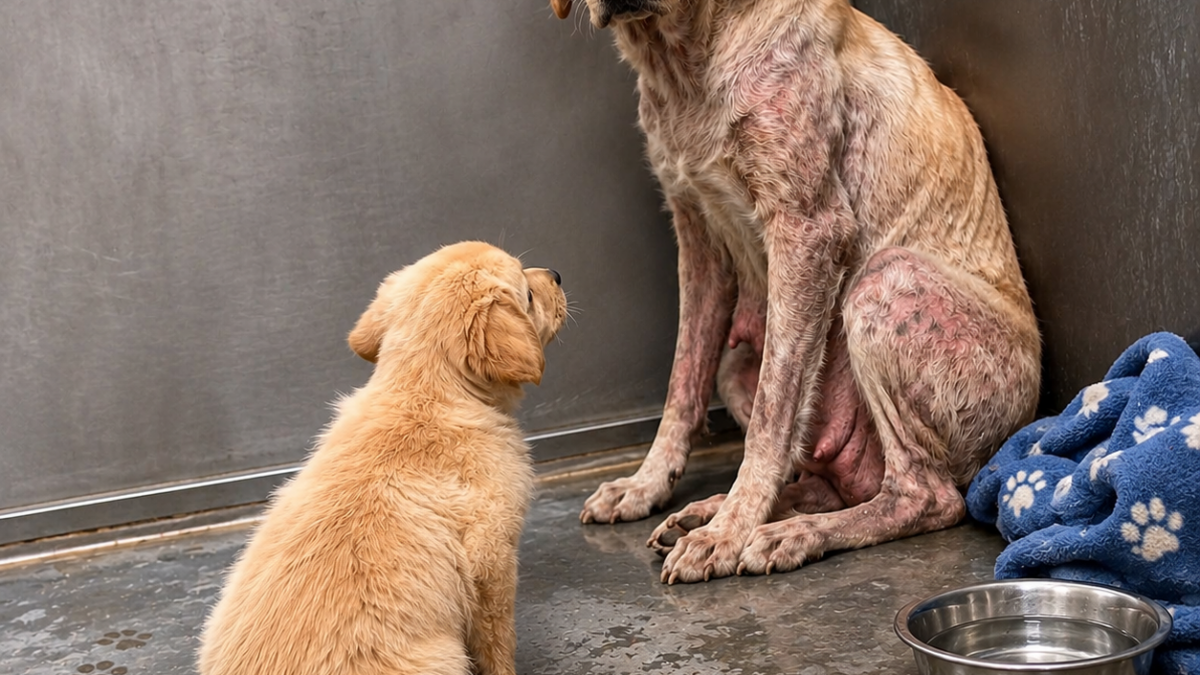
PART 2
I made it all the way to my car.
That was the ridiculous part.
I didn’t dramatically turn around in the hallway.
I didn’t burst into tears and announce that I was taking both dogs home.
I walked outside like a perfectly rational adult.
I unlocked my Honda.
I sat behind the wheel.
I even put the key in the ignition.
Then I stayed there.
Five minutes passed.
Maybe ten.
Cars moved along the road beyond the shelter fence. A delivery truck rumbled past. Somewhere behind the building, dogs barked.
I kept seeing Mabel’s face.
Not pleading.
That would have been easier.
She hadn’t begged me for anything.
She had simply looked at me.
Then Walter had rested his head on her paw.
I leaned forward until my forehead touched the steering wheel.
“This is stupid,” I whispered.
My apartment didn’t have a yard.
I had work tomorrow.
My lease required approval for pets over forty pounds.
And I had never owned a dog by myself.
Every logical argument said I should leave.
So naturally, fifteen minutes later, I was standing at the shelter desk again.
Dora looked up.
She didn’t smile.
That made it worse.
“If I asked you a completely hypothetical question,” I said, “would you promise not to look at me like you already know what I’m about to ask?”
“I can try.”
“Can Mabel and Walter be adopted together?”
Something changed in her expression.
Not excitement.
Caution.
“They can,” she said. “But it’s complicated.”
Of course it was.
“What does complicated mean?”
Dora glanced toward an office behind reception.
“Come sit down.”
We went into a small room with mismatched chairs, filing cabinets, and photographs of adopted animals covering one wall.
Dora closed the door.
“Mabel and the litter weren’t surrendered voluntarily,” she said.
I sat straighter.
“What happened?”
“Animal control found them.”
“Where?”
“An abandoned storage building outside town.”
My stomach tightened.
Dora continued.
“A utility worker heard puppies crying. Animal control got access and found Mabel locked inside with six pups.”
“Was there food?”
“A torn bag of kibble.”
“Water?”
“One bucket.”
I stared at her.
“How long had they been there?”
“We don’t know.”
“Who owned them?”
“That’s where things get messy.”
Dora folded her hands.
“Mabel had a microchip, but the registration information was outdated. The phone number didn’t work. The address belonged to a rental house that had been empty for nearly a year.”
“So whoever owned her just left them?”
“That’s what investigators are trying to establish.”
I thought of those bare patches in Mabel’s coat.
Her ribs.
The way she searched the empty kennel.
“What about Walter?”
“Healthy now. He was underweight when he arrived, but puppies recover faster.”
“And Mabel?”
Dora was quiet for a moment.
“She has old scars.”
“What kind?”
“Likely from previous C-sections. The veterinarian thinks she’s had several litters.”
Something hot moved through me.
Several litters.
Mabel was maybe five years old.
I pictured her body being used again and again, then discarded when she became inconvenient.
“Why haven’t you adopted her out?”
“We could have.”
Dora looked toward the hallway.
“But after the other puppies left, she stopped eating for almost two days. Walter was the only one who could get her interested in food.”
“So you’re keeping them together.”
“We’re trying.”
Trying.
That word bothered me.
“What happens if nobody takes both?”
Dora didn’t answer immediately.
That was enough.
I looked away.
My apartment suddenly seemed very far away.
“What if I foster them?”
Dora blinked.
“Foster?”
“Temporarily.”
I was talking too fast now.
“I don’t know if I can adopt two dogs. I don’t even know if my landlord will allow Mabel. But what if they stayed with me while you found someone? Someone with a house. A yard. Experience.”
Dora studied me.
“You walked in here today intending to donate food.”
“I know.”
“You’ve never owned a dog?”
“My parents had a beagle when I was growing up.”
“That isn’t the same thing.”
“I know.”
“Walter isn’t house-trained.”
“I assumed.”
“Mabel has separation anxiety.”
“I can learn.”
“She may have trauma behaviors we haven’t seen yet.”
“I can learn those too.”
Dora’s eyes narrowed slightly.
“Why?”
I opened my mouth.
No answer came.
Finally I said, “Because if I go home now, I’m going to spend all night wondering whether she’s still pacing.”
Dora looked at me for several seconds.
Then she sighed.
“That,” she said, “is exactly how shelters get volunteers.”
By four that afternoon, my landlord had been called.
My references had been checked.
My apartment had been photographed.
I had signed foster paperwork thick enough to apply for a mortgage.
And at 5:18 p.m., Mabel and Walter walked into my apartment.
Walter immediately peed on the kitchen rug.
I stared down at it.
He stared up at me.
Dora, standing beside the door, tried very hard not to laugh.
“Welcome to dog ownership,” she said.
“Fostering.”
“Sure.”
“Temporary.”
“Absolutely.”
She gave me a look that should have warned me.
Then she left.
For the first twenty minutes, Walter explored everything.
Chair legs.
Shoes.
Curtains.
A cardboard box.
My laundry basket.
He discovered that the reflection in the oven door contained another puppy and barked at it until he frightened himself.
Mabel did none of that.
She walked from room to room quietly.
Checking.
Searching.
Bedroom.
Bathroom.
Kitchen.
Living room.
Then back again.
Walter followed.
Eventually Mabel stopped beside my couch.
She looked at me.
I sat on the floor.
“It’s okay,” I said softly.
Her ears moved.
“You don’t have to understand yet.”
Walter climbed directly into my lap.
Mabel remained standing.
“Your son is much less cautious.”
Walter chewed my sweatshirt string.
I gently removed it from his mouth.
“He’s also rude.”
For the first time, I saw something change in Mabel’s eyes.
It wasn’t trust.
Not yet.
But curiosity.
That first night was terrible.
Walter cried when I turned off the lights.
Mabel paced.
I made a bed for them beside mine.
Walter climbed into it.
Mabel didn’t.
At midnight she was still walking.
At one she was still walking.
At 1:43, I sat up.
“Mabel.”
She stopped.
I patted the floor beside the bed.
“Come here.”
She stared at me.
Then she walked over.
She did not lie down.
She simply stood there.
I lowered my hand.
After several seconds, she stepped close enough for my fingers to touch the top of her head.
Her body tensed.
I almost pulled away.
Then slowly, very slowly, she leaned into my hand.
I scratched behind her ear.
She closed her eyes.
Walter was asleep three feet away.
Mabel looked at him.
Then at me.
Finally she lowered herself to the floor.
That was the first night she slept without pacing.
At 5:12 the next morning, Walter woke me by licking my face.
I discovered two things very quickly.
First, puppies do not care whether humans have slept.
Second, Walter possessed the energy of a tornado trapped inside a loaf of bread.
He ran down the hallway.
Slid across the kitchen.
Crashed into a chair.
Got up.
Ran again.
Mabel watched him with the exhausted expression of every mother in history.
I laughed.
Actually laughed.
It surprised me.
I couldn’t remember the last time I had laughed alone in my apartment before seven in the morning.
My routine changed immediately.
I woke earlier.
We walked before work.
Dora arranged for a shelter volunteer named Miguel to take them out around noon while I was at school.
I came home directly after work instead of stopping for coffee or wandering through bookstores.
My evenings became measured in feeding times, walks, chewed objects, and attempts to convince Walter that electrical cords were not toys.
Mabel remained cautious.
She hated closed doors.
If I shut the bathroom door, she waited outside it.
If I stepped into the laundry room, she followed.
If Walter disappeared around a corner, she went after him immediately.
At meals, she ate too quickly.
The first time I put down a full bowl, she swallowed everything in less than a minute, then stood over the empty dish.
So I bought a slow feeder.
The first time I gave her a biscuit, she carried it into the bedroom and hid it under a blanket.
That broke my heart more than seeing her ribs had.
Dogs only hide food when some part of them believes food might disappear.
For the first week, I kept reminding myself that they weren’t mine.
Temporary.
That was the word.
Temporary foster.
Temporary dog beds.
Temporary leash hooks beside the door.
Temporary fur on every piece of clothing I owned.
Then on Friday afternoon, one of my second graders saw a picture of Walter on my phone.
“Is that your puppy, Ms. Bennett?”
“No.”
Five children looked at me.
“He’s my foster puppy.”
“What does foster mean?”
“It means he lives with me until he finds his permanent home.”
A little boy named Noah frowned.
“But if he already lives with you, isn’t that his home?”
Children have an irritating ability to ask questions adults spend years avoiding.
“He needs the right home,” I said.
Noah considered that.
Then he pointed at the picture.
“He looks like he thinks he found it.”
I changed the subject.
That evening, I stopped at the grocery store.
When I returned, Mabel met me at the door.
Her tail moved once.
Just once.
I froze.
“Did you just wag at me?”
She looked embarrassed.
Walter launched himself against my knees.
“You saw it,” I told him. “Your mother likes me.”
Mabel walked away.
“Fine. Pretend it didn’t happen.”
The second wag came two days later.
The third came the following morning.
Soon she began waiting by the door when I came home.
Three weeks after I brought them home, Mabel climbed onto the couch beside me for the first time.
Walter was already sleeping across my legs.
She stood beside the cushion, uncertain.
I moved over.
“You’re allowed.”
She climbed up.
She curled beside Walter.
Then, after a moment, she rested her chin against my thigh.
I stopped breathing.
There are moments when your life changes quietly.
No announcement.
No music.
No dramatic revelation.
Just the warm weight of a dog’s head against your leg and the sudden understanding that losing it would hurt.
That night, I emailed Dora.
I typed one sentence.
I think I want to adopt them.
I stared at it for ten minutes.
Then I hit send.
The response arrived the next morning.
Can you come by after work? We need to talk.
Those words ruined my entire day.
At 3:45, I left school and drove directly to the shelter.
Dora was waiting.
So was a woman I had never met.
She introduced herself as Rachel Kim, the shelter director.
Her expression told me immediately that something was wrong.
Rachel gestured toward the same small office where Dora and I had spoken three weeks earlier.
I sat.
“What happened?”
Rachel placed a folder on the desk.
“Mabel’s former owner contacted animal control.”
For several seconds, I thought I had misunderstood her.
“Former owner?”
“He says she’s his dog.”
My hands went cold.
“And Walter?”
Rachel’s eyes met mine.
“He claims the entire litter.”
“No.”
The word came out before I could stop it.
Rachel sighed.
“Clara—”
“They were abandoned.”
“We believe they were abandoned.”
“You found them locked in a building.”
“Animal control found them.”
“With no owner.”
“Yes.”
“Starving.”
“Yes.”
“Then what exactly is there to discuss?”
Dora sat beside me.
“Ownership law can be complicated.”
I laughed once.
There was no humor in it.
“Complicated?”
“The microchip registration traces back to a breeding business,” Rachel explained. “Carver Family Labradors.”
The name meant nothing to me.
“The owner is Grant Carver. He claims Mabel’s real name is Belle.”
“Mabel is her name.”
“I know.”
“He says an employee was responsible for caring for her while he was traveling. According to him, the employee moved the dogs without permission and abandoned them.”
“How convenient.”
Rachel nodded.
“Animal control has questions too.”
“Then why are we worried?”
“Because he’s produced purchase records, registration papers, veterinary records, and photographs proving Mabel belonged to him.”
My stomach dropped.
“Can he take her?”
“Not today.”
“Can he take Walter?”
“Not today.”
I hated those two words.
Not today.
“What does he want?”
Rachel hesitated.
Dora looked at her.
Then Rachel said, “He wants both dogs returned.”
I thought about Mabel hiding biscuits under blankets.
The scars on her belly.
Her desperate searching.
“No.”
“Clara.”
“No.”
I stood so quickly the chair scraped backward.
“You didn’t see her the first night. She couldn’t stop walking. She couldn’t sleep. She panics when a door closes. She eats like someone is going to take the food away.”
“I know.”
“He did that to her.”
“We don’t know that yet.”
I turned toward Rachel.
“You know enough.”
She didn’t argue.
That frightened me even more.
“What happens now?”
“There’s an investigation.”
“And while that’s happening?”
“They stay with you.”
Relief hit me so hard my knees weakened.
“For now,” Rachel added.
There it was again.
For now.
I drove home angry.
Not ordinary anger.
The kind that makes every traffic light feel personal.
When I opened my apartment door, Walter came racing toward me.
Mabel followed more slowly.
She wagged.
I dropped to my knees.
Walter climbed half my body.
Mabel pushed her nose against my shoulder.
I wrapped both arms around her neck.
“No,” I whispered.
She licked my cheek.
“Nobody gets to throw you away and come back when you’re useful again.”
I had no idea then just how accurate those words would become.
Three days later, I met Grant Carver.
I was leaving the shelter after picking up medication for Mabel’s skin when a man called my name from the parking lot.
“Clara Bennett?”
I turned.
He was probably in his mid-forties.
Tall.
Clean jeans.
Expensive boots.
A dark green pickup sat behind him.
He looked like the kind of man people trusted immediately.
That made me nervous.
“Who are you?”
He smiled.
“Grant Carver.”
Every muscle in my body tightened.
He noticed.
“I’m not looking for trouble.”
“Then don’t follow me.”
“I didn’t follow you.”
“You knew my name.”
“The shelter mentioned you’re fostering Belle.”
“Mabel.”
His smile changed slightly.
“Her name is Belle.”
“She responds to Mabel.”
“She responded to Belle for five years.”
My stomach turned.
Five years.
“You shouldn’t be talking to me.”
“I’m trying to solve this without lawyers.”
“Talk to the shelter.”
“I have.”
I moved toward my car.
He stepped sideways.
Not enough to block me.
Enough to make me stop.
“I hear the puppy’s doing well.”
Walter.
There was something in his voice.
I looked at him.
“Stay away from my dogs.”
“Your foster dogs.”
I said nothing.
Grant pushed his hands into his jacket pockets.
“Look, I understand how this seems.”
“I doubt it.”
“Belle was never supposed to end up in that building.”
“But she did.”
“One of my workers screwed up.”
“And six puppies nearly starved.”
His jaw tightened.
“They did not nearly starve.”
“Mabel’s ribs were visible.”
“She loses weight nursing. Labradors do.”
I stared at him.
There are lies people tell because they expect you to believe them.
Then there are lies people tell because they are accustomed to nobody challenging them.
Grant’s lie was the second kind.
“You need to leave me alone.”
I opened my car door.
“Keep Belle.”
I stopped.
Behind me, Grant spoke casually.
“Keep her.”
I turned around.
“What?”
“If you’re attached to her, keep her. She’s fixed now anyway.”
The way he said it made my skin crawl.
“She can’t breed anymore,” he continued. “She’s no use to me.”
No use.
Mabel.
The dog who waited beside my door every afternoon.
The dog who checked Walter before she slept.
No use.
Grant nodded toward my car.
“But Walter is intact.”
There it was.
The truth.
Not concern.
Not love.
Inventory.
“You don’t want them both,” I said.
“I paid for that bloodline.”
“He’s a dog.”
“He’s worth several thousand dollars.”
I felt something inside me become perfectly still.
“So that’s what this is about.”
“You don’t understand breeding.”
“No. I understand enough.”
“Take the mother. Give me the pup. Everybody walks away happy.”
I stepped closer.
“Do you know what she did after the other puppies were adopted?”
His expression didn’t change.
“She searched for them.”
Nothing.
“She stopped eating.”
Nothing.
“Walter followed her everywhere because he was terrified he’d disappear too.”
Grant shrugged.
“They’re animals.”
That was the moment I stopped being afraid of him.
I had spent most of my life avoiding confrontation.
I disliked raised voices.
I hated conflict.
I usually rehearsed complaints in my head and then decided they weren’t worth saying.
But standing in that parking lot, something shifted.
“You’re right,” I said.
Grant smiled.
“They are animals.”
I closed my car door again.
“And somehow, both of them understand loyalty better than you do.”
His smile disappeared.
I got into my car and left.
That night I called Rachel.
Then I called animal control.
Then, for the first time, I stopped thinking like a frightened foster parent.
I started thinking like a librarian.
People underestimate librarians.
They think our job is putting books on shelves.
It isn’t.
Our job is finding information.
And Grant Carver had just given me a name.
Carver Family Labradors.
I started searching.
His website was polished.
Professional photographs.
Clean lawns.
Happy families holding puppies.
Words like ethical, family-raised, health-tested, and responsible breeding appeared everywhere.
Mabel was not on the current website.
But websites disappear more slowly than people think.
Old social media posts remained.
Cached advertisements.
Reviews.
Archived breeder listings.
I searched for hours.
At 11:37 p.m., I found her.
At least, I thought I did.
A photo from three years earlier showed a yellow Labrador sitting beside a red barn.
Champion Belle.
I zoomed in.
Same dark brown eyes.
Same pale patch around the muzzle.
Same tiny notch at the edge of her right ear.
The caption read:
Our beautiful Belle welcoming another exceptional litter.
Another litter.
I saved the image.
Then I found one from the previous year.
Belle with seven puppies.
Then another from fifteen months earlier.
Same dog.
Different name.
Honey.
I stared at the screen.
The marking on the ear was identical.
I opened another old listing.
Honey’s final litter!
Except it wasn’t.
Eight months later, Belle appeared again with another litter.
I began making a timeline.
My library training took over.
Dates.
Names.
Photographs.
Advertisements.
Business registrations.
Reviews.
By 2:00 a.m., I had identified at least four litters that appeared to involve Mabel.
Possibly five.
Walter slept beside my desk.
Mabel lay behind my chair.
I turned and looked at her.
“How many times?”
Her tail tapped the carpet.
My eyes burned.
“You were making him money before you were even fully grown, weren’t you?”
The next morning, I sent everything to Rachel.
She forwarded it to animal control.
Two days later, an officer named Torres called me.
“Ms. Bennett, where did you get these?”
“Public websites.”
“All of them?”
“Yes.”
“Don’t contact Carver.”
“I wasn’t planning to.”
“And don’t post any of this online.”
“I haven’t.”
“Good.”
He paused.
“We’re expanding the investigation.”
I should have felt relieved.
Instead, Grant escalated.
First came the emails.
He somehow found my school address.
The first was polite.
Clara,
I believe emotions have complicated this situation. Walter is legally mine. I am willing to allow you to retain Belle permanently if you cooperate.
I deleted it.
The second arrived the next day.
You are interfering with lawful property rights.
I forwarded it to Rachel.
The third went to my principal.
It accused me of stealing a registered breeding dog.
My principal, Dr. Harris, called me into her office.
I expected judgment.
Instead she closed the door and said, “Is the puppy cute?”
I blinked.
“What?”
“The puppy.”
“Yes.”
“How cute?”
I pulled out my phone.
She stared at Walter’s photo.
“Oh, that’s unfair.”
Despite everything, I laughed.
Then her expression became serious.
“We received a complaint.”
“I know.”
“I’m not concerned about your private legal dispute unless it enters the school.”
“I understand.”
“But document everything.”
“I am.”
“And Clara?”
“Yes?”
“Don’t let an angry man convince you that being loud makes him right.”
I remembered that sentence later.
Grant’s next move came on a Thursday evening.
I was walking Mabel and Walter when the green pickup appeared at the end of my street.
Mabel saw it before I did.
She stopped.
Her entire body changed.
Tail down.
Ears flattened.
Walter pressed against her.
The truck slowed.
Mabel began trembling.
Not barking.
Not growling.
Trembling.
I felt sick.
Grant had told me she’d lived with him for five years.
Maybe that was true.
But what I saw wasn’t recognition.
It was fear.
I pulled out my phone and started recording.
The truck stopped.
Grant lowered the window.
“That’s my dog.”
Mabel moved behind me.
I looked down.
That single movement told me more than any registration paper ever could.
“She doesn’t seem to agree.”
“You’re poisoning her against me.”
I almost laughed.
“She is a Labrador, Grant. I can’t explain a custody dispute to her.”
“Give me the puppy.”
“No.”
“You’re making this worse.”
“No. You made it worse before I ever met them.”
His face hardened.
“Court won’t care about your feelings.”
“Good.”
I held up my phone.
“Maybe it’ll care about yours.”
He saw that I was recording.
The truck accelerated away.
I sent the video to Officer Torres.
The next day, he called.
“Ms. Bennett?”
“Yes?”
“Would you be willing to bring Mabel to our office?”
My heart jumped.
“Why?”
“We want a veterinarian to examine her as part of the case.”
I took the afternoon off.
The examination lasted nearly two hours.
Dr. Patel, a veterinary forensic consultant, documented everything.
Old surgical scars.
Dental wear.
Chronic skin irritation.
Signs of repeated pregnancies.
A partially healed injury near her hip.
When he finished, he sat across from me.
“How old did the breeder say she is?”
“Five.”
Dr. Patel shook his head.
“I’d estimate six to seven.”
“Why would he lie?”
“To make her breeding history look less intensive.”
I looked at Mabel.
She rested her head on my shoe.
“How many litters?”
“I can’t prove a number from an examination.”
“But?”
He hesitated.
“But this dog has been bred repeatedly.”
I swallowed.
“Would that explain her condition when she arrived?”
“Repeated pregnancy alone wouldn’t explain severe malnutrition.”
“So somebody wasn’t feeding her.”
“Not adequately.”
My hands curled.
Dr. Patel looked at me carefully.
“Ms. Bennett, don’t make the mistake of thinking anger is useless.”
I met his eyes.
“It feels useless.”
“It isn’t.”
He closed the file.
“You just have to give it a job.”
I gave mine one.
I documented everything.
Then the person who changed the entire case walked into the shelter.
Her name was Leah Morgan.
She was twenty-six.
Thin.
Nervous.
She wore a hooded sweatshirt despite the warm weather.
Rachel called me that evening.
“You need to come here.”
“Is something wrong?”
“Someone wants to talk to you.”
Leah sat in the little office when I arrived.
She couldn’t stop moving her hands.
Rachel introduced us.
Leah looked at me.
“You have Belle.”
“Mabel.”
She nodded quickly.
“Right. Mabel.”
“You know her?”
Her eyes filled with tears.
“I used to feed her.”
The room went silent.
Leah took a breath.
“I worked for Grant Carver.”
Every muscle in my body tightened.
“For how long?”
“Almost two years.”
“Was Mabel there?”
“Yes.”
“Did you move her to that storage building?”
Leah shook her head violently.
“No. I called animal control.”
I stared at her.
She began crying.
“I should’ve called sooner.”
Rachel handed her tissues.
Leah wiped her face.
“Grant kept most of the dogs at his property. But when inspectors came around, he moved the ones that looked bad.”
“Why?”
“Because he wasn’t supposed to have that many.”
“How many?”
“Sometimes twenty-five. Thirty.”
My stomach turned.
“And Mabel?”
“She had trouble with her last litter.”
“Walter’s litter?”
“Yes.”
“What happened?”
“One puppy died during delivery. Grant wouldn’t take her to the emergency vet because he said it was too expensive.”
I looked down at my hands.
Walter had five siblings who survived.
There had been seven.
“Mabel nearly died?”
Leah nodded.
“I begged him.”
Her voice shook.
“He told me if I wanted to waste money on a dog, I could pay for it myself.”
“So what did you do?”
“I drove her.”
“You took her to the vet?”
“Yes.”
“Did he know?”
“Not until later.”
“What happened?”
“Emergency C-section.”
My vision blurred.
“And after?”
“He was furious.”
“At you?”
“At both of us, I guess.”
“At Mabel?”
Leah gave me a look I would never forget.
“Grant doesn’t get mad at dogs the way normal people get mad.”
I felt cold.
“What does that mean?”
“He sees everything as money. Food costs money. Vet care costs money. Kennel repairs cost money. Dogs are only valuable if they’re producing.”
No use to me.
Grant’s words returned.
“She couldn’t nurse properly after surgery,” Leah continued. “She got an infection. I kept telling him she needed treatment.”
“Did she get it?”
“Eventually.”
“And the storage building?”
Leah closed her eyes.
“Grant moved her there because he had a county inspection scheduled.”
“With six puppies?”
“Yes.”
“He left them there?”
“He told me to feed them once a day.”
My nails dug into my palm.
“Once?”
“I went twice whenever I could.”
“Then why were they starving?”
Leah looked devastated.
“Grant fired me.”
Everything became clear.
“The dogs were still inside.”
She nodded.
“He changed the padlock.”
“How long before you called animal control?”
“Three days.”
I wanted to be angry at her.
I wanted someone to blame.
But the woman in front of me already hated herself enough.
“You saved them,” I said.
She shook her head.
“I left them there.”
“You called.”
“Three days later.”
“You called.”
Leah began crying harder.
“I was scared.”
I understood that more than I wanted to.
Grant had relied on fear.
Fear from employees.
Fear from customers who signed contracts.
Fear from anyone he threatened with lawyers.
It was how people like him operated.
They didn’t need everybody to believe them.
They only needed everybody else to be too uncomfortable to fight.
“Do you have proof?” Rachel asked.
Leah looked at her.
Then she reached into her bag.
She placed an old phone on the table.
“Videos.”
Nobody spoke.
“Pictures too.”
My heart pounded.
“How many?”
“Hundreds.”
That changed everything.
The videos were worse than I expected.
Cramped kennels.
Dirty water.
Dogs standing in waste.
A chocolate Labrador with an untreated wound.
Three females confined together in a shed.
Mabel.
Pregnant.
Thin even then.
In one video, Leah’s voice could be heard saying, “She needs a vet.”
Grant answered from somewhere behind the camera.
“She needs to have the puppies.”
Another video showed Mabel after surgery.
She was lying on a blanket.
Grant’s boots appeared beside her.
His voice said, “If she doesn’t start feeding them by tomorrow, I’ll bottle the good ones and dump the rest.”
I had to stop watching.
Rachel turned away.
Leah covered her face.
I went into the hallway.
Mabel was staying with Dora that evening while we met.
I called her anyway.
“Can you put the phone near her?”
Dora didn’t ask why.
A moment later I heard movement.
Then breathing.
“Hey, girl,” I whispered.
My voice broke.
“I’m sorry.”
Mabel didn’t know what I meant.
Maybe that was mercy.
The investigation accelerated.
Search warrants were requested.
Leah gave a formal statement.
Dr. Patel submitted his findings.
Former customers were contacted.
Two agreed to provide records showing that puppies sold as belonging to different mothers appeared to have come from the same females.
One family had spent more than nine thousand dollars treating inherited orthopedic problems after Grant advertised both parents as health-tested.
Another family’s puppy had died before its first birthday.
Grant had blamed them.
The image of Carver Family Labradors began cracking.
Then Grant discovered Leah had talked.
And he stopped pretending to be polite.
One night, someone threw a brick through the shelter’s front window.
No message.
No note.
Nothing connecting it to Grant.
Still, Rachel installed cameras the next day.
My apartment manager called because a man had been asking which unit I lived in.
I bought a doorbell camera.
I hated doing that.
Not because I thought cameras were unreasonable.
Because my home had been the one place in my life that felt simple.
Now I checked the parking lot before walking the dogs.
I photographed unfamiliar vehicles.
I changed my route.
Grant had reached into my life without even touching me.
That was what fear does.
It forces you to rearrange yourself around another person.
One evening, Dora came over with dinner.
Walter was six months old by then.
His legs seemed too long for his body, and he had developed a habit of carrying one of my socks through the apartment whenever he was excited.
Mabel had gained almost twelve pounds.
Her coat had become thick and golden again.
She looked like a different dog.
Dora watched her sleeping on the rug.
“She trusts you.”
“Most days.”
“No.”
Dora smiled.
“She trusts you.”
I looked at Mabel.
“She still checks Walter every night.”
“She may always.”
“I hate what they did to her.”
“I know.”
“What if he gets them back?”
Dora didn’t answer.
“Seriously.”
I looked at her.
“What if some judge decides registration papers matter more than everything else?”
Dora set down her fork.
“Then we appeal.”
“What if that doesn’t work?”
“Then we fight another way.”
“What if I lose?”
Her voice softened.
“You already gave Mabel months of safety she wouldn’t have had.”
“That isn’t enough.”
“No.”
Dora’s eyes held mine.
“It isn’t.”
The custody hearing was scheduled for Tuesday, October 14.
I barely slept the night before.
Grant’s attorney argued that the shelter had unlawfully rehomed property belonging to his client.
Property.
Every time they used that word, I felt Mabel’s weight against my leg.
His attorney claimed a disgruntled employee had sabotaged Grant’s business and abandoned valuable dogs.
Then Leah testified.
Grant stared at her across the courtroom.
She shook so badly that the judge asked whether she needed a break.
She said no.
She told everything.
The litters.
The conditions.
The emergency surgery.
The storage building.
The padlock.
Grant’s attorney attacked her credibility.
“You were terminated for misconduct, weren’t you?”
“I was fired.”
“For misconduct.”
“For taking a sick dog to the veterinarian.”
“You used company funds without authorization.”
“I used my credit card.”
The attorney paused.
Leah continued.
“I still have the bill.”
I almost smiled.
He changed direction.
“You took videos without Mr. Carver’s permission.”
“Yes.”
“Because you intended to damage him.”
“No.”
“Then why?”
Leah looked directly at Grant.
“Because I knew someday he’d say none of it happened.”
The courtroom became very quiet.
Then Dr. Patel testified.
Then Officer Torres.
Then Rachel.
Grant testified last.
He was calm.
Polished.
Reasonable.
He said he loved dogs.
He said breeding was his life’s work.
He blamed Leah.
He blamed regulations.
He blamed overzealous animal welfare activists.
He blamed everybody except himself.
Then the county attorney played the recording from the shelter parking lot.
Keep Belle. She’s fixed now anyway. She’s no use to me.
Grant’s expression changed.
The recording continued.
But Walter is intact.
He’s worth several thousand dollars.
I watched the judge look at him.
For the first time, Grant seemed small.
The judge did not rule on the broader cruelty case that day.
That would come later.
But she denied Grant’s request for immediate return of Mabel and Walter.
They would remain in shelter custody.
With me as foster placement.
I should have celebrated.
Instead, I cried in my car.
Because they still weren’t mine.
And because I finally understood something.
Grant wasn’t fighting because he loved Walter.
He was fighting because losing Walter meant admitting he could lose.
People like Grant could tolerate cruelty.
They could tolerate lying.
They could tolerate animals suffering.
What they couldn’t tolerate was being told no.
Two weeks later, he came to my apartment.
It was 11:18 p.m.
I was asleep when Mabel barked.
Not her normal bark.
This was deep.
Explosive.
I sat up instantly.
Walter stood beside the bedroom door.
Mabel was already in the living room.
Another bark.
I grabbed my phone.
“Mabel?”
She stood rigid facing the front door.
Then I heard the handle move.
Someone was trying it.
My entire body went cold.
I dialed 911.
The handle moved again.
Then came a knock.
Three hard hits.
“Clara.”
Grant.
My blood turned to ice.
“Clara, open the door.”
I whispered to the dispatcher, “It’s him.”
Mabel growled.
I had never heard that sound from her.
Grant knocked again.
“I just want my dog.”
Walter began whining.
Mabel stepped in front of him.
“Police are on the way,” I shouted.
Silence.
Then Grant laughed.
“You really want to destroy my life over a dog?”
I looked at Mabel.
She had spent years being treated like a machine.
She had nearly died giving birth.
She had watched her puppies disappear.
She had been locked inside a storage building.
And he was standing outside my apartment asking whether she was worth destroying his life over.
“No,” I said.
My voice was surprisingly steady.
“You did that yourself.”
The doorknob moved again.
Then something scraped against the lock.
I backed away.
Mabel didn’t.
She stood between the door and Walter.
“Grant, stop.”
“Give me the puppy.”
There it was again.
Not Mabel.
Walter.
“I know he’s inside.”
Police sirens sounded in the distance.
Grant swore.
His footsteps retreated.
I ran to the window.
The green pickup tore out of the parking lot.
But this time, Grant had made a mistake.
My doorbell camera had recorded everything.
Including his face.
Including the handle moving.
Including his voice.
Give me the puppy.
And the security camera at the apartment entrance had captured his license plate.
Police stopped him less than three miles away.
There were bolt cutters in his truck.
And a leash.
Grant claimed coincidence.
Nobody believed him.
His attorney withdrew from the civil custody case three days later.
Then the county executed a warrant at the main Carver property.
They found seventeen dogs.
Three were pregnant.
Two required immediate veterinary care.
One older black Labrador had an untreated tumor the size of a baseball.
Animal control removed every dog.
I was at school when Rachel called.
I stepped into the supply room.
“They got them,” she said.
“All of them?”
“All seventeen.”
I leaned against a shelf.
“What about Grant?”
“Charges are being expanded.”
I closed my eyes.
For months I had imagined this moment.
I thought I would feel triumphant.
Vindicated.
Maybe even happy.
Instead, all I could think about were seventeen frightened dogs being loaded into transport crates.
“What happens to them?”
“Evidence hold first.”
“And then?”
“We’ll help.”
Of course she would.
That afternoon, I went to the shelter.
Temporary kennels had been set up everywhere.
Volunteers moved through the hall carrying bowls and blankets.
The smell of disinfectant filled the building.
Dogs barked from every direction.
I found Dora near the medical room.
“How bad?”
Her face answered before she did.
“Some are okay.”
“And the others?”
“Not.”
I helped anyway.
I cleaned bowls.
Washed blankets.
Carried food.
At nearly nine that night, I walked past one of the temporary kennels.
Mabel suddenly stopped.
I had brought her with me because she hated being alone for long.
She stared at a black Labrador lying inside.
The older dog lifted her head.
Mabel stepped closer.
The black dog’s tail moved.
Once.
Mabel whined.
Not loudly.
A tiny sound.
The black Labrador stood painfully and approached the bars.
They touched noses.
I looked at Dora.
“Do they know each other?”
“We think this one was there for years.”
Mabel whined again.
The other dog pressed against the bars.
I crouched.
“Who is she?”
Dora checked the intake sheet.
“They called her Rosie.”
Mabel became frantic.
Not fearful.
Excited.
She pawed the kennel.
Rosie did the same.
“What does that mean?”
Dora’s eyes filled.
“It could mean nothing.”
“But?”
“But maybe they were together.”
Later, Leah confirmed it.
Rosie was Mabel’s mother.
I had spent months watching Mabel grieve puppies she had lost.
Now I watched her find the dog who had raised her.
Rosie had been bred even longer than Mabel.
Eight years.
Maybe more.
Grant had kept her because she produced large litters.
When she stopped producing reliably, he stopped taking care of her.
Her tumor was benign.
It could be removed.
The shelter raised the money in forty-eight hours.
Rosie survived surgery.
Mabel visited her every day.
Something changed afterward.
Mabel stopped pacing completely.
She still checked Walter.
But she stopped searching rooms.
She stopped checking empty corners.
At night, she slept deeply.
As if some part of her finally understood that the people she loved could come back.
The criminal case took another five months.
Grant eventually accepted a plea agreement on multiple animal cruelty charges, attempted theft, trespassing, and violations connected to his breeding operation.
His business license was gone.
He was prohibited from operating a breeding business again.
The remaining dogs were surrendered permanently.
Money seized from the business and restitution payments helped cover veterinary costs.
Carver Family Labradors disappeared.
The website went offline.
The social media pages vanished.
For years, Grant had built his reputation on polished photographs and carefully chosen words.
Ethical.
Family-raised.
Responsible.
In the end, the truth required no marketing.
Just evidence.
Videos.
Records.
Veterinary reports.
A frightened employee who finally spoke.
And one starving Labrador whose body told the story Grant had spent years hiding.
The day the court permanently terminated his ownership claims, Rachel called me.
“Come to the shelter.”
My heart started pounding.
“Why?”
“Just come.”
I left school at four.
Dora stood behind the front desk when I arrived.
Rachel was beside her.
There were papers on the counter.
I stared at them.
“No.”
Dora smiled.
“Yes.”
I covered my mouth.
Rachel slid the documents toward me.
“Mabel and Walter are legally available for adoption.”
I started crying immediately.
It was humiliating.
Ugly crying.
The kind where breathing becomes complicated.
Dora came around the desk and hugged me.
Rachel laughed.
“Do you want a minute?”
“No.”
I wiped my face.
“Give me the papers.”
They both laughed.
I signed everything.
Every page.
Every line.
When Rachel reached the final form, she pointed to a box.
“Adopter name.”
I wrote:
Clara Bennett.
Then she pointed lower.
“Animals adopted.”
My hand shook.
Mabel.
Walter.
Rachel stamped the form.
“That is it.”
I looked at her.
“They’re mine?”
“They’re yours.”
“Forever?”
Dora laughed.
“That is generally how adoption works.”
I sat down.
For nearly nine months, I had refused to let myself imagine this moment fully.
Hope had felt dangerous.
Now it was real.
“They’re mine.”
Rachel leaned against the counter.
“You know, technically, you were supposed to foster.”
I looked at Dora.
She raised both hands.
“I said nothing.”
“You knew.”
“Of course I knew.”
“When?”
“The parking lot.”
“What parking lot?”
“The first day.”
I stared at her.
“You watched me come back.”
“Yes.”
“And you already knew?”
“I’ve worked in rescue twenty-three years.”
She smiled.
“Nobody sits in their car for fifteen minutes after meeting a dog unless they’re already in trouble.”
I laughed through tears.
When I got home, I opened the apartment door.
Walter rushed toward me carrying a sock.
Mabel followed.
I dropped to my knees.
“Well,” I said, “I have news.”
Walter dropped the sock.
Mabel tilted her head.
“You’re officially stuck with me.”
Walter licked my chin.
Mabel sat.
I held up the folder.
“These say I am legally responsible for every piece of furniture Walter destroys for the rest of his life.”
Walter wagged.
“That’s not an admission of innocence.”
Mabel walked forward.
She placed one paw on my knee.
The same paw Walter had rested his head on the first time I saw them.
I wrapped my arms around her.
“You’re home.”
Her tail thumped against the floor.
“No more kennels.”
Another thump.
“No more litters.”
Another.
“No more people deciding you’re valuable only when they can make money from you.”
Mabel pressed her face against my shoulder.
I closed my eyes.
“You’re just a dog now.”
That sounded too small.
So I corrected myself.
“You’re my dog.”
A month later, Rosie was adopted too.
Not by me.
Three dogs in a one-bedroom apartment would have been enough to make even Dora question my judgment.
Leah adopted her.
At first I was surprised.
Then I wasn’t.
Leah had carried guilt for months.
Maybe years.
Rosie gave her somewhere to put it.
They rented a little house outside town with a fenced yard.
Mabel and Rosie saw each other almost every weekend.
The first time I drove Mabel there after the adoption, she jumped out of my car and ran straight toward Rosie.
They chased each other across the grass.
Walter ran after both of them.
Leah stood beside me.
“She remembers her.”
“I think so.”
Leah wiped her eyes.
“Do you hate me?”
The question surprised me.
“No.”
“I should’ve done more.”
“You did eventually.”
“That’s not the same.”
“No.”
I looked at her.
“But if you hadn’t called, Mabel would’ve died in that building.”
Leah stared at the dogs.
“I was scared of him.”
“I know.”
“I kept telling myself I’d report it next week.”
I understood.
There is always a next week when fear is making decisions.
Then one day there isn’t.
“You testified.”
“Eventually.”
“You gave them the phone.”
“Eventually.”
“You helped stop him.”
She nodded.
I looked at Rosie rolling in the grass.
“Eventually still counts.”
That spring, I moved.
Not because I needed to.
My apartment manager had grown strangely fond of Walter, despite Walter once dragging a potted plant down the hallway.
But I found a small rental house fifteen minutes from school.
Two bedrooms.
Old kitchen.
Peeling paint on one windowsill.
And a fenced backyard.
The first time I opened the back door, Walter ran outside like he had been launched from a cannon.
Mabel stepped out more slowly.
She stood in the grass.
Wind moved through the trees.
Walter raced in circles around her.
I leaned against the doorway.
“This is yours.”
Mabel looked back at me.
“All of it.”
She walked into the middle of the yard.
Then she lay down in the sun.
That simple act made me cry.
She wasn’t searching.
She wasn’t guarding.
She wasn’t following.
She wasn’t waiting for someone to disappear.
She was resting.
A year after I first met her, Mabel passed the temperament evaluation for our school district’s reading-dog program.
Nobody was more surprised than I was.
The dog who once trembled when doors closed now walked calmly through elementary school hallways.
Children read to her.
Especially the nervous ones.
The struggling readers.
The kids who froze when teachers asked them to read aloud.
Mabel didn’t correct pronunciation.
She didn’t care how slowly they read.
She didn’t laugh when they stumbled.
She simply rested her head beside them and listened.
Noah, the boy who had once told me Walter already thought my apartment was his home, became one of her favorite students.
One afternoon he sat on the library rug reading a book about dinosaurs.
He struggled with a word.
“Paleontologist.”
He tried again.
“Paleo… paleo…”
Mabel placed her paw on his shoe.
Noah smiled.
“She’s helping.”
“I think she is.”
He finally said the word correctly.
Then he hugged Mabel.
“She’s a good dog.”
I swallowed.
“Yes.”
The simplest truths are sometimes the hardest ones to earn.
Mabel was a good dog.
She always had been.
Nothing Grant did changed that.
Nothing he called her changed that.
She had never been defective.
Never useless.
Never inventory.
She had been a mother doing everything she knew to protect her puppies.
She had survived.
Walter grew into a seventy-five-pound disaster.
He remained convinced that socks were a form of currency.
He loved everybody.
Mail carriers.
Children.
Delivery drivers.
Strangers.
Squirrels.
A plastic Halloween skeleton across the street that terrified him for three weeks and then became his best friend.
Mabel remained quieter.
She watched before trusting.
But once she loved someone, she loved them completely.
Sometimes I wondered what would have happened if I had driven away that first Sunday.
Maybe another person would have fostered them.
Maybe someone else would have fought Grant.
Maybe everything would have worked out.
But I stopped thinking that way.
Life isn’t built from all the roads we could have taken.
It’s built from the moments when we decide not to keep walking.
Two years after the shelter donation, Maple Grove held its annual fundraiser.
They asked me to speak.
I said no.
Then Dora asked.
I said yes.
The shelter courtyard was crowded that afternoon.
Families.
Volunteers.
Dogs wearing colorful bandanas.
Tables selling homemade treats.
Mabel sat beside me.
Walter sat for approximately seven seconds before attempting to steal a sandwich from a child.
When my turn came, I stood behind the microphone.
I had prepared three pages.
I used none of them.
“I came here two years ago because I saw a supply request online,” I began.
Mabel looked up at me.
“I bought dog food, disinfectant, blankets, and made a small donation.”
People smiled.
“I believed generosity meant giving something and leaving.”
I looked down at Mabel.
“I was wrong.”
The courtyard became quiet.
“Sometimes helping means carrying bags through a door.”
I rested my hand on Mabel’s head.
“And sometimes helping means refusing to walk back through that door when you realize somebody still needs you.”
I told them about fostering.
The investigation.
Leah.
Rosie.
The rescued dogs.
I did not say Grant’s name.
I didn’t need to.
He had occupied enough space in our lives.
Afterward, a woman approached me.
She had tears in her eyes.
“I adopted one of the dogs from that seizure.”
She showed me a photograph.
A chocolate Labrador sleeping upside down on a couch.
“That was Daisy,” she said. “They told me she lived in a kennel almost her entire life.”
“How is she?”
The woman laughed.
“She snores.”
“Good.”
“She stole an entire rotisserie chicken last Christmas.”
“Even better.”
The woman looked at Mabel.
“I wanted you to know.”
I knelt and hugged Mabel.
Around us were people holding dogs who had once been numbers on evidence sheets.
Rosie was there with Leah.
Daisy had a family.
The others had scattered into homes across the county.
Grant had once measured those dogs in dollars.
Stud fees.
Puppy prices.
Breeding potential.
Return on investment.
If revenge means making someone suffer simply because they made you suffer, then I never got revenge.
I didn’t need it.
What happened was better.
Every animal he had treated like property became proof that his way of seeing them had failed.
The business he protected was gone.
The dogs were safe.
The people he frightened had spoken.
The evidence he thought nobody would ever see had been seen.
And the Labrador he called useless was lying beside my feet while children lined up for the chance to pet her.
That was enough.
More than enough.
Late that afternoon, after the fundraiser ended, I helped Dora carry folding chairs inside.
The hallway looked almost exactly the way it had the first day I visited.
Same concrete floor.
Same kennel doors.
Same faint smell of disinfectant.
I stopped near the kennel where I had first seen Mabel.
It was empty.
Dora noticed me staring.
“You remember?”
“Every detail.”
Mabel walked inside the kennel.
My chest tightened.
For one terrible second, I expected her to panic.
She didn’t.
She sniffed the corner where her blanket had once been.
Then she looked at me.
Walter walked in behind her.
He sat.
Mabel looked at him.
Then she turned around and walked straight back out.
No pacing.
No searching.
No hesitation.
She came to me.
I crouched.
“You’re done with this place, aren’t you?”
She licked my chin.
Dora leaned against the doorway.
“She knows where home is.”
Walter barked from inside the kennel.
“Walter doesn’t.”
Dora laughed.
“Walter would live happily in a cardboard box if you were holding snacks.”
I called him.
He came charging out.
That night, after we returned home, I sat on the back porch.
Walter slept in the grass.
Mabel lay beside my chair.
The sunset turned the sky orange.
I thought about the woman I had been two years earlier.
Thirty-two.
Busy.
Careful.
Living inside routines designed to prevent anything from needing too much from me.
I had told myself I didn’t have room for a dog.
The truth was more embarrassing.
I was afraid of loving anything that could rearrange my life.
Mabel rearranged everything.
My mornings.
My evenings.
My apartment.
My finances.
My furniture.
My definition of responsibility.
Even the person I believed myself to be.
I had always thought courage belonged to loud people.
People who confronted.
People who fought.
People who weren’t afraid.
I had been wrong about that too.
Courage is sometimes a twenty-six-year-old former kennel worker carrying an old phone into a shelter.
Sometimes it’s a volunteer refusing to stop asking questions.
Sometimes it’s a veterinarian writing down exactly what someone else hopes nobody notices.
Sometimes it’s a frightened Labrador standing between a door and her puppy.
And sometimes it’s simply turning around after you’ve already reached your car.
Mabel stood.
She walked to the edge of the porch.
Walter opened one eye.
She looked back at him.
For a moment I remembered that first day.
Mabel pacing.
Walter following.
Mother and son moving together because he was terrified of being left behind.
Walter lifted his head.
Mabel waited.
I expected him to get up.
He didn’t.
He lowered his head back into the grass and went to sleep.
Mabel looked at him.
Then she walked over to me alone.
She lay beside my chair.
Walter stayed thirty feet away.
Sleeping peacefully.
I stared at him.
Then at her.
Something caught in my throat.
For two years, Walter had followed his mother almost everywhere.
Not anymore.
He finally knew she wasn’t going to disappear.
And Mabel finally knew she didn’t have to keep checking.
I lowered my hand onto her warm back.
“You did it, Mama.”
Her tail moved against the porch.
I smiled.
“All your babies got out.”
I thought about the five puppies adopted before I met her.
Walter beside us.
Rosie safe with Leah.
Seventeen dogs from Grant’s property sleeping in homes where nobody cared whether they ever produced anything again.
Mabel closed her eyes.
Maybe she understood none of my words.
Maybe she understood everything that mattered.
I had entered that shelter carrying bags of food because I wanted to do one small good thing without changing my life.
Instead, I found a starving mother searching an empty kennel for children she couldn’t bring back.
I thought I was rescuing her.
For a long time, that was how I told the story.
But sitting on that porch, with Walter sleeping safely in the yard and Mabel resting beside me without watching the gate, I finally understood the truth.
We had rescued each other.
And this time, nobody was leaving.








