I Shut the Gate on an Old Dog in the Rain—Four Days Later, He Was Trapped Under My Flooded Dock, and I Was the Only Voice He Trusted
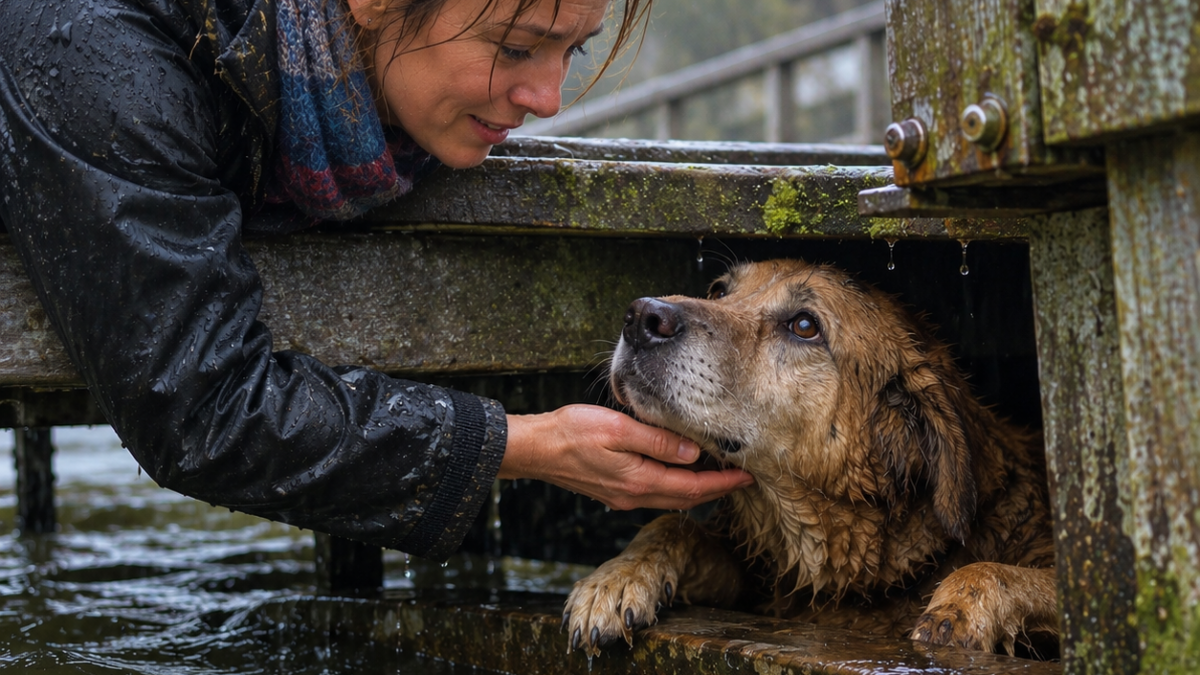
The first time I saw the old dog lying outside the nautical base in the rain, I opened the gate, pointed him back toward the towpath, and shut it behind him, never imagining that four days later I would be kneeling over the same gate while his claws struck desperately beneath a flooded dock I had already closed for safety.
By then the river had risen high enough to swallow the lower braces, an old mooring strap was twisted around one of his back legs, and every time firefighters reached toward him he recoiled toward the same freezing metal beam barely keeping his muzzle above the water, as though the thing saving him had also become the only thing he trusted.
What I didn’t understand yet was that getting his body out from under Dock B would be the easy part compared with what would happen after he pressed his exhausted head into my wrist and I was forced to decide whether the door I had once closed in his face was going to stay open when the rescue trucks were gone.
My name is Maud. I was forty-three and responsible for a small municipal boating base near Redon, where winter meant padlocks, damp wood, leaking storage rooms, and watching the Vilaine rise whenever rain settled over the region.
Most days I worked alone.
Four days before the rescue, I arrived and found a dog sleeping on the entrance mat.
He was medium-sized, tan, tangled around the legs, with gray circling his eyes. No collar. No tag.
When I opened the gate, he stood slowly, as if each joint needed permission.
His tail moved once.
“Wrong address, buddy.”
Visitors used the towpath beside the base, and I couldn’t leave an unknown dog wandering around the property. He looked behind me toward the dry doorway, hesitated, then stepped out into the rain.
I closed the gate.
Ten minutes later, I had stopped thinking about him.
By Saturday, the weather had worsened.
Rain had fallen most of the night, wind had thrown branches toward the bank, and my coworker Marc came to help secure the property before the river climbed higher.
We moved equipment inside and blocked access to the oldest dock, which we called Dock B, because its fastenings had already suffered in the high water.
Around eleven, I heard three sharp knocks.
Not barking.
Three uneven impacts against something hollow.
Then scraping.
I leaned over the railing.
A muzzle appeared between two dock sections.
Tan fur.
Gray eyes.
The same dog.
One front paw hooked around a wet brace, slipped, then caught again.
“Marc! Call the fire department! There’s a dog under here!”
When I knelt, I could finally see him.
His stomach was submerged while he balanced on a reinforcement bar, and a torn mooring strap had looped around one back leg. Every movement tightened it.
If he struggled too hard, he hurt himself.
If he let go, the current could pull his face beneath the boards.
“Hey. Look at me.”
He turned toward my voice.
His legs were shaking.
I started talking because I had nothing else to give him.
I told him the storage building leaked whenever rain came from the west. I complained that Marc never returned life jackets to the right shelf. I told him people often accused me of talking too much.
One ear moved.
I treated it like an answer.
When the firefighters arrived, they assessed the current and damaged dock before touching anything. Their team leader, Julien, spotted the strap and understood why simply pulling the dog out could make things worse.
I remembered the inspection hatch hidden beneath one of the benches.
I had the key.
The hatch opened with a metallic crack.
The dog panicked and slipped several inches.
“Here!” I shouted. “Look at me!”
He did.
Julien reached the trapped strap through the hatch and cut it while another rescuer supported the dog.
His leg came free.
But when they tried moving him away from the beam, he fought to get back to it.
The gloved hands terrified him.
Julien looked at me.
“Keep talking. He listens to you.”
I moved as close as the safe ground allowed and showed him my empty hands.
“It’s me,” I said. “The woman who shut the gate on you.”
His head turned.
“This time it’s open.”
And slowly, he stopped fighting.
[END OF FACEBOOK OPENING — CONTINUE STORY BELOW]
The firefighters lifted him onto the bank wrapped in two thick rescue blankets.
The moment his body touched solid ground, everything seemed to leave him at once.
Not only strength.
Resistance.
Fear.
The desperate instinct that had kept him clinging to that frozen metal brace beneath Dock B.
He simply collapsed.
Julien knelt beside him and checked his breathing while another firefighter covered him more completely.
“He’s hypothermic.”
“How bad?”
“Cold enough that we don’t waste time.”
The dog’s eyes were half closed.
I sat beside him, careful not to crowd him.
I expected him to flinch when I moved my hand.
Instead, his muzzle slid beneath my palm.
Then his forehead settled against the inside of my wrist.
Barely any pressure.
Just contact.
I froze.
Marc stood behind me.
“He likes you.”
I looked down at the exhausted animal.
“No.”
“What do you mean?”
“He doesn’t know me.”
Marc glanced toward Dock B.
“He knew your voice.”
That made the guilt worse.
Four days earlier, this same dog had been on my entrance mat.
Dry place behind me.
Rain outside.
I had opened the gate and sent him away because rules were rules, visitors used the property, and stray dogs were somebody else’s responsibility.
I had not kicked him.
I had not shouted.
I had done nothing cruel in the obvious sense.
That almost made it harder.
Because indifference rarely feels cruel while you are practicing it.
It feels practical.
The veterinarian was twenty minutes away.
I rode in Marc’s van because the animal rescue volunteer who met us at the clinic said moving the dog again later would only add stress.
During the drive, he lay on the blankets between my feet.
Every bump made him tense.
I kept talking.
Not because I believed my stories had magic in them.
Because silence seemed to frighten him.
“You’re going to hate the clinic,” I told him. “Bright lights, people touching you, absolutely no respect for personal space.”
One ear twitched.
“That’s what I thought.”
Marc glanced at me.
“You’ve named him already?”
“I have not.”
“You’re arguing with him.”
“I argue with everyone.”
“True.”
The clinic doors opened.
The dog immediately tried to stand.
Failed.
A veterinary nurse carried him inside.
I watched his head turn toward me.
That was the first moment I understood I was not going home yet.
The veterinarian introduced herself as Dr. Le Goff.
She examined his temperature, gums, heart, lungs, joints, leg injury and the old marks around his neck.
“He’s been through a lot.”
“Today?”
“Longer than today.”
She separated the fur at his neck.
A faint ring of thickened skin circled part of it.
Not fresh.
Old rubbing.
Old pressure.
Something that had happened repeatedly enough for the body to remember after the cause disappeared.
“What does that mean?”
“It means something rubbed here for a long time. A collar. Rope. Chain. We can’t tell from the mark alone.”
My stomach tightened.
“Was he tied up?”
“I didn’t say that.”
“But maybe.”
“Maybe.”
She continued the exam.
No microchip.
No tattoo.
No collar.
Advanced arthritis in the hips and lower spine.
A wound where the mooring strap had tightened around his rear leg.
Scraped paws.
Exhaustion.
Dehydration.
But his heart and lungs were stronger than anyone expected for a dog around twelve.
“He’s tough.”
I looked through the glass door where he lay beneath warming blankets.
“He almost drowned because he was afraid of being touched.”
Dr. Le Goff nodded.
“That’s something we should remember.”
“He let me touch him.”
“Yes.”
“Why?”
She smiled faintly.
“You were predictable.”
I stared.
“That’s the nicest thing anyone has ever said about me.”
“You stayed in one place. You used the same voice. You didn’t reach until he came toward you.”
That sounded less flattering but more useful.
The dog remained overnight.
I went home.
Or tried.
I made it as far as my kitchen before realizing I had left my keys on the clinic counter.
That was how scattered I was.
I drove back.
By the time I arrived, the front desk was closed, but a nurse recognized me through the glass.
She brought my keys.
Then said:
“He’s awake.”
I looked toward the treatment rooms.
“Can I see him?”
“Five minutes.”
I found him lying on a padded mat.
Dry now.
Fur beginning to fluff.
Still gray.
Still exhausted.
When I entered, his eyes opened.
His tail moved once.
Exactly once.
The same tiny movement from Tuesday.
I sat on the floor.
“Apparently we’re doing this again.”
He watched me.
“I left you outside once. Now I can’t even leave my keys.”
His head lowered.
I stayed five minutes.
Then fifteen.
The nurse finally appeared.
“Maud.”
“I know.”
“You need to go home.”
“I know.”
The dog’s eyes followed me toward the door.
Something inside me twisted.
I walked back.
Touched the floor once near his paw.
“I’m coming back tomorrow.”
Ridiculous.
He did not understand calendars.
But I said it anyway.
The next morning, the animal welfare association called.
They had started the mandatory search for an owner.
Photos sent to nearby shelters.
Local lost-animal pages checked.
Municipal services contacted.
Veterinary clinics alerted.
Nothing yet.
Then the volunteer, a woman named Sophie, said:
“We need to plan his discharge.”
“Okay.”
“There are no suitable foster homes nearby right now.”
I waited.
“The kennel we work with has room.”
I pictured metal gates.
Concrete.
Strangers.
A dog who had chosen freezing river water over gloved hands.
Sophie continued:
“It’s safe. They’re experienced.”
“I know.”
I did not know.
But I understood what she meant.
Then came the question.
“Would you be able to foster him temporarily?”
I looked at my key ring on the desk.
Base gate.
Hangar.
Storage room.
Workshop.
Office.
The same keys I had used four days earlier to lock the entrance after sending him back into the rain.
“How temporary?”
“Until an owner is located or the legal waiting period ends and we determine what comes next.”
“That is not a number.”
“No.”
“I work.”
“We know.”
“I’m gone during the day.”
“He can come with you if the municipality allows it.”
I laughed.
“Have you met municipalities?”
Sophie laughed too.
“I’m asking whether you’re willing, not whether it’s simple.”
That sentence followed me through the next two hours.
Willing.
Not ready.
Not qualified.
Not certain.
Willing.
I called Marc.
“Tell me this is a bad idea.”
“What?”
“The dog.”
“What about him?”
“They want me to foster.”
Silence.
Then:
“How many times have you already said yes in your head?”
“I have not.”
“Maud.”
“I’m asking for objective advice.”
“You called the man who stores life jackets wrong.”
“Forget it.”
“You’re taking him.”
I hung up.
Then called my supervisor.
That conversation went worse.
“A stray dog at the municipal base?”
“Temporarily.”
“No.”
“He would stay in the office.”
“No.”
“He nearly drowned under our dock.”
“That does not make him staff.”
“Marc barely qualifies as staff.”
“I heard that,” Marc said in the background.
My supervisor sighed.
“What if a visitor gets bitten?”
“He would not interact with visitors.”
“What if somebody complains?”
“I’ll put him behind the office gate.”
“What if—”
“Can we try one week?”
Silence.
“Maud.”
“One.”
More silence.
Then:
“If the association confirms liability coverage and he stays away from the public.”
“Yes.”
“And if there is one problem—”
“I know.”
“Temporary.”
“Temporary.”
The word became dangerous very quickly.
I went to the clinic that afternoon.
The dog stood when he saw me.
Slowly.
Painfully.
But stood.
Sophie handed me a foster agreement.
“Do you want to give him a temporary name?”
“He doesn’t have one?”
“Not that we know.”
The clinic had been calling him Dock.
I refused.
“That is terrible.”
“It’s descriptive.”
“He nearly died under one.”
“Fair.”
I looked at him.
Tan coat.
Gray muzzle.
One ear bent sideways.
A face that looked older when worried.
I said:
“Malo.”
Sophie smiled.
“Why Malo?”
“I don’t know.”
That was true.
It simply came out.
The dog’s ear moved.
Sophie pointed.
“He approves.”
“He reacted to sound.”
“Let me be sentimental.”
So Malo came home with me.
I had never owned a dog as an adult.
That became obvious immediately.
I bought too much.
Bed.
Bowls.
Joint-support mat.
Harness.
Three different kinds of food because I did not know what he liked.
A ridiculous plush duck.
Marc saw everything in my car.
“You said temporary.”
“It is.”
“Does the temporary dog need a orthopedic bed that cost more than my mattress?”
“He has arthritis.”
“So do I.”
“You’re thirty-nine.”
“I work with you.”
Fair.
The first evening, Malo refused to enter my house.
He stood on the front step.
Looked inside.
Then behind him.
I stepped away from the doorway.
“Take your time.”
He sniffed.
One paw over the threshold.
Back out.
Again.
The third time, he entered fully.
Then froze when the door swung half closed behind him.
His body went rigid.
I opened it immediately.
“Okay.”
He stared at the gap.
I left the door open for twenty minutes despite the cold.
Malo mapped the hallway.
Kitchen.
Living room.
Back door.
Then returned to the entrance repeatedly.
By bedtime, he had still not touched the expensive dog bed.
He slept on the mat beside the open kitchen doorway.
At two in the morning, I found him standing in the hall.
“What?”
He looked at the front door.
I opened it.
He stepped outside.
Stood in the garden.
Did nothing.
Then turned around and came back.
That happened three times.
By the fourth, I understood.
He was checking whether the door still opened.
I stopped complaining.
The next morning, I found the plush duck untouched and my slipper in Malo’s bed.
Apparently he understood theft.
Progress.
At the base, things were more difficult.
The first time we arrived, Malo stopped at the gate.
I unlocked it.
Opened it.
He did not move.
I stood inside.
The same place I had stood Tuesday morning.
That memory hit hard.
“You don’t have to.”
Malo stared toward the entrance mat.
Then at me.
I stepped back.
Left the gate completely open.
Marc came from the hangar.
He saw us.
Said nothing.
Malo finally crossed.
One step.
Then another.
He sniffed the mat.
The exact spot where I had found him.
Then walked into the office.
Marc whispered:
“You’re crying.”
“I’m standing in rain.”
“It isn’t raining.”
“Go move something.”
Malo became part of the winter base.
Unofficially.
Quietly.
He slept behind my desk.
He followed me when I checked locks.
Dock B remained closed for repairs.
Whenever we approached that side of the property, Malo slowed.
The first few times, I did not make him continue.
Then one morning he walked all the way to the barrier.
Stopped.
Looked toward the river.
His back legs trembled.
I waited.
Malo sniffed.
Then turned away.
Enough.
Recovery should not become a performance.
I had no need to force him to prove the river no longer frightened him.
The search for an owner continued.
Nothing.
Week one.
Nothing.
Week two.
Then a message appeared under a social media post.
I think I know this dog.
The commenter’s name was Lucie Morvan.
Sophie contacted her.
Lucie said she had seen a similar dog for years behind a property about fifteen kilometers away.
She remembered the bent ear.
Gray muzzle was newer, obviously.
She sent an old photograph.
Blurry.
Taken across a hedge.
A tan dog lying beside a small shed.
Something dark around his neck.
My stomach tightened.
“Is it him?”
Sophie asked.
“I don’t know.”
I enlarged the picture.
Same body shape.
Possibly.
But photographs lie when we want them to answer.
Lucie gave an address.
The association handled the rest.
I was told not to contact anyone myself.
That became difficult when Sophie called three days later.
“We may have found a previous owner.”
Previous.
Not current.
“What does that mean?”
“A man named Alain Morel.”
“Does he say Malo is his?”
“He says a dog matching this description disappeared from his property about six months ago.”
“Six months?”
“Yes.”
I looked at Malo, asleep behind my desk.
His nails were worn unevenly.
Old marks around the neck.
No identification.
“How far is his property from here?”
“About twelve miles.”
“Why didn’t he report him missing?”
“He says he assumed the dog had wandered off and wouldn’t come back.”
I said nothing.
Sophie continued.
“We’re verifying everything.”
“What was Malo’s name?”
Silence.
“Rex.”
I looked at him.
Malo did not move.
Rex.
The name felt wrong immediately.
That meant nothing legally.
Emotionally, it meant everything.
“Does he want him?”
Another pause.
“Yes.”
My chest tightened.
I had known this could happen.
That was the agreement.
Temporary.
If an owner appeared, the association investigated and determined next steps.
I had repeated that to myself every time Malo settled deeper into my life.
Temporary.
When I bought the second dog bed for the office.
Temporary.
When I learned he liked cooked carrots but hated raw ones.
Temporary.
When he started waiting outside the bathroom because apparently closed doors remained suspicious.
Temporary.
When he stopped sleeping near my front entrance and chose the rug beside my bedroom instead.
Temporary.
The word had been lying.
I crouched beside him.
“Malo.”
His eyes opened.
“What happens if you’re Rex?”
Tail.
One movement.
Unhelpful.
Sophie arranged a controlled meeting at the association’s facility.
I hated every part of the idea.
“What if he panics?”
“We stop.”
“What if he recognizes the man?”
“That information matters.”
“What if he wants to go with him?”
There.
The real question.
Sophie was quiet.
“Then we still assess welfare and ownership.”
“That’s not what I asked.”
“I know.”
I sat in my car afterward for almost twenty minutes.
Jealousy is ugly when directed at a dog’s possible history.
I wanted Malo to choose me.
That embarrassed me.
This old dog had existed twelve years before I learned his face.
He had memories, fear, habits, perhaps affection connected to people I knew nothing about.
I had no right to demand his past disappear because I finally felt responsible for him.
Still.
I wanted him to choose me.
The meeting happened on a Tuesday.
Exactly four weeks after I first shut the gate in his face.
Alain Morel arrived ten minutes late.
Fifty-something.
Work jacket.
Heavy boots.
A face already irritated by the process.
Malo was in a fenced courtyard with me and Sophie.
The moment Alain appeared through the outer gate, Malo stopped sniffing.
Completely.
His tail lowered.
His head moved down.
Not dramatically.
No barking.
No growling.
His body simply became smaller.
Alain called:
“Rex!”
Malo’s ears moved.
Recognition.
My heart sank.
Alain smiled.
“There he is.”
Malo did not approach.
“Rex!”
Another ear movement.
Alain entered the courtyard when Sophie permitted it.
He crouched.
“Come on.”
Malo stepped backward.
One step.
Then another.
He moved behind my legs.
I stopped breathing.
Alain’s smile disappeared.
“What’s this?”
Sophie remained neutral.
“Let him choose distance.”
“He knows me.”
“I can see he recognizes the voice.”
“He was always nervous.”
Malo pressed against my calf.
Alain stood.
“Rex, stop being stupid.”
The words hit me harder than they should have.
Malo flinched.
That mattered.
Maybe tone.
Maybe history.
Maybe coincidence.
Sophie saw it too.
She asked:
“How long did he live with you?”
“About nine years.”
“Where?”
“My property.”
“Indoors?”
Alain hesitated.
“Mostly outside.”
I looked at the old neck marks in my memory.
Sophie continued:
“What kind of containment?”
“Run.”
“Fence?”
“Cable.”
My stomach turned.
“What kind of cable?” she asked.
“Long line. He had room.”
I stared at Malo.
The ring of old friction around his neck.
Alain noticed.
“He was fine.”
I spoke before Sophie could stop me.
“Fine dogs don’t have permanent rubbing around their neck.”
He looked at me.
“And you are?”
“The foster.”
“Right.”
That word.
Foster.
Temporary caretaker.
Not owner.
Alain’s expression changed.
“So you got attached.”
“I got observant.”
Sophie cut in.
“Maud.”
I stopped.
Barely.
The questions continued.
Food.
Shelter.
Veterinary care.
Why no microchip.
Why no missing report.
Why he disappeared.
Alain said the dog had gotten loose during a move between properties.
He had looked “a bit.”
Then assumed someone took him.
“Six months ago?”
“Something like that.”
Malo had apparently survived months before reaching the base.
Or the timeline was wrong.
Either way, the story did not sit cleanly.
Sophie requested veterinary records.
Alain had none recent.
“He didn’t need a vet.”
“He has advanced arthritis.”
“He’s old.”
“That is when dogs often need vets most.”
Alain shrugged.
I wanted to hate him.
That would have been convenient.
He did not look like a monster.
He looked like a man who believed basic survival counted as adequate care.
Sometimes that is worse because it is so common.
At the end of the meeting, Alain stepped toward Malo again.
“Come on, Rex. We’re going.”
Sophie blocked him gently.
“Not today.”
“What?”
“The case is under review.”
“He’s my dog.”
“That will be determined through the process.”
“I have pictures.”
“We have them.”
“I raised him.”
I almost said something.
Sophie looked at me.
I remained silent.
Alain left angry.
Malo did not move until the gate closed.
Then he came around my legs.
Pressed his forehead against my wrist.
Same gesture.
Riverbank.
Clinic.
Home.
Now.
I sat on the ground.
“I know.”
Except I didn’t.
I knew only that he chose proximity to me in that moment.
Not a lifetime.
Not legal ownership.
A moment.
Still, I held onto it.
The investigation lasted almost three weeks.
Longest three weeks of my life.
The association found more evidence.
Lucie had photographs from previous years because she regularly walked near Alain’s property.
In several, the dog was visible attached to a running line behind an outbuilding.
That alone did not prove cruelty.
But the veterinary exam documented chronic neck friction, untreated arthritis, overgrown nails at intake, dental disease and poor muscle condition beyond what could be explained by four days near the river.
A former neighbor gave a statement that the dog was sometimes left outside overnight in bad weather.
Alain disputed it.
He said there was always shelter.
Another complication:
The dog had apparently belonged originally to Alain’s father.
When the father died, Alain kept him.
Not because he wanted him.
Because the dog came with the property.
That explained something without excusing it.
Malo had spent years as an inheritance nobody actively chose.
When Sophie told me that, I went home and sat beside him.
“You were furniture.”
Malo looked at me.
“Part of the property.”
His tail moved.
I hated everything about the thought.
The final decision was not dramatic.
No courtroom.
No police dragging anyone away.
The association, working through the appropriate animal-welfare process, documented the concerns.
Alain was given the option to contest formally or surrender his claim.
He chose surrender.
Why?
Maybe because he did not want legal scrutiny.
Maybe because he did not want veterinary expenses.
Maybe because, once forced to fight for the dog, he realized he had never really wanted him.
I will never know.
He signed.
Sophie called me at 4:12 on a Thursday.
“He’s clear.”
I stood in the base office.
“What does clear mean?”
“He can be adopted.”
I sat down.
Marc looked over.
“What?”
I held up one finger.
Sophie continued.
“If you still want to.”
I laughed.
Then cried.
Then laughed again.
Marc understood before I hung up.
“He’s yours?”
I looked at Malo.
He was asleep with his head on my boot.
“No.”
Marc frowned.
“No?”
“I’m his.”
Marc rolled his eyes.
“Dogs have ruined you.”
Maybe.
The adoption paperwork listed the name:
Malo.
I asked Sophie whether we should keep Rex somewhere.
“Why?”
“History.”
She shrugged.
“You can.”
I wrote it in the medical file under known previous name.
Then never used it again.
Not because I wanted to erase the past.
Because the name Malo belonged to the life we were building.
The first evening after adoption, I brought him to the base after closing.
No visitors.
No work trucks.
No firefighters.
Dock B was still under repair.
I opened the main gate.
Malo stood outside.
This time I did not step through first.
I waited beside him.
“Your choice.”
He sniffed the threshold.
Then crossed.
Tail moving.
Not once.
Three times.
Progress.
The following months changed both of us.
Malo gained weight.
Slowly.
His coat softened.
We started medication for arthritis.
Non-slip rugs at home.
A ramp into my car.
Short walks.
Warm bed.
Routine.
He remained frightened of hands coming quickly toward his neck.
So nobody did that.
We announced touch.
Used a harness.
Never grabbed his collar unless safety demanded it.
His world became predictable.
At the base, he learned the sound of my keys.
The difference between Marc’s boots and mine.
The opening time.
The lunch break.
The bakery delivery van.
He hated the municipal maintenance truck for reasons we never solved.
He became suspicious whenever men carried long poles.
Maybe history.
Maybe poles were simply offensive.
We did not need to decode every fear to respect it.
Spring brought visitors back.
That worried my supervisor.
“So what happens when children come?”
“Malo stays behind the office barrier.”
“What if he barks?”
“He barely barks.”
“What if someone reaches over?”
“I’ll put up a sign.”
The sign said:
OLD DOG AT REST. PLEASE ASK BEFORE APPROACHING.
Marc added below in marker:
THIS APPLIES TO MAUD TOO.
I removed it.
He wrote it again.
Eventually I left it.
Malo surprised us.
He did not seek crowds.
But he liked children who sat quietly.
One Saturday, a boy named Lucas came for a beginner kayaking session.
Eight years old.
Terrified of water.
His father kept saying:
“You begged to do this.”
Lucas stood in a life jacket near the launch ramp.
Crying.
“I don’t want to.”
The instructor tried.
The father tried.
Nothing.
Malo was lying behind the office barrier.
Lucas saw him.
“Can I pet the dog?”
I looked at Malo.
Then at the boy.
“Sit on the bench. Let him decide.”
Lucas sat.
I opened the inner gate.
Malo approached slowly.
Sniffed the child.
Then rested his head on Lucas’s knee.
Same move.
The boy stopped crying.
He stroked the gray muzzle.
“What happened to his ear?”
“Life.”
“Is he scared of water?”
I paused.
“Yes.”
Lucas looked at him.
“But he stays here?”
“Yes.”
“Why?”
“Because scary places can become safe when enough good things happen there.”
I heard myself say it.
Marc, passing behind me, looked over.
Lucas spent ten minutes with Malo.
Then stood.
Walked to the dock.
He did not become fearless.
He got into a kayak with an instructor and paddled twenty yards.
Then came back.
His father cried more than the child.
Malo got half a biscuit.
After that, I began letting him sit near certain beginner sessions when he wanted.
Never forced.
Never promoted as therapy.
He was simply an old dog near the water.
Some people found that comforting.
The dog who once nearly drowned beneath Dock B became part of the place.
That felt like revenge against the river.
Not because the river had done anything wrong.
Because fear no longer owned the location.
Then summer brought trouble.
Alain returned.
I was not there.
Marc called me while I was buying supplies.
“You need to come back.”
“What happened?”
“He’s here.”
“Who?”
Silence.
“Alain.”
My hands went cold.
“Where’s Malo?”
“With me. Office locked.”
“What does he want?”
“Says he wants to see the dog.”
“No.”
“I told him.”
“Do not let him in.”
“I’m not.”
I drove back too fast.
Alain stood outside the main gate.
Marc inside.
Malo nowhere visible.
Good.
I parked.
“What are you doing here?”
Alain looked irritated.
“I just want to see him.”
“You surrendered him.”
“I know.”
“Then no.”
“I lived with that dog nine years.”
“You kept him.”
His face hardened.
“Same thing.”
“No.”
I surprised myself with how calm I sounded.
“You surrendered your claim.”
“I made a mistake.”
I laughed.
The irony almost offended me.
“You want him back?”
“No.”
That stopped me.
“Then what?”
“I want to know if he’s okay.”
Part of me did not believe him.
Another part recognized something.
Regret.
Late.
Complicated.
Not enough to undo anything.
Still real.
I said:
“You can see a photograph.”
He looked toward the office.
“I want to see him.”
“No.”
“Why?”
“Because the last time he saw you, he hid behind me.”
Alain’s face changed.
“He was confused.”
“Maybe.”
“You think I beat him?”
“I didn’t say that.”
“That’s what everyone thinks.”
“I think he was neglected.”
He looked away.
“There’s a difference.”
He stared at the river.
“My father loved that dog.”
“Then what happened after your father died?”
Alain’s jaw tightened.
“I was dealing with a house, debts, my mother, work.”
“And Malo?”
“Rex.”
“Malo.”
He almost argued.
Stopped.
“I didn’t want a dog.”
There.
Finally.
“So why keep him?”
“Because my father asked me to.”
“That is not the same as choosing him.”
“I fed him.”
“I know.”
“He had shelter.”
“I know.”
“I didn’t hurt him.”
I looked toward the office.
“No. You just made his life small enough that survival became the standard.”
Alain flinched.
I did not feel victorious.
Only tired.
He said:
“When he got loose, I was relieved.”
That honesty stunned me.
He continued.
“Then I hated myself for being relieved.”
I said nothing.
“I saw the article after the rescue.”
The local paper had run a short story about Dock B.
“I saw him with you.”
He rubbed his face.
“He looked different.”
“How?”
“Like my father’s dog again.”
That sentence almost softened me.
Almost.
“What do you want from me?”
“Nothing.”
“Then why are you here?”
“I don’t know.”
I believed him.
That was perhaps the saddest part.
Malo had spent years with someone who did not know what to do with his existence.
Now that same man did not know what to do with guilt.
I said:
“You want to do something useful?”
He looked at me.
“Volunteer.”
He laughed bitterly.
“Where?”
“Anywhere animals are waiting because people think feeding them is enough.”
His face hardened again.
“You enjoy this.”
“No.”
I meant it.
“If I wanted revenge, I’d want you miserable.”
I nodded toward the office.
“I want him safe. Your misery doesn’t improve his hips.”
Marc coughed because apparently that sentence amused him.
Alain looked at the building.
“Can I at least know he’s okay?”
“He’s okay.”
“Happy?”
I thought.
Malo slept through lunch.
Stole Marc’s gloves.
Hated rain.
Loved carrots if cooked.
Followed me into every storage room.
Barked at the maintenance truck.
Sat with frightened children.
Slept beside my bedroom.
“Yes.”
Alain closed his eyes.
“Good.”
Then he left.
He never asked again.
Months later, Sophie told me he had donated toward the care of another senior dog at the association.
I did not ask whether she encouraged him.
Did not need to.
That was enough.
The most satisfying revenge is sometimes making the truth impossible to avoid.
Malo had not needed punishment delivered on his behalf.
He had needed a better life.
He got one.
At thirteen, Malo started sleeping through my morning alarm.
At fourteen, his arthritis worsened.
At fifteen, I bought a wagon.
Marc laughed until Malo rode in it during a long base inspection.
Then Marc asked if he could borrow it to move equipment.
“No.”
“It has wheels.”
“It is Malo’s.”
“He is a dog.”
“Exactly.”
The wagon stayed his.
Dock B was eventually replaced entirely.
New supports.
Wider inspection hatch.
Better access.
Improved safety barrier.
The municipality almost cut the budget until Julien, the firefighter who rescued Malo, sent a report documenting how dangerous the old access had been.
Repairs approved.
On reopening day, I kept Malo away until everyone left.
Then, near sunset, I walked him down.
He stopped twenty feet from the new dock.
I felt the leash tighten.
“We don’t have to.”
Malo sniffed.
Took one step.
Another.
The river was low.
Calm.
The dock did not groan.
No wind.
No rescue lights.
I sat on the grass.
Malo came beside me.
For several minutes, we watched the water.
Then he stood.
Walked toward the dock entrance.
I almost stopped him.
Didn’t.
He stepped onto the first plank.
Then the second.
His legs trembled.
Age.
Maybe memory.
He went only six feet.
Stopped.
Turned.
Came back.
I cried.
Not because he conquered fear.
I had stopped believing fear needed conquest.
He had chosen.
That was enough.
Julien visited occasionally after that.
Usually because the fire service conducted seasonal checks along the river.
Every time, Malo recognized his voice.
Tail.
Two or three movements.
Julien would crouch.
“Still alive, old man?”
Malo sniffed him.
“Rude,” I said.
“He nearly died under that dock three years ago.”
“Still rude.”
Julien smiled.
Then one year he brought a photograph.
Taken during the original rescue.
Malo in blankets.
Me kneeling beside him.
My face looked terrified.
His head pressed against my wrist.
“I thought you might want it.”
I stared.
“I look awful.”
“You looked soaked.”
“I look guilty.”
Julien shrugged.
“Maybe.”
I laughed.
Honest firefighter.
I framed the picture eventually.
Not because of heroism.
Because it captured the exact moment everything changed.
The dog I had put outside was back inside the circle of human concern.
And I had been given another chance.
People talk about second chances as though they are always grand.
They often look like:
A gate opened.
A wet dog allowed through.
A foster form signed.
A bowl placed on a floor.
A voice saying:
Come in.
Malo gave me that chance.
I did not intend to waste it.
At fifteen and a half, he became more fragile.
Kidneys beginning to change.
Muscle loss.
Heart still good.
Hearing weaker.
Eyes cloudy.
Dr. Le Goff said:
“He’s doing well for his age.”
I hated that phrase.
It contains a warning disguised as praise.
“For his age.”
Meaning:
Do not imagine forever.
I knew.
Still hated it.
We shortened his base days.
Winter mornings he stayed home.
Marc checked on him at lunch when I could not.
Sophie became an actual friend, not just the woman from the association.
She would text:
How is the mayor?
Because apparently Malo ran the base.
I replied:
Corrupt. Demands snacks.
At sixteen, he stopped coming to work regularly.
The base felt wrong without him.
Children asked:
“Where’s Malo?”
“Home.”
“Is he sick?”
“Old.”
Some children understood.
Others said:
“My grandma is old and she still goes places.”
Fair.
I brought him for short visits.
He lay beside the office.
Watched nothing in particular.
Listened.
Smelled the river.
Slept.
One afternoon, Lucas—the boy once afraid of water—returned at thirteen.
He was taller than me almost.
He had joined a youth paddling club.
He came into the office.
“Is that Malo?”
I laughed.
“Who else?”
Lucas crouched.
Malo lifted his head.
Probably did not remember.
Lucas did.
“You helped me.”
Malo sneezed.
The boy laughed.
“I know you don’t care.”
He sat beside him for ten minutes.
Then whispered:
“I’m competing next month.”
I pretended not to be emotional.
“Good.”
Malo rested his chin on Lucas’s shoe.
Life folds back strangely.
The dog who needed a voice beneath the dock became part of a child finding courage above it.
No magic.
Just proximity.
Then came the winter storm that nearly took him from me a second time.
Not the river.
His heart.
Malo woke at three in the morning breathing too fast.
I knew immediately.
Something wrong.
I called the emergency veterinarian.
Fluid.
Possible cardiac change.
Oxygen.
Medication.
He stabilized.
The vet said:
“We can keep him overnight.”
Malo looked toward the door.
Then me.
I remembered the clinic years earlier.
Doors.
Strangers.
Fear.
I asked:
“Do you need him medically?”
“Yes.”
Then he stayed.
Love is not always keeping someone beside you.
Sometimes it is leaving when the people inside can help better.
I went home.
Did not sleep.
At six, the phone rang.
Stable.
At nine, eating.
At noon, discharge.
I cried in the parking lot when he walked toward me.
Slowly.
Tail moving.
Still here.
That episode bought us eight more months.
I say “bought” as if money or treatment purchased time.
It didn’t.
Medicine helped.
His body decided the rest.
Eight months.
Spring.
Summer.
Early fall.
Enough.
The final decline began quietly.
Less breakfast.
More sleeping.
Difficulty standing.
One bad day.
Then good.
Then two bad.
Dr. Le Goff had given me a quality-of-life chart months earlier.
I hated it.
Food.
Pain.
Mobility.
Hygiene.
Interest.
Connection.
Good days.
Bad days.
I shoved it into a drawer.
Eventually I opened it.
Not because I wanted to.
Because love without measurement can become denial.
Malo still wanted me.
That category never changed.
If I sat, he came.
If I spoke, one ear moved.
If I left the room, he often followed.
But his body was failing around that loyalty.
One morning at the base, Marc found me crying in the equipment room.
“What happened?”
“Nothing.”
“Maud.”
“Malo didn’t eat.”
“He skips meals sometimes.”
“Chicken too.”
Marc stopped.
We both knew.
Malo had never rejected chicken.
I went home early.
He was on his bed.
Eyes open.
Tail moved once.
The original signal.
Tuesday morning at the gate.
Riverbank.
Hospital.
All of it.
One movement.
I sat.
“Don’t do that.”
He breathed.
“Not the one wag.”
Another.
I laughed through tears.
“Show-off.”
Dr. Le Goff came to the house that afternoon.
Kidneys worse.
Arthritis severe.
Heart tired.
Pain increasing.
Could we treat more?
Yes.
Could we hospitalize?
Yes.
Could we perhaps gain days?
Maybe.
Weeks?
Maybe.
Good weeks?
Her silence answered.
I looked at Malo.
He tried to stand when I moved.
Could not.
Still tried.
That decided me.
“He keeps following me.”
Dr. Le Goff nodded.
“I know.”
“He’ll follow until he can’t.”
“Yes.”
“I don’t want ‘can’t’ to become terror.”
“No.”
I called Marc.
Sophie.
Julien.
Not because Malo needed a crowd.
Because those people had become part of his map.
They came separately.
Quietly.
Marc first.
He brought cooked carrots.
Malo ate one.
We celebrated like idiots.
“See?” Marc said.
“Don’t.”
“I know.”
He cried outside.
Sophie came later.
She sat on the floor.
“You were supposed to be temporary.”
Malo breathed.
“So was I, apparently.”
She touched his shoulder.
“You created a monster.”
She nodded toward me.
Correct.
Julien came in uniform after shift.
Malo’s ears moved at his voice.
“There he is.”
Julien knelt.
“Still refusing to make anything easy?”
Tail.
Once.
Julien looked at me.
“He remembers?”
“I don’t know.”
He smiled.
“Let me have it.”
Fine.
He stayed five minutes.
Then left.
That evening, I opened the front door.
Malo loved cold air.
He used to stand in the garden even when I complained.
I placed his bed near the doorway.
He lifted his nose.
Autumn.
Wet leaves.
Distant wood smoke.
Rain somewhere.
I sat beside him.
The gate at the end of the path was visible.
Closed.
I suddenly hated it.
I stood.
Walked out.
Opened it.
Wide.
Then came back.
Malo watched me.
“Remember?”
His eyes remained on me.
“The first one.”
My throat closed.
“I closed it.”
I sat.
“Worst decision I made in under thirty seconds.”
Tail.
Tiny.
“I spent years trying to make up for it.”
Malo breathed.
“You know something?”
I put my hand beside his paw.
“I don’t think you needed me to.”
That was the truth.
Dogs do not keep moral ledgers the way we do.
Malo never demanded punishment.
Never asked why.
Never made me replay Tuesday.
I did that alone.
He simply learned whether the next door opened.
Again.
Again.
Again.
Eventually the pattern mattered more than the first failure.
Maybe forgiveness is sometimes nothing more dramatic than enough safe repetitions.
The next morning, Malo could not stand.
Dr. Le Goff returned.
I knew.
No debate.
No “one more day.”
He looked tired.
Not frightened.
That mattered.
I asked:
“Can we take him to the base?”
The veterinarian hesitated.
“Transport may be uncomfortable.”
I looked at Malo.
Then changed my mind.
“No.”
He did not need a symbolic pilgrimage.
Humans need those.
Dogs need comfort.
Home was here now.
So home it would be.
I moved his bed near the open front door again.
Marc came.
Sophie.
No crowd beyond that.
I placed the old red-brown towel from the clinic beneath his head.
The ridiculous plush duck, somehow still intact, sat on the shelf.
I did not bring it.
Symbols for me.
Not him.
Malo’s breathing was slow.
Dr. Le Goff prepared the sedative.
I held his face.
“You know the base is safe.”
Ear movement.
“Dock B is fixed.”
Another breath.
“Marc still puts life jackets in the wrong place.”
Marc laughed and cried at the same time.
“Unnecessary.”
“Malo deserves truth.”
Sophie covered her mouth.
I continued.
“Lucas isn’t afraid of water anymore.”
Malo’s eyes half closed.
“Alain left you alone.”
That name felt strange after years.
“Your old life can’t come get you.”
I swallowed.
“And I’m not shutting the gate.”
The sedative entered.
Malo relaxed.
His head became heavier in my palm.
Same weight as that first day after the river.
Exhausted forehead against my wrist.
Full circle.
I whispered:
“This time you don’t have to hold on.”
His breathing softened.
The words nearly broke me.
Under Dock B, holding on had saved him.
For years afterward, we praised him for surviving.
But survival should not become an obligation at the end.
“You can let go.”
Dr. Le Goff waited.
I nodded.
The final medication was given.
Malo took one breath.
Then another.
Then stillness.
Outside, the gate remained open.
No rain.
No river.
No cold metal.
No strap around his leg.
No hand reaching where he did not want it.
Just my palm beneath his head.
Malo died at home at approximately sixteen years old.
I sat beside him long after everyone stopped speaking.
Marc eventually walked outside.
Sophie followed.
Dr. Le Goff gave me time.
I looked toward the open door.
The first time I saw Malo, he had wanted dry shelter and I had decided he did not belong inside.
At the end, the whole house belonged to him.
His bed.
Bowls.
Rugs.
Ramp.
Hair in places hair had no logical reason to be.
I laughed through tears.
“You won.”
That was the revenge.
Not against Alain.
Not against me.
Not against the river.
Against every place that had told him:
Outside.
Stay there.
Not yours.
Not wanted.
He ended with too many places belonging to him.
My house.
The base office.
The towpath.
The hearts of people who once knew him only as the dog under Dock B.
After cremation, I did not scatter his ashes beneath the dock.
Too obvious.
Too much focus on the worst day.
I buried part beneath the tree in my garden where he liked afternoon shade.
The rest stayed in a simple wooden box.
No heroic inscription.
Only:
MALO
Below it:
THE GATE STAYED OPEN.
Marc mocked me for sentimentality.
He cried while doing it.
The base changed after Malo.
Some changes were formal.
We created a clear protocol for stray animals found on municipal property.
Scan.
Report.
Provide temporary safe containment when appropriate.
No simply pushing an animal beyond the gate and pretending responsibility ends at the boundary.
My supervisor approved it without mentioning that he had once said no dog could be at the base.
I remembered.
I was gracious enough not to remind him more than seven times.
Dock B’s new design included easier rescue access underneath.
Julien pushed for it.
He said:
“Hopefully never needed.”
Exactly.
We also kept a water bowl near the office during summer.
Not because every stray belonged there.
Because thirst does not care about jurisdiction.
One winter morning, almost a year after Malo died, I arrived and found a cat sleeping on the entrance mat.
Marc was behind me.
He started laughing before I said anything.
“Don’t.”
“What are you going to do?”
I unlocked the gate.
The cat stood.
I opened the office door.
“Come on.”
The cat stared.
Then walked away.
Marc laughed harder.
“Rejected.”
“Good.”
I left water anyway.
That became another joke.
But I noticed something.
The first memory of Malo had changed.
For years, when I thought of him, I saw the gate closing.
Then Dock B.
Then blankets.
Gradually, something else replaced those images.
Malo sleeping behind my desk.
Malo in the wagon.
Malo ignoring visitors.
Malo beside Lucas.
Malo standing on the repaired dock for six feet before deciding six feet was enough.
That was healing.
Not forgetting the failure.
Outnumbering it.
The former owner, Alain, contacted Sophie once after Malo died.
She asked whether I wanted the message.
I almost said no.
Then:
“What does it say?”
She forwarded it.
I saw the notice about Malo. I’m sorry. I know I gave up the right to say much, but I’m glad he had a real home at the end. My father would have been grateful. I wish I had understood sooner that keeping a dog is not the same as caring for one.
I read it twice.
Then deleted nothing.
Did not reply.
Not punishment.
There was simply nothing required.
His understanding belonged to him now.
Malo’s life no longer needed Alain’s remorse to become complete.
That mattered.
People often think closure means everyone says the perfect final sentence.
Usually not.
Sometimes closure means the sentence arrives and you realize you no longer need it.
A few months later, Sophie told me Alain was helping transport senior dogs for veterinary appointments.
I smiled.
“Good.”
That was all.
No applause.
No reconciliation.
No revenge spectacle.
Change.
Useful change.
Malo’s story spread farther than I expected because Julien’s department used part of the rescue in a training presentation about water access and animal retrieval.
I hated that.
Then I saw the slide.
No dramatic photo.
Just:
Do not assume a trapped animal will move toward rescue. Fear may make the known danger feel safer than unfamiliar help.
That was Malo exactly.
The metal bar nearly drowning him was familiar.
Hands were not.
How many creatures—human too—do that?
Cling to what hurts because it is known.
I thought about Alain.
A property.
A cable.
Years of small life.
Then a river.
Then me.
Maybe Malo’s greatest act of courage was not surviving the current.
Maybe it was eventually allowing himself to be lifted away from the only thing he could hold.
I carried that thought into my own life.
I had worked at the base for years partly because I liked being needed.
Also because I liked being alone.
People complicated things.
Dogs too, apparently.
After Malo, I became less proud of handling everything by myself.
I called people.
Accepted help.
Let Marc take shifts without rechecking all his work.
Mostly.
Started having dinner with Sophie once a month.
Went kayaking recreationally for the first time in years.
Imagine that.
I worked at a boating base and had stopped using the river for anything except measuring risk.
Malo had been frightened of water.
So had I, in a different way.
The first time I paddled past Dock B after his death, I stopped.
The current was gentle.
Sunlight.
A few birds.
Nothing dramatic.
I touched the dock with my paddle.
Then continued.
No speech.
No tears.
Enough speeches had already been made.
Years passed.
Lucas eventually became an instructor at the base during university summers.
The frightened eight-year-old who once needed an old dog’s head on his knee before entering a kayak now taught children how to capsize safely.
One afternoon he asked:
“Do you still think about Malo?”
“Every day.”
“That sounds sad.”
“It isn’t always.”
He nodded.
Then:
“I told one of the kids about him.”
I frowned.
“What did you say?”
“That he was scared of the water but came back here anyway.”
I corrected him.
“He didn’t choose the original return. He got trapped.”
Lucas rolled his eyes.
“You always ruin stories with accuracy.”
“Yes.”
“But later he came back.”
True.
“Tell that part.”
“I did.”
Good.
He pointed toward the office.
The sign remained:
OLD DOG AT REST. PLEASE ASK BEFORE APPROACHING.
No dog.
We had never removed it.
I laughed.
“That needs to come down.”
Lucas said:
“No.”
“Why?”
“There are still old people in there.”
I stared.
He ran.
Malo would have approved.
Or ignored him.
Probably ignored him.
The last physical trace of Malo at the base disappeared when we renovated the office floor.
His scratches near the door were sanded out.
I watched the worker do it.
Unexpectedly painful.
Marc noticed.
“You want me to stop them?”
“No.”
“They could leave that section.”
“No.”
I took a photograph.
Then let the scratches go.
Memory does not become more honest because we freeze every mark.
The new floor went down.
Visitors never knew.
That was okay.
Malo’s legacy was not scratches.
It was the unlocked logic behind how we handled vulnerability.
Look twice.
Do not assume fear means refusal.
Do not confuse staying alive with being cared for.
Do not make permanence the requirement for offering temporary safety.
And perhaps most importantly:
If you realize you closed the wrong door, open it.
Do not spend so long defending the first decision that you miss the second chance.
That lesson became painfully clear years later when a volunteer found another elderly dog near the towpath.
Different dog.
Black coat.
Cloudy eyes.
Collar.
This time, before anyone asked, Marc opened the office.
“Temporary,” he said.
I laughed.
“Of course.”
The owner was found within three hours.
An old man half a mile away whose gate latch had failed.
He arrived breathless.
The dog went wild.
Wonderful.
No tragedy.
No adoption.
No heroic rescue.
Just a dog returned safely.
The man thanked us repeatedly.
Marc said:
“It’s nothing.”
I looked at him.
It wasn’t nothing.
Small kindnesses often prevent the stories that become dramatic later.
The first version of me might have opened the outer gate and sent the dog toward the path.
Maybe he would have found home.
Maybe.
This version checked.
Malo had changed the default.
That was enough.
I sometimes get asked why I chose the name Malo.
I still do not know.
People assume it came from Saint-Malo because we were near Brittany.
Maybe unconsciously.
Maybe I simply needed a sound.
His old name Rex never fit in my mouth.
Malo did.
Names are strange.
They are not only labels.
Sometimes they mark eras.
Rex belonged to the dog tied behind someone’s property, if the records and photographs told the truth.
Malo belonged to the old dog under Dock B, then the dog behind my desk, then the dog sleeping beside my bedroom.
Neither erased the other.
But one life grew larger.
If I had to tell his story in a single image, I would not choose the rescue.
I would choose the main gate on a rainy morning two years later.
I had arrived early.
Malo was in the passenger seat.
I opened my door.
Got out.
Walked to the gate.
Unlocked it.
Then returned for him.
He climbed out slowly.
Stood outside.
The entrance mat was wet.
Same place.
Same kind of rain.
He looked through the opening.
Then at me.
I said nothing.
Malo stepped inside.
No hesitation.
Tail moving.
The gate remained open behind him while I carried equipment in.
He never turned around to check.
That was trust.
Not running into my arms.
Not dramatic rescue.
Not a newspaper headline.
Walking through an open gate without needing to verify whether it would slam shut.
That was what took years.
And that was the real revenge against everything that came before.
The cable marks.
The outside nights.
The unknown months wandering.
The cold water.
The hands he feared.
The first stupid woman who sent him back into the rain.
All of it lost power one ordinary repetition at a time.
Door opens.
Maud stays.
Food comes.
Bed remains.
Car returns.
Gate opens again.
Again.
Again.
Again.
Until safety became more familiar than fear.
That is the ending I wanted for Malo.
Not that he became fearless.
Fearless is overrated.
He became certain enough.
Certain the bowl would be there.
Certain my voice would come from the office.
Certain the floor would not shift beneath him.
Certain no cable would close around his neck.
Certain that when the river rose, nobody would force him near it.
Certain that if he stopped at a doorway, someone would wait instead of drag.
Certain that his age did not make him disposable.
Certain, finally, that he had a place.
The first time Malo asked me for that place, I misunderstood.
He lay on my dry entrance mat while rain fell behind him, and I saw only a stray where I needed a clear walkway.
He stood.
Wagged once.
Waited.
I opened the gate outward.
He left.
Four days later, water nearly took him.
For a long time I believed that made me responsible for everything that happened between.
It didn’t.
I did not tie the strap.
I did not make the river rise.
I did not create his past.
But guilt taught me something useful once I stopped using it to punish myself.
Responsibility begins at the moment you understand more than you did before.
Tuesday, I understood very little.
Saturday, I understood enough to stay.
The clinic taught me more.
The old photographs taught me more.
Malo taught me more every year.
And each time I learned, I had another decision.
Close.
Or open.
Ignore.
Or notice.
Defend myself.
Or change.
That is the only kind of redemption I trust now.
Not one grand act.
A pattern.
The old dog under Dock B never asked me to become a hero.
He asked, in the only ways available to him, whether I could become predictable.
I did my best.
Years after Malo died, a storm rolled through Redon nearly as hard as the one from that Saturday.
The river rose quickly.
We closed Dock B.
Secured equipment.
Checked every access point.
Marc—older now, still putting life jackets in the wrong place—walked the perimeter with me.
Rain hammered the roof.
Wind pushed branches against the bank.
At around eleven, I heard three knocks.
My entire body froze.
Marc heard them too.
We looked at each other.
Three irregular hits.
Then scraping.
I dropped what I was carrying.
Ran toward Dock B.
“Maud!”
Marc followed.
We reached the railing.
I looked down.
Nothing.
Another knock.
Then I saw it.
A branch caught beneath the float, hitting the underside with the current.
Three knocks.
Pause.
Scrape.
I laughed so hard I had to hold the railing.
Marc stared.
“You okay?”
“No.”
I was crying.
“Definitely not.”
He looked beneath the dock.
Then understood.
“Oh.”
We stood in the rain.
The branch struck again.
Three knocks.
For a second, Malo existed everywhere.
Not as a ghost.
Not literally.
As memory embedded so deeply in the sound of a place that my body responded before my mind.
I looked at the repaired hatch.
The safe supports.
The equipment ready nearby.
The protocol on the wall.
Everything that had changed.
Marc said:
“You want me to remove the branch?”
I wiped my face.
“Yes.”
“Heroic rescue?”
“Shut up.”
He removed it with a boat hook.
No firefighters.
No dog.
No story.
Perfect.
That afternoon, after the storm passed, I opened the main gate.
The towpath was muddy.
Water high.
No one outside waiting.
I stood there anyway.
Four days separated the woman who closed that gate from the woman who crawled emotionally, if not physically, beneath Dock B to bring an old dog back.
Years separated both from the woman standing there now.
I do not romanticize my mistake anymore.
I also do not let it define me.
Malo did not.
Why should I?
He taught me that a closed gate matters.
But so does the next time it opens.
Especially the next time.
If someone asks me what happened to the old dog firefighters pulled from beneath our dock, this is what I say:
He lived.
Not merely survived.
Lived.
He learned my house.
Stole slippers.
Hated the maintenance truck.
Helped a frightened child sit near water.
Convinced a stubborn municipal department to tolerate a dog behind an office.
Forced one former owner to look honestly at the difference between possession and care.
Changed rescue procedures.
Aged badly and beautifully.
Rode in a wagon.
Walked six feet onto the dock that once nearly killed him and decided six feet was enough.
Died with an open door in front of him and a hand he trusted beneath his head.
That is a full life.
Not a perfect one.
Full.
And if there was revenge in it, it was the quietest kind.
The dog who had learned that doors shut, hands frightened, and people could leave him outside spent his final years watching doors open before he even had to ask.
The man who once considered him inherited property had to live with the knowledge that someone else saw a family member.
The woman who sent him into the rain became the person who refused to move furniture without considering whether his old hips could cross the room safely.
The dock that trapped him was rebuilt so the next rescue would be easier.
The base that once had no place for a stray became the place where people learned to stop before deciding something vulnerable was simply in the way.
No shouting crowd.
No ruined enemy.
No spectacular punishment.
Just a life becoming so much larger than the neglect that came before it that the past could no longer be the first thing anyone saw.
That was enough revenge for me.
More than enough.
Because the last time I saw Malo alive, the gate was open.
He was lying near the doorway, too tired to stand.
Cold autumn air moved through the house.
I had spent years believing I needed to repay one terrible moment when I closed a door.
Then, as his breathing slowed, I finally understood something.
Love is not a debt you finish paying.
It is a place you keep making.
And for the rest of Malo’s life, whenever he looked toward a threshold wondering whether he was allowed to cross, I made sure the answer was the same.
“Yes, old man.
This time, you can come in.”








