I Pulled Over for a Dog With a Swollen Face—Then I Realized the Man Beside Him Was His Owner
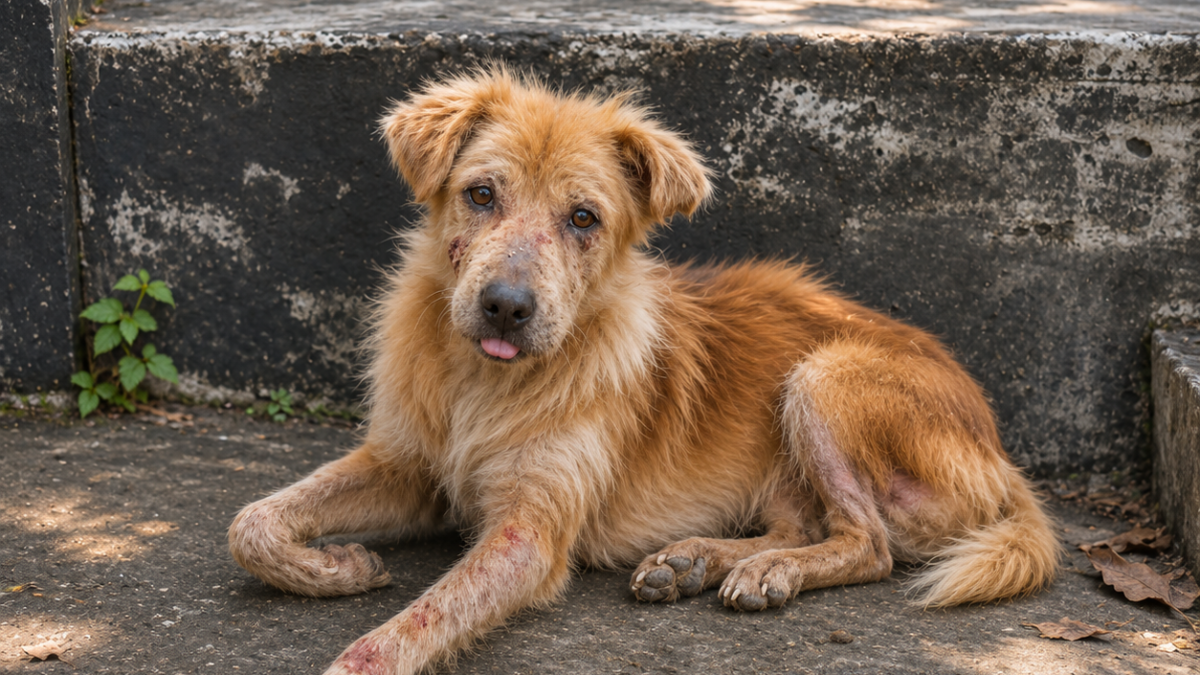
I pulled over because the dog’s face was so swollen that, from the road, I thought he had been hit by a car.
Then I realized the thin, trembling animal wasn’t a stray at all—the man standing beside him was his owner.
But the part that would stay with me longest wasn’t what had happened to Ossi’s body; it was who he kept looking for when we finally tried to take him somewhere safe.
I had been driving slowly through the neighborhood when I first saw him.
At first, all I noticed was the white dog standing near the side of the road.
He was motionless.
Not sniffing.
Not wandering.
Not searching for food.
Just standing there with his head lowered.
Something about him made me ease off the gas.
Then he lifted his face.
I hit the brakes.
The left side of his muzzle was badly swollen. His fur looked dirty and uneven, and even from several yards away, I could see how thin he was.
His ribs showed.
His hips stood out sharply beneath his coat.
Parts of his skin looked red and irritated.
He looked like a dog who had been surviving outside for a long time.
I pulled over.
“Hey, buddy.”
He looked at me but didn’t move.
I stepped closer.
That was when I noticed the man standing a few feet away.
“Is this your dog?”
He nodded.
I looked back at the animal.
The answer confused me more than if he had said no.
The dog slowly raised his eyes toward the man.
There was something almost hopeful in the way he did it.
“What happened to his face?”
The man shrugged.
“He ate a pork bone.”
“How long ago?”
Another shrug.
“A while.”
I crouched several feet away from the dog.
His eyes followed me nervously.
Up close, he looked worse.
The swelling around his mouth pulled one side of his face out of shape. Saliva had dried in the fur beneath his jaw. His coat was rough, and underneath it I could see irritated patches of skin.
“What’s his name?”
“Ossi.”
“How old is he?”
“Ten.”
Ten years old.
I looked at Ossi again.
A senior dog.
A dog who had apparently spent ten years belonging to someone.
Yet he stood in front of me looking as if no one had truly looked at him in weeks.
“Has a veterinarian seen him?”
“No.”
“Why not?”
The man’s expression barely changed.
“He’ll be fine.”
I stared at him.
Ossi was not fine.
Even without veterinary training, anyone could see that.
The swelling alone should have been enough.
The weight loss should have been enough.
The condition of his skin should have been enough.
But Ossi wasn’t crying.
He wasn’t barking.
He simply stood there quietly.
And sometimes quiet suffering is easier for people to ignore.
I called someone from our rescue network.
When help arrived, we brought a leash and prepared to take Ossi to a veterinary hospital.
I thought getting him away would be easy.
I was wrong.
The moment we tried to guide him toward the vehicle, Ossi stopped.
He turned around.
Looked at his owner.
Then pulled backward.
“Come on, Ossi.”
He refused.
Not violently.
Not aggressively.
He just planted his feet and stared at the man.
The same man who had allowed the injury in his mouth to go untreated.
The same man standing there while Ossi’s body told a story of neglect that words didn’t need to explain.
Ossi still wanted him.
That was the part I wasn’t prepared for.
I knelt beside him.
“It’s okay.”
He looked toward the man again.
His owner didn’t step forward.
Didn’t kneel.
Didn’t tell him goodbye.
Didn’t even reach out to touch him.
Ossi waited.
The man looked away.
Something tightened inside my chest.
Dogs don’t understand neglect the way humans do.
They don’t make lists of the times someone failed them.
They don’t decide that love should be withdrawn because it wasn’t returned properly.
Ossi only knew that this was the person he had belonged to.
And as we gently lifted him toward the vehicle, he kept twisting his head to look back.
The man never looked back at him.
Inside the car, Ossi remained standing for several seconds.
Then he slowly lowered himself onto the blanket.
I sat beside him.
His body felt tense under my hand.
“We’re taking you to get help.”
I don’t know whether he understood anything except the fact that he was leaving.
As we pulled away, he raised his head one last time and stared through the rear window.
That image followed me all the way to the hospital.
At the clinic, the veterinarian examined his mouth.
Her expression became serious almost immediately.
“How long has this been like this?”
I told her what the owner had said.
“A pork bone.”
She looked at me.
“And how long ago?”
“Weeks, apparently.”
She carefully opened Ossi’s mouth.
Then she stopped.
“This didn’t happen yesterday.”
I felt anger rise in me.
“What are we dealing with?”
She looked toward Ossi.
“More than a swollen face.”
And at that moment, I realized the injury we could see from the road was only the beginning.
**— END OF FACEBOOK OPENING —**
The veterinarian sedated Ossi so she could examine him properly.
I stayed nearby until the medication began taking effect.
He fought sleep at first.
Not physically.
His eyelids kept lowering, then opening again as though he was afraid of what would happen if he stopped watching the room.
“It’s okay,” I whispered.
His eyes finally closed.
Once he was asleep, the veterinary team shaved away some of the fur around his face and body.
That was when the rest became visible.
Under his white coat were red patches.
Scabs.
Scratch marks.
Areas where his skin had become thick and rough.
The veterinarian ran her fingers gently along his side.
“He’s been itching for quite a while.”
“Mange?”
“Possibly. We’ll test.”
She pointed toward several raw areas.
“He’s been scratching himself hard enough to break the skin.”
I looked at Ossi lying on the examination table.
Ten years old.
Thin.
His mouth infected.
His skin burning with irritation.
And somehow he had still been standing beside the man responsible for him, waiting for affection.
The veterinarian turned her attention back to his mouth.
The bone had apparently injured the tissue deep inside.
The wound had become infected.
The swelling wasn’t simply from trauma anymore.
There was an abscess.
Damaged tissue.
Pain that must have made eating difficult.
“How has he been eating?”
“I don’t know.”
She glanced at his body.
“Probably not well.”
They drew blood.
Even half sedated, Ossi looked frightened when the needle went in.
I put my hand against his shoulder.
“I’m here.”
His eyes met mine.
That was the first time I felt like he was really looking at me.
Not past me.
Not toward the door.
At me.
The test results came back well enough for surgery.
The veterinarian wanted to act quickly because of the infection.
“We need to clean the wound thoroughly,” she explained. “There may be damaged tissue that needs to be removed.”
“Is he going to be okay?”
“I think so. But he’s older, underweight, and not in good condition. Anesthesia always carries risk.”
I signed the paperwork.
Before they took him back, I scratched behind his ear.
“You made it this far.”
His head was heavy from the sedative.
“You’re not stopping now.”
The surgery lasted longer than I expected.
I paced.
Sat down.
Stood up again.
Checked my phone even though there was nothing to check.
Eventually the veterinarian came out.
“He’s awake.”
I exhaled so hard my chest hurt.
“How did it go?”
“We cleaned out the infection and treated the damaged tissue. It was worse than what we could see externally.”
“How much worse?”
She hesitated.
“The wound had been neglected for weeks. He was living with significant pain.”
I looked away.
I had been trying not to think about his owner.
That became impossible.
“Could this have been prevented?”
“With earlier treatment?”
“Yes.”
“Almost certainly.”
I felt my jaw tighten.
Ossi spent the night at the hospital.
The next morning, I found him lying in his kennel with his head on a folded blanket.
His face was still swollen.
His coat had been shaved in several areas.
He looked smaller than ever.
But when I approached, his tail moved.
Barely.
One soft tap.
I smiled.
“Hey.”
Another tap.
That tiny movement felt like a gift.
Over the next two days, the veterinary team treated his skin.
The tests confirmed mange.
He received medication.
His wounds were cleaned.
His mouth began healing.
But emotionally, Ossi seemed somewhere else.
Whenever the clinic door opened, he lifted his head.
Whenever footsteps passed, he looked.
I knew who he was waiting for.
On the second afternoon, I asked the veterinarian whether I could take him outside for a few minutes.
“He needs movement, but keep it short.”
I clipped on the leash.
“Come on, old man.”
Ossi stood slowly.
We walked outside.
The sun was warm.
Not hot.
Just enough to soften the air.
For a moment, I thought he might enjoy it.
He sniffed the grass.
Took three steps.
Then stopped.
He turned toward the hospital entrance.
“You want to go back?”
He pulled gently toward the door.
I followed.
At first, I thought he was tired.
Then I understood.
The hospital was now the last place where he had seen the direction his old life disappeared.
Maybe some part of him still believed the man would return.
I sat beside Ossi on the concrete.
“You miss him, don’t you?”
His ears moved.
I scratched the side of his neck.
“I wish I could explain things to you.”
How do you explain abandonment to a dog who still loves the person who abandoned him?
How do you tell him that loyalty is not always returned?
That sometimes the person you’re waiting for has already decided not to come back?
I couldn’t.
So I didn’t try.
I just stayed beside him.
Three days after surgery, Ossi was cleared to leave the hospital.
He needed medication.
Skin treatment.
A special diet while his mouth healed.
Regular follow-ups.
And rest.
Lots of rest.
I brought him to the place where he would recover.
The first thing he did was stand in the doorway.
He sniffed.
Then stepped inside.
Slowly.
There were other dogs nearby.
He could smell them.
Hear them.
But he didn’t react much.
He explored one corner.
Then another.
He found the water bowl.
Drank.
Then found the bed.
A thick, clean bed with a blanket folded over it.
Ossi sniffed it several times.
He stepped onto it.
Turned around.
Lay down.
And slept.
For hours.
The first week, he didn’t ask for much.
Food.
Water.
Short walks.
Sleep.
He never barked for attention.
Never demanded affection.
If I sat beside him, he accepted my hand.
If I walked away, he let me.
It was as though he had learned long ago not to expect anyone to stay.
His skin gradually changed.
The redness faded.
The constant scratching decreased.
Soft white fur began returning over the shaved areas.
His mouth healed.
Eating became easier.
And then I discovered Ossi’s favorite thing in the world.
Sunlight.
One afternoon, I couldn’t find him in his bed.
I checked outside.
There he was.
Stretched across a patch of warm ground.
Eyes closed.
Face turned toward the sun.
For the first time since I had met him, he looked peaceful.
Not cautious.
Not waiting.
Not hurting.
Just warm.
I sat nearby.
He opened one eye.
“Good?”
He closed it again.
Apparently that meant yes.
From then on, it became his routine.
Breakfast.
A slow walk.
Then sun.
If the weather was warm, Ossi found the brightest patch available and claimed it.
Sometimes I sat with him.
Sometimes I watched through the window.
His body slowly filled out.
His coat returned.
He began greeting me when I came outside.
At first, the greeting was only a tail wag.
Then he started walking toward me.
Eventually, he learned to smile.
People say dogs don’t smile.
I know what they mean scientifically.
I also know what Ossi looked like when I reached for the leash.
His mouth opened.
His eyes brightened.
His whole face changed.
That’s a smile.
About a month after his rescue, the animal welfare officer handling the case called me.
They had reviewed Ossi’s veterinary records.
Photographs.
The condition of his skin.
The untreated mouth injury.
They wanted a statement from me.
I gave one.
Then another person from the rescue gave one.
The veterinarian submitted her report.
The question was simple.
How had a ten-year-old dog reached that condition while living with someone who claimed to own him?
The answer was uncomfortable.
Slowly.
That is how neglect works most of the time.
Not one dramatic act.
One day becomes another.
A wound is ignored.
Then an infection.
A dog scratches.
Nobody treats the skin.
He loses weight.
Someone says he’ll eat later.
His face swells.
Someone decides it isn’t serious.
Pain becomes normal because the person responsible for stopping it keeps choosing not to.
I learned that Ossi’s owner had told investigators essentially the same story he’d told us.
“He ate a bone.”
As though those four words explained everything.
They didn’t.
A bone could explain the original injury.
It couldn’t explain weeks without treatment.
It couldn’t explain mange.
It couldn’t explain the weight loss.
It couldn’t explain scratches covering his body.
The owner eventually called the rescue.
He wanted Ossi back.
When I heard that, my first reaction was anger so sharp I had to put my phone down.
“What?”
The rescue coordinator repeated herself.
“He says Ossi belongs to him.”
“He let him live like that.”
“I know.”
“He didn’t even say goodbye.”
“I know.”
“He looked away.”
“I know.”
I started pacing.
“And now he wants him?”
“He knows an investigation has started.”
That told me everything.
I went outside.
Ossi was lying in the sun.
His coat was still patchy.
His face still healing.
But his body no longer looked like it might collapse.
He saw me.
His tail moved.
I crouched beside him.
“You’re not going back.”
I wasn’t legally the person who could make that promise yet.
I made it anyway.
The following days became a different kind of fight.
Not dramatic.
Paperwork.
Veterinary statements.
Photographs.
Dates.
Records.
The rescue documented every treatment Ossi needed.
Every medication.
Every infected wound.
The amount of weight he had lost.
The state of his coat.
His mouth.
His behavior.
I learned something during that process.
Evidence matters because neglectful people often count on memory becoming emotion.
They want the story to become:
Someone thinks I was bad to my dog.
Instead, we had numbers.
Medical findings.
Photographs.
Professional assessments.
The veterinarian had written one sentence that I read over and over:
**The condition observed was consistent with prolonged lack of appropriate medical care.**
Prolonged.
Not one bad afternoon.
Not a mistake.
A pattern.
When Ossi’s owner was interviewed again, he argued that the dog had always been thin.
The veterinarian compared older photos.
He argued that the skin condition had appeared suddenly.
The examination said otherwise.
He said the mouth injury hadn’t seemed serious.
The level of infection contradicted him.
Then came the part that mattered most.
He signed away his claim to Ossi.
Maybe he realized the evidence was too strong.
Maybe he wanted the investigation to disappear.
Maybe he simply decided an old dog with medical problems wasn’t worth fighting for.
I don’t know.
I only know what happened when I received the message.
**Ossi will not be returned to the previous owner.**
I read it twice.
Then I went outside.
“Ossi.”
He lifted his head.
“You’re free.”
He yawned.
I laughed.
“Very emotional reaction.”
He rolled onto his side.
I scratched his chest.
The investigation didn’t disappear.
The veterinary evidence remained.
The previous owner was cited under local animal welfare provisions and prohibited for a period from keeping another dog without oversight.
It wasn’t some dramatic courtroom revenge.
There was no screaming.
No handcuffs.
No perfect speech where he suddenly understood everything he’d done.
Real consequences are often quieter.
But he could not simply take Ossi back and pretend nothing had happened.
For me, that was enough.
Or I thought it was.
Ten weeks after the day I pulled over, Ossi stopped eating.
At first, I wasn’t terrified.
Dogs have bad days.
Maybe his mouth hurt.
Maybe his stomach was upset.
I offered softer food.
He turned away.
The next morning, he refused breakfast again.
Then water.
That frightened me.
“Ossi.”
He lay in his bed.
His eyes looked tired.
I put the leash near him.
Usually that was enough to make him stand.
Nothing.
My stomach dropped.
We went straight to the veterinarian.
Bloodwork.
Urine test.
More bloodwork.
I stood in the same clinic where he’d had surgery ten weeks earlier.
The same smell.
Same lights.
Same horrible waiting.
The veterinarian came into the room holding the results.
She sat.
I knew before she spoke.
“What?”
“Ossi has kidney disease.”
I looked at him.
“What stage?”
“Stage three.”
The words didn’t make sense at first.
“But he was getting better.”
“He was.”
“His skin healed.”
“Yes.”
“He gained weight.”
“I know.”
“He was walking.”
“I know.”
My voice broke.
“So how can this be happening?”
The veterinarian waited.
Then said quietly, “Recovery from one problem doesn’t protect him from another.”
I covered my face.
I hated that sentence because it was true.
Ossi was ten.
His body had endured neglect.
Infection.
Malnutrition.
Surgery.
And now, just when he had learned how to lie in the sun without waiting for someone who wasn’t coming back, his kidneys were failing.
“How long?”
“I can’t give you an exact answer.”
“Months?”
“Possibly.”
“Years?”
“Possibly, with management. Every dog is different.”
I cried.
I didn’t try to hide it.
“He just got here.”
The veterinarian looked at Ossi.
“I know.”
“He just started being happy.”
“I know.”
“I want him to have more time.”
“Then let’s give him the best chance we can.”
Ossi stayed for treatment.
Fluids.
Medication.
Careful monitoring.
His appetite had to return.
His hydration needed to improve.
The first two days, he barely ate.
I visited.
Sat by the kennel.
Talked to him.
“You remember the sun?”
He rested his chin on his paws.
“You have an appointment out there.”
Nothing.
“The sun is waiting.”
His eyes moved toward me.
“You’re not allowed to cancel.”
On day three, he licked a little food from my hand.
I nearly celebrated.
“Again.”
He took another bite.
“Good boy.”
One more.
The next day, he ate from a bowl.
By the end of the week, he finished everything I put in front of him.
I stared at the empty dish.
“Are you serious?”
Ossi licked the bowl.
“You could’ve done that six days ago and saved me several years of my life.”
His tail moved.
The veterinarian repeated his tests.
His kidneys were still diseased.
Nothing miraculous had happened.
Stage three didn’t disappear because we loved him.
But his values stabilized enough for him to leave the hospital.
That distinction mattered.
Rescue stories sometimes get told as if love cures everything.
It doesn’t.
Love does not reverse kidney disease.
It does not erase scars.
It does not restore lost years.
What love can do is make the years left worth living.
I took Ossi home.
The first afternoon, I opened the door to the yard.
He walked out slowly.
Stopped.
Lifted his nose.
Then found his sun.
Same place.
He lowered himself carefully.
Stretched his front legs.
Closed his eyes.
I stood there crying again.
This time, they were better tears.
His kidney disease changed our routine.
Special food.
Medication.
More water bowls.
Regular veterinary checks.
Watching his appetite like it was the stock market.
One day he’d eat beautifully and I’d feel invincible.
The next morning he’d hesitate and my stomach would tighten.
Living with a chronically ill senior dog teaches you not to think too far ahead.
You learn days.
Today he ate.
Today he walked.
Today he drank.
Today he wanted the sun.
Today is good.
Ossi’s fur continued growing back.
White.
Soft.
The raw skin disappeared beneath it.
His face changed too.
The swelling was gone.
The mouth injury became only a memory.
When people saw photographs from the day I found him beside photographs months later, they sometimes asked:
“Is that really the same dog?”
Yes.
Same dog.
Different life.
There was one thing, however, that took much longer to heal.
Whenever an older man approached us during walks, Ossi sometimes stopped.
He looked.
Waited.
Then moved on.
I always wondered whether he was searching for his previous owner.
That used to make me angry.
Eventually, it made me sad.
One afternoon, months after his rescue, we were walking slowly near the park when a man stepped out of a nearby shop.
Ossi stopped.
So did I.
It was him.
His former owner.
For a second, nobody moved.
Ossi stared.
The man recognized him.
I saw it immediately.
His eyes moved over the white coat.
The fuller body.
The healthy skin.
He looked surprised.
“Ossi?”
Ossi’s ears lifted.
My hand tightened around the leash.
The man took one step.
Ossi moved forward.
That hurt.
After everything, he moved toward him.
Dogs don’t keep score.
The man crouched slightly.
“Hey.”
Ossi reached him.
Sniffed his hand.
I watched, furious and heartbroken at the same time.
Then the man scratched Ossi once beneath the chin.
“You look better.”
I couldn’t stay quiet.
“He almost died.”
The man stood.
“I heard.”
“He had surgery.”
No response.
“He has kidney disease.”
He looked uncomfortable.
“I didn’t know.”
“That’s the problem.”
His face hardened.
“You don’t know everything.”
“No. I know what the veterinarian documented.”
“He was my dog for ten years.”
“And when he needed you, you did nothing.”
“That isn’t fair.”
I almost laughed.
“Fair?”
Ossi stepped back toward me.
The man looked down at him.
“I fed him.”
“You left an infected wound in his mouth for weeks.”
“He wouldn’t let me look.”
“A veterinarian could.”
“Money doesn’t grow on trees.”
I stared at him.
There it was.
An excuse.
Not regret.
Not sorrow.
An excuse.
“I understand money problems.”
“You don’t know mine.”
“You’re right.”
I shortened Ossi’s leash gently.
“But if you can’t afford treatment, you ask for help. You surrender the animal. You contact a rescue. You don’t watch him rot because doing something is inconvenient.”
He looked away.
Then he said, “He still came to me.”
The words were meant to hurt me.
For half a second, they did.
I looked at Ossi.
He was standing beside my leg now.
Then I looked back at the man.
“Of course he did.”
The man seemed surprised.
“He loved you.”
Silence.
“That’s what makes what you did worse.”
He had no answer.
I didn’t need one.
I started walking.
Ossi followed.
The man called his name once.
“Ossi.”
Ossi stopped.
I stopped too.
He looked back.
For several seconds, he stood between two lives.
The one he’d known for ten years.
And the one he’d been given afterward.
The man held out his hand.
Ossi watched him.
Then Ossi turned around.
He walked toward me.
Not quickly.
Not dramatically.
He simply came back.
I don’t know whether dogs understand closure.
I know I did.
I knelt.
“Let’s go home.”
Ossi pressed his shoulder against my knee.
We walked away.
I never saw his previous owner again.
For a long time, I thought that moment was my revenge.
The dog he’d neglected choosing to leave with me.
But later, I realized that wasn’t quite right.
Ossi didn’t reject him to punish him.
Ossi wasn’t taking sides.
He had simply learned where home was.
That was better.
Months passed.
Then a year.
Ossi’s kidneys remained a constant concern, but his condition stayed more stable than I’d feared.
Some months were good.
Others weren’t.
There were emergency visits.
Days when he refused breakfast and I felt panic rising before I could control it.
There were also wonderful days.
Walks when he pulled me toward a smell.
Afternoons when he rolled onto his back in the grass.
Mornings when he barked because breakfast was three minutes late.
The first time he barked at me for food, I actually laughed.
“Who do you think you are?”
He barked again.
I brought the bowl.
Apparently I worked for him now.
His favorite activity never changed.
Sun.
Every chance he got.
Sometimes I would find him stretched so completely across the warm ground that he looked melted.
His white coat glowed.
His eyes closed.
Mouth slightly open.
Peaceful.
When I remembered the dog by the roadside, it felt impossible that they were the same animal.
That dog had looked like he was apologizing for existing.
This dog took up space.
He expected breakfast.
He expected walks.
He expected his bed to be clean.
He expected me to follow when he decided we hadn’t spent enough time outside.
That expectation was healing.
Trust isn’t only coming when you’re called.
Sometimes trust is believing someone will come when you call them.
Ossi learned that.
If he woke at night and needed water, I got up.
If he refused food, I noticed.
If his skin looked irritated, we treated it.
If his bloodwork changed, the veterinarian called.
Nothing was ignored anymore.
One evening, I was sitting outside beside him when I thought about the day we found him.
I remembered his body turning in the car.
Looking through the rear window.
Searching for the man who wouldn’t look back.
At the time, I’d wanted to reach into Ossi’s mind and make him understand.
**Don’t miss him.**
**He failed you.**
**Stop looking back.**
I know now how selfish that would have been.
Love does not disappear because someone deserved it less.
Ossi had loved his owner.
That truth wasn’t an insult to me.
It was proof of who Ossi was.
Loyal.
Forgiving.
Softhearted beyond reason.
My job wasn’t to erase ten years of his life.
My job was to make whatever came next kinder.
The animal welfare case eventually closed.
The previous owner paid penalties associated with the neglect findings and remained subject to restrictions on future animal ownership.
Some people wanted more.
They wanted punishment that felt equal to Ossi’s suffering.
I understood.
But I stopped needing it.
Because every photograph of Ossi lying in sunlight was a kind of verdict.
Every pound he regained.
Every patch of fur.
Every healthy meal.
Every walk.
Every night in a clean bed.
The man who had looked away didn’t get to write the ending.
Ossi did.
There was one winter when I thought we were finally losing him.
His kidney values worsened.
He became tired.
The veterinarian adjusted medication and fluids.
I slept beside his bed for three nights.
On the fourth morning, sunlight came through the window.
Ossi stood.
Slowly.
He walked to the door.
I opened it.
“You sure?”
He stepped outside.
The air was cold, but one strip of sun had warmed the patio.
Ossi found it.
Of course he did.
He lay down.
I brought a blanket and sat beside him.
His head rested against my leg.
I stroked his white fur.
“You really are stubborn.”
His tail moved.
I smiled.
“Good.”
That became our agreement.
He could be old.
He could be sick.
He could have bad days.
But as long as he still wanted breakfast, walks, my company, or one more patch of sunlight, I would help him find it.
Ossi taught me something I wish more people understood about rescue.
Saving an animal isn’t always transforming him into a perfectly healthy dog.
Sometimes you rescue an animal who will always need medication.
Sometimes the damage has already been done.
Sometimes you arrive late.
That doesn’t mean you arrived too late.
Ossi was ten when we found him.
He had kidney disease.
Scars.
A body shaped by years we couldn’t change.
But he also had something he’d never had enough of.
Attention.
Care.
Someone watching.
That sounds small.
It isn’t.
When Ossi stopped drinking, someone noticed.
When he stopped eating, someone noticed.
When his blood values changed, someone noticed.
When he wanted to go outside, someone opened the door.
When he looked frightened at the clinic, someone stayed beside him.
Maybe care is simply refusing to look away.
That was the difference between his old life and his new one.
Not perfection.
Not luxury.
Someone looked.
Years later, I still think about the first moment I saw him.
That swollen face.
That thin body.
The assumption that he must be a stray.
Then the shock of learning the man beside him was his owner.
At first, I thought the cruelest moment came afterward when Ossi kept looking back and the man didn’t.
Now I think the most important moment came much later.
Ossi in the sun.
His coat soft and white again.
His mouth healed.
His body relaxed.
No one standing over him.
No one asking anything from him.
Just an old dog enjoying warmth.
Sometimes he’d hear me approach.
He’d open one eye.
His tail would tap once against the ground.
Then he’d close his eye again.
He knew I was there.
He didn’t need to check whether I would leave.
That might have been the biggest transformation of all.
Ossi eventually learned that not every goodbye meant abandonment.
Not every hand brought pain.
Not every illness would be ignored.
And not every person would look away.
I used to think I stopped my car that day because Ossi needed saving.
That’s true.
But it isn’t the whole truth.
He gave something back.
He taught me that loyalty can survive cruelty without becoming weakness.
That an old dog is not a lost cause.
That chronic illness does not erase joy.
That a short walk can matter.
That an empty bowl after a week of refusing food can feel like a miracle.
And that sunlight is sometimes enough reason to keep going for one more day.
If I could return to the moment we drove away from his old owner, I wouldn’t tell Ossi to stop looking back.
I’d let him look.
I’d let him grieve.
Then I’d sit beside him exactly as I did.
Because he didn’t need me to tell him whom he should love.
He needed someone willing to love him better.
And eventually, he understood.
Not through words.
Through meals that arrived every day.
Through medicine.
Through vet visits.
Through clean blankets.
Through walks.
Through patience.
Through sunlight.
Most of all, through someone who noticed when something was wrong and did something about it.
That’s how Ossi’s life changed.
Not in one dramatic moment.
One ordinary act of care after another.
The man who once owned him had ten years to become the person Ossi believed he was.
He chose not to.
We couldn’t give Ossi those ten years back.
But we could give him the days ahead.
And every time I saw that old white dog stretched across the warm ground, eyes closed and completely at peace, I knew exactly who had won.
It wasn’t me.
It wasn’t the rescue.
It certainly wasn’t the man who let him suffer.
Ossi won.
Because after everything his body had endured, he still learned to trust.
He still wanted to walk.
He still wanted to eat.
He still turned his face toward the sun.
And for the rest of the life he had left, nobody ever looked away from him again.








