I Found Two Kittens Dying Beside a Trash Bin—Then Security Footage Showed How They Got There
part 2
I called the emergency veterinary clinic first.
The camera could wait.
The kittens couldn’t.
The woman on the phone asked me questions quickly.
“Are they conscious?”
“Yes. Barely.”
“Breathing normally?”
“The orange one better than the black one.”
“Any vomiting?”
“No.”
“Diarrhea?”
“I don’t know.”
“How cold do they feel?”
“Very.”
“Do not force-feed them yet.”
That surprised me.
“They haven’t eaten.”
“I know. But if they’re severely hypothermic, feeding before they’re warmed can create more problems. Warm them gradually and bring them in.”
I looked down at the box.
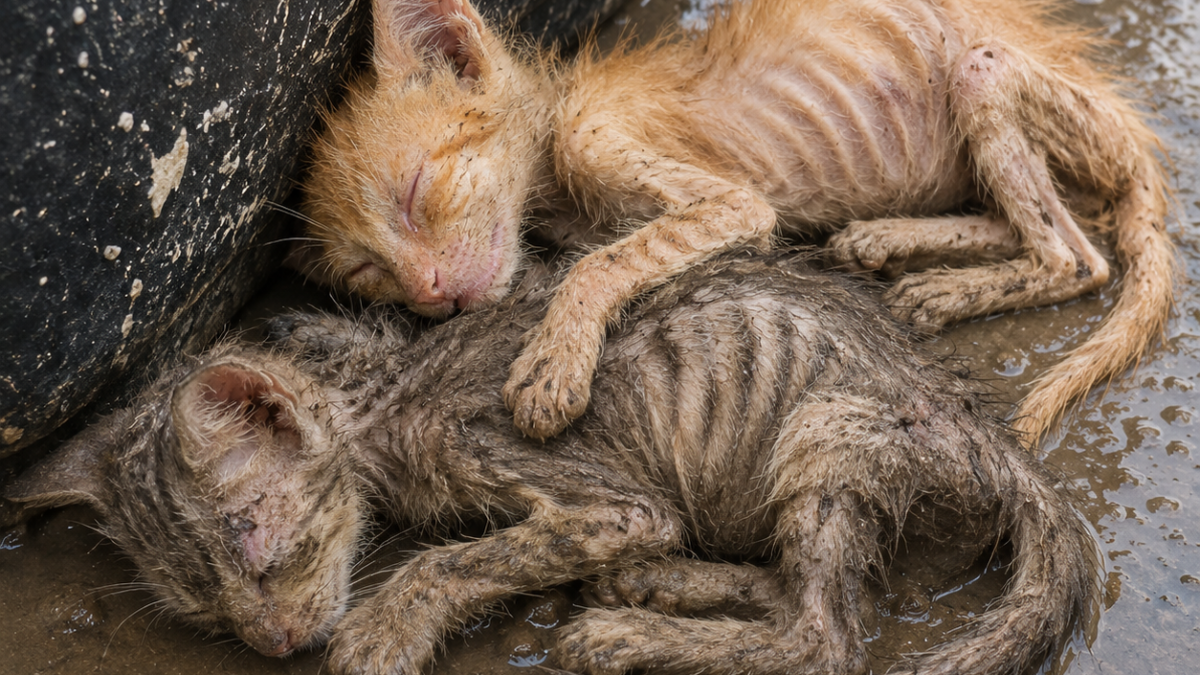
The orange kitten had one paw draped over the black kitten’s neck.
“I’m coming.”
The clinic was twelve minutes away.
I made it in nine.
I placed the box on the passenger seat and talked the entire drive.
I don’t know why.
Maybe I thought hearing a voice would keep them anchored.
“Stay with me.”
Red light.
“You’re okay.”
Turn.
“Almost there.”
The black kitten didn’t move.
At one point, I reached over at a stoplight and touched his side.
Breathing.
Still breathing.
When I arrived, a technician took one look inside the box and carried them straight through a set of swinging doors.
I followed until someone stopped me.
“Please wait here.”
“I found them.”
“I understand. The doctor will come talk to you.”
“But the black one—”
“They’re working on both.”
The doors closed.
I stood there holding two dirty towels.
For the first time since seeing them beside the dumpster, I had nothing to do.
That was when fear finally hit properly.
I sat.
Then stood again.
I looked at my hands.
Tiny flea specks.
Dirt.
One strand of orange fur stuck to my sleeve.
Twenty minutes passed.
Then thirty.
A veterinarian came out.
Her name was Dr. Morgan.
“Are you the person who brought in the two kittens?”
“Yes.”
She sat beside me.
That alone made my stomach tighten.
“How bad?”
“They’re extremely weak.”
I nodded.
“The orange kitten is dehydrated, underweight, hypothermic, and heavily infested with fleas.”
“And the black one?”
“Worse.”
My chest tightened.
“How much worse?”
“His temperature is lower. His blood sugar is very low. The flea burden may have contributed to anemia.”
I stared at her.
“Can he survive?”
“We’re treating him.”
“That’s not what I asked.”
She was quiet for a second.
“He has a chance.”
Not a promise.
A chance.
I nodded.
“What do they need?”
“Warming. Fluids. Glucose support. Flea treatment that is safe for their age and condition. Small controlled feeding once they’re stable enough.”
“Do it.”
“We will.”
“Both.”
She gave me a soft look.
“Both.”
I leaned back.
Then remembered the camera.
“There might be footage.”
“Footage?”
“They were beside my apartment dumpster. There’s a security camera over the trash area.”
Dr. Morgan’s expression changed slightly.
“Do you think they were dumped?”
“I don’t know.”
“Call animal control.”
“Tonight?”
“Tonight.”
So I did.
An officer named Ramirez took the report.
Not the same kind of urgency as the clinic.
More methodical.
Location.
Time.
Condition.
Description.
Whether I had seen a carrier.
Whether I had seen a bag.
Whether there was an adult cat nearby.
No.
No.
No.
“Don’t access or edit the security footage yourself if management can preserve it,” Ramirez told me. “Ask them to save the original.”
“I live there.”
“Management office?”
“Closed.”
“Call the emergency property number.”
I did.
It took four calls before someone answered.
I explained.
Two kittens.
Dumpster.
Possible abandonment.
Security camera.
The property manager sounded half asleep until I said animal control might request the footage.
Then suddenly he was very awake.
“I’ll preserve it.”
“When can we see it?”
“Tomorrow morning.”
Tomorrow.
I hated that word.
I returned to the hospital.
The orange kitten had started responding to warmth.
The black kitten was still struggling.
Dr. Morgan let me see them briefly.
They were inside a warming unit.
The orange one lifted his head when I came close.
“Hey.”
His eyes opened.
Barely.
The black kitten remained curled up.
The orange kitten moved toward him.
Even inside the hospital enclosure, still weak, still exhausted, he pressed his body against the black kitten’s side.
Dr. Morgan watched.
“They’re bonded.”
“They’re babies.”
“Doesn’t matter.”
I looked through the clear door.
“Will separating them hurt?”
“For treatment, sometimes we have to.”
“But otherwise?”
“We’ll keep them together when it’s safe.”
That mattered to me more than I expected.
At midnight, the orange kitten took his first real food.
Only a small amount.
A soft slurry from a syringe and shallow dish.
The black kitten refused.
His glucose was improving.
But not enough.
I stayed.
At one in the morning, Dr. Morgan told me to go home.
“No.”
“You can’t do anything here.”
“I know.”
“Then sleep.”
“No.”
She studied me.
“You’ve known them for maybe five hours.”
“I know.”
“Okay.”
She walked away.
No further argument.
At two fourteen, a technician came out smiling.
“The black kitten swallowed.”
I stood.
“What?”
“Small amount. But he swallowed.”
I laughed.
Then realized I was crying.
“Can I see him?”
“For a minute.”
I went back.
The black kitten’s eyes were open.
Not fully.
But open.
The orange kitten was beside him.
I placed one finger near the edge of the enclosure.
The orange kitten sniffed it.
The black kitten didn’t move.
“Come on, little guy.”
His ear twitched.
That was enough.
The next morning, I went straight from the clinic to the property office.
I had slept maybe forty minutes in my car.
The manager, Mr. Chen, met me with coffee.
“You look terrible.”
“Thank you.”
“I meant—”
“I know.”
He opened the security system.
The camera above the dumpster covered most of the area.
We went back through the previous day.
Nothing.
Morning.
Maintenance worker.
Resident with trash.
Delivery driver.
Afternoon.
Another resident.
A teenager cutting through the parking lot.
Then 5:42 p.m.
A small white van entered the service lane.
It stopped beside the dumpster.
My body went cold.
A man got out.
Cap.
Dark jacket.
He walked to the side door.
Opened it.
Reached inside.
And pulled out a cardboard box.
I leaned forward.
“No.”
Mr. Chen paused the footage.
The box moved.
Something inside.
He resumed.
The man carried it to the trash area.
Looked around.
Then tipped the box.
One tiny orange body slid onto the ground.
Then a black one.
Neither stood.
Neither ran.
The man shook the box once as if making sure nothing remained inside.
Then he threw the cardboard into the dumpster.
I stopped breathing.
“He dumped them.”
Mr. Chen said nothing.
The man walked back to the van.
Got inside.
Drove away.
The kittens barely moved.
The entire thing took less than forty seconds.
I stared at the screen.
“Can you zoom the plate?”
“Some.”
Three characters were clear.
Maybe four.
I called Ramirez.
He arrived within an hour.
The original video was exported.
Chain of custody.
Statements.
Time stamps.
Everything suddenly became official.
I wanted the man’s face.
His name.
His address.
I wanted to ask him how he could take two kittens who couldn’t even stand and place them beside garbage.
Instead, Ramirez gave me the most frustrating advice possible.
“Let us work.”
“I found them.”
“I know.”
“They were dying.”
“I know.”
“The black one almost didn’t make it.”
“I know.”
“Then tell me who he is.”
“When I know, and when I can legally tell you what matters, I will.”
I hated procedure.
Procedure did not feel like enough.
But I had two kittens in a hospital.
They mattered more.
I went back.
The orange kitten was stronger.
Not strong.
Stronger.
The black one had finally eaten a small amount.
Dr. Morgan seemed cautiously encouraged.
“He’s still critical.”
“But improving?”
“Yes.”
“Both?”
“Yes.”
I looked through the enclosure.
“They need names.”
The technician smiled.
“You naming them?”
“I guess.”
The orange kitten was staring at me.
His eyes were clearer now.
There was something almost bright about his expression despite everything.
The black kitten stayed tucked beneath the orange one’s neck.
I thought about the moon.
How even a small amount of light can change what darkness feels like.
“Yueyue.”
The technician repeated it.
“Yueyue?”
“For the orange one.”
“And the black kitten?”
I watched him press closer.
“Wuwu.”
“Yueyue and Wuwu.”
I nodded.
The names felt right.
Yueyue became the first to test his strength.
That afternoon, he stood.
His legs shook.
He took one step.
Collapsed.
Tried again.
Wuwu watched.
Then, unbelievably, he tried too.
He made it onto his front paws.
Stopped.
Dropped back down.
Yueyue crawled to him.
They touched noses.
Dr. Morgan stood beside me.
“That’s useful.”
“What?”
“Motivation.”
I smiled.
“So Yueyue is basically bullying him into recovery.”
“Supportively.”
“Right.”
By day three, both kittens were eating small meals on their own.
That was the first major turning point.
No syringe.
No coaxing every swallow.
Food dish down.
Sniff.
Eat.
Yueyue ate like someone had personally insulted him by delaying dinner.
Wuwu ate more slowly.
He frequently stopped and looked around.
Any unfamiliar sound made him freeze.
A door closing.
Metal dish dropping.
Footsteps.
Yueyue rarely reacted.
Wuwu reacted to everything.
“They went through the same thing,” I said.
Dr. Morgan nodded.
“Doesn’t mean they’ll process it the same way.”
That became true in almost every part of their recovery.
Yueyue was curiosity.
Wuwu was caution.
Yueyue climbed.
Wuwu watched.
Yueyue walked toward people.
Wuwu waited for Yueyue to prove they were safe.
If Yueyue explored three feet away, Wuwu followed two feet behind.
If Yueyue slept in my lap, Wuwu eventually curled beside my leg.
They were two tiny survivors with completely different strategies.
And neither strategy was wrong.
On the fourth day, Dr. Morgan told me they could leave the hospital.
“Both?”
“Both.”
I laughed.
“You’re sure?”
“Would you like us to keep them forever?”
“No.”
She smiled.
“Then take your kittens.”
My kittens.
I noticed the phrase.
I pretended not to.
I had bought a large soft-sided enclosure.
Blankets.
Low-sided litter tray.
Kitten food.
Water dish.
Heating pad designed for pets.
Toys they were too weak to care about.
I carried them inside.
Yueyue lifted his head immediately.
Wuwu buried his face against Yueyue’s side.
“This is temporary,” I told them.
Yueyue yawned.
“Don’t look at me like that.”
Temporary.
That was the lie.
The first night home was different from the hospital.
No machines.
No staff.
No one checking every twenty minutes.
Just me.
I became hyperaware of every sound.
At 11:30, Yueyue ate.
Wuwu ate a little.
At midnight, both slept.
At 12:17, I checked breathing.
At 12:42, again.
At 1:10, Wuwu moved.
I nearly called the hospital before realizing he was simply changing position.
By two in the morning, Yueyue climbed directly on top of Wuwu.
Wuwu complained for the first time.
A tiny squeaky sound.
I smiled.
“Good.”
Complaining meant energy.
The next morning, I woke to scratching.
Yueyue was trying to climb the enclosure wall.
“Absolutely not.”
He looked at me.
Climbed again.
Wuwu watched.
“You stay there.”
Wuwu immediately attempted to copy him.
I laughed.
“So that’s how this is going to be.”
Their transformation wasn’t fast.
That’s the part short rescue videos often hide.
They show the beginning.
Then the healthy ending.
In between is repetition.
Meals.
Medication.
Cleaning.
Litter.
Weight checks.
More meals.
Flea combing.
Vet appointments.
Worry.
Tiny improvements that might disappear the next day.
Yueyue’s weight increased first.
His belly rounded slightly.
His orange fur began to fluff.
Under the dirt, he was brighter than I expected.
Almost golden.
Wuwu remained smaller.
His black coat had a faint smoky gray underneath.
His eyes were huge.
He looked permanently surprised.
The flea infestation took time to fully control.
Their skin was irritated from bites.
Wuwu was mildly anemic.
He tired easily.
Sometimes Yueyue played for five minutes.
Wuwu lasted one.
Then curled up.
I stopped comparing.
Recovery wasn’t a race.
One afternoon, I rolled a soft ball across the floor.
Yueyue stared.
The ball stopped.
He approached.
Tapped it.
It moved.
He jumped backward.
Then attacked.
I laughed.
Wuwu stayed behind a blanket.
Yueyue chased the ball.
Pounced.
Missed.
Ran after it again.
For the first time, I saw him behave like a kitten instead of a patient.
I looked at Wuwu.
“You see that?”
Wuwu blinked.
Yueyue rolled the ball toward him.
It bumped Wuwu’s paw.
He froze.
Then touched it.
The ball moved.
Wuwu looked at Yueyue.
Yueyue jumped onto him.
Suddenly both were wrestling.
Awkward.
Slow.
Tiny paws.
Biting ears.
Rolling.
I sat on the floor and cried.
Not because it was sad.
Because three weeks earlier, one of them could barely open his mouth and the other barely breathed.
Now they were fighting over a ball.
I recorded twenty seconds.
Then stopped.
Some moments didn’t need an audience.
Officer Ramirez called the following day.
“We identified the van.”
My body tightened.
“Who?”
“Registered to a man named Eric Dalton.”
“Does he own the kittens?”
“We’re investigating.”
“Did you talk to him?”
“Yes.”
“And?”
“He says they weren’t his.”
I laughed once.
“Of course.”
“He claims he found them near his workplace.”
“And decided the trash area at my apartment complex was the best place to help?”
“That’s one of the questions.”
“What else?”
“He says he thought someone would take them.”
I stared at Yueyue asleep on my couch.
“They couldn’t stand.”
“I know.”
“He dumped them beside a garbage bin.”
“I know.”
“That’s not surrender.”
“I know.”
I hated how calm Ramirez remained.
“What happens now?”
“We’re checking the van’s history and speaking with people connected to him.”
“Why?”
“Because his story has problems.”
That got my attention.
“What problems?”
“He said he found them the same evening.”
“And?”
“A coworker says he had a box of kittens in the van that morning.”
I stood.
“How many?”
“Two.”
My stomach tightened.
“Anything else?”
“Let me work.”
That phrase again.
I wanted answers.
Instead, Yueyue woke and screamed because lunch was six minutes late.
Life continued.
A week later, Wuwu climbed onto my lap for the first time.
He didn’t do it directly.
Of course not.
Yueyue climbed first.
Circled twice.
Collapsed.
Wuwu stood three feet away.
Watching.
I ignored him.
Two minutes passed.
He came closer.
One foot.
Pause.
Another.
Pause.
Then he placed one paw on my leg.
I stayed completely still.
Wuwu climbed.
Slowly.
He tucked himself behind Yueyue.
His body trembled for maybe ten seconds.
Then stopped.
I felt his purr before I heard it.
A tiny vibration.
Almost nothing.
I closed my eyes.
No movement.
No phone.
No picture.
Just breathing.
That was the moment I knew temporary had ended.
They were staying.
Both.
No discussion.
No separating.
No adoption listing.
No one deciding one kitten was easier than the other.
Yueyue and Wuwu had survived together.
They would grow up together.
I filled out the adoption paperwork through the rescue organization that had helped coordinate their medical care.
The volunteer laughed.
“You know most foster fails take longer.”
“I wasn’t fostering.”
“What were you doing?”
“Panicking.”
“Apparently permanently.”
The forms were approved.
That night, I sat beside their beds.
“Congratulations.”
Yueyue bit my finger.
Wuwu hid behind him.
“Excellent family meeting.”
Then the investigation changed.
Ramirez called again.
“Dalton lied.”
I sat up.
“About finding them?”
“Yes.”
“What happened?”
“They belonged to his girlfriend’s cat.”
I closed my eyes.
“There’s a mother?”
“There was.”
“Was?”
A pause.
“The mother cat became ill after giving birth.”
My stomach turned.
“Where is she?”
“Dead.”
Silence.
I looked at Yueyue and Wuwu.
The two kittens were chasing each other beneath a chair.
“What happened to her?”
“We’re still establishing the timeline.”
Ramirez explained.
Eric Dalton’s girlfriend, Melissa, had an unspayed young cat named Pepper.
Pepper gave birth to four kittens.
Four.
Not two.
I stood.
“What happened to the others?”
“Two died before Yueyue and Wuwu were dumped.”
The room seemed colder.
“From what?”
“According to Dalton, they were weak.”
“Did anyone take them to a veterinarian?”
“No.”
“And Pepper?”
“She developed severe symptoms after giving birth.”
“No vet?”
“No.”
“Why?”
“Money, according to statements.”
I gripped the phone.
“So four kittens were born. Two died. Their mother got sick and died. Then he dumped the two survivors.”
“That’s what the evidence is indicating.”
I sat down slowly.
Yueyue ran past carrying the soft ball.
Wuwu followed.
“They watched two kittens die.”
“We don’t know who watched what.”
“Then Pepper died.”
“Yes.”
“And still no one asked for help.”
“There were rescue organizations in the area. Shelter intake. Low-cost clinics.”
“Did Dalton know?”
“Messages suggest he did.”
There it was.
Not ignorance.
Choice.
Ramirez continued.
“Melissa had asked him to take the surviving kittens somewhere safe.”
I frowned.
“So she tried?”
“Possibly.”
“Why didn’t she do it herself?”
“She was out of town when he dumped them.”
My anger narrowed.
“Does she know?”
“She does now.”
“What did he tell her?”
“That he surrendered them.”
I went silent.
He had told her he surrendered Yueyue and Wuwu.
Then drove to an apartment complex.
Carried them to a trash bin.
Dumped them onto concrete.
Threw the box away.
Drove off.
“Did he think no one would check?”
Ramirez exhaled.
“People who lie usually hope no one checks.”
The evidence included text messages.
Melissa:
**Please take them to the rescue on Westview. I already called. They said they can take them.**
Eric:
**I’m not driving across town for cats.**
Melissa:
**They will die.**
Eric:
**Not my problem.**
Then, later:
**It’s handled.**
Handled.
The word made my stomach turn.
He had reduced two living creatures to a task completed.
Boxes moved.
Problem gone.
Except Yueyue and Wuwu weren’t gone.
They were asleep in my home.
Alive.
And now his own messages were part of an animal cruelty investigation.
I didn’t tell the kittens.
Obviously.
They had more important things to do.
At seven weeks of recovery, Yueyue discovered the curtains.
I came home from work and found him halfway up.
“Wueyue.”
He froze.
I had accidentally called him something between Yueyue and Wuwu.
He kept climbing.
“No.”
Wuwu sat beneath him.
Watching.
“If you learn from him, I swear—”
Wuwu jumped onto the curtain.
“Excellent.”
Two kittens nearly dead beside a dumpster had become domestic terrorists.
I had never been happier.
Their favorite toys were little felt balls.
Yueyue carried one in his mouth.
Wuwu hugged them while sleeping.
At night, they often curled around each other.
Orange around black.
Black tucked beneath orange.
No matter how many beds I bought, they ended up sharing.
I stopped trying to separate them.
One enormous soft bed.
Two kittens.
Often only half of the bed used because apparently touching was mandatory.
The physical differences between them became more obvious as they grew.
Yueyue became broader.
Confident.
Curious.
He greeted visitors.
Inspected groceries.
Attempted escape missions into the hallway.
Wuwu remained cautious.
He hid when the doorbell rang.
Waited beneath furniture.
But once he knew someone, he became deeply affectionate.
Not casually.
Completely.
He would climb into my lap.
Press his head under my hand.
Purr until he fell asleep.
He didn’t give trust quickly.
But when he gave it, he gave all of it.
The first time someone dropped a cardboard box near him, Wuwu panicked.
He ran.
Hid behind the sofa.
Wouldn’t come out.
I sat nearby.
“No one is putting you in one.”
His eyes appeared beneath the sofa.
I had never considered that he might remember the box.
Maybe he didn’t.
Maybe he only feared the sound.
I couldn’t know.
But after that, I never forced him near cardboard carriers.
I used soft carriers instead.
Choice mattered.
Yueyue had almost no such fear.
He climbed into every box he saw.
Typical.
Two kittens.
Same trauma.
Different memories.
Then Eric Dalton came to my apartment.
I knew who he was immediately.
Security camera footage had circulated among management after the investigation.
I had seen his face.
He rang the doorbell.
I opened only the inner door, leaving the locked screen between us.
“What do you want?”
He looked past me.
“I heard you have the kittens.”
My pulse changed.
“You need to contact animal control.”
“I don’t want animal control.”
“Then you can leave.”
“They aren’t yours.”
I almost laughed.
“You dumped them beside my trash bin.”
“They weren’t mine either.”
“Exactly.”
His jaw tightened.
“My girlfriend wants them back.”
“Then she can speak to the rescue and investigators.”
He stepped closer.
“Just give them to me.”
Behind me, Yueyue appeared.
Of course.
Curiosity before survival instinct.
Eric saw him.
“That’s one.”
Yueyue stopped.
Wuwu stayed hidden.
Eric pointed.
“Give me the cat.”
“No.”
“They belong to Melissa.”
“No.”
“She owns the mother.”
“The mother is dead.”
His expression changed.
That told me he didn’t expect me to know.
I continued.
“Two of the kittens died.”
He looked away.
“You were told where to surrender these two.”
Silence.
“Instead you dumped them beside garbage.”
“I thought someone would find them.”
“Someone did.”
He shrugged.
For one second, he actually shrugged.
That did something to me.
I wanted to open the screen.
Not to hurt him.
To force him to look at Yueyue.
To explain every hour.
The warming unit.
The glucose.
The black kitten barely breathing.
The refusal to eat.
The flea anemia.
The fear.
The hospital bill.
But anger would give him an escape.
So I stayed behind the door.
“Leave.”
“They look fine now.”
That sentence hit harder than anything else.
They look fine now.
Now.
After someone else fought for them.
Now that the fleas were gone.
Now that they could eat.
Now that their bodies were warm.
Now that they no longer looked like dying animals beside garbage.
He wanted the healthy result.
Not the responsibility.
“No.”
“Melissa has rights.”
“Tell her to contact Officer Ramirez.”
Eric frowned.
“You called police on me over cats?”
“No.”
I looked at him.
“You did this to yourself over cats.”
He hit the screen door with his palm.
Yueyue jumped backward.
Wuwu disappeared deeper into the apartment.
My anger became immediate.
“Leave.”
“Or what?”
I raised my phone.
“Or I call the police and give them another documented incident.”
He stared.
Then stepped back.
“You think you’re some hero?”
“No.”
“Everybody online loves these sad animal stories.”
“I haven’t posted your name.”
“You better not.”
“I don’t need to.”
He looked confused.
“Your own video did enough.”
He left.
I called Ramirez anyway.
The visit was documented.
Eric had now made the mistake of connecting himself directly to the kittens again.
Melissa contacted me separately two days later.
I expected conflict.
Instead, she cried.
“I’m sorry.”
I didn’t know what to say.
She continued.
“I told him to take them to the rescue.”
“I saw the messages.”
“He told me he did.”
I remained quiet.
“I was with my mother. She was in the hospital. Pepper had already died.”
Her voice broke.
“I couldn’t deal with anything.”
Part of me understood.
Part of me was still angry.
“Why didn’t Pepper get medical care?”
Silence.
“I should have taken her.”
“Yes.”
No comforting lie.
She cried harder.
“I kept thinking she’d get better.”
“She didn’t.”
“I know.”
“You had four kittens.”
“I know.”
“Two died.”
“I know.”
“These two almost did.”
“I know.”
The conversation hurt.
But accountability and cruelty weren’t always the same.
Melissa had failed them.
Seriously.
But Eric had made the decision to dump Yueyue and Wuwu while knowing a rescue had agreed to take them.
Different choices.
Different responsibility.
She asked one question before we ended the call.
“Are they okay?”
I looked across the room.
Yueyue was upside down in a bed.
Wuwu was biting his tail.
“Yes.”
“Together?”
“Always.”
She exhaled.
“Thank you.”
I didn’t tell her it was okay.
It wasn’t.
I said only:
“They’re safe.”
That was true.
The legal case took months.
Animal cruelty cases do not move at the speed emotions want.
Reports.
Statements.
Veterinary records.
Video authentication.
Messages.
Charges.
Defense arguments.
Eric claimed he believed the kittens would be found quickly.
The prosecutor responded with the condition shown in veterinary records.
Both kittens were medically compromised.
One nearly died.
Placing them on concrete beside a trash receptacle was not equivalent to surrendering them to care.
Eric argued he did not cause their original illness.
True.
He argued Pepper’s decline wasn’t his responsibility.
More complicated.
He argued he had not physically injured the kittens.
Also true.
But abandonment doesn’t require beating an animal.
Sometimes cruelty is leaving.
The messages mattered.
**They will die.**
**Not my problem.**
**It’s handled.**
Those became the center of the case.
Because they showed knowledge.
He knew they were vulnerable.
He knew a rescue was available.
He chose convenience.
The first hearing I attended was emotionally disappointing.
No dramatic speeches.
No shouted confession.
Eric sat beside an attorney.
I sat behind the prosecutor.
Paperwork everywhere.
The judge discussed dates.
Evidence.
Procedure.
Then adjourned.
I walked outside angry.
“That’s it?”
Ramirez looked at me.
“What did you expect?”
“I don’t know.”
“Thunder?”
“Maybe.”
He almost smiled.
“Justice is mostly paperwork.”
“I hate paperwork.”
“So do criminals eventually.”
That helped.
Meanwhile, Yueyue and Wuwu had no interest in justice.
They had discovered a window.
Every morning, they sat together watching birds.
Yueyue chattered.
Wuwu copied him.
Sometimes their tails moved in perfect synchronization.
I bought a window hammock.
One.
Mistake.
Yueyue claimed it.
Wuwu climbed on top of him.
The hammock sagged.
I ordered another.
They ignored it.
Both continued using the first one together.
“Why do I buy anything?”
No answer.
At six months, they were unrecognizable compared with the kittens from the dumpster.
Yueyue had become a bright orange adolescent with a round face and enormous paws.
Wuwu’s black coat shone.
His eyes looked almost amber.
He remained smaller.
But healthy.
Their vet weighed them.
“Perfect.”
I smiled.
“Both?”
“Both.”
I thought about the first time I had weighed them.
Tiny numbers.
Terrifying numbers.
Now perfect.
Dr. Morgan examined Wuwu’s gums.
“Anemia resolved.”
She listened to Yueyue’s chest.
“Respiratory system sounds clear.”
I stood there feeling something close to disbelief.
“That’s it?”
“That’s what?”
“No crisis?”
She laughed.
“Would you like one?”
“No.”
“Then congratulations. You have normal kittens.”
Normal.
That word almost broke me.
Normal kittens.
The kind that climbed furniture.
Knocked over water.
Woke me at four in the morning because one had seen a shadow.
Yueyue learned to open cabinets.
Wuwu learned to follow.
Yueyue knocked objects from counters.
Wuwu waited below like an accomplice.
They chased each other through the hallway until they crashed into furniture.
They slept in soft beds.
Often hugging felt balls.
Exactly the kind of life I had hoped they would get.
One evening, I looked at old photographs.
The first one beside the trash bin.
I almost deleted it.
Not because I wanted to forget.
Because I didn’t want their worst moment to become their identity.
I kept it in a private folder.
Then set my phone wallpaper to a newer picture.
Yueyue asleep on his back.
Wuwu curled against him.
Round bellies.
Clean fur.
Safe.
That was who they were now.
The prosecutor eventually offered Eric a plea agreement.
I had mixed feelings.
Part of me wanted trial.
I wanted the video shown.
Wanted strangers to see him shake two helpless kittens out of a box.
Wanted the messages read aloud.
Wanted him embarrassed.
But the prosecutor explained.
A plea guaranteed conviction.
Guaranteed restitution.
Guaranteed an animal-possession restriction.
Guaranteed community service and mandatory animal-welfare education.
Guaranteed no risk of a complete acquittal on disputed elements.
Reality again.
Less cinematic.
More useful.
I agreed.
Not that the decision belonged to me.
But when they asked how I felt, I told the truth.
“Protect the next animal.”
That was the priority.
Eric entered the plea.
The judge reviewed the evidence.
Then asked him directly:
“Did you know an animal rescue organization had agreed to accept these kittens?”
He hesitated.
“Yes.”
“Did you take them there?”
“No.”
“Where did you take them?”
He looked down.
“An apartment complex.”
“Did you arrange for anyone there to receive them?”
“No.”
“Did you notify anyone?”
“No.”
“Did you place them beside a waste receptacle and leave?”
Silence.
His attorney leaned closer.
Eric answered.
“Yes.”
I closed my eyes.
There it was.
Not everything.
But enough.
The judge asked:
“Why?”
Eric’s answer stunned me.
“I was tired.”
That was it.
Not evil.
Not hatred.
Tired.
I looked at him.
Two kittens almost died because a grown man had been tired of dealing with a responsibility.
The judge’s voice became colder.
“Fatigue is not a legal defense to abandonment.”
Eric stared at the table.
“You had an available surrender option.”
No response.
“You chose not to use it.”
No response.
“Two animals suffered as a result.”
The sentence included fines, restitution toward veterinary expenses, community service, mandatory education related to animal care, probation, and a court-imposed restriction preventing him from owning or possessing animals for the period allowed under the law.
Some people online would have called it too light.
Maybe.
No punishment could recreate what Wuwu experienced while his body temperature dropped.
No fine could equal Yueyue trying to open his mouth and producing almost no sound.
But I had learned something.
Justice is not a machine that converts suffering into equal punishment.
It can only create consequences.
And sometimes, the most important consequence is stopping the same person from holding another vulnerable life.
After sentencing, Eric walked past me.
He stopped.
For a second, I thought he was going to apologize.
He didn’t.
He said:
“They’re alive.”
I stared at him.
“Yes.”
He shrugged slightly.
“So it worked out.”
The anger came back so fast I felt heat behind my eyes.
I stepped closer.
Then stopped.
“No.”
He frowned.
“It didn’t work out.”
I kept my voice low.
“They survived what you did.”
His face changed.
“That’s different.”
He looked away.
I continued.
“You don’t get credit because someone else refused to let your decision kill them.”
His attorney touched his arm.
Eric walked away.
That was the last conversation I ever had with him.
For months afterward, I replayed it.
They’re alive.
So it worked out.
I hated the sentence.
Then one evening, Yueyue knocked an entire container of treats onto the floor.
Wuwu was beside him.
Both began eating as quickly as possible.
I ran into the room.
“No!”
Yueyue froze with three treats in his mouth.
Wuwu ran.
I stared.
Then started laughing.
They were alive.
Yes.
That part was true.
But not because it worked out.
Because people worked.
Veterinarians.
Technicians.
Rescue volunteers.
Animal control.
Me.
And most of all, the two kittens themselves.
Survival was not permission.
It was defiance.
A year passed.
Their first Found Day came around.
I didn’t know their birthdays.
So the day I found them became the day we celebrated.
I bought two tiny cat-safe treats.
Placed one beside each bowl.
Yueyue ate his.
Then tried to steal Wuwu’s.
Wuwu slapped him.
I laughed.
“Personal growth.”
They were adults now.
Young.
Strong.
Still inseparable.
Wuwu no longer followed Yueyue everywhere.
Not physically.
He had gained confidence.
He explored on his own.
Sat with visitors.
Even approached some strangers.
But when something frightened him, he still looked for Yueyue first.
And Yueyue always seemed to notice.
Fireworks were the worst.
On the first New Year’s Eve, Wuwu hid beneath my bed.
Yueyue had initially been watching lights through the window.
Then he realized Wuwu was gone.
He disappeared into the bedroom.
I found both under the bed.
Yueyue pressed against him.
Not afraid.
Just there.
I lay on the floor.
“Okay.”
No forcing.
No pulling them out.
We stayed like that until midnight passed.
The next morning, both emerged.
Breakfast.
Life.
Their bond wasn’t dramatic.
It was constant.
A paw touching during sleep.
Shared grooming.
One waiting outside the litter box while the other finished.
Yueyue calling when he couldn’t find Wuwu.
Wuwu appearing.
It made me think about the dumpster.
The orange kitten crawling toward the black one when neither could stand properly.
That instinct never disappeared.
Together.
Always.
The rescue asked permission to use their story for an educational campaign about abandonment.
I said yes with conditions.
“No graphic photo as the main image.”
“Why?”
“I don’t want people knowing them only as dying kittens.”
The volunteer agreed.
We used a recent photograph.
Both cats in the window hammock.
Healthy.
Yueyue’s arm around Wuwu.
The caption focused on safe surrender.
Not shame.
Not anger.
Options.
If you can’t keep an animal:
Call a rescue.
Call a shelter.
Ask a clinic.
Ask for help.
Do not leave them beside garbage.
The campaign raised enough money to expand emergency intake support.
That mattered.
Melissa began donating.
At first anonymously.
I found out later.
She donated toward spay-and-neuter services.
I didn’t know how to feel.
Then I decided not every story needed a simple villain.
She had failed Pepper.
She knew it.
Nothing could undo that.
But if regret made her help another animal, I wasn’t going to reject it.
Eric remained different.
His court record followed him.
Two years after sentencing, Ramirez called.
“Thought you’d appreciate this.”
“What?”
“Dalton tried to adopt a dog.”
My stomach tightened.
“And?”
“Denied.”
“Because of the case?”
“Yes.”
I sat quietly.
Yueyue was sleeping on my keyboard.
Wuwu sat on the printer.
“Good.”
Ramirez laughed.
“That’s all?”
“What do you want, fireworks?”
“I expected more satisfaction.”
I looked at my cats.
“I have the satisfying part.”
He understood.
“How are they?”
“Criminals.”
“Healthy criminals?”
“Very.”
“Then good.”
That call gave me closure I didn’t know I still needed.
Not because Eric was unhappy.
I didn’t care.
Because another animal wouldn’t depend on him.
That was enough.
Years went by.
Yueyue became the social one.
Visitors came over.
Yueyue greeted them at the door.
Wuwu observed from a chair.
Five minutes later, if the person passed inspection, Wuwu appeared.
He loved calm people.
Quiet voices.
Slow hands.
Children made him nervous at first.
Then my niece learned to sit on the floor and wait.
Wuwu approached her.
Sniffed.
Walked away.
Next visit, closer.
Third visit, lap.
My niece looked at me with enormous eyes.
“Can I touch him?”
“Slowly.”
She stroked his back.
Wuwu purred.
She whispered:
“He picked me.”
I smiled.
“That’s special.”
Yueyue, offended at being ignored, jumped directly into her lap too.
Two cats.
One child.
Chaos.
At three years old, both were fully grown.
Yueyue looked enormous compared with the kitten I found.
He wasn’t actually huge.
Memory distorted scale.
Wuwu remained leaner.
Elegant.
His black coat looked almost blue in sunlight.
They had favorite balls.
Yes, still balls.
Yueyue carried yellow.
Wuwu preferred blue.
I once bought twenty identical replacements.
They ignored them because they smelled wrong.
Only the original battered balls mattered.
I kept them until the fabric nearly disappeared.
One evening, I found Wuwu asleep with the blue ball beneath his chin.
Yueyue was beside him.
I took a picture.
That became my favorite.
Not because it was beautiful.
Because it was boring.
Two cats asleep.
Safe enough to be boring.
That was the miracle.
When they were five, Yueyue became ill.
Nothing catastrophic.
A urinary issue.
But seeing him in pain pulled me backward instantly.
Hospital.
Tiny body.
Weak eyes.
I panicked.
The veterinarian calmed me.
“Treatable.”
“You’re sure?”
“Yes.”
Wuwu hated being separated.
He walked around the apartment calling.
When Yueyue came home, Wuwu sniffed him for almost a full minute.
Then smacked him on the head.
I laughed.
“That’s love.”
Yueyue slept.
Wuwu lay beside him.
Same as the beginning.
Some things never changed.
Later that year, Wuwu needed dental work.
I remembered Eric saying he was tired.
I remembered Pepper.
I remembered the consequences of not seeking care.
I approved treatment without hesitation.
Cost hurt.
Of course.
Veterinary care is expensive.
Responsibility is expensive.
But there is a difference between saying:
“I need help paying.”
And saying:
“Not my problem.”
That difference is where lives disappear.
I paid what I could.
The rescue fund helped with a small discount.
Wuwu recovered.
He came home.
Yueyue smelled his face.
Then both went to sleep.
No drama.
Exactly as it should be.
By the time they were eight, our home had changed.
New couch.
New job.
Different routines.
The cats remained.
Yueyue slept on my pillow.
Wuwu slept beside my knees.
Every night.
Sometimes I woke trapped between them.
I complained.
Never seriously.
The person who had once watched Wuwu’s chest just to make sure he was breathing now complained that the same cat took too much bed space.
Progress.
Their Found Day became a tradition.
No elaborate party.
Just chicken.
New toys.
A photo.
I kept every annual photo in one folder.
Year one.
Year two.
Three.
Four.
Five.
Six.
Their bodies changed.
Faces matured.
Eyes stayed familiar.
At year ten, white fur began appearing around Yueyue’s muzzle.
Wuwu developed a few silver hairs near his ears.
I hated noticing.
Time felt unfair.
They had lost enough at the beginning.
I wanted the years afterward to be endless.
But that isn’t how rescue works.
You don’t save an animal from mortality.
You save them into a life.
A real one.
With aging.
Illness.
Goodbyes.
Still worth it.
Especially worth it.
At eleven, Yueyue developed arthritis.
He stopped jumping onto the highest shelf.
I installed steps.
Wuwu used them too even though he didn’t need them.
Of course.
At twelve, Wuwu developed early kidney changes.
We changed food.
Added water stations.
Regular bloodwork.
He hated the carrier.
Still.
So I used the same soft carrier he had trusted for years.
He would look at it suspiciously.
Then enter when Yueyue sniffed it first.
Always Yueyue.
At thirteen, something happened I had feared their entire lives.
Yueyue was diagnosed with cancer.
The room went silent when the veterinarian said the word.
I held his head.
Yueyue purred.
He had no idea.
Treatment options existed.
We chose surgery.
Then medication.
Wuwu stayed beside him through recovery.
When Yueyue came home with shaved fur and stitches, Wuwu sniffed.
Then curled beside him.
The same tiny black kitten who once needed Yueyue’s warmth now gave it back.
For nine more months, Yueyue did well.
He ate.
Played less.
Slept more.
Still carried the yellow ball occasionally.
Then the cancer returned.
This time, the veterinarian was gentle.
“Treatment would buy limited time.”
“Good time?”
She hesitated.
Not enough.
I knew.
That night, I sat between both cats.
Yueyue on one side.
Wuwu on the other.
I remembered the first night.
Orange kitten crawling to black kitten.
Now Wuwu pressed against Yueyue.
Full circle.
I cried into both of them.
The final appointment happened at home.
I wanted no clinic smell.
No carrier.
No bright room.
Yueyue lay in his favorite bed.
Wuwu beside him.
The veterinarian explained.
I nodded.
Yueyue was fourteen.
Fourteen.
From barely alive beside a dumpster to fourteen years.
That fact did not make goodbye easier.
It made everything before it worth more.
I stroked his orange fur.
“Remember when you wouldn’t eat?”
His ear moved.
“You became very dramatic about food later.”
He purred faintly.
Wuwu pressed closer.
The sedative made Yueyue relax.
His head lowered.
Wuwu began grooming his ear.
I nearly broke.
“Good boy.”
My hand shook.
“You did enough.”
His breathing slowed.
I whispered:
“You don’t have to keep taking care of him.”
I looked at Wuwu.
Then back at Yueyue.
“I’ve got him.”
The final medication went in.
Yueyue took one last soft breath.
Then stopped.
Wuwu stayed beside him.
He sniffed.
Waited.
Groomed Yueyue’s face once.
Then sat down.
I don’t know what he understood.
But he knew something had changed.
For the next week, Wuwu searched.
Window.
Bed.
Kitchen.
Hallway.
He called at night.
A sound I hadn’t heard since kittenhood.
I slept in the living room with him.
He curled against my chest.
For years, Yueyue had been his confidence.
Now Wuwu had to learn the world without him.
I worried he wouldn’t.
But Wuwu had survived more than I gave him credit for.
Slowly, his routines changed.
He started sleeping on Yueyue’s side of the bed.
He claimed the old yellow ball.
Not to play.
Just slept beside it.
Three months later, he began greeting me at the door.
Something Yueyue used to do.
I laughed the first time.
“You’re trying his job?”
Wuwu meowed.
I picked him up.
He allowed it.
At fourteen, Wuwu became more affectionate than ever.
Visitors who knew his story were amazed.
“This is the shy one?”
“Was.”
He sat on laps.
Demanded attention.
Followed me.
Not because he was afraid to be alone anymore.
Because he liked company.
That distinction mattered.
At fifteen, his kidneys worsened.
We managed them.
Fluids.
Medication.
Food.
Regular vet visits.
He tolerated everything with the patient irritation of an old cat who believed humans were fundamentally incompetent.
At sixteen, he slowed.
At seventeen, he stopped climbing stairs.
I carried him.
Every time.
I thought about carrying him from beside the trash bin.
Tiny.
Cold.
Almost no movement.
Now old.
Warm.
Heavy enough to feel substantial.
A whole lifetime in my arms.
One winter morning, Wuwu stopped eating.
My heart knew before my mind allowed it.
The veterinarian came.
Same living room.
Different cat.
The old yellow ball lay beside Wuwu’s bed.
I had kept Yueyue’s ashes on a shelf nearby.
Wuwu rested his head against my hand.
I whispered:
“You followed him everywhere.”
His eyes opened.
“Everywhere.”
I smiled through tears.
“Don’t rush now.”
His breathing was slow.
“You can go when you’re ready.”
He purred.
Very faint.
The same tiny vibration I had felt the first time he climbed into my lap.
I remembered the dumpster.
My fingers against his ribs.
Searching for breath.
Now, seventeen years later, I placed my hand on the same side of his body.
The veterinarian administered the sedative.
Wuwu relaxed.
No fear.
No hiding.
Just tired.
I touched his face.
“Yueyue went first.”
My voice broke.
“He always did.”
First to eat.
First to explore.
First to climb.
First to trust.
And now, first to leave.
I leaned down.
“Go find him.”
The final medication went in.
Wuwu breathed out.
Then rested.
I kept my hand on him long after his heart stopped.
Seventeen years earlier, I had crouched beside two kittens wondering whether help had come too late.
It hadn’t.
Not for either of them.
They did not die beside garbage.
They didn’t grow up in a shelter.
They weren’t separated.
They weren’t forgotten.
They had seventeen years of sunlight.
Beds.
Food.
Toys.
Vet bills.
Destroyed curtains.
Window watching.
Chicken.
Warm laps.
Arguments about carriers.
Two battered felt balls.
And each other.
Almost all the way.
After Wuwu died, the apartment became impossibly quiet.
For the first time in seventeen years, there was no cat.
No orange.
No black.
No paws running through the hallway.
I packed some things.
Not the balls.
I couldn’t.
The yellow and blue balls stayed on my desk.
Side by side.
Months later, the rescue organization asked whether they could create a small emergency intake program in Yueyue and Wuwu’s names.
It would help animals abandoned after hours.
Food.
Emergency warming.
Veterinary transport.
Temporary foster supplies.
I said yes immediately.
They called it **The Yueyue & Wuwu Safe Surrender Fund.**
The name was long.
I loved it.
The first animals helped by the fund were three kittens found in a cardboard box outside a grocery store.
All survived.
The second case was an elderly dog tied to a fence.
Then a mother cat with newborn kittens.
Then two rabbits left outside a shelter after closing.
Different stories.
Same moment of decision.
Someone could walk past.
Or stop.
The fund existed because once, I had stopped.
Years later, Officer Ramirez—retired by then—came to one of the rescue’s fundraising events.
We hadn’t seen each other in a long time.
He looked at the photographs on the display board.
Yueyue and Wuwu as kittens.
Then adults.
Then old.
“You kept them both.”
“Of course.”
He smiled.
“You were never giving those cats up.”
“I considered it for at least six minutes.”
“Generous.”
He looked at the Safe Surrender Fund sign.
“Dalton ever know about this?”
“I don’t know.”
“Want him to?”
I thought about it.
Once, yes.
I would have wanted Eric to see everything.
Wanted him to know that the kittens he dumped had become beloved.
Wanted him to feel ashamed.
But time had changed the shape of revenge.
“No.”
Ramirez looked surprised.
“No?”
“He doesn’t matter.”
I looked at the photographs.
“They do.”
That was the final truth.
Eric had occupied forty seconds of security footage.
Forty seconds.
He picked up a box.
Drove.
Dumped two kittens.
Left.
Those forty seconds nearly ended two lives.
But Yueyue and Wuwu lived for years and years afterward.
His part was tiny compared with theirs.
That was the revenge.
He tried to make them disappear beside garbage.
Instead, they became the reason other animals were saved.
He called them not his problem.
They became my family.
He was too tired to drive across town to a rescue.
For seventeen years, I drove them to veterinarians, bought medicine, cleaned accidents, carried them when they were old, rearranged furniture, and came home early because somebody needed dinner.
He believed abandonment ended responsibility.
Their lives proved responsibility can become love.
And in the end, cruelty became the smallest part of their story.
Sometimes I still think about that first night.
Trash bag in my hand.
Flickering light.
Two shapes beside the dumpster.
Yueyue trying to open his mouth.
Wuwu barely breathing.
I remember touching Wuwu’s ribs.
Waiting.
Then feeling that tiny rise.
One breath.
Another.
That was all I needed.
One breath meant not too late.
One breath meant try.
One breath became seventeen years.
If I had known everything that would follow, I would have been terrified.
Hospital bills.
Sleepless nights.
Illness.
Court.
Fear.
Cancer.
Kidney disease.
Goodbyes.
But I would still have picked them up.
Every time.
Because between the beginning and the goodbye was a life.
Two lives.
And life is always bigger than the moment someone tried to throw it away.
I keep one photograph beside my bed.
Not the dumpster picture.
Never that one.
Yueyue and Wuwu are adults.
They’re asleep in the same oversized bed.
Yueyue’s orange paw is draped across Wuwu’s black back.
Between them are their little felt balls.
Nothing dramatic.
No scars visible.
No rescue scene.
No caption.
Just two cats sleeping.
Safe enough to close their eyes.
That is how I remember them.
Not as the kittens beside the trash.
Not as victims.
As brothers.
As troublemakers.
As family.
The orange kitten who could barely open his mouth grew into a loud, confident cat who demanded breakfast before sunrise.
The black kitten whose breathing I could barely see grew into an old man who slept on my chest and complained whenever I moved.
Someone once left them beside a dumpster because caring for them felt inconvenient.
But for the rest of their lives, they woke up in a home where their existence was never an inconvenience.
And the last thing either of them ever had to wonder was whether someone would come back.
I always did.
Until the day they no longer had to wait for me at all.
Yueyue went first.
Wuwu followed years later.
Just like he always had.
And somewhere in my mind, whenever I picture them now, they aren’t old.
They aren’t sick.
They aren’t beside that dumpster.
Yueyue is running ahead with the yellow ball.
Wuwu is following with the blue one.
Two tiny shadows racing through a bright hallway toward a warm bed.
Together.
Exactly the way they chose from the beginning.








