I Found Tiny Shelters Hidden Beneath Italy’s City Benches—Then Someone Tried to Destroy the Only Homes These Stray Cats Had Left
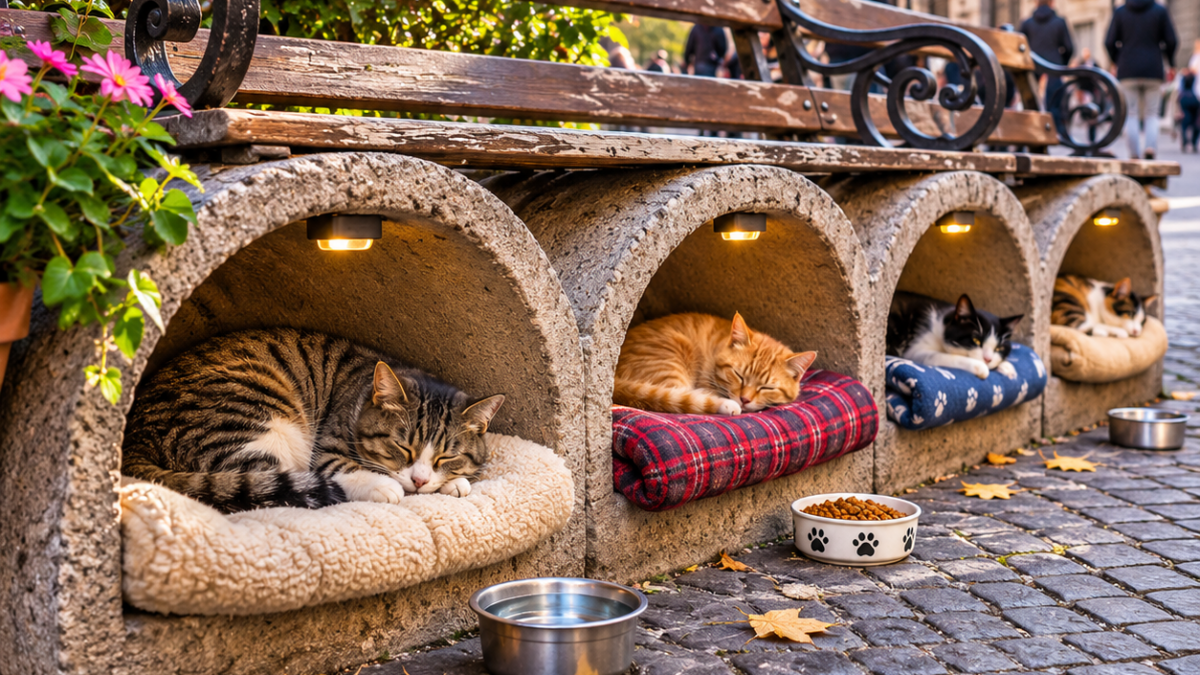
The first time I saw an old stray cat sleeping beneath a public bench in Italy, I had no idea that the little wooden shelter protecting her would soon become the center of a bitter fight.
I thought I was witnessing one of the simplest acts of kindness I’d ever seen, but within weeks, people were threatening to destroy something that meant the difference between comfort and suffering for animals nobody seemed to notice.
And when I discovered who was behind those threats, I realized that sometimes the smallest acts of compassion reveal the ugliest truths about the people who oppose them.
My name is Claire Bennett.
I’m fifty-eight years old, an American widow who moved to Italy hoping to find a little peace after losing the person who had made my world feel like home.
I never expected to become involved in a fight over stray cats.
I certainly never imagined that a wooden box no bigger than a suitcase could change the direction of my life.
But grief has a strange way of leading you toward things you never knew you needed.
Three years earlier, my husband, Daniel, had died after a long illness.
We had been married for thirty-one years.
He was the kind of man who brought injured birds home in shoeboxes and pulled his car over to move turtles out of the road.
Whenever I complained that we couldn’t rescue every animal in the world, he would smile and say, “No, sweetheart. But we can help the one right in front of us.”
After he died, our house in Ohio became unbearable.
Every room held a memory.
His coffee mug remained in the kitchen cabinet.
His gardening gloves still hung beside the back door.
And every evening, I caught myself turning toward his empty chair before remembering there was nobody there.
I eventually sold the house, packed two suitcases, and moved to a small apartment in a quiet Italian neighborhood.
I told my friends I wanted a new beginning.
The truth was simpler.
I wanted to go somewhere that didn’t remind me of everything I’d lost.
For the first few months, I spent my mornings walking through narrow streets lined with old buildings, flower-filled balconies, and little cafés where the owners remembered everyone’s name.
There was beauty everywhere.
But loneliness followed me across the ocean.
Then came a cold November morning.
Rain had fallen throughout the night, leaving the cobblestone streets shining beneath the streetlights.
I was walking home from a bakery, carrying a paper bag of warm bread, when I heard a faint scratching sound.
I stopped beside an old wooden bench near a small public square.
At first, I saw nothing unusual.
Then something moved beneath it.
I bent down.
And there, tucked beneath the bench, was a little wooden shelter.
It had a sloping roof, raised sides, and a small entrance just large enough for a cat.
Inside was a thick, dry cushion.
A fine protective screen covered part of the opening, helping keep insects away while allowing air to circulate.
And curled in the center of that tiny shelter was an elderly gray cat.
Her fur was uneven.
One ear had a small notch.
Her face was thin, and her whiskers were bent in different directions.
But she was warm.
Dry.
Safe.
While rainwater still dripped from the bench above her, she slept peacefully with her nose tucked beneath her tail.
I stood there staring.
Someone had built this.
Someone had measured the space beneath the bench, cut the wood, sanded the edges, added a cushion, and thought about protecting a stray animal from the cold and mosquitoes.
Someone had cared enough to create a home for a creature that didn’t belong to anyone.
I crouched lower.
“Hello, sweetheart,” I whispered.
The cat opened one yellow eye.
She looked at me for a moment.
Then closed it again.
I laughed softly.
“Well, I suppose I’m interrupting your morning.”
Behind me, a woman’s voice spoke in Italian.
“She doesn’t usually welcome strangers.”
I turned.
An elderly woman stood a few feet away, carrying a small bag of cat food.
She had silver hair, a dark green coat, and the kind of face that seemed to hold a lifetime of stories.
She smiled.
“Her name is Lucia.”
I looked back at the cat.
“She’s beautiful.”
The woman stepped closer.
“She’s old. Perhaps thirteen. Perhaps fifteen. Nobody knows exactly.”
“Does she belong to someone?”
The woman’s smile faded slightly.
“She belongs to the streets.”
I looked at the tiny wooden shelter.
“But someone made her a home.”
The woman nodded.
“Yes. Because belonging to nobody shouldn’t mean having nowhere safe to sleep.”
Those words settled somewhere deep inside me.
I didn’t know it then, but I would spend months remembering them.
And before that winter ended, I would discover just how much courage it could take to defend a place small enough for one forgotten cat to sleep.
PART 2
The elderly woman’s name was Sofia Moretti.
She was seventy-four, a retired schoolteacher who had lived in the neighborhood for almost fifty years.
Her English was better than my Italian, which was fortunate because my vocabulary still consisted mainly of greetings, food names, and apologies.
Sofia pointed toward the shelter.
“My husband built the first one.”
I looked at her.
“Your husband?”
“Alessandro. He was a carpenter.”
She smiled, but sadness flickered across her face.
“He believed that a city should be judged by how it treats those who cannot speak for themselves.”
I felt an immediate connection to her.
“My husband believed something similar.”
Sofia studied me.
“Is he still living?”
I shook my head.
“No.”
Her expression softened.
“Mine isn’t either.”
For a moment, neither of us spoke.
Then she looked back toward the cat.
“Alessandro died seven years ago. But I couldn’t bear to stop what we started.”
I glanced at the shelter again.
“How many have you made?”
“Eleven.”
I nearly dropped my bread.
“Eleven?”
She nodded with obvious pride.
“Some beneath benches. Some beside sheltered walls. All placed with permission and cared for by volunteers.”
I looked around the square.
Suddenly, I noticed something I had completely overlooked.
Another small wooden structure sat beneath a bench near the fountain.
And a third stood farther down the street.
They were painted in muted shades of brown and green, blending almost invisibly into the surroundings.
To most people, they probably looked like ordinary pieces of street furniture.
But to the animals living outside, they were something far more important.
They were places to escape the rain.
Places to hide from harsh sunlight.
Places to rest without lying directly on cold, wet stone.
I felt an unexpected tightness in my chest.
“Do people know about them?”
“Some do.”
“Do they help?”
“Some bring cushions. Some leave food with the volunteers. Some help with cleaning.”
She paused.
“And some complain.”
I looked at her.
“About what?”
“The cats. The shelters. Everything.”
Her smile became weary.
“People are often very concerned about things that don’t inconvenience them at all.”
I laughed.
Sofia invited me to accompany her on her morning rounds.
I accepted without thinking.
For the next hour, we walked through the neighborhood, checking the little shelters and making sure the cats were safe.
I met a black-and-white tomcat named Bruno, who apparently considered himself the mayor of the square.
There was a ginger kitten named Pippo, whose left hind leg had healed crookedly after an old injury.
Two sisters, Bella and Nina, shared a shelter beside a stone wall.
And beneath the bench near the bakery, Lucia slept so deeply that she barely noticed us changing her water.
Sofia knew every cat.
She knew their habits.
Their injuries.
Their personalities.
She knew which ones tolerated being touched and which preferred to keep their distance.
She knew which cats had been sterilized and which still needed veterinary attention.
And she never once spoke about them as though they were nuisances.
To Sofia, they were living beings with histories.
Some happy.
Some heartbreaking.
All deserving of care.
By the time we finished, my bread had gone cold.
I didn’t care.
For the first time since moving to Italy, I had spent an entire morning without thinking about how empty my apartment felt.
When Sofia asked whether I wanted to help again the following day, I said yes.
It was the easiest decision I’d made in years.
I had no idea it would eventually put me at odds with one of the most influential men in the neighborhood.
## PART 3 — THE CAT WHO REMINDED ME OF MY HUSBAND
Lucia became my favorite.
I tried not to admit it.
Sofia insisted that loving every cat equally was impossible.
“Even teachers have favorite students,” she told me. “They just pretend otherwise.”
Lucia was an elderly gray cat with one notched ear, clouded eyes, and a personality that reminded me painfully of Daniel.
She was stubborn.
Independent.
Unimpressed by unnecessary attention.
But when she decided she trusted someone, she offered a quiet affection that meant more than any dramatic display.
At first, she wouldn’t come near me.
I placed fresh water beside her shelter.
She watched from the entrance.
I cleaned the cushion.
She retreated behind the bench.
I sat nearby and spoke softly.
She ignored me.
It became our routine.
Every morning, I stopped beside her little house.
“Good morning, Lucia.”
She blinked.
“Lovely weather, isn’t it?”
Sometimes she sneezed.
Sometimes she walked away.
Once, she turned her back on me while I was speaking.
“You’re just like my husband,” I told her.
That evening, I cried in my apartment for the first time in weeks.
Not because something bad had happened.
But because something beautiful had reminded me of the man I loved.
The next morning, I brought a small photograph of Daniel.
It was an old picture taken during a vacation in Maine.
He was standing near the ocean, smiling broadly while holding a rescued seagull wrapped in a towel.
I sat beside Lucia’s shelter and looked at the picture.
“He would have loved you,” I whispered.
Lucia emerged slowly.
She approached my shoes.
Then she rubbed her cheek against my ankle.
I froze.
It was the first time she had voluntarily touched me.
I didn’t dare move.
After a moment, she sat beside my foot.
I wiped my eyes.
“Well, hello there.”
She looked up.
And for one strange, beautiful second, it felt as though Daniel was reminding me that I still had love left to give.
I began visiting twice a day.
I learned how Sofia organized the feeding schedule.
I helped wash cushions.
I carried water.
I bought supplies.
And when one of the shelters needed a new roof panel, I offered to pay for the wood.
Sofia refused.
“Your time is enough.”
I shook my head.
“Please. Let me.”
She studied me for a moment.
Then she smiled.
“Alessandro used to say that accepting help is also a form of kindness.”
I laughed.
“That sounds like something my husband would have said.”
Over the following weeks, Sofia introduced me to the other volunteers.
There was Marco, a retired electrician with enormous hands and a surprisingly gentle voice.
Elena, a veterinary technician who helped coordinate medical care.
And Tomaso, a university student who used his weekends to repair the shelters.
Together, they formed a small but determined community.
Nobody was paid.
Nobody expected recognition.
They simply believed that animals surviving on the streets deserved better than cold pavement and rain-soaked cardboard.
For the first time in years, I felt useful.
Not because someone needed me to fix their life.
But because there was meaningful work to do.
And then one morning, we found the first warning.
## PART 4 — THE RED LETTER
It was taped to Lucia’s shelter.
A bright red notice, folded beneath a strip of clear plastic.
Sofia noticed it before I did.
She stopped walking.
Her face changed.
“What is it?” I asked.
She didn’t answer.
She bent down, pulled the paper loose, and read it.
Then she handed it to me.
The notice was written in Italian, but I understood enough to recognize the words *unauthorized structures* and *removal*.
“What’s happening?”
Sofia’s hands trembled slightly.
“The new neighborhood improvement committee says the shelters must be removed.”
I stared at her.
“Why?”
“They claim they interfere with public maintenance.”
I looked at Lucia’s little house.
It sat neatly beneath the bench.
It didn’t block the sidewalk.
It didn’t extend into the walking path.
It wasn’t even visible from most angles.
“That doesn’t make sense.”
Sofia gave a tired sigh.
“It doesn’t have to make sense to frighten people.”
I examined the notice more carefully.
There was a committee name printed at the bottom.
*Bellacosta Streetscape Renewal Committee.*
And beneath it, a signature.
Vittorio Bellini.
Sofia saw me reading.
“Do you know him?” I asked.
She shook her head.
“Only by reputation.”
“What reputation?”
“He owns several commercial properties. He wants to modernize this district.”
“Modernize?”
“More expensive shops. New outdoor cafés. Better tourism.”
I looked around the square.
There were already cafés.
Flower stalls.
A bakery.
A little bookstore.
Families walking children to school.
Old men playing cards beneath a covered terrace.
It seemed perfectly alive to me.
Sofia continued.
“He believes the stray cats make the neighborhood look neglected.”
I stared at her.
“Because homeless animals are surviving outside?”
“Because he doesn’t want visitors to see them.”
I looked at Lucia.
She was sitting inside her shelter, grooming one paw.
Completely unaware that someone had decided her existence was bad for business.
Something hot rose in my chest.
“Surely he can’t just remove them.”
“We’ll have to check the permissions and speak to the municipality.”
“Then we will.”
Sofia looked at me.
“You don’t have to become involved, Claire.”
I folded the notice carefully.
“Yes,” I said. “I think I do.”
She smiled sadly.
“You’re stubborn.”
I laughed.
“You should have met my husband.”
But that afternoon, when we visited the other shelters, we discovered the same notices.
Eleven warnings.
Eleven tiny homes threatened.
And beneath one of them, a handwritten message had been scrawled in thick black marker.
*GET RID OF THE CATS.*
I stared at those words for a long time.
Then I looked at Sofia.
Her eyes were wet.
“Alessandro built these with his own hands,” she whispered.
I put my arm around her.
“We’re not giving up because someone doesn’t like them.”
I meant every word.
But I had no idea how far Bellini was willing to go.
## PART 5 — THE MAN WHO CALLED COMPASSION AN EYESORE
I met Vittorio Bellini three days later.
The committee had called a public meeting in a small hall beside the municipal offices.
I arrived with Sofia, Marco, Elena, and several neighbors.
At the front stood a tall man in an expensive navy suit.
His silver hair was perfectly styled.
His shoes looked as though they’d never touched a muddy sidewalk.
He greeted people with the practiced warmth of someone accustomed to getting his way.
When the meeting began, he displayed photographs of the neighborhood.
There were pictures of cracked pavement.
Overflowing trash bins.
Graffiti.
Damaged planters.
And then, unexpectedly, a photograph of Lucia’s shelter.
Bellini pointed toward the screen.
“These structures create an appearance of disorder.”
I stared at him.
Disorder?
The shelter was clean.
The cushion was dry.
The wood had been carefully painted.
A small bowl of fresh water sat beside it.
It looked better maintained than half the street furniture in the district.
Bellini continued.
“Our community must present itself as modern, welcoming, and commercially attractive.”
A man in the audience nodded.
Someone else muttered approval.
Then Sofia raised her hand.
Bellini barely glanced at her.
“Yes?”
“My husband helped build those shelters,” she said.
Her voice was quiet but steady.
“They are maintained by volunteers. The cats are monitored, and we work with veterinary professionals to manage the colony responsibly.”
Bellini smiled without warmth.
“Mrs. Moretti, we appreciate your dedication.”
I recognized the tone immediately.
It was the tone people used when they were about to dismiss someone politely.
“But emotional attachment cannot determine public policy.”
Sofia’s cheeks flushed.
“This isn’t just emotional attachment.”
He interrupted.
“We have to consider hygiene, appearance, and tourism.”
I raised my hand.
He looked irritated.
“Yes?”
I stood.
“My name is Claire Bennett. I’m a resident of this neighborhood.”
He studied me.
“American?”
“Yes.”
“Then perhaps you don’t fully understand our local concerns.”
A few people shifted uncomfortably.
I smiled.
“Perhaps. But I understand the difference between a documented public-health issue and someone simply disliking the sight of a stray cat.”
The room went quiet.
Bellini’s expression hardened.
“I beg your pardon?”
“Have there been inspections? Complaints supported by evidence? Any findings that these shelters are unsafe?”
He looked toward the committee secretary.
“This is a broader beautification initiative.”
“Then why are the cat shelters included with broken sidewalks and overflowing garbage?”
He adjusted his jacket.
“Because they affect the visual character of the district.”
I nodded.
“So the problem is how they look.”
“The problem is that we must move forward.”
I glanced toward Sofia.
Her hands were clasped tightly in her lap.
Then I turned back.
“With respect, a city doesn’t become more beautiful by making vulnerable animals suffer.”
A woman near the back murmured agreement.
Bellini’s jaw tightened.
“Nobody is proposing cruelty.”
“Then what alternative sheltering arrangements are being made for the cats?”
He paused.
“There are animal welfare organizations.”
“Have any agreed to take them?”
Silence.
“Has anyone assessed whether these cats can be safely relocated?”
Another pause.
I continued.
“Or are you simply planning to remove their shelter and hope they disappear?”
Bellini’s face reddened.
“Mrs. Bennett, this is not a personal debate.”
“It became personal when you put a removal notice on the home of an elderly cat.”
A ripple moved through the room.
Someone clapped once.
Bellini raised his voice.
“The committee will review all concerns. But we will not allow sentimentality to obstruct progress.”
I sat down.
My hands were shaking.
Sofia squeezed my arm.
“Thank you,” she whispered.
I looked at the photograph of Lucia’s shelter still glowing on the screen.
I thought of Daniel.
Of his patient kindness.
Of the way he always stopped for the animal everyone else drove past.
And I knew that if he had been sitting beside me, he would have stood up too.
## PART 6 — THE NIGHT THE SHELTER DISAPPEARED
The first shelter vanished the following Wednesday.
It belonged to Bruno.
The black-and-white tomcat who considered himself the mayor of the square.
Marco discovered it during his morning rounds.
The bench was still there.
The shelter wasn’t.
Only four pale marks remained on the pavement where its protective feet had stood.
Bruno sat nearby.
Wet.
Confused.
His fur was clumped from the rain.
When Marco called me, I hurried across the neighborhood.
Sofia was already there.
She stood beside the empty space, staring at the ground.
“Where is it?” I asked.
Marco shook his head.
“Gone.”
“Was it removed officially?”
“There’s no record of a scheduled removal that anyone has shown us.”
I looked around.
The square was waking up.
A delivery truck stood near the bakery.
People carried shopping bags.
A café worker arranged tables beneath an awning.
And Bruno sat beside the bench, staring at the place where his shelter had been.
The sight broke something inside me.
Not because the wooden structure was expensive.
It wasn’t.
Not because replacing it would be impossible.
It wouldn’t.
But because someone had deliberately taken away a safe place from an animal who had almost nothing.
Sofia knelt beside Bruno.
“Oh, my poor boy.”
He approached her cautiously.
She stroked his head.
I stood there, furious.
“Someone must have seen something.”
Marco nodded.
“We’ll ask.”
We spent the next two hours speaking with nearby shop owners.
Most hadn’t noticed anything.
But the bakery owner, Giuseppe, remembered a maintenance van arriving shortly after dawn.
“Two men,” he said. “They loaded something into the back.”
“Did they have a city logo?” I asked.
He shook his head.
“No. Private company.”
“Did you recognize them?”
“No.”
He hesitated.
“But I remember the name on the van.”
I took out my notebook.
“Please.”
“Bellini Property Services.”
The words seemed to hang in the air.
Sofia looked at me.
I looked back at her.
Neither of us spoke.
It wasn’t proof that Vittorio Bellini had ordered the shelter removed.
But it was enough to demand answers.
We documented the scene.
We photographed the empty space.
We recorded Bruno’s condition.
Then Elena contacted the local animal welfare office to report the removal and ask what procedures applied.
That afternoon, Marco built Bruno a temporary replacement using spare materials.
We placed it in a protected location that had been approved for temporary care while the situation was investigated.
Bruno entered it almost immediately.
He turned around twice.
Then curled up on the dry cushion.
I watched him settle.
My anger didn’t disappear.
But it became something more useful.
Determination.
That evening, I sat at my kitchen table and opened a new notebook.
On the first page, I wrote three words.
*Protect the shelters.*
Beneath them, I began listing everything we needed.
Records.
Permissions.
Photographs.
Witnesses.
Veterinary statements.
A clear understanding of local rules.
And people willing to speak publicly.
I had spent decades working as an administrative manager for a nonprofit organization.
I knew that powerful people often relied on others being too exhausted, frightened, or disorganized to challenge them.
I also knew something Bellini apparently didn’t.
A carefully documented truth can be far more powerful than an angry argument.
I placed Daniel’s photograph beside my notebook.
“All right, sweetheart,” I whispered. “Let’s help the one right in front of us.”
Then I began making calls.
## PART 7 — THE LETTERS WE WERE NEVER SUPPOSED TO FIND
Over the next week, we gathered everything we could.
Sofia found old correspondence from the municipality.
Alessandro had carefully saved copies of permission requests, maintenance agreements, and photographs showing where the shelters had originally been placed.
Some documents were old enough that the ink had begun fading.
Others were more recent.
They established that the volunteer group had previously worked with local officials to identify suitable locations.
Not every shelter had the same paperwork, and we knew some permissions might need updating.
But Bellini’s suggestion that the entire project had appeared without anyone’s knowledge was clearly misleading.
Marco contacted a municipal clerk who agreed to explain the process for confirming current authorization.
Elena assembled records showing the colony’s veterinary care.
She documented sterilization appointments, medical treatment, and the volunteer feeding schedule.
Tomaso created a map of the shelters.
We marked each location.
Measured whether it obstructed pedestrian movement.
Photographed the surrounding sidewalks.
And noted which structures needed repairs.
My apartment became our unofficial headquarters.
Every evening, people crowded around my kitchen table.
There were papers everywhere.
Coffee cups.
Photographs.
Receipts.
A growing pile of veterinary documents.
And a very suspicious-looking amount of Italian pastry.
Sofia sat beside me one evening, sorting old letters.
She stopped when she found a yellowed envelope.
“Oh.”
I looked up.
“What is it?”
She unfolded the paper.
Her face changed.
“It’s from Alessandro.”
I waited.
She smiled sadly.
“He wrote to the municipality after someone complained about the first shelter.”
She began reading in Italian.
Then translated slowly.
“He said that a public bench exists so people can rest when they are tired. He wondered why the empty space beneath it couldn’t offer the same kindness to an animal.”
I felt tears gathering.
Sofia continued.
“He wrote that the shelter did not belong to him. It belonged to the cat who needed it.”
She stopped.
Her hands trembled.
I reached across the table.
“That’s beautiful.”
She nodded.
“He was a good man.”
I looked at Daniel’s photograph on the shelf.
“So was mine.”
For a while, we sat quietly.
Then Sofia carefully folded the letter.
“I want people to know why we built these.”
I nodded.
“They will.”
The following afternoon, Tomaso came rushing into my apartment.
He was carrying his laptop.
“Claire, you need to see this.”
He opened a local business proposal circulating among neighborhood merchants.
It contained an illustration of the square after the proposed renovations.
New café terraces.
Decorative planters.
Additional outdoor seating.
Elegant lighting.
And no animal shelters.
Not one.
More interestingly, the plan included commercial spaces managed by a company connected to Bellini.
Tomaso pointed toward the screen.
“His business could benefit from some of the changes.”
I studied the proposal.
That didn’t automatically make the project improper.
Neighborhood improvements often involved private businesses.
But it raised questions about transparency.
Particularly when the man promoting the changes also appeared to be connected to the company whose vehicle had been seen removing a shelter.
“We need the official records,” I said.
Tomaso nodded.
“I already requested the public documents.”
I smiled.
“You’re learning.”
He laughed.
“From you.”
But the next morning, the situation took a frightening turn.
## PART 8 — LUCIA WAS MISSING
I arrived at the square just after seven.
The air was unusually cold.
Fog drifted between the buildings.
I carried fresh water and a clean cushion in a canvas bag.
As I approached Lucia’s bench, I noticed something wrong.
Her shelter door was hanging open.
The cushion lay on the pavement.
Wet.
Dirty.
And Lucia was nowhere to be seen.
My heart stopped.
“Lucia?”
No answer.
I crouched.
“Sweetheart?”
I looked beneath the bench.
Behind the planter.
Along the wall.
Nothing.
The little shelter had been pushed sideways.
One panel was cracked.
The protective screen had been torn loose.
I felt panic rising.
I knew stray cats sometimes wandered.
I knew Lucia had a territory.
But she rarely strayed far from her shelter, especially in cold weather.
I called Sofia.
She arrived fifteen minutes later.
The moment she saw the damage, her face went pale.
“Oh, no.”
“We’ll find her,” I said.
I tried to sound confident.
But my hands were shaking.
We searched the square.
Then the side streets.
We checked beneath parked cars.
Behind trash bins.
Inside the sheltered courtyard near the bakery.
Sofia called Lucia’s name in Italian.
I called in English.
As though the language mattered to a frightened old cat.
By noon, we had found nothing.
Elena joined us.
She reminded us to search quietly, since frightened cats often hide nearby rather than traveling far.
We asked the bakery owner to keep watch.
We notified the local rescue volunteers.
We left familiar bedding near a safe, sheltered location.
And we continued searching.
That afternoon, rain began falling.
Cold, steady rain.
The kind that soaks through your coat and makes the world feel smaller.
I kept picturing Lucia.
Her thin body.
Her uneven fur.
Her aging eyes.
I imagined her hiding somewhere wet and frightened.
I imagined her searching for the tiny wooden home that had always been there.
And for the first time since moving to Italy, I felt the same helplessness I’d experienced during Daniel’s final illness.
The terrible knowledge that loving someone doesn’t guarantee you can protect them.
At dusk, Sofia found me beside the damaged shelter.
I was sitting on the bench.
Soaked.
Exhausted.
My hands wrapped around a cold paper cup.
“Claire,” she said gently, “you need to come home.”
I shook my head.
“Not yet.”
“We’ll keep looking tomorrow.”
“What if she doesn’t survive the night?”
Sofia sat beside me.
She didn’t answer.
Because there was no reassuring answer.
I stared at the empty shelter.
“She’s old.”
“I know.”
“She trusted this place.”
“I know.”
My voice broke.
“Someone took that away from her.”
Sofia wrapped an arm around my shoulders.
We sat together in the rain.
Two widows.
One American.
One Italian.
Both grieving something that felt much larger than a little wooden box.
Then I heard it.
A faint sound.
So soft I almost imagined it.
A meow.
I sat upright.
“Did you hear that?”
Sofia listened.
Another meow.
We stood.
The sound came from behind a stack of crates near a closed flower shop.
I hurried toward it.
“Lucia?”
Something shifted in the shadows.
I knelt.
There she was.
Curled tightly behind the crates.
Wet.
Shivering.
Her eyes wide with fear.
“Oh, sweetheart.”
I started crying.
Sofia approached slowly.
Together, we coaxed Lucia into a carrier without frightening her further.
Elena met us at the veterinary clinic.
Lucia was cold and stressed, but thankfully she had no serious injuries.
The veterinarian kept her for observation and treatment.
I sat beside Sofia in the waiting room.
Neither of us spoke for a long time.
Then Sofia whispered, “Alessandro would have been so angry.”
I looked at her.
“So would Daniel.”
She gave a tired smile.
I reached for her hand.
“We found her.”
“Yes.”
“And we’re going to make sure this doesn’t happen again.”
This time, my voice didn’t shake.
## PART 9 — THE VIDEO THAT CHANGED EVERYTHING
Two days later, Giuseppe called.
“Claire, come to the bakery.”
His voice was urgent.
I hurried across the square.
He led me into the small office behind the kitchen.
A security monitor stood on the desk.
“I remembered something,” he said.
He explained that the bakery’s exterior camera covered part of the sidewalk near Lucia’s bench.
The angle wasn’t perfect.
But it captured a portion of the square.
He had checked the recording from the morning Lucia disappeared.
Then he showed me.
On the screen, two men approached the bench shortly before sunrise.
One carried tools.
The other pulled the wooden shelter partly out from beneath the seat.
They handled it roughly.
One removed the cushion and dropped it onto the pavement.
The other appeared to damage the side panel while moving the structure.
Lucia fled.
She shot across the edge of the screen and disappeared into the darkness.
I pressed a hand over my mouth.
Giuseppe paused the recording.
“Do you recognize them?”
“No.”
He pointed toward the far side.
A van was parked nearby.
The company lettering was partially visible.
Bellini Property Services.
I felt cold.
“Can you preserve this recording?”
“Already done.”
“Will you provide it to the proper authorities?”
“Yes.”
I looked at the frozen image of Lucia running away.
My chest tightened.
I thought of her shivering behind the flower shop.
Of Sofia searching in the rain.
Of that broken shelter.
And I felt an anger unlike anything I’d experienced in years.
Not loud anger.
Not reckless anger.
Something colder.
More focused.
Someone had decided a little wooden home was inconvenient.
And because of that decision, an elderly cat had been frightened into the cold.
I looked at Giuseppe.
“Thank you.”
He nodded.
“My grandmother used to feed the cats here. I won’t pretend I didn’t see this.”
I left the bakery and called Sofia.
Then Marco.
Then Elena.
We agreed to preserve the evidence, submit it to the relevant authorities, and request a formal review of the shelters’ status.
That evening, I sat at my kitchen table with the video description and our documents spread before me.
For weeks, Bellini had spoken as though his committee represented order, responsibility, and progress.
But the growing evidence suggested that the campaign against the shelters deserved serious scrutiny.
I opened my notebook.
On the next blank page, I wrote:
*No more private arguments.*
Then beneath it:
*Everything in the open.*
I wasn’t interested in humiliating Bellini.
I wasn’t interested in threats.
I wanted the facts examined.
I wanted the cats protected.
I wanted the volunteers treated fairly.
And I wanted everyone who had been told that compassion was an obstacle to progress to see what was actually happening.
The following morning, we requested another public meeting.
This time, we weren’t arriving with only our feelings.
We were bringing evidence.
## PART 10 — THE TOWN HALL CONFRONTATION
The meeting room was packed.
Neighbors stood along the walls.
Local shop owners filled the front rows.
Several animal welfare volunteers had traveled from nearby neighborhoods.
Sofia sat beside me.
She wore a dark blue dress and a small silver necklace that had belonged to her husband.
Her hands trembled slightly.
“Are you nervous?” I whispered.
She nodded.
“Very.”
I squeezed her hand.
“So am I.”
At the front of the room, Bellini stood beside two committee members.
He looked irritated.
But confident.
He had no reason to expect that anything had changed.
When the meeting began, he spoke about improving the neighborhood.
Cleaning the streets.
Supporting businesses.
Creating a more attractive environment for tourists.
Then he returned to the shelters.
“As I have explained, temporary sentimental projects cannot be allowed to interfere with our long-term vision.”
I felt Sofia stiffen beside me.
But I placed my hand on her arm.
“Wait.”
Bellini continued.
“The committee has acted responsibly and in good faith.”
A few people nodded.
Then the moderator opened the floor for questions.
I stood.
Bellini recognized me immediately.
His expression darkened.
“Mrs. Bennett.”
“Mr. Bellini.”
He sighed.
“Do you have another objection?”
“I have several questions.”
“Then please be brief.”
I held up a folder.
“First, can you confirm whether the committee formally authorized the removal of any cat shelters?”
Bellini hesitated.
“We have discussed maintenance concerns.”
“That wasn’t my question.”
The room grew quiet.
He frowned.
“Certain structures may require relocation.”
“Was any removal formally authorized?”
A committee member leaned toward him.
Bellini adjusted his microphone.
“I would need to review the specific records.”
I nodded.
“Thank you.”
Then I continued.
“Second, did Bellini Property Services receive any instruction to remove the structures?”
His expression changed.
“What are you implying?”
“I’m asking whether a company connected to you was involved.”
He laughed sharply.
“This is absurd.”
I looked toward the moderator.
“May we display the photographs and evidence we’ve submitted for review?”
The moderator nodded.
Tomaso connected his laptop to the projector.
The first image appeared.
Bruno’s shelter before it disappeared.
Clean.
Well maintained.
Placed neatly beneath the bench.
The second image showed the empty space afterward.
Then came photographs of Lucia’s damaged shelter.
Her soaked cushion.
The broken panel.
A close-up of the torn protective screen.
People began whispering.
Bellini shifted.
“These photographs don’t prove—”
“I’m not finished.”
My voice surprised me.
It was steady.
Clear.
Stronger than I expected.
I explained the timeline.
The warning notices.
The disappearance of Bruno’s shelter.
The van described by the bakery owner.
The damage to Lucia’s shelter.
Then Tomaso displayed still frames from the preserved security footage.
A van.
Two workers.
The shelter being moved.
The cushion dropped.
Lucia fleeing.
The room fell silent.
Bellini stared at the screen.
I turned toward him.
“Was this work authorized?”
His face reddened.
“I cannot answer for every action taken by private employees.”
“Then who instructed them?”
He looked toward his committee members.
Nobody answered.
I continued.
“We’re not asking anyone to decide guilt in this room. The evidence has been referred for appropriate review. But this community deserves an explanation.”
A woman near the back stood.
“My children walk past those shelters every day. They don’t obstruct anything.”
Another man spoke.
“I own the bookstore. Customers love seeing the cats.”
A café owner raised his hand.
“People stop to photograph the little houses. They ask who built them.”
Bellini tried to regain control.
“With respect, tourism cannot determine animal welfare policy.”
I looked directly at him.
“Neither should personal preference.”
The room grew quiet again.
I continued.
“These shelters are not substitutes for proper veterinary care or responsible colony management. They are one small part of a larger effort. Our volunteers maintain them, monitor the cats, and work with professionals.”
I lifted Sofia’s old letter.
“Years ago, a carpenter named Alessandro Moretti wrote that a public bench exists to give tired people a place to rest. He believed that the unused space beneath it could offer the same kindness to an animal.”
I paused.
Sofia lowered her head.
“He built the first shelter because he believed compassion didn’t need to be expensive or dramatic. Sometimes it only needed a few pieces of wood, a dry cushion, and someone willing to care.”
My voice began trembling.
I looked at Bellini.
“You call these structures an eyesore.”
Then I looked around the room.
“I call them evidence that people in this neighborhood still notice the vulnerable lives around them.”
For several seconds, nobody moved.
Then someone began clapping.
A woman near the door.
Another person joined.
Then another.
Soon, the room filled with applause.
I looked at Sofia.
She was crying.
I sat beside her.
She took my hand.
“Alessandro would have loved that.”
I wiped my eyes.
“So would Daniel.”
The meeting didn’t resolve everything immediately.
The authorities still needed to review the reported removal.
The municipality still needed to confirm the appropriate permissions and locations.
But Bellini’s attempt to present the matter as a simple beautification issue had failed.
People were asking questions.
People were demanding records.
And most importantly, people were finally seeing the cats not as obstacles, but as living creatures who deserved responsible care.
## PART 11 — THE TRUTH ABOUT PROGRESS
Over the following weeks, the situation changed.
The committee’s proposal faced additional scrutiny.
Questions were raised about how decisions had been made, whether proper procedures had been followed, and whether commercial interests had been clearly disclosed.
Bellini’s company became the subject of complaints concerning the shelter removals.
We cooperated with the review and provided the evidence we had collected.
We didn’t publish accusations we couldn’t prove.
We didn’t threaten anyone.
We didn’t damage property.
We simply refused to allow the facts to disappear.
That distinction mattered to me.
I thought of Daniel often during those weeks.
He had never believed that kindness meant weakness.
He was gentle with animals, patient with children, and generous with strangers.
But when he saw someone being mistreated, he could become astonishingly firm.
Once, years earlier, he’d found a frightened dog tied outside a grocery store in freezing weather.
He had waited with the animal while the store manager contacted the owner.
When the owner returned and became angry about the attention, Daniel calmly explained that leaving an animal exposed to dangerous cold was unacceptable.
He never raised his voice.
He didn’t need to.
I remembered that now.
And I understood that the most powerful response to cruelty wasn’t always revenge in the ordinary sense.
Sometimes it was forcing people to confront the consequences of what they had done.
Sometimes it was protecting the vulnerable so thoroughly that the people who wanted to erase them could no longer pretend they didn’t exist.
Our volunteer group began receiving offers of help.
A carpenter offered to repair the damaged shelters.
A local fabric shop donated washable cushions.
A veterinary clinic offered to help coordinate additional care for the colony.
A hardware store provided materials at a discount.
Several residents volunteered for cleaning and maintenance shifts.
Even people who didn’t particularly like cats agreed that damaged or unsafe structures should be repaired properly and that animal welfare decisions needed to be made responsibly.
The discussions gradually became more practical.
Which locations were suitable?
How could the shelters be secured without obstructing public access?
How often should they be cleaned?
Who would monitor the animals?
How could residents report concerns?
What arrangements were needed for sterilization, veterinary treatment, and emergencies?
Those were useful questions.
Questions that should have been asked from the beginning.
The municipality reviewed the proposed locations and worked with the appropriate groups to establish a clearer arrangement for approved shelters.
Some structures needed to be moved.
Others needed repairs.
Not every location was suitable.
We accepted that.
Our goal had never been to place wooden boxes wherever we pleased.
Our goal was to protect animals while respecting the people who shared the streets.
That was what responsible compassion looked like.
One evening, Tomaso arrived carrying a printed draft of the updated shelter plan.
He spread it across my kitchen table.
“Look.”
I studied the map.
Several approved locations were marked in green.
Lucia’s bench was one of them.
I looked up.
“She can stay?”
He smiled.
“Her shelter can be restored in the approved location.”
I covered my mouth.
Sofia began crying.
Marco laughed.
Elena hugged Tomaso.
And I sat there staring at a tiny green mark on a map.
A mark that meant an old cat would once again have a dry place to sleep.
It seemed such a small victory.
But to us, it meant everything.
## PART 12 — THE DAY THE SHELTERS RETURNED
The repairs began on a bright Saturday morning.
The square smelled of fresh bread and coffee.
Sunlight spilled across the cobblestones.
Tomaso arrived with tools.
Marco carried lumber.
Elena brought cleaning supplies.
Sofia appeared with a thermos of coffee and enough pastries to feed a small army.
I brought cushions.
Fresh ones.
Thick, washable, and covered in weather-resistant fabric.
We weren’t rebuilding the shelters exactly as they had been.
We were improving them.
The roofs were made more durable.
The floors were raised to help keep moisture out.
The entrances were positioned to reduce exposure to wind and rain.
The protective screening was replaced where appropriate to help reduce insect intrusion without blocking ventilation.
Every edge was sanded.
Every surface checked.
Every cushion fitted carefully.
Nothing extravagant.
Just thoughtful design.
Practical kindness.
As the volunteers worked, neighbors stopped to watch.
Some offered assistance.
Others asked questions.
A little girl approached with her father.
She couldn’t have been older than six.
She held a drawing in both hands.
It showed a gray cat sleeping beneath a bench.
Above it, in crooked letters, she’d written:
*EVERY CAT DESERVES A HOME.*
She looked up at Sofia.
“Is this for the old kitty?”
Sofia knelt.
“Yes, sweetheart.”
The little girl held out the picture.
“Can you put it somewhere she’ll see it?”
Sofia’s eyes filled.
“We’ll keep it safe.”
The girl smiled.
Then she ran back to her father.
I watched Sofia carefully fold the drawing and place it inside her bag.
“Alessandro would have loved this,” she whispered.
I nodded.
By afternoon, Lucia’s shelter was finished.
It was beautiful in the simplest possible way.
Smooth wooden sides.
A gently sloping roof.
A dry cushion.
A small entrance.
And beneath it, a little brass plaque.
Marco had arranged it as a surprise.
The plaque read:
*In Memory of Alessandro Moretti — A Kind Place for Every Small Life.*
Sofia stared.
Then covered her face.
“Oh, Marco.”
He looked embarrassed.
“Alessandro taught me how to work with wood when I was young. It seemed right.”
Sofia hugged him.
I turned away to wipe my eyes.
For several minutes, we stood around the little shelter.
Nobody spoke.
Then Elena arrived carrying Lucia’s carrier.
The veterinarian had cleared her to return to the colony under the volunteers’ care.
My heart began pounding.
I knelt beside the shelter.
Elena placed the carrier nearby.
We waited until the surroundings were quiet.
Then she opened the door.
Lucia hesitated.
Her yellow eyes surveyed the square.
She sniffed the air.
Took one cautious step.
Then another.
She walked toward the bench.
Paused.
Looked at the shelter.
I held my breath.
Lucia sniffed the entrance.
Then slowly stepped inside.
She turned around once.
Twice.
And lowered herself onto the dry cushion.
Her eyes closed.
I began crying.
Beside me, Sofia whispered, “Welcome home.”
The people watching remained quiet.
A few smiled.
Some took photographs.
The little girl who had made the drawing squeezed her father’s hand.
And there, beneath an ordinary public bench on an ordinary Italian street, an elderly stray cat fell asleep in a place someone had built simply because she deserved comfort.
Nothing about the moment was grand.
No ribbon-cutting ceremony.
No expensive monument.
No dramatic speech.
Just an old cat.
A wooden shelter.
And a group of people who had refused to stop caring.
## PART 13 — THE MAN WHO LOST WHAT HE COULDN’T BUY
Vittorio Bellini resigned from his leadership role in the neighborhood committee several weeks later.
The official review of the removal incidents continued through the relevant channels, and the committee adopted clearer procedures for future decisions.
I didn’t celebrate Bellini’s resignation.
Not in the way some people expected.
A few neighbors suggested we should throw a party.
Someone joked about putting his photograph on the next shelter.
I refused.
“This was never about humiliating him,” I said.
Marco raised an eyebrow.
“He tried to get rid of the shelters.”
“I know.”
“And his company’s van was recorded near the damaged one.”
“I know that too.”
“Then why aren’t you happier?”
I looked toward Lucia’s bench.
The old cat was sleeping peacefully.
“Because I didn’t start this to destroy a man. I started it to protect the cats.”
Marco considered that.
Then nodded.
“Fair enough.”
But I would be lying if I said I felt nothing when Bellini finally approached me.
It happened one afternoon outside the bakery.
I was carrying a bag of supplies when I heard my name.
“Mrs. Bennett.”
I turned.
Bellini stood a few feet away.
He looked different.
Not defeated exactly.
But diminished.
The confidence he had worn like an expensive coat was gone.
“Mr. Bellini.”
He glanced toward the square.
“I suppose you’re pleased.”
I studied him.
“About what?”
“The committee. The shelters. Everything.”
I took a breath.
“I’m pleased the cats have safe, approved places to rest.”
He looked irritated.
“You know what I mean.”
I remained quiet.
Finally, he said, “You made me look like a villain.”
I looked at him carefully.
“No. I asked questions.”
He scoffed.
“You turned people against me.”
“People saw the records and evidence. They made their own judgments.”
He looked away.
For a moment, I thought he might argue.
Instead, he said, “I wanted to improve the district.”
“I believe you wanted it to look different.”
“Is that so wrong?”
“No. Improvement isn’t wrong.”
I glanced toward Lucia’s shelter.
“But improvement should consider the lives already here.”
He followed my gaze.
The old gray cat was sitting at the entrance, calmly watching a pigeon.
Bellini said nothing.
I continued.
“Those cats were living here long before I arrived. Some were here before your committee existed. They don’t understand property values or tourist impressions.”
He remained silent.
“They understand hunger. Cold. Fear. Safety.”
I looked back at him.
“We had a chance to make this neighborhood better for everyone. It didn’t have to be a fight.”
For a long moment, he stared at the pavement.
Then he muttered, “Perhaps some things could have been handled differently.”
It wasn’t a full apology.
I didn’t pretend it was.
But it was more acknowledgment than I’d expected.
“Yes,” I answered. “They could have.”
He nodded stiffly and walked away.
I watched him disappear down the street.
Then I turned toward Lucia.
She was grooming her paw.
Completely uninterested in the conversation.
I laughed.
“You’re right, sweetheart. Some things aren’t worth losing sleep over.”
For months, I had imagined how satisfying it would feel to confront Bellini after everything that happened.
I thought I might want to shout.
To tell him how frightened Lucia had been.
How Sofia had cried.
How much work we’d put into rebuilding the shelters.
But when the moment finally arrived, I didn’t need any of that.
The shelters were back.
The cats were safe.
The volunteers had support.
And the neighborhood had learned something valuable.
That was enough.
It was the kind of victory Daniel would have understood.
## PART 14 — THE CAT WHO CHOSE ME
Winter returned.
The mornings grew colder.
Rain swept through the streets.
Tourists wrapped scarves around their necks and hurried into cafés.
But beneath the benches, the shelters remained warm and dry.
We checked them regularly.
Replaced cushions when necessary.
Cleaned them.
Monitored the cats.
And continued coordinating veterinary care.
Lucia remained my favorite.
She had recovered from her ordeal, but her age was becoming more apparent.
She moved slowly.
Slept longer.
Sometimes needed more encouragement to eat.
Elena monitored her closely.
One afternoon, the veterinarian examined Lucia and discussed her changing needs.
She was an elderly cat.
Her condition would require ongoing attention.
There might come a time when living outdoors was no longer appropriate.
I knew that.
And I dreaded it.
After the appointment, I sat beside Sofia outside the clinic.
“She’s getting old,” I whispered.
Sofia nodded.
“We all are.”
I laughed weakly.
“That’s not very comforting.”
She smiled.
“No. But it’s true.”
We sat quietly.
Then Sofia looked at me.
“Claire, have you ever thought about adopting her?”
I stared.
“What?”
“Lucia.”
I looked down at the carrier.
Inside, Lucia was sleeping.
“She’s lived outside for years.”
“Yes.”
“Would she even be happy indoors?”
“Perhaps. Perhaps not. We’d need to evaluate that carefully.”
I thought about my apartment.
The empty windowsill.
The spare bedroom.
The quiet evenings.
The chair beside the balcony door where I still sometimes imagined Daniel sitting.
For the first time, I pictured Lucia there.
Curled in a warm bed.
Watching birds through the window.
Sleeping without worrying about rain.
But I didn’t want to take her away from the only life she knew simply because I loved her.
So we consulted Elena and the veterinarian.
We discussed Lucia’s health.
Her temperament.
Her ability to adjust.
The importance of making any transition slowly and monitoring her well-being.
Eventually, we arranged a carefully supervised trial.
I prepared a quiet room.
A comfortable bed.
A litter box.
Food and water.
A hiding place.
Everything she needed to feel safe.
Then, one rainy afternoon, Lucia came home with me.
I carried her carrier through the apartment door.
“Well, sweetheart,” I whispered, “welcome.”
She looked around cautiously.
I opened the carrier and allowed her to explore at her own pace.
At first, she remained inside.
Then she stepped out.
Sniffed the carpet.
Walked toward the window.
And sat down.
I watched her.
She watched the rain.
For a long time, neither of us moved.
That evening, she ate her dinner.
Used the litter box.
Explored the room.
Then curled up on the cushion beside the window.
I sat nearby with a book.
For the first time in years, my apartment didn’t feel quite so empty.
Over the following days, Lucia gradually adjusted.
She found favorite sleeping places.
Learned the sound of the food cupboard.
Discovered that the living room sofa was far more comfortable than any wooden bench.
And she developed a habit of following me into the kitchen every morning.
The trial went well.
With the veterinarian’s guidance and the rescue group’s agreement, I formally adopted her.
I still visited Sofia and the outdoor cats.
I still helped maintain the shelters.
But now, when I returned home, someone was waiting.
One evening, Lucia climbed onto the sofa beside me.
She pressed her head against my arm.
Then curled up and began purring.
I looked at Daniel’s photograph on the shelf.
“You would have loved her,” I whispered.
Lucia lifted her head.
Then rested it against my hand.
I began crying.
But I was smiling.
## PART 15 — THE LETTER I WROTE TO DANIEL
On the third anniversary of Daniel’s death, I sat beside the window with Lucia sleeping in my lap.
Rain fell softly outside.
The sky was gray.
The apartment smelled of coffee and fresh bread.
I had spent the morning visiting the little cemetery where Sofia’s husband was buried.
I placed flowers beside Alessandro’s grave.
Sofia stood beside me.
We didn’t speak much.
We didn’t need to.
Later, back home, I took out a notebook.
For years, whenever grief felt too heavy, I wrote letters to Daniel.
I never showed them to anyone.
They were simply a way of speaking to the man I missed.
That afternoon, I began another.
*Dear Daniel,*
*You would not believe what has happened to me.*
*I moved to Italy because I thought I needed to escape the memories.*
*I thought that if I crossed an ocean, maybe the empty spaces inside me would feel smaller.*
*But grief followed me.*
*Of course it did.*
*You were my home for thirty-one years. I couldn’t leave that behind simply by changing countries.*
*Then one morning, I found a cat sleeping beneath a bench.*
*Someone had built her a little wooden house.*
*It wasn’t beautiful in the way people usually mean beautiful.*
*It was practical. Simple. Carefully made.*
*And it reminded me of you.*
*You always said kindness didn’t have to be complicated.*
*You said the world would be better if people stopped asking whether they could help everyone and started helping the one creature standing in front of them.*
*I used to think that was just one of your sweet little sayings.*
*Now I understand what you meant.*
*That cat led me to Sofia.*
*Sofia led me to a group of volunteers.*
*And those volunteers led me back into the world.*
*There were arguments, Daniel.*
*You would have hated the arguments.*
*There were meetings, letters, accusations, and days when I wondered why I had become involved at all.*
*An old cat disappeared in the rain, and I thought my heart would break.*
*But we found her.*
*We repaired her home.*
*We helped protect the others.*
*And now, somehow, she’s sleeping in my apartment.*
*Her name is Lucia.*
*She’s old and stubborn.*
*She dislikes strangers.*
*She has very strong opinions about breakfast.*
*You would adore her.*
I paused.
Lucia shifted in my lap.
Her purring grew louder.
I wiped my eyes and continued.
*I still miss you.*
*I always will.*
*But I’m beginning to understand that loving you doesn’t mean I have to remain lonely forever.*
*You taught me how to care.*
*And even though you’re gone, that part of you is still alive in the things I choose to do.*
*I think you’d be proud of the little shelters.*
*I think you’d love Sofia.*
*And I think you’d laugh at the sight of me trying to explain to an elderly Italian cat why she cannot have a second breakfast.*
*I haven’t stopped missing you.*
*But I’ve started living again.*
*And I wanted you to know.*
*Love, Claire.*
I closed the notebook.
Then I held Lucia a little closer.
Outside, the rain continued falling.
But for the first time in years, the sound didn’t make me feel alone.
## PART 16 — THE SMALL KINDNESS THAT BECAME SOMETHING BIGGER
By the following spring, the shelter project had grown.
Not dramatically.
Not into some enormous organization with offices and expensive publicity.
It remained what it had always been.
A group of ordinary people doing practical things for animals who needed help.
But the community had changed.
More residents understood the purpose of the shelters.
More people knew whom to contact if a cat was injured.
More volunteers helped with cleaning, feeding, and veterinary appointments.
A local school invited Sofia to speak about responsible animal care.
She asked me to accompany her.
I laughed.
“Me? What am I supposed to say?”
She smiled.
“Tell them what you learned.”
So I went.
We stood in front of a classroom filled with children.
Sofia showed photographs of the shelters.
Tomaso explained how they were designed to stay dry and allow ventilation.
Elena spoke about the importance of veterinary treatment, sterilization, and responsible care.
Then it was my turn.
I looked at the children.
Some were barely old enough to tie their own shoes.
A little boy in the front row raised his hand before I had even started.
“Do the cats know you built houses for them?”
I smiled.
“I don’t know whether they understand who built them.”
He looked disappointed.
“But I think they understand what it feels like to be safe.”
A little girl raised her hand.
“Why don’t all the cats just go home?”
The question caught me off guard.
I looked toward Sofia.
Then back at the girl.
“Because not every animal has a home waiting for it.”
She frowned.
“That’s sad.”
“Yes,” I said gently. “It is.”
Another child raised his hand.
“Can’t we give them houses?”
I smiled.
“That’s what we’re trying to do.”
After the presentation, the teacher approached us.
“The children want to make something.”
I expected drawings.
Perhaps posters.
Instead, the class organized a small project.
They collected washable blankets, raised money for veterinary supplies, and wrote messages of kindness for the volunteers.
One child brought a photograph of his own rescued cat.
Another wrote a short poem about animals sleeping in the rain.
A little girl gave Sofia a card that said:
*THANK YOU FOR REMEMBERING THE CATS.*
Sofia held that card for a long time.
Then she put it in her handbag beside the old letter Alessandro had written.
I watched her.
And I realized that his kindness had traveled farther than he could ever have imagined.
It began with one carpenter.
One bench.
One small wooden shelter.
Now children who had never met him were learning to notice animals that other people walked past.
The thought moved me deeply.
Because perhaps that was how compassion truly changed the world.
Not through one grand gesture.
But through thousands of small decisions.
One person stopping.
One person helping.
One person teaching another to care.
## PART 17 — THE BENCH THAT HELD TWO MEMORIES
The next year, the volunteers organized a small gathering in the square.
Not a celebration of victory.
Not a ceremony about Bellini.
A gathering to remember the people who had started the project and to thank everyone who continued caring for the cats.
Sofia asked me to speak.
I protested.
She ignored me.
Apparently, after seventy-five years on earth, she had decided politeness was optional.
On the morning of the gathering, I arrived early.
The benches had been cleaned.
The shelters checked.
Fresh cushions placed inside.
Small flower arrangements stood near the fountain.
People gathered slowly.
Shop owners.
Volunteers.
Families.
Children.
A few tourists who stopped to see what was happening.
Sofia stood beside the bench where Lucia had once slept.
Her eyes were bright.
“You look nervous,” I told her.
She laughed.
“So do you.”
I looked beneath the bench.
Lucia’s old shelter was still there.
It now provided a safe resting place for another cat, a shy little tabby named Rosa.
She was curled inside, completely uninterested in the crowd.
I smiled.
“At least someone isn’t worried about speeches.”
Sofia laughed.
When it was time for me to speak, I stood in front of the gathered neighbors.
My hands trembled.
I looked toward the bench.
Then toward Sofia.
Then I began.
“When I first moved to Italy, I was lonely.”
The crowd became quiet.
“I had lost my husband. I had left my home. And I honestly believed the most meaningful years of my life were already behind me.”
I paused.
“Then one morning, I saw a gray cat sleeping beneath a public bench.”
Several people smiled.
“At first, I thought the shelter was simply a clever idea. A little wooden box with a dry cushion. A practical way to help an animal escape the rain.”
I looked at Sofia.
“But I eventually learned that it represented something much greater.”
My voice grew steadier.
“It represented a choice.”
I glanced around the square.
“Every day, we make choices about what we notice. We can walk past suffering because it seems too small to matter. We can convince ourselves that someone else will help. Or we can stop long enough to ask what one living creature needs.”
I took a breath.
“Sometimes the answer is complicated.”
I looked toward Elena.
“Sometimes it requires veterinary care, coordination, resources, and careful planning.”
Then I smiled.
“And sometimes the answer begins with a few pieces of wood and a dry cushion.”
People laughed softly.
I looked back at Sofia.
“Her husband, Alessandro, believed that the empty space beneath a bench could become a place of safety.”
Sofia lowered her head.
“He didn’t build those shelters because he expected applause. He built them because he saw a need.”
My voice trembled.
“And years after he was gone, that small act of kindness brought me back to life.”
I paused.
The square was silent.
“I came to Italy trying to escape grief. Instead, I found people who taught me that love doesn’t disappear when someone dies.”
I swallowed.
“It continues through what we do.”
I looked toward the little brass plaque beneath the bench.
“Alessandro is no longer here. My husband, Daniel, is no longer here. But the kindness they believed in is still moving through this neighborhood.”
I smiled through tears.
“Every time someone replaces a wet cushion, carries water, helps an injured cat, or teaches a child to be gentle with an animal, that kindness continues.”
I looked around the gathering.
“So when you see these little shelters, please don’t think of them as just wooden boxes.”
I paused.
“Think of them as proof that even a small act of compassion can outlive the person who began it.”
For a moment, nobody spoke.
Then Sofia stood.
She walked toward me.
And hugged me.
The applause began quietly.
Then grew.
I held her tightly.
Two women who had lost the people they loved most.
Standing beside a wooden bench.
Surrounded by a community that had become family.
And beneath the bench, Rosa slept peacefully, unaware of how much her little home meant to everyone gathered around her.
## PART 18 — THE LAST LESSON
A few months later, Sofia became ill.
Nothing catastrophic at first.
Fatigue.
Dizziness.
A persistent weakness she kept dismissing.
She was stubborn.
Perhaps that was why I loved her so much.
Eventually, her doctor advised her to rest and reduce her activities.
I began taking over more of the shelter rounds.
Marco helped.
Elena coordinated veterinary care.
Tomaso handled repairs.
The volunteer network continued working.
But Sofia struggled with being away from the square.
One afternoon, I visited her apartment.
She sat beside the window, wrapped in a blanket.
A cup of tea rested on the table.
She looked smaller than usual.
“How are my cats?” she asked immediately.
I laughed.
“Good afternoon to you too.”
She waved a hand.
“Yes, yes. How are the cats?”
“Bruno is still bossy. Pippo is eating well. Bella and Nina have decided they own their entire courtyard.”
Sofia smiled.
“And Rosa?”
“Sleeping beneath Alessandro’s bench.”
Her eyes softened.
“Good.”
I sat beside her.
For a while, we watched people walking along the street.
Then she said something that frightened me.
“Claire, I worry about what will happen when I’m gone.”
I turned.
“Sofia.”
She raised a hand.
“Don’t pretend I’m immortal.”
I tried to smile.
But my throat tightened.
She looked at me gently.
“I don’t want the shelters to disappear because I’m not here to care for them.”
I took her hand.
“They won’t.”
She studied me.
“You promise?”
I nodded.
“I promise we’ll keep the project going as long as it can be done responsibly.”
She smiled.
“Good.”
Then she looked toward a photograph on the shelf.
Alessandro stood in front of his workshop, holding a piece of wood.
His smile was broad.
His hands looked strong.
“He always said a good carpenter builds things that last longer than he does.”
I looked at the photograph.
“He succeeded.”
Sofia’s eyes filled.
“Yes,” she whispered. “I think he did.”
That evening, before I left, she handed me an old wooden measuring tape.
It had belonged to Alessandro.
The numbers were worn.
One edge was chipped.
I stared at it.
“Sofia, I can’t take this.”
She closed my fingers around it.
“Yes, you can.”
“But it’s his.”
“That’s why I want you to have it.”
I began crying.
She smiled.
“Use it for something kind.”
I held her hand.
“I will.”
And I did.
Over the following months, I carried that little measuring tape whenever we repaired a shelter.
It wasn’t the most accurate tool.
It wasn’t the newest.
But every time I opened it, I remembered Alessandro.
And every time I placed it back in my bag, I remembered Sofia’s words.
*Use it for something kind.*
## PART 19 — THE NIGHT I REALIZED I WAS HOME
One evening, almost three years after I first arrived in Italy, I walked through the neighborhood at sunset.
The streets were warm.
The sky glowed pink above the rooftops.
Restaurants were preparing for dinner.
A young couple sat beside the fountain.
Children rode bicycles through the square.
I carried a small bag of fresh cushions.
At the first bench, I found Bruno sleeping.
At the second, Rosa watched pigeons.
Farther down the street, Pippo sat beside his shelter, grooming his crooked hind leg.
I checked each structure.
Clean.
Dry.
Secure.
Then I sat on the bench where Lucia had once lived.
I looked beneath it.
Rosa blinked at me.
“Hello, sweetheart.”
She stretched.
Then returned to sleep.
I smiled.
Three years earlier, I had sat on a bench much like this one and wondered whether my life would ever feel meaningful again.
I had crossed an ocean trying to escape the pain of losing Daniel.
I thought distance might help.
I thought unfamiliar streets might make the memories less sharp.
But the truth was that I didn’t need to forget him.
I needed to find a way to carry his love forward.
And somehow, a little wooden shelter had shown me how.
I thought about Bellini.
The arguments.
The missing shelter.
The frightening night Lucia disappeared.
The public meeting.
The repairs.
The children making cards.
The volunteers gathering around my kitchen table.
The way Sofia had become family.
It had all begun with one old stray cat sleeping beneath a bench.
I looked around the square.
People passed without noticing the shelter.
That was fine.
They didn’t have to notice.
The shelter wasn’t built for applause.
It was built for a cat.
And the cat was safe.
I sat there until the streetlights came on.
Then I walked home.
Lucia was waiting beside the apartment door.
She greeted me with an impatient meow.
I laughed.
“Yes, yes. I know. Dinner.”
She followed me into the kitchen.
Her gray fur had become softer with regular care.
Her eyes were still cloudy.
Her movements remained slow.
But she was comfortable.
Loved.
Safe.
After dinner, she climbed onto the sofa beside me.
I opened the window slightly.
Warm evening air drifted into the room.
Somewhere outside, church bells rang.
Lucia settled against my leg.
I looked at Daniel’s photograph on the shelf.
And suddenly, I knew something I hadn’t been able to say in years.
I was home.
Not because I had forgotten Ohio.
Not because I had stopped missing my husband.
Not because grief had disappeared.
But because I had finally built a life around the love that remained.
## PART 20 — THE KINDNESS BENEATH THE BENCH
People sometimes ask me why I cared so much.
Why I spent months attending meetings, gathering documents, repairing wooden shelters, and arguing over the welfare of stray cats.
Why I became so involved in something that seemed small.
I understand the question.
From a distance, it probably looked ridiculous.
A fifty-eight-year-old American widow fighting over little wooden structures beneath public benches in an Italian neighborhood.
But I wish those people could have seen Lucia that first morning.
Curled on a dry cushion while rain dripped from the bench above her.
I wish they could have seen Bruno sitting in the cold after his shelter disappeared.
I wish they could have seen Sofia holding Alessandro’s old letter, trying not to cry.
I wish they could have watched a frightened elderly cat emerge from a carrier, recognize the place where her home had been restored, and settle down to sleep.
Because then, perhaps, they would understand.
Compassion doesn’t always arrive with dramatic gestures.
Sometimes it is quiet.
Sometimes it is practical.
Sometimes it looks like a clean bowl of water.
A veterinary appointment.
A repaired roof.
A volunteer arriving early on a cold morning to replace a wet cushion.
And sometimes it looks like a small wooden shelter built beneath a public bench.
Nothing luxurious.
Nothing expensive.
Just enough space for a vulnerable animal to rest.
That is what made the project beautiful.
It didn’t pretend to solve every problem.
It didn’t make the cats’ lives perfect.
It didn’t replace the need for responsible animal care, sterilization, medical treatment, or adoption when appropriate.
But it acknowledged something important.
Those animals were here.
They were alive.
They could feel cold.
They could feel fear.
They could suffer.
And they deserved to be considered.
That was all Alessandro had tried to say when he built the first shelter.
That was all Sofia had fought to preserve.
And that was what I had finally learned.
A city isn’t made beautiful only by clean streets, expensive shops, and carefully arranged flowers.
It becomes beautiful when the people living there make room for kindness.
Even when nobody is watching.
Especially then.
One morning, years after that first encounter, I returned to Lucia’s old bench carrying a fresh cushion.
Rosa was sleeping inside.
I waited until she wandered out to stretch, then replaced the bedding and checked that everything was dry.
When I finished, I sat on the bench.
An elderly man approached and sat at the opposite end.
He glanced down.
“Is that a cat house?” he asked in English.
I smiled.
“Yes.”
He leaned forward.
Rosa was settling onto the clean cushion.
“How wonderful.”
I nodded.
“Someone built it for the strays.”
He watched her for a moment.
Then said, “That’s a lovely thing to do.”
I looked toward the little shelter.
The sloping roof.
The careful wooden sides.
The soft, dry cushion.
The entrance designed for a small creature seeking safety.
And I thought of every person who had helped keep it there.
Alessandro.
Sofia.
Marco.
Elena.
Tomaso.
Giuseppe.
The children.
The neighbors.
And Daniel, whose kindness had traveled across an ocean in my heart.
I smiled.
“Yes,” I said softly. “It really is.”
The man stood and continued down the street.
Rosa curled into a little ball.
Her eyes closed.
And once again, the world moved around her.
Cars passed.
People hurried to work.
Shopkeepers opened their doors.
Nobody stopped to applaud.
Nobody announced that something extraordinary was happening.
But beneath that ordinary public bench, a vulnerable little life was warm, dry, and safe because someone had chosen to care.
I sat there a little longer.
Then I reached into my bag and touched Alessandro’s old measuring tape.
I could almost hear Daniel’s voice.
*We can’t rescue every animal in the world, sweetheart.*
*But we can help the one right in front of us.*
For years, I had thought kindness needed to be grand to matter.
Now I knew better.
Sometimes the greatest things we leave behind are so small that strangers walk past them without noticing.
A wooden shelter.
A dry cushion.
A little space beneath a bench.
And the quiet certainty that even the most forgotten life deserves a place to rest.
I came to Italy believing I had lost my home.
Instead, I found a way to help build one.
Not just for Lucia.
Not just for the other stray cats.
But for myself.
And every time I walk past those benches, I remember that the world doesn’t become kinder all at once.
It becomes kinder one choice at a time.
One person.
One animal.
One small shelter.
One open heart.
**Because sometimes, the most beautiful part of a city isn’t what stands above the streets.**
**It’s the kindness quietly waiting beneath an ordinary bench.**
**THE END.**








