I Found My Missing 12-Year-Old Dog After 36 Days—But He Refused to Come Home Until We Looked Under an Abandoned Bungalow
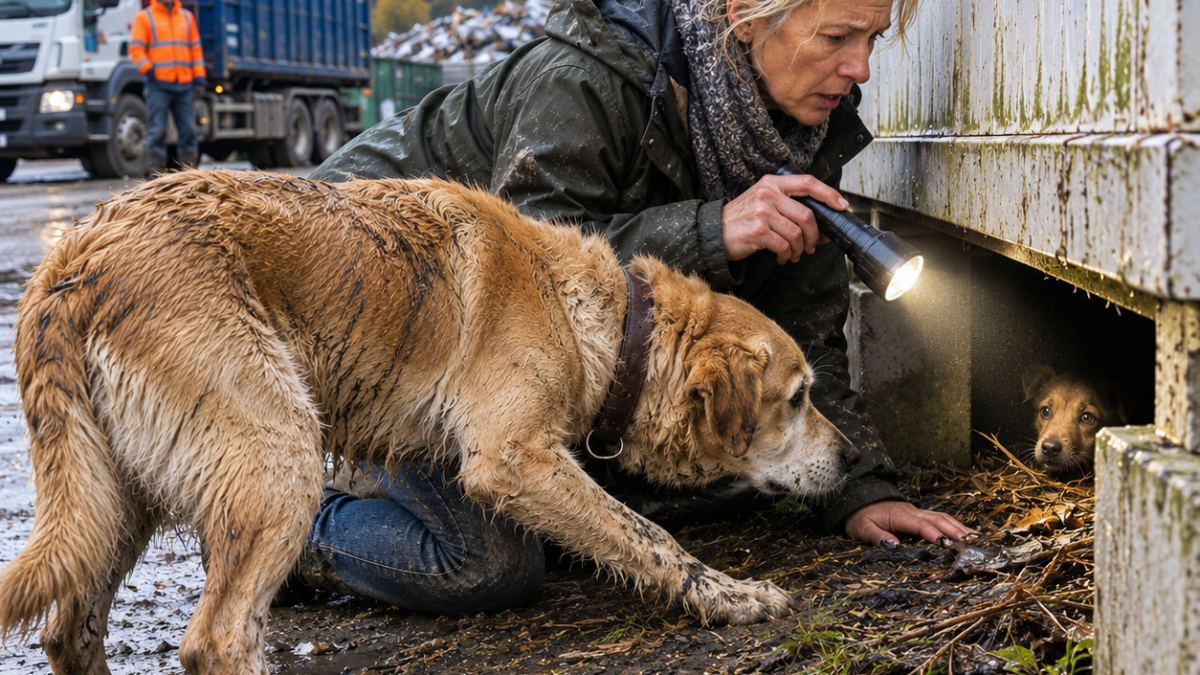
Thirty-six days after my twelve-year-old dog vanished through a storm-damaged gate, a stranger called and told me Basile was alive at a rural waste facility twenty miles away—but when I finally wrapped my arms around the old dog I had searched ditches, shelters, roads, and neighboring villages to find, he refused to get into my car and planted all four paws in the dirt as if going home was the one thing he absolutely could not do.
I thought fear, confusion, or thirty-six brutal days outside had changed him, until I noticed he kept carrying food beneath an abandoned construction bungalow scheduled to be lifted away that morning, then returning to the same narrow opening to lie with his muzzle pressed against the ground while a crane waited only yards away.
And when the workers pried back the first rotten board and a tiny cry rose from the darkness underneath—followed immediately by another—I realized Basile had not spent more than a month simply trying to survive; somewhere along the way, my missing dog had found a reason not to come home.
My name is Claire. I was fifty-eight and living alone in a small house outside a village in the Nièvre region when Basile disappeared.
He was a Labrador mix with an almost completely white muzzle, a slightly folded left ear, and the stubborn personality of a dog who had spent eleven years learning exactly which rules I would eventually give up enforcing.
He wasn’t particularly obedient.
But Basile stayed close.
If I worked in the garden, he slept beneath the apple tree.
If I came home from shopping, he waited behind the gate.
On bad days, he placed his heavy head on my knees without asking me to explain anything.
Then one Thursday, a violent windstorm snapped a branch from the old walnut tree and dropped it across the fence.
By the time I noticed the gate had been forced open, Basile was gone.
At first, I wasn’t frightened.
He sometimes followed a scent down the lane.
I expected to find him near the old washhouse or visiting the neighbor who secretly gave him biscuits.
I whistled.
Called.
Waited.
Nothing.
That night I left the outside light on and placed his bed near the door.
It stayed empty.
By the third day, I had walked every path around the village.
By the end of the first week, I had contacted veterinarians, shelters, municipal offices, local groups, farmers, anyone who might have seen an elderly honey-colored dog.
Every report made my heart jump.
A Labrador near a farm.
Wrong dog.
A stray crossing the road near Decize.
Nothing.
Another behind a supermarket.
Nothing again.
After three weeks, people stopped saying, “You’ll find him.”
Instead they said:
“You know, at his age…”
Then let the sentence die.
Basile had weak back legs.
His hearing wasn’t what it used to be.
He had never spent one night outdoors in the eleven years since I adopted him.
I knew exactly what people were thinking.
I refused to think it.
Then, on day thirty-six at 9:17 in the morning, my phone rang.
A man named Karim worked at an intermunicipal waste facility about twenty miles away.
His daughter had recognized Basile from a social media post.
“He’s been coming here for several days,” Karim told me. “We thought he belonged to a nearby farm. But today he won’t leave an old construction bungalow we’re supposed to remove.”
He sent a photograph.
Basile.
Thinner.
Dirty.
Alive.
I drove so fast I had to keep reminding myself not to crash before reaching him.
When I arrived, Basile recognized me instantly.
His tail moved.
Then he ran into my arms and buried his head against my chest.
I cried into his filthy fur.
I thought the story was over.
I opened my car.
Spread the blanket I had carried for more than a month.
“Come on, old man. Let’s go home.”
Basile followed three steps.
Stopped.
Looked back.
Then pulled toward the bungalow.
Again.
And again.
Karim told me Basile had been taking food from workers but often carrying pieces away instead of eating them.
Under the bungalow, I found discarded chicken containers, crumpled food wrappers, and a gray towel covered with fur much finer than Basile’s.
He pressed one paw against my wrist.
Then looked toward the opening.
Behind us, the crane engine started.
Basile threw himself between the vehicle and the building, barking harder than I had heard him bark in years.
“Give us five minutes,” Karim shouted.
We knelt in the dirt.
He wedged a crowbar behind the rotten wooden panel.
The board cracked.
A black opening appeared.
I switched on my phone flashlight.
Basile began whining.
Then a tiny cry came from beneath the bungalow.
A second answered.
Karim immediately stopped moving the board.
He looked into the darkness.
Then slowly turned toward me.
“Ma’am…”
His expression changed completely.
“Come look.”
[END OF FACEBOOK OPENING — CONTINUE STORY BELOW]
I dropped to my knees beside him.
“Basile, stay.”
Of course he didn’t.
The moment Karim widened the gap by another inch, Basile shoved his muzzle toward it.
I grabbed his collar.
“No. You’re not going under there.”
He struggled against me.
Not violently.
Desperately.
The same way he had resisted when I tried to take him to the car.
Karim turned on a stronger flashlight from his work belt and aimed it beneath the bungalow.
For several seconds, neither of us understood what we were seeing.
Then something moved.
A tiny face.
Brown.
Dirty.
Two black eyes reflected the light.
I covered my mouth.
“Oh my God.”
A puppy.
It was pressed against the back support beam, lying partly on the gray towel.
Then a second head appeared behind it.
Even smaller.
Karim whispered:
“There are two.”
Basile cried.
Both puppies responded.
That sound changed him instantly.
He stopped struggling long enough to listen.
His entire body trembled.
I looked at the empty chicken container beside my knee.
Then at Basile.
“You’ve been feeding them.”
Karim stared at me.
“What?”
“The food.”
I pointed beneath the building.
“You said he carried pieces away.”
Karim’s face changed.
“Every day.”
Basile tried again to reach the opening.
My throat tightened.
Thirty-six days.
For thirty-six days I had imagined Basile frightened, wandering randomly, simply trying to find his way home.
Now another possibility was beginning to form.
Not for all thirty-six days.
We would never know every mile he traveled.
But for some part of that time, he had not been wandering anymore.
He had stayed.
Karim moved closer to the opening.
“How did puppies even get under there?”
“I don’t know.”
“Where’s their mother?”
I looked into the darkness.
No movement except the two tiny bodies.
“Maybe farther back.”
Karim shouted toward another worker.
“Luc! Get over here.”
The crane driver killed the engine.
Good.
Another man approached.
“What now?”
“Animals underneath.”
He sighed.
“Rats?”
“Puppies.”
That stopped him.
“What?”
Karim pointed.
The man crouched.
“Damn.”
Behind us, the crane driver climbed out again.
He looked irritated.
“We removing this thing today or not?”
“Not until we know what’s under it.”
“I’ve got two more sites.”
Karim stood.
“There are dogs underneath.”
“Then get them out.”
“We’re trying.”
The driver glanced at Basile.
“That stray?”
“He has an owner.”
I raised one hand.
“Me.”
The man barely acknowledged me.
“Then keep him out of the way.”
I didn’t like him immediately.
Later, I would learn his name was Valette and that impatience was practically his profession.
At that moment, however, he was not a villain.
He was a man with a schedule.
That mattered because ordinary pressure can become dangerous long before anyone thinks of themselves as cruel.
Karim crouched again.
“We need to remove the panel completely.”
“Will the bungalow shift?”
“Shouldn’t.”
Valette answered from behind us:
“It won’t. It’s sitting on six concrete supports.”
Shouldn’t.
Won’t.
Two words I suddenly hated.
I looked beneath the structure.
“How much clearance?”
“Maybe fourteen inches at the highest point.”
“Can someone crawl under?”
Karim shook his head.
“Not safely. Not all the way.”
Basile whined.
The puppies cried again.
One voice was noticeably weaker.
I felt panic rise.
“Can we lift the bungalow?”
Valette laughed once.
“That’s exactly what we’re here to do.”
“Then lift it.”
“Not with animals loose underneath.”
Karim said:
“We could raise it a few inches with the crane while people watch the supports.”
Valette’s expression hardened.
“That isn’t the job order.”
I stared at him.
“There are living animals under there.”
“I heard you.”
“Then why are we talking about paperwork?”
“Because if that structure shifts and crushes somebody, you’re going to ask why we didn’t follow procedure.”
He wasn’t completely wrong.
That made him more frustrating.
Karim pulled his phone out.
“I’ll call the site manager.”
Valette muttered something and walked back toward his truck.
Basile lay down in front of the opening.
His muzzle disappeared into the darkness.
A puppy crawled a few inches toward him.
I could see only its nose.
Basile licked it.
My chest tightened.
He knew them.
This was not the curiosity of an old dog discovering something five minutes earlier.
This was recognition.
One of the waste-site workers, a woman named Sandrine, came over carrying gloves.
She looked beneath the bungalow.
“Oh.”
“Have you seen these puppies before?” I asked.
“No.”
“What about another dog?”
She hesitated.
“What?”
“A female.”
Sandrine looked toward Karim.
Then back at me.
“There was a little dog around here about two weeks ago.”
My heart moved.
“What did she look like?”
“Thin. Light brown. Maybe twenty pounds.”
“Was she with Basile?”
“Sometimes.”
Karim stood.
“You never told me.”
“I thought she belonged to one of the travelers farther down the road.”
“Where is she now?”
Sandrine’s face changed.
“I haven’t seen her for… maybe a week.”
Basile pressed closer to the opening.
I understood before anyone said it.
“These are hers.”
Sandrine looked sick.
“Maybe.”
“What happened to her?”
“I don’t know.”
But she did know something.
I could see it.
“What?”
“Claire,” Karim said softly.
I looked at Sandrine.
“Please.”
She swallowed.
“Last Tuesday, there was a dog on the access road after closing.”
“What dog?”
“I didn’t see well. It was raining.”
“What happened?”
“One of the drivers said he thought he hit something.”
The world went very quiet.
“What driver?”
“I don’t know.”
“Did anyone look?”
“Yes.”
“Did you find a dog?”
“No.”
My knees weakened.
Maybe it was the mother.
Maybe not.
We never found proof.
But the timeline fit.
A small female around the bungalow.
Then gone.
Basile carrying food.
Two puppies beneath the structure.
I looked at my old dog.
If their mother had disappeared, he had become the only living thing regularly returning.
Not because anyone trained him.
Not because he had some heroic understanding of responsibility.
He had simply stayed.
Perhaps he heard them cry.
Perhaps he had already bonded with their mother.
Perhaps they smelled familiar.
Whatever happened, Basile started carrying food.
His own food.
The pieces workers gave him.
The food he needed after wandering for weeks.
He carried some of it away.
To them.
I sat in the dirt.
“Basile.”
He looked at me.
His face had become so much thinner.
“How much did you give them?”
He obviously could not answer.
I touched his ribs.
Then understood those too.
He had survived.
But maybe not only for himself.
Karim returned with his phone.
“Manager says stop the removal.”
I exhaled.
Valette heard.
“How long?”
“As long as it takes.”
He looked at his watch.
“You people are turning two puppies into a national emergency.”
Karim stared at him.
“They’re alive.”
“So get them out.”
Something in me snapped.
I stood.
“My twelve-year-old dog managed to understand that much.”
Valette looked at me.
“What?”
“He’s been feeding them.”
The man’s expression changed only slightly.
I continued.
“He has been outside for thirty-six days. He’s lost weight. His paws are worn down. He could have left with me five minutes ago, but he won’t because there are two animals under that bungalow.”
Valette glanced at Basile.
Then away.
“I’m not saying leave them.”
“You’re acting as though their lives are an inconvenience.”
“I’m acting like someone responsible for heavy equipment.”
Fair.
Again.
I hated fair answers.
Before the argument could continue, one puppy cried sharply.
Then went silent.
Basile stood.
I dropped beside the opening.
“Hey.”
Nothing.
I aimed my light.
The first puppy moved.
The second did not.
“Karim.”
He was already beside me.
“Can you see breathing?”
“I don’t know.”
He called emergency animal services and the local fire brigade.
That is the point when the site stopped being a workplace and became a rescue scene.
Traffic was blocked.
Equipment shut down.
The fire crew arrived with lifting bags and structural supports.
A woman from a nearby animal rescue came with blankets, crates and oxygen.
Her name was Amélie.
She looked under the bungalow once.
“We need them out quickly.”
“Why?”
“Cold. Dehydrated. Maybe hypoglycemic.”
“How old?”
“Four weeks, maybe five.”
“Can they survive without the mother?”
“Yes.”
Then she added:
“If we get them out.”
Basile tried to follow her.
She looked at him.
“And he needs a veterinarian too.”
“He’s twelve.”
“I can see that.”
“He just came back after thirty-six days.”
Amélie looked at me.
“This is your missing dog?”
“Yes.”
She looked at the puppies.
Then at the chicken containers.
“Oh.”
That was all she said.
The firefighters placed inflatable lifting bags beneath two accessible corners of the bungalow.
Valette, to his credit, stopped complaining.
Once the rescue became technical, he became useful.
He knew the structure.
Weight.
Support points.
Weak sections.
He pointed.
“Do not lift from that edge. Frame’s rotten.”
The fire captain nodded.
“Good. Stay here.”
Valette did.
That mattered later.
People are rarely one thing.
The man who irritated me most that morning ended up spending forty minutes on his knees monitoring a cracked support so it wouldn’t shift toward the puppies.
The bungalow rose.
One inch.
Then two.
Wood groaned.
Basile barked.
“Easy,” I whispered.
Three inches.
The firefighters inserted blocks.
Another inch.
The opening became large enough to see farther.
And then we saw the truth.
Two puppies.
No mother.
The gray towel.
A shallow nest made from cardboard, plastic sacks, and pieces of old insulation.
Beside them:
Three pieces of dried chicken.
A crust of bread.
Half a sausage.
Food Basile had carried.
I started crying.
Amélie crawled partly under.
“I can reach one.”
The closest puppy tried to retreat.
“No, no.”
She extended one arm.
Got a hand beneath its chest.
Pulled slowly.
A tiny brown puppy emerged.
Mud.
Fleas.
Bones visible beneath the fur.
Alive.
Basile lost control.
He pulled toward it, whining.
I let him approach once Amélie nodded.
He sniffed the puppy from nose to tail.
The puppy pressed beneath his chin.
Everyone saw.
No one said anything.
The second puppy was farther back.
And not moving.
Amélie crawled again.
She reached.
“Come on.”
Silence.
She pulled the tiny body out.
For one horrible second, I thought we were too late.
Then the puppy gasped.
Amélie moved fast.
Blanket.
Rubbing.
Oxygen nearby.
A firefighter passed a warm pack.
“Come on, sweetheart.”
Basile stood so close I could feel him shaking through the leash.
The puppy made a weak squeak.
Basile answered.
Tail movement.
Tiny.
Amélie looked at me.
“She’s still here.”
I cried harder.
Both puppies were female.
About five weeks old.
Severely underweight.
Dehydrated.
Flea-infested.
One much weaker than the other.
The rescue team named them temporarily A and B.
Karim’s daughter later said that was unacceptable.
She renamed them Miette and Plume before anyone could object.
Miette was the larger one.
Plume was the one we almost lost.
Before they left for the veterinary clinic, something happened I will never forget.
Amélie placed both puppies in a crate lined with blankets.
Basile walked toward my car.
For the first time.
No pulling.
No hesitation.
He reached the open rear door.
Looked back toward the puppy crate.
Then at me.
I understood.
“They’re coming too.”
The animal rescue vehicle would transport the puppies.
But apparently Basile needed confirmation.
I touched his face.
“They’re coming.”
He put his front paws on my car.
His back legs struggled.
I helped him in.
Thirty-six days after disappearing, Basile finally agreed to leave.
Only after the puppies were safe.
I sat beside him in the back seat while Karim drove my car because my hands were shaking too badly.
The waste facility disappeared behind us.
Basile rested his head across my lap.
I touched his white muzzle.
“You could have come home.”
He slept.
Maybe he had tried.
Maybe he had become lost and survived until he encountered the other dog.
Maybe the puppies simply gave him a place to stop wandering.
I would spend months wanting exact answers.
I never got them.
That is one of the hardest things about animals.
They carry entire stories we can only reconstruct from paw prints, habits and what remains on the ground.
At the veterinary clinic, Basile weighed almost nineteen pounds less than at his last appointment.
My veterinarian, Dr. Moreau, stared at the number.
“He’s been missing how long?”
“Thirty-six days.”
“And he’s twelve?”
“Yes.”
“Claire…”
“I know.”
Bloodwork.
X-rays.
Paw examination.
Dehydration.
Muscle loss.
Minor skin infection.
A worsening of his arthritis.
But nothing immediately fatal.
I sat with my forehead against the wall.
“He’s okay?”
“He is remarkably stable considering what he’s been through.”
“Remarkably stable is not yes.”
Dr. Moreau smiled.
“He needs careful feeding, rest and monitoring. But yes, I think he’s going home.”
Home.
The word finally felt real.
Then I asked about the puppies.
Different clinic.
Different rescue.
Amélie called.
Miette was eating.
Plume was on fluids and warming support.
“She’s the one I’m worried about.”
“Will she survive?”
“I don’t know.”
Basile heard the puppy’s cry through my phone.
His head lifted.
I looked at him.
“You did your part.”
He tried to stand.
“No.”
I put one hand on his chest.
“Your shift is over.”
He sighed.
The next three days were difficult.
Basile came home.
His old cushion was still beside the radiator.
I had washed it twice while he was missing because I could not stand the thought of dust gathering on it.
When he walked through the door, he went directly there.
Circled.
Lay down.
Then slept for almost five hours.
I sat on the floor beside him.
Not touching.
Just watching his chest rise.
For thirty-six nights, I had gone to sleep without knowing whether he had a chest still rising anywhere.
Now I could see it.
Up.
Down.
Up.
Down.
I cried quietly enough not to wake him.
At five that afternoon, Basile opened his eyes.
Looked at the door.
Stood.
“What?”
He walked toward it.
I thought he needed outside.
I opened the garden door.
He went to the gate.
The repaired gate.
Then looked toward the road.
“No.”
He whined.
“You’re not going back.”
Another whine.
I understood.
“Miette and Plume.”
His ears moved.
“Oh, Basile.”
He sat.
The old dog who had finally reached home wanted to leave again.
Not because home meant nothing.
Because somewhere else two puppies existed.
I called Amélie.
She laughed when I explained.
“Bring him tomorrow if the vet approves.”
Dr. Moreau approved a short car trip.
So the next afternoon, we went.
Miette was in a foster room.
She recognized Basile before he reached the pen.
Her entire body wriggled.
Basile approached.
Sniffed her.
Licked one ear.
Then looked around.
Plume.
He knew one was missing.
Amélie noticed.
“She’s in the medical room.”
“Can he see her?”
“Maybe from outside.”
We walked to a glass door.
Inside, Plume slept beneath a warming blanket.
Tiny.
IV line taped to one leg.
Basile stood at the glass.
He did not bark.
He lay down.
Stayed.
Ten minutes.
Fifteen.
I finally had to pull gently.
“Come on.”
He resisted.
Not hard.
Same old Basile.
Amélie crouched.
“We’ll call you.”
I looked at her.
“You’re talking to the dog.”
“He seems more reasonable than you.”
Fair.
Plume survived.
That deserves its own sentence.
She survived.
The fourth morning she began eating independently.
The fifth, she stood long enough to complain.
By day seven, she was moved beside Miette.
Basile visited once more.
The two puppies climbed over him.
He looked deeply offended.
Miette chewed his ear.
Plume tried to sleep on his front leg.
I laughed.
“You nearly killed yourself for this?”
Basile looked at me.
Yes.
Apparently.
The rescue organization began looking into where the puppies came from.
No chip.
No mother.
No litter reported missing.
Sandrine’s description of the small female dog remained the only clue.
Then Karim called me.
“We found something.”
My stomach tightened.
“What?”
“Come if you want.”
I did not want.
I went anyway.
Beyond the waste facility, near a drainage embankment, workers had found the body of a small female dog after clearing storm debris.
Likely struck by a vehicle days earlier.
No collar.
No chip.
Light brown.
Lactating.
We never proved she was Miette and Plume’s mother genetically.
No one paid for testing.
We did not need certainty badly enough to turn grief into paperwork.
But everyone believed it.
I stood beside the embankment.
Basile remained in the car.
I was glad.
He did not need that.
Karim looked sick.
“I keep thinking about the driver.”
“Do you know who?”
“No.”
“Sandrine said someone thought they hit something.”
“Different contractor.”
“Did they stop?”
“Apparently they looked around.”
“Apparently.”
Anger came.
Hot.
Easy.
The kind of anger that wants one person to become responsible for every terrible thing.
A dog dead.
Two puppies starving.
Basile missing thirty-six days.
But we did not know whether that vehicle caused her death.
We did not know whether the driver saw her.
We did not know enough.
I had learned something during the search for Basile.
Uncertainty is painful.
Invented certainty is worse.
So I did not create a villain because grief wanted one.
But there was another issue.
The bungalow.
Karim later discovered workers had reported animal activity beneath it at least twice during the previous week.
Food scraps disappearing.
Sounds.
A small dog seen near the structure.
Nothing had been formally checked.
Why?
“Probably rats.”
“Probably stray cats.”
“Demolition’s Friday anyway.”
Later.
Someone else.
Not urgent.
Those familiar excuses.
If Basile had left with me immediately, the crane would have arrived.
The bungalow would have been lifted and loaded.
Maybe the puppies would have survived.
Maybe not.
No one wanted to calculate the second possibility.
An internal review followed.
Valette’s company received a warning for incomplete pre-removal inspection.
The waste facility introduced a mandatory visual and animal check beneath unused structures before moving them.
The municipality required a short delay and inspection protocol for demolition at sites known to attract strays.
Not dramatic.
No one went to prison.
No one’s life was ruined.
Good.
That was not what I wanted.
I wanted the next two tiny cries to be heard before a crane engine started.
Karim said:
“Basile changed the procedure.”
I laughed.
“He failed obedience class twice.”
“Management material.”
Absolutely.
The local newspaper heard the story.
I refused the first interview.
Then Karim’s daughter convinced me.
She was thirteen.
“You should do it.”
“Why?”
“Because people shared your missing-dog post. That’s how I recognized him.”
That stopped me.
Without the post, she might not have known Basile.
Without her, Karim might not have called.
Without Karim, the bungalow might have been lifted.
Everything was connected.
So I agreed.
The newspaper headline was ridiculous:
MISSING SENIOR DOG FOUND GUARDING ORPHANED PUPPIES AFTER 36 DAYS.
Technically true.
Still ridiculous.
The article spread.
People offered to adopt Miette and Plume before either was medically cleared.
Amélie became strict.
“These are not trophies.”
Good.
Applications.
Home checks.
Veterinary references.
Time.
Miette was adopted by Karim’s family.
His daughter had earned naming rights and apparently every other right through persistence.
When I told Basile, he seemed indifferent.
Then Miette visited.
He lost his mind.
For a twelve-year-old arthritic dog, “lost his mind” meant three circles and a bark.
Still impressive.
Plume was harder.
She remained smaller.
Nervous.
Sensitive to loud sounds.
Several families wanted her because of the story.
Then changed their minds after meeting a puppy who hid behind chairs.
I hated that.
“People want the survivor,” I complained.
Amélie replied:
“They want the idea of the survivor.”
That sentence stayed.
A woman named Céline eventually applied.
Fifty-three.
Quiet house.
Worked from home.
No children.
One elderly cat who ignored civilization.
She met Plume three times.
First visit, Plume hid.
Second, took food from her hand.
Third, slept near her shoe.
Céline said:
“I think that’s enough.”
“For adoption?”
“For trust.”
Good answer.
Plume went home.
Basile returned to his own routine.
Two walks.
Carrot during dinner.
Old cushion by the radiator.
Except he had changed.
Or maybe I had.
Before he disappeared, I assumed closeness meant I knew everything about him.
Basile stays near me.
Basile sleeps beneath the apple tree.
Basile likes carrots.
Simple.
Then he vanished and lived thirty-six days without me.
He made choices I did not see.
Survived roads I could not map.
Found another dog.
Stayed beside her puppies.
Carried food.
He had an entire chapter of life I would never fully understand.
That humbled me.
Love does not create complete knowledge.
It creates attention.
Different thing.
I paid more attention afterward.
Basile had nightmares sometimes.
His legs moved.
He woke abruptly.
For a few weeks, he became anxious during strong wind.
The sound that had preceded his disappearance.
I did not force him outside.
We waited.
He gained weight slowly.
Nineteen pounds lost.
One.
Three.
Six regained.
Dr. Moreau warned me not to rush.
His body was old.
Recovery would be measured differently.
At thirteen, you do not rebuild as though you are three.
We adjusted food.
Physical therapy exercises.
Short walks.
Warm bedding.
Basile accepted all of it with the dignity of a retired king.
Then, one morning, I found a piece of carrot beside his bed.
Uneaten.
I panicked.
Called the vet.
Dr. Moreau asked:
“Is he eating everything else?”
“Yes.”
“Drinking?”
“Yes.”
“Walking?”
“Yes.”
“Then perhaps he no longer likes carrot.”
I was offended on Basile’s behalf.
“He has eaten carrot for eleven years.”
“People change.”
Dogs too.
The next evening he ate it.
I sent the veterinarian a photograph.
He did not respond.
Rude.
Months passed.
Miette grew into a confident, ridiculous adolescent.
Karim brought her to visit every few weeks.
She jumped on Basile.
Stole his toys.
Tried to chew his collar.
He tolerated her until he didn’t.
One low grumble.
Miette immediately lay down.
Karim laughed.
“Grandfather rules.”
Basile was not her grandfather.
Biology did not matter.
The role fit.
Plume visited less often because car rides frightened her.
Céline sent videos.
Plume sleeping beside the old cat.
Plume learning stairs.
Plume standing in rain and refusing to pee because apparently trauma had not eliminated personality.
Basile watched the phone zero percent.
I watched every video three times.
A year after Basile returned, the waste facility invited us back.
I almost refused.
Then Karim said:
“Come see what changed.”
The bungalow was gone.
In its place was an open gravel area.
The site had installed two sheltered feeding stations managed with a local rescue group for stray cats and occasional lost dogs.
A sign listed a number to report animals.
Workers had training.
Not advanced.
Just practical.
Do not assume.
Check beneath structures.
Report injured animals.
Scan for chips.
Karim’s daughter had designed a small notice.
At the bottom was a photograph of Basile.
IF AN ANIMAL KEEPS RETURNING TO ONE PLACE, THERE MAY BE A REASON.
I stared.
“Too dramatic.”
She rolled her eyes.
“You’re old.”
“I’m fifty-nine.”
“Exactly.”
Children are cruel.
Basile walked slowly through the yard.
When we reached the place where the bungalow had stood, he stopped.
Sniffed.
Miette was beside him.
She sniffed too.
No dramatic recognition.
No cinematic music.
Basile peed on a concrete block.
Karim laughed.
“Closure.”
Apparently.
Valette was there.
I had not seen him since the rescue.
He approached awkwardly.
“Claire.”
“Mr. Schedule.”
He smiled despite himself.
“I deserved that.”
“Partly.”
He crouched toward Basile.
The old dog sniffed him.
Valette scratched his chest.
“I thought he was causing trouble.”
“He was.”
“Good trouble.”
I looked at him.
“What happened with the warning?”
“Company made us do new inspections.”
“Annoying?”
“At first.”
“And now?”
He pointed toward another part of the site.
“Last month one of the guys found a litter of kittens under a storage pallet before we moved it.”
I stared.
“All alive?”
“All.”
That was it.
The revenge people wanted from stories is often theatrical.
The rude man gets fired.
The cruel person gets humiliated.
The doubter begs forgiveness.
Real satisfaction can be quieter.
A man who once complained about five minutes learns to check before lifting.
Four kittens live.
That is better.
I looked at Basile.
“You hear that?”
He sniffed trash.
Hero.
The second year after Basile’s return, his back legs worsened.
He was fourteen.
Dr. Moreau said arthritis had progressed.
Medication.
Rugs.
Ramp into the car.
Basile hated the ramp.
He preferred attempting to jump and then looking betrayed when gravity remembered his age.
“No.”
I blocked him.
Ramp.
He stared.
“Use it.”
Stare.
“Basile.”
Finally he walked up.
The next time, he waited for the ramp.
Manipulative.
We still visited Miette.
Plume too, when possible.
Something interesting happened as Basile aged.
The puppies he once guarded stopped treating him like a climbing structure.
Miette became gentler.
She walked beside him.
If he stopped, she stopped.
Plume, always quieter, would lie near his bed without touching.
I assigned meaning.
Maybe too much.
But not all beautiful things require certainty.
At fourteen and a half, Basile began losing hearing more noticeably.
A dog who had once come when I called sometimes slept through my voice.
So I touched the floor.
Used hand signals.
Approached where he could see.
Our communication changed.
Still ours.
One afternoon, Karim’s daughter—now fifteen—asked:
“Do you think he remembers the bungalow?”
I looked at Basile.
“I don’t know.”
“Dogs remember things.”
“Yes.”
“Then?”
“I don’t know what form his memory takes.”
She seemed dissatisfied.
Adults always disappoint children when we refuse certainty.
I added:
“But his body remembered enough that day to refuse to leave.”
That mattered.
He did not need to narrate the reason.
Behavior was enough.
Later that year, a storm hit.
Not as violent as the one that broke my gate.
Still strong.
Wind shook the windows.
Basile stood.
Walked toward the hallway.
Paced.
Old fear.
I sat on the floor.
“Hey.”
His head turned.
I patted the rug.
He came.
Lay beside me.
I rested my hand on his shoulder.
The gate was secure.
The house warm.
No puppies beneath a building.
Nothing to fix.
After twenty minutes, he slept.
Recovery is sometimes simply discovering that a familiar sound no longer predicts disaster.
I understood that too.
The first storm after Basile disappeared had terrified me.
Branches.
Wind.
Every sound returned me to the open gate.
Now we weathered them together.
At fifteen, his kidneys began showing age.
Not failure.
Changes.
Then appetite became less reliable.
Dr. Moreau used a phrase I had heard and hated.
“Quality of life.”
I looked at him.
“He still has quality.”
“I know.”
“Then why are we talking about it?”
“Because talking before a crisis is kinder.”
I hated him for being right.
We made a list.
Food.
Comfort.
Mobility.
Interest.
Sleep.
Pain.
Connection.
Good days.
Bad days.
I put the paper in a drawer.
Did not look at it for months.
Basile still wanted his morning walk.
Short.
To the gate.
Past the neighbor.
Back.
Still wanted chicken.
Carrots had become inconsistent.
Still wanted me.
Good.
Then Miette became sick.
Not Basile.
Miette.
She was three.
Karim called.
“Emergency surgery.”
“What happened?”
“Intestinal blockage.”
I drove to the clinic.
Basile stayed home because it was too much for him.
Karim’s daughter sat in the waiting room crying.
“She’s going to die.”
“No.”
“You don’t know.”
She was right.
I sat beside her.
“No. I don’t.”
Hours later, surgery succeeded.
Piece of fabric removed.
Likely from a toy.
Miette recovered.
Karim said:
“She owes Basile another life.”
I shook my head.
“No.”
“What?”
“She already had her life.”
I had learned this.
Rescue is not debt.
Miette did not owe heroism because Basile saved her.
She was allowed to be a stupid dog who ate fabric.
That is what survival should buy.
Ordinary mistakes.
Ordinary years.
Ordinary love.
Basile turned sixteen.
Approximately.
We knew his age from the rescue records, but birthdays were estimates.
Still, sixteen.
The dog people quietly assumed was dead at twelve had reached sixteen.
I bought a ridiculous blue bandana.
He hated it.
Miette visited.
Plume came too, surprisingly calm in the car.
For the first time in years, both puppies—no longer puppies—were together with Basile.
We took a photograph beneath my apple tree.
Basile in the middle.
White muzzle.
Thin but stable.
Miette on one side.
Plume on the other.
I stood behind them looking terrible because I had been crying before anyone even took the picture.
That photograph became my favorite.
Not the missing poster.
Not the waste facility.
Not the newspaper.
That one.
Because rescue should eventually become boring enough to take family pictures.
Winter came.
Basile slowed.
One morning, he fell near his water bowl.
Not hard.
His back legs simply folded.
I helped him.
He stood again.
The next day, same.
Dr. Moreau examined him.
Arthritis.
Weakness.
Kidneys worse.
Anemia.
Age.
Always age.
“What can we do?”
“Support.”
“Meaning?”
“Pain management. Hydration. Food. Help with mobility.”
“How long?”
He looked at me.
I hated that look.
“Claire.”
“No.”
“We don’t know.”
“Good.”
He sighed.
Uncertainty was still something.
Basile had good weeks.
Then worse.
I used a sling beneath his hips.
He accepted it.
Sometimes.
Other times he looked insulted.
Miette visited and became unusually still.
She sniffed Basile’s face.
Then lay beside him.
Karim’s daughter whispered:
“She knows.”
Maybe.
Maybe not.
We humans are always trying to make animals confirm our grief.
Basile knew he was tired.
That was enough.
Then came the final morning.
No drama.
No storm.
No open gate.
I woke because the house was too quiet.
Basile was on his cushion.
Eyes open.
He had not come to my bedroom door.
I touched him.
“Morning.”
Tail.
Barely.
I offered water.
Nothing.
Chicken.
Nothing.
I lifted the harness.
No interest.
I sat.
Opened the drawer.
The quality-of-life list.
Food.
No.
Mobility.
Poor.
Pain.
Managed, barely.
Interest.
Low.
Connection.
Yes.
Always yes.
Good days.
I counted.
Then stopped.
I called Dr. Moreau.
“Today.”
He knew.
“I’ll come.”
Home visit.
I was grateful.
Karim came.
His daughter too.
Miette stayed in the car at first.
Then I said bring her.
Céline brought Plume.
That surprised me.
“Too much?”
She asked.
I looked at Basile.
“No.”
The two dogs entered quietly.
Miette approached first.
Sniffed him.
Basile’s tail moved.
Plume stayed farther away.
Then came close.
Lay down.
For a moment, the room became the space beneath the bungalow again.
Not literally.
Memory does strange things.
Old dog.
Two small lives beside him.
Except now everyone was safe.
Warm.
Fed.
Loved.
No crane.
No dirt.
No need for Basile to guard anything.
Karim sat on the floor.
“You caused a lot of paperwork.”
I laughed.
Basile breathed.
“You remember that?”
Karim stroked his head.
“I almost thought you were some farm dog stealing lunch.”
His daughter said:
“Dad.”
“What?”
“He was.”
Fair.
Dr. Moreau arrived.
He gave Basile a final examination.
No miracle.
No hidden solution.
Just an old body finished with its work.
I asked:
“Can we take him outside first?”
We carried him with the sling.
Under the apple tree.
His place.
The place where he used to lie while I gardened.
Sunlight.
Cool air.
Miette sniffed grass.
Plume sat near Céline.
Basile lifted his nose.
For a second he looked younger.
Not physically.
Something about attention.
I sat beside him.
“Thirty-six days.”
My voice broke.
“You made me search thirty-six days.”
Tail.
Tiny.
“You could have just come home.”
I cried.
Then laughed.
“But no.”
Basile closed his eyes.
“Of course not.”
Karim’s daughter knelt.
“You had work.”
Exactly.
I touched the white fur around his muzzle.
When Basile disappeared, people had told me:
“At his age…”
They never finished.
Now I finished for them.
“At his age, he found two lives worth staying for.”
That was better.
We brought him inside.
The first medication relaxed him.
His breathing softened.
Miette moved closer.
Plume remained still.
I held Basile’s head on my lap.
Dr. Moreau waited.
I thought I would say something profound.
Instead:
“Your cushion is still ugly.”
Karim laughed through tears.
Basile breathed.
“I love you.”
There.
Simple.
Enough.
The final medication was given.
One breath.
Another.
Then no more.
Basile died at home.
Sixteen years old.
Four years after people assumed a missing twelve-year-old dog probably had no chance.
Miette sniffed him.
Stepped back.
Plume did the same.
I do not know what they understood.
Céline took Plume home.
Karim took Miette.
The house became silent.
But not empty.
There is a difference.
Basile’s cushion remained beside the radiator for three months.
Eventually I moved it.
Not because I loved him less.
Because grief does not need furniture to prove itself.
His ashes went beneath the apple tree.
No big marker.
Just a small stone.
BASILE
Nothing else.
What could one line explain?
Missing thirty-six days.
Found twenty miles away.
Stayed beside two orphaned puppies.
Fed them from his own meals.
Stopped a demolition.
Changed a worksite’s procedures.
Came home.
Lived four more years.
Too much for a stone.
The real memorial existed elsewhere.
At the waste facility, workers still checked beneath structures.
Valette eventually became the person who trained new contractors on the inspection rule.
That made me laugh every time Karim told me.
“Mr. Schedule?”
“Mr. Animal Check now.”
Good.
One spring, they found an injured cat beneath a container before moving it.
Alive.
Another time, a hedgehog nest.
Moved safely.
Small things.
But that is how change works.
The puppies grew older.
Miette became a confident dog who adored children and distrusted vacuum cleaners.
Plume remained gentle and cautious.
Céline eventually sent me a photograph of her sleeping upside down on a couch.
No fear.
Just ridiculous.
Karim’s daughter graduated high school.
In one graduation photograph, Miette sat beside her.
The puppy beneath the bungalow had become part of another family’s history.
That is what Basile bought with pieces of chicken.
Time.
Not repayment.
Time.
The newspaper occasionally reposted the old story.
People called Basile heroic.
I stopped correcting them.
At first I disliked the word because it made him seem like something other than a dog.
Eventually I accepted that people need shorthand.
But when someone asked me what made him a hero, I never said intelligence.
I said:
“He stayed.”
That was it.
He stayed when leaving would have been easier.
He returned to the bungalow after eating.
He carried food.
He resisted me.
He stood between the crane and the structure.
Not because he knew what a crane could do.
Because the place mattered.
The cries mattered.
He stayed.
Sometimes that is the entire moral.
Years later, I was volunteering at a local rescue event when a woman approached me.
She recognized my name.
“You’re Basile’s Claire.”
Apparently I had become an accessory to my own dog.
“Yes.”
She had recently lost an elderly dog.
She said:
“I keep thinking I should have noticed sooner that he was sick.”
I knew the trap.
“What did the veterinarian say?”
“That his cancer was advanced.”
“Could you have known?”
“I should have.”
“That is not an answer.”
She cried.
I thought about the open gate.
Thirty-six days.
Every wrong sighting.
Every imagined failure.
“You can turn love into evidence against yourself if you try hard enough.”
She looked at me.
“What?”
“When Basile disappeared, I blamed myself for not seeing the broken fence sooner.”
I paused.
“I could have spent the rest of my life there.”
“Did you?”
“No.”
“Why?”
“Because eventually I learned the story continued without my permission.”
That was the deepest lesson Basile left me.
We imagine ourselves at the center of the lives we love.
Sometimes we are.
Sometimes not.
Basile had a life beyond my sight.
That did not mean he loved me less.
He recognized me immediately.
He came into my arms.
Then went back to the bungalow.
For years I thought about that moment.
The reunion I had wanted for thirty-six days.
I expected to become the most important thing in his world again the second he saw me.
Basile corrected me.
Love is not always ranked.
Sometimes one thing simply needs you more urgently.
He loved me.
The puppies needed him.
Both true.
I became grateful he resisted.
Imagine if he had not.
Imagine if I pulled harder.
Forced him into the car.
Closed the door.
Driven away.
The crane lifts the bungalow.
I will not finish that version.
I don’t need to.
It taught me enough.
The instinct to say:
Come on.
We’re done.
I have what I came for.
Can be dangerous.
Sometimes the story you think you are solving is only the visible story.
I thought I was searching for my dog.
Basile was waiting for me to help finish something else.
That is why the final image I keep is not the one from the newspaper.
It is a photograph Karim took without telling me on the morning we found the puppies.
I am kneeling in the dirt.
My coat filthy.
Hair a mess.
Basile beside me.
The bungalow lifted a few inches behind us.
Miette wrapped in a towel.
Plume barely visible in Amélie’s arms.
I am not looking at the camera.
Neither is Basile.
We are both looking at the puppies.
Whenever people ask whether Basile got his happy ending, I tell them yes.
But not because he came home.
Coming home was only part of it.
He got four more years under the apple tree.
He got warm winters.
Medication for old joints.
Too many pieces of chicken.
Visits from the two dogs who once cried beneath a bungalow.
He got old enough for his body to become the reason he stopped, instead of a storm, a road, hunger or fear.
And when he finally left, nobody was wondering where he was.
I was there.
Karim was there.
The puppies were there.
Home was around him.
That was the ending I had begged for during those thirty-six nights without him.
I simply hadn’t known what form it would take.
If there was revenge in Basile’s story, it was never about hurting anyone.
It was this:
The people who dismissed the sounds beneath the bungalow as rats learned to look.
The worker who wanted to move the structure quickly became the man teaching others to inspect first.
The site that almost became a grave became safer because one old dog refused to move.
The puppies everyone might never have known existed grew up in homes where they were wanted.
And the sentence people kept trying to finish—
“At his age…”
—finally had an ending.
At his age, Basile was not finished.
At his age, he still had something to protect.
At his age, he still had choices to make.
At his age, he still changed lives.
And after thirty-six days of searching, when I finally found my old dog and opened the car door, Basile taught me the most important thing he had ever taught me by refusing to get inside:
Sometimes finding the one you love is not the end of the rescue.
Sometimes they are waiting for you because there is still someone else to save.








