I Found a Starving Dog Tied to a Tree With a Letter in His Mouth—What I Read Made My Knees Give Out
PART 2
I folded the letter once and shoved it inside my jacket.
The engine grew louder.
Rex tried to stand.
His legs shook beneath him.
“Easy.”
I reached for the knot around the tree.
It had been pulled brutally tight and swollen from the rain.
I couldn’t get my fingers beneath it.
The vehicle was closer now.
I could hear tires grinding through mud.
Rex began trembling.
Not from cold.
From fear.
That told me more than anything in the letter.
I pulled the utility knife from my belt.
“I’m getting you out of here.”
The old leash was thick leather.
I sawed through it as quickly as I could.
Behind us, the engine stopped.
Silence.
That was worse.
I cut harder.
“Come on…”
The leather finally split.
Rex stumbled forward.
I caught him before he collapsed.
He weighed almost nothing for a dog his size.
“Can you walk?”
He tried.
His back legs nearly folded beneath him.
I slipped one arm under his chest.
Then I heard a door slam.
Someone had gotten out of the vehicle.
I didn’t wait to see who.
My truck was fifty yards away through wet brush.
With one hand supporting Rex, I started toward it.
Every few steps, I glanced behind us.
Nothing.
Branches.
Rain dripping from needles.
Gray morning light.
Then a man’s voice came through the trees.
“Rex!”
The dog stopped dead.
His entire body stiffened.
The voice called again.
“Rex! Come here, boy!”
Rex tried to move behind my legs.
That was all I needed to know.
I drew my radio.
“This is Carter. I need county assistance at Forest Road Seventeen, north section.”
Static.
Then dispatch answered.
“What’s the situation?”
“Possible animal cruelty. Possible suspect on scene.”
The man’s voice came closer.
“Rex!”
I kept moving.
“Daniel?”
I froze.
He knew my name.
A man stepped through the fir trees.
I recognized him immediately.
Caleb Turner.
Forty-two.
Local contractor.
He had been trying for almost a year to purchase several privately owned parcels bordering the state forest.
Caleb smiled when he saw me.
It wasn’t a friendly smile.
“Well,” he said. “Didn’t expect to find you out here.”
I shifted between him and Rex.
“What are you doing on a closed service road?”
“Looking for my dog.”
I looked down at Rex.
“Your dog?”
“Yeah.”
Caleb took a step toward us.
Rex growled.
Caleb stopped.
“You’ve got something of mine.”
“The dog?”
“And whatever he was carrying.”
My hand instinctively moved toward my jacket.
Caleb noticed.
His smile disappeared.
“So you opened it.”
I didn’t answer.
He took another step.
“Give me the letter, Daniel.”
The forest suddenly felt very quiet.
“Why?”
“Because it doesn’t belong to you.”
“Who wrote it?”
“You already read it.”
“Then say his name.”
Caleb’s jaw tightened.
“Don’t make this complicated.”
Rex pressed against my leg.
I could feel him shaking.
I had known Caleb casually for years.
Everyone did.
He owned equipment.
Cleared land.
Built cabins.
Fixed roofs.
Sponsored a Little League team.
The kind of man who shook hands at county fairs and always seemed to know somebody important.
But I had also heard complaints.
Property disputes.
Threats.
Questionable logging contracts.
Nothing that had ever stuck.
The letter inside my jacket changed the picture completely.
It had been written by an eighty-one-year-old man named Henry Wallace.
Henry owned nearly sixty acres at the northern edge of the forest.
His property included an old cabin, a spring, and the only practical access road to a valuable stretch of land Caleb had been trying to assemble for development.
I had met Henry several times.
Quiet man.
Retired schoolteacher.
Widower.
Loved dogs.
Loved those woods even more.
According to his letter, Caleb had spent months pressuring him to sell.
Henry refused.
Then someone started cutting his fences.
Equipment disappeared.
His well pump was damaged.
Threatening notes appeared on his porch.
Henry suspected Caleb.
But he couldn’t prove it.
The most disturbing line in the letter was simple.
**If anything happens to me, do not believe it was an accident.**
Now Rex was tied to a tree.
And Henry was nowhere in sight.
I looked at Caleb.
“Where’s Henry?”
His expression barely changed.
“Henry who?”
That answer scared me more than if he’d threatened me.
“Henry Wallace.”
Caleb shrugged.
“Haven’t seen him.”
“His dog was tied here.”
“Like I said, Rex is mine now.”
“Since when?”
“Since Henry gave him to me.”
Rex growled again.
Caleb glanced down.
“Ungrateful mutt.”
I stepped closer.
“Back up.”
His eyes lifted to mine.
“You don’t know what you’re getting into.”
“I know somebody left this dog here without food or water.”
“He got loose.”
“Funny. He got loose and tied himself to a tree?”
Caleb’s face hardened.
“You always did think that badge made you a cop.”
“It doesn’t.”
“Then stop acting like one.”
My radio crackled.
“Unit en route. Twelve minutes.”
Caleb heard it.
Something changed in his eyes.
He looked toward the road.
Then at me.
“Give me the letter.”
“No.”
“Daniel.”
“No.”
For several seconds, neither of us moved.
Then he smiled again.
“Fine.”
He stepped backward.
“Keep it.”
That was too easy.
He turned and disappeared through the trees.
A minute later I heard his truck start.
Rex didn’t stop shaking until the engine faded away.
I crouched beside him.
“You knew him.”
Rex looked toward the road.
“Yeah.”
I rubbed the side of his neck.
“And you were afraid of him.”
Deputies arrived eleven minutes later.
By then I had Rex in the back of my truck wrapped in an emergency blanket.
Deputy Maria Lopez took photographs of the tree, the cut leash, and the surrounding area.
She read Henry’s letter twice.
“Do you know where Henry is?”
“No.”
“When did you last see him?”
“Maybe three weeks ago.”
“You talk to him?”
“He asked about hunting activity near his south boundary.”
“Anything unusual?”
“He seemed nervous.”
Maria looked toward the road.
“Did he mention Turner?”
“Not directly.”
She pointed to the letter.
“He did here.”
The letter contained more than accusations.
Henry had written that he had collected documents.
Copies of property records.
Photographs.
Audio recordings.
He said the evidence was hidden somewhere “Rex knows.”
That phrase confused both of us.
“What does that mean?” Maria asked.
“I don’t know.”
“Could be metaphorical.”
“Henry wasn’t the metaphorical type.”
She folded the letter carefully.
“We need to find him.”
Rex suddenly lifted his head.
His ears turned toward the forest.
Then he whined.
I opened the truck door.
“What’s wrong?”
He tried to climb out.
“Easy.”
He pulled toward the north trail.
Maria watched him.
“You think he knows something?”
“The letter says he does.”
“We’re not using a half-starved dog as a search team.”
“I know.”
But Rex kept pulling.
I looked at Maria.
“Henry might be hurt.”
She sighed.
“Fine. Slowly.”
We followed Rex.
He could barely walk at first.
But once he recognized the path, something seemed to pull him forward.
We crossed a shallow creek.
Climbed a rocky ridge.
Passed an old logging road.
After almost a mile, Rex stopped beside a fallen cedar.
He sniffed the ground.
Then turned sharply downhill.
“Rex?”
He moved faster.
I followed.
Maria was behind me.
At the bottom of the slope stood Henry Wallace’s cabin.
The front door was open.
My stomach dropped.
“Henry!”
No answer.
Maria drew her weapon.
“Stay behind me.”
We approached.
The porch had been damaged.
A chair lay on its side.
One window was broken.
Inside, drawers had been pulled open.
Books covered the floor.
Someone had searched the place.
“Henry!”
Still nothing.
Rex moved directly toward the bedroom.
He stopped beside the bed.
Then began scratching at the floor.
Maria and I exchanged a look.
I moved a rug.
Underneath was a loose plank.
I pulled it up.
There was a metal box beneath the floor.
Rex sat beside it.
“The dog knew.”
Maria crouched.
“Don’t touch anything else.”
She photographed the box before opening it.
Inside were copies of deeds.
Bank records.
Printed emails.
Several flash drives.
A digital voice recorder.
And an envelope labeled:
**FOR THE SHERIFF.**
Maria looked at me.
“This just became much bigger.”
But Henry still wasn’t there.
We searched the cabin.
The woods.
The shed.
Nothing.
Finally Rex walked behind the cabin and stopped near the edge of the slope.
He began whining.
There were fresh tire marks in the mud.
Not from a car.
ATV.
They led toward an old quarry road.
We followed them.
About half a mile later, we found Henry’s walking cane.
Broken.
Lying beside the trail.
Then his hat.
Maria called for additional units.
Rex started pulling so hard that I almost couldn’t hold him.
“Easy!”
He barked.
The first real bark I had heard from him.
Then another.
We reached the abandoned quarry twenty minutes later.
At the bottom, beside a drainage ditch, we found Henry.
Alive.
Barely.
He was lying beneath brush and wet leaves.
His coat was torn.
There was blood on one side of his head.
“Henry!”
His eyes opened.
Rex tried to reach him.
“Rex…”
Henry’s voice was almost nothing.
The dog collapsed beside him.
Henry’s hand moved weakly toward his head.
“You found him.”
“I found both of you.”
He started crying.
So did I.
The ambulance took Henry to the hospital.
Rex went to an emergency veterinary clinic.
I drove behind them with Henry’s letter sitting on the passenger seat.
By that night, everything had changed.
Doctors said Henry had a fractured wrist, two broken ribs, dehydration, and a head injury.
He told investigators he remembered arguing with Caleb at the cabin.
Caleb wanted him to sign a property agreement.
Henry refused.
Caleb became angry.
Henry remembered being struck.
After that, pieces.
Being dragged.
Cold air.
The sound of an ATV.
Then waking alone near the quarry.
“What about Rex?” Maria asked him.
Henry closed his eyes.
“He tried to protect me.”
Caleb had kicked the dog.
Then tied him to the oak tree before driving Henry away.
But Caleb made one mistake.
He didn’t know about the letter.
Henry had prepared it weeks earlier.
He trained Rex to carry the wrapped envelope whenever Henry told him, “Find help.”
That morning, during the confrontation, Henry had managed to push the package beneath a chair.
Rex grabbed it before Caleb caught him.
“He was supposed to run,” Henry whispered.
“But he didn’t.”
“No.”
Henry began crying.
“He stayed near me.”
Caleb apparently caught Rex and tied him far from the cabin.
He must have assumed the package was meaningless.
But Rex never dropped it.
Not through rain.
Not through cold.
Not through hunger.
For days.
He held onto Henry’s last chance.
When I visited Rex the next morning, he was on fluids.
The veterinarian, Dr. Samantha Reed, met me outside his enclosure.
“He was in bad shape.”
“Will he make it?”
“I think so.”
I exhaled.
“He’s severely dehydrated and underweight. There are bruises along his ribs. One is cracked.”
My jaw clenched.
“From being kicked?”
“Possibly.”
Rex lifted his head when he heard my voice.
I walked closer.
“Hey, buddy.”
His tail moved once.
“You did it.”
Another small movement.
“You found somebody.”
I put my hand against the enclosure door.
“Henry’s alive.”
Rex’s ears lifted.
“Henry’s alive.”
The dog whined.
Dr. Reed turned away for a second.
I pretended not to notice her wiping her eyes.
Caleb Turner was arrested that afternoon.
But if I thought that meant the story was over, I was wrong.
It was just beginning.
The evidence in Henry’s box uncovered something far larger than an attempted land grab.
For almost six years, Caleb had been acquiring property around the northern forest boundary.
Sometimes legitimately.
Sometimes not.
Several elderly landowners had sold to companies controlled by him.
Three transactions involved people who later said they had never understood what they were signing.
One man’s signature appeared to have been forged.
There were payments to a county clerk.
Cash withdrawals.
Fake maintenance invoices.
And recordings.
Henry had recorded several conversations.
On one, Caleb could clearly be heard saying:
“You can sell now and walk away comfortable, or you can make this hard and lose it anyway.”
Henry answered:
“Is that a threat?”
Caleb laughed.
“Call it advice.”
Another recording was worse.
Henry confronted Caleb about damaged fencing.
Caleb said:
“Old men have accidents out here all the time.”
That sentence was played repeatedly on the local news after prosecutors released portions of the evidence.
Caleb’s reputation collapsed almost overnight.
People who had defended him became silent.
Others started talking.
A former employee admitted Caleb had paid crews to enter disputed property at night.
Another revealed that equipment had been used to destroy access roads.
A surveyor produced emails showing Caleb had pressured him to alter boundary measurements.
Then came the financial investigation.
Money from shell companies.
Illegal timber sales.
Tax fraud.
Bribery.
Caleb had believed Henry was just a stubborn old man standing in the way of a profitable development.
He had no idea Henry had been documenting everything.
And he definitely had no idea his dog would protect the evidence better than most people could have.
Henry remained in the hospital for nine days.
Rex was released after six.
I took him home temporarily because Henry had no one else nearby.
At least, I told myself it was temporary.
The first night, Rex refused to sleep.
He paced from the front door to the windows.
Back and forth.
Checking.
Listening.
Waiting.
At midnight, I found him sitting beside my bed.
“You’re safe.”
He watched me.
“Nobody’s coming.”
He still didn’t lie down.
I moved a blanket beside the bed.
“Fine. Stay there.”
Ten minutes later, he finally lowered his head.
At three in the morning, I woke because something was touching my hand.
Rex had moved closer.
His nose rested against my fingers.
I didn’t move.
For the first time since I found him, he slept deeply.
When Henry came home, Rex’s reaction nearly broke me.
I drove him to the cabin.
Henry stood on the porch with one arm in a sling.
The moment Rex saw him, the dog made a sound I had never heard before.
Half bark.
Half cry.
He jumped from my truck before I could stop him.
“Rex!”
Henry dropped his cane.
The dog reached him.
Henry went down on one knee.
Rex pushed his entire body against him.
“My boy.”
Henry wrapped his good arm around the dog’s neck.
“I thought I’d lost you.”
Rex whined and licked his face.
Henry laughed and cried at the same time.
I stood near the truck pretending I was interested in the trees.
Eventually Henry looked at me.
“You saved him.”
I shook my head.
“He saved you.”
Henry looked at Rex.
“Yes.”
Then he looked back at me.
“And you saved both of us.”
For a while, things became quiet.
Caleb remained in jail awaiting trial.
Henry recovered.
Rex gained weight.
The cabin was repaired.
I continued working.
Winter arrived.
Snow covered the same trail where I had found Rex.
But trouble wasn’t finished.
One evening in January, Henry called me.
His voice was tense.
“Daniel, somebody was here.”
“At the cabin?”
“Yes.”
“When?”
“While I was in town.”
“Anything taken?”
“No.”
“What happened?”
“The back door was open.”
I drove there immediately.
Rex met me outside.
He was alert.
Hair raised along his spine.
Inside, nothing obvious was missing.
But the floorboard hiding place had been opened.
The metal box was gone.
“That box is evidence,” I said.
“The sheriff took the original.”
Henry nodded.
“That one was empty.”
“So whoever came here didn’t know.”
“No.”
That was bad.
It meant someone still believed Henry had evidence they needed to destroy.
Caleb was in jail.
So he wasn’t working alone.
Maria arrived.
She photographed footprints outside.
One set.
Large boots.
The tracks led toward the road where a vehicle had parked beyond camera range.
“Who else knew about the box?” she asked.
“Police,” I said.
“Prosecutors.”
“Caleb.”
Henry looked at us.
“And whoever Caleb trusted.”
The answer came three days later.
Marcus Bell.
Caleb’s business partner.
Most people barely knew his name because Caleb had always been the public face of their companies.
Marcus handled finances.
Paperwork.
Permits.
Money.
Investigators discovered he had withdrawn nearly eighty thousand dollars the week after Caleb’s arrest.
Then he disappeared.
A warrant was issued.
For two weeks, nobody found him.
Then I saw him.
I was checking snow damage near a closed campground when a dark SUV passed at the end of the road.
The driver turned his face away.
But I recognized him.
Marcus.
I radioed it in.
Then I made the mistake of following.
Not closely.
Not heroically.
I simply wanted to know which direction he went.
The SUV turned onto an old timber road.
I followed at a distance.
His tracks were easy to see in the snow.
Five miles later, the road ended near an abandoned hunting cabin.
The SUV was there.
Empty.
I stopped my truck fifty yards away.
“Dispatch, I have the Bell vehicle at North Timber Spur Nine.”
“Units are thirty minutes out.”
Thirty minutes.
I should have stayed in the truck.
I know that now.
But then I heard a dog bark.
Rex.
My blood went cold.
There was no reason Rex should have been there.
I got out.
“Rex!”
Another bark came from the cabin.
Then Henry’s voice.
“Daniel!”
I ran.
Marcus appeared from behind the building holding a rifle.
I stopped.
“Don’t.”
His hands were shaking.
Behind him, Henry sat against the cabin wall.
His wrists were bound.
Rex was tied to a post.
Again.
For a second, I was back in November.
The oak tree.
The starving dog.
The leash.
The letter.
Rage moved through me.
“What did you do?”
Marcus pointed the rifle.
“Put the radio down.”
I did.
“Why is Henry here?”
“He wouldn’t tell me.”
“Tell you what?”
“Where the backups are.”
Henry laughed weakly.
“You really are stupid.”
Marcus turned toward him.
“Shut up!”
Rex lunged against the rope.
“Easy!” I shouted.
Marcus swung the rifle toward the dog.
“Don’t!”
He looked at me.
“You care about this dog?”
“Yes.”
“Then keep him quiet.”
I looked at Henry.
He had a bruise beneath one eye but seemed conscious.
“What backups?”
Henry answered before Marcus could stop him.
“He thinks I copied everything.”
“Did you?”
Henry smiled.
“Yes.”
Marcus struck him.
I moved forward.
The rifle came back toward me.
“Stay there!”
I stopped.
“Where are they?” Marcus shouted at Henry.
Henry wiped blood from his mouth.
“You’ll never find them.”
Marcus looked almost desperate.
“I’ll burn that cabin to the ground.”
“Go ahead.”
“I’ll kill the dog.”
Henry’s face changed.
Marcus saw it.
“So that’s what matters.”
He walked toward Rex.
The dog growled.
I spoke slowly.
“Marcus.”
He ignored me.
“You hurt him and you’re finished.”
He laughed.
“I’m already finished.”
That was the dangerous truth.
A man who believes he has nothing left can become unpredictable.
I heard something through the trees.
Faint.
Engines.
Police.
Marcus heard it too.
His head turned.
That second saved us.
Rex pulled backward against the rope.
The old post cracked.
Marcus looked toward him.
Rex lunged.
The rope snapped free.
Marcus raised the rifle.
I hit him from the side.
The shot went into the trees.
We crashed into the snow.
The rifle slid away.
Marcus punched me.
I grabbed his coat.
He reached toward a knife at his belt.
Then Rex was there.
The dog planted himself between us and growled with a sound so deep that Marcus froze.
“Don’t move,” I said.
Marcus stared into Rex’s face.
The dog did not bite.
Didn’t need to.
Deputies came running through the trees seconds later.
“Hands!”
Marcus raised them.
Rex remained between him and Henry until officers pulled Marcus away.
Then the dog turned.
He ran to Henry.
Exactly as he had months earlier.
Only this time, Henry was alive.
And Rex was strong.
Marcus eventually told investigators everything.
Not because he grew a conscience.
Because he wanted a deal.
He admitted Caleb had orchestrated the pressure campaign against Henry.
He admitted they had planned to develop the land through a chain of shell companies.
He admitted knowing about the forged documents.
He admitted entering Henry’s cabin.
And finally, he told them exactly what happened the night Henry disappeared.
Caleb had gone to the cabin intending to force Henry to sign.
Marcus waited nearby.
When Henry refused, Caleb struck him.
Rex attacked Caleb.
Caleb kicked him repeatedly.
They loaded Henry onto an ATV.
Marcus drove.
Caleb stayed behind long enough to catch Rex.
He tied the dog to the oak.
Marcus asked why they didn’t simply let him run.
Caleb’s answer was chilling.
“Because he’ll find somebody.”
He was right.
Rex would have.
So Caleb tied him where he thought no one would discover him in time.
What Caleb didn’t know was that Rex already had Henry’s letter.
When I heard that part, I sat in Maria’s office for several minutes without speaking.
Caleb understood the dog.
He knew Rex would seek help.
That’s why he tied him.
He didn’t underestimate Rex’s loyalty.
He feared it.
He simply underestimated how long Rex would hold on.
The trial began in May.
By then, the case had become one of the biggest scandals our county had seen in years.
Caleb faced charges connected to assault, attempted fraud, animal cruelty, conspiracy, bribery, forgery, and several financial crimes.
Marcus pleaded guilty and testified.
I testified too.
So did Henry.
When prosecutors showed the jury photographs of Rex tied to the oak tree, the courtroom became silent.
Then they displayed the letter.
The same one I had taken from his mouth.
The prosecutor asked me to read the first line.
My voice caught.
“If Rex has brought this letter to you, then something has happened to me.”
“Did Rex bring that letter to you?”
“Yes.”
“What condition was he in?”
“Close to death.”
“Did he release the letter before you took it?”
“No.”
“What happened?”
“He gave it to me.”
The prosecutor paused.
“You mean he physically placed it into your hand?”
“Yes.”
“How long had he likely been tied there?”
“Several days.”
“And despite hunger, cold, rain, and dehydration, he kept the letter?”
“Yes.”
Caleb’s attorney objected to the emotional wording.
The judge allowed the answer.
Later Henry testified.
He looked smaller than I remembered from before the attack.
Older.
But his voice was clear.
“Why did you write the letter?” the prosecutor asked.
“Because I was frightened.”
“Of whom?”
Henry pointed.
“Caleb Turner.”
Caleb didn’t look at him.
“Why involve Rex?”
“Because Rex knew Daniel.”
I looked up.
That surprised me.
Henry continued.
“Daniel had visited my property several times over the years. Rex remembered his uniform. His truck. His scent.”
I stared at him.
“You trained Rex to find Mr. Carter?”
“Yes.”
The prosecutor looked at me.
I felt my throat tighten.
Henry smiled faintly.
“I knew if Rex reached Daniel, Daniel wouldn’t ignore him.”
That sentence stayed with me.
The defense tried to portray Henry as confused.
An elderly man imagining threats.
Then prosecutors played Caleb’s own recorded voice.
“Old men have accidents out here all the time.”
No one in the jury box moved.
Marcus testified the next day.
He described the assault.
The forged documents.
The money.
The plan.
Then came the part about Rex.
“Mr. Turner tied the dog?”
“Yes.”
“Why?”
“He said the dog would go for help.”
“Did Mr. Turner provide food?”
“No.”
“Water?”
“No.”
“Shelter?”
“No.”
“What did you believe would happen to the dog?”
Marcus lowered his eyes.
“He’d die.”
Henry closed his eyes.
I looked at Caleb.
For the first time, he looked uncomfortable.
The jury deliberated for two days.
Guilty.
Not on every count.
But enough.
Enough that Caleb Turner would not walk freely through our forest again for a very long time.
At sentencing, Henry was allowed to speak.
He walked slowly to the front.
Rex was not permitted inside the courtroom, but Henry carried a photograph of him.
“I spent most of my life believing land was the thing worth protecting,” Henry said.
“The forest. The creek. My home.”
He looked toward Caleb.
“But when this man tried to take those things from me, I learned something.”
He held up Rex’s photograph.
“Loyalty is worth more.”
The room was silent.
“This dog was beaten.”
Henry’s voice shook.
“He was starved. Left in the rain. Tied where someone expected him to die.”
He swallowed.
“And still he protected the one thing I gave him because he believed it mattered.”
Henry looked directly at Caleb.
“You treated him like he was nothing.”
Then Henry smiled.
“But he was the reason you lost everything.”
That was the revenge.
Not cruelty returned with cruelty.
Not violence.
Not blood.
A dog Caleb had tried to silence carried the truth straight into the hands of the one person who could help.
The animal he left to die became the beginning of the case that destroyed his entire scheme.
Caleb lost his development permits.
His businesses collapsed.
Properties obtained through fraudulent transactions were seized or returned.
Victims received restitution.
Several county employees lost their jobs or faced charges.
Marcus received a reduced sentence for cooperation, though he still went to prison.
Henry kept his land.
But he made a decision nobody expected.
Six months after the trial, he called me to the cabin.
“I want to show you something.”
We walked toward the northern ridge.
Rex followed between us.
Henry stopped at a clearing overlooking the valley.
“I’ve signed it over.”
“To who?”
“The conservation trust.”
I stared at him.
“All sixty acres?”
“All of it.”
“Henry…”
“With a condition.”
“What condition?”
“It can never be commercially developed.”
He smiled.
“Caleb wanted these woods badly enough to nearly kill me.”
Henry looked out across the trees.
“Now nobody will ever build on them.”
I laughed.
“That might bother him.”
“I certainly hope so.”
That was Henry’s version of revenge.
Permanent.
Legal.
Quiet.
Perfect.
The old cabin remained his for life.
After that, the land would become part of a protected wildlife corridor.
And near the oak tree where I found Rex, Henry asked the conservation trust to install a simple wooden bench.
No plaque about Caleb.
No story about the crime.
Just one small brass plate.
It read:
**FOR REX
WHO NEVER LET GO**
The first time I saw it, I had to turn away.
Henry noticed.
“Twenty-seven years in the forest and you’re still soft.”
“Shut up.”
He laughed.
Rex sat beside the bench.
Healthy now.
His coat had grown back thick and dark.
His ribs were gone beneath strong muscle.
The old fear in his eyes had faded.
Mostly.
He still hated pickup trucks that sounded like Caleb’s.
He still became nervous when anyone handled rope.
And during storms, he refused to sleep alone.
Trauma doesn’t disappear because a story gets a happy ending.
Sometimes healing means learning that the bad thing is over.
Again.
And again.
And again.
Rex learned.
Henry helped him.
And in some strange way, Rex helped Henry too.
After the attack, Henry became nervous about leaving the cabin.
He jumped at engines outside.
He checked locks repeatedly.
Rex changed that.
If Rex slept, Henry slept.
If Rex relaxed, Henry relaxed.
They rebuilt each other.
Then came the winter that changed things one final time.
Henry was eighty-three.
Snow had fallen heavily for two days.
I called him that morning.
No answer.
I tried again.
Nothing.
I drove to the cabin.
Rex met me at the door.
He wasn’t barking.
He simply stood there.
My stomach tightened.
“Henry?”
Rex walked inside.
Henry was in his chair beside the fireplace.
His eyes were closed.
For one terrifying moment, I thought he was gone.
Then he opened them.
“Oh,” he said. “It’s you.”
I nearly fell over.
“You could answer your phone.”
“Battery died.”
“You scared ten years off my life.”
“At your age, that’s dangerous.”
I stared at him.
He smiled.
But something was wrong.
His face was pale.
I called an ambulance.
Henry had pneumonia.
He spent ten days in the hospital.
Rex stayed with me.
Every night, he sat near the front door.
Waiting.
When Henry came home, Rex pushed against him carefully, almost as though he understood how fragile his old friend had become.
That spring, Henry asked me for a favor.
“If something happens to me…”
“No.”
“Daniel.”
“No.”
“I’m eighty-three.”
“I don’t care.”
“That’s not how age works.”
I looked away.
He touched my shoulder.
“Listen.”
I did.
“I need to know Rex has a home.”
“He does.”
“With you.”
I turned back.
“Henry…”
“He already trusts you.”
“He belongs with you.”
“For now.”
His eyes softened.
“But when I’m gone?”
I couldn’t answer.
Henry smiled.
“That’s what I thought.”
He had already changed his will.
Rex would come to me.
A fund would cover veterinary expenses.
The cabin would transfer to the conservation trust.
I hated discussing it.
Henry didn’t.
He had almost died once because somebody wanted what he owned.
After that, death itself didn’t seem to frighten him much.
Being unprepared did.
We had another two years.
Good years.
Henry walked more slowly.
Rex developed some gray around his muzzle.
I visited almost every week.
Sometimes we talked.
Sometimes we didn’t.
There is a kind of friendship where silence becomes comfortable.
One September afternoon, Henry sat on the porch while Rex slept at his feet.
“Remember that letter?” he asked.
“How could I forget?”
“I almost didn’t write it.”
“Why?”
“Felt foolish.”
“For being afraid?”
“For trusting a dog with something that important.”
I looked at Rex.
“Seems like a pretty good decision now.”
Henry smiled.
“The best one I ever made.”
Then he became serious.
“There’s something I never told you.”
“What?”
“The original plan wasn’t for Rex to find just anyone.”
“I know. You trained him to find me.”
“No.”
Henry shook his head.
“I trained him to find the ranger station.”
“Okay.”
“But the week before the attack, I changed it.”
“Why?”
“Because I saw you at the north gate.”
I waited.
“You stopped your truck because there was a turtle in the road.”
I laughed.
“What?”
“You got out in the rain and carried that turtle across.”
“That was your reason?”
“Yes.”
“A turtle?”
Henry shrugged.
“If a man stops traffic for a turtle, I figured he’d probably stop for my dog.”
I laughed so hard Rex woke up.
Henry laughed too.
Then, without warning, my eyes filled.
“You trusted your life to me because of a turtle.”
“Apparently.”
“That’s insane.”
“Worked, didn’t it?”
It had.
Two months later, Henry died peacefully in his sleep.
Rex was beside him.
I found them the next morning.
This time, there was no violence.
No broken furniture.
No blood.
No fear.
Henry sat in the same chair beside the fireplace.
One hand rested near Rex’s head.
The dog refused to move when I entered.
I sat on the floor beside him.
For a long time, neither of us made a sound.
Finally I whispered, “He’s gone, buddy.”
Rex looked at me.
I don’t know how much dogs understand about death.
But he knew Henry was different.
He knew something had changed.
When the funeral home came, Rex tried to follow.
That was the hardest part.
I held his collar.
He cried.
Actually cried.
A low, broken sound from somewhere deep in his chest.
“I know.”
He pulled toward the vehicle.
“I know.”
I wrapped both arms around him.
“He loved you.”
Rex trembled.
“So much.”
At Henry’s funeral, people filled the small church.
Teachers he’d worked with.
Former students.
Neighbors.
Rangers.
Sheriff’s deputies.
Conservation volunteers.
Rex waited outside with me afterward.
When everyone left, I took him to Henry’s grave.
He sniffed the grass.
Then lay down.
We stayed until sunset.
That night, Rex came home with me.
For the first week, he barely ate.
He waited at the window whenever a truck approached.
He slept beside the front door.
Every morning he seemed disappointed that Henry wasn’t there.
I gave him time.
I didn’t try to fix it.
Some grief cannot be fixed.
It can only be accompanied.
So I sat with him.
Walked with him.
Worked around him.
Sometimes I brought him to the forest office.
Sometimes we went to Henry’s land.
Slowly, he changed.
One morning I woke up and found Rex asleep beside my bed instead of the front door.
That felt like progress.
Months later, he started playing with a tennis ball I bought.
The first time he brought it back to me, I laughed.
“There you are.”
His tail wagged.
“Thought I’d lost you.”
I hadn’t.
He had just needed time.
So had I.
I retired from the forest service three years later.
Thirty years in uniform.
On my final day, Maria—now sheriff—came to the station.
So did Dr. Reed.
Several younger rangers.
Someone brought cake.
Rex stole part of it.
Nobody stopped him.
Afterward, I drove to Henry’s old property.
The conservation trust had expanded the protected area.
A walking trail now passed near the oak tree.
The bench was still there.
**FOR REX
WHO NEVER LET GO**
Rex was older.
His hips were stiff.
His muzzle almost completely gray.
He walked slowly toward the bench.
I sat.
He rested beside me.
Wind moved through the trees.
For a moment, I remembered that November morning.
The rain.
The mud.
A starving dog tied to an oak.
A yellowed cloth package.
Those exhausted eyes.
I remembered reading:
**To whoever finds my Rex…**
I had thought I was rescuing an abandoned dog.
I had no idea I was holding the first piece of evidence in a case that would expose years of corruption.
I didn’t know the man who wrote the letter was lying injured in the woods.
I didn’t know Rex had been fighting for days to protect it.
And I certainly didn’t know that dog would eventually become my family.
I looked down.
Rex was watching the trees.
“You know something?”
His ear moved.
“You caused me a lot of trouble.”
He looked at me.
“Police reports. Courtrooms. Lawyers.”
His tail tapped the ground.
“You almost got me shot.”
Another tap.
“You stole retirement cake.”
He sighed.
I smiled.
“Still worth it.”
I scratched behind his ears.
He leaned against my leg.
We stayed there until the shadows grew long.
Years earlier, someone had tied Rex to that tree expecting the cold, hunger, and isolation to erase a problem.
Instead, Rex held onto the one thing his owner had trusted him to protect.
A letter.
A few sheets of paper.
Something that probably meant nothing to the man who abandoned him.
But that letter saved Henry’s life.
It exposed Caleb.
It protected the forest.
It returned stolen property.
It uncovered corruption.
And in the end, it gave Rex another home when the person he loved most was gone.
People sometimes ask me what part of the story I remember most.
They expect me to say the arrest.
The trial.
The moment the verdict was read.
Maybe the confrontation with Marcus.
But they’re wrong.
What I remember most is much quieter.
A freezing November morning.
A dog too weak to stand.
Me kneeling in wet leaves.
And Rex slowly lifting his head.
He didn’t know who I was.
He didn’t know whether I could be trusted.
He had already been hurt by people.
Starved.
Beaten.
Abandoned.
But somehow, with the last strength he had, he pushed that little cloth bundle into my hand.
He trusted me.
That was the moment everything changed.
Not when Caleb was arrested.
Not when Henry was found.
Not when the jury came back.
Right there.
A dog decided to trust one more human being.
And that human being happened to be me.
Rex lived four more years after Henry died.
He made it to almost fourteen.
Near the end, walking became difficult.
His hearing faded.
But he still loved riding in my truck.
Still slept beside my bed.
Still watched every door like it was his responsibility to protect me.
One October morning, I took him to Henry’s land.
The leaves were turning gold.
We walked slowly toward the bench.
Rex stopped beneath the oak.
The same tree.
For a second, I worried the place might frighten him.
It didn’t.
He sniffed the roots.
Then lay down in the grass.
Sunlight came through the branches.
I sat beside him.
“This is where I found you.”
He rested his head on my leg.
“Worst-looking dog I’d ever seen.”
His tail moved weakly.
“Don’t get offended.”
I rubbed his chest.
“You looked terrible.”
He closed his eyes.
“But you had that letter.”
The wind moved softly through the trees.
“And you wouldn’t let it go.”
I looked toward the protected ridge.
No bulldozers.
No roads.
No houses.
Only forest.
Exactly what Henry wanted.
“You did good, Rex.”
His breathing was slow.
“You saved him.”
I swallowed.
“You saved all of this.”
I placed one hand against his head.
“And you saved a piece of me too.”
Rex opened his eyes.
For a moment, they looked exactly as they had that first day.
Tired.
Gentle.
Trusting.
He touched his nose to my hand.
Then closed his eyes again.
Rex died two weeks later at home.
He wasn’t alone.
I was beside him.
My hand was on his head.
The old letter lay on the table nearby.
After the trial, Henry had given it back to me.
He said it belonged to the person Rex had chosen to deliver it to.
I kept it protected inside a frame.
The ink was faded.
The edges were brown.
But that first line could still be read.
**If Rex has brought this letter to you, then something has happened to me.**
After Rex died, I added something beneath it.
A photograph.
Not of him tied to the tree.
I never wanted that to be how people remembered him.
The photograph showed Rex and Henry on the porch.
Henry was laughing.
Rex was sitting beside him, looking proudly into the camera.
Underneath, I wrote one sentence.
**He carried the truth when no one else could.**
Rex was buried on Henry’s protected land.
Near the bench.
Near the oak.
The conservation trust gave permission.
We placed him where he could face the trail.
Maria came.
Dr. Reed came.
Several former deputies came.
People who had followed the case years before showed up too.
I didn’t make a speech.
I couldn’t.
Instead, I placed something beside him before the grave was closed.
A copy of Henry’s letter.
Not the original.
That stayed with me.
I folded the copy inside a small piece of yellow cloth.
Just like the package Rex had carried.
I rested my hand on the ground.
“You don’t have to hold onto it anymore, buddy.”
My voice broke.
“We know the truth now.”
For a moment, no one spoke.
Then wind moved through the oak branches.
I stood.
Walked back toward the trail.
And for the first time since that cold November morning, Rex wasn’t walking beside me.
That hurt more than I can explain.
But when I reached the bench, I looked back.
The forest was quiet.
Safe.
Protected.
Henry had won.
Rex had won.
Caleb had tried to take the land through fear.
Instead, his actions ensured it would remain protected forever.
He tried to silence Henry.
Henry’s evidence destroyed him.
He tried to leave Rex to die.
Rex became the reason the truth survived.
There are many kinds of revenge.
Some are angry.
Some are violent.
Some destroy everyone involved.
But the kind I witnessed was different.
The best revenge was that everything Caleb tried to erase outlived him.
Henry’s land remained.
Henry’s name remained.
The truth remained.
And Rex’s story remained.
The man who treated a loyal dog like disposable trash eventually became a forgotten criminal file.
The dog became a symbol of the forest.
Years later, children still stop beside that bench.
Some ask why Rex’s name is there.
And when they do, I tell them.
Not every detail.
Not the ugliest parts.
I tell them about an old man who loved his land.
About a dog who loved that man even more.
About a letter.
About a storm.
And about the morning I followed a faint whimper into the trees.
Then I point toward the small brass plate.
**FOR REX
WHO NEVER LET GO**
And I tell them the simplest truth of all.
Sometimes courage doesn’t roar.
Sometimes it is cold, starving, exhausted, and barely able to stand.
Sometimes courage has four legs.
And sometimes it carries a letter in its mouth.
I will never forget that cold November morning when I drove into one of the most isolated parts of the forest to inspect the damage from the previous night’s storm.
Rain had fallen for hours. The dirt roads were soft with mud, broken branches covered the trails, and every gust of wind sent water dripping from the trees like another brief shower.
I had worked as a forest ranger for twenty-seven years.
I had seen poachers, abandoned vehicles, illegal camps, injured wildlife, and more than a few pets that people had simply driven into the woods and left behind.
I thought very little could surprise me anymore.
I was wrong.
I had just stepped out of my truck near an old service road when I heard a sound.
It was faint.
So faint that I almost ignored it.
A whimper.
I stopped and listened.
Nothing.
Then it came again.
Not a bark.
Not a howl.
Just a weak, broken sound from somewhere beyond the fir trees.
“Hello?”
The forest gave me no answer.
I grabbed my flashlight and moved away from the road.
Wet branches dragged across my jacket as I pushed through the trees. The ground was slippery, and several times I had to catch myself against a trunk.
Then I stepped around a fallen branch and stopped.
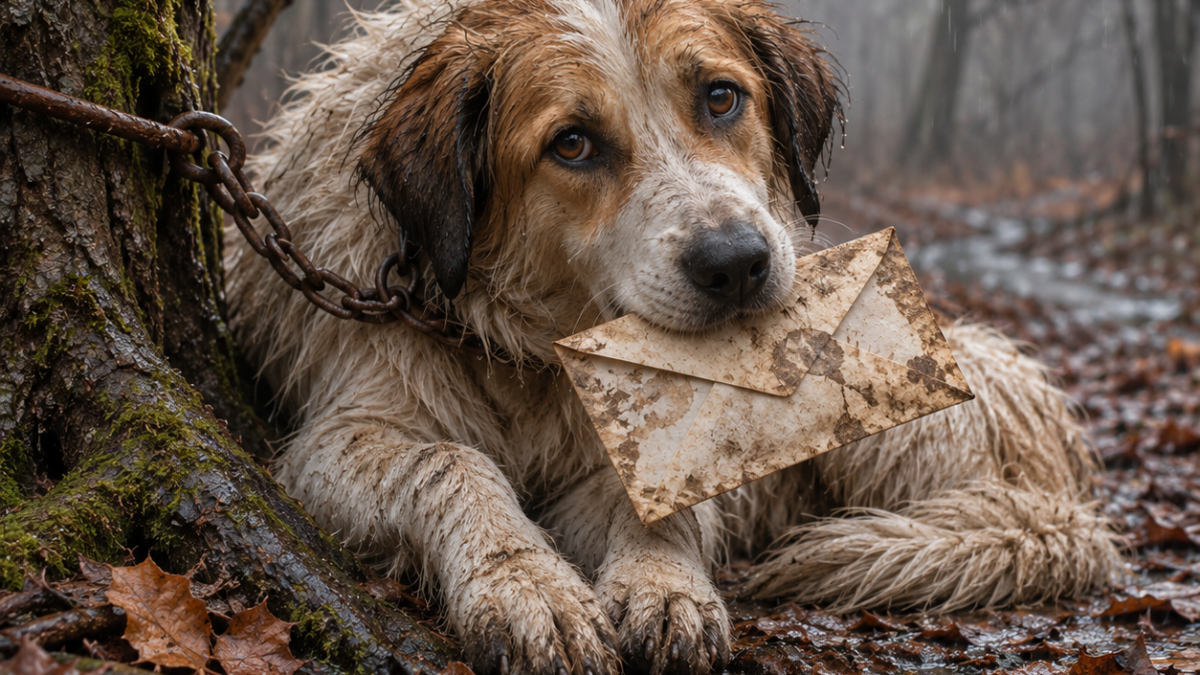
A dog was tied to an oak tree.
He was a German Shepherd, or at least he had once looked like one.
Now he was almost nothing but skin and bone.
His ribs showed clearly beneath his dirty coat. His paws were covered with dried mud. His fur was soaked and tangled. A weathered leather leash had been wrapped tightly around the tree, leaving him only enough room to stand or lie in the same patch of freezing ground.
There was no food.
No water bowl.
No shelter.
Nothing.
“Jesus…”
I approached slowly.
The dog didn’t bark.
He didn’t try to run.
He just stared at me.
His eyes looked exhausted, but there was something else in them.
Fear.
And patience.
As if he had been waiting for someone.
Then I noticed what he was holding between his teeth.
A small bundle wrapped in an old yellow cloth.
“What’s that?”
His ears moved slightly.
I knelt several feet away.
“Easy, buddy. I’m not going to hurt you.”
The dog watched every movement.
I reached toward the leash, but instead of pulling away, he lifted his head and pushed the bundle toward me.
I stared at him.
“You want me to take it?”
He moved forward as far as the leash allowed.
I reached out.
The moment my fingers closed around the cloth, he released it.
Inside was an envelope.
The paper was badly damaged by moisture, but someone had wrapped the letter itself in plastic.
On the front, barely visible through smeared ink, were the words:
“To whoever finds my Rex…”
I looked at the dog.
“Rex?”
His ears lifted.
My stomach tightened.
“So that’s you.”
I opened the envelope carefully.
The handwriting inside was shaky but readable.
The first sentence made me stop.
“If Rex has brought this letter to you, then something has happened to me.”
I looked around the forest.
Suddenly the silence felt different.
I continued reading.
“My name is Henry Wallace. I live in the old cabin north of Miller Creek. For months, a man named Caleb Turner has been trying to force me to sell my property. I have refused. Since then, my fences have been cut, my equipment has disappeared, and someone has damaged my well.”
I knew Henry.
He was eighty-one years old and owned about sixty acres beside the state forest.
Quiet man.
Retired teacher.
Widower.
I had spoken to him several times over the years.
He loved those woods.
And he loved his dog.
I kept reading.
“I have reported some of these incidents, but I have no proof. I have started keeping records. If I disappear or if something happens that is called an accident, please do not believe it without asking questions.”
My hands went cold.
Then I reached the final paragraph.
“The evidence is hidden where Rex knows to look. Trust him. He knows the way.”
I lowered the letter.
Rex was staring at me.
Before I could say anything, I heard an engine.
A vehicle was coming slowly down the closed forest road.
Rex’s entire body changed.
His ears flattened.
His tail pulled beneath him.
A growl rose from his chest.
The sound was weak, but the fear behind it wasn’t.
I folded the letter and shoved it inside my jacket.
“Okay, buddy.”
I reached for the knot holding his leash.
“We’re leaving.”
The leather had swollen from the rain.
I couldn’t loosen it.
The engine came closer.
I pulled my utility knife.
Rex tried to stand.
His legs shook so badly that he almost fell.
“Stay with me.”
I cut into the leather.
A vehicle door slammed somewhere behind the trees.
I froze.
Someone had stopped nearby.
Then a man’s voice called out.
“Rex!”
The dog pushed himself against my leg.
The voice came again.
“Rex! Come here!”
I finally cut through the leash.
Rex collapsed.
I caught him under the chest.
“Come on.”
I started toward my truck.
Then I heard my own name.
“Daniel?”
I stopped.
A man stepped through the trees.
Caleb Turner.
I recognized him immediately.
He was a local contractor who had spent years buying property along the forest boundary.
He smiled when he saw me.
But it wasn’t a friendly smile.
“Well,” he said. “This is unexpected.”
I shifted myself between him and Rex.
“What are you doing on a closed road?”
“Looking for my dog.”
I looked down.
Rex was trembling.
“Your dog?”
“Henry gave him to me.”
“When?”
Caleb shrugged.
“A few days ago.”
Rex growled.
Caleb looked at him.
“Stupid animal.”
The growl became louder.
I stared at Caleb.
“Interesting reaction to his new owner.”
His smile disappeared.
Then his eyes moved to my jacket.
“You found something.”
I didn’t answer.
“That dog was carrying something.”
“Was he?”
“Give it to me.”
“Why?”
“Because it isn’t yours.”
I reached for my radio.
Caleb’s face hardened.
“Don’t make this a bigger problem than it needs to be.”
“Where’s Henry?”
“I don’t know.”
“You were trying to buy his property.”
“So?”
“He wrote your name in a letter saying he was afraid something would happen to him.”
For the first time, Caleb looked genuinely angry.
“He’s an old man. He gets confused.”
“Is he confused about you threatening him?”
Caleb took a step toward me.
Rex forced himself upright.
“Daniel.”
Caleb’s voice became quieter.
“Give me the letter.”
“No.”
For several seconds, neither of us moved.
Then my radio crackled.
“Carter, county unit is responding. Twelve minutes.”
Caleb heard it.
His eyes changed.
He looked at Rex, then back at me.
Finally, he smiled.
“Keep it.”
He stepped backward.
“You’ll regret getting involved.”
Then he disappeared into the trees.
A minute later, I heard his truck drive away.
I crouched beside Rex.
“You knew him, didn’t you?”
The dog stared toward the road.
“And you were terrified.”
County deputies arrived soon afterward.
Deputy Maria Lopez read Henry’s letter while another officer photographed the tree.
“Where’s Henry?” she asked.
“I don’t know.”
“Last time you saw him?”
“Three weeks ago.”
Maria looked at Rex.
“You think he can walk?”
“Barely.”
Rex suddenly stood.
He turned toward a narrow trail leading north.
Then he whined.
“What is it?”
He pulled weakly against the piece of leash still attached to his collar.
Maria frowned.
“The letter said he knows where the evidence is.”
I looked at her.
“Maybe he knows where Henry is too.”
We followed him.
Rex moved slowly, but he never hesitated.
He crossed a shallow creek.
Climbed a narrow ridge.
Then turned toward Henry’s cabin.
The front door was open.
“Henry!”
No answer.
Maria drew her weapon.
“Stay behind me.”
Inside, the place had been torn apart.
Drawers hung open.
Books covered the floor.
A chair was broken.
Someone had searched the cabin.
Rex moved directly toward the bedroom.
He stopped beside the bed and scratched at the floor.
I pulled back a rug.
A floorboard underneath was loose.
Maria photographed it before we lifted it.
Beneath the boards was a metal box.
Inside were property documents.
Bank records.
Copies of emails.
Several flash drives.
A small recorder.
And another envelope.
“For the Sheriff.”
Maria stared at me.
“Henry knew exactly what he was doing.”
But Henry was still missing.
Rex left the cabin and moved toward the back of the property.
There were fresh ATV tracks in the mud.
We followed them.
Half a mile later, we found a broken walking cane.
Then a hat.
Maria called for backup.
Rex started barking.
Not weakly anymore.
Desperately.
We reached an abandoned quarry about twenty minutes later.
At the bottom of a slope, hidden near a drainage ditch, I saw a human shape.
“Henry!”
We ran down.
He was alive.
Barely.
There was blood on the side of his head.
His coat was torn.
One arm lay at an unnatural angle.
Rex tried to reach him.
Henry opened his eyes.
“Rex…”
The dog collapsed beside him.
Henry put one shaking hand on his head.
“You found help.”
I knelt beside them.
“Yeah.”
My throat tightened.
“He did.”
At the hospital, Henry told investigators what happened.
Caleb had come to the cabin with papers.
He wanted Henry to sign away access rights to his property.
Henry refused.
They argued.
Caleb hit him.
Rex attacked Caleb.
Caleb kicked the dog.
Then Henry remembered being dragged outside.
An ATV.
The cold.
After that, nothing.
“What happened to Rex?” Maria asked.
Henry closed his eyes.
“He tried to protect me.”
He had prepared the letter weeks before because he knew the situation was becoming dangerous.
He had trained Rex to carry it if Henry gave a specific command.
“Find help.”
During the confrontation, Henry had managed to push the bundle toward Rex.
The dog grabbed it.
Caleb eventually caught him.
He tied Rex to the oak tree far from the cabin.
He gave him no food.
No water.
Nothing.
He expected him to die there.
But Rex never let go of the letter.
Not through cold.
Not through rain.
Not through hunger.
When I visited the veterinary clinic the next morning, Rex was receiving fluids.
Dr. Reed met me outside his enclosure.
“He’s lucky.”
“Will he survive?”
“I think so.”
I exhaled.
“He’s badly dehydrated. Underweight. Bruised. One rib may be fractured.”
Rex lifted his head when he heard my voice.
I crouched.
“Hey, buddy.”
His tail moved once.
“Henry’s alive.”
His ears lifted.
I repeated it.
“Henry’s alive.”
Rex whined.
For the first time since the rescue, something in his eyes softened.
Caleb Turner was arrested that afternoon.
But that arrest opened a much larger investigation.
The evidence Henry had hidden showed that Caleb had spent years acquiring property around the forest.
Some deals were legal.
Others were not.
Several signatures appeared forged.
Older landowners had been pressured into selling.
One survey had been manipulated.
Money had moved through shell companies.
There were suspicious payments to local officials.
And Henry had recordings.
In one, Caleb said, “Sell now, or eventually you’ll lose everything anyway.”
Henry asked, “Is that a threat?”
Caleb laughed.
“Call it advice.”
In another recording, Caleb said something that later became one of the strongest pieces of evidence against him.
“Old men have accidents in the woods all the time.”
When that recording became public, people started talking.
Former employees.
Neighbors.
Landowners.
A surveyor.
A bookkeeper.
The story grew bigger every week.
Henry came home from the hospital nine days later.
Rex had been staying with me.
I drove him back to the cabin.
The moment Rex saw Henry standing on the porch, he made a sound I will never forget.
He jumped from my truck.
“Rex!”
Henry dropped his cane.
The dog reached him.
Henry went down on one knee and wrapped his good arm around Rex.
“My boy.”
Rex pushed his head against Henry’s chest.
“I thought I’d lost you.”
Henry was crying.
So was I.
I turned away and stared into the trees until I could get myself under control.
The trial happened several months later.
By then, Caleb’s business had collapsed.
He faced charges for assault, fraud, animal cruelty, bribery, forgery, and conspiracy.
His business partner eventually cooperated with prosecutors.
He confirmed that Caleb had attacked Henry.
He also confirmed why Caleb tied Rex to the tree.
“He said the dog would find somebody.”
That sentence made the courtroom completely silent.
Caleb had known Rex would try to save Henry.
That was why he left him tied up to die.
He didn’t underestimate the dog’s loyalty.
He was afraid of it.
I testified about finding Rex.
The prosecutor showed the jury photographs.
The oak.
The leash.
Rex’s condition.
Then the letter.
I was asked to read the first sentence aloud.
“If Rex has brought this letter to you, then something has happened to me.”
My voice almost failed.
Henry testified next.
He looked at Caleb and said, “You thought my dog was the weakest part of this story.”
He held up a photograph of Rex.
“He was the strongest.”
The jury found Caleb guilty on most of the major charges.
At sentencing, Henry spoke again.
He didn’t ask for revenge.
He didn’t ask the judge to make Caleb suffer.
He said something better.
“You tried to steal my land. You tried to frighten me off it. You nearly killed me because I refused to give you what you wanted.”
Henry paused.
“So I’ve made sure you’ll never have it.”
He had donated the entire sixty acres to a conservation trust.
The property could never be commercially developed.
Ever.
Caleb had almost destroyed his life trying to take that land.
Now nobody could buy it.
Nobody could build on it.
It would remain forest permanently.
That was Henry’s revenge.
Quiet.
Legal.
Permanent.
Caleb went to prison.
His companies were dissolved.
Several fraudulent transactions were reversed.
Land was returned.
Officials involved in the scheme were investigated.
And Rex?
Rex went home.
He gained weight.
His coat became thick and healthy again.
The fear slowly left his eyes.
Near the oak tree where I had found him, the conservation trust installed a small wooden bench.
On it was a brass plate.
It said:
FOR REX
WHO NEVER LET GO.
Two years later, Henry died peacefully in his sleep.
Rex was beside him.
That morning, when I entered the cabin, the dog was lying near Henry’s chair.
He looked at me, then at Henry.
I sat on the floor.
“I’m sorry, buddy.”
Rex rested his head against my knee.
Henry had already changed his will.
Rex came to live with me.
At first he waited by the door every evening.
Every truck made him stand.
Every footstep outside made his ears lift.
He was waiting for Henry.
Eventually, he stopped.
Not because he forgot.
Because he understood Henry wasn’t coming back.
I took Rex with me everywhere I could.
He rode in my truck.
He slept beside my bed.
He followed me through the woods after I retired.
Every year, we visited Henry’s land.
No construction ever came.
No roads.
No luxury cabins.
No bulldozers.
Only trees.
Creeks.
Wildlife.
Exactly what Henry wanted.
Rex lived four more years.
He was nearly fourteen when his body finally began to fail.
One October morning, I drove him to the place where I had found him.
We walked slowly toward the oak tree.
His hips were stiff.
His muzzle was gray.
But his eyes were peaceful.
I sat on the bench.
Rex lowered himself beside me.
“This is where it started.”
He put his head on my leg.
“You looked terrible that day.”
His tail moved once.
I laughed.
“You did.”
I scratched behind his ears.
“But you wouldn’t let go of that letter.”
I looked out across the forest.
“You saved Henry.”
The wind moved through the trees.
“You saved this land.”
I swallowed.
“And I think you saved me too.”
Rex lifted his head.
He touched his nose to my hand.
Two weeks later, he died at home.
I was beside him.
He wasn’t tied to anything.
He wasn’t cold.
He wasn’t hungry.
He wasn’t afraid.
My hand was on his head.
And the original letter Henry had written was on the table nearby.
After Rex died, I framed it.
Below it, I placed a photograph of Henry and Rex sitting together on the cabin porch.
Underneath, I wrote:
“He carried the truth when no one else could.”
We buried Rex on Henry’s protected land.
Near the oak.
Near the bench.
Before the grave was closed, I placed a copy of Henry’s letter inside a piece of yellow cloth.
The same way Rex had carried it when I found him.
I rested my hand on the ground.
“You can let go now, buddy.”
My voice broke.
“We know the truth.”
Years have passed since that cold November morning.
Sometimes children walking the conservation trail stop at Rex’s bench.
They ask who he was.
I tell them he was a dog somebody tried to abandon in the forest.
But that’s not the whole story.
So I tell them about Henry.
About the land.
About the letter.
About the storm.
And about one exhausted German Shepherd who was so weak he could barely lift his head, but somehow refused to drop the only thing his owner had trusted him to protect.
People often think courage has to look powerful.
It doesn’t.
Sometimes courage is starving.
Sometimes it is shaking from cold.
Sometimes it is covered in mud and tied to a tree.
Sometimes it can’t even bark.
But it keeps holding on anyway.
That is what I remember most about Rex.
Not the court case.
Not Caleb going to prison.
Not the property being saved.
I remember kneeling in the wet leaves and watching Rex push that bundle into my hand.
He had every reason to stop trusting people.
A person had hurt him.
A person had tied him up.
A person had left him to di3.
Yet when I reached toward him, Rex chose to trust one more human being.
And somehow, that one decision changed everything.
It saved Henry’s life.
It exposed a criminal.
It protected sixty acres of forest.
And years later, whenever I walk past that old oak tree, I still stop beside the bench.
I run my fingers across the brass plate.
FOR REX.
WHO NEVER LET GO.
Then I look at the woods Henry fought so hard to protect.
And I remember the dog who made sure the truth survived.








