I Found a Puppy Bound and Left to Di3 by the River—Then the Vet’s X-Ray Revealed 6 Bullets Inside Her
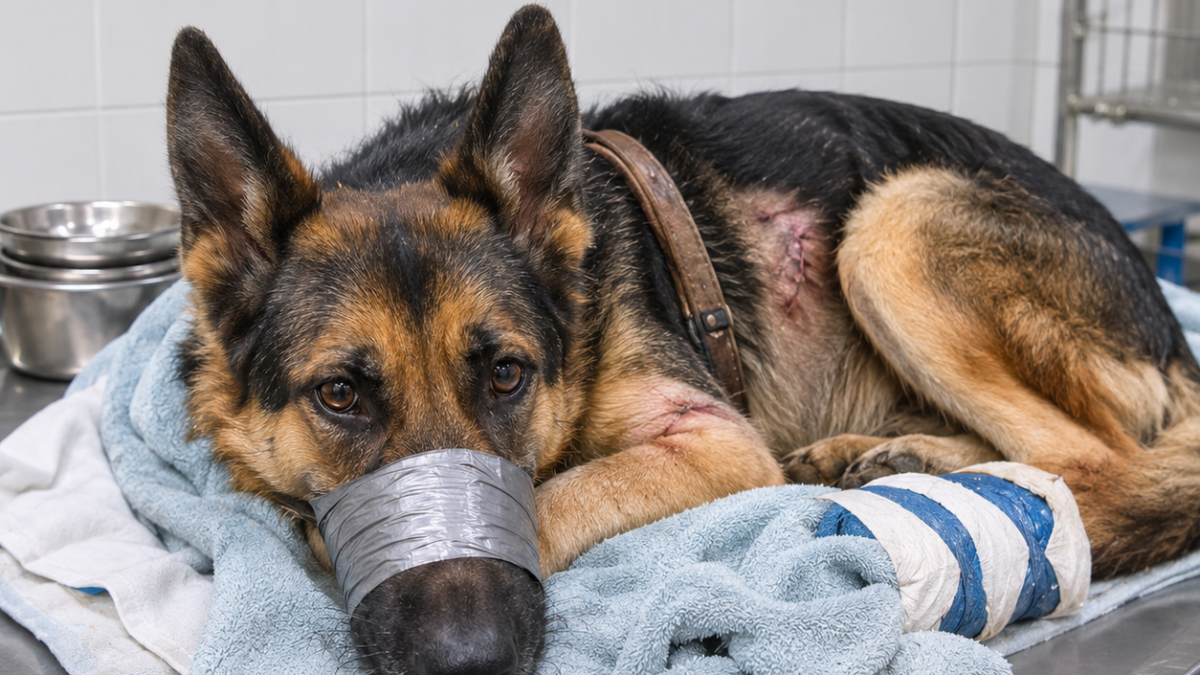
I thought the dark shape in the river grass was somebody’s discarded jacket—until my dog stopped so suddenly he nearly pulled the leash from my hand.
When I got closer, I realized it was a tiny female dog, her muzzle sealed shut with gray tape and her front legs bound so tightly she could barely move.
But the most horrifying thing about what had been done to her wasn’t visible until the veterinarian took the first X-ray.
I found her just after sunrise.
For almost seven years, I had walked the same stretch of river with my dog, Murphy, every morning before work.
It was our routine.
Coffee in a travel mug for me.
A worn red leash for him.
Forty minutes beside the water before the rest of the world woke up.
That morning was cold enough that my breath hung in front of my face.
Mist floated above the river.
The grass along the bank was still wet from overnight rain, and the only sounds were birds in the reeds and Murphy’s paws moving through the gravel.
We were halfway through our usual route when he stopped.
Not slowed.
Stopped.
His body went rigid.
The leash tightened.
“What is it?”
Murphy stared toward the tall grass near the water.
Then he growled.
Murphy almost never growled.
He was a twelve-year-old Labrador who considered strangers potential friends and squirrels a serious but ultimately forgivable inconvenience.
I followed his gaze.
Something dark lay between the reeds.
At first, I honestly thought it was a jacket.
People dumped garbage by the river all the time.
Then the shape moved.
Barely.
A twitch.
My stomach dropped.
“Stay.”
Murphy ignored me and pulled forward.
I walked closer.
Then I saw her face.
“Oh God.”
A small dog lay on her side in the mud.
She couldn’t have weighed more than twenty-five pounds even when healthy.
Her fur was dirty brown and white, caked with dried mud.
Several layers of gray duct tape had been wrapped around her muzzle.
Her front legs were tied together.
Her breathing was shallow.
So shallow I had to stare at her ribs to make sure they were moving.
I dropped to my knees.
“Hey.”
Her eyes opened.
Only slightly.
She tried to lift her head.
Couldn’t.
“Don’t move.”
My hands started shaking.
I pulled out my phone and called emergency services.
The dispatcher connected me with animal control.
I told them where I was.
“How badly is she injured?”
“I don’t know.”
“Is she conscious?”
“Barely.”
“Do not remove the tape if you think it may be attached to wounds. Keep her warm if you can.”
I took off my jacket.
Murphy stood beside me, whining.
I covered the dog’s body carefully.
Her eyes shifted toward him.
Murphy lowered himself to the ground.
For the next fifteen minutes, he stayed there.
No barking.
No movement.
Just watching her.
When the animal rescue team arrived, one of the women stopped dead when she saw the dog.
“Jesus.”
The other rescuer crouched.
“She still breathing?”
“Yes.”
“Barely.”
They cut the binding around her legs first.
Then carefully removed the tape.
When the final layer came away, the little dog gasped.
The sound went straight through me.
She tried to drink from a syringe but couldn’t manage more than a few drops.
One rescuer looked at me.
“Did you find anything else?”
“No.”
“Vehicle tracks?”
“I wasn’t looking.”
“We’ll come back.”
They lifted her onto a stretcher.
I don’t know why, but when they started toward the van, I followed.
One of them turned.
“Sir, you don’t have to—”
“I’m coming.”
“You found her. We’ll take care of her.”
“I know.”
I looked down at the dog.
“But I’m coming.”
At the veterinary clinic, they took her straight into emergency treatment.
Murphy and I waited outside.
Twenty minutes.
Then forty.
Then almost an hour.
Finally, a veterinarian named Dr. Caroline Evans came through the doors.
Her expression told me something was wrong.
“Are you the man who found her?”
“Yes.”
“She’s alive.”
I exhaled.
“But?”
Dr. Evans hesitated.
“We took X-rays because she has several unusual wounds.”
My stomach tightened.
“What did you find?”
She handed me a tablet.
On the screen was the outline of a small dog’s body.
Inside it were six bright shapes.
I stared.
“What are those?”
“Projectiles.”
“Bullets?”
“Rubber rounds.”
I looked up.
“Six?”
“Six.”
She pointed carefully.
“Several struck the chest. One is near the abdomen. Two are lodged farther back.”
I couldn’t speak.
Dr. Evans lowered the tablet.
“Someone didn’t just abandon this dog.”
Her voice became quieter.
“Someone deliberately hurt her before leaving her there.”
I looked through the glass doors toward the treatment area.
“What are her chances?”
“The next twenty-four hours will tell us.”
“Does she have a name?”
“No chip. No collar.”
I looked at the tiny shape beneath the blankets.
“Then call her Lika.”
Dr. Evans nodded.
That night, Lika lay beneath warm blankets with IV lines running into one leg.
She barely reacted when anyone touched her.
Every few hours, her eyes opened.
Then closed again.
Nobody knew whether she would live until morning.
But sometime during the second day, something happened that made Dr. Evans call me immediately.
And when I arrived at the clinic, Lika was doing something nobody there expected.
PART 2
When I walked into the recovery room, Murphy was with me.
Dr. Evans had agreed to let him visit because he had remained unusually calm around Lika from the beginning.
I expected to see the same tiny dog lying motionless beneath blankets.
Instead, Lika’s head was raised.
Only an inch or two.
But raised.
Her eyes moved toward the doorway.
Then toward Murphy.
Murphy stopped.
His tail began to move.
Slowly.
Lika made a sound.
A tiny whine.
Dr. Evans smiled.
“That.”
“What?”
“She hasn’t reacted to anyone all morning.”
Murphy walked toward the enclosure.
Lika tried to move.
Her body trembled.
“Easy,” Dr. Evans said.
Murphy lowered himself beside the kennel.
Lika’s nose touched the bars.
Murphy pressed his nose against hers.
I had to look away.
“She remembers him.”
“I think so.”
Dr. Evans crouched beside me.
“And that’s good.”
“How good?”
“Good enough that I’m slightly more hopeful than I was yesterday.”
I sat on the floor.
“Hey, Lika.”
Her eyes moved toward me.
“You’re still here.”
One ear twitched.
“That means you’re stubborn.”
Murphy’s tail tapped the floor.
“Apparently he approves.”
Over the next three days, Lika surprised everyone.
Not dramatically.
Healing wasn’t a miracle.
It was slow.
Measured in teaspoons of water.
A few bites of food.
A temperature returning to normal.
A heartbeat becoming stronger.
The first time she stood, she lasted less than three seconds before her legs folded beneath her.
The technician caught her.
Lika panicked.
She snapped weakly toward the woman’s hand.
Then immediately curled into herself.
The technician didn’t scold her.
“She thought I was going to hurt her.”
I understood.
What else was Lika supposed to think?
Somebody had taped her mouth shut.
Bound her legs.
Shot her six times.
Then left her beside a cold river.
To Lika, human hands had become something to fear.
That realization stayed with me.
It made me ashamed on behalf of people I had never met.
Dr. Evans explained that most of the rubber rounds could remain in place temporarily.
Removing all of them immediately would put Lika through more trauma than necessary.
One near her abdomen was causing inflammation and had to come out.
The surgery was scheduled for the fifth day.
I arrived before they took her in.
“She’s not technically your dog,” Dr. Evans reminded me gently.
“I know.”
“You don’t have to spend every day here.”
“I know.”
She smiled.
“I’m beginning to notice that answer means absolutely nothing.”
Pretty much.
I had become attached to Lika before she ever stood.
Maybe because I had been the first person to touch her after whatever happened.
Maybe because I couldn’t get the image out of my head.
Gray tape.
Bound paws.
Eyes that looked as if they had already stopped expecting help.
Whatever the reason, leaving felt wrong.
The surgery took almost two hours.
Dr. Evans removed one rubber projectile and cleaned damaged tissue.
When she came out, she looked tired but relieved.
“She did well.”
“She’s okay?”
“As okay as I can reasonably say right now.”
I closed my eyes.
“Thank you.”
“Don’t thank me yet. She has a long recovery ahead.”
“I’ll take long.”
That evening, police came to the clinic.
Until then, I hadn’t realized the case had been passed to investigators.
A detective named Rachel Moreno introduced herself.
“Mr. Harris?”
“Daniel.”
She sat across from me in the waiting area.
“You found the dog?”
“Yes.”
“I need you to tell me everything again.”
I did.
The time.
The location.
Murphy’s reaction.
Where Lika was lying.
What I saw.
Whether I noticed vehicles.
People.
Footprints.
Anything.
“I didn’t look around much.”
“That’s normal.”
“I was focused on her.”
“That’s also normal.”
I felt guilty anyway.
“What did you find?”
Rachel didn’t answer immediately.
“Some things.”
“What things?”
“We found tire impressions near the service access road.”
“So someone drove her there.”
“Probably.”
“Anything else?”
“Part of a roll of duct tape.”
My jaw tightened.
“Same tape?”
“Could be.”
“And the rounds?”
“Veterinary staff gave us the one they removed.”
“Can you trace rubber bullets?”
“Sometimes.”
That surprised me.
“They’re not bullets in the traditional ballistic sense, but manufacturers, size, composition, and sometimes weapon type can narrow things down.”
“So you think you can find whoever did this?”
Rachel gave me a careful look.
“I think we can try.”
I hated that answer because it was realistic.
I wanted certainty.
I wanted someone arrested by dinner.
I wanted a name.
A reason.
Something that made sense.
Rachel stood.
“One more thing.”
“What?”
“Don’t post details about the rounds.”
“Why?”
“We’ve released that she was injured. Not how many times she was shot.”
“Only the offender would know.”
“Exactly.”
That was the first moment I understood there was a real investigation.
Not just outrage.
Not just a sad dog people would talk about for three days.
Someone might actually be held responsible.
The story spread anyway.
A rescue volunteer posted a photograph of Lika wrapped in a blanket.
Not the worst photographs.
Nothing graphic.
Just her face.
Within hours, people across town were sharing it.
WHO DID THIS?
REWARD OFFERED.
JUSTICE FOR LIKA.
Donations arrived at the clinic.
Enough to cover her medical bills.
Then more.
The excess was placed into a fund for other abused animals.
I read comments for about ten minutes.
Then stopped.
Some were kind.
Some were furious.
Some wanted violence against whoever had hurt her.
I understood the anger.
I felt it too.
But looking at Lika taught me something.
Violence had already created enough damage.
I wanted justice.
Not another victim.
On day seven, Lika walked five steps.
Murphy was waiting outside her recovery enclosure.
The technician opened the door.
Lika hesitated.
Murphy stood.
She took one step.
Then another.
Her hind legs shook.
Murphy didn’t move toward her.
He waited.
Step three.
Four.
Five.
Then Lika collapsed against his chest.
Murphy stood there while she leaned on him.
I laughed and cried at the same time.
Dr. Evans handed me a box of tissues.
“You’ve been here a week and still don’t bring your own?”
“I keep believing I’m done.”
“You’re clearly not.”
No.
I wasn’t.
Two days later, investigators got their first major lead.
Rachel called me.
“Do you know a man named Victor Hale?”
“No.”
“You sure?”
“Yes.”
“He owns a private security training company outside town.”
“So?”
“They use less-lethal ammunition in training.”
My grip tightened around the phone.
“You think he shot Lika?”
“I didn’t say that.”
“You called for a reason.”
“One of the recovered rounds is consistent with a model his company purchases.”
My heart started pounding.
“Can lots of people buy them?”
“Yes.”
“So that’s not enough.”
“No.”
“What else?”
“His property is less than four miles from where you found Lika.”
That mattered.
“Does he have dogs?”
A pause.
“Yes.”
“What kind?”
“Several.”
“What kind, Rachel?”
“Working breeds. Some mixed.”
“Was Lika his?”
“We don’t know.”
I drove to the clinic immediately.
Dr. Evans was checking Lika’s wounds.
I sat beside the enclosure.
“You might have belonged to somebody.”
Lika looked at me.
“Maybe that’s not good news.”
Murphy lay beside us.
I rubbed his head.
“You know, when I got you, your biggest crime was eating a couch cushion.”
Murphy sighed.
“You were simple.”
Lika’s tail moved.
It was the first time I saw it.
Not a full wag.
Just one small movement.
I smiled.
“You hear me complaining about him?”
Another movement.
“Oh, that’s dangerous.”
The more Rachel investigated Victor Hale, the more complicated everything became.
His company, Sentinel Response Training, taught security guards, private contractors, and occasionally law enforcement personnel.
The facility covered fifteen acres behind high fencing.
They used firearms.
Tasers.
Pepper spray.
Less-lethal launchers.
Victor had no criminal record.
He sponsored charity events.
Donated equipment to local organizations.
Presented himself as a disciplined former military man who believed in responsibility.
Then investigators spoke to a former employee named Caleb Ross.
Caleb told them Victor kept several dogs on the property.
Not as pets.
As training animals.
When Rachel told me that, I felt sick.
“What does that mean?”
“He says the dogs were used during scenario exercises.”
“What kind of scenarios?”
“Guard-dog encounters. Aggressive-animal response.”
“With rubber bullets?”
“He says officially they weren’t supposed to fire at live animals.”
“Officially.”
“Yes.”
“Unofficially?”
“That’s what we’re trying to establish.”
A warrant was not easy to get.
Suspicion wasn’t evidence.
Then an anonymous caller contacted the tip line.
The caller said:
“Ask Victor what happened to number six.”
Number six.
Rachel didn’t tell the public.
She told Dr. Evans.
Then me.
“Why number six?”
“We don’t know.”
At the clinic, Lika was listed simply as FEMALE DOG—UNKNOWN.
But I remembered the X-ray.
Six projectiles.
Was it a coincidence?
Rachel thought so.
At first.
Then investigators obtained internal records from a former employee.
Sentinel kept dogs numbered rather than named.
Dog 1.
Dog 2.
Dog 3.
And so on.
There had been a Dog 6.
Female.
Small mixed breed.
Brown and white.
No longer listed.
My stomach went cold.
“Lika.”
“Probably.”
“What did the record say happened to her?”
“Transferred.”
“To who?”
“No destination recorded.”
“When?”
“Three days before you found her.”
I looked through the glass at Lika.
The small dog who had barely survived beside the river had been a number.
Not even a name.
Six.
Something about that made me angrier than I expected.
Maybe because names mean you recognize a life.
A personality.
A being that matters.
A number is easy to erase.
I walked into her room.
“Lika.”
Her ears lifted.
I crouched.
“You’re not Six.”
She watched me.
“Never again.”
Three days later, police executed a search warrant at Sentinel Response Training.
What they found changed the case completely.
Seven dogs.
Three with untreated injuries.
One with a damaged eye.
Records showing repeated use of animals during training sessions.
A locked storage room containing less-lethal launchers.
Boxes of rubber ammunition.
And a barrel behind one training structure filled with used duct tape, rope, and old dog collars.
Victor was not arrested that day.
I couldn’t understand why.
Rachel explained.
“Because owning the ammunition is not proof he used it on Lika.”
“What about the dogs?”
“Animal welfare charges are being reviewed.”
“The tape?”
“Common product.”
“The records?”
“Bad. Not enough for attempted killing.”
“He had Lika.”
“Likely.”
“He had the rounds.”
“Yes.”
“He had tape.”
“Yes.”
“And she ends up tied beside the river with six rounds inside her.”
Rachel rubbed her forehead.
“Daniel, I know.”
“Then arrest him.”
“We need to prove what happened.”
Justice moves slower than anger.
I hated learning that.
Lika came home with me before Victor was charged.
I had not planned to adopt her.
At least, that’s what I told everyone.
Dr. Evans handed me temporary foster paperwork.
“Two weeks.”
“Right.”
“Then we reassess.”
“Absolutely.”
She looked at Murphy.
Murphy looked back.
Dr. Evans smiled.
“You’re keeping her.”
“That’s a ridiculous conclusion.”
“Buy a second dog bed.”
I bought one on the way home.
Lika was terrified of the car.
The moment I opened the rear door, she flattened herself against the pavement.
I stopped.
“Okay.”
Murphy jumped in.
Lika watched.
He sat inside.
Waited.
Eventually, Lika put one paw on the floorboard.
Then another.
I didn’t touch her.
Ten minutes later, she climbed in beside Murphy.
That became our method for almost everything.
I didn’t show Lika the world.
Murphy did.
Doorways.
Stairs.
The backyard.
Food bowls.
Beds.
Visitors.
She trusted his judgment more than mine.
And I didn’t blame her.
The first night, she refused the new dog bed.
She slept beneath the kitchen table.
Murphy moved his own bed beside her.
At three in the morning, I found both dogs asleep with their backs touching.
I stood there in the dark for several minutes.
Something about it felt sacred.
The second week brought nightmares.
Lika would wake suddenly, scrambling against the floor.
Sometimes she made a muffled sound, as if expecting her mouth to be closed again.
I learned not to grab her.
I sat nearby.
Spoke softly.
Waited.
Murphy usually reached her first.
By the end of the month, she started sleeping through the night.
The tape was harder.
I discovered that accidentally.
I was packing a box one afternoon and tore a strip of gray duct tape.
The sound filled the kitchen.
Lika screamed.
She ran into the wall trying to get away.
I dropped everything.
“Lika!”
She hid beneath the table, shaking violently.
Murphy pushed beside her.
I sat on the floor.
“I am so sorry.”
She wouldn’t come near me for almost an hour.
After that, there was no duct tape in my house.
I threw every roll away.
Rachel continued working the case.
Then Caleb Ross, the former employee, agreed to give a formal statement.
He described a culture at Sentinel where Victor encouraged increasingly aggressive training.
Dogs were supposed to simulate threats.
Handlers wore protective equipment.
But over time, Victor became obsessed with proving less-lethal weapons were “safe enough.”
Caleb said Victor would fire rounds near dogs.
Then at padded targets beside them.
Then, eventually, directly at animals.
“Did you see him shoot Lika?” Rachel asked.
Caleb hesitated.
Then said yes.
According to his statement, the incident happened during a private training session.
Lika—then Dog 6—was released into a fenced exercise area.
Victor fired one rubber round toward her.
It struck her side.
She cried and ran.
Some trainees laughed nervously.
Victor fired again.
And again.
Caleb said:
“After the third shot, she wasn’t acting aggressive. She was trying to escape.”
Victor kept firing.
Six times.
Lika collapsed.
Someone said they needed a veterinarian.
Victor refused.
Why?
Because a veterinarian would ask questions.
Instead, he ordered two employees to restrain her.
One objected.
Victor threatened his job.
They taped her muzzle because she tried to bite when they lifted her.
Bound her front legs.
Loaded her into a truck.
“Where did they take her?”
Caleb looked down.
“I didn’t go.”
“Who did?”
“Victor and Mason Reed.”
That was a second name.
Mason was Sentinel’s operations manager.
Police questioned him.
He denied everything.
Then Rachel showed him Caleb’s statement.
Still denied it.
Then she showed him toll-camera footage.
Victor’s truck entering the river access road at 4:11 a.m.
Mason’s phone location traveling with it.
Mason stopped talking.
The next morning, he asked for an attorney.
Two days later, he made a deal.
That was the beginning of the end.
Mason admitted Lika was still breathing when they left her.
I wish I had never learned that detail.
He said Victor believed she would die before anyone found her.
They chose the river because flooding and wildlife might destroy evidence.
Mason claimed he objected.
Rachel asked:
“Did you remove the tape?”
“No.”
“Untie her?”
“No.”
“Call anyone?”
“No.”
“Then you didn’t object enough.”
When Rachel repeated that to me later, I was grateful.
Because it was true.
People often imagine cruelty as one evil person acting alone.
Sometimes it is.
But sometimes cruelty survives because other people stand nearby and decide their job, comfort, or fear matters more than stopping it.
Victor pulled the trigger.
Mason helped leave her.
Others knew enough to suspect.
Caleb finally spoke.
Lika lived because eventually somebody did the opposite.
Murphy stopped.
I looked.
Rescuers came.
Dr. Evans treated.
Rachel investigated.
One choice after another.
That mattered too.
Victor Hale was arrested almost two months after I found Lika.
Animal cruelty.
Evidence tampering.
Conspiracy.
Additional charges related to other dogs discovered at Sentinel.
Mason faced charges too but cooperated.
The news showed Victor being led from the courthouse.
He looked angry.
Not ashamed.
Angry.
He told reporters the allegations were “emotional nonsense.”
He claimed the dogs were training assets.
Assets.
That word made me turn off the television.
Lika was asleep on my couch.
Technically, she wasn’t allowed there.
Technically, I had lost control of my household.
Murphy lay on the floor beside her.
I watched Lika breathe.
“Asset.”
Her ear twitched.
“You know what you are?”
She opened one eye.
“Expensive.”
Her tail moved.
“Very expensive.”
Then she rolled onto her back.
I scratched her stomach.
“You’re also mine.”
That was how I decided.
Not with paperwork.
Not at the clinic.
On my living room floor.
The next morning, I called Dr. Evans.
“I want to adopt her.”
She laughed.
“Congratulations on finally discovering what everyone else knew six weeks ago.”
The trial did not happen quickly.
It took almost a year.
In that year, Lika became a different dog.
She gained twelve pounds.
Her coat became soft.
The scars around her muzzle faded.
Several rubber rounds were eventually removed because of inflammation, though two remained where surgery would have created unnecessary risk.
The veterinarian said they might stay for life.
I hated knowing they were there.
Tiny reminders inside her body.
But Lika didn’t seem interested in symbols.
She was interested in food.
Sunlight.
Murphy.
And eventually me.
The first time she brought me a toy, I nearly cried.
It was a destroyed tennis ball.
She dropped it beside my foot.
I stared.
“You want me to throw this?”
Lika stepped backward.
Tail wagging.
I threw it.
She ran.
Not fast.
Not elegantly.
But joyfully.
She brought it back.
Again.
“Okay.”
Again.
“Lika.”
Again.
After fifteen throws, I realized what I was seeing.
The dog I had found unable to lift her head was playing.
I sat down in the grass.
She ran toward me.
Instead of stopping, she crashed directly into my chest.
I fell backward laughing.
Murphy barked.
Lika licked my face.
For the first time, I heard myself say:
“You’re okay.”
Then corrected it.
“No.”
I held her close.
“You’re going to be okay.”
There is a difference.
Being healed is not the same as healing.
Lika still carried fear.
But she also carried new memories.
Good ones.
That is how trauma loses territory.
Not because the past disappears.
Because the future becomes larger.
The other dogs removed from Sentinel were rehabilitated.
Some had behavioral problems.
One couldn’t be safely adopted for months.
Another had permanent vision loss.
People donated.
Trainers volunteered.
A regional rescue organization took over care.
Victor’s company collapsed.
Clients canceled contracts.
Insurance withdrew coverage.
Employees left.
The county suspended his business permits.
Before the trial even began, Sentinel Response Training was effectively dead.
Some people online celebrated.
“This is karma.”
“That’s what he deserves.”
“Destroy him.”
I understood.
But the thing that gave me the most satisfaction wasn’t Victor losing money.
It was driving past the old Sentinel property months later and seeing a new sign.
SAFE HAVEN CANINE RECOVERY CENTER.
A nonprofit had purchased the site after foreclosure.
The shooting range had been removed.
The fenced exercise yard remained.
But now dogs ran there freely.
The first time I visited, I brought Lika.
I wasn’t sure I should.
Dr. Evans asked:
“Why take her back?”
“I don’t know.”
“Then don’t.”
That answer bothered me.
Not because she was wrong.
Because I realized I had been thinking like a human.
I wanted a dramatic moment.
Lika returning to the place where she suffered.
Standing there unafraid.
A symbol.
But Lika didn’t owe anybody a symbol.
She didn’t owe us bravery.
She didn’t need to confront her past for my satisfaction.
So I didn’t take her inside.
Instead, I parked across the road.
Lika slept in the back seat beside Murphy.
I looked at the new sign.
Dogs were barking in the distance.
Happy barking.
I smiled.
“That’ll do.”
The trial began the following spring.
By then, Lika had been with me almost fourteen months.
Rachel warned me beforehand.
“The defense will question you.”
“Fine.”
“They may suggest you’re emotionally involved.”
“I am.”
“They may suggest publicity influenced your memory.”
“It didn’t.”
“Just answer what’s asked.”
I nodded.
Then I looked down.
Lika was beside my chair at home.
“You can’t testify.”
Her tail moved.
“Probably for the best. You’d bite the defense attorney.”
She didn’t.
I did testify.
I described finding her.
The tape.
The bindings.
Her breathing.
The river.
The defense attorney asked:
“Did you see Mr. Hale shoot this dog?”
“No.”
“Did you see him transport her?”
“No.”
“Did you see him bind her?”
“No.”
“So everything you know about who injured her came from other people.”
“I know what I saw.”
“And what did you see?”
I looked at Victor.
“A dog someone expected not to survive.”
The attorney objected.
The judge sustained it.
The prosecutor asked me later:
“What was the dog’s condition?”
“Critical.”
“Did she recover?”
“Yes.”
“Where is she now?”
“At my house.”
“Did you adopt her?”
“Yes.”
“Why?”
I thought about that.
There were many answers.
Because Murphy loved her.
Because she trusted me.
Because after everything, the idea of handing her somewhere else felt impossible.
But I said:
“Because she had already survived enough uncertainty.”
Caleb testified next.
His testimony was devastating.
He admitted he stayed silent for weeks after the shooting.
The prosecutor asked why.
“I was scared of losing my job.”
“What changed?”
“I saw the picture of her.”
“What picture?”
“The one from the clinic.”
Caleb’s voice broke.
“I thought she died.”
“You knew what happened?”
“Yes.”
“You did nothing?”
“Yes.”
“Why speak now?”
He looked toward the jury.
“Because she lived.”
The prosecutor paused.
“And?”
Caleb swallowed.
“If she could survive what we let happen, I could at least tell the truth.”
Mason testified under his agreement.
He described the drive to the river.
Victor driving.
Lika in the back.
Bound.
Breathing.
Mason admitted he helped carry her into the reeds.
The prosecutor asked:
“What did Mr. Hale say?”
Mason looked toward Victor.
“He said, ‘By morning, there won’t be a problem.’”
I closed my eyes.
That sentence stayed with me for days.
There won’t be a problem.
Lika had been reduced to a problem.
A living thing erased because her suffering was inconvenient.
Then Dr. Evans testified.
She showed the X-rays.
Six bright shapes.
The jury saw what I had seen that first morning.
She explained the injuries.
The dehydration.
The trauma.
The prognosis.
Victor’s attorney tried to argue that rubber rounds are designed to be less lethal.
Dr. Evans’s face hardened.
“Less lethal does not mean harmless.”
“Are they commonly fatal?”
“They can be.”
“But this dog survived.”
Dr. Evans looked directly at him.
“Despite what was done to her. Not because it was safe.”
That answer ended the discussion.
The prosecution introduced Sentinel records.
Dog 6.
Female.
Brown-white.
No medical disposition.
Transferred.
Then photographs showed Lika on the property.
The same markings.
Same ear.
Same body.
The defense claimed Victor had not personally fired all six rounds.
Caleb said he had.
Training-camera footage recovered from a deleted hard drive confirmed four shots.
The remaining two were outside the camera angle.
It was enough.
The jury deliberated for six hours.
Guilty.
Multiple counts of aggravated animal cruelty.
Conspiracy.
Evidence tampering.
Related violations involving the other dogs.
Mason received a reduced sentence because of cooperation.
Victor received prison time, substantial fines, restitution, and a permanent prohibition in the state from operating an animal training facility or owning dogs after release, subject to court restrictions.
When the verdict was read, people behind me cried.
I didn’t.
I expected some huge emotional release.
Nothing happened.
Victor looked angry.
The lawyers gathered papers.
The judge spoke.
People moved.
That was it.
Justice can be surprisingly quiet.
Outside the courthouse, reporters asked:
“Do you feel Lika got justice?”
I didn’t want to answer.
Then one woman asked again.
I stopped.
“Lika doesn’t know what happened in that courtroom.”
Microphones moved closer.
“She knows whether she’s safe when she wakes up.”
I thought about her at home with Murphy.
“She is.”
I walked away.
That night, I sat on my couch.
Lika climbed beside me.
Murphy lay at my feet.
“You won.”
Lika yawned.
“Very emotional reaction.”
She placed one paw on my leg.
I smiled.
“Okay. You don’t care.”
And maybe that was healthier.
Victor spent years building a business around control.
Control of employees.
Animals.
Training.
Fear.
He believed strength meant forcing everything around him to obey.
Lika proved the opposite.
Strength was surviving.
Strength was learning to play after somebody taught you the world was cruel.
Strength was sleeping peacefully with your belly exposed.
Strength was trusting another hand.
The best revenge was not that Victor sat in prison.
It was that Lika lived a life he had decided she wasn’t allowed to have.
She became known around town after the trial.
I didn’t love that.
People recognized her during walks.
“Is that Lika?”
Sometimes.
One little boy approached us outside a coffee shop.
His mother said:
“Don’t touch without asking.”
He nodded.
“Can I pet her?”
I looked at Lika.
She watched him.
“Slowly.”
The boy held out his hand.
Lika sniffed.
Then walked closer.
He touched her head.
His face lit up.
“She’s soft.”
I laughed.
“Yes.”
“Was she always nice?”
I didn’t know how to answer.
“She was always good.”
His mother smiled.
The boy continued petting her.
“She has scars.”
“A few.”
“Do they hurt?”
“Not anymore.”
He thought about it.
Then said:
“Good.”
Children understand endings better than adults sometimes.
Good.
That was enough.
Two years passed.
Murphy turned fourteen.
His hips began failing.
He slept more.
Lika adapted.
She no longer tried to make him chase her.
She walked slowly beside him.
When he struggled with stairs, she waited.
When he stopped during walks, she stopped.
The dog who once needed him now cared for him.
I watched that reversal with both pride and sadness.
One winter morning, Murphy couldn’t stand.
I knew.
He knew too.
Dr. Evans came to the house.
Murphy lay on his favorite blanket near the fireplace.
Lika lay beside him.
I sat on the floor.
“Fourteen years.”
Murphy’s tail moved weakly.
“You ate three shoes.”
Another movement.
“Destroyed one couch.”
His eyes stayed on me.
“Saved one dog.”
My voice broke.
“That cancels everything else.”
Lika pressed her face against his neck.
Murphy died peacefully with my hand on his head and Lika beside him.
Afterward, Lika searched the house.
Room by room.
She stood by his empty bed.
Waited at the back door.
For two weeks, she barely touched toys.
Grief changed her.
I had spent years believing Murphy had saved Lika.
I hadn’t considered what she would do without him.
So I did what he taught me.
I stayed.
Didn’t force.
Didn’t fix.
Just stayed.
Eventually, Lika carried the ruined tennis ball to me.
Dropped it.
I looked at her.
“Really?”
Tail wag.
I threw it.
She ran.
That was the day we started moving forward again.
The Safe Haven Canine Recovery Center invited us to an anniversary event the following year.
This time, I took Lika.
Not because I wanted her to confront anything.
Because the place was no longer what it had been.
I let her decide.
We walked toward the gate.
Lika stopped.
Her body stiffened.
I stopped too.
“You don’t have to.”
She looked at me.
Inside the yard, a young rescue dog barked.
Not aggressively.
Playfully.
Lika’s ears moved.
She took one step.
Then another.
We entered.
The old training structures were gone.
In their place were shaded kennels, grass, enrichment equipment, and a small veterinary room.
A volunteer recognized Lika.
“Oh my God.”
I raised a hand.
“Please don’t crowd her.”
“Of course.”
Lika sniffed the ground.
Then moved toward the fence.
A black-and-white puppy approached from the other side.
They touched noses.
My throat tightened.
At one point, we reached a plaque mounted beside the main building.
It read:
THIS CENTER IS DEDICATED TO ANIMALS WHO SURVIVED NEGLECT, FEAR, AND ABUSE—AND TO THE PEOPLE WHO CHOOSE TO SPEAK WHEN SILENCE IS EASIER.
Caleb was there.
I hadn’t seen him since the trial.
He stood at a distance.
Then approached.
“Daniel.”
I nodded.
He looked at Lika.
“Can I?”
I hesitated.
Then said:
“Let her decide.”
Caleb crouched several feet away.
Lika stared at him.
His eyes filled.
“I’m sorry.”
Lika didn’t move.
“I should’ve stopped him.”
No response.
Caleb wiped his face.
“I’ve said that a thousand times.”
I said quietly:
“She doesn’t owe you forgiveness.”
“I know.”
He nodded.
“I know.”
Lika sniffed the air.
Then walked past him.
Not toward.
Past.
Caleb laughed through tears.
“Fair.”
I liked that moment because it wasn’t sentimental.
Sometimes forgiveness is not necessary for healing.
Sometimes accountability is enough.
Caleb volunteered at Safe Haven afterward.
Not with dogs at first.
Cleaning.
Repairs.
Laundry.
Whatever needed doing.
He said he wanted to spend years doing the work he should have done when it mattered.
Maybe that was guilt.
Maybe growth.
Probably both.
Lika grew older.
Her muzzle went gray.
The two remaining rubber rounds stayed inside her body.
Every annual X-ray showed them.
I hated seeing them.
Dr. Evans once asked:
“Do you know what I see?”
“Two pieces of something that shouldn’t be there.”
“I see a healthy eleven-year-old dog.”
I looked at her.
“The rounds are background now.”
That was a better way to think about it.
The worst thing that happened to Lika was still part of her.
But it wasn’t the whole picture.
Her life became bigger than the evidence of cruelty.
Morning walks.
Naps in sunbeams.
Car rides.
Cheese stolen from my plate.
A strange hatred of vacuum cleaners.
A deep love for children.
And eventually another dog.
His name was Theo.
I did not want another dog.
This fact means nothing in my life.
Theo arrived as a foster after being rescued from a hoarding case.
He was young, nervous, and terrified of men.
Lika met him.
Lay down.
Waited.
I laughed.
“You learned that from Murphy.”
Theo approached.
Lika became his guide.
The way Murphy had been hers.
Doorways.
Food.
Backyard.
Me.
I watched the cycle repeat.
That was the part of Lika’s story no courtroom could measure.
Pain had traveled through people to her.
But kindness traveled through dogs.
Murphy to Lika.
Lika to Theo.
Theo eventually became confident enough to be adopted by a retired couple.
On the day they picked him up, Lika watched from the porch.
Theo turned back.
They touched noses.
Then he left.
I sat beside Lika.
“You’re good at this.”
She leaned against me.
“You know, I could use some help with my taxes.”
No reaction.
“Worth a try.”
As Lika entered her twelfth year, her health began changing.
She tired more quickly.
Her appetite became inconsistent.
Dr. Evans found a mass near her liver.
Cancer.
I sat in the clinic holding the edge of the chair.
“Can you operate?”
“Maybe.”
“Will it help?”
“Possibly.”
“What would you do if she were yours?”
Caroline had been our veterinarian for more than a decade by then.
She sat beside me.
“I would ask whether treatment gives her more good days or simply more days.”
That was the hardest question.
We did some testing.
The cancer had spread.
Aggressive surgery would have been painful and unlikely to cure her.
So we chose comfort.
Lika didn’t know she was dying.
I loved that.
She knew breakfast.
Sunlight.
Walks.
My voice.
She knew the river path too.
For years, I had avoided taking her there.
Not because she remembered.
Because I did.
Then one cool October morning, I thought about it differently.
That river was not only where someone left her.
It was where Murphy found her.
Where I found her.
Where the worst part ended.
I opened the car.
“Want to go?”
Lika climbed in slowly.
We drove to the old path.
The grass had been cut.
The reeds were golden.
Mist floated above the water exactly as it had years earlier.
I felt my chest tighten.
Lika stepped out.
She sniffed.
No panic.
No shaking.
She walked.
Slowly.
We reached the spot.
At least, I thought it was the spot.
Years had changed the riverbank.
So had I.
Lika stood near the reeds.
I sat in the grass.
“You know something?”
She looked at me.
“I thought you were a jacket.”
Her tail moved.
“Seriously.”
I scratched her neck.
“Murphy knew better.”
At his name, her ears lifted.
“Yeah.”
I swallowed.
“He’d like this.”
Lika lay down beside me.
We watched the river.
For a long time, neither of us moved.
I remembered the tape.
The bound legs.
The six bright shapes on the X-ray.
The trial.
Victor.
The anger.
All of it felt strangely far away.
Lika nudged my hand.
I looked down.
She was calm.
That was justice.
Not Victor’s sentence.
Not the failed company.
Not the headlines.
This.
A dog once left to die beside the water lying in sunlight beside someone who loved her.
No fear.
No rope.
No tape.
No number.
Just Lika.
Her final week came in December.
She stopped eating almost completely.
Walking became difficult.
Caroline came to my house.
I knew what I had to do.
Knowing did not make it easier.
I placed Lika’s bed beside the fireplace.
The same place Murphy had spent his last afternoon.
I sat beside her.
“You remember him?”
Her ear moved.
“Of course you do.”
I stroked her head.
“I think he sent me back for you.”
That wasn’t rational.
I knew.
Didn’t matter.
Caroline prepared everything quietly.
Lika looked at me.
I expected to see the frightened eyes from that first morning.
I didn’t.
Her face was peaceful.
I put my forehead against hers.
“Listen to me.”
My voice broke immediately.
“You were never a number.”
Lika breathed slowly.
“You were never a problem.”
I cried.
“You were never something to throw away.”
Her tail moved once against the blanket.
“You were loved.”
Caroline looked down.
I kept talking.
“Murphy loved you.”
Breath.
“I love you.”
Another breath.
“You changed my life.”
I kissed her head.
“And you won.”
That was the last thing I told her before she died.
You won.
I meant it.
Victor had believed six shots would be the end of her story.
He was wrong.
He believed tape could silence her.
Wrong.
He believed the river would erase the evidence.
Wrong.
He believed nobody would care about one small dog recorded as number six.
Wrong again.
Lika lived almost twelve years after I found her.
Twelve years of meals.
Walks.
Beds.
Toys.
Sunlight.
Children petting her.
Other frightened dogs learning from her.
Twelve years Victor never intended her to have.
That was revenge enough.
I buried her beside Murphy.
A small cemetery had formed beneath the maple tree behind my house.
Murphy’s stone said:
MY BEST FRIEND.
LIKA’S said:
SHE WAS LEFT TO DIE.
SHE CHOSE TO LIVE.
For weeks, I couldn’t walk past it without stopping.
Then Safe Haven called.
They were building a new medical wing.
A donor had offered matching funds.
They wanted to name one recovery room after Lika.
I said yes.
On the day it opened, I stood inside the room.
Clean floors.
Warm kennels.
Medical equipment.
A large window facing the exercise yard.
On the wall was a photograph.
Not the river photograph.
Not the X-ray.
Not the tape.
A picture I had taken years later.
Lika running through grass with a tennis ball in her mouth.
Under it were the words:
LIKA’S ROOM
FOR THE ONES WHO WERE SUPPOSED TO DISAPPEAR.
I stood there too long.
A young veterinary technician approached.
“Are you Daniel?”
“Yes.”
“She was yours?”
I looked at the photograph.
“Yes.”
The technician smiled.
“We treated a dog in here this morning.”
“What happened?”
“Found tied behind a warehouse.”
My stomach tightened.
“Is she okay?”
“She will be.”
I looked around the room.
Then at Lika’s photograph.
“Good.”
The technician hesitated.
“Would you like to see her?”
I almost said no.
Then I remembered Murphy stopping beside the river.
So I followed.
The dog was small.
Black.
Terrified.
Lying beneath a blanket.
She watched me as I approached.
I stopped several feet away.
No reaching.
No forcing.
I sat on the floor.
For several minutes, nothing happened.
Then the dog’s nose lifted.
I smiled.
“It’s okay.”
She didn’t believe me.
Not yet.
That was fine.
I had learned patience.
I stayed.
Eventually she shifted one paw toward me.
Then another.
I put a treat on the floor.
Backed my hand away.
The dog sniffed it.
Ate.
I laughed softly.
“Yeah.”
My eyes filled.
“I knew a dog who started exactly like this.”
Years later, the river path has changed.
The city added lighting.
Security cameras.
The reeds are cut back regularly.
A small sign near the trail asks people to report abandoned animals.
Most people walking there have no idea why.
I do.
Sometimes I still walk that path.
Not every morning anymore.
I’m older.
My knees complain.
There is usually another dog with me.
There always seems to be another dog.
I blame Murphy.
And Lika.
At the place where I found her, I sometimes stop.
People pass.
Joggers.
Parents.
Dogs.
Life.
Once, a woman asked:
“Are you looking for something?”
I said:
“No.”
Then thought about it.
“Actually, I found something here a long time ago.”
“What?”
I smiled.
“A reason not to keep walking.”
She looked confused.
I didn’t explain.
Some stories don’t need to be told every time.
But Lika’s story is told.
At Safe Haven.
At the clinic.
By Rachel, who uses the case in training new investigators about animal-cruelty evidence.
By Caroline, who tells veterinary students that survival is not a medical statistic.
By Caleb, who still volunteers and tells people silence is a choice.
And by me.
When people ask what happened to the man who hurt her, they expect that to be the satisfying part.
“He went to prison.”
They nod.
“Good.”
Yes.
Good.
But that’s not the ending.
The ending is that his training company disappeared and became a rescue center.
The ending is that the dogs he treated as equipment became family members.
The ending is that Lika stopped being Dog 6.
The ending is that a dog who once screamed at the sound of duct tape eventually slept through thunderstorms with her feet in the air.
The ending is a tennis ball.
A couch.
A warm fire.
An old Labrador sleeping beside her.
The ending is twelve years.
Twelve years someone tried to steal from her.
And failed.
That is the part that satisfies me.
Cruelty wanted the final word.
It didn’t get it.
Fear wanted the final word.
It didn’t get it either.
Even the six rounds left inside her body didn’t define her.
They became smaller and smaller in the story as her life grew around them.
If I close my eyes, I can still see the first morning.
Mist above the river.
Murphy pulling the leash.
The dark shape in the grass.
I remember kneeling.
Seeing Lika’s eyes open.
At the time, I thought I was looking at an animal who had reached the end of her life.
I had no idea I was meeting her at the beginning.
Her real beginning.
The part where somebody stopped.
The part where somebody saw her.
The part where she was no longer alone.
And maybe that’s why I still think about the moment before Murphy pulled me toward the reeds.
I was walking.
I could have kept walking.
Most important moments don’t announce themselves.
They don’t arrive with music.
Sometimes they’re hidden in tall grass.
Quiet.
Barely breathing.
Waiting to see whether someone will notice.
Murphy noticed.
Then I did.
And because we stopped, Lika got twelve years.
Sometimes that is what saving a life looks like.
Not heroism.
Not revenge.
Not even courage.
Sometimes it is simply refusing to walk past someone the world has already decided to leave behind.








