I Found a Mutilated Puppy Limping Beside the Road—Then the Vet Told Me How Long He’d Been Surviving Like That
[TITLE]
**I Found a Mutilated Puppy Limping Beside the Road—Then the Vet Told Me How Long He’d Been Surviving Like That**
[FACEBOOK OPENING — 700–800 WORDS]
The puppy was so small that at first I thought the dark shape trembling beside the road was a piece of trash moving in the heat, until it lifted its head and tried to take another step on a leg that was no longer completely there.
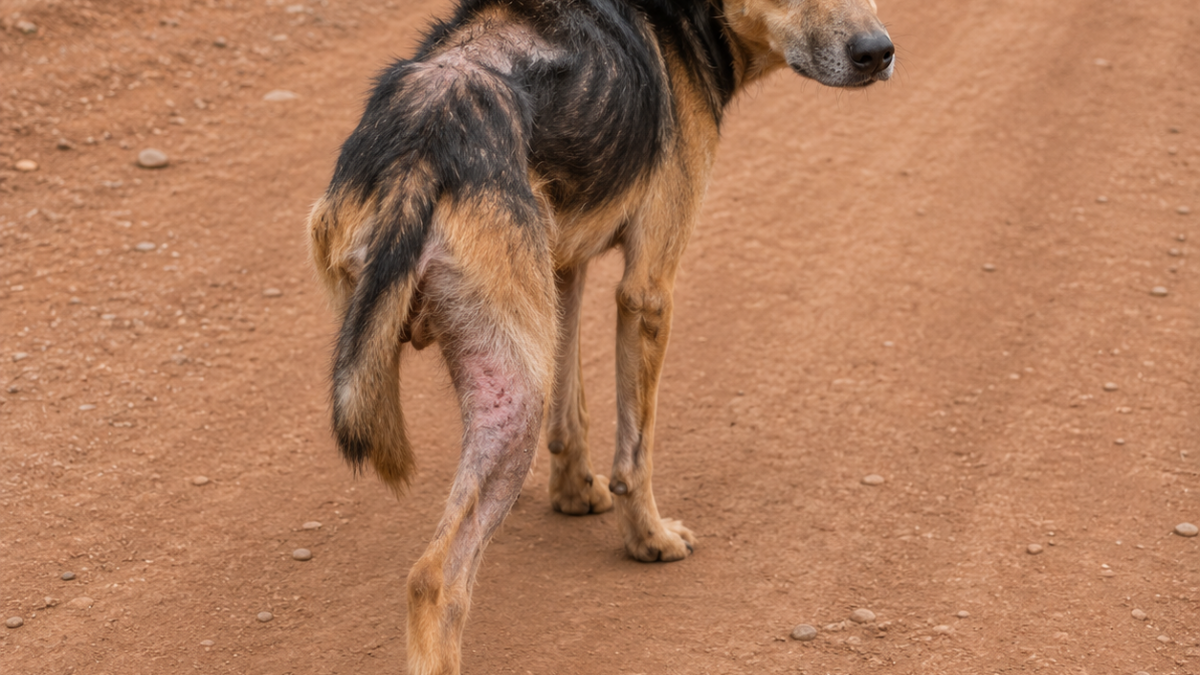
Cars kept passing while he limped from one patch of shade to another, his skin raw with sores, his ribs visible, and his nose searching the dirt for anything that might be food.
But when I pulled over and walked toward him, the way he looked straight into my eyes made me realize there was something far worse happening to that little body than I could see from the road.
I parked on the shoulder and stepped out.
The heat hit me immediately. The pavement shimmered, and even standing there in shoes felt uncomfortable.
The puppy had no shoes.
No water.
No shelter.
And almost no fur protecting his damaged skin.
“Hey, baby,” I said softly.
He stopped moving.
For a second, I thought he might run.
Then I saw his leg clearly.
Part of it was missing.
He tried to shift his weight and nearly fell.
“Oh, God.”
I crouched several feet away.
He couldn’t have been more than a few months old. His entire body looked too small for what had already happened to him. Patches of irritated skin covered his sides, neck, and face. Some areas were crusted. Others were red and inflamed.
His ears drooped.
His eyes didn’t.
They stayed fixed on me.
A truck roared past, blasting hot air and dust over both of us.
The puppy flinched but didn’t leave.
I pulled a bottle of water from my car and poured some into the plastic lid of a container I had in the back.
“Water?”
He watched my hands.
I slid it toward him.
For several seconds, he hesitated.
Then he moved.
One awkward step.
Another.
His injured leg barely touched the ground.
When he reached the water, he drank so desperately that I had to stop myself from letting him take too much too fast.
“Easy,” I whispered. “There’s more.”
He looked up.
That was the moment I knew I wasn’t driving away.
I called the veterinary hospital.
“I found a puppy beside the road,” I told the receptionist. “He’s in terrible condition.”
“What kind of injuries?”
I looked at him.
“Skin disease. He’s extremely thin. And…”
My voice caught.
“Part of one leg is missing.”
The woman’s tone changed immediately.
“Can you bring him in?”
“Yes.”
“Now?”
“I’m leaving now.”
Getting him into the car was harder than I expected.
When I reached toward him, he flattened himself against the dirt.
I stopped.
“I’m not going to hurt you.”
Of course, he didn’t know that.
For all I knew, hands were part of the reason he was afraid.
So I sat beside the road in the heat and waited.
Eventually, I offered my hand.
He sniffed my fingers.
Then something changed.
He leaned forward until the front of his head touched my palm.
Barely.
But it was enough.
I wrapped him carefully in a towel and lifted him.
He weighed almost nothing.
As I carried him toward the car, I felt his body trembling against my chest.
At the hospital, the veterinary team took one look at him and moved quickly.
A technician reached for him.
“What’s his name?”
I froze.
He didn’t have one.
Not that I knew.
“I just found him.”
She nodded and carried him through the doors.
I stood in the waiting room staring at the stains he had left on the towel.
Minutes stretched.
Then the veterinarian came out.
Her expression told me the examination had uncovered more than I had seen.
“He’s severely dehydrated,” she said. “He’s malnourished, his skin is badly diseased, and we’re dealing with multiple infections.”
I swallowed.
“And the leg?”
She paused.
“That injury isn’t recent.”
“How old?”
“We can’t know exactly.”
She glanced toward the treatment area.
“But it looks like he’s been living with it for weeks.”
Weeks.
I looked through the narrow window in the door.
The puppy was lying on a treatment table while two technicians worked around him.
“How does a puppy survive like that for weeks?”
The veterinarian didn’t answer immediately.
Then she said something that made my stomach tighten.
“The bigger concern is what’s happening inside what remains of that leg.”
I looked back at her.
“What do you mean?”
She took a breath.
“The infection is spreading.”
Then she opened his chart and turned it toward me.
“We need to talk about what happens if we don’t stop it.”
[END OF FACEBOOK OPENING]
[FULL STORY CONTINUATION]
I stared at the chart even though I barely understood what I was looking at.
There were numbers, abbreviations, notes from the examination, and a rough drawing showing the damaged limb.
But one word had already lodged itself in my mind.
Spreading.
“What happens?” I asked.
The veterinarian pulled a chair closer.
“If the infection remains localized, we have options. But this puppy is already weak. He’s dehydrated, underweight, and fighting infections in more than one place. His immune system doesn’t have much reserve.”
“Can antibiotics fix the leg?”
“They’ll help with infection, but the remaining tissue is badly damaged.”
She hesitated.
“I think we’re going to have to amputate.”
I looked through the glass again.
The puppy seemed impossibly small on the table.
“More of it?”
“What remains of the injured leg.”
I rubbed both hands over my face.
He had survived alone beside a road with part of a limb already gone, and now the first thing I was going to authorize after picking him up was another surgery.
The veterinarian must have seen the conflict on my face.
“This isn’t taking something away from him,” she said quietly. “That leg is hurting him. Removing the damaged tissue may be what gives him a chance.”
“May?”
“I won’t promise you something I can’t promise.”
That answer frightened me more than false reassurance would have.
“What are his chances?”
“He’s young. That helps.”
She glanced toward the treatment room.
“But we need to stabilize him first.”
I nodded.
“Do whatever he needs.”
“Are you taking responsibility for his care?”
The question was practical.
The answer felt bigger.
I looked again at the puppy I hadn’t known existed an hour earlier.
“Yes.”
The word left my mouth before I had time to think about money, time, transportation, recovery, or what exactly I had just committed myself to.
“Yes. I am.”
The first twenty-four hours were not dramatic in the way rescue stories sometimes become dramatic afterward.
There was no miraculous transformation.
No sudden tail wag.
No puppy standing up as if kindness alone had cured him.
He was simply sick.
The veterinary team started fluids for the dehydration. They cleaned his skin carefully, took samples, treated the infections they could identify immediately, and began antibiotics.
His skin disease was severe enough that even touching certain areas made him tense.
His body had been trying to fight too many things at once.
The veterinarian explained that malnutrition had made everything harder.
A healthy puppy has energy to grow.
Canarinho’s body had been using whatever energy he could find simply to stay alive.
That night, before I left the hospital, I stood beside his enclosure.
He had curled himself into the smallest possible shape.
“Hey,” I whispered.
One eye opened.
“You did your part today.”
His eye closed again.
“I’ll come back tomorrow.”
It felt strange making promises to a dog I had known for less than a day.
But I meant it.
The next morning, I returned before work.
A technician met me near the treatment area.
“He ate a little.”
I stopped walking.
“He ate?”
She smiled.
“Not much. But yes.”
I wanted to hug her.
Instead, I followed her to his enclosure.
There was a small bowl inside with food smeared along one edge.
The puppy lifted his head when I approached.
“Look at you.”
His tail didn’t move.
He didn’t stand.
But his eyes followed me.
That was enough.
The veterinarian came by a few minutes later.
“We need to keep building him up,” she said. “He’s still very fragile.”
“When can you operate?”
“When I’m more comfortable with his hydration and overall condition.”
“And if we wait too long?”
She looked at me.
“That’s the balance.”
There it was again.
No easy answer.
The damaged leg was dangerous.
Surgery was dangerous too.
His body had to become strong enough to survive the procedure before the infection made waiting impossible.
For the next two days, everything became about tiny measurements.
How much he drank.
How much he ate.
Whether his temperature stayed stable.
Whether the antibiotics were helping.
Whether the redness around the leg appeared worse.
Whether his gums looked better.
Whether he had enough strength to stand.
I had never imagined I could become emotionally invested in a few spoonfuls of puppy food.
But I did.
One afternoon a technician sent me a video.
The puppy was standing beside his bowl.
Not gracefully.
Not steadily.
But standing.
He lowered his head and ate.
I watched the video four times.
Then I noticed something else.
His tail moved.
Once.
A tiny flick.
I called the hospital.
“Did his tail just wag?”
The technician laughed.
“We noticed that too.”
“That counts.”
“It absolutely counts.”
By the third day, the veterinarian believed he was stable enough for surgery.
I arrived early.
He was lying on a blanket when they brought me back.
I sat on the floor beside him.
By then, I had begun calling him Canarinho.
The name had started as something affectionate, something small and bright that felt completely unlike the condition in which I had found him.
“Canarinho,” I whispered.
His ears shifted.
The technician beside me smiled.
“He knows it.”
“I think he knows I usually bring food.”
“That might be more accurate.”
I placed my hand near his head.
He leaned against my fingers.
It was the first time he had done that without hesitation.
The veterinarian entered.
“We’re ready.”
My stomach tightened.
She must have seen it.
“We’ll take good care of him.”
I nodded.
“Okay.”
A technician lifted Canarinho gently.
His eyes stayed on me as she carried him toward the door.
I hated that.
I wanted him to look away.
I wanted his last image before anesthesia to be someone competent in medical scrubs, not me standing there terrified.
The door closed.
And then there was nothing to do.
Waiting during surgery is a strange kind of helplessness.
You can sign the paperwork.
You can pay the bill.
You can ask questions.
You can authorize procedures.
Then eventually everyone who actually knows how to help disappears behind a door, and you sit under fluorescent lights with your phone in your hand.
I walked outside.
Then back inside.
I bought coffee and forgot to drink it.
I answered two messages and later realized I had no memory of what I had written.
Every time a staff member entered the waiting room, I looked up.
Finally, the veterinarian appeared.
I stood before she spoke.
“He’s okay.”
My knees almost weakened.
“The surgery went well.”
I exhaled.
She continued.
“We removed the remaining damaged portion of the limb. There was significant infected tissue, so I’m glad we didn’t wait longer.”
I looked toward the treatment area.
“Can I see him?”
“When he wakes up a little more.”
The first time I saw Canarinho after the amputation, he looked smaller than ever.
The bandaging around the surgical site seemed enormous against his thin body.
He was groggy and confused.
I sat beside him.
“Hey, little man.”
His eyes opened halfway.
Then closed.
The veterinarian crouched beside me.
“He’s going to have an adjustment period.”
“I keep thinking about how much he’s already adjusted to.”
She nodded.
“That may actually help him.”
Young dogs can be astonishingly adaptable.
Canarinho had already been putting very little useful weight on that injured limb. Once the painful, infected tissue was gone and his surgical site healed, the veterinarian believed he could learn to move comfortably on three legs.
But first we had to get him through recovery.
The next several days were difficult.
His pain had to be managed carefully.
His skin still needed treatment.
The surgery had removed one serious source of infection, but it had not erased the other problems.
He still needed antibiotics.
He still needed nutritious meals.
He still needed medicated baths.
And the baths were miserable.
The first time I helped with one, I understood how painful his skin really was.
We prepared warm water and the medicated solution.
“Slow,” the technician reminded me.
“I’m barely touching him.”
“I know.”
Canarinho trembled.
I supported his chest while she worked the medication through the areas that could tolerate it.
He turned his head toward me.
His eyes were wide.
“I know,” I whispered. “I know.”
There are moments in animal care when helping feels cruel.
You know the treatment is necessary.
The animal only knows that something hurts.
Canarinho did not understand that the bath was fighting the disease eating at his skin.
He did not understand antibiotics.
He did not understand surgery.
He did not understand that everyone around him was trying to undo damage that had been building for weeks.
He only knew how each moment felt.
So we made the difficult moments as gentle as possible.
After every treatment, I wrapped him in a clean towel.
Food came next.
Then rest.
Sometimes he fell asleep almost immediately.
Other times he watched me as though he was trying to decide whether I was still trustworthy after allowing the terrible bath to happen.
“You’re allowed to be mad at me,” I told him once.
He stared.
“I would be.”
Then I offered him a small piece of food.
He ate it.
“Apparently our relationship is repairable.”
A technician laughed from across the room.
Food became one of Canarinho’s favorite parts of recovery.
At first, he ate cautiously.
Then his appetite grew.
The difference was almost funny.
The puppy who had searched hot dirt for scraps began acting personally offended if dinner was late.
One afternoon, I walked into the treatment room carrying his food.
His head snapped up.
“Really?”
His tail started moving.
“You don’t even care that I’m here.”
The tail moved faster.
“You saw the bowl.”
He tried to stand.
“Okay, okay.”
I put the food down.
Canarinho attacked it with enthusiasm.
The technician leaned against the counter.
“That’s a good problem.”
She was right.
Every bit of appetite meant calories.
Every calorie meant strength.
Every ounce of strength helped his body heal.
After about a week, the change in his face became noticeable.
Not dramatic.
But real.
His eyes looked brighter.
His head stayed up longer.
He responded when people entered the room.
The sores covering his skin were still visible, but some looked less angry.
Healthy tissue was beginning to appear beneath the damaged areas.
Then came another milestone.
His surgical bandage was changed, and the veterinarian examined the amputation site.
“It looks good.”
Those three words meant more to me than I could explain.
“No infection?”
“Nothing concerning.”
I smiled.
Canarinho tried to chew the corner of the towel he was sitting on.
The veterinarian watched him.
“And apparently he’s feeling well enough to become annoying.”
“That’s excellent news.”
“It usually is.”
The harder Canarinho fought his way back toward puppyhood, the more obvious it became how much puppyhood he had missed.
He did not seem to understand toys.
The first time I placed a soft squeaky toy near him, he stared at it.
I squeezed it.
Squeak.
He flinched.
“Sorry.”
I moved it farther away.
A minute later, he leaned toward it.
Sniff.
Pause.
Another sniff.
Then he looked at me.
“It’s yours.”
He put his mouth around one corner.
The toy squeaked.
Canarinho jumped backward.
I laughed before I could stop myself.
He stared at the toy as if it had personally betrayed him.
“Yeah,” I said. “Very dangerous.”
For the next ten minutes he approached and retreated.
Finally, curiosity defeated suspicion.
He bit it again.
Squeak.
This time he didn’t jump.
His ears lifted.
He bit harder.
Squeak.
Something clicked.
He shook the toy.
Then bit it again.
Soon the treatment room was filled with squeaking.
One of the technicians came through the door.
“What is happening?”
“He discovered toys.”
She looked at Canarinho.
He was chewing with complete concentration.
“Well, we may regret that.”
We did.
Within days, he had learned that stuffed toys could be dragged across blankets, bitten, shaken, slept on, and occasionally dismantled.
That was when I began seeing the dog hidden underneath everything that had happened to him.
Canarinho was playful.
Stubborn.
Food-motivated.
Curious.
And far braver than I wanted to give him credit for.
His skin treatment continued.
Some days were easier than others.
There were mornings when the progress looked obvious.
There were other days when a new irritated area made me afraid we were going backward.
The veterinarian reminded me that severe skin disease rarely disappears in a clean straight line.
“We treat what’s in front of us,” she said. “Then we reassess.”
I learned to stop expecting every day to be better than the last.
Recovery was measured over weeks.
Not hours.
That lesson mattered when Canarinho began learning how to move after surgery.
The first attempts were awkward.
He stood on three legs, shifted his weight, and immediately sat down.
Then he tried again.
His balance had to change.
His muscles had to compensate.
I stayed near him because every part of me wanted to catch him.
The veterinarian stopped me.
“Give him a second.”
“He’s going to fall.”
“He might.”
“He just had surgery.”
“And he needs to learn where his body is.”
Canarinho took a step.
Wobbled.
Recovered.
Another step.
Then he sat.
I immediately reached for him.
The veterinarian smiled.
“He did it.”
“Two steps.”
“Yesterday he did none.”
The next day, he took four.
Then six.
Soon he could cross a small room.
His movements were not graceful.
But Canarinho did not appear interested in grace.
He was interested in getting where he wanted to go.
Usually that meant food.
Sometimes it meant me.
More often, as he became stronger, it meant whichever toy had been placed just beyond his reach.
His determination changed the atmosphere around him.
At the beginning, everyone lowered their voices near his enclosure.
People moved carefully.
The room felt like an intensive-care space.
A few weeks later, staff members were laughing because Canarinho had dragged a blanket halfway across the floor.
“He’s escaping with hospital property,” a technician announced.
Canarinho pulled harder.
“Sir, that blanket belongs to us.”
He ignored her.
“Canarinho.”
His tail wagged.
“Criminal.”
He won.
The blanket stayed with him.
As his medical condition improved, we began talking about foster care.
The hospital had saved his life.
It could not become his entire world.
Canarinho needed a home environment.
He needed normal sounds.
Normal routines.
A place where he could learn that a bed did not always have wheels underneath it and people did not always wear scrubs.
Finding the right foster mattered.
He still required follow-up care.
His skin was improving but not completely healed.
His surgery site needed monitoring.
His diet mattered.
And he was still learning to move confidently on three legs.
Eventually, a foster home opened.
The day we took him there, I carried him through the front door.
His entire body stiffened.
New place.
New smells.
New people.
I set him down carefully.
A soft dog bed sat against the wall.
Canarinho stared at it.
Then at me.
Then back at the bed.
“Go see.”
He limped over.
Sniffed one edge.
Stepped onto it.
Turned in a small circle.
Then lowered himself.
His entire body seemed to sink into the cushion.
I had seen dogs use beds thousands of times.
That one nearly made me cry.
Because I suddenly remembered the patch of ground beside the road.
Dry dirt.
Heat.
Passing cars.
A puppy trying to rest in a body covered with sores.
Now Canarinho was stretched across something soft enough to hold him.
He looked almost confused by the comfort.
His foster caregiver knelt nearby.
“Does he like it?”
“I think he just discovered civilization.”
She laughed.
Canarinho closed his eyes.
Within minutes, he was asleep.
For the first few days, the bed became his safe place.
He ate there.
Slept there.
Dragged toys there.
If something startled him, he returned to it.
At night, his foster sometimes heard him shifting, then becoming quiet again.
She sent me pictures.
Canarinho curled up under a small blanket.
Canarinho with his head hanging off the edge.
Canarinho asleep beside a toy.
The images looked almost unreal compared with the puppy I had carried off the roadside.
But foster care also revealed how much work remained.
Canarinho tired quickly.
Moving on three legs required energy.
His muscles were weak from malnutrition.
Short walks across the room could leave him exhausted.
So everything was gradual.
A few steps.
Rest.
A little play.
Rest.
Food.
Medication.
Sleep.
Skin treatment.
Another day.
He gained weight.
Slowly at first.
Then more consistently.
His ribs became less prominent.
His coat began returning in patches.
His skin changed color from angry red to softer pink, then gradually toward normal.
The sores closed.
The itching decreased.
He began tolerating his baths better.
Eventually, bath day stopped feeling like an act of betrayal.
One afternoon his foster sent me a video.
Canarinho was standing outside on grass.
I watched him sniff.
A breeze moved through what little fur had grown back along his neck.
He took three steps.
Then five.
Then something unexpected happened.
He sped up.
It was not exactly running.
Not yet.
But it was faster than walking.
My heart jumped.
“Come on,” his foster called.
Canarinho moved toward her.
His body bounced awkwardly.
One front leg.
Two back legs.
A rhythm unlike that of a four-legged dog but unmistakably purposeful.
He reached her and almost lost his balance because his tail was wagging so hard.
I watched the video again.
And again.
The puppy I had seen struggling to take one painful step beside the road was learning to run.
From that point forward, progress seemed to accelerate.
Not medically.
His body still healed at its own pace.
But emotionally, Canarinho had discovered movement.
Movement meant freedom.
Freedom meant trouble.
He began following his foster from room to room.
He learned where food was prepared.
He learned the sound of the refrigerator.
He learned that if a human entered the kitchen, there was at least a possibility something edible might happen.
He learned that socks left on the floor could be stolen.
He learned that stealing them caused humans to chase him.
This made the socks significantly more valuable.
“Canarinho.”
He froze with a sock in his mouth.
“Drop it.”
His tail wagged.
“Drop.”
He turned away.
“Don’t you dare.”
Three-legged sprint.
His foster called me laughing.
“He’s becoming a menace.”
“Good.”
“I’m serious.”
“So am I.”
There had been a time when everyone worried whether Canarinho had enough strength to eat.
If becoming a menace was the next stage, I welcomed it.
The first time I visited him at the foster home after he had settled in, I barely made it through the doorway.
Canarinho looked up.
For one second, he seemed unsure.
Then recognition hit.
His entire body moved.
He launched himself toward me.
“Canarinho!”
I dropped to my knees.
He reached me and nearly knocked himself over trying to climb into my lap.
I laughed.
“You remember me?”
His tongue hit my chin.
“I guess you do.”
I ran my hand along his side.
The skin felt completely different.
Not perfect.
But healed enough that I no longer feared hurting him simply by touching him.
That realization caught me off guard.
The first day, every contact had required caution.
Now I could rub his shoulders.
Scratch his chest.
Hold him while his tail thumped against the floor.
His foster stood nearby smiling.
“You should see him in the morning.”
“What does he do?”
“Chaos.”
“That sounds healthy.”
“He wakes up like he’s late for something.”
Canarinho grabbed a toy.
She pointed at him.
“That. For twenty minutes.”
He shook it violently.
“You brought this into my house.”
“I accept responsibility.”
As the weeks passed, adoption became possible.
That word gave me mixed feelings.
The entire purpose of rescue was to move Canarinho toward a permanent home.
But I had become attached to the rhythm of updates.
Medication finished.
Bath completed.
Weight gained.
New fur.
Longer walk.
First run.
New toy destroyed.
Sock stolen.
Nap photographed.
A permanent family meant letting someone else receive those moments.
It also meant Canarinho had succeeded.
So we began looking.
There was interest almost immediately.
A tiny three-legged puppy with an enormous personality attracted attention.
That worried me.
People can fall in love with a rescue story before they fall in love with the animal living beyond it.
Canarinho did not need someone who wanted to post a picture with a “miracle dog.”
He needed someone who wanted Canarinho.
The sock thief.
The food inspector.
The squeaky-toy destroyer.
The puppy who might require future veterinary monitoring.
The dog who moved differently but did not consider himself broken.
We spoke with potential adopters.
Some were kind but unprepared.
One person seemed surprised that Canarinho would still need ordinary veterinary care.
Another talked almost entirely about how inspirational his story was.
I kept waiting for questions about him.
What food does he like?
How active is he?
Can he handle stairs?
What kind of home would suit him?
What does he fear?
How does he sleep?
What makes him excited?
Eventually, one family asked exactly those questions.
They wanted to know about his daily life.
They asked about flooring because they worried slippery surfaces might be difficult.
They asked whether rugs would help.
They asked how much exercise was appropriate.
They asked whether he needed any special equipment.
They asked about his skin history.
They asked about his favorite toys.
Then they asked something that stayed with me.
“What makes him feel safe?”
His foster and I looked at each other.
“Soft beds,” she said.
I smiled.
“And people who don’t rush him.”
The family nodded.
Not dramatic.
Not emotional.
They simply wrote it down.
That small gesture mattered.
We arranged a meeting.
Canarinho entered the room with his usual mix of curiosity and confidence.
He sniffed everyone.
One family member sat on the floor rather than reaching over him.
Canarinho approached.
Sniff.
Step back.
Then forward again.
A hand lowered.
Canarinho touched it with his nose.
I watched from across the room.
No one grabbed him.
No one overwhelmed him.
They let him decide.
After several minutes, he brought them a toy.
His foster laughed.
“That’s a good sign.”
The toy was thrown a short distance.
Canarinho went after it.
He returned without the toy.
“He understands approximately half of fetch,” I said.
They laughed.
Canarinho raced back toward them anyway.
Something inside me relaxed.
The adoption did not happen that minute.
There were practical steps.
Veterinary records.
Home preparation.
Follow-up conversations.
Time to make sure the match was right.
I appreciated every delay.
Not because I wanted to keep Canarinho from having a family.
Because I wanted the next move to be his last.
He had already lived through too much uncertainty.
Eventually, the day came.
His foster packed his things.
Food.
Medication information.
Veterinary records.
A favorite blanket.
Several toys.
And the soft bed he had claimed on his first night.
“You’re taking the bed?” I asked.
His foster looked offended.
“Obviously.”
“He has a new bed there.”
“This one is his.”
Canarinho sat in the middle of the room watching us dismantle the little life he had built.
He knew something was happening.
Dogs always do.
His energy changed.
He followed his foster more closely.
When she picked up the blanket, he stood.
When the bag went toward the door, he followed it.
I knelt.
“Hey.”
He came to me.
I scratched the side of his neck.
The fur there had grown back.
Soft.
Healthy.
Warm.
I remembered the first time I had touched him beside the road.
The heat radiating off the ground.
The sores.
The sharp outline of bone beneath skin.
The missing portion of his leg.
The way he had looked up at me without knowing whether I was another danger.
Now he pushed his head into my palm impatiently.
“You’ve changed.”
He licked my wrist.
“I know. You don’t care.”
His foster crouched beside us.
Her eyes were wet.
“Don’t make me cry.”
Canarinho looked at her.
She laughed and wiped her face.
“You have no idea what you put me through.”
He wagged.
“Of course you’re happy.”
The new family arrived.
Everything became strangely quiet.
Not sad.
Just heavy with meaning.
We reviewed instructions we had already reviewed.
Discussed food we had already discussed.
Went over veterinary information one more time.
People do that when they are not ready to reach the moment everyone knows is coming.
Finally, there was nothing left to explain.
His new family clipped on his leash.
Canarinho walked toward the door.
Then turned around.
My chest tightened.
He looked at us.
For one irrational second, I wanted to tell everyone the adoption was canceled.
That was not what love required.
I smiled instead.
“Go.”
His tail moved.
The door opened.
Canarinho stepped outside.
Three legs.
No hesitation.
I followed them to the car.
His bed was already in the back.
He sniffed it and climbed in.
Of course he did.
Soft bed.
Problem solved.
Before they closed the door, I leaned in.
“Be good.”
He licked my nose.
“Or don’t.”
The door closed.
I stood in the driveway while the car disappeared down the street.
His foster stood beside me.
Neither of us spoke for a while.
Finally, she said, “The house is going to be way too quiet.”
“Your socks will be safer.”
“That doesn’t help.”
I laughed.
Then we both cried.
The first update came that evening.
A photograph.
Canarinho was lying on his old bed in his new home.
One toy beside his head.
The caption was simple.
He’s asleep.
I stared at the picture longer than necessary.
There was no crisis.
Nothing dramatic.
Just a sleeping puppy.
That was exactly what I wanted.
The next morning came another message.
He ate breakfast.
Later:
He found the toy basket.
Then:
He tried to steal a sock.
I laughed out loud.
“Of course you did.”
Over the following weeks, the updates became less frequent.
That might sound disappointing.
It wasn’t.
Frequent updates belong to emergencies.
Quiet lives do not need reporting every six hours.
Canarinho was settling in.
He learned the house.
He learned where his water stayed.
He learned which door led outside.
He discovered favorite sleeping spots.
He adjusted to the routines of his family.
And his family adjusted to him.
They added rugs in places where smooth flooring made it harder for him to turn quickly.
They kept his weight healthy so his remaining legs would not carry unnecessary strain.
They continued veterinary follow-ups.
They watched his skin.
And most importantly, they treated him like a dog.
Not a tragedy.
Not a symbol.
Not something fragile that should spend the rest of his life being protected from normal experiences.
Canarinho played.
He explored.
He made mistakes.
He got dirty.
He stole things.
He learned rules.
Sometimes he ignored them.
He became part of a household.
Months after I found him, his family sent me a video from outside.
I opened it while standing in my kitchen.
Canarinho was at the far side of a yard.
He had grown.
His coat looked almost completely different.
Where I remembered irritated skin and missing fur, I now saw a healthy young dog.
Someone called his name.
Canarinho turned.
Then he ran.
Not limped.
Ran.
Three legs hit the ground in a rhythm he had perfected completely.
His ears moved with every stride.
His mouth was open.
His whole face looked alive.
He reached the camera, spun around, and took off again.
I watched without breathing.
The video was less than a minute long.
When it ended, I restarted it.
And suddenly I was back beside the road.
The heat.
The cars.
The little body moving from one useless patch of shade to another.
One painful step.
Pause.
Another step.
Searching for scraps.
I remembered wondering how much longer he could keep doing it.
I had not known his name.
I had not known what had happened to his leg.
I had not known his skin hid multiple infections.
I had not known the damaged limb was threatening the rest of his body.
I had known only one thing.
He had looked at me.
That had been enough.
The next video showed something even simpler.
Canarinho ran into the house after playing.
He headed directly toward his bed.
The same kind of soft bed that had amazed him during foster care.
He turned around once, dropped down, and sighed.
That sound broke something open inside me.
Because people often focus on the running.
They see a three-legged dog racing across a yard and think that is the miracle.
I understood why.
Running was visible.
Dramatic.
Easy to compare with the puppy who could barely walk.
But I thought the bed mattered just as much.
Maybe more.
Running proved his body had healed.
Sleeping deeply in a home proved his world had changed.
Canarinho no longer had to search for food.
He did not have to move because the ground beneath him was burning hot.
He did not have to choose between pain and survival.
He did not have to wonder where water would come from.
He did not have to endure an infected limb because no one was there to help him.
He could run because he wanted to run.
Then he could come home because he had one.
That distinction stayed with me.
I continued receiving pictures as Canarinho grew.
His body filled out.
His coat became thicker.
His face lost that fragile puppy look.
But his eyes remained familiar.
The same eyes that had stopped me beside the road.
One afternoon I visited him.
I had not seen him in person for several months.
His family warned me before opening the door.
“He has a lot of energy.”
“I remember.”
“No. More.”
The door opened.
Canarinho appeared.
For half a second, he stared.
Then his entire body exploded into motion.
He launched himself toward me.
I barely had time to crouch.
“There you are!”
He collided with my knees.
I grabbed him.
He licked my face.
“You’re huge.”
He was not huge.
He was still a relatively small dog.
But compared with the weightless puppy I had once wrapped in a towel, he felt enormous.
Healthy enormous.
Alive enormous.
His family laughed.
“He’s been waiting by the window.”
“That’s because he associates me with food.”
Canarinho ran toward a basket and returned with a toy.
I recognized the behavior immediately.
“Still only knows half of fetch?”
“He has improved.”
The toy was thrown.
Canarinho raced after it.
He grabbed it.
Then ran away in the opposite direction.
I looked at his family.
“That is not improvement.”
“We define success differently here.”
For the next hour, I watched him move around the house as if he had always belonged there.
He knew where everything was.
He knew which chair usually contained a person willing to pet him.
He knew exactly where treats were stored.
He knew how to maneuver around furniture.
No one stared when he moved.
No one gasped when he ran.
His missing leg was simply part of his body.
Not the center of the room.
That might have been one of the most beautiful things I had ever seen.
Eventually, Canarinho climbed onto his bed.
I sat beside him.
He rested his chin near my knee.
I ran a hand along his back.
“Do you remember any of it?”
His eyes closed.
I knew there would never be an answer.
Maybe that was good.
Animals do not need to narrate their suffering for us.
They do not owe anyone an explanation of what they survived.
The scars existed.
The missing leg existed.
The medical records existed.
That was enough evidence.
I did not need Canarinho to remember the roadside so that I could understand the importance of the room we were sitting in.
Before I left, his family walked me outside.
Canarinho followed.
I opened my car door.
He tried to climb in.
“No.”
His family laughed.
“You’re being kidnapped.”
“You already have a house.”
Canarinho looked at me.
I pointed toward his front door.
“Home.”
His family called his name.
He turned immediately.
His tail wagged.
Then he ran back toward them.
I stood beside my car watching.
That was the moment the whole story finally felt finished.
Not when he survived surgery.
Not when his infections cleared.
Not when his skin healed.
Not when he first ran on three legs.
Not even when the adoption papers were signed.
It was watching him choose the direction of home without hesitation.
He knew where he belonged.
I got into my car and sat there for a few seconds before starting the engine.
On the passenger seat was the old towel I sometimes kept in the car for rescue pickups.
Not the same towel from that first day.
But similar enough to bring the memory back.
A trembling puppy.
A plastic lid filled with water.
A veterinarian saying the infection was spreading.
A surgery I was terrified to authorize.
Baths that hurt.
Meals measured by spoonfuls.
Two steps.
Four steps.
Six.
A soft bed.
A squeaky toy.
A foster home.
A family.
A yard.
Running.
That progression still seemed impossible when I laid it out in my mind.
But Canarinho had lived every part of it.
I started the car.
Before pulling away, I looked once more toward the house.
Canarinho was standing near the doorway.
His family was behind him.
Someone called.
He turned and disappeared inside.
I remembered how much effort it had taken him to make a single step the first day I saw him.
Now nobody inside that house was counting his steps anymore.
He had too many places he wanted to go.
[END OF STORY]
Văn bản đã dán (1)(20261121-140…








