I Found a Dying Kitten Outside the Hospital—Then One Test Made the Entire Room Go Quiet
part 2
“Tell me.”
The veterinarian sat across from me.
His name was Dr. Bennett.
He had been calm since the moment I arrived, but now his expression had changed.
“The kitten tested positive for feline panleukopenia.”
I stared at him.
“I don’t know what that means.”
“People sometimes call it feline distemper.”
The word sounded frightening even before he explained it.
“It’s a highly contagious viral disease,” he continued. “It can be extremely dangerous in kittens, especially one this young.”
I looked toward the treatment-room door.
“How young do you think he is?”
“Approximately four weeks.”
Four weeks.
I thought about the box.
The tiny body.
The maggots.
“Is that everything?”
Dr. Bennett didn’t answer immediately.
My chest tightened.
“What else?”
“He also tested positive for feline calicivirus.”
I stared at him.
“Two viruses?”
“Yes.”
“And the wounds?”
“Those are another issue.”
“The eye infection?”
“Likely related to his overall condition and respiratory disease.”
I lowered my head into my hands.
For a moment, I couldn’t speak.
The baby moved inside me.
A slow push against my ribs.
I had walked into the hospital that morning worried about whether my own child had gained enough weight.
Now, less than two hours later, another baby—one covered in black fur—was fighting for every breath behind a closed door.
“What are his chances?”
Dr. Bennett leaned forward.
“He’s very sick.”
“That’s not a percentage.”
“No.”
“Can you give me one?”
“Not responsibly.”
I looked at him.
“Then tell me what you’re thinking.”
He exhaled.
“Panleukopenia can be devastating in kittens. He’s severely malnourished, his blood sugar crashed, and he has secondary infections and wounds. The fact that he’s responding to glucose is encouraging.”
“So there’s hope.”
“Yes.”
“Enough hope to treat him?”
“Absolutely.”
That was all I needed.
“Then treat him.”
Dr. Bennett nodded.
“We already are.”
Because of the infectious diseases, the kitten had to be moved into isolation.
The staff wore protective clothing.
Everything that entered his room had to be handled carefully.
His bedding was separated.
His bowls were separated.
Even the equipment used around him had to be disinfected.
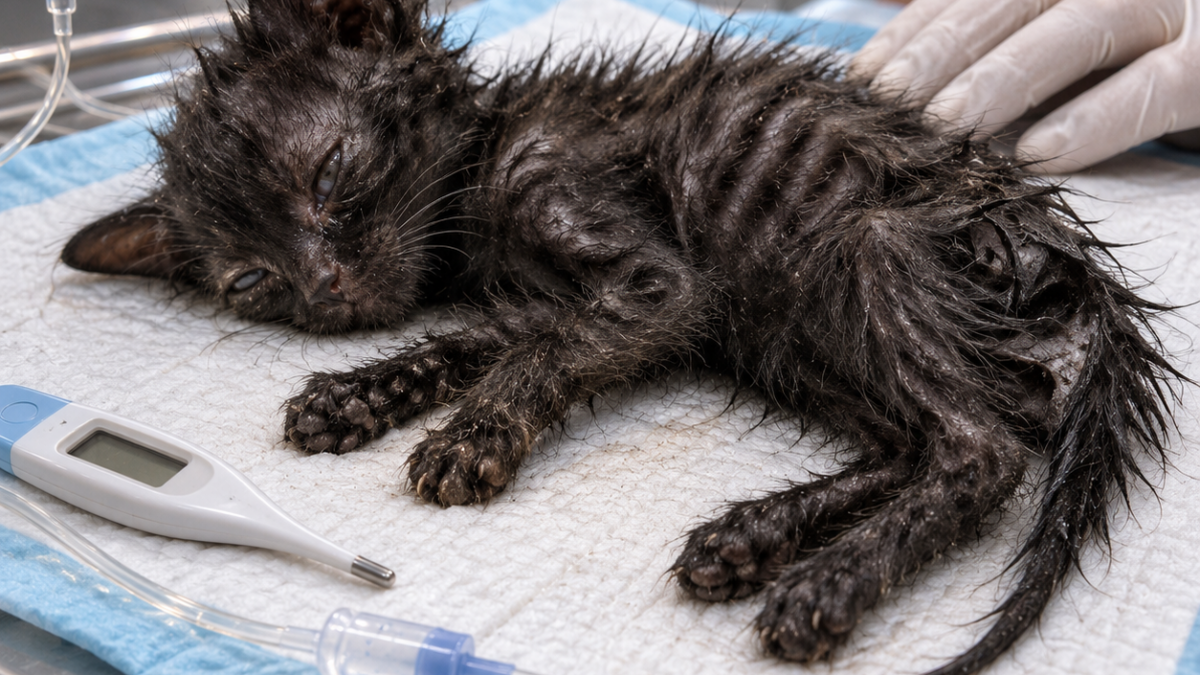
The nurses continued cleaning the wounds on his hind legs.
The maggots had damaged tissue but, mercifully, the injuries didn’t appear to have destroyed the limbs.
His eyes required medication.
He needed fluids.
Glucose support.
Nutritional support.
Monitoring.
Constant monitoring.
And after all of that, he still had to decide to fight.
I sat outside the isolation area while one of the nurses attempted to feed him.
She came out twenty minutes later.
“He won’t eat.”
My stomach sank.
“Nothing?”
“He licked a little, then stopped.”
“Can you force him?”
“We have to be careful.”
“Why?”
“He’s weak. We don’t want him aspirating food.”
I pressed both palms against my face.
“I found him. I brought him here. And now I can’t do anything.”
The nurse sat beside me.
“You brought him here.”
“Yes.”
“That’s not nothing.”
“It feels like nothing.”
“If he’d stayed beside that road another night, he probably wouldn’t be alive.”
Probably.
That word stayed with me.
I looked toward the isolation room.
“Does he have a name?”
The nurse smiled faintly.
“Not yet.”
I hadn’t even thought about it.
Maybe part of me had been afraid to name him.
Names create attachment.
Attachment creates fear.
But that logic had become ridiculous hours ago.
I was already attached.
“What do you call him on the chart?”
“Black kitten.”
I shook my head.
“No.”
The nurse laughed softly.
“No?”
“He needs something better than that.”
I thought for a moment.
When I’d found him, he had looked almost swallowed by the road itself.
Black fur.
Black eyes barely visible beneath infection and dirt.
But underneath all of it, he’d kept breathing.
“Shadow.”
The nurse repeated it.
“Shadow?”
I nodded.
“Because he was almost invisible.”
She smiled.
“Shadow it is.”
I visited the sanitation worker before going home.
He was still working near the hospital entrance.
The moment he saw me, he pushed his cart aside.
“The kitten?”
“Alive.”
His shoulders relaxed.
“Good.”
“But very sick.”
I told him the basics.
Two viruses.
Wounds.
Low blood sugar.
He frowned.
“Poor little thing.”
“He has a name now.”
“What?”
“Shadow.”
The old man smiled.
“Good name.”
He looked toward the bushes.
“I kept thinking about him.”
“So did I.”
“Someone left him there?”
“I don’t know.”
He shook his head.
“I didn’t see where he came from. Just saw him crawl out.”
That question began following me.
Where had Shadow come from?
A month-old kitten did not travel far alone.
Especially not one that sick.
Was there a mother nearby?
Other kittens?
Had he been born behind the hospital?
Had someone dumped him?
I called an animal rescue group that evening.
The volunteer promised to search the bushes and drainage areas around the hospital.
They found no mother.
No siblings.
No nest.
Nothing.
That made me more uneasy.
But Shadow was still alive.
That was what mattered first.
The next morning, I called the clinic at 6:12.
The receptionist laughed when she answered.
“I was wondering when you’d call.”
“How is he?”
“Wait.”
My heart pounded.
“Is something wrong?”
“No.”
I heard papers moving.
“He’s standing.”
I sat straight up.
“What?”
“He stood for a few seconds.”
“On his own?”
“Yes.”
I started crying.
My husband appeared in the doorway.
“What happened?”
I put the phone on speaker.
The nurse continued.
“He’s still weak. Don’t get too excited.”
Too late.
“He stood.”
“He did.”
“Did he eat?”
A pause.
“No.”
My happiness deflated slightly.
“We’re still working on that.”
“When can I see him?”
“Later this morning.”
I arrived with my hospital bag still in the trunk because everyone kept reminding me I could go into labor at any time.
My husband had started telling people I was the only woman he knew who might go from an animal isolation ward directly to the maternity ward.
He wasn’t wrong.
When I saw Shadow, I barely recognized him.
Not because he looked healthy.
He didn’t.
But the worst of the dirt was gone.
The maggots were gone.
His black fur had been gently cleaned and dried.
His eyes still looked swollen, but they were more open.
He was standing in the corner of the enclosure.
Trembling.
But standing.
“Shadow.”
His head moved.
He looked toward me.
Then something came out of his mouth.
“Meh.”
It was the weakest meow I’d ever heard.
I laughed.
“That’s terrible.”
He meowed again.
One nurse smiled behind me.
“He does that when he sees people now.”
“Good.”
Shadow took one step.
His legs trembled.
Another.
Then he sat.
“That’s enough.”
He looked offended.
For several minutes, I sat outside his enclosure while he watched me.
I wasn’t allowed to touch him casually because of the isolation protocol.
That hurt more than I expected.
He had spent who knew how long without comfort.
Now I was only a few feet away and still couldn’t simply pick him up.
“You’re going to get out of there,” I told him.
He blinked.
“Then someone’s going to spoil you.”
I hadn’t yet decided who that someone would be.
That problem had been waiting quietly in the background.
I was thirty-eight weeks pregnant.
My due date was approaching.
Our apartment was about to become a completely different place.
Newborn cries.
Sleepless nights.
Visitors.
Feeding.
Diapers.
My husband and I had prepared for a baby.
Not an immunocompromised kitten recovering from two serious viral infections.
Even if Shadow survived, taking him home with me immediately might not be realistic.
I hated admitting that.
But loving an animal does not automatically mean your house is the safest possible place for them.
I began calling people I trusted.
Not random strangers.
People I knew.
People whose homes I had seen.
People whose attitude toward animals I understood.
Most already had pets.
Because Shadow had panleukopenia, introducing him into a home with unvaccinated cats would require enormous care.
Others couldn’t take him.
Then I called my friend Claire.
She and her husband, Daniel, had lost their senior cat almost a year earlier.
They had no other animals.
They lived in a quiet house.
Claire listened to the entire story.
Then she said:
“Send me his picture.”
I did.
Thirty seconds later, she called back.
“Oh no.”
“What?”
“I love him.”
I laughed.
“He’s disgusting.”
“He’s perfect.”
“He currently looks like a wet sock.”
“Still perfect.”
“He’s sick.”
“I know.”
“Really sick.”
“I heard you.”
“He’ll need medication.”
“Okay.”
“Follow-up appointments.”
“Okay.”
“He may have long-term problems.”
“Okay.”
I became quiet.
Claire asked:
“What are you afraid of?”
“Giving him to someone and finding out they weren’t ready.”
“I’m not taking him because he’s cute.”
I looked at the photograph.
Shadow stared back with enormous, tired eyes.
Claire continued.
“If the vet thinks we can handle his care, we’ll handle it.”
“We?”
“Daniel’s sitting beside me.”
In the background, I heard him say:
“Tell her I said yes before you did.”
I smiled.
“That’s a lie.”
“It is.”
For the first time since finding Shadow, I could imagine an ending that didn’t involve me trying to care for a newborn baby and a medically fragile kitten simultaneously.
But we weren’t there yet.
Shadow still wouldn’t eat properly.
That became the new battle.
The glucose had given him enough energy to stand.
Fluids helped.
Medication helped.
But his body needed calories.
A nurse named Jenny spent nearly forty minutes one afternoon trying different foods.
Recovery diet.
Kitten formula.
Soft canned food.
Nothing.
Shadow turned his head away.
“He has to eat,” I said.
“I know.”
“Why won’t he?”
“Calicivirus can cause oral pain.”
She gently opened his mouth.
There were small irritated areas inside.
“Sore?”
“Likely.”
My heart sank.
Every problem seemed to create another.
“Then how do you feed him?”
“Patience.”
Jenny blended a small amount of meat-based kitten food until it was almost liquid.
She placed a tiny amount near his lips.
Shadow resisted.
She waited.
Tried again.
He licked.
Stopped.
Another tiny amount.
Another lick.
Then a swallow.
Jenny smiled.
“There.”
I leaned closer to the glass.
“Again.”
She offered more.
Shadow swallowed.
Then another.
Slowly.
Carefully.
Five minutes later, he had eaten what looked like almost nothing.
Jenny looked delighted.
“That’s enough for now.”
“That’s enough?”
“For him? Yes.”
I realized recovery had its own scale.
A healthy animal eating a teaspoon was nothing.
Shadow eating a teaspoon was victory.
The next day, he ate more.
Then he used the litter tray.
On his own.
I received a photograph from the clinic.
Shadow standing inside the tray looking deeply offended at being photographed.
I showed my husband.
“This is the best picture I’ve ever seen.”
He stared.
“It’s a cat in a litter box.”
“You don’t understand.”
“I clearly don’t.”
“He got there himself.”
My husband kissed my forehead.
“I understand enough.”
That afternoon, Shadow walked toward me when I visited.
Not dragged.
Not stumbled.
Walked.
His steps were still careful.
But steady.
“Shadow.”
He meowed.
Louder now.
I put a gloved finger near the enclosure opening when the nurse allowed it.
He pushed his head against it.
One tiny touch.
My eyes filled.
“There you are.”
He began purring.
The vibration was faint.
But real.
Jenny looked at me.
“You’re going to cry again, aren’t you?”
“Probably.”
“You cry a lot.”
“I’m pregnant.”
“Good excuse.”
“Thank you.”
On day four, Shadow ate from a dish without help.
The clinic sent me a video.
At first, I didn’t understand what I was watching.
Then I saw his head buried in a small plate of canned food.
Eating.
Eagerly.
I watched the video twelve times.
Maybe twenty.
My husband eventually took my phone.
“He’s still eating if you stop watching.”
“Give it back.”
“No.”
“I carried your child for nine months.”
He handed it back immediately.
Shadow kept improving.
Not in a straight line.
One morning, he became lethargic again.
His temperature rose.
I felt the old terror return.
Dr. Bennett adjusted supportive treatment.
They monitored his white blood cell count closely.
By evening, he perked up.
The next morning, he ate.
The diseases were still serious.
No one used the word cured.
Not yet.
But he was fighting.
And now he had enough strength to fight.
That mattered.
Meanwhile, the rescue volunteers continued asking questions around the hospital.
An elderly sanitation worker wasn’t the only person who had noticed Shadow.
A security guard remembered seeing a motorcycle stop near the bushes early that morning.
A nurse leaving a night shift remembered hearing a kitten crying before sunrise.
Then someone found a small cardboard carrier farther inside the shrub line.
Not the box we’d used.
Another one.
The bottom was stained.
A few strands of black fur clung to the cardboard.
I stared at the photograph when the rescue sent it.
“Was he dumped?”
“Possibly.”
“Can we check cameras?”
“The hospital has cameras near the parking exit.”
That changed the story.
Until then, I had imagined Shadow crawling from some hidden colony.
Maybe his mother had died.
Maybe he’d become separated.
But a carrier suggested something else.
Animal control was notified.
I tried not to focus on it.
Shadow’s survival mattered more than revenge.
Still, anger has a way of finding room.
Two days later, I received a call.
An officer named Rebecca Sloan introduced herself.
“We reviewed video from around the hospital.”
I sat down.
“What did you find?”
“A motorcycle stopped near the service lane at approximately 4:37 in the morning.”
“Can you see Shadow?”
“Not clearly.”
“What can you see?”
“A man carrying a small box toward the bushes.”
My hand tightened around the phone.
“Then he leaves?”
“Yes.”
“With the box?”
“No.”
I closed my eyes.
“Can you identify him?”
“We’re working on it.”
“What about the motorcycle plate?”
“Partial.”
I looked toward the empty baby crib beside me.
“You’ll tell me?”
“When there’s something appropriate to tell you.”
I hated that answer.
But I understood.
Shadow didn’t know any of this.
His world consisted of food.
Medicine.
A litter box.
Nurses.
And increasingly loud opinions.
By day five, he had decided he hated having his eyes cleaned.
Jenny approached with gauze.
Shadow backed away.
“Don’t start.”
He meowed.
“You loved me yesterday.”
Another meow.
I laughed from outside the enclosure.
“Fight her.”
Jenny turned.
“Do not encourage my patient.”
Shadow swatted weakly at the gauze.
Jenny smiled.
“That’s actually a good sign.”
“He’s getting rude.”
“Rude is healthy.”
I added that phrase to my growing list of things I had never expected to believe.
Day six.
No IV fluids for part of the day.
He drank.
He ate.
He used the litter tray.
His breathing had improved.
The wounds on his hind legs were healing.
His eyes remained irritated but looked dramatically better.
The kitten I’d found with flies covering him now screamed when lunch was late.
“Is he going to make it?” I asked Dr. Bennett.
This time, he smiled before answering.
“I think he’s telling us he intends to.”
That night, I had contractions.
Real enough to send me back to the same hospital where I’d found Shadow.
False labor.
My baby apparently had a sense of humor.
While I sat in maternity triage, I looked out toward the road.
The bushes were visible from one window.
Somewhere down there, less than a week earlier, Shadow had been dying.
My husband followed my gaze.
“You’re thinking about the cat.”
“No.”
“You are.”
“Maybe.”
“We are literally here because you might have a baby.”
“And Shadow ate an entire can today.”
He stared at me.
“I’ve lost you.”
“You married me.”
“Fair.”
The contractions slowed.
We went home.
The next morning, I visited Shadow.
“You and the baby need to coordinate schedules.”
He meowed.
“One patient at a time.”
By day seven, Dr. Bennett gave me news I’d been waiting for.
“If he continues like this through tonight, he can leave tomorrow.”
I stared.
“Leave?”
“He’s eating independently. Hydration is stable. He no longer requires IV support. His wounds can be managed at home. He’ll still need medication, isolation precautions, follow-up testing, and careful nutrition.”
“Claire can take him?”
“If she understands the requirements.”
“She does.”
“I want to speak to her directly.”
“Please.”
Claire and Daniel came to the clinic that afternoon.
They weren’t allowed to casually handle Shadow yet, but they stood outside the isolation area.
Claire saw him.
Her face crumpled.
“Oh, he’s tiny.”
Shadow looked at her.
Meowed.
Claire covered her mouth.
“That’s it.”
Daniel laughed.
“You’re done.”
“I was done from the picture.”
Dr. Bennett spent almost an hour explaining everything.
Panleukopenia precautions.
Calicivirus.
Cleaning.
Medication schedule.
Nutrition.
Return visits.
Warning signs.
Potential relapse.
When he finished, he asked:
“Still interested?”
Claire looked insulted.
“We came here to take him home.”
“Not today.”
“Tomorrow.”
“If he remains stable.”
“Then tomorrow.”
Daniel nodded.
“We’ll be ready.”
I watched them.
The fear inside me began loosening.
I couldn’t take Shadow home.
That had felt like failure.
Now I understood something.
Rescue isn’t ownership.
Sometimes loving an animal means recognizing that the best home isn’t yours.
The next morning, Shadow was discharged.
Eight days after I had found him.
Eight days.
It felt like months.
The first kitten I’d carried into the clinic could barely raise his head.
The kitten leaving walked out of his enclosure on steady little paws.
Still thin.
Still recovering.
But alive.
He saw me.
“Meow!”
I laughed.
“Yes, I know.”
Jenny carried him in a clean carrier.
I held the medication bag.
Claire and Daniel stood beside me.
Dr. Bennett reviewed instructions one last time.
“Medication at these times.”
Claire nodded.
“Food?”
“Small frequent meals initially.”
“Eyes?”
“Continue cleaning and medication as prescribed.”
“When do you want to see him?”
“Three days.”
“What if anything changes?”
“Call immediately.”
Claire took the paper.
“I will.”
Then she looked at me.
“Are you sure?”
The question hurt.
Not because I wanted to change my mind.
Because part of me wanted two impossible things at once.
I wanted to keep him.
I wanted him to have the quiet, stable recovery environment Claire could give him.
My baby kicked.
Decision made.
“I’m sure.”
Claire hugged me carefully around my enormous belly.
“We’ll send pictures every day.”
“Every hour.”
She laughed.
“Reasonable.”
I crouched awkwardly beside the carrier.
Shadow walked toward the door.
I slipped one finger through the gap.
He pressed his face against it.
“Hey, little man.”
He purred.
“You don’t know this yet, but you won.”
His eyes were clear enough now that I could actually see their color.
Golden-green.
Bright.
Alive.
I swallowed.
“Be good.”
Shadow bit my finger.
I laughed through tears.
“Or don’t.”
Claire carried him toward the car.
I stood outside the clinic watching them leave.
For the first time since finding him, I wasn’t responsible for what happened next.
That terrified me.
But Shadow was going home.
A real home.
Not bushes.
Not a roadside.
Not an isolation cage.
Home.
Claire sent a photograph twenty minutes later.
Shadow inside a soft bed.
Another thirty minutes after that.
Shadow eating.
Then:
**He screamed because I stopped petting him.**
I replied:
**Healthy.**
An hour later:
**He used the litter box.**
**Genius.**
That evening:
**He fell asleep on Daniel.**
The picture showed Shadow curled against Daniel’s chest.
His little black body looked almost weightless.
Daniel’s hand covered most of his back.
I stared at the photograph until my vision blurred.
My husband sat beside me.
“You okay?”
“Yes.”
“You’re crying.”
“Yes.”
“Those answers don’t match.”
“They do today.”
Three days later, Shadow returned for his follow-up.
Claire brought him.
I met them at the clinic.
He had gained weight.
Not much.
But enough.
Dr. Bennett smiled.
“Look at that.”
Shadow tried to climb out of the carrier.
“Apparently he’s feeling better.”
His wounds were healing.
No new maggots.
No fever.
Eyes improving.
Eating well.
Hydrated.
His bloodwork showed progress.
Not perfect.
Progress.
That became the word.
The case with animal control continued in the background.
The partial motorcycle plate was eventually matched to a man named Travis Cole.
He lived about three miles from the hospital.
Officer Sloan called me.
“We’ve interviewed him.”
“And?”
“He admits the kitten came from his property.”
My heart accelerated.
“His kitten?”
“He says a stray cat had a litter behind his building.”
“Where’s the mother?”
“Unknown.”
“Other kittens?”
She paused.
“There were three.”
My stomach sank.
“Three including Shadow?”
“Yes.”
“What happened to the other two?”
“One allegedly died.”
“And the other?”
“Missing.”
I closed my eyes.
“Did he take any of them to a vet?”
“No.”
“Why did he bring Shadow to the hospital?”
“He says he thought someone there would help.”
I laughed without humor.
“By putting him in bushes at four thirty in the morning?”
“That’s his statement.”
“Did he tell anyone?”
“No.”
“Leave a note?”
“No.”
“Walk inside?”
“No.”
“So he dumped a dying kitten near a hospital and drove away.”
“That is part of what investigators are reviewing.”
I wanted something immediate.
Arrest.
Punishment.
A clear villain receiving a clear consequence.
Instead, there were interviews.
Reports.
Evidence.
Real life again.
Officer Sloan continued.
“We searched the property with his consent.”
“And?”
“Several cats.”
My anger became colder.
“How many?”
“Nine.”
“Healthy?”
“Mixed condition.”
I stood.
“Meaning?”
“Some appear healthy. Others need care.”
“Are they staying there?”
“No.”
Relief.
Animal control and a rescue partner removed multiple cats for veterinary evaluation.
One was an adult black female.
Recently lactating.
Possibly Shadow’s mother.
DNA testing wasn’t considered necessary for the case, and no one could prove the relationship.
But when I saw her photograph, something inside me twisted.
Black coat.
Golden-green eyes.
Thin.
Older than Shadow, obviously.
But similar.
She survived.
That mattered.
The missing kitten was eventually found too.
Not alive.
I didn’t ask for details.
I couldn’t.
Shadow had been the only one of that litter to make it into proper medical care in time.
That knowledge changed something in me.
His survival stopped feeling merely lucky.
It felt almost impossible.
Claire called that night.
“Are you okay?”
I had told her about the investigation.
“No.”
“Want to see something?”
She sent a video.
Shadow running.
Not walking.
Running.
Across the living-room floor.
Tiny paws moving so fast his body looked slightly out of control.
He reached a toy mouse.
Pounced.
Rolled over.
Got back up.
Ran again.
I watched three times.
Then five.
The kitten who had once struggled to breathe now had more energy than balance.
Claire’s voice came through the phone.
“Still not okay?”
“Better.”
“Good.”
Shadow gained weight quickly after that.
His face filled out.
His black coat became glossy.
The wounds on his back legs closed.
The fur slowly grew over the shaved and damaged areas.
His eyes cleared.
His breathing normalized.
He became obsessed with food.
Not surprising.
Claire had to slow him down because he would try to eat as though every meal might disappear forever.
At first, he guarded the bowl.
Daniel would walk past and Shadow would hunch over the food.
No growling.
Just urgency.
So they worked patiently.
Same place.
Same times.
Enough food.
Every day.
Eventually, Shadow stopped rushing.
Not completely.
He remained an enthusiastic eater his entire life.
But he learned something important.
There would be another meal.
Security isn’t only having food.
It’s believing food will still exist tomorrow.
At six weeks after rescue, I went into labor.
For real this time.
My son was born healthy.
Seven pounds, four ounces.
The first photograph Claire sent after hearing the news showed Shadow sitting beside a tiny stuffed animal.
The message read:
**Shadow says congratulations to his fellow hospital baby.**
I laughed so hard my stitches hurt.
Two weeks later, after my doctor cleared me for a short visit, Claire brought Shadow over in his carrier.
We kept everything carefully managed because of his medical history and because my newborn was so young.
Shadow stepped out.
He was nearly twice the size he had been when I found him.
Not large.
Just no longer frighteningly tiny.
He saw me.
Stopped.
Then meowed.
I cried immediately.
Claire laughed.
“You two are ridiculous.”
I sat on the floor.
Shadow walked over.
He sniffed my hand.
Then climbed partly into my lap.
My baby slept in the bassinet several feet away.
For a moment, I looked at them both.
Two lives that had felt terrifyingly fragile during the same week.
One human.
One feline.
Both breathing easily now.
I touched Shadow’s head.
“You gave me a heart attack before he even arrived.”
Shadow purred.
My son slept.
Claire took a photograph.
It became one of my favorites.
Not because it was dramatic.
Because nothing was wrong.
A woman recovering from childbirth.
A healthy baby asleep.
A black kitten sitting beside her.
Ordinary.
I had learned to worship ordinary.
The criminal case against Travis wasn’t dramatic either.
The evidence did not support every terrible possibility my anger imagined.
There was no proof he had intentionally injured Shadow.
No proof he had caused the viral infections.
No proof he’d put the maggots there.
What investigators could document was neglect, failure to obtain needed care for animals under his control, and abandonment-related violations.
Veterinary records from the seized cats supported broader concerns about neglect.
Travis claimed he had been overwhelmed by the number of cats around his property.
The prosecutor responded with something simple.
Help existed.
Rescues existed.
Animal-control services existed.
Walking into the hospital existed.
Leaving a critically ill kitten hidden beside bushes before sunrise was not an acceptable surrender plan.
That distinction mattered.
I attended one hearing.
Travis looked nothing like the monster I had built inside my head.
He looked ordinary.
Work boots.
Clean shirt.
Tired face.
That made me angrier.
We like cruelty to look exceptional.
Sometimes it is simply convenience.
The judge asked him:
“Did you know the kitten was sick?”
Travis hesitated.
“Yes.”
“Did you observe wounds?”
“Yes.”
“Did you see flies around the animal?”
“Yes.”
My fingers curled.
“Why did you not take the kitten inside the hospital or to a veterinary facility?”
“I didn’t have money.”
The judge looked at him.
“Entering a hospital building to ask for assistance does not require payment.”
Silence.
“I thought someone would see him.”
The judge’s expression didn’t change.
“Eventually someone did.”
My eyes burned.
Yes.
Someone did.
Me.
But what if I had taken another exit?
What if my appointment had ended twenty minutes later?
What if the sanitation worker hadn’t noticed Shadow crawling from the bushes?
What if the sun had become hotter?
What if the flies had done more damage?
Leaving an animal where someone *might* notice is gambling with a life.
Shadow had survived the gamble.
That didn’t make the gamble acceptable.
Travis ultimately accepted responsibility under the applicable neglect and abandonment charges.
The result included fines, restitution toward veterinary and rescue expenses, mandatory animal-care education, and restrictions on keeping animals during the period ordered by the court and local animal-control authorities.
The remaining cats seized from the property were transferred through rescue channels as allowed.
Some needed treatment.
Some were placed in foster homes.
The adult black female recovered.
She was eventually adopted.
That became the most satisfying part of the case.
Not Travis paying money.
Not seeing him in court.
The empty property.
No sick cats left behind.
No next Shadow crawling into bushes waiting for luck.
People sometimes asked whether I felt like justice had been done.
I never knew how to answer.
No sentence could return the kitten who didn’t survive.
No fine could erase the maggots from Shadow’s legs.
No court order could give him back the days he spent starving.
Justice isn’t a refund.
But it can close a door.
It closed the door on more neglected cats remaining in that situation.
That was enough for me.
Shadow knew none of this.
He had become too busy destroying Claire’s house.
At three months old, he discovered curtains.
At four months, toilet paper.
At five months, houseplants.
Claire called me one afternoon.
“Your son is terrible.”
“My human son?”
“No.”
“Then he is legally your problem.”
“Shadow just knocked over a lamp.”
“Was it expensive?”
“That’s not the point.”
“Sounds like something the owner should deal with.”
She hung up.
Then sent me a picture of Shadow sleeping against her neck.
Caption:
**I hate him.**
I replied:
**Clearly.**
Daniel became Shadow’s favorite climbing structure.
Whenever Daniel sat on the couch, Shadow climbed his chest.
Shoulder.
Head.
Sometimes he simply sat across the back of his neck like a scarf.
“Why?” Daniel asked.
Claire answered:
“Because you allow it.”
“I do not.”
Shadow climbed higher.
“You absolutely do.”
The first anniversary of Shadow’s rescue came quickly.
Claire wanted to celebrate.
I brought a small toy.
The old sanitation worker from the hospital came too.
I had kept my promise and updated him throughout Shadow’s recovery.
His name was Mr. Park.
The moment he entered Claire’s home, Shadow hid.
Mr. Park laughed.
“He doesn’t remember me.”
“Maybe not.”
Five minutes later, Shadow emerged.
He sniffed the old man’s shoes.
Then his hand.
Mr. Park crouched slowly.
“Little one.”
Shadow rubbed against him.
The man’s eyes filled.
“That tiny?”
I held my hands a few inches apart.
“Smaller.”
He shook his head.
“I thought he would die.”
“So did I.”
Shadow climbed onto his lap.
Mr. Park laughed and cried at the same time.
“You were ugly.”
Claire gasped.
“Don’t insult him in his own house.”
Shadow purred.
Mr. Park stroked his glossy black fur.
“Now handsome.”
That Found Day became a tradition.
Every year, Claire sent a photograph.
Shadow beside a small treat.
Year one.
Year two.
Year three.
He became a beautiful adult cat.
Longer body than we expected.
Bright eyes.
Black coat with a tiny white patch beneath his chin that had been invisible under the dirt when I found him.
He remained vocal.
He greeted people.
Demanded food.
Talked to birds.
Argued when closed doors separated him from humans.
The kitten who once barely managed a rasp became an animal who apparently believed silence was unacceptable.
At two years old, he developed his favorite habit.
He waited by the front door when Claire and Daniel came home.
Every day.
Daniel would open the door.
Shadow would meow loudly.
As if reporting a serious emergency.
“What happened?”
“Meow!”
“Were you abandoned for seven hours?”
“MEOW.”
“Did nobody feed you?”
“Meow.”
Claire would point toward the automatic feeder.
“Don’t listen to him.”
Shadow remained unconvinced by facts.
My son grew alongside him.
When he was old enough to understand pictures, I showed him the photograph of Shadow in the clinic.
“This is Shadow?”
“Yes.”
“He’s tiny.”
“He was.”
“Why was he dirty?”
“He was very sick and alone.”
My son looked serious.
“Who helped him?”
“A lot of people.”
“You?”
“I found him.”
He considered that.
Then asked the kind of question children ask because adults overcomplicate everything.
“Why didn’t you keep him?”
I smiled.
“Because Claire’s house was better for him then.”
He frowned.
“But you loved him.”
“Yes.”
“So you gave him away?”
That phrase hurt more than it should have.
I thought carefully.
“I helped him get home.”
My son seemed satisfied.
That was exactly what had happened.
I hadn’t lost Shadow.
I had carried him through one part of the journey.
Claire and Daniel carried him through the rest.
At four, Shadow had a health scare.
He stopped eating.
Claire called me immediately.
My body reacted as if we were back at day one.
“Take him in.”
“We’re already driving.”
Bloodwork.
X-rays.
Examination.
Fortunately, it was gastrointestinal inflammation, treatable.
Not panleukopenia again.
Not calicivirus destroying him.
Not the end.
But for two nights, Claire slept beside him on the floor.
The second night, Shadow climbed onto her pillow and slept against her face.
The next morning, he ate.
Claire sent me:
**He finished half the bowl.**
I cried.
Years had passed and apparently a cat eating could still make me cry.
Some experiences permanently change your definition of good news.
Shadow recovered.
At six years old, he became slightly overweight.
Dr. Bennett—still his veterinarian—looked at the scale.
“Interesting.”
Claire frowned.
“What?”
“The first time he was here, we were desperate for every ounce.”
“And now?”
“Now I’m telling you to stop feeding him every time he screams.”
Shadow meowed from the examination table.
Claire pointed.
“See?”
Dr. Bennett laughed.
“Manipulation.”
I loved the irony.
Skin and bones.
Then healthy.
Then round enough for a diet discussion.
That was a problem I welcomed.
Mr. Park retired.
We visited him once.
Shadow came in a carrier.
The old man lived in a small apartment with his wife.
When we opened the carrier, Shadow walked straight out.
No hiding.
He sniffed the room.
Then climbed onto the couch.
Mr. Park sat beside him.
“I found the box.”
I looked at him.
“What?”
“The day you found him.”
He smiled.
“I found the cardboard box for you.”
“I remember.”
“You picked him up.”
“You helped.”
He waved the compliment away.
“No. I gave you a box.”
“Sometimes a box is exactly what’s needed.”
His wife laughed.
“He tells this story all the time.”
Mr. Park touched Shadow’s back.
“I thought maybe he wouldn’t survive the drive.”
“So did I.”
Shadow rolled onto his side.
Mr. Park rubbed his cheek.
“Strong.”
One tiny word.
Strong.
It was almost impossible to connect that word with the creature beside the road.
But Shadow had earned it.
Years passed.
My son started school.
Shadow grew into middle age.
Claire and Daniel moved once, and Shadow spent the first three days complaining about every room.
Then chose the sunniest window.
His life remained ordinary.
Exactly what I wanted.
Sometimes I saw rescue stories online where people focused entirely on the suffering.
Before.
Pain.
Wounds.
Fear.
I understood why.
Those images stop people.
But I began thinking more about the after.
Shadow wasn’t important because he’d nearly died.
He was important because he lived.
The after was where the meaning was.
Sun on black fur.
A warm bed.
Dental cleanings.
Annual vaccines as medically appropriate.
Diet arguments.
Scratched furniture.
Hair on clothing.
Vet bills.
Birthday treats.
Being annoyed because the cat woke you at five.
Ordinary responsibility.
That’s the life he almost lost.
When Shadow was nine, Claire’s husband became ill.
Nothing immediately fatal, but serious enough to require surgery and a difficult recovery.
Daniel spent weeks at home.
Shadow rarely left him.
He slept beside Daniel’s hip.
Sat near him while he ate.
Followed him slowly down the hallway.
One night, Daniel called me.
“Remember when you said you couldn’t keep him because you were having a baby?”
“Yes.”
“Thank you.”
I laughed.
“That’s random.”
“No.”
His voice changed.
“This cat hasn’t left me in three weeks.”
I became quiet.
“He knows you’re sick.”
“I think so.”
“Or he appreciates that you can’t get away.”
“That sounds more like him.”
We laughed.
Then Daniel said:
“I needed him.”
Those words stayed with me.
We often talk about rescued animals as recipients.
They receive food.
Medicine.
Homes.
But time changes the direction of care.
Eventually, the creature you once protected becomes the one sitting beside you when your own body fails.
Maybe that’s why rescue feels larger than a transaction.
The debt never stays one-sided.
Daniel recovered.
Shadow resumed his normal schedule of pretending not to care.
At eleven, Shadow’s kidney values began changing.
Early chronic kidney disease.
Manageable.
Diet.
More water.
Regular monitoring.
Claire called me after the appointment.
“He’s getting old.”
“No.”
“He is.”
“No.”
She laughed sadly.
“That isn’t a medical argument.”
“He was one month old last week.”
“He was one month old twelve years ago.”
I hated mathematics.
Shadow still looked good.
A little gray around the muzzle if the light hit him.
Slightly less muscle.
More sleep.
But still Shadow.
Still loud.
Still hungry.
Still waiting by the door.
The treatment worked for several years.
Then age accelerated.
At fourteen, arthritis appeared.
Steps were placed beside the couch.
Shadow ignored them.
Tried to jump.
Failed.
Looked insulted.
Eventually used the steps when nobody appeared to be watching.
At fifteen, his hearing diminished.
He stopped responding to the sound of the treat drawer from the next room.
Claire found this more upsetting than any blood test.
“That’s his superpower.”
“He can still smell them.”
Shadow appeared.
We laughed.
“See?”
At sixteen, his kidneys worsened.
Fluids became part of his routine.
Medication.
Special food.
More appointments.
Claire never complained about the work.
Neither did Daniel.
One evening, I remembered Travis saying he didn’t have money.
It was true that veterinary care can be expensive.
Sometimes impossibly expensive.
But the most haunting part of his story had never been poverty.
It was the refusal to ask.
To walk inside.
To call.
To surrender properly.
To say:
**I can’t do this alone.**
There is no shame in needing help.
The danger begins when pride, inconvenience, or indifference becomes more important than the life depending on you.
Shadow had survived because strangers did the opposite.
Mr. Park noticed.
I stopped.
The clinic treated.
Claire and Daniel opened their home.
A rescue searched.
Animal control investigated.
One tiny cat survived because responsibility was shared.
At sixteen and a half, Shadow stopped eating one morning.
Claire called me.
Her voice told me before her words did.
“Can you come?”
I went.
Shadow was in his favorite bed near the window.
Black fur now threaded with gray.
His body had become thin again.
Not like before.
Not starvation.
Age.
Disease.
Time.
Still, seeing his hips sharper pulled me back to the road.
I sat beside him.
“Hey.”
Shadow opened his eyes.
Golden-green.
Cloudier now.
But his.
He meowed.
Weak.
I laughed and cried.
“Still talking.”
Claire sat on the other side.
Daniel stood behind us.
The veterinarian came later that afternoon.
We had tried fluids.
Appetite medication.
Everything reasonable.
His kidneys were failing.
His body was tired.
Claire asked the question no one wants to ask.
“Are we keeping him here for us?”
The veterinarian was quiet.
Then nodded gently.
“I think he’s telling you he’s ready.”
Claire broke.
Daniel held her.
I stroked Shadow’s head.
Sixteen years earlier, I’d looked at his belly beside the road just to make sure it still moved.
Now every breath was visible again.
Slower.
Heavier.
I thought it would feel like the same moment.
It didn’t.
The kitten beside the road had been robbed of a chance.
The old cat in front of me had received his.
Sixteen years.
Home.
Family.
Food.
Love.
Annoying everyone.
That difference mattered.
Claire placed Shadow in the soft bed.
Daniel sat on the floor.
I stayed near his face.
The veterinarian prepared the first medication.
Claire whispered:
“I’m sorry.”
I looked at her.
“For what?”
“I can’t fix this.”
“You already did.”
She shook her head.
I pointed gently toward Shadow.
“You fixed sixteen years.”
Her face collapsed.
The sedative entered.
Shadow relaxed.
His breathing became easy.
For the first time in days, there was no tension in his body.
I touched the tiny white patch beneath his chin.
“Do you remember me?”
His eyelids moved.
Probably reflex.
I chose not to care.
“You fit in my hand.”
Claire laughed through tears.
“He hasn’t fit in anything for years.”
“That’s true.”
Shadow had once become mildly overweight enough for three separate diet discussions.
A perfect legacy.
Daniel rubbed his back.
“You were the loudest cat I’ve ever known.”
Shadow remained quiet.
Claire whispered:
“Good boy.”
The veterinarian asked if they were ready.
No one ever is.
Claire nodded.
The final medication went in.
I put my hand on Shadow’s side.
The same place I had watched for movement beside the hospital road.
His chest rose.
Fell.
Rose.
Then settled.
No next breath.
The veterinarian listened.
Waited.
Then whispered:
“He’s gone.”
Nobody moved.
For several minutes, the room was completely silent.
Shadow would have hated that.
Eventually Daniel said:
“He’d be yelling for dinner by now.”
We laughed.
Then cried harder.
Claire buried her face against Shadow’s fur.
I kept touching his head.
Sixteen years disappeared.
I could see the road.
Flies.
A cardboard box.
Mr. Park holding it open.
That tiny black body in my palms.
“Will he live?”
The old sanitation worker had asked.
Yes.
That was the answer.
Not forever.
But yes.
Shadow lived.
After he died, Claire gave me his first collar.
Tiny black collar.
Barely large enough to fit around my wrist.
She kept the one he’d worn as an adult.
We divided his history the way families divide photographs.
Not ownership.
Memory.
Mr. Park had already passed away by then.
His wife sent us a message after hearing about Shadow.
She wrote:
**My husband always remembered that kitten. He said it was one of the best things he ever helped do.**
I cried harder over that message than I expected.
A cardboard box.
That was all Mr. Park thought he’d contributed.
But rescue is built from small acts.
Someone finds a box.
Someone makes a call.
Someone drives.
Someone feeds one teaspoon.
Someone says yes to adoption.
No single act needs to be heroic.
Together, they become a life.
The rescue group established a small emergency fund in Shadow’s name.
It focused on neonatal and critically ill kittens.
Glucose.
Formula.
Emergency veterinary treatment.
Wound care.
Isolation costs.
The first kitten it helped was a tabby found inside an engine compartment.
Then a white kitten with pneumonia.
Then four orphaned siblings.
I received updates.
Each time, I thought about Shadow swallowing that first bit of glucose from a syringe.
Tiny mouth.
Desperate hunger.
That had been the beginning.
Years after his death, his name was still helping someone begin.
The legal case against Travis had become irrelevant long before that.
His punishment was part of the story.
But not the ending.
For a while, I had wanted revenge.
I wanted him to understand exactly how close Shadow came to dying.
I wanted him forced to look at the photographs.
I wanted him to feel shame.
Then years passed.
Shadow grew.
My son grew.
Claire and Daniel built thousands of ordinary days around that cat.
And eventually, I realized the best revenge had already happened.
Travis left Shadow in bushes because he didn’t want the responsibility.
Shadow became someone’s responsibility for sixteen years.
And they considered it a privilege.
He left Shadow without telling anyone.
Shadow spent the rest of his life surrounded by people who noticed when he skipped one meal.
Travis treated him as something inconvenient.
Claire rearranged vacations around his medication.
Daniel slept on the floor when Shadow was sick.
I received birthday photographs every year.
Mr. Park told his story until the end of his life.
A rescue fund eventually carried his name.
The kitten someone tried to make disappear became impossible to forget.
That was enough.
More than enough.
My son is old enough now to understand the whole story.
Not just the pretty version.
One evening, he found the original photograph.
Shadow beside the road.
Dirty.
Thin.
Eyes infected.
He stared for a long time.
“That’s really him?”
“Yes.”
“He looks dead.”
“Almost.”
“Did you know he’d survive?”
“No.”
“Then why did you pick him up?”
The question surprised me.
“What else was I supposed to do?”
My son shrugged.
“Some people would’ve walked past.”
I looked at the photograph.
Maybe.
Probably.
Not because everyone is cruel.
People are afraid.
Busy.
Unsure.
They think they lack experience.
They assume someone else will stop.
I had been thirty-eight weeks pregnant.
Exhausted.
Unprepared.
I had every practical reason to keep moving.
But there are moments when the question isn’t:
**Am I the perfect person to help?**
It’s:
**Am I the person who is here?**
That day, I was.
So I stopped.
That’s all.
I stopped.
Then Mr. Park found a box.
The veterinary team took over.
Claire and Daniel opened their home.
Shadow did the rest.
My son looked at another photograph.
Adult Shadow in a sunny window.
Round face.
Bright eyes.
“He’s fat here.”
I laughed.
“Do not disrespect the dead.”
“He is.”
“He was slightly overweight.”
“He’s fat.”
“Fine.”
We laughed.
That photograph remains framed in my house.
Not the roadside picture.
I keep that one privately because it matters.
But suffering shouldn’t be the image that defines him.
On my shelf, Shadow is healthy.
Sitting upright.
Black fur shining.
Mouth open in the middle of a meow.
Probably complaining.
That’s him.
Not the maggots.
Not the infected eyes.
Not the viruses.
Not the man who left him.
Shadow.
A loud, stubborn, greedy, affectionate black cat who survived long enough to become old.
There are few outcomes more beautiful than an animal once expected to die becoming inconveniently elderly.
More medications.
More steps.
More vet appointments.
More special food.
More time.
Every inconvenience is evidence of survival.
The last time I visited Claire after Shadow was gone, his bed was still beside the window.
Empty.
She hadn’t moved it.
“I know I should.”
“No.”
I sat beside her.
“You’ll move it when you’re ready.”
She touched the edge.
“He used to scream at me from here.”
“I know.”
“Sometimes I think I hear him.”
“I know.”
Daniel came in holding an old toy mouse.
One ear missing.
He placed it inside the bed.
“We found this under the couch.”
Claire laughed.
“Of course.”
We sat there quietly.
The room felt incomplete.
But not empty.
Sixteen years had filled it too thoroughly for that.
On my way home, I drove past the hospital.
I hadn’t used that road in a long time.
The bushes had been replaced.
New landscaping.
Cleaner sidewalk.
Different trash containers.
Mr. Park wasn’t there.
Shadow wasn’t there.
Nothing looked the same.
I parked anyway.
Walked to roughly the place where I had first seen him.
Cars passed.
People entered and left the hospital.
Doctors.
Patients.
Families.
Someone was crying.
Someone else was laughing into a phone.
Life arriving and leaving through the same doors.
I stood beside the curb.
Sixteen years earlier, I had been thirty-eight weeks pregnant, tired and thinking only about going home.
Then I saw flies.
A tiny movement.
One breath.
I placed my hand against my chest.
“Hey, Shadow.”
The wind moved through the shrubs.
Ridiculous.
But I smiled.
“I told you someone would spoil you.”
He had been spoiled.
Completely.
Food.
Beds.
Toys.
Warm windows.
Medical care.
People rearranging their lives around him.
A family waiting every time he woke.
That’s the ending that mattered.
Someone left a month-old kitten beside a road when he was covered in wounds and struggling to breathe.
They may have believed his life was already finished.
They were wrong by sixteen years.
Sixteen years of mornings.
Sixteen years of meals.
Sixteen years of meowing.
Sixteen years of being expected.
Wanted.
Missed when he wasn’t in the room.
The man who left him eventually faced consequences.
But Shadow’s greatest revenge wasn’t punishment.
It was longevity.
He lived long enough for the worst day of his life to become one small story from his childhood.
He lived long enough to forget hunger.
Long enough to trust hands.
Long enough to become demanding.
Long enough to grow gray.
Long enough that when his life finally ended, nobody could say he had been thrown away.
His family was holding him.
I sometimes think back to that first drive.
The cardboard box on the passenger seat.
My hand reaching over at every red light.
“Stay with me.”
At the time, I meant:
Stay with me for another minute.
Another breath.
Until the clinic.
Until someone more qualified can help.
I didn’t know he would stay for sixteen years.
But he did.
And when he finally couldn’t stay anymore, he wasn’t beside a road.
He wasn’t covered in flies.
He wasn’t alone.
He was warm.
He was old.
He was loved.
And after everything that tiny body had fought through during his first month of life, growing old was the victory none of us dared imagine.
The kitten I found struggling for each breath did not disappear into the bushes that morning.
He went home.
It simply took a few people—and one small cardboard box—to help him get there.








