PART 2: I Bought Land Outside the HOA—Then Their President Ordered Me Off a Footbridge That Was on My Deed
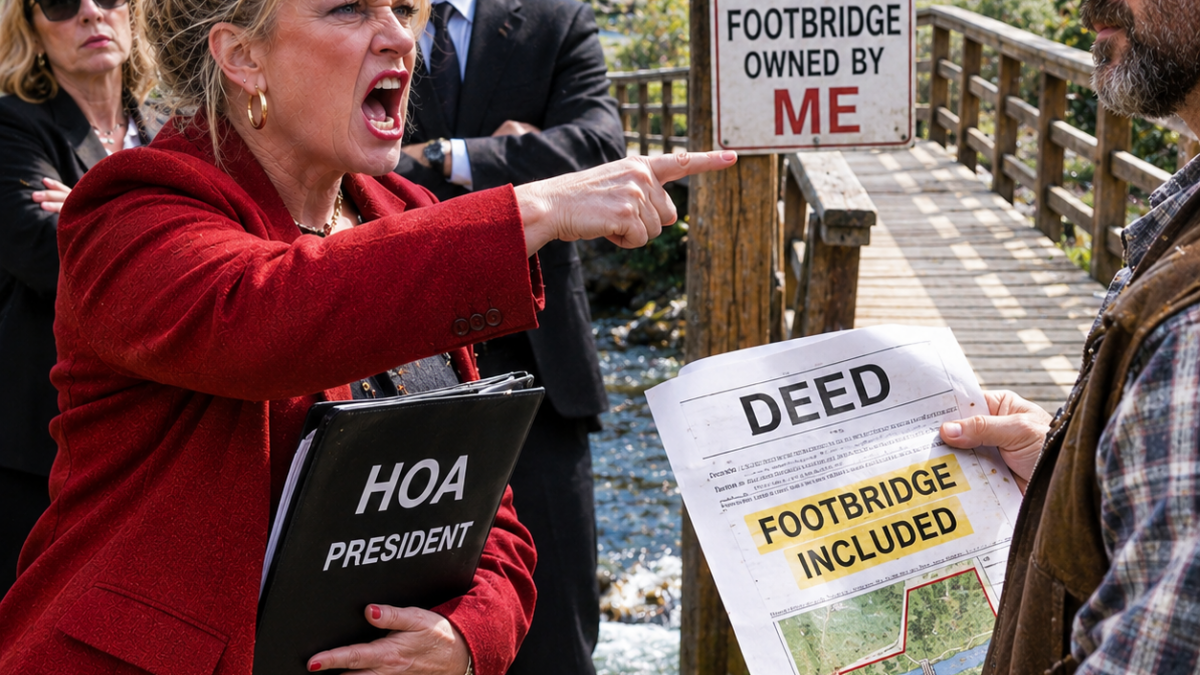
PART 2
I pulled the deed from the folder before Corbin had even finished speaking.
“Which paragraph?”
“Last page. Near the bottom.”
I flipped past the legal description, tax language, mineral reservations, utility references, and several clauses dense enough to make a normal person stop reading halfway through.
Then I found it.
At first, the sentence did not look important.
That is the thing about property documents. Life-changing language rarely comes with bold letters and arrows.
I read it once.
Then again.
Then a third time.
All structures, improvements, appurtenant access rights, and interests associated with the creek crossing located upon or serving the conveyed parcel are transferred with title unless expressly reserved herein.
I lowered the paper.
“Corbin.”
“I’m still here.”
“The bridge transferred with the parcel?”
“Potentially the ownership interest connected to it, yes.”
“Potentially?”
“I’m a surveyor, not your attorney.”
“You enjoy ruining good moments.”
“I’ve made a career of it.”
I stood and walked to the window.
From the cabin I could see part of the footbridge through the trees.
For three days, Marceline had been telling me I could not touch it.
Now the deed was telling me something very different.
“I need a lawyer.”
“Yes.”
“Before I do anything.”
“Especially before you do anything.”
I called Leah Grant, a real-estate attorney I had worked with on a commercial project several years earlier.
She agreed to review everything.
Her first instruction was simple.
“Do not cut locks, remove signs, close access, or confront anyone until I verify the chain of title.”
“There aren’t any locks.”
“Good.”
“Yet.”
She paused.
“Why did you say yet?”
“Because Marceline likes escalation.”
“Then let her escalate on paper.”
That turned out to be excellent advice.
For the next forty-eight hours, I did almost nothing except work on the cabin.
Or at least I tried to.
I replaced two damaged porch boards.
Measured the sag in the roofline.
Started pulling rotten trim off one window.
But every time I looked toward the trees, I thought about the bridge.
The contradiction bothered me.
Not because I wanted to own a footbridge.
I had bought the property without caring who owned it.
What bothered me was someone walking onto my land and telling me the truth was already settled when the paper suggested otherwise.
That kind of certainty had always bothered me professionally.
I had spent twenty years in construction meetings where a superintendent said, “That beam will work,” or an owner said, “We don’t need another inspection,” or a contractor said, “We’ve always done it this way.”
Then I would open the plans.
And there it was.
A note somebody had ignored.
A measurement nobody wanted to recheck.
A load calculation that made confidence irrelevant.
Buildings do not care how persuasive you sound.
Neither do property lines.
Three days later, Marceline returned.
This time she brought an attorney.
His name was Ivor Caldwell.
He was probably in his late fifties, silver-haired, well dressed, and noticeably less interested in intimidation than Marceline.
He handed me a folder.
“Mr. Rourke, the association would like to resolve this without unnecessary litigation.”
“So would I.”
Marceline looked surprised.
“Then sign the agreement.”
I opened the folder.
The first page called the document a Bridge Access Recognition and Control Agreement.
The association would receive permanent, uninterrupted authority to operate, regulate, maintain, restrict, and secure the footbridge.
I would acknowledge that Cedar Hollow possessed superior management rights.
The document also said the association could make “reasonable physical modifications” to the crossing and approach areas.
I stopped there.
“How much land does ‘approach areas’ mean?”
Ivor answered carefully.
“That would depend on practical necessity.”
“So undefined.”
“Not exactly.”
“Then define it.”
Marceline cut in.
“Mr. Rourke, this bridge has served Cedar Hollow for years. Nobody is trying to steal your property.”
I looked down at the paper.
“This gives you authority to change land I own.”
“It formalizes an existing arrangement.”
“That’s exactly what we disagree about.”
She leaned forward.
“You’re creating a crisis where none existed.”
“No. I bought land. Then you showed up telling me what I couldn’t do with it.”
I flipped another page.
There was no meaningful payment.
No clear maintenance split.
No liability protection for me.
No expiration.
No restriction preventing the HOA from widening the path later.
I looked at Ivor.
“What exactly am I getting?”
Marceline answered before he could.
“Peace.”
I nearly laughed.
“That isn’t consideration.”
Her expression hardened.
“It means the association stops pursuing violations.”
“I’m not in your association.”
“You keep saying that as though it settles everything.”
“It settles HOA violations.”
Ivor raised a hand.
“Let’s keep this narrow.”
“Gladly.”
I tapped the document.
“You want me to sign away control over a structure that may have transferred with my deed.”
Marceline crossed her arms.
“That bridge has served Cedar Hollow for decades.”
“That doesn’t answer ownership.”
“It is essential community infrastructure.”
“Still doesn’t answer ownership.”
I turned to Ivor.
“Have you reviewed my current recorded deed?”
“Yes.”
“All pages?”
He hesitated.
Marceline glanced at him.
That was the first moment I realized they might not be fully aligned.
“Yes,” he said carefully.
“So you saw the structure-and-access clause.”
Another pause.
“I saw it.”
“And?”
“There are matters requiring further verification.”
Marceline turned toward him.
“Ivor.”
He kept his eyes on me.
“The deed language is broader than I expected.”
“Does Cedar Hollow have a current permanent easement?”
“We are reviewing the record.”
“That sounds like no.”
Marceline stepped forward.
“You are deliberately twisting technical language.”
“No. I’m reading it.”
“You have no idea what you’re doing.”
That irritated me more than it should have.
Twenty years of engineering meetings had taught me how often people assumed the quiet person in the room did not understand the documents.
I kept my voice level.
“I build from documents for a living.”
“This is not construction.”
“No.”
I looked at the agreement.
“In construction, if you pretend the plans say something they don’t, the building falls down.”
I pushed the folder back.
“I’m not signing.”
Marceline’s jaw tightened.
“You’ll regret this.”
“Maybe.”
I looked at Ivor.
“But I’ll regret signing away property I paid for more.”
They left ten minutes later.
Ivor lingered at the bottom of the porch steps.
Marceline had already reached the SUV.
He turned back.
“Mr. Rourke.”
“Yes?”
“I’ve handled association disputes almost twenty years.”
“I’m sorry.”
That got half a smile.
Then he lowered his voice.
“Verify everything independently.”
“I am.”
He nodded.
“That would be my advice.”
Marceline called from the SUV.
“Ivor.”
He walked away.
That was not a victory.
But it told me something.
Her own attorney was uncomfortable.
The next morning, I discovered why Leah had told me not to touch anything.
A heavy steel chain had been wrapped across the entrance to the bridge.
New padlock.
Fresh post.
New sign.
CEDAR HOLLOW HOA PRIVATE ACCESS
AUTHORIZED RESIDENTS ONLY
I stood staring at it.
Then I noticed the camera.
Small black unit mounted to another fresh post.
It was not aimed down the bridge.
It was aimed toward my cabin.
For a few seconds, all the patience I had been proud of disappeared.
I walked back to the shed.
Opened the door.
Looked directly at the bolt cutters hanging on the wall.
My hand actually reached toward them.
Then I stopped.
Not because I thought the chain belonged there.
Because I heard Leah’s voice in my head.
Let them escalate on paper.
I shut the shed.
Then called Corbin.
He arrived forty-five minutes later.
He did not say hello.
He walked directly to the post.
Measured.
Checked his previous notes.
Then looked at me.
“You’re going to like this.”
“Should I?”
“They planted the post on your property.”
“The camera?”
“And the chain anchor.”
I stared.
“You’re sure?”
He gave me an offended look.
“Wesley.”
“Right. Sorry.”
He photographed everything.
Distances.
Angles.
Survey stakes.
The camera’s field of view.
The post location.
I wanted badly to cut the chain.
Every instinct said it was mine.
My land.
My bridge.
Their lock.
Corbin stopped me before I moved.
“Don’t.”
“I didn’t say anything.”
“You stared at the chain like you were mentally selecting bolt cutters.”
“I own bolt cutters.”
“I know.”
I put my hands in my pockets.
“What do we do?”
“Document.”
“That’s boring.”
“That’s why it works.”
We photographed the sign.
Recorded video.
Marked the post coordinates.
Printed the HOA emails.
Then Leah sent formal notice demanding the association remove the lock, camera, and posts pending verification of title.
Marceline responded with a mass email to Cedar Hollow residents.
Corbin forwarded it because one of his clients lived there.
Her message said:
Mr. Wesley Rourke possesses no legal authority whatsoever to interfere with Cedar Hollow’s bridge.
No legal authority whatsoever.
That was stronger than anything her attorney had said.
And it was in writing.
Inside Cedar Hollow, someone else noticed.
Dahlia Mercer, the HOA secretary, replied to the board email.
Her message was short.
Please circulate the original recorded easement supporting this statement.
No response.
Twenty-four hours later she asked again.
Still nothing.
Then my attorney received another cease-and-desist.
This one demanded that I stop discussing the bridge with Cedar Hollow residents.
Leah read that paragraph aloud over the phone.
Then she laughed.
“What?”
“I’m trying to decide whether they think they’re a government.”
“That makes two of us.”
“Do not communicate directly with Marceline.”
“I already wasn’t planning to invite her to dinner.”
“I’m serious.”
“So am I.”
The legal letter threatened injunctive relief if I “continued actions designed to undermine established community use.”
I called Leah again.
“What actions?”
“You hired a surveyor.”
“That’s illegal now?”
“No.”
“I photographed my property.”
“Yes.”
“Also illegal?”
“No.”
“I read my deed.”
“Dangerous behavior.”
I smiled despite myself.
Then Leah’s tone changed.
“Wesley, listen. Their claim may still have arguments we haven’t seen. Long use can raise complicated issues. Prescriptive rights, implied access, reliance. Don’t assume the expired document automatically ends every possible theory.”
That pulled me back to earth.
“So they could still win?”
“On some form of access? Maybe. On HOA control over your land? Much harder. But this is why we don’t celebrate early.”
“What should I do?”
“County records.”
“Corbin wants the same.”
“Good. Trace the entire chain.”
Two days later Corbin and I went to the county recorder’s office.
The clerk who helped us was an older man named Malcolm Pierce.
He wore reading glasses on a cord and seemed to know every drawer in the archive by memory.
We began with the subdivision plat.
Original Cedar Hollow development.
Creek.
Footbridge.
Adjacent parcel.
The original plan placed the bridge inside what was supposed to remain association-controlled land.
Then, seven years later, a correction had been filed.
Corbin leaned over the map.
“There.”
The correction shifted a narrow strip.
Not much land.
But it included the bridge approach and a substantial part of the crossing itself.
My current parcel.
I looked at Malcolm.
“Was Cedar Hollow notified?”
He checked the filing packet.
Then pulled out a letter.
“Yes.”
The developer had notified the association.
Receipt acknowledged.
I felt irritation rise.
“So they knew.”
Malcolm raised a hand.
“Someone knew at the time.”
Fair correction.
We kept digging.
The temporary access agreement appeared next.
Seventeen years old.
Limited access.
No ownership transfer.
No permanent easement.
Expiration tied to term and transfer.
Then we found the clause that mattered most.
Any temporary access privilege shall terminate upon conveyance of the adjacent parcel to a non-affiliated purchaser unless renewed in writing.
I stared at it.
“My closing triggered this?”
Corbin nodded slowly.
“Looks that way.”
“Any renewal?”
Malcolm searched.
Nothing.
No permanent easement.
No renewal.
No amendment.
No recorded replacement.
The HOA had been using the bridge based on a temporary agreement that had expired when I bought the land.
Then Malcolm disappeared into the archive.
He returned with a thin folder.
“Thought I remembered something.”
Inside were letters between Cedar Hollow’s original developer and the county planning office.
One letter came from the developer’s surveyor.
It warned that because of the boundary correction, the creek crossing would end up awkwardly divided between parcels unless the association obtained a permanent easement before the outside parcel was sold.
No permanent easement followed.
Then Corbin found a handwritten note.
Signature:
Eleanor Vane, Cedar Hollow HOA President.
The note was addressed to the board years earlier.
Do not rely upon the original subdivision map for future decisions concerning the creek crossing. Boundary correction recorded. Permanent access must be secured separately.
I read it twice.
“Who was Eleanor?”
Malcolm shrugged.
“Long time ago.”
Corbin looked at the date.
“This is devastating.”
“To them?”
“To anyone pretending nobody knew.”
I took certified copies.
But we were not finished.
Malcolm opened another file.
“Here’s something else.”
A meeting transcript from nearly fifteen years earlier.
The board had discussed the bridge.
One member had asked whether permanent rights should be purchased.
Another had worried about cost.
The chair at the time said the current owner was cooperative and that the temporary agreement was “sufficient for present needs.”
I leaned back.
“So they knew permanent access hadn’t been secured.”
“Apparently.”
Corbin pointed to the next line.
The board postponed action.
Then postponed it again six months later.
Eventually the issue disappeared from minutes altogether.
Not because it had been solved.
Because people stopped talking about it.
That bothered me more than a conspiracy would have.
A conspiracy at least requires somebody to know what they are doing.
This looked like something more ordinary.
People had inherited a risk.
They delayed fixing it because nothing had gone wrong yet.
Years passed.
Boards changed.
The temporary agreement became “the easement.”
The outdated map became “the boundary.”
Assumption hardened into tradition.
Then tradition hardened into authority.
Until Marceline stood at my driveway treating it like law.
Back at Leah’s office, we spread the evidence across the conference table.
Current deed.
Corrected boundary.
Temporary access agreement.
Expiration clause.
Developer warning.
Eleanor’s note.
Old meeting transcript.
Camera and lock photographs.
Marceline’s emails.
Leah sat silently for almost a minute.
Finally:
“You have a strong position.”
“Strong enough to cut the lock?”
She gave me a look.
“Why are men so obsessed with cutting locks?”
“Symbolism.”
“No.”
“Fine.”
She pointed toward the documents.
“The better move is formal notice.”
“That sounds less satisfying.”
“Legal work often is.”
We drafted twelve pages.
No threats.
No insults.
Just facts.
My parcel lay outside Cedar Hollow.
The bridge sat substantially on my land.
The current deed conveyed associated structure and access interests.
The previous agreement was temporary.
It expired upon transfer.
No renewal existed.
The HOA had installed posts, a chain, a lock, and surveillance equipment on my property without consent.
We demanded removal.
We invited production of any contrary recorded document.
Then we offered something Marceline probably did not expect.
Negotiation.
If Cedar Hollow genuinely needed continued access, I was willing to discuss a lawful new agreement.
Leah looked at me.
“You’re sure?”
“Yes.”
“You could refuse.”
“I know.”
“They locked you off your own bridge.”
“I know.”
“They put a camera facing your house.”
“I know.”
“So why offer?”
“Because seventy homeowners didn’t install the lock.”
She studied me.
“Good answer.”
That night, I sat on the porch with a beer and listened to the creek.
The bridge was dark beyond the trees.
For the first time, I thought about what would happen if I simply said no.
Legally, maybe I could force Cedar Hollow to use another route.
There was a longer connection farther north.
Not convenient.
Not pedestrian-friendly.
But possible.
Part of me liked the idea.
I am not proud of that.
I pictured Marceline explaining to residents why their easy crossing had disappeared.
I pictured the chain removed, replaced by my own gate.
I pictured her walking back to my cabin and asking instead of ordering.
It felt satisfying.
Then I remembered an elderly man I had seen crossing the bridge with a cane.
A woman pushing a stroller.
Kids on bicycles.
They had nothing to do with Marceline.
Revenge is easy when you imagine punishing one person.
It becomes harder when you count who else gets hit.
The next morning I told Leah:
“I won’t close it unless safety or legal necessity requires it.”
“Good.”
“But I’m not surrendering ownership.”
“Also good.”
“And I want the camera gone.”
She laughed.
“Yes, Wesley.”
Marceline’s response arrived the same day.
Emergency board meeting.
A Cedar Hollow resident named Beth Caldwell sent me an invitation.
She wrote:
Some of us think you should be allowed to speak.
I went.
The Cedar Hollow clubhouse was exactly what I imagined.
Stone fireplace.
Polished wood.
Framed landscaping awards.
Rules posted near the entrance.
Marceline stood at the front.
Dahlia sat at the secretary’s table.
Ivor was present too, but farther to the side than before.
Marceline spoke for fifteen minutes.
I was an outsider.
A threat.
A newcomer attempting to dismantle long-established access.
Someone using a technicality to control an entire community.
She said the bridge was essential.
She said the association had invested money in maintaining it.
She said years of uninterrupted use mattered.
Some of that was true.
That was important.
Bad arguments are strongest when they contain enough truth to sound reasonable.
She never once mentioned the expired agreement.
Never mentioned the corrected map.
Never mentioned Eleanor Vane.
When she finished, Dahlia raised her hand.
“Can we see the easement?”
Marceline’s expression tightened.
“We’ve discussed this.”
“No. You’ve said it exists.”
“It does.”
“Then show us.”
“This is not the time.”
A man in the audience called:
“When is?”
Someone else murmured agreement.
Ivor looked down at his notes.
Dahlia continued.
“You sent residents an email saying Mr. Rourke has no legal authority over the bridge.”
“That is our position.”
“Based on what document?”
Marceline’s tone sharpened.
“Years of established use.”
“That isn’t the document you said existed.”
The room became very quiet.
That was when I realized Marceline’s real problem was no longer me.
It was the first question her own people refused to stop asking.
She looked toward me.
“Since Mr. Rourke is here, perhaps he would like to explain why he believes decades of community use should be erased by one purchase.”
I stood.
“I don’t.”
That surprised her.
I walked to the front carrying one folder.
“I don’t want to erase anything.”
“Then unlock the bridge.”
“I didn’t lock it.”
A few residents laughed softly.
Marceline did not.
I laid the corrected plat on the table.
“This is the current boundary.”
Then the old map.
“This is the map your association appears to have been using.”
Then the temporary agreement.
“This gave Cedar Hollow access.”
I turned to the expiration clause.
“This ended when the adjacent parcel transferred to an outside buyer.”
I looked around.
“That buyer was me.”
Murmurs spread.
Marceline stood.
“That is your attorney’s interpretation.”
“No.”
A voice came from the third row.
Old.
Rough.
“I remember that.”
Everyone turned.
An older man rose slowly.
“Foster Kingsley,” he said. “I’ve lived here since phase one.”
Marceline looked uneasy.
Foster pointed toward the document.
“Eleanor warned us about that bridge.”
Dahlia turned.
“You knew Eleanor Vane?”
“Of course.”
“What did she say?”
“That the old map was wrong after the boundary correction.”
The room shifted.
Foster continued.
“She wanted the board to buy a permanent easement. Folks didn’t want to spend the money.”
Marceline stared at him.
“That was decades ago.”
“Yes.”
“And the bridge has been used continuously ever since.”
“Yes.”
“Which establishes—”
“I’m not a lawyer.”
Foster looked at me.
“But I remember her telling us somebody would eventually buy that outside parcel and then we’d have a mess.”
He sat.
Nobody spoke.
I placed Eleanor’s warning on the table.
Foster stared.
“That’s her handwriting.”
Marceline’s face changed.
I did not feel satisfaction.
Not exactly.
Mostly I felt relief.
The past had just walked into the room and confirmed the paper trail.
Dahlia asked:
“Wesley, what do you want?”
I answered honestly.
“To live in my house.”
A few people smiled.
“And the bridge?”
“If Cedar Hollow needs it, we can negotiate.”
Marceline laughed.
“There it is.”
“What?”
“The leverage.”
“No.”
“You want us dependent on you.”
“No.”
I looked at her.
“You’re free not to use it.”
Her smile vanished.
I continued.
“But if you need permanent access across private property, you should have a permanent agreement.”
A woman near the back asked:
“How much?”
“I haven’t named a price.”
Marceline said:
“Because you’re waiting to see how desperate we are.”
“That’s not true.”
“What do you want then?”
“Maintenance shared fairly. Liability clearly assigned. No HOA authority over my parcel. No locks. No cameras on my property. No unilateral changes.”
Dahlia nodded slowly.
“That sounds reasonable.”
Marceline turned toward her.
“You are the association secretary.”
“I know.”
“You’re supposed to protect Cedar Hollow.”
Dahlia looked at the papers.
“That’s what I’m trying to do.”
Ivor finally spoke.
“I recommend the board obtain an independent title opinion.”
Marceline looked at him.
“You already represent us.”
“Yes.”
“So give us your opinion.”
He hesitated.
Then said something that changed the room.
“My opinion is that the association should not take further unilateral action until title and access rights are independently verified.”
Marceline went still.
Dahlia leaned back in her chair.
Foster muttered, “Well.”
I almost felt sorry for Marceline.
Not because she was right.
Because I knew what it felt like when a professional you expected to support you instead told the room the documents mattered more than loyalty.
She called for adjournment.
The board did not vote that night.
Instead, Cedar Hollow hired an independent attorney.
Rachel Monroe.
She had no prior relationship with the HOA.
No history with Marceline.
No reason to protect me either.
Exactly what the situation needed.
Rachel spent two weeks reviewing everything.
During those two weeks, the chain remained.
I did not touch it.
Every morning I walked to the creek.
Every morning the camera blinked.
At first that little red light made me angry.
Then it made me tired.
My cabin sat on land I had just purchased because I wanted silence.
Instead, somebody else’s camera was pointed toward my path.
One evening I called Leah.
“I want it gone.”
“I know.”
“I could take it down in thirty seconds.”
“I know.”
“It’s on my property.”
“I know.”
“This is where you say I can.”
“No.”
I groaned.
“We’re close to a written resolution. Don’t give Marceline something new to argue about.”
I looked through the window.
The bridge was barely visible in the dark.
“You know what the stupid part is?”
“What?”
“I don’t even need the bridge.”
“Meaning?”
“My driveway connects to the county road on my side.”
“So Cedar Hollow needs it more than you do.”
“Yes.”
“And yet they locked you away from it.”
“Yes.”
Leah laughed softly.
“What?”
“Nothing.”
“No, tell me.”
“They really did handle this badly.”
That helped.
Three days later Rachel Monroe issued her opinion.
Dahlia forwarded it to me with board permission.
The conclusion was direct.
The current parcel deed conveyed ownership interests in the bridge structure and related access rights.
The old Cedar Hollow agreement had expired.
The association possessed no recorded permanent easement.
The corrected subdivision boundary was valid.
The HOA had no authority to install a lock, surveillance camera, or posts on my property without permission.
Continued use required a new agreement or a separate legal determination.
Rachel was careful not to say every possible access theory vanished.
Long use still mattered.
Reliance could matter.
Courts could decide issues the documents alone did not settle.
But one thing was unmistakable.
Marceline did not have the absolute control she had claimed.
I read the summary twice.
Then put the paper down.
No cheering.
No fist pump.
Nothing dramatic.
Just quiet.
I had spent weeks defending something that had already been mine before the first argument began.
That evening Marceline called.
First time she had contacted me directly since Leah became involved.
“I read the opinion.”
“So did I.”
“You sound pleased.”
“I sound tired.”
She was quiet.
Then:
“How much?”
“For what?”
“Stop doing this.”
“Doing what?”
“Pretending this isn’t about money.”
I walked onto the porch.
The creek moved somewhere in the darkness.
“It isn’t.”
“Everybody wants something.”
“I want the chain removed.”
“Fine.”
“The camera removed.”
“Fine.”
“The posts removed.”
“Fine.”
“No HOA authority over my parcel.”
Her voice tightened.
“Fine.”
“Maintenance shared under a written formula.”
Silence.
“And a recorded easement if you want permanent use.”
“That gives you leverage forever.”
“No. That gives both of us rules.”
She exhaled.
“You really don’t want a payout?”
“I’m not saying there can’t be consideration.”
“There it is.”
“Marceline.”
I was tired enough to stop being polite.
“You walked onto land I bought and told me I couldn’t use my own bridge. You threatened me. You sent cease-and-desist letters. You locked it. You put a camera facing my cabin.”
She said nothing.
“And after all that, I’m still offering your community a legal way to keep using the bridge.”
“Why?”
I thought about the residents in that meeting.
Foster.
Dahlia.
People who had relied on the crossing for years because someone else told them everything was settled.
“Because most of Cedar Hollow didn’t do this.”
That silenced her.
The next morning, maintenance workers removed the camera.
Not the chain yet.
Just the camera.
One of them walked toward me afterward.
“Mr. Rourke?”
“Yes.”
“I was told to give you this.”
He handed me the memory card.
“What is it?”
“Camera footage.”
“Why?”
“Board decided recordings made from your property should be returned to you.”
I looked toward Cedar Hollow.
“Dahlia?”
He smiled.
“I didn’t say.”
That small act mattered.
It was the first time anyone from the HOA had corrected something before being forced.
The chain came down two days later.
I was repairing trim on the cabin when I heard metal dragging.
I walked toward the creek.
Two workers removed the padlock.
Unwrapped the steel.
Pulled the sign.
One of them lifted a hand.
I waved.
Then the bridge was open again.
I did not cross it.
Not that day.
I stood at the entrance and looked at the boards.
Nothing physically had changed except the absence of a chain.
Yet it felt completely different.
Permission is invisible until somebody tries to take it away.
Leah and Rachel began drafting a permanent agreement.
That process took longer than I expected.
Because reasonable people still disagree.
Maintenance percentage.
Structural inspection.
Insurance.
Winter closure.
Flood damage.
Emergency repairs.
Whether Cedar Hollow could install lighting.
Whether bicycles counted as permitted access.
Whether contractors could cross.
Whether residents could use golf carts.
That one took three emails.
I wanted no motorized recreational vehicles.
Cedar Hollow wanted exceptions for mobility devices.
We agreed.
I insisted the easement could not be expanded into vehicular access without separate written consent.
Dahlia agreed immediately.
Marceline objected even though she was losing influence inside the board.
“What if the community changes?”
“Then negotiate.”
“What if you sell?”
“The easement follows the property under the written terms.”
“What if the next owner is unreasonable?”
“What if the next HOA president is unreasonable?”
She did not like that.
But it made the point.
A fair agreement cannot depend on everybody remaining nice forever.
It has to survive the day they are not.
During negotiations, Dahlia requested historical board records.
That changed the political side of the story.
Not because she found fraud.
She did not.
What she found was something more mundane and, in some ways, more damaging to trust.
Marceline had received Eleanor Vane’s old warning as part of a transition binder when she became president.
The binder contained a summary:
Creek crossing access requires future legal review if adjacent parcel ownership changes.
My purchase was exactly the event the note described.
Dahlia called me.
“She had this.”
“Are you sure?”
“Signed transition checklist.”
“Did she read it?”
“I can’t prove that.”
“Then don’t say she did.”
Dahlia went quiet.
“You always do that.”
“What?”
“Refuse to make the strongest accusation.”
“I make the one I can prove.”
“You’d be terrible in politics.”
“Thank you.”
What we could prove was enough.
Marceline had received the binder.
The warning was inside.
When I bought the parcel, instead of commissioning a fresh review before confronting me, she relied on the old map and internal assumptions.
That could be negligence.
It could be overconfidence.
It could be willful blindness.
I did not know.
What mattered to the residents was that she had spoken with absolute certainty without doing the verification her own files told her to do.
Then she escalated after contrary evidence appeared.
She ordered the chain.
Authorized the camera.
Approved the cease-and-desist.
That was harder to excuse.
Foster stopped by my cabin one afternoon.
He stood outside the property line until I invited him in.
That detail did not escape me.
“Coffee?”
“If it’s decent.”
“It’s not.”
“Good. I hate surprises.”
We sat on the porch.
He was seventy-four.
Lived in Cedar Hollow thirty years.
“I signed the petition,” he said.
“For what?”
“Removing Marceline.”
I looked at him.
“I didn’t ask for that.”
“I know.”
“I’m not interested in taking over your association.”
“Thank God.”
I laughed.
He became serious.
“This isn’t about you anymore.”
That was probably true.
“She knew about Eleanor’s warning?”
“She received a binder containing it.”
“Same thing.”
“Not exactly.”
He looked annoyed.
“You engineers.”
“I’m not going to say she read something if I don’t know she read it.”
Foster sipped his coffee.
“That’s terrible.”
“Told you.”
He swallowed with visible regret.
“Marceline’s been president six years.”
“That long?”
“People liked certainty.”
“Apparently.”
“She solved problems fast.”
“How?”
“Sometimes by being right.”
“And other times?”
“By being louder.”
That sounded familiar.
He stared toward the bridge.
“Eleanor used to be the opposite.”
“How?”
“She drove everybody crazy asking questions.”
“Sounds useful.”
“Nobody thought so then.”
He smiled.
“She once delayed a landscaping contract three months because a drainage drawing was missing.”
“Did it matter?”
“The contractor had designed runoff toward somebody’s basement.”
I laughed.
“So she was right.”
“Usually irritating people are, occasionally.”
The removal petition grew.
I stayed out of it.
That was deliberate.
If Marceline lost office, I wanted it to be because Cedar Hollow decided she no longer represented them, not because the outsider with bridge leverage demanded her removal.
Meanwhile, negotiations continued.
The HOA asked whether I would sell the bridge outright.
That surprised me.
Rachel presented the offer professionally.
It was not insulting.
The amount was fair.
Maybe more than fair.
I looked at Leah.
“What do you think?”
“You could take the money and transfer ownership of the structure plus a defined strip.”
“Would Cedar Hollow own land on my side?”
“Yes.”
“And the approach?”
Depending on survey.
I sat back.
For half an hour, I considered it.
The money could have paid for most of the cabin renovation.
A workshop.
New roof.
Maybe enough left to take months off work.
Then I pictured a narrow wedge of HOA-owned land cutting into my property.
A future board installing signs.
Cameras.
Maybe widening the path.
Not because the current agreement allowed it.
Because ownership would change the conversation forever.
“No.”
Rachel nodded.
“No counter?”
“No sale.”
“What if the number changes?”
“The answer won’t.”
Marceline heard about that and called me.
“Why?”
“Why what?”
“Why refuse?”
“I don’t want to sell the land.”
“It’s a narrow strip.”
“It’s my narrow strip.”
“You said money wasn’t the issue.”
“It isn’t.”
“Then this is personal.”
“No.”
“It has to be.”
I looked out at the creek.
“Marceline, not everything someone refuses to sell is an attack on the buyer.”
She was quiet.
That sentence became more important later.
At the time, she hung up.
The removal vote happened the following week.
I did not attend.
Dahlia called afterward.
“She’s out.”
I was replacing rotten boards on the cabin porch.
“All right.”
“That’s it?”
“What do you want me to say?”
“Most people would sound happier.”
I drove a screw into the board.
“I wanted my property respected.”
“It is.”
“Then I’m happy.”
Dahlia was quiet.
“She left without speaking.”
“That might be harder for her than losing.”
“Probably.”
Dahlia became acting president.
She did not want the job.
Residents insisted.
Her first board email made me laugh.
Until permanent elections, please assume every statement I make can be questioned and every document I cite can be requested.
Foster forwarded it with one line:
We may survive.
The final easement took another month.
Twenty-seven pages.
Residential pedestrian access.
Bicycles.
Mobility devices.
Maintenance allocations.
Structural inspections.
Flood response.
Emergency repairs.
Insurance.
Indemnity.
Clear property boundaries.
No HOA jurisdiction over my parcel.
No surveillance beyond Cedar Hollow land.
No lock without my written agreement except temporary emergency safety closure.
No commercial or vehicular expansion.
No unilateral widening.
No claim that long use expanded the written rights.
Disputes through mediation or court.
Dahlia read every page.
So did I.
Rachel joked:
“Has anyone here learned not to skim documents?”
Nobody laughed harder than Foster.
The signing happened in Rachel’s conference room.
Dahlia signed for Cedar Hollow.
I signed for my parcel.
Rachel notarized.
Leah reviewed every page.
Nobody skimmed the last page.
That felt appropriate.
Afterward, Dahlia asked:
“Can I ask you something?”
“Sure.”
“If Marceline had come to you on the first day and said, ‘We discovered an old access problem. Can we work out a permanent easement?’ what would you have done?”
I thought about it.
“Probably said yes.”
She stared at me.
“That easily?”
“Not free. Not informal. But yes.”
She laughed.
“All of this could have been avoided?”
“Most property fights can.”
“Then why aren’t they?”
“Because asking feels weaker than ordering.”
Dahlia sat quietly with that.
“So what did we spend?”
I looked at Leah.
She named the combined legal and engineering expenses we knew about.
Dahlia closed her eyes.
“Don’t tell the residents I asked.”
“They’re going to see the budget.”
“I know.”
That was the new Cedar Hollow.
People saw the budget.
The bridge still needed physical repairs.
The irony was almost funny.
We had spent months fighting over a structure nobody had bothered to inspect properly.
Corbin had already pointed out two deck beams with rot.
Several railing posts were loose.
One abutment had erosion damage.
During spring floods, water reached dangerously close to the lowest support.
I designed a preliminary rehabilitation plan.
Then hired an independent structural engineer named Grace Nolan to review it.
She walked the bridge with a hammer, flashlight, moisture meter, and an expression suggesting she trusted none of us.
I liked her immediately.
“You own this?” she asked.
“Apparently.”
“And they use it?”
“Yes.”
“And everybody fought before inspecting it?”
“Pretty much.”
She shook her head.
“Humans.”
“What’s wrong with it?”
“Let me finish judging you first.”
The final report was manageable.
Replace compromised deck members.
Reinforce the near abutment.
Improve drainage.
Add better lateral bracing.
Replace several rail components.
No catastrophic failure.
But delaying another five years would have made repairs significantly more expensive.
I sent the report to Dahlia.
Her response came fifteen minutes later.
Board meeting Tuesday. No locks will be installed.
I laughed.
Repair negotiations were almost boring.
Three contractor bids.
Insurance review.
Cost split according to the new easement.
Timeline.
Temporary closures during work.
Public notices.
No threats.
No cease-and-desist.
No black SUV in my driveway.
I found the lack of drama deeply satisfying.
Construction started in late summer.
For three weeks, my quiet property sounded like a small job site.
Circular saws.
Impact drivers.
Mini excavator.
Concrete mixer.
I should have hated it.
Instead, I kept finding excuses to walk down and inspect.
Old habits.
The superintendent finally said:
“You know we have our own engineer.”
“I know.”
“You’re still checking our measurements.”
“I know.”
He smiled.
“Engineers are terrible clients.”
“Correct.”
Cedar Hollow residents adapted.
The bridge remained open in limited windows.
When closed, they used the longer route.
Nobody died.
Nobody’s property values collapsed.
No civilization ended.
That also taught people something.
The bridge was important.
It was not magical.
Marceline stayed mostly out of sight.
Then one afternoon, during construction, she appeared at the far end.
No white blazer.
Jeans.
Plain jacket.
She stopped before entering the work zone.
The superintendent looked at me.
“Resident?”
“Former HOA president.”
He made the kind of face construction people make when they hear something will generate paperwork.
“I’m going to lunch.”
Coward.
Marceline waited.
I walked over.
“Need to cross?”
“No.”
“Then what?”
“I wanted to see the work.”
I looked behind her.
No one.
“Go ahead.”
She stepped onto the bridge carefully.
Part of the deck had been removed, exposing beams.
She stared down.
“I didn’t know it was this old.”
“Neither did I.”
“We spent money on maintenance.”
“Surface maintenance.”
She nodded.
“Paint. Boards.”
“Not structure.”
“No.”
For a minute, she watched the crew reinforcing the abutment.
Then she said:
“I was wrong.”
No buildup.
No excuse.
I looked at her.
“About the deed?”
“Everything.”
“That’s broad.”
She gave a tired smile.
“Maybe not everything.”
I waited.
She looked toward Cedar Hollow.
“I knew there was an old map issue.”
That was new.
“How much did you know?”
“Not enough.”
“When?”
“Years ago.”
“Before I bought?”
“Yes.”
I felt something harden in my chest.
“And the temporary easement?”
“I knew there had been one.”
“Did you know it expired?”
“Not until after Corbin started asking questions.”
“Then why keep threatening me?”
She looked down.
That question hurt more than the others.
“Because I was afraid.”
“Of what?”
“You.”
I almost laughed.
“You didn’t know me.”
“Exactly.”
She looked toward Cedar Hollow.
“That bridge is our most reliable pedestrian connection to the main road and trail. People used it every day. I had been telling residents for years it was settled.”
“And then I bought the parcel.”
“And suddenly it wasn’t.”
“So instead of asking—”
“I tried to control it.”
At least she did not hide from the sentence.
“Why?”
“Because I thought if I admitted uncertainty, people would think I had failed.”
I understood that more than I wanted to.
In construction, some of the worst decisions I had ever seen came from supervisors afraid to say, I don’t know.
She continued.
“Every year people came to me with problems. Drainage. Fences. Contractor disputes. Security. They expected answers.”
“So you gave them answers.”
“Yes.”
“Even when you didn’t have them.”
Her eyes met mine.
“Yes.”
The sound of saws filled the space between us.
“I got comfortable.”
“That’s what you told me the first day.”
“What?”
“You told me not to question arrangements older than me.”
She gave a small laugh.
“I remember.”
“I think you were really telling yourself that.”
“Probably.”
She looked down at the creek.
“After losing the presidency, I called my sister.”
“Dahlia mentioned you had family elsewhere.”
“She asked why beating you mattered so much.”
“What did you say?”
“Nothing.”
“That sounds unlike you.”
“It was.”
She smiled briefly.
“Then she asked whether protecting Cedar Hollow and protecting my reputation had become the same thing.”
I waited.
“And?”
“She was right.”
I did not tell Marceline I forgave her.
That would have been too clean.
I was still angry about the camera.
The threats.
The cease-and-desist.
The chain.
But anger does not require cruelty.
“You learned it,” I said.
“Late.”
“Still learned.”
She looked at me.
“You don’t hate me?”
“No.”
“You should.”
“That sounds exhausting.”
She laughed.
Real laughter this time.
For a moment she looked like somebody who had stepped out from under a weight.
She turned toward Cedar Hollow.
Before leaving, she stopped.
“Wesley?”
“Yes?”
“If I had asked nicely…”
I knew the rest.
“Yes.”
She closed her eyes.
“Of course.”
Then walked away.
The bridge repairs finished in October.
No ribbon cutting.
No plaque.
No ceremony.
Foster wanted at least donuts.
I agreed to donuts.
That was the extent of the celebration.
The first Saturday after reopening, I stood near the creek with coffee while residents crossed.
A woman jogging.
Two teenagers with bicycles.
An older couple walking slowly.
A man with a golden retriever.
Nobody stopped.
Nobody asked who owned the boards.
Nobody cared.
That was the best possible outcome.
The bridge had become boring again.
The following month, Cedar Hollow held elections.
Dahlia reluctantly ran for president.
She won.
Her first major act was not about the bridge.
It was about records.
Board packets would include supporting documents.
Legacy easements reviewed.
Vendor contracts centralized.
Property maps updated.
Legal claims verified before enforcement letters.
Residents gained easier inspection rights.
She called me afterward.
“I blame you.”
“For?”
“Three weekends in the archives.”
“Sounds healthy.”
“I hate you.”
“No you don’t.”
“Corbin says hello.”
“You’ve been talking to Corbin?”
“He’s reviewing two old drainage easements.”
I laughed.
“He was trying to retire.”
“Not anymore.”
Word about the dispute spread.
Not dramatically.
Small communities move information through hardware stores, coffee shops, contractors, surveyors, and people who know somebody who knows somebody.
Corbin started receiving calls from landowners next to older developments.
Shared driveways.
Utility corridors.
Road easements.
Creek access.
One afternoon he arrived at my cabin carrying a box of files.
“This is your fault.”
“What is?”
“I have six new clients.”
“Congratulations.”
“I was retiring.”
“You’ve said that for three years.”
“I was serious this time.”
“No surveyor retires. You just buy better boots.”
He looked down at his nearly new boots.
“That is unrelated.”
“Sure.”
He sat on the porch.
For a while, we watched the creek.
Then he said:
“You know what bothers me?”
“What?”
“Nothing here was hidden.”
I knew exactly what he meant.
The corrected map existed.
Eleanor’s warning existed.
The temporary agreement existed.
The expiration clause existed.
My deed existed.
No secret vault.
No forged records.
No conspiracy.
Just documents nobody read at the same time.
“The information was scattered,” I said.
“Still.”
“People trust summaries.”
“People trust whoever sounds like they read the file.”
That was true.
Marceline had not created the original problem.
She inherited it.
Her mistake was turning uncertainty into authority instead of turning uncertainty into research.
That distinction stayed with me.
A month later, Ivor Caldwell mailed me a handwritten note.
Mr. Rourke,
Thank you for remaining more reasonable than my client deserved during the early stages of the dispute. I have revised how my office reviews legacy easements for association clients. Your insistence on current recorded documents was justified.
— Ivor Caldwell
I kept the note.
Not as a trophy.
As evidence that conflicts do not have to end with everybody becoming enemies.
Leah saw it during a visit.
“You framed this?”
“No.”
“You should.”
“Why?”
“Lawyers almost never admit another person was right in writing.”
“I’ll preserve it in climate control.”
She rolled her eyes.
Then handed me her final bill.
I stared at the number.
“Maybe I should have sold the bridge.”
“Too late.”
“Can I pay in tomatoes?”
“Not if they’re the ones the deer ate.”
The cabin slowly became the home I had imagined.
I repaired the sagging roofline.
Replaced windows.
Rebuilt the porch.
Added a workshop behind the house.
Painted the cabin a dark green.
Nobody sent a color violation.
I celebrated that privately.
I planted tomatoes along the south wall.
The first year, deer ate nearly everything.
The second year, I built a fence.
Corbin drove by while I was working.
He stopped.
“Did you get HOA approval?”
I pointed toward the road.
“Leave.”
He laughed for a full minute.
Life became wonderfully boring.
Then spring brought the creek up.
Heavy snowmelt.
Three days of rain.
Water climbed beneath the bridge.
At five in the morning, I walked down with a flashlight.
One section of riprap near the reinforced abutment had shifted.
Not enough to panic.
Enough to inspect.
I called Dahlia.
She answered on the third ring.
“Bridge?”
“Yes.”
“What do you need?”
“Temporary closure while I check it.”
“How long?”
“I don’t know yet.”
“Do it.”
No argument.
No accusation.
No demand that Cedar Hollow control the process.
We placed signs at both ends.
Residents used the alternate route.
I called Grace Nolan.
She arrived by seven.
We inspected.
Minor scour.
One support area needed additional stone and geotextile reinforcement.
No structural damage.
Dahlia convened the board electronically.
Maintenance share approved.
Contractor hired.
The work finished that afternoon.
Bridge reopened the following morning.
Twenty-four hours.
No lawyers.
No cease-and-desist.
No camera.
No chain.
Dahlia walked over after we removed the closure signs.
“Imagine that.”
“What?”
“Two adults dealing with infrastructure.”
“Terrifying.”
She laughed.
That moment mattered more to me than the original board vote.
Because it proved the agreement was not merely paper.
It changed behavior.
That is what good documents are supposed to do.
Not create weapons.
Create clarity.
Over the next few years, Cedar Hollow and I developed something that looked almost like a normal neighbor relationship.
The HOA still irritated people.
That seemed unavoidable.
There was a six-week argument over decorative gravel.
A dispute about holiday lights that began in November and somehow survived until February.
One homeowner painted his garage door bright orange after learning the rules did not explicitly prohibit it.
Dahlia called me.
“Do engineers know anything about color psychology?”
“No.”
“Good. I need someone useless to complain to.”
She was a better president than Marceline had been.
Not because she was always right.
Because she became comfortable saying:
“I don’t know. Let’s check.”
That sentence saved Cedar Hollow money more than once.
One summer, the board considered adding a small pedestrian light near the bridge.
Old Marceline would probably have approved it and sent someone to install it.
Dahlia emailed me first.
Proposed location attached. Is this within your parcel?
Corbin checked.
Half the base would have crossed the line.
We moved it three feet.
Problem solved.
No lawsuit.
Three feet.
That was all.
Sometimes enormous conflicts are built out of distances small enough to step across.
Foster became a regular visitor.
He crossed the bridge with coffee.
Mine was still bad.
His was worse.
We sat on the porch and complained about modern construction.
“You people don’t build anything like they used to.”
“I’m literally rebuilding an old cabin better than it was.”
“Too many screws.”
“What does that mean?”
“Nails have character.”
“Nails pull out.”
“So do people.”
“That is not engineering.”
“Exactly.”
One afternoon, Foster brought an old photograph.
Black and white.
Cedar Hollow before most of the houses.
The original bridge looked little more than planks over heavy beams.
A woman stood beside it.
“Eleanor?” I asked.
He nodded.
“She fought for that bridge.”
“Against who?”
“Everybody.”
“What happened?”
“Developer wanted cheaper materials. She wanted stronger foundations.”
“Did she win?”
“Eventually.”
I looked at the picture.
The woman wore work boots and held rolled drawings.
“She was president?”
“First real one after the developer turned things over.”
“Marceline ever meet her?”
“Once or twice.”
He took the photograph back.
“Eleanor used to say associations forget they’re supposed to manage shared responsibilities, not collect power.”
“That sounds convenient after everything.”
“It does.”
“Did she actually say it?”
“Something like it.”
I laughed.
“At least you’re honest.”
He smiled.
Years later, if somebody asked what I remembered most, they probably expected me to mention Marceline’s threats.
Or the locked chain.
Or the meeting where Foster confirmed Eleanor’s warning.
Or the moment Rachel’s legal opinion arrived.
Those were dramatic.
But memory is strange.
The moment that stayed with me longest happened on an ordinary autumn morning.
Leaves had turned orange along the creek.
The cabin was finished.
The bridge repairs were years behind us.
I sat on the porch drinking coffee.
A Cedar Hollow resident I barely knew crossed the bridge with his dog.
He saw me.
Raised one hand.
“Morning, Wesley.”
“Morning.”
That was it.
He kept walking.
I went back to my coffee.
Nobody asked permission that was already covered by the easement.
Nobody challenged ownership.
Nobody performed authority.
Nobody needed documents.
The documents had already done their job.
A few weeks later, Marceline crossed again.
I had not spoken to her in months.
She stopped near the bridge entrance.
“Wesley.”
“Marceline.”
“Do you have a minute?”
“Sure.”
She came to the porch.
I offered coffee.
She looked at the cup.
“I remember what Foster said about your coffee.”
“Coward.”
“I’ll take water.”
I brought her a glass.
She sat.
For several minutes, neither of us spoke.
Then she said:
“I’m moving.”
“Out of Cedar Hollow?”
“Yes.”
“Why?”
“My daughter lives two states away.”
I nodded.
“That sounds like a better reason than bridge law.”
She smiled.
“I wanted to say goodbye.”
“You didn’t have to.”
“I know.”
She looked toward the creek.
“I’ve thought about selling for a while.”
“Because of what happened?”
“Partly.”
I waited.
“I hated walking into the clubhouse after I lost the presidency.”
“That makes sense.”
“For months I thought everyone was watching me.”
“They probably were.”
“Thank you.”
“You came here for honesty.”
She laughed.
Then became serious again.
“Eventually they stopped.”
“People do.”
“That was almost worse.”
“Why?”
“Because life continued.”
I understood.
When you are at the center of a conflict, it feels like the whole world has reorganized around it.
Then it ends.
People go back to groceries.
Lawns.
Bills.
Dogs.
You discover the event that consumed you became a story other people mention occasionally.
Marceline stared at the bridge.
“I was certain that bridge was mine to manage.”
“No.”
“I know.”
“I mean it wasn’t even yours when you were president.”
She smiled faintly.
“I really did hate you for a while.”
“I assumed.”
“You never seemed angry enough.”
“I was.”
“You hid it.”
“I had Leah telling me not to cut your chain.”
She looked startled.
“You were going to?”
“I stood in front of my bolt cutters for several seconds.”
Marceline laughed harder than I had ever heard her laugh.
“You should have.”
“That would have been terrible legal advice.”
“I know.”
She wiped at one eye.
Then her expression softened.
“I’m sorry about the camera.”
“That bothered me more than the chain.”
“I know that now.”
“Why aim it at the cabin?”
She looked embarrassed.
“I wanted proof if you interfered.”
“With the bridge.”
“Yes.”
“So you surveilled my path.”
“Yes.”
“That was a bad call.”
“One of many.”
I nodded.
She looked at me.
“Do you forgive me?”
There it was.
The kind of question people expect to have a clean answer.
I thought about it.
“I don’t think about it much anymore.”
“That isn’t the same thing.”
“No.”
“Is that better or worse?”
“For me? Better.”
She accepted that.
Maybe that was more honest than pretending everything had vanished.
Some things do not need to be forgiven dramatically.
They just need to stop controlling the present.
Before leaving, Marceline walked to the bridge.
I followed.
At the midpoint, she rested both hands on the railing.
“This is strange.”
“What?”
“I spent years thinking this bridge belonged to Cedar Hollow.”
“Now?”
“Now I think it belongs to the agreement.”
I looked at her.
“That’s not legally accurate.”
She groaned.
“You really cannot let anything sound poetic.”
“I’m an engineer.”
“I know.”
We smiled.
Then she walked toward Cedar Hollow.
Halfway across, she turned.
“If the next owner of my house complains about you, I’m telling them you’re impossible.”
“Fair.”
That was the last real conversation we had.
She moved two months later.
No dramatic goodbye.
No final reckoning.
Just a moving truck.
Dahlia texted me:
Marceline left. Bridge still standing.
I answered:
Verify with Corbin.
She sent back a rude gesture in text form.
Years passed.
I reduced my consulting workload.
Spent more time in the workshop.
Built furniture badly.
Improved slowly.
One winter I built a dining table out of reclaimed oak.
Corbin inspected it without invitation.
“This corner is out of square.”
“Leave.”
“By almost an eighth.”
“Leave.”
“Would you accept this on a job site?”
“It’s furniture.”
“Gravity doesn’t care.”
I nearly threw him into the creek.
He was still laughing when he crossed the bridge.
Dahlia eventually stepped down as HOA president voluntarily.
Her replacement, Marcus Bell, called me before his first board meeting.
“I’m told I’m supposed to introduce myself.”
“Who told you?”
“Dahlia.”
“She’s controlling.”
“I’ve noticed.”
Marcus was younger.
Forties.
Accountant.
Very cautious.
His first question:
“Is there anything about the bridge I should know that isn’t in the recorded easement?”
I smiled.
“You already know the important part.”
“What?”
“Ask that question.”
He did well.
The relationship survived leadership changes.
That was the real test.
A good agreement should not depend on the personalities who negotiated it.
Marceline and I had been the reason clarity became necessary.
But eventually, neither of us mattered.
The document remained.
The boundary remained.
The bridge remained.
One summer storm damaged a railing.
Marcus emailed photographs.
I approved repair access.
Cedar Hollow paid its maintenance share.
Done.
Another year, I replaced two deck boards myself.
Sent the receipt.
HOA reimbursed its portion.
Done.
No power struggle.
No accusations.
No one saying “long-standing authority.”
Just the boring machinery of neighbors acting like adults.
That was the revenge I never expected.
Not making Marceline suffer.
Making her old style of control unnecessary.
One evening, nearly ten years after I bought the land, I found the original closing box while cleaning the study.
Receipts.
Title documents.
Insurance.
The deed.
I pulled it out.
The paper looked more worn than I remembered.
I turned to the final page.
There was the sentence.
All structures, improvements, appurtenant access rights, and interests associated with the creek crossing…
I smiled.
Then I noticed something else.
A faint pencil mark beside the clause.
I had apparently made it years earlier.
A small line.
Probably the night Corbin told me where to look.
I sat at the same kitchen table where I had first read it.
The cabin around me was different.
New windows.
Straight floor.
Repaired roof.
Furniture I had built.
The place no longer smelled like dust and moving boxes.
It smelled like cedar and coffee.
Home.
I thought about the man I had been when I signed the closing documents.
Tired.
Ready to escape everybody else’s rules.
Certain distance alone could buy peace.
I had been naive.
Peace is not created by distance.
It is created by clarity.
Knowing what belongs to you.
Knowing what belongs to someone else.
Knowing where cooperation starts.
Knowing where authority ends.
And, sometimes, being willing to sit at a table for months until those things are written clearly enough that nobody has to fight about them again.
I put the deed back in the folder.
Then walked outside.
The evening was warm.
Creek low.
The bridge caught the last orange light.
I walked toward it.
At the center, I stopped.
A Cedar Hollow family was approaching from the other side.
Parents.
Two kids.
A dog pulling too hard on the leash.
I stepped aside.
The little girl looked at me.
“Do you live in the cabin?”
“Yes.”
“Is this your bridge?”
Her father looked embarrassed.
“Emma.”
“It’s okay.”
I looked down at the boards.
Then toward Cedar Hollow.
“It’s on my property.”
The girl frowned.
“So it’s yours.”
“Partly.”
Her mother smiled.
“That sounds complicated.”
“It used to be.”
The girl pointed toward Cedar Hollow.
“Can we still use it?”
“Yes.”
“Why?”
“Because we have an agreement.”
That satisfied her immediately.
Children are often less impressed by ownership than adults.
She skipped ahead.
The dog followed.
Her parents thanked me.
They continued toward the county trail.
I remained on the bridge.
That tiny conversation would have been impossible the first year.
Back then, every answer needed qualification.
Every qualification felt like surrender.
Now the truth was simple enough to explain to a child.
The land was mine.
The community had access.
Both things could be true.
I looked over the railing.
Water moved around stones.
The same creek Marceline had pointed toward the first afternoon she came to my property.
She had treated the bridge like a symbol of authority.
For a while, so had I.
Eventually it became what it had always been meant to be.
A crossing.
Nothing more.
That was enough.
When I bought the parcel outside Cedar Hollow, I thought I was buying freedom from an HOA.
Instead, I accidentally bought the one piece of property that forced that HOA to examine a mistake it had been carrying for nearly two decades.
They had an old map.
I had the current deed.
They had habit.
I had a recorded boundary.
They had certainty.
I had questions.
For weeks, certainty looked stronger.
It had letters.
Meetings.
Lawyers.
Locks.
Cameras.
Titles.
Then somebody finally opened the files.
And one by one, the things everybody had assumed were true became things they had to prove.
That was when the balance changed.
Not because I shouted louder.
Not because I threatened the community.
Not because I closed the bridge.
I never needed to.
The strongest thing I did was keep asking:
Show me.
Show me the map.
Show me the easement.
Show me the clause.
Show me the authority.
Eventually, they could not.
So we replaced assumption with agreement.
Years later, standing on that bridge with evening light stretching across the creek, I realized that was why the ending felt satisfying.
Nobody lost access.
I did not lose my land.
Cedar Hollow did not collapse.
Marceline did not become some cartoon villain destroyed forever.
She lost a position she had stopped using responsibly.
Then she had to live with what happened.
Eventually she understood part of it.
Eventually I stopped needing her to understand all of it.
Corbin got more work.
Dahlia became a better leader.
The association learned to read.
I finished my cabin.
The bridge remained open.
Sometimes justice is dramatic.
A ruling.
A vote.
A public defeat.
And sometimes justice is a quiet Saturday morning years later when somebody crosses your property under an agreement everybody respects, waves at you, and keeps walking.
No argument.
No permission demanded.
No authority invented.
Just a bridge carrying people from one side of the creek to the other.
I stayed there until the Cedar Hollow family disappeared beyond the trees.
Then I turned toward home.
Behind me, the old bridge creaked softly under the last of the evening wind.
Ahead of me, light glowed through the cabin windows.
The deed was back in its drawer.
I no longer needed to keep it on the kitchen table.
And that, more than anything else, told me the fight was finally over.
[END OF STORY]








