PART 2: HOA Walled Off My 40 Acres—Then a 1923 Easement Led Straight Through Their President’s Living Room
The HOA president stood in front of the six-foot cinder-block wall she had ordered across the only road to my back forty acres and told me, with a smile, that my land was officially landlocked because the neighborhood had “reclaimed” the access as common property. I warned her that the dirt road she had buried behind concrete was protected by a recorded easement older than every house in Whispering Pines, but she laughed, fined me for parking my work truck in my own driveway, and told me her new subdivision plat had erased my rights. What she didn’t know was that the document she was mocking contained a description so precise that, once a surveyor followed it exactly, the road she claimed didn’t exist was going to reappear in a place no one in that HOA was prepared to explain.
“That road belongs to the association now, Mr. Davison.”
Karen Miller stood with her hands on her hips. Behind her, the new wall ran across the dirt access I had used for twenty years to reach the timber ground behind my house.
My front ten acres held our ranch house, workshop, wood yard, and equipment sheds. The back forty held mature oak and pine that my son Mark and I selectively harvested through our small timber business. I had a thirty-thousand-dollar resort order due in three weeks, and my tractor and staging area were trapped on the far side.
“That road is a recorded easement,” I said.
Karen laughed.
“Your paperwork is obsolete. The county approved Whispering Pines Estates last month. This strip is HOA common area now. We’re putting in a butterfly garden.”
“You blocked access to forty acres for a butterfly garden?”
“You should have attended the informational meetings.”
“My property isn’t in your HOA.”
“That attitude is exactly the problem.”
Then she glanced toward my Ram 3500 parked neatly on my own driveway.
“And that commercial vehicle violates community standards. Three-hundred-dollar fine.”
I thought I had misheard her.
“You’re fining property that isn’t part of your association?”
“You border the community, Mr. Davison. Standards affect everyone.”
Twenty-four years in the Marine Corps had taught me that some arguments are won by refusing to become as emotional as the person provoking you.
So I kept my voice level.
“Karen, remove the wall.”
“No.”
“Then give me the name of the attorney who told you a subdivision plat can extinguish an older recorded easement.”
Her smile thinned.
“Our counsel has reviewed everything.”
She turned away.
“Welcome to the neighborhood.”
That night, Sarah found me at the kitchen table with my deed, old survey, tax maps, and the HOA notice spread in front of me.
“You’re doing the thing,” she said.
“What thing?”
“The thing where you stop talking and start making piles of documents.”
She sat beside me.
“How bad is the timber contract?”
“If I can’t get equipment through there, we miss delivery.”
“And after that?”
“We lose thirty thousand dollars and probably the account.”
Sarah looked toward the dark window.
“Go to the meeting.”
Karen’s first formal HOA meeting since the wall went up.
“I’m not a member.”
“You don’t need to be a member to show them a deed.”
Two nights later, I stood inside a brand-new beige clubhouse holding the folder that documented my access rights.
Karen sat behind a folding table like she had been waiting for me.
When public comments opened, I walked forward.
“This deed grants a perpetual thirty-foot easement for ingress and egress to my property.”
Karen nodded toward the projector.
A polished subdivision plat appeared behind her.
My dirt road was gone.
In its place was a green strip labeled FUTURE COMMUNITY GARDEN.
“As you can see,” she said, “your alleged easement does not appear on the county-approved final plat.”
“A new plat doesn’t erase a prior deed.”
“Our attorney disagrees.”
Then another slide appeared.
A photograph of my truck.
“Commercial vehicle violation. Three hundred dollars.”
Another photograph.
Mark on our tractor.
“Unapproved business activity. Five hundred dollars.”
The room went silent.
I closed my folder.
Karen leaned back, satisfied.
“This matter is closed.”
I looked at the map one last time.
“No,” I said. “It just moved to the county records office.”
The next morning, I opened a deed book that had not been touched in years and found a reference dated April 17, 1923.
And the deeper I followed that century-old legal description, the less the road on Karen’s shiny new map mattered.
PART 2
The county records office opened at eight.
I was there at seven forty-two.
That was an old habit.
Twenty-four years in the Marines had trained me to distrust anyone who believed arriving exactly on time counted as arriving on time.
Sarah had packed me coffee, two sandwiches, and an apple.
When I kissed her goodbye, she pushed the paper bag against my chest.
“Find your road.”
“I know where the road is.”
“No.”
She looked toward the new wall in the distance.
“Find the road on paper.”
That was different.
And she was right.
The road I had driven for twenty years was only useful if the law recognized it.
The records office occupied the ground floor of the old county courthouse, a red-brick building that had survived three renovations and apparently every shade of government carpet invented since 1974.
A woman behind the counter looked up when I walked in.
She was probably in her late sixties, gray hair pinned back, reading glasses hanging from a chain.
“Morning.”
“Morning, ma’am.”
“What can I help you find?”
“An easement.”
She smiled.
“You and everybody else with a new subdivision next door.”
That got my attention.
“Whispering Pines?”
Her smile disappeared.
“Maybe.”
I introduced myself.
She told me her name was Agnes Reynolds.
I gave her the book and page reference from my deed.
She disappeared through a door and returned carrying a volume so large she held it with both arms.
“Deed Book Forty-Five.”
She lowered it onto the table.
“Try not to sneeze on history.”
I opened to page 212.
There it was.
A deed from the 1950s.
The same language that appeared in my modern deed.
A perpetual, non-exclusive right of ingress and egress serving the tract that eventually became mine.
But the document referenced an earlier instrument.
Deed Book Twelve.
Page eighty-eight.
Agnes whistled when I showed her.
“You’re going backward.”
“That’s the plan.”
“Book Twelve is old.”
“How old?”
She checked the index.
“Early twenties.”
“1920s?”
“Unless you think the courthouse was recording deeds in eighteen twenty-three.”
I smiled.
“Fair.”
The older volume came from climate-controlled storage.
Its pages were brittle and yellowed.
The handwriting took time to decipher.
Sarah called around eleven.
“Anything?”
“Breadcrumbs.”
“That good?”
“Better than nothing.”
“You eating?”
“Yes.”
“You’re lying.”
I looked at the untouched paper bag.
“I’m about to.”
“Eat.”
“Yes, ma’am.”
Agnes pretended not to listen.
When I hung up, she said, “Smart wife.”
“The smartest person in our house.”
“Keep saying that.”
I finally found page eighty-eight.
April 17, 1923.
The document described the subdivision of a much larger farm.
My fifty acres had been carved from the eastern portion.
Because the parcel lacked direct frontage suitable for wagons and equipment, the seller reserved a corridor across the remaining land.
Thirty feet wide.
Perpetual.
Non-exclusive.
For ingress, egress, livestock, wagons, machinery, and “all manner of conveyance.”
The language was stronger than what appeared in my modern deed.
More important, it contained an actual metes-and-bounds description.
Bearings.
Distances.
Reference points.
Not “along the existing farm lane.”
Not “approximately.”
A mathematically described corridor.
I read it twice.
Then a third time.
Agnes saw my expression.
“You find your treasure?”
“I found something.”
She leaned over as far as professionalism allowed.
“Good something?”
“Could be.”
I photographed the document with permission, then ordered certified copies.
But one problem bothered me.
The legal description did not look exactly like the route I knew.
I could read enough surveying language to see the centerline was straighter than the dirt road.
The road I had always used curved around a rise before reaching the back forty.
The old description appeared to run more directly.
I asked Agnes if she knew a surveyor comfortable with century-old deeds.
She immediately wrote a name on a yellow note.
George Peterson.
“Retired,” she said. “Mostly.”
“Mostly?”
“He retires every January and takes another job by March.”
“Good?”
“He once found a six-foot boundary mistake that three other surveyors missed.”
“That sounds useful.”
“He is also rude.”
“I spent twenty-four years in the Marines.”
“Then you’ll be fine.”
George agreed to meet me that afternoon at a diner outside town.
He was seventy if he was a day, with white hair that refused discipline, a flannel shirt, and hands rough enough to look carved from the same oak I harvested.
He read the 1923 deed while drinking black coffee.
When he reached the granting language, he stopped.
Then he read it again.
“You own the dominant estate?”
“My fifty acres.”
“And this instrument is in your chain?”
“Every deed references it.”
He whistled softly.
“Mr. Davison, unless something later extinguished this, you have yourself one very old, very alive easement.”
“HOA says its new plat supersedes it.”
George looked at me over his glasses.
“Did the HOA president tell you that?”
“And their lawyer.”
“Lawyers say lots of things in letters.”
He took another sip.
“Recorded property rights generally don’t evaporate because somebody draws a cleaner map.”
“That’s what I thought.”
“Don’t get excited yet.”
He tapped the legal description.
“We prove continuity. We check for releases. Abandonment. Merger. Condemnation. Anything that changed it.”
“I used the road for twenty years.”
“Usage helps, but the legal corridor is what matters.”
He pulled the deed closer.
“And this corridor may not be your road.”
I leaned forward.
“You see that too?”
“Yep.”
He traced the bearings with a finger.
“Your current farm lane bends south.”
“This doesn’t.”
“No.”
“Can you plot it?”
George smiled.
“That’s the fun part.”
I drove home after sunset.
Sarah was at the kitchen table.
Mark was there too.
My son had inherited his mother’s habit of reading faces before asking questions.
“You found something,” he said.
“Maybe.”
He pushed a plate toward me.
“Eat first.”
“Your mother send you?”
“No.”
Sarah came in carrying another plate.
“Yes.”
I ate while explaining.
Mark listened.
He had come home from the service six years earlier and started helping me manage the timber tract.
Davison & Son Timber was modest.
We selectively harvested mature trees, sold firewood, milled some lumber, and contracted with local landowners for storm cleanup.
It was never supposed to become a major company.
It was supposed to become a life.
Something I could give him that wasn’t an inheritance check.
Work we enjoyed.
Land we understood.
Time together.
The wall had changed our schedule overnight.
Mark’s jaw tightened.
“What if we cut around the wall?”
“No.”
“It’s blocking our property.”
“It’s also their structure.”
“So?”
“So I am not giving Karen the pleasure of making us the people who destroyed something without a court order.”
He leaned back.
“You really think she’d call the sheriff?”
“She’d call the National Guard if she thought they’d ticket my truck.”
Sarah laughed despite herself.
Then Mark became serious.
“The resort called.”
I put down my fork.
“What’d you tell them?”
“We’re delayed.”
“And?”
“They need oak before the month ends.”
“Can we fill part from the front stockpile?”
“Maybe twelve cords.”
They needed fifty.
The remaining wood was staged behind the wall.
Our skidder was behind the wall.
So was the splitter trailer.
We could access the back forty on foot by crossing our own land, but there was no workable route for heavy equipment because of a steep ravine separating front and rear sections.
That was why the easement existed in the first place.
The 1923 owners had understood the terrain.
Karen did not.
Neither, apparently, had the developer.
The next morning, I called our resort client.
His name was Paul Wexler.
He ran facilities for a mountain resort forty miles north.
“Marcus, I like you.”
“That sounds like bad news.”
“It means I’m giving you fourteen days.”
“That’s not enough.”
“It’s more than procurement wants.”
“I have an access dispute.”
“I understand.”
“No, I mean literally. Somebody built a wall across my road.”
There was silence.
“You’re serious.”
“Unfortunately.”
Paul sighed.
“I’ll hold the contract for two weeks. After that I have to source elsewhere.”
“Understood.”
“You get access back, call me.”
“I will.”
When I hung up, Mark was standing in the workshop doorway.
“Thirty grand.”
“Yes.”
“We should sue them for every dollar.”
“If we lose it because of the wall, we will.”
He smiled faintly.
“That sounded more like you.”
George called that afternoon.
“Come to my place.”
“You finished?”
“I found your road.”
“Where is it?”
“Come see.”
His office occupied an outbuilding behind his house.
Inside were rolled surveys, monitors, maps, old transit equipment, and enough filing cabinets to preserve half the county.
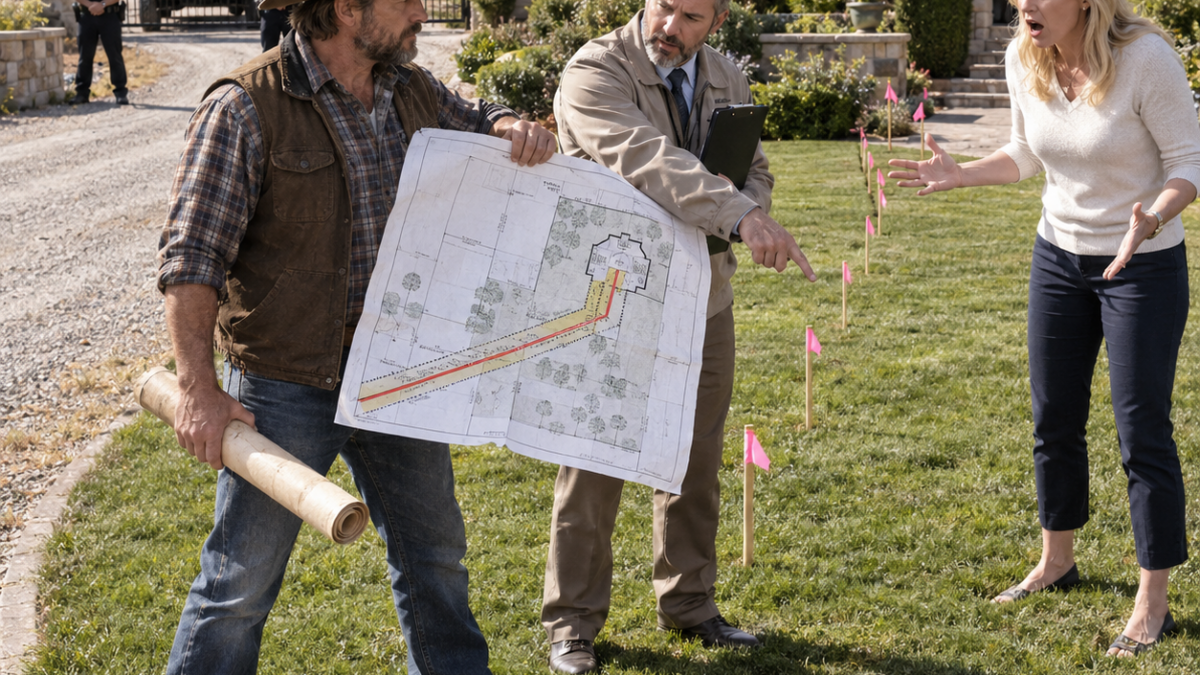
On a large screen, he had overlaid the 1923 description onto modern GIS imagery.
The line began where I expected.
At the old county road.
Then it traveled east.
Straight.
The dirt road I had used for decades followed it initially.
Then the modern road drifted south about forty feet.
“Probably happened sometime after the seventies,” George said.
“Why?”
“Could be washout. Tree fall. Farmer avoiding mud. People follow tire tracks. Eventually the informal route becomes the road everyone remembers.”
I watched the red corridor continue.
It entered the new subdivision.
Crossed Lot One.
I leaned closer.
“George.”
“I know.”
The thirty-foot strip ran directly toward the largest house in Whispering Pines.
A tan stucco two-story with stone columns, a circular driveway, and a lawn so perfect it looked digitally rendered.
Karen’s house.
The red corridor crossed her front landscaping.
Then the house itself.
Through the front entry.
Across the living area.
Past the kitchen.
Out the rear wall.
Then continued toward my property.
I looked at George.
“Tell me the overlay is wrong.”
“No.”
“Tell me the old bearing is magnetic and you forgot declination.”
“I accounted for it.”
“Tell me your control points are bad.”
“They aren’t.”
“George.”
He smiled.
“I checked four times because I knew you wouldn’t believe it.”
I stared at the map.
Karen had spent weeks insisting the easement did not exist.
Her own house sat directly on it.
I did not laugh.
Not immediately.
The consequences were too big.
“If this is right, how did they get a building permit?”
George’s amusement faded.
“That’s the question.”
“Title company?”
“Another question.”
“Developer?”
“Big question.”
He enlarged the image.
“Somebody missed an encumbrance. Maybe several somebodies.”
“Does this mean I can demand they tear down her house?”
George shook his head.
“That is a lawyer question.”
“Your opinion?”
“My opinion is courts don’t casually demolish expensive homes if another equitable remedy exists.”
That mattered.
The revenge fantasy was obvious.
I could already imagine Karen’s face if she learned her living room occupied my legal access.
But I did not want her house.
I wanted my road.
And thirty thousand dollars of oak had to move.
George printed the overlay.
Then he looked at me.
“You need counsel.”
“I figured.”
“Good counsel.”
“Know anyone?”
“No.”
“But Agnes does?”
He grinned.
“No. Marines do.”
He was right.
A man I had served with recommended Ben Carter.
Former JAG.
Property litigator.
Mid-thirties.
Compact office downtown.
When I sat across from him the next day, he read everything before speaking.
The 1923 deed.
Modern deed.
Subdivision plat.
HOA letters.
Wall photographs.
Fines.
George’s preliminary overlay.
Ben looked up.
“This is extremely interesting.”
“That sounds expensive.”
“It probably is.”
“Can we win?”
He leaned back.
“I don’t promise outcomes.”
“Good answer.”
“But based on what you brought me, the HOA’s position is aggressive.”
“Meaning wrong?”
“Meaning I want the complete title chain before I call anyone wrong.”
He pointed to George’s map.
“And I want a licensed active surveyor to independently verify this.”
“George is retired.”
“He can consult. Court wants current credentials on the formal survey.”
I nodded.
“What about the wall?”
“If easement is valid and wall obstructs it, we seek injunctive relief.”
“My business losses?”
“Document everything.”
“I have a thirty-thousand-dollar contract.”
“Do not assume you automatically get thirty thousand. Lost profits require proof. Mitigation matters.”
Again, I liked him.
He wasn’t selling revenge.
He was building a case.
“What about their fines?”
“If your property isn’t subject to the HOA, that becomes another problem for them.”
“And Karen’s house?”
Ben looked at the map again.
Then he smiled for the first time.
“That is a very large problem.”
He drafted a demand letter.
It was nothing like Karen’s HOA notices.
No insults.
No dramatic language.
He listed the recorded instruments.
Attached certified copies.
Explained that the easement ran with the land unless lawfully extinguished.
Demanded removal of the wall from the used access and suspension of the fines.
Requested preservation of all title, survey, permitting, and development records.
Fourteen days.
“We’re not mentioning the house?” I asked.
“Not yet.”
“Why?”
“Because we only have George’s preliminary overlay.”
“And?”
“And I prefer surprising opposing counsel with verified facts, not theories.”
Fair enough.
The HOA responded on day ten.
Their attorney, Preston Vance IV, wrote a six-page letter.
The tone told me more than the law.
My claim was “antiquated.”
The road was “permissive.”
The easement had allegedly been “superseded by subsequent development approvals.”
Any attempt to remove or bypass the wall would be treated as trespass.
They threatened fees.
Possible injunction.
Potential harassment claims.
Ben read the letter silently.
Then he placed it on his desk.
“They’re committing.”
“To what?”
“Their theory.”
“Is that good?”
“For us, maybe.”
He opened another folder.
“George’s independent surveyor finished the desktop review.”
I sat straighter.
“Same path?”
“Same path.”
“Through Karen’s house?”
“Through Karen’s house.”
For one ridiculous second, I felt guilty.
I hadn’t put the house there.
Still, the idea of a thirty-foot corridor slicing through someone’s living room was almost too absurd to process.
Ben studied me.
“You’re thinking about bulldozers.”
“No.”
“That answer was fast.”
“I’m thinking about access.”
“Good.”
He pointed at me.
“Stay there.”
We filed suit after the deadline passed.
Not a class action.
Not yet.
My complaint was narrow.
Declaratory judgment confirming the easement.
Injunction against obstruction.
Damages for lost access.
Challenge to HOA fines.
Preservation of all development records.
Ben did include a request for expedited relief because my timber business was suffering.
The judge set an early hearing.
Before that happened, something unexpected began inside Whispering Pines.
Residents contacted me.
The first was Dave Lawson.
He was the father whose daughter’s swing set Karen had questioned at the meeting.
I found him on a Saturday dismantling it.
“You’re actually taking it down?”
He tightened a bolt.
“Violation notice came yesterday.”
“How much?”
“Two hundred.”
“For a swing set?”
“Unapproved permanent recreational structure.”
His six-year-old daughter watched from the patio.
Her face told the story better than Dave did.
“You challenging it?”
He laughed.
“With what money? Their lawyer probably bills more in an hour than I make in a day.”
I leaned against the fence.
“You heard about my suit?”
“Whole neighborhood has.”
“Karen’s version or mine?”
“Mostly Karen’s.”
“Which is?”
“You’re trying to steal HOA land.”
I smiled.
“That’s creative.”
Dave put down the wrench.
“What’s actually happening?”
I explained.
Not Karen’s house.
Not yet.
Just the easement.
The wall.
The fines against non-HOA property.
The recorded documents.
Dave listened.
When I finished, he said, “She told us your road was never legal.”
“That’s what she says.”
“And you have a 1923 deed?”
“Yes.”
He stared toward the clubhouse.
“If she lies about that, what else is she lying about?”
Exactly.
That evening he called.
“Three other families want to talk.”
Then came Mrs. Gable.
Different Mrs. Gable than anyone I had known before, though every neighborhood apparently has one elderly woman who keeps better records than its governing board.
She was eighty-one.
Widowed.
Meticulous.
Karen had fined her because her bird feeder attracted “excess nuisance wildlife.”
“What wildlife?” I asked.
“Sparrows.”
I waited.
“That’s it?”
“And squirrels.”
“Did the bylaws prohibit bird feeders?”
“No.”
“How did she fine you?”
Mrs. Gable pulled out a folder.
The violation cited “activities materially inconsistent with community aesthetic and sanitary goals.”
I stared.
“That isn’t even specific.”
“I asked what rule I broke.”
“What did she say?”
“She said board interpretation is binding.”
Mrs. Gable’s late husband had given her the wind chimes hanging beside the porch.
Karen had also ordered those removed because of a complaint no one could identify.
Mrs. Gable refused.
So the fines accumulated.
A hundred dollars.
Then another hundred.
Then collection fees.
The more people I spoke with, the more I realized Karen’s authority rested on three things.
Residents were new.
The HOA was new.
Nobody wanted to be the first person accused of being difficult.
Karen thrived in that silence.
Sarah warned me not to let their grievances swallow our easement case.
“You’re becoming the neighborhood complaint department.”
“I know.”
“You have enough trouble.”
“I know.”
“So why are there twelve people coming to the workshop tonight?”
I looked at the folding chairs Mark was setting out.
“Because they asked.”
Sarah stared.
“You are incapable of doing anything halfway.”
“You married me knowing that.”
“I was young.”
Mark laughed from the workshop.
“Mom wins.”
“Keep setting chairs.”
The meeting started with twelve homeowners.
I made one rule.
“Documentation.”
Dave nodded.
“No rumors?”
“No.”
Mrs. Gable said, “What if the rumor is true?”
“Then find the document that proves it.”
We created a shared folder.
Violation notices.
Board minutes.
Emails.
Photographs.
Financial records residents were legally entitled to inspect.
Ben initially hated the idea.
“You are not turning your easement case into a neighborhood revolution.”
“I’m not.”
“That is exactly how Dave described it in his email.”
I rubbed my face.
“He used the word revolution?”
“Twice.”
“I’ll talk to him.”
Ben sighed.
“Marcus, organized homeowners are fine. Coordinated evidence is fine. Do not encourage harassment. Do not trespass. Do not record where consent laws prohibit it. Do not make public accusations we cannot prove.”
“Understood.”
“And stop using military terminology in email.”
“I haven’t.”
“Dave named the shared folder Operation Beige Freedom.”
I closed my eyes.
“I’ll handle Dave.”
By the following week, twenty families had signed a petition requesting a special HOA meeting and independent audit.
That was almost half the subdivision.
Karen reacted badly.
Fines increased.
A private security contractor began driving through the streets photographing lawns.
The HOA newsletter warned residents about “organized disruption.”
My truck appeared again.
So did my tractor.
Karen claimed our timber business violated HOA commercial restrictions.
Ben sent one paragraph in response.
Mr. Davison’s property is not within Whispering Pines Estates and is not subject to your client’s covenants. Continued issuance of fines may create additional liability.
The fines kept coming.
Ben smiled when the third arrived.
“She likes paper.”
“So?”
“So does discovery.”
The expedited hearing on the easement took place three weeks after filing.
Preston Vance argued that the easement had been abandoned because the traveled road no longer aligned exactly with the 1923 corridor.
Ben argued that the deeded right had never been released and that my decades of continuous access demonstrated the opposite of abandonment.
The judge did not decide the entire case that morning.
But she issued a temporary order prohibiting the HOA from further obstructing the existing traveled road and instructed both sides to complete a licensed survey of the deeded corridor.
The wall still stood.
The order did not authorize me to demolish it myself.
Instead, the HOA had to create temporary access through an opening.
For the first time in nearly six weeks, a contractor cut a sixteen-foot gap in the wall.
Mark and I stood watching.
He looked at me.
“Can I honk when we drive through?”
“No.”
“Why?”
“Because we’re adults.”
“You’re no fun.”
We drove the Ram through twenty minutes later.
He honked.
I pretended not to hear.
The timber contract was damaged but not lost.
Paul Wexler had sourced part of the order elsewhere.
He still took twenty-eight cords from us.
We lost revenue.
But we kept the relationship.
That mattered.
The legal battle continued.
Preston wanted to prove the old corridor irrelevant.
Ben wanted the opposite.
That meant depositions.
Karen’s came first.
I sat beside Ben.
She arrived in a navy suit and pearls.
No floral blouse.
No golf cart.
No clipboard.
She looked almost corporate.
Preston sat beside her.
Ben began gently.
Name.
Address.
Board role.
Knowledge of the subdivision.
Knowledge of my property.
Then the easement.
“You are aware Mr. Davison contends that a recorded easement benefits his property?”
“I’m aware he says that.”
“You have reviewed the 1923 deed?”
“I’ve seen copies.”
“Do you dispute its authenticity?”
“Our position is that it no longer controls.”
“That wasn’t my question.”
Preston shifted.
Karen said, “I don’t know whether it’s authentic.”
Ben slid a certified copy across.
“County certification is on the final page.”
Karen’s expression tightened.
Ben continued.
“Your property is Lot One?”
“Yes.”
“Did you receive a title commitment when you purchased?”
“Of course.”
“Have you reviewed it recently?”
“My lawyer has.”
Preston said, “Counsel, if you have a question—”
“I do.”
Ben looked back at Karen.
“Does your property contain any recorded easement serving Mr. Davison’s tract?”
“No.”
Preston turned toward her slightly.
Just slightly.
I saw it.
He was nervous.
Ben asked, “How do you know?”
“The final subdivision plat shows no such easement.”
“Anything else?”
“That is the controlling document.”
“Did anyone advise you that the 1923 easement was released?”
“No.”
“Did anyone show you a release?”
“No.”
“Did anyone identify a court order extinguishing it?”
“No.”
“So your testimony is based on its omission from the modern plat?”
“Yes.”
Ben nodded.
That was enough.
He did not bait her into a dramatic declaration.
Did not try to create perjury theater.
He simply established that Karen had absolute confidence in a document that omitted something recorded long before it existed.
The survey occurred the next Thursday.
Court-authorized.
Licensed.
Independent.
Civil standby arranged because Karen had already sent three emails accusing me of harassment.
I did not wear a Marine uniform.
Mark suggested it.
Sarah vetoed it before he finished the sentence.
“You are going to a property survey, not invading Normandy.”
“She has a point,” I told him.
“She always does.”
“I heard that,” Sarah called from the kitchen.
At eight fifty, the survey crew arrived.
At eight fifty-five, a sheriff’s deputy parked nearby.
By nine, half the neighborhood seemed to have discovered urgent reasons to check mailboxes.
Karen came outside at nine-oh-two.
“What is this?”
The lead surveyor, Frank Ellis, handed her a copy of the court order.
“We’re establishing the corridor described in Deed Book Twelve, Page Eighty-Eight.”
“You are not entering my property.”
“The order allows us to survey the affected parcels.”
“This is harassment.”
The deputy stepped closer.
“Ma’am, if you have an objection, contact your attorney. Please don’t interfere with the crew.”
Karen looked toward me.
“This is your circus.”
I said nothing.
Frank established control from known monuments.
His crew worked slowly.
Professionally.
No performance.
No cheering.
Every measurement was logged.
The first pair of stakes went into turf near the subdivision entrance.
Pink ribbon.
Thirty feet apart.
Then another pair.
Then another.
The corridor crossed landscaping Karen had helped approve.
A bed of roses.
Part of a flagstone walk.
Her front lawn.
The crowd grew quieter.
Karen’s confidence changed.
The stakes advanced toward her house.
Frank checked the instrument.
Then checked again.
His assistant called numbers.
Frank entered them.
Finally he stood facing Karen’s front door.
He did not grin.
Surveyors apparently save their emotions for bars after work.
“The corridor intersects the structure.”
Karen stared.
“No.”
Frank looked at his tablet.
“Yes, ma’am.”
“That’s impossible.”
“We’ll verify.”
They did.
Twice.
George stood beside me about fifty yards away.
He whispered, “Told you.”
I whispered back, “Try not to enjoy this.”
“I’m retired. Enjoyment is all I have.”
Frank approached Karen.
“To fully document the intersection, we can establish exterior points without entering. Interior access would help verify the crossing, but we won’t enter without consent or further court authority.”
Karen folded her arms.
“You are never entering my house.”
Preston arrived twenty minutes later.
He spoke privately with Karen.
Then with Frank.
Then with the deputy.
Finally he walked toward Ben.
His face had changed.
“Can we stipulate that the legal description crosses Lot One pending final survey?”
Ben said, “We’ll stipulate to nothing until the survey is complete.”
Preston glanced toward the house.
“You knew?”
“We had a preliminary overlay.”
“You sat on it.”
“We disclosed the deed.”
“That’s not what I asked.”
Ben gave him the same answer Preston’s clients loved.
“Our filings speak for themselves.”
Ultimately, Karen allowed limited interior access after Preston advised her it was better than another motion.
Only the surveyors entered.
No crowd.
No cameras.
No parade through her house.
Forty minutes later, Frank emerged.
He handed Ben and Preston copies of his field sketch.
The centerline crossed the foyer.
Living room.
A section of kitchen.
Rear wall.
Exactly as George predicted.
Karen stood on her porch.
No one laughed.
No one applauded.
The reality was too serious.
Her home sat on a deeded easement benefiting mine.
That meant the developer’s title work had failed somewhere.
Maybe its surveyor.
Maybe its title company.
Maybe both.
Karen was suddenly not only the person blocking my access.
She was also a homeowner whose property had been sold with a major unresolved encumbrance.
For the first time, I felt something besides anger toward her.
I felt pity.
Briefly.
Then she looked at me.
“This is your fault.”
The pity vanished.
“My fault?”
“You dug up a century-old technicality because you couldn’t follow community standards.”
I stared at her.
“A technicality?”
“My family lives here.”
“My family’s livelihood is behind the wall you built.”
“That’s different.”
“How?”
“This is my home.”
I stepped closer, but stayed off her property.
“And the back forty is mine.”
She opened her mouth.
Nothing came.
I said, “You were right about one thing, Karen.”
“What?”
“Rules matter.”
Then I walked away.
Frank’s certified survey was filed with the court.
The result changed everything.
The developer intervened.
So did its title insurer.
Karen’s mortgage lender retained counsel.
The HOA’s insurance carrier appointed separate counsel for the board.
Preston Vance suddenly became much more interested in settlement.
Ben explained why.
“The HOA thought this was you versus them.”
“And now?”
“Now the developer may have sold Lot One subject to an easement it failed to disclose properly. Title insurance may be involved. The lender cares. The HOA cares. Karen cares.”
“Does the house have to come down?”
“Not necessarily.”
I felt relief.
Ben noticed.
“You sound disappointed.”
“I’m not.”
“Good.”
He slid a diagram across the desk.
“Courts have equitable tools. They can enforce the easement as written. They can sometimes approve relocation if the beneficiary receives substantially equivalent access and local law allows it. Parties can settle with a substitute easement.”
“I want reliable access.”
“Exactly.”
“And damages.”
“Yes.”
“Lost timber income.”
“We’re documenting it.”
“And those HOA fines disappear.”
“They already should.”
“What about the wall?”
“Gone.”
That was the goal.
Not Karen homeless.
Access.
Compensation.
Boundaries nobody could rewrite because they disliked my truck.
Meanwhile, the homeowners petition reached the threshold for a special meeting.
Karen tried to delay it.
The bylaws did not give her much room.
Dave chaired the organizing committee.
I refused the title of leader.
He ignored me.
“You started this.”
“No. Karen did.”
“Fine. You’re honorary instigator.”
“Stop naming things.”
The special meeting filled the clubhouse beyond capacity.
The board sat at the front.
Karen looked exhausted.
Bob, the treasurer, avoided her eyes.
Cynthia, the secretary, had a stack of printed emails.
Dave spoke first.
“This is not about one swing set.”
Mrs. Gable raised a hand.
“My bird feeder would like equal recognition.”
People laughed.
Dave continued.
“It’s about process.”
He displayed notices.
Fines that cited no specific rule.
Appeals decided by the same committee that issued violations.
Expenses for private security that had never been clearly approved by membership.
Legal fees connected to my property dispute.
Then Cynthia spoke.
That surprised everyone.
“I need to say something.”
Karen turned toward her.
“Cynthia, this isn’t on the agenda.”
“It is now.”
Cynthia’s hands shook.
“I signed minutes I should have questioned.”
The room quieted.
“Karen would send drafts already written. Sometimes before meetings.”
Bob looked at her.
“You never told me that.”
“I was scared.”
Karen struck the gavel.
“This is outrageous.”
Cynthia continued anyway.
“She told me the developer’s attorney had confirmed Mr. Davison’s easement was invalid.”
Preston, seated near the side wall, immediately stood.
“I need to clarify that statement.”
Everyone turned.
He looked deeply unhappy.
“My firm did not represent the developer in its original title work.”
Karen’s face froze.
Cynthia asked, “Did you tell Karen the easement was definitely invalid?”
Preston chose every word.
“I advised the HOA that it had arguments based on the final plat and development history, subject to title review.”
“That isn’t what she told us.”
Bob looked at Karen.
“You said counsel called it unassailable.”
Karen’s face reddened.
“I summarized.”
“No,” Cynthia said. “You changed it.”
The room shifted.
Karen had survived anger before.
She had survived homeowners complaining about fines.
What she could not survive was her own board losing faith.
Bob opened a folder.
“I also have concerns about expenses.”
Karen snapped, “Not now.”
“Now.”
Private security bills.
Legal retainers.
Landscape contracts.
Some properly approved.
Some not.
Nothing suggested she had stolen money.
That mattered.
I did not want accusations inflated beyond proof.
But the board had allowed spending commitments with weak controls.
Karen often authorized first and sought approval later.
Dave introduced the recall petition.
The vote could not legally happen instantly; notice requirements applied.
So a formal election date was set.
Karen left before the meeting ended.
For the first time, she did not bang the gavel.
The legal case reached summary-judgment briefing a month later.
The central easement issue was stronger than ever.
The HOA no longer argued the easement never existed.
Instead, its new position was that it should be relocated away from Karen’s house.
That sounded reasonable on the surface.
Until Ben asked where.
Their first proposed route climbed a grade too steep for loaded timber trailers.
George calculated it.
Unsafe.
Their second crossed a drainage basin.
Seasonally impassable.
Their third was essentially the road I had always used.
The same road they had blocked.
I looked at Ben.
“So they’re offering me my road.”
“Eventually.”
“With conditions?”
“HOA-controlled gate. Restricted hours. No commercial vehicles over a certain weight.”
I laughed.
“Then no.”
“That was my answer.”
We proposed something cleaner.
The developer and HOA would grant me a permanent thirty-foot substitute easement along the existing dirt road.
No HOA gate.
No residential vehicle restrictions.
Reasonable maintenance obligations shared according to use.
The wall would be removed permanently.
My property would be expressly confirmed outside the association.
The title company would insure the new easement.
In exchange, once the substitute easement was recorded and functional, I would release active enforcement of the historic corridor across Karen’s house.
Ben watched me read the proposal.
“You understand what that means?”
“Yes.”
“You’re giving up leverage.”
“I’m trading unusable leverage for usable access.”
He smiled.
“That’s the correct answer.”
George agreed.
“So no bulldozer through her kitchen?”
“No.”
He sighed dramatically.
“Retirement continues to disappoint.”
The other side did not accept immediately.
Karen objected.
She wanted me to release everything first.
No.
She wanted the dirt road subject to HOA landscaping approval.
Absolutely not.
She wanted a ban on timber trucks before eight a.m.
Ben asked whether Whispering Pines planned to regulate county logging operations now.
That condition disappeared.
Then came damages.
The lost resort contract portion.
Extra equipment rental.
Legal costs.
Survey costs.
Business interruption.
We had records.
Invoices.
Emails.
Paul Wexler provided a statement confirming the reduced delivery.
The number was not life-changing.
But it was real.
The HOA’s insurer resisted punitive damages.
Ben advised caution.
“Punitive damages are difficult. We can litigate them.”
“How long?”
“Potentially years.”
“What do you recommend?”
“I recommend asking what outcome lets your family move forward.”
That night, Sarah and I sat on the porch.
No papers.
No lawyers.
Just us.
She asked, “What do you want?”
“My road.”
“You’ll have it.”
“Compensation.”
“You’ll have some.”
“Karen out.”
Sarah looked at me.
“That isn’t yours to decide.”
“I know.”
“The residents decide whether she stays president.”
“I know.”
“So what else?”
I thought about it.
“I want her to admit she was wrong.”
Sarah leaned back.
“Why?”
“Because she never does.”
“That’s why you want it.”
“Yes.”
“Will an apology make you trust her?”
“No.”
“Will it reopen your road?”
“No.”
“Will it get back the lost contract?”
“No.”
“Then maybe don’t make your peace depend on something she controls.”
I hated when she did that.
“Have I mentioned you’re annoying?”
“Frequently.”
The recall vote happened the following week.
Turnout was enormous.
Karen campaigned hard.
She sent letters warning residents that removing the current board would destabilize property values.
Dave sent one response.
Property values also dislike lawsuits involving a president’s living room.
I told him not to send it.
He sent it anyway.
The vote removed Karen as president.
Not unanimously.
But decisively.
Bob resigned voluntarily.
Cynthia remained temporarily to help transfer records.
A provisional board was appointed until regular elections.
Karen was still a homeowner.
Still entitled to the same rights as everyone else.
But no longer able to fine neighbors.
The morning after the recall, I saw her standing at the edge of her driveway.
No clipboard.
No HOA badge.
No golf cart.
She looked toward the pink survey stakes still marking the corridor.
I almost kept driving.
Then she raised a hand.
I stopped the truck.
She walked over.
“Happy?”
“No.”
“You won.”
“The road is still blocked.”
“The opening is there.”
“Temporary.”
She folded her arms.
“You destroyed my reputation.”
I turned off the engine.
“Karen, I didn’t write your emails.”
“You organized those people.”
“They organized themselves.”
“You sued us.”
“You built a wall across my access.”
“That land belongs to the association.”
“Not the easement.”
Her eyes flashed.
“That cursed deed should have been extinguished a hundred years ago.”
“But it wasn’t.”
She looked toward her house.
“Do you know what it feels like knowing there’s a legal right-of-way through your living room?”
I thought before answering.
“No.”
Then I pointed toward the back forty.
“But I know what it feels like when someone decides your recorded property rights don’t matter.”
She looked away.
For a few seconds, the fight drained from her face.
“I didn’t know.”
“About the old corridor?”
“Yes.”
“I believe you.”
That surprised her.
“You do?”
“Yes.”
“The developer didn’t disclose it.”
“That is between you, them, your title company, and your lawyer.”
She swallowed.
“I wouldn’t have bought that house.”
“I understand.”
“Then why are you doing this?”
“Doing what?”
“Threatening my home.”
“I offered to release enforcement across your home in exchange for a properly deeded substitute road.”
Her expression shifted.
“You’d do that?”
“Ben sent the proposal.”
“My lawyer said you were demanding everything.”
“Read it yourself.”
I could see anger return, but this time it was aimed somewhere else.
Perhaps at Preston.
Perhaps at the developer.
Perhaps at herself.
“You really only want the road?”
“I wanted the road the day you built the wall.”
She said nothing.
Then:
“And the money.”
“You cost my business money.”
“That wasn’t intentional.”
“Intent doesn’t refill the contract.”
She looked at my truck.
The same truck she had fined.
“I hated that thing.”
I almost laughed.
“I know.”
“It made the neighborhood look rural.”
“This was rural.”
“Not anymore.”
“No.”
I looked toward the identical roofs behind her.
“Not anymore.”
She rubbed her arms.
“Would you take less money if the road were settled?”
“That’s a lawyer question.”
“I’m asking you.”
“I will not take less than documented losses because you dislike the number.”
She nodded slowly.
For the first time, the conversation felt like one between two adults rather than a ruler and subject.
Then she said, “The butterfly garden was never my idea.”
That caught me.
“What?”
“The developer wanted the common area landscaped.”
“Then why tell me it was a butterfly garden?”
“Because it sounded better than drainage reserve.”
I stared at her.
“You landlocked forty acres for a landscaping concept you didn’t even care about.”
Her face tightened.
“I thought the easement was invalid.”
“You wanted it to be invalid.”
She didn’t deny that.
The mediation took place two weeks later.
By then Karen had separate counsel from the HOA.
That mattered.
The new board wanted settlement.
The developer wanted settlement.
The title insurer wanted settlement.
Karen was the emotional holdout.
The mediator moved between rooms for eight hours.
The first deal failed.
Then the second.
At four in the afternoon, Ben came back.
“They moved.”
“How far?”
“Wall comes down permanently.”
“Good.”
“Substitute easement along the historical traveled road, thirty feet, recorded and title insured.”
“Good.”
“No HOA gate.”
“Good.”
“No HOA vehicle restrictions.”
“Good.”
“Reasonable maintenance apportionment.”
“Fine.”
“Your property confirmed outside covenants.”
“Good.”
“Business damages paid.”
“How much?”
He gave me the number.
Less than our maximum demand.
More than our hard losses.
Fair.
“Legal fees?”
“Substantial contribution.”
“Survey?”
“Covered.”
I looked at Sarah.
She nodded.
“What do they get?”
Ben knew what I meant.
“You release active enforcement of the historic corridor once the new easement is recorded and operational.”
“So Karen keeps her house.”
“Yes.”
“That was always the point.”
Ben smiled slightly.
“There’s one more term.”
“What?”
“Karen wants no public statement implying she knowingly built on your easement.”
“That’s true. She didn’t know.”
“Then you’re fine with it?”
“Yes.”
“And you want an apology.”
I looked at Sarah.
She raised one eyebrow.
I sighed.
“No.”
Ben seemed surprised.
“No?”
“No forced apology.”
“Why?”
“If she means it, she can say it without a settlement clause.”
Sarah smiled.
The deal was signed that evening.
But it was not final until the documents recorded.
Ben made that clear.
“No celebration until the county stamp.”
Mark complained.
“I bought beer.”
“Beer keeps.”
The wall came down first.
The new board hired the contractor.
Same section.
Same cinder blocks.
This time the equipment worked from the HOA side under a permit.
Neighbors gathered.
Not because I invited them.
Because demolition equipment in a subdivision attracts people the way campfires do.
The excavator cracked the wall section by section.
Concrete blocks collapsed.
Rebar bent.
Dust rose.
Dave stood beside me.
“You should get the first block.”
“Why?”
“Trophy.”
“No.”
Mrs. Gable said, “Birdbath.”
I looked at her.
“What?”
“Paint it. Birdbath.”
Dave pointed at her.
“That’s why she’s smarter than both of us.”
The debris was hauled away.
The road graded.
Drainage restored.
A surveyor marked the thirty-foot substitute easement.
Then the deed was recorded.
The title company issued coverage.
Ben called me.
“Now.”
“Now what?”
“Now you have your road.”
I walked outside.
Mark was already beside the truck.
Sarah stood on the porch.
“You going somewhere?”
I held up my keys.
“Back forty.”
She smiled.
“Try not to honk.”
Mark honked before we cleared the driveway.
We drove the old dirt road.
For the first time in months, no wall.
No temporary construction opening.
No lawyer letter taped to a post.
Just gravel.
Dust.
Pines.
When we reached the back forty, Mark shut off the engine.
The silence settled around us.
I got out.
So did he.
Our splitter trailer sat beneath a shed.
The tractor needed a battery charge.
Stacks of seasoned oak waited beneath tarps.
Work.
Ordinary work.
I put one hand on the truck bed.
Mark looked at me.
“You okay?”
“Yeah.”
“You look weird.”
“Thank you.”
“You know what I mean.”
I looked across the timber.
“I spent months fighting to get here.”
“And now?”
“Now we have to work.”
He grinned.
“That’s the tragedy.”
We started the tractor.
The legal fight over the broader HOA issues continued after my easement settled.
I was no longer the center of it.
That was good.
The new board commissioned an independent audit.
No embezzlement was found.
That was important.
Karen had been controlling.
Overbearing.
Often reckless with process.
But she had not stolen association money.
Several fines were refunded because the board had no clear bylaw basis for them.
Mrs. Gable received every dollar back.
Dave’s swing-set fine disappeared.
The Air Force captain’s banner issue was reversed.
Security patrols were canceled.
The association adopted a written enforcement policy.
Actual rule.
Actual notice.
Actual appeal.
No invented “community standards” based on Karen’s mood.
Dave ran for the board.
I warned everyone.
He won anyway.
At his first meeting, he proposed renaming the architectural committee.
“To what?” Cynthia asked.
“The Mind Your Business Committee.”
Motion failed.
Mrs. Gable voted for it from the audience.
A month after the settlement, I received a letter.
Not HOA letterhead.
Karen’s personal stationery.
I almost threw it away.
Sarah saw the envelope.
“Open it.”
“Why?”
“Because you’ve been waiting six months for an apology you claim you no longer need.”
“That sounds manipulative.”
“It is.”
I opened it.
Karen did not write a beautiful confession.
She did not admit every sin.
She did not call me a hero.
The letter was six sentences.
Marcus,
I believed the final subdivision plat gave the HOA authority over the old access route. I was wrong. I also allowed my frustration with your refusal to follow what I considered community standards to affect how I handled the dispute. Blocking your access before the title issue was resolved was a serious mistake. I am sorry for the business loss and disruption this caused your family. I hope the new easement ends this permanently.
Karen
I read it twice.
Sarah waited.
“Well?”
“It’s an apology.”
“I gathered.”
“It has qualifiers.”
“Of course.”
“She still says ‘what I considered community standards.’”
“Marcus.”
“What?”
“Take the win.”
I folded the letter.
“You know I hate that phrase.”
“You love that phrase when you say it to Mark.”
“That’s different.”
She held out her hand.
“Give me the letter.”
“Why?”
“I’m putting it in your file under Things You Said You Didn’t Need But Absolutely Needed.”
I handed it over.
Karen’s house became a separate fight between her, the developer, the title insurer, and her lender.
Because I released enforcement of the old corridor after receiving the substitute easement, the house was no longer under threat from me.
But the title defect did not vanish.
Her insurer negotiated with the developer.
Money changed hands.
Corrections were recorded.
The historic easement was formally relocated with my consent.
That was the legally clean ending.
No bulldozer through a kitchen.
No one homeless because of a road laid out in 1923.
George complained this made the story less interesting.
“People like bulldozers.”
“People also like property rights.”
“Not on television.”
Karen listed her house the following spring anyway.
I heard through Dave that she and her husband wanted to leave Whispering Pines.
I did not ask why.
Everyone assumed humiliation.
Maybe.
Maybe they simply wanted a fresh start.
The FOR SALE sign went up on a Tuesday.
Karen came to my gate that afternoon.
She stayed outside.
Another improvement.
“I wanted you to hear it from me.”
“I saw the sign.”
“We’re moving.”
“I figured.”
She looked down the road.
“Somewhere without an HOA.”
That surprised me enough that I laughed.
She almost smiled.
“I know.”
“Seriously?”
“Very seriously.”
“That might be wise.”
She looked toward the back forty.
“Are you using the road every day?”
“Most days.”
“Trucks?”
“Some.”
“I never hear them.”
“Trees absorb sound.”
She nodded.
Another pause.
Then she said, “Do you still have the old survey?”
“Copies.”
“I want one.”
“Why?”
She looked toward her house.
“I want to frame it.”
I stared.
“You’re joking.”
“Maybe.”
That was the first time I realized she might eventually be able to laugh at herself.
Not then.
But eventually.
I gave her a reduced copy.
She studied the red corridor through her house.
“I really bought a house on your road.”
“Technically, yes.”
“That is the stupidest sentence I’ve ever heard.”
“Also technically yes.”
She folded the map.
“Take care, Marcus.”
“You too.”
She started walking away.
Then stopped.
“One thing.”
“What?”
“Your truck is still ugly.”
I smiled.
“It’s supposed to be.”
She shook her head and left.
The house sold three weeks later.
The buyer was a pediatric dentist named Aaron Cho and his wife Emily.
They received full title disclosure.
No surprises.
The historic corridor had already been relocated and released across the structure.
Their closing lawyer apparently spent an entire hour explaining why their living room once appeared inside a road easement.
Aaron later told me it was the most interesting title commitment his attorney had ever seen.
On moving day, their two boys ran across the lawn chasing a dog.
No security guard.
No clipboard.
No pink stakes.
Just a family.
Mark saw them when we drove past.
“Think they know the story?”
“Oh, they know.”
“Think they know Dad almost drove a bulldozer through the kitchen?”
“I never almost did that.”
“That’s not how Dave tells it.”
“Dave lies.”
“Dave says you rented a Caterpillar.”
“I did not.”
“Interesting.”
“Mark.”
He laughed.
Within a year, Whispering Pines changed more than I expected.
It did not dissolve.
That part of the neighborhood mythology came later.
The HOA stayed because shared roads, landscaping, stormwater systems, and clubhouse maintenance did not disappear just because one president had abused her role.
What changed was governance.
Residents rewrote enforcement procedures.
Board spending above a threshold required recorded votes.
Attorney advice could not be paraphrased as fact without written support.
Owners received full access to governing documents.
The architectural committee lost unilateral fine authority.
Appeals went to a different panel.
And, most important to me, the recorded boundary between Whispering Pines and my property appeared in bold red on every HOA reference map.
NOT SUBJECT TO WHISPERING PINES CC&Rs.
Dave wanted the letters larger.
I declined.
Mrs. Gable got her bird feeder back.
Three, actually.
The wind chimes returned.
Every time I drove past, I heard them.
The young Lawson family rebuilt the swing set.
Their daughter painted one support purple.
Dave panicked.
“Do we need architectural approval for purple?”
His wife stared at him.
He laughed.
“Too soon?”
“Yes.”
The Air Force captain hung his family service banner.
The baker received a written apology for the ridiculous complaint over the smell of bread.
Apparently there had never been a bylaw about gluten-sensitive noses.
Sarah and I went back to ordinary life.
Or tried to.
The timber business recovered.
Paul Wexler gave us another contract the following season.
Bigger than the first.
“You finally solve the wall problem?” he asked.
“Yes.”
“How?”
“Old deed.”
“That’s it?”
“Long story.”
“You should write a book.”
“No.”
“You’d sell more books than firewood.”
“Doubtful.”
Mark got engaged that winter.
Her name was Rebecca.
She was a nurse.
Smarter than both of us.
At dinner after he announced it, Sarah started crying.
Mark looked horrified.
“Mom.”
“I’m happy.”
“You look devastated.”
“That’s happy crying.”
“I’ve been in combat zones less confusing than this family.”
Rebecca laughed.
I raised my glass.
“To confusion.”
They married the following fall.
The reception was held on the back forty.
That mattered.
Not because of Karen.
Because the land was why we had fought.
String lights hung between pines.
Long tables sat near the clearing.
A local band played beneath a temporary shelter.
Trucks carried chairs, food, generators, and equipment down the restored road all morning.
Nobody stopped them.
Nobody issued a fine.
Nobody asked what color the trailer was.
Before the ceremony, I stood alone near the edge of the trees.
Sarah found me.
“You hiding?”
“Thinking.”
“Dangerous.”
She slipped her arm through mine.
“You remember the wall?”
“Every time I use the road.”
“I don’t.”
That surprised me.
“You don’t?”
“Not anymore.”
She looked toward Mark and Rebecca.
“I remember this.”
That was when I understood what she had been trying to tell me throughout the fight.
Rights mattered because life needed somewhere to happen.
The road was not the point by itself.
The road was how we reached work.
Family.
Land.
The future.
Karen had treated access as leverage.
I had treated it as law.
Sarah treated it as connection.
She was probably closest to the truth.
George attended the wedding.
He brought us a framed copy of the 1923 deed.
At the bottom he had added a small brass plaque:
THE ROAD THEY FORGOT TO READ.
I laughed harder than I had in months.
“You made this?”
“Retirement hobby.”
“You need better hobbies.”
“No.”
Ben came too.
He stood beside George at the bar.
Dangerous combination.
I overheard George telling three people that the easement crossed directly through Karen’s fireplace.
“It did not,” I said.
He waved me away.
“Close enough.”
“It crossed the living area and kitchen.”
“Fireplace sounds better.”
Ben raised his glass.
“I’m not correcting him.”
“Lawyers.”
At sunset, Mark found me near the truck.
“Dad.”
“What?”
“Thanks.”
“For?”
He gestured toward the woods.
“This.”
“It’s yours someday.”
“I know.”
“That wasn’t the deal?”
“No.”
He looked toward the road.
“When the wall went up, I thought we were going to lose the business.”
“So did I.”
“You never said that.”
“Parents are allowed to lie selectively.”
“I’m thirty-four.”
“Still my son.”
He smiled.
“I’m serious.”
“So am I.”
He hugged me.
Mark was not a hugger.
Neither was I.
We both pretended it lasted less time than it did.
The litigation officially ended nearly eighteen months after the wall first appeared.
The court entered final dismissal after settlement performance.
All easement documents recorded.
Damages paid.
Wall removed.
Fines canceled.
Attorney-fee issues resolved.
Historic corridor relocated by agreement.
The judge never had to order Karen’s house demolished.
That became important to me.
Because the longer the story lasted, the less interested I became in punishment for its own sake.
There was a version of me in those first weeks who would have enjoyed watching a bulldozer idle outside Karen’s front door.
I am not proud of that.
I was furious.
My business was threatened.
My land was cut in half operationally.
A woman with no authority over me used an HOA to issue fines and publicly tell me my recorded rights were meaningless.
Anger made destruction feel like balance.
But destruction is rarely balance.
Usually it is just more destruction.
The better victory was a road I could use without destroying someone else’s home.
A recorded easement insured against future disputes.
A community that learned how to govern itself.
A business my son could inherit.
That was enough.
More than enough.
Years later, Whispering Pines held its annual summer cookout near the clubhouse.
Dave invited us.
I said no.
Sarah said yes for both of us.
When we arrived, Mrs. Gable was sitting beneath a canopy.
She was older.
Smaller.
Still sharp.
“You finally joined the HOA?” she asked.
“Absolutely not.”
“Good.”
She handed me lemonade.
Children ran across the common lawn.
The old location of the wall had become landscaping after all.
Not Karen’s butterfly garden.
Something better.
Native grasses.
Milkweed.
Wildflowers.
A walking path.
Someone had installed a sign explaining that the area served as a pollinator garden and drainage corridor.
Dave stood beside it.
“You see?”
“What?”
“Karen finally got her butterfly garden.”
I laughed.
“That is cruel.”
“It is historically accurate.”
A monarch butterfly landed on milkweed near the path.
Mrs. Gable pointed.
“Karen would have fined it for unauthorized orange.”
That nearly finished me.
Even Sarah laughed.
Then Dave became serious.
“You know what people remember most?”
“The house?”
“Of course the house.”
“I figured.”
“But not because they wanted it demolished.”
He looked across the neighborhood.
“They remember the survey stakes.”
“Why?”
“Because that was the day everyone saw something we’d been missing.”
“What?”
“That Karen’s authority only existed because nobody checked it.”
I thought about that.
He was right.
The easement was powerful because it had been recorded.
But the real weakness in Karen’s system had not been a property line.
It was unquestioned certainty.
She said the plat erased my deed.
People believed her.
She said a swing set violated standards.
People took it down.
She said bird feeders were a nuisance.
People paid fines.
Not because every resident was weak.
Because most people have jobs.
Children.
Mortgages.
Parents.
Medical appointments.
Lives.
They assume the person carrying the binder has read the binder.
Sometimes they haven’t.
Sometimes the person with the gavel is simply louder.
A year after that barbecue, Agnes retired from the county records office.
She invited Sarah and me to a small retirement reception at the courthouse.
I brought her flowers.
George brought a cake shaped like a deed book.
It looked terrible.
Agnes loved it.
“You know,” she told me, “your case changed something here too.”
“What?”
“The county updated its review procedure for subdivision plats.”
That got my attention.
“When a new development is created from older agricultural parcels, staff now flag parent-deed easements for secondary review.”
“Because of Whispering Pines?”
She smiled.
“Nobody writes policy saying ‘because Karen built a house in somebody’s road.’”
“They should.”
George appeared beside us.
“I offered the wording.”
Agnes ignored him.
“But yes.”
I looked around the old records room.
The books were still there.
Decades of promises.
Restrictions.
Rights.
Family transfers.
Mortgages.
Easements.
Most of them invisible until somebody needed one.
“Funny,” I said.
“What?”
“All of this started because she called my deed dusty old paper.”
Agnes touched the edge of the counter.
“Dusty old paper runs the country.”
George raised his cake fork.
“To dusty old paper.”
We toasted.
Eventually, I turned more of the timber operation over to Mark.
My knees made that decision before my pride did.
He modernized things.
Digital inventory.
GPS tagging.
Online orders.
I complained.
Then profits improved.
I stopped complaining publicly.
Rebecca and Mark had a son.
They named him Samuel.
The first time I took Sam to the back forty, he was four.
He sat between me and Mark in the Ram as we drove the access road.
The same old truck.
More dents.
Still ugly.
Sam pointed toward Whispering Pines.
“Grandpa, is that the place with the lady’s house?”
Mark had clearly been talking.
I looked at him.
He stared straight ahead.
Coward.
“What lady?”
“The lady who built her house on your road.”
“That is an oversimplification.”
Sam considered this.
“Did you knock it down?”
“No.”
“Dad said you had a bulldozer.”
I turned toward Mark.
He started laughing.
“I never said you used it.”
“There was no bulldozer.”
“Dave said—”
“Dave is not a reliable historical source.”
Sam looked disappointed.
“So what happened?”
I slowed the truck near the bend.
“She thought a road belonged to her.”
“But it belonged to you?”
“I had a legal right to use it.”
“Same thing?”
“No.”
He frowned.
Explaining easements to a four-year-old may be harder than litigating them.
“Think of it like this. If your dad lets you walk through his room to reach the bathroom, you can use the path, but the room still belongs to him.”
Sam nodded.
“So Karen had to let you walk through her house?”
Mark made a choking sound.
“No.”
I glared at him.
“We found another path and wrote it down properly.”
Sam lost interest.
“Can I drive the tractor?”
And just like that, a case that consumed almost two years of our lives became boring to the next generation.
That felt healthy.
One autumn morning, I drove the access road alone.
Fog hung low between the pines.
Leaves had started turning.
The Ram bounced over the same ruts I had known for decades.
At the subdivision entrance, I glanced toward Lot One.
Aaron Cho had planted a red maple near the old survey corridor.
His boys were older.
A basketball hoop stood beside the driveway.
No one removed it at six p.m.
The old pink stake holes were long gone.
The house looked ordinary.
That pleased me more than I expected.
Conflict makes places feel symbolic.
A wall becomes tyranny.
A living room becomes legal irony.
A dirt road becomes a battlefield.
Then life continues.
Concrete comes down.
Grass grows.
Kids leave bicycles where surveyors once stood.
People move.
The symbolism fades.
What remains is whether the solution was good enough to outlast the anger.
Mine was.
The new easement remained recorded.
Title insured.
Wide enough for equipment.
No HOA control.
My fifty acres remained outside Whispering Pines.
Davison & Son Timber kept operating.
Mark became majority owner when I officially stepped back.
He still called me whenever something expensive broke.
Apparently retirement did not extinguish that easement.
Sarah and I spent more mornings drinking coffee on the porch.
One day she asked, “Do you miss fighting with Karen?”
I nearly spit out coffee.
“No.”
“You were very alive during that period.”
“I was furious.”
“Same heart rate.”
“Not the same thing.”
She smiled.
“I’m glad you didn’t destroy her house.”
“So am I.”
“You know you would have hated yourself.”
“I know.”
“You didn’t then.”
“No.”
I looked toward the tree line.
“Anger simplifies things.”
“How?”
“Good guys. Bad guys. My road. Her house.”
“And now?”
“Now I think she was arrogant, reckless, and wrong.”
“Strong start.”
“But the developer failed too. Title work failed. The HOA board failed. Residents stopped asking questions. I ignored their first meeting because I assumed none of it could touch me.”
Sarah nodded.
“That sounds more complicated.”
“It is.”
“Must be wisdom.”
“Don’t get carried away.”
She laughed.
Years later, Karen sent one Christmas card.
I don’t know why.
No return address I recognized.
Inside was a picture of her and her husband standing in front of a smaller house somewhere near the coast.
On the back she wrote:
No HOA.
You were right about that part.
I showed Sarah.
She smiled.
“You going to reply?”
“What would I say?”
“Nice house.”
“It might be on somebody’s easement.”
“Marcus.”
I laughed.
We sent a card.
No message about lawsuits.
No joke about roads.
Just Merry Christmas.
I never heard from her again.
That was fine.
Not every enemy needs to become a friend.
Sometimes peace is simply reaching a point where neither person needs anything from the other.
The last document from the whole affair still sits in my desk.
Not the lawsuit.
Not the settlement.
Not Karen’s apology.
The 1923 deed.
A certified copy.
April 17.
Thirty-foot easement.
Ingress.
Egress.
All manner of conveyance.
The language has outlived farmers, developers, surveyors, board presidents, and more than a century of changes to the land.
I keep George’s framed copy in the workshop too.
THE ROAD THEY FORGOT TO READ.
Mark hates it.
He says it makes the shop look like a law office.
I tell him to wait until the next boundary dispute.
One spring afternoon, Sam—seven by then—asked what the frame meant.
I explained again.
This time he understood a little more.
“So the old paper beat the HOA?”
“No.”
He looked confused.
“The old paper proved what everyone had already agreed to a long time ago.”
“What’s the difference?”
“Big difference.”
I crouched beside him.
“Winning isn’t making up a better rule than the other person.”
I tapped the frame.
“Sometimes winning is making people honor the promise that was already there.”
He thought about that.
Then looked toward the tractor.
“Can I drive now?”
“Ask your dad.”
“Dad said ask you.”
I found Mark thirty yards away laughing.
Cowardice apparently ran in the family.
That evening, three generations of Davisons drove down the access road.
Mark at the wheel.
Sam in the middle.
Me beside the window.
The pines crowded close.
Dust rose behind us.
At Whispering Pines, children played near the pollinator garden.
A monarch butterfly moved between flowers where the cinder-block wall once stood.
No guards.
No fines.
No argument.
We passed Karen’s old house.
The lights were on.
Someone was cooking dinner.
Through the front window I could see a family moving around the living room.
That same room George’s red line once crossed.
For a moment, I remembered the survey stakes.
Karen’s pale face.
The deputy.
The whispers from neighbors.
The satisfaction I felt when the law proved her wrong.
Then the memory passed.
I did not need that road anymore.
Not the one through her living room.
I had the road that mattered.
Recorded.
Open.
Practical.
Ours to use.
Mark turned off toward the timber tract.
Sam bounced in his seat.
“Grandpa?”
“Yeah?”
“Why did Karen block your road?”
I looked out at the woods.
There were many answers.
Because she wanted control.
Because she trusted a new map more than an old deed.
Because no one told her no early enough.
Because the developer made mistakes.
Because I had an ugly truck.
Because people sometimes confuse authority with ownership.
Finally I said, “She thought being in charge meant she got to decide what was true.”
Sam frowned.
“That’s dumb.”
I smiled.
“Yes.”
Mark laughed.
“Seven years old and already understands HOA governance.”
We reached the clearing.
Mark stopped the truck.
Evening light filtered through the oak canopy.
We climbed out.
Sam ran toward a stack of logs.
I shouted for him to slow down.
He ignored me.
Mark stood beside me.
“You know he’s going to own this someday.”
“I know.”
“You think he’ll keep the business?”
“Maybe.”
“You okay if he doesn’t?”
That question would have bothered me years earlier.
Now it didn’t.
“The land isn’t a command.”
Mark looked at me.
“That sounds like Mom.”
“I’ve been influenced.”
He smiled.
We watched Sam pick up a pinecone.
The road behind us stretched back toward the front ten.
Beyond that, the county road.
Beyond that, Whispering Pines.
One uninterrupted route.
Exactly what an easement was supposed to provide.
Access.
Nothing more.
Nothing less.
Karen had tried to turn that simple right into a test of power.
For a while, I let the fight become one too.
But in the end, the most satisfying part was not watching her lose the presidency.
It wasn’t seeing survey stakes run toward her front door.
It wasn’t hearing that the old corridor crossed her living room.
It wasn’t even winning damages.
It was driving to my land whenever I wanted.
It was watching my son build a future there.
It was knowing that the next person who bought either property would open a title report and see exactly where the road belonged.
No ambiguity.
No intimidation.
No whispered HOA interpretation.
Just a recorded line and a promise that could not be erased because somebody preferred a butterfly garden.
The sun dropped behind the trees.
Mark started the tractor.
Sam covered his ears and laughed.
I stood beside the access road and listened to the engine echo through the woods.
For years, I had thought retirement meant finally reaching a place where nobody could order me around anymore.
I learned that peace is not the absence of people trying.
Peace is knowing where your boundaries are, knowing what protects them, and knowing when to stand your ground without becoming the thing you are fighting.
I looked once more toward the road.
Then I followed my son and grandson deeper into the timber.
We had work to do.
[END OF STORY]
:::








