HOA Voted to Demolish My Cold Frame—Then They Learned Their Award-Winning Flowers Grew Inside It
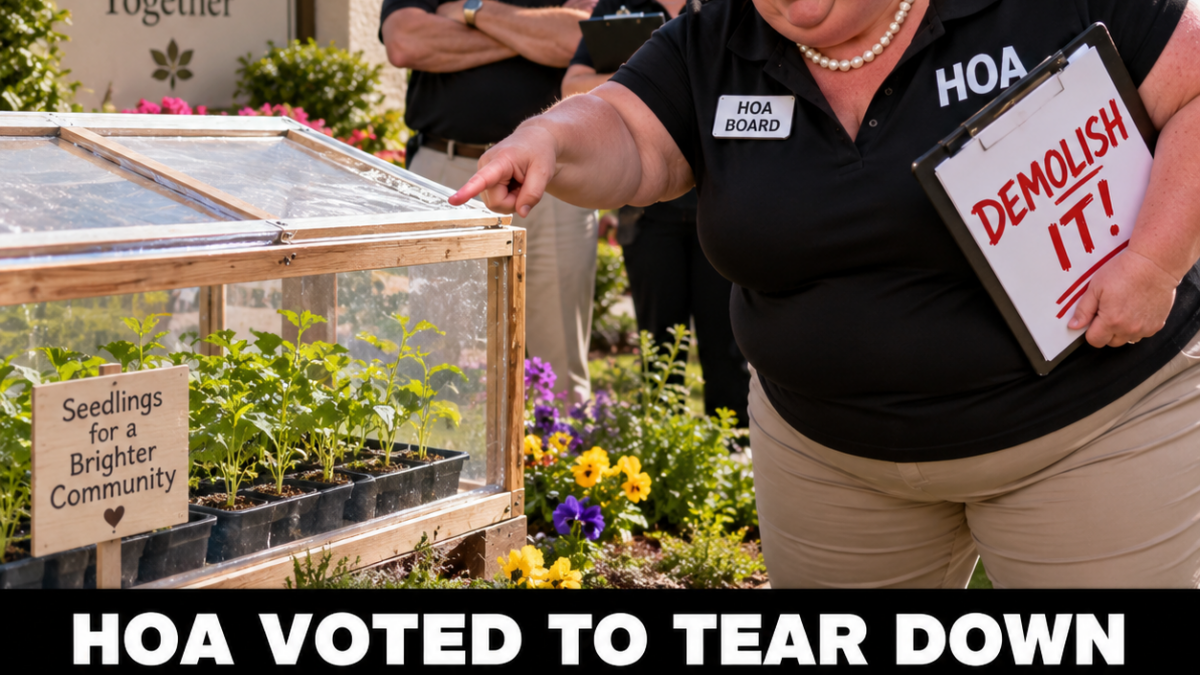
PART 2
I read the paragraph three times.
Then I leaned back in Sarah’s old dining chair and stared at the ceiling.
There it was.
Article 7.
Architectural Control.
Section 7.4(b).
Temporary seasonal structures under fifty square feet, without permanent foundations or utility connections, were permitted provided the homeowner submitted written notification describing their location and intended use.
Notification.
Not approval.
I hadn’t submitted the notification.
That was my mistake.
A procedural mistake.
Nothing more.
Karen’s letter, however, described the cold frame as an “unapproved agricultural structure.”
Those words appeared nowhere in the bylaws.
Not once.
I searched every page.
Two hundred and sixteen of them.
Fence heights.
Mailbox colors.
Roofing materials.
Exterior paint palettes.
Trash-container placement.
Satellite dishes.
Holiday decorations.
Nothing about “agricultural structures.”
Karen had invented the term.
At 1:17 in the morning, I closed the binder and rubbed my eyes.
The house was silent.
Sarah’s photograph sat on the sideboard across from me.
She was standing in the garden wearing muddy gloves and laughing because I had accidentally planted twenty-four tulip bulbs upside down.
“You’d tell me not to do anything stupid,” I murmured.
The photograph offered no advice.
But I could almost hear her answer anyway.
Don’t fight ugly with ugly, Mark.
Make them tell the truth.
I slept four hours.
At seven the next morning, I started knocking on doors.
George Henderson was outside filling his bird feeder.
“Morning, Mark.”
“Morning, George.”
He screwed the lid onto the feeder.
“Everything all right?”
“Can I ask you something?”
“Sure.”
I pointed toward my backyard.
“Does my cold frame bother you?”
He squinted.
“Your what?”
“The wooden structure behind the garage.”
“Oh.”
He laughed.
“That little greenhouse?”
“Cold frame.”
“Whatever you call it. Why would it bother me?”
“The HOA says they’ve received complaints.”
George’s smile disappeared.
“From me?”
“They didn’t give names.”
“Well, it wasn’t me.”
“You can see part of it from your upstairs window.”
“Son, I’ve seen worse things than a box full of flowers.”
He rested one hand on the bird feeder pole.
“Sarah would be proud of what you’ve done back there.”
That sentence landed harder than I expected.
“Thanks, George.”
“Karen bothering you?”
I gave him a look.
He sighed.
“Of course she is.”
Across the street, I caught Mike and Elena Ramirez trying to load their infant daughter’s stroller into their SUV.
I asked the same question.
Elena blinked.
“What cold frame?”
Mike looked toward my house.
“You have a greenhouse?”
“Sort of.”
“Then I guess our complaint isn’t very anonymous,” he said, smiling.
Three houses later, the result was the same.
Nobody cared.
Nobody had complained.
Then I reached Janice Bell’s house.
Janice had lived in Oak Creek almost twenty years.
Her ongoing battle with Karen involved three ceramic garden gnomes near her porch.
Karen said they were “visually inconsistent.”
Janice said they were gifts from her grandchildren.
The war had lasted eighteen months.
When I asked her about my cold frame, she immediately glanced toward the street.
“Come inside.”
That got my attention.
We sat at her kitchen table.
She lowered her voice.
“There weren’t any complaints.”
“You’re sure?”
“I was at the meeting.”
“What happened?”
“Karen brought your property up herself.”
“Why?”
“She said she’d been conducting a community standards inspection along the service alley.”
“The service alley isn’t HOA property.”
“I know.”
Janice leaned forward.
“She said she saw the structure through the trees and called it a blight. Bob asked whether anyone had actually complained.”
“What did she say?”
“She said complaints had been received.”
“But there weren’t any?”
“Not that she presented.”
“Was there a vote?”
Janice nodded.
“Near the end of the meeting. Most people had already gone home. Karen said you might be using it for commercial agriculture.”
I nearly laughed.
Commercial agriculture.
On forty-six square feet.
“Did she show photographs?”
“No.”
“Inspection report?”
“No.”
“Anything?”
“Just her opinion.”
I sat very still.
Janice studied my face.
“You’re angry.”
“I’m getting organized.”
She smiled.
“That sounds more dangerous.”
She wasn’t wrong.
My next call was to David Sterling.
Dave and I had served together years earlier.
He had been a JAG officer then.
Now he practiced property and real-estate law.
When I finished describing the situation, he was silent for several seconds.
Then he laughed.
Not politely.
A deep, delighted laugh.
“Oh, Mark.”
“What?”
“You always find interesting ways to retire.”
“I didn’t find this.”
“Okay. She found you.”
I heard papers moving on his end.
“Email me everything. The notice, bylaws, photos, meeting minutes if you can get them.”
“I haven’t requested minutes yet.”
“Do that today.”
“Think the cold frame is legal?”
“Based on what you’re telling me? Probably. Your failure to notify them is curable.”
“Probably?”
“I’m a lawyer. We don’t give engineers the satisfaction of hearing certainty for free.”
I smiled despite myself.
His tone changed.
“Listen carefully. Don’t threaten her. Don’t touch her. Don’t obstruct anything physically. And don’t start trading insults.”
“I wasn’t planning to.”
“I know you. You’re planning something much more complicated.”
“Maybe.”
“Good. Make it documented.”
By noon, Dave had reviewed the relevant pages.
He called back.
“You were right.”
“I usually am.”
“Let’s not ruin the moment.”
He explained our response.
We would send the board formal written notification of the cold frame, retroactively curing my procedural failure.
We would state that it complied with Section 7.4(b).
We would demand the specific provision supporting the board’s claim that it constituted an unapproved agricultural structure.
We would request copies of every complaint regarding my property.
We would request the inspection record.
We would request the meeting minutes and roll-call vote.
And we would explicitly notify the association that nobody was authorized to enter my property or remove any structure while the dispute remained formally contested.
“Certified mail?” I asked.
“Certified mail. Return receipt.”
“Email too?”
“Absolutely.”
“What happens if they show up Friday?”
“Call me.”
I spent the afternoon photographing everything.
The cold frame from the north.
South.
East.
West.
Tape measure showing the dimensions.
Foundation blocks.
Distance from property boundaries.
View from the street proving it was practically invisible.
Then I photographed what was inside.
Rows of green.
Hundreds of seedlings.
Some still small enough to fit beneath my palm.
Others already developing buds.
I stopped beside a tray of scarlet salvia.
Sarah had loved those.
I remembered our first year in the house.
She had stood exactly where I was standing now and told me the neighborhood entrance looked “like somebody decorated a dentist’s office with mulch.”
I’d laughed so hard I’d spilled coffee.
The next spring, I had quietly donated our surplus plants.
The beautification committee found them outside the clubhouse at dawn.
That was how the tradition started.
Nobody knew they were mine.
Especially Karen.
The irony was almost too perfect.
She was trying to destroy the thing feeding her own signature program.
But I wasn’t ready to reveal that.
Not yet.
An engineer understands load.
Put too much force on a structure at the wrong moment and it doesn’t fail cleanly.
It cracks unpredictably.
But apply pressure at the correct point?
Everything comes down exactly where you want it.
I mailed the packet Monday morning.
Karen signed for it Tuesday at 10:43.
At 11:16, I received an email.
**Mr. Evans,**
**Your legal posturing does not alter the board’s decision. The deadline remains Friday at noon.**
No citation to any bylaw.
No requested documents.
No complaints.
Nothing.
I forwarded it to Dave.
His response arrived two minutes later.
**Perfect. Save everything.**
Wednesday evening, another envelope appeared taped to my front door.
**FINAL WARNING.**
This one threatened an additional $250 daily fine.
I photographed the envelope where it had been placed before removing it.
Then I emailed the board again.
I requested a hearing.
Karen responded twenty minutes later.
**You may address the board at next month’s regular meeting. Removal will proceed beforehand.**
Dave called immediately.
“She can’t seriously think this helps her.”
“Apparently she does.”
“Read Article 3, Section 4.”
I flipped pages.
A homeowner facing enforcement action had the right to a hearing before final sanctions or nonemergency corrective action.
“She’s violating the hearing provision.”
“Exactly.”
“So Friday?”
“If they show up, document. Don’t physically interfere.”
I set two security cameras to record the backyard.
A third covered the driveway.
Friday arrived bright and cool.
At 11:38, I saw Karen’s golf cart.
Behind it came a white pickup towing a small utility trailer.
Two workers sat in the cab.
I walked outside.
Neighbors began appearing almost immediately.
Karen wore sunglasses and carried a clipboard.
“Morning, Karen.”
“Mr. Evans.”
She pointed toward the backyard.
“The compliance deadline has expired.”
“It expires at noon.”
She checked her watch.
“Twenty minutes won’t matter.”
“It matters to me.”
One contractor stepped from the truck.
He looked uncomfortable.
“Ma’am, where’s the structure?”
Karen pointed.
“Behind the garage.”
I raised my hand.
“Before anyone enters my property, you should know this dispute is under formal appeal, and your association has received written notice that entry is not authorized.”
The contractor froze.
Karen snapped, “Ignore him.”
He looked at me.
Then at her.
“Do you own the property?”
“I do.”
He turned toward Karen.
“You said the HOA had site control.”
“We have enforcement authority.”
“That’s not what I asked.”
Her cheeks flushed.
“This homeowner is in violation.”
The contractor removed his gloves.
“Lady, I’m not walking onto private property while the owner is standing here telling me I can’t.”
Karen’s face went red.
“You were hired to perform a job.”
“And I was told it was common-area property.”
“It is subject to HOA authority.”
“Not the same thing.”
He climbed back into his truck.
Karen stepped toward him.
“You’ll still charge him the service call.”
The contractor stared at her.
“I’m charging whoever signed our work order.”
For the first time, Karen looked uncertain.
The truck pulled away.
A few neighbors laughed.
Karen spun toward me.
“You think this is funny?”
“No.”
“You embarrassed this board.”
“I stayed on my property.”
“You’ve made this much harder than necessary.”
“So have you.”
She pointed at me.
“This isn’t over.”
“I agree.”
She drove off.
Two days later, I received an invoice from the HOA.
$450.
**CONTRACTOR MOBILIZATION EXPENSE.**
They had added it to my account.
That was when something changed in me.
Until then, I had wanted to protect the cold frame.
Now I wanted the neighborhood protected from Karen.
I started talking to people.
Really talking.
Not gossip.
Not rumors.
Documents.
Tom Miller showed me a $2,500 fine over his son’s basketball hoop.
The board claimed its finish violated color standards.
“It’s black,” Tom said.
“What’s the approved color?”
“Black.”
I stared at him.
“Apparently mine was the wrong black.”
Mrs. Gable had been threatened over wind chimes her husband gave her before he died.
Another family had received violation letters because their children drew flowers in sidewalk chalk on their own driveway.
One homeowner had been fined for leaving his trash can visible for forty-seven minutes after the collection window.
Another received a warning for placing Christmas lights three days before the approved decorating period.
The details sounded ridiculous individually.
Together, they formed a pattern.
Karen chose people unlikely to fight.
Widows.
Older residents.
Young families.
People too busy, tired, or polite to challenge her.
And she always made it feel personal.
As though the homeowner had failed the community rather than simply disagreed with her.
I invited several neighbors to my house.
We gathered around the same dining table where Sarah and I once planned vacations.
I laid out the documents.
Violation notices.
Invoices.
My certified letter.
Karen’s response.
The $450 charge.
“This is bigger than your greenhouse,” Tom said.
“Cold frame,” George corrected.
Everyone looked at him.
George shrugged.
“Mark gets particular.”
For the first time in days, I laughed.
Then I placed one more document on the table.
The bylaws’ recall provision.
Janice read it.
Her eyebrows rose.
“We only need twenty-five percent of homeowners to force a recall vote.”
“Correct.”
Tom looked around the table.
“Then what are we waiting for?”
That night, the petition began.
We didn’t announce it online.
We didn’t make dramatic accusations.
We walked door to door.
We showed documentation.
We asked people to make their own decision.
Within four days, we had twenty-nine signatures.
By the end of the week, forty-three.
Then sixty-one.
Far more than required.
Karen found out.
Of course she did.
The next morning, a mass email went to the community.
She accused “a small group of disruptive homeowners” of spreading misinformation.
She described the board as “the last defense against declining property standards.”
She didn’t mention me by name.
She didn’t need to.
That afternoon, I found a fresh violation notice in my mailbox.
My climbing rose extended six inches beyond the approved trellis footprint.
Sarah’s rose.
I stood there reading the letter.
That one nearly got me.
Not because of the fine.
Not because of the rule.
Because Karen had found the one thing in my front yard she knew mattered.
Whether she knew why or not, it felt like she’d put her hands on Sarah’s memory.
I carried the letter inside.
For twenty minutes, I sat at the kitchen table staring at it.
Then I went outside with pruning shears.
George saw me.
“You’re not cutting that down.”
“No.”
I measured six inches.
Then I carefully redirected the vine and tied it back to the trellis.
Compliant.
No damage.
No drama.
Karen would get nothing from me.
That evening, I wrote on a fresh sheet of paper:
**Win with facts.**
I taped it above my desk.
The HOA scheduled my formal hearing for the following Thursday.
Two weeks away.
That gave me time.
And time, in the hands of a patient man, is a powerful weapon.
While everyone else focused on the recall petition, I prepared something different.
The beautification committee.
Carol Patterson and Sue Morris ran it.
Unlike Karen, they were decent people.
They genuinely loved gardening.
They simply believed Karen’s stories.
For three years, they’d told everyone that Karen had developed a relationship with some unnamed premium nursery.
The seedlings appeared in plain flats.
No tags.
No invoices.
No branding.
Nobody asked questions because they were free and beautiful.
Karen encouraged the mystery.
I had heard her once at a block party.
“I have relationships,” she said with a wink.
I let her enjoy the credit.
Sarah hated public attention.
If she were alive, she would have preferred it that way.
But now Karen’s biggest lie had intersected with Sarah’s garden.
That changed things.
The Saturday before the hearing, I walked to the clubhouse carrying a wheelbarrow of compost.
Carol and Sue were kneeling in the entrance beds.
“Morning.”
Carol smiled.
“Mark! Those roses of yours are gorgeous.”
“Sarah’s doing.”
Her expression softened.
“You’ve kept them beautifully.”
“Trying.”
Sue wiped soil from her gloves.
“We’re getting ready for planting day.”
“When?”
“Next Saturday.”
“Flowers coming soon?”
Carol brightened.
“Wednesday.”
“Same supplier?”
She nodded.
“Karen says they’re going to be even better this year.”
I rested my hands on the wheelbarrow.
“That’s impressive.”
“What?”
“Getting seedlings that uniform.”
Sue looked interested.
“You think so?”
“Absolutely. Whoever grows them knows what they’re doing. Strong stems. Tight internodes. Healthy root systems.”
Carol grinned.
“Karen has an amazing connection.”
“Must.”
I looked toward the flower bed.
“Especially because they arrive without nursery tags.”
They both went quiet.
Sue frowned.
“Is that unusual?”
“For a commercial nursery? Very.”
“Why?”
“Tracking. Cultivar labeling. Branding. Inventory.”
Carol glanced at Sue.
I continued casually.
“Plants that healthy are usually started months earlier under controlled conditions. Greenhouse or cold frame. Somebody’s putting a lot of work into them.”
Sue looked thoughtful.
“Karen never told us who.”
“I assumed you knew.”
“No.”
I smiled.
“Well, whoever it is deserves credit.”
Then I changed the subject.
I helped them spread compost for fifteen minutes and went home.
That was all.
A seed doesn’t need shouting.
Just soil.
Wednesday came.
Normally, I would wake at 4:30.
Load the trays into my truck.
Drive to the clubhouse while the neighborhood slept.
Leave everything beside the maintenance door.
Then disappear.
That Wednesday, I slept until seven.
At 8:12, I saw Carol’s car drive past my house.
At 8:39, Sue’s.
At 10:04, Janice texted me.
**They are looking for the flowers.**
At noon:
**Carol called Karen.**
At 2:17:
**Apparently Karen says truck is delayed.**
At 5:42:
**No truck. Carol is furious.**
I put my phone down.
I didn’t feel victorious.
I felt sad.
Those seedlings had never been about winning.
They had been about Sarah.
Still, truth sometimes requires letting someone feel the weight of the lie they’ve been carrying.
Thursday evening, the clubhouse parking lot filled twenty minutes before the meeting.
I had never seen anything like it.
People stood along the walls.
Extra chairs were brought out.
George came carrying a folding chair from home.
“Didn’t want to get stuck standing.”
Tom arrived with a folder containing the recall petition.
Carol and Sue sat together in the second row.
They looked unhappy.
Karen entered at 6:58.
Red blazer.
Black slacks.
Pearl necklace.
Gavel.
For half a second, she looked like the old Karen.
Confident.
Certain.
Then she saw the crowd.
Something changed around her eyes.
Bob and Linda followed.
Neither looked comfortable.
Karen called the meeting to order.
“We have a full agenda tonight, so I will remind everyone that disruptions will not be tolerated.”
She read committee reports.
Treasurer’s report.
Pool maintenance.
Streetlight replacement.
For forty minutes, she made us wait.
Finally:
“Next item. Enforcement hearing regarding the unauthorized agricultural structure at 118 Creekside Drive, property of Mark Evans.”
I stood.
Karen immediately said, “You will have five minutes.”
“Article 3, Section 4 provides reasonable opportunity to present evidence.”
“Five minutes is reasonable.”
Dave, sitting in the back row, spoke for the first time.
“Madam President, I’m counsel for Mr. Evans. Given that the association has introduced alleged violations, contractor charges, and potential continuing fines, limiting his response arbitrarily to five minutes may raise procedural concerns.”
Karen stared at him.
“You didn’t tell me you’d hired an attorney.”
“I wasn’t aware I had to.”
A few people chuckled.
Karen struck the gavel.
“Fine. Proceed.”
I connected my laptop to the projector.
The first image appeared.
Section 7.4(b).
No speeches.
No accusations.
I simply read it.
Then I showed dimensions.
Forty-six square feet.
No foundation.
No utilities.
Seasonal.
Then the notification I had sent.
Certified-mail receipt.
Delivery signature.
Then my unanswered request for the alleged complaints.
“To date,” I said, “the board has provided zero written complaints.”
Karen interrupted.
“Anonymous complaints are confidential.”
“I didn’t request names. I requested redacted copies.”
Silence.
“There are no copies available,” she said.
“Then how were the complaints received?”
“Verbally.”
“At a meeting?”
“Privately.”
“How many?”
“Several.”
“How many is several?”
“This is not an interrogation.”
I nodded.
“No further questions on that point.”
The next slide appeared.
The contractor invoice.
$450.
“The association attempted removal before my hearing, despite Article 3, Section 4.”
Karen leaned toward her microphone.
“The board has enforcement discretion.”
Dave spoke calmly.
“Not unlimited discretion.”
Murmurs moved through the room.
Then I changed slides.
“My concern stopped being only about my property when I began speaking to neighbors.”
Tom stood.
Karen slammed the gavel.
“Sit down.”
He didn’t.
“My name is Tom Miller. Two years ago, this board fined my family twenty-five hundred dollars over a basketball hoop.”
“Mr. Miller—”
He held up the notice.
“The approved standards specify black. My hoop was black.”
Karen’s voice rose.
“This is irrelevant.”
Mrs. Gable stood.
“So are my wind chimes irrelevant?”
Someone else stood.
“And my kids’ sidewalk chalk?”
Another voice:
“My trash cans?”
Then another.
“My porch light?”
The room came alive.
Not screaming.
Testifying.
Karen kept striking the gavel.
“Order!”
Nobody was threatening her.
Nobody needed to.
People simply told the truth one after another.
The power was in the pattern.
Bob leaned toward Linda.
They whispered urgently.
Karen’s face had gone pale beneath her makeup.
Finally, she stood.
“Enough!”
The room quieted.
“These grievances have nothing to do with Mr. Evans’ violation.”
I looked at Dave.
He gave the slightest nod.
Karen continued.
“The board will proceed with its original enforcement decision.”
Carol suddenly stood.
Her voice wasn’t loud.
But everyone heard it.
“Karen.”
Karen froze.
Carol looked almost embarrassed.
“What happened to our flowers?”
The question seemed absurdly small after everything else.
Karen blinked.
“This isn’t the time.”
“It is for me.”
“Carol—”
“You told us the supplier was delivering Wednesday.”
“There was a problem.”
“What problem?”
“A shipment issue.”
Sue stood beside Carol.
“Yesterday you told me it was a truck breakdown.”
Karen’s eyes moved between them.
“That’s what I understood initially.”
Carol folded her arms.
“And today?”
Karen’s mouth tightened.
“Apparently there was a crop problem.”
“What kind?”
“A blight.”
Nobody moved.
Karen saw an escape route and rushed toward it.
“A fungal infection destroyed the inventory. These things happen in commercial horticulture.”
Carol’s face fell.
“All of it?”
“I’m afraid so.”
“There won’t be flowers?”
“Not this year.”
I could feel my heartbeat.
I looked down at my laptop.
Then at the photograph waiting on the next slide.
Dave had called it the ace.
Sarah would’ve called it excessive.
I stood.
“That’s terrible news.”
Karen looked at me suspiciously.
I walked toward the laptop.
“A crop failure?”
“Mr. Evans, this matter does not concern you.”
“Actually…”
I clicked.
The projector changed.
The entire wall behind Karen filled with sunlight and green.
Rows of marigolds.
Petunias.
Zinnias.
Salvia.
Snapdragons.
Hundreds upon hundreds of healthy seedlings inside my cold frame.
Nobody spoke.
Not even Karen.
I clicked again.
A photograph from the previous year appeared.
The same varieties planted at Oak Creek’s entrance.
Then another.
The year before.
Another.
Boxes of seedlings sitting outside the clubhouse before sunrise.
I had photographed every donation for my gardening journal.
Carol slowly turned toward me.
“Mark?”
“Yes.”
Her hand rose to her mouth.
“You?”
I nodded.
“The flowers came from me.”
Sue stared at the screen.
“All these years?”
“All these years.”
A sound went through the room.
Not laughter.
Not anger.
Something deeper.
Recognition.
Karen looked trapped.
Carol whispered, “Why didn’t you tell us?”
“Because I didn’t want credit.”
I swallowed.
“My wife started most of these varieties.”
I pointed toward the photograph.
“Sarah died three years ago.”
Several neighbors lowered their eyes.
“She loved this neighborhood. She used to complain that the entrance needed color.”
A few people smiled softly.
“The year after she died, I grew too many seedlings. I left the extras here. Then you put that note on the bulletin board asking the ‘garden angel’ to help again.”
Carol covered her mouth completely now.
“I saw it.”
I nodded.
“So I kept doing it.”
I looked at Karen.
“Every marigold she stood beside for the county photograph…”
Click.
Karen smiling in front of the entrance.
“…came from my backyard.”
A few gasps.
“Every petunia planted beneath the Oak Creek sign…”
Click.
“…started beneath the structure she calls an eyesore.”
Nobody looked at the screen anymore.
They looked at Karen.
She opened her mouth.
Nothing came out.
Then finally:
“I never claimed—”
Carol interrupted.
“You told us you had a supplier.”
“I said I had arrangements.”
“You took credit.”
“I coordinated the program.”
“You didn’t even know where the flowers came from!”
Karen’s composure fractured.
“That is not relevant to whether his structure complies!”
I closed the laptop halfway.
“You’re right.”
She looked surprised.
“The seedlings don’t determine whether the cold frame is legal.”
I held up the bylaws.
“These do.”
Then I held up the certified letter.
“And according to these, it is.”
Tom stepped into the aisle.
He raised the recall petition.
“I move that we immediately initiate the recall process against President Karen Smith for repeated enforcement outside the governing documents, improper assessment of charges, and misrepresentation to residents.”
A dozen voices answered.
“Second.”
Karen slammed the gavel.
“You cannot do this!”
Dave stood.
“They can request the process provided by the bylaws.”
“This meeting is adjourned!”
She struck the gavel again.
Nobody left.
Bob leaned toward his microphone.
“Karen…”
She spun.
“What?”
He looked at the petition.
Then at the crowd.
“I think we need to verify the signatures.”
Her face changed.
“You are not seriously entertaining this.”
Linda spoke quietly.
“We have to.”
Karen stared at them like they’d betrayed her.
Maybe they had.
Or maybe they had finally stopped being afraid.
She grabbed her purse.
“This association will regret this.”
Nobody answered.
She walked toward the side door.
Then Carol called after her.
“Karen.”
She stopped.
Carol’s voice trembled.
“You were going to destroy the place where our flowers came from.”
Karen didn’t turn around.
She left.
The door closed behind her.
For several seconds, the room remained silent.
Then George Henderson began clapping.
Slowly.
Once.
Twice.
Three times.
I looked at him.
“Don’t make this dramatic.”
He grinned.
“Too late.”
The whole room erupted.
I wish I could say I enjoyed it.
Part of me did.
But another part felt exhausted.
I packed my laptop.
Carol approached me with tears in her eyes.
“I’m so sorry.”
“You didn’t do anything.”
“We let her take credit.”
“That didn’t hurt me.”
“We believed her.”
“That didn’t hurt me either.”
She looked at the photograph still frozen on the projector.
“What hurt you?”
I followed her gaze.
“The idea that somebody could destroy something Sarah wanted built.”
Carol nodded.
“Then we won’t let that happen.”
The recall process moved faster than anyone expected.
Forty-three percent of homeowners had signed before the hearing.
By Saturday, the number was over fifty.
Sunday evening, Bob and Linda called an emergency board session for Tuesday.
Monday morning, however, Karen made the decision for them.
Every Oak Creek homeowner received an email at 8:03.
**Effective immediately, I resign my position as president and member of the Oak Creek Homeowners Association Board.**
That was the entire message.
No apology.
No explanation.
No defense.
Just resignation.
I stood at my kitchen counter reading it.
Then I deleted it.
I expected triumph.
Instead, I felt relief.
Tuesday’s emergency meeting still happened.
Bob rescinded my violation notice.
Linda removed the $450 contractor charge and every related fine.
They apologized publicly.
Then Bob surprised everyone.
“We need to review prior enforcement actions.”
Tom raised an eyebrow.
“All of them?”
“All of them.”
Over the next month, a volunteer committee reviewed three years of violations.
Several improper fines were refunded.
Others were canceled.
Policies were rewritten to require clearer notice.
Any fine above a certain amount required a recorded board vote.
Anonymous complaints had to be documented even if identifying information was removed.
Property entry required proper authority.
Meeting minutes had to be distributed within ten days.
No president would ever again be allowed to become the entire association.
At the special election, Tom Miller was chosen as interim president.
He hated the idea.
Which was one reason everyone trusted him.
His first public announcement was brief.
“We’re neighbors before we’re an organization.”
George whispered beside me, “Should put that on a plaque.”
“Don’t encourage them.”
“And maybe your cold frame.”
“No plaques.”
“You military guys hate fun.”
The Saturday after Karen resigned was supposed to have been the day contractors demolished my cold frame.
Instead, at 8:55 in the morning, my doorbell rang.
When I opened it, Carol and Sue stood on my porch.
Behind them were thirty people.
Wheelbarrows.
Wagons.
Garden gloves.
Trowels.
Coffee.
George had somehow attached a tiny American flag to his folding cart.
I stared at them.
Carol smiled nervously.
“We came for the flowers.”
I looked toward the backyard.
“So you finally found your supplier.”
Sue laughed.
“I hear he’s difficult.”
“Terrible customer service.”
“Doesn’t answer calls.”
“Never invoices.”
Carol’s smile faded into something gentler.
“We also came to see Sarah’s cold frame.”
That stopped me.
Not mine.
Sarah’s.
I opened the gate.
“Come on.”
People filed through the yard.
When Carol stepped into the cold frame, she simply stood there.
Warm sunlight filtered through the polycarbonate panels.
Seedlings filled both benches.
The smell was earth and cedar and damp leaves.
Sarah’s notebook rested on the shelf where I kept it in a plastic sleeve.
Carol noticed.
“Is that hers?”
I nodded.
“May I?”
I handed it to her.
She opened carefully.
Pages of handwriting.
Planting charts.
Little sketches.
Lists.
On one page:
**Community entrance ideas—more red, yellow, white. Make it cheerful.**
Carol’s eyes filled.
“She planned this?”
“Years ago.”
Sue looked at me.
“So technically we’ve been following Sarah’s beautification plan.”
“Looks that way.”
Carol closed the notebook.
“Then we should finish it.”
For the next three hours, Oak Creek changed.
Not physically.
Not at first.
People carried trays down the sidewalk.
Neighbors who had spent years waving politely stopped and actually talked.
Kids followed with plastic trowels.
George supervised everybody despite having no official authority whatsoever.
“That one’s too deep.”
“George,” I said, “you’ve planted exactly zero flowers.”
“I know bad workmanship when I see it.”
Tom shook his head.
“He’s running for HOA president next.”
George recoiled.
“I’d rather be hit by a bus.”
Laughter rolled through the entrance bed.
I knelt beside a little girl named Emma whose mother lived three doors down.
She held a petunia by the stem.
“Not there,” I said gently.
“How?”
“Hold the leaves. Never squeeze the stem.”
“Why?”
“Stem gets hurt easier.”
She adjusted her fingers.
“Like this?”
“Perfect.”
I showed her how to loosen the roots.
The motion brought back Sarah so vividly that I stopped breathing for a second.
Same soil.
Same kind of flower.
Same explanation she’d once given me when I was the beginner.
Don’t pull, Mark.
Coax.
Plants remember rough hands.
I looked away before anyone noticed my eyes.
Emma placed the petunia in the hole.
“Mr. Evans?”
“Yeah?”
“Was this your wife’s flower?”
I smiled.
“One of them.”
“Then I’ll be extra careful.”
Something inside me gave way.
Not painfully.
More like a knot finally loosening.
“She’d appreciate that.”
By noon, the Oak Creek entrance was transformed.
Red salvia behind white petunias.
Yellow marigolds along the edge.
Zinnias farther back.
Nothing expensive.
Nothing exotic.
Just healthy flowers arranged with care.
Carol placed a small garden marker near the bed.
I saw her pushing it into the soil.
“What did you put there?”
She froze.
“Nothing.”
“Carol.”
She stepped aside.
The marker read:
**SARAH’S GARDEN**
I stared at it.
“You said no plaques,” George reminded me.
“That’s not a plaque,” Carol said.
“Technicality.”
I crouched beside the sign.
For a moment, the whole entrance blurred.
Sarah had never wanted recognition.
But this didn’t feel like recognition.
It felt like remembrance.
I touched the top of the little marker.
“Leave it.”
Nobody said anything.
They didn’t need to.
That afternoon, after everyone went home, I sat on the porch with a glass of iced tea.
The neighborhood felt unusually quiet.
Then a car slowed in front of my house.
Karen.
She was driving.
For a moment I thought she might stop.
She didn’t.
She stared toward the backyard gate.
Then at me.
Then drove on.
A week later, I received a letter.
No HOA letterhead.
Plain envelope.
My name handwritten on the front.
Inside was one sheet of paper.
**Mr. Evans,**
**You may believe you’ve won. You have turned neighbors against people who volunteered years of their lives to protect property values. You embarrassed me publicly over a structure you could simply have registered properly from the beginning. I hope you’re satisfied with what you’ve done.**
No signature.
It didn’t need one.
I read it once.
Then placed it beside Sarah’s photograph.
For ten minutes, I considered replying.
I could have listed every lie.
Every improper fine.
Every abuse of procedure.
Every resident she’d intimidated.
I could have reminded her that she had tried to destroy something meaningful to me while taking credit for what it produced.
I could have written three pages.
Instead, I wrote four sentences.
**Karen,**
**I submitted the required notification. The board rescinded the violation and charges. The rest of what happened resulted from homeowners reviewing the association’s own records. I hope your next chapter brings you peace.**
I mailed it.
Dave called me sentimental.
George called me weak.
Janice called it perfect.
Sarah, I think, would have approved.
Summer arrived.
The flowers flourished.
Without Karen controlling every decision, something unexpected happened.
Residents started volunteering.
A retired plumber repaired the clubhouse irrigation line.
A college student redesigned the neighborhood website.
Parents organized a children’s garden plot.
Carol created a small propagation program.
Every few weeks, somebody stopped by my backyard to learn how to start seeds.
The cold frame had become almost famous.
Tom proposed formally listing it as a community horticultural resource.
I rejected that immediately.
“It’s still my backyard.”
“Can’t blame me for trying.”
“You can have seedlings.”
“Deal.”
In July, the county beautification committee visited again.
They had heard Oak Creek’s entrance looked better than the previous year.
This time, Carol met them.
She told them exactly where the flowers had come from.
A reporter from the local paper asked whether I wanted my photograph taken.
“No.”
“Why not?”
“Flowers photograph better.”
She laughed.
But later that week, the newspaper ran a photograph of the entrance.
No Karen.
No me.
Just residents gardening together.
The caption mentioned Sarah’s Garden.
I clipped it.
That one went into Sarah’s notebook.
August was unusually hot.
I spent most mornings watering before sunrise.
One morning George wandered over carrying two coffees.
He handed me one.
“Thought Army engineers drank motor oil.”
“Retired.”
He sat beside me on the porch.
For a while, we watched sprinklers throw silver arcs across the lawns.
Then he said, “You know what bothers me?”
“Many things.”
“I’m serious.”
“So am I.”
He ignored that.
“People think the big moment was that meeting.”
“It wasn’t?”
“Karen getting exposed. Everybody cheering. Her resigning.”
“Pretty big moment.”
“Sure.”
He sipped his coffee.
“But that wasn’t the victory.”
I looked at him.
“What was?”
He pointed toward the entrance.
“That.”
Two children were walking toward Sarah’s Garden with a watering can between them.
Their father followed carrying gardening gloves.
“No one’s afraid anymore,” George said.
I thought about it.
He was right.
Karen’s real power had never been the gavel.
It wasn’t fines.
It wasn’t notices.
It was isolation.
She convinced each person that they were alone.
That nobody else had been targeted.
That objecting would make them look difficult.
Once we started talking to each other, her power vanished.
“You’re getting philosophical,” I said.
“I’m eighty. Comes with the warranty.”
In September, a moving truck parked outside Karen’s house.
Nobody celebrated.
At least not publicly.
She had sold the property.
I was pruning Sarah’s climbing rose when movers carried furniture down her front steps.
Around four that afternoon, Karen came outside.
She looked smaller without the clipboard.
No blazer.
No golf cart.
No audience.
Just jeans and a gray sweater.
She noticed me.
For a few seconds, we stood across the street from each other.
I expected anger.
Maybe one final accusation.
Instead, she crossed the road.
I put down the pruning shears.
She stopped several feet away.
“The flowers look good.”
I glanced toward the entrance.
“They had a good year.”
She nodded.
Silence.
Then she looked toward my backyard.
“I really didn’t know.”
“About what?”
“The seedlings.”
“I know.”
“I thought the committee bought them.”
I waited.
She folded her arms.
“Carol always said they showed up.”
“They did.”
“Why didn’t you tell anyone?”
“I didn’t need anyone to know.”
She looked at me strangely.
“Everyone wants credit.”
“Sarah didn’t.”
Her expression changed slightly.
“I didn’t know your wife.”
“No.”
“I heard she was nice.”
“She was.”
Another silence.
Karen looked down the street.
“I suppose everybody hates me.”
“Some people are angry.”
“That’s a polite answer.”
“I’m not speaking for everybody.”
She looked back at me.
“Do you hate me?”
It was the last question I expected.
I thought carefully.
“No.”
She seemed almost offended.
“No?”
“What happened hurt people. What you did to me was wrong.”
Her jaw tightened.
“But I don’t hate you.”
“Why?”
“Because I don’t want to carry you around that long.”
Her face flickered.
Pain.
Anger.
Maybe understanding.
I couldn’t tell.
She glanced toward the rose.
“That one was on the violation list.”
“Yes.”
“I shouldn’t have done that.”
I said nothing.
It wasn’t a full apology.
But it was closer than anything I expected from her.
She took a breath.
“I got carried away.”
“With the rose?”
“With everything.”
I watched her.
“I’m not asking you to forgive me.”
“Good.”
That surprised her.
“Forgiveness doesn’t work well when someone asks for it like a receipt.”
For the first time, she almost smiled.
Almost.
“My husband says moving is good for us.”
“I hope it is.”
She nodded.
Then she turned.
“Goodbye, Mark.”
“Goodbye, Karen.”
I picked up the pruning shears.
She took several steps.
Then stopped.
Without turning around, she said, “Your wife would’ve liked the entrance.”
My throat tightened.
“Yeah.”
Karen walked back across the street.
An hour later, her car followed the moving truck out of Oak Creek.
That was the last time I saw her.
The following spring, I opened Sarah’s notebook on the first warm Saturday in February.
Outside, snow still covered the shaded parts of the yard.
Inside the cold frame, sunlight made the cedar warm beneath my hand.
I started the usual trays.
Marigolds.
Petunias.
Zinnias.
Salvia.
Snapdragons.
But that year, I wasn’t alone.
At nine o’clock, Carol arrived.
Then Sue.
Then George, who claimed he was there only for coffee.
Then Emma arrived with her mother.
Tom brought seed-starting mix.
Someone carried donuts.
Within half an hour, my quiet backyard was full of voices.
I should have hated it.
For years, the garden had been my private place with Sarah.
Yet somehow sharing it didn’t make her feel farther away.
It made her larger.
Her ideas were moving through other hands now.
Her flowers were going into other yards.
Her little notes about spacing and color were being followed by people she’d never met.
Emma held up a seed.
“This tiny thing becomes the big red flower?”
“If we do our job.”
“What if it doesn’t grow?”
“Then we plant another.”
She considered that.
“So gardening is mostly trying again?”
George laughed.
“Kid just explained life.”
I looked around the cold frame.
At the cedar I’d cut and joined myself.
At scratches from years of trays sliding across the benches.
At Sarah’s handwriting taped beside the thermometer.
For so long, I had believed preserving her memory meant keeping everything exactly as she’d left it.
Same roses.
Same beds.
Same notebook.
Same quiet routines.
But gardens don’t survive by staying unchanged.
They survive by growing.
That was the lesson I had missed.
By May, seedlings filled every available surface.
This time there was no secret delivery.
On planting morning, people came directly to my house.
Tom arrived pulling a wagon.
George wore an absurd straw hat.
Carol had printed a planting map based on one of Sarah’s sketches.
At the neighborhood entrance, volunteers worked from morning until lunch.
The flower bed looked better than it ever had.
Not because the plants were different.
Because the people were.
Nobody was taking credit.
Nobody was giving orders.
Nobody cared whose hands planted which flower.
At noon, Tom called everyone together.
He held a small wooden sign.
I immediately shook my head.
“We discussed signs.”
“Technically, you discussed plaques.”
George grinned.
“He’s got you.”
Tom turned the sign around.
It didn’t have my name.
It didn’t mention the HOA fight.
It said:
**GROWN TOGETHER**
Underneath, in smaller letters:
**From Sarah’s Garden**
I ran my thumb over the carved wood.
“You people are impossible.”
Carol smiled.
“We learned from you.”
They placed the sign among the flowers.
That evening, long after everyone had gone home, I walked to the entrance alone.
The setting sun lit the petunias.
Cars passed occasionally.
A sprinkler clicked somewhere down the street.
I crouched beside the flowers.
One red salvia stalk leaned slightly.
I straightened it.
Then I sat on the curb.
For three years after Sarah died, I had believed grief was something you survived by protecting what remained.
Her garden.
Her notebook.
Her plans.
Her cold frame.
Karen’s threat terrified me because it felt like another loss.
Another person coming to take something Sarah had left behind.
But fighting for that cold frame had done something I never expected.
It had opened the gate.
The place I’d built to preserve Sarah’s memory had become the thing that carried her memory beyond me.
Children knew her name.
Neighbors planted her flowers.
People who never met her followed her garden sketches.
Her kindness had survived without requiring anyone to know where it began.
That mattered more than an award.
More than revenge.
More than watching Karen resign.
I had wanted justice.
I got something better.
I got my community back.
And perhaps Karen’s greatest punishment wasn’t losing the presidency or leaving Oak Creek.
It was discovering that the thing she tried to destroy had never depended on her authority in the first place.
The flowers didn’t care who held the gavel.
They grew because someone tended them.
People, I learned, aren’t all that different.
Control can force obedience for a while.
Fear can keep a neighborhood quiet.
Rules can be twisted until decent people begin wondering whether they’re the problem.
But eventually, someone opens a binder.
Someone knocks on a neighbor’s door.
Someone asks a question.
Someone tells the truth.
And suddenly the person who seemed powerful is standing alone with nothing but a title everyone has stopped respecting.
My cold frame still stands behind the garage.
The cedar is weathered now.
One panel bears a small crack from a hailstorm.
I could replace the whole thing with something newer.
Bigger.
More efficient.
I won’t.
Every mark reminds me that it survived.
So did I.
Every February, I brush snow from the panels and start another season.
And when that first pale green shoot pushes through dark soil, I still think of Sarah.
I imagine her kneeling beside me.
Mud on her gloves.
Hair falling into her face.
Laughing because I’ve planted something too deep again.
Sometimes I talk to her.
“Entrance looks good this year.”
Or:
“George overwatered the petunias again.”
Or simply:
“I miss you.”
The garden never answers.
It doesn’t have to.
On warm evenings, when the flowers around Oak Creek are glowing in the last sunlight and neighbors stop beside them instead of hurrying home, I understand the answer anyway.
The cold frame Karen once called an eyesore is still there.
The flowers it grows are still everywhere.
Sarah’s climbing rose still reaches across the porch.
And every spring, when the whole neighborhood blooms from seeds started inside the structure they once voted to tear down, I’m reminded of something no HOA rule could ever teach:
The strongest revenge isn’t destroying the person who tried to tear down what you love.
It’s protecting what mattered, exposing the truth, and watching something beautiful grow so large that their cruelty becomes nothing more than compost beneath it.
And every time I walk past Sarah’s Garden, I look at those flowers and think the same thing.
They tried to make me tear down her dream.
The story could have ended there.
Karen was gone from the board. My violation had been erased. The cold frame was safe. The flowers were growing.
But the strangest thing about winning a fight is that sometimes the real damage only becomes visible after the person who caused it steps away.
Three days after Karen resigned, Tom knocked on my door carrying a cardboard file box.
He looked tired.
Not physically tired.
The kind of tired that comes from discovering too many things you wish you had never needed to know.
“You busy?”
I stepped aside.
“Come in.”
He carried the box to my dining room table.
That table had become headquarters for half the neighborhood during the previous month.
Sarah would have laughed at that.
She used to complain that I treated every household problem like a military operation.
Broken sprinkler?
Map it.
Leaking gutter?
Measure it.
Squirrel in the attic?
Reconnaissance.
Now the table was covered again.
Tom removed several folders.
“What is all this?”
“Board records.”
“I thought Linda had those.”
“She did.”
He pulled out a spreadsheet.
“Then we started reviewing them.”
I sat across from him.
His expression told me this was not another argument about flower colors.
“What did you find?”
“Mostly incompetence.”
“That doesn’t surprise me.”
“Some things do.”
He pushed the spreadsheet toward me.
There were rows of homeowner names, violation descriptions, charges, late fees, contractor expenses.
My name appeared near the bottom.
$450.
Contractor mobilization.
Tom tapped it.
“We reversed yours.”
“I know.”
“Then we looked at the others.”
I followed his finger upward.
Mrs. Gable.
Tom himself.
The Ramirez family.
Janice.
Names I recognized.
Names I didn’t.
Some amounts were small.
Fifty dollars.
One hundred.
Others reached into the thousands.
“What am I looking at?”
“Charges that don’t match the fee schedule.”
I looked up.
“How many?”
“Enough.”
That answer sat heavily between us.
Tom explained that Karen had repeatedly treated warning letters as final violations.
In several cases, homeowners had been assessed penalties before the written cure period expired.
In others, there was no record of a board vote.
A few contractor expenses had been passed directly to homeowners despite no clear authorization in the governing documents.
“Illegal?” I asked.
Tom shook his head.
“I don’t know. That’s why we’re sending everything to association counsel.”
“Good.”
He studied me.
“You’re not enjoying this very much.”
“Should I?”
“After what she did to you?”
I looked toward the backyard window.
From where I sat, I could see the top of the cold frame through the arborvitae.
“No.”
Tom leaned back.
“I thought you’d want blood.”
“I wanted her stopped.”
“Same difference.”
“No.”
I looked back at him.
“It isn’t.”
There had been nights, especially after Karen targeted Sarah’s rose, when I imagined humiliating her.
I imagined standing in that clubhouse while everyone finally saw her for what she was doing.
And when that moment came, I won’t pretend it wasn’t satisfying.
But satisfaction is not the same thing as hatred.
Hatred asks for more.
It always asks for more.
First you want the lie exposed.
Then you want the liar embarrassed.
Then punished.
Then ruined.
Eventually you spend more time tending your anger than anything you ever cared about before the fight began.
Sarah had spent too many years teaching me how to grow things for me to spend retirement growing that.
“Just fix what can be fixed,” I told Tom.
He nodded.
“That’s the plan.”
Association counsel reviewed the files over the next two weeks.
The result was worse than anyone expected.
Not criminal.
Not some dramatic conspiracy.
In a way, that made it more believable.
Karen had simply become accustomed to people not challenging her.
Small shortcuts turned into habits.
Habits became procedures.
Procedures became authority.
Nobody asked where the authority had come from.
The board announced a temporary suspension of all outstanding violation collections while each case was reviewed.
The reaction was immediate.
People started bringing records.
Folders.
Emails.
Photographs.
Old letters.
One afternoon, I walked into the clubhouse and found a line of residents waiting to speak with the review committee.
Mrs. Gable was there.
She carried a yellow envelope.
When she saw me, she smiled.
“Look.”
She opened it.
Inside was a letter reversing the fine over her wind chimes.
“They refunded it?”
“Every dollar.”
Her eyes became watery.
“It wasn’t even the money.”
I understood.
Her husband, Walter, had bought those chimes during their last anniversary trip before he died.
Karen had insisted they violated the association’s noise standards.
Mrs. Gable had eventually removed them rather than keep fighting.
“Are you putting them back?”
She straightened.
“Already did.”
As if summoned, a breeze moved through the trees outside.
Somewhere across the parking lot, faint metal notes rang together.
Mrs. Gable smiled.
“You hear that?”
“I do.”
“Walter picked them because he said they sounded like rain.”
We stood there listening for a few seconds.
That small sound meant more than Karen’s resignation ever could.
Across the room, Mike Ramirez was speaking with Linda.
His family had received repeated warnings over a portable basketball goal used by neighborhood kids.
Another resident had been charged for a small wooden bench near her front garden.
Janice’s three ceramic gnomes had apparently survived their eighteen-month legal campaign and were now technically compliant.
I found her outside afterward.
She was carrying one under each arm.
The third was tucked into a reusable shopping bag.
“What are you doing?”
“Reinstallation.”
“You brought them to the board meeting?”
“Evidence.”
I looked at the gnome in her left arm.
It wore a red hat and held a tiny shovel.
“You know, Karen might’ve had one point.”
Janice narrowed her eyes.
“What point?”
“That one’s ugly.”
She gasped.
“Mark Evans.”
I laughed and kept walking.
Behind me, she shouted, “Sarah would’ve sided with me!”
She probably would have.
That thought made me smile all the way home.
But the board review created another problem.
People were angry.
Understandably.
At the next community meeting, nearly every chair was occupied.
Tom stood at the front.
No gavel.
He had refused to use Karen’s.
Someone suggested burning it.
Tom locked it in a drawer instead.
“We’ve identified multiple enforcement actions that did not follow required procedures,” he said. “We’re correcting them.”
A man near the back raised his hand.
“What about Karen?”
Tom paused.
“What about her?”
“She caused this.”
Several people murmured agreement.
“She should pay the association back.”
“For what?” another person called.
“The lawyer fees!”
“She should be sued.”
“She should be banned from association property.”
Someone else shouted, “Put a lien on her house before she sells it!”
The mood changed quickly.
I recognized it.
Crowds do that.
Fear can become anger.
Anger can become appetite.
Tom raised both hands.
“Everyone, please.”
The room didn’t settle.
Then Carol stood.
“Stop.”
She didn’t shout.
She didn’t have to.
People respected her now.
“We spent years complaining that one person shouldn’t decide everything based on anger.”
The room quieted slightly.
Carol continued.
“So let’s not become exactly what we just removed.”
That did it.
Tom nodded.
“Association counsel will advise us on legitimate remedies. Nothing else.”
I watched faces around the room.
Some still angry.
Some embarrassed.
But people listened.
That moment mattered.
Because replacing a bad leader is easy compared with changing the culture that allowed one to become powerful.
A neighborhood doesn’t become healthy because one difficult person leaves.
It becomes healthy when everybody learns what not to repeat.
The board eventually determined that Karen would not personally be pursued for the ordinary administrative costs of reviewing the files.
The association would reverse improper charges, issue refunds where appropriate, and establish new safeguards.
Some homeowners wanted harsher consequences.
Others thought resignation and public exposure were enough.
I stayed out of that argument.
My revenge had already happened.
Every morning, I walked into the cold frame Karen wanted destroyed and saw hundreds of living reminders that her power had limits.
That was enough for me.
Then, one Tuesday morning, I found something strange beside my driveway.
A broken plastic seed tray.
I almost ignored it.
Then I noticed the soil.
Fresh.
Scattered across the pavement.
I walked around the side of the house.
The backyard gate was partly open.
I always latched it.
My pulse changed.
I moved faster.
The cold frame door was open.
Inside, two trays had been knocked from the bench.
Seedlings lay across the floor.
For one ugly second, every suspicion in my head pointed toward Karen.
I stood there staring.
Then I heard crying.
Quiet.
From behind the garage.
I followed the sound.
A boy sat against the fence.
Maybe twelve.
I recognized him vaguely.
He lived near the entrance with his mother.
Ethan.
His knee was scraped.
His face was pale.
“Ethan?”
He looked up.
“I didn’t mean to.”
My anger disappeared.
“What happened?”
He wiped his face.
“I wanted to see the flowers.”
“You could’ve knocked.”
“I know.”
He stared at the ground.
“My mom said you grow them.”
“So you came through the gate?”
He nodded.
“I thought it was unlocked.”
“It wasn’t.”
“I pushed it.”
The latch had been old.
Probably weaker than I realized.
“What happened to your knee?”
“I tripped carrying the tray.”
He looked terrified.
“I’m sorry.”
I sat beside him.
“Are you hurt anywhere else?”
He shook his head.
“I’ll pay for them.”
“With what?”
He hesitated.
“My birthday money.”
“How much birthday money?”
“Twenty-seven dollars.”
I tried not to smile.
“Those seedlings aren’t worth twenty-seven dollars.”
“But I killed them.”
I looked into the cold frame.
Some stems were broken.
Others were merely knocked out of their cells.
Most could be replanted.
“Come on.”
He looked confused.
“What?”
“You made the mess.”
His expression collapsed again.
“So you’re going to help me fix it.”
For the next forty minutes, we worked together.
I showed him how to lift the seedlings by their leaves.
How to replace loose soil around the roots.
How to identify a stem damaged beyond recovery.
When we finished, we’d lost eleven plants.
Out of hundreds.
Ethan stared at the empty cells.
“I still feel bad.”
“Good.”
He looked startled.
“Good?”
“Feeling bad means you understand you did something wrong.”
I handed him a packet of marigold seeds.
“What matters is what you do next.”
He looked at the packet.
“You want me to plant these?”
“Eleven.”
He counted carefully.
When he finished, he wrote his name on a wooden marker.
ETHAN — MARIGOLDS
His mother came running into my yard fifteen minutes later.
She had realized he was gone.
She was horrified.
“Mr. Evans, I am so sorry.”
“He’s fine.”
“He broke into your yard.”
“He pushed a bad latch.”
“I will pay for everything.”
I looked at Ethan.
“He already has.”
She followed my gaze to the newly planted tray.
He stood a little straighter.
That afternoon, I replaced the gate latch.
Not everything required a battle.
Sometimes a broken gate was just a broken gate.
Weeks passed.
Ethan came back every few days to check his marigolds.
The first time tiny green loops appeared above the soil, he ran to my porch.
“They grew!”
I followed him back.
Sure enough.
Eleven shoots.
Maybe Sarah had been right all along.
Give people something worth caring for, and sometimes they surprise you.
By early summer, Oak Creek’s entrance was brighter than I’d ever seen it.
Ethan’s marigolds filled one corner.
Mrs. Gable’s wind chimes sounded again.
Children played basketball at the Millers’.
Janice’s gnomes returned to their ridiculous positions near her porch.
Nobody mistook freedom for disorder.
Lawns were still maintained.
Homes were still cared for.
People still followed reasonable rules.
The difference was that the rules belonged to the community again.
Not to one person’s ego.
One evening, I stood watering Sarah’s climbing rose when Tom walked up.
He handed me an envelope.
I groaned.
“If that’s another HOA notice, I’m moving.”
He smiled.
“Open it.”
Inside was a certificate.
The board had officially recognized my cold frame as a permitted temporary seasonal structure.
I read the sentence.
Then again.
“You made a certificate?”
“Linda thought you’d appreciate documentation.”
“I appreciate documentation.”
“I know.”
He pointed at the bottom.
There were signatures.
Every current board member.
And beneath them, handwritten:
With thanks for the seedlings.
I laughed.
“This is absurd.”
“Frame it.”
“No.”
“Put it in the cold frame.”
“No.”
“Sarah would’ve framed it.”
“You all need to stop using my dead wife against me.”
He laughed.
But after he left, I carried the certificate inside.
I opened the drawer beneath Sarah’s gardening notebooks.
And I placed it there.
Not because the cold frame needed permission anymore.
Because sometimes paper tells a story.
A violation notice had started this.
A page of bylaws had helped stop it.
A petition changed the leadership.
And now one final document closed the circle.
The next morning, I went outside before sunrise.
The neighborhood was quiet.
Dew clung to the grass.
I opened the cold frame and checked the trays.
Ethan’s marigolds were strong enough to transplant.
I carried them toward the community entrance.
For years, I’d made that walk in secret.
Before dawn.
No witnesses.
No credit.
This time, when I reached the garden, I saw someone already there.
George.
Sitting on his folding chair with coffee.
“You stalking me?”
“Protecting community assets.”
“Go home.”
“No.”
I set the tray down.
He studied the seedlings.
“Those the kid’s?”
“Yep.”
“Not bad.”
“Don’t tell him that. He’s becoming arrogant.”
George smiled.
We planted the first few together.
The sun climbed above the roofs.
Lights came on in windows.
A garage door opened.
Someone waved.
Soon Carol arrived.
Then Sue.
Then Ethan, running down the sidewalk because he’d spotted us from his house.
“You started without me!”
“You were sleeping.”
“You said these were mine.”
“Then get your gloves.”
He dropped to his knees beside the bed.
Together, we transplanted all eleven marigolds.
When we finished, Ethan sat back proudly.
One plant leaned sideways.
He carefully straightened it.
“Do you think they’ll live?”
“I think they’ve got a good chance.”
He nodded seriously.
Then he looked at Sarah’s Garden sign.
“Did your wife plant all these?”
“No.”
“Then why does it have her name?”
I thought about how to explain it.
“She taught me how.”
“All of it?”
“Most of what matters.”
He accepted that.
Kids sometimes understand things adults spend years complicating.
He stood and brushed soil from his knees.
“Then she’s still kind of helping.”
I looked at him.
“Yeah.”
My voice came out quieter than I intended.
“She is.”
Later that summer, Karen’s moving truck arrived.
By then, nobody needed revenge.
Nobody stood outside cheering.
Nobody posted signs.
Nobody celebrated her departure.
We simply watched another chapter close.
When her car finally turned out of Oak Creek for the last time, I went back to pruning Sarah’s rose.
That felt right.
Because Karen had wanted everything to revolve around her authority.
Her final defeat was discovering that life went on without her at the center of it.
The board met.
Children played.
Wind chimes rang.
Flowers opened.
Neighbors argued occasionally and then worked things out.
And every morning, sunlight warmed the cedar walls of a forty-six-square-foot cold frame that was supposed to have been demolished.
Months later, when autumn finally browned the last petunia at the entrance, I began cleaning the beds.
Carol joined me.
We pulled dead annuals and filled paper garden bags.
She held one dried marigold head.
“Saving seeds?”
“Absolutely.”
She shook several into her palm.
Tiny black-and-white spears.
“You know what I love about this?”
“What?”
“One flower makes enough seeds for dozens more.”
I smiled.
“Sarah used to say that.”
Carol looked toward the little sign bearing her name.
“Sounds like her.”
That evening I carried the collected seeds home.
I labeled the envelope:
OAK CREEK — NEXT SPRING.
Then beneath it, almost without thinking, I wrote:
Keep growing.
I placed the envelope inside Sarah’s notebook.
And suddenly I understood why the ending of this story had never really been about Karen.
She was the storm.
Loud.
Disruptive.
Impossible to ignore while she was there.
But storms pass.
What matters afterward is what remains rooted.
The cold frame remained.
Sarah’s roses remained.
The friendships remained.
The courage people found in one another remained.
Even Ethan’s eleven marigolds left behind enough seeds to fill another bed the following year.
That was the part Karen never understood.
Power based on fear disappears the moment people stop being afraid.
But something grown through patience, generosity, and care can reproduce itself long after the person who started it is gone.
Sarah had been gone for years.
Yet every spring, Oak Creek became more beautiful because of something she began.
So when people ask me whether I regret fighting the HOA over a little wooden cold frame, my answer is simple.
No.
Because they thought they were threatening forty-six square feet of cedar and polycarbonate.
What they were really threatening was a promise I’d made without ever saying it aloud.
That as long as I was able, I would keep growing the things Sarah loved.
Karen gave me seventy-two hours to tear that promise apart.
Instead, seventy-two hours became the beginning of the fight that exposed her lies, freed my neighbors from years of intimidation, brought a divided community together, and turned Sarah’s private dream into something an entire neighborhood now shared.
And every spring, when those first trays of seedlings leave my backyard and make their way toward the entrance of Oak Creek, somebody inevitably asks whether I’m ever going to replace that old cold frame.
I always give them the same answer.
“Not a chance.”
Because some structures are made of more than wood.
Some hold memories.
Some hold promises.
And some survive long enough to remind everyone who tried to destroy them that the most satisfying kind of justice isn’t watching your enemy fall.
It’s standing in the exact place they tried to empty…
surrounded by everything they failed to take from you.
Instead, her dream changed the whole neighborhood.








